Introduction
It is well-established that people with and without disabilities require sufficient physical activity for good health and increasing evidence indicates that physical activity can enhance a range of clinical outcomes for people with NI such as stroke, Parkinson's disease, multiple sclerosis, spinal cord injury, cerebral palsy, and traumatic brain injury (Physical Activity Guidelines Advisory Committee, Reference Services2008). Competitive sport is a type of physical activity and the aim of this paper is to investigate the premise that long-term engagement in performance-focussed sports training may lead to significantly enhanced clinical outcomes for people with NI.
The paper has two main parts. The first is entitled ‘physical activity and health’. It provides key definitions before updating evidence regarding the dose-response relationship between physical activity and health and summarising what is known about physical activity interventions for people with NI. The second part is entitled ‘performance-focussed sports training’. It also begins with key definitions, presents what is known about the dose-response relationship between performance-focussed sports training and sports performance and then presents evidence to support the proposition that long-term engagement in performance-focussed sports training can lead to enhanced – or gold-medal – clinical outcomes for people with NI. To conclude, the main points are summarised and clinical/research implications are considered.
Physical Activity and Health
Physical activity is a health behaviour that Casperson (Reference Caspersen and Pandolf1989) defines as ‘any bodily movement produced by skeletal muscle that results in caloric expenditure’. The term encompasses a range of activities including sport, outdoor recreation, certain activities of daily living, and exercise (Caspersen, Powell, & Christenson, Reference Caspersen, Powell and Christenson1985).
Physical activity promotes physical fitness (Garber et al., Reference Garber, Blissmer, Deschenes, Franklin, Lamonte, Lee and Swain2011). There are four main types of fitness, and physical activity can be categorised according to the type of fitness it promotes: aerobic or (cardiorespiratory) fitness is promoted by aerobic activities such as walking, running, swimming, or cycling; muscular fitness (including muscular strength and muscular endurance) is promoted by strengthening (or resistance) activities such as push-ups, situps, bench press, or heavy lifting and carrying; flexibility can be enhanced by activities such as dynamic or static stretching or yoga; and activities that improve neuro-motor fitness (motor skills) include those that promote balance, postural stability, or sports skills (Garber et al., Reference Garber, Blissmer, Deschenes, Franklin, Lamonte, Lee and Swain2011).
In order to quantify physical activity, three dimensions (frequency, time, and intensity) must be measured (Garber et al., Reference Garber, Blissmer, Deschenes, Franklin, Lamonte, Lee and Swain2011; Powell, Paluch, & Blair, Reference Powell, Paluch and Blair2011). Frequency is the number of occasions of physical activity that occur in a given time period, usually expressed as bouts or sessions per week. Time is how long each bout of activity lasts, usually expressed in minutes or hours. Intensity is how physically demanding the activity is. Measures of intensity vary depending on whether a relative or absolute measure of intensity is required, and the type of activity. For example, the intensity of aerobic activity can be expressed in relative or absolute terms. Relative intensity is expressed as a proportion of an individual person's maximal capacity (e.g., the percent of the person's maximum aerobic capacity or the percent of their maximum heart rate). Relative intensity is most commonly used for clinical purposes (e.g., to prescribe exercise intensity for an individual client), rather than epidemiological purposes. Absolute intensity is expressed as the rate of energy expenditure required to perform the activity. The most widely used measure of absolute intensity is the MET. One MET is the rate of energy expenditure while sitting at rest (approximately 3.5ml/kg/min) and the intensity of an aerobic activity can be measured in multiples of this unit. There are three broad categories of intensity: light (1.6–2.9 METs); moderate (3.0–5.9 METs); and vigorous (>6.0 METs). Sedentary activities have energy expenditure of <1.5 METs.
The combination of intensity, time, and frequency is referred to as the volume of physical activity (Garber et al., Reference Garber, Blissmer, Deschenes, Franklin, Lamonte, Lee and Swain2011; Powell et al., Reference Powell, Paluch and Blair2011). Volume of physical activity is an important construct because it is more closely related to health benefit than any of the components (Physical Activity Guidelines Advisory Committee, Reference Services2008). Volume of aerobic physical activity is conventionally expressed as MET.minutes/week (i.e., intensity × time × frequency−1).
Habitual Physical Activity and Health – a Dose-Response Relationship
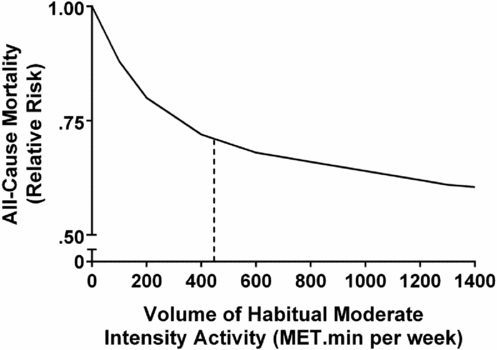
There is high-level evidence to indicate that the health benefits of habitual aerobic physical activity include decreased risk of all-cause mortality, as well as reduced risk of a range of diseases including coronary heart disease, stroke, type II diabetes, depression, and breast and colon cancer (Brown, Bauman, Bull, & Burton, Reference Brown, Bauman, Bull and Burton2013; Powell et al., Reference Powell, Paluch and Blair2011; World Health Organization, 2013b). For each of the conditions above, there is a specific dose-response relationship between the volume of habitual physical activity undertaken (dose) and the health benefit accrued (response). Figure 1 presents the dose-response plot for habitual moderate intensity physical activity and relative risk of all-cause mortality.
Relative risk of all-cause mortality by volume of habitual physical activity. When the volume of habitual moderate intensity activity is 0 MET.min per week, the relative risk of all-cause mortality is 1. As moderate-intensity activity increases, relative risk decreases in a curvilinear fashion. The dashed line indicates the current recommended volume of moderate intensity activity. From development of evidence-based physical activity recommendations for adults (18–64 years). Report prepared for the Australian government department of health (Brown et al., Reference Brown, Bauman, Bull and Burton2013).

One important feature of the dose-response plot presented in Figure 1 is that it is not linear but curvilinear, such that the gradient of the slope is greatest when the volume of physical activity is low, and gradually decreases as volume of activity increases (Brown et al., Reference Brown, Bauman, Bull and Burton2013; Powell et al., Reference Powell, Paluch and Blair2011). From a clinical perspective, this indicates that the people who will gain most from a given increase in physical activity are those who are least active. National physical activity guidelines in many countries recommend 30 minutes of moderate intensity physical activity 5 days/week (Brown et al., Reference Brown, Bauman, Bull and Burton2013; World Health Organization, 2013b), or a minimum of 450 MET.minutes/week. This point is indicated on the plot, and it can be seen that the slope of the plot to the right of the point is less than the slope of the plot to the left, indicating that once an individual is achieving guidelines, the health return for a given increase in physical activity begins to diminish. It should also be noted that there is no lower threshold for the volume of physical activity that will confer a health benefit – some physical activity, no matter how small, is better than no physical activity at all, and it is not necessary for people to meet national physical activity guidelines in order to derive significant health benefit (Brown et al., Reference Brown, Bauman, Bull and Burton2013; Powell et al., Reference Powell, Paluch and Blair2011).
Another important feature of the dose-response relationship presented in Figure 1 is that, even on the extreme right of the x-axis, the plot is still trending downwards. Clinically, this means that individuals can reduce their risk of all-cause mortality by increasing the volume of physical activity they undertake even when volumes of activity are as high as 1400 MET/min/week (approximately 7 hours 45 minutes of moderate intensity activity per week or three times the volume of activity recommended in most national guidelines) (Brown et al., Reference Brown, Bauman, Bull and Burton2013; Powell et al., Reference Powell, Paluch and Blair2011). This feature of the plot is consistent with findings from a recent study which reported that volumes of activity three to five-times the recommended volume (up to 12.5 hours of moderate intensity activity per week), confer a significant, modest reduction in the risk of all-cause mortality compared to recommended volumes (mean risk reduction of 39% vs. 31%) (Arem et al., Reference Arem, Moore, Patel, Hartge, Berrington de Gonzalez, Visvanathan and Matthews2015). The same study reported that risk reduction plateaued between five-times and ten-times the recommended volume (approximately 25 hours/week of moderate intensity activity), indicating that extremely high volumes of physical activity do not increase the relative risk of all-cause mortality (as was previously thought) but neither do they confer any risk reduction (Arem et al., Reference Arem, Moore, Patel, Hartge, Berrington de Gonzalez, Visvanathan and Matthews2015).
The general principle that higher-than-recommended volumes of physical activity confer greater health-risk reduction is consistent across a range of different health outcomes. For example, research has shown that people doing three times the national physical activity guidelines have a significantly lower risk of metabolic syndrome than people who are only meeting guidelines (Loprinzi, Lee, & Cardinal, Reference Loprinzi, Lee and Cardinal2013); people doing two or more times the national physical activity guidelines have significantly lower risk of respiratory disease-related death than those meeting guidelines (Williams, Reference Williams2014); and the risk of poor mental health continues to fall as volume of activity increases beyond the volume currently recommended (Hamer, Stamatakis, & Steptoe, Reference Hamer, Stamatakis and Steptoe2009).
It should also be noted that the health benefit conferred by a given volume of physical activity can be increased if the activities are completed at a vigorous intensity, rather than moderate (Ashor et al., Reference Ashor, Lara, Siervo, Celis-Morales, Oggioni, Jakovljevic and Mathers2015; Lee & Paffenbarger, Reference Lee and Paffenbarger2000; Swain & Franklin, Reference Swain and Franklin2006). A range of national physical activity guidelines explicitly promote the extra health benefit conferred by vigorous intensity activity (Brown et al., Reference Brown, Bauman, Bull and Burton2013; World Health Organization, 2013b).
Finally, note that the x-axis of the plot presents volume of habitual activity, indicating that the disease-risk reduction conferred by a given volume of physical activity will be realised only when duration of participation has been sufficient to induce physiological adaptation in the body. The duration required for physiological adaption to a given volume of activity can vary from weeks to months, with the exact period dependent on the physiological pathways that are acted upon, and the characteristics of the participant. For example, older age can increase the time required for adaptation (Powell et al., Reference Powell, Paluch and Blair2011).
Physical Activity and People with Neurological Impairment/s
In regard to physical activity and health, people with disabilities, including people with NI, are an understudied population (Physical Activity Guidelines Advisory Committee, Reference Services2008). Although the quantum of epidemiological evidence available is small, it clearly indicates that people with disabilities are less physically active than the general population – 50% of adults with disabilities get no aerobic physical activity, compared to 25% in adults without disabilities (Carroll et al., Reference Carroll, Courtney-Long, Stevens, Sloan, Lullo, Visser and Dorn2014). Data from the same sample indicate that physical inactivity is associated with an increased relative risk of disease – adults with disabilities are three times more likely to have diseases of inactivity (heart disease, stroke, diabetes, or cancer) than adults without disabilities.
High-quality, population-specific evidence of the dose-response relationship between physical activity and health in people with NI is not available (Rimmer, Chen, McCubbin, Drum, & Peterson, Reference Rimmer, Chen, McCubbin, Drum and Peterson2010). In the absence of such evidence, international health authorities have generalised dose-response evidence from the non-disabled population and recommend that, with some minor qualifications, people with disabilities require the same volume of activity as the general population (U.S. Department of Health and Human Services, 2008; World Health Organization, 2013b). At a population level, evidence indicates that this recommendation is appropriate – people with disabilities who are sufficiently active for health have a lower risk of chronic disease than people who are insufficiently active (Carroll et al., Reference Carroll, Courtney-Long, Stevens, Sloan, Lullo, Visser and Dorn2014). However, at an individual or clinical level, there will be a range of people for whom this recommendation is inappropriate including: people with conditions that may be exacerbated by physical overload (e.g., advanced muscular dystrophy) (Dal Bello-Haas & Florence, Reference Dal Bello-Haas and Florence2013); those with insufficient voluntary neuromuscular control to achieve moderate intensity activity (e.g., high tetraplegia) (Theisen, Reference Theisen2012) or those who are extremely de-conditioned due to extended periods of sedentary behaviour.
A number of reviews of research evaluating physical activity interventions for people with NI have been conducted (Physical Activity Guidelines Advisory Committee, Reference Services2008; Rimmer, Chen, McCubbin, Drum, & Peterson, Reference Rimmer, Chen, McCubbin, Drum and Peterson2010), including a number of population-specific reviews for people with spinal cord injury (Hicks et al., Reference Hicks, Martin Ginis, Pelletier, Ditor, Foulon and Wolfe2011; Kressler, Cowan, Bigford, & Nash, Reference Kressler, Cowan, Bigford and Nash2014), cerebral palsy (Rogers, Furler, Brinks, & Darrah, Reference Rogers, Furler, Brinks and Darrah2008; Verschuren, Ketelaar, Takken, Helders, & Gorter, Reference Verschuren, Ketelaar, Takken, Helders and Gorter2008), stroke (Saunders, Sanderson, Brazzelli, Greig, & Mead, Reference Saunders, Sanderson, Brazzelli, Greig and Mead2013), multiple sclerosis (Latimer-Cheung et al., Reference Latimer-Cheung, Martin Ginis, Hicks, Motl, Pilutti, Duggan and Smith2013), traumatic brain injury (Pawlowski, Dixon-Ibarra, & Driver, Reference Pawlowski, Dixon-Ibarra and Driver2013), and Parkinson's disease (Uhrbrand, Stenager, Pedersen, & Dalgas, Reference Uhrbrand, Stenager, Pedersen and Dalgas2015). All of the reviews cited lend support to the notion that, in order to maintain good health, people with NI should engage in regular, moderate intensity physical activity. They also indicate that, in addition to enhancing health, the physical activity interventions reviewed also confer beneficial changes in two other outcome areas: fitness (e.g., aerobic fitness or muscular fitness); and functioning (e.g., walking, lifting, carrying, climbing stairs, and self-care).
Two general observations can be made about studies evaluating physical activity interventions for people with NI. First, research evaluating interventions for people with NI focus on low volumes. For example, a comprehensive, systematic review of 54 exercise interventions for people with multiple sclerosis concluded that people with Multiple Sclerosis could improve physical capacity by performing as little as 180 MET.minutes/week of aerobic exercise (Latimer-Cheung et al., Reference Latimer-Cheung, Martin Ginis, Hicks, Motl, Pilutti, Duggan and Smith2013), less than half of the general recommendation (Physical Activity Guidelines Advisory Committee, Reference Services2008; World Health Organization, 2013a). A similar review of 82 exercise interventions for people with spinal cord injury concluded that people with spinal cord injuries could complete 120 MET.minutes/week and accrue fitness benefit (Hicks et al., Reference Hicks, Martin Ginis, Pelletier, Ditor, Foulon and Wolfe2011; Martin Ginis et al., Reference Martin Ginis, Hicks, Latimer, Warburton, Bourne, Ditor and Wolfe2011), less than 30% of the general recommendation (Physical Activity Guidelines Advisory Committee, Reference Services2008; World Health Organization, 2013a). A recent review of ‘intensive exercise therapy’ interventions for people with Parkinson's disease included 15 studies in which the maximum mean weekly frequency was three times per week, a relatively modest amount (Uhrbrand et al., Reference Uhrbrand, Stenager, Pedersen and Dalgas2015).
The second general observation is that, while the overall thrust of the evidence is that physical activity interventions induce beneficial changes in health fitness and functioning for people with NI, there are a range of benefits which have been hypothesised but for which extant evidence is weak or inconsistent. Specifically, there is only weak or inconsistent evidence that physical activity interventions improve: mobility in people with multiple sclerosis (Latimer-Cheung et al., Reference Latimer-Cheung, Martin Ginis, Hicks, Motl, Pilutti, Duggan and Smith2013); walking mobility and strength in people with cerebral palsy (Rogers et al., Reference Rogers, Furler, Brinks and Darrah2008; Scianni, Butler, Ada, & Teixeira-Salmela, Reference Scianni, Butler, Ada and Teixeira-Salmela2009; Slaman et al., Reference Slaman, Roebroeck, van der Slot, Twisk, Wensink, Stam and van den Berg-Emons2014); balance and walking performance in people with Parkinson's disease (Uhrbrand et al., Reference Uhrbrand, Stenager, Pedersen and Dalgas2015); body composition and functional capacity in people with spinal cord injury (Hicks et al., Reference Hicks, Martin Ginis, Pelletier, Ditor, Foulon and Wolfe2011); and muscular strength, balance, and walking speed in people with traumatic brain injury (Physical Activity Guidelines Advisory Committee, Reference Services2008). One plausible explanation may be that, to date, the dose of physical activity has been insufficient to elicit the hypothesised changes.
All of the reviews cited above present evidence from physical activity interventions developed with an explicit focus on enhancing outcomes of clinical relevance to people with NI – health, fitness, and/or functioning. Furthermore, such interventions would be delivered, in practice, by people who work clinically with people with NI. In this sense, the physical activity interventions reviewed can be characterised as ‘clinically-focused’, which is how they will be referred to from here forward. The next section of this paper will describe physical activity interventions developed with the specific aim of enhancing sports performance and will evaluate the proposition that performance-focussed sports training programmes may be an avenue to enhanced clinical outcomes for people with NI.
Performance-Focussed Sports Training
Like exercise, outdoor recreation and certain activities of daily living, sport is a subset of physical activity (Caspersen, Reference Caspersen and Pandolf1989) and can be defined as ‘. . .an institutionalised, competitive activity that involves vigorous physical exertion or use of relatively complex physical skills’ (Coakley, Reference Coakley2003, p.21). The terms ‘performance-focussed sport’ and ‘performance-focussed sports training’ will refer to physical activity that is planned and that is primarily undertaken for the purpose of enhancing performance in a chosen sport. This is in contrast to clinically focussed physical activity or exercise that an individual may undertake, described previously.
In the sport context, volume of physical activity is more commonly referred to as training load. In situations where individuals are trying to achieve peak performances at a specified future event, training loads may be optimal or sub-optimal at any a given time point (Issurin, Reference Issurin2010; Strohacker, Fazzino, Breslin, & Xu, Reference Strohacker, Fazzino, Breslin and Xu2015). Less than optimal training loads lead to insufficient training adaptations, and greater than optimal training loads likely lead to increased risk of injury or overtraining (Issurin, Reference Issurin2010; Strohacker et al., Reference Strohacker, Fazzino, Breslin and Xu2015). In this paper, we will refer to the optimal training loads that permit an individual to achieve peak performance at a specified time as the peak-performance training load (PPTL). Importantly, PPTL will comprise a mix of aerobic, strength, flexibility, and neuro-motor activities and the precise proportions of each activity type for a given individual will depend on the sport. Finally, it is important to note that PPTL and high-volume training are not synonymous and cannot be used interchangeably. This is because, while periods of very high-volume training are a typical component of PPTL, principles of periodisation dictate that at certain points in the competitive cycle (e.g., during recovery phases and tapering for competition) the volume of training necessary to elicit peak performance will actually be very small (Issurin, Reference Issurin2010), including volumes less than physical activity guidelines (450 MET.minutes/week).
The Dose-Response Relationship Between Performance-Focussed Sports Training and Sports Performance
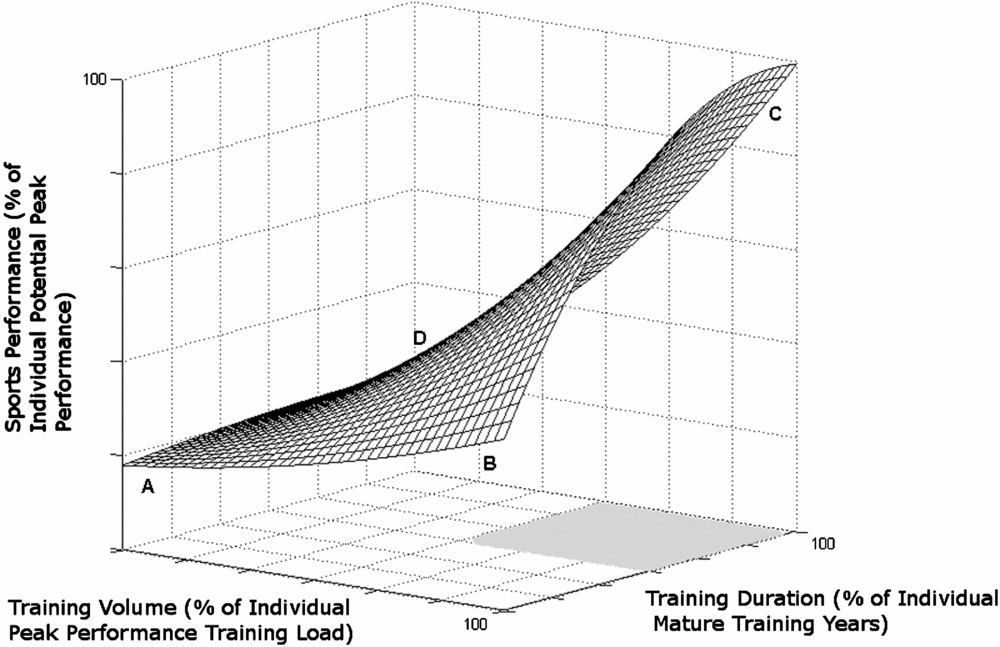
When physical activity is clinically focussed, the dose-response relationship of greatest relevance is the relationship between the volume of physical activity and one or more indices of health, fitness, or function. When physical activity is performance-focussed sport, the dose-response relationship of greatest relevance is that between performance-focussed sports training (dose) and sports performance (response). Figure 2 presents an evidence-based, hypothetical plot of the relationship between training volume, training duration, and sports performance for a healthy adult – with or without a NI – who has been sufficiently active for good health throughout their adolescence and who takes up a competitive sport at the time they reach full physical maturity. The three axes of the plot are described in the Figure caption.
An evidence-based, hypothetical plot of the relationship between training volume (x-axis), sports performance (y-axis), and training duration (z-axis) for a healthy adult undertaking performance-focussed sport. Sports performance (y-axis) is expressed as a percentage of the individual's potential peak performance. Note that there is no zero point on this axis – as long as the person is regularly competing in a sport, their performance will constitute a non-zero percentage of their potential peak performance, even though they may not be training. An individual who fully realises their athletic potential will reach 100% on the y-axis; Training volume or training load (x-axis) is expressed as a percentage of an individual's peak-performance training load (PPTL); Training duration (z-axis) is expressed as a percentage of the years between the time an individual reaches full physical maturation (i.e., approximately 18 years, an age at which physical maturation no longer has the potential to contribute to enhanced sports performance and the age immediately prior to the onset of age-related physical decline (variable by sport). An individual who continues to compete beyond the point at which age-related physical decline occurs is not represented on this plot, but will have completed 100% of their fully mature training duration.
The sports performance of an individual who has just begun competing in a sport (training duration = 0 years) and who is not undertaking any training (0% of PPTL) is represented by Point A on the plot (see Figure 2). An individual who continued to compete in their sport for the duration of their fully physically mature years but who never trained would achieve a very low percentage of their potential peak, as indicated by the trajectory of the line joining point A and point D.
The sports performance of an individual who has just begun competing in a sport (training duration = 0 years) and who is undertaking 100% of the PPTL for a beginner, is represented by point B. Note that the absolute volume of activity at point B is likely to be quite low, because the fitness of such a person is relatively low and high activity volumes would cause injury or over-training. The absolute volume of PPTL will be higher in endurance sports than in sports with a high technical or tactical component (e.g., cricket or golf).
The slope of the line joining point A and point B indicates that as the percentage of PPTL increases, so does sports performance. The relative proportion of aerobic, strength, flexibility, and neuro-motor activity which make up PPTL will vary from sport to sport. For example, endurance sports such as long-distance running and cycling will require a relatively large proportion of aerobic activity, while skill-based sports will require more neuro-motor activities.
The sports performance trajectory for an individual who undertakes 100% of their PPTL from the time they commence until the conclusion of their fully physically mature years is represented by the line joining point B and point C. As indicated by the graph, such a person will achieve 100% of their potential peak performance. The line joining point B and point C is characterised by a relatively steep initial gradient which gradually decreases to a plateau as years of training increase. As training years increase, the absolute volume of activity in this portion of the plot reaches extremely high levels. In this regard, the plot reflects evidence from long-term training studies of an elite cyclist (Pinot & Grappe, Reference Pinot and Grappe2015), a world champion rowing crew (Mikulic, Reference Mikulic2011), and 33 endurance-trained runners (Legaz Arrese, Serrano Ostariz, Jcasajus Mallen, & Munguia Izquierdo, Reference Legaz Arrese, Serrano Ostariz, Jcasajus Mallen and Munguia Izquierdo2005). For example, the cyclist, who was monitored from the age of 18 years to 23 years, increased annual training hours by 79% over this period, from 526 hours/annum at 18 years to 943 hours/annum at 23 years. However, the increase between 18 years and 20 years was 60%, with annual increases levelling off to less than 10% per annum thereafter (Pinot & Grappe, Reference Pinot and Grappe2015). Three other points should be highlighted: the 79% increase in training volume was achieved despite high initial training volumes (526 hours/annum requires a mean daily training time of 1 hour 45minute); the increase in training volumes was strongly correlated with improved sports performance; and the timescale over which these increases in physical activity volume were achieved was long term – years, rather than weeks or months.
Sport to Enhance Clinical Outcomes for People with Neurological Impairments – An Historical Perspective
Sir Ludwig Guttmann was a neurosurgeon and rehabilitation innovator who was the inaugural Director of the National Spinal Injuries Unit in Stoke Mandeville, Aylesbury, U.K (Tweedy & Howe, Reference Tweedy, Howe, Vanlandewijck and Thompson2011). His patients were principally ex-servicemen who had sustained war-related spinal cord injuries and he was among the first to recognise the potential for competitive sport to enhance clinical outcomes, promoting sport as ‘the most natural form of remedial exercise, restoring physical fitness, strength, coordination, speed, endurance and overcoming fatigue’ (Guttmann, Reference Guttmann1976, p.12). In 1948, in order to facilitate competitive sport, Guttmann began inviting other rehabilitation hospitals to bring teams of in-patients with NI to compete at the Stoke Mandeville Games. The Games were hosted annually at the Unit and were the direct forerunner of today's Paralympic games (Tweedy & Howe, Reference Tweedy, Howe, Vanlandewijck and Thompson2011) which are the most widely recognised sports competition for people with NI and the third-largest sporting event in the world (Bailey, Reference Bailey2007; Connick, Beckman, Ibusuki, Malone, & Tweedy, in press).
Unfortunately, public interest in the Games as a sporting event has not been paralleled by scientific attention to the clinical value of sport. While it is reasonably well accepted that sport, as a subset of physical activity, will confer health benefits consistent with other forms of physical activity, specific questions regarding the clinical value of sport for people with NI remain open, including: which clinical outcomes are enhanced? In which populations? By what volume of which sports? And to what extent?
Performance-Focussed Sports Training – An Avenue to Gold-Medal Clinical Outcomes for People with Neurological Impairments?
In order to determine whether long-term engagement in performance-focussed sport at a high percentage of PPTL does, in fact, lead to significantly augmented clinical outcomes for people with NI, requires rigorous, prospective, longitudinal clinical monitoring of athletes taking part in performance-focussed sports programmes that are delivered by people with expertise in judging and delivering PPTL. To date, no such studies have been conducted, however there are three sources of evidence which, while of lower quality/less relevance, do provide some support for the premise – evidence from studies investigating the benefits of high-intensity and/or high volume clinically focussed physical activity in people with NI; scientific evidence from elite/high-level athletes; and anecdotal evidence from Paralympic athletes.
The highest quality evidence which supports the premise that long-term engagement at a high percentage of PPTL may have significant clinical benefit comes from studies evaluating high-intensity and/or high volume, clinically focussed exercise in people with NI. At this point, it is important to emphasise that, while PPTL is not synonymous with either high-intensity or high-volume physical activity, PPTL does frequently include training periods in which either one or both of these elements are a focus (Fleck, Reference Fleck2011; Issurin, Reference Issurin2010). Furthermore, as described in Figure 2, year-on-year training at a high percentage of PPTL permits athletes to complete volumes of physical activity which could not be completed safely by people with no sports training background or who usually trained at a low percentage of their PPTL.
A systematic review of exercise-based interventions for people with stroke found some limited evidence to support the hypothesis that a higher dose of the same type of exercise enhanced motor recovery (Cooke, Mares, Clark, Tallis, & Pomeroy, Reference Cooke, Mares, Clark, Tallis and Pomeroy2010). Specifically, meta-analysis indicated that increased exercise dose was associated with greater improvements in comfortable walking speed, maximum walking speed, and upper limb muscle function (Cooke et al., Reference Cooke, Mares, Clark, Tallis and Pomeroy2010). The strength of these conclusions was limited by sample heterogeneity and sub-optimal research design. Emerging evidence from a dose escalation study indicates that the exercise dose which can be tolerated by people with NI may be significantly higher than the doses typically administered in exercise trials (Dite et al., Reference Dite, Langford, Cumming, Churilov, Blennerhassett and Bernhardt2015). The study found that a sample of six stroke survivors were able to complete 603 minutes (10 hours and 3 minutes) per week of a targeted multimodal exercise programme comprising endurance training, progressive resistance training, and task-related practice (Dite et al., Reference Dite, Langford, Cumming, Churilov, Blennerhassett and Bernhardt2015). This dose is substantially higher than studies included in the systematic review conducted by (Cooke et al., Reference Cooke, Mares, Clark, Tallis and Pomeroy2010) and double the exercise dose in studies of similar frequency and duration. Pre–Post improvements in the 6 minute walk test, 4-Square Step Test, and Timed up and Go Test averaged 23 to 41% (Dite et al., Reference Dite, Langford, Cumming, Churilov, Blennerhassett and Bernhardt2015). Findings must be interpreted cautiously due to the relatively young age of participants (<65 years) and strong self-selection bias.
In the general population, there is evidence that the health benefit conferred by a given volume of physical activity will be greater if the activities are completed at a vigorous intensity, rather than moderate (Ashor et al., Reference Ashor, Lara, Siervo, Celis-Morales, Oggioni, Jakovljevic and Mathers2015; Lee & Paffenbarger, Reference Lee and Paffenbarger2000; Swain & Franklin, Reference Swain and Franklin2006). There is some evidence that this is also the case that people with NI. A post-hoc analysis of two randomised controlled trials that evaluated the benefits of aerobic treadmill exercise in stroke survivors found that treadmill exercise significantly improved cardiorespiratory fitness (VO2 peak) (Lam et al., Reference Lam, Globas, Cerny, Hertler, Uludag, Forrester and Luft2010). Importantly, exercise intensity was the only variable which predicted the magnitude of the fitness gain; other factors including baseline severity of walking impairment, baseline fitness deficits lesion size, lesion side, and stroke recency did not (Lam et al., Reference Lam, Globas, Cerny, Hertler, Uludag, Forrester and Luft2010).
To date, studies evaluating physical activity interventions for people with NI have concentrated on exercise and, by comparison, sport is a very under-studied mode of physical activity. However, one recently published, cross-sectional study indicated that elite athletes with cerebral palsy may accrue favourable neuromuscular changes that are not seen in sub-elite athletes (Runciman, Derman, Ferreira, Albertus-Kajee, & Tucker, Reference Runciman, Derman, Ferreira, Albertus-Kajee and Tucker2015). The study found that five international-level Paralympic sprinters who performed a thirty second Wingate anaerobic sprint cycling test had neuromuscular fatigue profiles that were not typical of the fatigue profiles previously reported for sub-elite athletes with cerebral palsy, but were quantitatively and qualitatively similar to the control group of non-disabled athletes (Runciman et al., Reference Runciman, Derman, Ferreira, Albertus-Kajee and Tucker2015). More specifically, there was no significant difference between the fatigue index for athletes with cerebral palsy and the able-bodied control group, and the electromyography frequency-shifts were also similar, suggestive of a shift from type II muscle fibre activation to type I. The authors hypothesised that the training volumes undertaken by the cerebral palsy athletes in this sample may have induced near-maximal muscular adaptation not previously reported in people with cerebral palsy (Runciman et al., Reference Runciman, Derman, Ferreira, Albertus-Kajee and Tucker2015). However, it is important to recognise that, because the study was cross-sectional rather than prospective, an alternative explanation for the results may be that athletes with cerebral palsy who have a close-to-normal fatigue profiles are more likely to achieve elite Paralympic status.
Another study evaluated 169 males with spinal cord injury (53 with tetraplegia and 116 with paraplegia), and stratified participants into four groups based on frequency of sport activity – high active (> 4 sports sessions/week), mid-active (1–3 sessions/week), low active (1–3 sessions/month), and inactive (no sports participation) (Muraki, Tsunawake, Hiramatsu, & Yamasaki, Reference Muraki, Tsunawake, Hiramatsu and Yamasaki2000). Results show that the high active group had: significantly better depression scores than the low active and inactive groups; significantly better anxiety scores than the inactive group; and significantly more vigour than all of the other three groups (Muraki et al., Reference Muraki, Tsunawake, Hiramatsu and Yamasaki2000). The mid active group was only significantly different from the inactive group on two measures – depression and vigour, and was not significantly different from low active on any measures. The low active group was not significantly different from the inactive group on any of the measures. The results suggest that higher volumes of competitive sport are associated with better mental health outcomes (Muraki et al., Reference Muraki, Tsunawake, Hiramatsu and Yamasaki2000) although, because the study is cross-sectional, results must be interpreted cautiously.
The third and final source of evidence that long-term engagement in performance-focussed sport may significantly augment clinical outcomes for people with NI comes from the personal testimony of Paralympic athletes. In order to reach an elite level (e.g., competing at the Paralympic games), athletes with NI typically spend extended periods of time – several consecutive seasons – training at a very high percentage of their PPTL, placing them in the shaded quadrant of the dose-response plot presented in Figure 2. As the popularity of Paralympic sport has increased, personal profiles of such athletes are frequently compiled for the purposes of sports coverage and marketing. Such profiles constitute a relatively large body of anecdotal evidence regarding the perceived benefits of sport in this subpopulation, and one recurring theme is that long-term, performance-focussed sports training yields significantly enhanced clinical outcomes. For example, Jacqueline Freney (Reference Freney2014, Young Australian of the Year) has cerebral palsy and won eight gold medals at the London Paralympic games. In her official profile, Jacqui says ‘When I stepped up for my first race [in London]. . . I really didn't know how I would go but I knew that through eight years of really hard training I was at my peak’ (Freney, Reference Freney2014). Freney, who is a member of Swimming Australia's Elite Athlete Program, has expanded on this notion: ‘Hard training means 9 sessions/week, 2 hours/session of intense training. I haven't always been able to do that – it took me years to reach that level. . . if I didn't have swimming I would probably be in a wheelchair, overweight and very fragile’ (J. Freney, personal communication, September 18, 2014).
Jacqueline's story is consistent with those of many other successful Paralympic athletes from around the world with a range of NI, each of whom maintains that long-term, performance-focussed sports training has had an independent, positive impact upon their health, fitness, and functioning. Importantly, as Jacqueline's story illustrates, the benefits reported include large, clinically significant improvements in outcomes which are theoretically plausible, but which are currently only supported by weak or inconsistent evidence, including mobility, balance, body composition, independence, and functional capacity (Hicks et al., Reference Hicks, Martin Ginis, Pelletier, Ditor, Foulon and Wolfe2011; Physical Activity Guidelines Advisory Committee, Reference Services2008; Rogers et al., Reference Rogers, Furler, Brinks and Darrah2008; Scianni et al., Reference Scianni, Butler, Ada and Teixeira-Salmela2009; Slaman et al., Reference Slaman, Roebroeck, van der Slot, Twisk, Wensink, Stam and van den Berg-Emons2014). Clearly, outcome expectancy and a range of other factors could inflate the perceived benefits reported in athlete profiles; however, the consistency of the reports precludes summary dismissal of this evidence.
The evidence presented so far in this section suggests that long-term engagement in performance-focussed sport at a high percentage of PPTL may lead to significantly augmented clinical outcomes for people with NI. To conclude, there is also evidence that sports participation may confer an important array of psychosocial benefits of critical importance to many people with NI which other types of physical activities do not. For example, at least two studies have found that participation in organised sport is positively associated with employment in people with NI. A study of 149 adults with chronic spinal cord injury found that, after adjustment for age, education, and body mass index, participation in organised sport was significantly associated with employment, while participation in individually planned exercise was not (Blauwet et al., Reference Blauwet, Sudhakar, Doherty, Garshick, Zafonte and Morse2013). A study of 131 mobility impaired athletes who played either wheelchair rugby or wheelchair basketball found that playing an additional year of adaptive sport was associated with an approximately 4% increase in the likelihood of employment and concluded that a substantial economic benefit would result from increased participation in adaptive sport by people with mobility impairments (Lastuka & Cottingham, Reference Lastuka and Cottingham2015). Other key psychosocial benefits of sports participation include: higher satisfaction with life scores in people with spinal cord injury and other physical disabilities (Tasiemski, Kennedy, Gardner, & Taylor, Reference Tasiemski, Kennedy, Gardner and Taylor2005; Yazicioglu, Yavuz, Goktepe, & Tan, Reference Yazicioglu, Yavuz, Goktepe and Tan2012); enhanced quality of life in war veterans with disabilities and community-dwelling people with physical disabilities(Laferrier, Teodorski, & Cooper, Reference Laferrier, Teodorski and Cooper2015; Yazicioglu et al., Reference Yazicioglu, Yavuz, Goktepe and Tan2012); higher self-esteem (Laferrier et al., Reference Laferrier, Teodorski and Cooper2015); improved social functioning in people with disabilities (Dinomais et al., Reference Dinomais, Gambart, Bruneau, Bontoux, Deries, Tessiot and Richard2010); and improved social integration in people with spinal cord injury (Hanson, Nabavi, & Yuen, Reference Hanson, Nabavi and Yuen2001; McVeigh, Hitzig, & Craven, Reference McVeigh, Hitzig and Craven2009).
Conclusions
The aim of this paper was to investigate the premise that long-term engagement in performance-focussed sports training may lead to significantly enhanced clinical outcomes for people with NI. Evidence from the general population indicates that there is a dose-response relationship between physical activity and health and that, while national physical activity guidelines typically recommend a minimum of 450 MET.minutes/week of moderate intensity activity, health outcomes can be optimised by completing up to five times this volume of activity and increasing the proportion of vigorous intensity activity. In the absence of population specific evidence to the contrary, these dose-response characteristics derived from the general population provide the best guide for people with NI.
Studies evaluating physical activity interventions for people with NI indicate that although the volumes of activity administered are usually relatively low (often less than 450 MET.minutes/week), they are sufficient to significantly enhance a range of clinical outcomes. However, there are a range of clinical outcomes for which evidence is weak or inconsistent, and it is plausible that this may be due to the studies delivering an insufficient dose of physical activity.
Evidence from the general population indicates that people who undertake performance-focussed sports training at a very high percentage of their PPTL for an extended period of time can complete an increasingly large volume of physical activity, and that this increase correlates closely with improved sports performance. Evidence that people with NI may enhance clinical outcomes through performance-focussed sports training includes: evidence from studies investigating the benefits of high-intensity and/or high volume clinical exercise; scientific evidence from elite/high-level athletes; and anecdotal evidence from Paralympic athlete testimonials. Additionally, some evidence indicates that sports participation may confer an array of psychosocial benefits of critical importance to people with NI including higher rates of employment, higher satisfaction with life, better quality of life, and higher self-esteem, social functioning, and social integration.
It is logical that, in an understudied population such as people with NI, previous research has concentrated on development and evaluation of clinically focussed interventions that deliver low- to moderate-volumes of physical activity. This is because a high proportion of people with NI are profoundly inactive and the principles of exercise prescription and progression require that initial physical activity volumes and intensities undertaken by such participants are commensurately low, particularly the initial 12–16 weeks. While long-term, performance-focussed sports training is not inappropriate per se, a relatively small number of people with NI will be motivated to participate in such programmes. Furthermore, the lead-time and resources required to safely progress profoundly inactive participants to volumes and intensities of activity that are typically completed by mature athletes performance-focussed would be substantial (American College of Sports Medicine, 2013), posing significant logistical and resource challenges for clinicians.
However, in addition to low-volume interventions that meet the area of greatest clinical demand, there is also a need to explore promising interventions that may require more time and resources, but which permit people with NI to pursue the best possible clinical outcomes they can achieve. Based on the evidence presented in this paper, long-term engagement in performance-focussed sports training is a promising avenue through which to pursue enhanced clinical outcomes and, accordingly, rigorous scientific evaluation of such interventions is warranted. While the clinical demand for such long-term training interventions may currently be small, sufficiently positive scientific results may act to increase the number of people with NI who are motivated to participate in performance-focussed sport.
Financial Support
This research received no specific grant from any funding agency, commercial or not-for-profit sectors. Dr Connick's work is supported by the International Paralympic Committee.
Conflict of Interest
None.