Genes and environments can be correlated, which is referred to as genotype–environment correlation (rGE), and the nature of the correlation between genetic and environmental influences has an impact on parent and adolescent behavior and relationship quality (e.g., Horwitz, Marceau, & Neiderhiser, Reference Horwitz, Marceau, Neiderhiser, Kendler, Jaffee and Romer2011). When a measure of the “environment,” including parenting behavior and parent–adolescent relationship quality, is heritable, this suggests the presence of rGE. Three types of rGE are commonly described: passive, active, and evocative (Plomin, Loehlin, & DeFries, Reference Plomin, DeFries and Loehlin1977; Scarr & McCartney, Reference Scarr and McCartney1983). Passive rGE occurs when parents pass on genes to their offspring and provide an environment consistent with the heritable characteristics of the offspring. For example, passive rGE may drive positivity in the parent–adolescent relationship if parents pass on genes predisposing their adolescent toward openness and positivity, and parents themselves have a positive interactive style influenced by the same genes inherited by their children. Active rGE occurs when individuals seek out environments consistent with their heritable characteristics. For example, youth may seek out positive interactions with their parents because of their heritable characteristics. Evocative rGE occurs when individuals evoke responses from the environment because of their heritable characteristics. For example, evocative rGE may drive positivity in the parent–adolescent relationship if parents respond more positively to their adolescent because of genetically influenced characteristics like openness and positivity exhibited by the adolescent. It is difficult to disentangle active and evocative rGE, especially in the parent–child relationship. Therefore, we focus on passive and nonpassive (active and/or evocative) rGE. Here, we extend the dual-sample approach (used in Neiderhiser, Reiss, Lichtenstein, Spotts, & Ganiban, Reference Neiderhiser, Reiss, Lichtenstein, Spotts and Ganiban2007; Neiderhiser et al., Reference Neiderhiser, Reiss, Pedersen, Lichtenstein, Spotts and Hansson2004; described below) to test whether there are age-related differences in passive and nonpassive rGE across adolescence.
It has been hypothesized that nonpassive rGE increases, whereas passive rGE decreases, with child age for positive and negative aspects of the parent–child relationship (O'Connor, Deater-Deckard, Fulker, Rutter, & Plomin, Reference O'Connor, Deater-Deckard, Fulker, Rutter and Plomin1998; Reiss, Reference Reiss1995; Scarr & McCartney, Reference Scarr and McCartney1983). Developmental shifts in the rGE underlying parenting and the parent–child relationship have important theoretical ramifications for child development: the shifts in rGE may help accommodate increases in autonomy, which becomes more important during later childhood and adolescence relative to earlier in childhood (Scarr & McCartney, Reference Scarr and McCartney1983). That is, the increasing autonomy in adolescence translates into more selection into environments (e.g., increasing nonpassive rGE from childhood into adolescence and adulthood). This is in contrast with exposure to only environments that are provided earlier in childhood that may be more influenced by passive rGE. Taking a life-course perspective, the patterns of rGE present at different ages may be a marker for the developmental stage of the child and the parent–child relationship. Though developmental changes in the relative importance of rGE and in the types of rGE that operate in the parent–adolescent relationship have been hypothesized (e.g., O'Connor et al., Reference O'Connor, Deater-Deckard, Fulker, Rutter and Plomin1998; Reiss, Reference Reiss1995; Scarr & McCartney, Reference Scarr and McCartney1983), relatively few studies have explicitly examined adolescent age-related differences in rGE.
Evidence of rGE
Child-based designs
Findings from quantitative genetic studies showing that variation in adolescents' genotypes contribute to parenting behavior and relationship quality have been interpreted to suggest that youth evoke responses and have some control over their relationship with their parents (i.e., nonpassive rGE; e.g., Neiderhiser et al., Reference Neiderhiser, Reiss, Pedersen, Lichtenstein, Spotts and Hansson2004; Neiderhiser, Reiss, Lichtenstein, et al., Reference Neiderhiser, Reiss and Hetherington2007; Ulbricht & Neiderhiser, Reference Ulbricht, Neiderhiser and Yong-Kyu2009). These findings are bolstered with evidence from adoption designs suggesting nonpassive rGE in the parent–child relationship (e.g., Harold et al., Reference Harold, Leve, Elam, Thapar, Neiderhiser and Natsuaki2013; Klahr, McGue, Iacono, & Burt, Reference Klahr, McGue, Iacono and Burt2011).
A recent meta-analysis of child-based twin and sibling/adoption studies suggested that 26% of the variance in parent–child warmth and 40% of the variance in parent–child negativity was attributed to additive genetic influences (Klahr & Burt, Reference Klahr and Burt2014). Negativity was somewhat more heritable in mother–child relationships relative to father–child relationships. These estimates are somewhat higher than those provided in another recent meta-analysis (Avinun & Knafo, Reference Avinun and Knafo2014) of maternal positivity and negativity in children-as-twin studies, which reported a heritability estimate of about 23% for both positivity and negativity. Together, individual child-based studies and evidence from meta-analyses suggest that nonpassive rGE likely plays a nontrivial role in the parent–child relationship and in the parenting youth receive.
Parent-based designs
The extent to which variation in parents' own genotype and environments contribute to their parenting behavior has been interpreted to suggest the presence of passive rGE for parenting. Evidence from parent-based twin (i.e., children of twins) designs show that parents' genes and nonshared environmental influences impact positive and negative aspects of their own parenting behavior and family relationships (e.g., Kendler, Reference Kendler1996; Neiderhiser et al., Reference Neiderhiser, Reiss, Pedersen, Lichtenstein, Spotts and Hansson2004; Neiderhiser, Reiss, Lichtenstein, et al., Reference Neiderhiser, Reiss and Hetherington2007; Naryuste et al., Reference Narusyte, Neiderhiser, Andershed, D'Onofrio, Reiss and Spotts2011; Plomin, McClearn, Pedersen, Nesselroade, & Bergeman, Reference Plomin, McClearn, Pedersen, Nesselroade and Bergeman1989). These studies suggest that passive rGE also operates in the parent–adolescent relationship, given that parents' genes contribute to their own parenting. A recent meta-analysis of parent-based twin studies suggested that parents' genes account for about a quarter of the variance in warmth and negativity in parent–child relationships, examined broadly across child and adolescent ages, with no differences for mothers versus fathers (Klahr & Burt, Reference Klahr and Burt2014). Thus, passive rGE likely contributes meaningfully to parent–adolescent relationship quality.
Children of twins studies have also been used to examine the role of passive rGE for associations between parenting and child behaviors. For example, there were parent-based genetic influences on many indices of parental characteristics and behaviors and other aspects of the family environment, with many studies reporting findings consistent with passive rGE (McAdams et al., Reference McAdams, Neiderhiser, Rijsdijk, Narusyte, Lichtenstein and Eley2014). However, indications of passive rGE are not always found in children of twins studies. For example, analysis of some parenting behaviors and family environmental measures (e.g., harsh physical punishment, paternal criticism, and family conflict) were consistent with direct environmental effects on adolescent externalizing problems. Analyses of other parenting behaviors (e.g., mild or nonphysical punishment, maternal overinvolvement and criticism, and parental negativity) were more consistent with nonpassive rGE, suggesting that those parenting behaviors may be responses to adolescents' heritable behavior problems (McAdams et al., Reference McAdams, Neiderhiser, Rijsdijk, Narusyte, Lichtenstein and Eley2014). Together, findings from children of twins studies suggest that not only passive rGE but also direct effects from parenting to adolescent phenotypes and nonpassive rGE contribute to parent–child and parent–adolescent relationships. However, a limitation of these studies is that they have not examined differences in the contributions of parents' genes or environments due to adolescents' age.
In summary, findings from adolescent-based and parent-based twin studies suggest there is a role for both passive and nonpassive rGE in the parent–adolescent relationship (e.g., Klahr & Burt, Reference Klahr and Burt2014). This evidence suggests that both parent-based and adolescent-based genetic and environmental influences contribute to negative and positive aspects of parent–adolescent relationships. However, twin studies lack the ability to definitively conclude whether passive and/or nonpassive rGE contributes to a phenotype because these studies can only estimate genetic and environmental influences of either the parent or the adolescent. More definitive conclusions about whether passive and/or nonpassive rGE occur independently or simultaneously can be drawn when adolescent-based and parent-based genetic and environmental contributions to behavior are estimated within the same model or framework.
Distinguish passive and nonpassive rGE: Dual-sample designs
Because the presence of genetic or environmental influences on parenting behavior in a parent-based or adolescent-based twin design alone does not actually distinguish types of rGE, several methods have been developed in order to determine whether specific types of rGE occur independently or simultaneously in the parent–adolescent relationship. The Extended Children of Twins (ECOT) design combines parent-based and adolescent-based twin studies with comparable measures of parent and adolescent behavior within the same nested model, allowing researchers to examine three possible mechanisms explaining associations between parent and adolescent characteristics: direct environmental effects, free of genetic influences of the parent or adolescents; passive rGE; and nonpassive (evocative) rGE (see Narusyte et al., Reference Narusyte, Neiderhiser, D'Onofrio, Reiss, Spotts and Ganiban2008). Though the ECOT design provides a powerful test of rGE in associations between parent and adolescent behavior, the samples currently available for application of the ECOT design are not longitudinal and do not have the power to test for moderation by age. Further, the ECOT design examines rGE in associations between a specific parenting behavior and a specific adolescent behavior, and is not well suited for distinguishing types of rGE underlying more global measures of relationship quality.
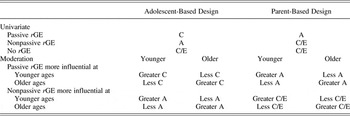
One strategy for discerning the potential role of passive and nonpassive rGE for relationship quality, as opposed to the role of rGE underlying an association between parent and child behaviors, entails combining and interpreting findings from parent-based and adolescent-based twin studies together (dual-sample design). This strategy permits inferences about whether passive and/or nonpassive rGE likely contribute to parent–adolescent relationship quality to be drawn using a univariate framework (see Neiderhiser et al., Reference Neiderhiser, Reiss, Pedersen, Lichtenstein, Spotts and Hansson2004; Neiderhiser, Reiss, Lichtenstein, et al., Reference Neiderhiser, Reiss and Hetherington2007). Table 1 (top) shows expected patterns of genetic and environmental contributions to parent–adolescent relationship quality that are consistent with passive and nonpassive rGE. As summarized in Table 1, nonpassive rGE is inferred if two key findings are significant: adolescent-based genetic influences and (in combination with) parent-based environmental influences. This pattern would suggest that adolescents' genetically influenced behaviors evoke relationship quality (adolescent-based genetic influences on relationship quality), and these behaviors provide the environmental context for relationship quality (parent-based environmental influences on relationship quality). The possible role of passive rGE would be most clearly indicated if there are parent-based genetic influences and adolescent-based shared environmental influences on relationship quality. In this scenario, parents would be behaving toward their adolescents in accordance with their own genotype (parent-based genetic influences), and providing similar environments for their adolescents (adolescent-based shared environmental influences), resulting in either positivity or negativity in the parent–adolescent relationship. It is important to note that in dual-study designs assessing relationship quality phenotypes, patterns of results conforming with passive rGE actually represent possible passive rGE because, while the conditions necessary for passive rGE are present, it is assumed that the parenting behaviors exert an influence on adolescent behavior (an assumption generally supported in the literature). To definitively assess passive rGE, parent and adolescent behavior would need to be measured in the same model, as in the ECOT design. Nonetheless, dual-study designs can be leveraged to infer whether passive and/or nonpassive rGE likely play a role in parent–adolescent relationship quality.
Interpretation of rGE in dual-sample designs

Note: In order to interpret rGE in dual-sample designs, both the finding in the adolescent-based design and the finding in the parent-based design must be present in order to interpret the rGE finding presented in the first column. C, Shared environmental influences; A, genetic influences; C/E, any environmental influence (e.g., shared and/or nonshared).
A set of two studies systematically used this dual-study approach to examine parenting during adolescence (Neiderhiser et al., Reference Neiderhiser, Reiss, Pedersen, Lichtenstein, Spotts and Hansson2004; Neiderhiser, Reiss, Lichtenstein, et al., Reference Neiderhiser, Reiss and Hetherington2007). Adolescent-based and parent-based genetic influences were found for the majority of the parenting constructs examined, indicating that rGE was operating. Further examination of the pattern of adolescent-based versus parent-based genetic and environmental contributions to parenting yielded two inferences about the parenting of adolescents. First, passive rGE was present for mother's positivity and monitoring, and fathers' negativity. Second, nonpassive rGE operated for mothers' negativity, and fathers' negativity and positivity, though results varied by reporter (Neiderhiser et al., Reference Neiderhiser, Reiss, Pedersen, Lichtenstein, Spotts and Hansson2004; Neiderhiser, Reiss, Lichtenstein, et al., Reference Neiderhiser, Reiss and Hetherington2007). The present study extends the dual-sample design to test whether rGE processes underlying positivity and negativity in the parent–adolescent relationship are moderated by adolescent age.
Adolescent-Age Related Changes in the Parent–Adolescent Relationship
There is evidence of phenotypic change in the parent–adolescent relationship across adolescence. For example, parent–adolescent conflict increases and closeness decreases from early to middle adolescence (i.e., ages 11–14, 5th–8th grades; Fleming, Catalano, Haggerty, & Abbott, Reference Fleming, Catalano, Haggerty and Abbott2010; McGue, Elkins, Walden, & Iacono, Reference McGue, Elkins, Walden and Iacono2005), and from middle to late adolescence (e.g., ages 14–18, 9th–12th grades; Fleming et al., Reference Fleming, Catalano, Haggerty and Abbott2010; Herrenkohl, Kosterman, Hawkins, & Mason, Reference Herrenkohl, Kosterman, Hawkins and Mason2009). It is possible that these general increases in conflict and decreases in closeness can be reflected in the extent to which passive and/or evocative rGE influence negative and positive aspects of parenting at different adolescent ages.
There is also evidence of general trends of change in genetic and environmental influences on parenting with adolescent age (for a review, see McGuire, Reference McGuire2003; Towers, Spotts, & Neiderhiser, Reference Towers, Spotts and Neiderhiser2002; Ulbricht & Neiderhiser, Reference Ulbricht, Neiderhiser and Yong-Kyu2009). Although the recent meta-analyses of child-based genetic and environmental influences on parenting (Avinun & Knafo, Reference Avinun and Knafo2014; Klahr & Burt, Reference Klahr and Burt2014) did examine moderation by age, in these studies adolescence as a single (wide) age grouping was compared with younger groups. Thus, these meta-analyses did not examine age-related differences across adolescence. To generate hypotheses about the moderation of genetic and environmental influences by adolescent age, we turn to studies examining age-related changes within adolescent samples. Longitudinal and cross-lagged studies suggest that adolescent-based genetic influences contribute to the increase in variance of parent–adolescent warmth and conflict from early to middle adolescence and middle to late adolescence (Burt, McGue, Krueger, & Iacono, Reference Burt, McGue, Krueger and Iacono2005; McGue et al., Reference McGue, Elkins, Walden and Iacono2005; Narusyte, Andershed, Neiderhiser, & Lichtenstein, Reference Narusyte, Andershed, Neiderhiser and Lichtenstein2007; Neiderhiser, Reiss, Hetherington, & Plomin, Reference Neiderhiser, Reiss, Hetherington and Plomin1999; Reiss, Neiderhiser, Hetherington, & Plomin, Reference Reiss, Neiderhiser, Hetherington and Plomin2000). Thus, theory and evidence suggests that nonpassive rGE increases across adolescence because genetic influences contribute to change in positivity and negativity in the parent–adolescent relationship. Thus far, no studies have examined adolescent age differences in parent-based genetic and environmental influences. Therefore, we examine adolescent age differences in parent-based and youth-based genetic and environmental influences in order to better understand developmental shifts in rGE.
Present Study
The aims of the present study were to examine how rGE processes underlying parent–adolescent relationship quality may differ as a function of adolescent age. We tested whether adolescent age moderated genetic and environmental influences on mother–adolescent and father–adolescent positivity and negativity using parallel parent-based (twin parents) and child-based (children who are twins or siblings) samples. Following the work of Neiderhiser et al. (Reference Neiderhiser, Reiss, Pedersen, Lichtenstein, Spotts and Hansson2004) and Neiderhiser, Reiss, Lichtenstein, et al. (Reference Neiderhiser, Reiss and Hetherington2007), we interpreted the presence of rGE using the patterns of findings from moderation results in both samples. We extended the dual-sample design by testing for differences in the extent to which parents' and adolescents' genes and environments influence relationship quality at various adolescent ages, and inferring differences in rGE at those different adolescent ages.
Based on our review of genetic and environmental influences on parenting behaviors, we expected that nonpassive rGE would be greater for older adolescents than for younger adolescents for both positive and negative aspects of the parent–adolescent relationship. This hypothesis would be supported by two findings: adolescent-based genetic contributions to parenting being greater among older versus younger adolescents, in conjunction with parent-based environmental contributions to parenting being greater among older versus younger adolescents. This pattern of change in adolescent-based genetic effects and parent-based environmental effects as a function of adolescent age would suggest that nonpassive rGE is more influential at older ages than at younger ages.
Consistent with theory (O'Connor et al., Reference O'Connor, Deater-Deckard, Fulker, Rutter and Plomin1998; Reiss, Reference Reiss1995; Scarr & McCartney, Reference Scarr and McCartney1983), we also hypothesized that passive rGE would be greater for younger adolescents than for older adolescents, for both positive and negative aspects of the parent–adolescent relationship. Decreasing influence of passive rGE as a function of adolescent age would be indicated if parent-based genetic influences and adolescent-based shared environmental influences on parenting were greater at younger than at older ages. There was not sufficient information on which to draw hypotheses for differences in mother–adolescent and father–adolescent relationships in regard to adolescents' ages.
Method
Participants
Nonshared Environment in Adolescent Development Study (NEAD) sample
The NEAD sample consisted of 721 predominantly White (>93%), middle-class families of same-sex twins and siblings who participated in the first wave of data collection in the NEAD project (Neiderhiser, Reiss, & Hetherington, Reference Neiderhiser, Reiss and Hetherington2007; Reiss et al., Reference Reiss, Neiderhiser, Hetherington and Plomin2000). Most of the families were recruited through a national market survey of 675,000 families, though some were recruited through random digit dialing of 10,000 telephone numbers throughout the United States in order to reach the target sample size. The inclusion criteria were strict: mothers, fathers, and two same-sex siblings were all required to participate. Sibling pairs were required to be within 4 years of each other in age, and live in the home at least half the time. Stepfamilies were required to be together for at least 5 years. Zygosity was established using a validated questionnaire on which adolescent twins were rated for physical similarity (Nichols & Bilbro, Reference Nichols and Bilbro1966). The agreement of this questionnaire with genotyping has been estimated at over 90% (e.g., Goldsmith, Reference Goldsmith1991). The analysis sample consisted of 698 families on whom there was information on zygosity, relationship quality, and adolescent age, falling into one of six sibling categories in two family types: 89 same-sex monozygotic (MZ) twin pairs, 98 dizygotic (DZ) twin pairs, and 94 full sibling pairs in nondivorced families, and 181 full sibling pairs, 106 half-sibling pairs, and 130 genetically unrelated sibling pairs in stepfamilies. Adolescents were 10 to 18 years old (M = 13.6 years, SD = 3 years). Siblings were within 4 years of age of each other (M = 1.6 years, SD = 1.3 years), and lived in the same household for at least 5 years. Mothers were aged 27–54 years (M = 38.20 years, SD = 4.76 years). Fathers were aged 26–72 years (M = 40.95 years, SD = 6.47 years). Additional sample information can be found in Reiss et al. (Reference Reiss, Neiderhiser, Hetherington and Plomin2000) and Neiderhiser, Reiss, and Hetherington (Reference Neiderhiser, Reiss and Hetherington2007).
Twin and Offspring Study in Sweden (TOSS)
The TOSS sample was built using a sampling and measurement plan to exactly mirror the NEAD sample, specifically during the adolescent transition. The TOSS sample consisted of 909 same-sex, White pairs of twins who are parents, their spouse or partner, and their adolescent offspring (Neiderhiser & Lichtenstein, Reference Neiderhiser and Lichtenstein2008), including mothers and nearly every father. The TOSS sample was obtained through the use of the Swedish Twin Registry. Zygosity was established using a validated questionnaire for which adolescent twins were rated for physical similarity (over 90% reliable with genotyping; Nichols & Bilbro, Reference Nichols and Bilbro1966). The analysis sample consisted of 848 families on whom there was information on zygosity, relationship quality, and adolescent age: 257 female MZ twin pairs, 124 male MZ twin pairs, 282 female DZ twin pairs, and 185 male DZ twin pairs. Adolescents were 11 to 22 years old (M = 15.7 years; SD = 2.4 years). All adolescent cousin pairs were the same sex and were within 4 years of age of each other (M = 1.8 years; SD = 1.5 years). Twin mothers were aged 32–60 years (M = 43.66 years; SD = 4.61 years). Twin fathers were aged 35–59 years (M = 46.98 years; SD = 4.61 years). Additional sample information can be found in Neiderhiser and Lichtenstein (Reference Neiderhiser and Lichtenstein2008).
Measures
As noted above, the NEAD and TOSS samples were designed to be complementary. The measures used in the present report are identical across both studies. Positive and negative aspects of the parent–adolescent relationships were assessed using composite scores from several measures derived from Hetherington and Clingempeel (Reference Hetherington and Clingempeel1992). Mother, father, and adolescent reports of parenting behavior and parent–adolescent relationships were assessed separately. This strategy for creating composites has been used previously (Neiderhiser et al., Reference Neiderhiser, Reiss, Pedersen, Lichtenstein, Spotts and Hansson2004; Neiderhiser, Reiss, Lichtenstein, et al., Reference Neiderhiser, Reiss and Hetherington2007; Reiss et al., Reference Reiss, Neiderhiser, Hetherington and Plomin2000).
Positivity
In both samples, mother–adolescent negativity was the average of mother and youth reports and father–adolescent positivity was the average of father and youth reports on the closeness/rapport subscale of the Parent–Child Relationships Scale (PCR; Hetherington & Clingempeel, Reference Hetherington and Clingempeel1992), and the instrumental and expressive affection subscales of the Expression of Affection Inventory (Hetherington & Clingempeel, Reference Hetherington and Clingempeel1992; α > 0.78 for each PCR and Expression of Affection Inventory Scale across reporters in NEAD and TOSS). Scores on each subscale were standardized and then summed to create positivity composites for each rater (α = 0.71–0.78 for NEAD, 0.72–0.81 for TOSS) and subsequently converted to ranks in order to aid in comparison across samples (Neiderhiser et al., Reference Neiderhiser, Reiss, Pedersen, Lichtenstein, Spotts and Hansson2004; Neiderhiser, Reiss, Lichtenstein, et al., Reference Neiderhiser, Reiss and Hetherington2007). Composites were created in this way to be consistent with previous reports (i.e., Neiderhiser et al., Reference Neiderhiser, Reiss, Pedersen, Lichtenstein, Spotts and Hansson2004; Neiderhiser, Reiss, Lichtenstein, et al., Reference Neiderhiser, Reiss and Hetherington2007) and to avoid single-measure bias (Bank, Duncan, Patterson, & Reid, Reference Bank, Duncan, Patterson and Reid1993).
Negativity
Mother–adolescent negativity was the average of mother and youth reports and father–adolescent negativity was the average of father and youth reports on the conflict/negativity subscale of the PCR and the coercion and punitiveness subscales of the Parent Discipline Behavior Inventory (Hetherington & Clingempeel, Reference Hetherington and Clingempeel1992; α > 0.61 across reporters in both studies). Mothers and youth reported on the mother–adolescent relationship and fathers and youth reported on the father–adolescent relationship. Scores on each subscale were standardized and then summed to create negativity composites for each rater (αs for each rater on each subscale = 0.50–0.57 for NEAD, 0.72–0.78 for TOSS) and subsequently converted to ranks, as with positivity scores and previous studies using these data. The specific scales comprising the negativity composite assess a variety of distinct behaviors tapping into different aspects of parent–adolescent negativity, which was designed to be a broader global index of negativity in the parent–child relationship (i.e., arguments, perceived conflict, parents' discipline, and adolescents' difficult behavior toward parents; Neiderhiser et al., Reference Neiderhiser, Reiss, Pedersen, Lichtenstein, Spotts and Hansson2004; Neiderhiser, Reiss, Lichtenstein, et al., Reference Neiderhiser, Reiss and Hetherington2007). Coercion measured by the Parent Discipline Behavior Inventory was least correlated with other negativity measures, and drove the borderline αs in NEAD.
Analytic strategy
Quantitative genetic analyses take advantage of similarities and differences between twins and siblings with varying degrees of genetic relatedness to parse the variance in a particular phenotype into additive genetic, shared environmental, and nonshared environmental components. By definition, twins or siblings share 100% of their shared environment (nongenetic influences that make family members similar) and none of their nonshared environment (nongenetic influences that make family members different, including measurement error). Different sibling types share different average proportions of their segregating genes: MZ twins share 100% of their genes, DZ twins and full siblings share an average of 50% of their segregating genes, half-siblings share an average of 25% of their segregating genes, and stepsiblings (genetically unrelated siblings) do not share any genes.
Comparisons of the relative likeness of different types of siblings and/or family members for parent–adolescent relationship quality are used to estimate genetic, shared, and nonshared environmental influences on the behavior. That is, sibling correlations, or correlations between Sibling 1's relationship quality and Sibling 2's relationship quality in each family, are compared across sibling types and used to infer genetic and environmental influences. In a child-based design (e.g., NEAD), if MZ adolescent twins are two times more similar for their relationship quality than are DZ adolescent twins, adolescent-based genetic influences are operating because MZ twins share (on average) twice as many genes as do DZ twins. Adolescent-based shared environmental influences on parent–adolescent relationship quality are indicated if the extent to which sibling correlations on relationship quality for MZ adolescent twins and DZ adolescent twins/full siblings are equal, or genetically unrelated adolescent siblings are correlated for relationship quality. The extent to which MZ adolescent twins are not perfectly correlated indicates the contribution of adolescent-based nonshared environmental influences on relationship quality. These principles apply equally to the parent-based design where twins are parents (e.g., TOSS). In TOSS, comparing the relative likeness of MZ and DZ twin parents provides information on the relative contributions of parent-based genetic, shared, and nonshared environmental influences on parent–adolescent relationship quality.
Moderation analyses
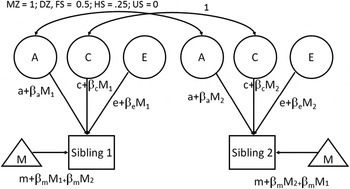
Biometric moderation analyses were conducted using OpenMx (Boker et al., Reference Boker, Neale, Maes, Wilde, Spiegel and Brick2010), using the extended univariate model outlined in van der Sluis, Posthuma, and Dolan (Reference van der Sluis, Posthuma and Dolan2012). The contributions of latent genetic (a), shared environmental (c), and nonshared environmental (e) influences to parenting were estimated, as well as the mean level of negativity/positivity (m), controlling for the direct effects of adolescent/parent and the cotwin/sibling's age (M). Furthermore, the degree to which adolescent/parent age (M) moderates genetic, shared, and nonshared environmental contributions to parenting was also explored. These effects are estimated as βaM (moderation of a), βcM (moderation of c), and βeM (moderation of e). Finally, the degree to which M moderated the mean level of parent–adolescent positivity or negativity (i.e., phenotypic differences due to age) was modeled as βmM (moderation of the mean, see Figure 1). Unstandardized variance components for a, c, and e influences (e.g., A, C, and E) were calculated at each level of the moderator (M; age). Equation 1 demonstrates the calculation of the unstandardized variance component for a influences.
 $$\hbox{A} = \lpar \hbox{a} + {\rm \beta}\hbox{aM}\rpar ^2. $$
Extended univariate moderation model. a, Genetic influences; c, shared environmental; e, nonshared environmental influences on parenting; M, estimate of the mean level of negativity/positivity (m) controlling for the direct effects of adolescent/parent and the cotwin/sibling's age (M); βaM, moderation of a; βcM, moderation of c; βeM, moderation of e; βmM, the degree to which adolescent/parent age moderated the mean level of parent–adolescent positivity or negativity (phenotypic differences due to age); M1, Twin/Sibling 1's age; M2, Twin/Sibling 2's age; MZ, monozygotic twin; DZ, dizygotic twin; FS, full siblings; HS, half-siblings; US, genetically unrelated siblings. The genetic correlation of Siblings 1 and 2 are set to different values based on the sibling type, according to quantitative genetic theory. The shared environmental correlation of Siblings 1 and 2 is by definition set to 1 for all sibling types.

Adolescent age was included as M; thus, the extent to which adolescent age moderated genetic and environmental contributions to mother–adolescent and father–adolescent positivity and negativity was assessed. Separate analyses were conducted for relationships with mothers and fathers, and for relationship quality (positivity or negativity) for the adolescent-based NEAD sample and the parent-based TOSS sample. In all analyses, the effects of adolescent sex, age differences between adolescent sibling or cousin pairs, and parent ages were controlled.
Model testing
Any paths that reached significance according to 95% confidence intervals in the full moderation model were judged to be significant. If confidence intervals suggested moderated paths approached significance, we evaluated the relative fits of nested models that systematically set each borderline-significant (i.e., confidence interval that included but did not cross 0) moderation path to “0.” If elimination of a specific moderation path produced a significant decrement in fit from the full model, the path was judged to be meaningful.
Interpretation of rGE
Nonpassive rGE is indicated by adolescent-based genetic influences (e.g., in NEAD) and parent-based environmental influences (e.g., in TOSS; see Table 1). That is, heritable adolescent characteristic/behaviors evoke relationship quality, and the evidence of parent-based environmental influences suggests that these adolescent-based heritable characteristics influence the parent-based aspects of relationship quality. Without evidence of parent-based environmental influences (i.e., if entirely, or mostly, parent-based genetic influences on parent–child relationship quality in the parent-based design were found), genetic influences shared by parents and adolescents would be the mostly likely etiology of relationship quality.
Extending that logic to the case of moderation, if age moderates adolescent-based genetic influences on relationship quality in NEAD, such that adolescent-based genetic influences were greater at younger ages than at older ages, and age moderates parent-based environmental influences on relationship quality in TOSS, such that parent-based environmental influences are greater at younger ages than at older ages, we would conclude that nonpassive rGE plays a stronger role in families with younger adolescents than in families with older adolescents (see Table 1). That is, in this pattern of findings, there would be evidence of nonpassive rGE at younger ages, but at older ages there would no longer be evidence of nonpassive rGE. Conversely, if age moderates adolescent-based genetic influences on relationship quality (in NEAD), such that adolescent-based genetic influences are greater at older ages than at younger ages, and age moderates parent-based environmental influences on relationship quality (in TOSS), such that parent-based environmental influences are greater at older ages than at younger ages, we would conclude that nonpassive rGE is more influential among families with older adolescents than families with younger adolescents. In this pattern of findings, we would find evidence for nonpassive rGE at older ages but no evidence at younger ages.
In the univariate case, possible passive rGE is indicated by finding both parent-based genetic influences (in TOSS) and adolescent-based shared environmental influences in NEAD (see Table 1). That is, parent-based genetic influences on relationship quality would indicate that parents' heritable characteristics and behaviors contributing to relationship quality are in accordance with their own genotype, and the evidence of adolescent-based shared environmental influences would suggest that parents provide similar environments for their adolescents. Passive rGE would not be concluded if parent-based genetic influences were present without evidence of adolescent-based shared environmental influences. For example, primarily adolescent-based nonshared environmental (in contrast to adolescent-based shared environmental) influences could indicate that while there are parent-based genetic influences on relationship quality, these genetic influences are not consistent with the parents' characteristics or behaviors that contribute to relationship quality. Primarily adolescent-based genetic influences in combination with parent-based genetic influences would suggest that genetic influences shared by parents and adolescents would be the mostly likely etiology of relationship quality.
Extending that logic to the case of moderation, if age moderates parent-based genetic influences on relationship quality in TOSS, such that parent-based genetic influences are greater at younger ages than at older ages, and age moderates adolescent-based shared environmental influences on relationship quality in NEAD, such that adolescent-based shared environmental influences are greater at younger ages than at older ages, we would conclude that passive rGE is more influential in families with younger adolescents than in families with older adolescents. That is, we would find evidence of passive rGE at younger ages, but no evidence of passive rGE at older ages. Conversely, if age moderates parent-based genetic influences on relationship quality in TOSS, such that parent-based genetic influences are greater at older ages than at younger ages, and age moderated adolescent-based shared environmental influences on parenting in NEAD, such that adolescent-based shared environmental influences are greater at older ages than at younger ages, we would conclude that passive rGE was more influential among families with older adolescents than among families with younger adolescents (see Table 1).
The above interpretations are the strongest and the most conservative estimates for differences in rGE processes across adolescent ages. However, if only one of the relevant influences of a pair needed for interpretation of rGE (e.g., adolescent-based genetic influences and parent-based environmental influences for nonpassive rGE) is moderated by age and the other is present but not moderated by age, there is still evidence of differences in rGE processes across adolescence, albeit somewhat weaker evidence. For example, if age moderates adolescent-based genetic influences on relationship quality in NEAD, such that adolescent-based genetic influences are greater at younger ages than at older ages, and there are parent-based environmental influences on relationship quality in TOSS (even if there was not significant moderation of the parent-based environmental influences), we would still conclude that nonpassive rGE is more influential among families with younger adolescents than among families with older adolescents. That is, among families with younger adolescents, there would be adolescent-based genetic influences in NEAD as well as parent-based environmental influences in TOSS, indicating nonpassive rGE. However, among families with older adolescents, there would only be parent-based environmental influences in TOSS (and no adolescent-based genetic influences in NEAD). The lack of adolescent-based genetic influences would indicate that nonpassive rGE could not be operating. Thus, we would conclude evidence of nonpassive rGE at younger ages, but not at older ages. Similarly, if genetic influences were present and the relevant environmental influences were moderated, we would still conclude that there was (weak) evidence that rGE may be moderated by age. For example, if age does not moderate adolescent-based genetic influences on relationship quality in NEAD, but adolescent-based genetic influences are present, and age moderates parent-based environmental influences on relationship quality in TOSS, such that parent-based environmental influences are greater at younger ages than at older ages, we would still conclude that nonpassive rGE is more influential among families with younger adolescents than among families with older adolescents.
Results
In all analyses, adolescent sex and the age differences between sibling or cousin pairs, and parents' ages were controlled for. We first examined univariate baseline models (without moderation), because there were some differences in the score construction and data included here from previous reports (e.g., combined raters instead of separate raters, and the earlier assessment wave in NEAD as compared with Neiderhiser et al., Reference Neiderhiser, Reiss, Pedersen, Lichtenstein, Spotts and Hansson2004; Neiderhiser, Reiss, Lichtenstein, et al., Reference Neiderhiser, Reiss and Hetherington2007; exclusion of observer report in the composite rater score as compared with Reiss et al., Reference Reiss, Neiderhiser, Hetherington and Plomin2000). The analyses of moderation results are presented next. Due to the quantity of specific findings used to interpret differences in rGE attributable to adolescent age in the moderation analyses, unstandardized variance components were computed (Equation 1) and are presented in figures to aid in interpretation. We also highlight the inferred rGE results following specific moderation results as well as a summary of rGE results at the end of the results section.
Baseline findings
Results for the baseline univariate analyses are presented in online supplementary Table S.1 for model fitting results and Table S.2 for parameter estimates. For positivity and negativity in the mother–adolescent and father–adolescent relationships, there were significant adolescent-based genetic, shared, and nonshared environmental influences in NEAD. For positivity and negativity in the mother–adolescent relationship in TOSS, parent-based shared environmental influences were nonsignificant and could be fixed to zero without a significant decrement in model fit, whereas parent-based genetic and nonshared environmental influences could not. Thus, there were meaningful parent-based genetic and nonshared environmental influences on positivity and negativity in the mother–adolescent relationship. For positivity and negativity in the father–adolescent relationship in TOSS, the best-fitting models of positivity and negativity in the father–adolescent relationship in TOSS (e.g., lowest AIC) were those estimating parent-based genetic and nonshared environmental influences, consistent with results from mother–adolescent relationship quality. However, for father–adolescent relationship quality in TOSS, we could only conclude that parent-based familial influences (not specifically genetic influences) play a role for positivity and negativity in the father–adolescent relationship because fixing either genetic or shared environmental influences to zero did not result in a decrement in model fit but fixing both genetic and shared environmental influences to zero did result in a decrement in model fit.
Interpreting these baseline findings according to Table 1, the presence of parent-based genetic and adolescent-based shared environmental influences, which was found for positivity and negativity in the mother–adolescent relationship, indicates the probable presence of passive rGE. Passive rGE may also play a role in positivity and negativity in father–adolescent relationships, although we cannot definitively conclude this from our data. Further, according to Table 1, the presence of adolescent-based genetic and parent-based (nonshared) environmental influences, which was found for positivity and negativity in both mother– and father–adolescent relationships, indicates the probable presence of nonpassive rGE. Thus, on a broad level across adolescence, there is evidence of both passive and nonpassive rGE for positivity and negativity in parent–adolescent relationships.
Moderation by age
Mother–adolescent negativity
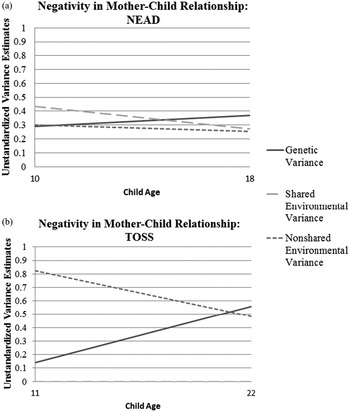
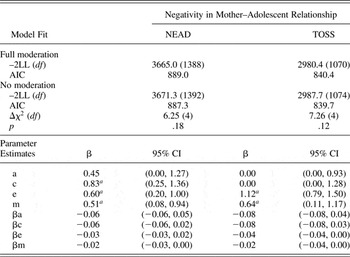
Model fit statistics for the full model and the model wherein all moderation paths were set to zero (i.e., dropped; no moderation) are presented in Table 2, as well as parameter estimates and 95% confidence intervals from the full models. In the NEAD (adolescent-based) sample, confidence intervals suggested that adolescent age did not moderate adolescent-based genetic, shared, or nonshared environmental influences on negativity in the mother–adolescent relationship (Figure 2). In the TOSS (parent-based) sample, there was no evidence that adolescent age moderated parent-based genetic, shared, or nonshared environmental influences on negativity in the mother–adolescent relationship (see Figure 2). Because no moderation paths were significant, adolescent age did not moderate rGE for negativity in the mother–adolescent relationship. There was also no evidence of phenotypic differences in negativity in the mother–adolescent relationship based on adolescent age (see Table 2).
Moderation results for adolescent age moderating mother–adolescent negativity. Unstandardized parameter estimates were obtained at the youngest (age 10 for the Nonshared Environment in Adolescent Development [NEAD] sample; age 11 for the Twin and Offspring Study in Sweden [TOSS] sample) and oldest (age 18 for the NEAD sample; age 22 for the TOSS sample) ages using the parameter estimates presented in Table 2 and Equation 1.Footnote 1

Moderation results for adolescent age moderating mother–adolescent negativity

Note: NEAD, Nonshared Environment in Adolescent Development; TOSS, Twin and Offspring Study in Sweden; –2LL, –2 log likelihood; AIC, Akaike information criterion. Model fit: full moderation includes all moderation terms: βa, βc, βe, βm. No moderation excludes all moderation terms: βa, βc, βe, βm. Parameter estimates: a, the unstandardized path estimate for genetic influences; c, the unstandardized path estimate for shared environmental influences; e, the unstandardized path estimate for nonshared environmental influences; βa, the unstandardized path estimate for the linear moderation coefficient on genetic influences; βc, the unstandardized path estimate for the linear moderation coefficient on shared environmental influences; βe, the unstandardized path estimate for the linear moderation coefficient on nonshared environmental influences; βm, the unstandardized path estimate for the linear moderation coefficient on the mean.
a Significance based on 95% confidence intervals.
Father–adolescent negativity
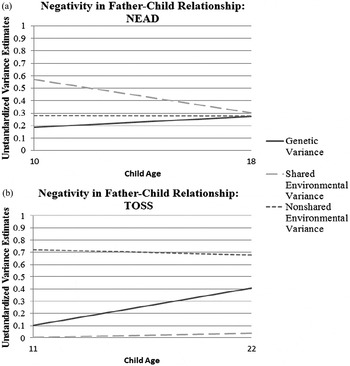
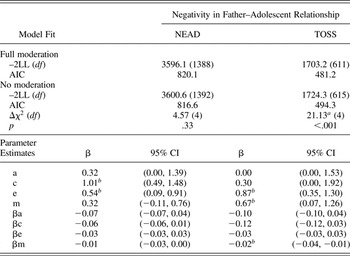
Model fit statistics for the full model and the model wherein all moderation paths were set to 0 (i.e., dropped; no moderation) are presented in Table 3, as well as parameter estimates and 95% confidence intervals from the full models. In the NEAD (adolescent-based) sample, confidence intervals suggested that adolescent age did not moderate adolescent-based genetic, shared, or nonshared environmental influences on negativity in the father–adolescent relationship (Figure 3). In the TOSS (parent-based) sample, there was no evidence that adolescent age moderated parent-based genetic, shared, or nonshared environmental influences on negativity in the father–adolescent relationship (Figure 3). Because no moderation paths were significant, adolescent age did not moderate rGE for negativity in the father–adolescent relationship. There was evidence of phenotypic differences in negativity in the father–adolescent relationship based on adolescent age: there was more negativity among families with younger rather than older adolescents only in the TOSS sample (see Table 3). This finding drives the poorer fit of the no-moderation model relative to the full moderation model in TOSS.
Moderation results for adolescent age moderating father–adolescent negativity. Unstandardized parameter estimates were obtained at the youngest (age 10 for the Nonshared Environment in Adolescent Development [NEAD] sample; age 11 for the Twin and Offspring Study in Sweden [TOSS] sample) and oldest (age 18 for the NEAD sample; age 22 for the TOSS sample) ages using the parameter estimates presented in Table 3 and Equation 1.Footnote 2

Moderation results for adolescent age moderating father–adolescent negativity

Note: NEAD, Nonshared Environment in Adolescent Development; TOSS, Twin and Offspring Study in Sweden; –2LL, –2 log likelihood; AIC, Akaike information criterion. Model fit: full moderation includes all moderation terms: βa, βc, βe, βm. No moderation excludes all moderation terms: βa, βc, βe, βm. Parameter estimates: a, the unstandardized path estimate for genetic influences; c, the unstandardized path estimate for shared environmental influences; e, the unstandardized path estimate for nonshared environmental influences; βa, the unstandardized path estimate for the linear moderation coefficient on genetic influences; βc, the unstandardized path estimate for the linear moderation coefficient on shared environmental influences; βe, the unstandardized path estimate for the linear moderation coefficient on nonshared environmental influences; βm, the unstandardized path estimate for the linear moderation coefficient on the mean.
a Significant decrement in model fit.
b Significance based on 95% confidence intervals.
Mother–adolescent positivity
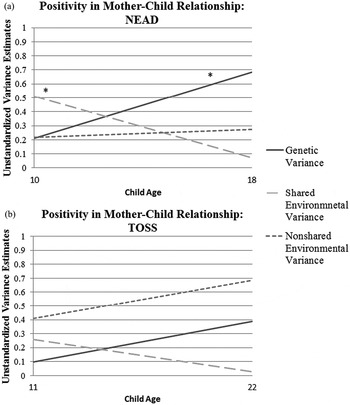
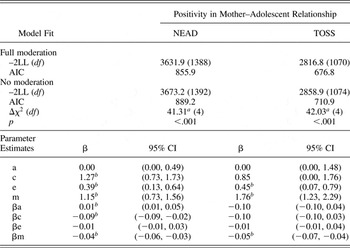
Model fit statistics for the full model and the model wherein all moderation paths were set to 0 (i.e., dropped; no moderation) are presented in Table 4 as well as parameter estimates and 95% confidence intervals from the full models. In the NEAD (adolescent-based) sample, confidence intervals suggested that adolescent age moderated adolescent-based genetic and shared environmental influences on positivity in the mother–adolescent relationship (see Table 4). Effects were probed and graphed (see Figure 4) using Equation 1: the estimated unstandardized variance components for adolescent-based genetic, shared, and nonshared environmental influences on mother–adolescent negativity were calculated at the youngest and oldest ages in the sample. These estimates showed that adolescent-based genetic influences were lower at age 10 (A = 0.21) than at age 18 (A = 0.68), whereas shared environmental influences were higher at age 10 (C = 0.51) than at age 18 (C = 0.07). Adolescent age did not moderate adolescent-based nonshared environmental influences on positivity in the mother–adolescent relationship. In the TOSS (parent-based) sample, there was no evidence that adolescent age moderated parent-based genetic, shared, or nonshared environmental influences on positivity in the mother–adolescent relationship (see Figure 4).
Moderation results for adolescent age moderating mother–adolescent positivity. Unstandardized parameter estimates were obtained at the youngest (age 10 for the Nonshared Environment in Adolescent Development [NEAD] sample; age 11 for the Twin and Offspring Study in Sweden [TOSS] sample) and oldest (age 18 for the NEAD sample; age 22 for the TOSS sample) ages using the parameter estimates presented in Table 4 and Equation 1. *Significant moderation.Footnote 3

Moderation results for adolescent age moderating mother–adolescent positivity

Note: NEAD, Nonshared Environment in Adolescent Development; TOSS, Twin and Offspring Study in Sweden; –2LL, –2 log likelihood; AIE, Akaike information criterion. Model fit: full moderation includes all moderation terms: βa, βc, βe, βm. No moderation excludes all moderation terms: βa, βc, βe, βm. Parameter estimates: a, the unstandardized path estimate for genetic influences; c, the unstandardized path estimate for shared environmental influences; e, the unstandardized path estimate for nonshared environmental influences; βa, the unstandardized path estimate for the linear moderation coefficient on genetic influences; βc, the unstandardized path estimate for the linear moderation coefficient on shared environmental influences; βe, the unstandardized path estimate for the linear moderation coefficient on nonshared environmental influences; βm, the unstandardized path estimate for the linear moderation coefficient on the mean.
a Significant decrement in model fit.
b Significance based on 95% confidence intervals.
Evidence that adolescent-based genetic influences were greater among families with older rather than younger adolescents coupled with evidence of parent-based environmental influences (parameter e, Table 4) suggests that nonpassive rGE was more influential at older adolescent ages than at younger adolescent ages for positivity in the mother–adolescent relationship (Table 1). Further, evidence that adolescent-based shared environmental influences were greater among families with younger rather than older adolescents coupled with evidence of parent-based genetic influences (in the univariate model) provided evidence that passive rGE is more influential at younger adolescent ages than at older adolescent ages for positivity in the mother-adolescent relationship (Table 1). There was also evidence that there was more positivity in mother–adolescent relationships among families with younger adolescents than among families with older adolescents (see Table 4).
Father–adolescent positivity
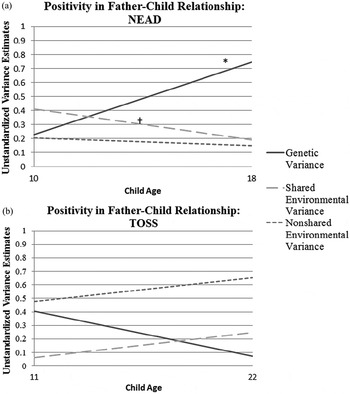
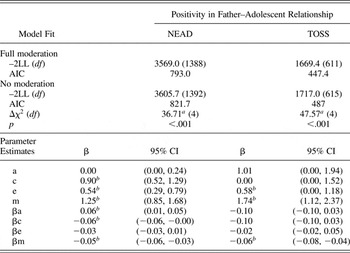
Model fit statistics for the full model and the model wherein all moderation paths were set to 0 (i.e., dropped; no moderation) are presented in Table 5, as well as parameter estimates and 95% confidence intervals from the full models. In the NEAD (adolescent-based) sample, confidence intervals suggested that adolescent age moderated adolescent-based genetic influences on positivity in the father–child relationship such that genetic influences were greater among older adolescents than among younger adolescents (see Figure 5). Based on confidence intervals, there was evidence that adolescent age may marginally moderate adolescent-based shared environmental influences as well. In order to verify the results based on confidence intervals, we set the moderation of shared environmental influences (βc) to equal zero, but estimated all other parameters freely. Model fitting results suggested a marginal, but not significant, decrement in model fit, Δχ2 (1) = 2.97, p = .08. Thus, we concluded that adolescent age did not significantly moderate adolescent-based nonshared environmental influences on positivity in the father–adolescent relationship. In the TOSS (parent-based) sample, there was no evidence that adolescent age moderated parent-based genetic, shared, or nonshared environmental influences on positivity in the father–adolescent relationship (see Figure 5).
Moderation results for adolescent age moderating father–adolescent positivity. Unstandardized parameter estimates were obtained at the youngest (age 10 for the Nonshared Environment in Adolescent Development [NEAD] sample, age 11 for the Twin and Offspring Study in Sweden [TOSS] sample) and oldest (age 18 for the NEAD sample, age 22 for the TOSS sample) ages using the parameter estimates presented in Table 5 and Equation 1. *Significant moderation. †Trend-level moderation.Footnote 4

Moderation results for adolescent age moderating father–adolescent positivity

Note: NEAD, Nonshared Environment in Adolescent Development; TOSS, Twin and Offspring Study in Sweden; –2LL, –2 log likelihood; AIE, Akaike information criterion. Model fit: full moderation includes all moderation terms: βa, βc, βe, βm. No moderation excludes all moderation terms: βa, βc, βe, βm. Parameter estimates: a, the unstandardized path estimate for genetic influences; c, the unstandardized path estimate for shared environmental influences; e, the unstandardized path estimate for nonshared environmental influences; βa, the unstandardized path estimate for the linear moderation coefficient on genetic influences; βc, the unstandardized path estimate for the linear moderation coefficient on shared environmental influences; βe, the unstandardized path estimate for the linear moderation coefficient on nonshared environmental influences; βm, the unstandardized path estimate for the linear moderation coefficient on the mean.
a Significant decrement in model fit.
b Significance based on 95% confidence intervals.
Evidence that adolescent-based genetic influences were greater among families with older rather than younger adolescents coupled with evidence of parent-based environmental influences (in the univariate model) suggests that nonpassive rGE was more influential at older adolescent ages than at younger adolescent ages for positivity in the father–adolescent relationship (Table 1). There was also evidence that there was more positivity in father–adolescent relationships among families with younger adolescents than among families with older adolescents (see Table 5).
Summary of rGE findings
There were two primary findings of interest. First, nonpassive rGE was more influential for positivity in mother– and father–adolescent relationships in families with older adolescents than in families with younger adolescents. Second, passive rGE was more influential for positivity in the mother–adolescent relationship in families with younger adolescents than in families with older adolescents.
Discussion
This report took advantage of two comparable genetically informed samples: a parent-based twin study and an adolescent-based twin/sibling study. By comparing results of how age moderated genetic and environmental influences on positivity and negativity in parent–adolescent relationships, we were able to infer differences in passive and nonpassive rGE at different adolescent ages. The present study adds to the literature because it is the first study to examine passive and nonpassive rGE for parent–adolescent relationship quality as a function of offspring age across adolescence. In contrast to the univariate findings, which suggested passive and nonpassive rGE for positivity and negativity in mother–adolescent relationships and nonpassive rGE for positivity and negativity in father–adolescent relationships, our moderation findings paint a more nuanced picture for how rGE operates in adolescence: rGE does not appear to influence positivity and negativity in the same ways across adolescence.
Implications
The type of rGE underlying the parent–adolescent relationship has been hypothesized to be important for targeting successful interventions (e.g., Feinberg, Neiderhiser, Howe, & Hetherington, Reference Feinberg, Neiderhiser, Howe and Hetherington2001). Our hypothesis that nonpassive rGE would be greater for older adolescents than for younger adolescents for positive and negative aspects of the parent–adolescent relationship was confirmed only for positivity. Evidence of nonpassive rGE suggests that adolescents' heritable characteristics contribute strongly to parent–adolescent relationship quality. Thus, it may be that to improve relationship quality in later adolescence, interventions seeking to increase positive behavior in adolescents would be the optimal strategy. Evidence of nonpassive rGE may also point to a focus on different parenting skills; for example, teaching parents how to recognize and reciprocate positivity in their adolescent may be a useful strategy to enhance parent–child relationship quality later in adolescence.
There was also some evidence supporting our hypothesis that passive rGE would play a greater role for positivity and negativity in parent–adolescent relationships including younger adolescents than relationships including older adolescents, but only for positivity in the mother–child relationship. Evidence of passive rGE suggests that relationship quality arises from shared genes of parents and adolescents, which are correlated with parenting behaviors. Therefore, this finding could be interpreted to suggest that to improve relationship quality earlier in adolescence, interventions targeting increasing positive parenting in mothers would be one possible strategy, potentially enhancing the passive rGE. Thus, age-related differences in patterns of rGE underlying parent–adolescent relationships may help to identify developmentally sensitive periods for training in different types of parenting skills or adolescent behaviors in interventions for parent–adolescent relationships, parenting behavior, and/or adolescent behavior. Further, our findings are specific to positivity in the parent–child relationship. This may suggest that interventions capitalizing on knowledge of rGE processes may have more success increasing positive aspects of the parent–child relationship rather than decreasing negative aspects of the parent–child relationship. These ideas remain empirical questions in need of verification.
Genotype–environment correlation in mother– versus father–adolescent relationships
The findings regarding nonpassive rGE applied to both mother– and father–adolescent relationships. Older adolescents seem to evoke more positivity from parents than do younger adolescents. However, findings regarding passive rGE were specific to the mother–adolescent relationship. The passive combination of genes and environments appears to be more important for promoting positivity among younger adolescents than among older adolescents. It may be that differences in parenting roles and time spent parenting are reflected in passive rGE. Mothers spend more time parenting children than fathers do, though fathers tend to be more involved in discipline (e.g., Marsiglio, Amato, Day, & Lamb, Reference Marsiglio, Amato, Day and Lamb2000). Changes in passive rGE may reflect differences in mothers' parenting characteristics in order to provide age-appropriate parenting (i.e., reducing parenting behaviors associated with genetic influences of the mother as adolescents become more autonomous).
As reported previously, the patterns of passive rGE varied with parent gender (e.g., Klahr & Burt, Reference Klahr and Burt2014; Narusyte et al., Reference Narusyte, Neiderhiser, D'Onofrio, Reiss, Spotts and Ganiban2008, Reference Narusyte, Neiderhiser, Andershed, D'Onofrio, Reiss and Spotts2011; Neiderhiser et al., Reference Neiderhiser, Reiss, Pedersen, Lichtenstein, Spotts and Hansson2004; Neiderhiser, Reiss, Lichtenstein, et al., Reference Neiderhiser, Reiss and Hetherington2007). Past literature, and findings from our univariate analyses, suggested that passive rGE may be more influential in mother–adolescent positivity than in father–adolescent negativity. Similarly, we found that moderation of passive rGE by age was indicated for mother–adolescent relationships but not for father–adolescent relationships. However, we found no evidence of systematic differences in moderation of nonpassive rGE in mother–adolescent versus father–adolescent relationships. While age-related changes in nonpassive rGE in mother–adolescent and father–adolescent relationships may not differ, the overall presence (i.e., mean levels) of passive and nonpassive rGE may still differ in mother–adolescent and father–adolescent relationships, as reported previously. Just as changes in the variance of a phenotype over time does not necessarily mean that there will be changes in mean levels of that phenotype, the presence of and changes in rGE in parent–adolescent relationships appear independent.
Age-related changes in the parent–adolescent relationship
Many longitudinal studies have investigated the trajectory of positivity and negativity in the parent–adolescent relationship across adolescence (a selection of which were reviewed above). The majority of these studies also do not use genetically informed data sets. However, these studies establish general trends of change over time that may be hypothetically influenced by changes in rGE. However, the patterns of differences in rGE generally did not explain phenotypic changes in parent–adolescent relationship quality here.
Overall results from this study suggest that the rGE processes underlying the parent–adolescent relationship differ as a function of offspring age during adolescence. Of note, in post hoc analyses, there was no systematic evidence of differences in the variance of relationship quality across adolescent ages, so differences in rGE across adolescent ages found here are not attributable to differences in total variance. Rather, these findings suggest that the type of rGE contributing to parent–adolescent positivity shifts from passive earlier in adolescence to nonpassive later in adolescence. Additional findings regarding the moderation of mean levels of positivity and negativity by parent and adolescent age show that generally the overall levels of positivity and negativity did not differ substantially with the age of the adolescent. For both samples, positivity was (slightly but significantly) greater among dyads including younger adolescents than those with older adolescents for relationships with mothers and fathers. In TOSS, negativity was greater among dyads including younger adolescents than among older adolescents in relationships with fathers only. These findings are consistent with a meta-analysis suggesting inconsistencies in direction of change, but hinting at slight decreases in positivity across adolescence (Laursen, Coy, & Collins, 1998). The findings typically show that negative aspects of the parent–adolescent relationship increase across adolescence, though these findings are not unequivocal (see Laursen et al., 1998). Because the phenotypic literature suggested increases in conflict over adolescence, and in an attempt to limit the number of tests assessed and ease interpretation, we only tested for linear moderation by age (i.e., developmental differences, not developmental change). However, by late adolescence, the parent–adolescent relationship may move out of a state of disequilibrium, and is marked by less conflict and more cohesion (Steinberg & Morris, Reference Steinberg and Morris2001), especially when the adolescent moves away from the home (Montemayor, Reference Montemayor1983). Thus, linear effects may not best characterize phenotypic changes in negativity in the parent–adolescent relationship.
Limitations and future directions
First, a limitation of these data is that the studies included are cross-sectional and therefore do not speak to how the relationship may change within dyads over time. In order to conclude that passive or nonpassive rGE in parent–adolescent positivity or negativity changes over time, longitudinal studies are needed. The present study suggests the importance of collecting longitudinal parent-based twin studies that are closely matched in demographics and assessment to longitudinal adolescent-based twin studies in order to disentangle the effects of rGE on the parent–adolescent relationship over time.
Second, our findings regarding rGE are interpreted at multiple levels. Quantitative genetic studies interpret the relative effects of genes and environments on phenotypes by comparing correlations between siblings of different types with different average proportions of shared genes. Measurement error is contained in the nonshared environment component of the variance along with any meaningful nonshared environmental influence. Further, we interpret passive and nonpassive rGE from patterns of genetic and environmental influences on the parenting phenotype in each of the parent-based and adolescent-based designs. We also interpret moderation of passive and nonpassive rGE from patterns of moderation of genetic, shared, and nonshared environmental influences on each of the phenotypes, instead of statistically testing for moderation of passive and nonpassive rGE. Future studies with large enough samples could test for moderation using an ECOT design to lend support to the current findings, and definitively test for passive rGE by including the adolescent behaviors. While longitudinal analyses are called for, this was not possible in the current report because the more difficult to obtain sample (TOSS, comprising twin parents with an adolescent close in age and the same sex as their cotwin's adolescent) was not assessed longitudinally. We hope that future studies will be better suited to longitudinally assess changes in rGE across adolescence.
Third, the comparability of the two samples is of particular importance for the present study, because we assume that both samples come from the same population and can thus be interpreted together. TOSS was designed to be comparable to NEAD, with many of the same measures included in both, and these samples have been used together in the past (e.g., Neiderhiser et al., Reference Neiderhiser, Reiss, Pedersen, Lichtenstein, Spotts and Hansson2004; Neiderhiser, Reiss, Lichtenstein, et al., Reference Neiderhiser, Reiss and Hetherington2007), and have been found to be comparable. There may, however, still be cultural differences and differences in parents' ages that limit the comparability of the samples. Further, this sample uses the first assessment in the adolescent-based sample, NEAD, instead of the second assessment, when the adolescents ranged from 13 to 21 years of age, as previously used in comparisons with the TOSS sample. This was necessary in order to have sufficient power to be confident in results of the moderation analyses in the NEAD sample, though it makes the age ranges of the sample somewhat less comparable. We do, however, believe that the ages are comparable enough to lend confidence in broad differences in rGE at different ages.
Fourth, there are likely some limitations to the generalizability of the samples. Both samples were both primarily of European ancestry, and the selection criteria in terms of family structure was quite strict, particularly the presence of same-sex twin/siblings and cousin pairs. It is unclear how these results would translate into families with opposite-sex siblings. However, nondivorced families, stepfamilies, and extended families were all used to derive the current findings; thus, findings may generalize to multiple family types. Despite these limitations, our findings, showing that adolescents' age has a meaningful influence on positivity in the parent–adolescent relationship, provide an important step for understanding how gene–environment correlation operates across adolescence. Fifth, because multiple (32) tests for moderation were carried out, it is possible that some of the significant findings are spurious. Therefore, we urge caution in interpretation of specific findings, and have instead focused on general patterns of findings.
Conclusions
The present findings suggest that the patterns of rGE underlying positivity in the parent–adolescent relationship vary as a function of adolescents' age. There were two main findings: (a) nonpassive rGE was more influential for positivity in mother– and father–adolescent relationships in families with older adolescents than in families with younger adolescents; and (b) passive rGE was more influential for positivity in the mother–adolescent relationship in families with younger adolescents than in families with older adolescents. We generally lend support to the notion that patterns of rGE may be a marker for the developmental stage of the parent–adolescent relationship. These findings provide partial support for the ideas hypothesized by Scarr and McCartney (Reference Scarr and McCartney1983) in that passive rGE was more influential earlier and nonpassive rGE was more influential later in the development of the adolescent, but only for positive aspects of the parent–adolescent relationship. Our findings may also have broader implications for interventions. For example, our findings may suggest targeting mothers' behavior in interventions aiming to promote positivity early in development (of the adolescent) but adolescents' behavior in interventions aiming to promote positivity later in development (of the adolescent).
Supplementary Materials
The supplementary materials for this article can be found online at http://dx.doi.org/10.1017/S0954579415000358.