1. Introduction
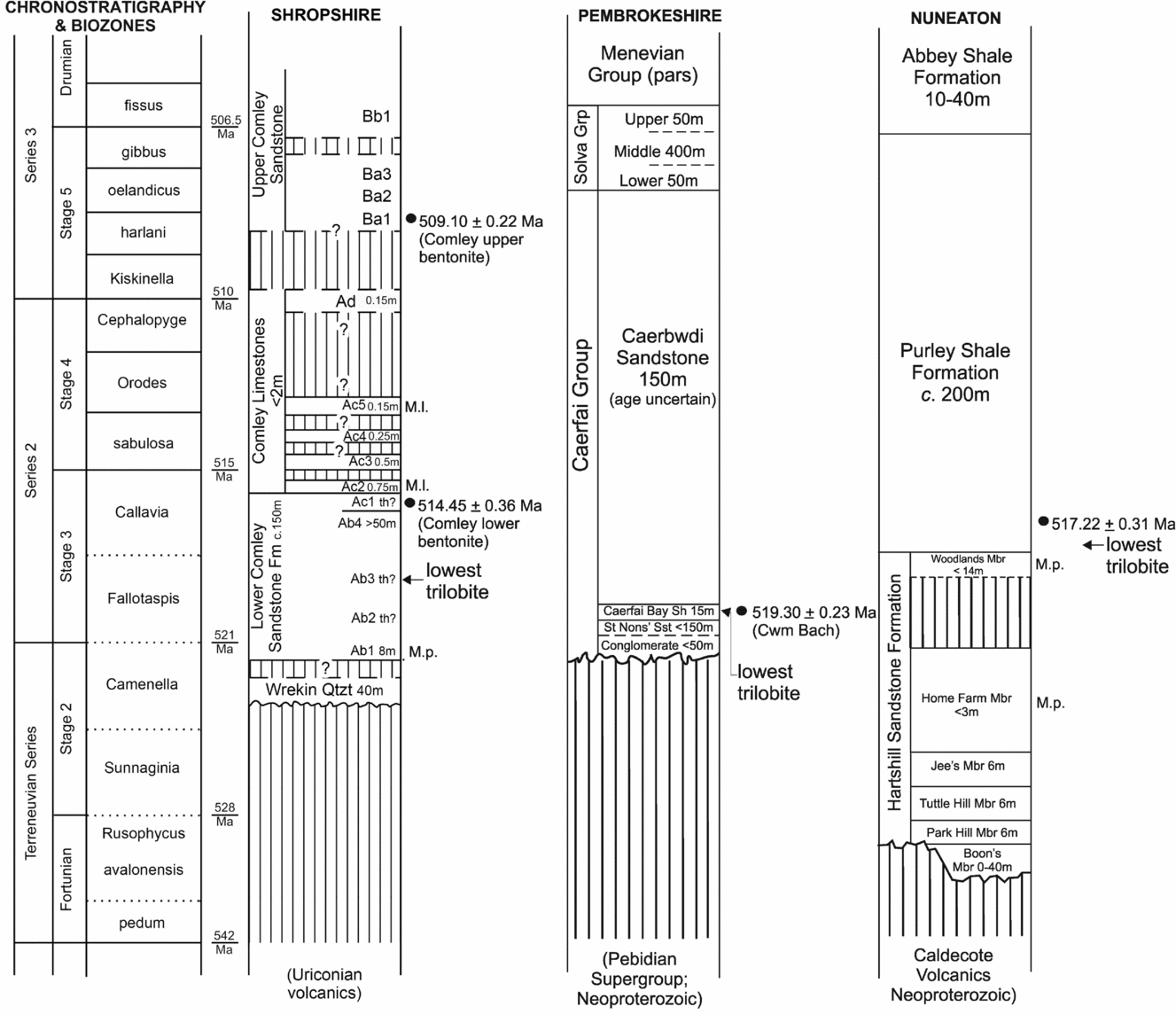
The rock successions of southern Britain have proved important for calibrating a global Cambrian chronology (Rushton et al. Reference Rushton, Brück, Molyneux, Williams and Woodcock2011, fig. 1). The age of the lowermost Cambrian rocks in England and Wales are undetermined, but in Pembrokeshire, a thin bentonite from the Caerfai Bay Shales Formation, some 11 m above the top of the St Non's Sandstone Formation at Caerfai Bay, yielded an age of 519 ± 1 Ma (Landing et al. Reference Landing, Bowring, Davidek, Westrop, Geyer and Heldmaier1998; see Fig. 1), and has been cited in support of a minimum age of 521 Ma for the base of Cambrian Series 2 (see Peng & Babcock, Reference Peng, Babcock, Ogg, Ogg and Gradstein2008; Harvey et al. Reference Harvey, Williams, Condon, Wilby, Siveter, Rushton, Leng and Gabbott2011). In Shropshire, Cambrian rocks have yielded dates that constrain the age of the Cambrian Series 2 – Series 3 boundary (Harvey et al. Reference Harvey, Williams, Condon, Wilby, Siveter, Rushton, Leng and Gabbott2011). A bentonite just below the top of the Green Callavia Sandstone yields an age of 514.45 ± 0.36 Ma (Harvey et al. Reference Harvey, Williams, Condon, Wilby, Siveter, Rushton, Leng and Gabbott2011), which provides a maximum age for the boundary between Cambrian stages 3 and 4 (see Fig. 1), as provisionally recognised by Rushton et al. (Reference Rushton, Brück, Molyneux, Williams and Woodcock2011, p. 3). A bentonite from within the basal Upper Comley Sandstone yields a U–Pb date of 509.10 ± 0.22 Ma that provides a minimum age limit on the base of Series 3, and of Cambrian Stage 5 (Harvey et al. Reference Harvey, Williams, Condon, Wilby, Siveter, Rushton, Leng and Gabbott2011; Fig. 1). This date provides constraint for the interpolated age of 510 Ma for the Series 2 – Series 3 boundary given by Peng & Babcock (Reference Peng, Babcock, Ogg, Ogg and Gradstein2008).
Stratigraphy of the Cambrian, Terreneuvian, Series 2 and Series 3 lithological succession for the Nuneaton area of Warwickshire and contemporaneous lithostratigraphic successions in Shropshire and Pembrokeshire, South Wales. Also shown are intervals from which radiometric dates have successfully been determined. Abbreviations: M.p. – Micromitra phillipsii; M.l. – Micromitra labradorica; ‘th’ – thickness. The alphanumeric nomenclature for the Shropshire column is after Cobbold (Reference Cobbold1921). In the column for Shropshire, ‘Comley upper bentonite’ and ‘Comley lower bentonite’ are defined in Harvey et al. (Reference Harvey, Williams, Condon, Wilby, Siveter, Rushton, Leng and Gabbott2011). In the column for Pembrokeshire, the age of the Caerfai Bay Shales at ‘Cwm Bach’ is the bentonite locality reported by Harvey et al. (Reference Harvey, Williams, Condon, Wilby, Siveter, Rushton, Leng and Gabbott2011), which gives a comparable, but slightly more refined age to that of the bentonite at Caerfai Bay, which yielded an age of 519 ± 1 Ma to Landing et al. (Reference Landing, Bowring, Davidek, Westrop, Geyer and Heldmaier1998).

Here we report a newly analyzed bentonite layer from the lower part of the Purley Shale Formation in Warwickshire, England, which provides the first radiometric age for the Cambrian sedimentary succession of the Charnwood Block within the Midland Microcraton (see Rushton et al. Reference Rushton, Brück, Molyneux, Williams and Woodcock2011). The new age provides additional chronological control on the Cambrian succession of England and Wales, and provides new stratigraphic ties with the evolving global Cambrian chronology (Peng & Babcock, Reference Peng, Babcock, Ogg, Ogg and Gradstein2008).
2. Geological and stratigraphical setting
The Charnwood Block is an integral component of the Avalon Composite Terrane (sensu Woodcock, Reference Woodcock, Rushton, Brück, Molyneux, Williams and Woodcock2011, p. 20), which was already assembled by early Cambrian times, and records part of the Cambrian succession of Avalonia. The Cambrian of the Charnwood Block is exposed in inliers in the Charnwood Forest area of Leicestershire, in the Nuneaton Inlier on the eastern edge of the Coventry Coalfield and in the small Dosthill Inlier on its western boundary fault, the latter two areas being in Warwickshire. Rushton (Reference Rushton and Holland1974, pp. 105–13) gave a general summary of the stratigraphy in these inliers, with references to earlier work. More recent accounts that also refer to many borehole records are given in Bridge et al. (Reference Bridge, Carney, Lawley and Rushton1998), Powell, Glover & Waters, (Reference Powell, Glover and Waters2000) and Rushton et al. (Reference Rushton, Brück, Molyneux, Williams and Woodcock2011). Within the Charnwood Block, the Cambrian rocks of Nuneaton represent a relatively complete stratigraphical succession. The arenaceous lower divisions of the Hartshill Sandstone Formation (Fig. 1) are known from extensive quarry exposures and have been thoroughly studied (Brasier, Reference Brasier, Cowie and Brasier1989 and references therein), and the whole succession of the Stockingford Shale Group has (aside from some parts of the Purley Shale Formation) been studied from excavations and borehole cores (Taylor & Rushton, Reference Taylor and Rushton1971).
The six members of the Hartshill Sandstone Formation (Fig. 1) were described by Bridge et al. (Reference Bridge, Carney, Lawley and Rushton1998, pp. 21–30). Brasier (Reference Brasier, Cowie and Brasier1989, p. 87) showed that they were deposited in a variety of near-shore to offshore marine facies and recorded the presence of several trace fossils of Cambrian type. In the absence of body fossils, correlation of the lower four members, all of them arenaceous, is not very certain. The Home Farm Member is a condensed succession of thin fossiliferous calcareous and phosphatic units, bounded above and below by non-sequences. Brasier (Reference Brasier1984, Reference Brasier1986, Reference Brasier, Cowie and Brasier1989) described the diverse fauna of small shelly fossils and discussed their correlation with the Bonavista Group (Terreneuvian) of SE Newfoundland, especially with the Cuslett Formation, and the overlying Fosters Point Formation (Landing & Benus, Reference Landing, Benus, Landing, Narbonne and Myrow1988); he suggested correlation of the Home Farm Member with part of the Tommotian and the lowest part of the Atdabanian stages of the Siberian Platform. The uppermost division of the Hartshill Sandstone Formation, the Woodlands Member (Fig. 1), overlies a hard-ground and an inferred non-sequence at the top of the Home Farm Member, and appears locally to pass up rapidly into the succeeding Purley Shale Formation (Brasier, Reference Brasier, Cowie and Brasier1989, p. 90).
The Stockingford Shale Group was deposited on a stable but gently subsiding marine shelf, mainly below wave-base. It is divided into seven mudstone formations with thin sandstone beds at some levels, the Purley Shale Formation being the lowermost unit. Deposition appears to have been fairly continuous, apart from an important non-sequence proved in the upper part of Cambrian Series 3 between the Abbey Shale and Mancetter Shale formations, and the possibility of a hiatus in the mid-part of the Purley Shale Formation (see Rushton et al. Reference Rushton, Brück, Molyneux, Williams and Woodcock2011, p. 33, for further discussion). Agnostoids, eodiscid and polymerid trilobites and bradoriid arthropods occur almost throughout the succession and enable correlation with the successions in SE Newfoundland and the biozonal succession in Scandinavia.
3. Sampled locality and horizon
Woodlands Quarry, 200 m NNW of Hartshill Green (5 km NW of Nuneaton), exposes the top of the Hartshill Sandstone Formation, including the upper part of the Jee's Member, the Home Farm Member and the Woodlands Member, succeeded conformably by the basal part of the Purley Shale Formation, the basal contact of which is displaced by a minor cross-fault and complicated by a lamprophyre sill that is intruded into the lowest part of the Purley Shale Formation succession (Eastwood et al. Reference Eastwood, Gibson, Cantrill and Whitehead1923, p. 33). Quarrying has long ceased and the locality is now a Site of Special Scientific Interest or ‘SSSI’ (Rushton et al. Reference Rushton, Owen, Owens and Prigmore1999, p. 81) and is the stratotype for the Home Farm Member.
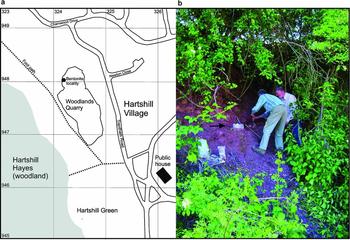
In the 1970s, after the quarry had been landscaped, a white clay bed about 2 cm thick was temporarily exposed near the base of the Purley Shale Formation in the SW face of the quarry; Adrian Rushton collected a small sample that, following analysis by C. R. Hallsworth at the British Geological Survey, was shown to be of volcanic origin. The west side of the quarry has since largely been levelled off and become overgrown. No bentonite can now be seen there, but in 2011 the present authors succeeded in sampling what is assumed to be the same bentonite bed at the northern end of the quarry (Fig. 2).
(a) Geographical position of the bentonite horizon in the NW corner of Woodlands Quarry. (b) The thin bentonite horizon (arrowed) in the basal Purley Shale Formation above the sill, Alan Cook (right) and Adrian Rushton for scale.

The new exposure of bentonite is situated in the NW corner of the Quarry at UK National Grid Reference SP 32417 94805, and at 113.5 to 114.5 m above Ordnance Datum (Lat. 52°33′0.558″N, Long. 1°31′24.0564″W; Fig. 2). The bentonite is estimated to be 7 m stratigraphically above the base of the Purley Shale Formation, but at this locality a sill about 7 m thick, extending from a level about half a metre above the base of the formation to about 6.25 m below the level of the bentonite, makes the topographical separation from the base of the Purley Shale Formation to the bentonite bed about 14 m.
4. U–Pb (zircon) geochronology: absolute age of the Purley Shale Formation bentonite
All analyses were carried out at the NERC Isotope Geosciences Laboratory (NIGL). Prior to ID-TIMS (Isotope Dilution Thermal Ionisation Mass Spectrometry) analyses, zircons were subject to a modified version of the chemical abrasion technique (Mattinson, Reference Mattinson2005). For details of sample pre-treatment, dissolution, anion exchange chemistry, mass spectrometry and data reduction at NIGL see Harvey et al. (Reference Harvey, Williams, Condon, Wilby, Siveter, Rushton, Leng and Gabbott2011) and references therein. Errors for U–Pb dates are reported in the following format: X(Y)[Z], where X is the internal or analytical uncertainty in the absence of all systematic error (tracer calibration and decay constants), Y includes the tracer calibration error (using an estimate of the 2 standard deviation of 0.05% for the Pb/U ratio in the tracer), and Z includes the additional 238U decay constant errors of Jaffey et al. (Reference Jaffey, Flynn, Glendenin, Bentley and Essling1971). These systematic errors are added, in quadrature, to the weighted mean internal error. All analytical uncertainties are calculated at the 95% confidence interval.
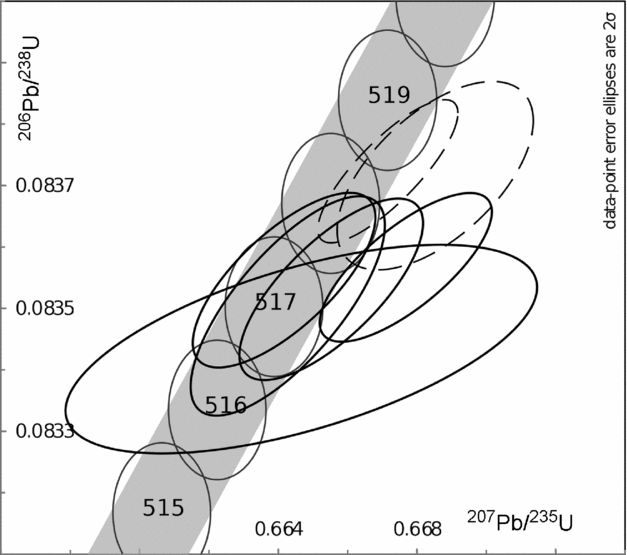
Nine optically clear zircon crystals extracted for chronology had a prismatic habit and pointed crystal terminations typical of magmatic zircon and were analyzed for U–Pb geochronology (Table 1). Grains z6 and z8 yielded 206Pb/238U ages of 1293.3 and 620.7 Ma that are interpreted as xenocrystic. Concordant grains z5 and z7 yielded 206Pb/238U ages of 518.4 Ma that are slightly older than the eruption age (Fig. 3) suggesting a prolonged pre-eruptive magmatic history. The ages of five zircon grains (z1–4 and z12) are equivalent within error and yielded a 206Pb/238U age of 517.22 ± 0.31(0.40)[0.66] Ma (MSWD = 0.67; probability of fit = 0.61). This is taken as the preferred eruption age of this tuff and the emplacement age at this stratigraphic level (Fig. 1).
U–Th–Pb data for zircons analysed by ID-TIMS

(a) z1, z2 etc. are labels for fractions composed of single zircon grains or fragments; all fractions annealed and chemically abraded after Mattinson (Reference Mattinson2005).
(b) Model Th/U ratio calculated from radiogenic 208Pb/206Pb ratio and 207Pb/235U age.
(c) Pb* and Pbc represent radiogenic and common Pb, respectively; mol% 206Pb* with respect to radiogenic, blank and initial common Pb.
(d) Measured ratio corrected for spike and fractionation only.
(e) Corrected for fractionation, spike, and common Pb; up to 1 pg of common Pb was assumed to be procedural blank: 206Pb/204Pb = 18.50 ± 0.50%; 207Pb/204Pb = 15.8 ± 0.5%; 208Pb/204Pb = 38.02 ± 0.75% (all uncertainties 1-sigma). Excess over blank was assigned to initial common Pb.
(f) Errors are 2-sigma, propagated using the algorithms of Schmitz & Schoene (Reference Schmitz and Schoene2007).
(g) Calculations are based on the decay constants of Jaffey et al. (Reference Jaffey, Flynn, Glendenin, Bentley and Essling1971). 206Pb/238U and 207Pb/206Pb ages corrected for initial disequilibrium in 230Th/238U using Th/U [magma] = 4.
Data in bold were used in the age calculation.
Conventional concordia plot for zircons from the Purley Shale Formation for single zircon grains analysed by the ID-TIMS method. The dashed ellipses show grains z5 and z7 that were not used in the age calculation.

5. Biostratigraphy and correlation
Faunas are recorded below the bentonite horizon, principally from the Home Farm Member of the Hartshill Sandstone Formation (Fig. 1). The oldest identifiable fossils that overlie the bentonite are from Locality 1 of Rushton (Reference Rushton1966, p. 4), which is estimated to lie about 60 m above the bentonite layer.
5.a. Home Farm Member
Brasier (Reference Brasier1984, p. 230) recognised six faunal assemblages from the Home Farm Member, in ascending order numbers I–VI, and listed their constituent taxa. Assemblage V, with around 30 taxa, is particularly rich and diverse; it has species in common with faunas from Scandinavia and Siberia, in particular with faunas near the Tommotian–Atdabanian boundary, and with eastern Canada, such as those of the Camenella baltica Biozone of the successions in Cape Breton Island and Newfoundland (Landing, Reference Landing1991, Reference Landing1995, Reference Landing1996). Brasier's (Reference Brasier1984) Assemblage VI extends up to the basal bed of the Woodlands Member; it is much less diverse, but includes some persistent, mainly tubular, fossils such as Coleoloides, Hyolithellus and Torellella that range up from lower assemblages.
5.b. Woodlands Member
Brasier's (Reference Brasier1984) Assemblage VII is a sparse fauna with Coleoloides typicalis and Torellella sp., collected from thin calcareous lenses at the top of the Woodlands Member (Fig. 1).
5.c. Purley Shale Formation
In 1912 the Geological Survey collected fragments of trilobites from calcareous nodules 0.3 m above the base of the Purley Shale Formation at Camp Hill Grange Quarry, 1.4 km SE of Woodlands Quarry, which was formerly a good section (Pringle, Reference Pringle1913; Eastwood et al. Reference Eastwood, Gibson, Cantrill and Whitehead1923, p. 33) but was subsequently filled in. The trilobite fragments were identified as Callavia? by Smith & White (Reference Smith and White1963, p. 401) and are the earliest record of trilobites from the Charnwood Block. Rushton (Reference Rushton1966, p. 37) collected a cephalic fragment from the same locality and horizon and identified it with doubt also as Callavia?, and additionally recorded trilobite fragments from the same horizon at Woodlands Quarry. The whereabouts of the material recorded by Illing (Reference Illing1913, p. 452) from a horizon 12 m above the base of the Purley Shale Formation at Stoneleigh Quarry ‘200 yards (c. 184 m) S of Worthington Farm’ (at SP 3200 9557) has not been ascertained. Brasier et al. (Reference Brasier, Hewitt and Brasier1978), who investigated a larger range of localities (including the working quarries to the SE of Hartshill), added greatly to the fauna by studying acid-insoluble residues from the calcareous deposits. Brasier's (Reference Brasier1984) Assemblage VIII, from calcareous nodules 1.5 m above the base of the Purley Shale Formation, contains Callavia?, Coleoloides typicalis, sponge spicules, conodonts?, Platysolenites antiquissimus and Teichichnus burrows (Brasier, Reference Brasier, Cowie and Brasier1989).
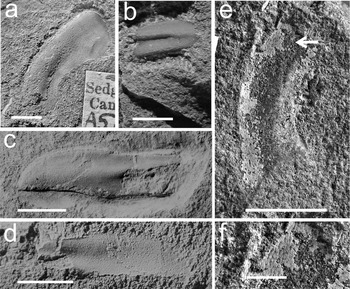
All of the above workers have noted the appearance of trilobite fragments just above the base of the Purley Shale Formation, but they are not identifiable to species level and are only doubtfully compared to Callavia (Fig. 4). It is suspected that the appearance of trilobite fragments is linked to the rapid change to more open marine facies from the Woodlands Member to the Purley Shale Formation, which Brasier (Reference Brasier, Cowie and Brasier1989, p. 87) plausibly envisaged as partly lateral equivalents. In the Cambrian correlation report (Rushton et al. Reference Rushton, Brück, Molyneux, Williams and Woodcock2011, p. 6) the first appearance of trilobites was adopted as a criterion for the recognition of the base of Series 2 of the Cambrian, but it was recognized also that the lowest trilobite biozones might overlap with the Camenella baltica Biozone at the top of the first Cambrian Series, the Terreneuvian.
Trilobites. (a, e, f) Cephalic fragment from Camp Hill Grange Quarry; (a) internal mould, SM A.57266a; (e) the counterpart (SM A.57266b) of the same shows sculpture that resembles that at the edge of the cephalic shield of Callavia callavei from the Comley Limestones (arrowed); (f) part of the same, enlarged. (b) Pleural fragment from Woodlands Quarry, within c. 30 cm of the base of the Purley Shale Formation, SM A.57267a. (c, d) Part and counterpart of a pleural segment assigned doubtfully to Callavia. GSM 102127 and GSM 102128; locality as for (a). Scale bars: (a, b) 3 mm; (c–e) 5 mm; (f) 1.5 mm.

6. Biostratigraphic significance of Micromitra
The fauna from the Home Farm Member of the Hartshill Sandstone Formation contains the brachiopod Micromitra phillipsii, characterized by a small, ventral posteriorly projecting knob, a long straight hinge line and rounded postero-lateral angles (see Cobbold, Reference Cobbold1919; and Brasier, Reference Brasier1984, Reference Brasier1986). Holl (Reference Holl1865) originally described M. phillipsii from the Hollybush Sandstone of the Malvern area and the lectotype was re-figured by Cocks (Reference Cocks2008, pl. 1, fig. 15). Matley (Reference Matley1902) recorded M. phillipsii from the underlying Malvern Quartzite as well as the Hollybush Sandstone, whose age, based on acritarchs, was discussed by T. L. Potter (in Rushton et al. Reference Rushton, Brück, Molyneux, Williams and Woodcock2011, p. 31); a recent review of this material has confirmed Matley's identification. In the Nuneaton area, M. phillipsii occurs in the Home Farm Member and also the Hartshill Sandstone Formation at the base of the Home Farm Member, ranging up to Bed 10ii of Brasier (Reference Brasier, Cowie and Brasier1989, fig. 5.6). Elsewhere in England M. phillipsii is recorded in the lower Cambrian Obolella groomi grits of Shropshire (Cobbold, Reference Cobbold1921; at the Ab1 horizon of Cobbold, see Fig. 1). Although Hinz (Reference Hinz1987) recorded ‘M. phillipsi’ from the somewhat younger Comley Limestones (see Fig. 1), those specimens are not considered to represent M. phillipsii as they appear to lack the characteristic knob.
In England, M. phillipsii appears to be characteristic of the Camenella Biozone and is not known to range up to the level of the oldest trilobites. Landing (Reference Landing1991, Reference Landing1995) recorded M. phillipsii from the lower Cambrian Avalonian successions in Cape Breton, Newfoundland, the Cuslett Formation and the Fosters Point Formation (Bonavista Group), and the Brigus Formation. The Cuslett and Fosters Point formations form part of the Camanella baltica Biozone; Brasier, Anderson & Corfield (Reference Brasier, Anderson and Corfield1992) showed the FAD of M. phillipsii in Avalonia within the lower part of the Cuslett Formation. Brasier (Reference Brasier1984) correlated the Home Farm Member in Nuneaton with the Cuslett Formation of Newfoundland, with faunas typical of the Camanella baltica Biozone, whilst Brasier, Hewitt & Brasier (Reference Brasier, Hewitt and Brasier1978) correlated the top of the Home Farm Member and the overlying Woodlands Member with the Tommotian Stage of Siberia. However, the Brigus Formation overlies the Fosters Point Formation and lies within the Callavia broeggeri Biozone and this indicates that M. phillipsii may range higher in Newfoundland than in England.
The species Micromitra labradorica (Billings), which is distinguished from M. phillipsii in lacking the characteristic knob on the ventral valve and having a high arched beak, is younger, and appears more characteristic of the Callavia Biozone (Cobbold, Reference Cobbold1921; Brasier, Reference Brasier, Cowie and Brasier1989; Hinz, Reference Hinz1987), at which level it occurs in the Cambrian succession of Shropshire (see Fig. 1). It has, however, not been recovered from the Cambrian succession of Warwickshire.
7. Stratigraphic significance of the bentonite
Trilobite fragments from levels near the base of the Purley Shale Formation (Figs 1, 4) appear to correlate to a level low in Stage 3 of the Cambrian, corresponding to some part of the Atdabanian of the Siberian successions, but their biozonal level remains doubtful. A fauna some 66 m above the base of the Purley Shale Formation with Serrodiscus bellimarginatus and Strenuella sabulosa is correlated with the sabulosa Biozone, which is treated as the base of Stage 4 of the Cambrian by Rushton et al. (Reference Rushton, Brück, Molyneux, Williams and Woodcock2011). There is no closer biostratigraphical control on the upper biozonal limit for the bentonite. Therefore, based on palaeontological information from the local succession, the bentonite is not older than the latest parts of the Camenella Biozone (Fig. 1), but could be somewhat younger, especially if, as seems likely, there is a significant time gap represented by the non-sequence between the Home Farm Member and the Woodlands Member; the bentonite is not younger than the sabulosa Biozone. However, it is likely that the bentonite age is nearer the earlier part of Series 2, within the Fallotaspis or Callavia trilobite Biozone, rather than nearer the top of that interval (Fig. 1) as this is supported by radiometric ages from Shropshire and Pembrokeshire for strata near the top and base of Stage 3 respectively (Fig. 1; see also Harvey et al. Reference Harvey, Williams, Condon, Wilby, Siveter, Rushton, Leng and Gabbott2011).
The age of 517.22 ± 0.31 Ma for the lower part of the Purley Shale Formation suggests that the deepening of marine lithofacies in Warwickshire post-dates the commencement of the global eustatic sea level rise interpreted for the Browns Pond dysoxic interval of the Laurentian succession (Landing, Reference Landing2012). In the approximately equivalent Cambrian interval in Shropshire, the Lower Comley Sandstone succession is marine from the level of the late Camenella Biozone through to the Callavia Biozone, its earliest trilobite being referable possibly to Fallotaspis or Kjerulfia (see Bergström, Reference Bergström1973). The equivalent stratigraphic interval in South Wales is represented by the unfossiliferous Caerbwdy Sandstone Formation, which is interpreted to be the product of deltaic deposition (Loughlin & Hillier, Reference Loughlin and Hillier2011). The bentonite horizon at Woodlands Quarry therefore appears to date a local marine transgression in the Nuneaton area.
8. Conclusions
Zircons from a bentonite near the base of the Purley Shale Formation in the Nuneaton area, Warwickshire, provide a 206Pb/238U age of 517.22 ± 0.31 Ma, the first radiometric age for the Cambrian succession of the Midland Microcraton and important for constraining the chronology of the earliest occurrence of trilobites in this region of Avalonia. The first occurrence of trilobites in the Purley Shale Formation is somewhat later than the trilobite fragments recovered from the Caerfai Bay Shales Formation of Pembrokeshire (see Siveter & Williams, Reference Siveter and Williams1995; Harvey et al. Reference Harvey, Williams, Condon, Wilby, Siveter, Rushton, Leng and Gabbott2011) and this is consistent with the appearance of trilobites in the Warwickshire succession being associated with a local marine transgression and a more open marine shelf setting. The new bentonite date provides an additional chronological control on the interval assignable to the Eofallotapsis and Callavia biozones of Cambrian Stage 3.
Acknowledgements
We thank the quarry owner Mr Ian Brown for access to Woodlands Quarry. We are very grateful to Dr Ed Landing (New York State Museum) for detailed discussion on Cambrian stratigraphy. We thank Matt Riley (Sedgwick Museum, Cambridge University) and Louise Neep and Paul Shepherd (British Geological Survey) for making specimens in their care available for study, and Natural England for funding the clearance work supervised by Alan F. Cook and Anton Irving in February 2011. This research was supported by NERC Isotope Geosciences Facilities Steering Committee grant IP/1124/0509.