

The main role of the starter culture in cheese technology is to metabolize lactose to lactic acid. In addition, it contributes to flavor development during cheese ripening based on its multiple enzymatic activities (Beresford et al. Reference Beresford, Fitzsimons, Brennan and Cogan2001). Lactobacillus helveticus is a thermophilic lactic acid bacteria (LAB) and constitutes one of the dominant microorganism of the natural whey starter generally employed in hard cooked cheeses, such as Italian and Swiss-type cheeses (Rossetti et al. Reference Rossetti, Fornasari, Gatti, Lazzi, Neviani and Giraffa2008; Gatti et al. Reference Gatti, Bottari, Lazzi, Neviani and Mucchetti2014). Natural whey starter is also used in Reggianito, which is the most typical grana type-cheese of Argentina (Candioti et al. Reference Candioti, Hynes, Quiberoni, Palma, Sabbag and Zalazar2002; Hynes et al. Reference Hynes, Bergamini, Suárez and Zalazar2003). However, in recent years, the use of frozen or freeze-dried commercial starter cultures composed by selected strains of thermophilic bacteria in combination with chemical acidification of the milk with food-grade acids (e.g., lactic or citric) or acidogen (glucono-δ-lactone – GDL- which it is hydrolyzed to gluconic acid), has become general practice in the Argentinean dairy industry in order to improve and standardize cheese quality (Vélez et al. Reference Vélez, Perotti, Wolf, Hynes and Zalazar2010). The unpredictable performance of the natural whey starter in cheese making is due to the high variability of its microbial composition. Another alternative method employed for culture preparation is the preincubation of the commercial starter in cheese whey. Several strains of L. helveticus (Lh209, Lh133 and Lh138), isolated from Argentinean natural whey starters, have demonstrated a good performance in terms of their technological, biochemical and functional properties in in vitro assays and in cheeses, in which these strains were individually resuspended and preincubated in whey (Reinheimer et al. Reference Reinheimer, Suárez, Bailo and Zalazar1995; Candioti et al. Reference Candioti, Hynes, Quiberoni, Palma, Sabbag and Zalazar2002; Hynes et al. Reference Hynes, Bergamini, Suárez and Zalazar2003; Perotti et al. Reference Perotti, Bernal, Meinardi and Zalazar2005; Burns et al. Reference Burns, Molinari, Beccaria, Páez, Meinardi, Reinheimer and Vinderola2010).
Selected strains of mesophilic lactobacilli of non-starter lactic acid bacteria (NSLAB) origin are also used as adjunct cultures in cheese making to control the potentially harmful microbiota and to improve and diversify cheese flavor and possibly accelerate the ripening (Beresford et al. Reference Beresford, Fitzsimons, Brennan and Cogan2001; Crow et al. Reference Crow, Curry and Hayes2001). Adjunct cultures have been assayed in soft and semi-soft cheeses (Crow et al. Reference Crow, Curry and Hayes2001; Irigoyen et al. Reference Irigoyen, Ortigosa, Juansaras, Oneca and Torre2007; Poveda et al. Reference Poveda, Nieto-Arribas, Seseña, Chicón, Castro, Palop and Cabezas2014) but, to our knowledge, few studies have been made in hard cooked cheeses. The cooking process to which the curd is exposed in the technology of hard cooked cheeses and the prolonged ripening period of these cheeses may affect the viability and enzymatic activities of the mesophilic lactobacilli added as adjunct cultures (Hickey et al. Reference Hickey, Auty, Wilkinson and Sheehan2017). The addition of mesophilic lactobacilli strains isolated from good-quality Tybo Argentinean cheeses, L. paracasei 90 (Lp90), L. plantarum 91 (Lp91) and L. casei 72 (Lc72), was studied in soft and semi-soft cheeses and cheese models and the contribution to the microbial and biochemical changes during cheese ripening was evaluated. In these studies, strains were added after their growth in MRS broth (Milesi et al. Reference Milesi, Vinderola, Sabbag, Meinardi and Hynes2009; Reference Milesi, Wolf, Bergamini and Hynes2010; Bergamini et al. Reference Bergamini, Peralta, Milesi and Hynes2013; Peralta et al. Reference Peralta, Wolf, Perotti, Bergamini and Hynes2016).
The growth medium of the strains used for the cultures preparation can modify their enzymatic activities which may be reflected in the different events related to cheese ripening such as proteolysis, lipolysis and volatile compounds production (Jensen & Ardö, Reference Jensen and Ardö2010; Pedersen et al. Reference Pedersen, Ristagno, McSweeney, Vogensen and Ardö2013).
The aim of this work was to evaluate the impact of two factors on the ripening profiles of hard cooked cheeses: (F1) the growth medium for the primary and adjunct cultures, constituted by autochthonous strains of Lactobacillus helveticus 209 (Lh209) and Lactobacillus paracasei 90 (Lp90), respectively, and (F2) the addition of Lp90 as adjunct culture.
Materials and methods
Strains and culture preparations
Two autochthonous strains belonging to INLAIN collection were used: L. helveticus 209 (Lh209) and L. paracasei 90 (Lp90). They are preserved at −80 °C in MRS broth (Biokar Diagnostiks, France) with 1·5 ml/l of glycerol as cryopreservant. Before use, each strain was reactivated in MRS broth (20 ml/l) twice in the broth overnight.
Two different growth media were assayed for the preparation of the primary and adjunct cultures (Lh209 and Lp90, respectively): cheese whey and MRS broth.
In the first case, the methodology used was according to Candioti et al. (Reference Candioti, Hynes, Quiberoni, Palma, Sabbag and Zalazar2002); the cheese whey (pH = 5·89 ± 0·09, acidity = 20 ± 2·0°D) was previously obtained from hard cooked cheese making performed in our pilot plant. A portion (approx. 800 ml) of whey was treated at 85 °C for 15 min, cooled at room temperature and distributed in three portions. The first aliquot (400 ml) was inoculated with the overnight culture of Lh209 (20 ml/l) and incubated for 24 h at 43 °C; the second aliquot (200 ml) was inoculated with the overnight culture of Lp90 (20ml/l) and incubated for 24 h at 37 °C; the third aliquot (200 ml) was not inoculated. After incubation, the whey containing the Lh209 strain reached a pH of 3·5 ± 0·1, a titratable acidity of 110·0 ± 3·5°D and a lactobacilli population of 9·0 log CFU/ml; and the whey with the Lp90 strain reached a pH of 4·0 ± 0·1, a titratable acidity of 55·0 ± 2·2°D and a lactobacilli population of 8·9 log CFU/ml.
In the second case, Lh209 and Lp90 strains were inoculated individually into MRS broth (50 ml) and incubated overnight at 43 and 37 °C, respectively. After incubation, the cells were harvested by centrifugation (10 000 g/10 min/5 °C) and the cell pellet was washed with 50 mm potassium phosphate buffer (pH 7). Then, they were resuspended in UHT milk (50 ml).
Experimental design and cheese making
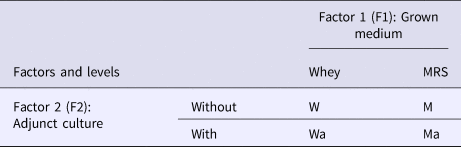
Miniature hard cooked cheeses (Reggianito type) were manufactured according to the standard protocol adapted to small scale by Vélez et al. (Reference Vélez, Perotti, Wolf, Hynes and Zalazar2010). Four stainless steel vats of 5 l of capacity were operated simultaneously and one cheese of about 0·5 kg was obtained from each vat. Four types of cheese were obtained: W, Wa, M and Ma cheeses (Table 1), which were manufactured in duplicate. The inoculation level of the Lp90 culture was selected in preliminary experiments employing a minicurd model (Vélez et al. Reference Vélez, Perotti, Rebechi, Meinardi, Hynes and Zalazar2011), in which this strain was exposed to the stress conditions of the hard cooked cheese making.
Experimental design for cheese making

Raw milk (20 l) was pasteurized at 65 °C for 30 min, cooled at 33 °C and distributed in the four vats (5 l in each one). CaCl2 (0·2 g/l) was added and then Lh209 and Lp90 cultures were inoculated to cheese milks, depending on the type of cheese. In this way, the whey culture with Lh209 was added to W and Wa cheese milks (40 mL/L), and, at the same time, the whey culture containing Lp90 was also incorporated in the Wa cheese milks (40 ml/l). An aliquot (200 ml) of sterilized whey was added to W cheese milks to equilibrate the volume in relation to Wa cheese milks. The Lh209 and Lp90 cultures, grown in MRS broth and resuspended in milk, were added to Ma cheese milks, while for M cheese milks the Lh209 culture was only added. In M and Ma cheese milks, pH was adjusted to the target value of 6·2–6·3 with glucono-δ-lactone (GDL) (Sigma Chemical CO, St Louis, EE.UU) (1·5 g/l). The addition of GDL is not necessary in W and Wa cheese milks because the whey cultures already provides the suitable acidity for this type of cheese. Then, chymosin (Chy-Max, Chr. Hansen Inc., Denmark, 350 IMCU/ml) was added at a concentration of 3·5 ml/l. Milk was allowed to set undisturbed for 20–25 min; the curd obtained was cut until reaching a size similar to half of a grain of rice. The mixture was heated to 52 °C at a rate of 1 °C/min, and then the curd was separated from the whey, placed in the mold, pressed during 12 h and salted by immersion in brine (200 g/l, pH 5·4) for 12 h at 12 °C. Cheeses were ripened at 12 °C and 80% relative humidity for 3 months. During this period, cheeses were vacuum packaged (approximately at 20 d of ripening) when they reached the appropriate moisture level (<360 g/kg). Microbial counts and pH measurements were performed at 7, 45 and 90 d, and the pH was also determined at the beginning of ripening (0 d). Gross composition, proteolysis and profiles of carbohydrates, organic acids and volatile compounds were analyzed at the end of ripening.
pH, gross composition, microbiological and proteolysis analyses
pH (Bradley et al. Reference Bradley, Arnold, Barbano, Semerad, Smith, Vines and Marshall1993), total solids (ISO 5534:2004), fat by Gerber Van Gulik methodology (ISO 3433:2008), and proteins by Kjeldahl method (ISO 8968-1/IDF 20-1:2011) were performed in all cheeses. Proteolysis was determined by measuring the nitrogen content by Kjeldahl of the soluble fractions at pH 4·6, in trichloracetic acid (TCA) 120 ml/l and in phosphotungstic acid (PTA) 25 ml/l, according to Hynes et al. (Reference Hynes, Bergamini, Suárez and Zalazar2003).
Thermophilic and mesophilic lactobacilli were analyzed by plate count on MRS agar (Biokar Diagnostics, France) after 48 h of incubation at 43 and 37 °C, respectively. Thermophilic lactobacilli only grew at 43 °C, while at 37 °C both mesophilic and thermophilic lactobacilli were able to grow, but the strains Lh209 and Lp90 were differentiated by phase contrast microscopic observation and the different morphology of the colonies: pin-point opaque colonies with small center and transparent halo-shaped border for Lh209 and small, smooth and creamy colonies for Lp90 (Reinheimer et al. Reference Reinheimer, Quiberoni, Tailliez, Binetti and Suárez1996; Bude-Ugarte et al. Reference Bude-Ugarte, Guglielmotti, Giraffa, Reinheimer and Hynes2006).
Organic acids and carbohydrates profiles
Organic acids and carbohydrates were analyzed by HPLC according to Peralta et al. (Reference Peralta, Wolf, Perotti, Bergamini and Hynes2016). The HPLC system consisted of an Aminex HPX-87H column (300 mm × 7·8 mm) and Aminex Cation-H guard column (30 × 4·6 mm) (Bio-Rad Laboratories, USA), thermostated at 65 °C. 0·01 M H2SO4 was used as mobile phase at a flow rate of 0·6 ml/min. UV (210 nm) and IR detectors were employed for the detection of organic acids and carbohydrates, respectively.
Volatile compounds
The analysis of volatile compounds was performed according to Wolf et al. (Reference Wolf, Perotti, Bernal and Zalazar2010). Headspace solid-phase microextraction (SPME) coupled to a gas chromatograph (GC) with flame ionization detector (FID) (Perkin Elmer, USA) was employed to isolate, separate and semi-quantify the compounds. A HP-INNOWAX column (60 m × 0·25 µm × 0·25 mm) (Agilent J&W, USA) was used. Desorption was made over 5 min at 250 °C. The detector was maintained at 290 °C. Peaks were tentatively identified by comparing their retention times to standards (Sigma Aldrich, Italy) injected under the same conditions and confirmed by mass spectrometry (GC Varian CP-3800 – MS Saturn 2000). The areas of the compounds were expressed in arbitrary units.
Statistical analyses
Two-way analysis of variance (ANOVA) was conducted on all results using Minitab 16 software (Minitab Inc., State College, PA, USA). When differences were significant (P < 0·05), the means were compared using Tukey's test. Volatile compounds with significant differences were further subjected to the principal component analysis (PCA) using IBM SPSS Statistics 20·0 software (SPSS Inc., USA).
Results and discussion
Physicochemical and microbiological analyses
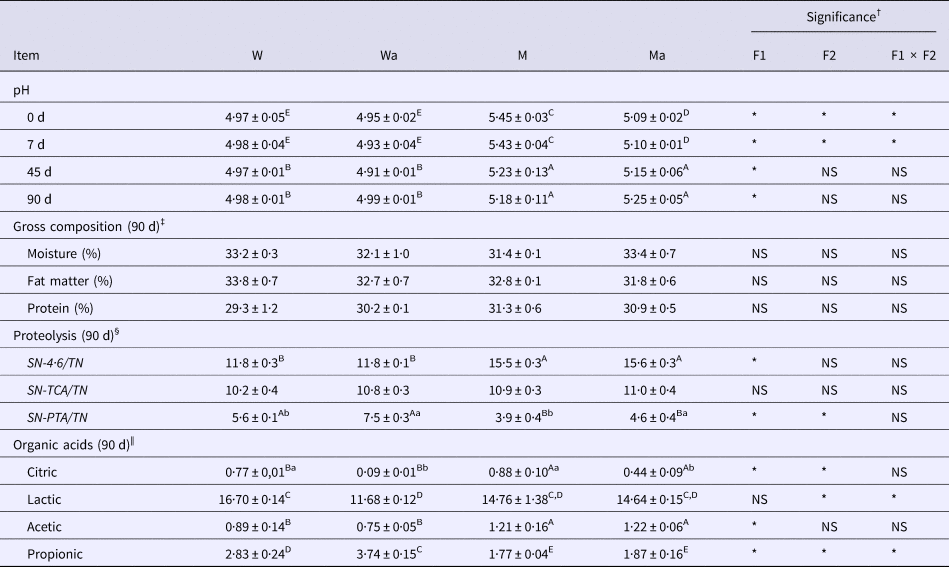
The two factors studied affected (P < 0·05) the pH of cheeses at 0 and 7 d; the pH values in decreasing order were: M > Ma > W~Wa cheeses. From the middle of the maturation (45 d) only the growth medium of cultures influenced the values: M~Ma > W~Wa cheeses (P < 0·05). These results show that Lh209 had higher acidifying activity after its growth in whey (Table 2). It is known that strains of mesophilic lactobacilli have low acidifying activity (Briggiler-Marcó et al. Reference Briggiler-Marcó, Capra, Quiberoni, Vinderola, Reinheimer and Hynes2007). As for the pH evolution during maturation, the values were unchanged in W and Wa cheeses, while a slight diminution was produced in M and Ma cheeses towards 90d.
Physicochemical composition, proteolysis, and organic acids in cheeses

NS, No significant.
† F1 = Methodology of the culture preparation; F2 = Adjunct culture.
‡ Values expressed as g 100/g of cheese.
§ Soluble nitrogen at pH 4·6 (SN-4·6), in trichloroacetic acid (SN-TCA); and in phosphotungstic acid (SN-PTA), expressed as percentage of total nitrogen (TN).
‖ Concentration of organic acids, expressed as g/Kg of cheese.
A,BValues within rows with different superscripts differ significantly (P < 0·05) for F1.
a,bValues within rows with different superscripts differ significantly (P < 0·05) for F2.
C,D,EValues within rows with different superscripts differ significantly (P < 0·05), when F1 × F2 is significant.
*P < 0·05.
Values are means ± SD.
The levels of the moisture and the contents of protein and fat matter at the end of ripening were similar for all cheeses (Table 2). Population of thermophilic lactobacilli in all cheeses was approx. 8·5 log CFU/g at 7 d, decreased ~1·3 log CFU/g (P < 0·05) at the middle of ripening (45 d), and then remaining unchanged towards the end of period (90 d) (Fig. 1). Counts of Lp90 in Ma and Wa cheeses were unchanged from 7 to 45 d reaching values between 8 and 9 log CFU/g, and then decreased ~2 log CFU/g (P < 0·05) at 90 d (Fig. 1). The decrease of the microbial counts has been reported in many cheese varieties and associated with the exposure of cultures to the adverse conditions present in the cheese matrix (lack of nutrients, high salt level in moisture, negative redox potential, among others), which may involve cell death, permeabilization and/or lysis and the release of enzymes (Beresford et al. Reference Beresford, Fitzsimons, Brennan and Cogan2001; Gatti et al. Reference Gatti, Bottari, Lazzi, Neviani and Mucchetti2014). However, the levels of Lp90 in cheeses at the end of ripening were superior to 6 log CFU/g, indicating a good survival of the strain to cheese environment. A high viability was also observed for this strain when it was used as adjunct culture in soft and semi hard cheeses (Briggiler-Marcó et al. Reference Briggiler-Marcó, Capra, Quiberoni, Vinderola, Reinheimer and Hynes2007; Milesi et al. Reference Milesi, Vinderola, Sabbag, Meinardi and Hynes2009).
Evolution of population of thermophilic lactobacilli (top panel) and mesophilic lactobacilli (bottom panel) during cheese ripening (values are means ± SD).

Proteolysis
The proteolysis was significantly affected by both factors studied (Table 2). The growth medium of the cultures influenced the SN-4·6/TN and SN-PTA/TN fractions and the addition of Lp90 only influenced this latter fraction, while no change was detected in the SN-TCA/TN fraction by any of the factors studied. The SN-4·6/TN fraction is an index of the primary proteolysis of cheeses, and it includes proteins -except caseins, peptides, amino acids (AA) and smaller sized N compounds-; the SN-TCA/TN fraction including medium sized to small peptides, free amino acids and smaller sized N compounds, and the SN-PTA/TN fraction including free amino acids and smaller sized N compounds (such as amines, urea and ammonium), are indexes of secondary proteolysis. The levels of the SN-4·6/TN fraction were higher (P < 0·05) in M and Ma cheeses, whereas the SN-PTA/TN fraction had higher levels (P < 0·05) in W and Wa cheeses. These results suggest that the activity of the proteolytic and peptidolytic enzymes of the cultures appear influenced by the growth medium (Jensen & Ardö, Reference Jensen and Ardö2010; Pedersen et al. Reference Pedersen, Ristagno, McSweeney, Vogensen and Ardö2013).
The addition of the adjunct culture produced a significant effect on the secondary proteolysis as it increased (P < 0·05) the values of the SN-PTA/TN fraction. Thus, the inclusion of Lp90 as adjunct culture in Reggianito cheese could contribute to accelerate ripening. Similar results were also evidenced for this strain when it was added as adjunct culture in soft and semi-hard cheeses made with S. thermophilus as primary starter (Milesi et al. Reference Milesi, Vinderola, Sabbag, Meinardi and Hynes2009).
Organic acids and carbohydrates profiles
Lactose, glucose and galactose were not detected in any of the cheeses analyzed. This result was expected as approx. 98% of the lactose is lost in the whey and the lactose residual in the curd is rapidly metabolized by the microbiota present. Glucose is one of the main energy sources of lactic acid bacteria and it is consumed in the first hours of cheese making and galactose can be metabolized by most species of lactobacilli (Beresford et al. Reference Beresford, Fitzsimons, Brennan and Cogan2001). The contents of citric, lactic, acetic and propionic acids in the cheeses were influenced differently by both factors studied (Table 2). Lactic was the major acid in all cheeses. The highest values (P < 0·05) were found for W cheeses and the lowest (P < 0·05) for Wa cheeses, while M and Ma cheeses showed intermediate values. These results suggest that Lp90 metabolized lactic acid into other compounds in Wa cheeses. A decrease (P < 0·05) in the citric acid levels was produced by Lp90 addition, mainly in Wa cheeses. Similar results were obtained by Buffa et al. (Reference Buffa, Guamis, Saldo and Trujillo2004), who detected a consumption of this acid in the absence of fermentable sugars by mesophilic lactobacilli present in the cheeses. In contrast, Lp90 was not able to metabolize citrate when added as adjunct culture in soft cheeses (Milesi et al. Reference Milesi, Wolf, Bergamini and Hynes2010). These different results observed for the same strain could be attributed to the carbohydrate content in the cheese matrix; in soft cheese there were considerable levels of residual lactose and galactose, while in hard cheese, the levels of these carbohydrates were negligible (Milesi et al. Reference Milesi, Wolf, Bergamini and Hynes2010; Peralta et al. Reference Peralta, Bergamini, Audero, Páez, Wolf, Perotti and Hynes2017). The methodology of the culture preparation also influenced the levels of citric; its content was lower (P < 0·05) in W and Wa cheeses. Acetic acid levels were higher (P < 0·05) in M and Ma cheeses, whereas an inverse behavior was observed for propionic acid as W and Wa cheeses had higher values (P < 0·05). The addition of Lp90 did not affect the acetic acid levels but increased (P < 0·05) the propionic acid concentration only in Wa cheeses.
Volatile compounds
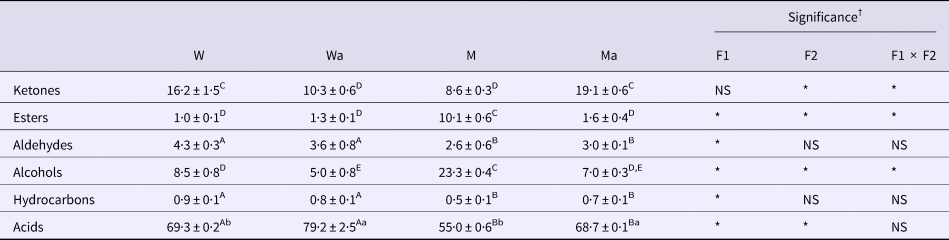
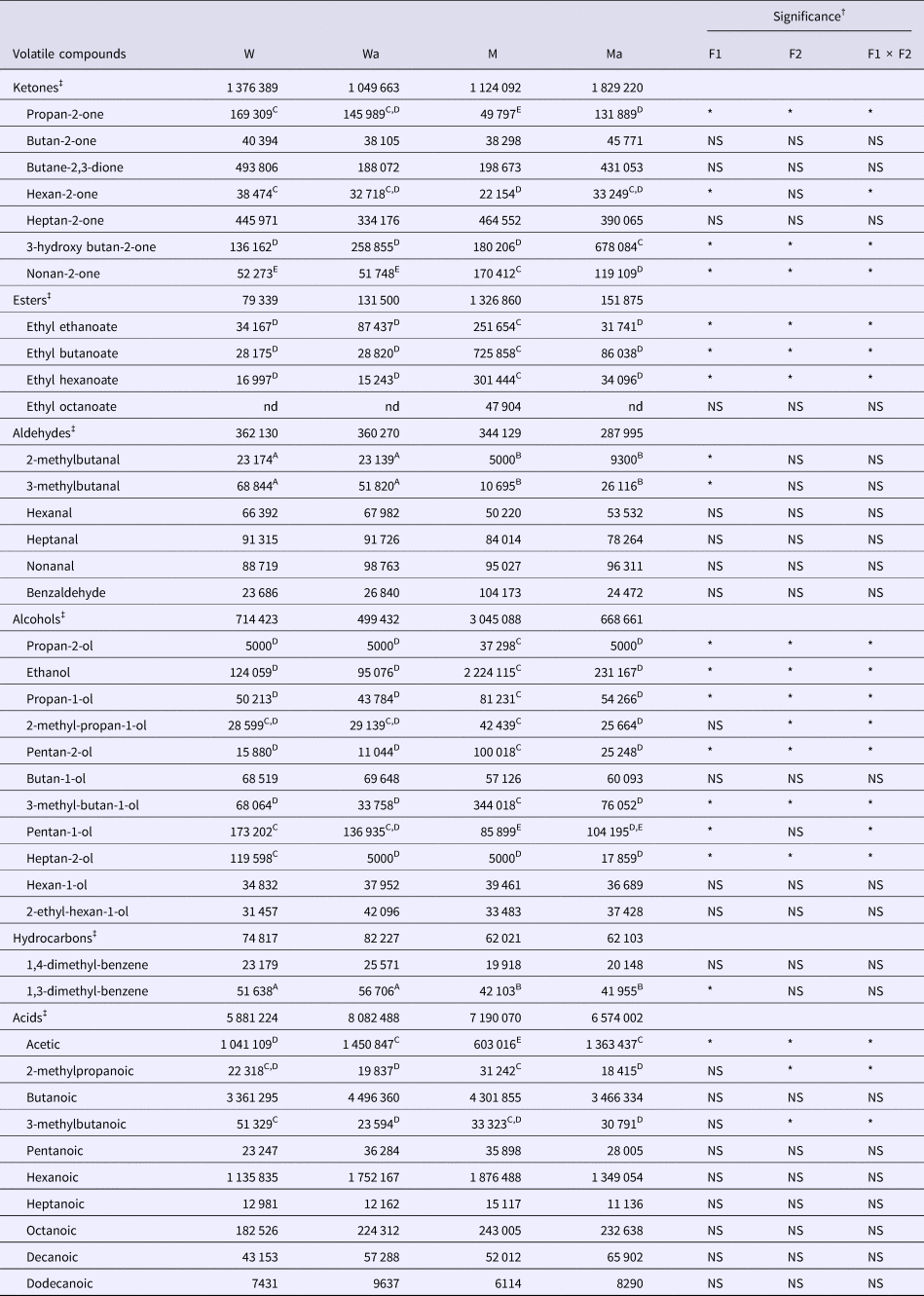
A total of 40 volatile compounds were identified in the headspace of cheese samples and grouped by chemical families: ketones, esters, aldehydes, alcohols, hydrocarbons and acids. These compounds have been reported in Reggianito type cheese (Wolf et al. Reference Wolf, Perotti, Bernal and Zalazar2010). Percentages of each family of compounds are shown in Table 3.
Percentages of the chemical families of the volatile compounds in cheeses at the end of ripening (90 d) (values are means ± sd)

NS, No significant.
† F1 = Methodology of the culture preparation; F2 = Adjunct culture.
A,BValues within rows with different superscripts differ significantly (P < 0·05) for F1.
a,bValues within rows with different superscripts differ significantly (P < 0·05) for F2.
C,D,EValues within rows with different superscripts differ significantly (P < 0·05), when F1 × F2 is significant.
*P < 0·05.
Acids were the predominant group in all cheeses. Ketones were the second most important group in W, Wa and Ma cheeses, while alcohols were the second most important group in M cheeses. The growth medium influenced compound profile in all the chemical families except ketones, and the Lp90 addition affected the levels of ketones, esters, alcohols and acids. W and Wa cheeses had higher levels (P < 0·05) of acids, aldehydes and hydrocarbons than M and Ma cheeses. These results suggest an impact of the growth medium of the cultures on the metabolic activities related to the cheese flavor formation (Jensen & Ardö, Reference Jensen and Ardö2010; Pedersen et al. Reference Pedersen, Ristagno, McSweeney, Vogensen and Ardö2013). Lp90 produced a marked increase (P < 0·05) in the acids and an important decrease (P < 0·05) in the alcohols. In addition, a diminution (P < 0·05) of the ketones in Wa cheeses, and an increase (P < 0·05) of them in Ma cheeses, in comparison with W and M cheeses, respectively, were observed. The ability of Lp90 to produce acids and metabolize alcohols has been reported by Milesi et al. (Reference Milesi, Wolf, Bergamini and Hynes2010).
The area values of the individual compounds are presented in Table 4 and summarized in Fig. 2. Significant differences were only found for 21 of the 40 compounds detected. Interactive effects of both factors were detected for the majority of them. Nonan-2-one, ethyl ethanoate, ethyl butanoate, ethyl hexanoate, propan-2-ol, ethanol, propan-1-ol, pentan-2-ol and 3-methyl-butan-1-ol had higher area values (P < 0·05) in M cheeses, while 3-hydroxy butan-2-one was found in higher level (P < 0·05) in Ma cheeses. 3-hydroxy butan-2-one is an important aroma compound in grana cheeses, which can be produced by the action of mesophilic bacteria (Fox et al. Reference Fox, Guinee, Cogan, McSweeney and Fox2000). Peralta et al. (Reference Peralta, Wolf, Perotti, Bergamini and Hynes2016) demonstrated the ability of Lp90 to produce this compound in a hard cheese extract. In addition, Wa and Ma cheeses had higher levels of acetic acid; a similar effect of Lp90 was previously observed in Cremoso cheese and in a soft cheese extract (Milesi et al. Reference Milesi, Wolf, Bergamini and Hynes2010; Peralta et al. Reference Peralta, Wolf, Perotti, Bergamini and Hynes2016). Lp90 strain showed a tendency to metabolize 2-methyl-propan-1-ol, 2-methylpropanoic and 3-methylbutanoic acids as their area values were lower in cheeses added with Lp90; this effect depended on the growth medium used for the culture preparation. M cheeses had higher levels (P < 0·05) of 2-methylpropanoic and 2-methyl-propan-1-ol than Ma cheeses, while the values of 3-methylbutanoic acid were higher (P < 0·05) in W than Wa samples. Different values of hexan-2-one and propan-2-one were detected for cheeses without Lp90; levels in W cheeses were higher (P < 0·05) than in M cheeses. On the other hand, the production of 2- and 3-methylbutanal (derived from the catabolism of isoleucine and leucine, respectively), and of 1,3-dimethyl-benzene was only affected by the growth medium of the cultures; W and Wa cheeses had higher areas values (P < 0·05) than M and Ma cheeses. The aldehydes are transient compounds as they can be easily oxidized or reduced depending on the redox potential of the medium (van Kranenburg et al. Reference van Kranenburg, Kleerebezem, van Hylckama Vlieg, Ursing, Boekhorst, Smit, Ayad, Smit and Siezen2002; Yvon, Reference Yvon2006). These compounds have been reported as characteristics in Reggianito type cheese (Wolf et al. Reference Wolf, Perotti, Bernal and Zalazar2010); some of them have low threshold perception and thus could impact in the sensory profile and finally in the cheese quality.
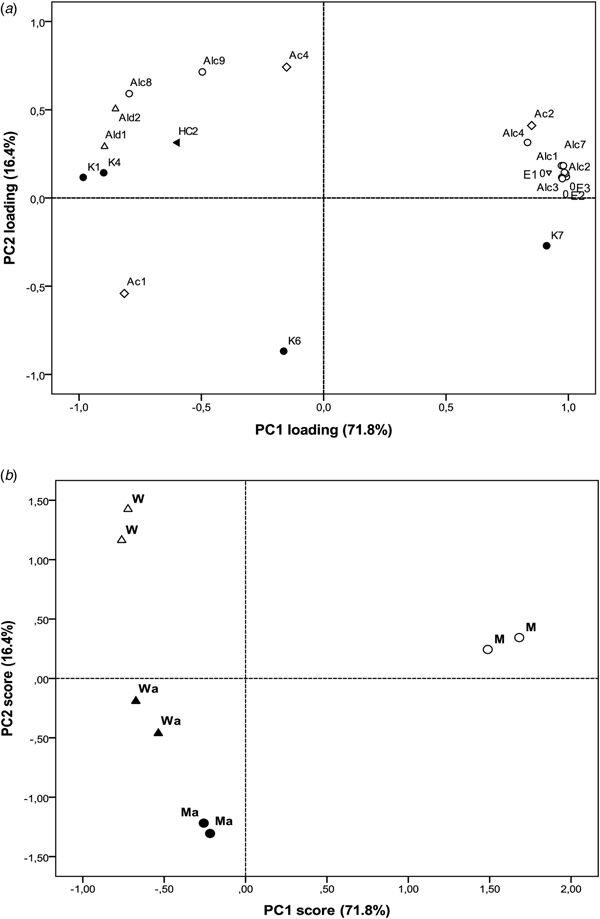
Loading plot (a) and score plot (PC1 vs. PC2) (b) of the PCA applied on the volatile compounds of cheese samples at the end of ripening (90 d). K1, propan-2-one; K4, hexan-2-one; K6, 3-hydroxy butan-2-one; K7, nonan-2-one; E1, ethyl ethanoate; E2, ethyl butanoate; E3; ethyl hexanoate; Ald1, 2-methylbutanal; Ald2, 3-methylbutanal; Alc1, propan-2-ol; Alc2, ethanol; Alc3, propan-1-ol; Alc4, 2-methyl-propan-1-ol; Alc5, pentan-2-ol; Alc7, 3-methyl-butan-1-ol; Alc8, pentan-1-ol; Alc9, heptan-2-ol; HC2, 1,3-dimethyl-benzene; Ac1, acetic acid; Ac2, 2-methyl propanoic; Ac4, 3-methylbutanoic.

Volatile compounds in cheeses at the end of ripening (90 d), expressed in arbitrary unit areas

ND, No detected; NS, No significant.
† F1 = Methodology of the culture preparation; F2 = Adjunct culture.
‡ Total area values of compounds for each chemical family.
A,BValues within rows with different superscripts differ significantly (P < 0·05) for F1.
a,bValues within rows with different superscripts differ significantly (P < 0·05) for F2.
C,D,EValues within rows with different superscripts differ significantly (P < 0·05), when F1 × F2 is significant.
*P < 0·05.
In the PCA, the first two PC accounted 88·2% of the total variance, PC1 and PC2 described 71·8 and 16·4% of the variation, respectively. The score and loading plot on PC1 vs. PC2 (Fig. 2) allowed us to summarize the information shown in Table 4, and clearly to visualize the differentiation of cheese samples according to the factors studied. W and Wa cheeses were characterized by the compounds negatively associated with PC1 (propan-2-one, hexan-2-one, 2- and 3-methyl butanal, acetic acid) and positively related to PC2 (heptan-2-ol and 3-methylbutanoic acid). M samples were placed on the upper right quadrant characterized by the compounds positively related to PC1 (propan-2-ol, ethanol, propan-1-ol, 2-methyl-propan-1-ol, pentan-2-ol, 2-methyl-butan-1-ol, nonan-2-one, ethyl ethanoate, ethyl butanoate and ethyl hexanoate and methylpropanoic acid), and they were separated perfectly of the Ma samples mainly characterized by compounds negatively associated with PC2 (3-hydroxy butan-2-one). Wa and Ma cheeses were located in the lower left quadrant characterized by compounds negatively associated with PC1 and PC2 and they separated clearly from M and W samples, which were positively related to PC1 and PC2.
The influence of different L. paracasei strains on the formation of flavor compounds has been reported. For example, Thage et al. (Reference Thage, Broe, Petersen, Petersen, Bennedsen and Ardö2005) found different flavor profiles for semi-hard reduced-fat cheeses made with the addition of three different strains of L. paracasei as adjunct cultures; the CHCC4256 strain showed the highest effect above all in the production of flavor compounds derived from branched-chain amino acids and aspartic acid (Asp), while the other two strains showed a lower or undetectable effect. In ewe´s cheeses such as Roncal-type and Manchego, the incorporation of L. paracasei strains increased several volatile compounds: acetic and butyric acids, 3-hydroxy butan-2-one, propan-1-one and some alcohols (Irigoyen et al. Reference Irigoyen, Ortigosa, Juansaras, Oneca and Torre2007; Poveda et al. Reference Poveda, Nieto-Arribas, Seseña, Chicón, Castro, Palop and Cabezas2014).
The influence of the growth medium on the microbial enzymatic activities involved in the aroma compounds production has been evaluated in various studies. The growth medium (MRS, skim milk, cheese extract) modified the profile of the aminotransferase (AT) activities of several strains of lactobacilli (Jensen & Ardö, Reference Jensen and Ardö2010; Pedersen et al. Reference Pedersen, Ristagno, McSweeney, Vogensen and Ardö2013). Likewise, García-Cayuela et al. (Reference García-Cayuela, Gómez de Cadiñanos, Peláez and Requena2012) have verified that the gene expression of enzymes involved in AA catabolism increased in a medium without valine and isoleucine; whereas Yvon et al. (Reference Yvon, Chambellon, Bolotin and Roudot-Algaron2000) reported the inhibition of the gene expression for aminotransferase activity related to branched-chain AA in the presence of high concentrations of the AA mentioned above, and methionine.
Conclusions
The L. paracasei 90 strain, added as an adjunct culture in hard cooked cheese, demonstrated an ability to favour some of the biochemical events related to cheese ripening. The growth medium used for the L. helveticus 209 and L. paracasei 90 cultures preparation impacted on their metabolic activities related to proteolysis and volatile compounds production.
According to the results, the incorporation of L. paracasei 90 as an adjunct culture in hard cooked cheeses, and the preincubation of the L. helveticus 209 and L. paracasei 90 cultures in cheese whey are interesting technological approaches to accelerate the cheese ripening and to enhance the production of some characteristic compounds of Reggianito type cheese. Both autochthonous strains, Lh209 and Lp90, demonstrated promise for the formulation of cultures for hard cooked cheeses.
Acknowledgements
The authors acknowledge to Consejo Nacional de Investigaciones Científicas y Técnicas (CONICET, Argentina) for the doctoral fellowship of Facundo Cuffia. The present work was financially supported by grants from Universidad Nacional del Litoral (CAI + D N° 501-201-10100082-LI).