Architectural remains are ubiquitous in the archaeological record, yet studies that seek to explain architectural variation in ancient societies are rare. This dearth of attention has been especially true of the most commonly encountered architectural remains—domestic structures. In contrast to the conspicuous scale and aesthetic value of public monuments such as mounds, pyramids, megaliths, and great walls, small and simple household dwellings can fade into the background of research priorities. Yet houses are an ideal unit of analysis for examining a wide range of research topics, including settlement and demographic patterns, urbanization, wealth inequality, and sociopolitical organization (Abrams Reference Abrams and Schiffer1989:48; Hirth Reference Hirth, MacEachern, Archer and Garvin1989:441; Olson and Smith et al. Reference Smith, Dennehy, Kamp-Whittaker, Colon and Harkness2014, Reference Olson and Smith2016).
Perhaps the rarity of architectural analyses of domestic structures stems in part from a lack of objective and easily applied methods for comparative research. We develop such methods for the ancient domestic architecture of south-central Arizona, where Hohokam villagers, over time, used a variety of architectural styles to build their homes. Our approach follows one described and applied by Abrams (Reference Abrams and Schiffer1989, Reference Abrams1994) called “architectural energetics.” It translates architecture into its labor inputs (the temporal duration of effort measured in person-hours for construction), and thereby promotes comparative analyses with comparable units of analysis (Abrams Reference Abrams and Schiffer1989:48). Ours is a quantitative, explicit, and replicable approach based on evidence typically accessible archaeologically in the Hohokam area.
To illustrate the utility of our approach, we document the cost differentials among the various Hohokam architectural styles, allowing for their changing popularity over time. We then apply an energetics approach to examine one of the key architectural transitions in Hohokam prehistory—the shift from wattle-and-daub pithouses to adobe and masonry surface rooms. For many years, this shift in architectural styles was attributed to cultural factors, namely, the arrival of Puebloan immigrants from the north (Gladwin Reference Gladwin1957:252–269; Haury Reference Haury1945:204–210, Reference Haury1976:355). More recently, it has been attributed to the depletion of wood for homebuilding due to population growth and environmental degradation (Loendorf and Lewis Reference Loendorf and Lewis2017:128–130).
We evaluate the argument for wood depletion with architectural data from the site of Pueblo Grande, one of the preeminent Hohokam villages in the Phoenix area. Our analysis focuses on the relative labor costs involved in using wood versus adobe in house construction. We also explore the relationship between population growth and the reduction in wood usage that occurred over time. We argue that wood depletion and population growth may have contributed to architectural change at Pueblo Grande, but social processes operating at the regional and macro-regional levels were likely more important. In a forthcoming paper, we use the Pueblo Grande architectural data to address social and political differentiation in Hohokam society, which may have been on the cusp of institutionalized inequality. Differences across households in the absolute expenditure and the relative cost per square footage may reflect inequitable control of resources, allowing some households to expend exaggerated amounts of labor on their residential architecture.
Hohokam Culture
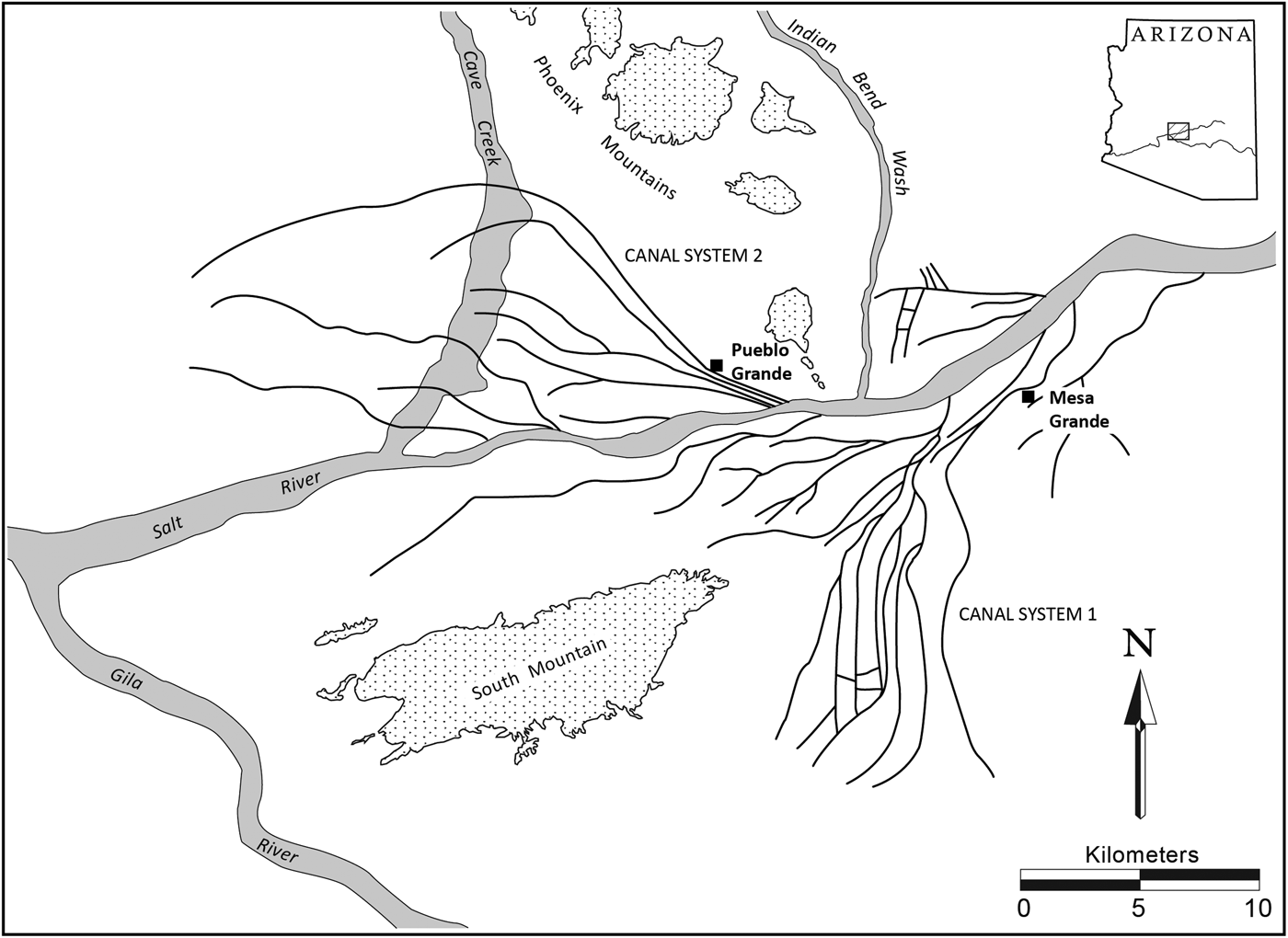
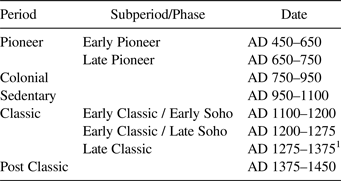
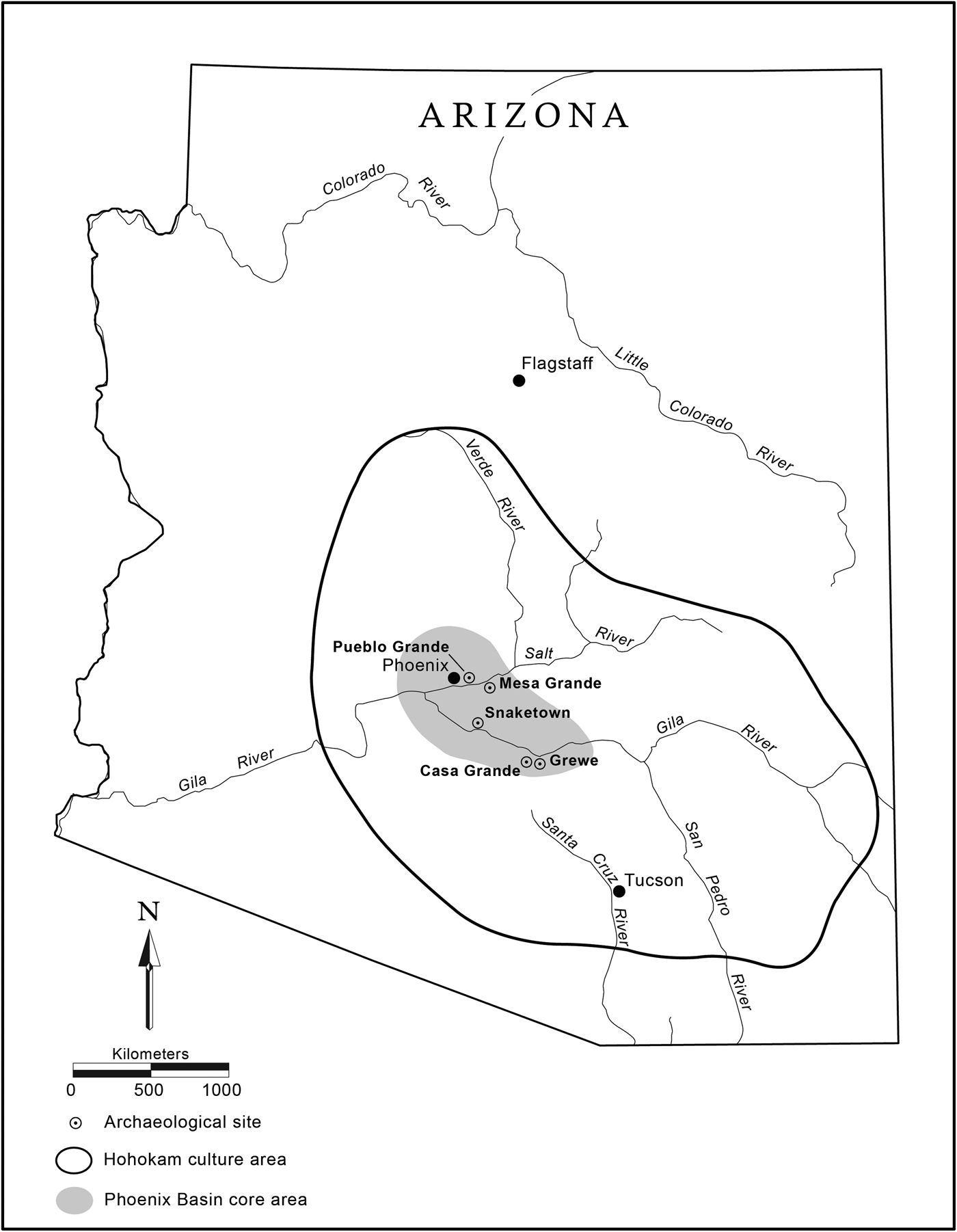
The Hohokam people continuously occupied the Phoenix Basin of south-central Arizona from about 2,000 years ago until their disappearance from the archaeological record in the fifteenth century (Figure 1, Table 1).Footnote 1 Their presence began when small numbers of desert cultivators established themselves along the lower Salt River and in the middle Gila River valley to the south. At first, the early settlers planted corn, beans, and pumpkins, and eventually cotton, on the fertile floodplains. Later, their descendants began diverting river water onto cultivated fields via short and shallow canals. Eventually, the hydraulic network was expanded to become one of the largest and most impressive hydraulic works of the prehistoric New World. Beginning around AD 750, along both the Salt and Gila rivers, various multivillage irrigation cooperatives first emerged to construct and manage hundreds of kilometers of ditches to transport water from the rivers to fields and habitation areas spread along the canal routes. Omar Turney (Reference Turney1929) named the largest of these irrigation cooperatives Canal System 2. At its greatest extent, the system encompassed some 20 settlements and nine main canals (the longest stretching over 30 km), which probably watered more than 15,000 acres (Howard Reference Howard, Howard and Huckleberry1991:5–15; Figure 2).
The Hohokam culture area.
Hohokam canal systems along the Salt River.

Hohokam Temporal Intervals.

1 Controversial dating. See Note 1.
Starting around AD 800 and lasting during the Colonial period (AD 750–950; see Table 1) and the Sedentary period (AD 950–1100), the Hohokam regional network encompassed 80,000 km2, an area the size of South Carolina. It was integrated by shared ritual beliefs manifest by playing a ceremonial ballgame on large earthen courts (Wallace et al. Reference Wallace, Heidke and Doelle1995; Wilcox and Sternberg Reference Wilcox and Sternberg1983). By AD 1000, during the Sedentary period, approximately 190 villages across the region had ball courts (Marshall Reference Marshall and Craig2001; Wilcox et al. Reference Wilcox, Samples, Keller and Laughner1996). The regular gatherings of people from many places and a network that interconnected a variety of ecological zones made these ballgames, and possibly associated marketplaces, conduits through which large numbers of exchange goods moved (Abbott Reference Abbott, Garraty and Stark2010; Abbott et al. Reference Abbott, Smith and Gallaga2007; Doyel Reference Doyel, Crown and Judge1991; Watts Reference Watts2013; Wilcox and Sternberg Reference Wilcox and Sternberg1983).
The cultural vigor of shared rituals, widespread cooperation, and high-volume exchange across an expansive region seems to have come to an abrupt halt around AD 1070, during the Sedentary to Classic transition. The ball court network collapsed (Abbott Reference Abbott, Hackbarth, Hays-Gilpin and Neal2002, Reference Abbott2006, Reference Abbott2007; Doelle and Wallace Reference Doelle, Wallace and Gumerman1991; Doyel Reference Doyel, Doyel, Fish and Fish2000), and as documented in the ceramic data, the volume of goods exchanged across the region abruptly declined (Abbott Reference Abbott2006, Reference Abbott2009; Abbott et al. Reference Abbott, Smith and Gallaga2007; Crown Reference Crown and Gumerman1991).
Apparently in reaction to the disturbances on a regional scale, demographic instability became common. At the beginning of the Classic period (AD 1100–1375), the population in the lower Salt River valley ballooned as the uplands immediately north were vacated. Migrants streamed into the valley, quickly doubling the number of residents at Pueblo Grande (Abbott and Foster Reference Abbott, Foster and Abbott2003) and probably at many other settlements (Doelle Reference Doelle, Elson, Stark and Gregory1995). The swelled populations erected platform mounds, probably as raised stages for community rituals (Downum and Bostwick Reference Downum, Bostwick and Abbott2003; Elson Reference Elson1998) and possibly as elevated residences of political elites (Doyel Reference Doyel1981; Fish Reference Fish, Fish and Reid1996; Gregory and Nials Reference Gregory, Nials, Dittert and Dove1985; Wilcox Reference Wilcox1987).
By the Late Classic period (AD 1275–1375), a great majority of residence groups in the Hohokam world erected their dwellings behind massive compound walls. Most Hohokam researchers would agree with Haury (Reference Haury and Noble1991:70) that the enclosures constituted a fundamental change from the previous domestic arrangements; domestic life was transformed from a relatively inclusive, egalitarian system to one characterized by greater exclusivity and inequality (McGuire Reference McGuire1992:204–207; Wilcox 1991:267–269). On a valley-wide scale, the Hohokam also circumscribed their communities with social boundaries coterminous with their irrigation infrastructure (Abbott Reference Abbott2000; Abbott et al. Reference Abbott, Ingram and Kober2006). For centuries, they struggled to cope with social fragmentation, environmental degradation, and declining health. By AD 1375, at the beginning of the Post Classic period, the compound walls had fallen into ruin, and the domestic architecture had reverted to Early Classic styles. Small and scattered populations lingered at Pueblo Grande and elsewhere until the final exodus around AD 1450 from a valley homeland that had been continuously inhabited for a millennium (Abbott Reference Abbott and Abbott2003; Fish and Fish Reference Fish and Fish2008).
Excavations at Pueblo Grande
The inhabitants of Pueblo Grande controlled the head gates and water intake in Canal System 2, and their settlement was the largest, most centrally located, and most politically prominent village in the lower Salt River valley. The earliest documented structures and trash accumulations at Pueblo Grande dated to the late Pioneer (AD 650–750) and Colonial periods and were situated at the heart of the village, proximate to where an enormous platform mound was built hundreds of years later (Bostwick Reference Bostwick, Bostwick and Downum1994; Bostwick and Downum Reference Bostwick, Downum, Bostwick and E. Downum1994:302; Ensor Reference Ensor2013:174–176; Foster Reference Foster1995; Schroeder Reference Schroeder1940). Excavations in the central precinct have been spotty, with some portions thoroughly investigated whereas others were left untouched. Nevertheless, the density of early structures seems to have been light, contrasting with the larger and more compact concentrations of the later Sedentary and Classic periods.
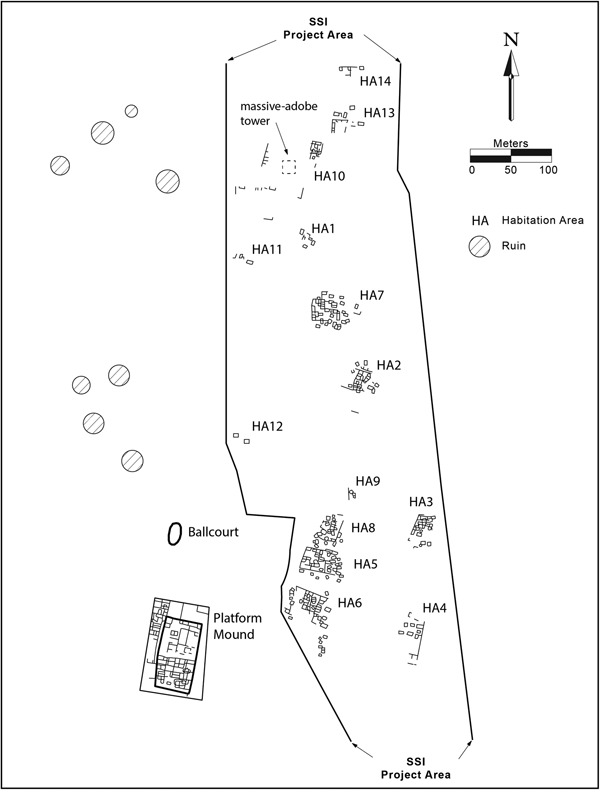
Beginning in the late Sedentary period, the first of three waves of migration swelled the population at Pueblo Grande. These waves are well documented with excavations in the eastern third of the site by Soil Systems, Inc. (SSI), prior to highway construction (Mitchell, ed. Reference Mitchell1994; Figure 3). Each wave expanded the settlement boundaries, pushing them successively farther from the central precinct of the village (see also Howard Reference Howard, Wilcox, Howard and Nelson1990:84).
The SSI project area.

The SSI project area uncovered 14 habitation areas (HAs), each encompassing between 1,200 and 3,000 m2 and demarcating a spatially discrete set of structures and features with associated cemeteries. Quite clearly, each habitation area was home to a self-recognized residence group that often persisted at the same locale for many generations. Four of those habitation areas (HAs 5, 6, 8, and 9) were established during the demise of the ball court network around AD 1070. The residence units consisted of dense clusters of pithouses in a style Haury (Reference Haury1976: 53–57) defined, labeled Type S-1.
Sometime around AD 1100, a second wave doubled the Pueblo Grande population virtually overnight (Abbott and Foster Reference Abbott, Foster and Abbott2003). In the SSI project area, six new habitation areas were found (HAs 1, 2, 3, 7, 10, and 12) constructed in five different architectural styles, including post-reinforced surface structures and four kinds of pithouses (Type S-2; rock lined; deep, adobe lined; and deep, post supported). The architectural variability suggested that populations from different homelands relocated to the eastern margin of the Pueblo Grande village and presumably at the northern and western margins of the site as well.
A few generations later, the dominant architectural form in all the existing habitation areas shifted to a new style: narrow-walled adobe structures. The population levels remained stable, although the stylistic differentiation across the settlement was transmuted into architectural homogeneity—an unambiguous pattern of conformity. One new residence unit (HA 11) was added in the SSI project area.
The final wave of migration transpired during the Late Classic period when all the previously existing habitation areas adopted a new architectural form. As was true across much of the Hohokam world at that time, the Pueblo Grande people built massive-walled adobe surface structures with towering compound walls to enclose each habitation cluster. The population in many of the habitation areas grew significantly as newcomers probably exercised kinship options to crowd into well-established residence groups. Three new units, HAs 4, 13, and 14, were also first inhabited at that time on the eastern edges of the site.
Architectural Styles at Pueblo Grande
Pueblo Grande contained domestic structures that varied in size, shape, and method of construction, which led the SSI excavators to define and describe eight architectural styles at the site (Mitchell Reference Mitchell and Mitchell1994). The construction of each style was made unique by the combination of 1) the presence or absence and different forms of house pits and 2) the various means by which the builders made use of locally procured building materials (wood, brush, adobe, and rock) to form the walls and roof. Each architectural style is described below.
Mitchell (Reference Mitchell and Mitchell1994:33) reports that SSI identified about 350 architectural features in the Hohokam Expressway corridor at Pueblo Grande. Some were quite fragmentary due to rebuilding within the long-occupied habitation areas, and modern disturbance also heavily debilitated many parts of the site. We analyzed every structure that could be assigned an architectural type and for which its construction cost could be calculated, a total of 143 houses. For this study, we excluded 6 small storerooms and 12 post-Classic dwellings, reducing our sample to 125 cases.
Both semi-subterranean and entirely above-ground constructions were abundantly present at Pueblo Grande. One major typological distinction parsed the semi-subterranean architecture, distinguishing houses-in-pits from true pithouses (Crary and Craig Reference Crary, Craig and Craig2001; Hayden Reference Hayden1931; Howard Reference Howard and Howard1988). A house-in-pit was built by excavating a shallow pit and then placing inside that hole a free-standing structure with post-framed walls. True pithouses, in contrast, were so named because the house pit (sometimes shallow, sometimes deep) was incorporated into the main design of the structure. Wall posts were situated outside the pit, and the pit's interior edge was utilized as the basal wall of the construction. Houses-in-pits predominated at most Preclassic Hohokam villages, whereas various forms of true pithouses were much more common during the Classic period.
At Pueblo Grande, a mixture of houses-in-pits and true pithouses were present during the Sedentary period. All were categorized as Type S-1 pithouses, distinguished by a shallow house pit, an elongated floor with rounded ends, and a roofed and often stepped or ramped entryway centered on the long axis of the building (Figure 4). The internal roof-support posts exhibited no consistent pattern, which Haury (Reference Haury1976:56) attributed to the twisted, nonlinear shape of the mesquite logs and limbs that served as the primary structural elements. The wall posts in the houses-in-pits were typically anchored in a groove that ringed the floor along its edge. In contrast, the wall posts in true pithouses sometimes were placed in a wall trench dug on the outside of the house pit. Between the wall posts, 25–30 cm thick bundles of reeds and arrowweed were probably attached and secured with horizontal braces and sealed by a 5 cm thick covering of adobe plaster. It was a wattle-and-daub construction, as observed ethnographically and based on examples of burned daub found at Grewe (Crary and Craig Reference Crary, Craig and Craig2001:41).
Architectural styles at Pueblo Grande.

Another major architectural distinction is one between semi-subterranean pithouses, including Type S-1 and other pithouse styles, versus surface structures, including the post-reinforced and massive-walled adobe styles. In addition to the presence or absence of a house pit, these structure types were engineered with different roof and wall constructions. Pithouses, depending on the number and arrangement of the primary roof-support posts, required one, two, or three main roof beams placed on top of the roof supports. Secondary roof beams formed the wall plate along the margins of the roof and sat on the top of the wattle-and-daub walls. Tertiary roof beams horizontally spanned the gap between the main and secondary beams. In contrast, adobe-walled surface structures required less wood for the roof. Their hard and dense adobe walls directly bore the load from the roof, and, thus, surface structures did not require the secondary roof beams that capped the less compacted wattle-and-daub walls of pithouses. Surface structures required only one main roof beam and smaller horizontal cross pieces that spanned the main beam and the wall tops.
For roofs on both pithouses and surface structures, a layer of brush and dirt was added above the rafters and then covered with an adobe plaster. The closing materials (tertiary beams, brush, and dirt) formed a durable covering usually 25–30 cm thick, which was made watertight with a 5 cm thick layer of adobe (Crary and Craig Reference Crary, Craig and Craig2001:43; Wilshusen Reference Wilshusen, Blinman, Phagan and Wilshusen1988; Figure 5).
Projected reconstruction of a typical two-post roof support system.

Type S-2 pithouses were first described at Snaketown by Haury (Reference Haury1976:57). They were similar in wall construction to the true pithouse versions of the Type S-1 cases, including a shallow house pit and a wall trench on the perimeter. They were distinguished by their squarish floors with rounded corners and a four-post roof-support configuration arranged in a square (see Figure 4). At Pueblo Grande, only one Type S-2 pithouse was excavated, which seemed to have been rebuilt twice. It dated to the beginning of the Early Classic period (AD 1100–1275) and probably was the founding construction in HA 1.
One rock-lined pithouse was encountered in the SSI project area (see Figure 4). It was probably the earliest structure found in HA 7. The most distinguishing traits of this true pithouse were the deep house pit and the lining of the interior pit walls with large, thin, indurated caliche slabs set into a thin adobe matrix. The caliche slabs were readily available, outcropping on the surface of the site. The structure had a rectangular shape with squarish corners, a short entryway, a well-plastered floor, and two roof-support posts.
Deep, post-supported pithouses were another rare architectural style at Pueblo Grande (see Figure 4). They were represented in the SSI sample by only two cases, possibly the founding constructions in HA 2 and HA 3. This style was unique in an interesting way. On one hand, the two structures were similar to a house-in-pit because their wall posts were set inside the house pit along the pit's edge. On the other hand, they were like true pithouses because the margins of the house pit served as the basal portion of the structural walls. This seeming contradiction is explained by an adobe lining packed around the wall posts, which filled the small spaces between them and the pit wall (Figure 6). The adobe was also applied to cover the pit's vertical surface between the wall posts. In effect, the adobe joined the wall posts to the house pit margins to form the structures' basal walls. As the name implies, the house pits for both the deep, post-supported pithouses at Pueblo Grande were deeply dug. Both cases had subrectangular shapes and roofs supported by a three-post arrangement.
Cross-section for different architectural types.

The deep, adobe-lined architectural style was characterized by a deep house pit and a thin lining of adobe (~5 cm) applied to the pit's vertical interior wall (see Figure 4). These subrectangular-shaped structures were true pithouses with wall posts anchored in the ground surface outside the pit margins (see Figure 6). One-, two-, and three-post roof-support patterns were constructed. The entryways were centered on the long axis of the structure, substantially built with an adobe lining, and ramped or stepped. Two deep, adobe-lined pithouses may have been the first structures built in HA 12, and two others were occupied during the Early Classic period in HA 7.
The walls of post-reinforced structures were made of solid adobe strengthened with internal, regularly spaced wall posts and horizontal stringers (see Figures 4 and 6). In comparison to the pithouse constructions, the walls of post-reinforced buildings were thicker, more compact, and made without the brush and reed wattle of pithouse walls. In two structures at Pueblo Grande, the postholes appeared to extend below the base of the adobe wall, suggesting that the posts were erected first, and then the adobe wall was built around them (Mitchell Reference Mitchell and Mitchell1994:56). Most post-reinforced structures were erected directly on the ground surface, but a few cases were built inside shallow pits and footed below the floor. In general, post-reinforced examples were rectangular, used two- and three-post roof-support patterns, and had substantial post-reinforced entryways. The earliest example of the post-reinforced buildings at Pueblo Grande was constructed in HA 10 during the second wave of immigration to the site around AD 1100. This architectural style was adopted slightly later in HAs 2, 3, 6, 7, and 8.
The distinguishing characteristic of the narrow-walled adobe style was a band of puddled adobe applied to the sides of a shallow house pit and forming the base of the pithouse wall (see Figure 4). The adobe band was footed with a wall trench to a depth of 5 to 10 cm below the floor level. Small wall posts were set outside the house pit at ground level, and at their base, were encased in the adobe band, which lapped out onto the ground surface (see Figure 6). The superstructure above the basal sections was possibly a wattle-and-daub construction. In addition to the common two-post pattern of roof support, buildings with three and four main supports were also observed. The entryways were either ramped or stepped and built with narrow adobe walls. The narrow-walled adobe style of pithouse construction accounted for nearly all the structures inhabited during the Late Soho phase (AD 1200–1275) at Pueblo Grande. The style fell out of favor in the Late Classic when the massive-walled surface rooms were built behind towering compound walls.
The most common architectural style in the SSI project area was the massive-walled adobe structures (see Figure 4). With few exceptions, all the domestic rooms built behind the massive compound walls during the Late Classic period were this type. Their most prominent characteristic was thick and solid coursed adobe-and-rock walls. Most wall thicknesses ranged between 35 and 50 cm (Cameron Reference Cameron and Stark1998:188–189; Wilcox and Shenk Reference Wilcox and Shenk1977). The building stones were slabs of indurated caliche procured from bedrock exposures on the edge of the village. An adobe-and-rock footer set into the ground several centimeters deep provided a foundation for the walls. The compound walls that surrounded each Late Classic habitation area, as well as the outer retaining walls of the Late Classic platform mound at Pueblo Grande, were built with the same construction materials and technique. All the rooms were rectangular with 90-degree corners. Most entryways were simple breaks in the wall without formal ramps or steps, as the floors were at ground level. The few projecting entries were outlined with narrow adobe-and-rock walls.
Obvious roof support postholes were absent in many massive-walled adobe structures. Nevertheless, based on ethnographic and experimental evidence (e.g., Wilshusen Reference Wilshusen, Blinman, Phagan and Wilshusen1988), we believe that most roofs in these structures were supported by a two-post system; however, one-, three-, and four-post patterns were also observed. The weight of the roof may also have been partially or entirely supported by the thick adobe walls, particularly in smaller rooms and adjacent rooms with shared (i.e., contiguous) walls. Because little direct evidence of roof construction is available and the focus of our study is on the possible wood depletion over time, we take a conservative approach here and assume that massive-walled adobe rooms without obvious roof-support posthole patterns utilized a two-post support system with a primary beam.
Methods
Our work is an outgrowth of architectural energetics, which involves quantitative labor cost reconstructions. As an assemblage of various raw materials and manufactured components, architecture has a composite cost of procuring, processing, and transporting raw materials and assembling them into the finished product. Architectural energetics involves the quantification of the construction expenses into a common unit of measurement for analytical comparison, an analytical attribute in the form of labor-time expenditures.
Architectural energetics avoids a subjective assessment of architectural outlays for use in comparative research by relying on three lines of evidence accessible to the archaeologist. First, the kinds and amounts of raw materials used in house construction are determined based on excavation data and field maps. Second, the key tasks associated with obtaining and assembling the building materials are identified based on ethnographic data. Third, the labor requirements associated with the various construction tasks are derived from replicative experiments (Craig Reference Craig and Craig2001:116; Erasmus Reference Erasmus1965). We adopt this objective and comparative approach to develop a methodology to calculate construction costs of various styles of Hohokam domestic architecture, which we hope will be widely applied for other Hohokam projects and others.
Our analysis began by recording various architectural details based on the field notes, maps, and profiles from the SSI excavations, which are curated at the Pueblo Grande Museum in Phoenix, Arizona. The SSI crews routinely completed architectural data forms for each structure, which also provided a wealth of information in a standard format across all architectural features. The recorded variables we relied on included feature number, habitation area, temporal assignment, architectural style, and various counts and measurements of architectural details.
Presented in the supplementary materials linked to this article is a narrative and other texts to usher the analyst through the various calculations of construction costs. The texts include a list of defined variables and the formula to calculate them. Constants, such as wall height and the rate of adobe mixing, are also listed. Three examples of the costs measured for individual structures are provided, which we hope will promote these methods in future applications.
Some details included how to measure the projected length and width of the floor and the length and width of the entryway. The wall widths of post-reinforced and massive-walled adobe surface structures were determined from field maps but could only be estimated for the pithouses because their walls were not preserved.
Upright roof supports were enumerated based on the location and size of the postholes in the floor. The number of primary beams, which rested on top of the uprights and spanned the distance between the main supports, was determined by the posthole pattern. The wall-post densities were determined when segments of the walls were sufficiently intact. Otherwise, we relied on estimated densities formulated according to architectural style.
Many calculations are needed to measure the labor costs for each Pueblo Grande structure. We relied on base rates obtained from experimental archaeology that translate the amounts of building materials into labor costs measured in person-hours. There were three primary components for construction costs: 1) the labor to dig and mix the adobe; 2) the labor to cut and transport the wood Footnote 2; and 3) the labor to erect the walls and construct the floor, roof, and internal features of the structure. By summing these expenditures, we derive the total cost of the structure. An estimate of the relative cost can be computed by dividing the total cost of the building by the total floor space. For this study, we made the calculations for 125 structures at Pueblo Grande.Footnote 3
Wood Supplies Argument
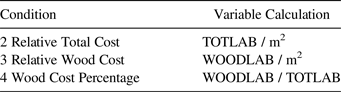
To exemplify the utility of our construction-cost methodology, we evaluate a recent suggestion that the sequence of stylistic changes in Hohokam domestic architecture was driven by depleted wood supplies during the Classic period. Loendorf and Lewis's (Reference Loendorf and Lewis2017) argumentFootnote 4 assumes that the Hohokam preferred wood, when available, because it had less relative cost (cost/m2 of floor space) versus the alternative (i.e., adobe). Although the costs of cutting and transporting wood may have remained constant, if the local availability of wood declined, then clearly the transportation costs would increase accordingly.Footnote 5 With wood depletion, the Hohokam were forced to use more expensive construction materials, driving up the total costs. If that argument is correct, then four conditions should hold true: 1) environmental degradation resulted in progressively declining wood resources suitable for house construction; 2) increasing total cost per m2 over time; 3) a temporal reduction in the total wood cost per m2; and 4) a decline over time in the percentage of the total labor accounted for by the wood costs. The authors marshal several lines of evidence to maintain that fewer and fewer trees were locally available from the beginning of the Classic period until its end. The evidence to support the second, third, and fourth conditions, in contrast, requires the quantification of construction costs. Calculating the building expenses for various types of Hohokam domestic architecture is the rationale for our approach, which in the present case, serves to scrutinize various elements of the wood-depletion model and its explanation for the temporal sequence of Hohokam architectural styles.
Condition 1: Wood Depletion and Environmental Degradation
Presumably spurred by demographic shifts that brought large numbers of immigrants into the Phoenix Basin starting at the inception of the Classic period, vital resources, including wood supplies for building materials, may have been in decline under mounting population pressure. At Pueblo Grande, the number of inhabitants practically doubled overnight as a considerable number of complete residence groups established themselves on the edges of the village, and the village continued to expand for generations thereafter (Abbott and Foster Reference Abbott, Foster and Abbott2003). Likewise, rising population levels across the valley have been documented for the Classic period (Doelle Reference Doelle and Dean2000; Hill et al. Reference Hill, Clark, Doelle and Lyons2004; Ingram Reference Ingram2008; Nelson et al. Reference Nelson, Kintigh, Abbott and Anderies2010).
It is not hard to imagine deleterious effects from overexploitation on the local environment, and, indeed, there is abundant macrobotanical and faunal evidence to infer degraded riparian zones with dwindling numbers of trees. Mesquite was the most sought-after wood used for construction and fuel by the Phoenix-area Hohokam (Bohrer and Kwiatkowski Reference Bohrer, Kwiatkowski and Kwiatkowski1999:137–138). The archaeological wood-charcoal evidence from several sites across the valley clearly showed mesquite was steadily depleted during the Sedentary and Classic periods (Bohrer and Kwiatkowski Reference Bohrer, Kwiatkowski and Kwiatkowski1999; Kwiatkowski Reference Kwiatkowski and Kwiatkowski1994, Reference Kwiatkowski and Abbott2003; Kwiatkowski and Miller Reference Kwiatkowski, Miller, Greenwald, Chenault and Greenwald1995; Miksicek and Gasser Reference Miksicek, Gasser, Graybill, Gregory, Nials, Fish, Gasser, Miksicek and Szuter1989). James (Reference James and Abbott2003:77–79) also noted changes in hunting practices during the Classic period at Pueblo Grande that he related to a less woody and a more open landscape (see also Bayham and Hatch Reference Bayham, Hatch and Rice1985).
Among the reasons for the decline in wood supplies were those undoubtedly related to humans. As Dove (Reference Dove1984) argued based on a simulation study, even small groups living in the lower Sonoran Desert could significantly reduce the amount of nearby wood within a relatively short time. The down cutting of the Salt River during the Early Classic period may have exacerbated the human-induced decline, probably destroying the riparian habitat and depleting the remaining trees (Nials et al. Reference Nials, Gregory, Graybill, Graybill, Gregory, Nials, Fish, Miksicek, Gasser and Szuter1989:69; see also Kwiatkowski Reference Kwiatkowski and Abbott2003:67; Waters and Ravesloot Reference Waters and Ravesloot2001:292). Miksicek and Gasser (Reference Miksicek, Gasser, Graybill, Gregory, Nials, Fish, Gasser, Miksicek and Szuter1989) documented a dramatic increase in saltbush and its replacement of willows and cottonwood trees. The transformed streamflow regime probably lowered the water table and dried out and eroded the floodplain with an expansion of the desert saltbush community at the expense of deciduous riparian habitat. Were these declines sufficiently deep to promote a sequence of stylistic changes in domestic architecture that progressively relied less and less on wood with higher and higher relative costs? We turn to measuring Hohokam construction costs to find out.
Conditions 2–4: Wood Costs
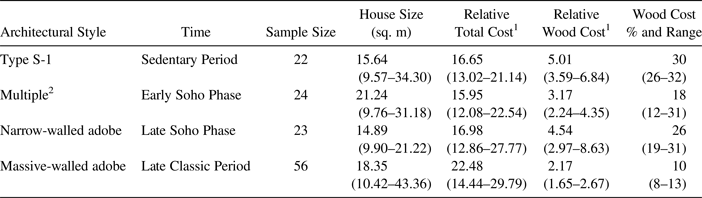
Of the four implicit conditions specified above, two through four pertain to aspects of wood costs over time. These conditions are quantifiable and can be applied to the Pueblo Grande architectural data to test the wood-depletion model (Table 2).
Calculating Variables for the Temporal Analysis.

For this analysis, we conceptualize relative total cost pertaining to the expense the builders were forced to bear dependent on the availability of basic construction materials. Relative total cost, however, can also reflect the extravagance of construction. Just as we today value our homes in terms of cost per square footage, relative total cost can reflect elaborateness of amenities. Nevertheless, we feel justified in ignoring construction extravagance here as a contributing factor because there is little evidence of elaboration in nearly all the Pueblo Grande structures (e.g., benches, raised floors, thickly plastered floors) and therefore seems to have little significance when explaining architectural variability and change through time at the site.
Results
The wood-depletion model implies that environmental change, including the over-exploitation of wood species used for construction, required Hohokam households to utilize less and less wood and adopt new but more expensive architectural styles. The model, therefore, predicts that the relative total cost of house building increased over time while the relative wood cost and the wood cost percentage declined.
Clear-cut trends (i.e., monotonic increase or decrease over time) were not apparent in the Pueblo Grande data (Table 3), but there were some specific changes that did support the model. As expected, Type S-1 pithouses did, on average, use the most wood; however, the overall cost of their construction was not considerably greater than for the architectural styles that preceeded them during the Early Classic period. Indeed, it was not until the Late Classic, when massive-walled adobe houses were erected, that the relative total cost increased significantly as wood usage declined substantially.
Median Construction Costs by Time at Pueblo Grande.

1 person-hours/m2
2 includes Type S-2; rock lined; deep, adobe lined; deep, post supported; post reinforced.
One interpretation is that Hohokam builders during the Early Classic found ways to reduce their dependence on wood without significantly increasing their overall construction costs. Only during the Late Classic were the Pueblo Grande villagers forced to bear far greater expense as they shifted to a far greater use of expensive adobe and much less wood compared to the earlier architectural styles (see Table 3). Our results, therefore, focus attention on the shift from narrow-walled adobe pithouses to massive-walled adobe surface structures. This architectural shift occurred rapidly and coincided with an influx of people to the village in the late thirteenth century. Perhaps the arrival of new immigrants pushed wood resources beyond a critical threshold. But earlier waves of immigration (e.g., Early Classic period) were equally large, if not larger, and they too occurred over a relatively short period. Also, the down-cutting event that Loendorf and Lewis (Reference Loendorf and Lewis2017:130) argue destroyed riparian habitats and depleted wood supplies along the middle Gila and lower Salt rivers occurred between AD 1020 and 1160 (Waters and Ravesloot Reference Waters and Ravesloot2001:292), more than a century before the shift to massive-walled adobe structures. These facts suggest to us that while wood depletion may have contributed to the adoption of massive-walled adobe architecture, other social factors were also likely involved.
Discussion
At the outset of the Late Classic period and throughout the Hohokam world, residential space typically became encircled by massive adobe compound walls that enclosed sets of similarly constructed massive adobe surface structures. Wood depletion may have been a problem at Pueblo Grande and in the Phoenix Basin in general, but the switch to adobe building materials was a regional phenomenon. As such, it cannot be explained by changing local conditions alone. For instance, upstream along the Salt River, as noted by Loendorf and Lewis (Reference Loendorf and Lewis2017:130), the inhabitants of the Tonto Basin also built massive adobe surface structures during the Late Classic. But population densities were much lower in the Tonto Basin (Doelle Reference Doelle and Dean2000), and there is little evidence for wood depletion over time (Dering Reference Dering and Spielmann1998:89; Miksicek Reference Miksicek, Elson and Clark1995).
Alternatives to the wood-depletion model that focus on society-wide concerns, such as security and privacy, may better explain the formally demarcated residential subdivisions of the Late Classic period. In addition to expending more labor in house construction, each Hohokam residence group surrounded itself and its stores with a barrier that stood 50 cm thick and 2 m high or more. Haury (Reference Haury and Noble1991:70) believed that the adobe compounds represented a living style that was totally different from that of the previous domestic units and expressed a psychologically disparate attitude by the residents about how to deploy themselves with respect to their neighbors. Sires (Reference Sires and Doyel1987) felt the compounds were a response to the privacy problems of aggregated populations. And Wilcox (Reference Wilcox, Crown and Judge1991) proposed that Preclassic and Early Classic residence groups had a distinct social identity, but Late Classic groups had a more formally marked boundary. It served to restrict access to information about matters internal to these groups, such as surplus holdings.
Rising social tensions during the Late Classic period may have also corresponded to a growing desire for greater durability in house construction, which was accomplished by the shift from wood to adobe. The Late Classic Hohokam builders may have anticipated a longer use life for their abodes if an effect of rising social tensions was long-term residential stability demarcating socially differentiated groups. As explained by McGuire and Schiffer (Reference McGuire and Schiffer1983), there are always tradeoffs between production and maintenance costs for architecture. Reducing maintenance can be achieved with higher quality or more expensive manufacturing. At Pueblo Grande, the mix of maintenance versus production costs varied across architectural styles. The markedly greater relative total costs for massive-walled adobe rooms as compared with those of the other structure types (see Table 3) testified to the large expense incurred when building primarily with adobe. On the other hand, adobe construction avoided the maintenance disadvantages when wood and wattle were the primary elements. These organic perishables likely suffered severe maintenance problems brought on by wood rot, dampness, and insect infestations. Across the Hohokam territory, the switch from primarily pithouse construction to massive-walled adobe rooms at the start of the Late Classic period seems more likely to have been the result of a changing social dynamic rather than to a changing availability of building materials.
Conclusion
Our study developed and implemented a methodology to calculate the labor costs involved in Hohokam house construction. The methodology focused on the raw materials used to build houses as indicated by excavation data and feature maps. It was designed to be applicable to a variety of architectural styles, including pithouses and surface rooms. To illustrate the method's utility for Hohokam research, we used house data from Pueblo Grande to evaluate the argument that the shift from wattle-and-daub pithouses to adobe surface structures during the Classic period was due to the depletion of wood resources (Loendorf and Lewis Reference Loendorf and Lewis2017). Lending some support to the wood depletion hypothesis, we documented a roughly 60% decrease in the amount of wood used in house construction at Pueblo Grande between the late Sedentary and Late Classic periods. However, the timing, tempo, and regional scale of the reduction in wood use did not meet test expectations. We conclude from this result that factors in addition to wood depletion were likely involved in bringing about the architectural changes observed.
Our study also found that the labor costs associated with house construction at Pueblo Grande increased significantly over time even though the size of the dwellings remained about the same (see Table 3), due to the increased costs associated with building adobe walls. This relative cost differential has implications that go beyond Pueblo Grande. In many societies around the world, households of higher status and greater wealth live in larger, more elaborate, and better made dwellings than those lived in by poorer and lower status households (Feinman and Neitzel Reference Feinman, Neitzel and Schiffer1984:57–59; also see papers in Kohler and Smith, eds. Reference Kohler and Smith2017). But dwelling size can also be related to other factors, including the number of residents (Cook Reference Cook1972:161; Hassan Reference Hassan1981:63–77) or the length of occupation (Kramer Reference Kramer and Kramer1979; Wilk Reference Wilk1983) or both. Dwelling size alone is, therefore, an insufficient basis for distinguishing among the demographic and socioeconomic factors that may contribute to architectural variability. Importantly, the measure of relative labor costs introduced in this study can assist in sorting out these factors because it keeps dwelling size separate from other architectural attributes related to household wealth and status—in particular, the quality and elaborateness of construction. In so doing, it adds another dimension of architectural variation that can be used to measure household inequality in future studies.
Acknowledgements
We are most grateful to Kathy Henderson, Bob Hunt, Doug Mitchell, Mike Smith, and two anonymous reviewers for their advice and suggestions. Their input significantly improved the quality of our presentation. We also thank Pueblo Grande Museum for access to the SSI excavation notes and records and giving us space to work. We are especially thankful to Holly Young at PGM for answering all our questions and guiding us through the SSI archives. This paper would not have been possible without Holly's assistance.
Data Availability Statement
The SSI Pueblo Grande materials are curated at the Pueblo Grande Museum in Phoenix, Arizona. A file of the architectural data recorded for this study will be made available on request.
Supplemental Materials
For supplementary material accompanying this paper, visit https://doi.org/10.1017/aaq.2018.94
Supplemental Text. Methods Narrative.
Supplemental Text. Variables, Formulae, and Constant Values.
Supplemental Text. Three Calculation Examples.
Supplemental Figure 1. S-1 pithouse #558.
Supplemental Figure 2. Narrow-walled adobe pithouse # 1000.
Supplemental Figure 3. Massive-walled adobe surface structure # 636.