Introduction
On 26 December 2004, an earthquake measuring >9.0 on the Richter scale, occurred northwest of the island of Sumatra in the Indian Ocean. It resulted in the fourth largest magnitude tsunami ever recorded. The earthquake and resulting tsunami created a disaster on a scale unprecedented in recorded history. Twelve countries surrounding the Indian Ocean were significantly affected. Thousands of foreign tourists, predominantly Europeans from 15 countries, including Swedes, Britons, and Finns, were vacationing at the time at popular holiday destinations primarily in Thailand and Sri Lanka. Although estimates vary, according to the IFRC, 176,000 have been confirmed dead, >128,000 in Indonesia alone, >48,000 are missing, and more than 1,700,000 displaced by the earthquake-tsunami.Reference Kohl, O'Rourke, Schmidman, Dopkin and Birnbaum1 Some 20,000 Swedes, 10,000 Britons, and 4,000 Finns were in the disaster area of which 561 Swedes, 163 Britons (12 dual nationals), and 179 Finns died.2–4
At the time of the tsunami, Sweden, the UK, and Finland involving a large number of its citizens did not have national catastrophe plans that addressed the contingency of a disaster occurring outside the country's borders. This unprecedented event required these governments to organize rapid rescue responses for a catastrophe thousands of miles away, something for which they had little or no experience. The rescue operations at the international airports in the three countries are analyzed with emphasis on “lessons learned” and recommendations for future similar rescue efforts.
Methods
An electronic literature search (PubMed; Google: March 2008; and July 2009) was conducted. Relevant articles (and Websites) (n = 9) in English or Swedish were identified, and the reference lists of those articles in turn were scrutinized for additional relevant articles (n = 4). The literature search complemented interviews with and unpublished reports from medical personnel involved in the rescue operations at the three airports. This report is based on those interviews and unpublished reports as well as 13 references chosen for their relevancy and perceived validity.
Findings and Recommendations
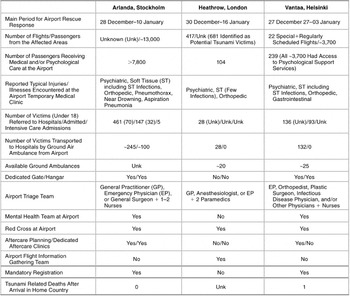
In the days following the tsunami, tens of thousands of European visitors returned home from the affected areas of Southeast Asia. Some 13,000 and 3,700 victims were repatriated at Arlanda Airport in Stockholm, Sweden, and Vantaa Airport in Helsinki, Finland, respectively, as well as an unreported number (681 identified as potential tsunami casualties) at Heathrow Airport in London. More than 7,800, 104, and approximately 3,700 casualties, received medical treatment and/or psychological care at Arlanda, Heathrow, and Vantaa Airports, respectively.2,4,5
Reported injuries/illnesses encountered at the three temporary airport medical clinics included psychological problems and/or soft tissue and/or orthopedic injuries. Arlanda reported pneumothorax, near drowning, and aspiration pneumonia as well. In Sweden, later reports indicated that seven hospitalized patients had confirmed methicillin resistant staphylococcus aureus (MRSA). Many of the wounds, however, were infected with multiple, often multi-drug resistant bacteria/fungi, many never having been seen locally. In Helsinki, gastrointestinal illnesses, which became more frequent later in the rescue operation, also were reported. Small numbers of survivors, 461 (70 <18 years of age) in Stockholm, 28 in London, and 136 in Helsinki, respectively, were referred to hospitals. Of these, approximately 245 in Stockholm, 28 in London, and 132 in Helsinki were transported by ground or air ambulance in the three cities, respectively.2,4,5
The rescue operations at Arlanda, Heathrow, and Vantaa Airports are presented in Table 1.
Comparison of rescue operations at the three airports2–5,7,8,10,11

Discussion
From 1900 to 2004, the number of disasters due to natural hazards reported and the number of persons affected by these disasters globally has increased exponentially.Reference Nates and Moyer6 With the acceleration of climate change, it can be expected that these trends will continue. Moreover, globalization and increased international travel will ensure that Westerners are involved in more disasters away from home.
In the aftermath of the Asia tsunami, the Swedish Tsunami Commission Report, the Asian Tsunami (Operation Bracknell) Heathrow Community Debrief Final Report, and the Finnish Tsunami Commission Report arrived at similar conclusions. These reports found it imperative that governments have national catastrophe plans to address such external contingencies. It was recommended in all three reports that these disaster plans be updated and practiced regularly, include medical competence at the political level, have formalized agreements with important non-governmental organizations (usually including the Red Cross) and other agencies, incorporate a media policy, and arrange for aftercare.4,7,8 It has been suggested elsewhere that such a disaster plan also should clarify the ethical and legal obligations to serve both at home and abroad when the personal safety of the rescuer cannot be ensured.Reference Iserson, Heine, Larkin, Moskop, Baruch and Aswegan9 In addition, the Swedish Tsunami Commission Report recommended that routines be in place for communicating “lessons learned” in the often charged atmosphere during a major disaster.7
With regard to the home airport medical operations, personnel in Stockholm, London, and Helsinki suggested that a dedicated gate and hangar for receiving casualties, if possible given airport logistics, is advisable. Rescue personnel in all three cities emphasized the difficulties encountered when injured/ill passengers arrived at distant gates. Nonetheless, in London, a dedicated terminal, gate, and hangar were not used to receive the tsunami victims. This was considered to be a logistical necessity given the high passenger volumes and airport complexities at Heathrow. The Metropolitan Police facilitated the redeployment of medical personnel when passengers arrived at gates distant from the temporary medical station.10
The airport medical leadership in each of the three cities recommended that a predetermined, temporary medical station site and predefined routines for medical resource allocation be elaborated in future disaster plans. In London, the temporary medical station was forced to move several times, and particular difficulties were encountered in medical resource procurement.8
According to the medical leadership at the airport, care also should be taken to minimize the impact of the rescue responses on normal operations and services including permanent airport medical clinics and local emergency ambulance and hospital services. Each of the three rescue operations chose not to involve the existing airport medical clinics, which remained available for the contingency of a second airport disaster. Likewise, descisons were made to use non-local ambulances and hospitals.
Choosing the right competencies for airport medical personnel also was found to be important by the airport medical leaderships. In Sweden, although the local disaster plan mandated a triage team that included an anesthesiologist and a nurse anesthetist, it soon became apparent that this team composition did not function well, and that the triage team should be comprised of a general practitioner, emergency physician, or general surgeon as well as two nurses with emergency medicine training. According to the medical leadership in Sweden, the anesthesiologists lacked the required triage skills. Similarly, some medical staff in Finland also displayed poor triage and emergency assessment skills. Mental health personnel were invaluable at Arlanda and Vantaa Airports, and in hindsight, were endorsed by the airport medical leadership at Heathrow Airport.
Providing for security clearance and education in airport routines was important. Lack of security clearance and education in airport routines created much confusion, particularly at Heathrow Airport.
The welfare needs of the medical staff, including food, lodging, and reasonable downtime were mentioned as important considerations. These become ever more important with protracted rescue operations and were more of an issue in the UK where the rescue operation continued from 30 December to 16 January.
The use of medical journals and survivor registration were valuable for aftercare and research. In addition, written information to patients regarding the post-traumatic stress disorder (PTSD), and when and how to seek aftercare for this and other problems was recommended. A Swedish study in the aftermath of the tsunami hypothesized that information provided regarding stress responses could help to normalize reactions decreasing anxiety and the risk for future psychological problems. While only 20% of the victims in Stockholm received this type of written information, approximately 50% of those who received it thought it to be of value.Reference Michélsen, Schulman, Häkanson and Hultman11
The incorporation of modern technology into the rescue response including the use of satellite telephones, global positioning systems, videoconferencing, and the Internet was recommended both by the airport medical leaderships and by the Tsunami Commission reports in Sweden and Finland and the Asian Tsunami (Operation Bracknell) Heathrow Community Debrief Final Report.4,7,8 Satellite telephones would have been helpful, for example, in communicating with forward reconnaissance teams and crew on incoming flights. In Stockholm, out-of-town ambulances had difficulty finding local hospitals, and would have benefited from on-board GPS systems. Daily briefings involving all key organizations were helpful in all three cities. This was executed most effectively in Sweden where the medical leadership attributed much of its success to their daily videoconference-based meetings. In addition, online information to physicians involved in aftercare was recommended.
The airport medical leaderships concluded that reforms in the airline industry were needed to provide for a better disaster response. Disaster planning and more flexibility in booking flights and seating were required. Blankets and aisle/first class seating for injured/ill passengers, for example, often were unavailable. In addition, it was recommended that flight attendants be required to undergo disaster training to minimize the risk of becoming psychological casualties themselves.
The necessity for psychological support both at the home airport and during aftercare for survivors, their family and friends, as well as rescue and flight personnel was emphasized particularly by medical personnel in all three countries. In Sweden, even though a large psychological rescue response was organized, it proved to be inadequate, at least during the first few days. Nonetheless, most passengers were met by mental health professionals at the airport. More than 250 personnel from the Psychological and Psychiatric Catastrophe Management Committee, the Child and Adolescent Psychiatry Service, and various community social services including the Swedish Church and the Red Cross participated at the Crisis Center.Reference Michélsen, Schulman, Häkanson and Hultman11 The Red Cross, in particular, had approximately 600 volunteers working round-the-clock in three shifts providing general psychosocial support and among other things distributing clothes.12 Children travelling alone, some having lost both parents, were prioritized. Additionally, 899 victims, of which 163 were children, were received at seven acutely established health clinics within the Stockholm region that were open round-the-clock and included specialized personnel for psychological and social support.2
In Finland, psychological support was provided by psychologists on returning flights (with the exception of the first few flights), by medical and mental health personnel at the airport medical station, as well as by the Red Cross and Finnish Church. In addition, each passenger received printed information regarding PTSD.4 In contrast, in the UK, the Red Cross, Women's Royal Volunteer Service, and the Heathrow Chaplin Service provided most of the emotional and general support.10 The Red Cross, in particular, once again played a major role in the rescue operation. It supplied clothing and shoes, made telephone calls to relatives, provided first aid, and gave practical and emotional support to 2,618 survivors at Heathrow and Gatwick Airports.13 A few of the physicians had some mental health training, but the need for professional psychological support services was unanticipated.
A follow-up study of Swedish tsunami victims conducted 14 months after the tsunami found that 79% (n = 442), 82% (n = 877), and 87% (n = 1,019) thought that the medical support, psychological support, and social/practical support, respectively, received at Arlanda Airport was of value. The study concluded that a well-organized, early, medical response and appropriate early psychological and social support were meaningful. Such support, the study argued, addressed immediate psychological needs—established that the danger was over, that one was being treated by competent people, and that someone was investigating what had happened to family and friends, as well as the need for accurate information and for contact with family. Such support also is thought to help to establish a feeling of security and decreases inner chaos, and is viewed in disaster psychology research as a critical factor in minimizing the psychological consequences of a catastrophe, and in avoiding secondary traumatiation.Reference Michélsen, Schulman, Häkanson and Hultman11,Reference Norris and Kaniasty14,Reference Weisaeth and Mehlum15
An analogous study (survey and interviews) of tsunami survivors and their family and friends conducted by the UK National Audit Office also supports the importance of psychological support after a disaster. Consistent with the conclusions of the previously cited Swedish study, respondents recommended that information about psychological reactions, and when and how to get help be provided at the airport. Sixteen months after the event, the Revised Impact of Event Scale (IES-R) and the Hospital Anxiety and Depression Scale (HADS), validated self-report measures to assess PTSD and anxiety and depression symptomatology, respectively, administered to respondents, demonstrated that more than one-third had scores that predicted PTSD and about 50% had scores predictive of clinically significant anxiety. In addition, one in six respondents who were in the affected area and one in four who were in the UK or elsewhere and who had lost family or friends had scores predictive of clinically significant depression. Those who lost family or friends scored higher on the IES-R but not on the HADS. Receiving psychological support within the first minutes to hours of the event did not significantly correlate with PTSD. Receiving support in the hours to days following the disaster, however, was inverse to PTSD symptoms on the IES-R to a high level of statistical significance. These data underscore the importance of ensuring prompt access to psychological support in a national disaster plan not only for those directly involved in the disaster, but even for their family and friends.16
The most acute deficiency in the rescue operations identified by the medical leadership at all three airports was the lack of information regarding incoming flights, including passenger injury/illness lists. In Sweden, attempts were made to fax passenger lists from intermediate stops in Delhi and Dubai, but these attempts either were unsuccessful or the lists were inaccurate. In addition, flights often had more than one flight code, and there was uncertainty as to whether one or several flights were arriving. These problems persisted throughout the disaster response although the situation improved with time. This lack of information led to a costly over-capacity of mobilized resources—one had to plan for the worst case scenario. In particular, readiness was maintained for the simultaneous ambulance transport of 120 patients from the airport.2 Finland encountered similar problems.
The Asian Tsunami (Operation Bracknell) Heathrow Community Debrief Final Report, in particular, recommended the deployment of forward reconnaissance teams from the outset for any large incident overseas involving a significant number of British nationals. As was the case in Stockholm and Helsinki, the lack of information regarding incoming flights with inventories of injured/ill passengers was one of the most acute deficiencies in the response. The problem was solved in London, however, by employing a team to call airlines and airports to obtain incoming flight information, and integrating this information with that from early deployed forward reconnaissance teams that had inventoried injured/ill passengers boarding returning flights.16 For comparison, similar problems were encountered during the rescue efforts following the Bam, Iran earthquake of 2003. Aircraft filled with injured/ill victims were frequently forced to travel to multiple airports in anticipation of a site that could receive their casualties (Personal Communication, A. Djalali, June 2009).
The present study suffers from a number of limitations. Information was retrieved to the extent that it could be retrieved. There remain many gaps in the data that could not be filled. The poor documentation in all three countries highlights the need for improvement in this area. Some of the data is based on unverifiable sources, including the memories of those involved in this tragedy. An electronic database for collecting flight and patient information including aftercare statistics is recommended for inclusion in any national disaster plan.
Conclusion
The three airport medical operations had variable success. All three responses suffered from the lack of a national catastrophe plan that addressed the contingency of disaster occurring outside of the country's borders that involved a large number of its citizens. They all were obligated to rely to a significant degree, on individual ingenuity and impromptu problem-solving. The coordinated and timely repatriation of all Finnish citizens by their government, the well-organized airport responses and anticipation of the psychological and aftercare needs of all those involved contributed to the relative effectiveness of the Finnish operation. The Swedish response also benefited from provisional planning for psychological and aftercare needs. In contrast, the British effort failed to anticipate these needs.
Acknowledgements
The authors thank Dr. Lennart Malmström (Karolinska University Hospital, Sweden), Dr. Jarkko Pajarinen (Helsinki University Central Hospital, Finland), and David Whitmore (London Ambulance Service) for their time and information.
Abbreviations:
GPS = global positioning system
HADS = Hospital Anxiety and Depression Scale
IES-R = Revised Impact of Event Scale
PTSD = post-traumatic stress disorder