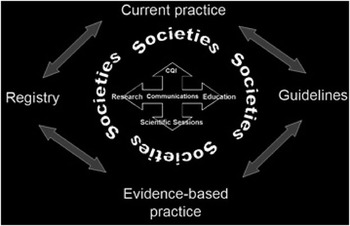
The International Consortium for Evidence-Based Perfusion (Fig. 1) is a collaborative partnership of societies of perfusionists, professional medical societies, and interested clinicians, whose aim is to promote the continuous improvement of the delivery of care and outcomes for patients undergoing extracorporeal circulation. The International Consortium for Evidence-Based Perfusion seeks to achieve these goals by developing an enhanced interdisciplinary strategy of care for patients and communication among the caregivers within the cardiac clinical microsystem. “Clinical microsystems are units at the front-line that provide most health care to most people”, as described at the following website: [http://www.clinicalmicrosystem.org/]. The foundation of The International Consortium for Evidence-Based Perfusion is identified through its commitment to four guiding principles:
The International Consortium for Evidence-Based Perfusion (www.bestpracticeperfusion.org) is a collaborative partnership of societies of perfusionists, professional medical societies, and interested clinicians, whose aim is to promote the continuous improvement of the delivery of care and outcomes for patients undergoing extracorporeal circulation. The International Consortium for Evidence-Based Perfusion seeks to achieve these goals by developing an enhanced interdisciplinary strategy of care for patients and communication among the caregivers within the cardiac clinical microsystem. CQI = Continuous Quality Improvement.

• Development of an international registry of perfusion to provide evaluation of current practice
• Development and publication of evidence-based guidelines, and integration of these guidelines into clinical practise
• Identification of gaps in the peer-reviewed literature with subsequent research in areas where the evidence is lacking
• Identification of gaps between current and evidence-based clinical practice in order to promote the improvement in the care of patients.
Additional information about this consortium may be found at http://www.bestpracticeperfusion.org/.
The International Consortium for Evidence-Based Perfusion recognizes that the practice of perfusion for congenital cardiac surgery is a unique discipline, and has therefore organized a standing committee to address the needs of this population of patients. To date, the committee consists of thirty-two individuals representing twenty-five congenital cardiac surgery centres in six countries. This committee convenes a conference call every month, is represented three times annually at the Multi-Societal Database Committee for Pediatric and Congenital Heart Disease Meeting, and corresponds routinely via e-mail.
The assessment and subsequent improvement of care for patients with congenital cardiac disease undergoing extracorporeal circulation requires a sufficient understanding of the complications that may occur. The Multi-Societal Database Committee for Pediatric and Congenital Heart Disease considers extracorporeal circulation to be a separate “organ-system”. In this Supplement to Cardiology in the Young, the International Consortium for Evidence-Based Perfusion has made every effort to identify and define the myriad of complications related to extracorporeal circulation that may occur while congenital patients are supported by extracorporeal circulation. The terms in the final list of complications related to extracorporeal circulation, along with their precise descriptions and official definitions, as developed by The International Consortium for Evidence-Based Perfusion working in collaboration with The MultiSocietal Database Committee for Pediatric and Congenital Heart Disease, are listed in Part 4 of this Supplement.
Historical background
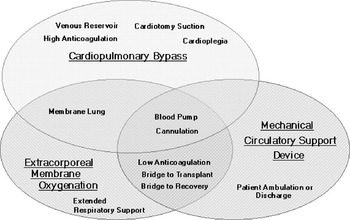
Since its introduction more than fifty years ago, the practice of extracorporeal circulation, also known as “perfusion”, has undergone many changes. In its infancy, the technicians responsible for operating and maintaining extracorporeal equipment, also known as perfusionists, were mostly self-taught, as no formal training programs existed. Over time, perfusion has become a highly specialized discipline with formal education programs and official board certification established in many parts of the world. The first organized educational school of perfusion was created in 1963 at the Cleveland Clinic.Reference Stammers1 Perfusionists are recognized as the experts in areas of extracorporeal equipment and practice. Three types of extracorporeal circulation that fall within the scope of practice for perfusionists (Fig. 2):
This Venn diagram demonstrates the relationships of the three types of extracorporeal circulatory support that fall within the scope of practice for perfusionists: cardiopulmonary bypass, extracorporeal membrane oxygenation, and mechanical circulatory support devices, otherwise known as ventricular assist devices.

• cardiopulmonary bypass
• extracorporeal membrane oxygenation, and
• mechanical circulatory support devices, otherwise known as ventricular assist devices.
Cardiopulmonary bypass
Cardiopulmonary bypass is defined as the process of diverting venous blood from a patient’s heart and lungs to a gas exchange system for the addition of oxygen, removal of carbon dioxide, and subsequent re-infusion to the patient’s arterial system. Cardiopulmonary bypass revolutionized the approach to cardiovascular surgery by affording surgeons the ability to work on a flaccid heart for extended periods of time for corrective procedures.Reference Galletti and Brecher2 In May, 1953, Dr. John H. Gibbon, Jr. reported the first successful use of cardiopulmonary bypass using the Gibbon-IBM heart-lung machine at Jefferson Hospital in Philadelphia, Pennsylvania, United States of America, when he operated on an eighteen year old woman with an atrial septal defect.Reference Gibbon3
In the 1950s, the technological challenge was to create a practical and safe device that could oxygenate blood and remove carbon dioxide. In 1955, at the University of Minnesota, Dr. C. Walt Lillehei began the routine use of a disposable “bubble oxygenator”.Reference Lillehei, Dewall, Read, Warden and Varco4 In 1967, further advancements were made when DeWall and colleagues introduced the hard-shell bubble oxygenator with an integrated oxygenator and “heat exchanger” in a disposable and pre-sterilized unit.Reference DeWall, Bentley, Hirose, Battung, Najafi and Roden5 In 1976, Bartlett and colleagues estimated that ninety percent of all cardiac operations worldwide were being performed with bubble oxygenators.Reference Bartlett and Harken6
Many innovators at the time did not believe the bubble oxygenator provided the safest and most efficient way to oxygenate blood and remove carbon dioxide. In 1967, Lande and colleagues introduced the first compact, disposable, commercially available “membrane oxygenator” for clinical use as a way of achieving separation between blood and gases.Reference Lande, Dos and Carlson7 The widespread use of membrane oxygenators, however, did not occur until the late 1980’s and early 1990’s. A body of evidence now exists that illustrates the benefits of membrane oxygenators to minimize gaseous embolization, and platelet and red blood cell destruction, relative to bubble oxygenators.Reference Hirayama, Yamaguchi, Allers and Roberts8–Reference Blauth, Smith and Newman11 Although most studies confirming a benefit of membrane oxygenators were conducted in adults, Groom and colleagues, in a survey of programs of perfusion of pediatric cardiac surgery determined that membrane oxygenators are used exclusively for cardiopulmonary bypass in North America.Reference Groom, Froebe and Martin12 These oxygenators are now used among the estimated 19,000 cardiac procedures conducted in the United States of America, annually on paediatric patients.Reference Chang and Klitzner13
Extracorporeal membrane oxygenation
Extracorporeal membrane oxygenation is defined as the process of diverting venous blood from a patient to a gas exchange system for the addition of oxygen, removal of carbon dioxide, and subsequent re-infusion to the patient’s arterial or venous system. Due to the time-dependent detrimental effects on the blood and end organs, bubble oxygenators were not feasible in the setting of prolonged extracorporeal support. In 1962, Cooley introduced the concept of temporary cardiorespiratory support outside of the operating room with a portable pump and bubble oxygenator.Reference Cooley and Beall14 A year later, Kolobow and colleagues introduced the silicone rubber membrane oxygenator, making long-term extracorporeal support practical.Reference Kolobow and Bowman15 The silicone membrane is often referred to as a “true membrane”, due to the absence of direct gas and blood interface. To this day, the design by Kolobow is largely unchanged and still widely used in North American centres that provide therapy with extracorporeal membrane oxygenation.Reference Groom, Froebe and Martin12 Recently however, new membrane oxygenator materials, such as polymethylpentene, have been developed that are easier to use and preserve coagulation better than silicone membranes, while maintaining the same level of durability.Reference Khoshbin, Westrope and Pooboni16
In 1976, Bartlett and colleagues reported the first successful neonatal survivor of extracorporeal membrane oxygenation.Reference Bartlett, Gazzaniga, Jefferies, Huxtable, Haiduc and Fong17 By 1989 two prospective randomized studies comparing extracorporeal membrane oxygenation to conventional medical therapy, showed a survivorship benefit among neonates cared for with extracorporeal membrane oxygenation.Reference Bartlett, Roloff, Cornell, Andrews, Dillon and Zwischenberger18, Reference O’Rourke, Crone and Vacanti19 The same year, the Extracorporeal Life Support Organization (www.elso.med.umich.edu) developed a voluntary registry of procedures involving extracorporeal life support in order to support research, regulatory agencies, and individual centres. By 2004, there were nearly 29,000 patients in this registry. According to the Extracorporeal Life Support Organization, extracorporeal life support for cardiac failure is increasing for all age groups from neonate to adult. From this registry, we have learned that the rates of survival to discharge for neonatal respiratory failure and cardiac failure are 77% and 38%, respectively.Reference Conrad, Rycus and Dalton20
Mechanical circulatory support device
A mechanical circulatory support device is defined as a pump or apparatus that augments or replaces the function of the failing heart. Two types of mechanical circulatory support devices are ventricular assist devices and intra-aortic balloon pumps. The use of a mechanical circulatory support device was first reported in adult patients who could not be weaned from cardiopulmonary bypass due to cardiogenic shock.Reference Pierce, Parr, Myers, Pae, Bull and Waldhausen21 Unfortunately, due to size limitations and technical barriers, mechanical circulatory support devices have had limited use in large infants and adolescent paediatric patients. Until recently, extracorporeal membrane oxygenation had been the only means of mechanical circulatory support for neonate and infant patients with cardiac failure.Reference Rogers, Trento and Siewers22 Additional devices are being introduced into the marketplace to address growing demand for such devices in infants and neonates. The Berlin Heart Excor® Pediatric pulsatile pneumatic circulatory support device is an example of one device that has been approved for use recently in Europe.Reference Stiller, Weng and Hubler23
The International Consortium for Evidence-Based Perfusion prefers the term “mechanical circulatory support device”. The list of complications developed by The MultiSocietal Database Committee for Pediatric and Congenital Heart Disease, working in collaboration with The International Consortium for Evidence-Based Perfusion, will retain the term ventricular assist device, but will acknowledge that the term “mechanical circulatory support device” is a preferred term by perfusionists. The rationale for retaining the term ventricular assist device is that this term is widely used at this time and is used in the Adult Cardiac Surgery Database of The Society of Thoracic Surgeons. In fact, the Adult Cardiac Surgery Database of The Society of Thoracic Surgeons is in the process of developing a specific module to track data about ventricular assist devices. The Dictionary of Complications provided in Part 4 of this Supplement will list and define the complications associated with ventricular assist devices and the complications associated with intra-aortic balloon pumps separately.
Consensus definitions
The International Consortium for Evidence-Based Perfusion developed consensus definitions for cardiopulmonary bypass, extracorporeal membrane oxygenation, and mechanical circulatory support devices using a combination of web-based communication software, conference calls, and email. These definitions highlight the similarities and differences between these three methods of extracorporeal circulatory support (Fig. 2).
Cardiopulmonary bypass is the process of diverting venous blood from a patient’s heart and lungs to a gas exchange system for the addition of oxygen, removal of carbon dioxide, and subsequent re-infusion to the patient’s arterial system. The two primary functions of the system are to provide temporary support during cardiac procedures and to create an optimal environment for the completion of intracardiac repairs. Cardioplegia, usually a hyperkalemic solution, is commonly administered to the heart to induce diastolic cardiac arrest and create a flaccid myocardium amenable to intervention. Cardioplegia is a unique feature of this method of extracorporeal circulation.
Extracorporeal membrane oxygenation is the process of diverting venous blood from a patient to a gas exchange system for the addition of oxygen, removal of carbon dioxide, and subsequent re-infusion to the patient’s arterial or venous system. The primary aim of extracorporeal membrane oxygenation is to provide extended support (days to weeks) for patients with reversible respiratory and/or cardiac failure to serve as a bridge to recovery or transplantation. Extracorporeal membrane oxygenation is associated with lower levels of anticoagulation than cardiopulmonary bypass and typically does not incorporate a reservoir. Of note, the term extracorporeal membrane oxygenation is commonly used interchangeably with extracorporeal life support.Reference Zwischenberger and Bartlett24 Extracorporeal lung assist, extracorporeal carbon dioxide removal, and cardiopulmonary support are variants of extracorporeal membrane oxygenation.
Mechanical circulatory support device is the use of a blood pump or apparatus that augments or replaces the function of the failing heart. Mechanical circulatory support devices are designed to provide longer-term (weeks to months) support for patients with cardiac failure. These devices may serve as a bridge to recovery, to transplantation, or for permanent cardiac support. Unlike cardiopulmonary bypass and extracorporeal membrane oxygenation these devices do not incorporate a gas exchange system. Use of these devices, while routine among adults, is increasing in paediatric cardiac surgery.Reference Hetzer, Stiller, Potapov and Lehmkuhl25 Noteworthy features of these devices include the ability to function on battery power, and accommodate patient ambulation within and outside of the hospital setting.
Controversies
This manuscript and Part 4 of this Supplement identifies and defines events considered by the experts in extracorporeal circulation to be complications related to this “organ-system”.
Controversy surrounded the fundamental definition of a complication. In the area of extracorporeal circulation, it is well recognized that microembolic events and haematologic abnormalities occur commonly. This quandary is termed “Normalization of Deviance”.Reference Vaughan26 By this concept, teams accept as normal, events or outcomes that in other venues might be considered a complication. This concept speaks to the core intention of this project, which is to create a framework by which we may evaluate our clinical practice, identify opportunities for improvement of process, and redesign our system to improve the care we provide to our patients.
The final complications list, as shown in Part 4 of this Supplement, includes many events that would be considered non-controversial for inclusion, and some events that would be challenged as complications. For example, the complication listed as “Cannula complication, Dislodgement of arterial cannula”, is an event that is very clear in its definition, occurrence, and potential implication. On the other hand, “Air complication with air in circuit, Gaseous emboli in arterial line – mechanically detected” may be more controversial due to some of the following reasons:
• the conflicting evidence supporting the association between gaseous microemboli and adverse neurologic injury
• most centres do not utilize sensitive Doppler devices to monitor for embolic activity, and
• most centres do not measure the consequence of these emboli in their daily practice, such as neuropsychological injury.
While Rodriguez and colleagues reported differences in cerebral embolic signals among children undergoing cardiopulmonary bypass, some members of our committee argued that evidence linking the use of these devices to outcome in children is nonetheless lacking.Reference Rodriguez and Belway27 The spirit of our profession should balance fiscal mindfulness with providing exemplary care to our patients. To this end, we seek and encourage the identification of those processes of care within our practice associated with the generation of emboli in order to improve the care provided to our patients.
Further, we recognized that terms used routinely in practice lacked uniform and consistent definitions. For example, although “disseminated intravascular coagulation” remains a clinically accepted diagnosis, a universally accepted diagnostic algorithm does not exist.Reference Gando, Iba and Eguchi28, Reference Lehman, Wilson and Rodgers29 Our efforts to define disseminated intravascular coagulation during extracorporeal membrane oxygenation were challenging due to the lack of uniformity in diagnosing disseminated intravascular coagulation without extracorporeal membrane oxygenation. Therefore, we chose the term “Bleeding, Coagulopathy related”, defined as “Excessive bleeding greater than 10 millilitres per kilogram per hour despite attempts to maintain platelets, fibrinogen, thrombelastography, and international normalized ratio values within departmental protocols”. In so doing, the definition of this complication allows for some specificity in its definition, while still accommodating protocol variations across institutions.
A further area of consternation reflected unwarranted variation in clinical practice. For example, the complication titled “Hematologic complication, Extracorporeal membrane oxygenation circuit replacement for hematologic concerns” reflects a complication, but may not always be adequately quantified. The practice at some institutions is to replace the circuit solely based on levels of plasma free haemoglobin exceeding 50 milligrams per decilitre. Members of our panel suggested that they would choose to replace the circuit if the levels of plasma free haemoglobin exceed 50–100 milligrams per deciliter in the setting of clinical symptoms of hemolysis, while others choose not to monitor levels of plasma free haemoglobin at all. With such varying practices across institutions, and limited evidence in the literature to support recommended guidelines for circuit replacement, the definition was derived, albeit regretfully, based on experiential practices.
Common to all discussions while developing the list of complications was the notion that we provide care in a very complex environment. We are all part of a larger cardiac microsystem (Table 1) made up of a large group of care providers. Improvement may be realized as each profession gains a greater understanding of their interdependences while appreciating the context in which care is provided. This project provides a common nomenclature to assist us in the dissemination of the current science, with the aim of facilitating the development of new knowledge.
Cardiac Microsystem Team Members.

Interactions with the cardiac system
Patients undergoing extracorporeal circulation are exposed to a unique relationship between the “extracorporeal organ-system” and their cardiac system. This point is exemplified in the setting of cardiopulmonary bypass and the processes of cardioplegia delivery and modified ultrafiltration. Cardioplegia is usually a hyperkalemic solution and is administered to the heart to induce diastolic cardiac arrest and protect the ischaemic myocardium from injury. Modified ultrafiltration is a technique designed to hemoconcentrate the patient and the cardiopulmonary bypass circuit after the cessation of cardiopulmonary bypass. Safe and effective practice of these techniques necessitates significant interdisciplinary interaction in order to maintain or enhance myocardial performance.
Cardioplegia
One of the initial descriptions of cardioplegia is credited to Hugh Bentall.Reference Bentall30 Cardioplegia raises unique issues for children, infants, and especially neonates. Many structural, functional, and metabolic differences between an adult and paediatric heart exist. The immature heart has a denser structure, and higher protein and water content per gram of tissue, than the adult counterpart. Prolonged periods of anaerobic metabolism are possible due to the decreased preload reserve and greater glucose metabolism of the paediatric heart.Reference Allen31, Reference Romero and Friedman32 Despite successful surgical procedures to repair congenital abnormalities, paediatric patients may experience morbidity and mortality related to reduced cardiac output and other complications of cardiopulmonary bypass.Reference Allen33, Reference Allen, Barth and Ilbawi34 Over half of these poorly functioning paediatric myocardiums, many of which may lead to the death of the patient, may result from inadequate cardioprotection during bypass.Reference Allen31, Reference Allen33 Variability in cardioplegic solutions and strategies may partially account for these complications.Reference Allen31–Reference Hammon35 In 1997, Demmy and colleagues reported that in the United States of America alone, 167 different types of cardioplegia solutions are used for adult clinical cardiac transplantations, a finding that may not be too dissimilar for those having congenital procedures.Reference Demmy, Biddle, Bennett, Walls, Schmaltz and Curtis36
Blood versus crystalloid
Many clinicians believe that blood cardioplegia provides optimal protection in the neonatal cyanotic heart. However, little difference between crystalloid and blood cardioplegia protection has been found when neonatal hearts are not stressed preoperatively and when ischaemic times are kept below 45 minutes.Reference Amark, Berggren and Bjork37, Reference Modi, Suleiman and Reeves38 Crystalloid cardioplegia is still widely used due to its ease of use and ability to improve surgical visibility. The myocardial cell’s preference for glucose and the low activity of 5’nucleotidase contribute to the paediatric heart’s ischaemic tolerance and make blood cardioplegia an ideal medium for cardioprotection.Reference Makinde, Gamble and Lopaschuk39 In a prospective, controlled randomized trial, the use of blood cardioplegia in acyanotic infants maintained normal myocardial substrate metabolism due to reductions in lactate production and glutamate uptake.Reference Amark, Berggren and Bjork37 Although the composition of cardioplegia solutions may vary, its cardioprotective effect may be attributed to hypothermia, potassium, alkalotic pH, membrane stabilizers, controlled pressures, and maintenance of diminished, while not absent, calcium concentrations. One object of myocardial protection is the delivery of oxygen to myocardial cells and the prevention of ischaemia. Oxygenated cardioplegic solutions will meet this need, unlike their non-oxygenated counterparts. Non-oxygenated solutions deliver 0.56 millilitres of oxygen per decilitre, while oxygenated crystalloid deliver 3.7 millilitres of oxygen per decilitre and blood cardioplegia deliver 4.2 millilitres of oxygen per decilitre.Reference Landymore and Myers40 Since the demands for oxygen of myocardial tissue at a temperature of 15 degrees Celsius may average 0.27 millilitres per minute per 100 grams for the left ventricle, a 30-minute ischaemic period may accumulate an oxygen debt of nearly 30 millilitres in the non-hypertrophied heart.Reference Guyton, Dorsey and Craver41 Thus, both oxygenated crystalloid and blood cardioplegia would be adequate for meeting this demand if the multi-dose technique is used.Reference Landymore and Myers40
Modified ultrafiltration
The use of ultrafiltration after separation from cardiopulmonary bypass was first reported by Naik, Elliott, and colleagues in 1991.Reference Naik, Knight and Elliott42, Reference Naik, Knight and Elliott43 In a prospective, randomized trial of paediatric patients, this 10-minute application of modified ultrafiltration demonstrated significant reductions in the requirement for transfusion of donated blood and the total “body water” of the patient. Since that time, this practice has become a routine part of clinical practice in approximately seventy-five percent of programmes of paediatric cardiac surgery.Reference Groom, Froebe and Martin12
In addition to the well reported improvements in removal of total body water, cytokines and increased hematocrits after cardiac surgery in the paediatric population,Reference Naik, Knight and Elliott42–Reference Hennein, Kiziltepe and Barst46 the hemodynamic effects of modified ultrafiltration include increased blood pressureReference Naik, Knight and Elliott42, Reference Chaturvedi, Shore and White47 and left ventricular systolic functionReference Chaturvedi, Shore and White47, Reference Davies, Nguyen, Gaynor and Elliott48 with a concomitant reduction in postoperative morbidity.Reference Raja, Yousufuddin, Rasool, Nubi, Danton and Pollock49 Aggarwal reported a significant decrease in posterior wall thickness with modified filtration secondary to reductions in myocardial water content.Reference Aggarwal, Das, Sharma and Kiran50 Within a span of 17 years, modified ultrafiltration is now used routinely in paediatrics for reducing total body water, increasing hematocrit, and improving systemic vascular resistance.
Conclusion
This manuscript is the product of an interdisciplinary collaboration between perfusionists and other providers of care for patients with congenitally malformed hearts. The development of consensus-driven nomenclature for the complications of congenital cardiac surgery related to extracorporeal circulation will afford improved communication across the clinical team. Identifying and defining these complications will provide a foundation for future research and create opportunities for the shared goal of improving the care of patients.
Acknowledgements
We gratefully acknowledge the contributions of the following individuals: Robert Baker, Timothy Dickinson, Renee Dickey, Brian Mejak, Chris Brabant, David Edgell, Debbie Hubble, Richard Ginther, Scott Lawson, Carla Zazulak, and Talya Frey.
We thank The Children’s Heart Foundation (http://www.childrensheartfoundation.org/) for financial support of this research.