During the plebeian secessions in Rome, the plebs retreated from the city but they did not leave it. According to Livy’s account of the first secession, they gathered at the Sacred Mount (Mons Sacer), created a new religion of the plebs, and swore an oath not to fight the patricians’ war until their demands were met. Footnote 1 After Menenius Agrippa’s failed arbitration, which included his famous appeal to the organic integrity of the body politic, the plebs won a newfound presence in the political community: the tribunes. They stood not just as parts but as members, as the members they already claimed themselves to be. They had become citizens and had inscribed their status on the public consciousness of Rome through the office of the tribunes. Many of the most characteristic institutions of the Roman republic followed the same course. Plebeian secessions gave birth to the Twelve Tables, the formal legislative supremacy of the plebs, and the abolition of the debt-bondage. Footnote 2 Livy called the post-secession dictatorial decree that abolished debt-bondage the Lex Poetelia (326 bc), “the dawn, as it were, of a new era of liberty for the plebs.” Footnote 3
This is one of those instances in which the distance between the ancients and the moderns is not so wide as we might think. The classical past was prologue. Consider the basic elements of the plebeian secessions: withdrawal from the city while insisting on continued membership; collective demands and a culture, even cult, of solidarity; class conflict and social crisis; economic and political demands folding into each other like a Mobius strip; the birth of a new liberty.
These are the elements of a strike narrative. Think, for instance, of the 1812 “blackface” strikers who, rioting against low wages and high wheat prices, painted their faces black, took sacred oaths of secrecy “under the canopy of Heaven,” armed themselves “with the implements of their trades,” and then “destroyed the property of those who were obnoxious to them.” Footnote 4 Or there were the thousands of working class Chartists who, in 1838, took their demands for universal suffrage and higher wages to a hill that Friedrich Engels tellingly referred to as the “Mons Sacer of Manchester.” Footnote 5 Or there was the dramatic 1937 “sit-down” strike in Flint, Michigan, in which workers converted a piece of private property into democratic public space. Footnote 6
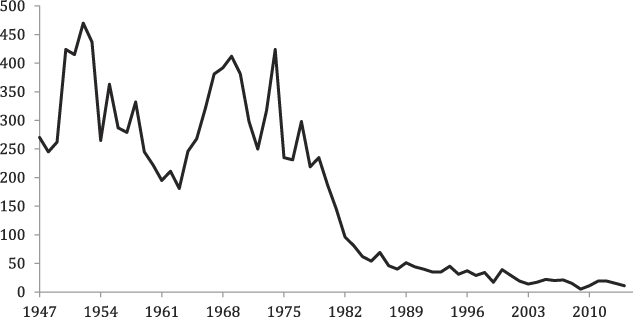
It is true that, since strike activity has declined by nearly 90 percent from its peak in the 1970s, we might think this form of collective action is no longer relevant (see Figure 1). However, in the past few years, we have seen significant strikes by Chicago teachers and transit workers, nurses and fast food workers, truckers and oil refiners, Verizon and WalMart workers. Footnote 7 Some of these actions have spilled out into wider campaigns, most significantly the recent “Fight for $15” strikes whose aim is to raise the minimum wage and which have included everyone from food service workers to child care providers. Footnote 8 These strikes have taken place in those sectors expected to add the largest number of jobs in coming years, like health care, food service, and retail. Footnote 9 Present and future Supreme Court rulings on topics like public sector union fees and unpaid work have revived interest in labor law generally, after years of relative indifference. Footnote 10 Moreover, strikes by British postal workers, South African miners, Belgian and Greek anti-austerity activists, and hundreds of thousands of Chinese workers, speak to the global scope of the issue. Footnote 11 Given the new politics of inequality that has emerged after the last decades of relative labor quiescence, and especially since the Great Recession of 2008 and the Euro-crisis of 2010, there is every reason to think that strikes will be as much a part of our future as our past.
Number of U.S. strikes involving more than 1,000 workers since 1945
Source: Bureau of Labor Statistics.

For these reasons, it is time to think anew about the strike as a distinct form of collective action. The reissue of old classics, like Jeremy Brecher’s labor history Strike!, and the appearance of new reflections, like labor lawyer Joe Burns’ Reviving the Strike or journalist Micah Uetricht’s Strike for America, are signs of renewed interest. But a small group of disparate examples is not a concentrated mass, and none of these pieces are part of political science. It is a strange fact about the right to strike that over the past fifty years English-speaking political philosophers have published only one book-length study and a handful of articles on this subject, Footnote 12 while neighboring political phenomena—civil disobedience, right of revolution, secession, civil war, social movements—attract vastly more attention. Further, despite ample discussion of the problem of inequality across all fields and subfields, there is relatively little discussion of labor rights. This is especially true among political philosophers, who, with those few aforementioned exceptions, have had much more to say about welfare rights and ideal distributions than about labor rights, especially the right to strike. Though the history of political thought offers many figures who thought about the strike either in systematic or piecemeal ways, the ideas of John Stuart Mill and Karl Marx, L.T. Hobhouse and Rosa Luxemburg, Georges Sorel and Big Bill Haywood seem to have had more influence on union organizers and social theorists, labor lawyers and intellectual historians, than current political philosophers. Footnote 13
My basic thought is that the right to strike is a right of human freedom claimed against the social domination that the typical modern worker experiences. Ordinarily, the right to strike is thought to be an economic right whose purpose is to maintain a certain kind of bargaining relationship among self-interested economic actors. However, it is better understood as a political right that individuals claim against an unjust system of law and property in the name of justice and emancipation. It is a political right even when most strikes do not have explicitly political ends. Put another way, one reason strikes are political is the way they threaten the normal distinction between politics and economics itself. They do so by challenging the idea that the logic of commodity exchange and private contracts should govern labor relations. The best justification of the right to strike lies in the way strikers claim their liberty not just as abstract persons but as socially-situated agents, who find themselves in the historically specific relationships of domination associated with the labor market. It is this connection to resisting domination that makes the right to strike political.
My central purpose is to develop an argument for the right to strike and in so doing to show how recent developments in political philosophy around concepts like domination and freedom can enrich our thinking about labor rights. Footnote 14 While basically a normative argument, this is not an argument from what is sometimes called ideal theory. The procedure here is not to imagine the best regime and derive the right to strike from features of that regime—quite the opposite. It would, in fact, be hard to understand just why the strike protects a fundamental interest in non-domination if we began from perfectly just conditions. As we shall see, we can only make sense of the right to strike—of the interests it protects, of its scope, of the role it plays in our moral reasoning—against the background of injustice. Those unjust conditions of domination explain the right to strike. I make no general claims about the superiority of non-ideal versus ideal theory. Rather, my argument here is narrower: to explain and justify the right to strike, we must begin with the significantly unjust conditions of the typical labor market.
The normative argument here connects to wider research programs on the politics of inequality and, in particular, to how we think about collective responses to economic injustice. While this article does not engage in the comparison, it certainly invites research into comparative labor regimes, especially comparisons among regimes where there is more robust strike activity compared with regimes that incorporate labor demands in other ways. More broadly, I introduce a distinctive kind of question we might ask when comparing political economies. The most familiar comparative questions ask who gets what and why or how do these institutions work compared to those. Since the right to strike is a right of actors who suffer injustice to attempt to remediate that injustice, sometimes by infringing the rights of others, it is one of those rights that touches on that other classic political question: ‘Who can do what to whom? Although I answer that question in a more analytic and normative vein, it is also an urgent empirical concern.
My argument proceeds in five parts. I start by trying to answer a deceptively simple question—what is a right to strike?—and show that any answer raises some significant moral and conceptual puzzles. In the second section, I use current American labor law to show that these puzzles are not abstract questions but reach deep into law and policy. In the third, fourth, and fifth sections, I show how the right to strike can be understood as a way of resisting the forms of structural and personal domination that are associated with the modern labor markets.
“Is It Peace or War”: Footnote 15 What Is a Right to Strike?
The right to strike is peculiar. It is not a right to quit. The right to quit is part of freedom of contract and the mirror of employment-at-will. Workers may quit when they no longer wish to work for an employer; employers may fire their employees when they no longer want to employ them. Either of those acts severs the contractual relationship and the two parties are no longer assumed to be in any relationship at all. The right to strike, however, assumes the continuity of the very relationship that is suspended. Workers on strike refuse to work but do not claim to have left the job. After all, the whole point of a strike is that it is a collective work stoppage, not a collective quitting of the job. This is the feature of the strike that has marked it out from other forms of social action.
If a right to strike is not a right to quit, what is it? It is the right that workers claim to refuse to perform work they have agreed to do while retaining a right to the job. Most of what is peculiar, not to mention fraught, about a strike is contained in that latter clause. Yet, surprisingly, few commentators recognize just how central and yet peculiar this claim is. Footnote 16 Opponents of the right to strike are sometimes more alive to its distinctive features than defenders. One critic, for instance, makes the distinction between quitting and striking the basis of his entire argument:
the unqualified right to withdraw labour, which is a clear right of free men, does not describe the behaviour of strikers.… Strikers … withdraw from the performance of their jobs, but in the only relevant sense they do not withdraw their labour. The jobs from which they have withdrawn performance belong to them, they maintain. Footnote 17
On what possible grounds may workers claim a right to a job they refuse to perform?
While many say that every able-bodied person should have a right to work, and they might say that the state therefore has an obligation to provide everyone with a job, the argument for full employment never amounts to saying that workers have rights to specific jobs from specific private employers. For instance, in 1945, at the height of the push for federally-guaranteed full employment, the Senate committee considering the issue took care to argue that “the right to work has occasionally been misinterpreted as a right to specific jobs of some specific type and status.” After labeling this a “misinterpretation,” the committee’s report cited the following words from one of the bill’s leading advocates: “It is not the aim of the bill to provide specific jobs for specific individuals. Our economic system of free enterprise must have free opportunities for jobs for all who are able and want to work. Our American system owes no man a living, but it does owe every man an opportunity to make a living.” Footnote 18 These sentences remind us how puzzling, even alarming, the right to specific jobs can sound.
In fact, in a liberal society the whole point is that claims on specific jobs are a relic of feudal thinking. In status-based societies, specific groups had rights to specific jobs in the name of corporate privilege. Occupations were tied to birth or guild membership, but not available to all equally. Liberal society, based on freedom of contract, was designed to destroy just that kind of unfair and oppressive status-based hierarchy. A common argument against striking workers is that they are latter-day guilds, protecting their sectional interests by refusing to let anyone else perform “their jobs.” Footnote 19 As one critic puts it,
the strikers’ demand for an inalienable right to, and property in, a particular job cannot be made conformable to the principles of liberty under law for all … the endowment of the employee with some kind of property right in a job, [is a] prime example of this reversion to the governance of status. Footnote 20
If such criticisms fundamentally misunderstand the entirely modern basis for the right to strike, we still need an account of how anyone could claim something like a property right in a job she not only never acquired but that she then refuses to perform.
A second problem follows on the first. If workers have rights to the jobs they are striking then they must have some powers to enforce those rights. Such powers might include mass picketing, secondary boycotts, sympathy strikes, coercion and intimidation of replacement workers, even destruction or immobilization of property—the familiar panoply of strike actions. While workers have sometimes defended such actions without using the specifically juridical language of “rights,” in many cases they have used that kind of appeal. Footnote 21 Even when they have not employed rights discourse, they have invoked some related notion of demanding fair terms to their job. Footnote 22 Each and any of the above listed activities of a strike—pickets, boycotts, sympathy actions—are part of the way workers not only press their demands but claim their right to the job. Strikers regularly implore other workers not to cross picket lines and take struck jobs. These are more than speech acts. At the outer edges, they amount to intimidation and coercion. Or at least, workers claim the right to intimidate and coerce if the state will not itself enforce this aspect of their right to strike. Liberal societies rarely permit a group of individuals powers that come close and even cross over into rights of private coercion. It is no surprise that regulation and repression of these strike activities have been the source of some of the most serious episodes of labor-related violence in U.S. and European history. Footnote 23 So, alongside the unclear basis for the strikers’ rights to their jobs, the problem for a liberal society is that this right seems to include private rights of coercion or at least troubling forms of social pressure.
Yet there is more. The standard strike potentially threatens the fundamental freedoms of three specific groups.
-
Freedom of contract. It conflicts with the freedom of contract of those replacement workers who would be willing to take the job on terms that strikers will not. Note that this is not a possible conflict but a necessary one. Strikers claim the job is theirs, which means replacements have no right to it. But replacements claim everyone should have the equal freedom to contract with an employer for a job.
-
Property rights. A strike seriously interferes with the employer’s property rights. The point of a strike is to stop production. But the point of a property right is that, at least in the owner’s core area of activity, nobody else has the right to interfere with his use of that property. The strikers, by claiming that the employer has no right to hire replacements and thus no way of employing his property profitably, effectively render the employer unfree to use his property as he sees fit. To be clear, strikers claim the right not just to block replacement workers, but to prevent the employer from putting his property to work without their permission. For instance, New Deal “sit-down” strikes made it impossible to operate factories, which was one reason why the courts claimed it violated employer property rights. Footnote 24 Similarly, during the Seattle general strike in 1919, the General Strike Committee forced owners to ask permission to engage in certain productive activities—permission it often denied. Footnote 25
-
Freedom of association. Though the conceptual issues here are complicated, a strike can seriously constrain a worker’s freedom of association. It does so most seriously when the strike is a group right, in which only authorized representatives of the union may call a strike. In this case, the right to strike is not the individual’s right in the same way that, say, the freedom to join a church or volunteer organization is. Moreover, the strike can be coercively imposed even on dissenting members, especially when the dissenters work in closed or union shops. That is because refusal to follow the strike leads to dismissal from the union, which would mean loss of the job in union or closed shops. The threat of losing a job is usually considered a coercive threat. So not only might workers be forced to join unions—depending on the law—but also they might be forced to go along with one of the union’s riskiest collective actions.
Note that each one of these concerns follows directly from the nature of the right to strike itself. Interference with freedom of contract, property rights, and the freedom of association are all part and parcel of defending the right that striking workers claim to “their” jobs. These are difficult forms of coercive interference to justify on their own terms and they appear to rest on a claim without foundation. Just what right do workers have to jobs that they refuse to perform?
Perhaps all this is a theoretical tempest in a teacup. Surely we can just add a simple proviso and all go home: no coercion. All relationships must be voluntary. Striking workers may claim to have a right to their jobs, so the argument goes, but they are confused when they say they have a right to it. That latter clause makes it appear like workers have rights of coercive enforcement, but, as noted, in liberal-democratic theory, that is prohibited. Workers may argue, protest, and exhort. They may refuse the existing terms of a job; they may try to persuade employers only to bargain with them; they may try to convince potential replacement workers not to cross picket lines. Indeed, these acts of moral suasion might even be ways of upholding the system of free exchange itself. As John Stuart Mill said,
I do not hesitate to say that associations of labourers, of a nature similar to trades unions, far from being a hindrance to a free market for labour, are the necessary instrumentality of that free market; the indispensable means of enabling the sellers of labour to take due care of their own interests under a system of competition… . Strikes, therefore, and the trade societies which render strikes possible, are for these various reasons not a mischievous, but on the contrary, a valuable part of the existing machinery of society. Footnote 26
However, Mill’s “necessary instrumentality of that free market” may only go so far:
It is, however, an indispensable condition of tolerating combinations, that they should be voluntary. No severity, necessary to the purpose, is too great to be employed against attempts to compel workmen to join a union, or take part in a strike by threats or violence. Mere moral compulsion, by the expression of opinion, the law ought not to interfere with; it belongs to more enlightened opinion to restrain it, by rectifying the moral sentiments of the people. Footnote 27
This is standard liberal advice on how to solve the problem. Workers are free to pursue their interests so long as they do not violate the basic rights of anyone else. They may engage in moral suasion, hoping to convince others not to take their jobs, or to convince employers to bargain with them rather than make contracts with others. Their freedom includes the right to join forces, so long as they don’t force anyone to join. They are free to bargain collectively, so long as they do not force anyone to bargain.
Unfortunately, this voluntarist solution works only by dealing a near irrevocable blow to the right to strike itself. Few strikes with any reasonable chance of success can hope to stand on moral suasion alone, especially when no serious pressure can be brought against employers or replacement workers. Footnote 28 A strike is not part, at least not only a part, of those activities of civil society that hope to win by the “soft force of the better argument” alone. Strikers must be able to impose severe costs on employers and replacements. If the right to strike protects some important human interest it cannot do so by effectively neutralizing that very form of collective action. Moreover, as one commentator reminds us, if there really is a right to the job that workers refuse to perform then
of necessity, a strike goes beyond merely attempting to persuade people not to break the strike; to use a suitably vague phrase, it involves putting pressure on those who would break the strike, to make it difficult or unpleasant for them to do so. That, surely, is what the apparatus and ideology of strikes is for: not just to persuade non-strikes so that they willingly accept whatever restrictions the strikers seek to impose; but to put pressure on them so that unwillingly, if needs be, they decline to break the strike. Footnote 29
So far then, we are on the horns of a dilemma. Either the right to strike really includes the right to the job that strikers refuse to perform, in which case a wide range of actions are permitted or at least enjoy some prima facie justification. Or the right to strike must take place purely in voluntaristic terms, in which case no basic rights are violated. But in that case there is little chance of the strike succeeding and there is no recognition of the strikers’ right to the job. Lest this seem like a purely theoretical dilemma, a brief survey of American labor law shows us the stakes of falling on one side or the other. As we shall see, American labor law has essentially chosen the liberal voluntarist position, which surrounds strikes with a number of rules and prohibitions that protect rights of property, contract, and managerial control at the expense of leaving an extremely constrained right to strike—perhaps no real right to strike at all.
An Example of the Stakes: American Case
In the United States the law says that private sector workers have a right to strike. Footnote 30 As part of this law the state may not issue pre-strike injunctions nor may it criminalize collective bargaining or the taking of strike action. Footnote 31 The law also prohibits employers from blacklisting pro-union employees or requiring “yellow-dog” contracts. Footnote 32 Nor may they fire a worker for defending unions or for going on strike. Footnote 33 Notably, protections for pro-union workers are one of the few restrictions on the employer’s employment-at-will rights to hire and fire whomever he wants. Footnote 34 This restriction means that American law recognizes that the prospect of losing one’s job is a coercive threat and therefore threatening to fire someone for striking violates his or her right to strike.
That is relevant because, surprisingly, while employers may not fire pro-union workers, the Supreme Court says that employers’ interest in maintaining production and controlling their property means they may threaten to close an entire business or relocate a plant solely because workers have threatened a strike. Footnote 35 They are also legally permitted to hire permanent replacement workers and these workers may vote to decertify the current union. Footnote 36 The only exception to that rule is when a strike is against “unfair labor practices,” which are strikes against employers accused to violating certain labor laws themselves (e.g., discriminating against pro-union employees.) For all normal “economic” strikes employers may explicitly threaten the entire body of workers with loss of their jobs and, though they may not fire the workers, may permanently replace them. It is unclear what conceptual distinction lies behind the legal distinction between firing and permanent replacement or shutting down and moving since the effect on the worker is the same. As one legal scholar has put it, “the ‘right to strike’ upon risk of permanent job loss is a ‘right’ the nature of which is appreciated only by lawyers.” Footnote 37 But there it is, in law. For these reasons alone we might think American workers do not enjoy a real right to strike.
Yet there is more. Footnote 38 Workers may not organize in industry-wide unions without individual, workplace-by-workplace unionization agreements. Strikes must also usually take place on a workplace-by-workplace rather than industry-wide basis. Footnote 39 Closed and union shops are acceptable in many states, though some prohibit even mandatory collection of dues, and the Supreme Court allows employers to ban union-organizers from their property. Footnote 40 Further, the employer’s property-interest in the “core of entrepreneurial control” over hiring and firing, plant location, investment, pricing, or production processes remains outside the scope of what law and precedent have established as labor’s legitimate interests. Footnote 41 Strikes must therefore be restricted to protest unfair labor practices or negotiate narrow bread-and-butter issues like wages and hours. Workers may not engage in sympathy strikes or secondary boycotts, which includes legal prohibition on workers picketing outside stores that use or sell products made in struck workplaces. Footnote 42 To understand the consequences of that last prohibition, consider a store that is selling goods made with parts from a struck factory. Anyone who is not a worker from the striking factory may stand outside, simply as a citizen with free speech rights, and petition against shoppers spending their money there. But a worker from the striking factory may not do the same because it is considered illegal, secondary picketing. To go on strike is therefore to lose some basic civil liberties like freedom of speech. Footnote 43 In other words, the repertoire of mass, solidarity-based strikes across an industry are no longer a part of union action at least in part because they have been, since the mid-twentieth century, illegal. There are other relevant laws and precedents, but this gives a vivid enough picture as it is.
The facts described in the previous three paragraphs remind us why our thinking about the right to strike matters. If the right to strike is just a derivative right, with the same general structure and function as rights of association, contract, and property, then many, if not all, of the laws or precedents described above are defensible. These restrictions flow from a rejection of the view that workers have an enforceable right to the job they strike; from the requirement that collective action remain voluntary; and from a refusal to accept that workers as a whole have shared interests as a consequence of their social position. Unions may, at most, operate closed shops and enjoy a formal right to strike, but they may not interfere with the core property rights of employers, contract rights of workers, nor claim that the interests of workers expand beyond a narrow range of issues in the workplace itself. If, however, we take the right to strike to be a distinct kind of right, protecting an independent interest, in which workers do legitimately have a right to the job over which they strike, then we would have to reject many existing restrictions on strike activity.
In other words, many of the current legal restrictions on workers make some kind of sense if we accept the voluntarist position. To understand why this voluntarist view is wrong, we must move to the world of social theory. Specifically, we have to understand the way in which the labor market subjects workers to overlapping forms of unfreedom.
The Commodification of Labor I: Structural Domination and Exploitation
So long as we view the labor market as a series of voluntary agreements to which workers and employers freely consent, we cannot make adequate sense of the right to strike. There are two interconnected forms of compulsion to which workers are subject that undermine any such view. Drawing on what has become known as the republican theory of freedom, I propose that we see these interconnected compulsions as forms of “domination” where domination means being subject to the uncontrolled or arbitrary power of another. Footnote 44 On this view, I am subject to another person’s will if that person has the capacity to interfere with me, even if he does not actually interfere. The dominator might be benevolent or malicious, but in either case, he dominates because he can interfere in an uncontrolled way. That is what distinguishes the republican position from the more common, liberal view of freedom as non-interference, where I am unfree only if someone actually interferes with my choices. Philip Pettit, who has done more than anyone to promote and develops this neo-republican theory, tends to take the view that structural domination does not exist because to be dominated means that one person is directly subject to another person’s will. Footnote 45 One employer might dominate an employee, simply by having the power to harass or interfere with her, but a group of individuals cannot, in themselves, be dominated nor can a background distribution of property be dominating. As Pettit puts it, “the property system … will not be a source of domination so far as it is the cumulative, unintended effect of people’s mutual adjustments.” Footnote 46 However, as I and others have argued elsewhere, given both the history of republican thinking and the inner logic of the theory of freedom, there is no special reason to restrict the concept of domination to only interpersonal relations. Individuals can be dominated in a more structural way, by the distribution of property or by general features of a labor market that involve submission in a more anonymous or impersonal way. There are various kinds of economic dependence that subject some individuals to the uncontrolled power of others. Footnote 47 Here we shall encounter just this kind of structural domination.
The concept of domination is useful for my argument because it illuminates certain relations of power and helps explain the sense in which the right to strike emerges out of a demand for freedom, not just for higher wages or safer conditions, though those substantive concerns are always also in play. Footnote 48 However, while I believe the republican theory is particularly useful, even those who doubt its value as a concept still ought to be persuaded by my argument for the right to strike. Although I cannot get into all the reasons why, the principle reason is the following. The background argument for the right to strike is that it is a remedial response to the substantial economic injustice that these compulsions entail. While I make sense of that injustice in terms of the nature and distribution of domination, a fellow-traveling reader could make sense of this injustice by using other conceptions of injustice and unfreedom. In that case, the right to strike would be adequately justified to them as a demand for freedom against unjustifiable denials of that freedom. That is all I can say about that issue here. Let us proceed, then, to the social analysis.
The two relevant kinds of domination are structural domination, which renders workers vulnerable to exploitation, and personal domination, which is the array of legal authority and social power that gives employers arbitrary control over workers in a particular workplace. If we recognize these as ineliminable features of the capitalist market for labor, then the right to strike makes sense not as a relic of feudal guild privileges nor just as an economically rational effort by some to maximize wages, but as a form of resistance to the modern labor market itself. Let us begin with structural domination and the problem of exploitation.
Though most closely associated with the Marxian tradition, the thought that desperate workers are exploited is a familiar one. Even those not so sympathetic to the complaints of modern wage-laborers can be found saying, as David Hume famously did, that “the fear of punishment will never draw so much labour from a slave, as the dread of being turned off and not getting another service, will from a freeman.” Footnote 49 Adam Smith gave this fact a turn in favor of workers:
It is not, however, difficult to foresee which of the two parties must, upon all ordinary occasions, have the advantage in the dispute, and force the other into a compliance with their terms.… In all such disputes the masters can hold out much longer.… Many workmen could not subsist a week, few could subsist a month, and scarce any a year without employment. In the long-run the workman may be as necessary to his master as his master is to him, but the necessity is not so immediate. Footnote 50
On top of which, as Smith noted, “masters are always and every where in a sort of tacit, but constant and uniform combination.” In a world in which economic necessity couples with employer collusion, workers have little choice: “Such combinations [by employers], however, are frequently resisted by a contrary defensive combination of the workmen; who sometimes too, without any provocation of this kind, combine of their own accord to raise the price of their labour.” Footnote 51 For this reason Smith thought it was wrong to treat trade unions as criminal conspiracies. Footnote 52 The view of unions and strikes as defensive, aimed at lessening employers’ ability to take advantage of workers’ need, persisted throughout the industrial age. By the time L.T. Hobhouse wrote Liberalism, it was possible for a liberal to argue that strikes might even be connected to human freedom:
The emancipation of trade unions, however, extending over the period from 1824 to 1906, and perhaps not yet complete, was in the main a liberating movement, because combination was necessary to place the workman on something approaching terms of equality with the employer, and because tacit combinations of employers could never, in fact, be prevented by law. Footnote 53
We must note, however, that nearly all of these arguments remain within a form of social theory that attempts to make capitalist practice more like its theoretical self-image. These thinkers tended to defend unions and their right to strike as a way of achieving “real freedom of contract” in the face of economic necessity. Hobhouse was updating Smith and Mill when arguing that “in the matter of contract true freedom postulates substantial equality between the parties. In proportion as one party is in a position of vantage, he is able to dictate his terms. In proportion as the other party is in a weak position, he must accept unfavourable terms.” Footnote 54 On this account, the right to strike is defensible only insofar as it helps maintain a position of relative equality among independent bargaining parties. It thereby secures contracts that are not just voluntary but truly free—Mill’s “necessary instrumentality of that free market.” This basic idea reappears in any number of twentieth-century acts of labor legislation and jurisprudence, perhaps most notably in the 1935 law granting American workers the right to strike. Footnote 55
The problem with the real freedom of contract view is that it is based on faulty social analysis. The labor market is not just another commodity market in which property-owners are, or can be made, free to participate or not participate. Here some social theory is inescapable. Workers who have no other consistent source of income than a wage have no reasonable alternative to selling their labor-power. That is because in capitalist societies most goods are only legally accessible if you can buy them. There is no other way of reliably acquiring necessary goods. The only way for most workers to get enough money to buy what they need is by selling their labor-power. Their only alternatives are to steal, hope for charity, or rely on inadequate welfare provision. These are, generally speaking, unreasonable alternatives to seeking income through wages. If workers have no reasonable alternative to selling their labor-power they are therefore forced to sell that labor-power to some employer or another. Footnote 56 This forcing exists even when workers earn relatively high wages, since they still lack reasonable alternatives, though the forcing is more immediate the closer one gets to poverty wages.
The key feature of this forcing is that it is consistent with voluntary exchange but it is not some occasional or accidental feature of this or that worker’s circumstances. It is a product of the distribution of property in society. People are forced to sell their capacity to labor when, on the one hand, everyone has property rights in their own capacity to labor and, on the other hand, some group of individuals monopolize all or nearly all of the productive assets in that society. These are the necessary conditions to create a labor market sufficiently robust to organize production. That is to say, a society in which the primary way of organizing production is through a labor market is one in which most people are forced into that labor market. Or, put another way, a society in which most people were truly free to enter or not enter the labor market would be one in which labor is so radically de-commodified that the mere formal possibility of a labor market could not serve, on its own, to guarantee social reproduction. Relations among workers and employers would be truly free and thus truly contingent. It is only when there is a sufficiently large population of individuals who have nothing but their labor-power to sell that the mechanism of social forcing guarantees a constant supply of labor through the labor market itself. But this means that, in a society based on the commodification of labor, the conditions that would make the buying and selling of labor-power a truly free set of exchanges would require utterly transforming that market-based production relationship itself. It would require giving workers a reasonable alternative to selling their labor—say through a sizable, unconditional basic income and universal public goods, or through giving all workers the possibility of owning or cooperatively owning their own enterprise. Such measures would amount to a radical de-commodification of labor-power, an overcoming of the very social conditions that give rise to the labor market’s self-image as a site of free exchange. As Ira Steward, a nineteenth-century American labor reformer, once said, “if laborers were sufficiently free to make contracts … they would be too free to need contracts.” Footnote 57
The foregoing social analysis is familiar enough, but its implications for the right to strike are rarely considered. The right to strike begins to make more sense if we reflect upon the fact that workers who are forced to sell their labor power are vulnerable to exploitation. Exploitation just is the word for structural domination in the domain of economic production. Footnote 58 Some workers will accept jobs at going wage rates and hours, others will be unable to bargain for what they need, and most can be made to work longer hours, at lower pay, under worse conditions than they would otherwise accept. Many employers know this and will take advantage of it. Footnote 59 Even if employers do not intentionally take advantage of it, they do so tacitly by making numerous economic decisions about hiring, firing, wages, and hours that assume this steady supply of economically-dependent labor. So it is not just the force of necessity, but the fact that this forcing leaves workers vulnerable to exploitation and the further fact that this is a class condition that is relevant to our thinking. It explains why workers might seek collective solutions to their structural domination and why they might refuse to believe that they can overcome their exploitation through purely individual efforts.
The further point is that, short of quasi-socialist redistribution or of giving everyone universal rights to ownership of capital, workers are justified in turning to some other way of resisting their structural domination. The legal fact of being able to quit a job is cold comfort because it allows workers to leave a specific boss, but not the labor market itself. Insofar as workers are forced into contracts with employers, and into work associations with other workers, they can only resist their structural domination from within. Here we have an insight into why the right to strike includes the perplexing claim that workers refuse to work yet maintain a right to the job. The typical worker can quit the job, but she cannot quit the work. To avoid being exploited she turns the table: she quits working without quitting the job.
Quitting the Work, Not the Job
We now have a way of explaining the right to strike as something decidedly more modern than just residual protection of some feudal guild privilege. The right to strike springs organically from the fact of structural domination. Striking is a way of resisting that domination at the point in that structure at which workers find themselves—the particular job they are bargaining over. It is not that workers believe they have some special privilege but quite the opposite. It is their lack of privilege, their vulnerability, that generates the claim. Structural domination makes its most immediate appearance in the threat of being exploited by a particular employer, even though the point of structural domination is that workers can be exploited by any potential employer. The sharpest form that the structural domination takes is through the threat of being fired, or of never being hired in the first place. The claim that strikers make to their job is therefore, in the first instance, a dramatization of the fact that their relationship is not voluntary, it is not accidental and contingent. They are always already forced to be in a contractual relationship with some employer or another. The refusal to perform work while retaining the right to the job is a way of bringing to the fore this social and structural element in their condition. It vivifies the real nature of the production relationship that workers find themselves in. Quitting the work but not the job is a way of saying that this society is not and cannot be just a system of voluntary exchanges among independent producers. There is an underlying structure of unequal dependence, maintained through the system of contracts, that even the “most voluntary” arrangements conceal.
This is not just a dramaturgical fact about strikes, though the drama has, in many cases, been nearly Greek in its intensity and tragedy. It is a point about power. It would not have the drama if it were not a power play. By demanding the job as a matter of right workers do not just publicize their domination, they attempt to challenge the forcing to which they are subject. Limiting the employer’s ability to make contracts with others, and preventing other workers from taking those jobs, is a way of reversing the power relationship. It is a way of neutralizing the threat of losing the job, which is the most concrete, immediate point of contact with that background structure of domination. If you cannot lose your job, you are less vulnerable, less immediately economically dependent. Of course, this does not do away with the background structure itself, but a particular strike can never do that. Though even here, there are times when a strike, as it becomes a more generalized rejection of structural domination—say in large-scale sympathy strikes or general strikes—can begin to challenge the broad structure of economic control itself. Footnote 60 This is a challenge to the logic of the capitalist labor market that begins from within, at the location of the strike itself. At that point in the system, strikers temporarily reverse the relationships of power by eliminating that employers’ ability to use the threat of job-loss against them.
They do that not just by claiming the job but by claiming it as a matter of right. The thought is that the exploitation of workers is unjustifiable, an unjustifiability that appears in the terms of the employment itself. Workers have the right to the job, and therefore to interfere with the employer’s property rights and other workers’ contract rights, because it is unjustifiable to subject workers to exploitative conditions. To be sure, many strikes and many strikers never articulate the argument in this language. But the point is not what workers always explicitly say, but rather what they do and what that doing presupposes. I am reconstructing the ideal presuppositions of a strike, and in particular, how to think about the peculiar set of assumptions about the right to a job. We have seen that it is no atavistic recovery of traditional rights and guild privileges but is a way of resisting a thoroughly modern form of social domination from a point within that structure of domination. Again, facing a freedom to quit the job but not the work, workers assert a right to quit working but keep the job.
To put this all another way, though strikes are still about bargaining, and in that sense like market exchanges, they are simultaneously a challenge to the market as the appropriate standard by which to judge the fairness of workers’ compensation. The market is unfair because of workers’ structural disadvantage. Over and against the market value, strikers can argue that there are shared, or at least shareable, standards of fair compensation that employers should adhere to. While here again we see the echoes of feudal theories of “just price” and equity jurisprudence, Footnote 61 we must note that in principle the claim is not, or does not have to be, based on special privilege. Rather, it begins by challenging the view that labor “freely” finds its value on the market. Workers are always already in relationships with employers and they cannot leave the basic relationship of earning money only by selling labor-power, no matter how many jobs they might quit. The standards we use for evaluating those kinds of forced relationships, like the state, are different, based on shared conceptions of justice and human need, not private agreement.
Two final observations before we move to the workplace itself. If the foregoing analysis is correct then we can get a better sense of the way a right to strike relates to the rights of employers and replacement workers. The right to strike does not have to include the claim that employers have no right to use their property to pursue their own interests. It just means employers have no right to use their property in ways that allow them to exploit workers. That is why, from within the theory of the right to strike, employers do not have a unilateral right to hire whomever they please on whatever terms they please. If that latter right is permitted then, of course, employers may take advantage of the fact that every propertyless worker needs a job. Further, the right to strike does not have to mean replacement workers have no right to pursue their interests and make labor contracts. Rather, it means they do not have a right to use that power to reproduce the system of structural domination that puts all workers at an unfair disadvantage. That is why they may not take jobs that striking workers refuse to perform.
The Commodification of Labor 2: Contracts and Workplace Government
Strikes are ways of resisting structural domination at its most immediate, concrete point—the job. But that is only one aspect of the unfreedom that produces strikes. The other arises from personal domination in the workplace itself. Most modern work is a continuous, coordinated activity of workers in a workplace. This coordination is only possible through a system of authoritative decisions and standards that cover the complex, ongoing, ever-changing set of workplace activities. Here we meet the second way in which a contract-based social theory is not up to the task of giving an adequate account of the actual relationships in which workers find themselves. Though there are attempts to explain and justify the arbitrary authority that employers possess by reference to the labor contract, these fail, leaving an analytic and moral void. The view of the workplace as a product of private contracts makes it difficult even to grasp the political structure of the workplace itself, let alone understand the range of issues against which workers might strike when resisting an employer’s arbitrary authority. Footnote 62
A workplace is a site of personal domination because workers are subject to the arbitrary authority of bosses. The bosses’ authority is arbitrary because it is not sufficiently controlled by workers. The ruling legal and social assumption is that decisions about how to run the workplace are up to employers and their managers. Workers are expected simply to obey. In American law, this is enshrined as the “core of entrepreneurial control” regarding hiring and firing, work schedules, design of tasks, introduction of new technology and the like—and they extend to prerogatives of capital regarding purchase of goods, plant location, and other investment-related decisions. Footnote 63 A general set of often poorly-enforced labor laws establish specific reservations against what an employer may order workers to do or require them to accept. But the very fact that these are specific reservations only reinforces the fact that the assumption is one of dependence on the arbitrary will of managers and owners. For examples, consider the fact that in many states employers have been within their rights when firing workers for comments they made on Facebook, for their sexual orientation, for being too sexually appealing, or for not being appealing enough. Footnote 64 Workers face being given more tasks than can be performed in the allotted time, being locked in the workplace overnight, being forced to work in extreme heat or physically hazardous but not illegal conditions, or being arbitrarily isolated from the rest of one’s coworkers. Footnote 65 Some workers are forced to wear diapers rather than go to the bathroom, are refused lunch breaks or pressured to work through them, are forced to keep working after their shift is up, are denied the right to read or turn on air conditioning during break, or are forced to take random drug tests and to perform other humiliating or irrelevant actions. Footnote 66 Notably, in these cases and in many others, the law protects the employer’s right to make these decisions without consulting workers and to fire them if they refuse.
The bitterness of this experience of subjection is old and used to carry the complaint of “wages-slavery.” As an American labor agitator once wrote in 1886,
liberty consists in being able to satisfy all one’s wants, to develop all one’s faculties, without in any way depending upon the caprice of one’s fellow-beings, which is impossible if man cannot produce upon his own responsibility. So long as the workman works for a boss, a master, he is not free. “You must obey,” the master will say, “for since I assume the responsibility of the undertaking, I alone have the right to its direction.” Footnote 67
The point of greatest interest to us here is that the employer’s claim to exercise this authority is intimately bound up with the commodification of labor-power and the free exercise of property rights. As the quotation above suggests, the employer’s authority is supposed to derive from the way in which he “assumes the responsibility of the undertaking.” He is the agent, putting his idea and money on the line, taking all the risk. The worker, on the other hand, already received her reward. She has sold her commodity—her labor-power—to the employer, who pays her a wage in exchange for rights to that commodity. To have a property-right in something is to have some kind of exclusive authority over it; therefore, the boss should not have to consult with the worker about how to use the labor-power he bought. However, as labor reformers have long observed, the special thing about the sale of labor is that “labor is inseparably bound up with the laborer.” Footnote 68 A labor contract “assumes that labor shall not be a party to the sale of itself beyond rejecting or accepting the terms offered. This purchase of labor gives control over the laborer-his physical intellectual, social and moral existence. The conditions of the contract determine the degree of this rulership.” Footnote 69 In other words, there is no way for the boss to enjoy his property right in the purchased labor-power without also exercising that arbitrary power over the person of the laborer. But this is just the kind of power that the exchange of property is not supposed to give over the seller of property since the seller’s will is supposed to be separable from the commodity. The employer’s arbitrary authority is derived from the view that the worker has sold his property, his labor-power, but that same theory of property seems to deny that such arbitrary control may be claimed when the seller cannot withdraw his will from the property.
There are a few ways that a contract-based social theory might respond to this challenge, but we shall focus here on the most important: Footnote 70 the incompleteness of contracts. It is a well known fact that all contracts are incomplete. Footnote 71 But in the case of the workplace, this incompleteness is intensified and magnified by the fact that the contract is to take part in a dynamic, continuous activity with other people. No matter what a worker has agreed to at the point of the contract, it is impossible for a contract to specify all of the eventualities that arise in the complex, ongoing process of running a workplace. Something else has to explain who exercises control over all these unanticipated matters. This means that no matter how freely made a contract is, we cannot say that the authority to which a worker is subject is justified by that free consent. At most, the radical incompleteness of labor contracts is what allows the many aspects of law and cultural assumption to fill the void. For instance, this where that “core of entrepreneurial control” over issues like hiring, firing, investment, and work organization plays a major role. Footnote 72 Strikers may not strike to contest these decisions and employers may not be forced to bargain about them. They need not give any account of why such production decisions have been made, even if they have dramatic consequences for employees—like producing plant closures or changing the organization and definition of tasks. Courts have defended this managerial control and the narrowing of the right to strike by importing older, status-based ideas about contract and property to fill the void of incompleteness. Only by (often semi-articulated) reference to quasi-feudal master-servant law have they been able to fill out the authority that the contract leaves open. Courts have argued that worker deference to managers of a “common enterprise” is implied in the contract or by arguing that employers enjoy uninfringeable property rights in the worker’s labor or wider enterprise. Footnote 73 In other words, courts themselves have acknowledged the incompleteness and thus indeterminacy of the contract with respect to the organization of work, but generally resolved this authority in favor of employers by appeal to something outside the contract itself.
So the point about structural domination was that workers might be forced to make a variety of explicit concessions on any number of issues—wages, hours, conditions, stultifying jobs. But the point about personal domination in the workplace is that the contract also seems to involve the tacit concession of generic control over a further set of unknown issues. The problem from the standpoint of contract theory is that the contract itself cannot adequately explain why this power is assumed to devolve to the employer nor why law should support this assumption. At most, we can only say that the worker agreed to give up this control, not that she in any way agreed to the various decisions about her work. Usually, however, we do not think a human being has a right to such blanket alienation of her liberty. In the case of work, the only reason supporting that worker’s alienation of control as authoritative seems to be that the worker sold her property—her labor-power—and therefore has no right to control that property for the duration of the work (within the reasonable boundaries of protective labor legislation) or that she owes obligations of deference to the employer.
As we have seen, workers resist these accounts on the grounds that their capacity to labor is not a commodity at all. Or at least, labor-power cannot operate as a commodity in this case because a crucial feature of the sale of property—separability of the seller’s will from the commodity sold—is impossible. Therefore whatever the status the labor contract has, the authority relations of the workplace itself cannot legitimately be derived from the contract—at least not from the contract conceived as a sale of property.
Workers nevertheless find themselves in a world in which employers do legally possess this arbitrary authority. The strike is, again, one way of challenging this authority by attacking the idea that, since they appear like sellers of their capacity to labor, workers may be treated as subordinates. The strike is a way of pressing the claim that workers, too, should exercise control rather than submit passively to managerial prerogatives. There are many historical examples of resistance to this kind of personal domination, such as “control strikes,” strikes over the introduction of new technology, and even strikes over seemingly lesser issues like “abolition of the luncheon privilege.” Footnote 74 The general point being that strikes that target decisions usually falling under the domain of “core of entrepreneurial control” are not just about instrumental considerations regarding compensation and conditions but about resisting the very logic of contract and property that supports the manager’s authority in the first place. Footnote 75
It is worth noting the way in which the two kinds of domination are intertwined. Resistance to managerial discretion is not just about objecting to arbitrary power as a matter of principle, nor just about challenging a particularly nasty manager. Rather, the point is that, in a modern capitalist economy, the manager’s authority is tied to the problem of exploitation itself. Structurally-dominated workers are not just threatened with exploitation at the moment of contract but in the workplace. The core interest of the employer is in extracting as much labor as possible, which is why employers, regardless of whether they are benevolent or cruel, tend to seek unchallenged authority over the work process. Seemingly petty actions, like denying bathroom breaks or imposing dangerous work speeds, are not, on this account, isolated instances of abuse, but rather moments when the structural imperatives of maximizing profits translate into the exercise of managerial authority and organization of work. Uncontested managerial authority is of concern to workers not just because those who have power tend to abuse it, but because this power is directed to a systematic purpose: it is used to exploit workers. These prerogatives are, in effect, a way of unilaterally altering the terms of employment. Threatening to introduce new technology, speed up work, relocate plants, or reduce and redistribute tasks is typically part of an interconnected process in which structural and personal elements of domination fold into each other to guarantee maximum effort for minimum compensation. That is why confining strikes narrowly to issues regarding wages, hours, and conditions is so problematic. Such limitations rely on analytically groundless or morally dubious attempts to derive entrepreneurial authority from the contract, and they fail to understand why managerial prerogatives with respect to hiring, firing, investment, and organization are just as significant to the basic interests of the worker as bread-and-butter issues like wages and hours. Footnote 76
The worker’s interest in not being subject to continuously arbitrary authority is expansive. The question of compensation cannot be separated from the organization and control over work. Nor can the expansiveness of this interest be reduced to the fact that workers cannot fairly bargain for basic terms if they cannot also contest the wider range of managerial prerogatives. All members of a democratic society have an independent interest in self-rule. They have that latter interest whenever they find themselves in the kind of ongoing, formally coordinated, rule-bound relationships that are backed by coercive law. This is just what a government is. Footnote 77 Absent an actually democratic workplace, the right to strike remains a central way for workers to resist these arbitrary forms of authority. Strikes are in many ways superior to protective legislation, labor arbitration, and the courts because those formal processes are slow and can cover only a limited number of issues. Strikes are more immediate, powerful, and reliable ways for workers to contest the employer’s otherwise arbitrary power. In the process of challenging that form of authority they challenge the very idea that they should be seen as mere sellers of their labor-power, with no further interests in liberty. They reject the notion that in making a labor contract they have alienated rights of control over their minds and bodies.
Conclusion: Labor Regimes and Political Science Research
I have argued that the right to strike is a right of human liberty because it is a form of justified resistance to two interconnected forms of unfreedom: structural and personal domination. Sympathetic critics might wonder why not argue for the elimination of these forms of domination altogether, perhaps by arguing for an egalitarian distribution of property and workplace democracy. But that fails to respond to the central question: what explains and justifies the right to strike. Moreover, talking about ideal distributions puts us in a different political register. It is one thing to ask “ideally speaking, what is the best state of affairs” and another to ask “here and now, who can do what to whom.”
As mentioned earlier, my argument invites a host of empirical political science questions, especially with respect to the analysis of “varieties of capitalism” and “contentious politics.” Before addressing these questions, it is worth recalling at least two of the most interesting features of the analysis of the right to strike. The first is that the kind of domination experienced in the labor market explains the right to strike’s peculiar structure: it is a right to refuse to do work while maintaining a right to the job. This conceptual structure makes sense if we see the strike as a way of reversing the structural domination of workers at the most immediate, concrete point at which they experience that domination: the threat of losing, or never acquiring, a job. The second interesting result is that the analysis explains the right to strike’s scope. There is no moral reason to restrict strikes to bread-and-butter issues of wages and hours. They may legitimately aim at a wide range of arbitrary exercises of managerial prerogatives and uses of property. That is because the strike can be a form of resistance to the domination that shows up not just in the threat of being fired, but in the organization of work itself. I have not here said much about the distinction among primary strikes, sympathy strikes, secondary strikes, general strikes and political strikes. That is for another essay. But I can say that the argument implies that sympathy and general strikes might be superior to workplace strikes because they are ways of more directly addressing the problem of structural domination. These broader strikes are a way of redressing the background distribution of power, of which any given employer is a relatively small part. I should add, too, that though I have a given a general account of the right to strike, I have not been able to say anything about more fine-grained issues regarding what kinds of things strikers shouldn’t do during a strike and what the reasons are for those constraints. That is also a separate question.
Instead of saying anything more about those questions, I wish to conclude here with some reflections on the interest of my argument for political science. From a conceptual and normative point of view, I have suggested that there are interesting normative results if we shift our question from what is a fair distribution to who can do what to whom, but this is also a way of reorienting empirical research. For instance, there is a great deal of interest in the study of ‘varieties of capitalism,’ an interest given renewed importance by the new politics of inequality and by ongoing debates about the fate of the welfare state, corporate regulation, and international finance. Footnote 78 The standard approach to thinking about variation has been some version of the distributive and institutional questions regarding what distributions are achieved; how do they vary; and how are they explained by/constitutive of different political coalitions. However, the right to strike and the wider question of labor rights points us to variations in powers of action. Instead of comparing, first and foremost, different welfare-state regimes, we might ask about different labor regimes, not just in the sense of the comparison among varieties of labor law but also the different powers and practices of organized workers. Moreover, since the right to strike is a moral right, one that would have to be given substance by a kind of culture or movement sub-culture, it is interesting to think about how the institutional and cultural conditions under which thinking about labor rights emerge in that self-assertive and conflictual way, as compared with the more cooperative and institutional practices of something like German works councils.
For straightforward reasons, there is also a connection here with the study of contentious politics. Within political science, it is one of the few literatures that has taken the strike seriously. For instance, Sid Tarrow’s Languages of Contention provides an account of the specificity of the strike as a form of collective action with its own distinctive moral vocabulary. Footnote 79 My argument, by pressing on what is conceptually peculiar about the strike, and the problems it raises for law and policy, also points to the strike’s distinctiveness. With an awareness of these distinguishing features, we can then make the strike—and related labor questions—a topic of analysis in an historical-institutionalist vein regarding why we get the different labor regimes that we do, how they are a product of different kinds of contentions, and when certain kinds of contentions are able to transform these inherited institutions. Such topics have episodically appealed to historical-institutionalists and scholars of labor contention, as we know from Victoria Hattam’s classic Labor Visions and State Power or Josiah Lambert’s superb “If the Workers Took a Notion”: The Right to Strike and American Political Development. Footnote 80 But these studies are few and far between. More is needed. After all, if my analysis is correct, the existing labor laws of the United States are profoundly unjust, and they might be sufficiently unjust that workers are under no moral obligation to obey them. But choosing to break them requires making the further claim that this law-breaking would lead to better outcomes—fairer laws, more power, less domination. That kind of claim needs the support of empirical research into the likely outcomes, under varying institutional conditions, of this kind of conflict. In this, as in many other cases, the political philosopher and the political scientist need each other.