I. INTRODUCTION
The general formula of garnet compounds is A3B2Si3O12 since they originally correspond to natural silicates, formula in which A2+ cations are located in large 8-coordinated sites, B3+ cations in octahedral sites and Si4+ cations in tetrahedral sites. These compounds crystallize most often in a cubic I cell (parameter close to 13 Å) containing eight formula units. The high flexibility of their structural framework allows various chemical substitutions, and among all the new phases prepared, lithium garnets form an important and interesting group because of the lithium mobility inside the 3D garnet framework. The best ionic conductors known actually are Li7La3Zr2O12Reference Murugan, Thangadurai and Weppner1 and Li6BaLa2Ta2O12Reference Thangadurai and Weppner2 with room temperature conductivities respectively equal to 2 × 10⁻⁴ and 4 × 10⁻⁵ S/cm.
The stability against moisture of such lithium garnet was accepted by many authors until some new studiesReference Wang, Wang, Gao, Yang and Fang3–Reference Galven, Dittmer, Suard, Le Berre and Crosnier-Lopez5 show the lithium ability to exit from the garnet framework in humid air at room temperature. Indeed, when the sample is stored in ambient air, a spontaneous and reversible ionic exchange Li+/H+ occurs, leading to a new protonated garnet form. The released lithium combines with atmospheric CO2 to form Li2CO3, making some lithium garnets CO2 absorbent. However, such instability seems to directly depend on the lithium distribution and cannot be generalized to all lithium garnetsReference Galven, Dittmer, Suard, Le Berre and Crosnier-Lopez5: if the lithium concentration is greater than what can be accommodated on the tetrahedral site commonly occupied (more than 3 lithium per formula), the garnet is sensitive to moisture. Taking into account the existence of new proton derivatives due to this instability, we are interested in this paper to a new protonated garnet Li6−xHxCaLa2Nb2O12 which crystallizes in an acentric space group, never used until now to describe a garnet compound. This result, obtained by second harmonic generation test and confirmed by transmission electron microscopy (TEM) study [selected area electron diffraction (SAED)] is completed by the structural characterization performed from powder neutron diffraction data.
II. EXPERIMENTAL SECTION
A. Sample preparation
A large quantity of the mother phase Li6CaLa2Nb2O12Reference Percival, Apperley and Slater6 was synthesized under powder form using a solid-state reaction between dried Li2CO3 (Aldrich, 99.997%), CaCO3 (Merck, 99%), La2O3 (Chempur, 99.9%), and Nb2O5 (Strem, 99.9%). The starting reagents were mixed together in stoichiometric amounts except Li2CO3 for which an excess of 10% was added to compensate the volatility of Li2O at high temperature. After grinding in ethanol and evaporation of the solvent, the mixture was pelletized and heated in an alumina crucible at 700 °C for 14 h to decompose the carbonates. The resulting powder was then crushed for a second time in ethanol and pelletized before heating at 900 °C for 22 h with one intermediate grinding. A final heating (925 °C for 2 h) was then applied to improve the crystallization of the sample. At each stage, an x-ray diffraction pattern is performed to follow the synthesis evolution.
To record neutron diffraction pattern of the exchanged garnet Li6−xHxCaLa2Nb2O12, we needed a large quantity of powder. For this, we introduced 9 g of the mother form Li6CaLa2Nb2O12 in a round-bottom flask containing 270 mL of glacial acetic acid. The solution, maintained under stirring, was heated at reflux for 4 days. After filtration, the product was washed in ethanol for 30 min and dried at 60 °C. The filtrate was preserved to perform lithium chemical analysis to determine the formulation of the exchanged garnet. To optimize the quality of the sample, the product was heated at 200 °C for 2 h.
B. Sample characterization
1. Chemical analysis
The chemical formulation of the protonated garnet was determined from the analysis of the lithium content present in the filtrate obtained from the washing step. This was performed with a Sherwood 410 flame emission spectrometer.
2. Thermal analysis and mass spectrometry
To determine the thermal behavior of the exchanged sample and to confirm the chemical formulation obtained from chemical analysis, we performed thermal analysis with a TGA Jupiter STA 449 F3 Netzsch instrument. We worked between 25 and 800 °C under Ar flow with a heating rate of 5 °C/min. This equipment, coupled to a mass spectrometer Aëolos QMS 403C Netzsch, allows the gas analysis emitted by the sample during heating.
3. Second harmonic generation test
A positive second harmonic generation (SHG) response is a proof that the crystal is noncentrosymmetric. To realize the SHG test, the polycrystalline sample is introduced into a Lindemann capillary tube with 0.7 mm internal diameter. For the test, we use near infrared optical pulses at 1064 nm from a Q-switched Nd:YAG laser (Teem photonics). The energy and the duration of the pulses are 10 μJ and 0.6 ns, respectively. The laser beam is focused on the sample to form a minimal spot of diameter 10 μm, resulting in a high peak power density convenient for the SHG test. The SHG pulses are measured by using a high-speed photoreceiver and a digital oscilloscope, resulting in a 1 GHz bandpass of measurement for the optical pulses.
4. Transmission electron microscopy
TEM study (SAED) were carried out on the mother Li6CaLa2Nb2O12 garnet form and on the exchanged Li+/H+ garnet form Li6−xHxCaLa2Nb2O12 using a JEOL 2100 electron microscope operating at 200 kV and equipped with a side entry double tilt specimen holder. Small crystallites were firstly crushed and ultrasonically dispersed in ethanol. One drop of the obtained suspension was placed on a holey carbon film Cu grid, to promote a random orientation of the crystallites after the solvent evaporation. Due to the low thermal stability of protonated forms, only SAED experiments were realized with a very low intensity of the electron beam.
5. Powder diffraction experiments
To check the quality of our samples, powder x-ray diffraction (PXRD) patterns were registered on a PANalytical X’pert Pro diffractometer equipped with the X’Celerator detector using Cu Kα radiation. The structural characterization was performed from neutron diffraction data recorded at ILL Grenoble on the D2B high-resolution neutron diffractometer (easy access) with the following experimental conditions: λ = 1.59504 (1) Å; angular range (°2θ) = 0.05–159.90; step scan increment (°2θ) = 0.05; counting time = 3 h. The refinement was carried out by the Rietveld methodReference Rietveld7 using FullProf refinement programReference Rodriguez-Carvajal8 and the GFOURIER softwareReference Gonzales-Platas and Rodriguez-Carvajal9 with a pseudo-Voigt function to describe the peak shape. The background was refined with polynomial function to limit the number of refined parameters.
III. RESULTS AND DISCUSSION
A. Li6CaLa2Nb2O12
All the lines of the PXRD pattern were indexed in a cubic cell with the Ia $\bar 3$d space group leading to the following refined parameter a = 12.7200(1), in agreement with the result of Percival et al.Reference Percival, Apperley and Slater6 and confirming thus the good crystallization and the purity of the mother phase Li6CaLa2Nb2O12.
B. Optimization of the Li+/H+ exchange conditions
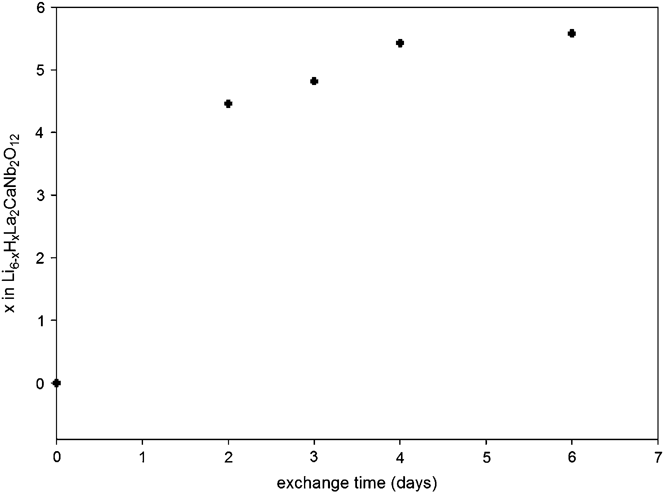
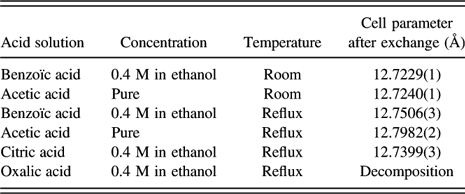
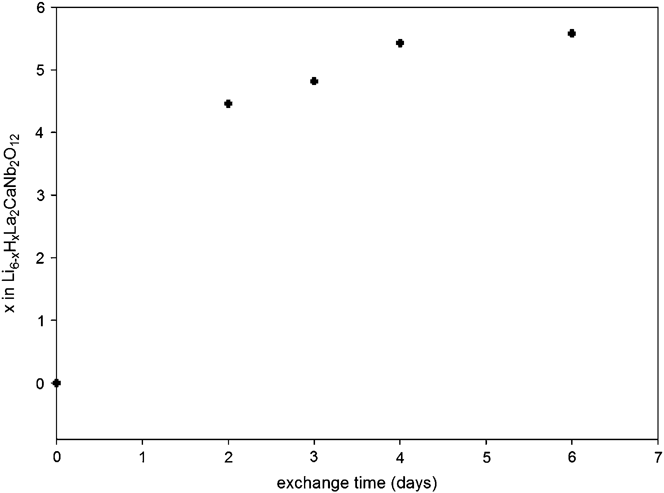
Firstly, the best Li+/H+ exchange conditions were determined by testing different acid solutions and by varying the synthesis temperature. Each time, a PXRD pattern was recorded to evaluate the quality of the resulting sample and to determine its cell parameters. The results of our tests are presented in Table I. They have all been performed on 1 g of mother phase for an exchange time of 4 days. The solutions were all prepared in ethanol with a concentration of 0.4 mol/L, except for the acetic acid solution which was used pure for our tests. We firstly observed that, whatever the acid solution, the cell parameter does not vary when the exchange is performed at room temperature. Taking into account our previous studiesReference Galven, Fourquet, Crosnier-Lopez and Le Berre4,Reference Galven, Dittmer, Suard, Le Berre and Crosnier-Lopez5 which showed that the Li+/H+ exchange is systematically associated to an increase of the cell parameter, this means that if there is an Li+/H+ exchange, it is surely low at this temperature. Secondly, when the solution is heated at reflux, we observe that the most important cell parameter variation is obtained with the acetic acid solution meaning that these conditions are most favorable for the Li+/H+ exchange. In addition, the PXRD pattern of this compound exhibits the thinnest hkl lines corresponding to the best crystallinity. To complete this study, we tried to improve the exchange by varying the exchange time in an acetic acid solution. After filtration, the lithium content present in the filtrate was analyzed using a flame emission spectrometer. We thus obtained the formulation of the exchanged Li6−xHxCaLa2Nb2O12 garnet depending on the exchange duration. These results are given in Fig. 1 and reveal that the Li+/H+ exchange increases rapidly and reaches its maximum after 4 days. PXRD patterns registered on two samples exchanged for 4 and 6 days show a slight decrease of the crystallinity for the second sample. We decided then to retain the following experimental conditions to perform the Li+/H+ exchange on 9 g of the mother garnet: 4 days in pure acetic acid solution heated at reflux. Last, the compound was washed in ethanol and heated for 2 h at 200 °C before the neutron diffraction experiment.
x in Li6−xHxCaLa2Nb2O12 as a function of exchange time (x determined from chemical analysis).
Experimental conditions of the tests performed on Li6CaLa2Nb2O12 for Li+/H+ exchange.

Cell parameter before exchange (Å): 12.7200(1).
C. Determination of the exchanged phase Li6−xHxCaLa2Nb2O12 stoichiometry
The chemical formulation of this new exchanged garnet can be determined by two complementary methods: the analysis of the lithium content present in the filtrate after exchange and the weight loss observed during TGA measurement. Indeed, under heating the proton departure as H2O (dehydration process) leads to a decrease of the sample mass. It is then possible to calculate, from the water loss observed, the proton quantity present in the sample before heating and to deduce the chemical formulation.
The analysis of the lithium content present in the filtrate after exchange corresponds to an exchange rate of 81.7%, leading to the formulation Li1.10H4.90CaLa2Nb2O12 (the H quantity being deduced from electrical neutrality). To confirm this result, a TGA measurement was performed on the same sample. As can be seen in Fig. 2, the weight loss associated with the proton departure is 6.26% corresponding to the formulation Li1.08H4.92CaLa2Nb2O12. The good agreement between the two results obtained allows us to retain Li1.1H4.9CaLa2Nb2O12 for the chemical formulation of the protonated garnet.
TGA curve for Li6−xHxCaLa2Nb2O12 showing a single weight loss step due to the departure of proton as H2O.
D. SHG test on the exchanged phase Li6−xHxCa La2Nb2O12
Figure 3 shows in solid line the shape of the recorded SHG pulse acquired on the digital oscilloscope for our exchanged phase Li6−xHxCaLa2Nb2O12. The amplitude is normalized to the signal maximum. The duration of the SHG pulse, characterized by the full width at half the maximum (FWHM), is 0.6 ns, which is shorter than the 0.8 ns laser pulses measured for the fundamental at 1064 nm (dashed line in Fig. 3). The shorter duration of SGH pulses assesses that the optical conversion process is nonlinear, in conformity with the fact that the SHG power is proportional to the square of the fundamental power. Through the measurement of the SHG amplitude, the SHG efficiency between two samples can be compared. We compare then the amplitude of our sample to that of the reference KTiOPO4 (KTP) sample, which is well known to be a very efficient material for frequency doubling. For convenience, we express the SHG efficiency of a material on a logarithmic scale, as the measured SHG signal may vary over several orders of magnitude from one sample to another. We can thus define the SHG efficiency by the relation:  $A_{_{{\rm{SHG}}} }^{{\rm{Sample}}} = 10 \cdot \log _{10} (P_{{\rm{SHG}}}^{{\rm{Sample}}} /P_{{\rm{SHG}}}^{{\rm{KTP}}} )$, where
 $P_{{\rm{SHG}}}^{{\rm{Sample}}}$ and
 $P_{{\rm{SHG}}}^{{\rm{KTP}}}$ are respectively the peak amplitudes of the SHG signal. Note that with our system of measurement, the minimum SHG efficiency that we can measure is −40 dB, i.e., 104 times smaller than the efficiency of the KTP.
The SHG pulse (at 532 nm) is shown in solid line (dark green line) with a pulse duration (FWHM) of 0.6 ns. For comparison, the fundamental IR pulse (at 1064 nm) is represented in dashed line (red line) with a significantly longer duration of 0.8 ns. The difference between the pulse durations assesses that the optical conversion process is nonlinear.
We found that the SHG amplitude of our sample is 1/100 of that of KTP. According to the definition given above, the SHG efficiency of our exchanged garnet phase is −20 dB. This value of efficiency is well above the detection threshold −40 dB. We can thus unambiguously conclude that this new protonated garnet compound is noncentrosymmetric.
E. TEM study on the mother and the exchanged garnet phases
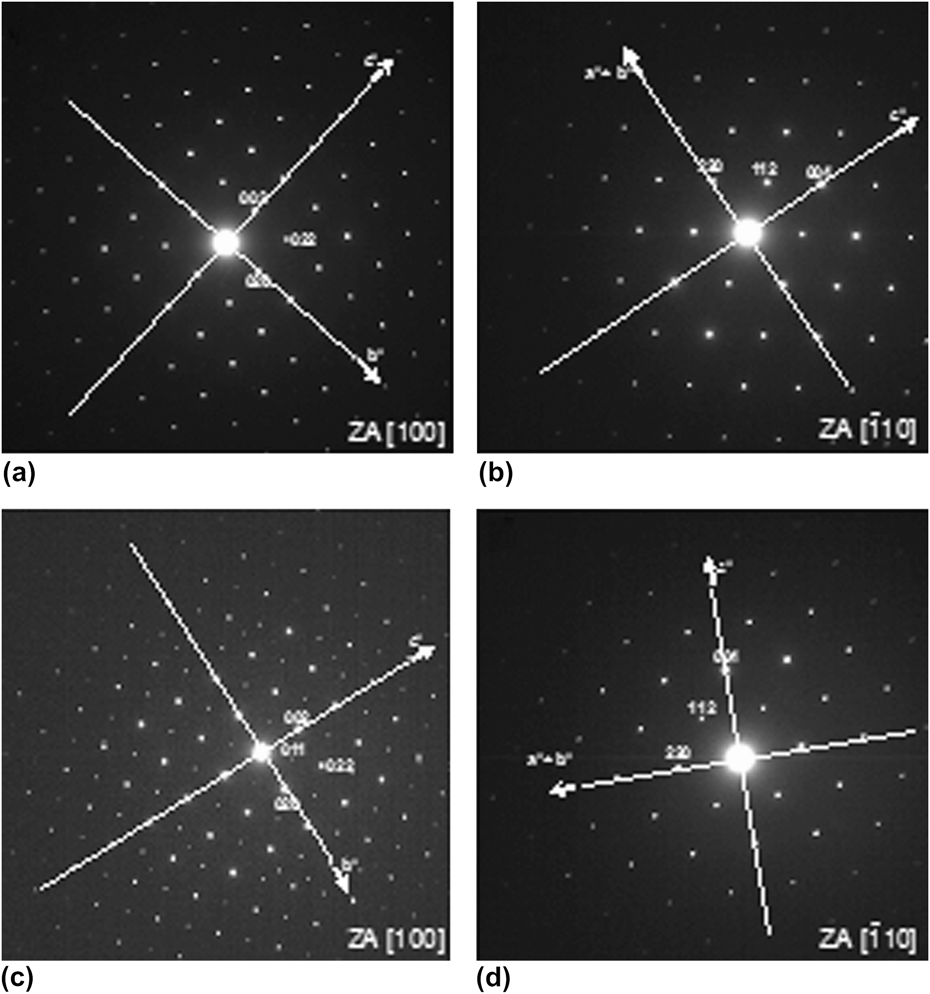
To precise the extinction symbol of the exchanged form Li6−xHxCaLa2Nb2O12, we decided to reconstitute the reciprocal space of several crystallites. This study revealed first that some particles were poorly crystallized, probably due to the synthesis way. Despite this situation, we confirmed a cubic I cell with a parameter close to 12.7 Å. We also deduced, from the systematic absence of the observed SAED patterns, that the a plane have been lost during the exchange [Figs. 4(a) and 4(c)], whereas the d plane was preserved [Figs. 4(b) and 4(d)], leading to the extinction symbol I - - d, compatible with only one space group I $\overline 4$3d. This space group is noncentrosymmetric, which is in good agreement with the SHG test. One can notice that the condition 00l, l = 4n, which should be checked on all SAED patterns was not respected on the [100] zone axis [Figs. 4(a) and 4(c)] for both the mother and the exchanged forms. This can be attributed unambiguously to double diffraction effect, which could be simply evidenced by tilting the crystallite. As evidence, the condition 00l, l = 4n, is effectively observed on Figs. 4(b) and 4(d) since the double diffraction effect cannot bring back the prohibited lines for this orientation.
Typical SAED patterns of Li6CaLa2Nb2O12 (a and b) and Li6−xHxCaLa2Nb2O12 (c and d) for two zone axis orientations.
F. Structural determination of the exchanged phase Li6−xHxCaLa2Nb2O12 from PND data
Taking into account SHG and TEM results, we started the structural refinements in the noncentrosymmetric I $\overline 4$3d (no. 220) space group, since in this group, all the observed diffraction lines are indexed. The initial structural model of the garnet framework [CaLa2Nb2O12]6− is built in this new space group with four atomic positions deduced from those in the usual centric space group Ia
 $\bar 3$d: one for Ca/La (24d site), one for Nb (16c site), and two for O (two 48e sites) (Table II). The refinement of this framework led to a high reliability factor (R Bragg = 13.3), showing the importance of light atoms (here, H and Li) in neutron diffraction data. When the refined atomic positions are judged and stabilized, Fourier difference calculations are performed and revealed four possible sites: two sites can be associated to lithium positions (12a and 12b) since each one is surrounded by four oxygen with distances close to 1.9 Å, whereas the other two sites (2 × 48e) can be attributed to proton positions with one oxygen at about 1.0 Å.
Transposition of the atomic positions of the garnet framework [CaLa2Nb2O12]6− from the I a  $\bar 3$d space group (no. 230) to I
 $\overline 4$3d (no. 220).
In a first step, these four Li/H cationic positions are added to the [CaLa2Nb2O12]6− framework, and refinements are performed without constraint leading to an important decrease of the reliability factor (R Bragg = 3.54) and a very good agreement between the observed and the calculated patterns. Unfortunately, this model leads to unreal results with, for example, negative displacement parameters for H and Li atoms and to a chemical formulation slightly different from that obtained from chemical analysis and TGA measurement (Li1.4H3.6CaLa2Nb2O12 instead of Li1.1H4.9CaLa2Nb2O12). In addition, the Li2 site was progressively emptied. At this stage, we decided to suppress the Li2 site from the structural model and to apply some constraints to obtain a stable refinement (i) the occupation factor of the Li site is now fixed and those of the H1/H2 sites are refined with a global constraint to preserve the chemical formulation deduced from TGA and lithium analysis; (ii) the isotropic temperature factor is the same for H1 and H2. In these conditions, the reliability factor R Bragg is satisfactory (4.0), but the Li thermal factor is still negative (−0.31). Finally, for a stable refinement, we chose to maintain the previous constraints and to fix the thermal factor for the Li atom to a reasonable value (B = 1.5). In these conditions, the reliability factor R Bragg slightly increases (4.65) but remains satisfying. The corresponding structure refinement results are given in Table III and the observed, calculated, and difference plots of the PND patterns are shown in Fig. 5. Table IV gathers atomic coordinates, occupation factors, isotropic temperature factors, and bond valence sumsReference Brese and O’Keefe10,Reference Brown11 ; whereas selected interatomic distances are summarized in Table V.
Observed, calculated, and difference PND patterns of Li6−xHxCaLa2Nb2O12 in the I $\overline 4$3d space group. Vertical bars are related to the calculated Bragg reflection positions.
Structure refinement results of Li6−xHxCaLa2Nb2O12 from PND data.
Atomic coordinates, B iso, and bond valence sums (Σ) for Li6−xHxCaLa2Nb2O12 from PND data (S.G.: I $\overline 4$3d).
a R La/Ca = 2/3R La + 1/3R Ca.
b 1.93 in a Ca/La, Nb, and Li environment and 2.22 in a Ca/La, Nb, and H2 environment (H2 and Li cannot be simultaneously present).
Selected interatomic distances (Å) for Li6−xHxCaLa2Nb2O12 from PND data (S.G.: I $\overline 4$3d).
G. Discussion
The comparison between the structures of the two garnets, Li6CaLa2Nb2O12 and Li6−xHxCaLa2Nb2O12, reveals first that the Li+/H+ exchange results from a topotactic reaction. Indeed, the [CaLa2Nb2O12]6− network is preserved and composed, as in the mother form, of (Ca1/3La2/3)O8 polyhedra sharing edges forming thus a tridimensional network. These polyhedra are connected by edge to isolated NbO6 octahedra. The interatomic distances Ca/La–O and Nb–O are in agreement with the expected values calculated from the ionic radiiReference Shannon12 leading to satisfactory bond valence sums (Table IV). The Li+ cations are located in the 12b site in a regular tetrahedral environment with Li–O distances of 1.955(2) Å corresponding to the sum of the ionic radii.Reference Shannon12 Consequently, the calculated bond valence sum for the Li+ ions (1.07, Table IV) is close to the expected value (1). Each corner of the LiO4 tetrahedra is connected to one NbO6 octahedra as shown in Fig. 6. If we compare the lithium location in Li6−xHxCaLa2Nb2O12 (S.G. I $\overline 4$3d) to the one observed in the mother form Li6CaLa2Nb2O12 (S.G. Ia
 $\bar 3$d), we observed that the 12b site correspond to the half of the 24d site, usually called Li1 in the Ia
 $\bar 3$d space group. In the same way, we can made a correlation between the H1 and H2 sites in the exchange form and the deuterium position in the hydrogarnet Sr3Al2(O4D4)3Reference Chakoumakos, Lager and Fernandez-Baca13: the two 48e sites (H1 and H2) correspond to the 96 h site occupied by the deuterium (S.G. Ia
 $\bar 3$d).
Partial projection of Li6−xHxCaLa2Nb2O12 structure showing the LiO4 tetrahedra, the NbO6 octahedra, and the H+ sites. The CaO8/LaO8 polyhedra have been omitted for more clarity.
Unfortunately, these structural results were obtained by applying some constraints during refinement. We are not sure that we would have obtained better results from neutron diffraction experiment by using (i) 7Li for the mother form synthesis to reduce the absorption cross-section and (ii) CH3COOD to perform the exchange to reduce the background and to increase the contrast between Li and D. Indeed, we think that the difficulties we have encountered are most probably due to the quality of the sample after exchange. Indeed, the TEM study revealed that, despite the final heating at 200 °C for 2 h, the crystallization of the exchanged compound is of poor quality. Moreover, we know that the lithium and proton distribution inside the garnet [CaLa2Nb2O12]6− network on their available sites is not necessarily uniform in all the crystallites and that the existence of domains is quite possible. In this situation, we have to consider that the Li+/H+ distribution can be locally different from the average distribution obtained from PND data refinements.
IV. CONCLUSION
This study concerns a new protonated garnet form Li6−xHxCaLa2Nb2O12 obtained by Li+/H+ exchange from the lithium garnet Li6CaLa2Nb2O12. This protonated compound, which exhibits a larger cell parameter than that of the mother form as usually observed after Li+/H+ exchange, crystallizes in an acentric space group never used until now for garnet (I $\overline 4$3d). The choice of this noncentrosymmetric space group is based on the unambiguous results obtained by SHG test as well as TEM study (SAED). Indeed, efficient positive SHG response, performed on a polycrystalline sample at room temperature, shows unambiguously the acentric character of this new phase while the reconstitution of the reciprocal space allows to determine precisely the space group, since only I
 $\overline 4$3d is compatible with the extinction symbol determined.
The Li+/H+ exchange obeys a topotactic mechanism since the garnet [CaLa2Nb2O12]6− network is preserved. Despite the difficulties encountered in the structural study, we showed that two lithium sites are affected by the Li+/H+ exchange whatever their oxygen environment in the mother form.
Last, taking into account our previous studies performed on exchanged compound,Reference Galven, Dittmer, Suard, Le Berre and Crosnier-Lopez5,Reference Galven, Fourquet, Suard, Crosnier-Lopez and Le Berre14 it seems that such Li+/H+ exchange is a good way to obtain acentric compounds, and it is interesting to note that this noncentrosymmetry character comes mainly from the unequally Li+ and H+ distributions in the network.