




No CrossRef data available.
Article contents
- Abstract
- ARTICULATING CLASSIC MAYA SOCIAL ORGANIZATION WITH POLITICAL ORGANIZATION
- APPROACHING CLASSIC MAYA SOCIAL ORGANIZATION IN RETROSPECT
- NEW EVIDENCE OF COPAN AFTER COLLAPSE: THE EARLY POSTCLASSIC EJAR PHASE (a.d. 950–1100)
- DATING THE EJAR PHASE
- EJAR VERSUS CONER: MATERIAL CULTURE AND IDENTITY
- SOCIAL ORGANIZATION BEFORE AND AFTER THE COLLAPSE OF COPAN: CONTINUITY OR DISJUNCTION?
- CONCLUSIONS
- RESUMEN
- ACKNOWLEDGMENTS
- References
THE WAY THINGS FALL APART: Social organization and the Classic Maya collapse of Copan
Published online by Cambridge University Press: 01 January 2004
Article contents
- Abstract
- ARTICULATING CLASSIC MAYA SOCIAL ORGANIZATION WITH POLITICAL ORGANIZATION
- APPROACHING CLASSIC MAYA SOCIAL ORGANIZATION IN RETROSPECT
- NEW EVIDENCE OF COPAN AFTER COLLAPSE: THE EARLY POSTCLASSIC EJAR PHASE (a.d. 950–1100)
- DATING THE EJAR PHASE
- EJAR VERSUS CONER: MATERIAL CULTURE AND IDENTITY
- SOCIAL ORGANIZATION BEFORE AND AFTER THE COLLAPSE OF COPAN: CONTINUITY OR DISJUNCTION?
- CONCLUSIONS
- RESUMEN
- ACKNOWLEDGMENTS
- References
Abstract
While the recent application of the house model to archaeology (Joyce and Gillespie 2000 Beyond Kinship: Social and Material Reproduction in House Societies. University of Pennsylvania Press, Philadelphia) has renewed interest in the nature of Classic Maya social organization, the relationships between Classic Maya social units and Classic Maya polities remain poorly understood. This article examines the effects of the Classic Maya collapse of Copan, Honduras on its constituent social units in an effort to ascertain the flexibility and resilience of these groups within larger political structures. Previous researchers suggested that Copan's collapse was limited largely to the ruling elite. However, the Copan Postclassic Archaeological Project has documented a distinct, possibly foreign occupation in the site center from a.d. 950 to 1100. These data suggest that the longevity of all Classic Copaneco social groups in the wake of dynastic collapse was significantly shorter than some have postulated. These data demonstrate that Classic Maya social units were not semiautonomous groups but, instead, were integrated within polities. Thus, they must be understood within larger political frameworks.
Information
- Type
- SPECIAL SECTION: NEW PERSPECTIVES ON ANCIENT LOWLAND MAYA SOCIAL ORGANIZATION
- Information
- Copyright
- © 2004 Cambridge University Press
The renewed archaeological interest in social organization of the Classic Maya has generated a number of new insights and opportunities. Particularly useful is the potential application of Claude Lévi-Strauss's ethnographic house model to Classic Maya archaeology (Gillespie 2000a). As the model is discussed at length elsewhere, I will briefly review it here. Derived from Northwest Coast chiefdoms, the model was originally developed as a way to reconcile kinship and affinity (Gillespie 2000b, 2000c). The house model eliminates ambiguities of kinship inevitably encountered with attempts to apply descent rules to corporate groups by replacing the term lineage with house. As such, the house model combines kinship with residence into a single, broader social concept. While the model has been successfully applied to modern ethnographically documented societies, its applicability to the past is just beginning to be explored by archaeologists.
The house-model approach offers several clear strengths in comparison with lineage models. First, by combining residence and kinship into a single concept, the house model recognizes the often nebulous emic definitions of social groups given by house members. In turn, the house model identifies process within what has traditionally been a classificatory scheme. The application of the house to archaeology also explicitly views material culture as codified objects of group identity, social cohesion, and innovation rather than as passive byproducts of culture. Continuity of house in the material record is directly correlated to the deliberate maintenance of social continuity, just as disjunctions in the material record reflect changes in social organization. In this way, houses are dynamic entities through which members continually reaffirm, modify, or deny their house affiliations through material culture. This final linkage of material and social continuities in the social reproduction of the house offers a diachronic perspective that is well suited to archaeological approaches. Together, these traits make the house model a valuable heuristic device with which to approach the reconstruction of past relationships.
The obvious danger of such a broadly defined and flexible model, however, is that it can become an “over-generalized, over-idealized buzzword” when applied as a panacea for all shortcomings of interpretation in studies of social organization (Gillespie 2001). Second, the focus on the house model among archaic states—in this case, Classic Maya civilization—potentially overemphasizes the importance of domestic groups in reconstructing ancient political organization. Finally, I would note that the archaeological application of the house confronts similar problems faced by proponents of alternative social models of organization that are derived from ethnography, be they models of cognatic corporate bodies, clans, or lineal descent groups. Ethnographically defined models must be carefully applied to archaeological problems. In this sense, the formidable challenge is to overcome the disparate and perhaps not mutually compatible nature of ethnographic and archaeological data.
In this article, I explore the relationships between social groups and broader political organizations. In particular, I examine the durability and flexibility of Classic Maya house groups, testing their abilities as social units to maintain societal bonds and material estates in the wake of dynastic collapse and the crumbling of higher levels of centralized organization. I approach these issues at the site of Copan, Honduras. While more research in this area is needed before any final conclusions may be drawn, I nevertheless reach conclusions in the case of Copan. New data suggest that the societal bonds of house organizations were unable to endure the pressures of political catastrophe, and ultimately the houses succumbed to burdens placed on the broader systems of politico-economic organization. I begin with an examination of how others have modeled the articulation of social organization within political organization for the Maya.
ARTICULATING CLASSIC MAYA SOCIAL ORGANIZATION WITH POLITICAL ORGANIZATION
A basic—and, I would argue, false—dichotomy persists between decentralized and centralized models of Classic Maya sociopolitical organization (Fox et al. 1996). Without wishing to revive longstanding debates, I would characterize the difference between the two perspectives as a matter of differences in degrees. On the one hand, the position of the decentralized state views a direct translation of social organization, in the form of corporate groups, into loosely organized, broader political systems. This organization is characterized by a degree of redundancy on every organizational level. On the other hand, proponents of a centralized model of state organization emphasize hierarchical organizational principles that exceed the boundaries of kin ties to unite polities. The archaeological correlations of such expressions of centralized organization are found in public buildings, particularly monumental architecture. Strong arguments can be made for the existence of elements of both models in the archaeological past, and neither should be seen as the exclusive explanation of the rise and fall of Classic Maya civilization (Demarest 1996).
With the case of the Classic Maya, the hieroglyphic records of descent among elite rulers, as well as ancestor veneration, are well attested practices (McAnany 1995; Schele and Freidel 1990; Schele and Mathews 1998; Schele and Miller 1986). However, clear evidence for large, hierarchically organized polities exists minimally from sites such as Calakmul (Folan et al. 2000), Tikal (Coe 1990), Caracol (Chase and Chase 1996), and many others. The house model may occupy a void somewhere between these two extremes:
Houses, as Lévi-Strauss (1982:186–187) noted, are most visible in societies that seem to be transitional between kin-based and contractual-based organization, those in which differential access to wealth, rank, and power are salient features (McKinnon 1991:31). Relationships are expressed in “the language of kinship,” but kinship itself is subverted in the process (Lévi-Strauss 1982:187). (Gillespie 2000a:476)
It seems reasonable to posit that a continuum of social-organizational principles guided ancient Maya group formation in which the elite house represented one extreme. The house both defined and was characterized by its role as a corporate group (Gillespie 2000b). These definitions contained both physical expressions of spatial relations and material property and consanguinal and affinal relationships of its occupants. The other end of this continuum would be occupied by smaller, lineally organized households defined principally on lines of kinship. Members of small households with little ideological, economic, or political power or potential power are likely to have had little incentive to veer from kinship ties. In contrast, members of established elite households, with more ideological, political, and economic power invested in maintaining their relationships to the house, doubtless would have an interest in molding the definition of the house group to suit situational needs, effectively negotiating the identity of the group. Yet others have argued that members of royal Maya households fastidiously adhered to blood ties (Houston and McAnany 2003).
While no single explanation may be adequate to account for the diversity of data, each model of social organization views political organization in a distinct form. Perhaps the clearest translation of rules of social organization directly into political organization comes from the segmentary-state model (Southall 1956), applied primarily to Late Postclassic Maya polities of Highland Guatemala (Fox 1987; Fox and Cook 1996), but also to the Classic Maya site of Copan in the form of a ranked household lineage model (Sanders 1989; Sanders and Webster 1988). In general terms, lineage segments were postulated to be organized along primarily patrilineal lines into larger political units that vied for political rule based on a series of lineage-derived rankings. However, the application of this model to the archaeological data has not been without criticism, including the existence of ambiguities in the data and questions of interpretation (Chase and Chase 1996; Demarest 1996; Marcus 1993). While some proponents of the house model have critiqued the segmentary-state model (Gillespie 2000a:470), a formalized model that incorporates houses within hierarchical structures has yet to be promulgated.
Clearly, the relationships between polities and associated households are complex and varied, in which influences from the former are not consistently or directly seen in the archaeological record of the latter (Bermann 1997; Henderson and Sabloff 1993; Sharer 1993). I explore some possible relationships between houses and archaic states using the case of the Classic Maya collapse of Copan.
Stability of Classic Maya Houses Through Time
The house is a potentially stable social unit over time, enduring well beyond the lifespan of any individual occupant (Gillespie 2000c; Joyce 2000). In the case of the Classic Maya, the lifecycle of a house, seen in the archaeological and architectural sequences of construction, remodeling, expansion, and rebuilding, may span uninterrupted for hundreds, or even thousands, of years in the same locus. Yet at almost every site in the Southern Maya Lowlands, including Calakmul, Tikal, Caracol, Palenque, Yaxchilan, and Quirigua, the pattern of continuity ceased by approximately a.d. 800.
A primary question that has yet to be asked is what happened to the house as a social unit when faced with the political upheavals of the Classic Maya collapse outside of its control. The great amount of data gathered over the three decades since the publication of the first in-depth examination of the Classic Maya collapse (Culbert 1973) point to the increasing realization that the processes resulting in collapse and abandonment were varied, involving different proximal causes and regional variations. Likewise, scholars now understand that the Classic-period collapse represented not the first political collapse but merely one in a series of cyclical falls and recuperations (Marcus 1993; Marcus and Feinman 1998). Thus, the more appropriate question to ask is why Maya society failed to recover following dynastic collapse.
The Classic Maya collapse thus represents a perfect case with which to examine the strengths and weaknesses of the societal bonds of houses in relation to political organization. The processes of destruction, through which disparate institutions (including houses) that were previously unified under the state become unraveled reveals most clearly the bonds of social organization. An examination of exactly which social, political, and economic institutions collapsed, and which did not, holds the potential to reveal much about both the relative strengths of constituent institutions and the organization of Classic Maya society.
Political upheaval and the fracturing of the cohesive bonds that once united elite houses under an archaic state theoretically should result in decentralization. If the intra-house bonds were stronger than those binding the polity, then one should expect to see an increased emphasis on political power of house groups in the wake of political collapse. Archaeologically, this would be seen as a period of continuity following collapse in which pre-collapse patterns were maintained.
In contrast, if the bonds that tied individuals to houses were weak, we would expect to see balkanization as factions previously united under the ideology of the house emerged to assert autonomy. In the archaeological record, such an occurrence could take the form of a flurry of residential constructions away from established house estates as new houses were founded after the collapse of centralized authority.
Alternatively, one may postulate the presence of several diagnostic features in the wake of dynastic collapse based on the segmentary-state model (Fox and Cook 1996). First, noble lineages would survive dynastic collapse largely intact, even with the demise of the royal residence and perhaps its inhabitants as well. Second, the collapse of elite rule should not signal the demise of second-tier elite lineages. Instead, some degree of political, social, and economic power of the elite households should be retained. Finally, one would expect noble lineage households to assert greater autonomy in the wake of dynastic collapse.
I choose as my focus the Classic Maya site of Copan, Honduras. Copan represents the only major Classic Maya center to which a form of the segmentary-state model has been applied (Sanders 1989; Sanders and Webster 1988). Sanders (1989:102) proposed a four-tiered organizational tenet for the site in which households, the bottom-most tier, were organized into a second tier of lineages based on descent. Above this, the third tier contained maximal lineage heads who were posited to form a noble class closely involved in issues of politics, economics, and ideology. The top tier in the proposed hierarchy was reserved for the king, whom, Sanders posits, may have had as many as several thousand habitants under his direct authority.
Inextricably linked to this model of sociopolitical organization was an accompanying chronological revision to support it (Webster and Freter 1990a, 1990b). While traditional models of the collapse of Copan placed its abandonment in line with other Classic Maya sites (Fash 1983; Longyear 1952; Morley 1920; Viel 1983), this alternative reconstruction proposed that Copan's population gradually dwindled over a period of 400 years following dynastic collapse, during which time pre-collapse patterns of settlement, architecture, and material-culture production and consumption, including Late Classic Coner ceramics, were maintained (Freter 1988).
The implications for understanding Classic Maya society raised by this model are that the societal bonds of elite house organization were stronger than those binding the polity together as a whole. Only gradually, over a period of centuries, were houses abandoned. The gradual nature of the collapse was linked to redundant nature of Maya social organization, characterized as “replicated units connected by social and ideological forces rather than articulated through vital economic ties” (Freter 1994:171). Thus, as with the segmentary-state model (Fox and Cook 1996), Classic Maya social organization is viewed as a series of hierarchically organized corporate groups that are most strongly bound at the lineage level, with economic redundancy present at each organizational tier. However, newly documented data derived from the Early Postclassic occupation of Copan challenge both this sociopolitical model and the chronological revision used in its support.
APPROACHING CLASSIC MAYA SOCIAL ORGANIZATION IN RETROSPECT
Rather than relying on traditional approaches that trace households through the Classic period up to the collapse, I approach issues of the Classic Maya collapse from an alternative perspective. I focused my research on the time after the collapse and sought out evidence for post-collapse societies within the site. Post-collapse societies are defined as Early Postclassic groups living in or near ceremonial centers following the collapse. Post-collapse groups are likely to have existed at many Classic Maya sites, yet they have been largely overlooked. Explanations for offerings and burials placed within the rubble of abandoned rooms in site centers typically attribute these activities to passing pilgrims without exploring the potential ideological and social significance of these acts and actors.
This approach offers several advantages. First, by beginning with the results of the collapse and working back to the causes, one gains the perspective of hindsight to the issues. With the effects at hand, isolating the processes that resulted in the effects becomes a feasible endeavor. Second, by starting after the fact, so to speak, one gains a clearer picture of the results of dynastic collapse. In addition, the study of post-collapse societies offers a novel approach that has not been systematically investigated. Thus, the technique holds the potential to reveal new data and expose new patterns that were not previously identified. Furthermore, the study of post-collapse societies holds great potential for reconstructing the collapse processes because their existence is directly tied to the collapse itself.
Theoretical Considerations of Post-Collapse Societies
As the house model views material continuity, expressed through both portable objects and architectural forms, as an expression of social continuity (Joyce and Gillespie 2000), several different scenarios concerning the relationships between the groups archaeologically documented from before and after dynastic collapse can be proposed and examined.
An overall dichotomy can be posited between (1) post-collapse societies that closely resemble or are identical to those predating dynastic collapse; and (2) post-collapse societies that bear little or no material similarities to dynastic-era groups. The latter scenario can be further subdivided into two distinct pictures. The first expects changes to be documented during the turbulent time of dynastic collapse but continuities in space and material culture to be retained. The second scenario views a complete disjunction between groups.
If the materials, architecture, and settlement of post-collapse societies are very similar or identical to those of the Classic period, then we can infer several conclusions. First, the inhabitants of the houses were able to survive dynastic collapse and maintain group cohesion. Thus, the bonds of social organization proved to be sturdier than those binding house groups into larger-scale units. Second, the fractioning of Classic society into its constituent households would support the segmentary-state model of political organization as houses (lineages) fission along lines of geography, kinship, or both.
In contrast, discontinuity between pre- and post-collapse groups would signal either an upheaval within house groups or, alternatively, a complete break of the house tradition. In the case of the former, the archaeological record would reflect significant changes in the artifact assemblages, architecture, and perhaps settlement hierarchy. These changes could be the result of multiple factors, including the possibility that some houses became extinct as a direct result of political collapse and economic, social, and political relationships between houses were strained as individuals negotiated their fates in the wake of political collapse. Likewise, aspects of the material culture and architecture might show innovations or, alternatively, newfound traditionalism as houses struggled in the wake of political upheaval. However, throughout the ordeal, the concept of place would be maintained. Thus, while modifications might occur, the house groups would be able to reproduce themselves and continue through dynastic collapse. The dynastic collapse therefore affected all inhabitants, but house members were able to weather the upheaval and continue their traditions after the collapse.
The last scenario posits complete discontinuity between the two groups, as I argue is the case at Copan. In this instance, changes in settlement, architecture, and material culture between pre-collapse and post-collapse groups are so dramatic that no cultural continuity can be found between the two. Thus, the post-collapse groups may have represented descendants of a local faction who made an unprecedented break with previous traditions, or perhaps a replacement population culturally unrelated to the dynastic house groups. Whatever the case may be, the radical changes documented suggest that the political collapse triggered processes that destroyed the old social structures, rendering house groups untenable in the wake of collapse. The key to analyzing the flexibility and strength of Classic Maya houses, then, rests in establishing the extent of the post-collapse society and its relationship to pre-collapse groups.
NEW EVIDENCE OF COPAN AFTER COLLAPSE: THE EARLY POSTCLASSIC EJAR PHASE (a.d. 950–1100)
Background
Until recently, diagnostic Early Postclassic markers such as Tohil Plumbate, Las Vegas Polychrome, and green Pachuca obsidian have been extremely scarce at Copan. Outside of the Main Group, little more than a handful of Tohil Plumbate sherds recovered from superficial contexts constituted the cumulative total of known Early Postclassic Ejar complex markers. Within the core area of the site, early investigations found several burials containing imported Early Postclassic Ejar complex pottery as well as a few surface middens containing late material (Longyear 1952). Beyond these isolated finds, excavation of Ballcourt B, Copan's second ballcourt, produced the only substantial deposit of diagnostic Ejar materials found during the intensive investigations of the last several decades (Fash and Lane 1983).
To expand on the findings of William Fash and Sheree Lane, I initiated the Copan Postclassic Archaeological Project (CPAP) in 1995. The first season of CPAP investigations culminated with the excavation of a large, low platform located on the southeast edge of Ballcourt B, located approximately 200 m south of the Acropolis in an area of dense settlement known as the Bosque (Figure 1). The building, Structure 11L-77, was the first identified Early Postclassic Ejar-phase construction in the Copan Valley (Manahan 1995). The CPAP's methodology expanded from this identification to combine extensive test excavations with selected wide horizontal exposures of newly identified Ejar-phase constructions in the same area between 1997 and 2001. From the nine identified Ejar-phase structures, five buildings were extensively excavated.

Center of Copan showing CPAP area in relation to the Main Group. Buildings and areas mentioned in the text are marked. The box demarcates the area enlarged in Figure 2. Map modified and adapted from Fash and Long (1983).
Rather than demonstrating continuity with pre-collapse domestic data, the Ejar data instead reflect unique patterns of social organization quite distinctive from anything known from the Late Classic. In fact, the documented differences of Ejar-phase lifeways, together with its secure temporal placement using both absolute and relative dating, make it the most abruptly different cultural phase documented in the millennia of human history in the Copan Valley. These different principles of social organization are registered in both settlement patterns and architecture.

CPAP area. Ejar-phase structures are labeled and drawn in black. Coner structures are shown in light gray. Redrawn and adapted from Fash and Long 1983.
Post-Collapse Settlement Patterns
The ubiquitous Classic-period settlement pattern at Copan—and, indeed, at most Maya sites—consists of patio groups formed of three or four mounded structures organized around a small private courtyard. At Copan, the courtyard groups have been further classified into a five-tier settlement hierarchy (Willey and Leventhal 1979). In contrast to Classic courtyard-oriented patio groups, the Ejar-phase Early Postclassic settlement consisted of a linear arrangement located around a large central plaza area, a pattern wholly absent in Classic-period Copan. The total extent of Ejar occupation identified by CPAP research encompasses nine discrete structures spread across an expanse of approximately 300×300 m, the main part of which was otherwise free of any earlier architecture visible on the surface (Figure 2). Although the structures did vary in size and proportions, no clear hierarchical arrangement was apparent.
While we may speculate that some other Ejar-phase settlements must have existed outside of the Bosque area, the presence of these postulated settlements is limited to a single building from the outlier site of Los Achiotes (Canuto 2002), despite extensive research throughout the area. One must consider both the tremendous amount of research devoted to settlement studies at Copan (Baudez 1983; Fash 1983; Gonlin 1993; Sanders 1986; Webster and Freter 1990a; Webster and Gonlin 1988) and the lack of identification of more than a single Ejar-phase construction outside of the Bosque area. In fact, an investigation by the author of a purposive sample of 146 buildings stretching across the Copan Valley failed to identify any additional Ejar buildings (Manahan 1999). It thus seems reasonable to conclude that if any Ejar occupations did exist outside of the area of the Main Group, they must be have been quite limited in scope.
Post-Collapse Architecture and Archaeology
Perhaps more telling than changes in settlement patterns were the dramatically different manners of utilizing space within the house itself. The mounded, pyramidal architecture of courtyard groups dominated both Classic-period Copan and other Southern Maya Lowland sites. The architectural forms favored height of construction over interior surface area, which is minimal. Each Coner structure was generally used for a single activity; separate kitchens, domiciles, and ritual buildings (if present) were the norm (Hendon 1991; Webster et al. 1986). Other household activities were conducted either within the central patio or along the terraced edges of buildings.
In contrast, these same activities were restricted within the confines of the exterior walls of a single building during the Ejar phase. When compared with earlier houses, the Ejar construction style yields essentially the inverse of the Coner architectural aesthetic. The Ejar structures were typified by individual single-component constructions. The buildings were quite large, relatively low, flat platforms that originally supported perishable wattle-and-daub superstructures with thatched roofs. The Ejar structures yielded a high proportion of interior surface area and only minimal height (.5–1.6 m) above the ancient ground surface. The areas in front of and around Ejar buildings were kept clear of debris save for midden deposits often found along the rear walls. Interior Ejar living spaces contained discrete activity areas, sometimes demarcated with interior single-course wall lines, including food processing and preparing (in the form of in situ groundstone implements), benches, and ritual activities (marked by censers and shrines), all together within the confines of the house (Manahan 2003:97–139). Associated midden deposits suggest that stone-tool production and the butchering of game occurred near, if not within, individual households.
The Ejar builders actively incorporated Coner materials within their structures, utilizing not only liberated cut stone for their walls and platform fill but also a substantial quantity (29 pieces in all) of carved-stone sculptures that originally formed the façades of some of the most important Coner temples in the Acropolis. Ejar residents incorporated these carved-stone elements into their foundations and exterior walls while placing other pieces within burials and shrines within their houses. The possible significance of these acts for understanding social organization are explored later. The presence of dismantled elements of hieroglyphically dated monumental Coner architecture also provides more data with which to secure the temporal placement of the Ejar phase.
Of the 29 pieces of sculpture recovered from CPAP excavations, the original locations of 21 of the pieces could be conclusively identified. The identified pieces originated from a total of five Coner buildings located within or immediately adjacent to the Acropolis in the Main Group. The most extensively represented Coner structure, with a total of nine pieces recovered from Ejar contexts, was Temple 18. Perhaps not coincidentally, the structure is also the one most relevant to issues of chronology.
Temple 18 represented the last building dedicated by the sixteenth and final ruler of the Copan dynasty, Yax Pasaj, in a.d. 801. The building, identified as the final ruler's likely funerary temple (Becker and Cheek 1983:497), was placed on the southeastern edge of the Acropolis. While the inscribed date of Stela 11, located directly in front of Temple 18, is unclear, the stela's unique iconographic style suggests that it was one of the last public carved monuments erected. Significantly, this building was sacked in ancient times, and the elaborate tomb contained within the structure, likely that of Yax Pasaj, was also looted (Becker and Cheek 1983). In addition to the nine pieces of sculpture from this important structure recovered by CPAP excavations, several more pieces were previously unearthed during excavation of Ballcourt B (Fash and Lane 1983). Together, these data demonstrate that the Ejar buildings clearly postdated the dynastic collapse.
Post-Collapse Houses and Identities
Applying the house model to the Ejar-phase data, one can see the expression of a very distinct cultural ethos in relation to Coner-phase households. I will explore some of the ways in which the Ejar-phase residents expressed their unique identities while being surrounded by symbols of past principles of sociopolitical organization.
In terms of social organization, members of post-collapse houses used a variety of novel techniques to actively distance their identities from the Classic Maya and to express their own social cohesion. The way in which Ejar-phase residents interacted with their environment, one largely physically defined by the dynastic inhabitants, tells much about how the inhabitants defined themselves. I argue that the post-collapse society forged an identity defined in direct opposition to the dynastic-period inhabitants by disregarding some material aspects of the previous culture, embracing other elements, and appropriating still others.
One example of this involves Early Postclassic Ejar settlement patterns. At Copan, residential architectural sequences around the zones fringing the Main Group may typically span three to four centuries, testifying to the continuity of the house as a locus of identity. Indeed, the architectural sequence from Group 9N-8 spanned more than a millennium (Webster 1989:14–15). In contrast to the long sequential patterns of growth in the same loci seen throughout time at Copan, the Early Postclassic residences all represented single component constructions that did not incorporate or expand on any previous architecture. Nor have any examples of rehabitation of existing architecture by Early Postclassic peoples been documented. Instead, the post-collapse societies chose to quarry the surrounding buildings as a source of construction material with which to erect their own, new residences. While the Ejar people settled in close proximity to abandoned Classic-period vaulted architecture, much of which was likely still standing, the people elected to build their residences anew. Rather than reoccupy or modify standing abandoned architecture, it appears that Ejar occupants proclaimed the independence of their own houses in stone.
In contrast to its treatment of Classic-period residential architecture, the post-collapse society recognized the ritual nature of several buildings within the Acropolis and the Main Group. In these instances, the Ejar people chose to co-opt the existing architecture, without any modifications, to use for their own ritual purposes. The Epiclassic and Early Postclassic peoples also used abandoned temple rooms and courtyard floors as burying ground for their dead (Joyce 1986; Longyear 1952).
In other cases, Ejar occupants appropriated objects from the past and transformed them into innovative statements of defiance and independence. The deliberate reuse of sculpture by the post-collapse society is at once intriguing and enigmatic. One expression of this act is the reuse of carved stones that originally composed the façades of some of the most sacred structures within the Acropolis, wherein members of the post-collapse society incorporated individual carved stones in the exterior façades of their residences. Reused Classic-period sculpture also appeared frequently in association with Early Postclassic burials within the Acropolis (Longyear 1952:47) as well as within both burials encountered during residential Ejar excavations. By taking elements of these stone façades from their original contexts and resetting them within their households in a novel manner, Ejar individuals appropriated symbols of a fallen dynasty and molded them into new expressions of ideological wealth.
This transformative nature can best be seen in an example from Structure 11L-77, located along the southeastern edge of Ballcourt B. In this case, the building contained a stone bench set against the interior rear wall along the longitudinal axis. The bench contained six carved stones that originally formed part of the facade and jamb of Temple 18. Four of the pieces were decorated with feather motifs, and one carving portrayed the head of a zoomorphic figure (Figure 3). The final piece was carved on two sides: one side of the stone contained feathers while the other depicted the hand of Yax Pasaj clutching the hair of a decapitated human head. This last piece originally rested on the interior jamb of Temple 18.

Stone bench from Structure 11L-77 constructed entirely of scavenged pieces of sculpture from the jamb and façade of Structure 10L-18 within the Acropolis. Drawing by Emily M. O'Brien.
Rather than re-creating a particular design from Temple 18 within the household confines, the bench formed from these pieces instead contained a mix of motifs stacked without regard to iconographic content. We can thus speculate that the Ejar residents attempted not to duplicate dynastic iconography but, rather, to transform the symbolism of past dynastic might and broaden it into a more generic reference to the exotic, while simultaneously appropriating the symbols as their own. Thus, the significance of the bench for its constructor derived not from its direct reference to the fallen dynasty but, instead, from a more generalized sense that the stones themselves represented an otherness in much the same way that imported portable luxury items were treasured and readily consumed.
These patterns attest to a mode of social organization completely distinct from that of Classic-period Copan. The replacement of patio groups with amorphous extended-family, or perhaps even multi-family, residential units tells much about the dramatic changes initiated by the Classic Maya collapse. Instead of relying on Classic Maya traditions and the incredibly long histories of individual houses seen in the Classic period, the Ejar residents instead creatively forged their own system of values by appropriating previous symbols of Classic Maya ideology. By taking individual elements of Classic Maya building façades that originally proclaimed allegiance to an entirely foreign ideology into their residences, the Ejar occupants redefined their significance by placing them in novel contexts. Perhaps ironically, these new Ejar statements of sovereignty were literally hewn from the blocks of past testaments to the final Copan king's prowess in war and political might.
DATING THE EJAR PHASE
René Viel (1983:538–539) originally defined the Early Post-classic Ejar phase to its broadest extent (a.d. 900–1200) based primarily on the distribution of Tohil Plumbate (Neff 2003) across Mesoamerica. After a subsequent decade of intensive field research failed to identify any significant Early Postclassic occupation, Viel (1993a, 1993b) later shortened and subdivided the phase into Epiclassic and Postclassic facets, limiting the span of Early Postclassic Ejar from only a.d. 950 to 1000 to better reflect the extremely limited and ephemeral nature of the phase as then known. The Epiclassic period at Copan, ranging from approximately a.d. 850 to 950, remains poorly defined. Within the site center, the few cultural materials dating to this time period consist primarily of offerings and intrusive burials containing imported Terminal Classic pottery forms (Joyce 1986; Longyear 1952; Viel 1993a). The absence of Coner material in these deposits, as well as their placement within rooms and courtyards in the Main Group, suggests that they were deposited after dynastic collapse.
CPAP research has further clarified and refined the span of the Ejar phase using absolute chronometric methods as well as relative chronological techniques, including ceramic and lithic regional comparisons. With these data in mind, the relative placement of the Ejar phase within the Early Postclassic period can now be securely dated to extend between a.d. 950 and 1100.
Absolute chronometric dates were produced through the battery of nine radiocarbon assays processed (Table 1). Of the samples processed, all but one were generated using accelerator mass spectrometry (AMS). The materials dated include carbonized pieces of the wattle-and-daub Ejar superstructures, carbonized seeds recovered from the floor of one Ejar building, and bone samples from burials associated with Ejar-complex ceramics. Calibrated intercept dates range from a.d. 970 to a.d. 1085, with one outlier of a.d. 1260, while most intercepts fall between a.d. 990 and 1020. In view of the Ejar data, I would offer an inclusive date range of a.d. 950 to a.d. 1100, a span of two—at most, perhaps, three—generations, for the length of Copan's Ejar-phase occupation. This chronological placement is further supported by the Ejar ceramic complex and lithic assemblage.
Summary of radiocarbon data from excavations of the Copan Postclassic Archaeological Projecta

Ejar Ceramic Complex
A total of 5,635 Ejar-complex sherds were studied from CPAP excavations, from which 11 types were established in a type-variety analysis (Manahan 2003). The Ejar-complex imports include both widely distributed fine paste types (together forming approximately 6% of the overall assemblage) and unique more crudely manufactured vessels imported from the surrounding region (less than 2% of the overall assemblage). The local utilitarian Ejar subcomplex formed 92% of the total assemblage.
Imported fine paste elite wares offer evidence of clear ties to other regions as well as relative chronological data. Fine paste Ejar ceramic types include the presence of such diagnostic markers as Tohil Plumbate (Figure 4) and Las Vegas Polychrome (Figure 5), as defined by the Rio Blanco phase at Los Naranjos (Baudez and Becquelin 1973), in roughly equal proportions. Also present, albeit in very limited quantities, are probable Fine Orange wares. These types were found within construction fill as well as in primary contexts such as middens and, with the exception of Fine Orange, burials within residential structures. Burial contexts also included other utilitarian Ejar types as well as thicker-paste, imported Early Postclassic types, including Tamoa Red-on-Buff, found at Cihuatan, El Salvador (Fowler 1981:206–213), as well as other unidentified imports (Figure 6). However, all of these whole vessels were recovered from Ejar-phase burials in the absence of even a single Coner vessel.

Tohil Plumbate vessels recovered from burial contexts. The left vessel came from Burial 58/3/1; the right vessel is from Burial 58/1/1. Photograph by the author.

Tripod Las Vegas Polychrome vessel and rollout from Burial 58/3/1. Drawing by the author based on drawings by José Espinoza and Nelson Paredes.

Ejar-phase pottery from burial assemblage. All vessels pictured were recovered from Burial 58/3/1. Vessels shown include two tripod Las Vegas Polychrome bowls (rear, left and right); Las Vegas Polychrome effigy vessel (right); Tohil Plumbate gadrooned jar (rear, center); two unidentified incised and gadrooned jars (center); and two Tamoa Red-on-Buff ladle censers. Not shown but also present in the deposit were a partially reconstructed effigy hourglass censer with post-fire polychrome paint and the fragment of utilitarian Ejar-type Kan Unslipped illustrated in Figure 6b. Photograph by the author.
The Ejar utilitarian assemblage contained a variety of storage vessels; cooking vessels, including comales; serving vessels, and ritual forms (Figure 7). In contrast to the well-made imported elite wares, the locally produced utilitarian assemblage was characterized by expedient, rather sloppy production and finishing techniques and an overall lack of standardization of forms. Utilitarian pastes appear visually to have been made from the same clay source as that of the Coner Zico group; however, the coarse and poorly sorted temper of the Ejar assemblage makes it readily distinguishable from Zico pastes. Ejar utilitarian vessel surfaces were almost all left unslipped and undecorated; some exteriors were even left unsmoothed or with large pebbles penetrating the surface. Despite the crudeness of the locally produced material, however, the utilitarian types, together with the imported fine paste wares, appear to have formed a complete assemblage without any surviving Coner (or Coner-derived) types. Careful contextual analysis of midden and burial deposits revealed that no Coner-phase pottery types continued to be produced alongside the Ejar complex (Manahan 2003:141–146). Furthermore, the distinctive forms of Ejar utilitarian complex ceramics, among them pyriform jars, hourglass-shaped censers, and ladle censers, suggest that Ejar forms were not derived from earlier Coner phase pottery but, rather, that they were related to contemporary pottery traditions found in central Honduras from around Lago Yojoa and in the Comayagua Valley.

Examples of some of the Ejar utilitarian types. Types shown are: (a) rim fragment of Kan Unslipped, Kan variety, “C”-shaped neck form; (b) large fragment of Kan Unslipped, Kan variety, cántaro form recovered from burial context; (c) several rim profiles of Puchica Unslipped, Puchica variety, the Ejar comal type; (d) censer rim fragments of the Ejar type Sí Papa Fillet Rim, Sí Papa variety (similar to Baudez and Becquelin 1973:Figures 128l–o). Profiles and photographs by the author.
Ejar Chipped-Stone Assemblage
The Early Postclassic chipped-stone data parallel trends seen in the ceramic assemblage. Dramatic shifts are seen in long-standing obsidian-blade procurement and production patterns. In terms of assemblages, less than half of the obsidian artifacts recovered from midden contexts was prismatic blades, in contrast to an average of 75% for Coner contexts (Aoyama 1999). Importantly, no evidence for the local production of prismatic blades was found from any Early Postclassic contexts at Copan (Braswell and Manahan 2001). Ejar blades were either imported as complete artifacts or scavenged from Coner contexts, a finding that potentially affects any obsidian-hydration methodology that exclusively sampled prismatic blades (Freter 1988:98–135).
Other traits of the Ejar-phase chipped-stone assemblage include the presence of obsidian from many different sources. A high percentage, as much as 12%, of green Mexican obsidian from the Pachuca source is typical from Ejar contexts. Also diagnostic are small but significant quantities of obsidian blades, all showing ground platforms, from other Mexican sources, including Pico de Orizaba, Veracruz, Ucareo, Michoacan, and perhaps Zaragoza, Puebla (Aoyama 1999; Braswell and Manahan 2001). Finally, the Ejar lithic assemblage contains a very high percentage of bifacial projectile points, diagnostic of the Early Postclassic, made of both obsidian and local chert (Figure 8). Excavations yielded 100 projectile points from a single Ejar building, forming 4% of the total chipped-stone assemblage from Structure 11L-77. This figure contrasts with that from Coner assemblages, where bifacial projectile points never exceeded .7% of the obsidian assemblage (Aoyama 1999:205).

Early Postclassic Ejar-phase chert bifacial projectile points. Photograph by the author.
The lithic and ceramic data along with the series of nine radiocarbon dates, evidence from Temple 18, and patterns of settlement and architecture together allow one to securely place the Ejar phase as a cultural phenomenon that postdated dynastic collapse and was distinct from the Classic-period Coner phase. This conclusion challenges any prolongation of the Coner chronology. One possible explanation for this discrepancy may lie in recent questions raised about obsidian-hydration methodology and interpretation.
Questioning the Classic Maya Collapse of Copan
The gradualist reinterpretation of Copan's collapse has been recently challenged from several fronts, with questions arising along two interrelated avenues. The first questions are primarily technical, concerning the accuracy and precision of the obsidian-hydration dating methodology; the second are broader issues of interpretation, regarding the implications of the obsidian hydration-derived dates and their relationships to other archaeological data (Andrews and Bill 2004; Andrews and Fash 2004; Canuto 2002; Fash and Manahan 1997; Fash et al. 2004). Despite the great promises of obsidian-hydration dating to revolutionize Mesoamerican chronometric determination, these hopes have gone largely unrealized if the paucity of applications within the past decade is any indicator. In fact, researchers at the site of Xunantunich concluded that despite their best efforts, the technique proved too unreliable to be of use (LeCount et al. 2002:58–59).
Its use at Copan represents the most ambitious application and, in that regard, also the most controversial. Some of the specific methodological challenges leveled at the application of obsidian-hydration dating at Copan (Braswell 1992, 1997; Braswell et al. 1996) were approached (Webster et al. 1993). However, more fundamental doubts about the technique as a whole raised by independent research outside the Copan area in the past decade have not been addressed (Anovitz et al. 1999; Riciputi et al. 2002). Evaluating the visual obsidian-hydration dating technique such as that employed at Copan (Freter 1988, 1992, 1993; Webster and Freter 1990a) by using secondary ion mass spectrometry (SIMS), Lawrence Anovitz and colleagues (1999:749) concluded that “the optical technique employed for standard OHD [obsidian-hydration dating] measurements is unsuited to providing data with the needed precision, and that the theoretical basis on which these data have been evaluated is incorrect.” Such strong statements derived from independent data must be considered when evaluating the validity of obsidian-hydration dating as employed at Copan.
EJAR VERSUS CONER: MATERIAL CULTURE AND IDENTITY
From this presentation of material culture, one can see that the Ejar-phase occupation of Copan represents a very distinct period in the history of the site. Expected patterns of continuity were not found between Late Classic and Early Postclassic houses. Instead, one sees a complete break across all physical markers of houses; every expression of Ejar-phase material practice, including settlement patterns, architectural forms, and material culture, is distinct from equivalent Coner data. The distinct material expressions seen in the Ejar phase demonstrate that the population crafted an identity that is readily distinguishable from that of the Coner predecessors on every level. In examining this new Ejar identity, the strongest similarities are found not from the preceding dynastic-era Copan polity but, rather, from contemporaneous sites across central Honduras and El Salvador. An exploration of the significance of these external relations aids in understanding both the nature of the Ejar population and the history of interaction between Copan and other groups living on the southeastern Maya periphery.
The unbounded and dynamic nature of ethnic identities and the complex manner in which they shape (and are shaped by) material culture make any one-to-one correlation between artifact and ethnicity improbable. This recognition does necessitate caution when approaching the subject, but it does not require its dismissal from consideration (Jones 1997; Schortman 1989). The divisions between speakers of Mayan, Xincan, and Lencan (and the ethnic groups of which they were composed) were neither static nor sharply bounded. Just as the geographical limits of Mayan speakers likely extended to the east beyond Copan at the height of the Classic period, the data suggest that, after the collapse, the Copan Valley may have been reoccupied by non-Mayan speakers from the east. Others have noted that the original habitants of this area were likely either Xincan or Lencan speakers (Campbell 1977; Fash and Stuart 1991; Joesink-Mandeville 1987).
For the people of Late Classic Copan, the site's location along the southeastern frontier of Classic Maya civilization always meant, from at least the beginning of the Classic period, that houses and their members were constantly expressing, maintaining, and modifying their identities in what was probably a multiethnic society (Fash 1983; Joyce 1986, 1991; Schortman 1986; Schortman and Nakamura 1991; Urban and Schortman 1986). The physical embodiments of these ethnic expressions can be found in a variety of aspects of material culture. For example, ceramicists have long noted that Classic Copan pottery types share far more affinity with assemblages from highland El Salvador than they do to any contemporaneous materials from sites in the Peten (Bill 1997; Culbert 1991; Demarest 1988; Longyear 1952; Viel 1983). These non-Classic Maya traits in the material culture contrasted with elite expressions of perhaps the most baroque style of Maya art known, leading some to speculate that the Copan dynasty may have ruled over what was likely a multiethnic population (Canuto and Manahan 1999; Demarest 1988; Fash 1983). In fact, the well-developed art style may bias one's perception of the site, making it seem in essence more “Maya” than it perhaps ever was. Likewise, the grandiose expressions of affinity with Classic Maya royal culture may overshadow long-standing interactions between Copan elites and groups outside the Maya periphery. Whatever the ethnic composition of Classic Copan society may have been, strong ties to Copan's eastern neighbors were apparent beneath the veneer of Classic Maya royal expressions.
In the wake of collapse, the fate of these groups living along the southeastern periphery seemed to vary between areas. While some regions collapsed, other parts were largely unaffected. The tumultuous events unleashed by dynastic collapse at Copan reverberated through many of the nearest sites, including Rio Amarillo (Saturno 2000) and the La Entrada region (Nakamura et al. 1991). Likewise, the fate of Late Classic Copan seemed entwined with more distant non-Maya centers such as Gualjoquito in Santa Barbara (Schortman et al. 1986), the Naco Valley (Urban 1986; Wonderley 1986), and the lower Ulua Valley (Joyce 1991), which either underwent dramatic transformations or were abandoned at the end of the Terminal Classic period.
In contrast, other regions appeared to have been less affected by the Classic Maya collapse. The inhabitants of some of these areas were in close contact with Copan throughout the Classic period. Sites in central Honduras—particularly the Lago Yojoa region and the Comayagua Valley—were the likely origin of Black Group Ulua Polychromes, ubiquitous in Late Coner assemblages, and shared the ceramic tradition of red-on-natural and incised jars such as Masica type at Copan (Joyce 1988, 1993; Viel 1977). Likewise, Copador polychrome, the hallmark of the Coner phase, was found in significant quantities in Classic-period contexts from these regions (Joyce 1993; Stone 1957). These two regions also experienced a brief Early Postclassic florescence at sites such as Los Naranjos (Baudez and Becquelin 1973) and Las Vegas (Stone 1957). Ejar material culture reflects economic ties to this region as well as shared ideas of more fundamental principles for organization of both community and household.
An examination of precisely which Ejar cultural traits were shared by individual populations in central Honduras may shed light on the identities of the Ejar occupants. The Ejar data may find comparisons on two levels. The more generalized comparisons are telling of interactions diagnostic of the Early Postclassic period, while specific traits found at particular sites may be indicative of underlying ethnic and/or linguistic affinities. In regard to the former, the presence of diagnostic Early Postclassic markers at Ejar-phase Copan as well as at sites such as Gualjoquito (Schortman et al. 1986) and Los Naranjos on Lago Yojoa (Baudez and Becquelin 1973) signaled a dramatic shift in interaction through the exchange of elite goods (Joyce 1986). These interactions appear to have focused more on building prestige through the exchange of exotic goods such as Las Vegas Polychrome and Tohil Plumbate than on marking shared views or ethnic identities. However, other traits may reveal closer affiliations.
Ejar-phase settlement patterns demonstrate that the ubiquitous Classic Maya house-organization principle of patio groups simply did not exist in Early Postclassic Copan. Instead, the Ejar settlement pattern is consistent with linear arrangements found in earlier and contemporaneous sites in central Honduras, specifically within the Comayagua Valley (Agurcia Fasquelle 1986; Canby 1951; Dixon 1989; Stone 1957), Naco Valley (Urban 1986), the Cajon region (Hirth et al. 1981), the Cacaulapa Valley in the Department of Santa Barbara (McFarlane 2002), and the Department of Yoro (Joyce and Hendon 2000). Likewise, the architectural form of the house itself, in which a large rectangular platform supporting a wattle-and-daub superstructure contained multiple rooms under a single roof, was also shared between these regions. In addition, within the Copan Valley this linear pattern of settlement organization has been found exclusively with pre-dynastic Late Formative-period hilltop settlements, including the local sites of Cerro Chino, Los Achiotes, and El Paraíso (Canuto 2002). Finally, material-culture similarities, specifically in regard to utilitarian pottery assemblages, can be drawn with the Comayagua Valley (Joesink-Mandeville 1993; Stone 1957). Particularly diagnostic are pyriform jar forms, vertical necked jars, and the predominance of unslipped vessels with coarse pastes. These shared traits suggest a level of identity beyond an economic tie. Every measurable marker of Ejar life, be it fine paste pottery, utilitarian pottery, groundstone, chipped stone, architectural style, house structure, or community layout, was unprecedented in the history of Copan and, instead, finds its closest analog outside the region, particularly in central Honduras. Whether this suite of characteristics can be grouped together as an expression of ethnic identity or, alternatively, as a wholly newfound identity forged by descendants of a local faction, the phase represents an entirely novel and unique development quite distinct from previous Coner patterns. In either instance, the Ejar-phase settlement itself was intrusive to the Bosque area. Thus, the new Ejar phase represented the strongest intrusion of central Honduran influence seen in the Copan Valley.
Traditionally, theories of outside forces in archaeology have rightly warranted a great deal of skepticism. In the case of Copan, however, the intrusive nature of the Early Postclassic Ejar phase is well verified by the archaeological record. No other region in the Maya world has been as extensively investigated as the Copan Valley. The vast sample size and overwhelming lack of evidence for any widespread Early Postclassic activity ensure that the Ejar-phase phenomenon possessed very little spatio-temporal depth. This is not to argue that the Early Postclassic people were conquerors of a weakened population that may have survived Copan's dynastic collapse. Although this possibility cannot be eliminated, the limited size of the final occupation suggests that an alternative scenario was more probable. Thus, the Ejar phase is likely to have consisted of a small population either in close affiliation with central Honduran groups or, perhaps, even as settlers from outside the Copan Valley, who opportunistically resettled a previously abandoned area.
This new population was likely aware of both Copan's former glory and its state of abandonment. Together, these factors made the valley desirable for resettlement, as it meant that, by a.d. 950, the valley contained sufficient natural resources (and a wealth of cultural remains) to support the foundation of a new population. Though limited in size, the Ejar population represented not an isolated phenomenon but, rather, one aspect of broader sociopolitical trends. This process was one in which groups living on the periphery of the Maya world, who are likely to have been well aware of potential economic and political resources held by Classic Maya centers, actively took advantage of opportunities presented in the wake of the Classic Maya collapse to expand their geographic and political base of control. Affiliation with these groups brought the Ejar population greater political opportunities and secured access to prestige goods, cementing newfound autonomy as they participated in the expanding trade routes of Early Postclassic Mesoamerica.
SOCIAL ORGANIZATION BEFORE AND AFTER THE COLLAPSE OF COPAN: CONTINUITY OR DISJUNCTION?
The patterns that emerge from the Ejar data concur that this final occupation of Copan appears quite distinct from Coner-phase houses. On every level of archaeological data—from settlement to architectural styles and material culture—one sees clear evidence for the appearance of trends that were novel to the area and completely unrelated to Coner-phase patterns. The cultural expressions contained in these data find their closest analogs not in established patterns within the Copan Valley but, instead, in contemporaneous groups living to the east in places such as the Comayagua Valley. The transformation from the Late Classic to the Early Postclassic period at Copan was so dramatic that it was not only the cultural patterning that changed drastically, as the very populations themselves likely changed as well. This situation supports the conclusion that the two cultural phases are completely discontinuous. Thus, we can conclude that the bonds that united Classic Maya houses at Copan were not able to survive the pressures of a political collapse.
In terms of process, one may deduce several patterns in the data. First, the post-collapse material culture of the Ejar phase is securely dated by both absolute and relative means to have begun no later than a.d. 975. The possibility of an overlap in occupation between the Ejar settlers in the site center and Coner-phase pottery-using descendants of Classic-period Copan is not supported by the new data. Earlier work using obsidian hydration dating is now questioned on methodological grounds. The claim that associated ceramics continued Coner norms (Webster and Freter 1990a:81) would require two distinct but overlapping traditions of ceramic production, distribution, and consumption in the Copan Valley, with no evidence of any exchange or interaction whatsoever. Although this scenario is theoretically possible, a comparison of population estimates makes it seem, at the least, incongruous. The small size of the Ejar population (roughly estimated at fewer than 100 people dispersed among nine structures) does not compare favorably with the estimated 5,000–8,000 Coner individuals purported to have been living in the Copan Valley between a.d. 1000 and 1150, including some 1,000–2,000 Coner individuals living in the Urban Core alone (Freter 1994:Table 26). Instead, the Ejar data suggest that both the site center and the surrounding rural Coner settlements were abandoned much more quickly than previously postulated.
Multiple lines of new evidence suggest that within no more than a century after dynastic collapse, all Coner houses were abandoned. During this century of upheaval, house members likely struggled to consolidate their power in the wake of political collapse. The processes in motion probably included those discussed on the topic of Copan's collapse (Fash 1983; Fash and Sharer 1991; Webster and Freter 1990a). However, it now seems clear that the processes occurred much more rapidly than some have proposed.
The firm dating of the Ejar phase to the end of the tenth century a.d. and the sheer magnitude of differences evident between pre- and post-collapse populations leave little doubt that the Ejar-phase occupants shared no relationship with Classic-period Copanecos. Thus, whatever the nature of the social bonds that united Classic Copan houses into larger political units may have been, none were capable of enduring the devastating effects of political breakdown in the ninth century.
CONCLUSIONS
The house model has done much to clarify how we perceive and discuss Classic Maya social organization. Perhaps even more important, the recent applications of the model have renewed and reinvigorated scholarly interest in the nature of the bonds that held together Classic Maya society. But while much has been revealed about the nature of Maya societies, it seems that little is clear about how such groups were integrated into polities. In this article, I hope to have articulated our current understanding of the complex and varied relationship between social units and political organization and noted that we still have a way to go before these issues are completely understood.
Throughout this article, I have tried to demonstrate the unique and intrusive nature of the Early Postclassic Ejar occupation at Copan. As the data suggest that abandonment after the Classic Maya collapse most likely occurred sometime before the onset of the Ejar phase in a.d. 975, I argue that the collapse and abandonment of Copan is not the anomaly among Southern Lowland Maya centers it once seemed. Instead, a relatively rapid and complete abandonment of the site during the decades, not centuries, following dynastic collapse places Copan squarely within trends documented at Tikal (Culbert 1993), Calakmul (Folan et al. 2000), Caracol (Chase and Chase 2004), Yaxchilan (López Varela 1989), Quirigua (Sharer 1985, 1988, 1991), Palenque (Schele 1991; Schele and Freidel 1990), and Dos Pilas and the Petexbatun area (Demarest 1997; Demarest et al. 1997; Inomata 1997).
I have also attempted to illustrate the way in which social organization played a role in the Classic Maya collapse. Although the distinctions between social and political units made by adherents of the segmentary-state model may be useful, the survival of the Classic Maya house nevertheless was directly tied to the fate of larger organizational systems. The data from Copan demonstrate that houses were clearly subject to the stresses and strains of these more centralized organizational structures. Despite all maneuvering and machinations on the part of house members intended to maintain internal stability, the organization and existence of houses ultimately were tied directly to higher scalar systems of organization, without which they were unable to survive. This finding contrasts with views previously expounded for Copan. The collapse of Copan demonstrates that lower-tier lineage-based structures cannot be assumed to be the primary building unit of higher elements of infrastructure. Instead, the data suggest that ideology and political organization must be considered when examining Classic Maya social organization.
In the case of the collapse of Copan, one sees that societal bonds were ultimately as vulnerable as the bonds that held the polity together. If factionalized houses were indeed one element in the downfall of the Copan polity, then these same institutions were unable to cope with the processes that they unleashed. Instead, I would suggest that the proximal cause of the Classic Maya collapse was not a preordained event facilitated through weak bonds of centralized organization. Rather, we must consider other, broader sociopolitical issues to understand why the polity of Copan, and every other major Southern Maya Lowland center, failed to recover after the collapse.
The nature of interactions that transpired between social units and political units is clearly complex and varied, and how societies transitioned between kin and class is still poorly understood. Only through focused efforts to elucidate the relationship between houses and archaic states will we will begin to understand these processes.
RESUMEN
Un interés reciente en la naturaleza de la organización social de los mayas clásicos ha revivido cuestiones sobre las relaciones entre unidades sociales y la organización política maya clásica. Por un lado, están los modelos de organización central, que muestran ejemplos de arquitectura monumental y edificios públicos para sostener su teoría que habían jerarquías que se extendían más lejos de los límites de organizaciones a base de parentesco y afinidad. En el otro lado, está el modelo de “segmentary state,” o de linajes segmentarios, que ha sido propuesto para explicar la organización social en sitios mayas posclásicos tardíos en las tierras altas de Guatemala (Carmack 1981; Carmack and Weeks 1981; Fox 1987; Fox and Cook 1996), y también el sitio clásico tardío de Copan, Honduras (Sanders 1989).
En el caso del último, la propuesta sugiere que la existencia de grupos organizados por linajes segmentarios ha sido ser culpable del colapso clásico maya de Copan. Según este modelo propuesto, el colapso de Copan fue un proceso gradual sobre siglos, mientras que la cultura material y los patrones de asentamiento no se cambiaron (Freter 1988; Webster and Freter 1990b). En efecto, se extendieron la fase clásica tardía Coner desde su término tradicional de 900 d.C. hasta 1200 d.C. Para la reconstrucción de la organización social maya clásica, este modelo implica que las fuerzas sociales al nivel del linaje, o sea casa, duraban más que los vínculos del nivel político.
El Proyecto Arqueológico Postclásico de Copan ha registrado nuevos datos derivados de una sociedad post-colapso previamente desconocida fechando a al fase cerámica posclásica temprana (950–1100 d.C.). Estos datos nos ofrecen una perspectiva distinta con que abordar cuestiones de la flexibilidad, elasticidad y durabilidad de los unidades sociales clásicos mayas.
Los nuevos datos revelan una ocupación muy distinta después del colapso dinástico que probablemente representa una reocupación del sitio por un grupo extranjero. La evidencia arqueológica de esta ultima ocupación, incluyendo patrones de asentamiento, estilos de arquitectura residencial, y la cultura material, atestiguan a una organización social diferente a los patrones previos documentados durante la fase Coner. Entonces, los nuevos datos sugieren fuertemente que el colapso de Copan fue más abrupto, rápido, y total a diferencia de lo que propuso el modelo gradual. Un colapso más rápido está de acuerdo con la vista tradicional del colapso de Copan (Fash 1983; Longyear 1952; Morley 1920; Viel 1983) y con la evidencia de otros sitos de las tierras bajas mayas del sur. En términos del modelo de organización social, la evidencia postclásica sugiere que los vínculos al nivel de linaje (o casa) no estuvieron suficientemente fuertes para evitar el impacto del colapso total de la infraestructura política. Así, cualquier modelo de organización social no puede ser entendido sin ser contextualizado en su estructura política.
ACKNOWLEDGMENTS
I gratefully acknowledge the permission given by the Instituto Hondureño de Antropología e Historia (IHAH) to conduct the field and laboratory research that generated the data presented here. I also thank the following institutions and grants that funded my research: Foundation for the Advancement of Mesoamerican Studies, Inc. (FAMSI), general research grant; Sigma Xi Grant in Aid of Research; Vanderbilt University Graduate Fellowship; Vanderbilt University Dissertation Improvement Grant; and Northern Illinois University. Finally, I thank Arthur Demarest, William Fash, Rosemary Joyce, and Patricia McAnany for their valuable comments, criticism, and support. While their comments greatly strengthened this manuscript, any errors or shortcomings remain my own.
References
REFERENCES
Agurcia Fasquelle, Ricardo
1986
Late Classic Settlements in the Comayagua Valley. In
The Southeast Maya Periphery, edited by
Patricia A. Urban and
Edward M. Schortman, pp.
262–274.
University of Texas Press,
Austin.
Andrews, E. Wyllys, and
Cassandra R. Bill
2004
A Classic Royal Residence at Copan. In
Copan: The History of an Ancient Maya Kingdom,
edited by
William L. Fash and
E. Wyllys Andrews.
School for American Research,
Santa Fe, NM,
in preparation.
Andrews, E. Wyllys, and
William L. Fash
2004
Issues in Copan Archaeology. In
Copan: The History of an Ancient Maya Kingdom, edited by
William L. Fash and
E. Wyllys Andrews,
School for American Research,
Santa Fe, NM,
in preparation.
Anovitz, Lawrence M.,
J.M. Elam,
Lee R. Riciputi, and
David R. Cole
1999
The Failure of Obsidian Hydration Dating: Sources, Implications,
and New Directions.
Journal of Archaeological Science
26:735–752.Google Scholar
Aoyama, Kazuo
1999
Ancient Maya State, Urbanism, Exchange, and Craft Specialization:
Chipped Stone Evidence from the Copan Valley and the La Entrada Region,
Honduras.
University of Pittsburgh Memoirs in Latin American Archaeology No.
12.
University of Pittsburgh Press.
Baudez, Claude F. (editor)
1983
Introducción a la arqueología de Copan, Honduras.
Vols. 1–3.
Instituto Hondureño de Antropología e Historia
(IHAH),
Tegucigalpa.
Baudez, Claude F., and
Pierre Becquelin
1973
Archéologie de Los Naranjos, Honduras.
Etudes Mésoaméricaines Mission Archéologique
et Ethnologique Française au Mexique,
Mexico.
Becker, Marshall J., and
Charles D. Cheek
1983
La estructura 10L-18. In
Introducción a la arqueología de Copan, Honduras,
vol. 2, edited by
Claude F. Baudez, pp.
381–500.
IHAH,
Tegucigalpa.
Bermann, Marc
1997
Domestic Life and Vertical Integration in the Tiwanaku Heartland.
Latin American Antiquity
8(2):93–112.Google Scholar
Bill, Cassandra R.
1997
Patterns of Variation and Change in Dynastic Period Ceramics and
Ceramic Production at Copan, Honduras.
Unpublished Ph.D. Dissertation,
Department of Anthropology, Tulane University,
New Orleans.
Braswell, Geoffrey E.
1992
Obsidian-Hydration Dating, the Coner Phase, and Revisionist
Chronology at Copan, Honduras.
Latin American Antiquity
3(2):130–147.Google Scholar
Braswell, Geoffrey E.
1997
La cronología y la estructura del colapso en Copan,
Honduras. In
Los Investigadores de la Cultura Maya 5, vol. 1, pp.
262–273.
Universidad Autónoma de Campeche,
Campeche, Mexico.
Braswell, Geoffrey, and
T. Kam Manahan
2001
After the Collapse: Obsidian Production and Exchange at Terminal
Classic and Early Postclassic Copan.
Paper presented at the 66th Annual Meeting of the Society for
American Archaeology,
New Orleans.
Braswell, Geoffrey E.,
Michael D. Glascock, and
Hector Neff
1996
The Obsidian Artifacts of Group 10L-2, Copan: Production, Exchange,
and Chronology.
Paper presented at the 61st Annual Meetings of the Society for
American Archaeology,
New Orleans.
Campbell, Lyle R.
1977
Quichean Linguistic Prehistory.
University of California Press,
Berkeley.
Canby, Joel
1951
Possible Chronological Implications of the Long Ceramic Sequence
Recovered at Yarumela, Spanish Honduras. In
The Civilizations of Ancient America,
vol. 1, edited by
Sol Tax, pp.
79–85.
University of Chicago Press.
Canuto, Marcello A.
2002
A Tale of Two Communities: Changes in the Social Organization of
Rural Copan.
Unpublished Ph.D. dissertation,
University of Pennsylvania,
Philadelphia.
Canuto, Marcello A., and
T. Kam Manahan
1999
Delimiting the History of the Classic Maya Occupation at Copan:
Preclassic and Postclassic Contexts.
Paper presented at the 64th Annual Meeting of the Society for
American Archaeology,
Chicago.
Carmack, Robert M.
1981
The Quiche Mayas of Utatlán: The Evolution of a Highland
Guatemala Kingdom.
University of Oklahoma Press,
Norman.
Carmack, Robert M., and
John M. Weeks
1981
The Archaeology and Ethnohistory of Utatlán: A Conjunctive
Approach.
American Antiquity
46(2):323–341.Google Scholar
Chase, Arlen F., and
Diane Z. Chase
1996
More Than Kin and King: Centralized Political Organization Among
the Late Classic Maya.
Current Anthropology
37(5):803–810.Google Scholar
Chase, Arlen F., and
Diane Z. Chase
2004
Terminal Classic Status-Linked Ceramics and the Maya
“Collapse:” De Facto Refuse at Caracol, Belize. In
The Terminal Classic in the Maya Lowlands: Collapse, Transition,
and Transformation, edited by
Arthur A. Demarest,
Prudence M. Rice, and
Don S. Rice, pp.
342–366.
Unviersity of Colorado Press,
Boulder.
Coe, William R.
1990
Excavations in the Great Plaza, North Terrace, and North Acropolis
of Tikal.
Tikal Report No. 14.
University Museum, University of Pennsylvania Press,
Philadelphia.
Culbert, T. Patrick
1973
The Classic Maya Collapse.
University of New Mexico Press,
Albuquerque.
Culbert, T. Patrick
1991
Maya Political History and Elite Interaction: A Summary View. In
Classic Maya Political History, edited by
T. Patrick Culbert, pp.
311–346.
Cambridge University Press,
Cambridge.
Culbert, T. Patrick
1993
The Ceramics of Tikal.
Tikal Reports No. 25.
University Museum, University of Pennsylvania Press,
Philadelphia.
Demarest, Arthur A.
1988
Political Evolution in the Maya Borderlands: The Salvadoran
Frontier. In
The Southeast Classic Maya Zone, edited by
Elizabeth H. Boone and
Gordon R. Willey, pp.
335–394.
Dumbarton Oaks,
Washington, DC.
Demarest, Arthur A.
1997
The Vanderbilt Petexbatun Regional Archaeological Project
1989–1994: Overview, History, and Major Results of a
Multidisciplinary Study of the Classic Maya Collapse.
Ancient Mesoamerica
8:209–227.Google Scholar
Demarest, Arthur A.,
Matt O'Mansky,
Claudia Wolley,
Dirk Van Tuerenhout,
Takeshi Inomata,
Joel Palka, and
Hector Escobedo
1997
Classic Maya Defensive Systems and Warfare in the Petexbatun
Region: Archaeological Evidence and Interpretations.
Ancient Mesoamerica
8:229–253.Google Scholar
Dixon, Boyd
1989
A Preliminary Settlement Pattern Study of a Prehistoric Cultural
Corridor: The Comayagua Valley, Honduras.
Journal of Field Archaeology
16:257–271.Google Scholar
Fash, William L.
1983
Classic Maya State Formation: A Case Study and Its Implications.
Unpublished Ph.D. dissertation,
Department of Anthropology, Harvard University,
Cambridge, MA.
Fash, William L., and
Sheree Lane
1983
El Juego de Pelota B. In
Introducción a la arqueología de Copan, Honduras,
vol. 2, edited by
Claude Baudez, pp.
501–562.
Instituto de Historia e Arqueológica de Honduras,
Tegucigalpa.
Fash, William L., and
Kurt Z. Long
1983
El mapa arqueológico del valle de Copán.
Introducción a la arqueolgía de Copán,
Honduras.
Instituto de Historia e Arqueológico de Honduras.
Fash, William L., and
T. Kam Manahan
1997
The Ejar Phase: Final Testimonies from Copan.
Paper presented at the 62nd Annual Meeting of the Society for
American Archaeology,
Nashville, TN.
Fash, William L., and
Robert J. Sharer
1991
Sociopolitical Developments and Methodological Issues at Copan,
Honduras: A Conjunctive Perspective.
Latin American Antiquity
2(2):166–187.Google Scholar
Fash, William L., and
David S. Stuart
1991
Dynastic History and Cultural Evolution at Copan, Honduras. In
Classic Maya Political History: Hieroglyphic and Archaeological
Evidence, edited by
T. Patrick Culbert, pp.
147–179.
Cambridge University Press,
Cambridge.
Fash, William L.,
E. Wyllys Andrews, and
T. Kam Manahan
2004
Political Decentralization, Dynastic Collapse, and the Early
Postclassic in the Urban Center of Copan, Honduras. In
The Terminal Classic in the Maya Lowlands: Collapse, Transition,
and Transformation, edited by
Arthur A. Demarest,
Prudence M. Rice, and
Don S. Rice, pp.
260–287.
University of Colorado Press,
Boulder.
Folan, William J.,
Joel D. Gunn, and
Maria d. R. Dominguez Carrasco
2000
Templos triádicos, plazas centrales y palacios
dinásticos: Un Análisis diacrónico del complejo de
la Corte Real de Calakmul, Campeche, México. In
Los Investigadores de la cultura maya 7, vol. 2., pp.
234–278.
Universidad Autónoma de Campeche,
Campeche, Mexico.
Fowler, William R., Jr.
1981
The Pipil-Nicarao of Central America.
Unpublished Ph.D. dissertation,
Department of Anthropology, University of Calgary.
Fox, John W.
1987
Maya Postclassic State Formation: Segmentary Lineage Migration in
Advancing Frontiers.
Cambridge University Press,
New York.
Fox, John W., and
Garrett W. Cook
1996
Constructing Maya Communities: Ethnography for Archaeology.
Current Anthropology
37(5):811–821.Google Scholar
Fox, John W.,
Garrett W. Cook,
Arlen F. Chase, and
Diane Z. Chase
1996
Questions of Political and Economic Integration: Segmentary Versus
Centralized States Among the Ancient Maya.
Current Anthropology
37(5):795–801.Google Scholar
Freter, AnnCorinne
1988
The Classic Maya Collapse at Copan, Honduras: A Regional Settlement
Perspective.
Unpublished Ph.D. dissertation,
Department of Anthropology, Pennsylvania State University,
University Park.
Freter, AnnCorinne
1992
Chronological Research at Copan: Methods and Implications.
Ancient Mesoamerica
3:117–134.Google Scholar
Freter, AnnCorinne
1993
Obsidian-Hydration Dating: Its Past, Present, and Future
Application in Mesoamerica.
Ancient Mesoamerica
4:285–303.Google Scholar
Freter, AnnCorinne
1994
The Classic Maya Collapse at Copan, Honduras: An Analysis of Maya
Rural Settlement Trends. In
Archaeological Views from the Countryside: Village Communities in
Early Complex Societies, edited by
G. Schwartz and
S. Falconer, pp.
160–176.
Smithsonian Institution Press,
Washington, DC.
Gillespie, Susan D.
2000a
Rethinking Ancient Maya Social Organization: Replacing
“Lineage” with “House.”
American Anthropologist
102(3):467–484.Google Scholar
Gillespie, Susan D.
2000b
Beyond Kinship: An Introduction. In
Beyond Kinship: Social and Material Reproduction in House
Societies, edited by
Rosemary A. Joyce and
Susan D. Gillespie, pp.
1–21.
University of Pennsylvania Press,
Philadelphia.
Gillespie, Susan D.
2000c
Lévi-Strauss: Maison and Société a Maisons. In
Beyond Kinship: Social and Material Reproduction in House
Societies, edited by
Rosemary A. Joyce and
Susan D. Gillespie, pp.
22–52.
University of Pennsylvania Press,
Philadelphia.
Gillespie, Susan D.
2001
Applying the House Society Model to Maya Social Organization.
Paper presented at the 99th Annual Meeting of the American
Anthropological Association,
Washington, DC.
Gonlin, Nancy
1993
Rural Household Archaeology at Copan, Honduras.
Unpublished Ph.D. dissertation,
Department of Anthropology, Pennsylvania State University,
University Park.
Henderson, John S., and
Jeremy A. Sabloff
1993
Reconceptualizing the Maya Cultural Tradition: Programmatic
Comments. In
Lowland Maya Civilization in the Eighth Century A.D., edited by
Jeremy A. Sabloff and
John S. Henderson, pp.
445–475.
Dumbarton Oaks,
Washington, DC.
Hendon, Julia A.
1991
Status and Power in Classic Maya Society: An Archaeological Study.
American Anthropologist
93(4):894–918.Google Scholar
Hirth, Kenneth G.,
Patricia A. Urban,
George Hasemann, and
Vito Veliz R.
1981
Patrones regionales de asentamiento en la region de El Cajon:
Departamentos de Comayagua y Yoro, Honduras.
Yaxkin
4:33–55.Google Scholar
Houston, Stephen D., and
Patricia A. McAnany
2003
Bodies and Blood: Critiquing Social Construction in Maya
Archaeology.
Journal of Anthropological Archaeology
22:26–41.Google Scholar
Inomata, Takeshi
1997
The Last Day of a Fortified Classic Maya Center: Archaeological
Investigations at Aguateca, Guatemala.
Ancient Mesoamerica
8:337–351.Google Scholar
Joesink-Mandeville, Leroy R.V.
1987
The Ethnological Significance of the Copan Archaic. In
The Periphery of the Southeastern Classic Maya Realm, edited by
Gary W. Pahl, pp.
1–26.
Latin American Studies Center,
University of California, Los Angeles.
Joesink-Mandeville, Leroy R.V.
1993
Comayagua Valley. In
Prehistoric Pottery of Honduras: Regional Classification and
Analysis, edited by
John S. Henderson and
Marilyn Beaudry-Corbett, pp.
234–247.
Institute of Archaeology,
University of California Press, Los Angeles.
Jones, Siân
1997
The Archaeology of Ethnicity: Constructing Identities in the Past
and Present.
Routledge Press,
New York.
Joyce, Rosemary A.
1986
Terminal Classic Interaction on the Southeastern Maya Periphery.
American Antiquity
51:313–329.Google Scholar
Joyce, Rosemary A.
1988
Ceramic Traditions and Language Groups of Prehispanic Honduras.
Journal of the Steward Anthropological Society
15(1–2):158–186.Google Scholar
Joyce, Rosemary A.
1991
Cerro Palenque: Power and Identity on the Maya Periphery.
University of Texas Press,
Austin.
Joyce, Rosemary A.
1993
The Construction of the Maya Periphery and the Mayoid Image of
Honduran Polychrome Ceramics. In
Reinterpreting Prehistory of Central America, edited by
Mark Miller Graham, pp.
51–101.
University of Colorado Press,
Boulder.
Joyce, Rosemary A.
2000
Heirlooms and Houses: Materiality and Social Memory. In
Beyond Kinship: Social and Material Reproduction in House
Societies, edited by
Rosemary A. Joyce and
Susan D. Gillespie, pp.
189–212.
University of Pennsylvania Press,
Philadelphia.
Joyce, Rosemary A., and
Susan D. Gillespie (editors)
2000
Beyond Kinship: Social and Material Reproduction in House Societies.
University of Pennsylvania Press,
Philadelphia.
Joyce, Rosemary A., and
Julia A. Hendon
2000
Heterarchy, History, and Material Reality:
“Communities” in Late Classic Honduras. In
The Archaeology of Communities: A New World Perspective, edited by
Marcello A. Canuto and
Jason Yaeger, pp.
143–160.
Routledge Press,
New York.
LeCount, Lisa J.,
Jason Yaeger,
Richard M. Leventhal, and
Wendy Ashmore
2002
Dating the Rise and Fall of Xunantunich, Belize: A Late and
Terminal Classic Lowland Maya Regional Center.
Ancient Mesoamerica
13:41–63.Google Scholar
Lévi-Strauss, Claude
1982
The Way of the Masks.
University of Washington Press,
Seattle.
Longyear, John M.
1952
Copan Ceramics: A Study of Southeastern Maya Pottery.
Carnegie Institution of Washington Publication 597.
Washington, DC.
López Varela, Sandra L.
1989
Análisis y clasificación de la cerámica de un
sitio maya del clásico Yaxchilán, México.
BAR International Series 535.
British Archaeological Reports,
Oxford.
Manahan, T. Kam
1995
The Nature of the Classic Maya Collapse at Copan, Honduras.
Unpublished M.A. thesis,
Department of Anthropology, Northern Illinois University,
DeKalb.
Manahan, T. Kam
1999
Excavation Report of the 1999 Field Season Copan Postclassic
Archaeological Project: Operation 58/4. Copan, Honduras.
Ms on file,
Instituto de Historia e Arqueológica de Honduras,
Copan, Honduras.
Manahan, T. Kam
2003
The Collapse of Complex Society and Its Aftermath: A Case Study
from the Classic Maya Site of Copan, Honduras.
Unpublished Ph.D. dissertation,
Department of Anthropology, Vanderbilt University,
Nashville, TN.
Marcus, Joyce
1993
Ancient Maya Political Organization. In
Lowland Maya Civilization in the Eighth Century A.D., edited by
Jeremy A. Sabloff and
John S. Henderson, pp.
111–184.
Dumbarton Oaks,
Washington, DC.
Marcus, Joyce, and
Gary M. Feinman
1998
Introduction. In
Archaic States, edited by
Joyce Marcus and
Gary M. Feinman, pp.
3–13.
School of American Research Press,
Santa Fe, NM.
McAnany, Patricia A.
1995
Living with the Ancestors: Kinship and Kingship in Ancient Maya
Society.
University of Texas Press,
Austin.
McFarlane, William J.
2002
Early Postclassic Project, El Coyote, Sta. Barbara: Preliminary
Informe.
Ms on file,
Instituto de Historia e Arqueológica de Honduras,
Tegucigalpa.
McKinnon, Susan
1991
From a Shattered Sun: Hierarchy, Gender, and Alliance in the
Tanimbar Islands.
University of Wisconsin Press,
Madison.
Morley, Sylvanus G.
1920
The Inscriptions at Copan.
Carnegie Institution of Washington Publication 219.
Washington, DC.
Nakamura, Seiichi,
Kazuo Aoyama, and
Eiji Uratsuji (editors)
1991
Investigaciones arqueológicas en la region de La Entrada.
Vols. 1–3.
Servicio de los Voluntarios Japoneses con el Extranjero and IHAH,
San Pedro, Honduras.
Neff, Hector
2003
Analysis of Mesoamerican Plumbate Pottery Surfaces by Laser
Ablation-Inductively Coupled Plasma-Mass Spectrometry (LA-ICP-MS).
Journal of Archaeological Science
30:21–35.Google Scholar
Riciputi, Lee R.,
J. Michael Elam,
Lawrence M. Anovitz, and
David R. Cole
2002
Obsidian Diffusion Dating by Secondary Ion Mass Spectrometry: A
Test Using Results from Mound 65, Chalco, Mexico.
Journal of Archaeological Science
29:1055–1075.Google Scholar
Sanders, William T.
1989
Household, Lineage, and State at Eighth-Century Copan, Honduras. In
House of the Bacabs, Copan, Honduras, edited by
David L. Webster, pp.
89–105.
Dumbarton Oaks,
Washington, DC.
Sanders, William T. (editor)
1986
Excavaciones en el área urbana de Copan.
Vol. 1.
Secretaría de Cultura y Turismo, IHAH,
Tegucigalpa.
Sanders, William T., and
David L. Webster
1988
The Mesoamerican Urban Tradition.
American Anthropologist
80:521–546.Google Scholar
Saturno, William
2000
In the Shadow of the Acropolis: Rio Amarillo and Its Role in the
Copan Polity.
Unpublished Ph.D. dissertation,
Department of Anthropology, Harvard University,
Cambridge, MA.
Schele, Linda
1991
An Epigraphic History of the Western Maya Region. In
Classic Maya Political History: Hieroglyphic and Archaeological
Evidence, edited by
T. Patrick Culbert, pp.
72–101.
Cambridge University Press,
Cambridge.
Schele, Linda, and
David A. Freidel
1990
A Forest of Kings: The Untold Story of the Ancient Maya.
William Morrow,
New York.
Schele, Linda, and
Peter L. Mathews
1998
The Code of Kings: The Language of Seven Sacred Maya Temples and
Tombs.
Scribner,
New York.
Schele, Linda, and
Mary E. Miller
1986
The Blood of Kings: Dynasty and Ritual in Maya Art.
Kimball Art Museum,
Fort Worth, TX.
Schortman, Edward M.
1986
Interaction Between the Maya and Non-Maya along the Late Classic
Southeast Maya Periphery: The View from the Lower Motagua Valley,
Guatemala. In
The Southeast Maya Periphery, edited by
Patricia A. Urban and
Edward M. Schortman, pp.
114–137.
University of Texas Press,
Austin.
Schortman, Edward M.
1989
Interregional Interaction in Prehistory: The Need for a New
Perspective.
American Antiquity
54:52–65.Google Scholar
Schortman, Edward M., and
Seiichi Nakamura
1991
A Crisis of Identity: Late Classic Competition and Interaction of
the Southeast Maya Periphery.
Latin American Antiquity
2(4):311–336.Google Scholar
Schortman, Edward M.,
Patricia A. Urban,
Wendy A. Ashmore, and
Julie C. Benyo
1986
Interregional Interaction in the SE Maya Periphery: The Santa
Barbara Archaeological Project 1983–1984 Seasons.
Journal of Field Archaeology
13:259–272.Google Scholar
Sharer, Robert J.
1985
Terminal Events in the Southeastern Lowlands: A View from
Quirigua. In
The Lowland Maya Postclassic, edited by
Arlen F. Chase and
Prudence M. Rice, pp.
245–253.
University of Texas Press,
Austin.
Sharer, Robert J.
1988
Quirigua as a Classic Maya Center. In
The Southeast Classic Maya Zone, edited by
Elizabeth H. Boone and
Gordon R. Willey, pp.
31–65.
Dumbarton Oaks,
Washington, DC.
Sharer, Robert J.
1991
Diversity and Continuity in Maya Civilization: Quirigua as a Case
Study. In
Classic Maya Political History: Hieroglyphic and Archaeological
Evidence, edited by
T. Patrick Culbert, pp.
180–198.
Cambridge University Press,
Cambridge.
Sharer, Robert J.
1993
The Social Organization of the Late Classic Maya: Problems of
Definition and Approaches. In
Lowland Maya Civilization in the Eighth Century A.D., edited by
Jeremy A. Sabloff and
John S. Henderson, pp.
91–110.
Dumbarton Oaks,
Washington, DC.
Stone, Doris Z.
1957
Archaeology of Central and Southern Honduras.
Papers of the Peabody Museum of Archaeology and Ethnology Vol. 49, No.
3.
Harvard University,
Cambridge, MA.
Southall, Aidan W.
1956
Alur Society: A Study in Processes and Types of Domination.
Heffer,
Cambridge.
Urban, Patricia A.
1986
Precolumbian Settlement in the Naco Valley, Northwestern Honduras.
In
The Southeast Maya Periphery, edited by
Patricia A. Urban and
Edward M. Schortman, pp.
275–295.
University of Texas Press,
Austin.
Urban, Patricia A., and
Edward M. Schortman (editors)
1986
The Southeast Maya Periphery.
University of Texas Press,
Austin.
Viel, René
1977
Etude de la céramique Ulúa-Yojoa Polychrome
(Nord-Oueste de Honduras): Essai d'analyse stylistique du
Babilonia.
Unpublished Ph.D. dissertation,
Université René Descartes,
Paris.
Viel, René
1983
La Evolución de la cerámica en Copan: Resultados
preliminares. In
Introducción a la arqueología de Copan, Honduras,
vol. 1, edited by
Claude Baudez, pp.
471–549.
Instituto de Historia e Arqueológica de Honduras,
Tegucigalpa.
Viel, René
1993a
Evolución de la cerámica de Copan, Honduras.
IHAH,
Tegucigalpa.
Viel, René
1993b
Copan Valley. In
Prehistoric Pottery of Honduras: Regional Classification and
Analysis, edited by
John S. Henderson and
Marilyn Beaudry-Corbett, pp.
12–18.
Institute of Archaeology,
University of California Press,
Los Angeles.
Webster, David L. (editor)
1989
The House of the Bacabs, Copan, Honduras.
Studies in Pre-Columbian Art and Archaeology No. 29.
Dumbarton Oaks,
Washington, DC.
Webster, David L., and
AnnCorinne Freter
1990a
Settlement History and the Classic Collapse at Copan: A Redefined
Chronological Perspective.
Latin American Antiquity
1:66–85.Google Scholar
Webster, David L., and
AnnCorinne Freter
1990b
The Demography of Late Classic Copan. In
Precolumbian Population History in the Maya Lowlands, edited by
T. Patrick Culbert and
Don S. Rice, pp.
37–61.
University of New Mexico Press,
Albuquerque.
Webster, David L., and
Nancy Gonlin
1988
Household Remains of the Humblest Maya.
Journal of Field Archaeology
15:169–190.Google Scholar
Webster, David L.,
William L. Fash, and
Elliot M. Abrams
1986
Excavaciones en el conjunto 9N-8: Patio A (Operación
VIII).
In
Excavaciones en el área urbana de Copan,
vol. 1, edited by
William T. Sanders, pp.
155–318.
Instituto de Historia e Arqueológica de Honduras,
Tegucigalpa.
Webster, David L.,
AnnCorinne Freter, and
David Rue
1993
The Obsidian Hydration Dating Project at Copan: A Regional Approach
and Why It Works.
Latin American Antiquity
4(4):303–324.Google Scholar
Willey, Gordon R., and
Richard M. Leventhal
1979
Prehistoric Settlement at Copan. In
Maya Archaeology and Ethnohistory, edited by
Norman D. Hammond and
Gordon R. Willey, pp.
75–102.
University of Texas Press,
Austin.
Wonderley, Anthony W.
1986
Naco, Honduras: Some Aspects of a Late Precolumbian Community on
the Eastern Maya Frontier. In
The Southeast Maya Periphery, edited by
Patricia A. Urban and
Edward M. Schortman, pp.
313–332.
University of Texas Press,
Austin.
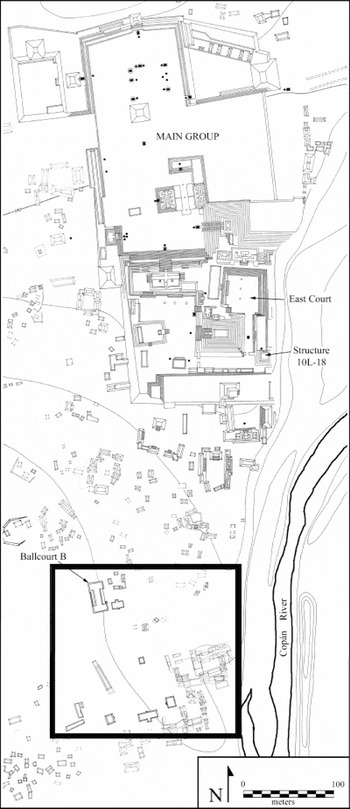
Center of Copan showing CPAP area in relation to the Main Group. Buildings and areas mentioned in the text are marked. The box demarcates the area enlarged in Figure 2. Map modified and adapted from Fash and Long (1983).
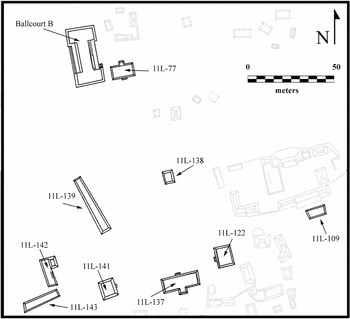
CPAP area. Ejar-phase structures are labeled and drawn in black. Coner structures are shown in light gray. Redrawn and adapted from Fash and Long 1983.
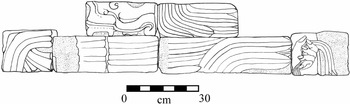
Stone bench from Structure 11L-77 constructed entirely of scavenged pieces of sculpture from the jamb and façade of Structure 10L-18 within the Acropolis. Drawing by Emily M. O'Brien.
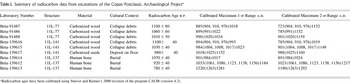
Summary of radiocarbon data from excavations of the Copan Postclassic Archaeological Projecta
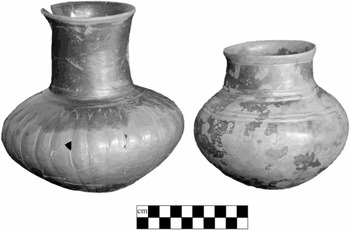
Tohil Plumbate vessels recovered from burial contexts. The left vessel came from Burial 58/3/1; the right vessel is from Burial 58/1/1. Photograph by the author.
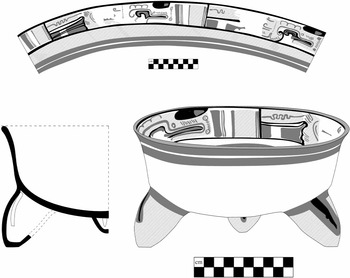
Tripod Las Vegas Polychrome vessel and rollout from Burial 58/3/1. Drawing by the author based on drawings by José Espinoza and Nelson Paredes.
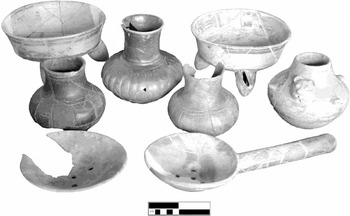
Ejar-phase pottery from burial assemblage. All vessels pictured were recovered from Burial 58/3/1. Vessels shown include two tripod Las Vegas Polychrome bowls (rear, left and right); Las Vegas Polychrome effigy vessel (right); Tohil Plumbate gadrooned jar (rear, center); two unidentified incised and gadrooned jars (center); and two Tamoa Red-on-Buff ladle censers. Not shown but also present in the deposit were a partially reconstructed effigy hourglass censer with post-fire polychrome paint and the fragment of utilitarian Ejar-type Kan Unslipped illustrated in Figure 6b. Photograph by the author.
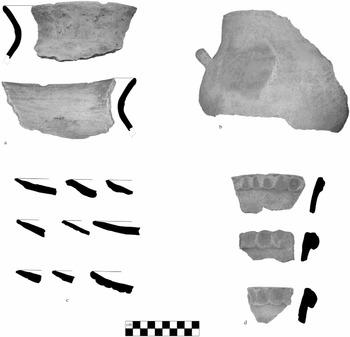
Examples of some of the Ejar utilitarian types. Types shown are: (a) rim fragment of Kan Unslipped, Kan variety, “C”-shaped neck form; (b) large fragment of Kan Unslipped, Kan variety, cántaro form recovered from burial context; (c) several rim profiles of Puchica Unslipped, Puchica variety, the Ejar comal type; (d) censer rim fragments of the Ejar type Sí Papa Fillet Rim, Sí Papa variety (similar to Baudez and Becquelin 1973:Figures 128l–o). Profiles and photographs by the author.

Early Postclassic Ejar-phase chert bifacial projectile points. Photograph by the author.
 You have
Access
- 40
- Cited by