On August 5, 1999, Michael Crawford stabbed Kenneth Lee at the latter's apartment. Earlier that evening, Crawford and his wife, Sylvia, had been out drinking. When someone mentioned Lee, Crawford became enraged; he subsequently claimed that Lee had attempted to rape his wife some weeks before. Michael and Sylvia went looking for Lee and, when they found him, the attack soon ensued. In the aftermath, Sylvia gave a statement to police that largely accorded with Michael's, but differed in one crucial point: she failed to confirm that Lee had seemed to reach for something—perhaps a weapon—before he was stabbed. Washington State's marital privilege law permitted Crawford to bar Sylvia from testifying at trial, but over Crawford's vociferous objection, the court allowed the jury to hear the recording of her earlier statement to police, based upon the Confrontation Clause of the Sixth Amendment, which specifies that, “In all criminal trials, the accused shall enjoy the right … to be confronted with the witnesses against him.”Footnote 1
At the culmination of the ensuing appeals, the United States Supreme Court reaffirmed a commitment to interpreting the Confrontation Clause in accordance with the dictates of the common law and at the same time endorsed a new theory of the right protected by confrontation. Expressing the view that civil law modes of criminal procedure constituted “the principal evil” against which the Founders wished to guard, the court, led by Justice Antonin Scalia, insisted that statements taken outside the trial courtroom were suspect. The majority concluded, in particular, that common law practice would not have permitted the admission of testimony gathered earlier and not subject to cross-examination; the Confrontation Clause, they extrapolated, similarly prohibited the use of such evidence.Footnote 2 The decision in Crawford significantly altered the direction of constitutional interpretation of the clause, spawning a significant new set of restrictions on prosecutions and generating substantial scholarly controversy over the merits of the Supreme Court's historical claims.
The Confrontation Clause is not the only area of criminal procedure in which originalists invoke the common law of 1791, when the Bill of Rights was ratified, to illuminate the nature and scope of a constitutional right. They generally look to the common law to determine whether a search is “unreasonable” within the meaning of the Fourth Amendment.Footnote 3 Parts of the Fifth Amendment are susceptible to a similar analysis.
Since Crawford, the court has alternately expanded the reach of the Confrontation Clause and expressed divisions over the viability of the resulting jurisprudence. Decisions extending Confrontation Clause protections have generally been justified on the basis of originalist claims about the compass of English and American common law at the time of the founding.Footnote 4 Several cases have also declined to broaden the scope of the clause.Footnote 5 These opinions have instead largely relied on prudential concerns about the possible consequences of rendering certain kinds of evidence too difficult to present at trial, as well as assessment of the purpose for which the statement in question was made.Footnote 6 Fewer have questioned whether the Supreme Court's representation of the common law itself at the time of the founding furnishes an accurate picture.Footnote 7
This symposium article contends that the image of the common law drawn by the Supreme Court in the Confrontation Clause context is both distorted and incomplete. In particular, the court and scholars defending originalist positions rely almost entirely on English sources in their reconstruction of the common law basis for the Confrontation Clause, thereby neglecting the diversity of American common laws from the time of the founding, a diversity that has already been unearthed by a number of legal historians.Footnote 8 By drawing on hitherto untapped sources to furnish a bottom-up reconstruction of how testimony was treated in local criminal courts within mid- to late eighteenth-century New Jersey, this article demonstrates that, in at least some jurisdictions, the originalist vision of common law did not apply. The common law cannot, therefore, furnish a univocal answer to questions about the original meaning of the Confrontation Clause.
I. Understanding Confrontation Through the Common Law
Originalists invoke the common law in several ways to explicate the meaning of the Confrontation Clause. First, they turn to the common law as a general background principle through which to understand procedural safeguards, setting the common law in opposition to the civil law. Second, they employ their interpretations of common law to flesh out the nature of the right being protected. And third, they appeal to the lack of certain common law practices at the time of the founding as a reason to reject such practices today.
Crawford itself, which began the modern transformation of the Confrontation Clause, encapsulates these tendencies. After affirming that “[t]he founding generation's immediate source of the concept [of the right to confront one's accusers] … was the common law,” Justice Scalia insisted, with the inevitable reference to Blackstone, that “The common-law tradition is one of live testimony in court subject to adversarial testing, while the civil law condones examination in private by judicial officers.”Footnote 9
As some critics have demonstrated, members of the founding generation did not hold the animosity toward civil law, inquisitorial systems, that the Supreme Court has posited, and civil law procedures were hardly foreign to the early American scene.Footnote 10 Hence Justice Scalia's framing of the Confrontation Clause as necessarily partaking of common rather than civil law norms already distorted the picture.
In light of the strict line he drew between civil and common law procedure, Justice Scalia was then forced to rationalize what look like civil law elements as merely exceptions to the common law. He was obliged to acknowledge that common-law procedure at the time the Bill of Rights was ratified did include a surprisingly inquisitorial component—pretrial examinations conducted by justices of the peace—but justified that element as a minor falling away from common law. He relied, in particular, on the fact that the elements he deemed inquisitorial derived initially from statutes.
Two sixteenth-century statutes passed during the reign of Queen Mary, often called the “Marian bail and committal statutes,” had furnished the framework. These specified that, in felony cases, justices of the peace—local men appointed by the crown to maintain order—should “take the examination of such prisoner [brought before him on suspicion of felony or manslaughter], and information of those that bring him, of the fact and circumstances thereof, and the same, or as much thereof as shall be material to prove the felony, shall be put in writing within two days after the said examination.” In conjunction with recording the examination, the justices were obliged to certify whether or not the prisoner had been bailed and could also “bind all such by recognizance or obligation, as do declare anything material to prove the said manslaughter or felony … to appear at the next general gaol-delivery … to give evidence against the party.” The witness statements collected could later be introduced at trial if the original witness were dead or otherwise unavailable.Footnote 11
Despite this history, Scalia rejected the notion that the Confrontation Clause could be consistent with the admission at trial of testimony recorded from earlier proceedings. He drew a line between the Marian statutes and common law practice, insisting that the former were in derogation of the common law, and, as such, should be narrowly construed. Furthermore, he suggested, the rationale for the common law rule by the time of ratification of the Bill of Rights precluded the use of such materials in most circumstances. The reason, Scalia contended, that the Bill of Rights insisted upon confrontation was to furnish defendants an opportunity to cross-examine witnesses against them and, correspondingly, to forbid the admission of recorded testimony that had not been subject to cross-examination.Footnote 12
This effort to flesh out the nature of confrontation has an appealing intuitiveness. Even if the reader had not previously contemplated that cross-examination might be the principle undergirding the Confrontation Clause, it seems clear that a defendant—or at least a defense attorney—could take advantage of the presence of the witnesses to impeach their credibility and inquire about the factual basis for their testimony.
And yet, different rationales for confrontation also emerge from the Founding Era. As some scholars have argued, drawing on state constitutional language that spoke of a “face to face” encounter, rather than confronting witnesses, another value could be served by forcing people to see the person against whom they were testifying: that of guilt or shame if the witness's accusation was unjust or testimony was false.Footnote 13 This notion is supported by Founding Era references to face-to-face meetings such as that in a letter from Meriwether Smith to Thomas Jefferson. As Smith warned, “In my Absence, My Enemies may attack my Character & Conduct; but the Time will come when I shall meet them face to face, and it will be well for them if I do not make them ashamed.”Footnote 14
In this instance, however, the witness's shame would still support the trial's function of establishing truth, as would an explanation based in the notion that a witness's demeanor at trial might indicate whether or not that person was lying. This truth-finding explanation for confrontation seems incomplete, however, given the belated timing of a confrontation norm in relation to other mechanisms of criminal procedure such as the hearsay rule. Hence John Langbein, while emphasizing the role of the confrontation requirement in establishing truth, expresses puzzlement in The Origins of Adversary Criminal Trial about its tardy arrival in English common law and its lack of explicit association with the rise of defense counsel.Footnote 15
Commentators have occasionally identified other values underlying the Confrontation Clause, ones that are dignitary rather than functional. As Toni Massaro writes, “The confrontation guarantee reflects a belief that criminal trials should … treat the defendant—even an alleged child molester—as an equal, dignified participant in the proceedings against him.” Sherman Clark, endorsing what he terms an “accuser-obligation approach” to confrontation, similarly states, “it is somehow beneath us—inconsistent with our sense of who we want to be as a community—to allow witnesses against criminal defendants to ‘hide behind the shadow’ when making an accusation.”Footnote 16
The origins of the clause are notoriously murky; although the conventional account—which Crawford endorsed—attributes the confrontation right to the colonists’ dismay at the secrecy cloaking witnesses against Sir Walter Raleigh, little evidence supports any such concern.Footnote 17 Virginia's 1776 Declaration of Rights, among other colonial constitutions, specified that, “in all capital or criminal prosecutions a man has a right … to be confronted with the accusers and witnesses.”Footnote 18 Yet the source for this provision too remains mysterious. Examining the term “confrontation” itself yields suggestive if inconclusive results. None of the legal dictionaries of the Founding Era define “confront” or “confrontation,” and only one even mentions the term in passing.Footnote 19 References among the writings of the Founders and other early American sources are likewise exceedingly sparse.
Samuel Johnson's 1755 dictionary does contain both “confront” and “confrontation.” For the latter, he refers only to “The act of bringing two evidences face to face”; for the former, he includes, as the third definition, “To oppose one evidence to another in open court.” Intriguingly, he attributes the derivation of both words to French.Footnote 20 Indeed, the “confrontation” furnished a critical aspect of criminal procedure in ancien régime France. This confrontation occurred after the evidence of the witnesses had been taken in secret and the prisoner examined. One treatise describes the procedure, during the confrontation:
[T]he judges should ask the prisoner if he knows the witness who faces him and if he has any reproaches to make against him. … The judges should annotate and write in the epigraph or at the beginning of the confrontation all that the prisoner says or objects against the witness with whom he is confronted, specifying the reproaches very precisely and not in vague and general terms. If the witness denies or agrees to the reproaches made against him by the prisoner, the judges should mention it in writing at the foot of the reproaches. If, by contrast, the prisoner says that he knows the witness who confronts him for an honest man and has no reproaches to make against him, the judges should also write that down.Footnote 21
The initial moment of confrontation and opportunity for objection took place, notably, before the accused even heard the witness's testimony. Instead, it furnished an opening to challenge the witness based on that person's character or status. Only subsequently was the witness's testimony read aloud and the defendant allowed to question aspects of that evidence. Although the relation between this French practice of confrontation and the American adoption of a confrontation norm remains unknown, the structure of French proceedings suggests the importance of the face-to-face meeting between the witness and the defendant apart from the effort to ascertain the truth of the testimony.
Justice Scalia himself derived his conclusion about the values that the common law of the Founding Era protected from his account of English practice, focusing on evidence he adduced that depositions and other recorded witness statements were not accepted by English courts in the absence of the defendant's opportunity for cross-examination. Strikingly, Scalia cited no American cases resolved prior to the founding, and rested his argument largely on English cases that would only doubtfully have been received in the United States in time for ratification of the Sixth Amendment and not at all before passage of a number of provisions resembling the Confrontation Clause in early state constitutions.Footnote 22
In addition to extracting the overarching principle of cross-examination from Scalia's account of the common law at the time of the Bill of Rights, the Crawford decision and its successors relied on the practices of the Founding Era to carve out any exceptions to the right of confrontation. In doing so, these cases paid lip service to American practices leading up to the Constitution, yet adduced little evidence of such practices. Scalia himself wrote that the Confrontation Clause “is most naturally read as a reference to the right of confrontation at common law, admitting only those exceptions established at the time of the founding.”Footnote 23 In a later opinion that cited Crawford among other cases, Justice Samuel Alito insisted that “We have recognized that the Confrontation Clause does not prohibit the introduction of out-of-court statements that would have been admissible in a criminal case at the time of the founding.”Footnote 24 When dismissing the relevance of the fact that “at common law the results of a coroner's inquest were admissible without an opportunity for confrontation,” another case stated that, “as we have previously noted, whatever the status of coroner's reports at common law in England, they were not accorded any special status in American practice.”Footnote 25 Despite these statements, the court has adduced virtually no systematic account of American practice on the ground.
As I have argued elsewhere, originalist emphasis on a singular common law rather than multiple common laws in England and America has conduced to a distorted vision of what the Constitution guarantees. In the case of confrontation, this article demonstrates, an examination of colonial and early state common law suggests that originalists on the court have been too hasty in insisting that pretrial examinations protected cross-examination throughout early America.
Rather than focusing on appellate decisions, this article instead turns to trial practices, looking at evidence of what justices of the peace actually did in pretrial hearings in mid- to late eighteenth-century New Jersey, and reconstructing the nature of the evidence considered at trial.Footnote 26 Unlike Virginia or Pennsylvania, New Jersey's state constitution contained no provision at the time of the founding analogous to what would become the Confrontation Clause of the federal Constitution.Footnote 27 Although this circumstance could suggest that New Jersey practice deviated from that undergirding the Confrontation Clause, New Jersey ratifiers’ understanding of the common law backdrop of the provision would presumably be as salient to the original meaning as that of ratifiers from other states.
II. Examination in Practice
Originalists claiming that the common law would have protected cross-examination have emphasized the significance of what actually took place in Marian pretrial procedure. Robert Kry, who clerked for Justice Scalia during the term when Crawford was decided, insists that Marian examinations were only admissible at common law when taken with the prisoner there. In support of this proposition, he adduces as evidence a sample of cases from 1789 at the Old Bailey, the central criminal court of England situated in London.Footnote 28 Within this sample, he finds that “eighteenth-century Marian examinations were routinely conducted in the prisoner's presence,” basing this conclusion in part of the fact that the defendant's presence was explicitly noted in twenty-two (80%) of the depositions he examined.Footnote 29
Turning to the other side of the Atlantic and away from an urban jurisdiction casts Kry's findings in a more partial light. American cases from New Jersey instead suggest that, at least in some parts of the colonies and early states, pretrial examinations were conducted on a more ad hoc basis and frequently in the absence of the defendant. Furthermore, a review of more than fifty depositions drawn from these cases includes no evidence of defendants or their counsel cross-examining witnesses for the prosecution. The only reference to cross-examination in these archival materials occured when one trial justice mentioned the cross-examination of a witness for the defense in his notes on the evidence. The picture that emerges from these case documents does not indicate the growth of a robust practice of cross-examination in pretrial proceedings. Instead, it gives a sense, particularly in the context of the rural administration of justice, of a more haphazard set of encounters in which witnesses would be examined when available, sometimes even in their own homes by roving justices.
One of the most telling indications of the absence of cross-examination on the part of the defendant is the timing of the depositions taken, which in a number of cases were handled on different dates. In those instances, there is no sign that the accused was present while other witnesses furnished their testimony.Footnote 30 Although it is theoretically possible that all of these depositions would have been considered inadmissible at trial given the circumstances under which they were taken, originalists themselves have emphasized the significance of common practice to the establishment of general common law norms; if common practice did not widely emphasize cross-examination in the context of some colonies, it indicates that a search for a unitary common law underlying constitutional terms may be misguided.
Julius Goebel and Raymond Naughton's classic study Law Enforcement in Colonial New York notes the absence of cross-examination in preliminary hearings in New York, but also the complaint against one justice of the peace, Henry Van Rensselaer, who was attempting to suppress riots around Albany, for taking witnesses's statements in the absence of the accused parties.Footnote 31 Kry lays significant weight on this protest as demonstrating that the practice that Goebel and Naughton described was already unacceptable. Examining a more complete picture, however, shows that the practice noted was not restricted to one justice of the peace but was, in fact, more widespread; in New Jersey, which has been much more sparsely considered in the scholarly literature on criminal procedure, we can see a vast array of similar proceedings.Footnote 32
One particularly elaborate set of pretrial proceedings furnishes a window into late eighteenth-century New Jersey criminal procedure, as well as into the sometimes fraught community relations out of which prosecutions arose. In March of 1773, several members of the Barmore family in Bergen County, New Jersey, accused their neighbor, Isaac Conklin, of a crime from long ago: the murder of a weaver who had been brought to his house by some fellow tinkers nearly 20 years before.Footnote 33 Many in the Barmore clan—in addition to other members of the community—were deposed, and Conklin himself was examined. Presumably some contemporaneous dispute between the neighbors led to the revelation of this long-buried murder, but the recorded testimony does not specify the nature of the grievance: whether it was Conklin's failure to furnish a bribe to the Barmores for their silence or some new set of circumstances. It does furnish signs of earlier conflict and a sense of the role that the previously suppressed accusation played in that setting. One of the Barmore daughters, Christina Ryker, had lived with the Conklins for a period, including during the time when the incident took place. Some years later, “Conklin came to fetch” her, and on the road reported “that a man had said she was a bad girl and whorish,” to which she replied, “if I am I have not done so bad as you have.” Conklin—according to Ryker—responded that “you was then a little girl and don't know much about it, but what you do know keep it secret and you shall not lose by it.” This threat of future revelation appears to have been held over Conklin by his neighbors and even—according to Ryker—his own wife.
Most of the narratives, including Conklin's own, agree on the central details of the story. Sometime between 18 and 20 years before, a tinker and his son had brought a weaver to Conklin's house, with his hands tied behind his back, purportedly because he had attempted to rape the tinker's daughter. The mother, Rachel Simonson (previously Barmore), had formerly seen the weaver at Kingston and believed that he hailed from Trenton. The weaver asked for some food, which Conklin's wife provided; his hands were untied so that he could eat and go in back of the property to use the outhouse, but instead of returning to his captivity, the weaver then ran away. The tinker and Conklin set a dog after him, and then followed in hot pursuit. Soon Conklin returned, claiming he was tired of running after the weaver and that he wanted to get his gun to shoot partridges. Between a half hour and an hour later, various witnesses heard the report of a gun, although they could not swear it was Conklin's. The tinker and Conklin subsequently returned and, after Conklin conferred with his wife, the latter several times exclaimed, “Lord Christ what will become of us.” People later searched for the weaver but he was never seen again.
Other details only emerge from one or another account. On the prisoner's side, we read that Conklin had initially resisted having the weaver on his premises as there had been no warrant for his arrest, but that the tinker had produced a warrant from Justice John Ryerson and commanded Conklin to aid him in conveying the prisoner, which he finally agreed to, and that the weaver had succeeded in his escape. On the accusers’ side, we are told that after the murder, Conklin had buried the weaver beneath a tree, that he had offered the Barmore matriarch a cow to keep quiet, and that his garments were blood-stained, perhaps from slaughtering an animal but also possibly from the murder of the weaver.
A final outlier version of the story, that of Tamity Berry, who appears to have been on familiar terms with the weaver, whom she knew as John Barclay, seems difficult to reconcile with the others. According to Berry, the chain of events was started by the weaver mentioning to the tinker's daughter—with Conklin present—that she had been rumored to be involved with Conklin; the next day was when the tinker accused the weaver of attempting to rape the former's daughter, setting in motion the chain of events described by the other witnesses. Berry then recounted a subsequent set of occurrences that no one else had mentioned. As she explained, sometime later, Conklin and the tinkers were taken to the house of Peter Demarest, at which point it was reported to Berry that “that Devil of a Conklin will now turn Kings Evidence,” after which the whole company proceeded “to Justice Moores, and from thence to the House of Joseph Baldwin were the Justices were met.”
Moore was not among the justices who recorded the examinations that have been preserved, so presumably this earlier legal proceeding had taken place sometime between the initial disappearance of the weaver and the current set of accusations. The reader can glean nothing about the present situation of the tinkers from any of the depositions, hence it is possible that Conklin had “turn[ed] Kings Evidence” against them and that they had been executed at some earlier time.
The dates affixed to the various depositions as well as their form and the personnel at each are revealing with respect to the justices’ methods of gathering the evidence and the presence or lack thereof of cross-examination. One would not necessarily expect cross-examination with respect to the initial set of accusations in support of the arrest, those of William Barmore and Cristina Ryker, two of Rachel Simonson's children. William Barmore's account was sworn before Peter Zabriski and John Fell, two justices of the peace of Bergen County (and later members of New Jersey's convention to ratify the Constitution) on March 24, 1773. Cristina Ryker's oath was taken the following day, March 25, before the same justices, plus George Ryerson. The examination of Conklin himself—which describes him as the “prisoner,” “charged … by the Oaths of William Barmore and Cristina Ryker”—occurred on the same date before the same people. Hence it is possible that he was present for Ryker's deposition although there is nothing in that document to suggest any cross-examination.
One interesting aspect of the form of Barmore's deposition is the fact that it includes a second examination on the same day before the same justices of the peace. This second examination focuses on Barmore's mother's role in instigating the current accusation and in suggesting to her son—who had been 7 years of age at the time the underlying events had occurred—a set of memories that might or might not be what he had actually recollected. Although these details could plausibly be ones that might have been generated by cross-examination, it appears highly unlikely that Conklin would have been present, as his own examination occurred the following day and this accusation probably preceded his arrest. That suggests the possibility that the justices of the peace themselves viewed their role as including inquiring into inconsistencies or weaknesses in the deponent's testimony.
Several depositions—those of Catherine van Zyl, Lena van Blarikham, and Tammity Berry—stem from March 27. These were taken before John Fell and Roelef Westerwelt and all specify sums given as recognizances to ensure the witnesses’ appearance at the next session of the Court of Oyer and Terminer. Rachel Simonson's deposition was taken several days later, on March 29, before yet another individual, David Ogden, a justice of the New Jersey Supreme Court. No recognizance was recorded in conjunction with this document.
From the perspective of procedure, a few details about these materials are noteworthy. First, the statements were transcribed on several different dates—including two subsequent to Conklin's examination—and presided over by several disparate justices. Second, there is no indication at all of the presence of the defendant at the later examination of witnesses. Third, there is no mention of cross-examination; the only textual evidence suggesting something of the sort consists in the re-examination of William Barmore the day before Conklin's examination. This indicates that the justices of the peace, not Conklin himself, may have been engaged in the task of attempting to ascertain the veracity of Barmore's deposition.
These features were far from unique to the Conklin case and indeed appear to have been widespread. Following a deposition from the victim of an assault in Middlesex County, a justice of the peace specifically summoned several other potential witnesses “to appear before me or any other his Majestys Justices to give Evidence on the part of our Lord the King willingly.”Footnote 34 These witnesses did indeed appear on a later date before a different justice. This separate request for witnesses to make themselves available before any justice of the peace suggests that the presence of the defendant at such meetings would have been highly unlikely. A number of the other cases involving multiple witnesses similarly include depositions procured on different dates without any indication of the defendant's presence.Footnote 35
In the 1772 case of King v. Phebe Combs (also from Middlesex County), in which the defendant was accused of stealing various household items, one of the four depositions taken refers to the witness's earlier encounter and conversation with Combs herself after the latter “had been examin'd before Jonathan Frazee Esq.;” reporting the ensuing exchange, Combs “said she understood that this Deponent had Discovered the Matter about said Goods to Mr. Everson, and then requested of this Deponent to Let it Drop and Say No More About it ….”Footnote 36 Here we see evidence of discussion between a defendant and a witness about testimony but completely outside the context of the pretrial examination itself.
III. Evidence in the Absence of Witnesses
Although analysis of pretrial materials suggests the absence of cross-examination within the depositions regularly taken by justices of the peace, the question remains as to whether written documentation of evidence made its way into criminal trial proceedings. In the context of New York, Goebel and Naughton observe that “[t]he casual way in which any remembrance of evidence was noted in court makes it difficult to determine how far the sworn examination was employed in New York.”Footnote 37 This statement is true of New Jersey as well. Nevertheless, extant records of what took place in the New Jersey Court of Oyer and Terminer, particularly when examined in conjunction with the miscellaneous documents remaining from case files, indicate that written statements were introduced into court on some occasions in the absence of the person who had furnished them.
The Record and the Minute Books proceed chronologically by term and county. The kind of information provided varies across the entries. In general, following the date, those present in court are noted first; this includes the justices and sundry other officials, who are sometimes (but not always) explicitly mentioned, as in this passage from November Term, 1750 in Monmouth County: “Present: Samuel Nevil, John Bowne, Jonathan Forman and John Anderson, Esq'rs. Justice of the Peace, coronors & constables called. Grand Jury called.”Footnote 38 Often the names of the grand jurors are noted (including those who failed to appear). On some occasions, the account includes those sworn to give evidence to the grand jury or the defendants or witnesses who appeared or made default on recognizances that were designed to ensure their participation in court proceedings.Footnote 39 Relatively brief discussions of the cases heard then follow. The Record and Minute Books do not generally specify whether evidence is live or written.
Both the justices and the lawyers often overlapped between civil and criminal proceedings. Following the Oyer and Terminer session, Justice Samuel Nevill would frequently preside over nisi prius proceedings in the same county;Footnote 40 depositions were explicitly employed in these trials at nisi prius.Footnote 41 Abraham Cottnam shows up as a prosecutor and defense attorney in criminal cases in addition to representing individuals at nisi prius.Footnote 42 Lawyer David Ogden, who would later serve himself as a justice on the New Jersey Supreme Court, and was considered one of the most distinguished lawyers of the time, represented a plaintiff in trespass as well as a defendant at a murder trial.Footnote 43 Although the sparsity of surviving Chancery records from New Jersey renders comparison of personnel difficult, Thomas Farmar did serve as a master in Chancery as well as taking on the role of the chief justice of the Supreme Court.Footnote 44
Throughout the Oyer and Terminer records themselves, witnesses, examinations, and any other written documents are conglomerated under the designation “evidences.” The clearest indication that witnesses were actually present in court comes from those sessions in which the appearance of witnesses upon recognizances is recorded, or witnesses are listed as being sworn. In those contexts, it is possible to cross-reference the list of “evidences” in particular cases with the initial catalogue of those who appeared on recognizances or were sworn, and cast doubt on whether those not listed in either category actually showed up in person. Conversely, when an individual who defaulted on his or her recognizance is included as an evidence in a case, that raises the strong implication that his or her testimony was not live. There are other cases in which no witnesses at all are mentioned at the trial; these sometimes involve a recent prior indictment or a coroners’ inquest, so it is possible that in those instances the witnesses did not appear again before the petit or traverse jury.
To glean the complexity involved in reconstructing the historical record, it is worth dwelling at some length on the case of Paul Ouybert (alternately spelled Weeber or Weebear, indicating its pronunciation), who was born in Champaigne, in France, and came as a servant to America, where he was bought by one Colonel John Johnston. A few years after his term of service expired, he bought a little house and some acres. During August of 1760, he and John Poquet and a couple of other friends traveled to New Brunswick. A conflict between Ouybert and Poquet ensued, and simmered for a couple of days. On August 23, Poquet visited Ouybert, who, missing some money after this interlude, believed that Poquet had stolen from him. Ouybert tracked Poquet down at Dr. Johnston's farm and, when the latter denied having pocketed Ouybert's gold, stabbed him. Much of this information came out at Ouybert's examination before Justice Nevill on August 25, 1760.Footnote 45
The file also contains a coroner's inquest, taken by Coroner Henry Moore at Johnson's Farm on August 26, 1760. Coroner's inquests at this period functioned as substitutes for grand jury indictments.Footnote 46 Nothing indicates that Ouybert was present at this inquisition, which was signed by the jurors and also includes two sworn statements, marked on the outside “James Williams Deposition.” The said Williams:
being duly sworn as the law dictates, upon his oath saith, that on Sunday the 24th of this Instant, being at the House of Doctor Johnston at Matchiponix, he was Informed by Mr Johnstons Family that one Paul Weebear stabed one Francis Pokiet upon which said Williams went upstairs and was informed by Said Pokiet that said Weeber stabed him, and said he would die, said Williams. Further declareth that he held apprehend said Weeber, and that said Weeber acknowledged to said Williams that he had stabed said Pokiet and would do it again, and would kill him again tomorrow if he could and further this Deponent saith not.
On the same page, and likewise sworn before the coroner, Henry Moore, Dr. John Waterhouse “being duly sworn saith that he verily believes that the Wound given Francis Pokiet in his Belly was the Occasion of Sd. Pokiet's Death, and further this Deponent saith not.”
A final affidavit, sworn before Nevill again on August 25, appears in the file, that of Heathcote Johnston, who:
deposeth and saith, that on Sunday the 24th of August, 1760 in the afternoon about Four O'Clock, this Deponent, who was then at his Father's Farm, (Dr Johnston's) at Matchiponix, was informed by a Frenchman … that Paul Weebear had stabbed one John Poquet a French Prisoner in the Belly: That this Deponent then went to the Door, and saw the aforesaid Paul with a Knife in his Hand; and the aforesaid Paul Weebear being asked how he came to do it replied, that the Frenchman Poquet had stolen money from him; and that afterwards the said Paul went Home: That this Deponent hearing, that Poquet, the wounded Man, was above Stairs in this Deponent's Father's House, he went up to see him, and saw a Wound in his Belly below the Naval, which looked fresh; and this Deponent further saith, that the said John Poquet died on Monday Morning the 25th of August, as this Deponent verily believes of the said Wound. And further this Deponent saith not.
This paper is labeled “The Affidavit of Heathcote Johnston relating to the murder of John Poquet,” following which is written “Evidence: John Derncie, James Williams, Dr. Waterhouse.”
This label raises many more questions than it answers. Was the evidence listed that which was produced at trial? As it was written on Heathcote Johnston's affidavit, was that also made available? Consulting the Reports does not fully clarify the matter. As that tersely recounts, on the date of October 17, 1760, in Middlesex County, “The Attorney General opened the Cause. Evidence for the Crown, John Derncie, Doctor John Waterhouse, the Examination & Confession of the Prisoner.”Footnote 47 A guilty verdict followed. Missing from the list of evidences is James Williams, whose deposition was included in the coroner's report and who is also listed as evidence on the outside of Heathcote Johnston's affidavit. Yet perhaps what was written in this location of the Record did not provide a complete picture. Earlier in the day, we find that in the cases of “The King v. James Williams” as well as “The King v. John Waterhouse,” both cases of “recognizance to give evidence,” each defendant appeared.Footnote 48 Hence Williams seems to have been present despite not being listed under the evidences for the crown at trial. This leaves uncertain the status of Heathcote Johnston's deposition. Was it introduced but unmentioned? It is impossible to know.
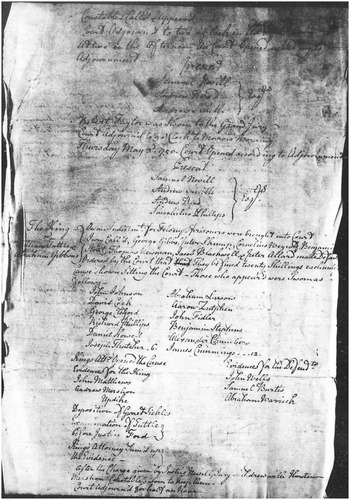
In the 1750 case of King v. Tuttle and Gibbons, it is clearer from the record that written statements, including a coconspirator's examination, a deposition, and potentially a third document, were presented in court, although some of these materials have disappeared (Figure 1).Footnote 49 Laborers William Tuttle and Abraham Gibbons were both indicted for felony in 1749 for breaking and entering the dwelling of John Mathews and stealing some silver coins and state bills of credit and currency. As in the Ouybert trial, an examination remains, although only of William Tuttle, not of Gibbons, despite the fact that the justice of the peace who recorded the confession mentioned that “then was brought by warrant before me Abraham Gibbons and William Tuttle both accused by John Mathewes.” Tuttle's examination describes the set of events surrounding the two defendants’ encounter with Mathews and casts significant blame on Gibbons, whom he represents as engaging in thievery during the entire time of their travels together. Only after Tuttle's signature on the document do we see any full acknowledgment of his own guilt, in the form of “Two omishons made in the above Examination one is that the above examinant acknowledged to have received out of the said Mathewes his mony knowing it to be the stolen money also receaved the pincushion above mentioned and reported that had it of his the said examinants his mother pray excuse the omishons—Sir with all regards in great hast Remain your very Humbelest Servant Jacob Hand.”
Minute Book entry for the Tuttle & Gibbons Case. Source: New Jersey State Archives.

On the reverse of the indictment itself is inscribed on one side the date of its filing, followed by the statement that, “At a Court of oyer & Terminer in May 1750: Andrew Smith Esq. one of his Majesties Justices of the peace for the County of Hunterdon delivered this Indictment into open Court with his proper Hands: It is ordered to be filed.” On the other side (and perpendicular) is written “Billa Vera, Edward Hart Foreman,” following which is stated “Evidence for the King: John Matthews. The Confession of William Tuttle before Justice Ford.” Was this the evidence before the grand jury or the evidence furnished at trial? It is hard to know in this case. In some instances, when no reference to the trial or verdict is included, it is clearer that the evidences enumerated were those who appeared before the grand jury. Here either seems possible.
Regardless of the answer to this question, the account from the Record demonstrates that John Mathews did not appear at trial. Under the list of recognizances assessed the prior day, May 1, we find “John Mathews. On recognizance to give evidence. The defendant being called made default.” As soon as court opened the next day, trial of the case of Tuttle and Gibbons, who pled not guilty, was ordered for the following morning. The notes on the trial explain that “King's attorney opened the cause. Evidences for the King were John Mathews, Andrew Mershon, [blank] Updike, a disposition of Garret Sickles, and an examination of Tuttle before Justice Ford. Evidences for the defendants were John Wells, Samuel Burtis and Abraham Warrick.”Footnote 50 The phrase “disposition of Garret Sickles” suggests a document pertaining to the disposal of property as the phrase implies, which seems unwarranted by any of the facts of the case. The better reading is “deposition,” confirmed by examination of the Minute Books, which refer to the “deposition of Garret Sickles.”Footnote 51 Furthermore, John Mathews is listed as an evidence despite having defaulted on his recognizance. Hence it appears that his testimony must have been included in documentary rather than oral form.
Other case files also include or reference doctors’ reports or coroners’ inquests, and one indicates that Justice Alito might have been mistaken in concluding that American practice did not permit admission of a coroner's inquest. State v. McDonald, from 1786, dates from after the time period covered in the Record. The Minute Books, however, contain an account of the trial. The case file lists the witnesses at the coroner's inquest.Footnote 52 Importantly, the same parties are listed as witnesses in the Minute Books as at the coroner's inquest, but none are recorded as being sworn to give testimony or as appearing on their recognizances. The implication is that these individuals did not and were not required to appear at the Court of Oyer and Terminer, and that the testimony from the coroner's inquest instead sufficed.
Further omissions or discrepancies in the records suggest reliance on something other than oral testimony. As the conflicts in the materials already outlined demonstrate, excessive reliance on these discrepancies would be unwise, as it appears that errors are present throughout. Nevertheless, these details do indicate the possibility that the court relied on written records in some instances, and cross-checking the Record with the Minute Books helps to eliminate the effects of scribal error.
The implication that the court considered written testimony is strongest in those instances in which a witness is marked as failing to appear on his or her recognizance and is then subsequently recorded as an evidence at trial. One explanation for this circumstance might be that the person simply arrived late; that situation, however, seems to be treated differently, as the sources frequently report that someone who initially defaulted subsequently appeared, and describe remittance of the fine.Footnote 53
The aforementioned John Mathews from the Tuttle and Gibbons case furnishes one instance of this phenomenon, but there are others as well. When witnesses were called to appear upon their recognizance before the felony trial of John Daugherty, one Cooper and a George Fischer both failed to appear.Footnote 54 Listed as evidences for the king at trial were included “Thom. Combs, Isaac Rutinghouse, Isaac Cooper—affirmed, Fischer—sworn, William Brown.”Footnote 55 This sequence of events strongly suggests that Cooper and Fischer's prior statements committed to writing, rather than their live testimony, were admitted.
Another category entails a lack of correspondence—similar to that in the Tuttle and Gibbons case—between those listed as appearing on recognizances and those mentioned as testifying at trial. Hence, John Wardell, Jr. is listed as an evidence against Alexander Fletcher in his 1755 trial for manslaughter; whereas all the other prosecution witnesses are mentioned previously, Wardell is omitted there, suggesting that he may not, in fact, have been present in court.Footnote 56 When Hugh Rony, alias William Rufus, was indicted for burglary, the file records Robert Montgomerie, Joseph Woodward Junior, Joseph Wright, Alexander McGarnet, and Aaron Jackson (labeled respectively 1, 5, 2, 3, and 4) as evidences, yet Jackson is not listed as being sworn in the Record despite being also noted under the evidence for the crown at trial.Footnote 57 Similarly, when Simon Hussey alias Anderson was indicted for horse stealing, Charles Davis, Thomas Denny, Esq'r, Arthur Buildal, and Solomon Loyd all served as witnesses; all are likewise recorded as “evidences for the King” at trial, but Arthur Buildal was not noted in the Record as having entered into recognizance or been sworn by the court.Footnote 58 At the trial of Charles Conaway for buggery, a number of the evidences for the king are not noted as appearing on their recognizance although the majority were.Footnote 59
IV. Conclusion
Reconstructing the pretrial examination of witnesses and the extent to which documentary records of testimony found their way into colonial New Jersey criminal trials suggests that originalists’ near-exclusive reliance on British common law practices to explicate the original meaning of the Confrontation Clause neglects the complexity of original meanings that would have been present throughout the different American states at the time of the founding. At least in New Jersey, and probably elsewhere, cross-examination was not a common component of pretrial procedure; furthermore, depositions and other documentation of the testimony of witnesses who did not appear in court were nevertheless accepted in those tribunals, contrary to the historical arguments of many originalists. This circumstance raises the normative question for originalists of how to treat history that does not furnish a univocal answer to the question of what the original meaning of a particular constitutional provision might be, a normative question that remains to be answered.