Western liberal political philosophy asserts the necessity of political and
civic education. From the eighteenth century to the present, scholars and
community leaders have argued that democratic civic, political, or
citizenship education helps maintain order in a society that grants enormous
freedom to pursue one's self-interest. This study asks: to what extent do
college and university political science faculty engage in civic education?
In 1996, the American Political Science Association (APSA) established a
Task Force on Civic Education. It determined that there was a
problem–“evidence suggesting mounting political apathy in the United
States”–and that “political education in the United States is inadequate
across the board” (APSA 2000 [1998]). To offset
this risk, Robert Putnam (2000, 404–6) has argued
that a partial remedy is “civics education.” However, Stephen T. Leonard
(1999) has asserted that calls for
civic–including political and citizenship–education by the APSA fall on deaf
ears or run contrary to the motivations of most faculty. Is Leonard's an
accurate assessment?
To permit an empirical assessment of civic education, our data collection
about civic education by American political scientists addresses four
questions: (1) To what extent do political science faculty members consider
education about citizenship to be a primary teaching objective? (2) Are the
faculty members who rank citizenship education as a very important
pedagogical objective more likely to be participants in civic and political
organizations? (3) If faculty members believe citizenship education is a
duty for all faculty, are they more likely than other faculty members to use
an experiential learning pedagogy? (4) Do departments reward faculty
members' efforts in civic education?
Data Collection and Analysis
Because of time and financial constraints we chose to use email and an
online questionnaire. Because we only wanted political scientists who
are currently teaching, we used political science department web sites
as our source for e-mail and mailing addresses (see Dillman 2000). Approximately 2,275 valid email addresses
were collected. The faculty survey was placed on a web site for online
completion and also sent as an email attachment. Six hundred and ten
faculty responded by completing the online faculty survey, for a
response rate of slightly over 20%. Surveys were also mailed to a random
sample of 600 political scientists; 200 surveys were returned from this
mailing–a response rate of 33%. The respondents reflected the population
of political science faculty reported by the APSA (2001). The percentage of male and female respondents
mirrored the percentage of political science faculty who are male and
female. However, respondents were more likely to be in small (fewer than
10 faculty) departments (81% vs. 65% for APSA members) and in social
science or combined departments rather than political science (38% vs.
26% for APSA members).
The survey asked faculty their perception of their department's mission,
their personal specialties, how they define their role, their feelings
about the appropriateness of civic education, whether they teach civic
education courses, and how they assess such courses. To complete the
analysis, primary faculty activity was recoded as TEACHING to include
the responses teaching, teaching and research, and teaching and service
as (1) and all others (0). Professional specialty was recoded as POLICY
to include the responses public policy and public administration as (1)
and all other specialties coded (0).
Regarding civic education, we stated, “There are many ways in which a
faculty member might teach civic and political responsibilities or
involve students in civic activities,” and then asked them to check all
the activities that they personally undertook. The activities included
teaching a course with explicit goal of teaching civic responsibilities,
organizing a program or event with an explicit goal of teaching civic
responsibilities, teaching a course with an explicit goal of stimulating
civic engagement, and organizing a program or event with an explicit
goal of stimulating civic engagement. We created the variable ED
ENLIGHTEN as a dummy variable to include faculty who checked either
“teach course with explicit goal of teaching civic and political
responsibilities,” or “organize a program or event with an explicit goal
of teaching civic and political responsibilities.” The variable ED
ENGAGE was created as a dummy variable for the responses “teach a course
with an explicit goal of stimulating civic engagement,” or “organize a
program or event with an explicit goal of stimulating civic
engagement.”
Citizenship Education
To what extent do political science faculty consider education about
citizenship to be a primary teaching objective? Two questions were
established to measure faculty attitudes about the appropriateness of
teaching civic education. In response to our question, “How appropriate
do you think it is for political science faculty to teach students about
the principal civic and political responsibilities or duties incumbent
upon citizens in a democratic society?” (abbreviated APPTEACH), more
than 97% of the faculty responded that it was appropriate in some
pedagogical situations, while 43.5% said they considered it to be a duty
for all faculty. Despite these responses, 20% of the respondents who
believe it is a duty to teach civic responsibilities do not do so
themselves. Faculty who are expected to excel in research are least
likely to feel teaching civic responsibilities is appropriate, while
those who specialize in policy or public administration are most likely
to feel it is appropriate: 60% of these faculty saying it is a duty to
teach civic responsibilities.
Another question (abbreviated APPREQUIR) asked, “How appropriate do you
think it is for political science faculty to require civic and political
engagement or activities and political participation among students?”
received a less favorable response rate, with 16.3% responding that such
a requirement was inappropriate, and only 8.5% indicating it was a duty
for all political science faculty. Seventy-five percent, however, felt
it was appropriate in some pedagogical contexts. Again, fewer faculty
actually teach or supervise programs to accomplish these goals than say
it is appropriate to do so. Almost 26% of those who consider it a duty
do not teach or organize programs that require civic or political
engagement. Faculty who are expected to excel in research or teaching
and research responded most negatively, while faculty who teach public
administration or public policy responded most positively. Almost 90%
(89.3%) of the public administration/policy faculty felt that it was
appropriate in at least some contexts to require civic or political
activity among students; in contrast, only 77.7% of political theorists
felt that it was sometimes appropriate. It appears that faculty who are
more directly tied to the study of political action in America are more
likely to believe students should be engaged in civic or political
action than methodologists, theorists, and those specializing in
international relations or comparative politics. Male faculty were also
more likely to believe the requirement was inappropriate (19.4% for male
versus 9.2% for female faculty).
Faculty Political and Civic Activism and Civic Education
Are the faculty who rank citizenship education as a very important
pedagogical objective more likely to be participants in civic and
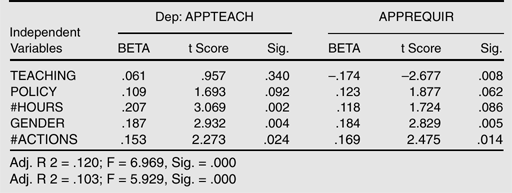
political organizations? Using APPTEACH and APPREQUIR as measures of
faculty attitudes about teaching civic responsibilities and
stimulating civic engagement, and our computed variables #HOURS, which
counts the number of hours per week the faculty member engages in civic
or political service, and #ACTIONS, which counts the number of civic
actions reported by the faculty member during the past year, we find
that faculty members who are civically active are more likely to believe
teaching civic responsibility and requiring political engagement by
students are appropriate pedagogical tools. As the regression results
reported in Table 1 indicate, both #HOURS and
#ACTIONS variables were significant contributors to both the perceived
appropriateness of teaching and the appropriateness of requiring civic
and political engagement, although #ACTIONS is the most significant.
Although primary faculty role (TEACHING) was included in the model, it
was not significant. Field of teaching, the number of hours of community
service, the number of civic actions, and gender all contribute to
faculty attitudes about teaching civic responsibilities. The model is
very similar when regarding faculty attitudes about requiring civic
engagement, but the faculty role (teaching vs. research or service)
makes a difference in this model. Interestingly, it is a negative
relationship, indicating that research faculty are more likely to think
requiring civic activities is appropriate. Faculty attitudes about
requiring civic engagement are strongly related to their personal level
of civic participation and to their gender, role, number of hours of
community service, and teaching area.
Political science faculty's attitudes about civic education appear to be
affected by the type of volunteer or civic activity in which the faculty
member engages. Family and church related activities are not correlated
with attitudes about teaching civic responsibility. Attitudes about
requiring civic and political engagement are, however, correlated with
church activities and service on boards as a volunteer but not with
other volunteer activities. Attending hearings and writing letters are
the two civic actions most strongly related to attitudes about both
teaching and requiring civic or political activities.
To what degree does faculty behavior reflect faculty attitudes about
teaching? We asked faculty whether they taught a range of courses or
organized programs with the specific goals of teaching civic
responsibilities or stimulating civic action. The majority of
respondents teach or organize at least one of the courses or programs we
listed. Over 39% teach a course to stimulate civic engagement; 53% teach
a course that teaches civic responsibilities; 35.1% organize programs to
teach civic responsibilities; and 33.9% organize a program to stimulate
civic engagement. Only 30% responded that they neither taught nor
organized any of these four options. Although a majority of faculty
(53%) indicated that they teach a course with an explicit goal of
teaching civic responsibility, we do not have course syllabi or other
evidence to describe the manner by which this goal is achieved.
Approximately 26% of faculty responded that they teach a
service-learning course, a pedagogy with an often-stated goal of
promoting civic engagement, although only three syllabi were offered to
support this contention.
As with attitudes about teaching, faculty who engaged
in either volunteer activities or civic activities also appeared to be
more likely to both teach civic responsibilities and teach or require
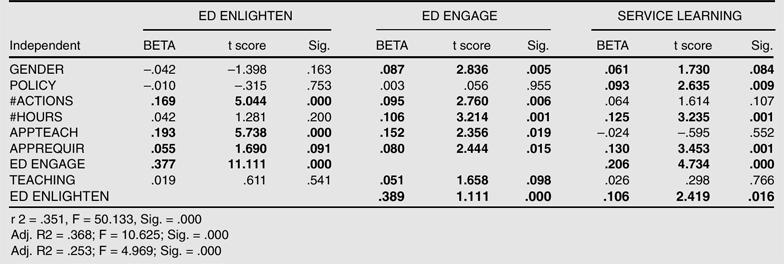
civic action among their students. An OLS regression, reported in Table 2, found that perceived appropriateness of
teaching (APPTEACH), #ACTIONS, and whether faculty require civic
participation of students (ED ENGAGE) were most significant in
predicting whether faculty would teach civic responsibilities (ED
ENLIGHTEN). With regard to required student civic and political
engagement, the results were similar. The only non-significant variable
in this model was POLICY (faculty member's specialty). The variables
#HOURS, GENDER, and #ACTIONS were the strongest predictors.
Interestingly, the significant variables measure personal attitudes and
behavior rather than professional and institutional attributes. These
results suggest that the employment of politically committed faculty
could further the civic education of undergraduates. Also, personal
civic engagement is more important than volunteer work in guiding
faculty members' decisions to teach civic education courses. Therefore,
we conclude that the political science faculty who rank citizenship
education as a very important pedagogical objective are more likely to
be participants in civic organizations. Political and civic activism by
faculty motivates their efforts to offer civic and political education
and stimulate the political engagement of students.
Faculty Choice of Experiential Education
If faculty believe citizenship education is a duty for all faculty, are
they more likely to use experiential learning pedagogy? How do they
measure the success of this activity? Because service-learning is often
touted as a method for either teaching civic responsibilities or
stimulating civic engagement, we asked whether faculty use
service-learning. Approximately 26% of faculty respondents said that
they use service-learning. The use of service-learning is highly
correlated with #HOURS and #ACTIONS–our measures of faculty civic and
political engagement, APPREQUIR, APPTEACH–our measures of the
appropriateness of teaching and requiring courses on civic
enlightenment, and ED ENLIGHTEN and ED ENGAGE–our measures of faculty
actions such as organizing programs related to civic responsibility or
stimulating civic engagement. In addition, tenured associate professors
are most likely to use service-learning (34.3%) while those faculty with
more than 25 years of teaching are least likely to report using
service-learning (19.3%). Female faculty are more likely to use
service-learning (32.2%) than male faculty (24.4%).
The third section of Table 2, labeled SERVICE
LEARNING, shows the results of an OLS regression analysis with the
teaching of service-learning as the dependent variable and–as
independent variables–gender, rank, #HOURS (hours of community service),
POLICY (teach policy field), ED ENLIGHTEN, ED ENGAGE, TEACHING (primary
faculty role), #ACTIONS (number of civic activities), APPTEACH
(appropriateness of teaching civic or political responsibility), and
APPREQUIR (appropriateness of requiring civic or political engagement).
This model indicates that ED ENGAGE, #HOURS, and APPREQUIR are the most
important predictors of teaching service-learning. These variables
measure attitudes about requiring civic activity and teaching courses to
stimulate civic activity. Whether the faculty member teaches in policy
or public administration and GENDER are next in importance. Faculty who
are themselves active, who teach in a field that is often applied, and
who believe courses that involve students in civic activity are
appropriate are also the faculty who are most likely to use
service-learning as a pedagogical tool. Most significant is whether they
organize programs to stimulate civic engagement. It appears that most
faculty perceive service-learning as a tool to achieve that particular
goal. The model thus suggests that the political science faculty who use
service-learning are politically and civically committed faculty who
plan classes to require student's civic engagement. Faculty who are not
personally engaged are not likely to push students to become engaged.
Degree of personal civic involvement and whether they think it is
appropriate to teach civic responsibility do not predict the use of
service-learning.
Assessment of Activities
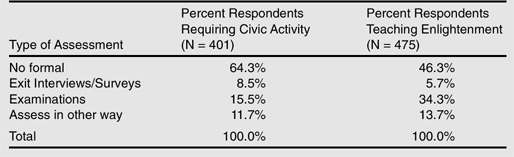
As Table 3 indicates, a majority of faculty who
report that they teach courses or organize programs to stimulate civic
engagement provide no formal assessment at all. Exams are the most
common tool used by those faculty who assess their students' activities.
Almost a majority (46.3%) of faculty who report teaching courses or
organizing programs with an explicit goal of teaching civic
responsibility also provide no formal assessment. Of those faculty
reporting that they use service-learning, 19% report no formal
assessment of civic understanding and 21.1% do no formal assessment of
student's political engagement. Exit interviews are the most common form
of assessment (53.3% for civic understanding and 69.2% for political
engagement). Also, 42.7% report that they use exams, papers, or a senior
thesis to measure students' level of civic understanding, and 52.1% use
these methods to measure students' political engagement. Perhaps most
interesting, but also disturbing, is that 11.1% of those faculty who say
they use service-learning do not require any form of reflection. Because
reflection is considered to be an essential component of
service-learning, it appears that more than 10% of the faculty who say
they use service-learning leave out an important component of the
pedagogy or misunderstand what a service-learning course should
include.
Incentives for Civic Education
Do departments promote and reward faculty efforts in civic or political
education? Overall, it appears that very few faculty receive any extra
rewards for teaching such courses. Only 20.3% of faculty members
reported receiving any incentives. However, the more of these courses or
activities in which faculty members were engaged, the more likely they
were to receive some form of incentive. Over 35% of those who taught all
four types of “civics” courses reported incentives. The most common
incentive reported (12%) was consideration of the activity in promotion
and tenure decisions. The existence of incentives did not contribute
significantly toward attitudes about teaching, requiring civic activity,
nor did it predict whether faculty taught any of the 12 possible civic
education options.
Conclusion and Recommendations
Overall, faculty who responded to this survey tended to believe that
teaching civic responsibility was a fairly important goal. A smaller
number, but still a majority, of respondents felt it was appropriate to
require civic activity and said they required such activities of their
students. Faculty level of civic engagement is a better predictor of
faculty involvement in civic education than their rank, type of
department, gender, or even perceived appropriateness of teaching such
courses. Faculty who are not personally engaged are unlikely to try to
stimulate their students to become engaged. Therefore, something of a
gap appears between activist faculty committed to civic education and
the majority of political science faculty.
Can the current situation–with limited attentiveness to civic and
political education–change? For there to be change the discipline and
individual departments must rationally assess their objectives. If the
discipline or departments make the civic education of students an
objective, they must then encourage faculty to advance the objective.
How? Our data suggest that one way to advance toward the civic education
of students as a collective objective is to employ faculty who willingly
join in civic educational activities. This is difficulte for several
reasons. Graduate education in political science almost always neglects
instruction in the pedagogy of civic education, and instead stresses the
need to publish objective, scholarly work in refereed journals with a
bias toward basic rather than applied research. Faculty members who
commit to civic education face the problem of devoting considerable time
to an activity that might not be weighed as important as other
activities at the time of promotion.
Therefore, we recommend that the profession add pedagogical and civic
components to the graduate education of political scientists. Next,
because our data suggest the importance of personal commitment in the
provision of civic education, departments with a civic and political
education curriculum must reconsider their hiring practices. They might
seek scholars committed to civic education as well as other departmental
goals. Additionally, departments committed to civic education should
strongly encourage the use of formal assessment of faculty in relation
to this objective when making tenure and promotion decisions so they
have reliable data about the best instructional techniques. In a related
vein, departments that support civic education must provide much
expanded incentives for faculty to invest time and effort in programs
designed to achieve these goals. This is especially true of the most
thoroughgoing means of civic education–service-learning courses.
Finally, our study suggests that many faculty members who teach civic and
political education and, especially, service-learning courses are not
including systematic, critical reflection in their courses. This may be
because of a lack of skill in or knowledge of this aspect of political
education and experiential and service-learning courses. Accordingly,
our final recommendation is that departments, colleges, or universities
that urge faculty to adopt service-learning and related methods of civic
education provide adequate support in the form of workshops, mentors, or
other assistance to these faculty, particularly with regard to
reflection and assessment.
The authors thank Frank Vaughan for assistance. Partial support for the
project came from a grant awarded by Pennsylvania and West Virginia
Campus Compacts, funded by a Corporation for National and Community
Service Learn and Serve Grant.