Introduction
Secondary cardiovascular disease (CVD) prevention in heart disease patients is a major public health concern given the high occurrence of heart disease worldwide (Khan et al., Reference Khan, Hashim, Mustafa, Baniyas, Al Suwaidi, AlKatheeri and Lootah2020). There is widespread evidence that depression constitutes an important risk factor for recurrent cardiac events (RCEs) in heart disease patients (Freedland & Carney, Reference Freedland and Carney2013; Meijer et al., Reference Meijer, Conradi, Bos, Thombs, van Melle and de Jonge2011; Nicholson, Kuper, & Hemingway, Reference Nicholson, Kuper and Hemingway2006). However, less attention has been paid to anxiety for which findings are inconsistent. Some studies suggest that anxiety symptoms increase the risk of RCEs (Frasure-Smith & Lesperance, Reference Frasure-Smith and Lesperance2008; Roest, Martens, Denollet, & de Jonge, Reference Roest, Martens, Denollet and de Jonge2010; Tully et al., Reference Tully, Winefield, Baker, Denollet, Pedersen, Wittert and Turnbull2015; Van Beek et al., Reference Van Beek, Zuidersma, Lappenschaar, Pop, Roest, Van Balkom and Voshaar2016), in stable coronary heart disease (CHD) (Frasure-Smith & Lesperance, Reference Frasure-Smith and Lesperance2008) and myocardial infarction (MI) patients (Van Beek et al., Reference Van Beek, Zuidersma, Lappenschaar, Pop, Roest, Van Balkom and Voshaar2016). An increased risk of cerebro-cardiovascular events with anxiety has been reported in coronary artery bypass surgery patients (Tully et al., Reference Tully, Winefield, Baker, Denollet, Pedersen, Wittert and Turnbull2015). Furthermore, anxiety is associated with a greater risk of all-cause mortality in CHD patients, particularly when comorbid with depression (Watkins et al., Reference Watkins, Koch, Sherwood, Blumenthal, Davidson, O'Connor and Sketch2013). A link between the persistence of anxiety symptoms over time and adverse cardiac outcomes has also been shown (Moser et al., Reference Moser, McKinley, Riegel, Doering, Meischke, Pelter and Dracup2011; Shibeshi, Young-Xu, & Blatt, Reference Shibeshi, Young-Xu and Blatt2007).
Yet, some studies fail to show an association between anxiety symptoms and RCEs in CHD patients (Kornerup, Zwisler, Prescott, & Danrehab Group, Reference Kornerup, Zwisler, Prescott and Danrehab Group2011; Versteeg et al., Reference Versteeg, Hoogwegt, Hansen, Pedersen, Zwisler and Thygesen2013), or between anxiety and depressive symptoms and mortality in MI-hospitalised patients (Lane, Carroll, Ring, Beevers, & Lip, Reference Lane, Carroll, Ring, Beevers and Lip2001). Other studies have even suggested that anxiety symptoms may confer a protective effect in stable CHD patients (Meyer, Buss, & Herrmann-Lingen, Reference Meyer, Buss and Herrmann-Lingen2010; Meyer, Hussein, Lange, & Herrmann-Lingen, Reference Meyer, Hussein, Lange and Herrmann-Lingen2015). Indeed, anxiety symptoms were found to have opposite effects on survival in different subgroups of CVD patients, with a protective effect for those with a stable condition, an increased risk for post MI left-ventricular patients and a lack of effect for other MI patients (Meyer et al., Reference Meyer, Buss and Herrmann-Lingen2010). Furthermore, evidence points to a differential effect according to the types of symptoms. One study reports a stronger prognostic association with RCEs for somatic anxiety than for psychological anxiety symptoms (Roest, Heideveld, Martens, de Jonge, & Denollet, Reference Roest, Heideveld, Martens, de Jonge and Denollet2014).
However, comparison between studies is hampered by methodological differences, in the choice of clinical populations, assessment tools, outcomes and time-frames. In addition, choice of confounders and adjusting or not for cardiac-disease severity (Frasure-Smith & Lesperance, Reference Frasure-Smith and Lesperance2003) and depression (Frasure-Smith & Lesperance, Reference Frasure-Smith and Lesperance2008; Martens et al., Reference Martens, de Jonge, Na, Cohen, Lett and Whooley2010; Strik, Denollet, Lousberg, & Honig, Reference Strik, Denollet, Lousberg and Honig2003; Van Beek et al., Reference Van Beek, Zuidersma, Lappenschaar, Pop, Roest, Van Balkom and Voshaar2016; Watkins et al., Reference Watkins, Koch, Sherwood, Blumenthal, Davidson, O'Connor and Sketch2013) can substantially modify the associations. Moreover, there is considerable variability in the length of follow-up between studies (Roest et al., Reference Roest, Martens, Denollet and de Jonge2010), along with intra-study variability in duration of time between anxiety assessment and endpoint (Meyer et al., Reference Meyer, Buss and Herrmann-Lingen2010; Van Beek et al., Reference Van Beek, Zuidersma, Lappenschaar, Pop, Roest, Van Balkom and Voshaar2016). A time-dependent approach allows the assessment of risk within a standardised time-window, taking into account the potential time-varying effect of the exposure. In contrast to depression (Li et al., Reference Li, Van Halm-Lutterodt, Zheng, Liu, Guo, Feng and Guo2018; Norton et al., Reference Norton, Pastore, Ancelin, Hotopf, Tylee, Mann and Palacios2020; Pequignot et al., Reference Pequignot, Dufouil, Prugger, Peres, Artero, Tzourio and Empana2016), this approach has so far not been reported on for anxiety which is known to fluctuate considerably over time, especially in the elderly (Palacios, Khondoker, Mann, Tylee, & Hotopf, Reference Palacios, Khondoker, Mann, Tylee and Hotopf2018).
The current study draws on data from the UPBEAT-UK cohort of heart disease patients followed up at 6-month intervals over 3 years. The aim was to examine the Hospital Anxiety and Depression Scale (HADS) subscales identified as psychomotor agitation, psychic anxiety and depression (Friedman, Samuelian, Lancrenon, Even, & Chiarelli, Reference Friedman, Samuelian, Lancrenon, Even and Chiarelli2001), measured at baseline (long-term) and 12-to-18 months prior to the RCE (short-term standardised for time-to-event) as predictors of RCEs including mortality. Individual HADS items were also examined. It was hypothesised that psychic anxiety would be more likely than agitation to be a risk factor for RCEs, given that it reflected the most anxiety-specific fear and panic symptoms of anxiety. An association was also expected for depression, as shown previously for both cognitive and somatic symptom dimensions (Norton et al., Reference Norton, Pastore, Ancelin, Hotopf, Tylee, Mann and Palacios2020).
Methods
Study design and sample
The UPBEAT-UK cohort was set up in 2008, drawing on patients from CHD registers of 16 general practices in South East London (Tylee et al., Reference Tylee, Ashworth, Barley, Brown, Chambers, Farmer and Walters2011). Participating general practitioners invited all of their long-term CHD register patients aged 18 and above to agree to be contacted by the research team for the study. Of the 2938 registered patients, 917 agreed to be contacted and 803 (87.6%) participated. Participants were interviewed at inclusion and followed up for 3 years, undergoing 6-monthly assessments. Written informed consent was obtained from all patients before the initial assessment. Ethics approval was granted through the Bexley and Greenwich Research Ethics Committee (REC reference number: 07/H0809/38). The analysis was performed on 595 patients with data on cardiac status at the 18, 24, 30 and 36 months follow-ups and no missing data for the main covariates (Norton et al., Reference Norton, Pastore, Ancelin, Hotopf, Tylee, Mann and Palacios2020).
Measures
Socio-demographic and lifestyle characteristics, including relationship status, smoking, alcohol consumption and body mass index (BMI) were collected at baseline only. At baseline and each follow-up, severity of chest pain was measured using the Rose Angina Questionnaire (Rose, Reference Rose1962) and was classified as: no angina (none or mild); chest pain when walking uphill only (moderate); chest pain when walking on the level and uphill (severe). In addition, quality of life scores were obtained using the EuroQol EQ-5D scale, excluding the pain/discomfort and depression/anxiety subscales (Rabin & de Charro, Reference Rabin and de Charro2001), and social problems from the Social Problems Questionnaire (SPQ) (Corney & Clare, Reference Corney and Clare1985).
Outcome variable: recurrent cardiac event (RCE)
RCEs included: any visit to the rapid access chest pain clinic, accident and emergency department (A&E) or emergency hospital admittance, where cardiac-related chest pain was the diagnosis (rapid access); bypass graft or angioplasty; MI and any cardiovascular cause of death. Events were coded and dated by a medical doctor on the team after examination of the general practitioner's notes, which included all cardiology notes, investigations and interventions.
Hospital and Anxiety Depression Scale (HADS)
The HADS is a self-report scale composed of 14 items, rated on a 0-to-3 scale, measuring symptoms of anxiety and depression. The original authors suggested a 2-factor scale with seven items relating to anxiety (HADS-A), and seven items to depression (HADS-D) (Zigmond & Snaith, Reference Zigmond and Snaith1983). A 3-factor solution subdividing HADS-A has since been reported as more appropriate for cardiac patients (Barth & Martin, Reference Barth and Martin2005; Hunt-Shanks, Blanchard, Reid, Fortier, & Cappelli, Reference Hunt-Shanks, Blanchard, Reid, Fortier and Cappelli2010; Martin, Lewin, & Thompson, Reference Martin, Lewin and Thompson2003), with evidence for either Dunbar et al. (Dunbar, Ford, Hunt, & Der, Reference Dunbar, Ford, Hunt and Der2000) or Friedman et al.'s model (Barth & Martin, Reference Barth and Martin2005; Martin et al., Reference Martin, Lewin and Thompson2003), as providing the best fit. We performed confirmatory factor analysis on our data and found similar fit statistics for both models. We chose to apply Friedman's 3-factor model with items grouped into the following subscales:
• Psychomotor Agitation (referred to as agitation): items 1, 7, 11
• Psychic Anxiety (referred to as anxiety): items 3, 5, 9, 13
• Depression: items 2, 4, 6, 8, 10, 12, 14
Statistical analysis
All analyses were performed using Cox proportional hazard models with delayed entry and age as the time scale (Lamarca, Alonso, Gomez, & Munoz, Reference Lamarca, Alonso, Gomez and Munoz1998). The assumption of proportional hazards over time was tested for baseline variables and the linearity of continuous variables was verified. Results are expressed as hazard ratios (HRs) with 95% confidence intervals (CIs). For comparative purposes, the agitation, depression and anxiety subscales were standardised according to the number of items, with HRs for the anxiety and depression subscales expressed for a 1.33 and 2.33 point increase, respectively.
We performed two types of analyses:
(i) with HADS subscales analysed as baseline variables in order to examine the long-term risk, allowing for variability in time-to-event as events could occur at either the 18, 24, 30 or 36 month follow-ups;
(ii) with HADS subscales analysed as time-dependent variables measured 12-to-18 months prior to the event in order to examine the short-term time-standardised risk.
We excluded participants with RCEs at the baseline, 6- and 12-month follow-ups. This ensured a gap of at least 12-months between baseline HADS assessment and outcome. In the short-term time-dependent analysis, HADS scores and available covariates were selected at the N − 3 follow-up, allowing for this 12-month RCE-free gap.
We adjusted for baseline and available time-dependent covariates associated with RCE with p values <0.25 (see Table 1), along with well-established risk factors (model 1). Moreover, interactions between subscales and sex, chest pain and diagnosis at registry entry were tested and were not significant. The agitation subscale was not explored further as it was not significantly associated with the outcome in model 1, Table 1 and model 1, Table 2. For anxiety and depression, we did not to test the interaction between the subscales as continuous scores, given the high correlation between the two (r = 0.71). Instead, we tested two separate interactions: between anxiety and depression grouped into terciles (DEP3) and between depression and anxiety grouped into terciles (ANX3). Interactions were significant (with p value set at <0.15) in the baseline analysis only and were retained in the models, with anxiety stratified by DEP3 and depression by ANX3. In the time-dependent analysis, we further adjusted anxiety for DEP3 and depression for ANX3 (model 2). When examining individual HADS items, we used Bonferroni correction to correct for multiple comparisons. Statistical analyses were performed using SAS Enterprise Guide Version 7.15 (SAS Institute, Inc., Cary, North Carolina).
Sample description at baseline according to the occurrence of an RCE at follow-up (N = 595)

COPD, chronic obstructive pulmonary disease; CKD, chronic kidney disease; NA, not applicable or unavailable at follow-up.
a Cox proportional Hazard model adjusted for sex, for baseline variables.
b Cox proportional Hazard model adjusted for sex, for time-dependent variables.
c Median (IQR).
d For a 1.33 point increase in risk for ANX and a 2.33 point increase in risk for DEP, for comparability purposes between the three sub-scales (see section ‘Methods’).
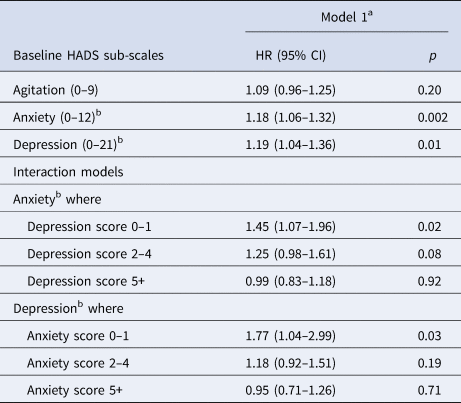
Associations between baseline HADS sub-scales and RCE at follow-up (95 events/595)

a Adjusted for sex, diagnosis at entry (MI no/yes), smoking, chest pain, hypertension and chronic obstructive pulmonary disease.
b For a 1.33 point increase in risk for ANX and a 2.33 point increase in risk for DEP, for comparability purposes between the 3 sub-scales.
Results
Sample description
The cohort (Walters, Barley, Mann, Phillips, & Tylee, Reference Walters, Barley, Mann, Phillips and Tylee2014), the study sample and how it compares to those excluded from the analysis (Norton et al., Reference Norton, Pastore, Ancelin, Hotopf, Tylee, Mann and Palacios2020) have been described in detail elsewhere. Of the sample, 70.6% were male with a median age of 72 years (range: 27–98). The main diagnoses at entry to the registry were: documented MI (42.4%), CHD (48.2%) and angina (6.9%). Median time from baseline to event was 22.3 months [Inter-quartile range (IQR): 13.4, min-max: 12.1–36.2]. Events ranged from rapid access (47.4%), to cardio-cerebrovascular cause of death (26.3%), bypass graft or angioplasty (24.2%), and MI (2.1%). The baseline sample is further described according to the occurrence of an RCE at follow-up (Table 1).
Baseline HADS subscales as RCE risk factors
In the baseline analysis, taken separately, both anxiety and depression, but not agitation, were significantly associated with an RCE risk in model 1 (Table 2). We found interacting effects between anxiety and DEP3 and between depression and ANX3 (model 1: p = 0.06 and p = 0.11, respectively). Anxiety was a significant RCE risk factor only in the lowest depression tercile (p = 0.02) and depression only in the lowest anxiety tercile (p = 0.03).
Time-dependent HADS subscales as RCE risk factors
In the time-dependent analysis, only anxiety and depression significantly increased the RCE risk (Table 3). The association for agitation was not significant (p = 0.11). Interactions between anxiety and DEP3 and depression and ANX3 were not significant (model 1: p = 0.43 and p = 0.67, respectively). When further adjusted for DEP3 in model 2, anxiety remained significantly associated with RCE risk. The association also remained significant when adding quality of life to the model (HR 1.19; 95% CI 1.02–1.38, p = 0.02). Conversely, depression was no longer associated with an increased RCE risk when adjusted for ANX3 (HR 1.05; 95% CI 0.87–1.27, p = 0.61) or for quality of life (HR 1.11; 95% CI 0.94–1.29, p = 0.21).
Associations between time-dependent HADS sub-scales and RCE at follow-up (95 events/595)

a Model 1: adjusted for sex, diagnosis at entry (MI no/yes), smoking, and time-dependent chest pain, hypertension and chronic obstructive pulmonary disease.
b Model 2: model 1 further adjusted for depression in terciles for ANX and anxiety in terciles for DEP.
c For a 1.33 point increase in risk for ANX and a 2.33 point increase in risk for DEP, for comparability purposes between the 3 sub-scales.
Individual HADS items as RCE risk factors
Specific subscale items associated with RCE differed between the baseline and time-dependent analysis. For anxiety, item 5 (worrying thoughts) was the only multiple-comparison corrected significant item in the baseline analysis (HR 1.52; 95% CI 1.21–1.91, p = 0.0004) (Fig. 1). Conversely, item 13 (feelings of panic) was the only item to reach significance in the time-dependent analysis (HR 1.52; 95% CI 1.18–1.95, p = 0.001). For depression, item 10 (lost interest in appearance) was the only significant item in the baseline analysis (HR 1.56; 95% CI 1.23–1.97, p = 0.0002), and item 4 (laughing at things) in the time-dependent analysis (HR 1.54; 95% CI 1.15–2.07, p = 0.004). When further adjusted for quality of life, findings were unchanged for the anxiety items, but time-dependent depression item 4 was no longer significant (p = 0.01).
Associations between baseline and time-dependent HADS items and RCE at follow-up (95 events/595). Note: Scoring reversed for positively phrased items 2, 4, 6, 7, 12 and 14. (a) Adjusted for sex, diagnosis at entry (MI no/yes), smoking, chest pain, hypertension and chronic obstructive pulmonary disease. (b) Adjusted for sex, diagnosis at entry (MI no/yes), smoking, and time-dependent chest pain, hypertension and chronic obstructive pulmonary disease. * Significant association when applying Bonferroni correction with p values set at p = 0.0125 for anxiety and p = 0.007 for depression.

Discussion
Our study suggests that anxiety and not depression is an independent short-term RCE risk factor, when considering both dimensions simultaneously. Indeed, the association between anxiety and RCE risk remained significant when further adjusted for depression, with a 22% increased risk (HR 1.22, 95% CI 1.05–1.41) in the following 12-to-18 month time-window for every 1-point increase in anxiety score (scale: 0-to-9). Our findings add evidence to a potential causal relationship as many of the causality principles of Bradford–Hill (Hill, Reference Hill1965) are verified, such a strength, temporality and dose–response relationship. To our knowledge, this is the first time anxiety as an RCE risk factor has been examined taking into account time-to-event. In addition, the different individual HADS items associated in the two types of analyses suggest specific symptoms may be related differently to RCEs depending on the time-frame.
Anxiety as an RCE risk factor
Despite inconsistencies regarding anxiety as an RCE risk factor, with some studies reporting no association (Kornerup et al., Reference Kornerup, Zwisler, Prescott and Danrehab Group2011; Lane et al., Reference Lane, Carroll, Ring, Beevers and Lip2001; Tully et al., Reference Tully, Winefield, Baker, Denollet, Pedersen, Wittert and Turnbull2015; Versteeg et al., Reference Versteeg, Hoogwegt, Hansen, Pedersen, Zwisler and Thygesen2013) and one a protective effect (Meyer et al., Reference Meyer, Hussein, Lange and Herrmann-Lingen2015), our findings add to a body of evidence suggesting an increased long-term RCE risk with anxiety disorders (Tully et al., Reference Tully, Winefield, Baker, Denollet, Pedersen, Wittert and Turnbull2015; Tully, Cosh, & Baumeister, Reference Tully, Cosh and Baumeister2014) or symptoms (Frasure-Smith & Lesperance, Reference Frasure-Smith and Lesperance2008; Van Beek et al., Reference Van Beek, Zuidersma, Lappenschaar, Pop, Roest, Van Balkom and Voshaar2016; Watkins et al., Reference Watkins, Koch, Sherwood, Blumenthal, Davidson, O'Connor and Sketch2013). Two other studies found positive associations between anxiety symptoms and RCEs using the 7-item HADS-A, dichotomised by applying the 8+ threshold (Zigmond & Snaith, Reference Zigmond and Snaith1983). In one, anxiety was measured in 804 stable CHD patients approximately 2 months after hospital discharge for an acute coronary syndrome with a 2-year follow-up for RCEs (Frasure-Smith & Lesperance, Reference Frasure-Smith and Lesperance2008). In the other, anxiety assessed during hospitalisation for coronary angiography increased the 3-year risk of all-cause mortality in 934 patients (Watkins et al., Reference Watkins, Koch, Sherwood, Blumenthal, Davidson, O'Connor and Sketch2013). In a recent study of 396 MI patients, cardiac anxiety was associated with an increased 4-year RCE risk. Anxiety was assessed using the Cardiac Anxiety Questionnaire, which focuses on symptoms typically triggered by MI, namely fear, attention, avoidance of physical exercise and safety-seeking behaviour (Van Beek et al., Reference Van Beek, Zuidersma, Lappenschaar, Pop, Roest, Van Balkom and Voshaar2016). In keeping with these studies, we found the association between anxiety and both short-term and long-term RCE risk to be robust to the effect of cardiac disease severity. We adjusted for severity in our study using diagnosis at registry entry and chest pain as proxies.
In addition, we found the anxiety but not the agitation subscale to be associated with an increased RCE risk. The agitation subscale can be considered less ‘anxiety-specific’ than the anxiety subscale. Indeed it focuses on restlessness, tenseness and difficulties in relaxing whereas the anxiety items capture fear and panic responses related to physical hyperarousal of anxiety. Intuitively, feeling ‘wound-up’ could be considered risk inducing, especially as relaxation therapy is a common feature of secondary CVD prevention programmes (Whalley, Thompson, & Taylor, Reference Whalley, Thompson and Taylor2014). However, these symptoms alone distinguished from the other more anxiety-specific ones may not be sufficient, nor meet alone plausibility criteria for the pathophysiological processes linking anxiety to cardiac events. To the best of our knowledge, only one other study has looked at the different subtypes of anxiety and no other has used any of the HADS three-factor structures. Roest et al. (Reference Roest, Heideveld, Martens, de Jonge and Denollet2014) examined the Hamilton Anxiety and Depression Rating Scale symptom dimensions in 418 patients in relation to recurrent MI and all-cause mortality (Roest et al., Reference Roest, Heideveld, Martens, de Jonge and Denollet2014). Associations were significant for somatic anxiety, but a trend only was observed for psychological anxiety. Comparison with the HADS is limited due to the partial overlap of items covered by the different scales. For instance, there are no questions in the HADS on somatic anxiety, and no assessment of insomnia. In a previous analysis, we found the somatic depression dimension of the PHQ-9 which includes insomnia to be a short-term RCE predictor (Norton et al., Reference Norton, Pastore, Ancelin, Hotopf, Tylee, Mann and Palacios2020).
With some exceptions where, for instance, the prognostic effect of anxiety on survival was examined over 12 months (Lane et al., Reference Lane, Carroll, Ring, Beevers and Lip2001), most studies focus on the longer-term effect over 2 (Frasure-Smith & Lesperance, Reference Frasure-Smith and Lesperance2008), 3 (Shibeshi et al., Reference Shibeshi, Young-Xu and Blatt2007; Watkins et al., Reference Watkins, Koch, Sherwood, Blumenthal, Davidson, O'Connor and Sketch2013) or 4–5 years (Frasure-Smith & Lesperance, Reference Frasure-Smith and Lesperance2003; Martens et al., Reference Martens, de Jonge, Na, Cohen, Lett and Whooley2010; Meyer et al., Reference Meyer, Buss and Herrmann-Lingen2010; Meyer et al., Reference Meyer, Hussein, Lange and Herrmann-Lingen2015; Strik et al., Reference Strik, Denollet, Lousberg and Honig2003; Van Beek et al., Reference Van Beek, Zuidersma, Lappenschaar, Pop, Roest, Van Balkom and Voshaar2016; Versteeg et al., Reference Versteeg, Hoogwegt, Hansen, Pedersen, Zwisler and Thygesen2013). When reported, intra-study variability in follow-up is considerable; with, for example, mean (s.d.) follow-up durations of 5.7 (0.8) (Meyer et al., Reference Meyer, Buss and Herrmann-Lingen2010) and 4.2 (2) (Van Beek et al., Reference Van Beek, Zuidersma, Lappenschaar, Pop, Roest, Van Balkom and Voshaar2016) years. In our study, patients were followed for 3 years with a median time-to-event from baseline of 22.3 months (IQR: 13.4) and in the time-dependent analysis, the median time-to-event was 14.1 months (IQR: 3.5). Associations observed for anxiety in the two longitudinal analyses managing time-to-event differently, and allowing for an event-free period between exposure and outcome, lend support to the temporality principle for causality (Hill, Reference Hill1965). Furthermore, so far, no studies have examined the short-term effect of anxiety coupled with a time-dependent approach. Yet, restricting the risk to a specific time window (12-to-18 months) can be particularly useful to clinicians for anticipating RCE risk and setting up preventative measures and interventions.
The effect of anxiety moderated by or adjusted for depression
Previous studies on the independent associations of anxiety and depression with long-term RCEs have shown mixed results, some retaining anxiety alone (Shibeshi et al., Reference Shibeshi, Young-Xu and Blatt2007; Watkins et al., Reference Watkins, Koch, Sherwood, Blumenthal, Davidson, O'Connor and Sketch2013), some depression alone (Versteeg et al., Reference Versteeg, Hoogwegt, Hansen, Pedersen, Zwisler and Thygesen2013), some both (for DSM-IV disorders only; Frasure-Smith & Lesperance, Reference Frasure-Smith and Lesperance2003) and some neither (Lane et al., Reference Lane, Carroll, Ring, Beevers and Lip2001; Roest et al., Reference Roest, Heideveld, Martens, de Jonge and Denollet2014). Some studies only report findings for anxiety, robust to adjustment for depression (Martens et al., Reference Martens, de Jonge, Na, Cohen, Lett and Whooley2010; Van Beek et al., Reference Van Beek, Zuidersma, Lappenschaar, Pop, Roest, Van Balkom and Voshaar2016). Although most examined depression and anxiety entered simultaneously as covariates into the same model (Roest et al., Reference Roest, Heideveld, Martens, de Jonge and Denollet2014; Van Beek et al., Reference Van Beek, Zuidersma, Lappenschaar, Pop, Roest, Van Balkom and Voshaar2016) or constructed composite variables (Frasure-Smith & Lesperance, Reference Frasure-Smith and Lesperance2008), few tested the interaction between the two (Martens et al., Reference Martens, de Jonge, Na, Cohen, Lett and Whooley2010; Watkins et al., Reference Watkins, Koch, Sherwood, Blumenthal, Davidson, O'Connor and Sketch2013).
To our knowledge, three other studies have administered both HADS subscales to compare the effects of anxiety and depression on cardiac prognosis (Kornerup et al., Reference Kornerup, Zwisler, Prescott and Danrehab Group2011; Versteeg et al., Reference Versteeg, Hoogwegt, Hansen, Pedersen, Zwisler and Thygesen2013; Watkins et al., Reference Watkins, Koch, Sherwood, Blumenthal, Davidson, O'Connor and Sketch2013). In a sample of 536 hospitalised CVD patients, Kornerup et al. (Reference Kornerup, Zwisler, Prescott and Danrehab Group2011) found no evidence of an association between HADS-A or HADS-D 11+ scores, CVD and all-cause mortality over a 5-year follow-up. Conversely, Versteeg et al. (Reference Versteeg, Hoogwegt, Hansen, Pedersen, Zwisler and Thygesen2013) found depression but not anxiety to be associated with rehospitalisations and 5-year mortality in 610 CHD patients. Moreover, in the absence of a moderating effect (p = 0.66), Watkins et al. (Reference Watkins, Koch, Sherwood, Blumenthal, Davidson, O'Connor and Sketch2013) found anxiety only to be a significant independent predictor of all-cause mortality in an extended multi-adjusted model. These latter two studies examined HADS-A and HADS-D as binary variables using the 8+ score threshold (Zigmond & Snaith, Reference Zigmond and Snaith1983). In our baseline analysis, the interaction terms for anxiety with depression in terciles and for depression with anxiety in terciles were above the set significance thresholds and therefore retained in the models. HRs were presented for each tercile of the moderating factor. We found that anxiety was a significant RCE risk factor in patients with a low depression level (score: 0–1), with a trend only in those with a moderate level (score: 2–4). Depression was a weaker RCE risk factor, both before and after stratification by anxiety level. Overall, this suggests a more complex effect of anxiety and depression symptoms as long-term RCE risk factors when symptoms are not limited to those specific to one of the dimensions only. This is in keeping with Frasure-Smith and Lesperance's underlying negative affectivity dimension, shared by scales measuring depression, anxiety and anger, which was shown to be associated with long-term cardiac-related mortality (Frasure-Smith & Lesperance, Reference Frasure-Smith and Lesperance2003).
In the time-dependent analysis, the lack of significance of the interactions between anxiety and depression in terciles and depression and anxiety in terciles suggests that anxiety and depression act as independent risk factors. Our findings highlight the strong role of anxiety as an independent short-term RCE risk factor, even when controlling for depression. This is in keeping with a greater effect found for anxiety as an all-cause mortality risk factor in CHD patients (Watkins et al., Reference Watkins, Koch, Sherwood, Blumenthal, Davidson, O'Connor and Sketch2013). To our knowledge, there is no other study of the joint effects of anxiety and depression on RCEs using a time-dependent approach to which our findings can be compared.
Individual psychic anxiety items as RCE risk factors
The analysis of specific subscale items reveals different associations for long-term and short-term risks. For anxiety, whereas item 5 (worrying thoughts) was associated with RCE in the baseline analysis, item 13 (feelings of panic) was the only significant item in the time-dependent approach. It has been suggested that the HADS has poor trait coverage due to its narrow focus (Norton, Cosco, Doyle, Done, & Sacker, Reference Norton, Cosco, Doyle, Done and Sacker2013). However, the ‘worrying thoughts’ item could tentatively be measuring trait rather than state-worry, thus increasing the RCE risk regardless of the variability in time-to-event. Its effect may be modulated by state items that would have a greater short-term impact on outcome. This lends support to a differential effect of anxiety types – extended to specific symptoms – on RCEs, further modulated by the timing of the exposure-outcome matrix.
Mechanisms for anxiety as an RCE risk factor
There are several potential direct mechanisms that could explain the adverse effect of anxiety on RCE, especially as a short-term risk factor. Pathophysiological processes are well documented and include notably arrhythmic mechanisms and dysfunction of the autonomic nervous system and hypothalamic–pituitary–adrenal axis, leading to increased catecholamine stimulation of the myocardium (Chrousos, Reference Chrousos2009; Fisher & Newman, Reference Fisher and Newman2013; Pereira, Cerqueira, Palha, & Sousa, Reference Pereira, Cerqueira, Palha and Sousa2013). Indirect behavioural pathways include unhealthy lifestyle (inactivity, diet, as well as alcohol and smoking, which were taken into account in the current study) (Bonnet et al., Reference Bonnet, Irving, Terra, Nony, Berthezene and Moulin2005). Regarding health-seeking behaviour, anxiety can confer both a protective effect by inducing more regular follow-ups and engagement in preventive care strategies, as well as a negative effect, by triggering social inhibition and a negative coping strategy. One small study on 76 patients found no effect of anxiety on compliance to medical follow-up and medication (Benninghoven et al., Reference Benninghoven, Kaduk, Wiegand, Specht, Kunzendorf and Jantschek2006). This is in keeping with the inconsistent findings as to the prognostic long-term effect of anxiety on RCEs. A recent study from the UPBEAT-UK cohort investigated the direction of the association between chest pain, anxiety and depression and concluded that anxiety and depression tended to be consequences rather than causes of chest pain in CHD patients (de Heer et al., Reference de Heer, Palacios, Ader, van Marwijk, Tylee and van der Feltz-Cornelis2020).
Limitations
One of the main limitations was the heterogeneity of cardiac events, both at registry entry and as the outcome variable. Indeed, anxiety has been shown to have opposite effects on 5-year survival in different types of patients, with a protective effect for those with a stable CHD condition, an increased risk for post MI left-ventricular patients and a lack of effect for other MI patients (Meyer et al., Reference Meyer, Buss and Herrmann-Lingen2010). Regarding the outcome, there is always a risk of misclassification of anxiety-related symptoms or disorders such as panic as cardiac-related chest pain, especially when examining anxiety as a short-term predictor. To minimise this, we left a 12-month event-free period between exposure assessment and outcome. We thus aimed to reduce the risk of a simultaneous onset of the two, with anxiety acting as a marker of disease rather than as a risk factor. It could be argued that in addition to a possible causal mechanism, anxiety could result in a lower threshold for rapid access consultation. This cannot be excluded, but we believe that the 12-month RCE-free gap between assessment and event reduces this possibility. In addition, we performed a sensitivity analysis, removing the 40 less severe ‘rapid access’ events from the 95 RCEs. Although effect sizes for baseline HADS remained unchanged, there was a reduction in effect size for time-dependent anxiety, which no longer remained statistically significant. Another limitation was the absence of data on measures of disease severity. For example, we had no data on left ventricular ejection fraction, which would have provided a better adjustment for cardiac severity than chest pain used as a proxy, along with diagnosis at registry entry. In addition, we were not able to adjust for medication, psychotropic or cardiac-related, nor for treatment compliance.
Strengths
An important strength of our study is the use of the HADS, which despite some controversy (Cosco, Doyle, Ward, & McGee, Reference Cosco, Doyle, Ward and McGee2012; Norton et al., Reference Norton, Cosco, Doyle, Done and Sacker2013; Straat, van der Ark, & Sijtsma, Reference Straat, van der Ark and Sijtsma2013) is still today recognised as a useful well-validated tool for assessing depression and anxiety symptoms in medically ill patients (Bjelland, Dahl, Haug, & Neckelmann, Reference Bjelland, Dahl, Haug and Neckelmann2002). Indeed, it focuses on psychosocial rather than somatic symptoms, sleep or appetite (which we studied previously; Norton et al., Reference Norton, Pastore, Ancelin, Hotopf, Tylee, Mann and Palacios2020) and thus avoids false-positives in clinical settings. Furthermore, we used the 3-factor symptom classification, identified as being the best fit for cardiac disease patients (Barth & Martin, Reference Barth and Martin2005; Hunt-Shanks et al., Reference Hunt-Shanks, Blanchard, Reid, Fortier and Cappelli2010; Martin et al., Reference Martin, Lewin and Thompson2003; Martin & Thompson, Reference Martin and Thompson2000; Martin, Thompson, & Barth, Reference Martin, Thompson and Barth2008). We chose Friedman et al.'s classification (Friedman et al., Reference Friedman, Samuelian, Lancrenon, Even and Chiarelli2001) rather than Dunbar et al.'s (Dunbar et al., Reference Dunbar, Ford, Hunt and Der2000), as the item distinguishing the two, worry, is recognised as an important aspect of general anxiety rather than a sign of restlessness and agitation. This choice allowed us to extract the most anxiety-specific symptoms from the initial seven HADS-A items and our differential findings for the subscales adds to the plausibility of the mechanisms explaining the anxiety-RCE association. Moreover, we believe that the careful choice of the time-span during which exposure and outcome were measured gives further strength to our study. In addition to the 12-month event-free period between exposure assessment and outcome, we removed patients who entered the register in the 6-months preceding baseline to avoid reverse-causality. But, above all, the time-dependent approach allowed us to examine the time-to-event standardised effect of symptoms on RCEs. The overall design allowed us to verify causality principles of temporality and dose–response relationship, which along with the strength of the association lends support to a causal relationship. Further studies are required to explore potential mediating effects on the causal pathway.
Conclusion
Our study suggests that anxiety is an independent short-term risk factor for RCEs in heart disease patients as well as a stronger risk factor than depression. This effect is specific to a set of symptoms reflecting more general anxiety, fear and panic, rather than symptoms of restlessness and agitation. The two analytical approaches indicate a differential effect of anxiety according to the presence of concomitant depressive symptoms, over the long and short term. Our findings highlight the need for regular assessments of anxiety, focusing on specific symptoms, in order to evaluate both the long and short-term risk. Assessing risk narrowed down to a specific time-window can be particularly useful to clinicians for referring patients to secondary CVD prevention programmes. The timing and regularity of these interventions, with for example personalised care (Barley et al., Reference Barley, Walters, Haddad, Phillips, Achilla, McCrone and Tylee2014) focusing on the psychological treatment for the management of fear, worry and panic symptoms, is crucial.
Acknowledgements
The authors are grateful to the Primary Care Research Network-greater London for their support and assistance in recruiting practices to the UPBEAT-UK study and to the 16 practices who provided assistance. They are also grateful for the work of the UPBEAT research team for setting up the study and collecting the data.
Financial support
This paper represents independent research commissioned by the National Institute for Health Research (NIHR) under it Programme Grants for Applied Research scheme (RP-PG-0606-1048). It also represents independent research part-funded by the National Institute for Health Research (NIHR) Biomedical Research Centre at South London and Maudsley NHS Foundation Trust and King's College London. The views expressed are those of the authors and not necessarily those of the NHS, the NIHR or the Department of Health.
Conflict of interest
None.