Introduction
Severe acute respiratory syndrome coronavirus-2 has led to a global health crisis with far-reaching effects on world economies and healthcare systems. In order to limit the strain on healthcare within the National Health Service (NHS), various medical health authorities swiftly issued guidance to suspend all non-urgent medical care and elective procedures during the first wave of the pandemic.Reference Soreide, Hallet, Matthews, Schnitzbauer, Line and Lai1,Reference Bhangu, Lawani, Ng-Kamstra, Wang, Chan and Futaba2 The majority of elective otological surgery was initially placed in priority level 4 (elective surgery can be deferred beyond three months) by ENT UK, the Federation of Royal Colleges and NHS England.3 This included all new cochlear implantation surgical procedures, with the exception of cochlear implantation surgery for pre-lingually deafened children at the margins of neural plasticity for speech development and for post-meningitis patients with threatened cochlear ossification. As such, the majority of new cochlear implantation procedures for profoundly deaf adults and post-lingually deafened children were delayed by over three months during the first wave of the coronavirus disease 2019 (Covid-19) pandemic.
Hearing loss is the second most common disability in the UK, affecting approximately 12 million people.4 Hearing loss can have a significant adverse impact on the quality of life (QoL) of affected patients, who are more likely to experience sadness, depression, anxiety, social isolation and insecurity relating to their hearing impairment.Reference Lotfi, Mehrkian, Moossavi and Faghih-Zadeh5,Reference Kamil and Lin6 Hearing loss is also associated with an increased risk of developing dementia and shorter life expectancy.Reference Amieva, Ouvrard, Meillon, Rullier and Dartigues7 Cochlear implants are an established surgical option for patients with moderate to severe hearing loss who have not benefitted from acoustic hearing aids. In such cases, studies have shown cochlear implantation surgery to improve speech perception, communication, relationships, psychosocial wellbeing and QoL of those affected.Reference Rapport, Hughes, Boisvert, McMahon, Braithwaite and Faris8,Reference Francis, Chee, Yeagle, Cheng and Niparko9
As the pandemic unfolds, cochlear implantation for the majority of profoundly deaf adults is now classed as priority level 3 (surgery to be performed in less than three months) by the Federation of Surgical Specialty Associations.10 However, much uncertainty still remains around when and how normal healthcare practice will resume. Although the anxiety induced by this pandemic on healthcare workers is well documented, the true effect upon patients is poorly understood, with only three studies published in the literature so far that have directly explored the impact on patients of delayed elective surgical procedures.Reference Shanafelt, Ripp and Trockel11–Reference Kaiser, Svoboda, Waldauf and Netuka14
The aim of our study was to investigate the impact on patients of the Covid-19 pandemic and the postponement of cochlear implantation procedures during the first wave of the pandemic in the UK. Our objectives were to: (1) establish the impact of postponement of cochlear implantation surgery and the Covid-19 pandemic on the emotional well-being of patients affected and (2) establish the impact of postponement of cochlear implantation surgery and the Covid-19 pandemic on the daily life of patients affected.
Materials and methods
Study design
A single-centre observational cross-sectional study was conducted at the Richard Ramsden Centre for Auditory Implants, Manchester Royal Infirmary, Manchester University NHS Foundation Trust, UK. All adult patients scheduled for elective cochlear implant surgery who had their cochlear implantation surgery postponed because of the Covid-19 healthcare response were identified (n = 38) and contacted via e-mail and post. All patients who fell within the cochlear implantation criteria, regardless of their shielding status, were invited for the study. Participants were advised that their participation in the study was voluntary and would not affect their healthcare.
The protocol for this study was reviewed by the Manchester University NHS Foundation Trust research ethics committee and granted exemption from full ethical review.
Questionnaires
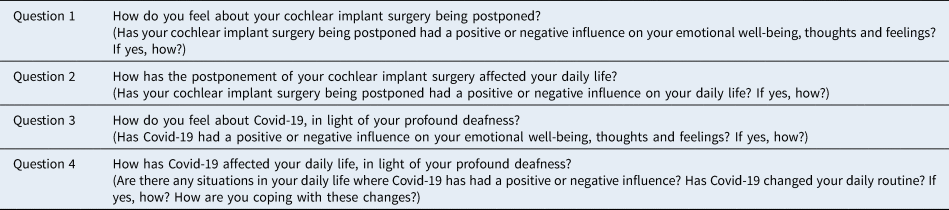
All participants were sent open-ended written questionnaires and encouraged to respond in as much detail as possible to four main study questions outlined in Table 1. A written questionnaire design was chosen to encourage participation from patients with the severest form of hearing impairment who struggle with the use of telephones, while also avoiding face-to-face contact to limit Covid-19 exposure.
Study questionnaire

Patients were encouraged to respond to questions 1–4 in as much detail as possible. Covid-19 = coronavirus disease 2019
Data analysis
Participant responses were assigned a unique study identification number. Once anonymised, the data remained non-identifiable for all further analysis purposes. Qualitative analysis was conducted by the main author (R Abrar) who coded the questionnaire responses through careful interpretation using a grounded theory approach.Reference Devitt15,Reference Sbaraini, Carter, Evans and Blinkhorn16 Several iterative cycles were used to develop these preliminary codes using a constant comparison technique. Emerging categories from codes were refined to identify core themes. Dedoose (version 8.3.17, Los Angeles, USA) web software was used for all qualitative analysis.
Results
Demographic data
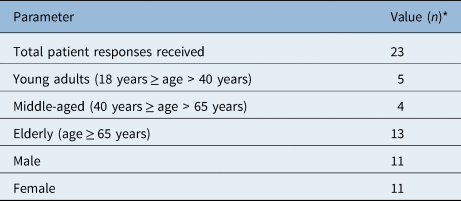
Of the 38 eligible patients invited to participate in the study, 23 patients responded to the questionnaires and were consequently included in the study analysis. There were equal numbers of male and female responders, and patient ages ranged from 18 to 89 years, with a median age of 69 years (Table 2).
Demographic data of patients

*One patient returned the questionnaire form without any demographic details and therefore their responses were not analysed in relation to gender and age but were still included for the rest of qualitative analysis
Theme 1: immediate patient reactions
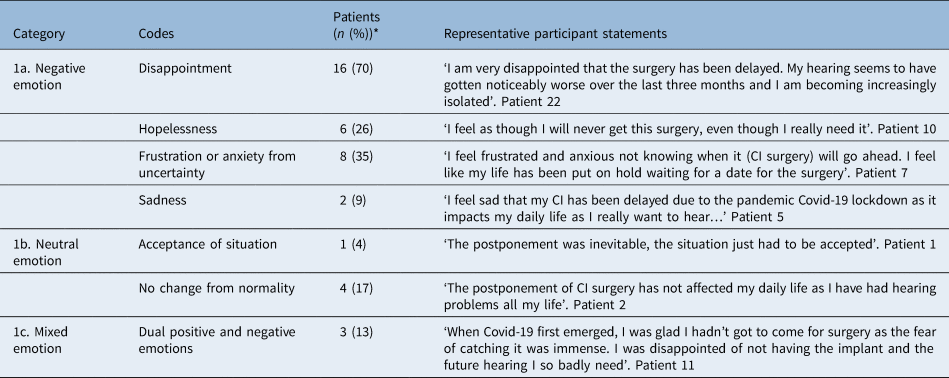
The majority of participants (16 of 23 patients; 70 per cent) expressed primarily negative emotional reactions to the postponement of their surgery. Four patients were categorised as expressing an overall neutral emotional reaction, three were found to have mixed positive and negative emotional reactions, and no participants expressed a predominantly positive reaction to the postponement of their surgery. An overview of these patient reactions with example patient statements is provided in Table 3.
Theme 1: immediate patient reactions to postponement of cochlear implantation surgery because of the Covid-19 pandemic

*n = total number of participants expressing statement(s) relevant to the code. The percentage is calculated from total study participants of 23. CI = cochlear implantation; Covid-19 = coronavirus disease 2019
The most common negative reactions expressed by patients were disappointment (16 of 23 patients), frustration or anxiety from the uncertainty of when they would receive their cochlear implantation surgery (8 of 23 patients), hopelessness that they may never have their cochlear implantation surgery (6 of 23 patients), and sadness at the news of cochlear implantation postponement (2 of 23 patients). The expression of these negative emotions did not seem to be particularly biased towards either gender. However, interestingly the feeling of hopelessness towards receiving an implant in the future was only expressed by elderly patients. One elderly participant commented:
Although partly expected, it was still a massive disappointment to have my implant cancelled back in May. Now at 75 (years of age), I begin to think I may never receive an implant. (Patient 4)
In contrast, feelings of frustration and anxiety from the uncertainty of when the cochlear implantation surgery would be (8 of 23 patients) were more commonly expressed by young adults compared with other age cohorts. One young adult participant described feeling like their ‘life had been put on hold waiting for a date for their surgery’ (patient 7). Another young participant's worry about the uncertainty of the timeline for their surgery stemmed from the potential impact it could have on his educational plans:
My plan was to finish A levels, have the surgery and use a gap year before university to become confident in using the implants. Without any timescale on the surgery, I am finding it really difficult. I am really worried about when I will now get the surgery and how much time there will be before I want to start university… It just feels like an unbearable wait when there are no timescales. Even if I had a provisional date, months ahead, at least I would have something to work towards. (Patient 14)
The number of participants who expressed overall neutral or mixed emotions to the postponement of their cochlear implantation surgery was small (4 of 23 patients). One patient described:
… the surgery being postponed has not really had a negative influence on my daily life, as what you've never had you never miss. (Patient 17)
Although the majority of patients understandably expressed their disappointment at the postponement of their much-awaited surgery that ‘seemed like a beacon’ (patient 12), many also added that they understood the reasons why they needed to be postponed, for example:
I am very disappointed of course but understand that the additional strains on medical & surgical staff could not have been foreseen and that elective surgical procedures have all been postponed because of the risks of transmission of the virus. (Patient 12)
Theme 2: impact on mental health
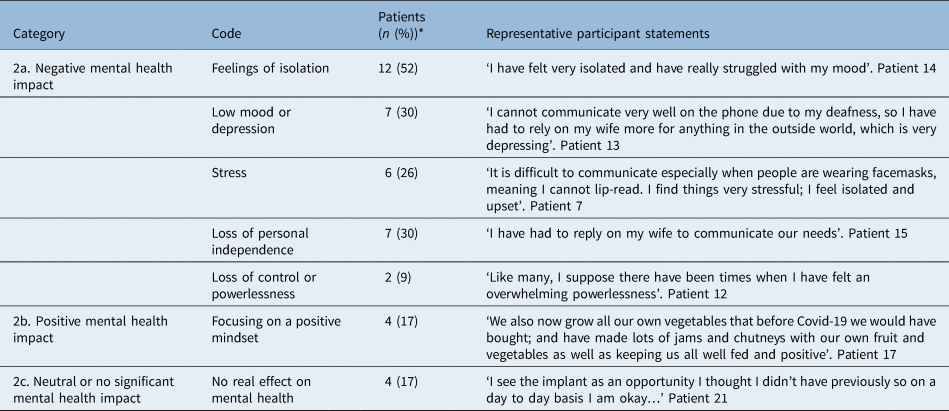
The majority of participants (15 of 23 patients; 65 per cent) expressed statements pertaining to a predominantly negative impact of the postponement of cochlear implantation surgery and the Covid-19 pandemic on their mental health. Only 2 patients (9 per cent) described a primarily positive overall impact of lockdown and postponement of cochlear implantation surgery on their mental health. Four patients (17 per cent) expressed statements that were interpreted as neutral or having no significant mental health impact. Two patient responses were deemed inconclusive as they contained insufficient information to enable accurate interpretation of the impact on their mental health. Categories and codes generated to interpret the theme of impact on patient mental health are summarised in Table 4.
Theme 2: impact of postponement of cochlear implantation surgery and Covid-19 lockdown on participants’ mental health

*n = total number of participants expressing statement(s) relevant to the code. The percentage is calculated from total study participants of 23. Covid-19 = coronavirus disease 2019
Importantly, more than half of all study participants (12 of 23 patients; 52 per cent) expressed feelings of isolation or loneliness; this seemed to be equally distributed across all three age cohorts. One patient notably commented:
As I am now working from home, I feel more isolated from society due to distancing and not being able to follow conversations via virtual conferencing, with family members or work colleagues etc. (Patient 20)
Thirty per cent of all study participants (7 of 23 patients) also described feeling low in mood or experiencing depression. This was more commonly expressed by elderly participants compared with young adult and middle-aged participants of the study. One elderly patient described:
When the lockdown first started, I was quite positive about finding things to do about the house. Recently though, I find I am often sitting down doing very little but staring into space. I know this is not good, but I lack the motivation to do anything about it. I feel I may be on the verge of becoming clinically depressed. (Patient 22)
In contrast, feelings of stress (6 of 23 patients; 26 per cent) and loss of personal independence (7 of 23 patients; 30 per cent) were more commonly expressed by young adults compared with study participants from other age cohorts. One of the youngest participants of the study summarised his feelings quite aptly:
It is increasingly difficult for me to be independent as the new rules over wearing masks in shops etc mean that I am no longer able to manage these things on my own. It is causing me huge anxiety as I hate to rely on people. (Patient 14)
Theme 3: impact on general daily life
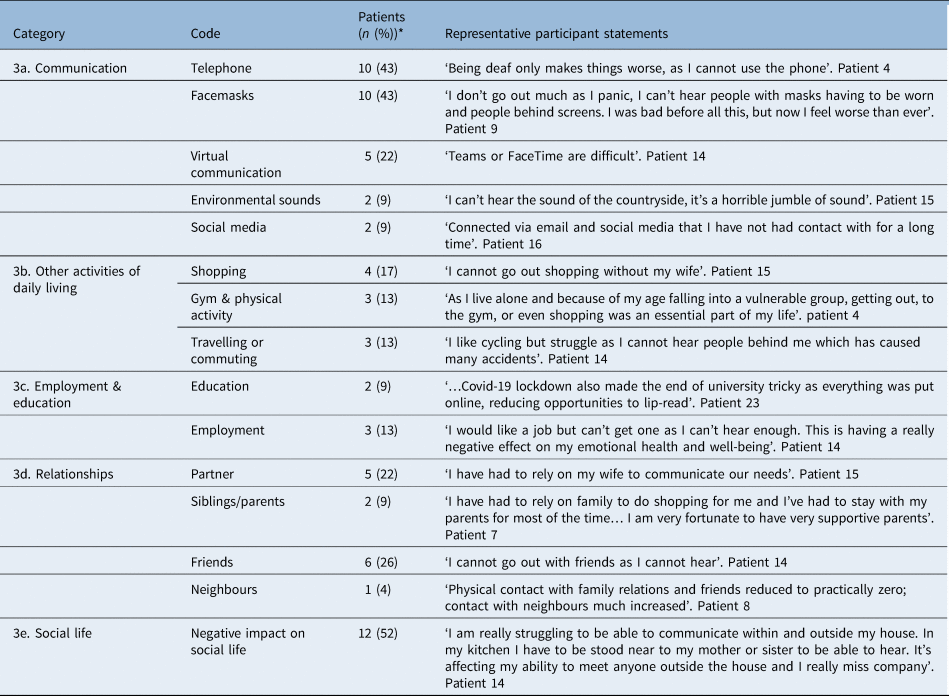
Multiple factors were observed to likely be contributing towards the strong patient reactions and significant mental health impact noted in themes 1 and 2, respectively. These factors were explored separately under theme 3, the impact on general daily life (Table 5). Overall, 91 per cent (21 of 23 patients) of study participants described some form of negative impact on their general daily life because of postponement of cochlear implantation surgery and the Covid-19 pandemic.
Theme 3: impact on general daily life

*n = total number of participants expressing statement(s) relevant to the code. The percentage is calculated from total study participants of 23. Covid-19 = coronavirus disease 2019
Category 3a: communication
Sixty-five per cent (15 of 23 patients) of participants reported experiencing difficulty with communication and hearing, either via telephone or virtual communication modalities, related to facemask usage or when listening to environmental sounds. The most commonly reported difficulty was with the use of telephones (10 of 23 patients; 43 per cent) and facemasks (10 of 23 patients; 43 per cent) as patients struggled to lip-read behind the facemask barrier. The majority of participants who shared their difficulty with telephone communication were elderly, but difficulty with facemasks was more equally reported by all three age cohorts. One elderly participant explained the profound impact this was having on his life:
The wearing of facemasks is total deafness for me. I have to admit it's easier for me to stay at home, a complete silent world is not what I want, even though I am scared of catching Covid-19. (Patient 11)
Apart from the increased isolation with shielding and not being able to communicate with family over the phone, this struggle also translated to other aspects of life that might not have been as much of an issue prior to the Covid-19 pandemic, as illustrated in the following comment by one participant:
Hate the fact that we cannot see our doctor or have any normal appointments. Telephone appointment is a no go for me. I just cannot hear on the phone at all. Sick of people saying I need a phone appointment first. It makes me stressed like people don't understand deafness. (Patient 9)
Although patient views were unanimous with regards to struggle with telephones and facemasks, opinions on the use of virtual communication methods for remote working and educational purposes were more divided. One participant in favour reported ‘thanks to technology, I am still able to talk and see my friends and learn and be guided by my teachers in my studies’ (patient 5). However, others felt that ‘Teams or FaceTime are difficult’ (patient 14), and university education provided online ‘reduced opportunities to lip-read’ (patient 23) making life more difficult for them.
Two elderly patients reported difficulty with environmental sounds, with one expressing his heartfelt disappointment at the postponement of cochlear implantation surgery by commenting:
I was hoping this year to have been able to have heard the birds sing again, at the moment I have trouble hearing what my wife says when she is sitting next to me, never mind someone two metres away. (Patient 13)
Overall, just three participants reported a positive impact on their communication skills during the time period where their surgery was delayed; this was partly because of the benefit they found from virtual communication methods, as discussed earlier, and partly through the increased use of social media (Table 5).
Category 3b: daily activities
In addition to problems with communication as explored in category 3a above, 35 per cent of participants (8 of 23 patients) reported struggling with other activities of daily living such as shopping, exercise or the gym, and travelling; for example, patient 15 described:
It's difficult to go into places i.e. shops when you cannot hear what people are telling you to do. (Patient 15)
Difficulty with commuting or travel was also described by three participants, with one expressing that he was ‘concerned about driving and not being able to hear sirens’ (patient 14).
Category 3c: education and employment
Two young adult participants described difficulties pertaining to their educational activities, and three participants, each from a different age cohort, also reported difficulty in relation to their employment because of poor hearing, with one participant describing the impact of delay in his cochlear implantation surgery and the Covid-19 pandemic:
I have also been furloughed from my work as a designer since the beginning of lockdown, but my boss keeps facetiming me to ask if I have heard anything regarding my implant, because of the difficulty I was having at work communicating with staff. He is hoping that when I return, I will have had it done and therefore be happier in my working environment. (Patient 13)
Category 3d: relationships
Overall, 44 per cent of participants (10 of 23 patients) described the Covid-19 pandemic and postponement of cochlear implantation surgery as having an impact on relationships with partners, parents, siblings, friends or neighbours. Two male participants noted an increased reliance on their wives for activities such as ‘communication with doctors, hospital, workmen etc’ (patient 11). Two participants noted a detrimental impact on the relationship with their significant other, with one explaining:
I have hardly been out of the house and garden since the lockdown started. I rarely speak now to anyone apart from my wife. She has always found my deafness irritating and this prolonged close contact has had a very detrimental effect upon our relationship. (Patient 22)
In contrast, another participant expressed how he felt the Covid-19 lockdown had had a positive impact on his relationship with his partner:
Covid-19 has been positive in the fact that we have visited places e.g. parks which we would have normally not considered – we have learnt to appreciate more life with partner, even after 56 years! (Patient 1)
Regarding friendships, 6 of 23 patients (26 per cent) reported difficulties with seeing friends, either because of shielding or lockdown rules or from problems hearing, meaning that they were not able to interact with friends as they would have wished. Although contact with friends was greatly reduced, one patient noted that her contact with ‘neighbours was much increased’ (patient 8).
Category 3e: social life
More than half of all participants (12 of 23 patients; 52 per cent) from all 3 age cohorts, either directly or indirectly, suggested a significant negative impact of the postponement of their cochlear implantation surgery or Covid-19 lockdown on their social life within their questionnaire responses. One participant commented:
I have been unable to hear for so long, my life has telescoped down to only being able to communicate to and through my wife, and only able to smile at my grandchildren. I cannot meet friends or go to any groups because I cannot participate. I thought by now I would have become a part of society again before it is too late. (Patient 15)
Theme 4: coping strategies and philosophical reflections
Despite the increasing challenges affecting every aspect of these patients’ lives, approximately 39 per cent of participants (7 females and 2 males; 9 of 23 study participants) described finding new hobbies or developing old ones as coping strategies (Table 6). These included walking, gardening, exotic cooking, reading and online scrabble. One participant commented: ‘We took daily walks together, just around the block and the local field, which we had never bothered with before and enjoyed that’ (patient 6).
Theme 4: coping strategies and philosophical reflections

*n = total number of participants expressing statement(s) relevant to the code. The percentage is calculated from total study participants of 23. Covid-19 = coronavirus disease 2019
Interestingly, the majority of the participants who described using coping strategies were elderly patients, and two were young adult participants. No middle-aged participant commented on any coping strategy that had potentially helped them get through the Covid-19 lockdown period.
In comparison, philosophical reflections were shared without prompt by participants of all age cohorts. These ranged from reflection on ‘length of life left and how to make fuller use of it’ (patient 1) to questioning the existence of the virus and whether it was a hoax from the government (patient 9). One participant notably reflected:
It (Covid-19) has made people realise and value that the best things in life are free – breathing clean air, spending time with your loved ones and respecting nature and taking care of it as much as we can. (Patient 5)
Discussion
This is the first study of its kind that has explored the impact of postponement of elective surgical procedures and the Covid-19 pandemic on a unique cohort of profoundly deaf adults awaiting cochlear implantation surgery. We believe the use of a small set of very open-ended questions in this qualitative study increased the richness of responses received, as well as the significance of the themes generated. The deep patient emotions and difficulties reflected within the thematic categories were expressed to a large degree by participants without much direct prompt. We chose a written questionnaire in our qualitative study design to maximise inclusivity of patients with the severest form of hearing loss by avoiding virtual or telephone interviews, while also limiting patient exposure to Covid-19 through avoidance of face-to-face interview methods.
Impact on well-being
More than half of patients surveyed (65 per cent) who had their cochlear implantation surgery postponed because of the Covid-19 pandemic described an overall negative impact on their mental health. Disappointment was the most common emotional reaction expressed by our study participants (70 per cent), which is similar to a recent study by Kaiser et al. who also found disappointment to be the most common emotional reaction by patients who had their elective spinal surgical procedures cancelled because of the Covid-19 pandemic.Reference Kaiser, Svoboda, Waldauf and Netuka14
Another key finding was the large proportion of our respondents (52 per cent) who expressed feelings of isolation or loneliness. This figure is startlingly higher than the prevalence of loneliness shown in recent literature within the general population in the UK during this Covid-19 pandemic (27 per cent). Whereas Groarke et al. used the Three-Item Loneliness Scale to identify younger age groups to be more at risk for loneliness, we found an equal distribution of feelings of isolation or loneliness within all three age cohorts analysed in our study.Reference Groarke, Berry, Graham-Wisener, McKenna-Plumley, McGlinchey and Armour17
Previous studies have reported pervasive loneliness to be associated with an increased risk of depression and suicidal ideation.Reference Beutel, Klein, Brähler, Reiner, Jünger and Michal18 Of note, an important factor postulated in the literature to be predictive of loneliness and suicidality is hopelessness.Reference Joiner and Rudd19 We observed that just under half of all elderly participants in our study expressed feelings of hopelessness towards ever receiving their cochlear implantation surgery. This was in addition to 30 per cent of all participants describing low mood or symptoms of depression which were also more commonly expressed by elderly participants compared with other age cohorts. This identifies the elderly with hearing impairment as potentially being at an even greater mental health risk as compared with young adults or middle-aged patients.
A significant proportion of our study participants (35 per cent) also expressed increased levels of added anxiety or frustration from the uncertainty surrounding the date for their cochlear implantation surgery, which many felt was a ‘beacon’ (patient 12) leading to ‘a better life’ (patient 13). A recent study investigating the patient impact of cancellation of electively scheduled hip and knee arthroplasty because of the Covid-19 response in the USA also showed that the highest source of anxiety in patients was the uncertainty of when their operation would be rescheduled.Reference Brown, Bedard, Rojas, Anthony, Schwarzkopf and Barnes12 Greco et al. also found that the majority of uro-oncological patients whose surgery was postponed because of the Covid-19 pandemic experienced increased anxiety, loss of energy and depression.Reference Greco, Altieri, Esperto, Mirone and Scarpa13 Other previous studies have also shown that cancellation of surgical procedures can have a significant psychosocial impact on affected patients, with prolonged suffering and worsened patient experience, in addition to reduced efficiency of health systems.Reference Brown, Bedard, Rojas, Anthony, Schwarzkopf and Barnes12,Reference Ivarsson, Kimblad, Sjöberg and Larsson20–Reference Wong, Harris, Moonesinghe, Moonesinghe, Wong and Harris22
Other impacts of the pandemic
For our cohort of patients, mental health concerns were amplified because of the far-reaching impact of their hearing disability on every aspect of their lives and the unique additional challenges they face in an era of virtual communication and facemasks. Patients not only reported UK lockdown policies as a contributive factor towards their poor mental health and sense of loneliness but also described their difficulties with communication as playing a significant role in reducing their opportunities to interact with others, thereby intensifying their physical and social isolation. Sixty-five per cent of patients reported communication difficulties, with 44 per cent of patients specifically highlighting their struggle with using telephones (the majority being elderly participants) and 44 per cent emphasising their struggle with facemasks (participants of all age cohorts). Facemasks are a new form of communication barrier for our patients who previously regularly compensated their poor hearing with their ability to lip-read. While there seems to be a lack of clear facemask usage by the public in general, it is worth noting that no clear facemask has yet received CE marking, which is an essential requirement for any personal protective equipment before medical use in the UK.
We found that these struggles with communication for our profoundly deaf participants translated to almost all spheres of their lives, from increased reliance on family members for activities of daily living, such as shopping, to difficulty with maintaining a social life (52 per cent) and loss of personal independence (30 per cent). As the world swiftly adapts to social distancing rules by increasingly switching towards virtual modes of communication in education and employment, some of our study participants also expressed their concerns of experiencing difficulty using these platforms because of their profound deafness.
Patient adaptations and coping strategies
It is worrying that despite the extensive negative impact on the daily life and mental well-being of our patients awaiting cochlear implantation surgery, only 39 per cent of our study participants described the use of any adaptive coping strategies, although this area of discussion was also directly prompted within question four of the study questionnaire (Table 1). Literature has shown that adopting coping strategies is associated with stronger mental health, with coping styles such as having a positive attitude thought to be one of the best protective factors against distress.Reference Zhou, Macgeorge and Myrick23,Reference Babore, Lombardi, Viceconti, Pignataro, Marino and Crudele24 Problem-solving as a coping method has also been shown to reduce sadness in older patients during other infectious disease outbreaks.Reference Yeung and Fung25,Reference Chew, Wei, Vasoo, Chua and Sim26 The lack of coping strategies expressed by the majority of our patient cohort highlights the pressing need for more support and psychological interventions, both at a local and global scale, to assist patients affected by cancellation of elective surgical procedures and equip them with the tools to better deal with their adverse psychosocial circumstances.
Adaptations for qualitative analysis
In our study design, we sought to increase inclusivity by the use of emails and post to disseminate our study questionnaires. We limited bias against patients from a lower socioeconomic status who may not have access to the internet and against elderly patients who may not be comfortable using online forms of communication. We also avoided telephone interviews to minimise bias against those with the severest form of hearing loss and avoided face-to-face interviews to limit patient exposure to Covid-19. Our study was also inclusive to all patients at our centre who met the cochlear implantation criteria, regardless of their shielding status.
Despite our utmost efforts to reach all adult patients at our centre who had their cochlear implantation surgery postponed because of the Covid-19 pandemic, we received responses from 61 per cent of patients whom we initially contacted via email and post. An email reminder was sent after 10 days, but no reminders were sent via post. Our data collection period was limited to one month which meant that any hospitalised or unwell potential participants may not have had the opportunity to respond within this short time period.
We appreciate that qualitative analysis can be inherently biased towards patients who provide more detail of their experiences within their responses. However, we believe the use of a small number of very open-ended questions in our study questionnaire enabled rich patient responses and detailed thematic qualitative analysis that was not constrained to the limits of focused quantitative methods of data collection. The majority of thematic categories developed during the qualitative analysis were not directly prompted within the study questions; this highlights the real value that each category and code holds for the patient(s) it relates to.
• This study explores the impact of postponing elective cochlear implantation and the coronavirus disease 2019 (Covid-19) pandemic on profoundly deaf adults awaiting surgery
• These patients experienced social isolation, loneliness, depression and stress during the first wave of the Covid-19 pandemic
• Evidence from this study can improve overall patient care and reduce significant adverse psychosocial impact on patients
• This study sets a precedent for urgent further exploration of impact of the Covid-19 pandemic on all cancellation of elective surgery
When statements expressed by different patients were mapped to the same category repeatedly, this further strengthened the depth and reliability of each of the categories developed within our qualitative analysis. We suspect that the total number of participants experiencing a negative impact from the Covid-19 pandemic and postponement of their cochlear implantation surgery would be much higher if a more direct approach with questions addressing each theme in this study had been used. Therefore, we feel this study provides a basis for a future mixed methods approach to investigate the full extent of the impact on daily life and mental health of our cohort of patients. We note that because of the uniqueness of our cohort of patients with significant hearing disability, caution should be exercised when generalising our study findings to the wider population of patients affected by cancellation or postponement of elective surgical procedures because of the Covid-19 pandemic.
Potential interventions
We identified patients awaiting cochlear implantation surgery to be at a potentially greater risk of adverse psychosocial consequences compared with other patient populations because of additional distinct challenges faced as a result of their hearing disability. We hope that cochlear implantation surgery healthcare institutes worldwide can utilise our study findings to develop interventions to support patients who are continuing to be affected by the postponement of their cochlear implantation procedures and lockdown regulations.
We suggest that: (1) local strategies are developed to provide clear guidance to patients regarding expected surgery timelines to minimise anxiety and hopelessness stemming from the uncertainty surrounding cochlear implantation surgery dates; (2) mental health support programmes are further established to better tackle adverse psychosocial impact such as loneliness, depression and stress; (3) platforms are developed to equip and educate patients on adaptive coping strategies; and (4) more widespread use of clear facemasks is encouraged, with urgent incorporation of CE marked clear facemasks within healthcare, particularly in specialised settings that look after patients with hearing impairment.
Conclusion
Our study has highlighted the far-reaching impact of postponement of cochlear implantation procedures and the Covid-19 pandemic on the mental health and daily life of profoundly deaf patients keenly awaiting cochlear implantation surgery. These patients experienced high levels of social isolation, loneliness, depression and stress during the first wave of the Covid-19 pandemic. This has been exacerbated by their increasing struggle with daily communication because of widespread use of non-clear facemasks limiting their ability to lip-read, as well as increased popularity of virtual communication methods to maintain social distancing.
We believe our study sets a precedent for urgent further exploration of the full impact of the Covid-19 pandemic on all patients affected by cancellation of their elective procedures. As we slowly emerge from the Covid-19 pandemic with the majority of elective surgical procedures continuing to be postponed further, we hope our research data can be used to develop much needed evidence-driven strategies to improve overall patient care and reduce significant adverse psychosocial impact on patients, especially on those with severe hearing impairment.
Acknowledgements
This research was supported by the National Institute for Health Research Manchester Biomedical Research Centre. We would like to thank our patients on the cochlear implantation waiting list who kindly contributed to our study.
Competing interests
None declared