INTRODUCTION
Traumatic brain injury (TBI) is a leading cause of acquired disability in children (Dewan et al., Reference Dewan, Rattani, Gupta, Baticulon, Hung, Punchak and Park2019), with long-term outcomes influenced by demographic, pre-injury, and injury-related factors. The most established factor impacting long-term outcomes in pediatric TBI is severity of injury; children with severe TBI demonstrate poorer neuropsychological outcomes than children with mild to moderate TBI (Anderson, Catroppa, Morse, Haritou, & Rosenfeld, Reference Anderson, Catroppa, Morse, Haritou and Rosenfeld2005; Ewing-Cobbs, Fletcher, Levin, Iovino, & Miner, Reference Ewing-Cobbs, Fletcher, Levin, Iovino and Miner1998; Ewing-Cobbs et al., Reference Ewing-Cobbs, Prasad, Kramer, Cox, Baumgartner, Fletcher and Swank2006; Jaffe, Polissar, Fay, & Liao, Reference Jaffe, Polissar, Fay and Liao1995; Taylor et al., Reference Taylor, Yeates, Wade, Drotar, Stancin and Minich2002). The second factor contributing to long-term outcomes is age at injury; children injured younger demonstrate poorer performance on neuropsychological assessment than children injured older (Anderson et al., Reference Anderson, Catroppa, Morse, Haritou and Rosenfeld2005; Anderson, Spencer-Smith, et al., Reference Anderson, Spencer-Smith, Leventer, Coleman, Anderson, Williams and Jacobs2009; Ewing-Cobbs et al., Reference Ewing-Cobbs, Barnes, Fletcher, Levin, Swank and Song2004; Levin et al., Reference Levin, Culhane, Mendelsohn, Lilly, Bruce, Fletcher and Eisenberg1993, Reference Levin, Fletcher, Kusnerik, Kufera, Lilly, Duffy and Bruce1996; Slomine et al., Reference Slomine, Gerring, Grados, Vasa, Brady, Christensen and Denckla2002; Verger et al., Reference Verger, Junque, Jurado, Tresserras, Bartumeus, Nogues and Poch2000), likely due to immaturity of the frontal lobes (Gogtay et al., Reference Gogtay, Giedd, Lusk, Hayashi, Greenstein, Vaituzis and Thompson2004) and less consolidated skills at the time of injury (Anderson et al., Reference Anderson, Catroppa, Morse, Haritou and Rosenfeld2005; Ewing-Cobbs & Barnes, Reference Ewing-Cobbs and Barnes2002; Taylor & Alden, Reference Taylor and Alden1997). In addition to severity of TBI and age at injury, pre-injury adaptive behavior (Anderson, Morse, Catroppa, Haritou, & Rosenfeld, Reference Anderson, Morse, Catroppa, Haritou and Rosenfeld2004; Catroppa, Godfrey, Rosenfeld, Hearps, & Anderson, Reference Catroppa, Godfrey, Rosenfeld, Hearps and Anderson2012; Chapman, Levin, Matejka, Harward, & Kufera, Reference Chapman, Levin, Matejka, Harward and Kufera1995), family functioning such as conflict, intimacy, and parenting style (Anderson, Godfrey, Rosenfeld, & Catroppa, Reference Anderson, Godfrey, Rosenfeld and Catroppa2012; Max et al., Reference Max, Roberts, Koele, Lindgren, Robin, Arndt and Sato1999), and socio-economic status (Aguilar et al., Reference Aguilar, Elleman, Cassedy, Mercuri Minich, Zhang, Owen Yeates and Wade2019; Anderson et al., Reference Anderson, Morse, Klug, Catroppa, Haritou, Rosenfeld and Pentland1997; Donders & Kim, Reference Donders and Kim2019) have also been found to contribute to long-term outcomes.
Neuropsychological assessment of language in pediatric TBI reveal relatively spared expressive lexicons (e.g., naming) across severities for children injured older (i.e., >8 years; Catroppa & Anderson, Reference Catroppa and Anderson2004) and for mild and moderate TBI in children injured younger (i.e., <8 years; Anderson et al., Reference Anderson, Morse, Catroppa, Haritou and Rosenfeld2004; Haarbauer-Krupa et al., Reference Haarbauer-Krupa, King, Wise, Gillam, Trapani, Weissman and Depompei2018). Age-appropriate performance on expressive naming in the long-term stage of pediatric TBI recovery suggests that most children with TBI continue to acquire new vocabulary after injury. However, applying acquired knowledge does not show the same sparing in children with TBI, as evidenced in long-term outcomes of verbal IQ (Anderson, Catroppa, Morse, Haritou, & Rosenfeld, Reference Anderson, Catroppa, Morse, Haritou and Rosenfeld2009; Catroppa & Anderson, Reference Catroppa and Anderson2004). Verbal IQ demonstrates relatively “flat” recovery trajectories in comparison to positive slopes of performance IQ, despite noticeably less impairment than performance IQ in the initial stage of injury (Anderson et al., Reference Anderson, Godfrey, Rosenfeld and Catroppa2012; Babikian & Asarnow, Reference Babikian and Asarnow2009). Flat recovery trajectories of verbal IQ suggest continued difficulties on tasks that require children to apply acquired word knowledge (e.g., verbal concept formation, reasoning, and expression), higher-level language skills that are needed for scholastic success (Allen, Thaler, Donohue, & Mayfield, Reference Allen, Thaler, Donohue and Mayfield2010; Hanten et al., Reference Hanten, Li, Newsome, Swank, Chapman, Dennis and Levin2009). Thus, a closer examination of verbal IQ may bring awareness to impairments in language tasks requiring executive functions, tasks that have been identified as vulnerable to pediatric TBI across severities (Cermak, Scratch, Kakonge, & Beal, Reference Cermak, Scratch, Kakonge and Beal2021; Cermak et al., Reference Cermak, Scratch, Reed, Bradley, Quinn de Launay and Beal2019).
To date, verbal IQ in pediatric TBI has been examined in two meta-analytic studies with limitations (Babikian & Asarnow, Reference Babikian and Asarnow2009; Königs, Engenhorst, & Oosterlaan, Reference Königs, Engenhorst and Oosterlaan2016). In the first meta-analytic review of neurocognitive outcomes in pediatric TBI (Babikian & Asarnow, Reference Babikian and Asarnow2009), effects of injury on verbal IQ were present in all severities in the long-term stage of recovery (i.e., >24 months postinjury); small sample size of studies within each TBI severity (e.g., k = 1) precluded meta-analysis in the short-term stage of recovery (i.e., < six months postinjury). In a larger meta-analytic review of intelligence outcomes in child TBI (Königs et al., Reference Königs, Engenhorst and Oosterlaan2016), effects of injury on verbal IQ were present in moderate and severe TBI in the subacute stage of recovery (i.e., < six months postinjury) and in all severities in the chronic stage of recovery (i.e., > six months postinjury). However, normative data were used to calculate effect sizes for uncontrolled studies potentially resulting in conservative effect sizes as identified by the original authors (Königs et al., Reference Königs, Engenhorst and Oosterlaan2016). Therefore, it was timely to address the limitation identified by Königs et al. (Reference Königs, Engenhorst and Oosterlaan2016) and complete a meta-analysis of verbal IQ using controlled studies only. Further, it was necessary to complete a quality appraisal of the included studies to evaluate if any risk of bias (e.g., selection, confounding, measurement) contributed to overall estimated effects of injury on verbal IQ performance.
Our first aim was to examine verbal IQ performance by severity of TBI. We expected our results to show the largest estimated effect for severe TBI, based on predictors of outcome in childhood TBI literature (Anderson et al., Reference Anderson, Catroppa, Morse, Haritou and Rosenfeld2005; Ewing-Cobbs et al., Reference Ewing-Cobbs, Barnes, Fletcher, Levin, Swank and Song2004; Verger et al., Reference Verger, Junque, Jurado, Tresserras, Bartumeus, Nogues and Poch2000). Our second aim was to explore the estimated effect of pediatric TBI on verbal IQ performance over time. We expected our results to demonstrate a long-term effect of injury on verbal IQ performance based on literature describing recovery trends of verbal IQ in children with TBI (Anderson et al., Reference Anderson, Catroppa, Morse, Haritou and Rosenfeld2005; Anderson, Catroppa, Morse, Haritou, & Rosenfeld, Reference Anderson, Catroppa, Morse, Haritou and Rosenfeld2000; Ewing-Cobbs et al., Reference Ewing-Cobbs, Fletcher, Levin, Francis, Davidson and Miner1997). In turn, we hypothesized that the estimated effects of injury on verbal IQ performance would demonstrate the degree of potential impairment in the accessibility and application of lexical knowledge in childhood TBI.
METHODS
Our systematic review and meta-analysis process was guided by the Preferred Reporting Items for Systematic Reviews and Meta-Analyses (PRISMA; Moher, Liberati, Tetzlaff, & Altman, Reference Moher, Liberati, Tetzlaff and Altman2009); this review was not registered.
Search Strategy
We searched four electronic databases: Ovid MEDLINE, Embase + Classic Embase, CINAHL Plus, and APA PsycInfo using subject headings and key terms for the subjects (1) brain injury, (2) child, and (3) intelligence. We expressed our search in Boolean logic using the terms “OR” to connect each subject together followed by “AND” to combine all three terms as seen in Table 1. There were no limits placed on the year of publication, with the most updated search completed on November 1, 2020.
Search terms used in MEDLINE

Eligibility Criteria
Studies selected met the following inclusion criteria: (1) included participants with TBI and no previous brain injury, (2) results reported verbal IQ performance data (e.g., standardized scores) from a standardized measure, (3) included a non-brain injured control group, (4) participants’ age at initial injury was between 3 months and 18 years, (5) was a cross-sectional or longitudinal study design, and (6) was published in English. Studies were excluded if verbal IQ data (e.g., scores) were not reported, if there was no control group, and if results included adult TBI data with no separation of age at injury (e.g., child, adult). Additionally, studies were excluded if they were clinical opinion pieces, case studies, or reliability testing (e.g., tool development) of a verbal IQ measure. Lastly, if there were studies from the same research group with participant overlap, the study that reported verbal IQ by TBI severity (e.g., mild, moderate, and/or severe) was included and the study that reported TBI as a group (i.e., mixed TBI severities) was excluded. Search results were uploaded into Covidence (“Covidence systematic review software,” n.d.). Articles were screened by two reviewers (C.C. and L.K) in two stages (i.e., title and abstract screen, and full text) based on the inclusion and exclusion criteria listed above. A third reviewer (D.B.) resolved any discrepancies.
Data Collection
Study characteristics were extracted by the first author (C.C.) into an abstraction form based on similar reviews conducted on verbal fluency outcomes (Cermak et al., Reference Cermak, Scratch, Kakonge and Beal2021) and cognitive communication impairments (Cermak et al., Reference Cermak, Scratch, Reed, Bradley, Quinn de Launay and Beal2019) in pediatric TBI. Characteristics that were extracted from each study included: (1) the article’s author(s), (2) year of publication, (3) location of study, (4) population (e.g., sample size, sex, and severity of TBI), (5) age at injury, (6) time since injury, (7) age at assessment, and (8) verbal IQ measure used. Data extracted from each verbal IQ score included the standard score means and standard deviations from each group (e.g., TBI and controls). Abstracted data were reviewed for accuracy by the last author (D.B.)
Assessment of Study Quality and Risk of Bias
Assessment of study quality was guided by the Joanna Briggs Institute critical appraisal checklist for cross-sectional studies (Moola et al., Reference Moola, Munn, Tufanaru, Aromataris, Sears, Sfetcu, Mu, Aromataris and Munn2017). Eight questions in the quality appraisal tool were divided into the following domains of bias: (1) selection bias, (2) confounding bias, and (3) measurement bias. Each question was given a descriptive rating: yes, no, unclear, or not applicable. Descriptive ratings of each domain were used to inform risk of biases. In turn, an overall influence of bias on estimated effect sizes was determined based on the descriptive ratings from each of the three domains. All risks of biases were rated as “low,” “moderate,” or “high.” Study quality and risk of bias were rated independently by two reviewers (C.C. and L.K.). Any disagreement between the two reviewers was resolved via discussion with a third reviewer (D.B.).
Statistical Analysis
Studies were statistically summarized using RevMan 5.3 meta-analysis software to (1) calculate the effect sizes of childhood TBI on verbal IQ performance in comparison to controls, and (2) calculate statistical heterogeneity (Tau 2). Potential sources of clinical heterogeneity included TBI severity and time since injury. We addressed TBI severity by completing a separate meta-analysis for studies that reported verbal IQ data by TBI severity (e.g., mild, moderate, severe) and for studies that reported verbal IQ data as a TBI group (i.e., mixed TBI severities). We addressed time since injury by completing a subgroup analysis at two epochs of time: <12 months postinjury (i.e., short-term) and ≥12 months postinjury (i.e., long-term, or chronic stage of recovery). These time epochs were selected based on pediatric TBI literature identifying 12 months postinjury as the time of plateau in neuropsychological recovery (Anderson, Catroppa, Morse, et al., Reference Anderson, Catroppa, Morse, Haritou and Rosenfeld2000; Yeates et al., Reference Yeates, Taylor, Wade, Drotar, Stancin and Minich2002).
A random effects model (Hedges & Vevea, Reference Hedges and Vevea1998) was applied to calculate effect sizes based on standardized mean differences of verbal fluency scores using a 95% confidence interval. Effect sizes were characterized using Cohen’s (Reference Cohen1988) categorization of small (0.2), medium (0.5), and large (0.8). A positive effect size (g > 0) indicated better performance of the TBI group compared to controls whereas a negative effect size (g < 0) indicated worse performance of the TBI group compared to controls. Statistical heterogeneity (Tau 2) was calculated to reflect the amount of variance of effect sizes between studies within each time epoch.
RESULTS
Study Selection
The electronic database search of MEDLINE, Embase, CINAHL, and PsycInfo yielded 4961 articles. All articles were imported to Covidence. After removal of duplicate articles, 3000 remained. Screening of titles and abstracts of the identified references resulted in 185 articles for full-text review. Full-text review of articles resulted in 19 studies (k) meeting inclusion criteria for this systematic review. See Figure 1.
PRISMA flow diagram of study selection.

Description of Studies
The 19 studies that met inclusion criteria for this review originated from the United States of America (k = 9; Donders & Kim, Reference Donders and Kim2019; Haarbauer-Krupa et al., Reference Haarbauer-Krupa, King, Wise, Gillam, Trapani, Weissman and Depompei2018; Jaffe et al., Reference Jaffe, Fay, Polissar, Martin, Shurtleff, Rivara and Winn1993; Levin, Song, Ewing-Cobbs, Chapman, & Mendelsohn, Reference Levin, Song, Ewing-Cobbs, Chapman and Mendelsohn2001; Massagli et al., Reference Massagli, Jaffe, Fay, Polissar, Liao and Rivara1996; Max et al., Reference Max, Koele, Lindgren, Robin, Smith, Sato and Arndt1998; Tremont, Mittenberg, & Miller, Reference Tremont, Mittenberg and Miller1999; Warschausky, Kewman, & Selim, Reference Warschausky, Kewman and Selim1996; Wozniak et al., Reference Wozniak, Krach, Ward, Mueller, Muetzel, Schnoebelen and Lim2007), Australia (k = 6; V. Anderson et al., Reference Anderson, Godfrey, Rosenfeld and Catroppa2012; V. Anderson, Catroppa, et al., Reference Anderson, Catroppa, Morse, Haritou and Rosenfeld2009; V. Anderson, Catroppa, Rosenfeld, et al., Reference Anderson, Catroppa, Rosenfeld, Haritou and Morse2000; Crowe et al., Reference Crowe, Catroppa, Babl and Anderson2012; Didus et al., Reference Didus, Anderson and Catroppa1999; Garth & Anderson, Reference Garth and Anderson1997), United Kingdom (k = 2; Chadwick, Rutter, Brown, Shaffer, & Traub, Reference Chadwick, Rutter, Brown, Shaffer and Traub1981; Hawley et al., Reference Hawley, Ward, Magnay and Mychalkiw2004), Spain (k = 1; Verger et al., Reference Verger, Junque, Jurado, Tresserras, Bartumeus, Nogues and Poch2000), and South Africa (k = 1; Schrieff-Elson et al., Reference Schrieff-Elson, Thomas, Rohlwink and Figaji2015). The year of publication ranged from 1981 to 2019. Control groups included orthopedic injury (k = 4) and healthy controls (k = 15). Eleven studies examined verbal IQ performance by TBI severity (Table 2), and eight studies examined verbal IQ performance by TBI group (i.e., mixed TBI severities; Table 3).
Study characteristics for studies separating TBI severities

M = mean; SD = standard deviation; Ax = assessment; NR = not reported; OI = orthopedic injury.
a age and time in years unless otherwise reported.
b verbal IQ data categorized as moderate TBI in meta-analysis based on mean GCS score of moderate-severe group.
c age of the study sample.
Study characteristics for studies of mixed TBI severities

M = mean; SD = standard deviation; Ax = assessment; NR = not reported; VCI = verbal comprehension index; Y = young; O = old, c. Mild = complicated mild (i.e., GCS of 13 to 15 with positive neuroimaging findings), OI = orthopedic injury.
a age and time in years unless otherwise reported.
b GCS (Glasgow Coma Scale) score (M, SD) provided when sample size of severity was not reported.
For studies that examined verbal IQ by TBI severity (k = 11), average age at injury ranged from preschoolers (e.g., <6 years of age; k = 4) to school-age children (e.g., age 6–18 years; k = 7). Most studies were cross-sectional (k = 8) compared to longitudinal (k = 3). Time since injury for cross-sectional studies ranged from days postinjury (i.e., acute) to 10 years postinjury. Time since injury for the longitudinal studies included acute (e.g., within 1 month) and 1-year postinjury.
For studies that examined verbal IQ by TBI group (i.e., mixed TBI severities; k = 8), one study separated groups by age at injury, dividing age groups by “young” (e.g., <7 years of age) and “old” (e.g., ≥7 years of age) TBI (Garth & Anderson, Reference Garth and Anderson1997). The remaining studies of mixed TBI had preschoolers (e.g., <6 years of age k = 1), school-age children (e.g., age 6–18 years; k = 6), and a blend of preschoolers and school-age children (k = 1). All studies of mixed TBI were cross-sectional (k = 8). Time since injury for cross-sectional studies ranged from days postinjury (i.e., acute) to 9 years postinjury.
Outcome Measures
Eighteen of 19 studies used an intelligence test developed by Wechsler to assess verbal IQ. These included the Wechsler Preschool Primary Scale of Intelligence (Wechsler, Reference Wechsler1989, Reference Wechsler2002), the Wechsler Intelligence Scale for Children (Wechsler, Reference Wechsler1949, Reference Wechsler1974, Reference Wechsler1991a, Reference Wechsler1991b, Reference Wechsler2003, Reference Wechsler2014), and the Wechsler Adult Intelligence Scale (Wechsler, Reference Wechsler1955, Reference Wechsler1997). One study used a translated version of the Wechsler Abbreviated Scale of Intelligence (WASI; Wechsler, Reference Wechsler1999) from English to Afrikaans and one study used the Kaufman Brief Test of Intelligence (Kaufman & Kaufman, Reference Kaufman and Kaufman1990). All studies reported verbal IQ performance as a standard score (M = 100, SD = 15).
Estimated Effect of TBI on Verbal IQ Performance
The negative effects of TBI on verbal IQ performance were present in moderate and severe TBI at <12 months postinjury (i.e., short-term) and in mild, moderate, severe TBI at ≥12 months postinjury (i.e., long-term). A summary of the estimated effects of injury with subgroup analysis and statistical heterogeneity can be seen in Table 4.
Summary of the estimated effects of TBI at two epochs of time with statistical heterogeneity

k = number of studies; n1 = number of participants in TBI group; n2 = number of participants in control group; g = Hedge’s g, 95% CI = range of effect size based on 95% confidence interval; p = p-value of significance of effect size from zero; Tau 2 = an estimate of between-study variance (heterogeneity); I 2 = percentage of variability in estimated effects that is due to heterogeneity.
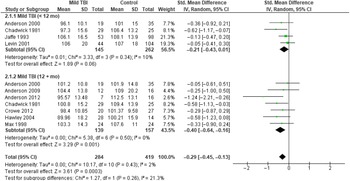
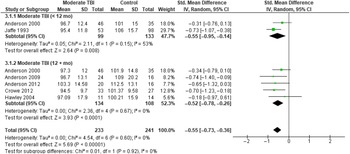
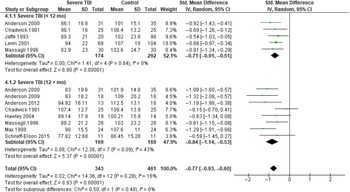
Specifically, the estimated effect of injury was small in mild TBI (g = −0.29, 95% CI [−0.45, −0.13], k = 9), medium in moderate TBI (g = −0.55, 95% CI [−0.73, −0.36], k = 6) and approaching large in severe TBI (g = −0.77, 95% CI [−0.93, −0.60], k = 10). Subgroup analysis of time postinjury in mild TBI revealed no effect in the short-term stage of recovery (i.e., <12 months postinjury; g = −0.21, 95% CI [−0.43, 0.01], k = 4). as confidence intervals crossed zero. Effect sizes in mild TBI approached medium in the long-term stage of recovery (i.e., ≥12 months postinjury; g = −0.40, 95% CI [−0.64, −0.16], k = 7). For moderate TBI, effect sizes were medium at short-term (g = −0.55, 95% CI [−0.95, −0.14], k = 2) and long-term (g = −0.52, 95% CI [−0.78, −0.26], k = 5) time epochs. For severe TBI, effect sizes were large at short-term (g = −0.71, 95% CI [−0.91, −0.51], k = 5) and long-term (g = −0.84, 95% CI [−1.14, −0.53], k = 8) time epochs. Statistical heterogeneity, or the between-study variance of effect sizes within each time epoch, was not significant. See Figures 2, 3, and 4 for forest plots of effect sizes by TBI severity and at both epochs of time.
Forest plots of estimated effect sizes for mild TBI.

Forest plots of estimated effect sizes for moderate TBI.

Forest plots of estimated effect sizes for severe TBI.

For studies of mixed TBI severities (i.e., verbal IQ data were reported in the original study as one TBI group), the estimated effect of TBI was medium (g = −0.66, 95% CI [−0.93, −0.39], k = 8). Subgroup analysis of time postinjury revealed a medium effect size at <12 months postinjury (g = −0.46, 95% CI [−0.74, −0.18], k = 4) and a large effect size at ≥12 months postinjury (g = −0.85, 95% CI [−1.28, −0.41], k = 4). Statistical heterogeneity was larger for studies of mixed TBI severities than in studies that separated its verbal IQ results into mild, moderate, and severe TBI, although not significant (p = 0.05). See Figure 5 for forest plots of effect sizes for studies of mixed TBI severities at both time epochs.
Forest plots of estimated effect sizes for studies of mixed TBI severities.

Assessment of Study Quality
Selection bias was rated “low” for 17 studies and “moderate” for two studies due to insufficient information on how TBI was reliably measured (Donders & Kim, Reference Donders and Kim2019) and misclassification of mild TBI (Chadwick et al., Reference Chadwick, Rutter, Brown, Shaffer and Traub1981). Confounding bias was rated “low” in 17 studies and “moderate” in two studies due to insufficient matching of TBI and control groups on social-economic status (Warschausky et al., Reference Warschausky, Kewman and Selim1996; Wozniak et al., Reference Wozniak, Krach, Ward, Mueller, Muetzel, Schnoebelen and Lim2007), a factor significantly associated with verbal IQ outcomes (Anderson et al., Reference Anderson, Morse, Catroppa, Haritou and Rosenfeld2004; Crowe et al., Reference Crowe, Catroppa, Babl and Anderson2012; Donders & Kim, Reference Donders and Kim2019; Donders & Nesbit-Greene, Reference Donders and Nesbit-Greene2004). Measurement bias was generally low except for two studies (Chadwick et al., Reference Chadwick, Rutter, Brown, Shaffer and Traub1981; Schrieff-Elson et al., Reference Schrieff-Elson, Thomas, Rohlwink and Figaji2015). First, Chadwick et al. (Reference Chadwick, Rutter, Brown, Shaffer and Traub1981) used an outdated measure at the time of study (e.g., WISC vs WISC-R), potentially leading to ceiling effects as time since injury progressed (Flynn, Reference Flynn1984). Second, Schrieff-Elson et al. (Reference Schrieff-Elson, Thomas, Rohlwink and Figaji2015) used a translated version of the WASI, contributing to potential validity concerns. See Table 5 for individual study ratings.
Assessment of study quality and risk of bias

Y = yes; NA = not applicable; Un = unclear; Mod = moderate.
Together, the overall influence of methodological bias on estimated effect sizes was rated “low” for 15 studies, “moderate” for three studies, and “high” for one study. Inter-rater reliability for risk of bias evaluation was 85% and included disagreements in selection bias and confounding bias. These disagreements were resolved by discussion with the last author (D.B.) to reach a consensus on overall bias rating (e.g., low, moderate, high) on estimated effect sizes.
DISCUSSION
Our systematic review and meta-analysis examined the estimated effects of pediatric TBI on verbal IQ performance at two epochs of time: <12 months postinjury and ≥12 months postinjury. In general, verbal IQ was found to be vulnerable in children with TBI as demonstrated by negative effect sizes and corresponding negative confidence intervals. Negative effect sizes were demonstrated across all severities and at each epoch of time, except for mild TBI within one-year after injury. Meta-analyses were consistent with our initial expectations: the estimated effect of pediatric TBI was largest in severe TBI and smallest in mild TBI and the estimated effects of injury were present long-term in all severities. In general, our findings support the meta-analysis of intelligence outcomes by Königs et al. (Reference Königs, Engenhorst and Oosterlaan2016); specifically, that the effects of injury on verbal IQ performance were present in the short-term stage of pediatric TBI in moderate and severe TBI and that the effects of injury were present in the long-term stage of pediatric TBI across all severities. One minor difference between our meta-analysis and the meta-analysis of Königs et al. (Reference Königs, Engenhorst and Oosterlaan2016) was the size of estimated effects; our meta-analysis revealed slightly larger effect sizes in the chronic stage of TBI (i.e., ≥12 months postinjury) in comparison to the chronic stage of TBI in Königs et al. (Reference Königs, Engenhorst and Oosterlaan2016). This may be due to the inclusion of controlled studies in our meta-analysis, resulting in more precise effects when compared to the use of normative data in Königs et al. (Reference Königs, Engenhorst and Oosterlaan2016). Greater effects of injury in our meta-analysis compared to Königs et al. (Reference Königs, Engenhorst and Oosterlaan2016) may also be due to differences in time epochs; our study used a longer length of time postinjury (e.g., ≥12 months) to characterize the chronic (i.e., long-term) stage of TBI recovery whereas Königs et al. (Reference Königs, Engenhorst and Oosterlaan2016) used a shorter length of time postinjury (e.g., >6 months). Using a longer length of time postinjury to characterize “chronic” effects may have revealed slightly larger effect sizes as the impact of injury on verbal IQ performance has been found to have a delayed onset in children (Anderson et al., Reference Anderson, Catroppa, Morse, Haritou and Rosenfeld2005; Anderson, Catroppa, et al., Reference Anderson, Catroppa, Morse, Haritou and Rosenfeld2009).
Statistical heterogeneity was present in our meta-analysis, particularly in mild TBI at <12 months postinjury and severe TBI at ≥12 months postinjury. The study that contributed the most to statistical heterogeneity (i.e., between-study variance) was Chadwick et al. (Reference Chadwick, Rutter, Brown, Shaffer and Traub1981), with removal of data from that study reducing heterogeneity from 10% to 0% in mild TBI at <12 months postinjury, and 43% to 0% in severe TBI at ≥12 months postinjury. The medium effect size (g = −0.62) evidenced at <12 months postinjury in mild TBI may have been due to how “mild severity,” was characterized. First, Chadwick et al. (Reference Chadwick, Rutter, Brown, Shaffer and Traub1981) used posttraumatic amnesia (PTA) rather than Glasgow Coma Scale (GCS) scores to classify severity. Further, Chadwick et al. (Reference Chadwick, Rutter, Brown, Shaffer and Traub1981) characterized PTA of less than 7 days as “mild”; current norms characterize PTA of 1 to 7 days as moderate and PTA of less 24 h as mild (Ewing-Cobbs, Levin, Fletcher, Miner, & Eisenber, Reference Ewing-Cobbs, Levin, Fletcher, Miner and Eisenber1990). Consequently, some children in Chadwick et al.’s (Reference Chadwick, Rutter, Brown, Shaffer and Traub1981) mild TBI sample may be classified as moderate TBI today due to advancements in assessment tools for severity classification. Despite differences in PTA norms over time, the use of GCS scores may have mitigated this classification difference. This highlights the importance of using a multidimensional approach (e.g., GCS, PTA) to classify TBI severity in children, particularly the use of neuroimaging to assist in differentiating uncomplicated (i.e., negative neuroimaging findings) from complicated (i.e., positive neuroimaging findings) mild TBI (Adelson et al., Reference Adelson, Pineda, Bell, Abend, Berger, Giza and Wainwright2012).
The small effect size in Chadwick et al. (Reference Chadwick, Rutter, Brown, Shaffer and Traub1981) at ≥12 months postinjury in severe TBI may have stemmed from the use of an outdated measure of verbal IQ at the time of assessment, with ceiling effects becoming more likely as length of time since the original version of a measure was released (Flynn, Reference Flynn1984). As a result, ceiling effects may have underestimated the effects of injury, resulting in a small effect size. Despite the contribution of Chadwick et al. (Reference Chadwick, Rutter, Brown, Shaffer and Traub1981) to statistical heterogeneity in both mild and severe TBI, removal of this study’s verbal IQ data left estimated effect sizes relatively unchanged.
Statistical heterogeneity was also evidenced in studies of mixed TBI severities, likely due to differences in group composition and age at injury. For example, small effect sizes were seen in studies with predominately mild to moderate TBI (Donders & Kim, Reference Donders and Kim2019; Wozniak et al., Reference Wozniak, Krach, Ward, Mueller, Muetzel, Schnoebelen and Lim2007) and large effect sizes were seen in studies with mostly severe TBI (Didus et al., Reference Didus, Anderson and Catroppa1999; Garth & Anderson, Reference Garth and Anderson1997). Further, one study comparing age at injury found a large effect size in young TBI compared to a medium effect size in children injured older (Garth & Anderson, Reference Garth and Anderson1997), consistent with research identifying age at injury as a significant contributor to neurocognitive outcome (Anderson et al., Reference Anderson, Catroppa, Morse, Haritou and Rosenfeld2005; Anderson, Spencer-Smith, et al., Reference Anderson, Spencer-Smith, Leventer, Coleman, Anderson, Williams and Jacobs2009; Ewing-Cobbs et al., Reference Ewing-Cobbs, Barnes, Fletcher, Levin, Swank and Song2004; Levin et al., Reference Levin, Culhane, Mendelsohn, Lilly, Bruce, Fletcher and Eisenberg1993, Reference Levin, Fletcher, Kusnerik, Kufera, Lilly, Duffy and Bruce1996; Slomine et al., Reference Slomine, Gerring, Grados, Vasa, Brady, Christensen and Denckla2002; Verger et al., Reference Verger, Junque, Jurado, Tresserras, Bartumeus, Nogues and Poch2000). Taken together, group composition and age at injury were likely contributors to effect size differences seen across studies of mixed TBI severities, emphasizing the importance of stratifying severity and age at injury in pediatric TBI research when possible.
Inspection of forest plots revealed wide confidence intervals in studies with small sample sizes (e.g., n < 15), highlighting variability in individual verbal IQ performance (Anderson et al., Reference Anderson, Godfrey, Rosenfeld and Catroppa2012; Garth & Anderson, Reference Garth and Anderson1997; Hawley et al., Reference Hawley, Ward, Magnay and Mychalkiw2004; Schrieff-Elson et al., Reference Schrieff-Elson, Thomas, Rohlwink and Figaji2015; Wozniak et al., Reference Wozniak, Krach, Ward, Mueller, Muetzel, Schnoebelen and Lim2007). In addition to small sample sizes, wide confidence intervals were also evident in studies ≥12 months post-TBI compared to studies <12 months post-TBI; this raises the question if factors other than severity (e.g., home environment, educational supports) are contributing to the impact of injury on verbal IQ performance as length of time postinjury increases.
Limitations & Future Directions
Four limitations accompanied our meta-analysis; first, we did not stratify age at injury (e.g., early childhood and middle childhood) due to the limited number of studies after subgroup analysis of severity and time. However, age at injury is an important consideration for future meta-analytic reviews, particularly as children injured younger demonstrated larger effects than children injured older as seen in Garth & Anderson (Reference Garth and Anderson1997). Second, we included different verbal IQ measures, potentially contributing to lower effect sizes for measures that were abbreviated versions of verbal IQ (e.g., K-BIT, WASI). Third, we only included studies published in English, therefore may have missed articles meeting our inclusion criteria. Fourth, the small number of longitudinal studies included in our meta-analysis limited the ability to draw conclusions that pediatric TBI demonstrates widening gaps in verbal IQ over time.
Future studies that use verbal IQ are encouraged to include descriptive statistics by subtest (e.g., vocabulary, similarities, comprehension) as this is necessary to address a continuously changing verbal IQ index (e.g., primary vs supplemental subtests) that accompany updated editions. Additionally, future studies are encouraged to use verbal IQ in conjunction with functional language tasks such as narrative discourse, reading comprehension, and verbal reasoning as this may help elucidate higher-level language impairments experienced in this population. Lastly, examination of environmental factors (e.g., home setting, school supports) and personal factors (e.g., attitude, behavior) are necessary to determine the contribution of contextual factors (World Health Organization, 2002) as length of time postinjury increases.
Guidelines for conducting observational meta-analysis have yet to be developed (Mueller et al., Reference Mueller, D’Addario, Egger, Cevallos, Dekkers, Mugglin and Scott2018). However, methodological consistency across studies is imperative for meta-analysis of observational studies. In pediatric TBI, this includes adding neuroimaging to assist inappropriate classification of TBI severity, matching groups on socio-demographics (e.g., parent education, parent occupation) to minimize confounding bias, and stratifying severity (when sample size permits) to reduce clinical heterogeneity. Adherence to these recommendations and recommendations put forth by Adelson et al. (Reference Adelson, Pineda, Bell, Abend, Berger, Giza and Wainwright2012) and Suskauer et al. (Reference Suskauer, Yeates, Sarmiento, Benzel, Breiding, Broomand and Lumba-Brown2019) may improve the quality of research conducting and reporting for future meta-analyses of neuropsychological outcomes in pediatric TBI.
CONCLUSIONS
Findings from our meta-analysis demonstrate effects of TBI on verbal IQ within the first year of injury for moderate and severe TBI. The effects of injury were present beyond the first year of injury in all severities, including mild TBI. It is important to note that we only examined estimated effects by severity and time; additional factors (e.g., preinjury functioning, age at injury, environment) need to be considered, particularly as length of time postinjury increases. The evident impact of injury on verbal IQ is consistent with pediatric TBI literature that describes difficulties with higher-level language experienced in this population (Aguilar et al., Reference Aguilar, Elleman, Cassedy, Mercuri Minich, Zhang, Owen Yeates and Wade2019; Catroppa & Anderson, Reference Catroppa and Anderson2004; Cermak et al., Reference Cermak, Scratch, Reed, Bradley, Quinn de Launay and Beal2019; Haarbauer-Krupa et al., Reference Haarbauer-Krupa, King, Wise, Gillam, Trapani, Weissman and Depompei2018). However, further analysis of verbal IQ subtests (e.g., vocabulary, similarities, comprehension) in addition to more functional measures of language (e.g., narrative discourse, reading comprehension, verbal reasoning) are needed to help understand the relation between formal measures of verbal ability and higher-level language impairments.
Financial support
There are no financial relationships to disclose.
Conflicts of interest
There are no conflicts of interest to disclose.