Background
Unemployment is an important public health problem associated with physical and psychological morbidity and increased mortality (Dooley and Catalano Reference Dooley and Catalano1980; Ferrie et al. Reference Ferrie, Kivimaki, Shipley, Davey Smith and Virtanen2013). Previous studies have reported that job insecurity and unemployment are related to coronary heart disease (CHD), with newly unemployed individuals showing a higher risk of CHD (Lundin et al. Reference Lundin, Falkstedt, Lundberg and Hemmingsson2014; Virtanen et al. Reference Virtanen, Nyberg, Batty, Jokela, Heikkila, Fransson, Alfredsson, Bjorner, Borritz, Burr, Casini, Clays, De Bacquer, Dragano, Elovainio, Erbel, Ferrie, Hamer, Jockel, Kittel, Knutsson, Koskenvuo, Koskinen, Lunau, Madsen, Nielsen, Nordin, Oksanen, Pahkin, Pejtersen, Pentti, Rugulies, Salo, Shipley, Siegrist, Steptoe, Suominen, Theorell, Toppinen-Tanner, Vaananen, Vahtera, Westerholm, Westerlund, Slopen, Kawachi, Singh-Manoux, Kivimaki and Consortium2013). Studies have also presented that unemployment increases mortality risk and that job displacement can lead to higher suicide rates (Bonamore, Carmignani and Colombo Reference Bonamore, Carmignani and Colombo2015; Milner, Page and LaMontagne Reference Milner, Page and LaMontagne2013; Montgomery et al. Reference Montgomery, Udumyan, Magnuson, Osika, Sundin and Blane2013). Furthermore, unemployment has also been positively associated with poorer mental health and higher levels of depressive symptoms, which is particularly important as depression is currently one of the leading causes of disability (Lei et al. Reference Lei, Sun, Strauss, Zhang and Zhao2014; Paul and Moser Reference Paul and Moser2009).
Regarding the relationship between unemployment and depression, the latent deprivation model proposed by Jahoda states that unemployed individuals become distressed because they lack the five latent functions of employment that serve important psychological needs, which are time structure, social contact, collective purpose, status and activity (Jahoda Reference Jahoda1981). Distress results because unemployment leads to a deprivation of such characteristics. Contrastingly, Fryer proposed poverty as the main cause for unemployment distress since unemployment commonly results in material deprivation (Fryer Reference Fryer and Mclaughlin1992). According to this model, unemployment leads to poverty and powerlessness, which triggers adverse psychological reactions (Fryer Reference Fryer and Mclaughlin1992).
In line with these theoretical assumptions and previous findings citing unemployment as a risk factor for increased levels of depressive symptoms, the mental health effects of unemployment are often particularly pronounced in populations aged 45 or above. Work serves as an essential medium to interact with the society and to maintain adequate financial security among older aged individuals (Chu et al. Reference Chu, Liao, Li, Lee, Tang, Ho and Lee2016). Naturally, job displacement can induce financial and psycho-social burdens through financial instability and reductions in social interaction (Mandal, Ayyagari and Gallo Reference Mandal, Ayyagari and Gallo2011). Yet older workers often face a higher probability of becoming unemployed and find it comparatively difficult to obtain jobs of an equivalent level (Chan and Stevens Reference Chan and Stevens2001; Farber Reference Farber1996). In addition, older workers’ earnings losses after re-employment are generally higher than among younger workers and these factors explain the U-shaped association shown between age and job loss distress (Couch Reference Couch1998; Paul and Moser Reference Paul and Moser2009). Not surprisingly, previous studies have demonstrated that unemployment can lead to significant risks for increased depressive symptoms in older workers (Mandal and Roe Reference Mandal and Roe2008).
The issue of late-life unemployment and depression is particularly important in South Korea, a rapidly ageing country expected to become the second oldest in the world by 2050 (Kim et al. Reference Kim, Park, Kim, Kim, Kim, Kim, Kim, Moon, Bae and Woo2011). Unemployment in the older aged populations is gaining attention because the South Korean labour force participation rate of the elderly population is markedly high, at 68.6 and 41.9 per cent for men and 43.8 and 22.7 per cent for women aged 60–64 years and 65 years or older, respectively, compared to the Organisation for Economic Co-operation and Development (OECD) average at 52.3 and 16.7 per cent for men and 32.5 and 7.6 per cent for women, respectively (Jang et al. Reference Jang, Cho, Chang, Boo, Shin, Lee and Berkman2009). South Korea also ranks first among OECD countries in the poverty rate for elderly people and has the highest suicide rate, of which over 90 per cent can be attributed to emotional and psychological status (Cho et al. Reference Cho, Lee, Kim, Lee and Sohn2011; Han and Kim Reference Han and Kim2014; Kim and Yoon Reference Kim and Yoon2013). Hence, South Korea's rapidly ageing society, high rates of labour force participation and poverty among elderly people show the importance of addressing old-age unemployment in South Korea because older workers who are less capable of financially sustaining their households have shown higher mental health declines during unemployment periods (Gallo et al. Reference Gallo, Bradley, Dubin, Jones, Falba, Teng and Kasl2006).
An important aspect to consider in the relationship between unemployment and depressive symptoms is the presence of social safety nets as it can impact the effect sizes of the negative influence of unemployment on the mental health of older-aged populations (Paul and Moser Reference Paul and Moser2009). As unemployment protection can mitigate the economic pressures commonly felt by workers after unemployment, individuals with higher levels of unemployment protection may be comparatively less predisposed to the negative mental health effects of unemployment (Paul and Moser Reference Paul and Moser2009). In other words, the availability of social safety nets may alleviate the socio-economic impact of unemployment and the associated negative mental health effects by acting as a reliable source of financial support and also by reducing job displacement distress (Back and Lee Reference Back and Lee2011).
The South Korean social security and pension system related to labour is composed of unemployment insurance, industrial accident compensation insurance (IACI) and the national pension. Unemployment insurance provides 50 per cent of original wages with a maximum ceiling to displaced workers for a fixed amount of days, which ranges from 90 to 240 days depending on one's age and the number of years enrolled. The IACI covers necessary medical expenditures and wages for workers who experience industrial accidents. Thus, the unemployment insurance and the IACI functions to provide financial stability for job-displaced individuals. The national pension is a social security system targeting the enrolment of employees aged 18–59, in which contributions are calculated based on one's reported monthly earnings (Whiteford and Whitehouse Reference Whiteford and Whitehouse2006). Pension benefits are paid starting from the retirement age of 60 to individuals who have contributed for at least ten years. The average pension benefit level is 40 per cent of one's lifetime income contributed and the average benefit level has been reported to be generally low as the public pension scheme was introduced only in 1988. However, because around 32 per cent of South Korean elderly people live below the minimum costs of living, the availability of a guaranteed income through pension benefits can have financial buffering effects (Korea Institute for Health and Social Affairs 2008).
Previous studies have explored the relationship between unemployment and depressive symptoms but few have examined this association in East Asian populations. Additionally, studies incorporating the role of social safety nets are rare despite their potential impact on the size of negative mental health effects resulting from unemployment. Therefore, focusing on the negative mental health effects of unemployment and the mediating role of social safety nets in the stated relationship, this study aimed to investigate the effect of job displacement on depressive symptoms in the South Korean mid-aged (ages 45–59) and elderly (ages 60 or above) population. In addition, this study also intended to examine how unemployment insurance, IACI and national pension status interact in this relationship.
Materials and methods
Study population
This study was carried out using data from the Korean Longitudinal Study of Aging (KLoSA) for the years 2006, 2008, 2010 and 2012. The KLoSA is conducted by the Korean Labour Institute on a nationally representative sample of households, which are selected using a multi-stage stratified sampling method based on geographical areas. Surveys are conducted biennially through a computer-assisted personal interviewing technique and cover topics including demographics, family and social networks, physical and mental health, employment and retirement, income and wealth.
In the 2006 wave of KLoSA, 12,254 individuals were originally included. From this number of individuals, 8,688 individuals were successfully followed up (84.7% of the first-wave panel) in the 2008 panel, 7,920 individuals (77.2% of the first-wave panel) in the 2010 panel and 7,486 individuals (73% of the first-wave panel) in the 2012 panel. This study limited its study population to subjects who reported being employed at the study baseline in 2006 as it aimed to examine the relationship between a new onset of unemployment and individuals’ depressive symptoms. Thus, a total of 1,536 individuals who were economically active and had earnings in 2006 formed the baseline population. Self-employed individuals were excluded from the analysis because they may have different characteristics regarding their job displacement and social safety nets, particularly if the individuals were business owners. Study participants were characterised into the mid-aged (ages 45–59) and the elderly (60 or above) groups as age 60 is the official retirement age in South Korea. Of the 1,536 individuals included in the baseline population, 1,469 participants were successfully followed up in 2008 to explore changes in their employment status. In 2008, individuals remained continuously employed or became unemployed. Afterwards, 1,292 individuals were followed up in 2010 and 1,087 individuals in 2012 to detect similar changes in their employment statuses.
Measures
Depressive symptoms
The outcome variable, depressive symptoms, was measured in the KLoSA using the Center for Epidemiological Studies Depression Scale (CES-D 10) developed at the Boston site of Established Populations for Epidemiological Studies of the Elderly (Kohout et al. Reference Kohout, Berkman, Evans and Cornoni-Huntley1993). The CES-D 10 inquires whether the following ten items were felt or carried out during the past week: (a) ‘I was bothered by things that usually don't bother me’; (b) ‘I felt difficulty concentrating’; (c) ‘I felt depressed’; (d) ‘I felt tired in everything I performed’; (e) ‘I felt that I was doing generally well’; (f) ‘I felt fearful’; (g) ‘I did not think that I slept well’; (h) ‘I felt generally satisfied’; (i) ‘I felt alone and lonely’; and (j) ‘I could not get going’. Responses are dichotomised into either a yes or a no, leading to a total score of 0–10. A total value of 4 or above indicates depression and the validity of the CES-D 10 as a screening tool for older adults has been assessed and proven (Andresen et al. Reference Andresen, Malmgren, Carter and Patrick1994). The α coefficient for the Boston version of the CES-D 10 was reported as 0.92 for the general population and 0.80 for elderly persons aged 65 or above (Kohout et al. Reference Kohout, Berkman, Evans and Cornoni-Huntley1993).
Employment status
Employment status changes between the years 2006–2008, 2008–2010 and 2012–2012 were measured using a question that asked participants whether they were working at the time of the interview. Of the participants who replied ‘yes’, KLoSA further inquired if individuals were employed, self-employed or working in a family business without receiving income.
Only individuals who reported being employed were included in the 2006 baseline study population. Based on the same research question described above, followed-up individuals were then classified as being employed or unemployed. Hence, in the 2008 measurement, individuals could be categorised into the ‘employed to employed’ or ‘employed to unemployed’ categories as only employed individuals were initially included in the 2006 measurement, meaning that individuals could either maintain or lose their jobs. However, because the study included employed and unemployed individuals starting from the 2008 measurement, employment status was then classified into the ‘employed to employed’, ‘unemployed to employed’, ‘employed to unemployed’ and ‘unemployed to unemployed’ groups in 2010 and 2012. To distinguish between unemployed and officially retired individuals without plans for future re-employment, all retired individuals were excluded.
Covariates
Demographic, socio-economic and health-related covariates were included in this study. Demographic covariates were gender (male or female), age groups (45–49, 50–54 or 55–59 for the mid-aged group and 60–64, 65–69 or 70 or above for the elderly group), region (metropolitan cities, small or medium-sized cities or rural regions) and marital status (single, divorced, separated and widowed or married). Socio-economic factors included one's education level (elementary school, middle school, high school or university and beyond), participation status in social activities (yes or no), the number of co-habiting generations (living alone, couple, two generations or three generations), wealth (quartiles), equalised household income (quartiles), unemployment insurance status, IACI status and national pension status. Equalised household income was obtained by dividing the household income by the square root of the number of household members. Equalised household income was used to account for the size of households and allow income comparability between households of different sizes. The classification of unemployment insurance, IACI and one's national pension status distinguished between the ‘none’ or ‘enrolled’ categories. Individuals were categorised as being enrolled if they had received or were currently receiving insurance or pension benefits. Individuals were also recognised as being enrolled if they were currently paying contributions that would make them eligible for benefits in the future. Lastly, health-related covariates included alcohol consumption status (yes or no), smoking status (yes or no), number of chronic diseases (0, 1, 2 or 3) and average number of activities of daily living one reported difficulty with. The alcohol consumption status was categorised based on the question ‘Do you currently consume alcohol?’ The smoking status was based on the question ‘Did you smoke 100 or more cigarettes in the past year?’, and if participants replied ‘yes’, they were then asked whether they currently smoked. If participants answered ‘yes’ to both questions, they were classified as smokers.
Statistical analysis
In order to examine the study participants’ general characteristics, t-tests and analysis of variance (ANOVA) were performed to compare values and standard deviations. A generalised estimating equation (GEE) model was used to analyse the relationship between employment status change in years 2006–2008, 2008–2010 and 2010–2012, and depressive symptoms in years 2008, 2010 and 2012. The GEE model was utilised because it is an extension of the quasi-likelihood approach used to analyse longitudinal correlated data that accounts for time variations and correlations among repeated measurements present in longitudinal studies (Hanley, Negassa and Forrester Reference Hanley, Negassa and Forrester2003). Specifically, the GEE model has the benefit of producing reasonably accurate standard errors and is commonly used in analysing longitudinal correlated data (Hanley, Negassa and Forrester Reference Hanley, Negassa and Forrester2003).
Sub-group analysis was performed based on unemployment insurance status, IACI status and national pension status. This analysis was conducted to examine how the association between employment status change and depressive symptoms is impacted by one's insurance or pension benefit entitlement status. The calculated p-values were all two-sided and considered significant at p ⩽ 0.05. All analysis was carried out using the SAS software, version 9.4 (SAS Institute, Cary, North Carolina, USA).
Results
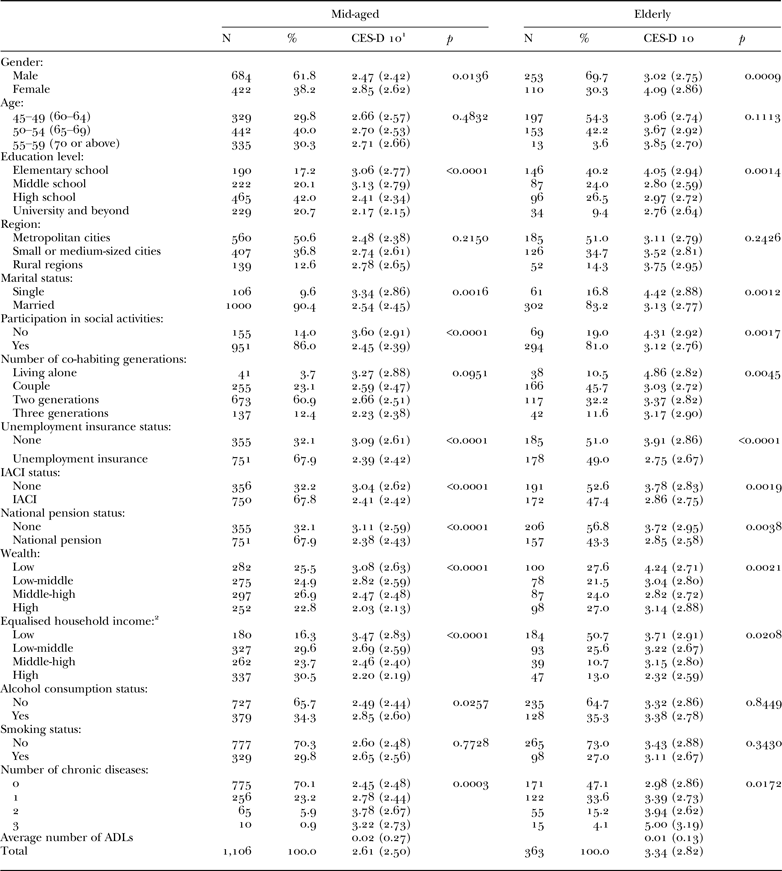
The characteristics of the study participants in 2008 are shown in Table 1. Tables 2 and 3 present the average CES-D 10 scores by employment status change in the years 2008–2012. In the mid-aged group, 985 (89.1%) individuals remained ‘employed to employed’ whereas 121 (10.9%) individuals became ‘employed to unemployed’ between 2006 and 2008. The mean CES-D 10 scores of the participants in 2008 were 2.61 (standard deviation (SD) = 2.50). In the elderly group, 253 (69.7%) individuals were in the ‘employed to employed’ group and 110 (30.3%) in the ‘employed to unemployed’ group, with the mean CES-D 10 scores of the whole group being 3.34 (SD = 2.82). Similarly, from 2008 to 2010, 706 (79.5%) mid-aged individuals remained employed (‘employed to employed’), 48 (5.4%) shifted from ‘unemployed to employed’, 95 (10.7%) moved from ‘employed to unemployed’ and 39 (4.3%) remained unemployed (‘unemployed to unemployed’). The mean depression score of the mid-aged group in 2010 was 2.75 (SD = 2.61). Similarly, in the elderly group, 227 (56.2%) remained employed (‘employed to employed’), 28 (6.9%) shifted from the ‘unemployed to the employed’ group, 65 (16.1%) went from being ‘employed to unemployed’ and 84 (20.8%) remained unemployed (‘unemployed to unemployed’), with a mean CES-D 10 score of 3.21 (SD = 2.85). Lastly, between 2010 and 2012, 489 (76.4%) mid-aged individuals were categorised into the ‘employed to employed’ group, 35 (5.5%) into the ‘unemployed to employed group’, 58 (9.1%) into the ‘employed to unemployed’ group and 58 (9.1%) into the ‘unemployed to unemployed’ group. The mean depression score of the mid-aged group in 2012 was 2.70 (SD = 2.64). Likewise, 218 (48.8%) elderly individuals were in the ‘employed to employed’ group, 27 (6.0%) in the ‘unemployed to employed’ group, 86 (19.2%) in the ‘employed to unemployed’ group and 116 (26.0%) in the ‘unemployed to unemployed’ group. The elderly individuals had a mean CES-D 10 score of 3.08 (SD = 2.86) in 2012.
General characteristics at first follow-up (2008) of individuals employed in 2006

Notes: 1. Center for Epidemiological Studies Depression Scale (CES-D 10) score is expressed as mean (standard deviation). 2. Equalised household income was obtained by dividing the household income by the square root of the number of household members. IACI: insurance accident compensation insurance. ADLs: activities of daily living.
Source: Korea Longitudinal Study of Aging.
Average Center for Epidemiological Studies Depression Scale (CES-D 10) scores by employment status in 2008–2012 (mid-aged)

Note: 1. CES-D 10 score is expressed as mean (standard deviation).
Source: Korea Longitudinal Study of Aging.
Average Center for Epidemiological Studies Depression Scale (CES-D 10) scores by employment status in 2008–2012 (elderly)

Note: 1. CES-D 10 score is expressed as mean (standard deviation).
Source: Korea Longitudinal Study of Aging.
The results of Tables 2 and 3 reveal that the highest CES-D 10 scores are found in the ‘employed to unemployed’ group, followed by the ‘unemployed to unemployed’ group, the ‘unemployed to employed’ group and the ‘employed to employed’ group in the mid-aged category. In contrast, the highest depression scores are found in the ‘unemployed to unemployed’ group in the elderly category, followed by the ‘employed to unemployed’, the ‘unemployed to employed’ and the ‘employed to employed’ groups. Apart from these results, it can also be seen from Table 1 that the mean CES-D 10 scores generally escalate with age.
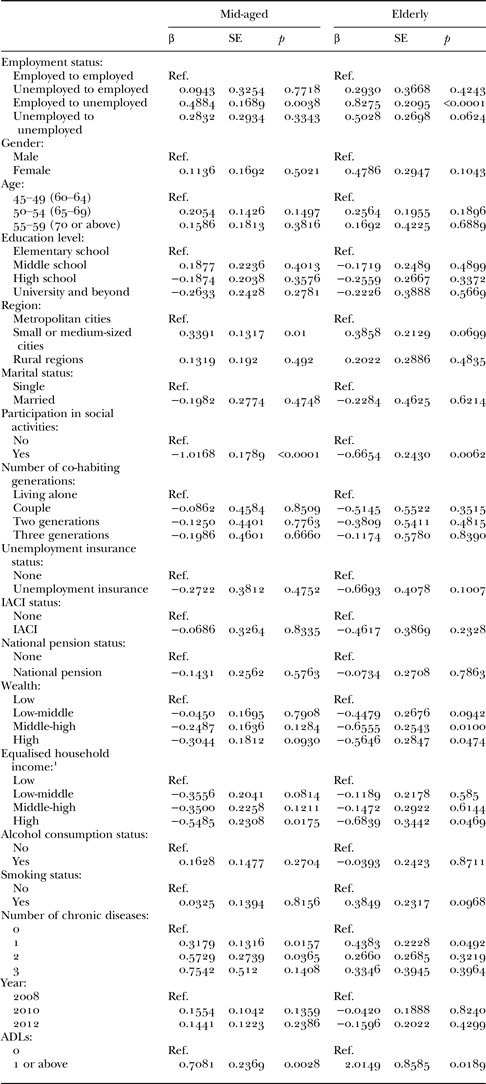
The results of the GEE analysing the effect of employment status change during 2006–2008, 2008–2010 and 2010–2012 on CES-D 10 scores in 2008, 2010 and 2012 are shown in Table 4. After controlling for all covariates, compared to the ‘employed to employed’ reference group, the ‘employed to unemployed’ group had statistically significant increases in depression scores in both the mid-aged (β = 0.4884, p = 0.0038) and the elderly categories (β = 0.8275, p ⩽ 0.0001).
Results of the generalised estimating equation analysing the effect of employment status alteration during 2006–2008 (or 2008–2010, 2010–2012) and Center for Epidemiological Studies Depression Scale (CES-D 10) scores in 2008 (or 2010, 2012), among individuals who were employed at the 2006 baseline

Notes: 1. Equalised household income was obtained by dividing the household income by the square root of the number of household members. SE: standard error. IACI: insurance accident compensation insurance. ADLs: activities of daily living. Ref.: reference group.
Source: Korea Longitudinal Study of Aging.
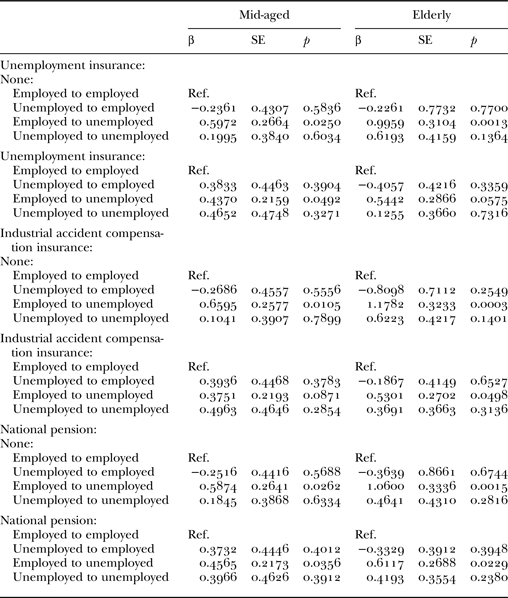
Lastly, Table 5 presents the results of the GEE model analysing the effect of employment status change during 2006–2008, 2008–2010 and 2010–2012 on CES-D 10 scores in 2008, 2010 and 2012 by unemployment insurance, IACI and national pension status. The main results of Table 4 were generally maintained in the unemployment insurance, IACI and national pension ineligible groups of the mid-aged and the elderly individuals. In contrast, the mid-aged and elderly ‘employed to unemployed’ groups who were eligible for unemployment insurance and IACI benefits did not show statistically significant increases in their depression scores compared to the ‘employed to employed’ group. With regard to national pension status, the ‘employed to unemployed’ mid-aged individuals enrolled in the national pension still showed statistically significant increases in their CES-D 10 scores compared to the ‘employed to employed’ group, although the extent of the CES-D 10 score increase was reduced (β = 0.5874, p = 0.0262 versus β = 0.4565, p = 0.0356). The elderly group also showed similar trends (β = 1.0600, p = 0.0015 versus β = 0.6117, p = 0.0229).
Results of the generalised estimating equation analysing the effect of employment status alteration during 2006–2008 (or 2008–2010, 2010–2012) and Center for Epidemiological Studies Depression Scale (CES-D 10) scores in 2008 (or 2010, 2012), among individuals who were employed at the 2006 baseline: based on pension status

Notes: Adjusted for gender, age, education level, marital status, region, wealth, equalised household income, alcohol consumption status, smoking status, number of chronic diseases, year, number of activities of daily living and number of instrumental activities of daily. SE: standard error. Ref.: reference group.
Source: Korea Longitudinal Study of Aging.
Discussion
In line with previous findings, it was expected in this study that unemployment would be associated with higher levels of depressive symptoms. The analysed results correlated with the expected results as the mid-aged and elderly unemployed individuals showed higher depression scores than continuously employed individuals. Only individuals who transitioned from an employed to unemployed state showed significant escalations because those who remained unemployed or became re-employed after previous unemployment did not show significant changes. This is in contrast to a previous meta-analysis conducted by Murphy and Athanasou targeting Western participants, which concluded that job loss was associated with an increase in depressive symptoms and that re-employment was also related to a reduction in distress (Murphy and Athanasou Reference Murphy and Athanasou1999). The differences may result because this analysed study only targeted individuals aged 45 or above, with older workers being known to face further difficulties in discovering high-quality jobs and being more likely to find re-employment in jobs with poorer working conditions (Yang Reference Yang2011). Paul and Moser's meta-analysis also demonstrated the negative mental health effects of unemployment and presented that a higher proportion of unemployed individuals show psychological problems (Paul and Moser Reference Paul and Moser2009). Similar results were discovered in a meta-analysis conducted using cohort studies, which explained that unemployment and job insecurity posed risks for depression especially when individuals were simultaneously exposed to insecure employment (Kim and von dem Knesebeck Reference Kim and von dem Knesebeck2016). With specific regard to studies performed targeting the older population, a previous study revealed that job loss was associated with increased depressive symptoms in individuals aged 50–64 years and that wealth acted as a central mitigating factor (Riumallo-Herl et al. Reference Riumallo-Herl, Basu, Stuckler, Courtin and Avendano2014). The results of this study offer further insight into previous results as they show that job displacement leads to increased depression scores in mid-aged and elderly individuals, and that the effect size is greater among the elderly population.
Financial distress and reduced social networks have been proposed as plausible mechanisms explaining this relationship. Regarding financial distress, job displacement has been considered to be a stressful life event that leads to a reduction in private economic resources and earnings, which also decreases the capability to buy health-promoting goods (Artazcoz et al. Reference Artazcoz, Benach, Borrell and Cortès2004; Olesen et al. Reference Olesen, Butterworth, Leach, Kelaher and Pirkis2013). Unemployment is also likely to result in further financial strains resulting from increased contributions for health insurance because under the South Korean National Health Insurance system, employers and employees are designated to each support one half of an employee's health insurance costs. Thus, unless a direct family member of a displaced individual can provide family member national health insurance support, individuals will inevitably be required to pay higher costs for health insurance and may consequently face further financial pressures. Since financial hardships have been associated with depression, it is probable that unemployment leads to depression through financial strains (Butterworth, Rodgers and Windsor Reference Butterworth, Rodgers and Windsor2009). Apart from economic loss, unemployment often implies reduced social networks and a loss of social roles. Job-displaced individuals face cessations in social and cultural participation that can also indicate declined social support (Broom et al. Reference Broom, D'Souza, Strazdins, Butterworth, Parslow and Rodgers2006). Additionally, the loss of social roles has been linked with reduced positive self-regard and perceived social standing, which can induce adverse mental health effects (Anaf et al. Reference Anaf, Baum, Newman, Ziersch and Jolley2013; Hu et al. Reference Hu, Adler, Goldman, Weinstein and Seeman2005).
The results of this study reveal that the mean depression scores of the study participants increase with age and that the mental health effects of unemployment are stronger in the elderly group than the mid-aged group. The prevalence of depressive symptomology has been known to increase with age, which can significantly impact wellbeing and quality of life (Singh and Misra Reference Singh and Misra2009). The stronger impact of unemployment on depressive symptoms in the elderly group results because in addition to the higher likelihood of depression in the older population, unemployment also more likely results in a lower income, the cessation of asset accumulation and decreased probabilities of re-employment, which are related to stronger symptoms of depression (Chu et al. Reference Chu, Liao, Li, Lee, Tang, Ho and Lee2016). Moreover, the South Korean elderly workers continuing to work past the age of retirement are often those in greater financial need (Yoon Reference Yoon2013). This is important since South Korea has the highest poverty rate for elderly people amongst OECD countries at 47.2 per cent compared to the 12.5 per cent OECD average (Han and Kim Reference Han and Kim2014). Yet the majority of older workers experience downward labour adjustment and marginalisation from the workforce, often working in irregular positions characterised by vulnerability and low earnings (Jones and Tsutsumi Reference Jones and Tsutsumi2009). Moreover, as depression has been related to illnesses that are notable public health problems in ageing societies, including chronic physical illnesses, cardiovascular diseases, Parkinson's disease, musculoskeletal disorders and decreased functional abilities, the societal effects of late-career unemployment can be particularly strong and require appropriate addressing (Gallo et al. Reference Gallo, Bradley, Siegel and Kasl2000; Karpansalo et al. Reference Karpansalo, Kauhanen, Lakka, Manninen, Kaplan and Salonen2005).
The impact of unemployment in the mid-aged and elderly groups is also noteworthy because the investigated period of this study included the relatively recent worldwide economic recession. The economic recession of 2008 has caused significant job losses in many European countries, the United States of America and South Korea (Eskesen Reference Eskesen2010; Riumallo-Herl et al. Reference Riumallo-Herl, Basu, Stuckler, Courtin and Avendano2014). Not surprisingly, the economic recession has been associated with excess mortality and suicides in numerous countries (Chan et al. Reference Chan, Caine, You, Fu, Chang and Yip2014; Karanikolos et al. Reference Karanikolos, Mladovsky, Cylus, Thomson, Basu, Stuckler, Mackenbach and McKee2013). Moreover, economic contraction and the resulting corporate downsizing and labour market restructuring has also contributed to higher risks for depression and has adversely impacted individuals’ mental health (Park et al. Reference Park, Min, Chang, Kim and Min2009). In fact, unemployment can be particularly damaging during recessions because it disrupts an individual's sense of coherence, which is essential in adapting to social stress (Surtees, Wainwright and Khaw Reference Surtees, Wainwright and Khaw2006). Specifically, the unemployment-associated risk of ill health is prominent as elderly individuals face lower prospects of re-employment and worse economic adversity at such periods (Montgomery et al. Reference Montgomery, Udumyan, Magnuson, Osika, Sundin and Blane2013). It is also plausible that the societal mental health effects of increased unemployment during the recession period partially influenced the depression levels of individuals investigated in this study. Therefore, because the older-aged populations have been shown to be comparatively susceptible to labour market conditions, it is necessary to examine the societal moderating factors when contemplating policies for the ageing population, particularly in countries still recovering from the economic crisis and suffering from low employment rates.
In the relationship between unemployment and depressive symptoms, financial security can act as a moderating factor because job displacement often exerts the greatest impact on economically unstable individuals (Back and Lee Reference Back and Lee2011; Gallo et al. Reference Gallo, Bradley, Dubin, Jones, Falba, Teng and Kasl2006). The findings of this study reveal that displaced mid-aged and elderly individuals with unemployment insurance generally do not have increases in depression scores than continuously employed individuals. On the other hand, participants without unemployment insurance showed escalations in their CES-D 10 scores. Such findings are in agreement with previous studies which demonstrated that receiving unemployment insurance benefits after unemployment helped to alleviate individuals’ depression (Tefft Reference Tefft2011). In fact, if comprehensive unemployment benefits are available, current and future income losses may be prevented and this may protect workers from depression that results due to financial insecurity (Brugiavini Reference Brugiavini2001). Hence, although the amount of benefits received by the different participants can vary under the South Korean social security system, which states that displaced workers are entitled to 50 per cent of original wages for 90–240 days based on age and the number of years enrolled, individuals with unemployment insurance are partially guarded from current and future financial losses. Furthermore, the positive aspects of unemployment insurance may be significantly shown among mid-aged and elderly individuals because job-seeking reimbursements in this age group have been reported to be high (Sang Reference Sang2003).
Likewise, unemployed mid-aged and elderly individuals enrolled in IACI showed no significant increases in depression scores compared to their employed counterparts whereas unemployed participants not enrolled in IACI exhibited statistically significant upsurges. The IACI offers financial security by compensating for medical expenditure and wage compensations related to occupational injuries and diseases, which are generally unanticipated and cause financial strains. For instance, if individuals require nursing home care or become unemployed due to industrial accidents, those with IACI will be able to receive reliable reimbursements for medical and living costs. The IACI can act as an important social safety net in the older age groups because the 50–59 age group has been reported to receive the highest number of compensations in South Korea (Ahn, Kang and Kim Reference Ahn, Kang and Kim2004). Thus, being able to receive aid in times of unforeseen injuries can reduce the resulting financial strains and negative mental health effects.
Lastly, with regard to the national pension, unemployed participants both with and without national pension showed higher depression scores than employed participants. However, individuals without a national pension showed higher increases in depression scores than individuals entitled to national pension and this was prominent in the elderly participants. Stronger effects seen in the elderly group may result because unlike mid-aged persons who are not yet eligible for pension reimbursements, elderly persons are qualified to receive benefits based on previous contributions. Naturally, the financial mitigating effects of pension compensations will be stronger in the elderly group because the mid-aged group only expects future pension income whereas elderly individuals currently receive pension income. At present, the South Korean public pension scheme is immature as South Korea is a late-developing welfare state (Kim Reference Kim2009; Lee and Smith Reference Lee and Smith2009). However, since national pension eligibility ensures at least US $650 per month, national pensions can still put forth positive influences in at least partially relieving financial pressures and serve as a social security measure for elderly individuals (Levande, Herrick and Sung Reference Levande, Herrick and Sung2000). Therefore, taking into account the fact that downward income volatility shows a dose–response relationship with depression (Prause, Dooley and Huh Reference Prause, Dooley and Huh2009), one's national pension status can act as an important contributing factor to relieving depressive symptoms in job-displaced individuals.
This study has some limitations. First, this study did not take into account the type of one's employment status, e.g. whether the employment is precarious or permanent, due to data limitations. Second, the amount of unemployment insurance, IACI and national pension benefits was not measured also because of data limitations. However, the impact of this limitation may not have been very strong. This is because unemployment insurance reimbursements are given for 50 per cent of one's wages. Although the absolute amounts will differ, this ensures that beneficiaries will receive at least half of their original earnings with a maximum ceiling. The IACI provides compensations solely based on need, and the regulations governing the proportion of benefit coverage do not differ between individuals. For the national pension, while benefits depend on one's previous contributions, enrolled individuals are guaranteed at least US $650 per month. Additionally, because the national pension in South Korea has been relatively recently introduced and is still immature, the maximum reimbursement amounts are not yet high. Still, future studies incorporating the amount of unemployment insurance, IACI and national pension compensations are needed to provide further insights. Last, as the measurements of household income and wealth in this study were based on self-reports, there may have been some limitations in recording this variable to the absolute amount.
Despite the limitations stated above, this study also has strengths. It was longitudinal in design with six years of follow-up and only individuals employed at the baseline were included to analyse the effect of new onset unemployment on depressive symptoms. In addition, this study is unique because it incorporates the effect of social safety nets on the association between unemployment and depressive symptoms. As such studies are rare, the results elude the importance of the availability of social safety nets in terms of the mental health of displaced older individuals. This is particularly important as many countries are ageing. Additionally, because East Asian countries are known to generally share similar characteristics with each other regarding depression, the findings of this study may be more widely applied in investigating the association between unemployment and depressive symptoms in the mid-aged and elderly groups.
Conclusion
This study reveals that the shift from employment to unemployment among mid-aged and elderly individuals is associated with poorer depression scores, highlighting the importance of employment status change in addressing the mental health of older individuals. The results also demonstrate the significance of social safety nets in the relationship between job loss and depressive symptoms because individuals without unemployment insurance, IACI or national pension were shown to be more vulnerable to the negative mental health effects of job displacement. Therefore, as many countries are facing a rapidly ageing population, appropriate provision of unemployed mid-aged and elderly individuals is crucial in addressing the mental health of older populations.
Acknowledgements
There is no specific funding which supported this study. W.K. designed the study, collected the data, performed the statistical analysis and wrote the manuscript. Y.C., T.-H.L, S.-Y.J., K.-T.H. and E.-C.P reviewed and edited the manuscript. E.-C.P is the guarantor of this work and, as such, has full access to all of the data. E.-C.P assumes responsibility for the integrity of the data and accuracy of the data analysis. All authors read and approved the final manuscript. The data used in this study was publicly available and did not include personal information as all information was anonymised prior to analysis. Hence, no informed consent was required for this study. There are no financial or non-financial competing interests to declare by the authors.