The study of stress, parenting, and child adjustment has a lengthy history in the fields of developmental science, clinical psychology, and developmental psychopathology (cf. Garmezy, Masten, & Tellegen, Reference Garmezy, Masten and Tellegen1984; Rutter, Reference Rutter, Kent and Rolf1979; Sandler & Block, Reference Sandler and Block1979). Early investigations in this area documented negative relations between contextual stressors in and outside the family and children's psychosocial adjustment (for a review, see Compas, Reference Compas1987). Subsequent research efforts explored mechanisms by which contextual strain may affect child development, with most of the literature emphasizing the putative mediating role of parenting behavior (for a review, see Deater-Deckard, Reference Deater-Deckard1998; Grant et al., Reference Grant, Compas, Thurm, McMahon, Gipson and Campbell2006). To date, however, studies have not controlled for interindividual longitudinal stability and cross-sectional covariation among measures of contextual strain, parenting quality, and child adjustment. Further, shared method variance has confounded empirical evidence from studies that rely on a single informant, usually a parent, across multiple constructs of interest (for a discussion, see Lorenz, Conger, Simon, Whitbeck, & Elder, Reference Lorenz, Conger, Simon, Whitbeck and Elder1991; Sawyer, Streiner, & Baghurst, Reference Sawyer, Streiner and Baghurst1998). The absence of longitudinal studies with independent measures of context, parenting, and child functioning over time has stymied efforts to differentiate mediated from direct effects and clarify pathways of influence across contextual, parenting, and child factors over time (Cole & Maxwell, Reference Cole and Maxwell2003). Therefore, this investigation employed multiple measures, informants, and time points to evaluate reciprocal pathways of influence across independent assessments of maternal contextual strain, mothers' parenting behaviors, early childhood regulation, and children's behavioral and academic adjustment at school entry.
Child Regulation and Adaptation
Self-regulation is a “cornerstone” of child development (National Research Council and Institute of Medicine, Reference Shonkoff and Phillips2000). Children's emergent abilities to redirect, control, modify, and regulate their emotions and behaviors across early childhood contribute to adaptive behavioral and academic functioning at school entry (Blair, Reference Blair2002; Buckner & Bassuck, Reference Buckner and Bassuck2001; Calkins, Graziano, & Keane, Reference Calkins, Graziano and Keane2007; Degnan, Calkins, Keane, & Hill-Soderlund, Reference Degnan, Calkins, Keane and Hill-Soderlund2008; Raver, Reference Raver2002). Early disruptive behavior problems not only portend later problems (Campbell, Shaw, & Gilliom, Reference Campbell, Shaw and Gilliom2000; Egeland, Pianta, & Ogawa, Reference Egeland, Pianta and Ogawa1996; Lavigne et al., Reference Lavigne, Arend, Rosenbaum, Binns, Kaufer-Cristoffel and Gibbons1998) but also compromise subsequent competence in other age-salient domains, including academic achievement and peer relationships (Egeland, Kalkoske, Gottesman, & Erickson, Reference Egeland, Kalkoske, Gottesman and Erickson1990; Hinshaw, Reference Hinshaw1992). Similarly, early patterns of academic achievement set the stage for future school success or failure (Blair, Reference Blair2002; Duncan et al., Reference Duncan, Dowsett, Claessens, Magnuson, Huston and Klebanov2007; Gutman, Sameroff, & Cole, Reference Gutman, Sameroff and Cole2003). Moreover, recent research points to developmental cascades or carryover effects from childhood externalizing behavior to lower academic performance in adolescence (Masten et al., Reference Masten, Roisman, Long, Burt, Obradović and Riley2005; Mesman, Bongers, & Koot, Reference Mesman, Bongers and Koot2001), as well as from early academic difficulties to later behavior problems (for a review, see Hinshaw, Reference Hinshaw1992).
Despite evidence of reciprocal effects between childhood behavior problems and academic difficulties, less is known about the transactional processes that underlie the initiation of these pathways during the toddler and preschool periods. Given the marked stability of externalizing behavior problems and academic achievement, efforts to identify processes that contribute to the initiation of behavioral and achievement trajectories at school entry have disproportionate salience for prevention and intervention efforts. The current study examined the development of children's regulation in terms of behavioral compliance, attention, and emotion management through the toddler and preschool years to examine relations between early childhood regulation and children's behavioral and academic adaptation at school entry. In addition, adopting an ecological–transactional perspective on development broadly (Bronfenbrenner & Morris, Reference Bronfenbrenner, Morris, Damon and Lerner1998; Cicchetti & Toth, Reference Cicchetti, Toth, Luthar, Burack, Cicchetti and Weisz1997), and on early school transition in particular (Rimm-Kaufman & Pianta, Reference Rimm-Kaufman and Pianta2000), this investigation advanced beyond the child to examine contextual and parenting influences on child adaptation, as well as to evaluate reciprocal child effects on parenting and contextual factors. By evaluating transactional relations among contextual stress, parenting quality, and child regulation across early childhood, this study sought to clarify pathways toward behavioral and academic adaptation at school entry.
Child Development in Stressful Contexts
Studies of child development in stressful contexts ascended to prominence following several theoretical developments. First, ecological developmental models emphasized children's natural embeddedness within overlapping systems of influence (Bronfenbrenner, Reference Bronfenbrenner1977, Reference Bronfenbrenner1986; Bronfenbrenner & Morris, Reference Bronfenbrenner, Morris, Damon and Lerner1998). Second, dynamic systems models demonstrated that change in one domain may elicit or inhibit change in another domain (Granic & Hollenstein, Reference Granic and Hollenstein2003; Sameroff, Reference Sameroff2000; Thelen, Reference Thelen1992). Third, the developmental psychopathology framework encouraged the study of development in high-risk youth populations as a unique lens through which both atypical and typical developmental processes may come into focus (Cicchetti, Reference Cicchetti1990; Sameroff & Seifer, Reference Sameroff and Seifer1983; Sroufe, Reference Sroufe1990a).
Studies of child development in stressful contexts indicate that both structural inequalities and stressors at the macrolevel, such as poverty (Brooks-Gunn & Duncan, Reference Brooks-Gunn and Duncan1997; McLoyd, Reference McLoyd1998), and proximal factors, such as parenting stress (Abidin, Jenkins, & McGaughey, Reference Abidin, Jenkins and McGaughey1992; Morgan, Robinson, & Aldridge, Reference Morgan, Robinson and Aldridge2002), are prominent threats to child well-being. An array of contextual factors both outside and inside the family affect child development, including negative life events (Berden, Althaus, & Verhulst, Reference Berden, Althaus and Verhulst1990; Pianta, Egeland, & Sroufe, Reference Pianta, Egeland, Sroufe, Rolf, Masten, Cicchetti, Neuchterlein and Weintraub1990; Sandler & Block, Reference Sandler and Block1979), parental/marital relationship tension (Almeida, Wethington, & Chandler, Reference Almeida, Wethington and Chandler1999; Deater-Deckard & Scarr, Reference Deater-Deckard and Scarr1996), and the quality of parental social support (Cochran & Brassard, Reference Cochran and Brassard1979; Crnic, Greenberg, Ragozin, Robinson, & Basham, Reference Crnic, Greenberg, Ragozin, Robinson and Basham1983; Koeske & Koeske, Reference Koeske and Koeske1990). Moreover, the developmental impact of contextual stressors may vary across female and male offspring (Goodman, Brumley, Schwartz, & Purcell, Reference Goodman, Brumley, Schwartz and Purcell1993; Zaslow & Hayes, Reference Zaslow, Hayes, Lamb, Brown and Rogoff1986). For example, evidence suggests that maternal stressors may contribute to depressive symptoms and undermine social functioning in girls, whereas these same stressors may be associated with increased levels of externalizing and self-destructive behaviors in boys (Egeland & Kreutzer, Reference Egeland, Kreutzer, Cummings, Greene and Karraker1991). In an even more extreme example, Cox and colleagues found that mothers' relationship tension was associated with positive parenting behaviors toward daughters and with negative parenting behaviors toward sons (Cox, Owen, Lewis, & Henderson, Reference Cox, Owen, Lewis and Henderson1989). In light of these early findings, researchers began to search for mechanisms by which parental contextual strain may influence child development.
Parenting in Stressful Contexts
Much like their children, parents (and their parenting) are sensitive to contextual influence (for a review, see Belsky & Jaffee, Reference Belsky, Jaffee, Cicchetti and Cohen2006). Moreover, as the primary point of contact between young children and the external milieu (Belsky, Lerner, & Spanier, Reference Belsky, Lerner and Spanier1985; Collins, Maccoby, Steinberg, Hetherington, & Bornstein, Reference Collins, Maccoby, Steinberg, Hetherington and Bornstein2000), parenting may explain how contextual stressors negatively influence child outcomes (for a review, see Crnic & Low, Reference Crnic, Low and Bornstein2002; Deater-Deckard, Reference Deater-Deckard1998). Contextual stressors are associated with decreased parenting quality (e.g., hostile, controlling, punitive caregiving; Abidin, Reference Abidin1995; Elder, Nguyen, & Caspi, Reference Elder, Nguyen and Caspi1985; Erel & Burman, Reference Erel and Burman1995; Repetti & Wood, Reference Repetti and Wood1997; Rodgers, Reference Rodgers1998; Webster-Stratton, Reference Webster-Stratton1990). In contrast, social support and positive parental/marital relationships are associated with increased parental responsiveness and warmth (Belsky, Reference Belsky1984; Crnic et al., Reference Crnic, Greenberg, Ragozin, Robinson and Basham1983; Feeley, Gottlieb, & Zelkowitz, Reference Feeley, Gottlieb and Zelkowitz2005). Although these data seem to support the mediating role of parenting behavior between contextual strain and child outcomes, this remains an empirical question, one that demands (and until now has not received) independent measures of contextual stress, parenting, and child adaptation over time.
Empirical evaluations of the mediating role of parenting in relations between contextual stress and child outcomes are mixed. Studies relying on a single parental informant across measures find support for the mediation of contextual influences on child development through parenting behaviors (e.g., Deater-Deckard & Scarr, Reference Deater-Deckard and Scarr1996; Jackson, Reference Jackson2000). However, studies in which two or more of these constructs are assessed independently typically do not find evidence of mediation (e.g., Anthony et al., Reference Anthony, Anthon, Glanville, Naiman, Wannders and Shaffer2005; Crnic, Gaze, & Hoffman, Reference Crnic, Gaze and Hoffman2005; but see Conger, Patterson, & Ge, Reference Conger, Patterson and Ge1995). In the only study to employ independent measures of parent-reported contextual stress, observer-rated parenting behavior, and teacher-reported child adjustment, Roberts (Reference Roberts1989) did not find strong relations between contextual stress and parenting in a cross-sectional sample of 30 two-parent families. Two decades later, the present study is the first to examine these relations in a rigorous, multimethod, prospective design with independent measures of context, parenting, and child adjustment at each time point.
This study investigated relations among independent measures of contextual, parenting, and child effects while controlling for child and parent factors that may moderate these relations. As reviewed previously, child sex is a salient consideration in studies of contextual influences on child development (Goodman et al., Reference Goodman, Brumley, Schwartz and Purcell1993). In addition, children's intellectual capacity contributes to their early academic achievement (Naglieri & Bornstein, Reference Naglieri and Bornstein2003). Finally, evidence suggests that the relation between contextual stressors and parenting may differ as a function of parental age and education status (Beautrais, Fergusson, & Shannon, Reference Beautrais, Fergusson and Shannon1982; Bee et al., Reference Bee, Barnard, Eyres, Gray, Hammond and Speitz1982; Feeley et al., Reference Feeley, Gottlieb and Zelkowitz2005; Ragozin, Basham, Crnic, Greenberg, & Robinson, Reference Ragozin, Basham, Crnic, Greenberg and Robinson1982). Therefore, this investigation evaluated the potential influences of child sex, child IQ, maternal age, and maternal education on expected relations among contextual stress, parenting, and child adjustment.
Parent–Child Transactions in Stressful Contexts
The parent–child relationship is “a moving bidirectional system in which the responses of each participant serve not only as the stimuli for the other but also change as a result of the same stimulus exchanges, leading to the possibility of altered responses on the part of the other” (Bell, Reference Bell1979, p. 822). The relation between parenting and child adaptation is transactional such that both parent and child influence and are influenced by the other (Cicchetti & Toth, Reference Cicchetti, Toth, Luthar, Burack, Cicchetti and Weisz1997; Sameroff & Chandler, Reference Sameroff, Chandler, Horowitz, Hetherington, Scarr-Salapatek and Siegel1975). Children select, interpret, and construct their own environments, which makes them initiators of developmental exchanges and active contributors to the family context (Bell & Harper, Reference Bell and Harper1977; Lerner & Spanier, Reference Lerner and Spanier1978; Maccoby & Martin, Reference Maccoby, Martin, Mussen and Hetherington1983).
Despite increasing attention to parent–child transactions in contemporary developmental science (Dunn, Reference Dunn1997; Lollis & Kuczynski, Reference Lollis and Kuczynski1997; Pardini, Reference Pardini2008; Pettit & Arsiwalla, Reference Pettit and Arsiwalla2008; for a review, see Sameroff, Reference Sameroff2009), most theoretical and empirical treatments of contextual stress, parenting, and child development have evaluated pathways from context to child through parenting. Yet evidence clearly demonstrates that child behaviors can provide feedback that increases parenting stress and distress (Gross, Shaw, & Moilanen, Reference Gross, Shaw and Moilanen2008; Jackson, Reference Jackson2000; Mash & Johnston, Reference Mash and Johnston1990) and perhaps influence broader aspects of the parenting context, including stressful life events, social support, and relationship tension (Donenberg & Baker, Reference Donenberg and Baker1993; Ostberg, Hagekull, & Hagelin, Reference Ostberg, Hagekull and Hagelin2007; Suarez & Baker, Reference Suarez and Baker1997). Child development is the “outcome of the relationship of an active organism to an active environment” (Sameroff & Seifer, Reference Sameroff and Seifer1983, p. 1264). Moreover, child effects on parents and context are apt to increase with age (Crnic et al., Reference Crnic, Greenberg, Ragozin, Robinson and Basham1983; Deater-Deckard, Reference Deater-Deckard1998) and may be especially prominent during periods of major developmental transition, as in the entry into formal schooling (Gross et al., Reference Gross, Shaw and Moilanen2008). By exploring both parentally mediated contextual influences on child development, and potential effects from child to context and parenting, this investigation evaluated theoretically specified transactional models across contextual, parent, and child levels of analysis using multiple methods, informants, and time points.
The Current Study: Transactions Across Context, Parent, and Child Effects
As relational and transactional views of development garner increasing theoretical and empirical support (cf. Gottlieb & Halpern, Reference Gottlieb and Halpern2002; Sameroff & Mackenzie, Reference Sameroff and Mackenzie2003), efforts to document developmental “cascades” or “spillover” effects wherein “there is a direct transfer of mood, affect, or behavior from one setting to another” (Almeida et al., Reference Almeida, Wethington and Chandler1999, p. 49) and perhaps back again (see also Bolger, Delongis, Kessler, & Wethington, Reference Bolger, Delongis, Kessler and Wethington1989; Crouter, Reference Crouter1984; Margolin, Christensen, & John, Reference Margolin, Christensen and John1996; Masten et al., Reference Masten, Roisman, Long, Burt, Obradović and Riley2005) have become increasingly prominent models of developmental inquiry. Yet designs that incorporate controls for both stability within domains and concurrent relations across them, which are needed to rigorously evaluate transactional and progressive cross-domain relations over time, have emerged only recently (Burt, Obradović, Long, & Masten, Reference Burt, Obradović, Long and Masten2008; Masten et al., Reference Masten, Roisman, Long, Burt, Obradović and Riley2005; Mesman et al., Reference Mesman, Bongers and Koot2001; Obradović, Burt, & Masten, Reference Obradović, Burt and Masten2010). This study extended this literature by explicitly focusing on the transactional relations among contextual stress, parenting, and child adjustment from 24 to 72 months.
The purpose of this investigation was to clarify pathways toward behavioral and academic adaptation at school entry by evaluating prospective transactional relations across contextual strain, parenting quality, and child regulation during the early childhood years in a sample of high-risk mothers and their first born children. To our knowledge, this is the first path analytic study of longitudinal relations across these domains over and above their stability and cross-sectional covariation. Further, this is the only investigation to employ independent measures of contextual strain, parenting, and child adjustment over time.
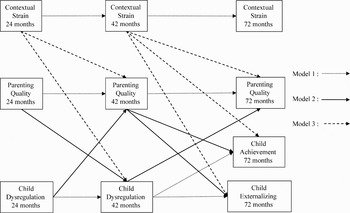
Central hypotheses were systematically evaluated using a series of nested path analytic models and successive nested model comparisons (see Figure 1). The first (continuity) model examined both within-time relations among contextual, parent, and child levels of analysis, and the stability of each construct across time. Despite changes in measures, informants, and assessment contexts across domains and time, we expected significant stability would emerge, above and beyond cross-sectional cross-domain relations. Similar patterns of continuity have been observed in prior studies of stress (Abidin, Reference Abidin1990; Crnic et al., Reference Crnic, Gaze and Hoffman2005; Mulsow, Caldera, Pursley, Reifman, & Huston, Reference Mulsow, Caldera, Pursley, Reifman and Huston2003), parenting (Kemppinenm, Kumpulainen, Raita-Hasu, Moilanen, & Ebeling, Reference Kemppinenm, Kumpulainen, Raita-Hasu, Moilanen and Ebeling2006; Roberts, Block, & Block, Reference Roberts, Block and Block1984; Sroufe, Egeland, Carlson, & Collins, Reference Sroufe, Egeland, Carlson and Collins2005), and child adjustment (Campbell et al., Reference Campbell, Shaw and Gilliom2000; Egeland et al., Reference Egeland, Pianta and Ogawa1996; Lavigne et al., Reference Lavigne, Arend, Rosenbaum, Binns, Kaufer-Cristoffel and Gibbons1998). Further, these patterns are consistent with an organizational perspective on development, which emphasizes developmental progression via successive patterns of differentiation and hierarchical integration over time (Sroufe, Reference Sroufe, Cicchetti and Beeghly1990b; Sroufe & Waters, Reference Sroufe and Waters1977; Werner & Kaplan, Reference Werner and Kaplan1964). Drawing on the literature reviewed above, and broader dynamic systems models of development, we also expected to find significant covariation among contextual strain, parenting quality, and child adjustment at each time point.
A summary of the freely estimated paths in hierarchically nested path analytic models. Model 1 represents a baseline comparison model of longitudinal stability within domain and cross-domain covariation. Cross-sectional correlations are not shown for clarity, but they are included in each model. Model 4 includes direct paths from child dysregulation → context and from parenting → context. All models include paths from prior models in sequence.

The second (dyadic) model explored proximal transactional relations between child regulation and parenting quality across early childhood, and with behavior problems and academic achievement at 72 months, over and above the stability and cross-sectional covariation of both. Adopting a transactional model of development (Cicchetti & Toth, Reference Cicchetti, Toth, Luthar, Burack, Cicchetti and Weisz1997; Sameroff & Chandler, Reference Sameroff, Chandler, Horowitz, Hetherington, Scarr-Salapatek and Siegel1975), we expected reciprocally influential relations from parent to child and from child to parent. In contrast to dominant paradigms of parent–child influence, this dyadic model did not prioritize child–parent or parent–child relations because we expected that the transactional nature of the parent–child relationship would be fully expressed by the start of the study at 24 months, particularly given the developmental salience of agency and autonomy at this age (Sroufe, Reference Sroufe, Cicchetti and Beeghly1990b).
The third (active context) model extended beyond the dyadic level of analysis to evaluate the direct influence of contextual strain on mothers' parenting quality and children's regulation and adaptation. Although evidence points to direct effects from context to parenting behavior (Belsky & Jaffee, Reference Belsky, Jaffee, Cicchetti and Cohen2006), direct effects from context to child functioning have received less attention. Yet recent evidence against parental mediation suggests that contextual effects may directly influence child development (Anthony et al., Reference Anthony, Anthon, Glanville, Naiman, Wannders and Shaffer2005; Crnic et al., Reference Crnic, Gaze and Hoffman2005). Finally, a fourth (reactive context) model was included to explore potential child and parent effects on context given evidence that individuals interpret, select, and create their own environments to varying degrees (Bell & Harper, Reference Bell and Harper1977; Lerner & Spanier, Reference Lerner and Spanier1978; Maccoby & Martin, Reference Maccoby, Martin, Mussen and Hetherington1983).
Nested path analytic comparisons offered the best available method to empirically evaluate whether or not there is a cascade of influence from contextual strain to parenting behavior to child regulation and adaptation. Further, this design afforded the opportunity to explore multiple bidirectional relations between child functioning and parenting quality (Model 2), from contextual strain to parenting behavior and child functioning (Model 3), and from child and parent behaviors to contextual strain (Model 4). In follow-up analyses, we examined whether the final selected (i.e., best-fitting) model varied between boys and girls, between mothers who were teenagers at the time of their child's birth and those who were older, and between mothers who had not completed their high school degree/GED and those who had. Prior evidence points to greater homotypic continuity in boys' early behavioral adjustment and more discontinuous patterns in girls' behavioral adjustment across early childhood (Keenan & Shaw, Reference Keenan and Shaw1997; Mesman et al., Reference Mesman, Bongers and Koot2001). Further, boys appear to be more vulnerable to stressful life events during the early childhood years (Goodman et al., Reference Goodman, Brumley, Schwartz and Purcell1993; Zaslow & Hayes, Reference Zaslow, Hayes, Lamb, Brown and Rogoff1986). Therefore, we expected these pathways to be especially salient for boys. Young mothers with low levels of educational attainment may be less able to buffer themselves and their children from contextual stressors (Beautrais et al., Reference Beautrais, Fergusson and Shannon1982; Bee et al., Reference Bee, Barnard, Eyres, Gray, Hammond and Speitz1982; Feeley et al., Reference Feeley, Gottlieb and Zelkowitz2005). Therefore, we anticipated that these relations would be more pronounced among teenage mothers, and among mothers who had not completed high school. Finally, because IQ is an established predictor of academic achievement (Naglieri & Bornstein, Reference Naglieri and Bornstein2003), we examined whether the pattern of significant effects in the best-fitting model persisted when the relation between child IQ and children's current and prospective adjustment was added to the model.
This investigation extends the literature on contextual strain, parenting, and child development in several ways. First, we evaluated transactional pathways across multiple methods, informants, and contexts. Although we anticipated that this would yield smaller effects than studies relying on shared methods (for a discussion, see Lorenz et al., Reference Lorenz, Conger, Simon, Whitbeck and Elder1991; Sawyer et al., Reference Sawyer, Streiner and Baghurst1998), we believe that this design would provide a uniquely stringent and informative test of transactional relations among contextual, parenting, and child levels of analysis across early childhood. Second, we selected age-salient indicators of child adaptation with respect to both problematic and competent pathways. Although the majority of prior studies have focused on children's negative adjustment (Abidin et al., Reference Abidin, Jenkins and McGaughey1992; Berden et al., Reference Berden, Althaus and Verhulst1990), we also examined developmental pathways toward academic competence at 72 months. We examined early markers of dysregulation as antecedents of externalizing behavior at 72 months. Further, we expected regulatory difficulties in early childhood to undermine children's academic competence at the start of formal schooling as indicated by an objective measure of achievement. Third, based on the literature reviewed above, we evaluated the invariance of these models across multiple groups on the basis of child sex, maternal age, and maternal education. In addition, we included child IQ in the final model to determine whether observed effects remained significant above and beyond the influence of child IQ on children's functioning.
Method
Participants
Participants were drawn from a sample of 267 children (45.3% female) whose mothers were recruited during the third trimester of their first pregnancy from the urban public health clinic where they were receiving prenatal care in the mid-1970s (for complete sample data, see Egeland, Reference Egeland, Starr and Wolfe1991; Egeland & Brunnquell, Reference Egeland and Brunnquell1979). The total sample of children was 58.4% Caucasian; 13.5% African American; and 2.6% Latino, Asian, or Native American. Approximately 16.1% of the children were of mixed racial heritage (9.4% missing father data). The mothers were identified as “at risk” for parenting problems because of poverty (100%), single motherhood (62%), young maternal age (ages 12–34 years; M = 20.5 years, SD = 3.74), and low maternal educational attainment (40% had not completed high school).
Procedures
Over the course of this study, we collected extensive data across multiple methods, settings, and informants. The current analyses employed data collected when the children were 24, 42, and 72 months, including psychological tests, face-to-face interviews, questionnaires, and direct observations of child regulation and mother–child interactions. Information was collected from mother, child, observer, and teacher informants in home, laboratory, and school settings. Measures used in the current analyses assessed maternal contextual strain, parenting quality, children's regulation at 24 and 42 months, and children's behavioral and academic adjustment at 72 months.
Measures
Parenting quality
24-Month parenting quality
At 24 months, mother–child dyads were observed in several laboratory tasks, including a series of problem-solving tool tasks of increasing complexity, and a 10-min period of free play that ended with a 6-min clean-up task. The tool tasks consisted of increasingly difficult problem-solving challenges that ranged from the child needing to use a stick to push a treat out of a hollow tube to the most challenging task in which the child had to use a weighted block to activate a lever system that would cause a treat to pop out of a Plexiglas box (for a full task description, see Matas, Arend, & Sroufe, Reference Matas, Arend and Sroufe1978). Mothers were asked to offer any help they felt the child needed to solve the problem. Maternal parenting was rated on two 7-point scales by independent raters viewing videotapes of the interactions. Mothers' supportive presence was evaluated based on (a) her ability to provide a “secure base” from which the child felt comfortable working with the tasks and (b) her attentiveness to the child's needs throughout the session. Mothers' quality of assistance was rated based on her abilities to (a) help the child see the connection between her/his actions and outcomes and (b) give the child enough help to succeed, but not more or less. Two independent coders rated 69 randomly selected cases yielding intraclass correlations of .92 for supportive presence and .82 for quality of assistance.
At the close of the free play task, mothers were asked to “get the child to put the toys on the shelf.” Mothers' structure and limit setting abilities were rated on a 6-point scale that evaluated the degree to which she (a) was clear about defining her wishes, (b) set limits and boundaries with appropriate follow-through, and (c) showed positive support and encouragement of the child. The intraclass correlation across all cases was .83 (Sroufe & Ward, Reference Sroufe and Ward1980). Coders for the clean-up task were not the same as those who scored the tool task performance, and both sets of coders were blind to all other information.
The parenting composite was created by standardizing all ratings, combining them within tasks, and then averaging them across tasks to minimize the influence of shared method variance within study constructs. Thus, ratings of mother's supportive presence and quality of assistance were composited first (r = .86) to yield a tool task variable, which was then averaged with the rating of structure and limit setting during the clean up portion of the free play task (r = .49, p < .001).
42-Month parenting quality
At 42 months, mother–child dyads were observed during a series of semistructured teaching tasks. The tasks consisted of (a) building copies of a block tower using a series of smaller blocks, (b) naming as many things that have wheels as the child could think of, (c) sorting a series of plastic chips by color and shape, and (d) solving a maze that had been traced onto an Etch-a-Sketch™ (for full task description, see Erickson, Sroufe, & Egeland, Reference Erickson, Sroufe and Egeland1985). Blind raters evaluated mothers' parenting along several dimensions, including supportive presence (i.e., her emotional support, warmth, encouragement), quality of instruction (i.e., her pacing, quality, and timing of hints and instructions), and structure and limit setting (i.e., the appropriateness and effectiveness of her behavior management techniques). Ratings were made along 7-point scales with higher values reflecting more positive parenting behavior as assessed across all four tasks. For example, a rating of 1 on the supportive presence scale captured a mother who “completely fails to be supportive to the child, either being aloof and unavailable or being hostile toward the child … , ” whereas a rating of 7 was assigned to a mother who “skillfully provides support throughout the session. She sets up the situation from the beginning as one in which she is confident of the child's efforts … If the child is having difficulty, she finds ways to structure the problem to reward some sort of success by the child.” All ratings were summed across two observers yielding scores ranging from 2 to 14. Disagreements of two points or more were decided by conference and/or a third observer. The intraclass correlations for independent ratings across a randomly selected sample of 87 participants were .87 for supportive presence, .86 for quality of assistance, and .89 for structure and limit setting. Parenting quality at 42 months reflected a composite of the three teaching task parent ratings (α = 0.87).
72-Month parenting quality
At 72 months, independent raters evaluated the quality of the caregiving environment using the Home Observation for Measurement of the Environment (Caldwell & Bradley, Reference Caldwell and Bradley1984). Examiners obtained information on 91 yes/no items scored across nine subscales that evaluated the child's home environment. Raters were trained to 90% agreement with regular checks to prevent observer drift. Parenting quality reflected a composite of the Parental Responsivity Scale (i.e., the mother's sensitivity to the child's frustration, fears, feelings, and ideas, as well as her acceptance of the child's negative feelings) and the Encouraging Maturity Scale (i.e., the quality and consistency of the mother's limit setting and discipline, as well as her age appropriate expectations for the child; r = .51, p < .001). The Home Observation for Measurement of the Environment is widely used and well validated, with several studies documenting its efficacy as a measure of parenting behavior (Garret, Ng'andu, & Ferron, Reference Garret, Ng'andu and Ferron1994; Jackson, Reference Jackson2000).
Child adjustment
24-Month child dysregulation
As previously described, children completed a series of increasingly complex tool tasks with their mothers during the 24-month assessment. Observers rated each child across a series of characteristics using 5- to 7-point scales. There was complete independence between raters of parenting quality and raters of child regulation. Individual ratings of the child's noncompliance, anger, and negative affect were standardized and then composited for these analyses (α = 0.87). The child's noncompliance with maternal directions and suggestions was evaluated along a 6-point scale with the high end reflecting a child who rejected virtually all suggestions from the mother throughout the session, and the low end reflecting a child who appeared responsive and oriented to the mother's directions throughout the session. The 6-point anger scale captured the child's angry interaction with her/his mother or objects with higher ratings indicative of more intense negative emotionality or pervasive angry expressions in the session (e.g., multiple tantrums). Ratings of negative affect ranged along a 4-point scale from predominantly negative affect with the child spending at least 50% of the session trying to leave the task, crying, hitting, or engaging in other negative expressions (i.e., a score of 4) to neutral or positive expressions with no instances of negative affect (i.e., a score of 1). Intraclass correlations across 69 randomly selected cases were .91 for the noncompliance scale, .89 for the anger scale, and .78 for the negative affect scale.
42-Month child dysregulation
At 42 months, children participated in a laboratory-based assessment of frustration tolerance and coping using Block's barrier box task (Harrington, Block, & Block, Reference Harrington, Block and Block1978). Children were presented with a series of attractive toys and permitted to play with them freely. In the corner of the room, there was a latched, Plexiglas box containing a duplicate set of attractive toys. After 1 min, the child was told the toys belonged in a different room. The attractive toys were removed and the child was left with the latched box and a few unattractive toys. For the next 10 min, the child was allowed to try to open the box to play with the toys inside and/or to play with the less attractive toys on the floor. A composite of standardized observer ratings of the child's negative affect, ego control, and hyperactivity–distractability was used in these analyses (α = 0.69). Negative affect was evaluated on a 5-point scale ranging from a low score of 1 for a child who never got upset or overtly angry during the frustration task, to a score of 5 for a child who was extremely upset characterized by excessive crying, anger, yelling, or destructive behaviors. Ratings of ego control captured the degree to which the child was able to contain her/his impulses, desires, and feelings about the frustrating situation. This rating ranged from extreme undercontrol (i.e., a rating of 1 was given to a child who tried to leave the room in frustration or who panicked and became disorganized in the face of the barrier) to extreme overcontrol (i.e., a rating of 7 was given to a child who showed no overt response to the unavailability of the toys). Scores at both ends of the extreme are markers of poor ego control. Thus, the rating was recoded from 1 to 4 with a score of 4 representing the least ideal balance between emotional expression and control in the form of either extreme undercontrol or extreme overcontrol. The hyperactivity–distractibility rating was evaluated along a 6-point scale ranging from a child with clear attentional focus and systematic coping at the low end (i.e., a score of 1) to a child evidencing a marked lack of focus and almost frenetic activity at the high end (i.e., a score of 6). Minimum agreement, corrected for chance, for each scale exceeded 75% across 45 randomly selected cases.
Ratings of each child's regulatory difficulties at 42 months were also based on her/his performance during the previously described teaching tasks. Child ratings of compliance and negativity during the teaching tasks were made on 7-point scales. Ratings of child compliance reflected the extent to which the child complied with the mother's task directions. This scale was reverse-scored for use in these analyses so that low ratings reflected compliance and high ratings reflected noncompliance. Ratings of negativity reflected the degree to which the child exhibited anger, dislike, or hostility during the tasks with low scores on a 7-point continuum connoting a generally neutral or positive demeanor and high scores reflecting marked negativity that clearly interfered with the child's task performance. The reliabilities of the compliance and negativity ratings were evaluated across 87 randomly selected cases yielding scores of .90 and .93, respectively. These ratings were composited to yield a teaching task dysregulation score (r = .77, p < .001), which was then composited with the previously described barrier box dysregulation score (r = .29, p < .001). As at 24 months, there was no overlap between raters of parenting quality and raters of the child during the teaching tasks, nor between raters of the child during the barrier box task and raters of the child during the teaching tasks.
72-Month child externalizing behavior
During in-person interviews, teachers completed the Child Behavior Checklist: Teacher Report Form (TRF; Achenbach & Edelbrock, Reference Achenbach and Edelbrock1986). The TRF is designed to assess children's behavior problems and social competence and has demonstrated high reliability and validity in varied samples (Achenbach, Reference Achenbach1991). The checklist consists of 118 behavioral descriptions that are rated by the teacher as not true (0), somewhat or sometimes true (1), or very true or often true (2). Eight subscale scores, an internalizing, an externalizing, and a total problem score are derived from the TRF. The broadband externalizing score was used in these analyses.
72-Month child academic achievement
The Peabody Individual Achievement Test (PIAT; Dunn & Markwardt, Reference Dunn and Markwardt1971) was administered to each child during the 72-month home visit. The PIAT assesses achievement in five areas, including (a) mathematics, (b) reading recognition, (c) reading comprehension, (d) spelling, and (e) general information. The PIAT total score was used to index academic achievement at 72 months.
Contextual strain
Stressful life events
Stressful life events were assessed using a modified version of the 51-item Life Event Inventory (Cochrane & Robertson, Reference Cochrane and Robertson1973) with some items added (e.g., trouble with welfare) and others deleted (e.g., retirement) to increase its relevance to the Project sample (Egeland & Deinard, Reference Egeland and Deinard1975). The resultant 39-item Life Events Scale was designed to assess the amount of social and economic stress experienced by the family. Life stress data were collected during semistructured maternal interviews at several time points, including the 42- and 72-month assessments. The interviewer asked whether each event (e.g., job loss, death of family member) had occurred since the preceding assessment or was ongoing at the time. Positive responses were probed further to enable independent, trained coders to rate the severity of each stressor on a 3-point scale using established criteria which specified the frequency of the experience since the last assessment and the extent to which the event involved a person with whom the mother had a close relationship (Egeland, Breitenbucher, & Rosenberg, Reference Egeland, Breitenbucher and Rosenberg1980). At each time point, a total weighted life stress score was computed by summing the number of items checked on the scale, with the weights assigned according to the severity of each stressor. Across all items, the mean interrater agreement was .86 (Pianta, Reference Pianta1986).
Relationship tension
Independent raters evaluated the degree of tension in the mother's primary relationship. This rating was informed by interview questions about the mother's primary relationship with respect to hostility, discord, or distance in the relationship, as well as her reported feelings of satisfaction and security in the relationship. Ratings were not provided for mothers who were partnered only briefly during the rating period. Ratings of tension were made on a 5-point scale from almost nonexistent (1), which captured a relationship where disagreements may have occurred but they did not lead to tension in the form of hostility or marked disconnection, to severe (5), which characterized a relationship that was either marked by extreme hostility, discord, and volatility, or one in which mother and partner were totally disconnected and did not interact in any meaningful way. Interrater reliability ranged from .94 to .97 across 10% of cases at each time point (Hyatt, Reference Hyatt1985).
Quality of social support
At each time point, maternal interviews included questions that were designed to elicit information about the quality and extent of the mother's support system (e.g., questions about satisfaction with friendships, the consistency and quality of help available to the mother regarding her own or her child's care, the extent and efficacy of agency-based support services). As noted by Shonkoff (Reference Shonkoff1985), social support encompasses the availability of meaningful and consistently nurturing relationships that communicate a sense of interpersonal security and commitment. When relevant, the stability and supportive quality of the mother's relationship with a husband/boyfriend was taken into consideration, as was the support available from family, friends, and outside agencies (e.g., religious institutions, psychotherapy). Based on these questions, the quality of emotional support available to the mother was rated on a 7-point scale from almost nonexistent (1), which indicated that there was a total absence of any kind of support leaving the mother almost entirely isolated, to excellent (7), which reflected a highly consistent, diverse support network of people who really cared about the mother and were proactive in their efforts to ensure her well being. Interrater agreement within one point (calculated as number agreement divided by number of total items across 25% of cases) was 84–92% across time points.
Contextual strain composites
Composites were created at each time point using all available data about the mother's experience of stressful life events, relationship tension, and quality of social support (reverse scored). At 24 months, strain was assessed with only the latter of these variables, which indexed the degree, consistency, and quality of support (or lack thereof) available to the mother. At 42 months, contextual information was available across all three areas. The 72-month strain composite reflected an average of the social support and stressful event measures.
Covariates
Child characteristics
Child sex was coded for boys (0) and girls (1) to enable multiple group analyses. Child intelligence was assessed with the Bayley Scales of Infant Development at 24 months of age (Bayley, Reference Bayley1962). The Mental Development Index was used as an index of child IQ at 24 months.
Maternal characteristics
Maternal age at the time of the child's birth was coded to indicate whether the child was born to a teenage mother (i.e., age > 20 years = 0; age ≤ 19 years = 1). Maternal education was coded to indicate whether she had completed high school requirements with a degree or GED (i.e., no high school degree/GED = 0; completed high school degree/GED = 1).
Data analytic plan
Data preparation
The rate of missing cases ranged across variables with a mean of 11.51% (SD = 5.03). The majority of attrition occurred prior to the 24 month assessment when these analyses began. Of the original 267 children, 209 (78.28%) had data on relevant variables between the 24-month and 72-month assessment waves. There were 207 participants at the 24-month assessment, 193 participants at the 42-month assessment, and 191 participants at the 72-month assessment. At the 72-month assessment, teacher reports were available for 188 participants (response rate = 98.43%). There were no significant differences between the 209 participants in these analyses and the 58 children who dropped out of the study prior to the 24-month assessment with respect to relevant demographic variables. All available data on the 209 participants were included in these analyses using maximum likelihood estimation (Schafer, Reference Schafer1997; Schafer & Graham, Reference Schafer and Graham2002).
Model evaluation and comparison
Nested path analytic models were examined using Mplus version 5.2 (Muthén & Muthén, Reference Muthén and Muthén2007). Models were estimated using the MLR option in Mplus to account for the nonnormality of some variables. As described previously, central hypotheses were evaluated sequentially (see Figure 1). First, we examined the longitudinal stability of maternal contextual strain, parenting, and child adjustment and the within-time covariations between them using the baseline continuity model (Model 1). Next, we modeled longitudinal cross-domain paths of increasing complexity to evaluate the hypotheses detailed above. Power considerations limited our cross-domain longitudinal analyses to adjacent time points. The dyadic model (Model 2) included the same stability and within-time covariation paths as the continuity model, as well as five additional longitudinal cross-domain paths between parent and child. Extending beyond the dyad to the level of context, we tested direct influences of context on both child and parent functioning using the active context model (Model 3), which included five additional cross-domain paths over Model 2. Finally, we examined pathways from child and parent to contextual strain via the inclusion of four additional cross-domain paths in the reactive context model (Model 4).
Absolute model fit was evaluated with the comparative fit index (CFI > 0.90), the Tucker–Lewis index (TLI > 0.90), and the root mean square error of approximation (RMSEA < 0.08). Failure to meet these criteria on one or more fit indices was indicative of poor model fit, athough debate remains about how best to evaluate model fit (Hu & Bentler, Reference Hu and Bentler1999; Marsh, Hau, & Wen, Reference Marsh, Hau and Wen2004). A scaling constant, c coefficient, was used to evaluate chi-square difference tests between successive models to determine whether a model with more estimated parameters (i.e., less parsimony) evidenced better relative fit to the data than a more parsimonious model (Sattora, Reference Sattora, Heijmans, Pollock and Satorra2000). When the chi-square difference test was significant, we selected the less parsimonious (i.e., more complex) model above its more parsimonious predecessor. Models were compared sequentially (i.e., nested) until a nonsignificant chi-square value was obtained.
The best-fitting model was further examined to evaluate the invariance of observed pathways as a function of child sex, maternal age at delivery, and maternal educational status. We evaluated the sex invariance of the final model by constraining model parameters across boys (0) and girls (1). As with child sex, we evaluated the invariance of observed effects across maternal age and education by separately examining the model parameters among children with nonteenage mothers (0) and among those with teenage mothers (1), as well as among children whose mothers did not have a high school degree/GED (0) and those whose mothers did have a high school degree/GED (1). These multiple group invariance analyses were important given prior evidence of relations between these factors and contextual strain, parenting quality, and/or child adjustment (Beautrais et al., Reference Beautrais, Fergusson and Shannon1982; Bee et al., Reference Bee, Barnard, Eyres, Gray, Hammond and Speitz1982; Feeley et al., Reference Feeley, Gottlieb and Zelkowitz2005; Ragozin et al., Reference Ragozin, Basham, Crnic, Greenberg and Robinson1982). Finally, we evaluated the robustness of the final model by examining the longitudinal cross-domain paths after the inclusion of child IQ at 24 months to the final model. We examined the relation between child IQ and regulation at 24 months, as well as its influence on child regulation at 42 months, externalizing problems at 72 months, and academic achievement at 72 months.
Results
Descriptive statistics and bivariate relations
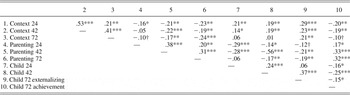
Bivariate relations revealed longitudinal stability within each domain over time (see Table 1). Contextual strain at 24 months was significantly related to strain at 42 months (r = .53, p < .001), and strain at 42 months was associated with strain at 72 months (r = .41, p < .001). Bivariate correlations across parenting measures were similarly robust with significant correlations between observer-rated parenting quality at 24 and 42 months (r = .38, p < .001), and between observer ratings of parenting quality at 42 and 72 months (r = .31, p < .001). Similarly, child dysregulation at 24 months was significantly related to child dysregulation at 42 months (r = .24, p < .001). Finally, child regulatory difficulties at 42 months were positively related to teacher reports of externalizing problems at 72 months (r = .37, p < .001) and negatively related to academic achievement at 72 months (r = −.25, p < .001).
Zero-order correlations between variables included in the path analyses

Note: Pairwise N range = 148–191.
†p < .10. *p < .05. **p < .01. ***p < .001.
Cross-sectional cross-domain correlations were significant at each time point. Maternal contextual strain was negatively related to observed parenting quality at all time points (24 months, r = −.16, p < .05; 42 months, r = −.22, p < .001; 72 months, r = −.24, p < .001). Positive relations between contextual strain and child dysregulation were evident at 24 months (r = .21, p < .01) and at 42 months (r = .19, p < .01). Concurrent contextual strain was also related to increased externalizing behavior problems at 72 months (r = .21, p < .01), but was only marginally correlated with children's academic achievement at 72 months (r = −.10 p < .10). Parenting quality was negatively associated with child regulation problems at 24 months (r = −.29, p < .001) and at 42 months (r = −.56, p < .001). Parenting quality was negatively related to child externalizing behaviors at 72 months (r = −.19, p < .001) and positively related to academic achievement at 72 months (r = .32, p < .001).
Cascade path analyses
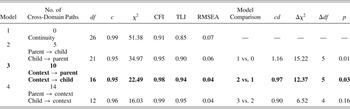
The continuity model (Model 1), which included stability paths and within-time cross-domain paths, evidenced poor fit to the data as indicated by the low TLI value (CFI = 0.909, TLI = 0.853, RMSEA = 0.068; see Table 2). The inclusion of transactional relations between parent and child over time in the dyadic model (Model 2) yielded good fit (CFI = 0.950, TLI = 0.900, RMSEA = 0.056), which was significantly better than Model 1, Δχ2 (5) = 15.22, p < .01. The addition of direct effects from contextual strain to parenting quality and child adjustment in the active context model (Model 3) further improved the overall model fit (CFI = 0.977, TLI = 0.939, RMSEA = 0.044), Δχ2 (5) = 12.37, p < .05. However, estimation of reciprocal pathways from parenting quality and child regulation to contextual strain in the reactive context model (Model 4) did not yield significantly improved fit (CFI = 0.986, TLI = 0.950, RMSEA = 0.040), Δχ2 (4) = 6.52, ns. Thus, both absolute and relative fit indices converged on the adoption of Model 3 as the best-fitting model (Hu & Bentler, Reference Hu and Bentler1999; McDonald & Ho, Reference McDonald and Ho2002; Sattora, Reference Sattora, Heijmans, Pollock and Satorra2000).
Fit statistics and model comparisons for hierarchically nested path analyses

Note: Model 1 represents continuity (within-construct) paths and within-time covariations only The final selected model is in bold. c, weighting constant for computing the chi-square statistic using robust estimation method; CFI, comparative fit index; TLI, Tucker–Lewis index; RMSEA, root mean square error of approximation; cd, weighting constant for the difference between two chi-square values using robust estimation.
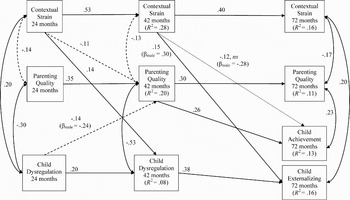
Standardized path coefficients and R 2 values for the best-fitting model (Model 3) are depicted in Figure 2. The stability coefficients were consistently positive and significant. In addition, significant within-time covariation between parenting quality and child dysregulation was evident at 24 months (β = –0.30, p < .001) and at 42 months (β = –0.53, p < .001), but there was not a significant relation between parenting and externalizing behavior at 72 months. However, parenting quality at 72 months was significantly related to concurrent academic achievement (β = 0.23, p < .01). Contextual strain and parenting quality at 72 months were negatively related (β = –0.17, p < .05), with marginally significant negative paths between contextual strain and parenting quality at 24 months (β = –0.14, p < .10) and at 42 months (β = –0.13, p < .06). Contemporaneous contextual strain was positively related to child regulatory difficulties at 24 months (β = 0.20, p < .01) and to externalizing behavior problems at 72 months (β = 0.20, p < .05), but this path was not significant at 42 months. Contextual strain at 72 months was not related to concurrent academic achievement.
Standardized path coefficients in the best-fitting final model (Model 3). Solid lines connote significant coefficients (i.e., p < .05). Dashed lines indicate paths with marginally significant coefficients (i.e., p < .10); χ2 (16, N = 209) = 22.49, ns; comparative fit index = 0.98, Tucker–Lewis index = 0.94, root mean square error of approximation = 0.04.

Transactional relations between parent and child were modest, with a marginally significant prediction from child dysregulation at 24 months to lower parenting quality at 42 months (β = –0.15, p < .06), but no significant contribution of child dysregulation at 42 months to parenting at 72 months. Parenting quality at 24 months did not predict child regulation at 42 months, nor did parenting quality at 42 months contribute to teacher-reported externalizing behaviors at 72 months. However, parenting quality at 42 months was a significant predictor of children's academic achievement at 72 months (β = 0.26, p < .01).
Cross-domain relations between contextual strain and child regulation were evident over time, with significant contributions of contextual strain at 24 months to child regulatory problems at 42 months (β = 0.14, p < .05), and of contextual strain at 42 months to child externalizing at 72 months (β = 0.15, p < .05). However, contextual strain at 42 months did not predict academic achievement at 72 months. Cross-domain relations from contextual strain to parenting quality were less robust with a marginal contribution of contextual strain at 24 months to lower parenting quality at 42 months (β = −11, p < .10), but no relation between contextual strain at 42 months and parenting at 72 months.
Invariance analyses
Child sex
Multiple group analysis in Mplus with specified equality constraints across pairs of estimated paths for females and males was used to examine the sex invariance of the final model. Constraining stability and cross-sectional cross-domain paths yielded a model that was not significantly different from a model with freely estimated stability and cross-sectional cross-domain paths: Δχ2 (19) = 18.18, p = 0.51. However, constraining the longitudinal cross-domain paths to equality across females and males yielded a model with significantly poorer fit than a model with unconstrained longitudinal cross-domain paths: Δχ2 (10) = 20.96, p < .05. Nested comparisons between a model with unconstrained longitudinal cross-domain paths and a series of models with constraints for each individual longitudinal cross-domain path revealed three longitudinal cross-domain paths that varied by child sex. All three pathways were significant for males, but were not significant for females (see Figure 2): (a) child regulation at 24 months to parenting quality at 42 months (male, β = –0.24, p < .01; female, β = –0.01, ns), (b) contextual strain at 42 months to externalizing at 72 months (male, β = 0.30, p < .001; female, β = –0.01, ns), and (c) contextual strain at 42 months to academic achievement at 72 months (male, β = –0.28, p < .01; female, β = 0.06, ns).
Child intelligence
The covariation between child IQ at 24 months and child regulation at 24 months was added to the final selected model, along with effects from child IQ at 24 months to child regulation at 42 months, and to externalizing behavior and academic achievement at 72 months. This model yielded poor fit to the data (CFI = 0.94, TLI = 0.85, RMSEA = 0.07). Child IQ was negatively related to concurrent dysregulation (β = –0.33, p < .001), but was not related to dysregulation at 42 months, nor to externalizing behavior at 72 months. Child IQ contributed to academic achievement at school entry (β = 0.38, p < .001), and the path from parenting quality at 42 months to child academic achievement at 72 months became nonsignificant (β = 0.14, ns) when child IQ was included in the model.
Maternal age and education
Multiple group invariance analyses examined whether or not the continuity and cross-domain cascades in the final model remained significant among children who were born to a teenage mother and among those born to a mother who was over 19 years of age at the time of delivery. Constraining stability and cross-sectional cross-domain paths yielded a model that was not significantly different from a model with freely estimated stability and cross-sectional cross-domain paths: Δχ2 (19) = 25.79, p = .14. Similarly, constraining the longitudinal cross-domain paths to equality across children with teen moms and children with older moms yielded a model that was not significantly different from a model with unconstrained longitudinal cross-domain paths: Δχ2 (10) = 13.39, p = .20. Comparisons of model fit between children of mothers who did not have a high school diploma/GED and those whose mothers did have a high school diploma/GED supported the invariance of the final model across maternal education groups. As with maternal age, a comparison of fit between a model with fixed continuity and cross-sectional covariation, and a model with unconstrained continuity and cross-sectional covariation was not significant: Δχ2 (19) = 18.08, p = .52. Similarly, a model with fixed longitudinal cross-domain paths did not fit the data differently than a model with unconstrained longitudinal cross-domain paths: Δχ2 (10) = 5.64, p = .85.
Discussion
This investigation examined transactional relations among maternal contextual strain, parenting, and child development beginning in toddlerhood and extending through preschool to the time of school entry. Using nested path analytic models, we examined specific pathways by which experience in one domain cascades or spills over to affect subsequent functioning in other domains (for a discussion, see Masten et al., Reference Masten, Roisman, Long, Burt, Obradović and Riley2005). Models of spillover effects across domains have been prominent in the literature on contextual stress and child adjustment (Bolger et al., Reference Bolger, Delongis, Kessler and Wethington1989; Crouter, Reference Crouter1984; Margolin et al., Reference Margolin, Christensen and John1996), but methodologically rigorous empirical evaluations of these models have been lacking. Employing independent measures across multiple informants and time points, this study evaluated bidirectional relations between mother and child behaviors, as well as among contextual strain, parenting, and early childhood regulation and adaptation while controlling for both the longitudinal stability of each construct and the within-time covariation between constructs. These data have important implications for understanding early pathways toward externalizing behavior problems and academic achievement, and, by extension, for intervention efforts aimed at preventing maladaptive behavioral and academic trajectories.
As expected, there was significant stability between individuals in levels of contextual strain, parenting quality, and child adjustment at 24, 42, and 72 months. These data are consistent with organismic-developmental models, which emphasize the cumulative and coherent nature of development through the integration of successive adaptive organizations over time (Sroufe, Reference Sroufe, Cicchetti and Beeghly1990b; Sroufe & Waters, Reference Sroufe and Waters1977; Werner & Kaplan, Reference Werner and Kaplan1964). Prior levels of contextual stress, parenting quality, and child adjustment were probabilistically associated with later levels, which corroborates prior evidence of stability in parenting stress (Abidin, Reference Abidin1990; Crnic et al., Reference Crnic, Gaze and Hoffman2005; Mulsow et al., Reference Mulsow, Caldera, Pursley, Reifman and Huston2003), parenting behavior (Kemppinenm et al., Reference Kemppinenm, Kumpulainen, Raita-Hasu, Moilanen and Ebeling2006; Roberts et al., Reference Roberts, Block and Block1984; Sroufe et al., Reference Sroufe, Egeland, Carlson and Collins2005), and child adjustment over time (Campbell et al., Reference Campbell, Shaw and Gilliom2000; Egeland et al., Reference Egeland, Kalkoske, Gottesman and Erickson1990; Lavigne et al., Reference Lavigne, Arend, Rosenbaum, Binns, Kaufer-Cristoffel and Gibbons1998).
Beyond the stability of contextual, parenting, and child factors across time, these data point to an independent contribution of maternal contextual strain to child development. This study supports recent cross-sectional evidence that contextual factors may be associated with child adjustment (Anthony et al., Reference Anthony, Anthon, Glanville, Naiman, Wannders and Shaffer2005; Crnic et al., Reference Crnic, Gaze and Hoffman2005). Direct relations from mothers' contextual strain at 24 months to child dysregulation at 42 months were replicated in the observed path from contextual strain at 42 months to child externalizing behavior at 72 months. This consistent effect, despite change from observer ratings of child regulation in the laboratory to teacher ratings of child behavior in the classroom, suggests that direct contextual effects may be a heretofore underappreciated factor in understanding pathways to early behavior problems.
Moreover, contextual effects may be especially salient for boys. Among boys, mothers' contextual strain at 42 months was associated with both externalizing behavior and academic achievement at 72 months. These data are consistent with other evidence suggesting that females may be less sensitive to contextual strain, but more sensitive to parental well-being (Pianta et al., Reference Pianta, Egeland, Sroufe, Rolf, Masten, Cicchetti, Neuchterlein and Weintraub1990), which itself may be influenced by or contribute to contextual stress (Compas, Howell, Phares, Williams, & Ledoux, Reference Compas, Howell, Phares, Williams and Ledoux1989; Fergusson, Hons, Horwood, Gretton, & Shannon, Reference Fergusson, Hons, Horwood, Gretton and Shannon1985). One possibility is that these pathways appeared more salient for boys because these analyses focused on early problem behaviors (see also Mesman et al., Reference Mesman, Bongers and Koot2001). Although this interpretation is consistent with evidence that contextual effects contribute to girls' internalizing, rather than externalizing behavior problems (Egeland & Kreutzer, Reference Egeland, Kreutzer, Cummings, Greene and Karraker1991; Grant et al., Reference Grant, Compas, Thurm, McMahon, Gipson and Campbell2006), the finding that contextual strain also negatively influenced boys', but not girls', academic achievement suggests that boys may be especially sensitive to maternal contextual strain in early childhood.
Overall, transactional relations between parenting and child regulatory functioning were modest. However, a transactional cascade from child regulation to parenting quality to academic achievement emerged among mother–son dyads. Boys' behavioral dysregulation during the laboratory assessment at 24 months contributed to fewer expressions of maternal sensitivity and less effective maternal limit setting at 42 months. In turn, insensitive and ineffective parenting at 42 months contributed to lower levels of academic achievement at 72 months. These data are consistent with a transactional model of parent–child relationships as reciprocal systems in which both parent and child initiate and respond to changes in one another (Bell, Reference Bell1979; Pettit & Arsiwalla, Reference Pettit and Arsiwalla2008; Sameroff & Chandler, Reference Sameroff, Chandler, Horowitz, Hetherington, Scarr-Salapatek and Siegel1975). Moreover, these data suggest that cascades from child behavior to academic functioning may begin as early as the toddler years and magnify in intensity over time (see Masten et al., Reference Masten, Roisman, Long, Burt, Obradović and Riley2005; Mesman et al., Reference Mesman, Bongers and Koot2001).
Together, these findings point to spillover or cascade effects from maternal contextual strain to child adjustment, and, among boys, from child regulation to the parenting context to early academic achievement. These relations appeared to be independent of maternal age and education. However, children's intellectual functioning at 24 months was related to both concurrent child regulation and academic achievement at 72 months. Moreover, the contribution of child IQ to academic achievement at 72 months rendered the previously observed path from parenting quality at 42 months to academic achievement at school entry nonsignificant. This finding warrants further exploration in the literature, as early intellectual functioning may itself be a consequence and cause of transactional relations across context, parenting, and child effects (Pianta & Egeland, Reference Pianta and Egeland1994).
The significance of these relations across independent observations over time and in varied contexts magnifies their empirical and applied merit. Nevertheless, limitations in the current study highlight areas for future research that will extend the significance of these findings and remedy their shortcomings. First, methodological and statistical issues regarding the measurement of life events are a major concern in the study of stress effects, including in this study (for a review, see Cohen, Kessler, & Gordon, Reference Cohen, Kessler and Gordon1997). For example, measures of contextual strain may include varied (and perhaps unrelated) events in a single construct, including positive and negative events, controllable and uncontrollable stressors, and major life events and daily hassles (Crnic et al., Reference Crnic, Gaze and Hoffman2005; Rowlison & Felner, Reference Rowlison and Felner1988; Rutter, Reference Rutter1981; Tausig, Reference Tausig1982). Although these data suggest that maternal contextual strain directly influences child development, the analyses did not differentiate among contextual factors pertinent to mothers' stress, social support, and/or relationship quality. Future studies must clarify if and how specific elements of contextual strain carryover to influence child development. Although our findings counter dominant models of parent-mediated contextual effects, it may be that some stressors are indirectly related to child functioning via their effects on parenting behavior (e.g., Conger, Conger, & Elder, Reference Conger, Conger, Elder, Duncan and Brooks-Gunn1997; Levendosky, Huth-Bocks, Semel, & Shapiro, Reference Levendosky, Huth-Bocks, Semel and Shapiro2003). Alternately, other stressors may influence child development via their influence on parental psychopathology (Fergusson, Horwood, & Sahnnon, Reference Fergusson, Horwood and Sahnnon1984). Although efforts to elucidate the specificity of stress effects are in their infancy, they hold great promise for informing targeted intervention efforts in the future (cf., Costa, Weems, Pellerin, & Dalton, Reference Costa, Weems, Pellerin and Dalton2006; McMahon, Grant, Compas, Thurm, & Ey, Reference McMahon, Grant, Compas, Thurm and Ey2003).
Second, the specific informants and assessment contexts used in this investigation may have influenced observed pathways across context, parenting, and child adaptation. As expected, the observed pathways were relatively modest compared to single informant studies where shared method variance may inflate apparent relations between constructs (Lorenz et al., Reference Lorenz, Conger, Simon, Whitbeck and Elder1991; Sawyer et al., Reference Sawyer, Streiner and Baghurst1998). Beyond the magnitude of relations, however, evidence also suggests that the appearance of specific pathways between contextual stress and parent and child outcomes may vary across informants (e.g., child vs. parent; Banez & Compas, Reference Banez and Compas1990; Rowlison & Felner, Reference Rowlison and Felner1988). Further, our data support prior suggestions that the assessment context also influences observed relations. For example, Crnic and Greenberg (Reference Crnic and Greenberg1990) did not find significant relations between parental reports of life stress and laboratory-based observations of parenting behavior, yet Crnic and colleagues (Reference Crnic, Gaze and Hoffman2005) did find relations between contextual stress and home-based observations of parenting. In the current study, the relation between contextual strain and parenting behavior observed in the home at 72 months was stronger than relations between contextual strain and parenting behavior observed in the laboratory at 24 and 42 months. In addition to differences across home and laboratory settings, actual or apparent developmental cascades across ecological levels may vary across cultures. For example, Oburu (Reference Oburu2005) found that high caregiver stress was associated with lower levels of child behavior problems in a sample of Kenyan grandmothers raising their orphaned grandchildren. These findings illustrate the need for future research to explore if and how decisions about sources of information and the location of assessment contexts (e.g., home, laboratory, school) may influence observed relations among context, parenting, and child development.
Third, the disproportionate salience of these pathways for boys' adjustment in this study points to important sex differences, but there may be other individual differences that moderate the impact of stress on development. For example, prior studies have found that maternal age and education may influence the impact of contextual strain on parenting behavior (Beautrais et al., Reference Beautrais, Fergusson and Shannon1982; Bee et al., Reference Bee, Barnard, Eyres, Gray, Hammond and Speitz1982; Feeley et al., Reference Feeley, Gottlieb and Zelkowitz2005), although our data did not replicate such effects. Future research should evaluate when and why stress effects may differ across family members. Exploring the impact of contextual strain on fathers and fathering may be especially profitable, given some evidence that fathers (and fathering behavior) are sensitive to contextual stress effects (Elder et al., Reference Elder, Nguyen and Caspi1985), and perhaps even more so than are mothers (Almeida et al., Reference Almeida, Wethington and Chandler1999; Osborne & Fincham, Reference Osborne and Fincham1996). Efforts to explore the differential sensitivity to contextual strain across individuals and family members (e.g., siblings; Deater-Deckard, Smith, Ivy, & Petrill, Reference Deater-Deckard, Smith, Ivy and Petrill2005) will clarify protective factors and processes that may buffer some children (and parents) from contextual strain (Masten et al., Reference Masten, Garmezy, Tellegen, Pellegrini, Larkin and Larsen1988; Obradović & Boyce, Reference Obradović and Boyce2009; Pianta & Egeland, Reference Pianta and Egeland1990).
Despite limitations, the current findings can inform intervention efforts to prevent or constrain maladaptive pathways and/or to promote adaptive pathways over time. First, the observed stability of contextual strain, parenting quality, and child adjustment supports cumulative models of stress and adaptation (Crnic et al., Reference Crnic, Gaze and Hoffman2005; Masten & Wright, Reference Masten and Wright1998), as well as broader principles of self-organization over time (Sroufe, Reference Sroufe, Cicchetti and Beeghly1990b). These patterns suggest that intervention efforts should begin early and continue over time to prevent the initiation of maladaptive pathways and maximize cumulative models of protection (Wyman, Sandler, Wolchik, & Nelson, Reference Wyman, Sandler, Wolchik, Nelson, Cicchetti, Rappaport, Sandler and Weissberg2000). Second, the presence of significant cross-domain relations above and beyond both longitudinal stability and cross-sectional covariation is a testament to the enduring possibility for change in development. Despite the stability of children's disruptive behaviors, for example, a capacity for change remains, one that justifies interventions to promote or prevent positive and negative developmental patterns, respectively. Third, observed relations between contextual strain and independent ratings of real-time child and parenting behaviors support ecological models in which parent and child development are embedded within larger systems of influence (Bronfenbrenner, Reference Bronfenbrenner1977; Bronfenbrenner & Morris, Reference Bronfenbrenner, Morris, Damon and Lerner1998). Children's early behavioral and academic adjustment at school entry follows from multiple levels of influence, including the context, parents, and the child her/himself. As such, interventions must operate at multiple levels of ecology to modify the transactional relations across them. Yet the success (or failure) of such efforts rests on our capacity to elucidate and integrate the dynamic and transactional nature of child development in future research and practice.
Conclusion
More than 25 years ago, Sameroff and Seifer (Reference Sameroff and Seifer1983) argued that the future of risk research lay in the continued advancement toward “conceptualizing the complexity of relationships between a dynamically organized child and a dynamically organized context” (p. 1265). The current study represents one such advance; one that joins a growing body of work aimed at clarifying dynamic relations among multiple domains of adaptation and influence across time (Cicchetti & Dawson, Reference Cicchetti and Dawson2002; Masten, Reference Masten2007). Until recently, the nearly exclusive focus on unidirectional models of contextual influence from parent to child promulgated a myopic view of development that undervalued the developing child as an agent of her/his own development and an actor in the broader social world. Further, these models neglected the possibility of direct influences from context to child, independent of parenting effects. These data suggest that the context of the parent is also the context of the child, and the regulatory and adaptive functioning of the child influences that of the parent. Thus, comprehensive interventions aimed at promoting early adaptation and school success must attend to the parent, the child, and the broader context(s) of strain and support in which they reside (Kazdin & Whitley, Reference Kazdin and Whitley2003).