On October 27, 2018, a lone gunman seeking to murder as many Jews as possible, entered the Tree of Life Synagogue in Pittsburgh, Pennsylvania and started shooting congregants and first responders. Eleven Jewish people were killed and seven suffered serious injuries, making it the deadliest attack on American Jewry in history. This anti-Semitic massacre was not only an example of the deadly consequences prejudice can have in America, but served as a dangerous reminder of the inadequate knowledge scholars and practitioners have when it comes to explaining and predicting incidents targeting minorities in liberal democracies. Little research has attempted to systematically answer when and where ethnoreligious groups are more likely to be the target of prejudice. In order to begin evaluating what drives hate crime on ethnoreligious minorities, I theorize the broad factors that ultimately contribute to variation in ethnoreligious targeting by examining reported anti-Semitic incidents in the U.S. from 2001–2014. In doing so, I hope to bridge gaps in our understanding of when bigoted attitudes can manifest into prejudicial behavior, ranging from vandalism and harassment to murder.
To many, the “Unite the Right” rally in Charlottesville, Virginia, in August of 2017 underscored that the memes and online bigotry of the Alt-Right posed a real threat to those opposed to a “white nationalist” world view. Another topic to materialize out of Charlottesville was the utilization of anti-Semitism by far-right organizations and participants, captured firsthand by viral videos of Tiki torch-bearing marchers shouting, “Jews will not replace us.” Yet, anti-Semitic hate crimes targeting American Jewry and their institutions are not a new phenomenon. In 2009, James W. von Brunn, a known Holocaust denier, attempted to breach Washington, DC’s Holocaust Museum where he shot and killed a security guard in the line of duty. In 2014, Neo-Nazi Frazier Glenn Miller, Jr., shot and killed three people at two different Jewish centers in Kansas City in a single day. Since 2001, over 850 anti-Semitic hate crimes intimidating or violently targeting individuals and nearly 12,000 incidents of vandalism have occurred in the United States as reported in the Federal Bureau of Investigation (FBI) Uniform Crime Report (UCR). Jews were the most frequent targets of all reported religion-motivated incidents in the United States every year since the FBI has collected statistics on domestic hate crimes.Footnote 1
Considering the intensity of ethnoreligious prejudice and the severity of its manifestations in the United States, it is puzzling that political scientists have devoted minimal attention to the study of ethnoreligious hate crime. This gap is even more surprising because considerable literatures in political science are devoted specifically to studies of ethnicity, religion, race, and related identity-based bias and discrimination. Even less consideration has been given to the investigation of incidents motivated by anti-Semitism as a particular prejudice. The scarce systematic research that exists on explaining variation in anti-Semitic incidents has focused almost exclusively on Europe (e.g., Jacobs et al. Reference Jacobs, Veny, Callier, Herman and Descamps2011; Feinberg and Stewart Reference Feinberg and Stewart2018). This focus on Europe is perhaps unsurprising considering the continent’s Holocaust history, growing immigration concerns, and the intensity of contemporary anti-Semitic attitudes measured across the continent (ADL 2015). However, attention to American anti-Semitism is critical because “the U.S. Jewish population is twelve times larger than the second largest Jewish diaspora community” currently located in France (DellaPergola Reference DellaPergola, Dashefsky and Sheskin2015). Depending on how Jews are defined by demographers, the United States is home to either the largest or second largest Jewish community in the world (Feinberg Reference Feinberg2019, 1-2).
I attempt to show here the importance of analyzing event counts to better comprehend what motivates behavioral manifestations of hate. Additionally, I present an original theory that helps illustrate what drives the considerable variation in reported religion-motivated hate crimes within U.S. states. This theory is built on four key concepts: opportunity, distinguishability, stimuli, and organization that are developed in the sections that follow. I utilize data from the FBI UCR of reported anti-Semitic hate crimes across the United States from 2001–2014 to test this theory. I find that measures operationalizing all four theoretical concepts are statistically significant in explaining anti-Semitic incidents in U.S. states. Consequently, I present a critical theoretical and empirical baseline for scholars seeking to study variation in ethnoreligious-motivated targeting in America and the Western world.
Minority Group Targeting
In The Clash of Civilizations, Huntington (Reference Huntington1996) argues that grandiose post-Cold War geopolitical concerns could no longer be explained by interstate alliances but through identity fault lines, driven largely by cultural and religious differences. For scholars heeding his prediction, the considerable increase in political science scholarship concerned with the role of ethnoreligious groups as political actors, exploration of ethnoreligious identity and security, and increasingly transnational political influences are a natural reaction to a post-Cold War world. In their seminal study on civil war recurrence, Fearon and Laitin (Reference Fearon and David D2003) were among the first to control for religion in a quantitative study of conflict. Thanks in part to data generated by the U.S. State Department’s International Religious Freedom reports, a number of scholars have analyzed how religion and religious issues have motivated conflict and altered the distribution of violence (Basedau et al. Reference Basedau, Fox, Pierskalla, Struüver and Vuüllers2017; Fox Reference Fox2004, Reference Fox2017; Grim, Skirbekk, and Cuaresma Reference Grim, Skirbekk and Cuaresma2013; Svensson Reference Svensson2007, Reference Svensson2013; Svensson and Nilsson Reference Svensson and Nilsson2018). Despite the growing recognition of the role religion played in social conflict, scholarship measuring ethnoreligious violence was primarily interested in examining it as a motive for interstate or civil conflict dynamics, as well as its role in foreign policy decision-making, and in conflict contagion (Fox Reference Fox2001; Fox & Sandler Reference Fox and Sandler2004). The work of Grim and Finke (Reference Grim and Finke2007) whose comparative study of 143 countries focused on examining religious persecution across states, exemplifies a transition into the study of religious discrimination at the state level. They find that government regulation and social regulation work in tandem to explain why certain states are more likely to exhibit religious persecution than others. The focus on state-level religious discrimination and repression (e.g., Grim and Finke Reference Grim and Finke2010; Fox Reference Fox2016; Fox, Finke, and Eisenstein Reference Fox, Finke and Eisenstein2018) continues to be systematically explored, analyzing both governmental and societal factors that contribute to these phenomena. Although this scholarship has helped considerably to elucidate why the treatment of religious minorities varies across the globe, its primary focus has been on governmental repression (e.g., Finke, Martin, and Fox Reference Finke, Martin and Fox.2017, Sarkissian Reference Sarkissian2015), and the nexus between societal and state-sponsored discrimination and persecution (e.g., Grim and Finke Reference Grim and Finke2010). Related analysis has not yet systematically examined the security dilemmas facing ethnoreligious minorities from hate groups or lone-wolf actors that are unsanctioned by the government and do not enjoy broad societal support for their actions.
The focus of prior research on ethnoreligious violence or comparative minority-group treatment combined with certain data-related shortcomings allows me to contribute to filling several key theoretical and empirical gaps in the literature. First, prior event count data used to study religion-motivated social conflict is often casualty-driven and does not usually account for non-lethal violence targeting ethnoreligious minority groups. Second, past studies examining ethnoreligiously motivated prejudice aggregate social conflict characteristics, such as casualties or displacement, into yearly reports, which have a limited value in determining more temporally specific motivations for variations in ethnoreligious targeting. Third, despite a robust literature comparatively investigating religious discrimination and persecution, none of these works have yet focused on ethnoreligious hate crime variation within states.
The majority of relevant empirical findings explaining non-state actors’ targeting of minority groups are found in the study of racially motivated crimes within countries, namely the United States. By focusing on the empirical factors that explain variations in hate crimes, scholars have evaluated the roles that target population density (e.g., Green et al. Reference Green, Strolovitch, Wong and Bailey2001); economic hardship (e.g., Krueger and Pischke Reference Krueger and Pischke1997; McLaren Reference McLaren1999); political circumstances (e.g., Koopmans Reference Koopmans1996); political rhetoric (e.g., Karapin Reference Karapin1996); and hate group activity (e.g., Green, Glaser, and Rich Reference Green, Glaser and Rich.1998) contribute to minority targeting. However, just as with the aforementioned political science studies focused on religious persecution, this research suffers from several shortcomings. First, available empirical studies of racial and sexual-orientation hate crime tend to be quite narrow in focus. Most of this research utilizes a short temporal range, analyzes a discrete location, and focuses on identifying individually impactful variables. Second, studies of minority group targeting have emphasized a desire to produce theoretical models that better explain motivations for prejudice, both real and subjective (e.g., Hamm Reference Hamm1994; Koopmans Reference Koopmans1996; Green, Glaser, and Rich Reference Green, Glaser and Rich.1998), but often fail to holistically incorporate factors that explain when and where behavioral manifestations of prejudice occur. Finally, this research tends not to examine geopolitical factors that may be critical in contributing to ethnoreligious minority targeting within a country or state.
I attempt to bridge contemporary political science research on religious persecution and scholarship focused on minority prejudice and targeting by providing a comprehensive theoretical explanation for variation in incidents targeting ethnoreligious groups. Rather than look at all ethnoreligious group targeting in the United States, I analyze anti-Semitic incidents to underscore the group-specific motivations that are relevant to fully understanding the targeting of a particular minority group. While future iterations of this research should confirm its applicability to anti-Islamic incidents in the United States, for example, the decision to focus on an individual ethnoreligious group allows also for the coherent incorporation of individual group prejudicial motivations within the broader theory.
U.S. Jewry and Anti-Semitism
Victor Tcherikover, a Russian-Israeli historian, observed that “very few phenomenon in human history have a history of two thousand years. Anti-Semitism is one of them” (Berenbaum 2008, 218). However, prejudice and violence have not affected all Jewish communities evenly. The Jewish experience in the United States is, by and large, significantly more positive than the Jewish experience in Europe, which was marked by pogroms and expulsions. Although American Jews suffered anti-Semitism, namely in the form of educational quotas, professional limitations, and social exclusion, climaxing during the Great Depression, they have generally been considered an integral part of the pluralistic identity of the United States. By and large, Jews are not seen or treated as a “nation within a nation,” in America, which was their defining experience in Europe leading up to the Holocaust and which remains a critical concern among Europe’s Jews today.
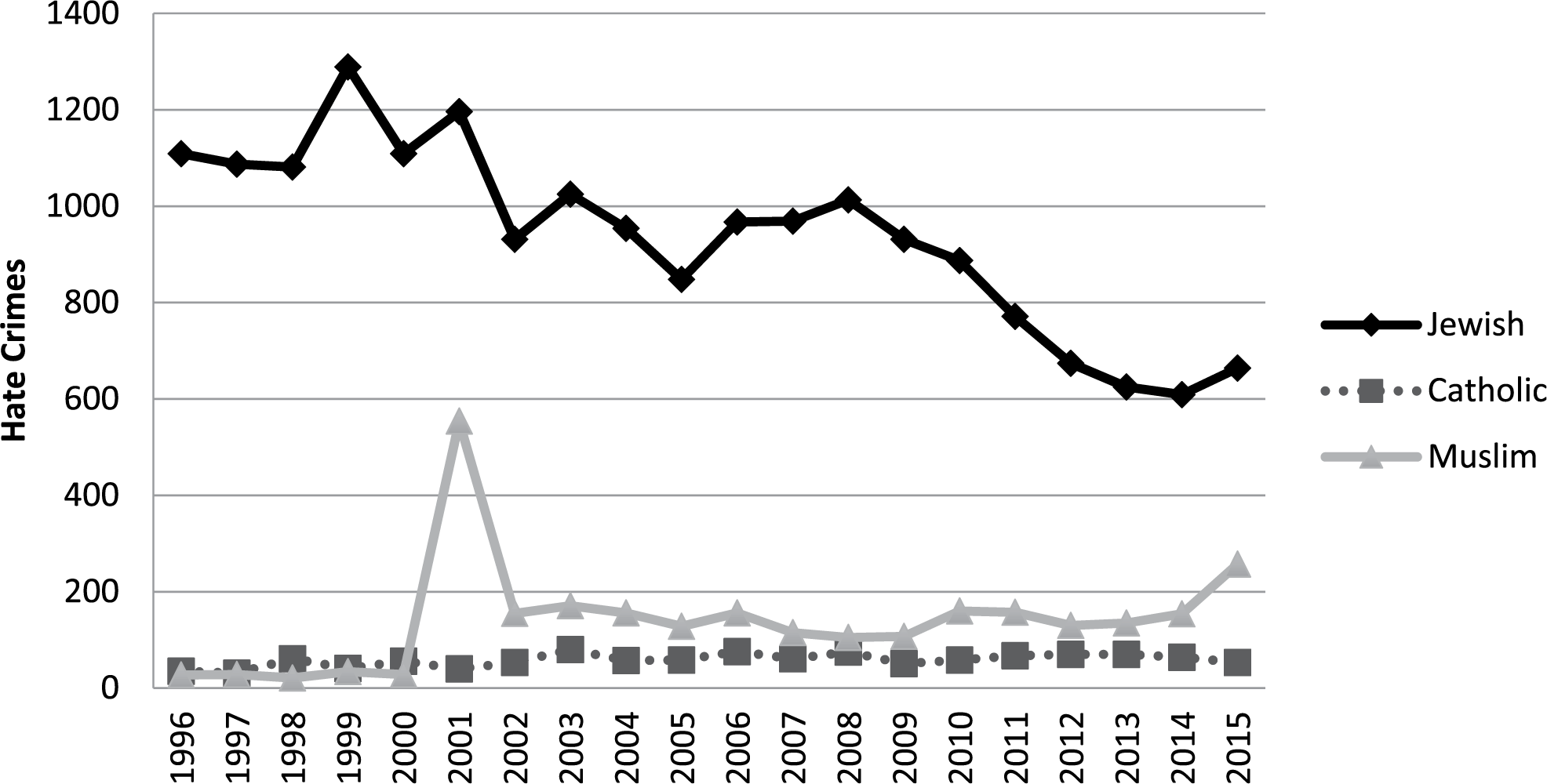
My decision to study the targeting of American Jewry over other American ethnoreligious communities is threefold. First, anti-Semitic incidents have been the most frequently reported religious hate crime in the United States since the beginning of accessible FBI UCR hate crime data.
Annual reported hate crimes in the U.S. by religion

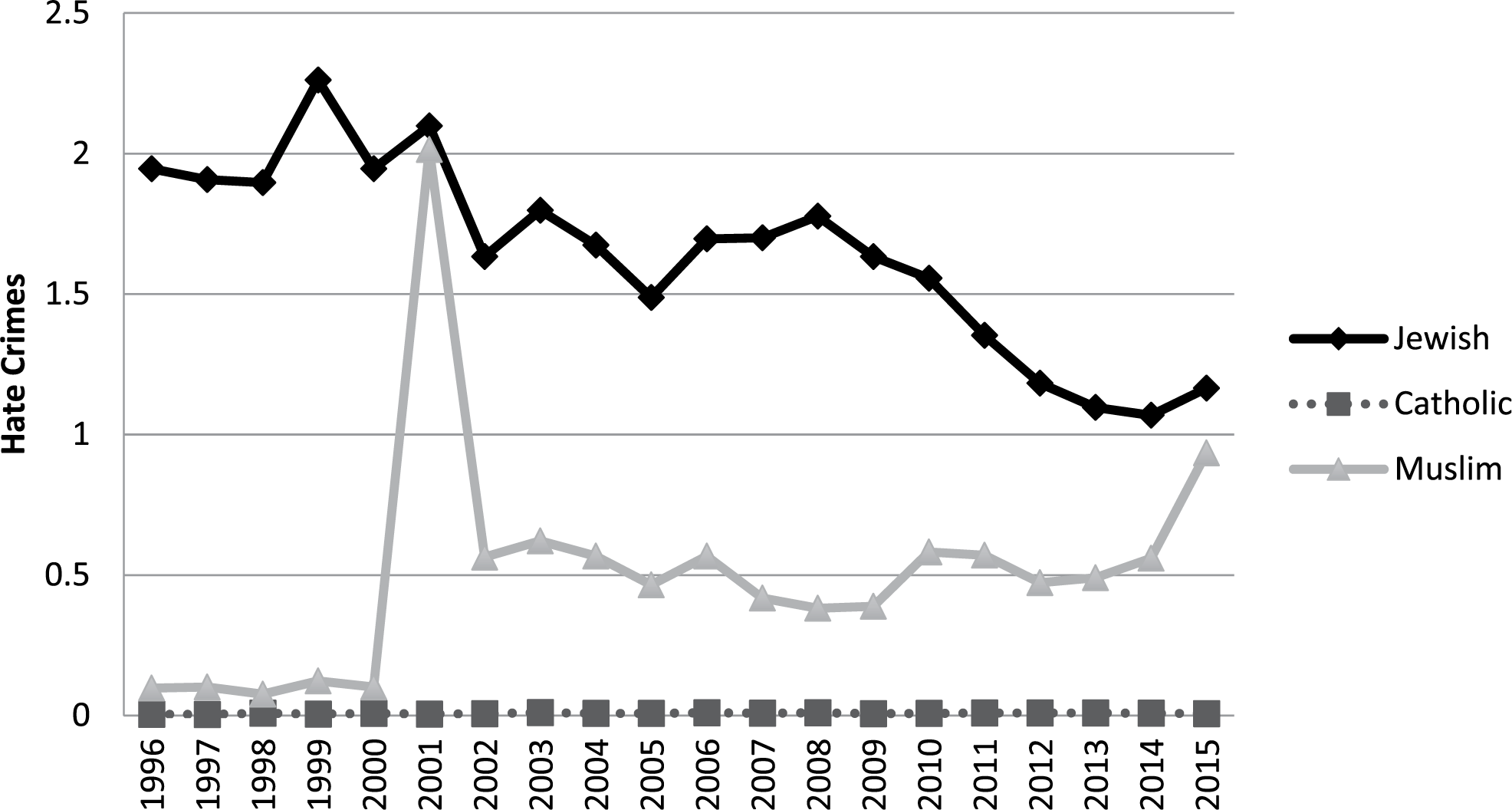
When factoring in the size of the religious group’s population, Jews have suffered proportionally more reported hate crimes than any other ethnoreligious group. The only time parity was almost reached was in 2001, which saw a spike of anti-Islamic hate crimes likely attributable to the 9/11 terrorist attacks.
Annual reported hate crimes per 10,000 people by religion in the U.S.

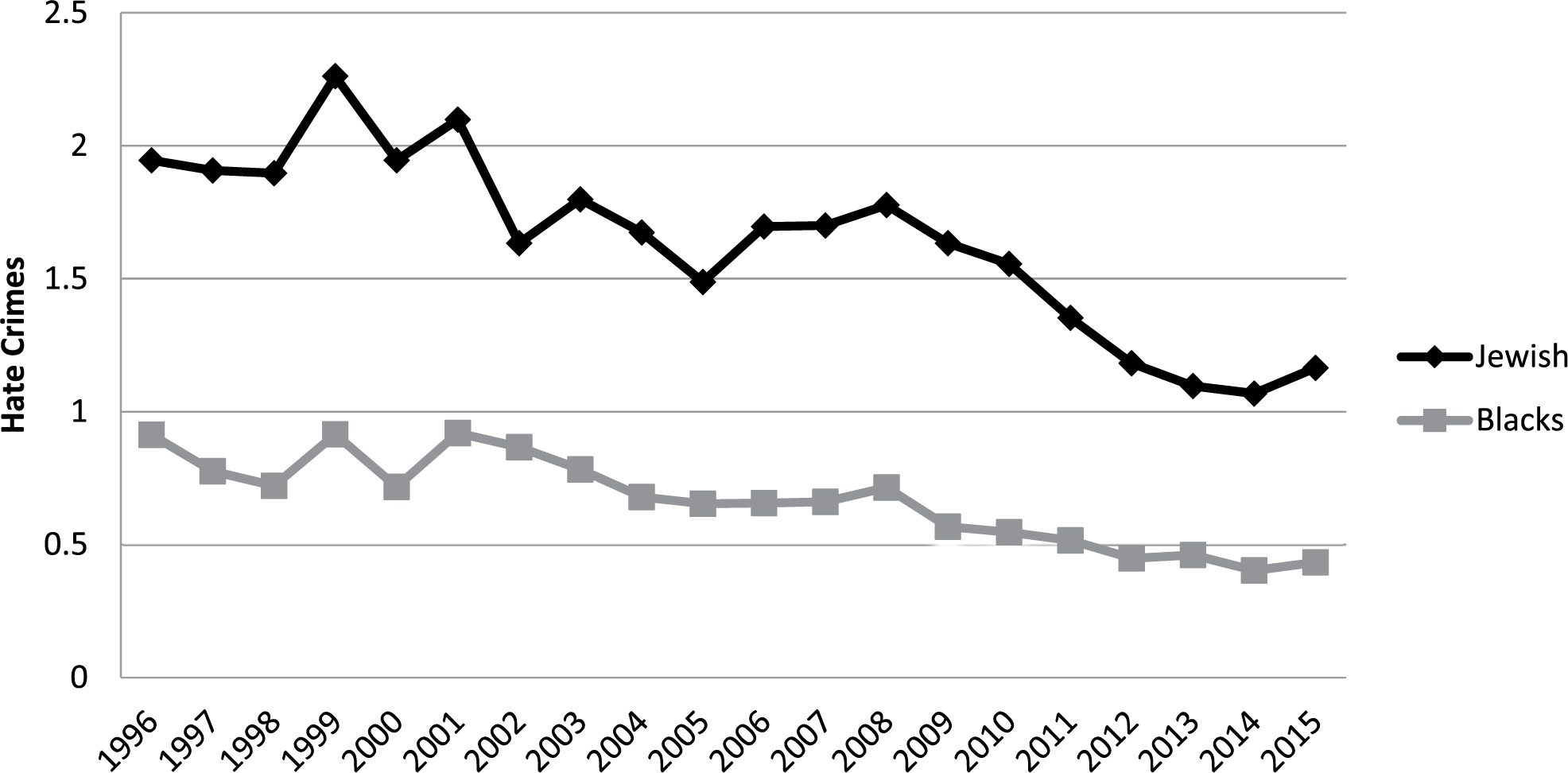
Perhaps most surprisingly, when factoring in population size, Jews and Jewish institutions have proportionally been the targets of more hate crimes than blacks and black institutions in the United States.
Annual reported hate crimes per 10,000 people for American Jews and blacks

Scholars have suggested that variation in hate crime reporting can be explained through several factors. One such factor is the targeted group’s relationship with law enforcement. If that group has trust issues with law enforcement, often from perceptions of disproportionate monitoring and targeting by law enforcement, they are less likely to report hate crime to these authorities (Hendrix et al. Reference Hendricks, Ortiz, Sugie and Miller2007). This affects Muslim, Arab, and black Americans to a larger degree than other racial, ethnic, and religious groups in America. Another important factor that results in the underreporting of hate crime is the immigration status of the target (Bunar Reference Bunar2007). Alternatively, Jews tend to suffer less than other minority groups from these factors that increase underreporting of crime. Nonetheless, American Jewry is the target of such a large number of reported hate crimes, both proportionally and in totality, within the sample, that it represents the ideal group to apply a comprehensive theory explaining ethnoreligious targeting.
Second, for roughly sixty years following the horrors of the Holocaust, America became home to the largest concentration of Jews in the world. Today the United States is home to just under six million Jews, which make up more than 70% of the Jewish diaspora––the total world Jewish population not living in Israel. Consequently, any study of anti-Semitic hate crime in the United States is essential for scholars interested in understanding anti-Semitism broadly, as American Jewry represents such a sizeable portion of the world’s total Jewish population.
Third, anti-Semitism in the United States has proven to be particularly puzzling for scholars and practitioners to explain, in part because of the comparatively favorable experience of Jews in America. Demographic and economic data on American Jews show they continue to attain very high levels of educational achievement and familial income when compared to other ethnic, religious, and racial groups (Burstein Reference Burstein2007, 209). Partially evidencing the successful integration and stability of American Jewry, only a minuscule proportion of American Jews immigrate to Israel compared to the rapidly declining Jewish populations in staple European Jewish communities such as the diaspora in France or Ukraine.Footnote 2 The American Jewish experience is so uniquely positive it has been described as “a blessing for the Jewish people unlike any other blessing given any other people in the world” (Podhoretz Reference Podhoretz2018).
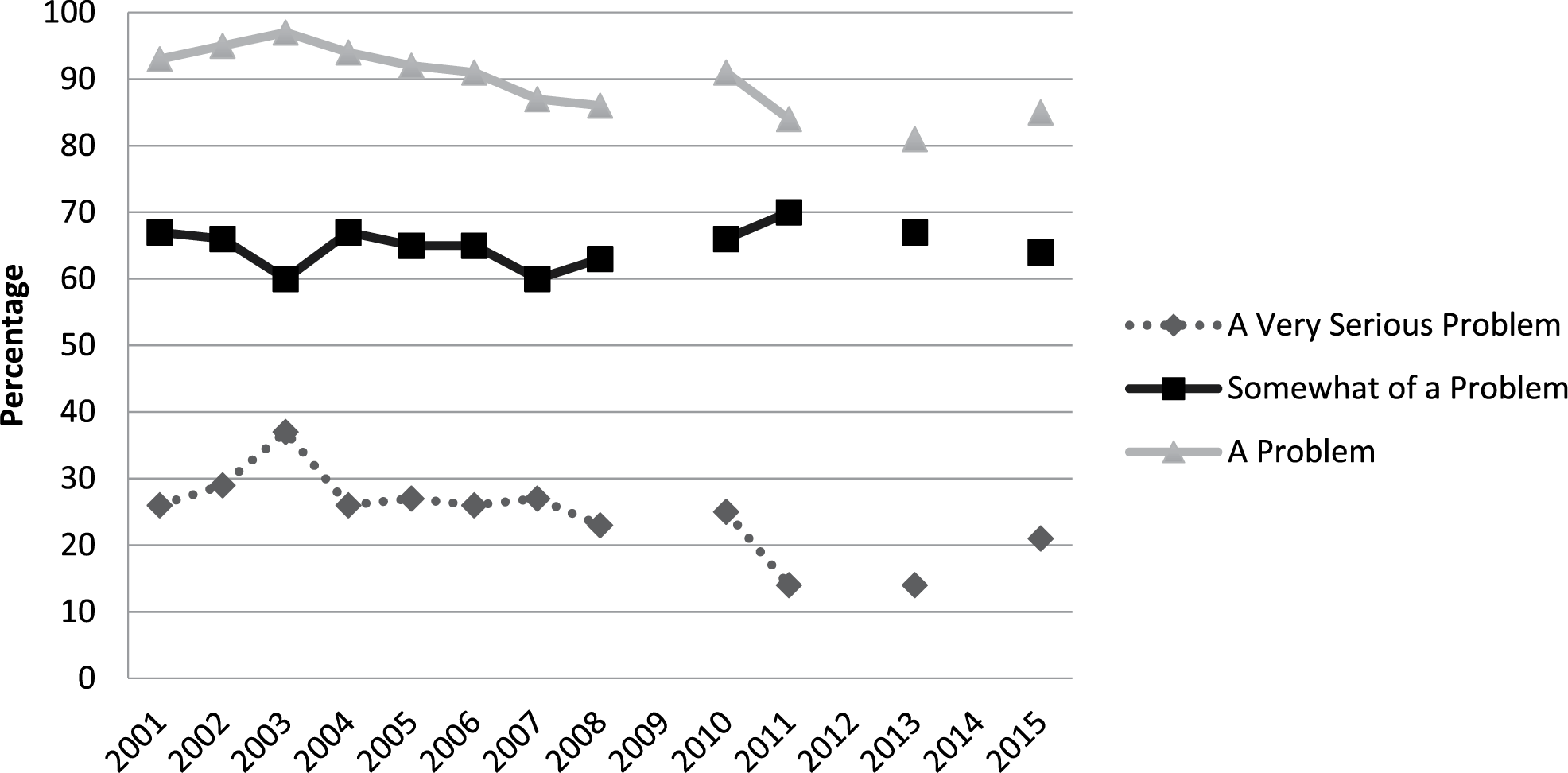
However, American Jews are not without domestic antagonists. According to the Anti-Defamation League’s (ADL) polling, 10% of adult Americans (some 24 million people) harbor explicit anti-Semitic attitudes and beliefs (ADL 2015)Footnote 3. Furthermore, both quantitative and qualitative research focused on the American Jewish experience also suggest that American Jews continue to both witness and experience substantial anti-Jewish prejudice (Dubow et al. Reference Dubow, Pargament, Boxer and Tarakeshwar2000; Goldberg 2000) and remain considerably anxious about anti-Semitism in the United States (Cohen Reference Cohen2010). Cohen also identifies a relationship between anxiety toward anti-Semitism and the number of reported anti-Semitic activities in American Jewry. Figure 4 utilizes data from the National Survey of American Jews taken by the American Jewish Committee (AJC) from 2001–2015.Footnote 4 It confirms that Jews consistently report high levels of concern and anxiety regarding anti-Semitism in the United States in the last two decades.
Percentage of American Jews who believe anti-semitism is a problem
Source: Data from American Jewish Survey (AJC) Survey of Jewish Public Opinion.

Despite a sizeable American population possessing anti-Semitic attitudes and concern over anti-Semitism among the American Jewish community, additional bodies of survey research analysis underscore that Jews are considered a highly respected and integrated ethnoreligious group in the U.S. (Cohen Reference Cohen2010). A recent Pew Poll (2017) shows Americans continue to hold the “warmest feelings” toward Jews among all sizeable religious groups in the United States at 67%, warmer than Catholics at 66%, mainline Protestants at 65, Evangelicals at 61%, and considerably higher than other salient U.S. religious minorities such as Hindus at 58%, Mormons at 54%, and Muslims at 48% (Pew 2017).Footnote 5
Interestingly, it is clear that American warmth towards its Jewish population, the relative success of Jewish assimilation and integration, Jewish appreciation for America, and Jewish economic and educational achievement has not protected Jews from being the most frequent group target of reported religion-motivated hate crimes. Consequently, exploring anti-Semitic incidents in the United States represents both the most challenging and best choice to build a theory of broader religion-motivated hate crime due both to its prevalence and its seemingly enigmatic nature.
Theory
While prior scholarship has theorized how specific factors or mechanisms help to explain variation in minority-targeting events perpetrated by non-state actors, extant literature does not yet combine these mechanisms into a single theoretical approach. Building on empirical research from political science and criminology, I argue there are four distinct, albeit interrelated, concepts that are critical in determining the targeting likelihood of ethnoreligious groups: opportunity, distinguishability, stimuli, and organization. Within these four concepts, group-specific characteristics and explanations of prejudice must be applied. The following section first provides a detailed definition for each of the four concepts mentioned earlier. Following the broad examination of each concept, I continue by explaining how it is applied and advanced through group-specific characteristics.
Opportunity
Opportunity, defined as the demographic characteristics that make a hate crime more likely to occur in a particular location, is one of four key concepts in explaining variations in ethnoreligious targeting. The notion that population size can alter perceptions of group threat goes back to Allport, Clark, and Pettigrew (Reference Allport1954) and Blalock (Reference Blalock1967). There are two key reasons why the size of the target population is critical in determining hate crime likelihood: targeting feasibility and the motive of inducing target group insecurity.
American Jewry, a relatively small ethnoreligious minority group making up under 2% of the total U.S. population, tends to be concentrated in specific states, making their physical presence in many areas nearly non-existent. Interestingly, although Americans exhibit high levels of Jewish population innumeracy, over estimation is not consistently associated with anti-Semitic beliefs (Herda Reference Herda2013). Practically, however, targeting Jewish individuals and institutions are made considerably less feasible in areas where the community is exceptionally tiny or non-existent. To highlight this disparity in targeting opportunity, three states, New York at 26.2%, California at 18.2% and Florida at 9.5% are home to more Jews than all of the other forty-seven U.S. states combined (Sheskin and Dashefsky Reference Sheskin and Dashefsky2013). This disproportionality can be further appreciated when thinking about institutional rather than individual targets. For example, despite being the tenth largest state in total area, as of 2014, there was only one synagogue in Wyoming. Alternatively, New York, the twenty-seventh largest state in square miles, had 1,029 Jewish congregations (Grammich Reference Grammich2012). Domestic terrorism scholarship finds a considerable relationship between perpetrator location and target selection, with Cothern et al. (Reference Cothren, Smith, Roberts and Damphousse2008) showing that half of domestic terrorism incidents occur within a thirty-mile radius of the perpetrator’s residence. However, even when the intended target-group community is distant, some perpetrators have shown the ability to travel great distances to commit their attack, including Glen Frazier Miller, who traveled nearly 200 miles from rural Missouri to Overland Park, Kansas, in order to shoot people he perceived to be Jewish. Simply put, there is greater opportunity for anti-Semitic hate crimes to occur in areas with larger Jewish populations and plentiful Jewish institutions.
However, feasibility alone does not explain variation in hate-crime opportunity. While hate crimes regularly target individuals or single institutions because of real or perceived characteristics that they associate with a group, such attacks tend to be directed at an entire community. Andrew Anglin, the founder of the Neo-Nazi website “Daily Stormer” that receives millions of visitors a month, explicitly shared this motivation there: “Fear. Now is the time for it … . We want these people to feel unwanted. We want them to feel that everything around them is against them. And we want them to be afraid” (SPLC 2019). With the motive of community impact in mind, a potential perpetrator may target areas with larger Jewish populations to more widely and efficiently disperse the effects of their hate. This motivation was central to the proposed 1977 Neo-Nazi march on Skokie––a town of 40,000 Jews (of about 70,000 total residents) including roughly 5,000 Holocaust survivors––and shows the purposeful motive of hate groups directing their animus toward large target communities. In addition to target community awareness, the charged reaction of large and organized target communities to an incident can generate greater publicity, increasing the reach of the individual or group committing the hateful offense.
Hypothesis 1: The larger a state’s Jewish population, the greater the number of reported anti-Semitic incidents.
Distinguishability
Distinguishability also relies on the role that feasibility of an attack plays in determining minority targeting by focusing on circumstances and characteristics that singularize a group. Unlike other minorities whose identity is partially defined by recognized descent-based characteristics, determining who is Jewish is significantly more challenging because of varying definitions of who is Jewish and because physical features are often not group-specific. Additionally, those possessing anti-Semitic attitudes may consider others to be Jewish who do not identify as Jewish themselves.
Chandra (2006, 399), expanding on Horowitz’s (Reference Horowitz1985) seminal work on ethnic identity categorization, notes that ethnic identity definitions are often determined by “information about an individual’s ethnic identity categories––and the categories to which she does not belong––can be obtained through superficial observation.” While Jewish stereotypes have employed a belief that Jews possess specific physical features, these markers are considerably less definitive than ethnic characteristics associated with skin color or other genetic markers. Additionally, while certain Jewish religious denominations are associated with specific dress, most American Jews are indistinguishable from other Americans on that basis. Consequently, those seeking to target Jews may use other identifiers, such as Jewish religious observation to determine ethnic belonging.
While Jews in the United States tend to be less religious than the general public,Footnote 6 many still celebrate four of the most important Jewish holidays, specifically Passover, Hanukkah, and Rosh Hashanah and Yom Kippur, known together as the high holidays. A Pew (Reference Mohamed and Horowitz2013) research survey on religion finds that some 70% of Jews attended a Passover Seder and 53% fasted, at least partially, during Yom Kippur.Footnote 7 Synagogue attendance,Footnote 8 as well as taking off from work or school, is likely to help single out Jewish individuals from other Americans, consequently making them easier to target and making them more likely to be a victim of a hate crime.Footnote 9 This is exemplified by the recent anti-Semitic massacre at the Tree of Life Synagogue in Pittsburgh. The shooter, Robert Bowers, traveled to Squirrel Hill, a neighborhood known to have a large Jewish community, entered a synagogue during Shabbat when Jews attend religious services, and began shooting indiscriminately at congregants.
Hypothesis 2: The number of reported anti-Semitic incidents will increase during widely celebrated Jewish holidays.
Stimuli
Stimuli explains that certain circumstances and events make prejudicial narratives and behavior both more salient and pervasive. Pointed fluctuations of anti-Semitic attitudes or behaviors within a country have been elucidated by substantial vicissitudes challenging the state as a whole; most frequently related to military defeat (e.g., Brustein Reference Brustein2003), sharp economic decline (e.g., Rosenberg Reference Rosenberg1967), and political crisis (e.g., Pulzer Reference Pulzer1988; Wistrich Reference Wistrich2010).
While these aforementioned state-based factors have been important in explaining deterioration in conditions for targeted communities, they have been subject to limited empirical testing. Do negative stimuli still produce a rise in anti-Semitic behavior perpetrated by individuals or organizations in the contemporary United States, where American Jews are well integrated into the political and social fabric of the nation and enjoy the full rights of citizenship unhindered by the state? I argue that certain negative stimuli are likely to result in rises in reported hate crimes.
Petersen (Reference Petersen2002), shows that violence targeting Jews in Eastern Europe varied based on perceived social hierarchy placement. This exemplifies the importance of emotion in patterns of discriminatory actions or ethnic violence and shows that resentment is a key driver of ethnic violence. Furthermore, anti-Semitism is often clearly linked to beliefs in “international Jewish power” (Brym Reference Brym1996, Bergmann Reference Bergmann, Rensmann and Schoeps2008, Bilewicz et al. Reference Bilewicz and Stefaniak2013). In many ways, the stimuli associated with spikes in anti-Semitic beliefs are also those that invoke resentment and conspiratorial notions of control and domination. Poor economic conditions invoke resentment of perceived Jewish wealth and market control, and Israeli conflict violence can exacerbate stereotypes of Jewish power.
Usury is a common form of anti-Semitism and has been used as early as classical antiquity, becoming even more prevalent in the Middle Ages (e.g., Lipton Reference Lipton1999). Jewish association to unethical lending practices, often the result of institutionalized quotas or discrimination preventing Jewish entry into certain occupations, evolved along with industrializing nations, into perceived Jewish connections to a corrupt system of global finance. Shylock has turned into Rothschild and Fagin has become Goldman Sachs. According to the ADL (2015), 16% of Americans (over 50 million people) believe that “Jews have too much power in the business world” and “Jews have too much power in international financial markets.” This belief is predicated on exaggerated, but measurable differences in average Jewish economic attainment in the United States.Footnote 10
There is a considerable debate about if, when, and how economic circumstances perceived to be tied to outgroups play a role in prejudice and discrimination. On one hand, research and empirical findings clearly connect outgroup scapegoating to beliefs of associated economic deprivation (Bilewicz & Krzeminski Reference Bilewicz and Krzeminski2010; Bilewicz et al. Reference Bilewicz and Stefaniak2013), and to prejudicial behaviors and violence (e.g., Glick Reference Glick2002, 113-142). On the other hand, a large corpus of research (e.g., Green, Glaser, and Rich Reference Green, Glaser and Rich.1998; Hainmueller and Hopkins Reference Hainmueller and Hopkins2014) note that prejudicial attitudes and behaviors are not linked to individual economic circumstances. Instead, these scholars argue that ingroup prejudicial attitudes and behavior toward outgroups that they perceived to be threatening are largely driven by sociotropic factors (Legge Reference Legge1996; Hainmueller and Hopkins Reference Hainmueller and Hopkins2014), namely hostility to perceived difference in culture. Still others (Bergmann Reference Bergmann, Rensmann and Schoeps2008) have suggested that while economic circumstances may play a role in anti-Semitism, they matter less than stronger personality predictors like nationalism and authoritarianism.
As a consequence, testing the effects of unfavorable economic circumstances on anti-Semitic hate-crime variation can help to contribute to whether this factor is (broadly) a strong driver of prejudice. However, it is important to note than unlike other forms of economic scapegoating—such as diminished job supply due to cheap foreign labor—economic anti-Semitism tends to be tied to disproportionate influence, control, and wealth. Research has found that these beliefs become more pervasive and pronounced during periods of substantial economic regression and uncertainty, frequently injecting themselves into populist reactions to economic policy (e.g., Kimmel Reference Kimmel2003). For these reasons, I argue that unfavorable economic conditions will increase the likelihood of reported anti-Semitic incidents in the United States.
Hypothesis 3: Unfavorable economic conditions will increase the likelihood of anti-Semitic incidents.
Empirical research has suggested that perceptions of Israel’s military and domestic policies, particularly reported casualties as a result of their military operations, can contribute to anti-Semitic attitudes and motivate perpetrators to commit anti-Semitic incidents. Kopstein and Wittenberg (Reference Kopstein and Wittenberg2018) have shown that Jews with greater connections to Zionism in Europe, even prior to the creation of the modern state of Israel, put them at significantly greater risk of violence leading up to the Holocaust. Closer to the contemporary, Jacobs et al. Reference Jacobs, Veny, Callier, Herman and Descamps2011, find a link between reports of anti-Semitism and Israeli military violence in Belgium during Operation Cast Lead in 2008. In the American context, the ADL (2014) has shown a descriptive link between spikes in anti-Semitic incidents in the United States and Israel’s military operations in the past. This connection between the behavior of Israel, an independent state, and American Jewry, suggests a presumption by perpetrators that American Jews are integrally linked to the policies of Israel and that American Jews may pursue policies that strengthen Israeli–U.S. ties as part of a dual loyalty.
I argue that violent military operations involving Israel are likely to result in increases of reported anti-Semitic incidents for two distinct but not mutually exclusive reasons. The first explanation relies on both real, exaggerated, and fictitious American support and preferential treatment of the state of Israel, which feeds into concerns and narratives ranging from legitimate to anti-Semitic. Second, conflict-induced casualties resulting from Israeli military operations can harden preexisting anti-Semitic attitudes resulting in the radicalization of individuals as well as providing the motivation for existing extremists to target the Jewish community.
Historically, the special relationship between Israel and the United States began at Israel’s birth in 1948, with President Truman becoming the first world leader to recognize the fledgling Jewish state. However, more contemporary narratives point to the array of special privileges that the United States has provided to Israel, including over $140 billion in total aid, special money to develop weapons systems unnecessary for the Pentagon, access to “top-drawer U.S. weaponry,” and exclusive intelligence access (Mearsheimer and Walt Reference Mearsheimer and Walt.2006, 31). Many, including politicians in Israel, see this U.S. assistance as critical to keeping their military edge in the region (Eisenstadt and Pollock Reference Eisenstadt and Pollock2012).
This inimitable connection between Israel and the United States is frequently explained by the strength of the American Israel lobby, more controversially called the “Jewish Lobby” by some, whose influence on American politicians has been ranked second only to the American Association of Retired People (AARP) and ahead of powerhouses like the National Rifle Association (NRA) (Mearsheimer and Walt Reference Mearsheimer and Walt.2006, 41). Israeli military conflict, especially for those fundamentally opposed to American assistance to Israel or the existence of the state itself, can provoke anger at American Jewry’s perceived culpability in the Israeli–U.S. relationship thus making them more likely to be targeted for hate crimes.
Of course, it is reasonable that greater numbers of reported anti-Semitic incidents during violent Israeli military operations are not explained by the Israeli–U.S. relationship exclusively. In a rare study investigating the systematic effects of Israeli conflict on diaspora Jews, Jacobs et al. (Reference Jacobs, Veny, Callier, Herman and Descamps2011) find that the intensity of violence during Operation Cast Lead in 2008–2009 was the single most important exogenous factor in explaining increases in the number of reported anti-Semitic incidents across Belgium. Furthermore, anti-Semitism data from a twelve-country survey completed by the European Union Agency for Fundamental Rights in 2018 show that 69% of the Jewish European participants believe that the Arab–Israeli conflict impacts their feelings of safety a great deal or a fair amount. Consequently, it may be that diaspora populations are blamed for the actions of the homeland, and that no American Jewry-specific narrative is necessary to explaining anti-Semitic incident variation.
I argue that an additional explanation for spikes in anti-Semitic attacks associated with Israeli military operations is reactions to related graphic images of casualties, which are more likely to be broadcast through the media and disseminated online. Bradley et al. (Reference Bradley, Codispoti, Cuthbert and Lang2001), utilizing the defense cascade model (Lang, Bradley, and Cuthbert Reference Lang, Bradley and Cuthbert1997), report that pictures of mutilated victims of violence strongly activated a sense of defensive action such as imminent attack within those surveyed. Such images are frequently distributed by mainstream news sources as well as on social media during Israeli military engagements. For those already subscribing to narratives of a Jewish/Israeli danger to their wellbeing or the security to groups they are tied to, Israeli military conflict and associated violence moves the threat from distant to present, and makes a reactive action more likely.
Hypothesis 4: When Israel engages in a particularly violent military operation, the number of reported anti-Semitic incidents will increase.
Of course, unfavorable economic conditions and Israeli military conflict are not the only stimuli which may result in resentment and measurable increases to anti-Semitic violence. Returning again to the Tree of Life Synagogue massacre in Pittsburgh, the perpetrator was seemingly triggered by news of a Jewish aid organization providing resources for migrants coming from Central America. While Jews are commonly associated with acceptable stereotypes such as being politically liberal, which is backed by empirics since the New Deal, Jewish connection to progressive causes often transcends the political in the eyes of anti-Semites and enters into the world of conspiracy. Consequently, a Jewish group’s resources to help migrants is not seen as a position on human rights but as evidence of nefarious Jewish plans to consolidate global dominance by removing national borders and identities. However, while Jewish groups, politicians, and celebrities have long been tied to liberal political positions, liberal activity and events perceived by white nationalists as threatening are so numerous, their systematic empirical testing is extremely challenging.Footnote 11 For this reason, I choose to more closely examine unfavorable economic conditions and violent Israeli military operations in order to establish the connection between stimuli and anti-Semitic incident variation.
Organization
Hate crimes in the United States are often organized and perpetrated by hate groups or individual members affiliated with them. Hate groups do more than just disseminate racist propaganda. Incidents ranging from vandalizing institutions to targeted violent assault motivated by prejudice often entail encouragement, planning, and participation by these groups. Furthermore, these groups often provide a forum to be recognized and celebrated for hate-motivated attackers. A prime example of likely hate-group related anti-Semitic violence occurred in January of 2018 when Samuel Woodward, a member of the avowed Neo-Nazi hate group called the Atomwaffen Division, was indicted for murdering a nineteen-year-old Jewish university student (Thompson et al. Reference Thompson, Winston and Hanrahan2018). Many Atomwaffen Division members lauded the suspect with praise in private online chats (Thompson and Winston Reference Thompson and Winston2018).
According to the Southern Poverty Law Center (SPLC 2018), there are 892 hate groups currently operating in the United States. Of these, at least 521 of these groups are either primarily motivated by anti-Semitism or are ideologically sympathetic to such ideas. Hate group representation varies considerably across time and within states. For example, from 2001-2014, the nationwide count of the two most prominent anti-Semitic hate groups, Neo-Nazis and Racist Skinheads, ranged from as high as 306 in 2010 and as low as 188 in 2003 (SPLC 2018). California registered the single highest number of anti-Semitic hate groups at 58 in 2008, had as few as 20 in 2004. I argue that the frequency of these groups is essential to explaining the number of reported anti-Semitic incidents within states.
Hypothesis 5: The more anti-Semitic hate groups operating within a state, the greater the number of reported anti-Semitic incidents.
Data and Methodology
Dependent Variable
The dependent variable for my analysis is the number of anti-Semitic incidents occurring in a U.S. state in a given week. To my knowledge, the research of Jacobs et al. (Reference Jacobs, Veny, Callier, Herman and Descamps2011) and Feinberg (Reference Feinberg2019) represent the only articles that use the event counts of reported anti-Semitic incidents as a dependent variable. Their findings regarding the effects of Israeli conflict on anti-Semitic incident variation suggest that weekly counts provide the most appropriate temporal unit to study the phenomenon. Furthermore, a breakdown by state-week allows for greater accuracy in measuring the effects of other important explanatory variables (e.g., Jewish holidays) compared to other options including measures such as state-month.Footnote 12
The UCR data reports more than just a crime’s motivational bias, it also codes the “type” of criminal offense. Beyond utilizing total anti-Semitic incident counts, I aggregate these criminal offense types into two categories: vandalism offenses and violent and intimidation offenses. These two aggregated incident groupings make up the vast majority of anti-Semitic offenses coded in the UCR data. The primary difference between violent and intimidation incidents and vandalism incidents, beyond the nature of the crime itself, is the type of target. Most violent-intimidation offenses target an individual or group of Jews, while most vandalism offenses target Jewish property or Jewish institutions.Footnote 13 Jewish institutions include houses of worship as well as Jewish community centers, Jewish schools, and Jewish cemeteries. This breakdown allows my models to pick up whether certain hypothesized factors and contexts may affect Jewish individuals more than Jewish institutions (or vice versa), which is critical for practical utilization of this analysis such as updating security protocols to protect specific targets.
Independent and Control Variables
To test for the influence of a state’s Jewish population on anti-Semitic incident variation, I employ demographic data from The American Jewish Year Book (DellaPergola Reference DellaPergola, Dashefsky and Sheskin2015), which utilizes state population data from the U.S. Census. This collection of Jewish demographic data is not adjusted with a temporal consistency across states. Furthermore, even when Jewish population changes are reported at the state level within the data, they tend to be minute.Footnote 14 Consequently, it makes sense to use this data as a constant throughout my sample making it eligible only for cross-state analysis.
To account for the influence of Jewish holidays on anti-Semitic incident variation, I code the four most frequently celebrated annual Jewish holidays: 1) Rosh Hashanah, 2) Yom Kippur, 3) Hanukkah, and 4) Passover. Hanukkah and Passover as celebrated over the course of eight days while the period beginning with Rosh Hashanah and ending with Yom Kippur, known as the Jewish high holidays, is observed over ten days. Because incidents are coded at a weekly level, each Jewish holiday falls over the two weeks they are observed in the data and are coded as a 1 with all other weeks coded as 0. Additionally, the Jewish calendar is lunar so the weeks in which these holidays are celebrated change annually. This variation is accounted for in the data.
To test for the influence of unfavorable economic conditions on anti-Semitic incident variation, I use state-level economic data provided by the U.S. Bureau of Labor Statistics. In my models, I code the change in a state’s unemployment rate from the prior month to account for unfavorable economic conditions.Footnote 15
To test for the influence of Israeli military operations on anti-Semitic incident variation, I code all weeks in which a major Israeli military action is occurring that results in at least 100 opposition casualties (B’Tselem 2018) and the week following its completion as 1, and all other weeks as 0. Six Israeli operations met this threshold during 2001–2014: Operation Defensive Shield (2002), Operation Days of Penitence (2004), the Second Lebanon War (2006), Operation Cast Lead (2008–2009), Operation Pillar of Defense (2012), and Operation Protective Edge (2014). These operations span thirty-nine weeks in the data set.
To explain the effects of hate groups on anti-Semitic incident variation, I use hate group data from the Southern Poverty Law Center (SPLC 2018). The SPLC lists the number of active hate groups at the state level in a given year. Furthermore, hate groups are counted through shared mission and allegiance classifications. The two hate groups accounted for in the data are two of the most common and most outwardly anti-Semitic: Neo-Nazi and Racist Skinhead groups. These are not only two of the largest anti-Semitic hate organizations in the United States by typology, but their members are also frequently involved in criminal enterprises and are often convicted of hate crimes.
I also employ several control variables in the model. All years and months in the dataset are dummied out to ensure that potential variation between them are not improperly influencing the findings. Additionally, a state’s populationFootnote 16 has also been dummied out under the assumption that states with larger populations might see greater counts of reported anti-Semitic incidents.
Methodology
Data in this article is formatted to test three dependent variables—total reported anti-Semitic incidents, total reported vandalism anti-Semitic incidents, total reported violent and intimidation anti-Semitic incidents—in a state-week format. Consequently, anti-Semitic events are observed through the use of panel data to better account for unmeasurable or unobserved factors that exist across different states in the dataset.
While several of the hypotheses presented here incorporate data that varies within a particular state, including unemployment rate change, number of Neo-Nazi groups, and number of Racist Skinhead groups, most of the other hypotheses address events, such as Jewish holidays, U.S. presidential elections, and violent Israeli military operations, that do not vary across states. Specifically, the demographic data used here—measuring the proportion of a state’s Jewish population and a state’s total population—only varies across states. Simply put, this results in a hierarchical data concern. The issue of hierarchical data structure exists not only as a result of certain temporal data limitations but also exists at the level of theory. As previously mentioned, the theoretical concept of “opportunity” is dependent largely on the concentration of targets within a specific area (for this analysis, a state). However, numerous factors vary within a state, contributing largely to the theoretical concepts of “stimuli” and “organization.” This creates a complex structure where both place-based hierarchies and temporal hierarchies exist. While considerable political science research has approached these concerns through the use of fixed effects modeling, arguably a “gold standard” for such data in political science (Schurer and Yong Reference Schurer and Yong2012, 1, as cited in Bell and Jones Reference Bell and Jones2015, 133) recent methodological approaches suggest that correctly specified random effect modeling is in fact a preferred choice. Random effects models are favored not only because of their generalizability but because of their ability to extrapolate greater context through the incorporation of both time-invariant and time-variant variables (Bell and Jones Reference Bell and Jones2015, 134).
As a result of specifying the proportion of a state’s Jewish population within the hierarchies of a negative binomial regression as an independent variable requiring random effects, while leaving all other measured independent variables in fixed-effects format, I provide the best contextual analysis in which to test all six hypotheses. This approach is known as a employing a negative binomial regression with mixed effects. Importantly, utilizing fixed effects and random effects in a model together does not alter the direction or critically change the significance of any measured independent variable in the models. Furthermore, all models employ robust standard errors.
Findings
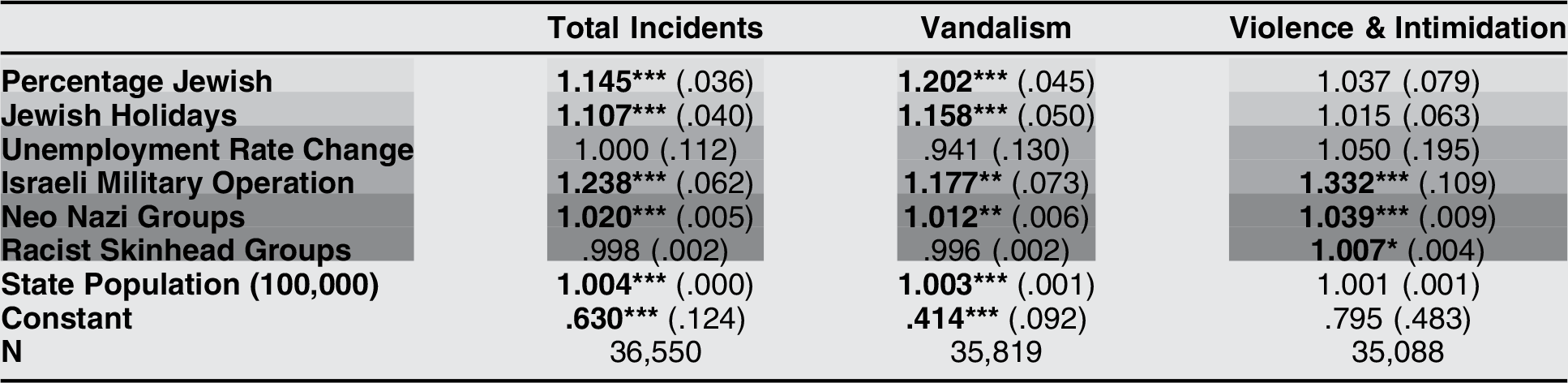
Table 1 reports the findings of three mixed effects negative binomial regression models that also appropriately specify the fixed effects of certain independent variables. Each model utilizes a different dependent variable. The left column reports how each independent variable affects the total number of reported anti-Semitic hate crimes in a state per week. The center column specifically details anti-Semitic hate crimes classified as vandalism in a state per week. The right column utilizes anti-Semitic hate crimes coded as incidents of violence or intimidation. Different variations of grey are utilized in the table’s rows to remind readers that certain variables are testing certain theoretical concepts introduced in this article. The lightest grey row containing concentration of Jews within a state tests the concept of “opportunity”; the light grey row utilizes Jewish holidays to test the effects of “distinguishability”; the grey rows reflect the consequences of “stimuli” as a result of unemployment and Israeli military operations alter reported anti-Semitic incidents; and the dark grey rows comprising of Neo Nazi groups and Racist Skinhead groups examine the concept of “organization.” The white rows at the bottom of the table contain a control for the models, a state’s total population, and report the constant.
State reported anti-Semitic incidents per week (2001–2014)

Mixed effects negative binomial regression with robust standard errors
* p<0.1; ** p<0.05; *** p<0.01
Opportunity (lightest grey), Distinguishability (light grey), Stimuli (grey), Organization (dark grey), Controls (white)
All models report findings through incidence rate ratios (IRR) for purposes of convenience. In each cell within the table the top number is the (IRR) and the bottom number in parentheses is the standard error.
The first model looking at the total anti-Semitic hate crimes reported in a state-week confirms the theoretical expectations that I put forth. All four theoretical concepts discussed—opportunity, distinguishability, stimuli, and organization—play a role in explaining variation in reported anti-Semitic hate crimes. A major component of opportunity, the percentage Jewish population of a state, is critical in determining the number of reported anti-Semitic incidents across states. For every additional percentage point of a state’s Jewish population, the model reports a 14.5% increased likelihood of anti-Semitic hate crimes in a given week. Descriptively, New York State, which has the highest concentration of Jews at 8.91%, suffers an average of 219 reported anti-Semitic hate crimes a year. South Dakota, which is roughly 0.03% Jewish, experiences fewer than one reported anti-Semitic hate crime annually.
During weeks when Jewish holidays are observed, a key measure of distinguishability, states are 10.7% more likely to suffer a reported anti-Semitic incident. This finding confirms the importance that event-based distinguishability has on hate crime likelihood, which is particularly crucial for American Jews, who often have few (if any) physical identifiers, especially when compared to other targeted ethnoreligious and racial minorities in the United States. While certain stimuli such as unemployment rate change do not significantly explain variations in reported anti-Semitic incidents, Israeli military operations have the most substantial influence on anti-Semitic incident variation amongst all variables in the model. In weeks when Israel is engaged in military operations resulting in at least 100 casualties, states are 23.8% more likely to report the occurrence of an anti-Semitic incident. The failure of presidential elections or unfavorable economic circumstances to have a significant effect on reported anti-Semitic hate crime is also valuable information. While these stimuli have historically had an effect on minority targeting and these events are often intimately tied to anti-Semitic narratives or tropes, as measured in the model, they do not result in increased motives to target Jews in America. Organization, as a concept, is also important in explaining variations in reported anti-Semitic incidents. While racist skinhead groups have no significant effects on the total number of reported anti-Semitic incidents and anti-Semitic vandalism, neo-Nazi groups have a considerable role in the targeting of Jews. For every additional active neo-Nazi group within it, a state is more likely to report an anti-Semitic hate crime by 2.0% in a week.
The second model accounts for reported-vandalism anti-Semitic hate crimes in a state. The same explanatory variables meaningful to explaining all anti-Semitic hate crime variation remains significant for vandalism. For every additional percentage point Jewish that a state is, it reports 20.2% more anti-Semitic vandalism. Weeks in which Jewish holidays are celebrated see a 15.8% increase in anti-Semitic incidents, just over a 5% jump from its effect on total reported anti-Semitic incidents. Israeli military operations result in a 17.7% increase and every additional active neo-Nazi group in a state results in a 1.2% increase in reported anti-Semitic vandalism.
The third model, which looks at anti-Semitic violence and intimidation hate crimes, sees certain variables that previously were relevant lose explanatory significance, and others obtain marginal significance. Interestingly, the theoretical concepts of opportunity measured by a state’s Jewish population percentage and distinguishability measured through the weeks where major Jewish holidays are observed do not significantly explain violent and intimidation anti-Semitic hate-crime variation. However, variables representing stimuli and organization remain critical in elucidating anti-Semitic incident variation. When Israel is engaged in a military operation, reported violent and intimidation hate crimes increase by 33.2%. Every additional active neo-Nazi group in a state increases incidents by 3.9% and, for the first time, active Racist Skinhead groups become marginally significant.
Discussion and Future Research
My findings represent a vital first step in the systematic study of ethnoreligious targeting from non-state actors. There are several clear takeaways from the models presented that will help frame the way social scientists systematically study the targeting of ethnoreligious minorities. Measures related to all four theoretical concepts that I proposed—opportunity, distinguishability, stimuli, and organization—significantly help to explain reported anti-Semitic incidents in the United States. The larger the percentage of a state’s population is Jewish, the more potential targets there are for potential hate crime perpetrators. This is especially true for acts of vandalism, which frequently occur at institutional targets such as synagogues, Jewish schools, Jewish community centers, and Jewish cemeteries. Unsurprisingly, larger Jewish population concentrations are prerequisites for these institutions to exist. If possible, future research may consider testing how characteristics of Jewish institutions, beyond just their concentration, affect targeting likelihood. For example, one might hypothesize that Orthodox synagogues make more opportune targets as their members’ attendance is more frequent and the Jews attending are more likely to have distinguishable religious garments such as black frock coats (e.g., bekishes) and hats (e.g., shtreimels). Relatedly, neighborhoods in Brooklyn with extremely high concentrations of Orthodox and Hasidic Jews, such as Crown Heights, have been the target of increasing anti-Semitism including vandalism, intimidation, and violence (Markowicz Reference Markowicz2019). Of particular interest for scholars and practitioners alike is that Jewish population concentration does not seem to strongly influence the likelihood of violence and intimidation targeting. Jews anywhere, not just those in large communities, can be the targets of violence and intimidation incidents.
Distinguishability, like opportunity, is imperative to explaining anti-Semitic hate crime variation within states. Weeks when important Jewish holidays are observed make reported hate crime more likely to occur for several reasons. Jews and Jewish institutions are easier to identify during holidays, and the increase in attention that holiday-observing groups receive can be a drive for action as well. Because an underlying motive behind hate crimes is making the target community feel insecure, hate crimes can have more sizeable effects when target group identity is more salient. This is particularly relevant for American Jewry, who do not frequently attend religious services but more regularly celebrate Passover, Hanukkah, and the high holidays at religious institutions. Jewish holidays create a prime opportunity for those motivated by the desire to make Jews feel unsafe practicing their religion. Future research should explore two queries related to the concepts of opportunity and distinguishability. First, in seeking to expand the possible universality of this research, what role does minority-group size and identifying capability through descent-based characteristics have in determining the salience of opportunity and distinguishability in explaining hate crime? Second, and relatedly, do the features of the locations of Jewish institutions play a role in the likelihood of their targeting? Namely, are Jewish institutions located in urban areas that receive heavier traffic more likely to be targeted than suburban or rural institutions?
The role Israel plays in the targeting of American Jewry contributes to scholarship that examines prejudice and the security of ethnic minorities. Comparative surveys of the Jewish diaspora mainly find that American Jews are measurably less attached to Israel than Jews living in other Western nations like France, Canada, and Great Britain. Additionally, BBC surveys of over twenty countries across several years underscore that contemporary American attitudes towards Israel make the United States one of the most pro-Israel countries in the world (Beauchamp Reference Beauchamp2014). Nonetheless, American Jews as targets clearly correlate with Israeli military conflict activity. This suggests a strong tie between ethno-religious stereotypes and international events that can stimulate someone into perpetrating a hate crime. Just as some have noted a possible link between Islamic terrorism and the targeting of Muslim individuals and groups (Maza Reference Maza2017), Jewish communities, regardless of actual closeness to Israel, are the targets of those seeking punitive action for Israeli operations.
The finding that anti-Semitic hate crime increases dramatically as a result of Israeli military conflicts also contributes to the rapidly growing social science research agenda that examines migrants and diaspora/homeland relations. While a considerable amount of scholarship explores how diaspora play a role in provoking intrastate conflict (e.g., Collier and Hoeffler Reference Collier and Hoeffler2004; Saideman, Jenne, and Gallagher Reference Saideman, Jenne and Cunningham2011), fostering socioeconomic development (Patterson Reference Patterson2006), and influencing domestic politics (Baser and Swain Reference Baser and Swain2008) in their homeland, little is known about how homeland reputation systematically influences the experience of diaspora communities. Shain and Barth (2003, 453) aptly note that “diasporas cannot control their status as perceived members of a remote homeland, and thus become implicated in the homeland’s international affairs.” I provide empirical support for this relationship and the possibility of its negative consequences unrelated to host-state policy or actions. It is my hope that future diaspora scholarship continues to explore how homeland actions and reputation can directly contribute to concerns over diaspora security.
Another major takeaway from this article is the strong effect hate groups operating within a state have in determining the targeting of ethnoreligious minorities, especially violent and intimidation incidents. Although the incident-rate ratio associated with each additional active neo-Nazi group seems relatively small, the number of neo-Nazi groups operating within a state varies quite dramatically over time and can be a significant factor in determining the likelihood of anti-Semitic incidents. Social scientists eager to study minority-group security within countries must continue to explore ways of incorporating the effects of extralegal hate groups. Finally, Americans—who, following the events in Charlottesville, Virginia, are beginning to see past the stereotype that members of organized hate groups are simply backward and unresourceful bigots—must fully recognize the genuine concern these groups pose to ethnoreligious minority security. From a level of policy, limiting the recruitment power, resources, and expansion of hate groups operating within states may result in fewer reported violent and intimidation hate crimes.
By analyzing hate crimes at the state-week unit over a fifteen-year period, I illustrate the universality of what motivates and makes the prejudicial targeting of ethnoreligious minorities more likely to occur. At the level of theory, I contend that scholars should continue to identify factors within the conceptual constructs of opportunity, distinguishability, stimuli, and organization, applicable to all prejudices as well as those that are specific to certain ethnoreligious groups. Furthermore, there is no reason to assume that these theoretical constructs cannot contribute to the systematic study of the prejudicial targeting of minority racial and sexual-orientation groups.
For comparison, scholars should utilize anti-Semitic hate-crime data from other countries with sizeable Jewish populations such as France, Great Britain, and Argentina to determine country-level variables that may play a role in ethnoreligious targeting. Research should also analyze other religion-motivated hate crimes within the United States, most obviously incidents prompted by anti-Islamic prejudices. These future endeavors will be critical to further advancing our understanding of ethnoreligious prejudice and targeting. Furthermore, these studies can continue to provide ethnoreligious minority communities, policymakers, and public security with vital information to help reduce the chances of minority groups becoming victims of hate through the application of proactive measures designed to protect them under circumstances where they are more likely to be targeted.