The argument has often been made that contemporary African ethnicities are products of the ideological experiments and actions of colonial agents including early ethnographers, colonial administrators, missionaries, and converts.Footnote 1 The role of Christian missions in this project is well documented.Footnote 2 For example, John Peel argues that the creation of a Yoruba ethnicity was an evangelical project, the ‘cultural work’ of early missionaries and the Christian Yoruba intelligentsia.Footnote 3 Similarly, Birgit Meyer suggests that the interactions between the missionaries of the Norddeutsche Missionsgesellschaft (NMG) and Ewe mission workers were instrumental to the creation of an Ewe ethnic identity, or as the missionaries termed it, Volkwerdung unter den Ewe.Footnote 4 That there is, in Meyer's words, an ‘intricate relationship between Christianity and nationalist or ethnic identity in the context of colonialism’ in West Africa is undeniable.Footnote 5
The Anlo, the focus of this article, are today considered the westernmost Ewe-speaking peoples. Their chiefdom was one of the better-defined precolonial societies in the region, with sharp definitions of what constituted ‘Anloness’ by the early nineteenth century.Footnote 6 Over the twentieth century, however, Anlo and a number of their other Ewe-speaking neighbours, societies characterised by divergent historical experiences and different cultural practices, came to think of themselves as one people who had shared a single history and unified culture. It is widely argued that mission Christianity played an important role in ushering in a distinctive modernity in Ewe-speaking societies, including Anlo; that this modernity encompassed elements such as engagement with mission schools, acceptance of European cultural norms, and access to the broader colonial economy; and that these cultural and political processes worked collectively over a period of time to create a pan-Ewe identity across disparate groups of Ewe-speaking peoples.Footnote 7
The very idea of the oneness of the Ewe originated within the NMG and initially existed in a discursive space accessible only to their early converts. Such converts functioned as ‘ethnic intellectuals’, in Peel's terms. In addition to being crucial to the spread of Christianity in Anlo, they were also key early advocates of Ewe unity.Footnote 8 However, the strategies employed by these Anlo ethnic intellectuals to promote the idea of eυegbe or Eweness – Christian education, a distinctive cultural modernity, and support for an Ewe political block – did not lead to an uncomplicated reorientation of ethnic identification from Anloness to Eweness, in the manner that much of the academic literature appears to suggest.Footnote 9
The tendency of scholars to focus on the role of mission Christianity in the creation of modern ethnic identities has created two major conceptual shortcomings. First, a divide has been created between non-Christian and Christian religious and cultural processes – in missionary discourse, between the realms of ‘the Devil and the Cross’ – suggesting that each tradition developed independent of the other. Yet, the relationship between non-Christian religious traditions and Christianity in Anlo, as in other African societies, has always been complex. Religious traditions have evolved in tandem with one another and, over the past century and a half, have often been complementary as opposed to exclusive. The introduction of Christianity did not represent a break in Anlo religious history. Rather, Christianity was inserted into local religious concepts and practices, coming to function within the historical dynamics and structural schema of those traditions. Conversion to Christianity did not entail a complete negation of local religious agents. Instead, spiritual entities in the pre-Christian pantheon were reconceptualised and often understood as satanic forces located in opposition to Christianity.Footnote 10
Despite missionary demonisation of all local religious agents, Christians continued to find ways over the decades to incorporate what they believed to be the most desirable elements of pre-Christian traditions into their Christianity.Footnote 11 Proponents of both traditions have always made use of ritual techniques and strategies associated with the other. Christians often consulted priests of local deities, while even the most committed followers of local deities occasionally attended church for spiritual favours. The Anlo situation illustrates that the creation and realisation of an Ewe ethnicity was not solely an evangelical artefact, but a conversation between the realms of the ‘Devil’ and the ‘Cross’. While Ewe as a broad ethnic identity may have been conceived by Christian missionaries and set into motion by Anlo Christianised intellectuals, it, in part, became widely accepted in Anlo through an engagement with non-Christian practices including spirit possession, ancestor veneration, and the building of a certain shrines. Developed seven decades after the introduction of Christianity, these practices aimed to address Anlo concerns about relations with other neighbouring Ewe-speaking peoples.
Second, by overemphasising the role played by Christianised elites in ethnic identity formation, scholars have failed to explain how those described by Peel as the ‘less concerned mass of the ethnic constituency’ engaged with processes set in motion by ethnic intellectuals.Footnote 12 The Anlo case demonstrates that it was members of one of the most marginalised groups in society – slave women from the inland Ewe region – who generated ritual measures that inadvertently encouraged a sense of Eweness among some Anlo, aiding adoption of a pan-Ewe identity. Anlo had looked upon inland Ewe-speaking peoples as their closest ‘Other’ due to a history of warfare and enslavement. The transition in ethnic identification in Anlo from being Anlo to being Ewe involved a reassessment of slaveholding, the practice through which Anlo encountered inland Ewe peoples, especially women.
Enslaved women, as we shall see, engineered this reassessment in order to gain recognition in the ritual sphere from their Anlo masters and, in the process, supported notions of the cultural and spiritual unity of Ewe peoples. Tobias Wendl usefully terms such recognition ‘ritual consciousness’, describing how it provides a platform for people to engage with uncomfortable memories that have been suppressed in mainstream historical consciousness.Footnote 13 In the case of the ritual consciousness generated by slave women in Anlo, their actions resulted in them becoming, like Christianised Anlo elites, proponents of pan-Eweness. This case suggests the need to reconsider the singular importance of Christianity and Christian elites in colonial and postcolonial processes of ethnic identity formation.
BEFORE MISSION, EMPIRE, AND THE NATION: PRECOLONIAL EWELAND
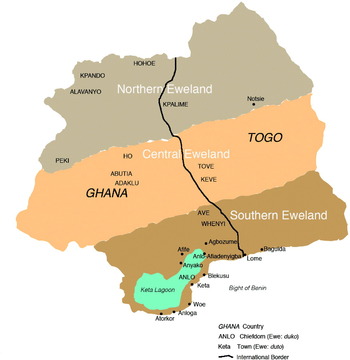
Anlo was one of the better-defined chiefdoms (in Ewe, dukowo; sing. duko) in what is now recognised as Eweland, comprising several city-states (in Ewe, dutowo; sing. duto) administered from the capital Anloga. The Anlo referred to inland Ewe-speaking dukowo located to their north by a number of names including Ewedome and Krepi.Footnote 14 The loosely organised Krepi dukowo were located at a strategic point on the north-south trade routes, the major regional artery between the coast and interior. Trade in salt, fish, and slaves formed the backbone of the Anlo economy in the eighteenth and nineteenth centuries. Anlo merchants frequently made expeditions to the slave markets located at the interface of the forest and savanna belts via Krepi, acquiring a large number of slaves from Krepi and beyond, for both domestic use and sale into the trans-Atlantic trade.Footnote 15
Some of the Krepi dukowo were under the control of Asante, the most significant regional power until the mid-nineteenth century. Anlo remained outside Asante's political boundaries, but maintained friendly ties with the kingdom. Asante collaborated with the Anlo in the 1860s and 1870s in order to reassert their dwindling influence over the trade routes that ran through Krepi. The most extreme period of warfare between the Asante-Anlo alliance and the Krepi dukowo – known as the Peki Wars – occurred between 1869 and 1874.Footnote 16 The number of enslaved people in Anlo peaked in the immediate aftermath of the Peki Wars, due to the large number of prisoners-of-war and slaves captured from Krepi.
Missionaries of the NMG arrived on the Slave Coast in 1847 and, later that year, established a mission post in Peki, the largest of the Krepi dukowo. The post was abandoned in 1853 due to the unstable political situation developing across Krepi. The missionaries retreated to the Anlo port of Keta, soon establishing mission stations in the two Anlo coastal dutowo of Keta and Anyako.Footnote 17 British influence had been growing along the Slave Coast since the 1850s, when the Danes sold Fort Prindsensten (in the vicinity of Keta) to the British. As part of their campaign against Asante, the British attacked and defeated Anlo in 1874. Soon thereafter, European powers separated Ewe-speaking dukowo into two different colonial territories: Peki and Anlo were integrated into the British Gold Coast Colony by the 1890s, while Ho and most of the central Ewe belt became part of the German Protectorate of Togoland by 1884. At the time of this separation, the region's various groups of Ewe-speakers did not conceive of themselves as a single people as they had recently been locked in conflict.Footnote 18
Map of Eweland.

THE INVENTION OF EWELAND: FROM MISSIONARY ETHNOGRAPHY TO ELECTORAL POLITICS IN THE POSTCOLONY
The very term ‘Ewe’ has its origins in missionary ethnography. One of the first missionaries to visit the inland Ewe in 1853, Dauble, wrote that people described themselves as ‘Weme’, meaning people of the valleys, which Dauble transcribed as ‘Eweme’. Another missionary, Bernhard Schlegel, called the language of the entire linguistic cluster ‘Eiboe’. ‘Ewe’, thus, was probably a corruption of ‘Eweme’ or ‘Eiboe’, originating out of early missionaries’ efforts to name the language and peoples among whom they worked.Footnote 19 In tune with Protestant Germanic notions of nationhood, a common language was taken to be the obvious indicator of political and cultural unity, and associated with the ties that bind a nation. Missionary discourse represented the Ewe as not only a cohesive linguistic entity but as having been a single political unit in the past that had recently degenerated into several warring tribes.Footnote 20
Missionaries envisioned their work in paternalistic terms: they aimed to merge the warring Ewe subgroups into one, ‘like our German people’, and ‘to speak in a new tongue’ and in a ‘Christian manner’.Footnote 21 In accordance with this vision of a Christian Ewe nation, paramount importance was placed on standardising dialectical variations in the Ewe language, to serve as a ‘worthy container for the accommodation of the Gospel’.Footnote 22 Schlegel, the first missionary to study the variations between Ewe dialects, prioritised the Anlo dialect, which subsequently came to be widely taught in schools all over Eweland. As part of their nation-building exercise, NMG missionaries began promoting myths that legitimised the unity of Ewe-speaking peoples. The idea of a common mass migration from Ife, followed by settlement at and subsequent dispersal from the walled city of Notsie, gradually gained acceptance across Ewe-speaking groups. Notsie changed in status from being a religious centre famed for the efficacy of its nature spirits to the mythic homeland from which all Ewe peoples had originated.Footnote 23 By the early 1900s, the story of Togbui Agorkoli's oppression of his Ewe subjects, which resulted in their flight from Notsie, was also widely taught in schools.Footnote 24
Anlo intellectuals came to make sense of their past and their situation in West Africa not only as Christians but also as colonial (and later postcolonial) subjects, through reference to biblical accounts and the mission-authored history of the Ewe. The story of Ewe origins has often been inserted directly into biblical narratives: Anlo historians such as Agbotadua Kumassah and Charles Mamattah subscribe to the idea that the Ewe, along with all major African ethnic groups, were descended from Noah's son, Ham; their long migrations took them to areas which correspond to the modern nation-states of Egypt, Sudan, Ethiopia, Mali, Nigeria, the Republic of Benin (Ketu), Togo (Notsie), and finally to their present abode in south-eastern Ghana.Footnote 25 Ewe intellectuals also often draw parallels between the escape of the Israelites from Egypt and the Ewe exodus from Notsie, with the Ewe experience of oppression under Agorkoli's rule equated with the experience of the Israelites in Egypt.Footnote 26 Anlo Christianised elites during the late colonial and early postcolonial periods, in particular, empathised with the sense of marginality expressed in these biblical narratives as they felt politically neglected first, on the fringes of the Gold Coast Colony and, then, in the modern nation-state of Ghana.Footnote 27
The Christianised Ewe intelligentsia produced two political movements between the 1910s and 1950s that owed much to the NMG conception of Eweness. Each of these movements metamorphosed into a political party, these parties making use of pan-Ewe sentiments to varying degrees. Anlo attitudes to these two movements are indicative of how uncomfortable they felt with Eweness as a badge of identity.Footnote 28 The first party that made use of pan-Ewe rhetoric was the Togoland Congress (TC), which advocated the reunification of British- and French-ruled Togolands that had been formed following Germany's defeat in the First World War and its dispossession of overseas colonial territories.Footnote 29 The TC was keen to exclude the Gold Coast Ewe, the Anlo, and the Peki, mainly because they were fearful of creating an Anlo-dominated grouping as the Anlo-controlled regional trade networks.Footnote 30 As a result, Anlo elites paid little attention to the TC.
The second movement was the All Ewe Conference (AEC), established in 1946. The AEC aimed to unite all Ewe-speaking groups across the Gold Coast and the parts of Togo under British auspices.Footnote 31 The Accra-based Anlo intellectual, Daniel Chapman, was one of the founding members of this party. Drawing on the legacy of the NMG, the AEC evoked a sense of Eweness – belief in the unity of Ewe culture, common customs, and a shared origin and history – to justify its project. The AEC appealed to Anlo Christian elites, such as Anlo's first mission-educated paramount chief, Togbui Sri II.Footnote 32 For the Anlo elite who supported the AEC, Eweness and Christianity were part of the same package: as Christians, they thought of the Anlo as part of the larger Ewe nation as conceived by NMG missionaries, a nation that could prosper only as a single harmonious unit.
In accordance with this mission-inspired definition of Eweness, Anlo advocates of the AEC tried, albeit with little success, to gather support for the movement's pan-Ewe politics in Anlo as well as to forge ties with Ewe-speaking groupings to the north. They were unsuccessful on both fronts. The idea of cultural or political unity with inland Ewe was inconceivable to most Anlo on account of the recent Peki Wars. Moroever, inland Ewe groups, especially the Peki, viewed the pan-Ewe politics of some Anlo elites as covert attempts to exert political, economic, and cultural hegemony in the subregion. In reality, the pan-Ewe politics of Anlo elites, such as Togbui Sri II, arose out of the need to safeguard their traditional trading ties with coastal Ewe groups to their east, as the exchange of goods and commodities had come to be threatened by embargoes imposed at the border between the Gold Coast and the Togolands.Footnote 33
Support for pan-Ewe politics, including bodies like the AEC, dwindled in the 1950s not only in Anlo but across Eweland. The formation of the modern nation-states of Ghana and Togo in 1957 and 1960 changed the political landscape in the region completely, contributing to the evolution of different conceptions of Eweness in the two countries. A transnational Ewe identity held little political credence in the early postcolonial era as Ghanaian and Togolese Ewe became more concerned with negotiating ethnic alliances and rivalries within their newly formed nations.Footnote 34 Within Ghana, Anlo's relationship with their immediate Ewe-speaking neighbours changed significantly. The new political reality left them disconnected from their traditional eastern coastal allies (who were now in Togo) while the dynamics of ethnic clientalism in Ghana, encouraged them to cultivate new alliances.
In postcolonial Ghana, a clear ethnic fault line has been visible between the two main political traditions, currently represented by the National Democratic Congress (NDC) and the National Peoples’ Party (NPP). Coastal peoples such as the Fanti and Ewe support the NDC and position themselves against the NPP which is mainly supported by the inland Asante-dominated Akan belt.Footnote 35 The NDC is associated with arguably the most controversial figure in postcolonial Ghanaian history, Flight Lieutenant J. J. Rawlings who, in 1979, seized power in a military coup and remained head of state until 2000. Rawlings is an Anlo from Keta and his administration was often accused of Ewe and, in particular, Anlo ‘tribalism’.Footnote 36 In the five elections held between 1992 and 2011, the NDC has routinely secured an overwhelming majority of the popular vote in the Volta Region, which roughly corresponds to the Ewe-speaking belt.Footnote 37 Among the districts that have supported the NDC in the northern Volta Region are those that comprised the Krepi dukowo which had been antagonistic to Anlo in the nineteenth century. The NDC, although backed by several other ethnic groups in Ghana, is the closest the various Ewe subgroups in Ghana have ever come to supporting a single political movement.Footnote 38 In postcolonial electoral politics, Anlo have aligned themselves with their former slaves (the inland Ewe peoples) in opposition to an Asante-led inland Akan grouping (their military allies in the nineteenth century).
That the Anlo have been at the forefront of creating a unified Ewe political identity in Ghana, after pan-Ewe politics received a lukewarm reception in their chiefdom during the colonial era, is noteworthy. The reasons for the failure of pan-Ewe politics in 1940s Anlo are twofold. First, the idea of Eweness was ideologically meaningful to Christian Anlo but it meant little to the non-Christian Anlo, the majority of ‘the less concerned mass of the ethnic constituency’. Second, and relatedly, many Anlo during the 1940s could not conceive of themselves as members of a larger Ewe grouping due to the recent Peki Wars. During that conflict, the Anlo captured a large number of inland Ewe-speaking peoples who became incorporated into Anlo society as slaves, making them the Anlo's most intimate ‘Other’. These inland Ewe slaves represented all things un-Anlo: they did not exist as social beings outside their roles as slaves, making them the very antithesis of Anloness in the Anlo imagination. However, by the turn of the twenty-first century, the idea of a pan-Ewe identity had become well established in Anlo, as evidenced by developments in the political sphere. One means by which this shift occurred in Anlo ritual consciousness was through slave women encouraging Anlo to forge spiritual and social ties with their inland Ewe neighbours.
SLAVERY IN ANLO
Domestic slavery was widely practised in precolonial Anlo. Like most slaveholding societies in West Africa, the Anlo exhibited a preference for slave women, with slave men being sold into the trans-Atlantic trade.Footnote 39 Most slave women in Anlo were ethnic outsiders, captured in warfare or bought at slave markets. As outsiders, slaves lacked all the cultural attributes of Anloness: they were not born in Anlo, they did not speak Anlo as their mother tongue, they did not have Anlo ancestors or worship Anlo deities, and they did not have Anlo kin. Considered the property of their Anlo masters, such women had few social rights. A slave was referred to by a number of terms: dzikpleadu (pl. dzikpleaduwo), literally ‘one who was born with teeth’, describing a person acquired not at birth but later in life, especially during late childhood; nkekevi (pl. nkekeviwo) and dogbevi (pl. dogbeviwo), both of which referred to a child conceived or purchased during the day (when most trade is conducted) instead of at night; and amefefle (pl. amefeflewo), indicating a bought person. All these terms contrast being born with being bought or captured, emphasising that slaves obtained their social roles in Anlo not through birth but enslavement.
Anlo men frequently married foreign slave women who were valued for their reproductive and productive abilities. As land was scarce in Anlo, prestige and wealth were acquired through control of people, making slavery an effective means for enlarging local lineages. Although Anlo was a patrilineal society, matrilineal kin competed with patrilineal kin for influence over individuals. Anlo men often preferred marrying slave wives because they lacked local kin. Once married, Anlo slaveowning families integrated slave women into their patrilineages through cultural and ritual mechanisms. They expected them to speak the Anlo dialect, observe Anlo laws and customs, and become ritually tied to the gods and the ancestors of the patrilineage. Moreover, Anlo fathers, and by extension the patrilineage, exerted complete control over the resulting progeny as such offspring lacked matrilineal connections in the chiefdom.Footnote 40 On account of their Anlo fathers, the children of mixed unions did not retain their slave status. They were thoroughly Anlo-ised, and integrated into Anlo patrilineages as junior kinspeople. While memory of their mothers’ slave status was kept alive through the absence of local matrilineal kin, descendants of such slave and non-slave unions were thoroughly assimilated as full members of Anlo society.Footnote 41
Anlo had enslaved many peoples over three centuries including Dagomba, Gonja, Hausa, Tchamba, and Losso from the northern savanna; Akan from the forest belt; and inland Ewe. By the 1870s, most of the slaves acquired through the north-south trade were but a memory in Anlo society, their descendants absorbed into Anlo's patrilineal kinship structures. The total population of non-Anlo born slaves, however, peaked in the aftermath of the Peki Wars. These slaves were predominantly inland Ewe women, carried away from the Krepi dukowo during the 1870s and married to their Anlo owners. After the British proclamation of 1874 abolished ‘slave’ status in the Gold Coast colony, some ex-slaves sought to move back to their original homes to live among their own kin. This proclamation was not well-received in Anlo where slaves were reportedly killed when they attempted to return to their homes.Footnote 42 Moreover, many in Anlo believed that slaves who escaped would die soon afterwards as a result of severing ties with the deities of their adoptive patrilineages.Footnote 43 Fearing such retribution, many inland Ewe slave women remained in Anlo. David Nyamesi of Anlo-Afiadenyigba, a town with a population of approximately 7,000 where I conducted ethnographic research on memories of slavery between 2003 and 2011, explained his slave great-grandmother's dilemma:
My great-grandmother Ama was brought to Anlo-Afiadenyigba after the Peki conflict when she was about six or seven years old along with her two sisters, who also became slave wives to my patrilineage. They hailed from Wumenu, [a village near Ho]. She had three sons for her husband (my great-grandfather), of which my grandfather Kwaku Nyamesi was one.
There is a very strong deity in our family called Mawuchoo. Ama was put under its control as soon as she came here and married her owner. This tied her to her husband and his ancestors and lineage. Her husband knew what she was thinking as a result of the magic of the deity. He knew when she was unhappy. He knew when she looked at or thought about other men. He knew when she contemplated escape. If she left her husband's household, Mawuchoo would have either brought her back to Anlo or killed her. So Ama was frightened. Ama never went back [to her natal home], but died here in Anlo.Footnote 44
This family history reveals how, following the British proclamation of emancipation, ritual strategies worked to detain slave women in Anlo where they, in effect, remained enslaved.
Yet, by the start of the twentieth century, religion in Anlo was on the brink of change. Religious movements from the north swept into the area and the very slave women who felt intimidated by Anlo ritual tactics soon used similar means to exert influence over their Anlo masters and descendants. Through crafting ritual and religious processes that fused local distinctions between local and foreign, master and slave, and Anloness and inland Eweness, slave women reconfigured their position in Anlo society. It was this reconfiguration in ritual consciousness that would help strengthen the developing discourse of pan-Ewe identity in mainstream Anlo political and cultural consciousness.
THE WRATH OF THE SLAVES: WITCHCRAFT AND GODS, C. 1910–50
About seven decades after Christianity came to Anlo, two new religious movements entered the chiefdom from the north. The first wave entered in the 1910s and was associated with deities who had their ritual hubs in the savanna belt that roughly corresponded to the Northern Territories of the Gold Coast Colony. Before they made an appearance in Anlo, the popularity of these gods had reached epidemic proportions in Asante and the broader Akan forest belt. Abrewa, Kunde, Senyakupo, Sacrebode, and Tigare were some of the savanna deities that enjoyed brief but intense spells of fame in Akan areas between approximately 1890 and 1930.Footnote 45
The explosion of interest in these savanna deities coincided with increased concern about witchcraft in many areas of the Gold Coast. In the Akan forest belt especially, the introduction of cash cropping and integration into the broader colonial economy led to rapid social change resulting in the emergence of new wealthy elites. These elites challenged established social hierarchies and transformed the very structure of society. The success of these nouveau riches raised suspicions that they used witchcraft to restrict the reproductive ability and success of others.Footnote 46
Fearful of becoming victims of witchcraft during this period of socioeconomic turmoil, many Akan searched for spiritual security. They observed that societies of the northern savanna had not experienced change as tumultuous as that in the southern Gold Coast, and that witchcraft and witchcraft accusations were conspicuously absent in those societies. Akan observers concluded that powerful anti-witchcraft deities had protected northerners. Consequently, many Akan adopted deities of savanna peoples to combat the witchcraft pandemic in their region.Footnote 47 These northern deities were ‘Akanised’ in the forest belt, metamorphosing from their original form into a corpus of anti-witchcraft techniques that included the use of protective charms, amulets, and medicines. Akan enthusiasm for these resources facilitated their spread to southern neighbours, including Ga and Ewe peoples. By the late 1910s, Anlo had effectively incorporated these ritual techniques into their religious system to combat witchcraft-related problems. These techniques eventually came to be known in Anlo – and neighbouring coastal Ewe societies – as Atikevodu or Gorovodu.Footnote 48
The second distinct religious movement arrived in Anlo during the 1920s. It was centered on a deity from Kete Krachi, a town located north of the Ewe-speaking region. Kete Krachi was home to the famous Dente shrine and its oracle, known as the Dente Bosomfo, regarded as a successful war oracle in the subregion.Footnote 49 The Bosomfo's power lay in his control of the major trade routes that accessed large inland markets such as Salaga. Threatened by the Bosomfo's influence, the Germans captured and executed him in 1894, destroying his shrine and exiling most of his entourage.Footnote 50 Kete Krachi passed from German to British hands after the First World War, becoming part of British-mandated Togoland. Although the British monitored religious cults closely, they allowed the Krachi people to resurrect Dente worship, believing that suppressed cults surreptitiously worked to the detriment of colonial authority.Footnote 51Dente worship was officially reinstated in Kete Krachi in the early 1920s, resulting in the establishment of several smaller satellite shrines dedicated to the deity in the central and coastal Ewe-speaking regions including Anlo. Small-scale religious entrepreneurs, functioning as freelance ritual specialists typical of West Africa's religious landscape, established these satellite shrines.Footnote 52 In Anlo, the growth of Dente worship was part of a broader embrace of ritual resources and particularly anti-witchcraft remedies from not just the savanna but all societies to the north.Footnote 53 At its origin in Kete Krachi, Dente was an oracular cult in which state leaders and individuals consulted the Bosomfo in moments of crises.Footnote 54 Yet, as with Gorovodu, Dente worship in Anlo initially sought to address witchcraft-related concerns.
This dramatic transformation in Anlo's religious landscape became a grave concern for colonial officials in Anlo. In 1939, a troubled police officer notified the secretary of native affairs that ‘34 places in 31 villages where there are Kunde houses have been visited … Each village has over 200 worshippers. It is estimated that at an annual festival of the fetish at Adina, more than 6000 worshippers attend.’Footnote 55 Some Anlo were just as perplexed by the influx and appeal of these deities from the savanna and from Kete Krachi.Footnote 56 Anlo religion is a cumulative depository of deities and ritual techniques, acquired as a result of migrations, travel, trade, conquest, and warfare. Deities and techniques are received into the religious matrix, coming to be reorganised over time into cults or belief systems, metamorphosing both structurally and functionally to address local existential and religious concerns.Footnote 57 While Gorovodu and Dente were by origin from the savanna and Kete Krachi, they were layered systems of knowledge by the time they reached Anlo, having incorporated features from the Akan and inland Ewe cultural zones during the course of their cross-cultural passage. In Anlo, they would once again be transformed to address specific spiritual concerns.
The Anlo believed – and continue to believe – that they have a limited degree of agency in choosing the spiritual entities they worship. Rather, they are led towards particular deities and ancestral spirits, either by accident or as a result of individual or collective actions. Komla Donkor of Anlo-Afiadenyigba explained the panic created in Anlo by the influx of these new northern religious forms in the late 1920s:
My grandfather did not know why so many members of our patrilineage were attracted to these strange northern forms of worship. Instead of becoming Christians or instead of worshipping our own Anlo gods, members of my patrilineage were, for some reason, being drawn to practice these northern rituals, such as drinking strange medicines and manufacturing magical objects. When they stopped doing these things, members of the family become sick and died. This was happening not just to members of our partilineage, but to people all over the town. My grandfather and his contemporaries were mystified. Why were these rituals from far northern lands and Kete Krachi so important for our survival? It was like we were under some kind of spell. We, in Anlo, did not know much about those distant lands, as we had never been there. However, several of our ancestors had travelled to the savanna and to Kete Krachi, mainly to purchase slaves and to make war. Our slave women hailed from there. So we began to wonder if there was some connection between slaveholding and this mysterious new religion. Most of us affected in this way had another thing in common: we belonged to slaveowning lineages. Then we felt sure that the slave women must know something about this.Footnote 58
As Donkor's account indicates, some Anlo made sense of the arrival of this ‘new religion’ through their chiefdom's prior relations with northern peoples. Anlo associated both the northern savanna (the home of Gorovodu) and Kete Krachi (the location of the mother Dente shrine) with their slaves.
To assist in managing these new religious forms during the 1930s, Anlo turned to their female slaves born in inland Eweland. A slave woman named Ablesi is credited with first managing the situation in Anlo-Afiadenyigba. Ablesi hailed from a village in the Peki area but was enslaved by Anlo warriors in the 1870s when she was a young child and brought to Anlo-Afiadenyigba. She married her owner, a man from Anlo-Afiadenyigba, and eventually bore him three children. A member of Ablesi's husband's patrilineage first brought Dente worship to Anlo-Afiadenyigba. Soon after, several members of his patrilineage followed his lead, believing too that they needed to appease Dente. Seeking to understand why unfamiliar non-Anlo divinities had gained adherents in their household, members of the patrilineage were intrigued when Ablesi revealed she had memories of Dente being worshipped in her ancestral village in northern Eweland. Encouraged by her Anlo owners, Ablesi travelled to her native village and then to Kete Krachi to collect more information about Dente worship.Footnote 59
Upon returning to Anlo-Afiadenyigba, Ablesi explained that dissatisfied slaves and their gods were behind the appearance of both Gorovodu and Dente. Gorovodu was, according to Ablesi, a collection of deities from the northern savanna who were worshipped by slaves of Losso, Hausa, Kabye, and Dagomba extraction while Dente, in her opinion, was a god from Kete Krachi that northern and inland Ewe peoples worshipped. She argued that slave ancestors, along with their gods, had attached themselves to potential devotees in Anlo to demand full social recognition of their (Anlo) descendants. Slaves in Anlo, according to Ablesi, were dissatisfied with being rendered largely invisible members of society, being forced to accept Anlo cultural practices, and, upon their deaths, being buried haphazardly without proper rituals. Ablesi went on to insist that the slave ancestors and their gods should be accorded the respect they deserved by the establishment of shrines dedicated to them all over Anlo. She proposed that a certain type of worship, which erased this cultural wrong, be established in Anlo-Afiadenyigba. In response, a shrine – the first of its kind – was constructed in the Nyerwese division of Anlo-Afiadenyigba in the late 1930s where Anlo slaveholding lineages gathered together to worship their slave ancestors and their gods.Footnote 60
Ablesi's role as interpreter demonstrates how inland Ewe slave women were critical to the formation of a cult that aimed to address the aftermath of slaveholding in Anlo. The rituals promoted by such women amounted to a bold strategy to write themselves and other slaves into local history by exploiting Anlos’ ritual fear of unknown northern forms of worship.Footnote 61 These slave women suddenly found that the attitudes of their Anlo masters had changed towards them: they were no longer treated with indifference but became valued members of society whose help was needed to avert a spiritual crisis. This unexpected series of events began with the arrival of mysterious ritual techniques and ended with public recognition of the social value of slaves and their ancestors.Footnote 62 These practices were instrumental in erasing the cultural and political differences between inland Ewe and Anlo peoples, thereby facilitating the spread of a pan-Ewe ethnic identity.
FOFIE PRACTICES: THE PERFORMANCE OF EWENESS IN ANLO
I belong to a slaveholding patrilineage. My grandmother was an Ewedome [inland Ewe] woman. I believe my patrilineage also enslaved many other women from the Ewedome lands and the savanna, in addition to the grandmother I knew. I know all about my Ewedome ancestors but little about the ones from the savanna, as the latter were brought to Anlo a very long time ago.
I have a shrine which is dedicated to all my Ewedome ancestors as well as all the other forgotten slaves our patrilineage kept. In fact, we, the Anlo, never thought we had anything in common with other inland Ewe-speaking people – until we realised we had enslaved them, married them, they had given birth to our children, and have now become our ancestors! Without our ancestors – especially our slave ancestors – we are nothing.Footnote 63
Dente – better known as Krachi Dente or Fofie in contemporary Anlo – evolved into a set of religious practices through which Anlo renegotiated the relationship between themselves, and their slave ancestors. Rituals associated with the worship of Fofie revived and continue to revive the memory of slavery in Anlo.Footnote 64 Historians have described how, as early as the nineteenth century, some Anlo possessed the means to address the consequences of slavery; a cult also called Fofie was dedicated to slaves who died in the chiefdom.Footnote 65 The Dente cult from Kete Krachi and this older Fofie cult merged, probably in the 1930s, into a corpus of practices that addressed the more disturbing effects of the aftermath of domestic slaveholding.Footnote 66
In explaining the influx of northern deities into Anlo, Ablesi pointed to the slave ancestors and their gods, who were angered by their marginal social status and mistreatment of slaves in Anlo through the generations. According to those I interviewed, members of eighty slaveowning lineages – a considerable section of the town's population – began reflecting on the consequences of their slaveholding. Fofie worship became a means to prevent future retribution from slave ancestors. Enslaved inland Ewe women assumed centre-stage in this process of historical reconciliation, instructing Anlo slaveholders how to appease their slave ancestors and deities. The Fofie shrine in Nyerwese, established upon Ablesi's recommendations, came to house objects associated with the Peki Wars and inland Ewe slaves. These objects, including a stool carried away from the inland areas during the wars and several personal items belonging to enslaved Ewe women, assumed great ritual importance. Upon the recommendations of slaves, Fofie worship grew to encompass the dedication of women to slave deities, the construction of shrines where slave ancestors could be revered, and the forging of marriage ties with the areas from which slaves originated.Footnote 67
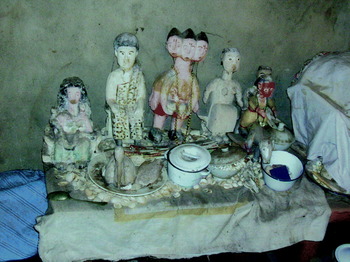
A typical household shrine in Anlo-Afiadenyigba, belonging to a Fofie worshipping lineage that formerly owned slaves, depicting the divinities (both imagined and real) of the peoples they once enslaved (photo: Meera Venkatachalam, August 2005).

Many slaveholding lineages began dedicating one female family member in each generation to the full-fledged worship of these entities. They believed and some still believe that these women, known as fofiesiwo (sing. fofiesi), are under the influence of dissatisfied spirits of slave ancestors.Footnote 68 The various anti-witchcraft movements which the Anlo collectively referred to as Gorovodu – Kunde, Abrewa, Senyakupo, and Sacrebode – came to be widely regarded as gods of the slaves that possessed fofiesiwo.Footnote 69 These slave spirits speak to their audiences/descendants not in Anlo but in the tongues of their homelands including northern savanna languages, Twi, and, predominantly, northern Ewe dialects. During possession ceremonies, a new form of incorporation occurs, with these spirits and their gods temporarily reemerging in Anlo through the bodies of their Anlo descendants. The conceptual differences between spirits and spirit-hosts, slaves and owners, and non-Anlo and Anlo are temporarily erased through possession as Anlo fofiesiwo merge with their inland Ewe slave ancestors.
Nyomesi was the first woman, under Ablesi's influence, to become a fofiesi and dedicate herself to the worship of slave ancestors. Nyomesi was possessed by her grandmother, a slave woman who had been abducted from Peki in the 1860s. While Nyomesi passed away in 1988, I became acquainted with her children and members of her patrilineage at the start of my research in Anlo-Afiadenyigba in 2003. As Anlo believe that each fofiesi must be replaced by another member of her patrilineage to keep the memory of slave ancestors and their gods alive, Nyomesi's niece – her brother's daughter – was initiated into the cult in 2001. Relatives believed that this niece was under the influence of her deceased aunt, her northern Ewe slave ancestors, and their deities. Like all fofiesiwo, she took on a new name and identity after her initiation into the cult, becoming known as Metumisi, a supposedly Akanised name from northern Eweland.Footnote 70
In the 1940s, fofiesiwo, in collaboration with other members of their patrilineages, began reimagining what slave ancestors and their gods may have been like. Slaveowning lineages also established household shrines, some of which still exist, meant to house those gods and to compensate for ignoring them over several generations. At the altars of household shrines, idols purportedly depicting northern Ewe gods stand alongside the deities deemed to be Hausa, Tchamba, and Dagomba. The ancestors depicted vary greatly from shrine to shrine, depending on the nature, inclinations, and ethnic origins of the patrilineage's slave ancestors. These ancestors are both real and imagined. Those from the northern savanna are largely imagined, while those from the inland Ewe regions are the very slave women who helped in the institutionalisation of Fofie worship.
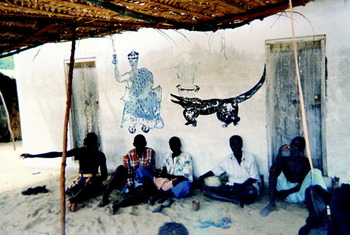
Krachi Dente/Fofie shrine in Nyerwese (photo: Meera Venkatachalam, August 2003).

In a further attempt to reinsert these inland Ewe ancestors into historical memory, Fofie worshipping lineages, in the 1950s, sought to determine the origins of their former slaves through contacting relatives in their home areas. Although they were unable, largely due to their more chronologically distant enslavement, to locate the areas from which their northern savanna slaves hailed, most Fofie worshipers believe that they have located the precise homes of their enslaved ancestors who were captured in central and northern Ewe enslaved during the Peki Wars. For example, Elias Agboado, a retired school teacher from Anlo-Afiadenyigba, has traced the home of his paternal grandmother, an enslaved woman captured during that period, to Gane, a small village outside of Ho. After this grandmother and her enslaved co-wives died in the late 1930s, members of the Agboado family, following the advice of newly initiated Fofie devotees, travelled to the Ho area to identify Elias Agboado's grandmother's relatives. The two families subsequently maintained strong ties and, in the early 1970s, Elias Agboado married Grace Dotse whose paternal grandmother was the sister of his enslaved grandmother.Footnote 71
Other Anlo men have also been encouraged to marry women from the families of their inland Ewe slave ancestors. In 2004, I came across eight inland Ewe women living in Anlo-Afiadenyigba who were related to deceased slave women of their husbands’ patrilineages. As a mark of reciprocity, some Anlo women have also married spouses from the households of their slave ancestors. Marriages such as these have allowed patrilineages in Anlo to keep the memory of their slaveowning past alive as well as cement ties with kin in the broader Ewe-speaking region. These moves, which amount to broadening kinship ties to include inland Ewe, are seen to foster a sense of Eweness, as indicated by Elias Agboado's account:
Several Anlo families, like my own, are well-connected with Ewedome [inland Ewe] regions. My family enslaved Grace's grandmother three generations ago. We continue to maintain ties with those Ewedome people, because, we are all basically the same people. Grace is not a slave wife like her grandmother was to my grandfather, but a legitimate partner. Ewedome gods are our gods, their ancestors are our ancestors. In Fofie shrines, we worship those slave ancestors and revere them just as we would our own Anlo ancestors. We, the Anlo, and the inland Ewe are more similar than different: we speak the same language and have similar cultural traditions; we are all one big family, descendants of the same people who fled Notsie. We must maintain ties with the inland Ewe peoples, as not only are we related by blood as a result of marriages in the past and present, but the Ewedome people are also our closest [political] allies in Ghana now.Footnote 72
CONCLUSION
In Anlo society, Fofie worship has been fundamentally concerned with the spiritual aftermath of slaveholding and the need to incorporate slave ancestors and their descendants. Fofie became a means for Anlo to investigate their history and forge ties with their neighbours to the north. Through these practices, Anlo addressed their troubled historical relationship with their closest ‘Other’, the inland Ewe, and, particularly, the Krepi. Slaves from inland Ewe regions, after being subjugated during their lifetimes and expelled from historical memory afterwards, have been reincorporated into Anlo society through Fofie rituals. Inland Ewe ancestors are revered in Anlo shrines and treated like legitimate Anlo ancestors. Slave spirits enter Anlo society during possession ceremonies, combining with their Anlo hosts. Similarly, marriages contracted between Fofie worshiping lineages in Anlo and their inland Ewe kin obscure differences between master and slave, between Anlo and non-Anlo. During rituals associated with Fofie worship, Anlo simultaneously draw attention to the inherent foreignness of all things from the Ewe interior and fuse Anloness with Eweness.
Through Fofie worship, Anlo have developed a discourse of Eweness in their ritual consciousness that runs parallel to discourses of Eweness in mainstream political consciousness. Although the concept of an Ewe ‘nation’ owes much to the history of Christian schooling and theology in Eweland, some Anlo also forged ties with other Ewe by developing a corpus of non-Christian performative practices from the 1940s onwards. The power of this ritual discourse on Eweness is evident today in Ghanaian national politics. While it may be argued that the clientalist dynamics of the postcolonial state would have inevitably fostered the creation of a pan-Ewe political identity, Anlo involvement in that project probably would have been less enthusiastic had it not been for the dramatic ritual interventions of some slave women who worked to link Anlo to their inland Ewe neighbours.