Implications
Police horses have to cope with challenging objects and unpredictable situations during their duty. Wastage and behavioral problems are a common problem for the mounted police. Therefore, there is a need for information providing insight into behavioral and physiological responses of horses during police work and/or training, for reasons of both animal welfare and economics.
Introduction
Police horses have to cope with challenging objects and unpredictable situations when on duty. These horses are trained to remain calm in turbulent situations such as tumultuous crowds and fireworks for the reasons of public safety and the security of the police officers, and of course, for their own welfare (Thomas, Reference Thomas2010). To a certain extent, the way horses respond to challenging situations is affected by their individual coping strategies (Horváth et al., Reference Horváth, Igyártó, Magyar and Miklósi2007). A police horse is invariably ridden by a variety of police officers during its career. Horse–rider miscommunications and/or the use of unsuitable horses, are contributing factors in accidents, behavioral problems and wastage (McGreevy and McLean, Reference McGreevy and McLean2010). Therefore, it is essential to gain insight into the physiological and behavioral responses of horses during police training and work (Thomas, Reference Thomas2010).
Police horses need to have a suitable temperament and nature to overcome even the most challenging circumstances (Thomas, Reference Thomas2010). Behavior and certain specific aspects of a horse's temperament can be assessed using behavioral scoring in (challenging) behavioral tests and/or using rating scores from experts, trainers and/or riders (Visser et al., Reference Visser, Van Reenen, Van der Werf, Schilder, Knaap, Barneveld and Blokhuis2002; Munsters et al., Reference Munsters, Visser, van den Broek and Sloet van Oldruitenborgh-Oosterbaan2012). Performance scores have been used to select police dogs (Slabbert and Odendaal, Reference Slabbert and Odendaal1999; Horváth et al., Reference Horváth, Igyártó, Magyar and Miklósi2007), but no studies are available on the selection of police horses for their work.
Heart rate (HR), heart rate variability (HRV) and some hematological variables have been shown to be useful in predicting and interpreting the responses of horses to challenging situations (Visser et al., Reference Visser, Van Reenen, Van der Werf, Schilder, Knaap, Barneveld and Blokhuis2002). In a study of the way horses cope with challenging circumstances, HR and HRV proved to be the most helpful indices (Von Borell et al., Reference Von Borell, Langbein, Despres, Hansen, Leterrier, Marchant-Forde, Marchant-Forde, Minero, Mohr, Prunier, Valance and Veisser2007).
In the Netherlands, the decision to purchase prospective police horses is based on the subjective opinions of two experts regarding the suitability for police work. Horses are tested in situations that simulate normal police work.
The aim of the study was to evaluate the physiological and behavioral responses of experienced and inexperienced horses during police training, using HR, HRV, behavior score (BS) and police performance score (PPS) of horses during four test settings.
Material and methods
Horses and riders
Twelve Warmblood horses (age 9 ± 4 years; two mares and 10 geldings) from the Dutch Police Department were studied. Six had extensive experience with police work (12 ± 5 years of age; 19 to 120 months’ experience) and six horses (7 ± 2 years of age) had <1 month of experience. All horses were randomly selected and privately owned sport horses trained to novice or medium level before being offered for sale to the police. Horses without experience were exercised 1 h/day on 5 days/week. Experienced horses were exercised 2 to 3 times/week (for 2 to 6 h/day) during regular police work and on the other days were exercised for 1 h. All horses were housed in individual stalls, bedded on straw, had unlimited access to water and were fed hay and concentrate up to their individual needs. All horses were ridden by two experienced police riders of similar size and weight and more than 10 years’ experience of police work.
The Animal Ethics Committee of Utrecht University concluded that the proposed study did not need ethical approval, as it did not qualify as an animal experiment under Dutch law.
Police training tests
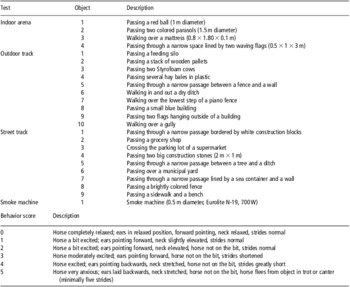
Four police training tests were used in the present study: the outdoor track, street track and smoke machine tests were selected as they were in use by the police for more than a decade to select police horses and simulate normal police work. As challenging object test ‘the indoor arena test’ was added, as behavioral tests are used to assess physiological and behavioral responses of animals (Slabbert and Odendaal, Reference Slabbert and Odendaal1999; Taylor and Mills, Reference Taylor and Mills2006). Horses were ridden at walk during all tests, and location and approach to the objects were standardized as much as possible (descriptions of all objects and tests are presented in Table 1).
Description of the different challenging objects in four test settings (the indoor arena test, outdoor track test, street track test and smoke machine test) used to evaluate physiological and behavioral responses of 12 Dutch Warmblood horses during police training and behavioral scores used to assess behavioral responses of 12 Dutch Warmblood horses during police training

Behavioral scores were adapted from the studies of Visser et al. (2010) and Munsters et al. (Reference Munsters, Visser, van den Broek and Sloet van Oldruitenborgh-Oosterbaan2012).
The ‘indoor arena test’ was conducted in an indoor arena (20 × 40 m), where horses encountered four challenging objects positioned at a distance of 20 m or more from each other (duration ±2 min; Supplementary Material S3). The ‘outdoor track test’ was conducted outside on the grounds of the Dutch Police Department, and horses encountered 10 challenging objects positioned 20 to 100 m apart (duration ±10 min). The ‘street track test’ consisted of a 4.2 km circuit through the nearest town with 10 challenging objects along the course (duration ±45 min). The ‘smoke machine test’ was conducted on the grounds of the Dutch Police Department, and here horses encountered the smoke machine, which was started when the horses were at 20 m distance and was kept running for 10 s (duration ± 2 min). In the street track and smoke machine tests, each experimental horse was accompanied by an experienced horse (not included in this study) and the test horse was always in front during the approach to the challenges.
Experimental set-up
Horses performed all tests three times on 3 consecutive days in weeks 1, 3 and 7. Supervision of tests was done by the same individual at all times. On the 1st day, baseline values of horses were obtained in the horse's stall; after the horses were equipped with an HR monitor, they were allowed to acclimatize in their stables before rest HRs were taken. Afterwards, horses were saddled and ridden at walk for 4 min in a quiet, familiar indoor arena (20 × 40 m) to obtain HR and HRV at normal walk.
In the morning of the 2nd day, horses performed at the indoor arena test and in the afternoon they performed at the outdoor track test. In the morning of the 3rd day, the street track test was conducted and in the afternoon the smoke machine test was conducted.
At the start of each test, horses were saddled and instrumented in a handling box and video cameras and HR monitors were started simultaneously. The riders mounted the horses outside the handling box and started with the test. Riders were instructed similarly as was done in the study of Munsters et al. (Reference Munsters, Visser, van den Broek and Sloet van Oldruitenborgh-Oosterbaan2012). When horses encountered the challenging objects, they were allowed to perform attention and exploration behaviors so that they had sufficient time and space to choose their behavioral response (Baragli et al., Reference Baragli, Mariti, Petri, De Giorgio and Sighieri2011). If a horse was afraid of an object, the rider stayed passive and gave the horse the opportunity to approach the object voluntarily. If a horse did not do so during the first 2 min, the rider supported the horse with consistent signals of the least invasive kind (Baragli et al., Reference Baragli, Mariti, Petri, De Giorgio and Sighieri2011; Munsters et al., Reference Munsters, Visser, van den Broek and Sloet van Oldruitenborgh-Oosterbaan2012). If the horse still refused to pass the object, the horse was led away and the test continued by approaching the next object.
HR measurements
During each test, horses were equipped with an HR monitor (Polar RS800CX, Polar Electro Oy, Kempele, Finland) with soft cotton-like transmitters containing the electrodes. The two electrodes were placed under the girth behind the left elbow and under the saddle at the left withers. To optimize contact, electrodes and skin were soaked with water. HR monitors continuously recorded HR (beats/min) and HRV (root means square successive differences; ms) using the RR-interval mode. Before further evaluation, the HR data were checked visually for artefacts. During each test, each horse was videotaped continuously with a video camera (JVC, Yokohama, Japan).
BS and PPS
For each test, a BS of each horse was given by an experienced observer on a 0 to 5 scale (Table 1), adapted from the study of Munsters et al. (Reference Munsters, Visser, van den Broek and Sloet van Oldruitenborgh-Oosterbaan2012) and Visser et al. (Reference Visser, Karlas, van Deurzen, Workel and van Reenen2010). To make this as ‘blinded’ as possible, the assessment was done by the first author 1 month later in a randomized order.
Simultaneously, a PPS was given by two experienced police trainers for each test (Slabbert and Odendaal, Reference Slabbert and Odendaal1999). In this score, performance was graded as ‘pass’ for a police horse (PS-0) when horses reacted calmly, in a relaxed manner and showed no or only a minor response to the challenging object, or as ‘no-pass’ for a police horse (PS-1) when there was an excitement response, including flight behavior and/or resistance to approach the challenging object.
Reliability of the indoor arena test
First, a pilot study was conducted to determine the reliability of the indoor arena test. Six horses (not included in the main study; 11 ± 6 years, two mares and four geldings) performed the indoor arena test twice with an interval of 8 h. Three observers independently gave each horse a BS score per object and for total performance. Inter-observer reliability (Taylor and Mills, Reference Taylor and Mills2006) of the indoor arena test (Spearman rank correlation) was high: observer I and observer II (r = 0.775; P < 0.001), observer I and observer III (r = 0.809; P < 0.001) and observer II and observer III (r = 0.851, P < 0.001). Inter-test reliability between the two tests was good (r = 0.615; P < 0.001). Therefore, it was concluded that the arena test was a reliable assessment of behavioral reactions to challenging situations (Visser et al., Reference Visser, Van Reenen, Van der Werf, Schilder, Knaap, Barneveld and Blokhuis2002; Taylor and Mills, Reference Taylor and Mills2006).
Statistical analysis
All data are given as mean ± s.d. Means were calculated for all parameters per horse, per test and per week and compared between ‘experienced’ and ‘inexperienced’ horses. A normal probability plot was used to check the residuals for normality. If the normality assumption did not hold, the data were log-transformed. Data of HR and HRV were analyzed using a linear mixed-effect model with horse as random effect and experience, test, week, test–week, test–experience and age as fixed effects. This was used as the starting model. Akaike's Information criterion (AICC) was used to see whether this model could be reduced; if no further reduction was possible this was the final model. Terms in the final model were considered important. Results are presented in t-values as AICC was used; an effect size (t-value) of >2.00 (more than two times larger than the standard error) indicates a real difference.
Non-motor HR can be defined as the additional increase in HR caused by other things than physical activity, that is, emotionality reactivity (Visser et al., Reference Visser, Van Reenen, Van der Werf, Schilder, Knaap, Barneveld and Blokhuis2002). To correct for the physical activity during the tests, the HR and HRV of ‘normal walk’ were used. Non-motor HR and HRV were taken into account as a covariate of the model. BS and PPS data were analyzed using a logistic regression with horse as a random effect and test and week as fixed effects (P > 0.05). For statistical analysis, the software programmes (R: A Language and Environment for Statistical Computing, R Foundation for Statistical Computing, Vienna, Austria 2010) and (SPSS 17.0, IBM Company, IL, USA) were used.
Results
General data
One of the test horses (horse 4) participated only in week 1, after which it was returned to the owner. Horse 10 did not participate in the street track and smoke machine tests in week 3, because it was on duty that day, and in week 6, horses 3 and 7 were sold to another police department. In week 7, only the indoor arena and outdoor track test could be conducted because the next day, some horses had to perform at an abrupt riot duty.
HR and HRV measurements
Mean HR at the stall differed from normal walk (t = 6.20), indoor arena (t = 9.13), outdoor track (t = 6.54), street track (t = 6.06) and smoke machine tests (t = 9.26). Mean HR at the indoor arena and smoke machine tests were significantly higher compared with normal walk (t = 2.44 and t = 3.50, respectively), outdoor track (t = 2.83 and t = 3.91, respectively) and street track tests (t = 2.48 and t = 3.52, respectively). Mean HR of normal walk did not differ from the outdoor track and street track tests (Table 2).
The effect of rest at stall, normal walk and four test settings (indoor arena test, outdoor track test, street track test and smoke machine test) on the mean HR (beats/min), HRV (ms), BS (0 to 5) and PPS (0 to 1) in 12 Dutch Warmblood horses during police training. Horses were evaluated at all tests in weeks 1, 3 and 7Footnote *; data presented were aggregated over these three time points

HR = heart rate; HRV = heart rate variability; BS = behavior score; PPS = police performance score; s.e.m. = standard error of the mean; RMSSD = root mean square of successive differences; nd = not determined.
a,b,c Different superscripts in a same line correspond to a significant difference (in HR and HRV data; t > 2.00, in BS and PPS data; P < 0.05) between tests.
* Number of animals: 1st week, n = 12; 3rd week, indoor arena test and outdoor track test n = 11, street track and smoke machine tests n = 10 and 7th week, all tests n = 9.
Unlike mean HR, mean HRV at the stall only differed from normal walk (t = 3.08) and the indoor arena test (t = 2.80). HRV of the indoor arena test was significantly lower than street track test (t = −2.78) but did not differ from the normal walk. However, street track and outdoor track were significantly higher than normal walk (t = 3.06 and t = 2.11, respectively; Table 2). There was a significant correlation between mean HR and mean HRV at the stall (r = −0.468, P = 0.032), but there was no correlation during normal walk (Supplementary Material S1). There was no significant difference in non-motor HR and HRV between tests.
BS and PPS measurements
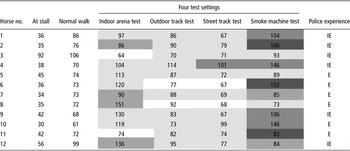
There was no significant difference in BS between tests or between individual horses (Table 2). However, increase in BS did not always correspond with an increase in HR or vice versa (Table 3). In contrary with BS, PPS differed significantly between some of the tests; on an average, more horses received PPS of ‘not-pass’ during the smoke machine and indoor arena test compared with the other two tests (Table 2).
The effect of rest at stall, normal walk and four test settings (indoor arena test, outdoor track test, street track test and smoke machine test) on the mean HR (beats/min) and BS (0 to 5) of 12 Dutch Warmblood horses (six inexperienced horses and six experienced horses) during police training

HR = heart rate; BS = behavior score; IE = inexperienced; E = experienced.
HR and BSs of horses did not always correlated with each other. To clarify, data of tests in week 1 were presented in the table and BS were indicated with different colours.
The final police horse suitability assessment is also included in the table. Different shades reflect different behaviour scores (BS; scale 0–5) of the individual horses during the specific tests, as stated above.
BS = 0,  $$\[--><$>\raster="fx1"$$$; BS = 1,
 $$\[--><$>\raster="fx2"$$$; BS = 2,
 $$\[--><$>\raster="fx3"$$$; BS = 3,
 $$\[--><$>\raster="fx4"$$$; BS = 4,
 $$\[--><$>\raster="fx5"$$$; BS = 5,
 $$\[--><$>\raster="fx6"$$$.
Age and experience
Age did not differ significantly between experienced and inexperienced horses. Age, experience, test repetitions and individual horses showed no significant interaction or influence on HR, HRV and BS data. The combined PPS of all tests and weeks was significantly higher (P = 0.021) for the experienced horses compared with the inexperienced horses.
Discussion
Horses
Authors are aware that the small sample size is a limitation of the study. However, difficulties in conducting this study were huge; the willingness and openness of police departments to contribute to this research and the practical difficulty to schedule horses free from their duties was not easy.
In the present study, age of the horses and the experience as a police horse did not show significant influence on physiological and behavioral responses of horses. This may have been due to the limited number of horses, or due to a bias in pre-selection of the horses, as only visibly calm horses would ordinarily be selected for police training; no horses with high sensitivity or initial responses are offered for sale to the police. This was also shown by the moderate behavioral responses of horses during all tests and that some young and completely inexperienced horses coped well with the challenging situations during the police training test. This may suggest that experience as a police horse and age are not always the key factors in how police horses handle stress. The background training and the initial response or temperament of a horse may play a more important role in how horses respond to challenging situations (Visser et al., Reference Visser, Van Reenen, Van der Werf, Schilder, Knaap, Barneveld and Blokhuis2002). In addition, no habituation occurred during the test weeks, though horses tended to habituate during the first 2 weeks of the study, although after a 4-week interval outcomes were comparable with the 1st week. This may also be due to the fact that the initial response of a horse to a challenging object will influence whether habituation or sensitization occurs (McGreevy and McLean, Reference McGreevy and McLean2010). In addition, a 4-week interval seems too long to sustain habituation.
Physiological and behavioral responses
For practical reasons, it was not possible to alternate the order of tests. However, authors do not think that there was an order effect on the results, as the indoor arena and smoke machine test elicited the greatest responses and were conducted as the first and last test.
In horses, usefulness of HRV data and correlation with stress-related behavior seems to differ between studies (Visser et al., Reference Visser, Van Reenen, Van der Werf, Schilder, Knaap, Barneveld and Blokhuis2002; Munsters et al., Reference Munsters, Visser, van den Broek and Sloet van Oldruitenborgh-Oosterbaan2012). At rest, there is a negative correlation between HR and HRV (Von Borell et al., Reference Von Borell, Langbein, Despres, Hansen, Leterrier, Marchant-Forde, Marchant-Forde, Minero, Mohr, Prunier, Valance and Veisser2007), which was confirmed in the current study. Parker et al. (Reference Parker, Goodwin, Eager, Redhead and Marlin2009) showed that the reliability of HRV data was good in stationary horses, but much less reliable when horses moved. This was also found in the present study: a significant increase in HR during tests was only partly mirrored in significant decrease in HRV data.
The physiological and/or psychological status of the horse is related to HR, and as discussed earlier, it may be related to HRV. However, the psychological status is not always apparent in the visible behavior of the ridden horse (Munsters et al., Reference Munsters, Visser, van den Broek and Sloet van Oldruitenborgh-Oosterbaan2012). BS showed no discriminative capacity between tests or horses, whereas HR, HRV and PPS did. This may suggest that police experts evaluated more factors than only behavior of the horse, as the PPS values correspond a little more with HR and HRV data of the horses compared with BS data. However, this lack of significant difference in BS may also be partly because of the fact that the sample size was small in the present study. However, HR of horses was also not always correlated with their observed behavioral responses; some (introvert) horses with low BS had increased HRs compared with other horses with the same BS during the same activity. This suggests that differences in ‘emotional reactivity of horses’, a term used by Visser et al. (Reference Visser, Van Reenen, Van der Werf, Schilder, Knaap, Barneveld and Blokhuis2002). The use of non-motor HR and HRV to correct for the physical activity and to elucidate the ‘emotional reactivity’ of horses did not make any difference. This may suggest that ‘emotional reactivity’ is not always reflected well in the behavior of ridden horses. To maximize the welfare of police horses, it is important that they are suitable for the job (Thomas, Reference Thomas2010). Therefore, it is important to distinguish between horses that were really calm and the horses that seemed calm but had increased HRs, suggestive of a stress-related response (Visser et al., Reference Visser, Van Reenen, Van der Werf, Schilder, Knaap, Barneveld and Blokhuis2002). Therefore, HR measurements may provide useful complimentary information to assess horses with moderate behavioral responses, such as police horses.
On an average, horses experienced lower levels of stress during the tests of the present study compared with other studies using novel object tests (McGreevy and McLean, Reference McGreevy and McLean2010). This may be partly due to the fact that all horses were allowed to perform attention and exploration behavior when encountering the challenging objects. Therefore, horses had sufficient time and space to choose their behavioral response. This is associated with a more positive learning experience, shown by more explorative behavior toward the challenging objects, than when horses were more restricted in their behavioral responses (Baragli et al., Reference Baragli, Mariti, Petri, De Giorgio and Sighieri2011).Therefore, it is concluded that police horses overall experienced relatively low amounts of stress during these police training tests (some tests were not more stressful than riding at normal walk). As these tests reflect partly normal police work, it is suggested that this kind of police work is not significantly stressful for horses and it would have no negative impact on the horse's welfare.
Future implications
Three of the tests in the present study are used for the selection of police horses in the Netherlands. During the selection of police dogs, three behavioral tests, which resemble work of a police dog, predicted 81.7% of unsuccessful police dogs and 91.7% of successful police dogs using behavior and performance scores (Slabbert and Odendaal, Reference Slabbert and Odendaal1999). It would be interesting to investigate in more detail how behavioral and physiological measurements of horses may contribute toward a more objective selection of suitable police horses. Further, selection of a police horse is now primarily based on behavioral responses during regular street patrol work (outdoor track and street track test), which elicits no more responses from horses than during normal walk and is consequently not an optimal parameter. The indoor arena and smoke machine tests elicited the greatest responses and may be therefore more useful to discriminate between individual horses and useful as a selection criteria.
Furthermore, horse–rider interaction is important to maintain mental calmness in horses throughout their careers and to avoid behavioral problems and wastages later on (McGreevy and McLean, Reference McGreevy and McLean2010). The study of Munsters et al. (Reference Munsters, Visser, van den Broek and Sloet van Oldruitenborgh-Oosterbaan2012) showed that the interaction between the horse and the rider is important for the amount of stress horses experience encountering challenging objects. Therefore, the evaluation of horse–rider interaction may be useful in further research.
In conclusion, no habituation occurred during the test weeks and experience as a police horse seems not a key factor in how these horses handle stress. All horses showed only modest behavioral responses and HR may provide complimentary information for individual evaluation and welfare assessment of these horses. Overall, little evidence of stress was shown during these police training tests, and as these tests resemble normal police work, it is suggested that this kind of police work is not significantly stressful for horses.
Acknowledgements
The authors thank Mrs L. Roost for her assistance during the study, Mr A. de Jong and the Dutch Police Livestock Department in Nunspeet for their assistance during the experimental work and Mr M. de Zoete and Mr J. Tromp for riding and handling the horses.
Supplementary materials
For supplementary materials referred to in this article, please visit http://dx.doi.org/doi:10.1017/S1751731112002327