Introduction
Throughout the sixteenth century the growth of long-distance ocean voyages and the global silver trade intensified multi-ethnic encounters and commercial exchanges in the Asian maritime space. In a period when the Ming state significantly interrupted private trading overseas, thriving, intertwined smuggling and piracy, as defined in official discourse, played vital roles in increasing the dynamics of the maritime economy and generating tensions to the coastal security of East Asia.Footnote 1 However, Northeast Asian waters, in particular the northern section of the Yellow Sea (Figure 1), appear to be separated from this tendency in historical examinations.Footnote 2 Indeed, although the northern littoral zones of Ming China and Chosŏn Korea were at the time seldom included in the range of activity of “Japanese pirates”, this does not indicate that this region was a stagnant pool and a barren boundary lacking any remarkable interactions or conflicts. Rather, its private seafarers and coastal residents were deeply involved in the vibrant yet turbulent maritime activity of the sixteenth century.
The northern section of the Yellow Sea.

While scholars have emphasised the need to look at both the interconnectivity and subregional diversity of East Asian waters,Footnote 3 the cohesion and peculiarity of the northern sea frontier between China and Korea as well as the region's position within a broader picture of maritime East Asia still receive little attention.Footnote 4 Recently the economic and military significance of China's northern coast has been attracting growing scholarly interest in the West. Examinations of the Bohai Sea, especially its port cities, in different historical contexts prove that this contiguous and distinct area can be adopted as a useful spatial scale for reconsidering the maritime history of China being dominated by its southern coast.Footnote 5 In contrast, this research offers a transborder view by emphasising the northern part of the Yellow Sea, which functioned as a shared frontier of Northeast Asian states and an integrated constituent of East Asian seas. It highlights mobility and interaction in this space as important factors in shaping local communities and influencing border management.
By applying this approach, this research displays the freer movement and offshore expansion of coastal populations within the region and their growing engagement in illicit maritime enterprises, including commerce and violence, a phenomenon that emerged in the late fifteenth century and became noticeable in both Ming and Chosŏn official records in the mid-sixteenth century. This distinct and seemingly isolated episode was shaped in specific settings, but it also provided a resonance to the quickening and expanding circulation of materials and peoples, as well as to a surge in the piracy that other East Asian sea regions witnessed during this period.
This article pays further attention to the Ming and Chosŏn authorities’ control of their northern maritime peripheries concerning this flow of private seafarers and their outlawry. While this issue closely interrelates with the international environment of East Asia, it needs to be embedded within the nuanced perception and flexible management of indigenous maritime groups. Current scholarship tends to stress the contradiction between the conservativeness of Ming maritime policies and the development of illicit seafaring and violence, a contradiction that was lessened only after the conditional lift of maritime prohibition in 1567.Footnote 6 Instead of viewing this process as merely passive, defensive, and suppressive, this research reveals the multifaceted and adaptable state response to coastal outlaws in the sixteenth century.Footnote 7 Also, the existing examinations of Ming maritime policies are still largely drawn from the experience of China's southeastern coasts without addressing the regional differences of the north. Through investigating the localised manifestation of state rules in the northern Yellow Sea, this research aims to enrich our understanding of the diversified practice and internal dynamics of coastal governance that would otherwise be homogeneous or oversimplified.
In the late sixteenth century, when overseas trade had become acceptable in Fujian, the failure to regulate the increasing maritime violence in the northern Yellow Sea caused the strengthening of the mutual prohibition between Ming China and Chosŏn Korea. The fundamental challenge in their coastal control mechanism for dealing with cross-border navigation and offshore migration explained this decision. Rather than presupposing the two authorities as land based and inward looking, the core of this mechanism, as this research argues, was to demarcate, (il)legalise, and institutionalise the flow and interaction of seafaring populations by making categories and boundaries in discursive, administrative, and geographic spaces. However, state attempts to establish explicitness or territorialise control of ambiguous and fluid maritime agents were often limited in the multiscaled sets of the internationality, regionality, and locality. As a result, this not only placed Chosŏn Korea in a dilemma of discerning and filtering maritime violence, but also led to a retreat of Ming state power from the sea in the late sixteenth century. By revealing this process, this article aims to break down the dichotomy between Northeast Asian terra-centred polities and the maritime world, and also to explore the motivations, instruments, and constraints that ran beneath state options with regard to transmarine mobility.
In a less-bounded space: the maritime economy and population mobility of the northern Yellow Sea
Large-scale, government-authorised diplomatic trips, seaborne trade, and transport between China and the Korean Peninsula were historically important and prosperous after the Tang dynasty (618–907). Directed by consecutive islands in the Changshan Archipelago 長山群島 southeast of Liaodong, and the Miaodao Archipelago 廟島群島 at the Bohai Strait, subregional navigations in the Yellow Sea were relatively operable and less dangerous compared to setting sail far from the coast. In Tang China the regularised route with Silla began in Dengzhou, was connected by the Miaodao and Changshan islands, and then extended to the offshore islands of southwestern Korea. More convenient and frequent bilateral contacts were also made possible via the direct seaways between coastal Shandong and northwestern Korea.Footnote 8 The Yuan Empire further established “water posts” (Ch. shuiyi, 水驛) along the southern Liaodong and western Korean coasts, which institutionalised the Yuan-Koryŏ sea transport, especially for delivering grain in famine years.Footnote 9 During the Yuan-Ming transition period, the high profitability of conducting sea trade attracted numerous migrants to Liaodong, which contributed to the formation of dominant powers in the local society.Footnote 10
Beginning in 1371, however, the newly founded Ming dynasty generally prevented its individuals from sailing and trading abroad. To constrain the Japanese piracy that was active in its northern coast in this period, the offshore islands of Shandong had also been forcefully depopulated.Footnote 11 Similarly, inherited from the late Koryŏ policy of emptying islands (K. kongdo chŏngch'aek, 空島政策) for the suppression of local maritime powers and influenced by the Ming sea ban policy covering Korea's coastal regions, the Chosŏn dynasty shifted towards a prohibition of offshore dwelling and private commerce overseas.Footnote 12 Moreover, since official interaction between the two states was routinised over land after the Ming Yongle reign (1403–1424), even state-level exchanges in the Yellow Sea vanished.
This mutual exclusion of maritime activity was largely challenged by a sharp increase in illicit seafaring in the mid-sixteenth century. While the weaponised smuggling groups that were labelled as ‘Japanese pirates’ (Ch. wokou, K. waegu, 倭寇) more frequently targeted the southern coasts of China and Korea, the growing appearance of castaways, smugglers, pirates, and insular migrants was also detected in the north. These individuals played major roles in reconnecting and invigorating this intentionally separated sea space.
This phenomenon largely resulted from the greater commercial and social vigour in the border region of Ming China and Chosŏn Korea after the sixteenth century. Influenced by the importing of a tremendous amount of silver into China and its subsequent establishment of a monetary system with a silver standard, the Liaodong-Korean borderland experienced the development of a commodity economy and was increasingly incorporated into interregional and transnational trade systems. Silver, ginseng, and fur were continuously transported from the northeast to inland China, exceeding the restrictions and requirements of the government-supported tribute and mutual trade (Ch. hushi, 互市). Chosŏn society was also eager for Chinese items such as silk and cloth fabrics, which disregarded the state prohibition.Footnote 13 Along with this trend, border populations of Northeast Asia actively participated in wide-ranging trade networks and were more mobile across state boundaries. Liaodong merchants, for example, became a direct medium for exchanging merchandise from the Yangtze Delta for silver from Korea.Footnote 14 Trespassing, smuggling, and poaching operations in the Yalu River boundary also became markedly visible, a problem that had perplexed the Chosŏn government since the early sixteenth century.Footnote 15
This vitalisation of cross-border commerce was also reflected in the energised maritime economy along the coastal regions of the northern Yellow Sea. Trade contacts began to expand among the indigenous peoples. As Ming officials observed, in the mid-sixteenth century not only was there frequent interaction among private boatmen between Liaodong and Shandong for fishing and trading through the Bohai Strait, but they also transacted with merchants from Southeast China and sometimes sailed across the sea to Korea under the loose prohibition of local governments.Footnote 16 As the Chosŏn court complained in the same time period, coastal residents of northwestern Korea commonly pursued profits by boating back and forth to Liaodong coastal guards and offshore islands.Footnote 17
Exploitation and transportation in this region also developed to the extent that it disturbed the social order based on a small-scale peasant economy. In northwestern Korea, in particular the P'yŏngan coast, the expansion of coastal cultivation, sea transportation, and grain transactions boosted the formation of a chain of profit that connected regional magistrates and private seafarers. Even court officials were involved. One example is that of a P'yŏngan coastal magistrate in the 1560s whose crimes included transporting acquired items to his own house by boat, demanding cloth from local households and exchanging it for official grain, and even conducting an unauthorised hunt on the sea that caused a shipwreck.Footnote 18 This is also reflected in the exploration of coastal resources by P'yŏngan district magistrates and their building of corrupt ties with central influential powers by misappropriating fertile coastal lands for building country estates and transshipping local official grain. Marine techniques further improved in the north so that people could travel through previously impassable places to transport grain from the border region.Footnote 19 Probably written during his appointment as a censor in 1565 and 1566, one report from Yi I 李珥 (1536–1584), a prominent Chosŏn scholar-official, describes the impact of this situation well:
The authorities have widely occupied farmlands in coastal counties and towns, and largely opened the route for ship transport. Therefore the official stores have all been used to sponsor corruption and bribery, and private grain completely belongs to itinerant traders for the making of profits.Footnote 20
In offshore Liaodong both land and marine resources were employed more fully, a situation intertwining with the clear escape of Liaodong military households from the restraint of the Ming garrison system in the sixteenth century. The Liaodong military garrisons (Ch. weisuo, 衛所) had functioned as basic defence units since the early Ming dynasty, which restricted hereditary households, the primary population of Liaodong, with obligatory service. Meanwhile, the military farming system (Ch. tuntian, 屯田) coerced Liaodong soldiers serving as guards into cultivating land to be self-sufficient and controlled them through various forceful methods, onerous land forces, and land taxes. With the growing annexation and privatisation of military farmlands and the subsequent decline of the tuntian system, as well as the heightened social mobility stimulated by the ongoing private economy, in the sixteenth century military households extensively moved to the unmanaged places of the Liaodong borderland, including its offshore archipelagos, and sought additional methods for making a living.Footnote 21
Beginning in the late fifteenth century, these Liaodong residents, who were trying to evade heavy taxation and labour, spread to and settled on some remote islands of the Changshan Archipelago. They lived by fishing, hunting, trading wild animals, the fur of marine mammals, and the flesh of fish, as well as looting goods from coastal residents.Footnote 22 They further survived in a more secure and long-term way by cultivating land, and even lived together with Korean migrants and had hybrid offspring with them.Footnote 23 During the mid-sixteenth century the Miaodao Archipelago and other islands scattered near Dengzhou became another major haven for Liaodong runaways. Since these arable, unoccupied lands were suitable for inhabitancy and reclamation, these Liaodongnese assembled and engaged in fishing and trading, regarding this space as “a place with happiness” in comparison to the “prison-like” Liaodong.Footnote 24
In addition to these recorded acts, other forms of resource utilisation in the Chinese-Korean northern sea region are also traceable in official accounts. The acquirement and circulation of timber is one apparent example. In the mid-sixteenth century the Ming court noted that merchants often sailed giant ships to the offshore islands of eastern Shandong to cut and trade wood.Footnote 25 A wider range of the Northeast Asian frontiers was also included in this timber trade network. To obtain construction materials for ships in the offshore islands of the Jinzhou Guard of Liaodong, wood was imported and traded beyond the realm of the Liaodong administration where forest resources were rich.Footnote 26 In a trespassing case discussed later in this article, Liaodong military servicemen were also found to be collaborating with Jinzhou islanders to steal timber from the Korean coastal waters. Moreover, although this was rarely seen, Liaodong evaders claimed that they sailed to sea islands for the purpose of mining silver and producing charcoal.Footnote 27
In the sixteenth-century northern Yellow Sea frontier, the expansive cultivation of coastal and offshore farmlands, the accelerated exchange of materials that involved multiregional and multilayered profit seekers, the growing collection of various resources such as sea products, fur, timber, silver, and charcoal, as well as the inflow of unrestrained migrants all indicated that this area had begun to experience a transformation from a strictly prohibited and desolate barrier to a more vigorous and mobile contact zone in which informal interaction and trading networks were established and extended. As the next section of this research shows, this new, changing circumstance consequently modified the coastal control processes of the Chosŏn and Ming governments.
A means of control: classifying seafarers, delineating pirates
Sea-oriented interactions were generally embargoed in the Yellow Sea and therefore marginalised in the official discourse of Chosŏn Korea as illicit or at least suspicious, and required scrutiny. While this maritime abnormality made the Chosŏn regime vigilant to any possible danger from the sea, as a tributary state of Ming China the regime also adopted a collaborative sea-salvage mechanism with the latter. This was in response to a growing number of transmarine drifters during the Ming Jiajing reign (1522–1566), even before this system was formalised and more broadly applied among East Asian states after the early eighteenth century.Footnote 28 The Chosŏn government accordingly employed different categories, for example, unrecognised ships (K. mibyŏnsŏn, 未辨船 or hwangdangsŏn, 荒唐船),Footnote 29 castaways, and pirates, to describe, discern, or determine the nature of these unauthorised seafaring enterprises and to take further countermeasures such as repatriation and military defence aimed at different groups to maintain and secure Korea's coastal order.
The interpretations of these divisions varied, depending on the contexts in which they were positioned, as Chosŏn officials’ use of the term “Japanese pirates” reveals.Footnote 30 The extended and shifting meaning of “water bandits” (K. sujŏk, 水賊) that interacted with the emerging challenge coming from the north is another example. The Chosŏn Korean government's creation and conception of this category during the late fifteenth century only specified the violent groups with certain characteristics in the sea region between Cheju Island and Chŏlla Province. In 1474 when the term first appeared in Chosŏn wangjo sillok (Annals of the Chosŏn dynasty), it was used to describe those who acted rampantly in the coastal counties of Chŏlla.Footnote 31 While scholars argue for their origins and primary members as either the Cheju sea people or the coastal people from southern and then western Chŏlla,Footnote 32 it is certain that Chosŏn officials applied this category to characterise the piratelike Koreans in the south where the so-called Japanese pirates were also active, although the former sometimes dressed and spoke like Japanese to blur the ethnic boundary.Footnote 33
Beginning in the 1520s the Chosŏn court began to note the presence of water bandits in the northern Yellow Sea, a result of illicit seafaring and interaction between Chinese and Koreans. For instance, in 1522 after a few Korean smugglers were caught going to an offshore island of Liaodong, King Chungjong demonstrated his particular interest in the issue of maritime safety. In addition to ordering an inquiry about the island's trading, cultivation and immigration, he wanted to determine whether the indigenous islanders had a connection with water bandits and were equipped with weapons for defence.Footnote 34
The current scholarship tends to widen the definition of water bandits as perceived by the Chosŏn government in the sixteenth century. Rokutanda Yutaka argues that this classification incorporated various unauthorised seafarers around the Korean Peninsula, such as seaborne raiders other than Japanese pirates, suspicious ships, and people who engaged in illegal maritime activity.Footnote 35 Ryu Ch'angho claims that instead of aggressive pirates, water bandits in the north were simply poachers and smugglers of the fur and leather that were produced in this area.Footnote 36 However, as will be seen, although water bandits shared some common features with a broader scope of sea-ban breakers, Chosŏn officials preferred to delineate them as armed and organised groups obtaining and trading specific goods, and whose violent tendencies imposed a direct threat to Korea's coastal security.
In 1526 the Chosŏn government captured seventy-six smugglers under the suspicion that they were water bandits. Since the crucial evidence of spotted seal furs and horsehide leather that typically belonged to water bandits was not found at their places, court officials suggested a closer interrogation.Footnote 37 One case of a confirmed crime conducted by water bandits is preserved in a 1546 report to King Myŏngjong, which states that a Korean water bandit named Ko Chijong 高之宗 was arrested on Ch'odo Island 椒島 of Hwanghae Province. Ko was originally from the Ŭiju border but then escaped to Ming China, where he led treacherous traitors and even established a base. Due to the severity of Ko's crime in comparison with two other kinds of common border crossings, namely Korean coastal inhabitants’ seafaring and trading in offshore and coastal Liaodong, and Hamgyŏng border men's escape to the Jurchen tribes, Myŏngjong agreed that this case should be handled differently.Footnote 38 This discussion demonstrates that, unlike scattered seaborne smuggling in the northern portion of the Yellow Sea, water bandits were more organised and could involve both Chinese and Korean border people.
A more direct explanation comes from a Chosŏn official, Kim Sŏngil 金誠一 (1538–1593), who was appointed as the royal inspector of Hwanghae Province to examine its armament in 1583. In the same year Kim submitted a memorial to King Sŏnjo in which he depicted the acts and equipment of water bandits in detail. Kim distinguished water bandits from sea raiders coming along the southern coast of Korea since the former travelled from Liaodong and the Bohai Sea to Hwanghae. They robbed and established bases on Korea's offshore islands, built ships using timber probably from the woodlands of these islands, poached horses from ranches, and smuggled horsehide leather between Korea and China. This account corresponds with another contemporary description that claimed water bandits were robbers, but their crimes were not as serious as invading Korean territory.Footnote 39 Regarding the military strength of the so-called water bandits, they did not have weapons of war, but armed themselves only with crossbows with blunt arrows and stone-headed bludgeons. Although they recurrently attacked Korea's naval forces, Kim considered them weak and easily defeated if Chosŏn border generals would place a higher priority on this matter.Footnote 40
These records illuminate that between the 1520s and the 1580s the Chosŏn government paid ongoing attention to the existence of water bandits mainly on Korea's northwestern coast, regarding them as distinct from pirates in the south. These gangs were of a certain scale but poorly armed, and were composed of mingled Chinese and Korean border populace; they sailed from the Bohai Sea and Liaodong and were especially active between the offshore islands of Liaodong and Hwanghae; they robbed, poached, and smuggled fur, leather, and timber from the sea and insular ranches and forests.
Creating a perceptual boundary of seaborne raiders was essential for the Korean government in order to manage Ming Chinese transmarine seafarers, who needed to be treated prudently since they were from “the Superior Country”. However, the boundary itself was overlapping, negotiable, and open to interpretation. For instance, in 1544 about 200 Fujian castaways were found along the Ch'ungch'ŏng coast. Their killing and plundering of Koreans had “no difference from water bandits”, but the Chosŏn court hesitated to record the fact that they carried firearms or just describe them as shipwreck victims in order to pacify the outlaws and reduce conflict.
Even when the Chosŏn authorities attempted to clarify this distinction, they rarely succeeded in establishing such a boundary.Footnote 41 This was especially the case when they detected and regulated water bandits among Liaodong castaways, both of whom created a major disturbance on Korea's northwestern coast, in particular the Hwanghae littoral. Based on the limited provincial reports to the central government, an investigation of foreign drifting cases in northwestern Korea during the sixteenth century in which Chosŏn officials confirmed or speculated that the participants were Ming Chinese can provide insight into this problem. A list of these collected cases is presented in Table 1.Footnote 42
Confirmed/possible Chinese castaway cases in northwestern Korea during the sixteenth centuryFootnote 43

Based on the castaways’ confessions, the Chosŏn court knew that the exact points of departure in cases 1, 2, 5, 7, 8, 14, and 15 were the coastal guards Jinzhou and Fuzhou, and/or the southern offshore islands of Liaodong. While the hometowns of the Chinese castaways in cases 4, 10, 11, and 12 were unrecorded, it is highly possible that they came from Liaodong as well.Footnote 44 Therefore, with the exception of cases 3, 6, 9, and 13, whose identities were either unclear or were Chinese smugglers travelling with Japanese, the other cases all proved to be related to Liaodong border residents who approached the Korean coast either by accident or on purpose, showing the prominent role of Liaodong seafarers in promoting cross-border mobility in the northern Yellow Sea.
It can also be seen that most drifting incidents on Korea's northwestern littorals, information on which was submitted to the central government, occurred between the 1530s to the 1550s and peaked in the 1560s, roughly the Ming Jiajing period when private maritime interactions in the southern seas of East Asia were also booming. Aware of Ming people's trade and travel overseas without government permission, the Chosŏn court often cast doubt on the legitimacy of Chinese castaways. It expressed caution in regard to the authenticity of their confessions and ordered more detailed investigations after they were sent from the incident sites to Seoul. However, even after the Chosŏn Korean government displayed competence in recognising illegal seafarers and inhabitants on the sea, it found it challenging to find solid evidence that they were in fact water bandits, and thus was unable to further differentiate them from those who generally violated the sea ban policy.
In case 1, although King Chungjong and his officials raised the possibility that the Liaodong castaways were water bandits, based on their questionable confessions about the legitimacy of their hunting, this was never confirmed through further investigation. This reoccurred in the Chosŏn court's examination of case 4. While it believed the Chinese who were captured offshore P'yŏngan intended to attack Korea, no evidence was found on their boats to prove this. A more evident example is reflected in case 14, which was assumed to be collusion between Chinese border people and Korean coastal fugitives who founded a base on the sea to be bandits. However, since the Korean government failed to find proof to support this conjecture after an investigation, it had to treat this case as a normal drifting incident.
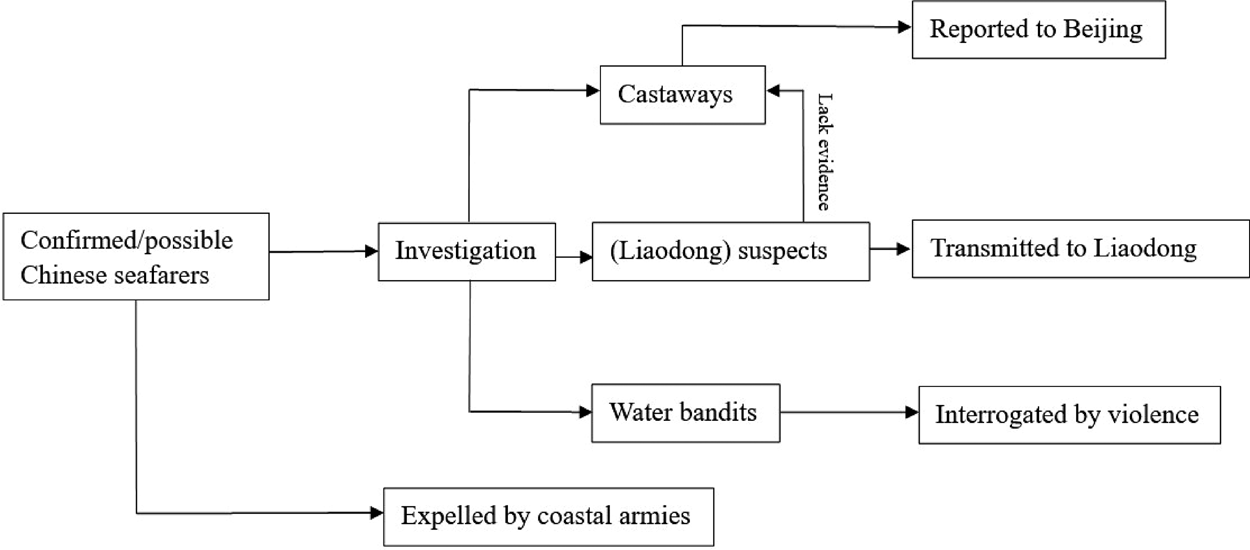
This frustration of recognising piracy among other violations of maritime prohibition demonstrates the interrelation and interchangeability of these categories. When private seafarers were found to be violently endangering Korea, they were treated as pirates, but as long as they withdrew, or even if their crimes were not detected, they could claim they were simply castaways going to sea for various purposes such as hunting or fishing without infringing on Korean law. While this malleable and vague nature of piracy was pervasive, what made Chosŏn Korea's inspection and response tools less effective needs to be particularly understood in terms of its subtle bilateral relations, both with the Ming central government and the Liaodong regional administration (Figure 2).
Chosŏn Korea's investigation, classification, and response procedures to confirmed/possible Chinese seafarers in the northern Yellow Sea in the sixteenth century.

Constrained by its careful diplomatic consideration in framing Chinese-Korean tribute relations, the Chosŏn court's unwillingness to make a more detailed interrogation of suspected Chinese castaways, especially through forceful methods, was one major obstacle in its identification of water bandits. In case 4, even when King Chungjong had noted the contradictory confessions of those who trespassed borders and occupied Korean castles, he did not order the use of punitive measures because they were Ming Chinese.Footnote 45 The limitations of dealing with Chinese drifting incidents are more clearly reflected in case 11, in which more than 40 Chinese people were found to be establishing houses, setting forges, and repairing ships off the shore of Hwanghae. In spite of the fact that their intent to settle within the territory of Korea was unusual, both the Hwanghae governor and the Chosŏn court were reluctant to subject them to compulsory interrogation because they were people of the “Superior Country”.Footnote 46
Only when the detained Chinese were confirmed to have committed crimes such as piracy did the Korean government seek a more radical solution. In case 10, after the Chosŏn government had ascertained that the Chinese trespassers connecting with Korean people were water bandits based on Ch'odo Island, it extorted a confession from them through physical violence.Footnote 47 Considering that it was also from Ch'odo Island that the Korean government arrested Ŭiju water bandit Ko Chijong, a successful recognition of these Chinese pirates might have first been achieved through the interrogation of the Korean domestic bandit Ko. Otherwise, due to the lack of decisive evidence, the Korean government only investigated suspicious Chinese border-crossing cases conventionally, acknowledged and repatriated them as normal drifters, and submitted these incidents to the Ming court as required.Footnote 48
Chosŏn Korea's tension with the Liaodong Military Commission, the provincial-level administration of Liaodong, also influenced its treatment of Liaodong seafarers, as reflected in cases 1, 2, 4, 5, 8, 11, and 14. Fully aware of their questionable status due to the inauthenticity or inconsistency of their confessions (cases 1, 4), their unusual arrival location (case 2), their suspected wrongdoings (cases 1, 4, 11, 14), and law-breaking seafaring (cases 5, 8), Chosŏn kings and officials often discussed whether to submit these cases to Beijing. In cases 2, 5, 8, and 14, only after it determined that these seafarers were nonthreatening castaways did the Chosŏn court make a final decision to repatriate them to China, usually through Korean tribute trips, and notify the Ming court of their existence. In contrast, since the Chosŏn court considered cases 1, 4, and 11 as premediated poaching and trespassing, it treated them with more discretion, concealing their behaviour from the Ming central government and only transmitting them to the Liaodong Military Commission for further investigation, jurisdiction, or penalty. As was often discussed between Chosŏn kings and officials, this was because reporting these trespassing cases to Beijing could infuriate the Liaodong officials who were directly in charge of border personnel and could be reproached by the Ming central government for loose management. This nuanced processing largely reflected Chosŏn Korea's realistic decision not to offend the Liaodong government due to their intense interaction and interdependence in aspects of cross-border affairs and tribute routine.Footnote 49
Moreover, the close intertwinement between Chinese private seafarers and pirates disturbed and, to some extent, shifted Chosŏn Korea's naval defence in the mid-sixteenth century to passively expelling castaways from the Korean coast in order to avoid military conflict that could escalate the diplomatic tension with the Ming.Footnote 50 As shown above, after King Myŏngjong ascended to the throne in 1545 the Chosŏn court ordered the castaways in case 9 to return to sea by themselves instead of capturing, investigating, and repatriating them to China.
It can be seen that, given the complex international circumstances and the arising security issue from the northern sea, the Chosŏn government accordingly adjusted its grouping of private seafarers and delimitation of maritime violence. It applied both the measures of sea salvage and coastal defence to treat these groups, showing the plasticity of its response mechanism to the changing maritime world. However, its inspection, recognition, and management of castaways and pirates was largely subjected to its political relations with different levels of the Ming authorities, which obscured the images and boundaries of these people, complicated and weakened the Chosŏn polity's handling of them, and consequently impeded its successful coastal governance.
A Ming approach: creating and demarcating realms in ambiguity
While Korea's northwestern littoral was experiencing a degree of turbulence, Ming China also confronted the problems brought about by the increasing number of Liaodong evaders and their border crossings, an issue interrelated with the Ming government's varying considerations of its maritime governance of the north. It appears that in 1525 the Ming court adopted specific measures toward Liaodong coastal evaders for the first time, just two years after the interruption of the authorised Chinese-Japanese trade relationship and the rise of Japanese raids on China's southern coast. Corresponding with the immediate enhancement of maritime prohibition, the Ming Ministry of War ordered the Jinzhou and Fuzhou coastal deserters to sea islands, to be recalled because of the possibility that they could connect with Japanese pirates.Footnote 51 This policy aimed to make a clear-cut administrative demarcation between the sea and the continent, isolating these islands and preventing an outmigration that would extend beyond state governance.
However, mere separation and prohibition did not function effectively for long. In the following decades Ming officials gave tacit consent to the Liaodong evaders’ inhabitance on the sea and attempted to expand their administration of them. By the 1530s the taxation of runaways had been implemented in the offshore islands of the Jinzhou, Fuzhou, Haizhou, and Gaizhou guards.Footnote 52 In the 1540s Wei Huan 魏煥 (1485–?), a low-ranking official from the Ministry of War in the Jiajing period, discussed the more thorough administration of them in his military book on Ming border defence. He mentioned the difficulty in handling evaders in the southeast Liaodong mountains and islands, who were either called “vagrants” (Ch. liumin, 流民) if they gathered in mountain areas, or “islanders” (Ch. daomin, 島民) if they migrated to sea islands:
They are like refugee migrants everywhere who make a living off their strength and flout government regulations. If they are relocated and then ignored, you will have no means to disperse them among the general population of the empire. On the other hand, if on account of your fear of an incident you restrain them with the law, then you are likely to instigate a disaster.Footnote 53
To solve this problem Wei Huai suggested censors be dispatched and prefectures and counties be established in the southeast Liaodong mountain and sea areas—a “vacant space” that had been maintained as a fence defending Liaodong since the early Ming. The community-based baojia 保甲units were also to be set. Wei further proposed loose regulation of them at the beginning in order to settle the runaways without protest. After they were pacified and stabilised, they could then be easily indoctrinated and regulated, and even recruited as soldiers.Footnote 54
Compared to the preventive controls of Liaodong evaders in the past decades, Wei Huan's thought was apparently more radical, and aimed to expand state governance to the unmanaged offshore islands of Liaodong, authorise the existence of maritime migrants, and absorb them into the Liaodong administrative system. Although his proposal was not fully realised, in response to the threat of Japanese pirates Jiang Dong 江東(1508–1565), who was in the position of Liaodong Grand Coordinator in 1552–1554, suggested temporarily sending officials and organising the dense population of the Jinzhou islands by the baojia system for their self-defence in the 1550s. The Ministry of War approved this, showing its intention of turning maritime migrants into legitimised military strength when it was necessary.Footnote 55
Wei's consideration correlated with his addressing the proper laxity in regard to the maritime ban of this region. Impeded by the presence of northern Yuan power, the lack of labour forces and the initial experiment of the military farming system, overland transportation and agricultural production in Liaodong were impractical during the Ming Hongwu reign (1368–1398).Footnote 56 As a result, the seaway connecting Dengzhou and Liaodong Lüshun (the Deng-Liao sea route) was opened for the government-organised transportation of military provisions and items from South China to Liaodong. However, after the early Zhengde reign (1506–1521), even regional-scale sea transport between Shandong and Liaodong ceased.Footnote 57 Accompanying this disbandment of official sea transport, the prohibition of private maritime connection in this region was also enhanced in the first half of the sixteenth century.
Ming officials who valued the strategic significance and social dynamics of Liaodong discussed the re-establishment of sea transport via the Bohai Strait, and emphasised the positive role of indigenous sea people under proper government control in improving Liaodong's military and economic strength. Based on their travel experiences in Liaodong during their diplomatic mission to Korea, two central officials submitted a memorial to the Jiajing emperor in 1536 in which they noted that the people of the Liaodong coastal Jinzhou, Fuzhou, Haizhou, and Gaizhou guards owned private boats and traded between Dengzhou and Liaodong for a living, and further suggested allowing them to navigate official ships to transfer cotton and cloth. In order to prevent these people's private communication, the two officials also provided a management solution of giving them transportation remuneration and numbering their boats.Footnote 58
While this plan still attempted to separate private maritime trade from official sea transport, Wei Huan emphasised the current underestimation of sea defence in maintaining Liaodong border security and proposed fully resuming the Deng-Liao sea route for multiple uses. To smooth the way for improving Liaodong coastal defence and re-establishing its sea transport, he suggested advancing maritime mobility through the agency of private seafarers so that their proficiency in navigation could be utilised to supply military provisions and trade commodities, and defend against enemies.Footnote 59
The proposition of transforming illicit maritime agents into official resources received special attention in the great Liaodong famine during the late 1550s and early 1560s. Realising the prosperity of the illicit trade between the Jinzhou and Dengzhou coasts, Wang Yu 王忬(1507–1560), the Supreme Commander of Ji-Liao (the Jizhou and Liaodong areas) in 1555–1559, discussed capitalising on privately owned boats by requisitioning and organising them for grain transportation to secure Liaodong along the Bohai Bay.Footnote 60 One record in the Ming Liaodong archives provides a glimpse into how the inhabitants from the Jinzhou islands were integrated into the official transport system in this famine. Liaodong military officers carefully examined islanders and their boats. The hired boats were then numbered and registered, and the sailors were paid with silver to transport grain from the Shanhai Pass. Within 20 days in early 1560, 63 island boats departed from Liaodong, carrying a total 3,765 dan (389.6775 m3) of rice; 489 taels of silver were paid for this transportation.Footnote 61 In order to supervise their work these boats were arranged into groups and led by officers of the Liaodong coastal guards, with their numbers, captains’ names, sizes, amount of rice, and transportation fees recorded in detail.Footnote 62
If conducting an official grain transport was not sufficient, the Ming government was willing to lift the ban on Liaodong private maritime trade with Tianjin and Shandong. To incentivise seafaring merchants, preferential policies were adopted to encourage their active trade. For instance, being appointed as the Liaodong Grand Coordinator from 1559 to 1561, Hou Ruliang 侯汝諒 (1515–1561) stated that since local Shandong offices often thwarted the smooth process of Dengzhou and Laizhou sea transport, Shandong coastal residents should be allowed to trade without being taxed with government permission. In addition, Hou suggested strict inspection of individual merchants in order to eliminate unstable factors such as contraband trade, runaways, and collusion with Japanese pirates that would threaten coastal security.Footnote 63
For Ming officials the perception and arrangement of private maritime agents had to be modified in different circumstances. Administrative policies could be adjusted to transform these people into a legitimate resource or, in the majority of cases, they were merely regarded as outlaws or even pirates. A Ming official once vividly described the latter situation: in order to gain merit, coastal military officers identified islanders residing between Dengzhou and Lüshun as pirates once they drifted to shore, although, as he stated, they only made their living by logging and fishing.Footnote 64
While it was easy for the government to illegalise diverse private maritime activities under sea bans, the expansion and enhancement of authority over the sea, as reflected in Wang Yu's and Hou Ruliang's above statements, required more effort, such as exercising supervision and regulation of maritime trade and transportation, to make fluid seaborne performers manageable for official use. However, the difficulty of explicitly categorising and outlining these individuals’ hybrid features and complex networks made it a challenge for the Ming state to maintain distinct control over the licit while simultaneously excluding the illicit, which thus led to a pendulous management of the sea region between Shandong and Liaodong in the mid-sixteenth century.
As recorded, although sea trade was allowed via the Deng-Liao lane to assist the Liaodong grain market in 1558–1559, this policy was soon rejected by Zhu Heng 朱衡 (1512–1584), the Grand Coordinator for Shandong in 1560–1561. He stated that merchants not only secretly travelled through the Great Canal to the southeast ports of Suzhou, Hangzhou, Huai'an, and Yangzhou, but outlaws on islands between Shandong and Liaodong had ganged together. He feared this would destroy the Ming's careful and solid sea defence and develop into a danger just like that of Japanese piracy. The Ministry of War approved Zhu's proposal to reinstate the prohibition of Deng-Liao maritime trade.Footnote 65 This relaxation and then reinforcement reoccurred several times thereafter. For instance, just one year after Zhu Heng's rejection, the Ming court reapproved commercial activities between Dengzhou and Jinzhou at the request of Vice Minister of War Ge Jin 葛縉 (1511–?), who oversaw Liaodong military affairs.Footnote 66 However, due to the opposition of Shandong officials, the lifting of the prohibition was terminated once again.Footnote 67
Policy shifts intertwined with the regional dilemma between Shandong and Liaodong on dealing with illicit economic activity and the violence of Liaodong evaders in the Bohai Strait. Observed by contemporaries in the mid-sixteenth century, the presence of unconstrained Liaodong households who lived on neighbouring islands of Dengzhou had become a major problem in Shandong that needed to be solved as quickly as possible.Footnote 68 The Shandong government held a consistent attitude toward preventing Liaodong migrants from swarming into the coastal waters of Shandong and trading with the local Shandong people, complaining that it was arduous to inspect outlaws if the Deng-Liao route was opened. However, Liaodong officials argued that it was impossible to eradicate smuggling and evasion even when a complete prohibition of maritime transportation was carried out. They blamed Shandong officials for their nearsightedness since they only concerned themselves with investigating illicit actions, regardless of the benefits gained from maritime trade.Footnote 69 After all, a strengthened connection with the Shandong coast could facilitate the input of materials to Liaodong and better integrate it into the Ming defence system, whereas the Shandong government had to face the intractable and vague management brought by Liaodong runaways offshore of Shandong.Footnote 70
To clarify the geographic ambiguity of governing these private maritime players, the Ming state attempted to develop a new solution, transferring administrative power over them from Liaodong to Shandong in the Longqing reign (1567–1572). Some specific regulations included distributing the responsibility of managing Liaodong residents on the Shandong offshore islands to the Shandong coastal prefectures, using the jiji 寄籍 policy to register the domicile of Liaodong evaders in Shandong and the baojia system to control them, imposing land and boat taxes on them, and permitting their fair and legal trade with Shandong people. Meanwhile, their navigations overseas, including to Korea, in two-masted ships were strictly prohibited. Their private exchanges at night, contraband smuggling and successive migration to the sea were also banned.Footnote 71
Followed by a moderation of maritime prohibition, this jiji policy acknowledged the maritime migration of Liaodong evaders and authorised the Shandong government's control of them, aiming at formulating and stabilising state control over a weakly managed sea frontier. However, this policy did not last long either. As Vice Minister of War Wang Daokun 汪道昆 (1525–1593) pointed out in 1573, it furthered the escape of Liaodong coastal residents because of the separation of their jurisdictive and familial connections from Liaodong, making offshore Shandong a legal shelter exempt from heavy taxation.Footnote 72 Although Wang presented the enhancement of the inspection of their trade and transportation through cooperative efforts between Shandong and Liaodong officers, his proposal once again failed to solve the problem. As one Ming official commented,
The sea is boundless, broken only by these jutting islets. In the middle of the night skiffs sail a thousand li in a flash. We cannot build a comprehensive coastal defence, and who would be willing to just wait (on the sea) to be killed?Footnote 73
The policy retreat to depopulation of the sea islands of Liaodong and Shandong
Although the Ming government explored reassimilating fluid Liaodong islanders by expanding as well as demarcating administration of the sea area of Liaodong and Shandong, an underlying contradiction existed between the two interlaced motivations of accepting and taking advantage of their mobility while shaping and constraining this trend within official control. The failure to maintain this fragile balance finally compelled the Ming state to turn its maritime policy in the Bohai Strait to thorough depopulation. In 1574 a total of 4,070 people were returned to Liaodong, among whom were more than 2,000 “vigorous, strong and available” males.Footnote 74 As the following analysis shows, the violence of Liaodong seafarers in Korea was a direct reason for this policy shift.
In 1568 a conflict erupted between Liaodong insular migrants and Korean sailors. While the Korean side only briefly described this case as a clash between water bandits from Hŭksan Island 黑山島 of Chŏlla Province and the Chŏlla Naval Commander Im Chin 林晉,Footnote 75 a memorial written by Liaodong Regional Inspector Sheng Shixuan 盛時選 (1530–?) in 1569 records its trial process in detail, providing direct insight into Liaodong islanders’ daily lives and commercial activity. According to Sheng's narration, in the eighth month of 1568 Korean coastal military men encountered and fought with four bandit boats on Hŭksan Island. Ten criminals on the boats, including one named Liu Ming 劉名, were captured alive. The Korean government interrogated them and identified them as Chinese, so they were returned to Liaodong for further action.
Differing from Chosŏn Korea's usual treatment of Liaodong suspects’ trespassing, as analysed above, this apparently direct conflict was so serious that King Sŏnjo also reported it to the Ming Ministry of War for a thorough investigation and prohibition of these insular pirates. The Ming Ministry of War transmitted this case to Sheng Shixian, requiring him to inquire into the truth and impose a heavier punishment on Liu Ming and his company than in prior border crossing cases. It also asked for an investigation of the local Jinzhou officers who did not impose a strict prohibition on their subjects.
Sheng Shixuan recorded Liu Ming and the other criminals’ confessions. In simple terms, Liu Ming was a supernumerary of the Jinzhou Guard. In the Jiajing reign Liu Ming and other military servicemen of the Gaizhou and Dongning guards went to live off the Jinzhou coast in order to evade forced labour, where they met several islanders who constructed three two-masted ships without government permission. They hired Liu Ming and his companions to go to sea to acquire timber and then conduct trade on land. In the seventh month of 1568 Liu Ming and his companions departed for the sea islands of Korea. Concerned about being caught in Korea, they brought forbidden weapons, including gunpowder, for self-defence. Without being detained or even noticed by the Liaodong Jinzhou officers, they began their travel on the fourteenth day of this month.
After arriving at Hŭksan Island on the second day of the eighth month, they bought three document papers sealed by Unbong County of Chŏlla Province and five signal arrows from nearby, which were probably used to disguise their real identities and allow them to pretend to be native Koreans. They were later discovered by Korean guards and pursued by Im Chin and his followers. A total of 26 of the Chinese seafarers were killed in this conflict; the other 10, including Liu Ming, were arrested. After the Korean local government investigated the case, Liu Ming and the others were confirmed to be from Liaodong. The Chosŏn court connected this case to several other previous crimes, stating that in those cases the pirates attacking the Korean coastal regions wore clothes like Han Chinese. The court suspected that Liu Ming's people were also a gang based on a sea island and made their living by robbery.
In contrast, the Liaodong government officials believed that this trespassing was carried out by Liaodong seafarers with private weapons who were only logging in Korea, and whose intention was not to plunder as pirates did. This interpretation would lessen the severity of this case and therefore diminish the assumed responsibility of the Liaodong administration. However, since Liu Ming and the others had indeed violated the maritime prohibition, they were still sentenced to be executed or flogged/fined in accordance with the extent of their crimes. Some governing officers of the Jinzhou, Fuzhou, and Left Dingliao guards were also accused of dereliction of duty, as required by the Ming Ministry of War.Footnote 76
While the Liaodong and Chosŏn governments displayed divergent perspectives on whether to define Liu Ming's case as piracy based on their respective interests, the noticeable violence between Liaodong, Shandong, and Korea attracted a great deal of attention from Ming senior officials. For instance, Supreme Commander of Ji-Liao Liu Yingjie 劉應節 (?–1590) and Liaodong Grand Coordinator Zhang Xueyan 張學顏 (1554–1598) observed in 1574 that the Liaodong islanders had seriously endangered the border security of China and Korea as they plundered coastal fishermen and deserters. Their crimes also induced coastal outlaws and evaders of Shandong and Liaodong to assemble on the sea and even be pirates. Their looting of Korean people was especially emphasised; they seized property and horses in Korea and sold them openly, yet the Korean government did not dare arrest them.Footnote 77
Liu and Zhang analysed the Ming's military plight of whether to exterminate or passively defend against this disturbance. The former would incur a massive cost and stimulate the outlaws’ resistance, whereas the latter could permit them to grow into an uncontrollable problem. This problem was worsened by the geographic distance and administrative ambiguity of the Bohai Strait since the islanders residing there “neither belong[ed] to Shandong in the south nor belong[ed] to Liaodong in the north”. This situation allowed the coastal Shandong and Liaodong offices to “tolerate and shuffle, sit idle and be conservative, which develops [the problem] step by step and almost leads to disaster”.Footnote 78 As a consequence, the best resolution was to repatriate offshore evaders to Liaodong land.
To prevent their return to the sea, Ming officials ordered their houses and living materials to be destroyed, as well as regular and thorough checks and arrests of maritime migrants, with the cooperation of Dengzhou and Jinzhou officers. Rigid regulations on the size and number of boats owned by coastal Dengzhou and Jinzhou residents were also established; a household could only own three boats, and each of them could be no larger than one zhang (3.2 metres). These boats had to be numbered and registered in local governments, and used only for fishing and to transport daily supplies. A compromise was also made on removing evaders from the relatively remote Shandong islands and relocating them to the closer Shicheng, Guanglu, and Changshan islands if they had kin in these places. These islands were taxed and cultivated under the control of the Liaodong coastal guards.Footnote 79
This situation represented a shift in the Ming maritime policy from expanding to retracting state power over the northern seas in the last few decades of the sixteenth century before the Imjin War (1592–1598). International and domestic trade were both forbidden, and the residents on the islands between Shandong and Liaodong were strictly removed. As recorded by Liaodong Grand Coordinator Gu Yangqian 顧養謙 (1537–1604) in the late 1580s, the rigid inspection and repatriation of insular migrants were still implemented each year.Footnote 80 However, the long-term deployment of this policy did not prevent remigration to the sea. A 1579 record from Ming Shenzong shilu (Veritable Records of the Ming Dynasty) suggests that some island bandits who were subdued and returned to the Jinzhou Guard went back to sea and remained in Korea as armed robbers.Footnote 81 The development of maritime violence, caused by an administrative vacuum, was further described by Shandong Dengzhou magistrate Tao Langxian 陶朗先 (1579–1625) in the 1610s. He stated that the disconnection between Shandong and Liaodong left the islands in between uninhabited, and thus sea bandits were able to occupy the region: “They are neither Chinese nor barbarians, and cultivate lands for self-sufficiency. If Liaodong is asked, it says that they are vagrants of Dengzhou; if Dengzhou is asked, it says that they are bandits fleeing from Liaodong.”Footnote 82
Conclusion
This study provides a portrait of how indigenous seafarers spread across the China-Korea northern sea space and participated in a range of maritime activities that helped revitalise this frontier and involved it in the burgeoning East Asian economies in the sixteenth century. This noteworthy tendency directly challenged and adjusted the Chosŏn and Ming authorities’ coastal management. While the two governments perceived and defined these sea-ban violators as castaways, evaders, poachers, smugglers, and pirates, these official representations themselves fell into varying, interchanging, and sometimes contradictory discourses in various circumstances shaped by the swelling of maritime violence in a wider space, intergovernmental negotiations, regional tensions, and communal interactions. As a result, although facing specific challenges caused by the transmarine mobility in their northern sea frontiers, both states were placed in the same predicament of discernment, division, and institutionalisation of this trend. The Chosŏn government's coastal response mechanism, which combined military defence and sea salvage, was largely split by the difficulties of drawing a distinct and fixed line between Chinese castaways and pirates, and effectively handling suspicious individuals from Liaodong. For Ming China, the contradiction existed in mobilising, yet also scrutinising, the coastal and offshore populace, an issue intensified by the administrative vagueness of the northern sea space. Due to this, Ming maritime policies in the mid-sixteenth century often vacillated in coping with maritime migration.
Building boundaries, both tangible and intangible, to categorise and territorialise the emerging strangers from the sea was instrumental for Ming China and Chosŏn Korea in maintaining their mutual coastal order. If this goal was not achieved in an inclusive way, separating and exiling the ‘other’ would be important, as shown in the Ming state's offshore depopulation of the northeast in the second half of the sixteenth century. A similar practice reoccurred to a greater extent in China's northern littoral during the Latter Jin period and in Fujian in the 1660s-80s. As argued by Dahpon David Ho, the Qing's coastal depopulation of Fujian was a manifestation of early modern states’ “desire to establish sovereignty, impose subjecthood, and constrain the mobility of peripheral populations”.Footnote 83 This research further demonstrates that the implementation of such policies can be understood as a more feasible and less costly way of creating clear-cut boundaries for coastal control against dislocation and turmoil compared to other alternatives. Above all, for the Ming and Qing governments, ensuring state security had to be prioritised ahead of economic growth and smooth communication with the outside world.
Acknowledgements
This research is sponsored by the Shanghai Planning Office of Philosophy and Social Sciences (Grant No. 2020ELS002). It was first presented at the 2019 annual conference of the Association for Asian Studies. I thank Dr Philip Thai for his valuable comments and the attendees for their questions and feedback. My great appreciation goes to Professors George Kallander, Norman Kutcher, Tonio Andrade, David Robinson, and Gang Zhao, who read the earlier version of this article and provided insightful advice. I am also grateful to the two anonymous JRAS reviewers for their helpful suggestions.