Introduction
The intersection between informal (care provided by family members and friends) and formal (paid) care has received considerable attention in the past few decades. Four major theories have attempted to explain this relationship. The first theory proposes that formal care substitutes for informal care, given the demographic changes that have resulted in a shortage of family caregivers (Tennstedt et al., Reference Tennstedt, Crawford and McKinlay1993). The second theory argues that the use of formal versus informal care is task specific, so that certain tasks are more likely to be performed by informal caregivers and others by formal caregivers. This model proposes that individuals choose caregivers based on particular task characteristics (Litwak, Reference Litwak1985). The third theory suggests a hierarchical compensatory model whereby caregiving shifts from planned informal to formal care after all other options were exhausted. The initial preference is to supply informal support whereas formal support is sought as a last resort (Cantor, Reference Cantor1979). Finally, a complementary model of care suggests that formal caregiving supplements informal caregiving based on the older patient's needs and the availability of informal care. This model postulates that formal and informal care providers share the overall caregiving load (Chappell and Blandford, Reference Chappell and Blandford1991). Despite the growing debate regarding these various models, there is no agreed upon model that fully characterizes the intersection of formal and informal care.
This study examines family caregiving at the intersection between formal caregiving provided by nursing personnel and live-in migrant home care workers when an older patient is hospitalized. The provision of long-term home care is a universally observed phenomenon (Marek and Rantz, Reference Marek and Rantz2000; Martin-Matthews, Reference Martin-Matthews2007). This arrangement fulfills the preferences of older adults who prefer to remain in their home environment as well as with their family members (Ayalon, Reference Ayalon2009). It is also less financially expensive than institutional care (Heller, Reference Heller2003). In many developed countries, home care is provided by migrant workers who are recruited in order to meet the shortage of local caregivers (Yeoh et al., Reference Yeoh, Huang and Gonzalez1999; Panayiotopoulos, Reference Panayiotopoulos2005; Anderson, Reference Anderson2012).
Approximately 55,000 older Israelis were eligible to employ a live-in migrant home care worker in 2001 (Natan, Reference Natan2011). Live-in migrant home care workers in Israel come primarily from the Far East and Eastern Europe. They provide round-the-clock personal care to the most vulnerable segments of society. Their stay in the country is limited and they are required to leave the country within less than five years or when their care recipient dies. Past research has shown that with the entrance of a live-in migrant home care worker into the family, family members maintain some of their caregiving tasks and serve as care managers and as mediators between the older care recipient and the migrant home care worker. Migrant home care workers, on the other hand, take on emotional and nursing tasks (Ayalon, Reference Ayalon2009). Given the frailty of many of the older home care recipients, many will be periodically admitted to the hospital. We found that on a given week, approximately 20% of the older patients were accompanied by a migrant home care worker during hospitalization.
The few studies that have addressed the intersection of family care, home care, and nursing personnel primarily focused on the paid caregiver, while giving limited attention to the roles of family members within this arrangement (Cho and Kim, Reference Cho and Kim2006; Fouka et al., Reference Fouka, Plakas, Papageorgiou, Mantzorou, Kalemikerakis and Vardaki2012). Given the limited research on the intersection between private informal care, private migrant home care, and public nursing care within the hospital premises, we primarily review the literature concerning family caregiving within the hospital.
Past research has demonstrated the important role that family caregivers play during the hospitalization of the care recipient. A study conducted in Israel found that about 69% of the patients had family caregivers, who provided on average care for eight hours per day. Reportedly, their main motivation for care was the desire to help the patient (Auslander, Reference Auslander2011). In contrast, a study in the United States found that only about 25% of the caregivers spent eight hours or more next to their care recipient during hospitalization (Desbiens et al., Reference Desbiens, Mueller-Rizner, Virnig and Lynn2001). A different study conducted in Finland found that half of the family members were actively involved in their relative's care during hospitalization (Åstedt-Kurki et al., Reference Åstedt-Kurki, Paunonen and Lehti1997). This argues for potential sociocultural variations in family caregiving.
Family caregiving in the hospital is often characterized as an anxiety-producing experience (Aggar et al., Reference Aggar, Ronaldson and Cameron2011), which induces many negative emotions (Åstedt-Kurki et al., Reference Åstedt-Kurki, Lehti, Paunonen and Paavilainen1999). Some have argued that during hospitalization, family members migrate into a secondary role in caregiving (Lowson et al., Reference Lowson2012). The care provided by family members was portrayed mainly as emotional in nature, accompanied by very minimal physical assistance (Laitinen, Reference Laitinen1993). Another study found that family members visited the patient in the hospital in order to provide emotional and physical support as well as to learn more about the patient's medical condition (Tzeng and Yin, Reference Tzeng and Yin2008). An attempt to create a typology of family caregiving within the hospital setting suggested that family members tended to (a) engage in the provision of care for their family member, (b) collaborate with healthcare professionals, and (c) take care of their own needs (Li et al., Reference Li, Stewart, Imle, Archbold and Felver2000). A study conducted in Israel concluded that family caregivers were engaged in the following tasks: accompanying, monitoring, communicating, supporting, and comforting their relatives during hospitalization (Auslander, Reference Auslander2011).
As for the interaction between family members and nursing personnel, research has shown that family members often report unmet knowledge needs that are not well addressed by the nursing personnel (Lavdaniti et al., Reference Lavdaniti2011). This was felt to be secondary to their high-volume workload, preventing adequate time for an interaction with patients and respective family members (Söderström et al., Reference Söderström, Benzein and Saveman2003). Others have shown that insufficient attention is being paid by nursing personnel to the emotional needs of family caregivers (Åstedt-Kurki et al., Reference Åstedt-Kurki, Paavilainen, Tammentie and Paunonen-Ilmonen2001). A different study concluded that despite the nursing personnel's willingness to allow family members to participate in the care, most family members are unwilling to participate in caregiving tasks during the hospitalization of their care recipient (Azoulay et al., Reference Azoulay2003).
The present study. Given the increasing prevalence of hospitalized older patients accompanied by migrant workers, we examined the changing roles of family members in the care of their hospitalized relatives, and attempted to define the relationship between family members and the other paid caregivers in this setting: nursing personnel and migrant home care workers. The theory of diffusion of responsibility was used to evaluate family members’ roles within this caregiving arrangement (Darley and Latane, Reference Darley and Latane1968). This theory postulates that individuals are less likely to take on responsibility for their actions or inactions when others are present, assuming that others will pursue such responsibility. For diffusion of responsibility to occur, a critical number of individuals should be present as well as feelings of ambiguity regarding one's expected roles (Darley and Latane, Reference Darley and Latane1968). Given the relative novelty of the hospital situation for family caregivers and the fact that at least two other groups of paid caretakers are present in this caregiving situation, we expected to observe diffusion of responsibility among family caregivers. We used qualitative research to investigate these interactions, allowing an indepth exploration of the topic. For the purpose of obtaining a widened perspective on this caregiving arrangement, interviews were conducted with nursing personnel, migrant home care workers, family members, and hospitalized older patients.
Methods
Sample
This study was approved by the Helsinki Committee of Hadassah Hospital. Eligibility criteria included patients aged 65 years or older, accompanied by a live-in migrant home care worker, having adequate mental status to participate in the interviews, as per medical record. Eligibility criteria for family members included any family member who self-identified as the primary caregiver. Eligibility criteria for migrant home care workers included the ability to adequately communicate in English or Hebrew. All nursing personnel were interviewed without selective criteria.
In selecting participants for the study, we attempted to reach maximum variations in terms of demographic characteristics such as age, gender, or education (Patton, Reference Patton1990). We continued with data collection until theoretical saturation was reached (Strauss and Corbin, Reference Strauss and Corbin1998). Seventy-three interviews were conducted including 17 older patients, 20 live-in migrant home care workers, 16 family members, and 20 nurses. The majority of patients were female (70.6%). The average age was 80 years (SD = 6.0). The average level of education attained was 10.8 years (SD = 6.4). The average number of years receiving care from a migrant home care worker was 5.6 (SD = 10.3). Hospital stay averaged 4.1 days (SD = 2.0). The average number of chronic conditions was 2.1 (SD = 1.5) and impairment in activities of daily living (e.g. eating) and instrumental activities of daily living (e.g. managing finances) was very high, with a mean of 9.8 (SD = 2.3) out of a maximum of 12 impaired activities.
The average age of the migrant home care workers was 34.8 years (SD = 7.0), with the majority being female (80%). Their average level of education was 11.5 years (SD = 2.1). Most were from the Philippines (60%). Their average length of stay in the host country was 4.1 years (SD = 2.1). Family members’ average age was 57.3 years (SD = 7.8) and the majority were female (68.8%). Most were children of the patients (81.3%). The majority of nurses were also female (52%), with 15.8 (SD = 1.9) years of education. On average, they worked 36 hours (SD = 5.1) per week.
Procedure
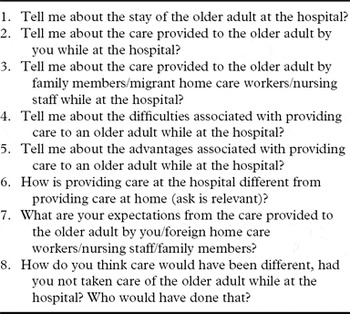
Three bilingual social workers with training in qualitative research served as interviewers. Interviews were conducted between July 2011 and April 2012 in either Hebrew or English according to respondents’ preferences. A funnel approach was employed during interviews, starting from broad questions such as “Tell me about your hospitalization/your care recipient's hospitalization,” followed by more detailed questions such as “What are your expectations of yourself during hospitalization.” Respondents were asked descriptive questions, such as “Describe your role in this caregiving setting.” They were also asked analytic/interpretive questions such as “What are the advantages of having a migrant home care worker during hospitalization,” and comparative questions such as “How do you think the treatment would have been without a migrant home care worker present.” An interview guide is presented in Table 1. In addition, selected demographic questions were included to better situate the respondents in a sociocultural context. On average, interviews were conducted for 25–40 minutes due to the disjointed nature of the hospital environment. Attempts were made to conduct interviews in a quiet, uninterrupted, and isolated environment with none of the other stakeholders present, but this was not always possible given the physical design of the hospital ward.
Interview guide

Analysis
Data categories were coded in stages, with each successive stage representing a more complex conceptual level (Strauss and Corbin, Reference Strauss and Corbin1998). Each interview was first coded thematically for major content areas (e.g. the performance of emotional tasks by migrant home care workers). Next, commonalities and differences across interviews were evaluated and themes were regrouped to represent major content areas that received considerable attention across participants (e.g. perceived roles of family caregivers). We did not try to force data into preconceived themes but used an open coding approach that allowed interview data to guide the creation of the categories (Creswell, Reference Creswell1998). To search for intertheme consistencies and contradictions, descriptive (e.g. family members do not perform physical tasks) and then interpretive categories (e.g. physical tasks by family members as a cultural taboo) were created to represent interview data. The final stage was selective coding, which involved the identification of core categories to create a storyline (Strauss and Corbin, Reference Strauss and Corbin1998), with the focus on family caregivers for the purposes of this study. Analyses were conducted for each group separately and commonalities and differences across groups were noted. Nvivo 7 was used for data management and storage.
Establishing sources of trustworthiness
All interviews were recorded and transcribed verbatim. An audit trail (Rodgers and Cowles, Reference Rodgers and Cowles1993) was maintained by recording the data analysis process and keeping records for all stages of the analysis. To establish the rigor of the study and to ensure its conformability (Guba and Lincoln, Reference Guba and Lincoln1989), the findings were discussed in detail with several hospital employees of different professional affiliations and their feedback was incorporated. Finally, interviews from the four groups constitute a form of triangulation (Long and Johnson, Reference Long and Johnson2000).
Results
Three main themes emerged from the data. The first concerned the family members’ caregiving roles. Family members viewed care management as their primary responsibility. In contrast, older patients, nursing personnel, and home care workers emphasized the family member's physical presence. When hands-on care was performed by family members, it was primarily performed by the wives of older patients. The second theme concerned barriers to the fulfillment of caregiving roles. Barriers were classified as cultural, practical, or emotional. The final theme concerned potential conflicts between the involved groups. Nursing personnel freely discussed unmet expectations associated with the care provided by family carers. These evolved around two major areas: (a) perceived lack of care and neglect of the older patient and (b) interference in routine nursing care by family members. When conflicts and unmet expectations were discussed with older patients and home care workers, their responses were centered around issues of neglect and inadequate care. When family members discussed conflicts and unmet expectations, this was primarily in relation to the migrant home care worker, with most family members reporting empathy with nursing personnel.
Family caregiving roles
Four major family caregiving roles were identified. Family members emphasized their care management role, whereas older adults, home care workers, and nursing personnel tended to emphasize the physical presence of family members as their main role. Other roles included emotional and hands-on care.
Care management
Adult children of patients and, to a lesser degree, the spouses tended to emphasize care management as their main role. Adult children portrayed themselves as being “in charge” of the entire caregiving arrangement, which included the nursing personnel, physicians, migrant home care workers, and the patients. The following statement by an adult daughter provides an illustration of this perspective: “I am [in] the ministry of finance. One of the doctors said that I am the captain here. I manage everything, including paid caregivers. He [father] was a very independent person, but at some point he gave me the handles. I am the oldest daughter, I manage everything here.”
This perspective was supported by some older adults, who viewed family members as being in charge of the entire caregiving scheme, “he [son] brings in the worker, he pays taxes, electricity, takes my income and brings it over. Everything. . . .”
Nursing personnel and migrant home care workers did not discuss the family members’ roles in these terms and hardly acknowledged the managerial aspects associated with the care.
Physical presence
Physical presence was noted as an essential task to be performed by family members. This is illustrated by the following quotation from an interview with an adult daughter, “I come to visit, but he [father] has three workers, one of them takes care of the shifts and of contacting physicians. . .” Similarly, a patient provided a consistent description of the role performed by her adult children, “their [family] role is to come, so I won't get bored.” A similar view was articulated by some of the nurses who argued for the importance of family visits, “I think this is a sensible behaviour of the family, to come and show interest.” Consistently, when asked to describe the family's involvement in the care, most home care workers emphasized family visits as the main role of family members: “the family comes to visit mother . . . to speak with mother.” The difference between the four groups, however, lies in the fact that the latter two groups (migrant home care workers and nursing staff) discussed family members’ physical presence with irony, alluding to the mere absence of even this basic responsibility, whereas the former two groups (family members and older adults) discussed physical presence as an important task performed by family members.
Emotional care
Even though emotional care did not capture a major role in the discussion, it was identified as one of the expected roles of family members. This is evident in the following statement of an adult child of a patient, “We try to make his [father's] time as nice as possible and to make sure he gets everything he needs.” Patients also commented on the importance of emotional care. This is evident from the following statement made by one of the patients, “they [family] help me with everything and I get lots of love.”
Expectations for emotional care by family caregivers were also articulated by the nursing personnel, “I think that families do not need to do anything because they come just to see the patient. But they can give emotional support. They can help in this way and that's it. Practically, I don't expect them to do anything.” Migrant home care workers, on the other hand, did not emphasize emotional care as one of the tasks of family members.
Hands-on care
Although hands-on care received substantial attention in interviews with all stakeholders, it was often identified as the one task family members did not engage in. Family members were portrayed as refraining from performing physical tasks such as changing diapers and washing the patient. Moreover, even less demanding tasks such as bringing water to a patient were hardly ever performed by family members according to respondents’ reports.
An adult child of a patient described this vividly, “there is a need to wash him [father], dress him. We cannot do this, it is better that a stranger [worker] does it, rather than the kids. Kids cannot do that [physical care].” In concordance with the views expressed by family members, nursing personnel also emphasized that most family members do not participate in nursing care, “the family, to tell you the truth, is not really participating in the care. There are even some families that demand that we moisten the patient's lips. I don't know if they are afraid to touch the patient or whatever. . .”
Nonetheless, in contrast to the adult children of patients, wives of patients reported and were perceived by the other groups as taking an active role in performing nursing duties during hospitalization. A wife described this clearly, “she [migrant home care worker] washes him, feeds him, everything. When she is on vacation, I do these things for her.” A similar account was proposed by a migrant home care worker, “I need a rest too. . .It's the wife [of the patient]. She replaces me. I work together with the wife. So, what I do in the morning, she does the same thing, later in the afternoon.”
Barriers to fulfilling caregiving roles
All groups spontaneously identified barriers preventing family members to assume caregiving roles. The most commonly identified were cultural, practical, and emotional barriers.
Cultural barriers
Patients, nursing personnel, and family members identified religious or cultural beliefs as the main reason for the lack of engagement in nursing care. For instance, many argued that the provision of physical care by adult children for their parent is a taboo. An older woman clearly summarizes the view that nursing care should not be performed by family members, “they [family members] will do whatever is necessary, but a male [from the family] cannot wash me.” One of the nurses articulated this same argument, “if he [patient] uses a diaper, and he is not a baby, then it's a taboo. Especially when this is your mother or father.”
Others attributed a lack of physical care to the Jewish tradition, which reportedly precludes children from providing physical care to their parents. This is illustrated by the following quotation from an interview with an adult child of a patient: “it is written in the bible, we should be very careful to make sure that he [patient] doesn't get hurt. . .one of the measures to prevent this is to bring someone else to do this [physical care], so that we won't hurt father for God's sake. Respecting your father, this is the most important commandment. . .,” concluded an adult child.
Practical barriers
Practical considerations were identified as a major problem for the provision of family care. These included long commuting distances to the hospital, preoccupation with attending to daily routines, and ignorance in performing specific hospital tasks.
Adult children of patients tended to attribute their absence from the hospital because of employment obligations: “we are all working, my brothers and I. . .and she [worker] knows my mom and her physical needs better than we do. . . .” Many patients explained that the lack of involvement by their children was due to their home-family situation as well as work related responsibilities. Reportedly, some adult children live at great distance from their older parents and are preoccupied with their daily lives. This is articulated in the following statement by one patient “they [children] each have their own family. And it is hard to ask them for help. How can I ask her [daughter] to bring me things, if I know that she didn't even have enough time to cook a meal for her family?”
Being busy with everyday activities was also identified as a potential barrier to family caregiving by migrant home care workers. The following statement demonstrates this: “the family comes from time to time. They cannot come daily. They work.” Another practical barrier to care was the perception of not having adequate knowledge to provide reasonable care for patients. This was identified primarily by nursing personnel. The following quotation by a nurse provides an example, “some families can even cause harm. They do not understand anything.”
Emotional barriers
Fear was identified as a major obstacle preventing family members from engaging in the physical tasks of caring. This is illustrated by the following account of one of the nurses, “they call for us to do all kinds of things, to transfer the patient from his bed to a chair, to change a diaper. It is exceptional to see a family member who helps to lift a patient, who is not afraid of touching the patient.” Some family members reported a similar barrier, “she [worker] talks to him [patient] tells him stories. I, on the other hand, am afraid to feed him. Because he is not breathing well and my sisters are like me. We feed him, but with great fear and she comes and does it really quickly. ” Other adult children identified past relationships with their parents as an emotional obstacle to current engagement in care. An older child reported that, “I am not sure I would have been able to sit here all day [like the migrant home care worker], (a) because we [child and parent] have our former disagreements, and (b) for me to be in one place during the whole day is like a death sentence. . . .” Despondency was also suggested as a barrier for providing care by family members. This is illustrated by the following statement of an adult child, “we pray for him and we read the bible for him and we hope he will get better. But there is nothing else we can do.”
Conflicts
Two major conflicts were identified with regard to family members by nursing personnel. Most often family members were viewed as not doing enough, while at other times, as being overly involved. Family members, on the other hand, reported some concern about the workers’ involvement in patient care, however, they had almost no dissatisfaction with the care provided by nursing personnel.
Lack of care and neglect
The nursing personnel were most critical of the family members’ lack of involvement in the care for the patients. Many emphasized the family members’ lack of physical presence, whereas others argued that even when family members are present, they fail to perform minimal caregiving tasks, such as providing water. This is illustrated by the following quotation from one of the nurses: “family members do not help. They ask us to do things. To change a diaper. . . It is uncommon to find a family member who is being helpful, who helps with lifting, who is not afraid to touch. It is unusual. Usually they say, ‘I don't touch him/her, come do this.’ Most of the time, you don't see them help the patients. They just say ‘hello’. . . .” Using a milder tone, some migrant home care workers and patients concurred with these observations and argued that family members are either too busy to actually be involved in the care or are too apprehensive to provide physical care.
Too much involvement
Too much involvement in the form of requests and questions was portrayed as problematic by nursing personnel. Reportedly, many family members tend to engage staff members in excess discussion of the patient's medical condition and hinder the staff from performing their jobs. This conflict was reported by nursing personnel and not by the other three groups. A nurse stated, “look, my expectation is that they [family members] won't interfere with my business. Because many times, and I am sorry to say that, they cause more disturbance than actually being helpful.”
Can I trust this worker?
A dilemma articulated by some family members was whether or not the worker can be trusted to provide caregiving services to the patient. This is illustrated by the following quotation from an interview with an adult child, “potential disadvantages [of the worker] are that we don't know if she [worker] is here all day, because she meets with her friends, they speak their own language, and they start celebrating. . .I have seen this happen before.” Several patients expressed similar sentiments, “she [worker] is sitting here, taking her time and then goes away for half an hour or an hour. . . .” Nursing personnel reported similar concerns about migrant home care workers. The following statement illustrates this vividly, “I saw her [worker] sitting. When she came, I told her, ‘he [patient] was waiting for you to take him to the shower,’ then she looked at me as if I were a weirdo.”
Nursing is doing its best
In contrast to migrant home care workers, who were viewed with suspicion, nursing personnel were regarded in high esteem by family members and patients alike. The following quotation by a family member demonstrates the respect and trust family members felt toward nursing personnel “my expectations are that they [staff] take care of my mom and that's exactly what they do. I am in awe of their work, especially given their high workload.”
Patients concurred with this point of view and also praised the nursing personnel, “I am speechless. I cannot talk enough about what they [personnel] do. They do what they can.” Although, to some degree this view was shared by migrant home care workers, they also expressed some competing views, emphasizing inadequate attendance to patients’ needs, “I don't want to ask for help [from personnel]. If I ask for help [from personnel], they say, ‘just a minute,’ I don't want to be ignored all the time.”
Discussion
This study evaluated family caregiving at the intersection between migrant home care and nursing care during the older adult's hospitalization. This study provides support to a task-specific model of care, which argues that formal care “steps in” to fulfill specific caregiving tasks (Litwak, Reference Litwak1985). In this study, it was clear that most adult children remained in a care management role, but were reluctant to perform other caregiving roles, which remained in the domain of nursing personnel and migrant home care workers. However, in the case of the wives of older patients, the complementary model more adequately portrays the intersection of care (Chappell and Blandford, Reference Chappell and Blandford1991), where the wife and the migrant home care worker share in the care of the older patient.
Consistent with past research (Ayalon, Reference Ayalon2009), we found that adult children perceive their care management role as central. Hence, even in the event of hospitalization of the older patient and the entrance of “new players” into the caregiving setting, adult children do not abandon their traditional caregiving roles. A different picture emerged following interviews with nursing personnel and migrant care workers, who perceived the physical presence of the family members as their main role, which is not always adequately performed. This illustrates the importance of obtaining several perspectives on family caregiving within the hospital setting as the different parties perceive the family caregiving roles quite differently. Although care management is important for the continuation of care, physical presence is a peripheral role, which in itself has only minor significance unless accompanied by other roles, such as the provision of emotional care, monitoring the patient's condition, or communication with nursing personnel.
Although family members, older patients, and nursing personnel tended to emphasize emotional care as one of the primary family caregiving tasks, migrant home care workers did not acknowledge this as a role performed by family members. In contrast to physical presence or nursing care, which are objectively measured, emotional care is more subjective in nature. Hence, relative to Israelis, migrant home care workers might have different expectations or standards for emotional care provided by family members. The present findings are interesting in light of past research, which found that migrant home care workers have a central role in the provision of emotional care to their older care recipients (Ayalon, Reference Ayalon2009). Failure to mention emotional care as part of the family caregiving tasks may reflect an implicit attempt by migrant home care workers to maintain the emotional domain within their area of care.
Past research has shown that the provision of hands-on care by family members ceases upon the hospitalization of older patients (Laitinen, Reference Laitinen1993). Similar to past research (Ayalon, Reference Ayalon2009), we found that when the family caregiver is the wife of an older patient, she tends to continue her caregiving role, providing many of the nursing duties traditionally performed by migrant home care workers and nursing personnel. On the other hand, when the family caregiver is an adult child, nursing duties are rarely performed by this person, but are rather shared by both migrant home care workers and the nursing personnel. These differences between adult children as caregivers versus spouses as caregivers have been noted in past research, conducted in North America and Europe. In accordance with the present findings, past research has shown that adult children are less likely to perform personal caregiving tasks, tend to report higher levels of caregiving burden, and are also more likely to place the older adult in an institution compared with spouse caregivers (Montgomery and Kosloski, Reference Montgomery and Kosloski1994; Conde-Sala et al., Reference Conde-Sala, Garre-Olmo, Turró-Garriga, Vilalta-Franch and López-Pousa2010).
Motivation for the provision of care by family members is well documented in the literature (Smith et al., Reference Smith, Kleinbeck, Boyle, Kochinda and Parker2001; Kolmer et al., Reference Kolmer, Tellings, Gelissen, Garretsen and Bongers2008; Auslander, Reference Auslander2011). Nevertheless, very little response was elicited by those interviewed with regard to motivation for care provision. More often, spontaneous discussion revolved around barriers to the provision of appropriate care, as if interviewees had to justify deviations from the expected norms in caregiving.
Different barriers to the various caregiving tasks were spontaneously identified. A central barrier identified primarily by family members and older care recipients was the presence of cultural norms that suggest that nursing care should not be provided by adult children. It appears as if family members and older adults struggled with two competing themes, one that says that care should, in general, be provided by family members and another that says that hands-on care should not be provided by family members. To deal with this dissonance and to explain family members’ lack of engagement in hands-on care, they emphasized the latter and made a distinction between family care and nursing care.
To explain family members’ lack of physical presence, family members, patients, and even migrant home care workers tended to emphasize practical considerations, such as geographical distance and work as barriers. Being “stuck” in the middle is a common experience of adult children who have to care for their older parents while tending to their young children (Riley and Bowen, Reference Riley and Bowen2005). In the present study, it appears that some adult children solved this conflict by delegating the duty of being physically present to the migrant home care worker. Although we did not collect systematic data on this, the population most difficult to reach in our study was the population of family members, who often were not physically present or available for an interview. This is somewhat contrasted with an epidemiological study that found that about 70% of hospitalized Israeli patients were accompanied by a family caregiver (Auslander, Reference Auslander2011). The fact that the study was not age restricted (Auslander, Reference Auslander2011) might explain the apparent discrepancy. In addition, in contrast to past research, this study focused on older hospitalized patients who were accompanied by migrant home care workers. Hence, it is possible that some family caregivers leave the task of being physically present to the migrant home care worker.
Emotional factors such as fear might also explain the failure to provide nursing tasks. Negative precipitations (spillovers) from past interactions with the hospitalized patients were identified as barriers to the provision of emotional care as well as to being physically present during hospitalization. It is interesting that in a hospital environment, most family members spoke about their emotional reactions to the tasks at hand rather than their feelings about the patient's medical condition. This might be seen as a tendency of family members, particularly adult children, to emotionally distance themselves from the situation. The tendency of adult children to focus on the managerial tasks associated with caregiving might be another indicator for emotional separation. Being a care manager puts the family member in a position of strength and enables detachment from daily tasks.
Most of the conflicts at the intersection of family care, migrant home care, and nursing care were discussed by the nursing personnel who tended to view family members as reluctant to participate in patient care. In contrast, they also complained that too much involvement by family members would prevent nursing personnel from performing their routine tasks. This finding is consistent with past research which has demonstrated that nursing personnel do not always perceive their engagement with family members as a major task and at times, perceive family members’ involvement as a burden (Benzein et al., Reference Benzein, Johansson, Arestedet and Saveman2008). These ambivalent feelings expressed by nursing personnel emphasize the conflicting roles that family members must assume as caregivers. They are criticized both for their lack of involvement and for over-involvement in patient care.
When we focused on the migrant home care workers in our analysis, we found a similar situation where migrant home care workers were criticized for their presence as well as for their absence (Ayalon et al., under review). Hence, in contrast to the nursing personnel that have very defined roles and expectations, the two other types of caregivers in this nexus of care have diffused and undefined roles. This serves as a double-edged sword, where family members and migrant home care workers are doomed if they do and doomed if they do not.
Two other conflicts emerged regarding perceived expectations of nursing personnel and migrant home care workers’ caregiving roles. Nursing personnel were viewed positively by family members and patients. Unmet expectations were rarely discussed. Moreover, empathy was noted for the high demands placed on nursing personnel. In contrast, migrant home care workers were often criticized and viewed negatively for not performing their roles adequately. This can be explained by the fact that during hospitalization, patients and family members are subjected to nursing personnel's initiatives in providing nursing services. If interviews of family members and older patients were performed a second time following discharge, then perhaps views expressed would be different.
Another important factor that could potentially be responsible for differential attitudes reported toward nursing staff versus migrant home care workers is the differential placement of the two professions along the caregiving hierarchy. Migrant home care workers are at the bottom of the hierarchy, given their foreign status and “unskilled and undefined” role. Their expected duties include roles that no one else in society would consent to perform (Anderson, Reference Anderson2000; Salazar Parrenas, Reference Salazar Parrenas2001). Nursing staff, on the other hand, have an established, well-defined, supervisory role on the unit. As a result, all three groups are less hesitant to criticize migrant home care workers.
Several potential shortcomings of this study should be acknowledged. First, the study was conducted in only one hospital ward. It is possible that work environments including patient load are different in other hospital wards. In addition, interviews were conducted in either English or Hebrew. As a result, the pool of potential migrant home care workers was limited due to language restrictions. The relative small sample size of respondents from each interest group is another limitation that should be acknowledged. This is particularly relevant for the case of family members, who were mainly children of the hospitalized patients, rather than spouses. The present findings should be reviewed with caution, given past research that has shown notable differences between the two parties in terms of caregiving duties and degree of involvement (Georges et al., Reference Georges, Jansen, Jackson, Meyrieux, Sadowska and Selmes2008). Finally, interviews were conducted with only those family members who were present during the patient's hospitalization. Thus, the study is limited to those family members who fulfilled at least one of the caregiving tasks discussed in this study, namely, being present next to the older patient.
Conclusions
Despite its limitations, this study provides a rare exploration of the intersection between family, nursing, and migrant home care. Our findings demonstrate that the perception of family caregiving roles varies according to the group interviewed, with adult children of patients emphasizing care management while the others noting mainly physical presence. Wives of the patients, however, performed nursing roles that complemented the care provided by migrant home care workers and the nursing personnel. Our findings also demonstrate the preoccupation with barriers to family care, potentially as a means to excuse family members’ limited involvement in the care. Finally, our findings highlight the ambivalence toward family care and home care within the hospital premises relative to the more accepting and even forgiving attitudes toward nursing staff.
Implications for practice
A major implication of this study concerns the diffused role of family caregivers who are criticized by nursing personnel for failure to adequately participate in patient care as well as for unnecessary and superfluous intervention. Thus, there is a need to better define family members’ roles within a hospital setting and to train nursing staff to acknowledge variations in family caregiving. It appears that the presence of migrant home care workers does not reduce expectations that family members remain physically present at the patient's bedside. The identification of various barriers for family care potentially suggests that all groups are not satisfied with the performance by family members in caregiving tasks. It is possible that the discussion of perceived barriers to care represents an attempt by family members to alleviate some of the guilt associated with their caregiving experience. The same discussion by older patients might represent dissatisfaction and disappointment. Hence, health providers should pay attention to this discrepancy between expected and performed family caregiving roles. To some extent, the criticism brought by nursing personnel reflects a departure from a family-centered approach, with family members being viewed as a nuisance, rather than as a collaborator. Hence, it appears that nurses might benefit from additional educational interventions geared toward family-centered care.
Conflict of interest
None.
Description of authors’ roles
Liat Ayalon is responsible for concept development, analysis of the data, and the write-up of the entire manuscript. Sara Halevy-Levin, Zvi Ben-Yizhak, and Gideon Friedman are responsible for concept development, assistance with data collection, and critical revisions of the manuscript.
Acknowledgment
The study was funded by the Israeli Ministry of Health.