1. Introduction
This paper deals with a problem of reservation in a large distributed system. Our motivation is a car-sharing system in which a fleet of cars move around and are parked at a set of stations, mainly for electric issues. A crucial problem is the presence of empty and full stations. In an empty station users cannot pick up a car, while in a full station, also called saturated, users cannot park the car. Reservation could help the user to find both a car at the departure station and a parking space at the destination. We focus on a reservation policy called double reservation which is to reserve both the car and the parking space at the same time, a moment before picking up the car. Car and parking space reservations were proposed by Autolib’, the car-sharing system that existed in Paris from 2011 to 2018. Its fleet was composed, in July 2016, of 3980 electric vehicles, called Bluecars, distributed in 1084 stations in the Paris metropolitan area with 5935 charging points. More than 126 900 subscribers registered for the service. See [23] for more details about Autolib’.
Note that if the time between the reservation and the pick-up is zero, the policy is to reserve only the parking space when the car is picked up. This policy is called simple reservation. In free-floating systems, users cannot reserve parking spaces as the cars are parked in a public space. These systems are outside the scope of the paper.
1.1. Simple reservation model
The simple reservation model can be described as follows. It consists of N stations of finite capacity K and
 $M_N$
cars. Users arrive at rate
 $\lambda$
in each station. A user reserves a parking space at a randomly chosen destination station when he or she picks up a car. If this is not possible, the unhappy user leaves the system. Otherwise, after a trip with exponential distribution of parameter
 $\mu$
, the car is parked at its reserved parking space in the destination station.
The system is said to be large when N and
 $M_N$
tend to infinity at the same order. Only the fleet size
 $M_N$
is of the order of N. The other variables such as the arrival rate per station
 $\lambda$
or the mean trip duration
 $ 1/\mu$
are bounded, so of the order of 1. Indeed, an increase in the number N of stations can be considered as a densification of the service area, and not as an extension. There is no reason for the mean trip time to increase. The aim of studying the model when N tends to infinity is to obtain an approximation of a car-sharing system with a large fleet and a large number of stations. The aim is not to study the physical extension of the service area or the number of stations.
Let us denote by
 $s_N$
the ratio
 $M_N/N$
, tending to a constant s which is the average number of cars per station. This sizing parameter s is a key parameter of the system. In [Reference Bourdais, Fricker and Mohamed7], this policy is studied in a homogeneous framework with a mean-field approach, using a large-scale analysis similar to that of bike-sharing systems in [Reference Fricker and Gast10].
Due to the the parking space reservation, the state of each station is described in [Reference Bourdais, Fricker and Mohamed7] by a vector with two components: the number of cars and the number of reserved parking spaces, which is the main difference from [Reference Fricker and Gast10]. The state process is 2N-dimensional and Markovian. With standard arguments, mean-field convergence is established. Beyond this, the analysis of the equilibrium point is much more delicate with parking space reservation.
The aim of this paper is to prove these results extended to the double reservation model introduced as follows. In particular, our paper gives a proof of [Reference Bourdais, Fricker and Mohamed7, Theorem 2], omitted in [Reference Bourdais, Fricker and Mohamed7], on the simple reservation model.
1.2. Double reservation model
Station-based car-sharing systems such as Autolib’ offer the possibility of reserving a car and a parking space in the desired station online, a moment before actually picking up the car. In this paper, we consider a model that meets this user demand. In our model, the user reserves a car at a given departure station and, at the same time, a parking space at a destination station. If there is no car or no parking space available, the user leaves the system. Otherwise, it takes a time called the reservation time between car reservation and car pick-up. The reservation time has an exponential distribution with mean
 $1/\nu$
. Then follows the trip, whose duration is assumed to have an exponential distribution with mean
 $1/\mu$
. Eventually the user parks the car at the reserved space in the destination station and leaves the system.
1.3. Discussion of the model
1.3.1. Approximation of a large system
In practice the numbers of stations and cars are finite but large. For example, on 3 July 2016, Autolib’ offered 1084 stations for 3980 electric cars; see [23]. Asymptotic analysis provides an approximation of the behavior of this finite-size system. Therefore, the dimensioning problem of finding the optimal number of cars per station for N large is approximated by its limit value when N tends to infinity.
1.3.2. Double vs simple reservation
To get the order of magnitude of the variables of our model, note that Autolib’ offered 30 minutes as the maximum reservation duration for the car and 1 hour 30 minutes for the maximum reservation duration of the parking space at the destination (see [Reference Waserhole22, p. 20]). Moreover, the mean trip duration was around 38 minutes (see [2] for 2013). Thus, the mean trip time
 $1/\mu$
and the mean reservation time
 $1/\nu$
are comparable. This fully justifies the motivation of studying the double reservation policy.
1.3.3. Extension to a heterogeneous model
For sake of simplicity, our choice of a homogeneous network is motivated by the mean-field approach used in our study. A homogeneous framework is generally presented as the simplest, allowing the difficulties of the model to be highlighted and simple explicit results to be obtained. It is still possible to extend this study to a heterogeneous model using clusters by grouping stations with similar parameters in the real system. Since the trip times are random with an exponential distribution of parameter
 $\mu$
, the heterogeneity of the trips is carried by the randomness. Finally, network heterogeneity is carried by the arrival rate depending on the cluster and the probability of reserving a parking space in a station of a given cluster (for the homogeneous model, this probability is
 $1/N$
). See [Reference Fricker, Gast and Mohamed11] for details. For models with the state process having a product-form invariant measure, the heterogeneous framework is quite natural. In the context of bike- and car-sharing systems, see [Reference Fricker, Mohamed, Popescu and Trépanier12, Reference Fricker and Tibi13]. However, our model does not fit into this framework. For such models, the mean-field approach remains effective, hence our choice of a homogeneous model.
1.3.4. Extension to heterogeneous users
To take account of different reservation behaviors of users, two classes of users can be considered: users who reserve early and users who reserve at the last minute. This means introducing two different parameters
 $\nu_1$
and
 $\nu_2$
for the exponential distribution of the reservation time. This extension remains within a Markovian framework.
Furthermore, the real-world trip time distribution can be fitted by an Erlang distribution. Replacing the exponential distribution of the trip time by an Erlang distribution, i.e. the distribution of the sum of independent and identically distributed (i.i.d.) random variables with exponential distribution, a state process capturing the phases of the Erlang distribution is still Markovian.
1.4. Main results and contribution
1.4.1. Mean-field approach
A three-dimensional state space (reserved cars, reserved spaces, and available cars) for each station does not allow this process to be fully described as a Markov process, because the parking space reservation time is the sum of two exponentially distributed variables (car pick-up time and trip time). This leads to the introduction of a fourth variable to distinguish between parking spaces reserved by users not yet travelling and users travelling. But even the associated state process is not Markov. As we will see on the transitions described in Section 2, the Markov process associated with this model, denoted by
 $(X^N(t))$
, is more complicated, and in particular of dimension
 $(N+1)^2$
, where N is the total number of stations. Therefore, for a given station, the state space is of dimension N, which is not suitable for an asymptotic analysis when N tends to infinity. To solve this problem, we introduce the process, denoted by
 $(Z^N(t))$
, which describes the state of each station i,
 $1 \leq i \leq N$
, as a function of the Markov process
 $(X^N (t))$
. Indeed,
 $Z^N_i(t)$
has four components:
-
•
 $R_i^{r,N}(t)$
, the number of parking places reserved by non-driving users at station i at time t;
-
•
$R_i^{N}(t)$
, the number of parking places reserved by users driving at station i at time t; -
•
$V_i^{N}(t)$
, the number of cars available at station i at time t; -
•
$V_i^{r,N}(t)$
, the number of reserved cars at station i at time t.


As previously mentioned, the process
 $(Z^N(t)) = (R^{r,N}(t), R^{N}(t), V^{N}(t), V^{r,N}(t))$
is of dimension 4N but is not a Markov process. The loss of the Markov property is the price to pay for this dimension reduction. Nevertheless, remarkably, we prove that, despite this non-Markovian description, the state
 $(Z^N_i(t))$
of a given station i (
 $1\leq i \leq N$
) converges in distribution, as N goes to infinity, to a non-homogeneous Markov process
 $(\overline{Z}(t))=(\overline{R^r}(t),\overline{R}(t),\overline{V}(t),\overline{V^r}(t))$
satisfying the Fokker–Planck equation
 \begin{align} \frac{{\mathrm{d}}}{{\mathrm{d}} t}\mathbb{E}(f(\overline{Z}(t))) & = \lambda\mathbb{P}(\overline{V}(t) \gt 0)\mathbb{E}((f(\overline{Z}(t)+e_1)-f(\overline{Z}(t))) \mathbf{1}(\bar{S}(t) \lt K)) \nonumber \\[3pt] & \quad + \nu\mathbb{E}((f(\overline{Z}(t)+e_2-e_1)-f(\overline{Z}(t))) \mathbf{1}(\overline{R^r}(t) \gt 0)) \nonumber \\[3pt] & \quad + \mu\mathbb{E}((f(\overline{Z}(t)+e_3-e_2)-f(\overline{Z}(t))) \mathbf{1}(\overline{R}(t) \gt 0)) \nonumber \\[3pt] & \quad + \lambda\mathbb{P}(\overline{S}(t) \lt K) \mathbb{E}((f(\overline{Z}(t)+e_4-e_3)-f(\overline{Z}(t))) \mathbf{1}(\overline{V}(t) \gt 0)) \nonumber \\[3pt] & \quad + \nu\mathbb{E}((f(\overline{Z}(t)-e_4)-f(\overline{Z}(t))) \mathbf{1}(\overline{V^r}(t) \gt 0)), \end{align}
with
 $e_1=(1,0,0,0)$
,
 $e_2=(0,1,0,0)$
,
 $e_3=(0,0,1,0)$
, and
 $e_4=(0,0,0,1)$
, f a function with finite support on
 $\mathbb{N}^4$
, and
 $\overline{S}(t) = \overline{R^{r}}(t) + \overline{R}(t) + \overline{V}(t)) + \overline{V^{r}}(t)$
the limiting number of unavailable parking spaces at station i at time t. The asymptotic process
 $(\overline{Z}(t))=((\overline{R^r}(t),\overline{R}(t),\overline{V}(t),\overline{V^r}(t))$
is a jump process with time-dependent rates, the so-called McKean–Vlasov process. This mean-field convergence theorem is not standard at all. Indeed, the mean-field limit is usually obtained for a Markov state process.
1.4.2. The equilibrium
For non-homogeneous Markov processes, recall that there can be several invariant measures. We prove that there is a unique invariant measure in a restricted framework. The proof is based on three main arguments. First, by applying queueing theory, the McKean–Vlasov process on the basic state space is identified with a tandem of four queues with an invariant measure of explicit product form. This explicit product form allows us to change the problem of existence and uniqueness of the invariant measure of the non-homogeneous Markov process to the same problem for a fixed-point equation in dimension 4. Then, by straightforward simplifications, the last fixed-point equation is reduced to dimension 2. This simplification is straightforwardly proved by the queueing interpretation of the limiting McKean–Vlasov process. Finally, the global inversion theorem and a monotonicity property allow us to conclude. The last two arguments are based on combinatorial calculations. Monotonicity is just proved when the mean reservation time is sufficiently small. We are convinced that this assumption is technical but the proof needs other tools. This monotonicity property is first guessed on the tandem of queues. It is a main benefit of the queueing interpretation of the limiting process.
1.5. Related works
For sharing systems, despite the need for analysis of these stochastic systems, most of the literature concerns operations research (OR) and data analysis. Probabilistic models have been proposed and analyzed for bike-sharing systems [Reference Fricker and Gast10, Reference Fricker and Tibi13], where usage does not allow reservation. As far as we know, there has been no stochastic analysis for car-sharing systems with reservation before [Reference Bourdais, Fricker and Mohamed7].
For car-sharing systems, the first part of the literature investigates the location problem. In [Reference Boyac, Zografos and Geroliminis8], OR optimization is used to plan an efficient car-sharing system in terms of the number, location, and capacity of stations and fleet size, applied to the case of Nice, France.
Vehicle redistribution and staff rebalancing is a big issue in car-sharing systems (see, e.g., [Reference Nourinejad, Zhu, Bahrami and Roorda19]). For simple reservation, called complete parking reservation (CPR), [Reference Kaspi, Raviv and Tzur16] showed by simulation and [Reference Kaspi, Raviv, Tzur and Galili17] with OR techniques that CPR outperforms no reservation for a specific user-oriented metric. This metric is the excess time users spend in the system due to lack of cars or parking spaces, i.e. the difference between actual time and ideal trip time, including walking times to stations. The reservation impact was not investigated in [Reference Deng, Gupta and Shroff9], but the charging problem was: a queueing analysis for dimensioning the fleet size was proposed for a closed network taking account car charging.
Despite the potential of car sharing, even data analysis remains largely unexplored. This is also due to the lack of data provided by the operators. [Reference Boldrini, Bruno and Conti5] exploited one month (April 2015) of publicly available data from Autolib’, in Paris, France, with 960 stations and 2700 electric cars at this time, giving an idea of the average car pickup rate and the availability of cars at a station. Furthermore, a dichotomy between Paris and the suburbs was highlighted.
Mean field is an efficient tool for studying the behavior of large distributed systems or interacting systems in many different application domains. These systems have large numbers of both nodes and customers (particles, cars, etc.). To the best of our knowledge, our large-scale stochastic analysis is the first for a stochastic model of car sharing systems with double reservation. Our first main result is that the non-Markovian state process for a given station converges to a non-homogeneous Markov process, which is not standard. Furthermore, we note that this limiting Markov process can be described using a simple queueing system. This result was first obtained by simulation in [Reference Bourdais and Fricker6, Section 5]. Indeed, in [Reference Bourdais and Fricker6], an artificial Markov model on the state of the stations, called the approximate model process, is introduced for the double reservation. Its mean-field limit at equilibrium fits with the real dynamics at equilibrium, which allows the authors to guess such an outcome. The same phenomenon is proved in an entirely different framework, for a model of a network with failures, in [Reference Aghajani, Robert and Sun1]. Note that the framework in [Reference Aghajani, Robert and Sun1] induces simultaneous jumps, which make the proofs more technical. Our paper discusses a simpler framework which focuses on the main arguments and provides the proof of the result expected in [Reference Bourdais and Fricker6]. Like our model, the celebrated Gibbens–Hunt–Kelly model exhibits strong interactions [Reference Gibbens, Hunt and Kelly14]. In [Reference Graham and Méléard15], it is proved that these interactions disappear for the mean-field limit. Because of these three models, we believe that this methodology can be useful in many other contexts. A main contribution of the paper relies on the result of uniqueness of the equilibrium point in high dimensions (dimension 4), thanks to a nice interpretation in terms of queues. As far as we know, there is no such result in the literature.
1.6. Outline of the paper
In Section 2, the Markov process
 $(X^N(t))$
associated with our model is defined and the stochastic evolution equations are given. In Section 3, the second process
 $(Z^N(t))$
describing the state of the stations is introduced. A heuristic computation of its McKean–Vlasov asymptotic process is derived. Theorem 1, which establishes the existence and uniqueness of this stochastic process, is proved. Section 4 is devoted to Theorem 2, giving the mean-field convergence for
 $(Z^N(t))$
, and highlights the probabilistic interpretation of the Mckean–Vlasov process. Section 5 analyses its invariant distribution.
2. The model
In this section, we describe the dynamics of our stochastic model. We recall that the system has N stations of capacity K. The Markov process that gives the dynamics of the system is
 $X(t)=\big(X^N_{i,j}(t),0\leq i,j\leq N\big)$
, where, for
 $1\leq i,j\leq N$
, at time t,
-
•
$X^N_{i,j}(t)$
is the number of cars reserved at i with parking space reserved at j; -
•
$X^N_{0,j}(t)$
is the number of parking spaces reserved at j by users driving; -
•
$X^N_{i,0}(t)$
is the number of cars available at station i.


The total number of cars is
 $M_N$
and the fleet size parameter, defined as the mean number of cars per station if they are all parked, is
 \begin{equation*} s \,:\!=\, \lim_{N\rightarrow +\infty} \frac{M_N}{N}.\end{equation*}
2.1. Transitions of the Markov process
The transitions of the Markov process
 $(X^N(t))$
are reservations, car pick-ups, and car returns.
-
• Reservations. At station i, at rate
$\lambda$
, an available car is replaced by a reserved car and an available parking space is reserved at the same time at a random station, say j. If there is either no available car at i or no available parking space at j, the reservation fails. If a reservation is made at time t, where the limit from the left of function f at t is denoted by
\begin{equation*} \begin{cases} X^N_{i,0}(t) = X^N_{i,0}(t^-)-1 & \text { for } 1\leq i\leq N, \\[3pt] X^N_{i,j}(t) = X^N_{i,j}(t^-)+1 & \text { for } 1\leq i, j\leq N, \end{cases} \end{equation*}
$f(t^-)$
.
-
• Car pick-ups. After a reservation, the user takes a time with an exponential distribution with parameter
$\nu$
to come and pick up the car. So, at rate
$\nu$
, each car reserved at station i disappears and the associated parking space reserved at station j moves to a parking space reserved by a driving user. When taking such a car at time t,
\begin{equation*} \begin{cases} X^N_{i,j}(t) = X^N_{i,j}(t^-)-1 & \text { for } 1\leq i,j\leq N, \\[3pt] X^N_{0,j}(t) = X^N_{0,j}(t^-)+1 & \text { for } 1\leq j\leq N. \end{cases} \end{equation*}
-
• Car returns. After a trip with exponential distribution with parameter
$\mu$
, a driving user returns his car. Thus, at rate
$\mu$
, for each parking space at station j reserved by a driving user, his car becomes an available car. When a car is returned at station j at time t,
\begin{equation*} \begin{cases} X^N_{0,j}(t) = X^N_{0,j}(t^-)-1, \\[3pt] X^N_{j,0}(t) = X^N_{j,0}(t^-)+1. \end{cases} \end{equation*}




Note that
 $(X^N(t))$
is an irreducible Markov process on the finite state space
 \begin{equation} \big\{x = (x_{i,j}) \in \mathbb{N}^{(N+1)^2}, \textstyle\sum_{j=0}^N x_{i,j} + \sum_{j=0}^N x_{j,i} \leq K, \sum_{0\leq i,j\leq N}^N x_{i,j} = M_N\big\},\end{equation}
where K is the finite capacity of each station, thus
 $(X^N(t))$
is ergodic.
2.2. Stochastic evolution equations
The dynamics of
 $(X^N(t))$
can be given in terms of stochastic integrals with respect to Poisson processes. Let us introduce the following notation.
-
• A Poisson process on
$\mathbb{R}_+$
with parameter
$\xi$
is denoted by
$\mathcal{N}_{\xi}$
. A sequence of such i.i.d. processes is denoted by
$(\mathcal{N}_{\xi,i}, i\in \mathbb{N})$
. -
• A Poisson process on
$\mathbb{R}_+^2$
with intensity
$\xi\,{\mathrm{d}} t\,{\mathrm{d}} h$
is denoted by
$\overline{\mathcal{N}}_{\xi}$
. A sequence of such i.i.d. processes is denoted by
$(\overline{\mathcal{N}}_{\xi,i}, i\in \mathbb{N})$
. -
• A marked Poisson process
$(t_n,U_n)$
, where
$(t_n,n\in\mathbb{N})$
is a Poisson process on
$\mathbb{R}_+$
with parameter
$\xi$
and
$(U_n, n\in \mathbb{N})$
is a sequence of i.i.d. random variables with uniform distribution on
$\{1,\ldots,N\}$
, is denoted by
$\mathcal{N}_{\xi}^{U,N}$
. Note that, for
$1\leq i \leq N$
,
$\mathcal{N}_{\xi}^{U,N}(\cdot,\{i\})$
is a Poisson process on
$\mathbb{R}_+$
with parameter
$\xi/N$
, and
$\mathcal{N}_{\xi}^{U,N}(\cdot,\mathbb{N})$
is a Poisson process on
$\mathbb{R}_+$
with parameter
$\xi$
.


Let us introduce the following independent point processes. A reservation of a car in station i is a point of a Poisson process
 $\mathcal{N}_{\lambda,i}^{U,N}$
on
 $\mathbb{R}_+^2$
. For reservations of both a car at station i and a parking space at station j, the times from the moment the user makes a reservation to the moment the car is picked up form a Poisson process
 $\mathcal{N}_{\nu,i,j}$
on
 $\mathbb{R}_+$
. We need a sequence of such i.i.d. processes
 $(\mathcal{N}_{\nu,i,j,l},l\in \mathbb{N})$
as cars are picked up independently, and the same for the trip times of cars returned at station j, associated with a sequence
 $(\mathcal{N}_{\mu,j,l},l\in \mathbb{N})$
of independent Poisson processes.
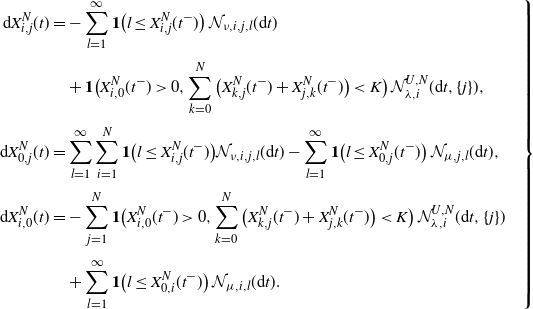
Using the previous notation, process
 $(X^N(t))$
is given by the following stochastic differential equations. For
 $1\leq i, j \leq N$
and
 $t\geq 0$
,
 \begin{equation} \left. \begin{aligned} {\mathrm{d}} X^N_{i,j}(t) & = -\sum_{l=1}^{\infty}\mathbf{1}\big(l\leq X^N_{i,j}(t^-)\big)\,\mathcal{N}_{\nu,i,j,l}({\mathrm{d}} t) \\[3pt] & \quad + \mathbf{1}\big(X^N_{i,0}(t^-) \gt 0,\sum_{k=0}^N\big(X^N_{k,j}(t^-)+X^N_{j,k}(t^-)\big) \lt K\big)\, \mathcal{N}_{\lambda,i}^{U,N}({\mathrm{d}} t,\{j\}), \\[3pt] {\mathrm{d}} X^N_{0,j}(t) & = \sum_{l=1}^{\infty}\sum_{i=1}^N\mathbf{1}\big(l\leq X^N_{i,j}(t^-)\big)\mathcal{N}_{\nu,i,j,l}({\mathrm{d}} t) - \sum_{l=1}^{\infty}\mathbf{1}\big(l\leq X^N_{0,j}(t^-)\big)\,\mathcal{N}_{\mu,j,l}({\mathrm{d}} t), \\[3pt] {\mathrm{d}} X^N_{i,0}(t) & = -\sum_{j=1}^N\mathbf{1}\big(X^N_{i,0}(t^-) \gt 0,\sum_{k=0}^N\big(X^N_{k,j}(t^-)+X^N_{j,k}(t^-)\big) \lt K\big)\, \mathcal{N}_{\lambda,i}^{U,N}({\mathrm{d}} t,\{j\}) \quad \\[3pt] & \quad + \sum_{l=1}^{\infty}\mathbf{1}\big(l\leq X^N_{0,i}(t^-)\big)\,\mathcal{N}_{\mu,i,l}({\mathrm{d}} t). \end{aligned} \right\}\end{equation}
3. The asymptotic process
3.1. Introduction to the asymptotic process
Some more notation is needed. The state of each station i is given by the quadruplet
 \begin{equation*} Z_i^N(t)=\big(R^{r,N}_i(t),R^{N}_i(t),V^{N}_i(t),V^{r,N}_i(t)\big)\end{equation*}
where, at node i at time t:
-
•
$R^{r,N}_i(t)$
is the number of parking spaces reserved by non-driving users; -
•
$R^N_{i}(t)$
is the number of reserved parking spaces by users driving; -
•
$V^N_i(t)$
is the number of available cars; -
•
$V^{r,N}_i(t)$
is the number of reserved cars.


The process
 $(Z^N(t))$
takes values on
 \begin{equation*} \mathcal{S}^N = \big\{(w_i,x_i,y_i,z_i)_{1\leq i\leq N}, (w_i,x_i,y_i,z_i)\in\Sigma_K, \textstyle\sum_{i=1}^N w_i+x_i+y_i+z_i=M_N\big\},\end{equation*}
where
 $\Sigma_K=\{(w,x,y,z) \in \mathbb{N}^4, w+x+y+z\leq K \}$
. Moreover, let us denote by
 $S^N_i(t)=R^{r,N}_i(t)+R^{N}_i(t)+V^{N}_i(t)+V^{r,N}_i(t)$
the number of unavailable parking spaces at station i at time t. Note that
 $ S^N_i(t)$
is a function of
 $Z^N_i(t)$
. This process
 $(Z^N(t))$
gives some refined state of the stations and can be obtained as a function of the Markov process
 $(X^N(t))$
by
 \begin{equation*} R^{r,N}_i(t) = \sum_{j=1}^N X^N_{j,i}(t), \qquad R^{N}_i(t)= X^N_{0,i}(t), \qquad V^{N}_i(t) = X^N_{i,0}(t), \qquad V^{r,N}_i(t) = \sum_{j=1}^N X^N_{i,j}(t).\end{equation*}
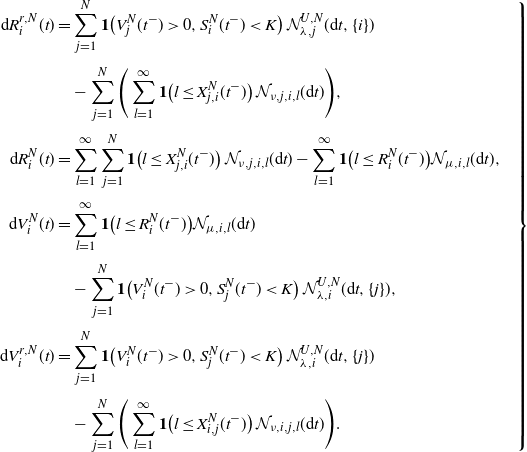
So, the evolution equations of
 $(Z^N(t))$
can be obtained from (3) as follows
 \begin{equation} \left. \begin{aligned} {\mathrm{d}} R^{r,N}_i(t) & = \sum_{j=1}^N\mathbf{1}\big(V^N_{j}(t^-) \gt 0, S^N_{i}(t^-) \lt K\big)\,\mathcal{N}_{\lambda,j}^{U,N}({\mathrm{d}} t,\{i\}) \\[3pt] & \quad - \sum_{j=1}^N\Bigg(\sum_{l=1}^{\infty}\mathbf{1}\big(l\leq X^N_{j,i}(t^-)\big)\, \mathcal{N}_{\nu,j,i,l}({\mathrm{d}} t)\Bigg), \\[3pt] {\mathrm{d}} R^{N}_i(t) & = \sum_{l=1}^{\infty}\sum_{j=1}^N\mathbf{1}\big(l\leq X^N_{j,i}(t^-)\big)\,\mathcal{N}_{\nu,j,i,l}({\mathrm{d}} t) - \sum_{l=1}^{\infty}\mathbf{1}\big(l\leq R^N_i(t^-)\big)\mathcal{N}_{\mu,i,l}({\mathrm{d}} t), \quad \\[3pt] {\mathrm{d}} V^{N}_i(t) & = \sum_{l=1}^{\infty}\mathbf{1}\big(l\leq R^N_i(t^-)\big)\mathcal{N}_{\mu,i,l}({\mathrm{d}} t) \\[3pt] & \quad - \sum_{j=1}^N\mathbf{1}\big(V^N_i(t^-) \gt 0,S^N_j(t^-) \lt K\big)\,\mathcal{N}_{\lambda,i}^{U,N}({\mathrm{d}} t,\{j\}),\\[3pt] {\mathrm{d}} V^{r,N}_i(t) & = \sum_{j=1}^N\mathbf{1}\big(V^N_i(t^-) \gt 0,S^N_j(t^-) \lt K\big)\,\mathcal{N}_{\lambda,i}^{U,N}({\mathrm{d}} t,\{j\}) \\[3pt] & \quad - \sum_{j=1}^N\Bigg(\sum_{l=1}^{\infty}\mathbf{1}\big(l\leq X^N_{i,j}(t^-)\big)\, \mathcal{N}_{\nu,i,j,l}({\mathrm{d}} t)\Bigg). \end{aligned} \right\}\end{equation}
This process
 $(Z^N(t))$
, in dimension 4N, is not a Markov process because the evolution equations for
 $(Z^N(t))$
are not autonomous. They depend on the Markov process
 $(X^N(t))$
which lives in dimension
 $(N+1)^2$
; see (2). We introduce process
 $(Z^N(t))$
because it is sufficient to capture the performance of the system, such as the fact that a station is empty or full. The quite remarkable property is that the limit as N gets large of
 $(Z^N(t))$
is a non-linear Markov process. We present this process in this section and prove the convergence result in the next section.
3.2. Heuristic computation of the asymptotic process
The proof of the convergence will be given in the next section. Here we show how we can guess the asymptotic process. Suppose that, for
 $1\leq i\leq N$
,
 $(Z^N_i(t))$
converges in distribution to some process
 $(\overline{Z}(t))=(\overline{R^r}(t),\overline{R}(t),\overline{V}(t),\overline{V^r}(t))$
. Let
 $\mathcal{P}_i^N$
be the random measure on
 $\mathbb{R}_+$
defined by
 \begin{align*} \mathcal{P}_i^N([0,t]) = \int_0^t\sum_{j=1}^N\Bigg(\sum_{l=1}^{\infty}\mathbf{1}\big(l\leq X^N_{j,i}(s^-)\big)\, \mathcal{N}_{\nu,j,i,l}({\mathrm{d}} s)\Bigg).\end{align*}
 $\mathcal{P}_i^N$
is a counting process (with jump size 1) on
 $\mathbb{R}_+$
and its compensator is
 \begin{align*} \nu\int_0^t\sum_{j=1}^N X^N_{j,i}(s)\,{\mathrm{d}} s = \nu\int_0^t R^{r,N}_i(s)\,{\mathrm{d}} s\end{align*}
(see [Reference Robert20, Proposition A.9], for example). Thus, due to the convergence in distribution of
 $(Z^N_i(t))$
and the standard results on convergence of point processes,
 $\mathcal{P}_i^N$
converges to a non-homogeneous Poisson process
 $\mathcal{P}^{\infty}$
with intensity
 $(\nu\overline{R^r}(t))$
. It can be written as
 \begin{align*} \mathcal{P}^{\infty}({\mathrm{d}} t) = \int_{\mathbb{R}_+}\mathbf{1}\big(0\leq h\leq \overline{R^r}(t^-)\big)\, \overline{\mathcal{N}}_{\nu,1}({\mathrm{d}} t,{\mathrm{d}} h)\end{align*}
where, with our notation,
 $\overline{\mathcal{N}}_{\nu,1}$
is a Poisson process with intensity
 $\nu\,{\mathrm{d}} h\,{\mathrm{d}} t$
, using the characterization of a Poisson process by the martingale of its stochastic integral.
Along the same lines,
 $\tilde{\mathcal{P}}_i^N$
, the random measure on
 $\mathbb{R}_+$
defined by
 \begin{align*} \tilde{\mathcal{P}}_i^N([0,t]) = \int_0^t\sum_{j=1}^N\Bigg(\sum_{l=1}^{\infty}\mathbf{1}\big(l\leq X^N_{i,j}(s^-)\big) \,\mathcal{N}_{\nu,i,j,l}({\mathrm{d}} s)\Bigg),\end{align*}
is a counting process (with jump size 1) on
 $\mathbb{R}_+$
with compensator
 \begin{align*} \nu\int_0^t\sum_{j=1}^N X^N_{i,j}(s)\,{\mathrm{d}} s = \nu\int_0^t V^{r,N}_i(s)\,{\mathrm{d}} s.\end{align*}
It converges to a non-homogeneous Poisson process
 $\tilde{\mathcal{P}}^{\infty}$
with intensity
 $(\nu\overline{V^r}(t))$
, i.e.
 \begin{align*} \tilde{\mathcal{P}}^{\infty}({\mathrm{d}} t) = \int_{\mathbb{R}_+}\mathbf{1}\big(0\leq h\leq \overline{V^r}(t^-)\big)\, \overline{\mathcal{N}}_{\nu,2}({\mathrm{d}} t,{\mathrm{d}} h).\end{align*}
Remark 1. The point processes
 $\overline{\mathcal{N}}_{\nu,1}$
and
 $\overline{\mathcal{N}}_{\nu,2}$
are independent because
 $\mathcal{P}_i^N$
(respectively
 $\tilde{ \mathcal{P}}_i^N$
) is a function of
 $(\mathcal{N}_{\nu,i,j,.},j)$
(respectively
 $(\mathcal{N}_{\nu,j,i,.},j)$
), where
 $(\mathcal{N}_{\nu,i,j,.},j \not= i)$
and
 $(\mathcal{N}_{\nu,j,i,.},j \not= i)$
are independent.
Then let us consider the random measure
 $\mathcal{Q}_i^N$
on
 $\mathbb{R}_+$
defined by
 \begin{align*} \mathcal{Q}_i^N([0,t]) = \int_0^t\sum_{j=1}^N\mathbf{1}\big(V^N_{j}(s^-) \gt 0,\; S^N_{i}(s^-) \lt K\big)\, \mathcal{N}_{\lambda,j}^{U,N}({\mathrm{d}} s,\{i\})\end{align*}
with compensator
 \begin{align*} \lambda\int_0^t\mathbf{1}\big(S^N_{i}(s) \lt K\big)\frac{1}{N}\sum_{j=1}^N\mathbf{1}\big(V^N_{j}(s) \gt 0\big)\,{\mathrm{d}} s.\end{align*}
Heuristically, by the asymptotic independence of stations and the law of large numbers, as N tends to infinity,
 $({1}/{N})\sum_{j=1}^N\mathbf{1}\big(V^N_{j}(t) \gt 0\big) \rightarrow \mathbb{P}(\overline{V}(t) \gt 0)$
. Thus, formally, as N tends to
 $+\infty$
,
 $\mathcal{Q}_i^N$
converges to a non-homogeneous Poisson process
 $\mathcal{Q}^{\infty}$
with intensity
 $\lambda\mathbf{1}(\overline{S}(t) \lt K)\mathbb{P}(\overline{V}(t) \gt 0)$
. In other words,
 \begin{align*} \mathcal{Q}^{\infty}({\mathrm{d}} t) = \int_{\mathbb{R}_+}\mathbf{1}\big(0\leq h\leq\mathbf{1}(\overline{S}(t^-) \lt K) \mathbb{P}(\overline{V}(t^-) \gt 0)\big)\,\overline{\mathcal{N}}_{\lambda,1}({\mathrm{d}} t,{\mathrm{d}} h).\end{align*}
With exactly the same working,
 $\tilde{\mathcal{Q}}_i^N$
on
 $\mathbb{R}_+$
defined by
 \begin{align*} \tilde{\mathcal{Q}}_i^N([0,t]) = \int_0^t\sum_{j=1}^N\mathbf{1}\big(V^N_{i}(s^-) \gt 0,\; S^N_{j}(s^-) \lt K\big)\, \mathcal{N}_{\lambda,i}^{U,N}({\mathrm{d}} s,\{j\})\end{align*}
formally converges in distribution when N tends to
 $+\infty$
to the non-homogeneous Poisson process
 $\tilde{\mathcal{Q}}^{\infty}$
with intensity
 $(\lambda\mathbf{1}(\overline{V}(t) \gt 0)\mathbb{P}(\overline{S}(t) \lt K))$
also defined by
 \begin{align*} \tilde{\mathcal{Q}}^{\infty}({\mathrm{d}} t) = \int_{\mathbb{R}_+}\mathbf{1}\big(0\leq h\leq\mathbf{1}(\overline{V}(t^-) \gt 0) \mathbb{P}(\overline{S}(t^-) \lt K)\big)\,\overline{\mathcal{N}}_{\lambda,2}({\mathrm{d}} t,{\mathrm{d}} h).\end{align*}
Note that, for the same reason as previously,
 $\overline{\mathcal{N}}_{\lambda,2}$
is independent of
 $\overline{\mathcal{N}}_{\lambda,1}$
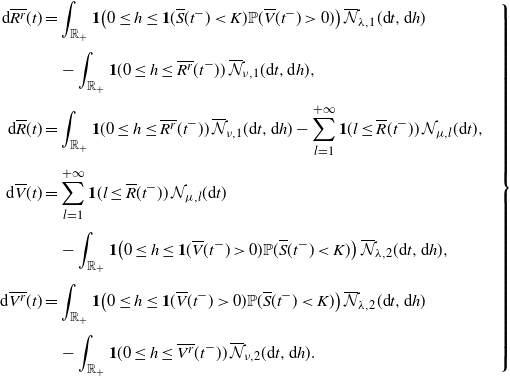
. Formally taking the limit in (4) leads to
 \begin{equation} \left. \begin{aligned} {\mathrm{d}}\overline{R^r}(t) & = \int_{\mathbb{R}_+}\mathbf{1}\big(0\leq h\leq\mathbf{1}(\overline{S}(t^-) \lt K) \mathbb{P}(\overline{V}(t^-) \gt 0)\big)\,\overline{\mathcal{N}}_{\lambda,1}({\mathrm{d}} t,{\mathrm{d}} h) \\[3pt] & \quad - \int_{\mathbb{R}_+}\mathbf{1}(0\leq h\leq\overline{R^r}(t^-))\, \overline{\mathcal{N}}_{\nu,1}({\mathrm{d}} t,{\mathrm{d}} h), \\[3pt] {\mathrm{d}}\overline{R}(t) & = \int_{\mathbb{R}_+}\mathbf{1}(0\leq h\leq\overline{R^r}(t^-))\,\overline{\mathcal{N}}_{\nu,1}({\mathrm{d}} t,{\mathrm{d}} h) - \sum_{l=1}^{+\infty}\mathbf{1}(l\leq \overline{R}(t^-))\,\mathcal{N}_{\mu,l}({\mathrm{d}} t), \quad \\[3pt] {\mathrm{d}}\overline{V}(t) & = \sum_{l=1}^{+\infty}\mathbf{1}(l\leq \overline{R}(t^-))\,\mathcal{N}_{\mu,l}({\mathrm{d}} t) \\[3pt] & \quad - \int_{\mathbb{R}_+}\mathbf{1}\big(0\leq h\leq\mathbf{1}(\overline{V}(t^-) \gt 0) \mathbb{P}(\overline{S}(t^-) \lt K)\big)\,\overline{\mathcal{N}}_{\lambda,2}({\mathrm{d}} t,{\mathrm{d}} h), \\[3pt] {\mathrm{d}}\overline{V^r}(t) & = \int_{\mathbb{R}_+}\mathbf{1}\big(0\leq h\leq\mathbf{1}(\overline{V}(t^-) \gt 0) \mathbb{P}(\overline{S}(t^-) \lt K)\big)\,\overline{\mathcal{N}}_{\lambda,2}({\mathrm{d}} t,{\mathrm{d}} h) \\[3pt] & \quad - \int_{\mathbb{R}_+}\mathbf{1}(0\leq h\leq \overline{V^r}(t^-))\, \overline{\mathcal{N}}_{\nu,2}({\mathrm{d}} t,{\mathrm{d}} h). \end{aligned} \right\}\end{equation}
3.3. A first result
Then the first result gives the existence and uniqueness of a stochastic process solution of the system of stochastic differential equations (SDEs) in (5). Let
 $T \gt 0$
be fixed. Let
 $\mathcal{D}_T=\mathcal{D}([0,T],\mathcal{P}(\Sigma_K))$
be the set of càdlàg functions from [0,T] to
 $\mathcal{P}(\Sigma_K)$
.
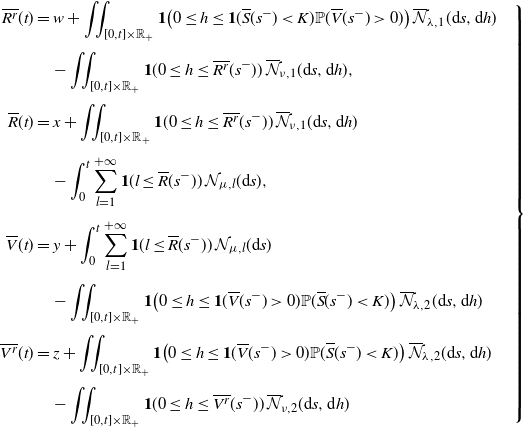
Theorem 1.
(McKean–Vlasov process.) For every
 $(w,x,y,z)\in\Sigma_K$
, the system of equations
 \begin{equation} \left. \begin{aligned} \overline{R^r}(t) & = w + \iint_{[0,t]\times\mathbb{R}_+}\mathbf{1}\big(0\leq h\leq\mathbf{1}(\overline{S}(s^-) \lt K) \mathbb{P}(\overline{V}(s^-) \gt 0)\big)\,\overline{\mathcal{N}}_{\lambda,1}({\mathrm{d}} s,{\mathrm{d}} h) \quad \\[3pt] & \quad - \iint_{[0,t]\times\mathbb{R}_+}\mathbf{1}(0\leq h\leq\overline{R^r}(s^-))\, \overline{\mathcal{N}}_{\nu,1}({\mathrm{d}} s,{\mathrm{d}} h), \\[3pt] \overline{R}(t) & = x + \iint_{[0,t]\times\mathbb{R}_+}\mathbf{1}(0\leq h\leq\overline{R^r}(s^-))\, \overline{\mathcal{N}}_{\nu,1}({\mathrm{d}} s,{\mathrm{d}} h) \\[3pt] & \quad - \int_0^t\sum_{l=1}^{+\infty}\mathbf{1}(l\leq\overline{R}(s^-))\,\mathcal{N}_{\mu,l}({\mathrm{d}} s), \\[3pt] \overline{V}(t) & = y + \int_0^t\sum_{l=1}^{+\infty}\mathbf{1}(l\leq\overline{R}(s^-))\,\mathcal{N}_{\mu,l}({\mathrm{d}} s) \\[3pt] & \quad - \iint_{[0,t]\times\mathbb{R}_+}\mathbf{1}\big(0\leq h\leq\mathbf{1}(\overline{V}(s^-) \gt 0) \mathbb{P}(\overline{S}(s^-) \lt K)\big)\,\overline{\mathcal{N}}_{\lambda,2}({\mathrm{d}} s,{\mathrm{d}} h) \\[3pt] \overline{V^r}(t) & = z + \iint_{[0,t]\times\mathbb{R}_+}\mathbf{1}\big(0\leq h\leq\mathbf{1}(\overline{V}(s^-) \gt 0) \mathbb{P}(\overline{S}(s^-) \lt K)\big)\,\overline{\mathcal{N}}_{\lambda,2}({\mathrm{d}} s,{\mathrm{d}} h) \\[3pt] & \quad - \iint_{[0,t]\times\mathbb{R}_+}\mathbf{1}(0\leq h\leq\overline{V^r}(s^-))\, \overline{\mathcal{N}}_{\nu,2}({\mathrm{d}} s,{\mathrm{d}} h) \end{aligned} \right\} \end{equation}
has a unique solution
 $(\overline{R^r}(t),\overline{R}(t),\overline{V}(t),\overline{V^r}(t))$
in
 $\mathcal{D}_T$
.
Note that the solution of (6) satisfies the Fokker–Planck equation (1) in the introduction.
Proof. The proof is standard and quite technical. Let us introduce the Wasserstein distances on
 $\mathcal{P}(\mathcal{D}_T)$
. For
 $\pi_1,\pi_2\in\mathcal{P}(\mathcal{D}_T)$
,
 \begin{align*} W_T(\pi_1,\pi_2) & = \inf_{\pi\in\mathcal{C}_T(\pi_1,\pi_2)}\int_{\omega=(\omega_1,\omega_2)\in\mathcal{D}_T^2}(d_T(\omega_1,\omega_2)\wedge 1) \,{\mathrm{d}}\pi(\omega), \\[3pt] \rho_T(\pi_1,\pi_2) & = \inf_{\pi\in\mathcal{C}_T(\pi_1,\pi_2)}\int_{\omega=(\omega_1,\omega_2)\in\mathcal{D}_T^2} (\|\omega_1-\omega_2\|_{\infty,T}\wedge 1)\,{\mathrm{d}}\pi(\omega), \end{align*}
where, for
 $f\in \mathcal{D}_T$
,
 $\|f\|_{\infty,T}=\sup\{\|f\|,0\leq t\leq T\}= \sup\big\{\sum_{i=1}^4|f_i(t)|,0\leq t\leq T\big\}$
,
 $\mathcal{C}_T(\pi_1,\pi_2)$
is the set of couplings of
 $\pi_1$
and
 $\pi_2$
, i.e. the subset of
 $\mathcal{P}(\mathcal{D}_T^2)$
with first marginal
 $\pi_1$
and second
 $\pi_2$
, and
 $(\mathcal{D}_T,d_T)$
, with
 $d_T$
the distance associated with the Skorohod topology, is complete and separable and thus
 $(\mathcal{P}(\mathcal{D}_T),W_T)$
is complete and separable, and
 $W_T(\pi_1,\pi_2) \leq \rho _T(\pi_1,\pi_2)$
.
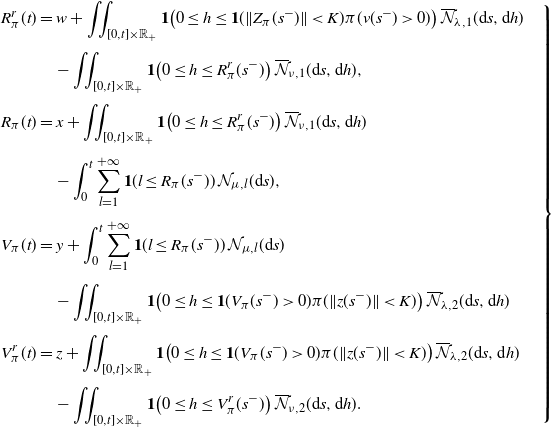
Let us define
 $\Phi\,\colon (\mathcal{P}(\mathcal{D}_T),W_T) \rightarrow (\mathcal{P}(\mathcal{D}_T),W_T)$
,
 $\pi \mapsto \Phi(\pi)$
, where
 $\Phi(\pi)$
is the distribution of
 $(Z_{\pi}(t))=(R^r_{\pi}(t),R_{\pi}(t),V_{\pi}(t),V^r_{\pi}(t))$
, the unique solution of the SDEs
 \begin{equation} \left. \begin{aligned} R^r_{\pi}(t) & = w + \iint_{[0,t]\times\mathbb{R}_+}\mathbf{1}\big(0\leq h\leq\mathbf{1}(\|Z_{\pi}(s^-)\| \lt K) \pi(v(s^-) \gt 0)\big)\,\overline{\mathcal{N}}_{\lambda,1}({\mathrm{d}} s,{\mathrm{d}} h) \quad \\[3pt] & \quad - \iint_{[0,t]\times\mathbb{R}_+}\mathbf{1}\big(0\leq h\leq R^r_{\pi}(s^-)\big)\, \overline{\mathcal{N}}_{\nu,1}({\mathrm{d}} s,{\mathrm{d}} h), \\[3pt] R_{\pi}(t) & = x + \iint_{[0,t]\times\mathbb{R}_+}\mathbf{1}\big(0\leq h\leq R^r_{\pi}(s^-)\big)\, \overline{\mathcal{N}}_{\nu,1}({\mathrm{d}} s,{\mathrm{d}} h) \\[3pt] & \quad - \int_0^t\sum_{l=1}^{+\infty}\mathbf{1}(l\leq R_{\pi}(s^-))\,\mathcal{N}_{\mu,l}({\mathrm{d}} s), \\[3pt] V_{\pi}(t) & = y + \int_0^t\sum_{l=1}^{+\infty}\mathbf{1}(l\leq R_{\pi}(s^-))\,\mathcal{N}_{\mu,l}({\mathrm{d}} s) \\[3pt] & \quad - \iint_{[0,t]\times\mathbb{R}_+}\mathbf{1}\big(0\leq h\leq\mathbf{1}(V_{\pi}(s^-) \gt 0) \pi(\|z(s^-)\| \lt K)\big)\,\overline{\mathcal{N}}_{\lambda,2}({\mathrm{d}} s,{\mathrm{d}} h) \\[3pt] V^r_{\pi}(t) & = z + \iint_{[0,t]\times\mathbb{R}_+}\mathbf{1}\big(0\leq h\leq\mathbf{1}(V_{\pi}(s^-) \gt 0) \pi(\|z(s^-)\| \lt K)\big)\,\overline{\mathcal{N}}_{\lambda,2}({\mathrm{d}} s,{\mathrm{d}} h) \\[3pt] & \quad - \iint_{[0,t]\times\mathbb{R}_+}\mathbf{1}\big(0\leq h\leq V^r_{\pi}(s^-)\big)\, \overline{\mathcal{N}}_{\nu,2}({\mathrm{d}} s,{\mathrm{d}} h). \end{aligned} \right\} \end{equation}
Note that
 $\pi(v(t) \gt 0)=\int_{z=(r^r,r,v,v^r)\in\mathcal{D}_T}\mathbf{1}(v(t) \gt 0)\,{\mathrm{d}}\pi(z)$
. The existence and uniqueness of a solution to (6) is equivalent to the existence and uniqueness of a fixed point
 $\pi=\Phi(\pi)$
.
Let us prove that
 $\pi=\Phi(\pi)$
has a unique fixed point. For
 $\pi_1,\pi_2\in\mathcal{P}(\mathcal{D}_T)$
, let
 $Z_{\pi_1}$
and
 $Z_{\pi_2}$
be solutions of (7). Thus,
 $(Z_{\pi_1},Z_{\pi_2})$
is a coupling of
 $\Phi(\pi_1)$
and
 $\Phi(\pi_2)$
and, for
 $t\leq T$
,
 $\rho _t(\Phi(\pi_1),\Phi(\pi_2)) \leq \mathbb{E}(\|Z_{\pi_1}-Z_{\pi_2}\|_{\infty,t})$
.
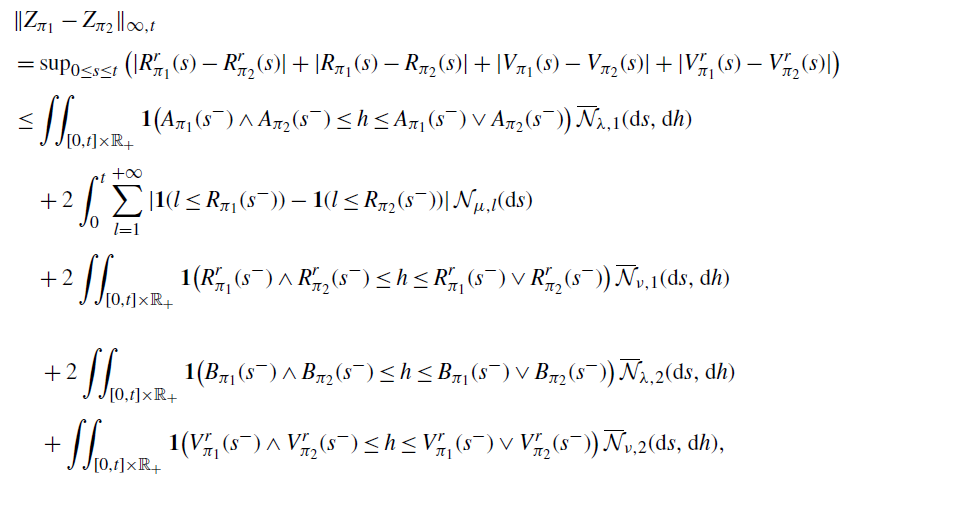
For
 $t\leq T$
, using the definition in (7) of
 $Z_{\pi_1}$
and
 $Z_{\pi_2}$
,
 \begin{align*} & \|Z_{\pi_1}-Z_{\pi_2}\|_{\infty,t} \nonumber \\[3pt] & = \sup\nolimits_{0\leq s\leq t}\big(|R^r_{\pi_1}(s)-R^r_{\pi_2}(s)| + |R_{\pi_1}(s)-R_{\pi_2}(s)| + |V_{\pi_1}(s)-V_{\pi_2}(s)| + |V^r_{\pi_1}(s)-V^r_{\pi_2}(s)|\big) \nonumber \\[3pt] & \leq \iint_{[0,t]\times\mathbb{R}_+}\mathbf{1}\big(A_{\pi_1}(s^-)\wedge A_{\pi_2}(s^-)\leq h\leq A_{\pi_1}(s^-) \vee A_{\pi_2}(s^-)\big)\,\overline{\mathcal{N}}_{\lambda,1}({\mathrm{d}} s,{\mathrm{d}} h) \nonumber \\[3pt] & \quad + 2\int_0^t\sum_{l=1}^{+\infty}|\mathbf{1}(l\leq R_{\pi_1}(s^-))-\mathbf{1}(l\leq R_{\pi_2}(s^-))|\, \mathcal{N}_{\mu,l}({\mathrm{d}} s) \nonumber \\[3pt] & \quad + 2\iint_{[0,t]\times\mathbb{R}_+}\mathbf{1}\big(R^r_{\pi_1}(s^-) \wedge R^r_{\pi_2}(s^-) \leq h \leq R^r_{\pi_1}(s^-) \vee R^r_{\pi_2}(s^-)\big)\,\overline{\mathcal{N}}_{\nu,1}({\mathrm{d}} s,{\mathrm{d}} h) \nonumber \\[3pt]& \quad + 2\iint_{[0,t]\times\mathbb{R}_+}\mathbf{1}\big(B_{\pi_1}(s^-) \wedge B_{\pi_2}(s^-) \leq h \leq B_{\pi_1}(s^-) \vee B_{\pi_2}(s^-)\big)\,\overline{\mathcal{N}}_{\lambda,2}({\mathrm{d}} s,{\mathrm{d}} h) \nonumber \\[3pt]& \quad + \iint_{[0,t]\times\mathbb{R}_+}\mathbf{1}\big(V^r_{\pi_1}(s^-) \wedge V^r_{\pi_2}(s^-) \leq h \leq V^r_{\pi_1}(s^-) \vee V^r_{\pi_2}(s^-)\big)\,\overline{\mathcal{N}}_{\nu,2}({\mathrm{d}} s,{\mathrm{d}} h),\end{align*}
where
 $A_{\pi}(t) = \mathbf{1}(\|Z_{\pi}(t)\| \lt K)\,\pi(v(t) \gt 0)$
and
 $B_{\pi}(t) = \mathbf{1}(V_{\pi}(t) \gt 0)\,\pi(\|z(t)\| \lt K)$
. The mean of each term on the right-hand side of (8) is bounded as follows. For the first term,
 \begin{align*} \mathbb{E}\bigg(\iint_{[0,t]\times\mathbb{R}_+} & \mathbf{1}\big(A_{\pi_1}(s^-) \wedge A_{\pi_2}(s^-) \leq h \leq A_{\pi_1}(s^-) \vee A_{\pi_2}(s^-)\big)\,\overline{\mathcal{N}}_{\lambda,1}({\mathrm{d}} s,{\mathrm{d}} h)\bigg) \\[3pt] & \leq \lambda\int_0^t|\pi_1(v(s) \gt 0)-\pi_2(v(s) \gt 0)|\,{\mathrm{d}} s \\[3pt] & = \lambda\int_0^t|\pi(z,v_1(s) \gt 0)-\pi(z,v_2(s) \gt 0)|\,{\mathrm{d}} s \\[3pt] & = \lambda\int_0^t\int_{\omega=(z_1,z_2)\in\mathcal{D}_T^2}|\mathbf{1}(v_1(s) \gt 0)-\mathbf{1}(v_2(s) \gt 0)|\, \pi({\mathrm{d}}\omega)\,{\mathrm{d}} s \\[3pt] & \leq \lambda\int_0^t\int_{\omega=(z_1,z_2)\in\mathcal{D}_T^2}|v_1(s)-v_2(s)| \wedge 1\, \pi({\mathrm{d}}\omega)\,{\mathrm{d}} s \leq \lambda\int_0^t\rho_s(\pi_1,\pi_2)\,{\mathrm{d}} s. \end{align*}
For the second term,
 \begin{align*} \mathbb{E}\Bigg(\int_0^t\sum_{l=1}^{+\infty} & |\mathbf{1}(l\leq R_{\pi_1}(s^-))-\mathbf{1}(l\leq R_{\pi_2}(s^-))|\,\mathcal{N}_{\mu,l}({\mathrm{d}} s)\Bigg) \\[3pt] & \leq \mu\int_0^t\mathbb{E}\Bigg(\sum_{l=1}^{+\infty}|\mathbf{1}(l\leq R_{\pi_1}(s)) - \mathbf{1}(l\leq R_{\pi_2}(s))|\Bigg)\,{\mathrm{d}} s \\[3pt] & \leq \mu\int_0^t\mathbb{E}(|R_{\pi_1}(s)-R_{\pi_2}(s)|)\,{\mathrm{d}} s \leq \mu\int_0^t\mathbb{E}(\|Z_{\pi_1}-Z_{\pi_2}\|_{\infty,s})\,{\mathrm{d}} s. \end{align*}
For the third term,
 \begin{align*} \mathbb{E}\bigg(\iint_{[0,t]\times\mathbb{R}_+} & \mathbf{1}\big(R^r_{\pi_1}(s^-) \wedge R^r_{\pi_2}(s^-) \leq h \leq R^r_{\pi_1}(s^-) \vee R^r_{\pi_2}(s^-)\big)\, \overline{\mathcal{N}}_{\nu,1}({\mathrm{d}} s,{\mathrm{d}} h)\bigg) \\[3pt] & \leq \nu\int_0^t\mathbb{E}\big(\big|R^r_{\pi_1}(s)-R^r_{\pi_2}(s)\big|\big)\,{\mathrm{d}} s \leq \nu\int_0^t\mathbb{E}(\|Z_{\pi_1}-Z_{\pi_2}\|_{\infty,s})\,{\mathrm{d}} s. \end{align*}
For the fourth term,
 \begin{align*} \iint_{[0,t]\times\mathbb{R}_+} & \mathbf{1}\big(B_{\pi_1}(s^-) \wedge B_{\pi_2}(s^-) \leq h \leq B_{\pi_1}(s^-) \vee B_{\pi_2}(s^-)\big)\, \overline{\mathcal{N}}_{\lambda,2}({\mathrm{d}} s,{\mathrm{d}} h) \\[3pt] & \leq \lambda\int_0^t\mathbb{E}\big(|\mathbf{1}(V_{\pi_1}(s) \gt 0)\pi_1(\|z(s)\| \lt K) - \mathbf{1}(V_{\pi_2}(s) \gt 0)\pi_2(\|z(s)\| \lt K)|\big)\,{\mathrm{d}} s \end{align*}
 \begin{align*} & \leq \lambda\int_0^t\mathbb{E}\big(|\mathbf{1}(V_{\pi_1}(s) \gt 0) - \mathbf{1}(V_{\pi_2}(s) \gt 0)|\big)\,{\mathrm{d}} s \\[3pt] & \leq \lambda\int_0^t\mathbb{E}\big(\big|V_{\pi_1}(s)-V_{\pi_2}(s)\big|\big)\,{\mathrm{d}} s \leq \lambda\int_0^t\mathbb{E}\big(\|Z_{\pi_1}-V_{\pi_2}\|_{\infty,s}\big)\,{\mathrm{d}} s. \end{align*}
For the fifth term, as for the third term,
 \begin{align*} \mathbb{E}\bigg(\iint_{[0,t]\times\mathbb{R}_+} & \mathbf{1}\big(V^r_{\pi_1}(s^-) \wedge V^r_{\pi_2}(s^-) \leq h \leq V^r_{\pi_1}(s^-) \vee V^r_{\pi_2}(s^-)\big)\, \overline{\mathcal{N}}_{\nu,2}({\mathrm{d}} s,{\mathrm{d}} h)\bigg) \\[3pt] & \leq \nu\int_0^t\mathbb{E}\big(\|Z_{\pi_1}-Z_{\pi_2}\|_{\infty,s}\big)\,{\mathrm{d}} s. \end{align*}
Thus,
 \begin{equation*} \mathbb{E}(\|Z_{\pi_1}-Z_{\pi_2}\|_{\infty,t}) \leq (2\mu + 3\nu + 2\lambda)\int_0^t\mathbb{E}(\|Z_{\pi_1}-Z_{\pi_2}\|_{\infty,s})\,{\mathrm{d}} s + \lambda\int_0^t\rho_s(\pi_1,\pi_2)\,{\mathrm{d}} s. \end{equation*}
By Grönwall’s inequality,
 $\mathbb{E}(\|Z_{\pi_1}-Z_{\pi_2}\|_{\infty,t}) \leq C_t\int_0^t\rho_s(\pi_1,\pi_2)\,{\mathrm{d}} s$
with
 $C_t=\lambda\exp((2\mu+3\nu+2\lambda)t)$
. For
 $t\leq T$
,
 \begin{equation} \rho_t(\Phi(\pi_1),\Phi(\pi_2)) \leq C_T\int_0^t\rho_s(\pi_1,\pi_2)\,{\mathrm{d}} s. \end{equation}
This leads to the uniqueness of the solution of
 $\Phi(\pi)=\pi$
. Indeed, if
 $\pi_1$
and
 $\pi_2$
are fixed points of
 $\Phi$
, then (9) is rewritten as
 $\rho_t(\pi_1,\pi_2) \leq C_T\int_0^t\rho_s(\pi_1,\pi_2)\,{\mathrm{d}} s$
. By Grönwall’s inequality again, for each
 $t\leq T$
,
 $\rho_t(\pi_1,\pi_2)=0$
and thus
 $\pi_1=\pi_2$
. The existence is proved by an iteration argument. Let
 $\pi_0\in\mathcal{P}(\mathcal{D}_T)$
and
 $\pi_{n+1}=\Phi(\pi_n)$
. By (9),
 \begin{align*} W_T(\pi_{n+1},\pi_n) & \leq \rho_T(\pi_{n+1},\pi_n) \\[3pt] & \leq C_T^n\rho_T(\pi_{1},\pi_0)\int_{0\leq s_1\leq s_2\cdots\leq s_n\leq T}{\mathrm{d}} s_1\cdots{\mathrm{d}} s_n \leq \frac{(C_TT)^n}{n!}\rho_T(\pi_{1},\pi_0). \end{align*}
Thus
 $(\pi_n)$
converges since
 $(\mathcal{P}(\mathcal{D}_T),W_T)$
is complete. Because of (9),
 $\Phi$
is continuous for the Skorohod topology and its limit is a fixed point of
 $\Phi$
.
4. Mean-field limit
Recall that, by Theorem 1, the so-called McKean–Vlasov process
 $(\overline{Z}(t))$
is the unique solution of the system of equations (6). The empirical distribution
 $\Lambda^N(t)$
of
 $(Z^N_i(t), 1\leq i \leq N)$
is defined, for f on
 $\Sigma_K$
, by
 \begin{equation*} \Lambda^N(t)(f) = \frac{1}{N}\sum_{i=1}^N f(Z^N_i(t)) = \frac{1}{N}\sum_{i=1}^N f(R^{r,N}_i(t),R^{N}_i(t),V^{N}_i(t),V^{r,N}_i(t)).\end{equation*}
Process
 $(\Lambda^N(t))$
takes values in
 \begin{align} \mathcal{Y}^N = \Bigg\{ & \Lambda\in\mathcal{P}(\Sigma_K),\ \Lambda_{(w,x,y,z)}\in\frac{\mathbb{N}}{N}, \nonumber \\[3pt] & (w,x,y,z)\in\Sigma_K, \sum_{(w,x,y,z)\in\Sigma_K}(x+y+z)\Lambda_{(w,x,y,z)}N=M_N\Bigg\}. \end{align}
As process
 $Z^N$
is not Markov, process
 $(\Lambda^N(t))$
is not Markov. The aim of this section is to prove mean-field convergence for
 $(Z^N(t))$
, i.e. that the sequence of processes
 $(\Lambda^N(t))$
converges in distribution to
 $(\overline{Z}(t))$
. This means that, for any function f with finite support, the sequence of processes
 $(\Lambda^N(t)(f))$
converges in distribution to
 $(\mathbb{E}(f(\overline{Z}(t)))$
.
Theorem 2.
(Mean-field convergence.) The sequence of empirical distribution processes
 $(\Lambda^N(t))$
converges in distribution to a process
 $(\Lambda(t))\in\mathcal{D}([0,T],\mathcal{P}(\Sigma_K))$
defined, for f with finite support on
 $\Sigma_K$
, by
 $\Lambda(t)(f)=\mathbb{E}(f(\overline{Z}(t)))$
with
 $(\overline{Z}(t))$
the unique solution of (6). Moreover, for any
 $k\geq 1$
and for
 $1\leq i_1 \lt \cdots \lt i_k\leq N$
, the sequence of finite marginals
 $(Z^N_{i_1}(t),\ldots,Z^N_{i_k}(t))$
converges in distribution to
 $(\overline{Z}_{i_1}(t),\ldots,\overline{Z}_{i_k}(t))$
, where
 $(\overline{Z}_{i_1}(t)),\ldots,(\overline{Z}_{i_k}(t))$
are independent random variables with the same distribution as
 $(\overline{Z}(t))$
.
The last property is the propagation of chaos. The proof is presented in Section 4.3.
4.1. Evolution equations of the empirical measure
Let us introduce the following notation. For
 $z\in \Sigma_K$
,
 $f\colon \Sigma_K \rightarrow \mathbb{R}_+$
, and
 $(e_i,1\leq i\leq 4)$
the canonical basis of
 $\mathbb{R}^4$
, i.e.
 $e_1=(1,0,0,0),\ldots,e_4=(0,0,0,1) $
,
 \begin{align*} \Delta_{i,i+1}(f)(z) & = f(z-e_i+e_{i+1})-f(z), \quad 1\leq i\leq 3, \\[3pt] \Delta_{1}^+(f)(z) & = f(z+e_1)-f(z), \\[3pt] \Delta_{4}^-(f)(z) & = f(z-e_4)-f(z).\end{align*}
Let
 $\Sigma_K=\{(w,x,y,z)\in \mathbb{N}^4, w+x+y+z\leq K\}$
. For
 $f\colon \Sigma_K\rightarrow \mathbb{R}_+$
, straightforwardly by (4),
 \begin{align*} {\mathrm{d}} f(Z_i^N(t)) & = \Delta_{1}^+(f)(Z_i^N(t))\sum_{j=1}^N\mathbf{1}\big(V^N_{j}(t^-) \gt 0, S^N_{i}(t^-) \lt K\big)\, \mathcal{N}_{\lambda,j}^{U,N}({\mathrm{d}} t,\{i\}) \\[3pt] & \quad + \Delta_{1,2}(f)(Z_i^N(t))\sum_{j=1}^N\Bigg(\sum_{l=1}^{\infty}\mathbf{1}\big(l\leq X^N_{j,i}(t^-)\big)\, \mathcal{N}_{\nu,j,i,l}({\mathrm{d}} t)\Bigg) \\[3pt] & \quad + \Delta_{2,3}(f)(Z_i^N(t))\sum_{l=1}^{\infty}\mathbf{1}\big(l\leq R^N_i(t^-)\big)\, \mathcal{N}_{\mu,i,l}({\mathrm{d}} t) \\[3pt] & \quad + \Delta_{3,4}(f)(Z_i^N(t))\sum_{j=1}^N\mathbf{1}\big(V^N_i(t^-) \gt 0, S^N_j(t^-) \lt K\big)\, \mathcal{N}_{\lambda,i}^{U,N}({\mathrm{d}} t,\{j\}) \\[3pt] & \quad + \Delta_{4}^-(f)(Z_i^N(t))\sum_{j=1}^N\Bigg(\sum_{l=1}^{\infty}\mathbf{1}\big(l\leq X^N_{i,j}(t^-)\big)\, \mathcal{N}_{\nu,i,j,l}({\mathrm{d}} t)\Bigg).\end{align*}
Thus, using the martingale decomposition for Poisson processes,
 \begin{align*} {\mathrm{d}} f(Z_i^N(t)) & = \Delta_{1}^+(f)(Z_i^N(t))\mathbf{1}\big(S^N_{i}(t) \lt K\big)\sum_{j=1}^N\mathbf{1}\big(V^N_{j}(t) \gt 0\big) \frac{\lambda}{N}\,{\mathrm{d}} t \\[3pt] & \quad + \Delta_{1,2}(f)(Z_i^N(t))R^{r,N}_{i}(t)\nu\,{\mathrm{d}} t + \Delta_{2,3}(f)(Z_i^N(t))R^N_i(t)\mu\,{\mathrm{d}} t \end{align*}
 \begin{align*} & \quad + \Delta_{3,4}(f)(Z_i^N(t))\mathbf{1}\big(V^N_i(t) \gt 0\big) \sum_{j=1}^N\mathbf{1}\big(S^N_j(t) \lt K\big)\frac{\lambda}{N}\,{\mathrm{d}} t \\[3pt] & \quad + \Delta_{4}^-(f)(Z_i^N(t))V^{r,N}_{i}(t)\nu\,{\mathrm{d}} t + {\mathrm{d}}\mathcal{M}_{f,i}^N(t), \end{align*}
where
 $(\mathcal{M}_{f,i}^N (t))$
is a martingale which will be detailed in Section 4.2. By summing this equation for i from 1 to N and dividing by N,
 \begin{align} \Lambda^N(t)(f) & = \Lambda^N(0)(f) + \mathcal{M}_f^N(t) \nonumber \\[3pt] & \quad + \lambda\int_0^t\Lambda^N(s)(\Sigma_K\cap\{y \gt 0\})\Lambda^N(s) (\Delta_{1}^+(f)\mathbf{1}(\Sigma_{ \lt K}))\,{\mathrm{d}} s \nonumber \\[3pt] & \quad + \nu\int_0^t\Lambda^N(s)(\Delta_{1,2}(f)p_1)\,{\mathrm{d}} s + \mu\int_0^t\Lambda^N(s)(\Delta_{2,3}(f)p_2)\,{\mathrm{d}} s \nonumber \\[3pt] & \quad + \lambda\int_0^t\Lambda^N(s)(\Sigma_{ \lt K})\Lambda^N(s)(\Delta_{3,4}(f)\mathbf{1}(y \gt 0))\,{\mathrm{d}} s + \nu\int_0^t\Lambda^N(s)(\Delta_{4}^-(f)p_4)\,{\mathrm{d}} s, \end{align}
where
 \begin{align} \mathcal{M}_f^N(t) & = \frac{1}{N}\big(\mathcal{M}_{f,1}^N(t) + \mathcal{M}_{f,2}^N(t) + \cdots + \mathcal{M}_{f,N}^N(t)\big), \\[-32pt] \nonumber \end{align}
 \begin{align} \Sigma_{ \lt K} & = \{(w,x,y,z)\in \mathbb{N}^4, w+x+y+z \lt K\}, \\[-32pt] \nonumber \end{align}
 \begin{align} p_i\colon\mathbb{N}^4\rightarrow\mathbb{N} & \text{ is the}\ i\text{th projection } (\text{for example } p_1(w,x,y,z)=w). \end{align}
4.2. The martingale term
The martingale term is
 $\mathcal{M}_f^N(t)$
given by (12) where, for
 $1\leq i\leq N$
,
 \begin{align*} {\mathrm{d}}\mathcal{M}_{f,i}^N(t) & = \Delta_{1}^+(f)(Z_i^N(t))\sum_{j=1}^N\mathbf{1}\big(V^N_{j}(t^-) \gt 0, S^N_{i}(t^-) \lt K\big) \bigg(\mathcal{N}_{\lambda,j}^{U,N}({\mathrm{d}} t,\{i\}) - \frac{\lambda}{N}\,{\mathrm{d}} t\bigg) \\[3pt] & \quad + \Delta_{1,2}(f)(Z_i^N(t))\sum_{j=1}^N\sum_{l=1}^{\infty}\mathbf{1}\big(l\leq X^N_{j,i}(t^-)\big) \big(\mathcal{N}_{\nu,j,i,l}({\mathrm{d}} t) - \nu\,{\mathrm{d}} t\big) \\[3pt] & \quad + \Delta_{2,3}(f)(Z_i^N(t))\sum_{l=1}^{\infty}\mathbf{1}\big(l\leq R^N_i(t^-)\big) \big(\mathcal{N}_{\mu,i,l}({\mathrm{d}} t) - \mu\,{\mathrm{d}} t\big) \\[3pt] & \quad + \Delta_{3,4}(f)(Z_i^N(t))\sum_{j=1}^N\mathbf{1}\big(V^N_i(t^-) \gt 0,\; S^N_j(t^-) \lt K\big) \bigg(\mathcal{N}_{\lambda,i}^{U,N}({\mathrm{d}} t,\{j\}) - \frac{\lambda}{N}\,{\mathrm{d}} t\bigg) \\[3pt] & \quad + \Delta_{4}^-(f)(Z_i^N(t))\sum_{j=1}^N\sum_{l=1}^{\infty}\mathbf{1}\big(l\leq X^N_{i,j}(t^-)\big) \big(\mathcal{N}_{\nu,i,j,l}({\mathrm{d}} t) - \nu\,{\mathrm{d}} t\big),\end{align*}
whose increasing process is expressed as
 $\big\langle\mathcal{M}_f^N\big\rangle(t) = ({1}/{N^2})\big(\lambda I_1^N(t) + \mu I_2^N(t) + \nu I_3^N(t)\big)$
where, by careful calculation,
 \begin{align*} I_1^N(t) = \sum_{i=1}^N\int_0^t\bigg( & (\Delta_{1}^+(f)(Z_i^N(s)))^2\mathbf{1}\big(S^N_{i}(s) \lt K\big)\Lambda^N(s)(\Sigma_K\cap\{y \gt 0\}) \\[3pt] & + \big(\Delta_{3,4}(f)(Z_i^N(s))\big)^2\mathbf{1}\big(V^N_i(s) \gt 0\big)\Lambda^N(s)(\Sigma_{ \lt K}) \\[3pt] & + \frac{2}{N}\Delta_{1}^+(f)(Z_i^N(s))\Delta_{3,4}(f)(Z_i^N(s)) \mathbf{1}\big(V^N_{i}(s) \gt 0,S^N_{i}(s) \lt K\big)\bigg)\,{\mathrm{d}} s, \\[3pt] I_2^N(t) = \sum_{i=1}^N\int_0^t\big( & \Delta_{2,3}(f)(Z_i^N(s))\big)^2 R^N_i(s)\,{\mathrm{d}} s, \\[3pt] I_3^N(t) = \sum_{i=1}^N\int_0^t\bigg( & \big(\Delta_{1,2}(f)(Z_i^N(s))\big)^2 R^{r,N}_i(s) + \big(\Delta_{4}^-(f)(Z_i^N(s))\big)^2 V^{r,N}_i(s) \\[3pt] & + \frac{2}{N}\Delta_{1,2}(f)(Z_i^N(s))\Delta_{4}^-(f)(Z_i^N(s))X_{i,i}(s)\bigg)\,{\mathrm{d}} s.\end{align*}
The term with
 $X_{i,i}^N(s)$
comes from the fact that only sequences
 $(\mathcal{N}_{\nu,i,j,.},j \not= i)$
and
 $(\mathcal{N}_{\nu,j,i,.},j \not= i)$
are independent; see Remark 1. This then yields straightforwardly that there exist
 $C_0,C_1 \gt 0$
such that, for
 $1\leq i \leq 3$
,
 $\|I_i^N\|_{\infty,T} \leq (C_0 N+C_1)T \|f\|^2_{\infty}$
. Thus,
 \begin{equation} \big\|\big\langle\mathcal{M}^N_f\big\rangle\big\|_{\infty,T} \leq (\lambda+\mu+\nu)\bigg(\frac{C_0}{N} + \frac{C_1}{N^2}\bigg)T\|f\|^2_{\infty} .\end{equation}
Thus, applying Cauchy–Schwarz, then Doob’s inequalities,
 \begin{equation*} \big(\mathbb{E}\big(\sup\nolimits_{0\leq s\leq T}\big|\mathcal{M}^N_f(s)\big|\big)\big)^2 \leq \mathbb{E}\big(\sup_{0\leq s\leq T}\big|\mathcal{M}^N_f(s)\big|^2\big) \leq 4\mathbb{E}\big(\big(\mathcal{M}^N_f\big)^2(T)\big) = 4\mathbb{E}\big(\big\langle\mathcal{M}^N_f\big\rangle(T)\big),\end{equation*}
and the martingale
 $\big(\mathcal{M}^N_f(t)\big)$
converges in distribution to 0 when N tends to
 $\infty$
.
4.3. Convergence of the empirical measure process
This section is devoted to the proof of the mean-field convergence theorem (Theorem 2). The proof is based on standard tightness and uniqueness arguments using stochastic calculus and martingale theory. To be self-contained, the paper presents the detailed proof via Propositions 1 and 2.
Proposition 1.
(Tightness of the empirical measure process.) The sequence
 $(\Lambda^N(t))$
is tight with respect to the convergence in distribution in
 $\mathcal{D}(\mathbb{R}_+,\mathcal{Y}^N)$
, with
 $\mathcal{Y}^N$
defined by (10). Any limiting point
 $(\Lambda(t))$
is a continuous process with values in
 \begin{equation} \mathcal{Y} = \Bigg\{\Lambda\in\mathcal{P}(\Sigma_K),\sum_{(w,x,y,z)\in\Sigma_K}(x+y+z)\Lambda_{(w,x,y,z)}=s\Bigg\}, \end{equation}
a solution of
 \begin{align} \Lambda(t)(f) & = \Lambda(0)(f) + \lambda\int_0^t\Lambda(s)(\Sigma_K\cap\{y \gt 0\})\Lambda(s) (\Delta_{1}^+(f)\mathbf{1}(\Sigma_{ \lt K}))\,{\mathrm{d}} s \nonumber \\[3pt] & \quad + \nu\int_0^t\Lambda(s)(\Delta_{1,2}(f)p_1)\,{\mathrm{d}} s + \mu\int_0^t\Lambda(s)(\Delta_{2,3}(f)p_2)\,{\mathrm{d}} s \nonumber \\[3pt] & \quad + \lambda\int_0^t\Lambda(s)(\Sigma_{ \lt K})\Lambda(s)(\Delta_{3,4}(f)\mathbf{1}(y \gt 0))\,{\mathrm{d}} s + \nu\int_0^t\Lambda(s)(\Delta_{4}^-(f)p_4)\,{\mathrm{d}} s \end{align}
for any function f on
 $\Sigma_K=\{(w,x,y,z)\in \mathbb{N}^4, w+x+y+z\leq K\}$
and with
 $\Sigma_{ \lt K}$
and the
 $p_i$
defined by (13) and (14).
Proof. This amounts to proving that, for any function f on
 $\Sigma_K$
, the sequence of processes
 $(\Lambda^N(t)(f))$
is tight with respect to the topology of the uniform norm on compact sets. For this, using the modulus of continuity criterion (see [Reference Billingsley4]), it suffices to prove that, for
 $T,\varepsilon,\eta \gt 0$
, there exist
 $\delta_0 \gt 0$
and
 $N_0\in \mathbb{N}$
such that, for all
 $\delta \lt \delta_0$
and all
 $N\geq N_0$
,
 \begin{equation} \mathbb{P}\big(\sup\nolimits_{0\leq s\leq t\leq T,\,|s-t| \lt \delta}|\Lambda^N(t)(f)-\Lambda^N(s)(f)| \gt \eta\big) \lt \varepsilon. \end{equation}
Let
 $T \gt 0$
,
 $\varepsilon \gt 0$
,
 $\eta \gt 0$
,
 $\delta \gt 0$
, and
 $s,t \in [0,T]$
such that
 $|s-t| \lt \delta$
be fixed. For the third term on the right-hand side of (11), there exists
 $C_2 \gt 0$
such that
 \begin{equation*} \bigg|\int_s^t\Lambda^N(u)(\Sigma_K\cap\{y \gt 0\})\Lambda^N(u)(\Delta_{1}^+(f)\mathbf{1}(\Sigma_{ \lt K}))\,{\mathrm{d}} u\bigg| \leq \delta C_2\|f\|_{\infty}, \end{equation*}
and the same holds for the other terms. Thus, there exists
 $C_3 \gt 0$
such that
 \begin{equation*} |\Lambda^N(t)(f)) - \Lambda^N(s)(f))| \leq \delta C_3\|f\|_{\infty} + \big|\mathcal{M}^N_f(t)-\mathcal{M}^N_f(s)\big|. \end{equation*}
Using (15) for the martingale term, there exists
 $C_4 \gt 0$
such that
 \begin{equation*} \mathbb{E}\big(\sup\nolimits_{0\leq s\leq t\leq T,\,|s-t| \lt \delta}|\Lambda^N(t)(f) - \Lambda^N(s)(f)|\big) \leq \delta C_4\|f\|_{\infty} + 2\mathbb{E}\big(\sup\nolimits_{0\leq t\leq T}\big|\mathcal{M}_f^N(t)\big|\big). \end{equation*}
Thus, as the martingale term converges in distribution to 0, there exist
 $\delta_0 \gt 0$
and
 $N_0\in \mathbb{N}$
such that, for all
 $\delta \lt \delta_0$
and all
 $N\geq N_0$
, the left-hand side of the previous equation is less than
 $\varepsilon$
. Then, using Markov’s inequality, the sequence of processes
 $(\Lambda^N(t)(f))$
satisfies (18) and thus is tight. Therefore, if
 $\Lambda$
is a limiting point of
 $\Lambda^N$
, again using (11), as
 $\big(\mathcal{M}^N_f(t)\big)$
converges in distribution to 0, (17) holds. As the function f has finite support, all the terms on the right-hand side are straightforwardly continuous on t.
The following proposition gives the uniqueness of a limiting point of
 $(\Lambda^N(t))$
.
Proposition 2.
(Uniqueness.) For every probability
 $\Lambda_0$
on
 $\Sigma_K$
, (17) has at most one solution
 $(\Lambda(t))$
in
 $\mathcal{D}(\mathbb{R}_+,\mathcal{P}(\Sigma_K))$
with initial condition
 $\Lambda_0$
.
Proof. Let
 $(\Lambda^1(t))$
and
 $(\Lambda^2(t))$
in
 $\mathcal{D}(\mathbb{R}_+,\mathcal{P}(\Sigma_K))$
be two solutions of (17) with initial condition
 $\Lambda_0$
. For f a function on
 $\Sigma_K$
and
 $t\geq 0$
,
 \begin{align*} \Lambda^1(t)(f) - \Lambda^2(t)(f) & = \lambda\int_0^t(\Lambda^1(s)-\Lambda^2(s))(\Sigma_K\cap\{y \gt 0\})\Lambda^1(s) (\Delta_{1}^+(f)\mathbf{1}(\Sigma_{ \lt K}))\,{\mathrm{d}} s \\[3pt] & \quad + \lambda\int_0^t\Lambda^2(s)(\Sigma_K\cap\{y \gt 0\})(\Lambda^1(s)-\Lambda^2(s)) (\Delta_{1}^+(f)\mathbf{1}(\Sigma_{ \lt K}))\,{\mathrm{d}} s \\[3pt] & \quad + \nu\int_0^t(\Lambda^1(s)-\Lambda^2(s))(\Delta_{1,2}(f)p_1+\Delta_{4}^-(f)p_4)\,{\mathrm{d}} s \\[3pt] & \quad + \mu\int_0^t(\Lambda^1(s)-\Lambda^2(s))(\Delta_{2,3}(f)p_2)\,{\mathrm{d}} s \\[3pt] & \quad + \lambda\int_0^t(\Lambda^1(s)-\Lambda^2(s))(\Sigma_{ \lt K})\Lambda^1(s) (\Delta_{3,4}(f)\mathbf{1}(y \gt 0))\,{\mathrm{d}} s \\[3pt] & \quad + \lambda\int_0^t\Lambda^2(s)(\Sigma_{ \lt K})(\Lambda^1(s)-\Lambda^2(s)) (\Delta_{3,4}(f)\mathbf{1}(y \gt 0))\,{\mathrm{d}} s. \end{align*}
Recall that, for a signed measure
 $\pi$
on
 $\Sigma_K$
,
 $\|\pi\|_{{\mathrm{TV}}} = \sup\{|\pi(f)|,f\colon\Sigma_K\rightarrow\mathbb{R},\|f\|_{\infty}\leq 1\}$
. From the previous equation,
 \begin{equation*} \|\Lambda^1(t)-\Lambda^2(t)\|_{{\mathrm{TV}}} \leq (8\lambda+4\nu+2\mu)\int_0^t\|\Lambda^1(s)-\Lambda^2(s)\|_{{\mathrm{TV}}}\,{\mathrm{d}} s. \end{equation*}
Applying Grönwall’s lemma,
 $\|\Lambda^1(t)-\Lambda^2(t)\|_{{\mathrm{TV}}}=0$
, which completes the proof.
Proof of Theorem 2. Let
 $(w,x,y,z)\in\Sigma_K$
and
 $\Lambda_0=\delta_{(w,x,y,z)}$
. If
 $(\overline{Z}(t))$
is the unique solution of (6) and the measure-valued process
 $(\Lambda(t))$
is defined, for f a function on
 $\Sigma_K$
, by
 $\Lambda(t)(f)=\mathbb{E}(f(\overline{Z}(t)))$
, then it is easy to check that
 $(\Lambda(t))$
is a solution of (17). The convergence of
 $(\Lambda^N(t))$
follows from Propositions 1 and 2. See [Reference Sznitman21, Proposition 2.2] for the propagation of chaos property.
4.4. Probabilistic interpretation of the asymptotic process
Note that the Fokker–Planck equation (1) is the functional form of the stochastic equation (17). Recall that, in (1), equalities in distribution hold, as
 \begin{equation*} \iint_{[0,t]\times\mathbb{R}_+}\mathbf{1}\big(0\leq h\leq\overline{R^r}(s^-)\big)\, \overline{\mathcal{N}}_{\nu}({\mathrm{d}} s,{\mathrm{d}} h) = \int_0^t\sum_{l=0}^{\infty}\mathbf{1}\big(l\leq \overline{R^r}(s^-)\big)\,\mathcal{N}_{\nu,l}({\mathrm{d}} s).\end{equation*}
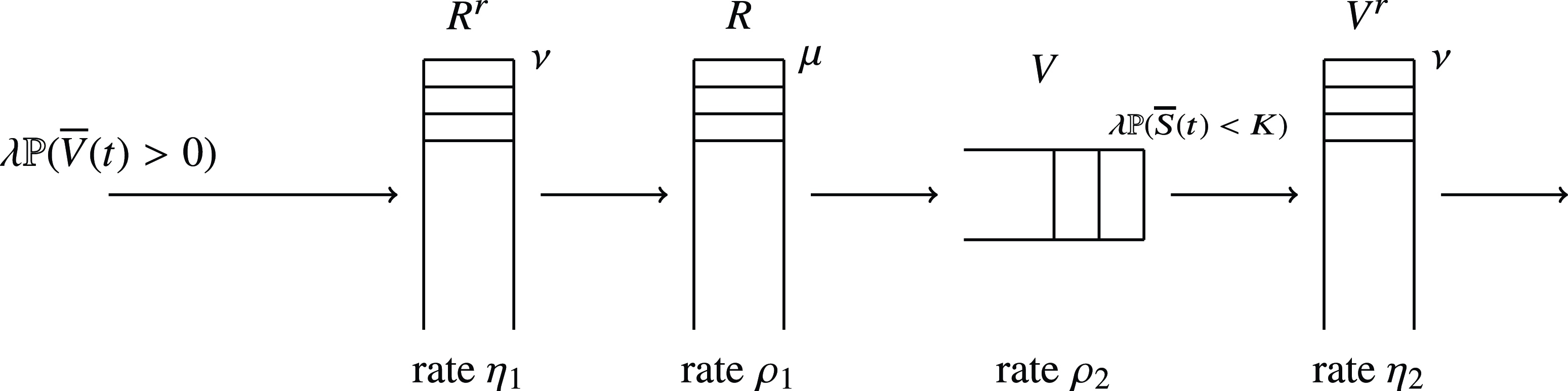
Thus, the non-homogeneous Markov process
 $(\overline{Z}(t))$
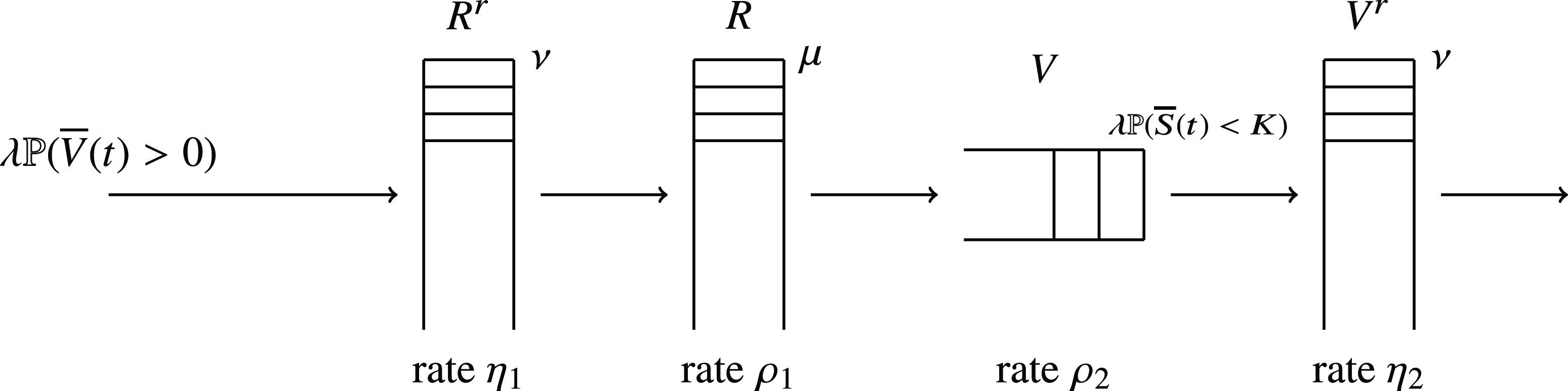
can be seen as the state process of four queues in tandem, with overall capacity K. This means that
 $\overline{R^r}(t)$
,
 $\overline{R}(t)$
,
 $\overline{V}(t)$
, and
 $\overline{V^r}(t)$
are the numbers of customers in, respectively,
-
• the first queue, an infinite-server queue with service rate
$\nu$
, -
• the second one, an infinite-server queue with service rate
$\mu$
, -
• the third one, a one-server queue with variable service rate
$\lambda\mathbb{P}(\overline{S}(t) \lt K)$
at time t, and -
• the last one, an infinite-server queue with service rate
$\nu$
,


while the arrival process is a non-homogeneous Poisson process with intensity
 $\lambda\mathbb{P}(\overline{V}(t) \gt 0)\,{\mathrm{d}} t$
.
Let
 $\eta_1$
,
 $\rho_1$
,
 $\rho_2$
, and
 $\eta_2$
be the arrival-to-service-rate ratios for the four queues from left to right in Figure 1. By definition,
 \begin{equation} \begin{alignedat}{2} \eta_1(t) & = \frac{\lambda}{\nu}\mathbb{P}(\overline{V}(t) \gt 0), \qquad & \rho_1(t) & = \frac{\lambda}{\mu}\mathbb{P}(\overline{V}(t) \gt 0), \\[3pt] \rho_2(t) & = \frac{\mathbb{P}(\overline{V}(t) \gt 0)}{\mathbb{P}(\overline{S}(t) \lt K)}, & \eta_2(t) & = \frac{\lambda}{\nu}\mathbb{P}(\overline{V}(t) \gt 0). \end{alignedat}\end{equation}
Dynamics of
 $(\overline{Z}(t))$
as a tandem of four queues. The vertical queues are
 $M/M/\infty$
queues, while the horizontal one is an
 $M/M/1$
queue. The overall capacity is K.
5. Equilibrium of the asymptotic process
The quadruplet of the numbers of customers in four such queues in tandem with fixed arrival-to-service-rate ratios
 $\eta_1$
,
 $\rho_1$
,
 $\rho_2$
, and
 $\eta_2$
and finite overall capacity K is an ergodic Markov process as an irreducible Markov process on a finite state space. Moreover, the unique invariant probability measure has a well-known product form given by
 \begin{equation} \pi_{j,k,l,m}(\rho) = \frac{1}{Z(\rho)}\frac{\eta_1^j\rho_1^k}{j!k!}\rho_2^l\frac{\eta_2^m}{m!}\end{equation}
where, to shorten the notation,
 $(\eta_1, \rho_1, \rho_2, \eta_2)$
is denoted by
 $\rho$
and the normalizing constant is
 \begin{equation*} Z(\rho) = \sum_{j+k+l+m\leq K}\frac{\eta_1^j\rho_1^k}{j!k!}\rho_2^l\frac{\eta_2^m}{m!} .\end{equation*}
If the process
 $(\overline{Z}(t))$
of the number of customers in the four queues in tandem is at equilibrium then, denoting its generator by
 $L_{\rho(t)}$
,
 $0 = \pi(\rho(t))L_{\rho(t)}$
, where
 $\rho(t)=(\eta_1,\rho_1,\rho_2,\eta_2)(t)$
is given by (19). This means that the equilibrium point is the probability measure
 $\pi(\rho)$
on
 $\mathcal{Y}$
defined by (16), where
 $\rho=(\eta_1,\rho_1,\rho_2,\eta_2)$
satisfies
 \begin{align} \eta_1 & = \frac{\lambda}{\nu}(1-\pi_{0V}(\rho)), \\[-32pt] \nonumber \end{align}
 \begin{align} \rho_1 & = \frac{\lambda}{\mu}(1-\pi_{0V}(\rho)), \\[-32pt] \nonumber \end{align}
 \begin{align} \rho_2 & = \frac{1-\pi_{0V}(\rho)}{1-\pi_{S}(\rho)}, \\[-32pt] \nonumber \end{align}
 \begin{align} \eta_2 & = \frac{\lambda}{\nu}(1-\pi_{0V}(\rho)), \end{align}
with
 $\pi_{0V}(\rho)=\sum_{j+l+m\leq K} \pi_{j,0,l,m}(\rho)$
and
 $\pi_{S}(\rho)=\sum_{j+k+l+m = K} \pi_{j,k,l,m}(\rho)$
. Viewing the tandem of four queues as a station,
 $\pi_{0V}(\rho)$
is the probability that there is no car available and
 $\pi_S(\rho)$
the probability that the station is saturated.
Because
 $\pi(\rho)$
has support on
 $\mathcal{Y}$
,
 \begin{equation} s=\sum_{j+k+l+m\leq K} (k+l+m) \pi_{j,k,l,m}(\rho).\end{equation}
Theorem 3.
(Uniqueness and characterization of the equilibrium point.) If
 $\nu$
is large enough then there exists a unique equilibrium point for the Fokker–Planck equation (17) which is
 $\pi(\rho)$
defined by (20), where
 $\rho=(({\mu}/{\nu}) \rho_1,\rho_1,\rho_2,({\mu}/{\nu})\rho_1)$
and
 $(\rho_1,\rho_2)$
is the unique solution of
 $\rho_1 = ({\lambda}/{\mu})(1-\pi_{0V}(\rho))$
,
 $s = \sum_{j+k+l+m\leq K}(k+l+m)\pi_{j,k,l,m}(\rho)$
.
Remark 2. The uniqueness of the equilibrium point is the main issue. Moreover, its characterization given by Theorem 3 is a major contribution which allows us to derive quantitative results. Proving the uniqueness of the equilibrium point in dimension 2 is quite rare in the literature: we can cite two papers. For the celebrated model in [Reference Gibbens, Hunt and Kelly14], simulations highlight a range of parameters with two stable equilibrium points, called metastability phenomena. This fact was proved some 30 years later in [Reference Martirosyan and Robert18]. In [Reference Baccelli, Foss and Shneer3], the same question is solved for a migration–contagion model using a convexity argument. The arguments used in our paper are totally different.
Remark 3. The assumption that
 $\nu$
is large enough is a technical assumption for the proof. It seems that the result is true for all
 $\nu \gt 0$
but the proof is, for the moment, out of reach.
Let us prove Theorem 3 in five steps. Steps 2, 3, and 4 are devoted to the special case where
 $\nu$
tends to infinity. This case is called the simple reservation case. Indeed, when
 $\nu$
gets large, it turns out that the model corresponds to the case where the car is not reserved in advance, and the parking space is just reserved when the user takes the car. This model is studied in [Reference Bourdais, Fricker and Mohamed7]. Step 1 is here to present the framework for the simple reservation case. Steps 2, 3, and 4 exhibit the proof of [Reference Bourdais, Fricker and Mohamed7, Theorem 2] omitted in [Reference Bourdais, Fricker and Mohamed7] for the simple reservation model.
Proof of Theorem 3.
Step 1: The simple reservation case. For the model with simple reservation, the problem of existence and uniqueness of an equilibrium point amounts to finding
 $(\rho_1,\rho_2)$
such that
 \begin{align} \rho_1 & = \frac{\lambda}{\mu}(1-\pi_{.,0}(\rho_1,\rho_2)), \\[-32pt] \nonumber \end{align}
 \begin{align} \rho_2 & = \frac{1-\pi_{.,0}(\rho_1,\rho_2)}{1-\pi_{S}(\rho_1,\rho_2)}, \\[-32pt] \nonumber \end{align}
 \begin{align} s & = \sum_{i+j\leq K}(i+j)\pi_{i,j}(\rho_1,\rho_2), \end{align}
where the invariant probability measure is now
 \begin{equation*} \pi_{i,j}(\rho_1,\rho_2) = \frac{1}{Z(\rho_1,\rho_2)}\frac{\rho_1^i}{i!}\rho_2^j, \end{equation*}
with
 $Z(\rho_1,\rho_2)=\sum_{i+j\leq K} \pi_{i,j}(\rho_1,\rho_2)$
,
 $\pi_{.,0}=\sum_{i=0}^K\pi_{i,0}$
, and
 $\pi_{S}=\sum_{i+j = K}\pi_{i,j}$
.
Step 2: (26)–(28) amount to (26) and (28). Note that any
 $\rho$
solution of (26) and (27) lies in
 $\Gamma=[0,\lambda/\mu\mathclose{[}\times\mathbb{R}^+$
. For any
 $\rho\in\Gamma$
,
 $\rho$
is a solution of (27) because
 \begin{equation*} \rho_2(1-\pi_S(\rho_1,\rho_2)) = \rho_2\frac{1}{Z(\rho_1,\rho_2)}\sum_{i+j \lt K}\frac{\rho_1^i}{i!}\rho_2^j = \frac{1}{Z(\rho_1,\rho_2)}\sum_{j \gt 0,i+j\leq K}\frac{\rho_1^i}{i!}\rho_2^j = 1-\pi_{.,0}(\rho_1,\rho_2). \end{equation*}
Step 3: Diffeomorphism from (26).
Lemma 1.
(Diffeomorphism.) There exists a strictly increasing diffeomorphism
 $\phi\,\colon\mathopen{]}0, \lambda/\mu\mathclose{[} \rightarrow ]0,\infty\mathclose{[}$
and
 $\psi=\phi^{-1}$
such that
 $(\rho_1,\rho_2)$
is a solution of (26) if and only if
 $\rho_2 = \phi(\rho_1)$
.
Proof. First,
 $(\rho_1,\rho_2)\in\Gamma$
is a solution of (26) if and only if
 $f(\rho_1,\rho_2) = 0$
where f is the
 $\mathcal{C}^{\infty}$
function defined by
 \begin{equation} f(\rho_1,\rho_2) = \bigg(\frac{\lambda}{\mu}-\rho_1\bigg)Z(\rho_1,\rho_2) - \frac{\lambda}{\mu}\sum\limits_{i=0}^K\frac{\rho_1^i}{i!}. \end{equation}
To prove the existence of a strictly increasing diffeomorphism
 $\phi$
which maps
 $\rho_1$
to
 $\rho_2$
, we apply the global inverse function theorem to an auxiliary function h defined on
 $\Gamma$
by
 $h(\rho_1,\rho_2)=(\rho_1,f(\rho_1,\rho_2))$
. Indeed, h is injective if and only if, for any
 $\rho_1\in\mathopen{]}0,\lambda/\mu\mathclose{[}$
and
 $\rho_2,\rho^{\prime}_2\in\mathopen{]}0,+\infty\mathclose{[}$
,
 $f(\rho_1,\rho_2)=f(\rho_1,\rho_2^{\prime})$
implies that
 $\rho_2=\rho_2^{\prime}$
. As f is
 $C^1$
on
 $\mathopen{]}0,\lambda/\mu\mathclose{[} \times \mathopen{]}0,+\infty\mathclose{[}$
, it is sufficient to prove that
 $\partial f/\partial\rho_2 \not= 0 $
on
 $\mathopen{]}0,\lambda/\mu\mathclose{[} \times \mathopen{]}0,+\infty\mathclose{[}$
to obtain that
 $\rho_2\mapsto f(\rho_1,\rho_2)$
is strictly monotone, and thus injective.
Note that it is easy to see that
 $\partial f/\partial\rho_2$
is positive on
 $\mathopen{]}0,\lambda/\mu\mathclose{[} \times \mathopen{]}0,+\infty\mathclose{[}$
. Indeed, since
 $\rho_1 \lt \lambda/\mu$
and
 $\rho_2\mapsto Z(\rho_1,\rho_2)$
is non-decreasing,
 $$\frac{\partial f}{\partial\rho_2}(\rho_1,\rho_2) = \bigg(\frac{\lambda}{\mu}-\rho_1\bigg) \frac{\partial Z}{\partial\rho_2}(\rho_1,\rho_2) \gt 0.$$
As a consequence, h is injective and
 $C^1$
on
 $\mathopen{]}0,\lambda/\mu\mathclose{[} \times \mathopen{]}0,+\infty\mathclose{[}$
. By the global inversion function theorem,
 $h^{-1}$
is
 $C^1$
on
 $h\big(\mathopen{]}0,\lambda/\mu\mathclose{[} \times \mathopen{]}0,+\infty\mathclose{[}\big)$
and a
 $C^1$
 $\phi$
exists defined on
 $\mathopen{]}0,\lambda/\mu\mathclose{[}$
by
 $h^{-1}(\rho_1,0)=(\rho_1,\phi(\rho_1))$
. Thus, to prove that the diffeomorphism
 $\phi$
is strictly increasing on
 $\mathopen{]}0,\lambda/\mu\mathclose{[}$
amounts to showing that, for all
 $\rho_1 \in \mathopen{]}0,\lambda/\mu\mathclose{[}$
,
 \begin{equation*} \frac{\partial f}{\partial\rho_1}(\rho_1,\phi(\rho_1)) \lt 0, \end{equation*}
or, equivalently, that, for all
 $(\rho_1,\rho_2)\in\mathopen{]}0,\lambda/\mu\mathclose{[}\times\mathopen{]}0,+\infty\mathclose{[}$
such that
 $f(\rho_1,\rho_2)=0$
,
 \begin{equation*} \frac{\partial f}{\partial\rho_1}(\rho_1,\rho_2) \lt 0. \end{equation*}
First, from (29), we obtain the first partial derivative of the function f,
 \begin{equation*} \frac{\partial f}{\partial\rho_1}(\rho_1,\rho_2) = -Z(\rho_1, \rho_2) + \bigg(\frac{\lambda}{\mu}-\rho_1\bigg) \sum_{i+j\leq K-1}\frac{\rho_1^i}{i!}\rho_2^j - \frac{\lambda}{\mu}\sum_{i=0}^{K-1}\frac{\rho_1^i}{i!}; \end{equation*}
thus, subtracting this from (29) yields
 \begin{equation} f(\rho_1,\rho_2) - \frac{\partial f}{\partial\rho_1}(\rho_1,\rho_2) = Z(\rho_1,\rho_2) + \bigg(\frac{\lambda}{\mu}-\rho_1\bigg)\sum_{j=0}^K\frac{\rho_2^j\rho_1^{K-j}}{(K-j)!} - \frac{\lambda}{\mu}\frac{\rho_1^K}{K!}. \end{equation}
By (29),
 $f(\rho_1,\rho_2)=0$
can be rewritten as
 \begin{equation*} \frac{\lambda}{\mu}-\rho_1 = \frac{\lambda}{\mu Z(\rho_1,\rho_2)}\sum_{i=0}^K\frac{\rho_1^i}{i!}. \end{equation*}
Thus, the second term on the right-hand side of (30) is
 \begin{align} \bigg(\frac{\lambda}{\mu}-\rho_1\bigg)\sum_{j=0}^K\frac{\rho_2^j\rho_1^{K-j}}{(K-j)!} & = \frac{\lambda}{\mu}\frac{1}{Z(\rho_1,\rho_2)}\sum_{i=0}^K\frac{\rho_1^i}{i!} \sum_{j=0}^K\frac{\rho_2^j\rho_1^{K-j}}{(K-j)!} \nonumber \\[3pt] & = \frac{\lambda}{\mu}\rho_1^K\frac{1}{Z(\rho_1,\rho_2)}\sum_{i,j=0}^K \frac{\rho_1^{i-j}\rho_2^j}{i!(K-j)!} \nonumber \\[3pt] & \geq \frac{\lambda}{\mu}\rho_1^K\frac{1}{Z(\rho_1,\rho_2)} \sum_{0\leq j\leq i\leq K}\frac{\rho_1^{i-j}\rho_2^j}{i!(K-j)!}, \end{align}
using the fact that all the terms are positive. For the sum on the right-hand side of (31), we have
 \begin{equation*} \sum_{0\leq j\leq i\leq K}\frac{\rho_1^{i-j}\rho_2^j}{i!(K-j)!} = \frac{1}{K!}\sum_{j+k\leq K}\frac{K!\rho_1^{k}\rho_2^j}{(j+k)!(K-j)!} \geq \frac{Z(\rho_1,\rho_2)}{K!} \end{equation*}
using that, for any
 $j,k \in \mathbb{N}$
,
 $j+k\leq K$
,
 \begin{equation*} \frac{K!}{(j+k)!(K-j)!} = \frac{1}{k!}\frac{K!}{(K-j)!}\frac{k!}{(j+k)!} = \frac{1}{k!}\prod_{i=0}^{j-1}\frac{K-i}{j+k-i} \geq \frac{1}{k!}. \end{equation*}
In conclusion, (31) gives
 \begin{equation*} \bigg(\frac{\lambda}{\mu}-\rho_1\bigg)\sum_{k=0}^K\frac{\rho_2^K\rho_1^{K-k}}{(K-k)!} \geq \frac{\lambda}{\mu}\frac{\rho_1^K}{K!}. \end{equation*}
Plugging this into (30) and using that
 $Z(\rho_1,\rho_2) \gt 0$
, it turns out that
 $$f(\rho_1,\rho_2) - \frac{\partial f}{\partial\rho_1}(\rho_1,\rho_2) \gt 0.$$
Therefore, as
 $f(\rho_1,\rho_2)=0$
,
 $$\frac{\partial f}{\partial\rho_1}(\rho_1,\rho_2) \lt 0$$
for all
 $(\rho_1,\rho_2) \in \mathopen{]}0,\lambda/\mu\mathclose{[} \times \mathopen{]}0,+\infty\mathclose{[}$
such that
 $f(\rho_1,\rho_2)=0$
.
Lemma 1 means that the solutions of (26) can be expressed with only one parameter. Note that this will be useful for the study of the equilibrium, especially in calculations to obtain asymptotics. This concludes the third step of the proof.
Step 4: A monotonicity argument to conclude the simple reservation case. After (26) and (27), let us focus now on (28). The idea is to prove that the mean number in a tandem of two queues with total capacity K is a strictly increasing function of both arrival-to-service rates. This generalizes the monotonicity argument in the similar proof in [Reference Fricker and Gast10, Section 3.1]. Then, using Lemma 1, we get the existence and uniqueness of the equilibrium point.
Lemma 2.
(Monotonicity.) The average number
 $\mathbb{E}(R+V)$
of vehicles and reserved spaces per station, where (R,V) is a random variable with distribution
 $\pi(\rho_2,\rho_1)$
, is a strictly increasing function of both
 $\rho_2$
and
 $\rho_1$
.
Proof. Let
 $(\rho_1,\rho_2)\mapsto\mathbb{E}(R+V)$
be denoted by
 $g_K$
. It is sufficient to prove that, for all
 $(\rho_1,\rho_2)\in\Gamma$
,
 $$\frac{\partial g_K}{\partial\rho_1}(\rho_1,\rho_2) \gt 0 \quad \text{and} \quad \frac{\partial g_K}{\partial\rho_2}(\rho_1,\rho_2) \gt 0$$
by induction on K.
By a change of indices,
 $g_K$
can be rewritten as
 $$g_K = \frac{\sum_{i+j\leq K}(i+j)({\rho_1^i}/{i!})\rho_2^j}{\sum_{i+j\leq K}({\rho_1^i}/{i!})\rho_2^j} = \frac{\sum_{k=0}^K kp_k}{\sum_{k=0}^K p_k},$$
where, by definition,
 $$p_k = \sum_{j=0}^k\rho_2^j\frac{\rho_1^{k-j}}{(k-j)!}.$$
Define also, for
 $(k,l)\in \mathbb{N}^2$
,
 $r_{l,k} = {p_l}/{p_k}$
.
Let
 $k \gt 0$
be fixed. We first show that
 $r_{k,k-1}$
is an increasing function of both
 $\rho_1$
and
 $\rho_2$
. Indeed,
 $$r_{k,k-1} = \frac{p_k}{p_{k-1}} = \frac{\rho_2 p_{k-1} + \rho_1^{k}/k!}{p_{k-1}} = \rho_2 + \frac{\rho_1^{k}}{k!}\frac{1}{p_{k-1}},$$
and thus
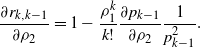 \begin{equation} \frac{\partial r_{k,k-1}}{\partial\rho_2} = 1 - \frac{\rho_1^{k}}{k!}\frac{\partial p_{k-1}}{\partial\rho_2} \frac{1}{p_{k-1}^2}. \end{equation}
But, by the definition of
 $p_k$
,
 \begin{equation} \rho_1^{k}\frac{\partial p_{k-1}}{\partial\rho_2} = \sum_{j=1}^{k-1}j\rho_2^{j-1}\frac{\rho_1^{2k-j-1}}{(k-j-1)!} = \sum_{j=0}^{k-2}(j+1)\rho_2^{j}\frac{\rho_1^{2k-j-2}}{(k-j-2)!}. \end{equation}
And, using the fact that all the terms of the sum in the following equation are positive,
 \begin{equation} k!p_{k-1}^2 = k!\sum_{1\leq u,v\leq k}\rho_2^{u+v-2}\frac{\rho_1^{2k-u-v}}{(k-u)!(k-v)!} \gt \sum_{i=0}^{k-2}\rho_2^{i}\rho_1^{2k-i-2}\sum_{j=1}^{i+1}\frac{k!}{(k-2-i+j)!(k-j)!}. \end{equation}
For all j,
 $0\leq j \leq i+1$
, while
 $k-2-i+j \lt k$
, we have
 $$\frac{k!}{(k-2-i+j)!(k-j)!} \gt \frac{1}{(k-i-2)!} , $$
and then
 $$\sum_{j=1}^{i+1}\frac{k!}{(k-2-i+j)!(k-j)!} \gt \frac{i+1}{(k-i-2)!}.$$
Plugging in (34) and comparing with (33) gives
 $$k!p_{k-1}^2 \gt \rho_1^{k}\frac{\partial p_{k-1}}{\partial\rho_2}.$$
Therefore, using (32) allows us to conclude that
 $$\frac{\partial r_{k,k-1}}{\partial\rho_2} \gt 0 .$$
Moreover,
 \begin{equation*} \frac{\partial r_{k,k-1}}{\partial\rho_1} = \frac{\rho_1^{k-1}}{(k-1)!p_{k-1}} \bigg(1 - \frac{\rho_1}{kp_{k-1}}\frac{\partial p_{k-1}}{\partial\rho_1}\bigg) \gt 0, \end{equation*}
because it is easily checked that
 $\partial p_{k-1}/\partial \rho_1= p_{k-2}$
and then
 $kp_{k-1} \gt \rho_1 p_{k-2}$
.
Therefore, if
 $l \gt k$
,
 $r_{l,k} = \prod_{i=k+1}^l r_{i,i-1}$
is an increasing function of
 $\rho_2$
and
 $\rho_1$
. This gives us that
 $u_K$
defined by
 $$u_K = \frac{p_K}{\sum_{k=0}^K p_k} = \frac{1}{\sum_{k=0}^K r_{k,K}}$$
is non-decreasing in
 $x\in\{\rho_1,\rho_2\}$
, because
 $r_{k,K}=1/r_{K,k}$
is non-increasing in x.
Note that
 $g_0$
is constant with x and that
 $g_K = (1-u_K)g_{K-1} + Ku_K$
, which yields
 $$\frac{\partial g_K}{\partial x} = (K-g_{K-1})\frac{\partial u_K}{\partial x} + (1-u_K)\frac{\partial g_{K-1}}{\partial x}.$$
Since
 $K-g_{K-1} \gt 0$
,
 $u_K \lt 1$
, and
 $\partial u_K/\partial x \gt 0$
, by induction we can conclude that
 $\partial g_K/\partial x \gt 0$
for all
 $K \geq 1$
. This completes the proof.
By Step 2, it remains to prove that, for any
 $s \gt 0$
, there exists a unique
 $(\rho_1,\rho_2)$
solution of both (26) and (28). By Lemma 1, (26) can be rewritten as
 $\rho_1=\psi_{\rho_2}(\rho_2)$
with
 $\rho_2 \geq 0$
. Then, (28) becomes
 \begin{equation} s = g_K(\psi_{\rho_2}(\rho_2),\rho_2). \end{equation}
Let us denote the right-hand side of (35) by a function
 $s_K$
defined on
 $\mathopen{[}0,+\infty\mathclose{[}$
which maps
 $\rho_2$
to
 $g_K(\psi_{\rho_2}(\rho_2),\rho_2)=\mathbb{E}(R+V)$
. It is sufficient to prove that
 $s_K$
is strictly increasing. This is true, using that
 $$s_K^{\prime} = \frac{\partial g_K}{\partial\rho_2} + \frac{\partial g_K}{\partial\rho_1}\psi^{\prime}_{\rho_2}$$
as (35) holds with
 $\psi_{\rho_2}$
at
 $\rho_2$
but also in a neighborhood of
 $\rho_2$
, and using both Lemmas 1 and 2. To conclude the proof, we can easily check that
 $s_K$
covers the whole interval
 $\mathopen{[}0,+\infty\mathclose{[}$
. Indeed, if
 $\rho_2 = 0$
, the only
 $\rho_1$
solution of
 $f(\rho_1,\rho_2)=0$
is 0 and
 $E(R+V)=0$
. Similarly, when
 $\rho_2$
tends to infinity,
 $\rho_1$
has to tend to
 $\lambda/\mu$
to keep
 $f(\rho_1,\rho_2) = 0$
and
 $E(R+V)$
tends to
 $+\infty$
. This completes the proof for the single reservation case.
Step 5: The double reservation case. Straightforwardly, (21) and (24) lead to
 $\eta_1 = \eta_2 = \frac{\mu}{\nu}\rho_1$
. Then the main argument is that (22) and (23) can be rewritten as (26) and (27), where
 $\rho_1$
is replaced by
 $\tilde{\rho_1}=(1+2\mu/\nu)\rho_1$
and
 $\lambda/\mu$
by
 $a=\lambda/\mu(1+2\mu/\nu)$
. Indeed, by straightforward algebra,
 $\pi_{0V}(\rho)=\pi_{\cdot,0}(\tilde{\rho_1},\rho_2)$
and
 $\pi_{S}(\rho)=\pi_{S}(\tilde{\rho_1},\rho_2)$
.
Unfortunately, (25) is not rewritten as (28) with the previous change of variables
 $\tilde{\rho_1}=(1+2\mu/\nu)\rho_1$
, but, with careful calculations, as
 \begin{equation} s = \sum_{i+j\leq K}\bigg(\frac{1+\mu/\nu}{1+2\mu/\nu}i+j\bigg)\pi_{i,j}(\tilde{\rho_1},\rho_2). \end{equation}
To complete the proof for any
 $\nu \gt 0$
amounts to proving that, for
 $a \gt 0$
and
 $K\in \mathbb{N}$
,
 \begin{equation*} S(x,y)= \frac{1}{Z(x,y)}\sum_{i+j\leq K}(i+2j)\frac{x^i}{i!}y^j \end{equation*}
is a strictly increasing function of
 $x\in\mathopen{[}0,a\mathclose{[}$
under
 $f(x,y)=0$
, where
 \begin{equation*} f(x,y) = (a-x)Z(x,y) - a\sum_{i=0}^K\frac{x^i}{i!}, \qquad Z(x,y) = \sum_{i+j\leq K}\frac{x^i}{i!}y^j. \end{equation*}
Indeed, the ratio on the right-hand side of (36) is a non-increasing function from
 $(0,+\infty)$
to
 $\big(\frac12,1\big)$
. By the linearity of differentiability and multiplication by a scalar, it suffices to prove that the right-hand side of (36) is non-increasing as a function of
 $\tilde{\rho_1}$
for
 $\rho_2=\phi(\rho_1)$
defined in Lemma 1 with the two values
 $\frac12$
and 1 of this ratio. For the value 1, it is exactly Lemma 2. It remains to prove it for the value
 $\frac12$
, which was previously asserted.
Nevertheless, due to the simple reservation case (Steps 2 to 4), by continuity, the proof of Theorem 3 is complete for
 $\nu$
large enough.
Acknowledgements
The authors would like to thank Cédric Bourdais for his contribution to the analysis of this model during his internship at INRIA.
Funding information
There are no funding bodies to thank relating to the creation of this article.
Competing interests
There were no competing interests to declare which arose during the preparation or publication process of this article.