Antimicrobial resistance (AMR) is an emerging problem worldwide, driven by multiple factors including inappropriate antibiotic use, insufficient laboratory and surveillance systems, inadequate infection control, poor sanitation, and antibiotic use in agriculture. Reference Chan, Fan and Fok1 In 2015, the World Health Organization (WHO) announced its global action plan to address the AMR problem. 2 One of the most challenging objective of this action plan is to optimize the use of antimicrobials.
Antimicrobial stewardship programs (ASPs) in the acute-care setting have been proven to be effective in promoting rational antibiotic use Reference Rattanaumpawan, Sutha and Thamlikitkul3,Reference Schuts, Hulscher and Mouton4 ; however, many countries, especially the low- to middle-income countries, may have more limitations in implementation of ASPs. Reference Van Dijck, Vlieghe and Cox5 Although Thailand is classified as an upper- to middle-income country by the World Bank 6 , its resources for implementing effective ASPs are nonetheless limited. Past studies conducted in Thailand revealed that only 70% of medium-to-large hospitals had an ASP, Reference Khawcharoenporn, Apisarnthanarak and Mundy7 and only 60% had all of the necessary core components for ASP implementation. Reference Apisarnthanarak, Jantarathaneewat and Weber8
The feasibility of ASP implementation at acute-care hospitals nationwide and potential barriers to such programs have not been thoroughly explored. Thus, we conducted a national survey to evaluate the feasibility of ASPs and to identify potential barriers to their implementation in acute-care hospitals in Thailand.
Methods
Study settings and design
During 2019, we conducted a national survey using an anonymous questionnaire in Thailand. Thailand is geographically divided into 12 health districts (Areas of Health or AHs) with an average of 6–7 provinces per AH.
The eligible participants included 1 healthcare representative from each target hospital, defined as any acute-care hospital with ≥10 hospital beds from any of the 3 following hospital categories: (1) Ministry of Health (MOH) hospitals, (2) the University Hospital Network (UHOSNET) hospitals, and (3) the Private Hospital Association (PRIV) hospitals. In 2019, 836 (93.2%) of 897 MOH hospitals, all 23 UHOSNET hospitals (100%), and 327 (89.1%) of 367 PRIV-hospitals met our inclusion criteria. Of 1,287 hospitals from these categories, 1,186 were eligible to participate: 59 large hospitals (>500 beds), 281 medium-sized hospitals (101–500 beds), and 846 small hospitals (11–100 beds).
The Siriraj Institutional Review Board approved the study protocol with a waiver of informed consent (certification no. Si 692/2018). The study was granted a waiver of the institutional review board requirement by the National Central Research Ethics Committee, Thailand.
Questionnaire development
The questionnaire consisted of 4 sections: (1) hospital infrastructure (9 items), (2) details of any current ASP in the hospital (19 items), (3) barriers to ASP implementation (16 items), and (4) the respondent’s characteristics (2 items). All questions were in Thai and contained both closed and open-ended questions. The draft questionnaire was tested by a pilot group of healthcare personnel (2 physicians, 4 pharmacists, and 2 nurses) and was subsequently revised for simplicity and comprehensibility. The English version of questionnaire is presented in the Supplementary Material (online).
Questionnaire distribution
The anonymous questionnaire was distributed to all potential responders via 2 methods: paper or online. For the potential respondents in the MOH hospitals, a paper with a QR code link to a questionnaire was provided during the annual MOH strategic planning session on AMR management. For the potential respondents at UHOSNET hospitals and PRIV hospitals, the paper questionnaires were sent by the postal service to the hospital directors. Each hospital director was asked to send the questionnaire to the person who is most responsible for ASP in their hospitals. To enhance the response rate, all respondents were mailed a Thai AMS handbook as a reward for completing and returning the survey via postal service. If there was >1 response from a given hospital, only the first was included.
Statistical analysis
Categorical variables were reported as frequencies and percentages, and continuous variables were reported as mean ± standard deviation, median, and range according to the distribution. Nonparametric tests were used to assess differences between groups in all variables. All analyses were performed using STATA/IC version 14.0 software (StataCorp, College Station, TX). A 2-sided P value ≤.05 was considered statistically significant.
Results
Of 1,186 eligible respondents, 399 (33.6%) completed the questionnaire. The response rate for the MOH group was 40.0% (334 of 836), the response rate for the UHOSNET group was 52.2% (12 of 23), and the response rate for the PRIV group was 14.4% (53 of 367). The response rate of the large hospitals was 81.4% (48 of 59), the response rate of medium-sized hospitals was 54.4% (153 of 281), and the response rate of small hospitals was 23.4% (198 of 846).
Respondent characteristics and hospital infrastructure
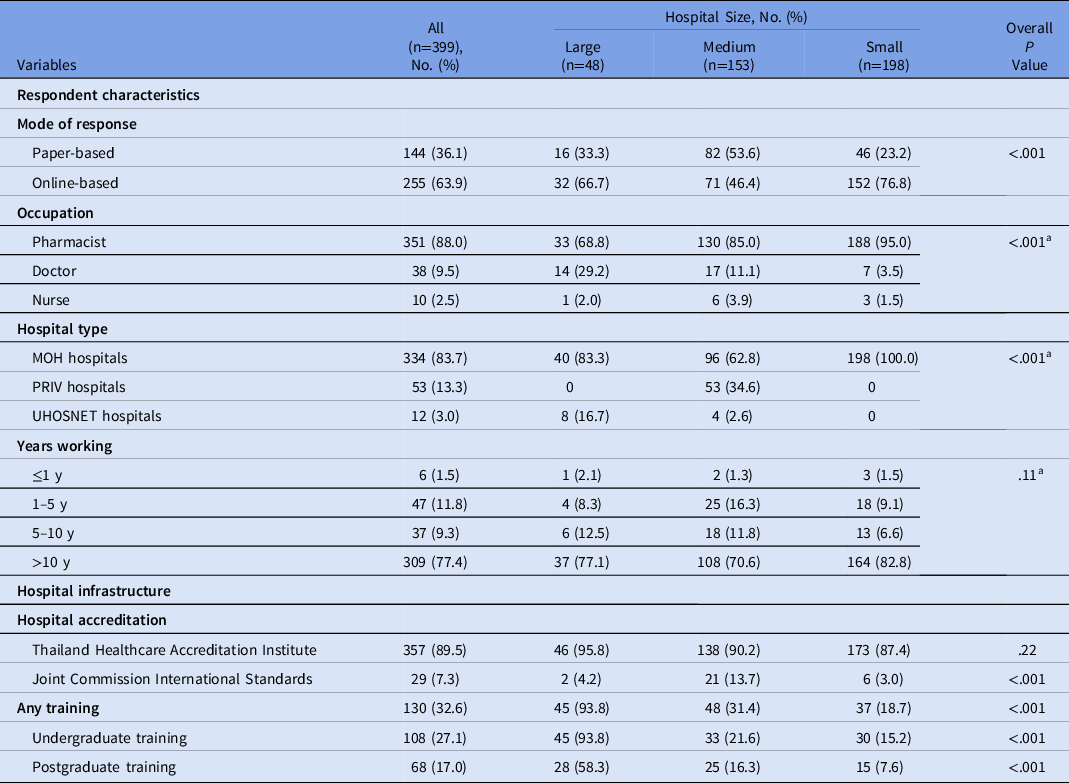
Table 1 shows hospital characteristics reported by 399 survey respondents. Of these 399 respondents, 198 respondents (49.6%) were from small hospitals, 153 respondents (38.3%) were from medium-sized hospitals, and 48 respondents (12.0%) were from large hospitals.
Hospital Characteristics Reported by 399 Survey Respondents for the Feasibility of Antimicrobial Stewardship Program Implementation

Note. MOH, Ministry of Health; PRIV, Private Hospital Association; UHOSNET, University Hospital Network.
a P value from a nonparametric test.
More than half of respondents (63.9%) completed the questionnaire online. Among these 399 respondents, 38 were physicians (9.5%), 351 were general pharmacists (88.0%), and 10 were nurses (2.5%). Most of these were MOH representatives (83.7%) and had been working at their current hospitals for >10 years (77.4%).
Nearly all of the responding hospitals (89.5%) were accredited by the Thailand Healthcare Accreditation Institute, whereas only a few (7.3%) were accredited by the Joint Commission International Standards. Furthermore, 32.6% of respondents reported that their hospitals had undergraduate and/or postgraduate training (residency or fellowship training); these programs were more prevalent in large hospitals.
Current hospital ASP structures and strategies
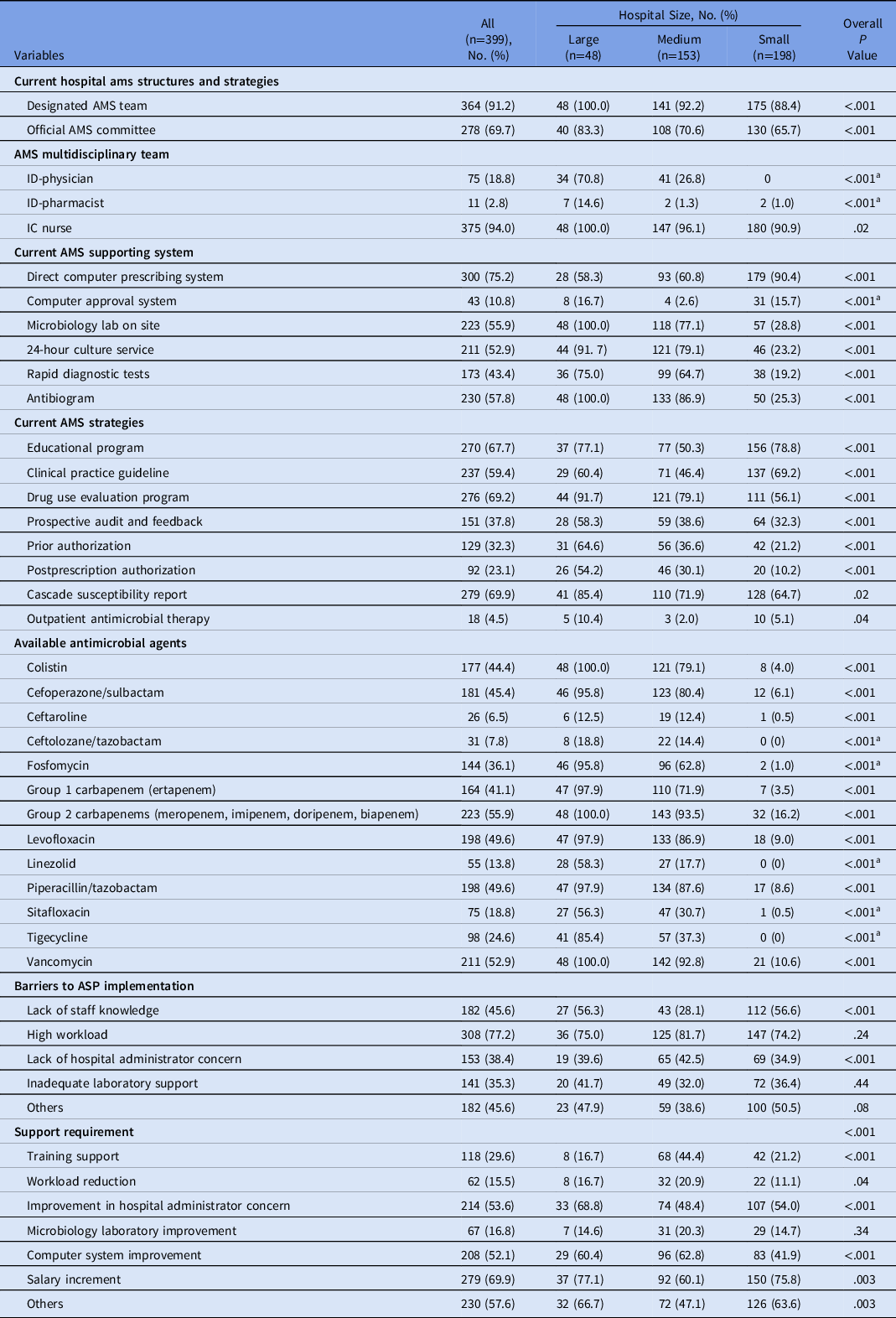
Details of current hospital ASP structures and strategies are presented in Table 2. Although nearly all hospitals (91.2%) had a designated AMS team, only 69.7% had an official AMS committee. The membership of AMS teams and the inclusion of an infectious disease physician were available for 70.8% of large hospitals but for only 26.8% of medium-sized hospitals. None of the small hospitals reported having infectious disease physicians available on their AMS team. An infectious disease pharmacist was available in only 14.6% of large hospitals and was rarely available in medium-sized hospitals (1.3%) and small hospitals (1.0%). An infection control nurse was available in nearly all hospitals (94.0%).
Details of Hospital Antimicrobial Stewardship Programs (ASPs), Barriers to ASP Implementation, and Requirements for Support

Note: AMS, antimicrobial stewardship; ASP, antimicrobial stewardship program; IC, infection control; ID, infectious disease; OPAT, outpatient antimicrobial therapy.
a P value from a nonparametric test.
The availability of each AMS supporting system differed significantly by hospital size (overall P values < .001). Nearly all supporting systems, except the direct computer prescribing system, were more prevalent in the large hospitals. All large hospitals reported having their own microbiology laboratory unit and hospital antibiograms, and 91.7% had a culture service available 24 hours per day. However, only half of participating hospitals reported having their own microbiology laboratory and a 24-hour culture service.
Nearly all of the specific AMS strategies were more prevalent in large hospitals. The 3 most common AMS strategies were cascade susceptibility reporting (69.9%), a drug-use evaluation program to ensure appropriate antimicrobial use (69.2%), and an educational program (67.7%). However, medium-sized hospitals were less likely to report having an educational program (50.3% vs 78.8%; P < .001) and clinical practice guidelines (46.4% vs 69.2%; P < .001) than small hospitals.
Large hospitals were more likely to have broad-spectrum antimicrobial agents available compared with the medium-sized and small hospitals (all P < .001). Table 2 also lists available antimicrobial agents stratified by hospital size.
Barriers to ASP implementation and requirements for support
The most common barriers to ASP implementation were high workload (77.2%), lack of staff knowledge (45.6%), lack of hospital administrator concern (38.4%), and inadequate laboratory support (35.3%). We detected no difference by hospital size in reporting the barriers of high workload or inadequate laboratory support.
The 3 most commonly reported requirements for support of an ASP were salary increase (69.9%), greater hospital administrator concern (53.6%), and improvement in computer support (52.1%). When stratifying by hospital size, the most commonly cited support requirement was the salary increment in both large and small hospitals (77.1% and 75.8%, respectively) and improvement of the computer system in medium-sized hospitals (62.8%). Further details of obstacles to ASP implementation and support requirements are presented in Table 2.
Discussion
Although most participating hospitals did report having designated AMS teams (91.2%), only a small proportion of them reported having an infectious disease physician and/or infectious disease pharmacist. Due to limited availability of these important ASP team members in Thailand, only general practitioners and/or general pharmacists without any formal infectious disease training comprise the ASP team. Training general pharmacists for antibiotic review and authorization in resource-limited settings could be an option. Reference Rattanaumpawan, Upapan and Thamlikitkul9
Approximately 20% of mall hospitals used antibiotics with high resistance potential, as classified by the 2019 WHO AWaRe classification of antibiotics (ie, grade 2 carbapenems and vancomycin). 10 Furthermore, ˜30% of medium size-hospitals do not have access to ertapenem, which is a necessary antibiotic for outpatient antimicrobial therapy for infections caused by extended-spectrum β-lactamase-enzyme–producing bacteria. These findings reveal that the issue of an inappropriate antibiotic list persists in hospitals regardless of size in Thailand.
The most commonly reported barriers to ASP implementation were the high workload involved, followed by a lack of knowledge, a lack of hospital administrator concern, and inadequate laboratory support. The 3 leading support requirements were increased salary, computer support, and greater concern from hospital administrators. Thus, the recognized problems in ASP implementation are somewhat redundant. This study was not qualitative, so it is difficult to interpret whether these respondents did not need support in a given issue or whether they believe that these problems may be impossible to resolve.
Our study has several strengths. This was the first nationwide survey of the feasibility of and barriers to ASP implementation in acute-care hospitals in Thailand. Second, the participating hospitals represent the spectrum of hospital and hospital networks. Lastly, not only did we explore the existing hospital AMS infrastructure, we also focused on the barriers to implementation and needs for further support of ASPs. The results provide a greater understanding of the challenges in AMS implementation.
Our study has several limitations. First, the response rate was only 31.0%; consequently, response bias may be an issue. Respondents with considerable interest in the AMR issue may have been more likely to participate. Second, because all information was gathered from a single representative of each hospital, results from the questionnaire may not represent all healthcare personnel at a given hospital. Furthermore, the respondents may not have had access to all information regarding their hospital’s infrastructure and current ASP. Finally, the study was conducted in Thailand, and these results may not be applicable to other countries.
In conclusion, AMS is well recognized at the national level in Thailand. However, the necessary core components for ASP implementation are fully available in only a small proportion of acute-care hospitals. The major barriers to ASP implementation reported in this study included the increased workload, followed by a lack of staff knowledge, lack of hospital administrator concern, and inadequate laboratory support. Customized action plans focusing on strengthening knowledge and understanding of personnel should be arranged for the successful implementation of ASPs at the national level.
Supplementary material
To view supplementary material for this article, please visit https://doi.org/10.1017/ice.2021.147
Acknowledgments
We thank all respondents for their participation in our study. Furthermore, we thank Phairam Boonyarith, PharmD, for her support in data collection. We also thank John Daniel from Edanz Group for editing a draft of this manuscript.
Financial support
This research project was supported by a Young Clinician/Scientist Award from the Institut Merieux in conjunction with the Infectious Disease Association of Thailand, and by the Health Systems Research Institute of Thailand (grant no. HSR 62-045).
Conflicts of interest
The authors report no conflicts of interest relevant to this article.