1. INTRODUCTION: ELECTRONIC MUSIC AESTHETICS
The musicological debate and the analyses concerning historical features and compositions of electronic music (Elektronische Musik) of the 1950s are vast. The art production in Germany in the post-war period was very fruitful but, at the same time, the electronic aesthetics was also criticised (Schaeffer Reference Schaeffer1952). At the beginning of the 1950s, a few young composers such as Karlheinz Stockhausen, Henri Pousseur, Karel Goeyvaerts and Gottfried Michael Koenig gathered together in the studio of the Westdeutscher Rundfunk in Cologne (WDR), directed by Herbert Eimert, a composer from the previous generation. Their general idea was to compose music with electronic instruments employing the serial technique (serielle Musik) aiming to organise the electronic material.
Eimert (Reference Eimert1958: 2) defines electronic music, in an attempt to differ from French concrete music (musique concrète), as based on ‘the composition of electrically generated sounds made audible by a generator, i.e. recorded on tape without recourse to any instrument or microphone. Electronic music exists only on tape (or on record) and can only be realised in sound by means of a loudspeaker system.’ So, we observe that, at least in the beginning, only synthetic sounds could be employed in electronic compositions (sound recordings and their transformations were not allowed) and they should be recorded in a fixed media (tape or record) to be diffused by loudspeakers during the performances.
Regarding the terminology, Grant (Reference Grant2001: 5–7) points out a problem to define what ‘serial electronic music’ is. The term serielle Musik was coined by Karlheinz Stockhausen to distinguish the electronic works of his contemporaries from the twelve-tone dodecaphonic music. Therefore, he adopted the French term ‘sériel’, importing it from the primary language of many of his colleagues. However, in both English and French, ‘serialism’ refers to all music composed with rows (series), including dodecaphonic music. In those languages and others, the convention was to adopt the expressions ‘total serialism’ or ‘integral serialism’, reflecting the extension of the serial technique to parameters other than pitch. But those expressions were not accepted in the German language. As Eimert himself pointed out, they imply lack of freedom and could be compared to ‘totalitarianism’ and equated with the Third Reich. At the same time, ‘general serialism’ adopted by Henri Pousseur (in French) was more attractive.
The aesthetics of serial electronic music was influenced by different manifestations of the period such as the abstractionism of visual arts (Paul Klee, Piet Mondrian) – in opposition to the representational art – subjects of the new science such as quantum physics and the duality of the wave/particle debate, brought by physicist Werner Heisenberg, and information theory, introduced into the WDR Electronic Studio by physicist and phoneticist Werner Meyer-Eppler (Grant Reference Grant2001: 20–38). In terms of musical aesthetics, the main influences to be mentioned were the pointillistic twelve-tone serialism of Anton Webern (Eimert and Stockhausen Reference Eimert and Stockhausen1958) and the statistical form of Claude Debussy (Stockhausen Reference Stockhausen1988b; Eimert Reference Eimert1961).
The discussion of the serial technique employed in electronic music is normally the gateway to the analysis of electronic music compositions. But the notion of statistical form leads us to the discussion of perceived musical form controlled in time by the serial manipulation of musical parameters (pitch, intensity, partials and their duration), such as a serial conception of Gestalt based on the idea of a textural continuity. Paul Gredinger (Reference Gredinger1958) affirmed that time could not be seen as one of the dimensions to be serialised in electronic music, but as the only general dimension of musical compositions. By considering time as a general dimension to be statistically controlled, an ideal texture in time could be manipulated (the formal evolution of the piece), by the control of pitch levels and their spatial realisation through dynamic intensity.
2. THE PERCEPTION OF TIME
From our standpoint, the control of form over time and the idea of a textural continuity are among the main achievements of the serial technique employed in electronic music. This influenced many compositional procedures and techniques in instrumental and electroacoustic music from the 1960s onwards. Our hypothesis is that, as Gredinger (Reference Gredinger1958: 43) pointed out, the idea that time is an independent parameter above which other musical parameters are attached or vary is the principle of the dynamic systems, as it was considered in the thermodynamics of the nineteenth century (Prigogine Reference Prigogine1995). Moreover, since electronic music was influenced by the ideas of quantum physics of the twentieth century (Heisenberg Reference Heisenberg1971) this idea is certainly incorporated. Thus, we understand that if music can be viewed as a complex dynamic system (especially at the moment of performance), it presents emergent properties related to acoustic and perception characteristics. Here, emergence can be understood as a process result where the whole is greater than the sum of its parts and has properties not shared by its parts (Ashby Reference Ashby1956: 109–13).
The ideas of time as a general and independent dimension and its evolution in a ‘one-way direction’ are also properties of complex dynamical systems (Prigogine Reference Prigogine1995: 26). Taking this idea as a starting point, our aim is to discuss the perception of time related to the perception of pattern and recurrence and variation of sound materials and their transformations throughout the pieces. For this purpose, we apply phase space graphs whose definition comes from Henri Poincaré’s studies on the celestial mechanics, which were discussed in a previous article (Rossetti and Manzolli Reference Rossetti and Manzolli2019: 206). The phase space graphs exclude time representation as it is seen on a Cartesian plane (past–present–future). However, it is very useful to identify the presence of patterns and recurrences such as the ones we find in the Gestalt theory.
As Gilbert Simondon states (Reference Simondon2013: 88–91), form psychology (Gestaltpsychologie) stands between a metaphysical approach (such as in Bergsonism) and a psychophysical analysis. It can be approached to a mediation unifying form and matter in a common operation. According to Gestalt theorists (Wertheimer, Koffka and Köller), the primitive perception already has form and structure in itself and can be considered as a ‘totality’. In this sense, we can speak of an isomorphism between the perceived objects and the perceived forms (interior and exterior are equivalents). Time, on the other hand, is not an object but a construction, and the duration is based on the identification of rhythms and periodicities. Paul Fraisse (Reference Fraisse1967: 90–5) affirms that only the perception of the present exists, including the idea of simultaneity of events. Thus, the perception of time is organised around the present, but it also depends on the inclusion of past and future, which is comparable to the perception of depth: form and matter belong to the present; memories, and markers, to the past; forces and tensions, to the future. The perception of time and duration is essentially the perception of change as transformation and movement, its rhythms (periodicities), similarities and differences.
Emphasising this approach, the perception can be viewed as a form of knowledge and valued in musical experience and analysis. In this sense, it is important to mention the research of René Thom on the intelligibility of forms or a general theory of intelligibility, the semiophysics (Thom Reference Thom1988). This theory has a basis on the Physics of Aristotle, which takes into account the idea of the continuum as a starting point. Thom’s semiophysics generally describes the perception schema and the world as made of saliences (saillances) and pregnancies (prégnances). The salience is the premiere experience, the discontinuity, and presupposes short forms which highlight from the background. The pregnancy supposes continuity and forms with long durations that can be associated with meanings or qualities.
To explore this standpoint, we propose a textural (timbre) and segmentation analysis of two works of the electronic music genre: Gesang der Jünglinge (1955–6), by Karlheinz Stockhausen, and Thema (Omaggio a Joyce) (1958), by Luciano Berio. Stockhausen’s work was composed at the WDR Studio in Cologne, while Berio’s piece was composed at the Studio di Folonogia Musicale, in Milan. One of the common aspects between both works corresponds to the employment of the voice (and its transformations) as their main compositional material. Another important aspect concerning those electronic works is the interdisciplinary collaboration between composers and researchers from other areas. Physicist and phoneticist Werner Meyer-Eppler played a significant theoretical role at the WDR Studio in the 1950s (giving lectures and defining compositional and aesthetical foundations), whereas semiologist and linguist Umberto Eco worked in collaboration with Berio in the composition of Thema. This close relation between electronic music, language and voice regarding the two compositions will be explored later.
In the methodology for the textural and segmentation analysis, we propose the utilisation of audio descriptors (Peeters Reference Peeters2004) such as volume (Malt and Jourdan Reference Malt and Jourdan2009; Rossetti and Manzolli Reference Rossetti and Manzolli2019), a graphical representation of the timbre evolution and/or the sound texture, and the mel scale graphical representation, a perceptual model of the human auditory system behaviour (Peeters Reference Peeters2004). As we intend to show and discuss, although both pieces have several procedures in common, their time evolution and the perception of duration are significantly different. For this reason, we apply the phase space graphs to find the presence of patterns, recurrences and differences of the sonic materials in terms of their spectral and psychoacoustic features. Our conclusion will try to relate the perception of time theory presented and the outcomes of the analyses of the works.
3. SPACE AND TIME IN ELECTRONIC MUSIC: THE MUSICAL CONTINUUM
As pointed out previously, the main purpose of the serial technique employed in electronic music was to statistically control the musical continuum in time (Grant Reference Grant2001: 96). The idea of the musical form as an evolution depending on the permeability of the materials (structures) was presented by Ligeti (Reference Ligeti2010). Those structures could be superimposed and juxtaposed in time, and perceptually could impregnate, merge or segregate each other. Ligeti mentioned, as an example of this process, the compositional process of his electronic work Artikulation (1958).
Boucourechliev (Reference Boucourechliev1960) affirmed that totality and continuity define the electronic music sound universe by the continuous qualitative evolution of the sound material, which could be pure electronic sounds or extended into instrumental sounds and voice (such as in the compositions which will be discussed). In that way, new regions of continuous expansion and differentiation of instrumental and vocal sounds can be achieved, linked to new forms.
3.1. New time morphology and degrees of change
The pitch continuum of electronic music was the object of experiments that opened new possibilities compared to the discrete steps of the equal-tempered instrumental scale. Stockhausen (Reference Stockhausen1959) proposed the extension of the pitch continuum of electronic music into a continuum of durations. In a broader sense, pitches and durations could form one unique scale that would evolve from frequencies (pitches), in Hz (cycles per second), to durations and rhythm, in seconds. This phenomenon was musically demonstrated in the middle section of his work Kontakte (1958–60) where an isolated pitched sound was glissandoed into a lower region and slowed down continuously until it was transformed into a discontinuous sound figure with a periodical rhythm (Stockhausen Reference Stockhausen1995: 19–20). According to him, the perceptual limit of sound continuously (pitch) and discontinuously (rhythm) was around 1/16 of a second.
With the work Gesang der Jünglinge (1955–6), space became an important parameter in electronic music conception. This work was initially composed for five loudspeakers (Valiquet Reference Valiquet2012). In the premiere of 1956, four loudspeakers were placed around the public, while the fifth was set up on stage. After this performance, Stockhausen decided to make a new mix of the piece in four channels, the version that remained until today (Smalley Reference Smalley2000). Similarly, Thema (Omaggio a Joyce) is also a quadraphonic work. After this work, Stockhausen (Reference Stockhausen1988a) proposed a theoretical form to congregate different musical parameters in musical composition. According to him, in occidental music, five parameters could be manipulated and managed together: pitch (harmony–melody), duration (metrics–rhythm), timbre (phonetics), intensity (dynamics) and sound localisation in space (topography). He suggests that composition would be the organisation of acoustic transformations from the variability of those musical parameters, which could be measured by degrees of change. Each degree of change applied to a single parameter could, similarly, be applied to another parameter with the same relation. In that way, the degree of change is a tool to maintain proportional structures between musical parameters and a form to achieve continuity in the statistical evolutions in time.
3.2. Modulation
But even with the employment of those techniques and procedures, how could one be assured that perceptually there would really be a musical continuum in electronic works? Actually, the serial techniques described previously would mainly operate in micro-time scale (in milliseconds) by the manipulation of partials, their durations and their intensities. However, perception acts in a macro-scale (in seconds) where the form emerges. In fact, the sound objects perceived are formed by the agglutination of those partials composed individually. We present below two possibilities of employment of the term ‘modulation’, with the purpose of seeing how the sound fusion phenomenon into a continuous timbre is possible and how perception operates. The former possibility is the sound modulation by electronic processing and the latter is the act of perception as a modulation.
For Meyer-Eppler (Reference Meyer-Eppler1958), the reason for different partials to merge in perception into one unique timbre that evolves and transforms in time is the presence of aleatoric acoustic modulations. In instrumental music, this phenomenon is given by the almost imperceptible variation of musical parameters (pitch, intensity, timbre and duration) produced by musicians in live performances. In the context of electronic music, those timbre modulations could be produced by the utilisation of a noisy aleatoric signal (in a frequency band from 10 to 100 Hz), generating amplitude and frequency modulations together with the other tones. The aleatoric modulation opens possibilities to manage and work with noisy sounds. If the frequency band and the intensity of the modulating wave are broader, the resultant sound presents noisier characteristics, with the result that exact pitch cannot be determined.
From an ecological standpoint, Gilbert Simondon (Reference Simondon2010) states that the act of perception executed by a subject is a modulation, in a sense that the energy transference is an irreversible process and a two-pole system is formed: one is the energetic (the subject) and the other is the information (object to be perceived). A modulator is a system that performs the synthesis between something (which is the information or one form) and one energy. The act of perception by an organism can be summarised by an energy input (given by food digestion and breathing), an information input (the perception) and the organised energy output, which is characterised by the living being action in the environment. The modulation in perception occurs by the interaction between energy and information, where the information is the modulating energy and the power is the modulated energy.
4. SOUND MATERIAL MANIPULATION AND COMPOSITIONAL TECHNIQUES
Here we present information regarding the composition of Gesang der Jünglinge and Thema (Omaggio a Joyce). The purpose is not to present extensive musicological information about the compositional processes of those works since that has already been done before by other authors (Decroupet and Ungeheuer Reference Decroupet and Ungeheuer1998; Di Scipio Reference Di Scipio2000; Maconie Reference Maconie2016; Link Reference Link2017). On the other hand, our objective is to provide relevant information on the creative process that will help us perform our timbre/textural and segmentation analysis.
4.1. Gesang der Jünglinge
Stockhausen’s compositional project in Gesang der Jünglinge aimed to naturally combine phonemes with electronic sounds. As we can understand from the information we discuss next, it is a serial piece, nevertheless, our analysis will not delve into that issue, which was detailed in other articles such as Decroupet and Ungeheuer (Reference Decroupet and Ungeheuer1998).
In the text ‘Actualia’ (Stockhausen Reference Stockhausen1958), in which Stockhausen describes aesthetic and technical issues of this composition, he affirms that the combination of sung speech phonesFootnote 1 and composed electronic sounds should be quite natural. The phones were introduced into the continuous range of timbres that exists from sinus tones to white noise. For the composition, Stockhausen recorded the voice of a twelve-year-old boy reading excerpts from the Bible’s Book of Daniel. The multiple recordings of the boy’s singing voice were transformed by different electroacoustic processes and combined with electronic sounds. The gap between musical sense and the word sense is continually variable, as is the relationship between sound and phones. These ambiguities are constantly explored in the piece.
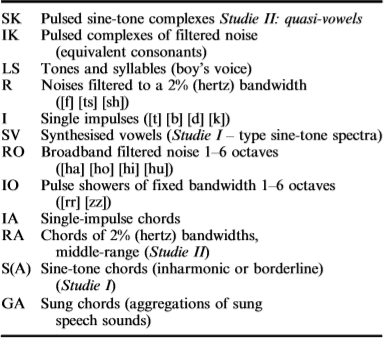
According to his experience with electroacoustic music until that moment – before Gesang der Jünglinge, Stockhausen had composed three electroacoustic pieces: Concrète Étude (1952), Studie I (1953) and Studie II (1954) – he constructed a unified table of electronic and voice-like sounds. The objective was to systematise the sound element scale assimilating electronic sounds into the family of synthesised sounds. For this purpose, criteria from analytic phonetics were applied (vowels-sine tones, consonants-noise bandwidths, plosives-impulses, various mixture forms) (Maconie Reference Maconie2016: 152). We present this in Table 1.
Stockhausen’s sound element scale from analytic phonetics criteria (Stockhausen Reference Stockhausen1956: 64)

For the desired timbre continuum to be perceived, the basic elements of electronic sounds must be differentiated in a way similar to the elements of the various speech phones. The vowel is the single serial element with harmonic formants, while the simple voiceless consonant is a serial single element of noise. In between these two extreme poles, various groups of mixtures and combinations occur (Stockhausen Reference Stockhausen1958: 46). As Eimert explains (Reference Eimert1958: 3–4), electronic music sound material is classified as (1) the sinusoidal tone; (2) the note (built up from a series of harmonic partials); (3) the note mixture (formed by partials that are not ordered harmonically); (4) noise (white noise or its filtered parts, the ‘coloured’ noises); (5) sound complexes (chords); and (6) impulses (regular or statistic beats of clicks). It is important to highlight that note mixtures and chords are not the same. Mixtures have a higher degree of internal fusion and can be perceived as units.
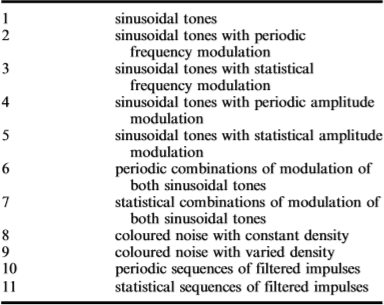
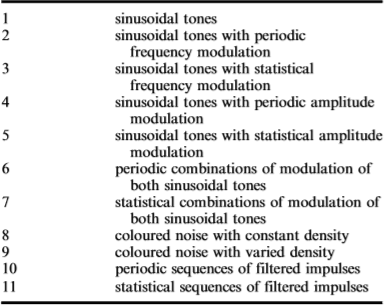
In Gesang der Jünglinge, each timbre (phones and electronic sounds) was accessible for composition in periodic (harmonic) and statistical (noisy) forms. In that way, a scale of eleven basic elements ensured the timbre continuum between the pure harmonic tone and the white noise (see Table 2). Various ranges of different band-spectra tone mixtures, noises, and different timbre permutations were conceived for the piece (Stockhausen Reference Stockhausen1958: 46–7).
Basic elements of the timbre continuum in Gesang der Jünglinge
4.2. Thema (Omaggio a Joyce)
Berio’s work, composed in 1958, relates to Stockhausen’s piece in many ways, however, the techniques employed in Thema (Omaggio a Joyce) are quite different (Link Reference Link2017). It is a verbal electroacoustic work whose material derives from the voice recording of the Chapter XI ‘Sirens’ of Ulysses from James Joyce. The text was read and recorded in three languages: English (voice of Cathy Berberian), French (voices of Umberto Eco and Marise Flach) and Italian (voices of Ruggero de Daninos, Nicoletta Rizzi and Furio Colombo) (Eco Reference Eco and De Benedictis2012).
Berio (Reference Berio and Menezes2009) highlights that Ulysses’s Chapter XI presents a narrative technique influenced by musical polyphony, specifically the fuga per canonem. The recorded excerpt indicates a kind of apertura with theme expositions and succession of leitmotivs. In a sense, it can be approached to the idea of ‘timbre melody’ (Klangfarbenmelodie) with references to musical instruments execution techniques such as trillo, appoggiatura, martellato, portamento and glissando. These techniques were approached into onomatopoetic expressions of the English language, such as:
Imperthnthn thnthnthn ……………….trillo
Chips, picking chips…………………staccato
Warbling. Ah, lure!…………….appoggiatura
Deaf bald Pat brought pad knife took up…martellato
A sail! A veil awave upon the waves…glissando
So, as Stockhausen wanted to create a continuum between electronic sounds and the human voice in Gesang der Jünglinge, Berio desired to reach a new kind of relation between word and sound in Thema. As Berio states, the aim was neither to oppose nor to merge two distinct expressive systems, but to create a relation of continuity between them, with imperceptible passages from one to another. The idea was to concentrate on the polyphonic intentions of Joyce’s text, trying to dissociate them from their enunciative expressions and meanings. The phonetic aspect was taken into account in function of electroacoustic transformation possibilities. Thus, from the three-language assemblage created, Berio sought to construct relations of sonority between them (Berio Reference Berio and Menezes2009).
Di Scipio (Reference Di Scipio2000) states that the main modes of Joyce’s text elaboration in ‘Sirens’, recorded during the composition of the piece were the elision, the contraction (union of phonemes), the concatenation of two or more words; concatenation of syllables or monosyllabic words (rhythms, alliterations); repetition in close distance of identical words or with similar sounds (rhythms, alliterations); repetition in very close distance of syllables or phonemes; and processes of temporal dilatation of single phonemes (stretching). Berio replicated and multiplied these text elaborations in electroacoustic processing and tape editing, decomposing and rearranging the words with distinct criteria.
To reach the objective of gradual and continuous evolution, Berio returned to the original English text collecting and classifying most of the words in a scale of vocal colours (/a/ao/u/). By a constant speed variation in very tiny limits, the continuity of this scale was highlighted. Also, diverse modes of voice excerpts superimpositions were chosen, distancing from the natural voice mechanism production. Another intervention was made by producing artificial consonant junctions (/bp/td/tb/kg/) which allowed more richness of articulation, with variations of duration, frequency and frequency bands. For instance, the /s/, the base-colour of the whole piece, was naturally transformed on a white-noise frequency band. From all those compositional processes, the vocal material becomes unrecognisable in many excerpts of the piece. However, each text element is always the subject of three articulation stages that can have their order inverted: discontinuous, periodic and continuous (Berio Reference Berio and Menezes2009).
Discontinuous → periodic → continuous. E.g.: Goodgod, he never heard inall
Continuous → periodic → discontinuous. E.g.: /s/
Periodic → continuous → discontinuous. E.g.: thnthnthn
Berio concludes his text (Reference Berio and Menezes2009) by affirming that at this point of elaboration (techniques discussed above) he could easily proceed to the continuous evolution of the vocal material into synthetic sounds, however, he stopped near the boundaries of this possibility. By this excerpt of his text, we can conclude that in Thema (Omaggio a Joyce) he only employed sounds derived from the recorded voices. Thus, it could be classified as a concrete piece composed with electronic (and serial) techniques.
5. PERCEPTUAL DESCRIPTORS AND CONCEPTS OF EMERGENCE AND PERCEPTION IN TIME-FREQUENCY DOMAIN
In this section, we present the methodology of our analysis, which is based on the idea that the perception of time has the properties of dynamic systems (Prigogine Reference Prigogine1995). According to this idea, concepts of emergence and time perception are central to our analysis. To mediate it, we present the perceptual descriptors of mel scale and volume that provide us with a databased visual representation of sound phenomena related to perceptual models.
The mel scale descriptor consists of a set of critical band filters intending to model the auditory system behaviour (Peeters Reference Peeters2004: 4). The mel model is the consequence of a set of experiments addressing the pitch perception of pure tones (Zwicker and Falst Reference Zwicker and Fastl1999: 111). The mel frequency scale is based on band filters that are linear at low frequencies (below 1000 Hz) and logarithmic at high frequencies (above 1000 Hz) (Peeters Reference Peeters2004: 4). According to Peeters (Reference Peeters2004), the space bands are calculated by dividing the mel curve into twenty-four equal parts. By using the mel descriptor, we can generate a spectral representation of the pieces with a perceptual point of view. This approach has already been used to analyse electroacoustic music, using Zwicker’s model of critical bandwidths (Antunes, Rossetti and Manzolli Reference Antunes, Rossetti and Manzolli2019).
The volume descriptor generates a multidimensional representation of the sound by extracting features that are relevant to the perception. According to Truax (Reference Truax1992), the concept of volume is related to the ‘perceived magnitude of sound or the psychological space it occupies’. Aiming to create a representation of the sound texture evolution in time, Malt and Jourdan (Reference Malt and Jourdan2009) created a graph by superposing the data of three descriptors: spectral centroid, spectral spread and loudness. The spectral centroid is the barycentre of the spectrum concerning the size of a window of analysis (Agostini, Longari and Pollastri Reference Agostini, Longari and Pollastri2003; Peeters Reference Peeters2004). The spectral spread calculates the spread of the sound spectrum around its mean value (Peeters Reference Peeters2004). Loudness is a model of the subjective perception of sound intensity, which is based on Fletcher and Munson (Reference Fletcher and Munson1933) curves, that are reviewed in ISO Standard (2003).
The concept of emergence has been widely discussed in the context of the timbre of electroacoustic music (Di Scipio Reference Di Scipio2003; Rossetti, Teixeira and Manzolli Reference Rossetti, Teixeira and Manzolli2018; Rossetti and Manzolli Reference Rossetti and Manzolli2019). As discussed above, time has emergent properties in complex dynamical systems, and can be approached and analysed based on the perception of patterns, repetitions and variations over time. One way to represent the emergence of those features in time is to employ phase space graphs aiming to find regions of accumulation of points (repetition of patterns) and dispersion of points (indicating a variation of the material). The phase space graphs proposed in the analyses came from the data extracted from the same audio descriptors of the volume representation: spectral centroid, spectral spread and loudness. We employ the spectral centroid values in the x-axis and combine them in different plots with the spectral spread and loudness values in the y-axis.
From our standpoint, these representations based on perceptual models will help us to solve two tasks: the segmentation of the musical pieces; and the analysis of the recurrence of the sound material in the time domain. Our hypothesis is that the sound material and its recurrence in the time domain are responsible for our perception of how time passes. This is shown by the position of the plotted points in the phase space graphs. So, by observing the rate of recurrence, we can interpret how the sound material and its relation to our psychophysiological responses shape the sensation of time. The idea of pregnancy and salience presented in section 2 will guide our interpretation. The variation of the energy into the filter of the bands of the mel scale, as well as the variation on time of the volume representation, will be the key to this point of view.
6. ANALYSIS AND SEGMENTATION
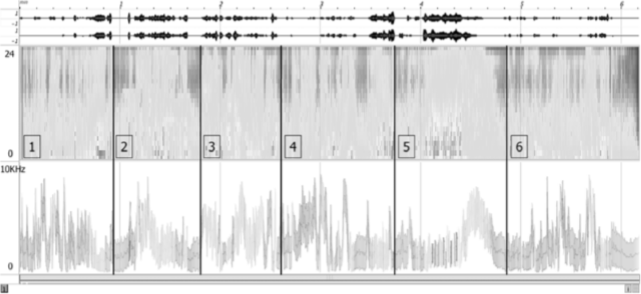
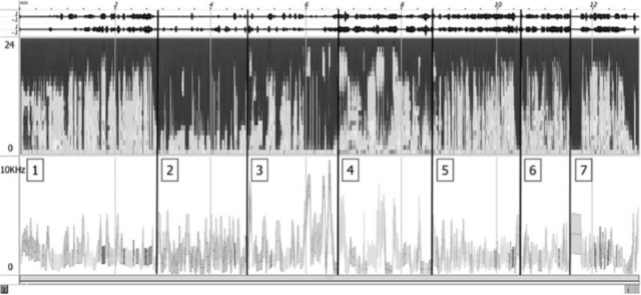
In this section, we discuss the analyses of the descriptors. In Figures 1 and 2, we present the mel scale above and the volume below. The mel scale plots the twenty-four bands on the vertical axis and time on the horizontal axis. The white colour represents the energy of the spectra. In the volume representation, the width of the line represents the spectral spread. The centreline represents the spectral centroid, and the grayscale represents the loudness. We can also see in the figures the segmentation with numbers and vertical lines, which will be discussed in section 6.1.
Mel scale (top) and volume (bottom) of Thema (Omaggio a Joyce).

Mel scale (top) and volume (bottom) of Gesang der Jünglinge.

The mel descriptors of Thema reveal great energy distribution in all the bands and all the segments. The volume descriptor shows a great variation along the piece. We can observe a lower variation only in the first half of the segment 5, which is also the segment with more energy in the lower bands of the mel scale. By comparing all the segments, we can pay attention to the low differentiation considering the development of the spectra in time.
The mel descriptor in Gesang der Jünglinge reveals a higher massive presence of the sound spectra in sections 1, 5, 6 and 7. On the other hand, segments 2, 3 and 4 reveal more segregation of the spectra in the band descriptor. The volume descriptor shows a low variation all over the piece, except in segments 3 and 4. Consequently, the piece representation suggests differentiation of the sound material in the development of the spectra in time.
6.1. Segmentation
To discuss the analyses of both works, we divide the pieces into segments. We proceed with the segmentation based on the peaks, valleys and breakpoints of the descriptors in the graph. This division allows us to investigate the formal development of the musical pieces. For the next steps of the analysis, it is also necessary to compare the recurrence of the sound material in the piece. In table 3, we show the six segments of the piece Thema (Omaggio a Joyce) and their initial time, as presented in Figure 1. In Table 4, we show the initial times of the seven segments of the piece Gesang der Jünglinge and their initial time, as shown in Figure 2.
Segmentation of Thema (Omaggio a Joyce)

Segmentation of Gesang der Jünglinge

6.2. Recurrence of the material in each segment
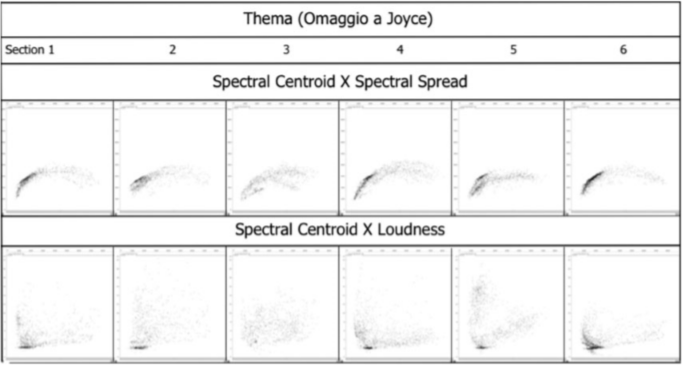
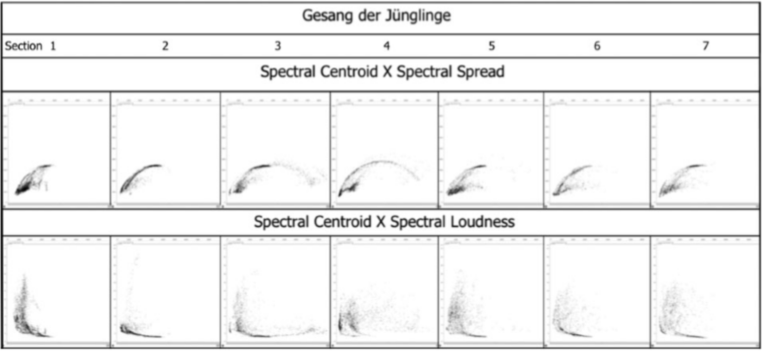
The second step of our analysis is to investigate the recurrence of the sound material in each segment of the pieces. For that, we have generated phase space graphs relating the spectral centroid data (in the x-axis) with the spectral spread (y-axis) and the spectral centroid (x-axis) values with the loudness values (y-axis) – Figures 3 and 4. It is important to emphasise that these are the same descriptors employed for the generation of the volume graph. The agglutination of the points in the phase space indicates the recurrence of the material in time, which means that, if we have more agglutination of points, we have more recurrence of the musical material in time with similar timbral characteristics.
Phase space graphs of each segment of Thema (Omaggio a Joyce).

Phase space graph of each segment of Gesang der Jünglinge.

First, we want to describe some aspects of the descriptors applied to Thema. The spectral centroid indicates energy in almost all the frequency ranges. The loudness descriptor shows significant distribution, with peaks in segments 2 and 5. On the other hand, the spectral spread shows us a higher concentration in the lower frequencies. Mainly because of the high scattering of the loudness and centroid, the representation of each segment suggests a high variation of the sound material in time.
The spectral centroid of Gesang der Jünglinge reveals higher distribution in segments 3 and 4, however, in the other segments, its presence is concentrated in the lower frequencies. The spectral spread reveals higher agglutination of energy in the lower frequencies. And the loudness has medium distribution in all segments, with low variation. By comparing each segment, we can observe that segments 3 and 4 are different from the other segments. The main reason for that is the behaviour of the spectral centroid. The consequence of this is a lower variation of the sound material in time.
7. DISCUSSION OF OUTCOMES AND CONCLUSIONS
By observing the descriptor representation, we can affirm that Stockhausen’s piece has more reiteration of the material in the segments of the piece. This repetition is revealed by the distribution of the energy in the mel scale. Segments 1, 5, 6 and 7 explore more mass sounds, with higher energy in all bands of the mel scale. In segments 2, 3 and 4 of the same graph, we can see more segregation of sound material. On the other hand, Thema’s representation suggests an exploration of sound masses, with a higher presence of sound energy distributed in the mel bands of all segments.
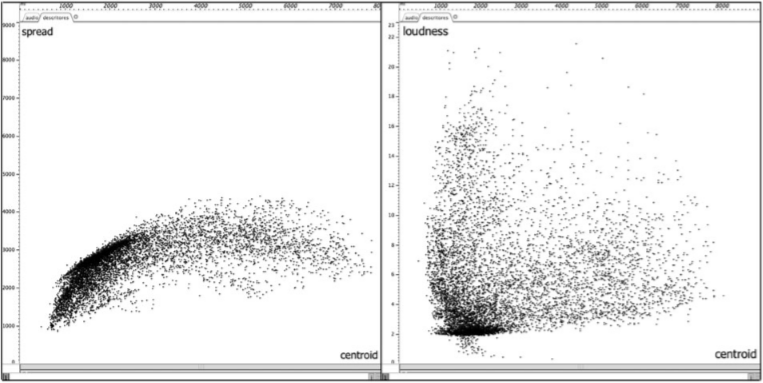
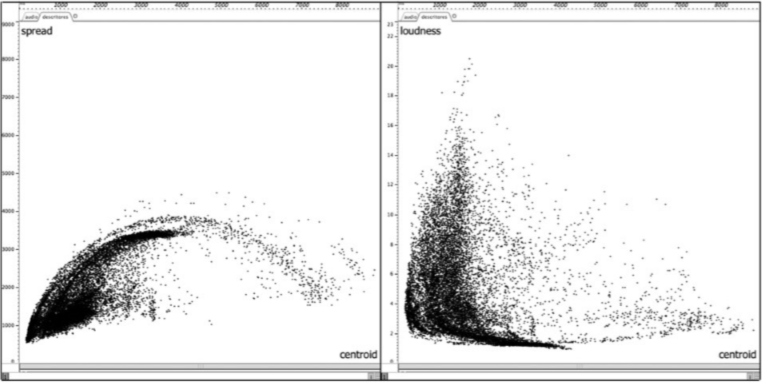
To enhance the discussion of the results of our analysis, we have integrated the data of the phase space graphs in Figures 5 and 6. Then, we were able to comment on the global difference between the two pieces.
Phase diagram of Thema (Omaggio a Joyce).

Phase diagram of Gesang der Jünglinge.

By observing Figures 5 and 6, our idea about sound spectra development explored in section 6.2 is reinforced. We can observe that Gesang der Jünglinge exhibits a higher concentration of sound material, especially with regard to spectral spread and loudness. On the other hand, Thema reveals a higher scattering of the descriptor’s parameters in the graphs.
We believe that with this development of sound material, our conclusions concerning time perception is supported. By comparing the development of the pieces in time, we can conclude that Thema suggests a time perception linked with the idea of ‘one-way direction time’. This irreversibility of time is a consequence of the absence of reiteration of sound material and patterns. On the other hand, Gesang der Jünglinge suggests the idea of a cyclic and spiral time, which is a consequence of the redundancy of the sound material in time. The idea is that Gesang explores similar patterns of sound materials and their transformation in time.
The manipulation of the sound material in electronic music theoretically and practically deals with the idea of a musical continuum; on the other hand, time perception deals with other mechanisms to detect a continuum and establish duration. The perception of a more continuous time can be viewed as the presence of similar events, recurrences and transformations of the original material. This is the case of Stockhausen’s piece, where more pregnancies are detected in terms of sound materials and textures, as we can see in Figure 6. When the spectral centroid or the perception of brightness is compared with the spectral spread (the variation of the sound spectrum) and the loudness (the psychoacoustic intensity perception), we observe a huge quantity of accumulated points in similar regions. In this way, if the form is given by the perception of order, recurrences and periodicities, we can say that Stockhausen in Gesang der Jünglinge also approached the idea of continuity in form.
On the other hand, the perception of time in Thema (Omaggio a Joyce) has a different behaviour. The continuous evolution of the sonic material proposed by Berio does not reflect a continuous time perception. As we can observe in Figure 5, the graphs indicate a smaller region of accumulation of points, in contrast with a huge area, where the points are dispersed. This indicates that the spectral variation of the sound material in terms of intensity and frequency is very high, reflecting in a greater presence of saliences or discontinuities in perception. The one direction time pointed out above about Berio’s piece indicates the perception of a more unstable and varied form where fewer periodicities are found. Finally, we can highlight that the search for a continuum in sound material in a gradual scale does not necessarily provide the emergence of continuity in the global form. It depends on the intentions of the composers and their forms of organisation of the sound objects in time.
Acknowledgements
Danilo Rossetti is supported in his post-doctoral research by the São Paulo Research Foundation (FAPESP), process 2016/23433-8. Micael Antunes is supported by FAPESP in his doctoral research, process 2019/09734-3. Jônatas Manzolli is supported by the National Council for Scientific Research (CNPq) under a Pq fellowship, processes 04431/2018-4 and 429620/2018-7.