Introduction
Many societies throughout the world are heavily dependent on automobiles as the predominant means of transportation (Buys et al., Reference Buys, Snow, van Megen and Miller2012). The ageing process and health conditions more common in older age may lead to impairments which affect an individual's ability to drive safely. As a result, older people often decide or are advised to reduce or cease driving activities, due to health or financial reasons, or discomfort with driving (Byles and Gallienne, Reference Byles and Gallienne2012; Liddle et al., Reference Liddle, Gustafsson, Bartlett and McKenna2012). Driving cessation may negatively impact the older person in terms of changes to well-being and lifestyle (Edwards et al., Reference Edwards, Lunsman, Perkins, Rebok and Roth2009a). There is a large body of evidence that compares those who have already ceased driving (retired drivers) with those who are still driving (current drivers), documenting the adverse psychosocial effects associated with driving cessation. Increased depressive symptoms (Marottoli et al., Reference Marottoli1997; Windsor et al., Reference Windsor, Anstey, Butterworth, Luszcz and Andrews2007), reduced life satisfaction (Liddle et al., Reference Liddle, Gustafsson, Bartlett and McKenna2012), and social isolation (Lister, Reference Lister1999) are psychosocial issues commonly reported by older retired drivers when compared to older current drivers. These psychosocial changes may stem from a loss of independence, a lack of personal control, and reduced participation in important life roles, all of which have been linked to driving cessation (Liddle et al., Reference Liddle, Gustafsson, Bartlett and McKenna2012; Ragland et al., Reference Ragland, Satariano and MacLeod2005; Windsor et al., Reference Windsor, Anstey, Butterworth, Luszcz and Andrews2007). Together, these consequences may lead to uncertainties in personal identity which can have major implications on an individual's self-esteem, psychological state and well-being (Eisenhandler, 1990; King et al., Reference King2011; Liddle et al., Reference Liddle, Turpin, Carlson and McKenna2008).
Driving cessation can also alter the older person's lifestyle with studies showing that retired drivers have significantly reduced out of home activities when compared to current drivers, and as such have reduced community access (Curl et al., Reference Curl, Stowe, Cooney and Proulx2013; Liddle et al., Reference Liddle, Gustafsson, Bartlett and McKenna2012; Marottoli et al., Reference Marottoli2000). While studies have shown that the frequency with which retired drivers and current drivers attend nondiscretionary activities such as medical appointments and grocery shopping are similar, there is evidence to suggest retired drivers are less likely to attend discretionary activities such as social and leisure activities (Liddle et al., Reference Liddle, McKenna and Broome2005). When leaving the home, retired drivers are more likely than current drivers to use other forms of transport such as public or community transport (Bartley and O’Neill, Reference Bartley and O’Neill2010); however, there is still a heavy reliance on the use of private transportation (e.g., lifts from family and friends) (Buys et al., Reference Buys, Snow, van Megen and Miller2012). There is some suggestion that health issues associated with reasons for retiring from driving may make using alternative transport difficult and unsafe (Buys et al., Reference Buys, Snow, van Megen and Miller2012; Oxley and Whelan, Reference Oxley and Whelan2008). Surveys of older drivers have shown that current drivers rely heavily on driving themselves and alternative transport is rarely used (Liddle et al., Reference Liddle, McKenna and Broome2005). Participants in a study conducted by Buys and colleagues (Reference Buys, Snow, van Megen and Miller2012) suggested that the physical demands associated with using public transport may make it difficult for the older individual to negotiate and therefore there is a continued reliance on private transportation.
Large population-based studies have compared outcomes for older drivers and retired drivers (e.g., Marottoli et al., Reference Marottoli1997; O’Connor et al., Reference O’Connor, Edwards, Waters, Hudak and Valdes2013). The studies have demonstrated that retired drivers have poorer outcomes in physical and mental health and community participation (Marottoli et al., Reference Marottoli2000; Marottoli et al., Reference Marottoli1997; Ragland et al., Reference Ragland, Satariano and MacLeod2005). They have also indicated that driving cessation is predictive of morbidity, residential care admission and mortality for older people, even when allowing for age, health, and frailty indicators (e.g., Edwards et al., Reference Edwards, Perkins, Ross and Reynolds2009b; Freeman et al., Reference Freeman, Gange, Munoz and West2006). With the acknowledgement of the outcomes associated with driving cessation, longitudinal examination of population data has been used to attempt to predict who will cease driving, and which factors may mediate poor outcomes related to driving cessation (e.g., Edwards et al., Reference Edwards, Ross, Ackerman, Small, Ball, Bradley and Dodson2008; O’Connor et al., Reference O’Connor, Edwards, Waters, Hudak and Valdes2013). Longitudinal examination of driving cessation has indicated gender, education, and racial disparities between older people who continue driving and those who cease driving (Choi et al., Reference Choi, Mezuk, Lohman, Edwards and Rebok2012). An understanding of the process of driving cessation is also beginning to emerge. Longitudinal population data suggests that older drivers gradually decrease their distance and frequency of driving prior to stopping for a variety of reasons (Molnar et al., Reference Molnar2013). As studies have also indicated a reluctance to use alternative transportation and a reduced participation in community based activities, there is a focus on how to promote better outcomes related to driving cessation (Molnar et al., Reference Molnar2008).
In addition to the well-documented well-being and lifestyle changes associated with driving cessation, there is research that describes older people's reluctance to plan for driving cessation or engage in discussions about the issue, especially for current drivers (Meuser et al., Reference Meuser, Berg-Weger, Chibnall, Harmon and Stowe2013; Yassuda, Wilson, and von Mering, Reference Yassuda, Wilson and von Mering1997). Gerontological research has characterized the process of driving cessation as a life transition, whereby people may gradually change their driving patterns, community mobility, and acceptance. It has been noted that older drivers may be reluctant to engage in planning due to their awareness of the potentially negative outcomes of driving cessation and a lack of readiness to engage in the necessary behavioral and identity changes (King et al., Reference King2011). Assessment of the aspects of readiness for the transition in mobility have indicated an impact of anticipatory anxiety, perceptions and concerns about being dependent, perceptions of a major negative impact to quality of life, and resistance to engage in discussion or planning about changes to mobility (Meuser et al., Reference Meuser, Berg-Weger, Chibnall, Harmon and Stowe2013). Planning for a major life change like driving cessation might be expected to improve the outcomes through better gradual preparation and maintenance of control (Buys et al., Reference Buys, Snow, van Megen and Miller2012; Liddle and McKenna, Reference Liddle and McKenna2003). However, for older people who are reluctant to plan, this transition may be quite complicated (Berg-Weger et al., Reference Berg-Weger, Meuser and Stowe2013; Meuser et al., Reference Meuser, Berg-Weger, Chibnall, Harmon and Stowe2013).
The individualized nature of the driving cessation process suggests that older people facing driving cessation may need support based on their individual readiness for the transition in their mobility (Berg-Weger et al., Reference Berg-Weger, Meuser and Stowe2013; Meuser et al., Reference Meuser, Berg-Weger, Chibnall, Harmon and Stowe2013). A qualitative study has identified four phases of driving cessation – driving in the past, predecision, decision, and postcessation phases – indicating that some older people make careful, purposeful decisions to cease driving (Liddle et al., Reference Liddle, Turpin, Carlson and McKenna2008). Those older people who are still driving and have made the decision to cease in the near future are termed “retiring drivers.” A recent large trial of a group program for older drivers facing driving cessation (Liddle et al., Reference Liddle2013) has identified a group of older drivers who are actively planning for when they stop driving. This group of older people has made a definitive decision to cease driving in the near future (retiring drivers) and had sought education and support by attendance at a group program. Previous literature have reported comparisons of current and retired drivers but the retiring group of drivers has not been clearly identified in previous studies. The overall aim of this study was to understand the retiring drivers group in comparison with retired drivers, while considering what is known about the differences between older drivers and retired drivers. It sought to explore whether the general pattern of gradual reduction then cessation of driving found for older drivers is accompanied by changes to transport behaviors, well-being, and beliefs about driving cessation. It also sought to determine whether the self-identified retiring drivers were a unique subgroup of older drivers who differed fundamentally from retired drivers, or represented a stage of adjustment in lifestyles prior to driving cessation. Therefore, the purpose of this study was to directly compare the sociodemographic characteristics and, well-being and lifestyle status of retiring drivers with the retired drivers. The specific research questions were:
-
1. Do retiring drivers differ from retired drivers on sociodemographic characteristics?
-
2. Do retiring drivers demonstrate different patterns of use of transport when compared with retired drivers?
-
3. Do retiring drivers differ from retired drivers on well-being and lifestyle outcomes?
Method
Ethical considerations
This study obtained ethical approval from the Behavioral and Social Sciences Ethical Review Committee (human subject approval number 2007000821) at the University of Queensland. Before participating in the initial stages of this study, written informed consent was obtained from participants. The data used in the current study is comprised of baseline data collected from a randomized controlled trial (RCT) examining the effectiveness of an education and support program for retired and retiring drivers (UQDRIVE) (Liddle et al., Reference Liddle2013).
Participants
Participants consisted of people aged 60 years and over who were living independently in the community. Inclusion criteria stated that participants were required either to be retired from driving or planning to retire from driving within the next 12 months; able to provide written, informed consent; and have a Short Portable Mental Status Questionnaire (SPMSQ) score greater than seven so as to rule out cognitive impairment (Pfeiffer, Reference Pfeiffer1975). Eligible participants needed to be able to communicate sufficiently in English in order to participate in a group intervention and complete the outcome measures. The RCT recruited 131 participants and their baseline data have been used for this study and analyses. The participants included 68 who had already retired from driving and 63 who identified themselves as planning to retire.
Procedure
Participants were invited to participate in the UQDRIVE program which involved an education and support group program run over 6 weeks (Liddle et al., Reference Liddle, McKenna and Bartlett2007). Potential participants from the community were encouraged to make contact with the research team to express an interest and eligibility was determined at this initial contact. Initial data collection (baseline measures) were performed in South East Queensland from 2008 to 2010 and conducted during face-to-face interviews at the person's home.
Measures
Sociodemographic information. Descriptive information was collected from all participants at baseline and included driving status, age, gender, educational status, current residence, living situation, and marital status.
Well-being outcomes
Mood . The Geriatric Anxiety Inventory (GAI) (Pachana et al., Reference Pachana2007) includes 20 questions which assess the presence of anxiety symptoms among older people during the previous week. Answers to the questions are dichotomized into “agree” or “disagree.” Examples include, “Do you think of yourself as a nervous person?” and “Do you find it hard to relax?” A score on the GAI of nine or above indicates clinical levels of anxiety (Pachana et al., Reference Pachana2007). This tool has been shown to have excellent test-retest and inter-rater reliability as well as well-established validity (Pachana et al., Reference Pachana2007). The Geriatric Depression Scale (Sheikh and Yesavage, Reference Sheikh and Yesavage1986) was used to identify symptoms of depression in the current study. This scale includes fifteen questions with either “yes” or “no” responses. Examples include, “Do you feel happy most of the time?” and “Do you feel helpless?” For clinical purposes, a score of five or greater suggests depression and requires further investigation (Almeida and Almeida, Reference Almeida and Almeida1999). This test has well-established validity and reliability when evaluated against other diagnostic criteria (Sheikh and Yesavage, Reference Sheikh and Yesavage1986).
Self-efficacy . The Transport and Lifestyle Self-efficacy Questionnaire was adapted from Lorig et al. (Reference Lorig1996) Chronic Disease Self-efficacy Scale for the purposes of the trial. Statements related to transport and lifestyle issues were used to measure how confident a participant felt with participating in life roles and activities without driving. For example, “How confident do you feel about being able to stay involved in the community without driving?” and “How confident do you feel about being able to stay in contact with friends and family without driving?” This questionnaire assessed participants’ level of confidence on a 10-point scale ranging from 1, not confident at all, to 10, very confident, with 5 indicating neither confident nor not confident. Cronbach's alpha was calculated for data collected using this scale in the clinical trial and was 0.91 indicating a high level of internal consistency. This transport and lifestyle self-efficacy questionnaire was successfully trialed in a pilot study (Liddle et al., Reference Liddle, McKenna and Broome2005).
Lifestyle outcomes
Episodes away from home and modes of transport used in the previous week . Participants were interviewed about the activities of their previous week. They were encouraged to use a diary or calendar to accurately recall occasions in which they left the home (episodes away from home), the reason for the trip, and the mode of transport used, over the previous week.
Community activities and modes of transport used. The interviewer asked questions relating to the frequency with which the older person attended community activities such as medical appointments, grocery shopping and social and leisure activities, and modes of transport used. For example, one of the frequency questions was “How often do you access medical appointments?” Responses were daily or several times a week, less often than weekly, less often than monthly, and rarely or never. Each frequency question was then accompanied with an open ended question such as “How do you access (activity)?”
Analysis
Analysis employed a number of approaches depending on the type and distribution of data. Participants were divided according to their driving status (retiring or retired drivers) and these groups were compared statistically on sociodemographic characteristics, episodes away from home, frequency of attending community activities, modes of transport used, alternative transport used, anxiety, depression, and self-efficacy. A two-sample t test with equal variances was used for age and episodes away from home as they were normally distributed. Nonparametric analysis, Mann-Whitney U test, was used for frequency of modes of transport used, presence of anxiety and depressive symptoms, and self-efficacy as they were not normally distributed (Utts and Heckard, Reference Utts and Heckard2012). All other sociodemographic characteristics (other than age), frequency of attending community activities, and alternative transport use were dichotomized and Pearson Chi square analyses were conducted where possible. However, where the expected frequency of a cell was below five, a nonparametric test (Fisher's exact) was used (Utts and Heckard Reference Utts and Heckard2012). STATA Statistical Data Analysis Special Edition 10.0 was used to conduct data analysis.
Results
Sociodemographic outcomes
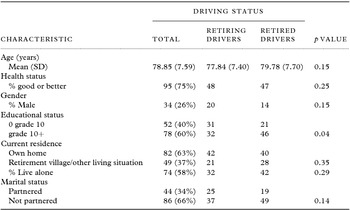
The baseline sociodemographic characteristics and results of comparisons for the two groups of participants are outlined in Table 1. The retired drivers (n = 68) were a mean age of 79.78 (SD = 7.40) years and the retiring (n = 63) were a mean age of 77.84 (SD = 7.40) years. Retiring drivers had significantly lower levels of educational attainment than the retired drivers (p = 0.04).
Sociodemographic characteristics of participants

Additional information about the driving cessation process was collected from retired drivers. This identified that they were a median age of 76.12 (IQR = 72.00–83.00) years when they ceased driving. They reported that they had ceased driving due to a range of reasons (multiple responses allowed) including health (53%), discomfort (22%), licensing body or health professionals’ orders (13%), family pressure (7%), the financial cost associated with owning a car (6%), and other (25%), which included multifaceted reasons not adequately described by the other categories such as “moved to a retirement village, did not feel comfortable driving a car in the new location, and the new location did not have a garage.” Finally, the retired drivers indicated that their decision to cease driving involved themselves (87%), a doctor (35%), family (24%), friends (1%), and other (1%). Again, participants could give multiple answers. No comparable data were available for retiring drivers.
Well-being outcomes
The well-being outcome measures examined the differences between retiring and retired drivers in regards to anxiety symptoms, depressive symptoms, and transport and lifestyle self-efficacy (Table 2). Analysis from the Mann-Whitney U test indicated that retired drivers had significantly more depressive symptoms (p = 0.01) and anxiety (p = 0.05), yet had a significantly greater sense of transport and lifestyle self-efficacy (p = 0.04).
Well-being outcomes

aPossible scores range from 0 to 20, with higher scores indicating higher anxiety.
bPossible scores range from 0 to 15, with higher scores indicating higher depressive symptomatology.
cPossible scores range from 0 to 10, with higher scores indicating higher self-efficacy.
Lifestyle outcomes
Episodes away from home and modes of transport used. Retiring drivers had significantly (t(129) = −2.14, p = 0.03) more mean episodes away from home (5.30, SD = 2.48) than retired drivers (4.31, SD = 2.79). Fisher's Exact analysis showed that retired drivers were significantly more likely to use alternative transport during these episodes away from home (p < 0.001). Alternative transport use refers to using modes of transport other than driving self, including catching public transport, walking, getting a lift from family or friends, using community transport, or catching a taxi.
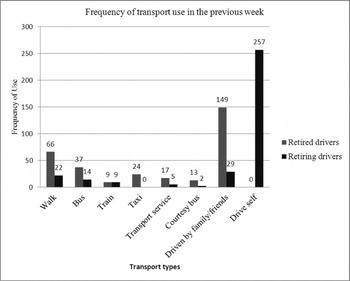
Analysis of modes of transport used with the Mann-Whitney U test found that retired drivers were significantly more likely to walk (z = 2.30, p = 0.02), catch a bus (z = 2.017, p = 0.04), catch a taxi (z = 4.23, p < 0.001), use community transport services (z = 2.51, p = 0.01), or get a lift with friends/family (z = 5.15, p < 0.001) when leaving the home. The frequencies for each individual mode of transport used in the previous week are graphed in Figure 1.
Frequency of alternative modes of transport used in the previous week during episodes away from home as recorded by the weekly diary.

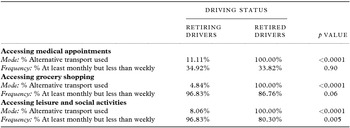
Community activities and modes of transport used. The frequency with which an older person attended medical appointments, grocery shopping, and social and leisure activities was measured. Table 3 outlines these frequencies of attendance as well as the use of alternative transport when comparing groups. Fisher's exact test showed that retired drivers, who were significantly less likely (p = 0.02) to attend leisure or social activities. Although not significant, there was a trend for retiring drivers to attend grocery shopping more frequently (p = 0.06); however, accessing medical appointments were similar between the two groups (p = 0.90). When looking at modes of transport used when attending these community activities, Fisher's exact analysis showed retiring drivers were significantly less likely to use alternative modes of transport when accessing medical appointments (p < 0.001), grocery shopping (p < 0.001), and leisure and social activities (p < 0.001). The trend for modes of transport used for these community activities was similar to that displayed in Figure 1 where retired drivers reported a range of modes of transport used and retiring drivers predominantly drove themselves.
Community activities and alternative transport used

Discussion
This is the first known study to investigate the sociodemographic characteristics, well-being and lifestyle status of retiring and retired drivers who self-selected to attend a community-based group program for driving cessation. The comparison indicated that retiring drivers leave the home more often, use a narrower range of transport modes and report lower levels of transport related self-efficacy compared to retired drivers. Despite planning to cease driving, it seems that retiring drivers have not begun to change transport behaviors and do not seem confident in how well they will cope with adjustment to life without driving. This indicates that engagement in planning to cease driving may mark a critical time for intervention and support to facilitate a smoother transition to driving cessation.
The sociodemographic characteristics of participants were investigated for homogeneity of the groups and to allow for comparison with participants from other driving cessation studies. Participants for this study were volunteers recruited from the general community and accurately reflected the gender, age, education status, and health status described from other driving cessation studies (e.g., Ragland et al., Reference Ragland, Satariano and MacLeod2005). In contrast to differences found between current and retired drivers in previous studies (e.g., Garre-Olmo et al., Reference Garre-Olmo, Pujol, Garriga, Lopez-Pousa and Vilalta-Franch2009; Ragland et al., Reference Ragland, Satariano and MacLeod2005), the retiring and retired drivers of this study were similar in terms of age, gender, health status, current residence, living situation, and marital status.
Previous literature has reported retired drivers to have a lower education than current drivers (e.g., Garre-Olmo et al., Reference Garre-Olmo, Pujol, Garriga, Lopez-Pousa and Vilalta-Franch2009); however, in the current study, a higher percentage of retired drivers had completed more than 10 years of education compared to retiring drivers. This finding may be an artifact of the interventional nature of the study or the recruitment methods used. Participants responded to a call for participants and, therefore, needed to self-recognize a need for education and support. It is possible that educational attainment may influence the likelihood and timing of seeking help or alternatively having the resources to source the required assistance or transport in relation to driving cessation.
With respect to lifestyle status, retiring drivers reported significantly more episodes away from the home equating to one extra trip in the previous week. Liddle et al. (Reference Liddle, McKenna and Broome2005) reported a difference of 2.6 episodes away from home per week when comparing retired drivers to current drivers. It is possible that retiring drivers may be reducing the amount of trips undertaken either in preparation for driving cessation, or as a result of the health and lifestyle issues which are prompting them to plan for driving cessation. The literature has described a number of implications associated with reduced number of episodes away from home, including increased depression, reduced life satisfaction, reduced engagement in valued roles, and social isolation (Liddle et al., Reference Liddle, Gustafsson, Bartlett and McKenna2012; Marottoli et al., Reference Marottoli2000; Marottoli et al., Reference Marottoli1997). Continued community engagement allows for greater social integration which has been linked to lower mortality and greater well-being in later life (Marottoli, et al., Reference Marottoli2000). Therefore it is important for retiring drivers to maintain their current level of episodes away from home and active planning and support during this transition may play a key role in reducing these changes in lifestyle. Future research may investigate whether differences in driving cessation outcomes are found for those who have engaged in active planning compared to those who have not.
An unexpected finding was that although retired drivers had higher levels of depressive and anxiety symptomatology, as has been found in other studies (e.g., Windsor et al., Reference Windsor, Anstey, Butterworth, Luszcz and Andrews2007), they reported higher levels of self-efficacy in relation to transport and lifestyle. This group had adjusted to learning to use alternate transport. It is proposed that a group program may improve self-efficacy in relation to transport and lifestyle prior to cessation, with earlier adaption to transport behaviors and lifestyle. This improved self-efficacy may enhance the mobility and continued participation of people during and following the transition. In turn, this may reduce some of the loss of activity participation and social interaction which has been linked to driving cessation (Liddle et al., Reference Liddle, Gustafsson, Bartlett and McKenna2012; Marottoli et al., Reference Marottoli2000). The impact of engagement or lack of engagement in planning, and support during planning requires further exploration to determine any impact this may have in long term health and wellbeing outcomes following driving cessation.
With the decrease in episodes away from home may also come a reduction in discretionary activities. Retired drivers, or those who support them, may perceive continued engagement in social and leisure activities as less necessary, and therefore, reduced value is placed on these types of activities and fewer resources directed toward them. In the current study, retiring drivers attended leisure and social activities significantly more than retired drivers, further supporting that access to driving seems to allow easier participation in discretionary activities. Two-thirds of retired drivers relied on being driven by family or friends when attending leisure and social activities and as such may feel as though they are a burden. When unable to return a favor or show reciprocity, older adults may be less inclined to ask for lifts from family and friends to avoid inconveniencing others (Johnson, Reference Johnson2008), and therefore may not attend the activity. Reduced participation in leisure and social activities can lead to social isolation (Herrera et al., Reference Herrera2011), reduced happiness, and loss of important life roles (Menec, Reference Menec2003). A related finding, that retired drivers had a trend towards less frequent grocery shopping trips, should be further investigated and supports made available for both discretionary and nondiscretionary activities for those experiencing driving cessation.
When engaging in episodes away from home in general, just under half (48%) of those trips made by retired drivers involved private vehicles (i.e., driven by family or friends), as well as 85% of retiring drivers (including driving self). This suggests that there continues to be a heavy reliance on private transportation for both groups. There is a reluctance by older people to use alternative transport, in particular public transport, which may reflect a life time of habits and the easier physical access of using private transportation (Buys et al., Reference Buys, Snow, van Megen and Miller2012). Alternative transport, in particular public transport, tends to be viewed as inconvenient, unsafe, and unacceptable (Buys et al., Reference Buys, Snow, van Megen and Miller2012; Curl et al., Reference Curl, Stowe, Cooney and Proulx2013; Liddle et al., Reference Liddle, McKenna and Broome2005) and may, therefore, not be an easy transition for older people. It has been suggested however, that a combination of improving design and accessibility of the existing transport options, as well as providing older people with education to increase awareness and acceptance of alternative transport may be required (Buys et al., Reference Buys, Snow, van Megen and Miller2012; Curl et al., Reference Curl, Stowe, Cooney and Proulx2013).
Whilst there was a heavy reliance on private transportation from both groups, retired drivers were significantly more likely to use alternative modes of transport when leaving the home. This may suggest that older people are only using alternative modes of transport such as public and community transport services, when they have no other options. If there is limited use of these alternative modes of transport prior to ceasing driving, then it may increase the adjustment that needs to take place once cessation has occurred. Therefore, older people planning to retire from driving may need prompting and support to explore the use of alternative transport in order to ease into the transition. Actual use of alternative transport may support the higher self-efficacy reported by retired drivers, albeit a modest but significant difference. Higher self-efficacy has been linked to lower incidences of clinical depression and it is suggested that self-efficacy is strengthened by experiencing success (Blazer, Reference Blazer2002). Therefore, recent and successful use of alternative transport experienced by retired drivers may facilitate higher confidence and greater use of alternative options. Self-efficacy may be enhanced in retiring drivers through targeted education and support including facilitating experience with alternative transport prior driving cessation. The limited use of alternative transport suggests that retiring drivers have not substantially changed their transportation patterns in planning for driving cessation. They appear to have adapted mainly by reducing the overall number of trips but still relying on driving, when it would be preferable to maintain the overall number of trips and increase the range of alternative transportation used.
Limitations
The investigators acknowledge the limitations associated with the study. Where comparisons were made between retiring and current drivers, they are done so based on published literature. The participants of this study may not accurately reflect all retired and retiring drivers in the community. The older people who did participate were volunteers; people who had self-identified as needing support and were available and well enough to participate in the study. Additionally, participants needed to be able to communicate sufficiently in English for data collection and group participation. There was a propensity towards higher educational attainment for the retired driver group which has been discussed and which may have impacted the findings. The study was conducted in a largely metropolitan area with relatively good access to alternate transport. However, we did not measure all variables which may impact episodes out of home including the climate.
The number of participants in the current study was relatively low and may be a limitation. At times data had non-normal distributions and, therefore, caution must be taken when generalizing to the wider population. The analysis in this study required multiple comparisons of related variables and therefore increases the likelihood of Type I errors. However, this was an exploratory study investigating outcomes for a group that have not been previously studied, so it was important to avoid Type II errors and, therefore, the significance level was set at 0.05 to enable emerging trends to be identified (Utts and Heckard, Reference Utts and Heckard2012).
Future studies
The intervention delivered at later stages in the study (UQDRIVE) has indicated some effectiveness in improving community mobility outcomes for retired and retiring drivers (Liddle et al., Reference Liddle2013). The trial led to suggestions for making the group program more flexible and individualized to further improve outcomes (Liddle et al., Reference Liddle2013). Other driving cessation researchers have also suggested that the readiness for change and other individual factors be considered in providing support and intervention for people facing driving cessation (Berg-Weger et al., Reference Berg-Weger, Meuser and Stowe2013). Longitudinal studies monitoring an individual's mood and self-efficacy across the driving cessation process should be conducted to ascertain the impact of identifying a plan to cease driving and receiving support to do this on a transition to life without driving. Future studies should also include a range of geographic locations to understand their influence on the driving cessation process. Future research should also focus on following retiring drivers over time to determine the effectiveness of engaging in education and support over no engagement, along with the exploration of the process of driving cessation to determine how older people who identify as being a planner, engage in planning. The characteristics, qualities, and experiences of retiring drivers could be more deeply explored through use of qualitative methodology.
Conclusion
In conclusion, both retiring and retired drivers may benefit from support and education to counteract the negative effects of driving cessation. Although retiring drivers were engaging more often in the community they reported significantly less transport self-efficacy. There was a heavy reliance within both groups to rely on private transportation. However, retired drivers appeared to use alternative modes of transport more frequently than retiring drivers. The infrequent use of alternative transport and reduced self-efficacy despite continued engagement in the community implies that retiring drivers may be in a critical position to engage in education and support relating to driving cessation. Equally this study supports that retired drivers have reduced participation in social and leisure activities which may adversely impact mood, including anxiety and depression. It is, therefore, essential that continued attention be directed toward that education and support required to negate the effects of reduced participation in these types of activities.
Conflict of Interest
None.
Description of Authors’ Roles
JL was involved in all aspects of the study design, implementation, statistical analysis, and paper preparation. LG was involved in the study implementation, statistical analysis, and paper preparation. NP was involved in the study design and implementation and edited the paper. GM was involved in the study design, assisted with data collection, and edited the paper. TR extracted the data, conducted all statistical analyses, and wrote the paper.
Acknowledgments
We would like to acknowledge and thank the UQDRIVE team and participants for their contribution to and support for this project. We would also like to acknowledge the funding body, National Health and Medical Research Council of Australia project grant (455876).