




No CrossRef data available.
Article contents
The schedule of attitudes toward hastened death: Validation analysis in terminally ill cancer patients
Published online by Cambridge University Press: 19 July 2005
Abstract
Objective: The faithful translation of the English version of the Schedule of Attitudes toward Hastened Death (SAHD) into Greek and its validation as an assessment tool in terminally ill cancer patients receiving palliative treatment.
Methods: 120 terminally ill cancer patients attending a Palliative Care Unit, at the University of Athens, Greece, between June 2003 and November 2003 for palliative treatment.
Results: SAHD would be a useful instrument for measuring desire for hastened death with valid psychometric properties in a Greek cancer population. The SAHD demonstrated high reliability. Desire for hastened death was significantly associated with Hospital Anxiety and Depression Scale (HAD) depression (r = 0.607, p < 0.0005) and substantially correlated with HAD anxiety (r = 0.502, p < 0.0005). “Pain intensity” had a moderate correlation with SAHD scores (r = 0.28, p = 0.01) and SAHD scores correlated significantly with “pain interference in mood” (r = 0.38, p = 0.01) and in “enjoyment of life” (r = 0.34, p = 0.03). SAHD correlation with quality of life was statistically significant (r = −0.38, p < 0.01) as was health status (r = −0.36, p < 0.01). Patients with a Poor Performance Status (from Eastern Cooperative Oncology Group scale) correlated significantly with high scores in SAHD (p = 0.038). Factor analysis supported the unidimentionality of the measurement.
Significance of results: SAHD could be a useful and valid instrument for measuring desire for hastened death in Greek terminally ill cancer patients.
Keywords
Information
- Type
- Research Article
- Information
- Copyright
- © 2004 Cambridge University Press
INTRODUCTION
Palliative care in terminally ill cancer patients has become an important area of research and clinical care. One of the most compelling and clinically significant mental health issues in palliative care is the patient's desire for death and physician-assisted suicide (PAS) (Emanuel, 2002). Across several research studies, some level of desire for death or suicidal ideation was recognized in 13–45% of terminally ill cancer patients receiving palliative treatment (Brown et al., 1986; Owen et al., 1992; Chochinov et al., 1995a; Breitbart et al., 2000; Lloyd-Williams, 2002; Suarez-Almazor et al., 2002). In addition, cancer patients, especially those in the terminal phase, are at increased risk although relatively few of them commit suicide (Bolund, 1985). Feelings of depression, hopelessness, and anxiety are common reactions of patients as they approach the terminal phase (Pessin et al., 2002). Assessment of depression requires sensitive questioning because it can be confused with symptoms resulting from the underlying disease or treatment side effects. Moreover, depression is strongly influenced by and interacts with uncontrolled pain (Foley, 1995; Van Houdenhove & Onghena, 1997).
Some studies have found a relation between desire for hastened death and primary cancer location such as prostate, breast, (Olafsen, 1981) urological cancers, neck and face (Farberow et al., 1971; Weisman, 1976; Bolund, 1985), and gastrointestinal (Louhivouori & Hakama, 1979), whereas others have found that the risk of suicide was greater in patients with metastatic cancer (Olafsen, 1981; Fox et al., 1982; Crocetti et al., 1998).
Desire for death is a phrase that has been applied to a variety of related phenomena including requests for assisted suicide and euthanasia and suicidal ideation (Rosenfeld et al., 2000). The only countries that openly allow medically assisted death are the Netherlands and Belgium. In the Netherlands, about 3.4% of all deaths are reported as intentional medically assisted deaths (Emanuel, 2002). In the state of Oregon in the United States, PAS by prescription of lethal medication is also legal but euthanasia is not (Ganzini & Block, 2002). Rates of assisted suicide in Oregon are much lower than the Netherlands (roughly 0.01%). Recent studies in Oregon have reported that the fear of loss of control of the circumstances of death is the major reason patients initiate a request for PAS (Ganzini & Block, 2002; Kahn et al., 2003).
A review of the empirical research studies on issues relating to assisted suicide showed that they have methodological problems (Rosenfeld, 2000) because they use mainly indirect methods of measuring patient desire or interest in hastened death (Brown et al., 1986; Owen et al., 1992; Seale & Addington-Hall, 1994; Breitbart et al., 1995; Back et al., 1996; Emanuel et al., 1996; Ganzini et al., 1998; Meier et al., 1998; Wolfe et al., 1999; Rosenfeld, 2000). The first direct method, a clinician-rated instrument, was developed by Chochinov et al. (1995b). It was a significant contribution to the area of assisted suicide; however, it is unvalidated with a restricted range of possible scores. The Schedule of Attitudes toward Hastened Death (SAHD) provided a response to these limitations, because it is a validated, brief, self-report measure and can be more easily standardized across study settings (Rosenfeld et al., 1999; Rosenfeld, 2000).
The aims of the present study were to create a faithful translation of the English version of the Schedule of Attitudes toward Hastened Death in Greek (G-SAHD) and validate this translation in a population of terminally ill cancer patients attending a palliative care unit.
METHODS
Patients
The present study was performed at the outpatient clinic of a palliative care unit in Athens, where patients are referred from general hospitals around Greece. From June 2003 to November 2003, a total of 191 patients suffering from incurable cancer were treated in the unit for pain relief and cancer-related symptoms. Patients were judged eligible to enter the study if they fulfilled the following inclusion criteria: histologically confirmed malignancy, age over 18 years, ability to communicate effectively with the study personnel, and knowledge of the disease diagnosis. Finally, all patients were informed of the nature of the study, the risks and benefits of participation, and, if they were willing to participate, were asked to provide written informed consent. Exclusion criteria were: a history of drug abuse, a diagnosis of psychotic illness, or significant cognitive impairment.
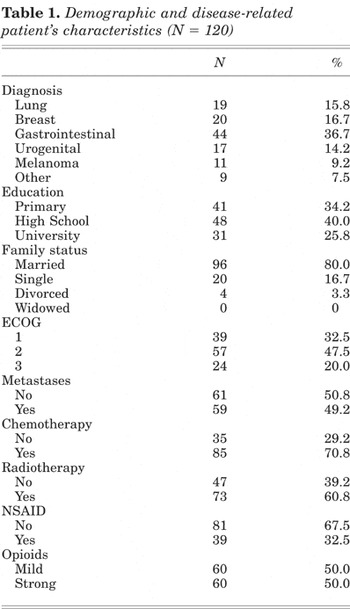
A representative sample of 148 patients was drawn; from them 28 patients (19%) did not complete the assessment forms, either due to refusal or due to the fact that they lived far away from Athens and thus were excluded from the study. The final sample consisted of 120 cancer patients. From the 120 participant cancer patients, 61 (50.8%) were male and 59 (49.2%) female. The average age was 61.4 years (range = 24–83). Information on the patients' demographic characteristics, performance status, as well as primary and secondary location is shown in Table 1.
Demographic and disease-related patient's characteristics (N = 120)

Procedures and Measurements
All patients were interviewed by one member of the palliative care unit to elicit background medical history including demographic data, prior mental health, and current condition. The evaluations were completed in a brief interview.
The clinician-rated instrument was the performance status measuring the patients' overall physical functioning as defined by the Eastern Cooperative Oncology Group (ECOG) (0 = optimum performance status, 4 = worse performance status) (Aaronson et al., 1993).
The patient self-report scales included the Schedule for Attitudes toward Hastened Death, assessing patients' desire for hastened death. This measure uses a true or false format and encompasses several potential aspects of desire for death including concerns about future quality of life, personal factors that may influence patient's desire for death, and direct thoughts on hastened death. All patients were asked to complete the SAHD at the unit (baseline evaluation) and then 7 days later (follow-up evaluation) to test the stability of the questionnaire. If necessary, brief instructions were given on how the questionnaire should be completed.
Concerning the cutoff score that has been used as in the previous validation studies (Rosenfeld et al., 1999; Rosenfeld, 2000), 7 or greater (more than one standard deviation above the mean) would be classified as having a high level of desire for death and a more conservative cutoff score, 11 or greater, as having a strong desire for death.
The next self-report scale used was the Hospital Anxiety and Depression Scale (HADS) (Zigmond & Snaith, 1983). The HADS is a mood scale specifically designed for use with medically ill patients. It is brief and limited to the two most common aspects of psychological disorders presenting in hospital practice: anxiety and depression. Assessment of the overall severity of anxiety and depression are rated on four-point (0–3) scales (Zigmond & Snaith, 1983). Mood state was divided into four ranges: normal, mild, moderate, and severe (Snaith, 2003). A review of the psychometric properties of the HADS (Herrmann, 1997) showed that the acceptability and the reliability of the questionnaire are good. Most studies have confirmed the bidimensional structure (Moorey et al., 1991; Herrmann, 1997; Spinhoven et al., 1997) and the discriminant validity of the HADS (Herrmann, 1997). In their original study, Zigmond and Snaith (1983) recommended two cutoff scores for both subscales: 7/8 for possible and 10/11 for probable anxiety or depression (with possible ranges of 0–21 for each subscale).
Another self-report assessment used was the Greek Brief Pain Inventory (G-BPI) (Mystakidou et al., 2001a) to establish the patients' level of pain at the last 24 h. Scoring is based on a 10-point scale. It consists of 4 pain intensity and 7 interference items. In this study, only 3 items were included: Item 3: “the worst pain felt” (0 = no pain, 10 = the worst pain), Item 9ii: “the interference of pain in the mood,” and Item 9vii: “in the enjoyment of life” (0 = It does not interfere, 10 = It interferes completely).
Finally, the EORTC Core Quality of Life Questionnaire (QLQ-C30, Version 3.0) (Aaronson et al., 1993; Mystakidou et al., 2001b) was administered. It is composed of eight multi-item scales and six single-item scales. From the overall 30 items, 2 were selected, measuring the global quality of life, Item 29: “health status during the last week” (on a 7-point scale 0 = worst, 7 = excellent) and Item 30: “quality of life during the last week” (on a 7-point scale 0 = worst, 7 = excellent).
The HADS Scale, as well as the G-BPI and the EORTC QLQ-C30 questionnaire, were administered to 60 randomly selected patients from the overall sample (N = 120).
The study was performed in accordance with the Helsinki Declaration and according to European guidelines for good clinical practice.
Translation
Two independent translators translated the SAHD into the Greek language and then another two independent translators translated it back to English. Finally, a crossing over of these translations was conducted.
Statistical Analysis
Frequency analyses and descriptive statistics were used to assess the frequency of endorsement of the individual items on the G-SAHD and the distribution of total scores. To assess the Reliability of the G-SAHD, internal consistency (Cronbach's alpha coefficients) was calculated (Cronbach, 1951; Nunnally & Bernstein, 1994). Test/retest was conducted using four different approaches (Pearson's r value, Kendall's tau-b, Cohen kappa, and paired samples test). Spearman correlation coefficients and Kruskal–Wallis tests were used to quantify the degree of association between the total scores of the G-SAHD and the other measures used to establish concurrent validity (HADS, BPI, EORTC).
No cases were omitted from the analysis due to missing data. The statistical software SPSS for Windows (version 10.0) was used in the statistical analysis.
RESULTS
Reliability
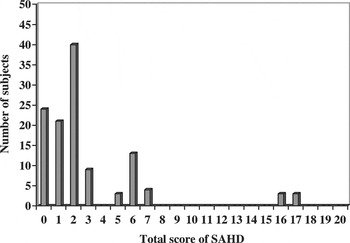
The total scores on the 20-item Schedule of Attitudes toward Hastened Death ranged from 0 to 20 with a mean of 2.90 (SD = 3.70) and a median of 2 (maximum possible range = 0–20; 0 = least desire for death). The distribution of scores was positively skewed, with few individuals endorsing large numbers of items and the majority of patients (70%) endorsing zero, one, or two items (Fig. 1). In this sample, 8.3% of the patients corresponded to a high level of desire for death, whereas 5% of patients corresponded to a strong desire for death. Seventy-eight percent of the participants had a total score of 3 or less. Only 1 of the 20 SAHD items was endorsed by >50% of the sample, 3 items were endorsed by ≥25%, and only 6 items were endorsed by ≤5%.

Distribution of scores on the 20-item SAHD for 120 patients.
The most frequently endorsed items were Item 2: “I expect to suffer a great deal from emotional problems in the future because of my illness,” which was endorsed as true by 54 patients (45%); Item 17: “I expect to suffer a great deal from physical problems in the future because of my illness,” which was endorsed as true by 70 patients (58.3%), and Item 13: “Because my illness cannot be cured, I would prefer to die sooner, rather than later,” which was endorsed as true by 29 patients (24.2%).
The infrequently endorsed items included Item 3: “My illness has drained me so much that I do not want to go on living” and Item 5: “Unless my illness improves, I will consider taking steps to end my life,” each of which was endorsed as true by only 6 patients (5%); Item 7: “Despite my illness, my life still has purpose and meaning,” endorsed as false by only 6 patients (5%); Item 8: “I am careless about my treatment because I want to let the disease run its course,” and item 11: “I have stopped treatment for my illness because I would prefer to let the disease run its course,” each of which was endorsed as true by only 4 patients (3.3%); and Item 4: “I am seriously considering asking my doctor for help in ending my life,” which was endorsed as true by only 3 patients (2.5%). Finally, Item 18: “I plan to end my own life when my illness becomes too much to bear,” was endorsed as true by only 9 patients (7.5%).
The overall internal consistency of the G-SAHD was high; the coefficient alpha was 0.89. Item-total correlation was acceptable, ranging from 0.25 to 0.83. The median item correlation was 0.61. Only two items had item-total correlations <0.30; 13 items had item-total correlations >0.50.
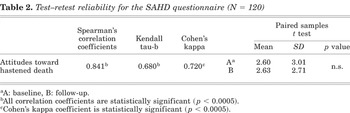
To measure test/retest reliability, SAHD responses were compared at baseline and follow-up administration (7 days later). SAHD scores were remarkably consistent between the two occasions and were highly correlated (r = 0.84, p < 0.0005, Kendall Tau-b = 0.68, p < 0.0005, Cohen's kappa coefficient = 0.72, p < 0.0005). Moreover, the paired samples t test between baseline and follow-up administration indicated no statistically significant differences (Table 2).
Test–retest reliability for the SAHD questionnaire (N = 120)

Validity
Demographic characteristics were analyzed to determine whether they were associated with the total scores on the SAHD. There were no differences in SAHD scores with regard to gender (Kruskal-Wallis χ2 = 1.89, df = 1, p = n.s.), age (Kruskal-Wallis χ2 = 2.31, df = 1, p = n.s.), educational level (Kruskal-Wallis χ2 = 1.19, df = 3, p = n.s.), or family status (Kruskal-Wallis χ2 = 0.824, df = 2, p = n.s).
Concurrent Validity
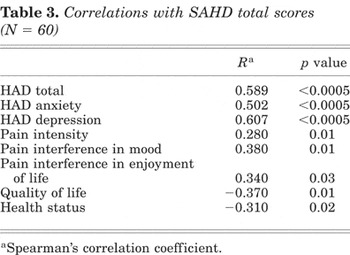
Concurrent validity was assessed by correlating SAHD total scores with HADS, G-BPI, and EORTC items. These correlations are reported in Table 3. The SAHD total scores were highly correlated with scores on the HADS (r = 0.59, N = 60, p < 0.0005). Somewhat lower but substantial correlations between SAHD scores and the HADS Anxiety subscale were found (r = 0.50, N = 60, p < 0.0005). On the other hand, the correlation between total scores on SAHD and the HADS Depression subscale was even higher (r = 0.61, N = 60, p < 0.0005).
Correlations with SAHD total scores (N = 60)

The three items from the Brief Pain Inventory were also examined in conjunction with the SAHD. Although “pain intensity” (Item 3) was correlated moderately with SAHD scores (r = 0.28, N = 60, p = 0.01), “pain interference in mood” (Item 9ii) and “in enjoyment of life” (Item 9iv) were more highly correlated with SAHD scores (r = 0.38, N = 60, p = 0.01 and r = 0.34, p = 0.03, respectively). The items “overall quality of life” and “health status” from EORTC QLQ-C30 were also significantly correlated with SAHD Scores (r = −0.38, N = 60, p < 0.01 and r = −0.36, N = 60, p < 0.01, respectively).
Known-Groups Validity
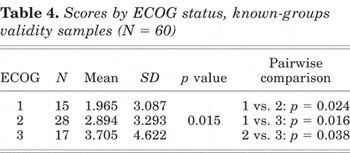
The SAHD scale was examined in terms of the items' ability to distinguish between subgroups of patients formed on the basis of their disease severity. Clinical status (i.e., disease severity) was measured by ECOG performance status. Patients with an ECOG score 1 were categorized with a “good” performance status (n = 15 patients; 24.2%), patients with an ECOG score 2 were categorized with a “moderate” performance status (n = 28 patients; 47.5%), and patients with an ECOG score 3 were categorized with a “poor” performance status (n = 17 patients, 28.3%). The SAHD items discriminated well between subgroups of patients, indicating that scores were significantly higher in patients with poor performance status compared to patients with a moderate to good performance status (p = 0.015; Table 4).
Scores by ECOG status, known-groups validity samples (N = 60)

Exploratory Factor Analysis
Exploratory factor analysis (principal component analyses) was carried out to explore the validity of the SAHD using data from all subjects at baseline. Similar to earlier validation studies (Rosenfeld et al., 1999; Rosenfeld, 2000), this sample resulted in a single factor model. Examination of the eigenvalues and scree test based on principal components factor analysis indicated that more representative for this sample is one factor explaining 42% of the total variance. Analysis of the factor loadings from various alternative solutions (using a varimax rotation for possible two or six factors solutions) indicated that a unidimensional model best accounted for the variance in scores.
DISCUSSION
One of the most controversial issues in treatment of terminally ill patients concerns assertions of a desire for a hastened death (Rosenfeld, 2000; Pessin et al., 2002). The present study involved the translation and validation of the SAHD in a population of Greek cancer patients receiving palliative care. The Greek version of the SAHD proved to be culturally acceptable. The validity and reliability in the Greek sample were similar to those obtained to other languages (Rosenfeld et al., 1999, 2000; Breitbart et al., 2000). The results of the factor analyses confirm the unidimensional model of the SAHD, as a single factor was found the most representative for the data.
It is interesting that in this Greek sample, only 8.3% of the terminally ill cancer patients would be classified as having a high level of desire for death and only 5% as having a strong desire for death probably due to adequate palliative treatment. This is somewhat lower than the rates found in U.S. studies of desire for death using the SAHD (Rosenfeld et al., 2000). The most frequently endorsed question in this study was “I expect to suffer a great deal from physical problems in the future because of my illness,” similar to Rosenfeld's study of terminally ill cancer patients in the United States (Rosenfeld et al., 2000). The least frequently endorsed items were also similar across these two studies (“I am seriously considering asking my doctor for help in ending my life,” “Unless my illness improves, I will consider taking steps to end my life,” “I am careless about my treatment because I want to let the disease run its course,” “I plan to end my own life when my illness becomes too much to bear”).
Near the end of life, some psychiatric problems including depression, anxiety, and delirium can emerge (Pessin et al., 2002). We found a high correlation between the HADS depression subscale and SAHD scores (r = 0.61), supporting the belief that depressed patients are more likely to request euthanasia or PAS (Emanuel et al., 1996; Henderson & Ord, 1997). Somewhat lower but still high correlations were found with the HADS anxiety subscale (r = 0.50). It seems that anxiety is relatively common in terminally ill patients as it may reduce a patient' tolerance for physical distress, especially persistent and uncontrolled pain (Emanuel et al., 1996; Rosenfeld et al., 2000; Kahn et al., 2003).
Correlations were much lower, but still significant between the SAHD and measures of pain intensity (r = 0.28), pain interference in mood (r = 0.38), and pain interference in enjoyment of life (r = 0.34). These findings supported the hypothesis that intractable or persistent pain can result in a heightened desire for death (Derogatis et al., 1983; Breitbart, 1993; Rosenfeld et al., 1999).
Results have also shown negative moderate correlations but statistically significant with overall quality of life (r = −0.38) and with health status (r = −0.36). The participant patients were receiving palliative treatment, so the findings might be consequential with the treatment they are receiving (Mystakidou et al., 2004). Despite of the fact that some epidemiological surveys have found that males and older people are at higher risk of suicide (Fox et al., 1982; Allebeck et al., 1989; Conwell et al., 1990; Levi et al., 1991; Filiberti et al., 1998), in this study there was no correlation between SAHD scores with age, gender, education, or family status.
The SAHD is the first assessment tool for the evaluation of the desire of hastened death in Greek terminally ill cancer patients. The Greek version of SAHD appears to have psychometric properties similar to the original version of the questionnaire (Ganzini & Block, 2002). A strength of this study is that no cases were omitted from the analysis due to missing data and there was a high degree of compliance. Moreover, SAHD could be a useful and valid instrument for measuring desire for hastened death in terminally ill patients in order to develop interventions that aim to support cancer patients, diminish this desire, and improve their quality of life. A suggestion for future research would be a further analysis between SAHD and the other measurements used (HAD, BPI, etc.) to assess any reactions between desire for death, depression, pain, and quality of life.
References
REFERENCES
Aaronson, N.K.,
Ahmedzai, S.,
Bergman, B.,
et al.
(1993).
The European Organization for Research and Treatment of Cancer
QLQ-C30; A quality-of-life instrument for use in international clinical
trials in oncology.
Journal of the National Cancer Institute,
85,
365–376.Google Scholar
Allebeck, P.,
Bolund, C., &
Ringback, G.
(1989).
Increased suicide rate in cancer patients. A cohort study based on
the Swedish Cancer-Environment Register.
Journal of Clinical Epidemiology,
42,
611–616.Google Scholar
Back, A.L.,
Wallace, J.I.,
Starks, H.E.,
et al.
(1996).
Physician-assisted suicide and euthanasia in Washington
State.
Journal of the American Medical Association,
275,
919–925.Google Scholar
Bolund, C.
(1985).
Suicide and cancer: II. Medical and care factors in suicide by
cancer patients in Sweden, 1973–1976.
Journal of Psychosocial Oncology,
3,
17–30.Google Scholar
Breitbart, W.
(1993).
Suicide risk and pain in cancer and AIDS patients. In
Current and emerging issues in cancer pain: Research and
practice,
Chapman, C.R. &
Foley, K.M. (eds.), pp.
1–17, 49–65.
New York:
Raven Press.
Breitbart, W.,
Bruera, E.,
Chochinov, H.,
et al.
(1995).
Neuropsychiatric syndromes and psychiatric symptoms in patients with
advanced cancer.
Journal of Pain and Symptom Management,
10,
131–141.Google Scholar
Breitbart, W.,
Rosenfeld, B.,
Pessin, H.,
et al.
(2000).
Depression, hopelessness, and desire for hastened death in
terminally ill patients with cancer.
Journal of the American Medical Association,
284,
2907–2911.Google Scholar
Brown, J.H.,
Henteleff, P.,
Barakat, S.,
et al.
(1986).
Is it normal for terminally ill patients to desire death?
American Journal of Psychiatry,
143,
208–211.Google Scholar
Chochinov, H.M.,
Wilson, K.G.,
Enns, M.,
et al.
(1995a).
Prevalence of depression in the terminally ill: Effects of
diagnostic criteria and symptom threshold judgments.
American Journal of Psychiatry,
151,
537–540.Google Scholar
Chochinov, H.M.,
Wilson, K.G.,
Enns, M.,
et al.
(1995b).
Desire for death in the terminally ill.
American Journal of Psychiatry,
152,
1185–1191.Google Scholar
Conwell, Y.,
Caine, E.D., &
Olsen, K.
(1990).
Suicide and cancer in late life.
Hospital and Community Psychiatry,
41,
1334–1339.Google Scholar
Crocetti, E.,
Arniani, S.,
Accia, S.,
et al.
(1998).
High suicide mortality soon after diagnosis among cancer patients in
central Italy.
British Journal of Cancer,
77,
1194–1196.Google Scholar
Cronbach, L.J.
(1951).
Coefficient alpha and the internal structure of test.
Psychometrica,
16,
297–334.Google Scholar
Derogatis, L.R.,
Marrow, G.R.,
Fetting, J.,
et al.
(1983).
The prevalence of psychiatric disorders among cancer
patients.
Journal of the American Journal Association,
249,
751–757.Google Scholar
Emanuel, J.E.
(2002).
Euthanasia and physician-assisted suicide: A review of the empirical
data from the United States.
Archives of Internal Medicine,
162,
142–152.Google Scholar
Emanuel, J.E.,
Fairclough, L.D.,
Daniels, E.R.,
et al.
(1996).
Euthanasia and physician-assisted suicide: Attitudes and experiences
of oncology patients. Oncologists, and the public.
Lancet,
347,
1805–1810.Google Scholar
Farberow, L.,
Ganzler, S.,
Cutter, F.,
et al.
(1971).
An eight years survey of hospital suicides.
Suicide and Life Threatening Behavior,
1,
184–201.Google Scholar
Filiberti, A.,
Audisio, R.A., &
Kaasa, S.
(1998).
Psychosocial issues in old cancer patients.
Critical Reviews in Oncology and Hematology,
27,
132–133.Google Scholar
Foley, K.
(1995).
Pain, physician assisted suicide, and euthanasia.
Pain Forum,
4,
163–178.Google Scholar
Fox, B.H.,
Stanek, E.J.,
Boyd, S.C.,
et al.
(1982).
Suicide rates among cancer patients in Connecticut.
Journal of Chronic Disease,
35,
85–100.Google Scholar
Ganzini, L. &
Block, S.
(2002).
Physician assisted death: A last resort?
New England Journal of Medicine,
346,
1663–1665.Google Scholar
Ganzini, L.,
Johnston, W.S.,
McFarland, B.H.,
et al.
(1998).
Attitudes of patients with Amyotrophic Lateral Sclerosis and their
care givers toward assisted suicide.
New England Journal of Medicine,
339,
967–973.Google Scholar
Henderson, J.M. &
Ord, R.A.
(1997).
Suicide and neck cancer patients.
Journal of Oral Maxillofacial Surgery,
55,
1217–1221.Google Scholar
Herrmann, C.
(1997).
International experiences with the Hospital Anxiety and Depression
Scale. A review of validation data and clinical results.
Journal of Psychosomatic Research,
42,
17–41.Google Scholar
Kahn, J.M.,
Lazarus, J.C., &
Owens, P.D.
(2003).
Allowing patients to die: Practical, ethical and religious
concerns.
Journal of Clinical Oncology,
21,
3000–3002.Google Scholar
Levi, F.,
Bulliard, J., &
La Vecchia, C.
(1991).
Suicide risk among incident cases of cancer in the Swiss Canton of
Vaud.
Oncology,
48,
44–47.Google Scholar
Lloyd-Williams, M.
(2002).
How common are thoughts of self-harm in a UK palliative care
population?
Supportive Care in Cancer,
10,
422–424.Google Scholar
Louhivouori, K.A. &
Hakama, J.
(1979).
Risk of suicide among cancer patients.
American Journal of Epidemiology,
109,
59–65.Google Scholar
Meier, D.E.,
Emmons, C.,
Wallenstein, S.,
et al.
(1998).
A national survey of physician-assisted suicide and euthanasia in
the United States.
New England Journal of Medicine,
338,
1193–1201.Google Scholar
Moorey, S.,
Greer, S.,
Watson, M.,
et al.
(1991).
The factor structure and factor stability of the Hospital Anxiety
and Depression Scale in patients with cancer.
British Journal of Psychiatry,
158,
255–259.Google Scholar
Mystakidou, K.,
Mendoza, T.,
Tsilika, E.,
et al.
(2001a).
Greek Brief Pain Inventory: Validation and utility in cancer
pain.
Oncology,
60,
35–42.Google Scholar
Mystakidou, K.,
Tsilika, E.,
Parpa, E.,
et al.
(2001b).
The EORTC Core Quality of Life Questionnaire (QLQ-C30-c30, Version
3.0) in terminally ill cancer patients under palliative care: Validity and
reliability in a Hellenic sample.
International Journal of Cancer,
94,
135–139.Google Scholar
Mystakidou, K.,
Tsilika, E.,
Kouloulias, V.,
et al.
(2004).
The “Palliative Care Quality of Life Instrument (PQLI)”
in terminal cancer patients.
Health & Quality of Life Outcomes,
2,
8.Google Scholar
Nunnally, J. &
Bernstein, I.
(1994).
Psychometric Theory.
New York:
McGraw-Hill.
Olafsen, O.M.
(1981).
Suicide among cancer patients in Norway. In
Depression et Suicide. Aspects Medicaux Psychologiques et
Socio-Culturels,
Soubrier, J.P. &
Vedrinne, J. (eds.), pp.
587–591.
Oxford, UK:
Pergamon Press.
Owen, C.,
Tennant, C.,
Levi, J.,
et al.
(1992).
Suicide and euthanasia: Patient attitudes in the context of
cancer.
Psychooncology,
1,
79–88.Google Scholar
Pessin, H.,
Rosenfeld, B., &
Breitbart, W.
(2002).
Assessing psychological distress near the end of life.
American Behavioral Science,
46,
357–372.Google Scholar
Rosenfeld, B.
(2000).
Assisted suicide, depression and the right to die.
Psychology, Public Policy and Law,
6,
467–488.Google Scholar
Rosenfeld, B.,
Breitbart, W.,
Galietta, M.,
et al.
(2000).
The schedule of attitudes toward hastened death.
Cancer,
88,
2868–2875.Google Scholar
Rosenfeld, B.,
Breitbart, W.,
Stein, K.,
et al.
(1999).
Measuring desire for death among patients with HIV/AIDS: The
schedule of attitudes toward hastened death.
American Journal of Psychiatry,
156,
94–99.Google Scholar
Seale, C. &
Addington-Hall, J.
(1994).
Euthanasia: Why people want to die earlier.
Social Science of Medicine,
39,
647–654.Google Scholar
Snaith, R.P.
(2003).
The Hospital Anxiety and Depression Scale.
Health and Quality of Life Outcomes,
1,
29.Google Scholar
Spinhoven, P.H.,
Ormel, J.,
Sloekers, P.P.A.,
et al.
(1997).
A validation study of the Hospital Anxiety and Depression Scale
(HAD) in different groups of Dutch subjects.
Psychological Medicine,
27,
363–370.Google Scholar
Suarez-Almazor, M.E.,
Newman, C.,
Hanson, J.,
et al.
(2002).
Attitudes of terminally ill cancer patients about euthanasia and
assisted suicide: Predominance of psychosocial determinants and beliefs
over symptom distress and subsequent survival.
Journal of Clinical Oncology,
20,
2134–2141.Google Scholar
Van Houdenhove, B. &
Onghena, P.
(1997).
Pain and depression. In
Depression and Physical Illness,
Robertson, M.M. &
Katona, C.L.E. (eds.), pp.
465–497.
Chichester, UK:
Wiley & Sons Ltd.
Weisman, A.
(1976).
Coping with behavior and suicide in cancer. In
Cancer: The Behavioral Dimension,
Cullen, G.,
Fox, B. &
Ison, R. (eds.), pp.
321–341.
New York:
Raven Press.
Wolfe, J.,
Fairclough, D.L.,
Clarridge, B.,
et al.
(1999).
Stability of attitudes regarding physician-assisted suicide and
euthanasia among oncology patients, physicians, and the general
public.
Journal of Clinical Oncology,
17,
1274–1279.Google Scholar
Zigmond, A.S. &
Snaith, R.P.
(1983).
The Hospital Anxiety and Depression Scale.
Acta Psychiatrica Scandinavica,
67,
361–370.Google Scholar
Demographic and disease-related patient's characteristics (N = 120)
Distribution of scores on the 20-item SAHD for 120 patients.
Test–retest reliability for the SAHD questionnaire (N = 120)
Correlations with SAHD total scores (N = 60)
Scores by ECOG status, known-groups validity samples (N = 60)
 You have
Access
- 28
- Cited by