Introduction
The upper oesophageal sphincter is the area of the upper digestive tract that forms a barrier between the oesophagus and the pharynx, which recurrently opens and closes during various physiological events.Reference Logemann1 The upper oesophageal sphincter is composed of three muscles: the inferior pharyngeal constrictor (or thyropharyngeus), the cricopharyngeus and the cervical oesophagus. The thyropharyngeus originates from the oblique laminar line of the thyroid cartilage. From these origins, the fibres spread backwards and medially to be inserted, with the muscle of the opposite side, into the fibrous pharyngeal raphe in the posterior median line of the pharynx. The cricopharyngeus muscle attaches to the dorsolateral aspect of the lower part of the cricoid cartilage, forming a horizontal muscular band like a ‘sling’. All three muscles contract to maintain tone in the upper oesophageal sphincter, but only the cricopharyngeus, the primary muscle of the upper oesophageal sphincter, relaxes in response to physiological stimuli.
Cricopharyngeus muscle action is semiautomatic and involuntary, despite its striated nature. The cricopharyngeus sphincter muscle is normally in a state of tonic contraction at rest, and relaxes during swallowing, belching and vomiting. If the cricopharyngeus fails to relax or is not co-ordinated with the pharyngeal contraction wave, dysphagia is experienced.Reference Logemann1 Since the 1950s, cricopharyngeal myotomy has been the treatment of choice for cervical dysphagia, and its effectiveness is well established.Reference Cook and Kahrilas2 Recently, many authors have reported treating dysphagia with botulinum injections into the cricopharyngeus muscle.Reference Restivo, Palmeri and Marchese-Ragona3
Though the function and anatomy of the upper oesophageal sphincter are well known today, there is some uncertainty surrounding the history of its identification. Vesalius (1514–1564), and the first three anatomists of the famous ‘Vesalian School of Padua’, Realdus Columbus (circa 1516–1559), Gabriel Fallopius (1523–1562) and Hieronymus Fabricius ab Aquapendente (1533–1619), left no description or drawing of the cricopharyngeus muscle.
Julius Casserius
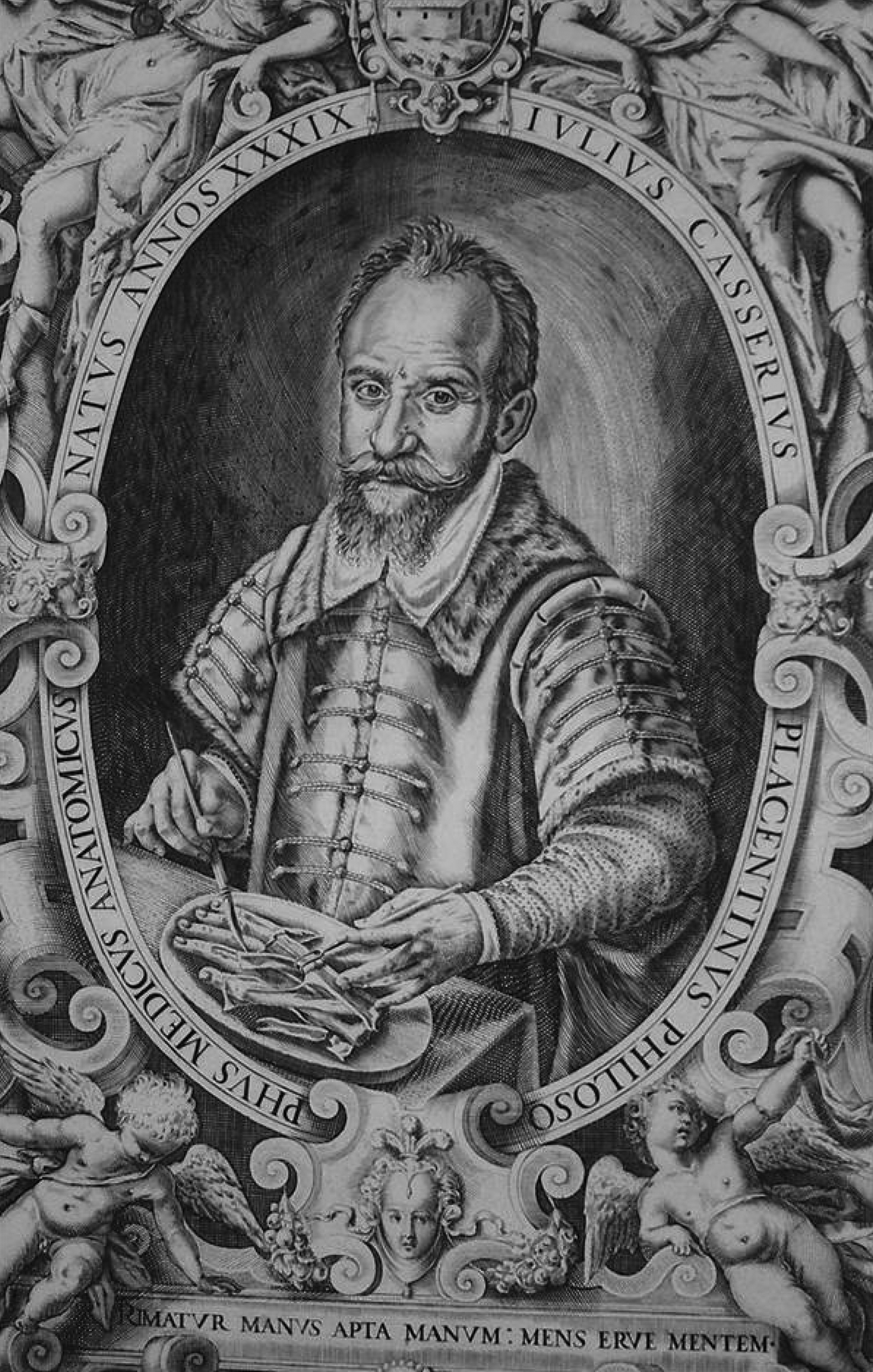
Julius Casserius (who was born in Piacenza in 1552 and died in Padua in 1616) was a professor of anatomy, physiology and surgery at Padua University. Casserius’ family was very poor and the young Julius assumed the job of servant in the house of the famed anatomist Hieronymus Fabricius ab Aquapendente. From being a servant, he first became Fabricius' auditor and then his brilliant disciple. Early on, after completing his degree in medicine and philosophy, Casserius gave private lessons, with dissections, in Padua, and became lecturer of surgery and later of anatomy (Figure 1). Casserius was so successful as an anatomist that he aroused envy and hostility in his old teacher Fabricius.Reference Guerrier and Mounier-Kuhn4–Reference Riva, Orrù, Pirino and Riva6
Portrait of Casserius with the famous sentence ‘Rimatur manus apta manum: mens erue mentem’, which translates as ‘the skilful hand dissects the hand: mind, do disclose the mind’.5

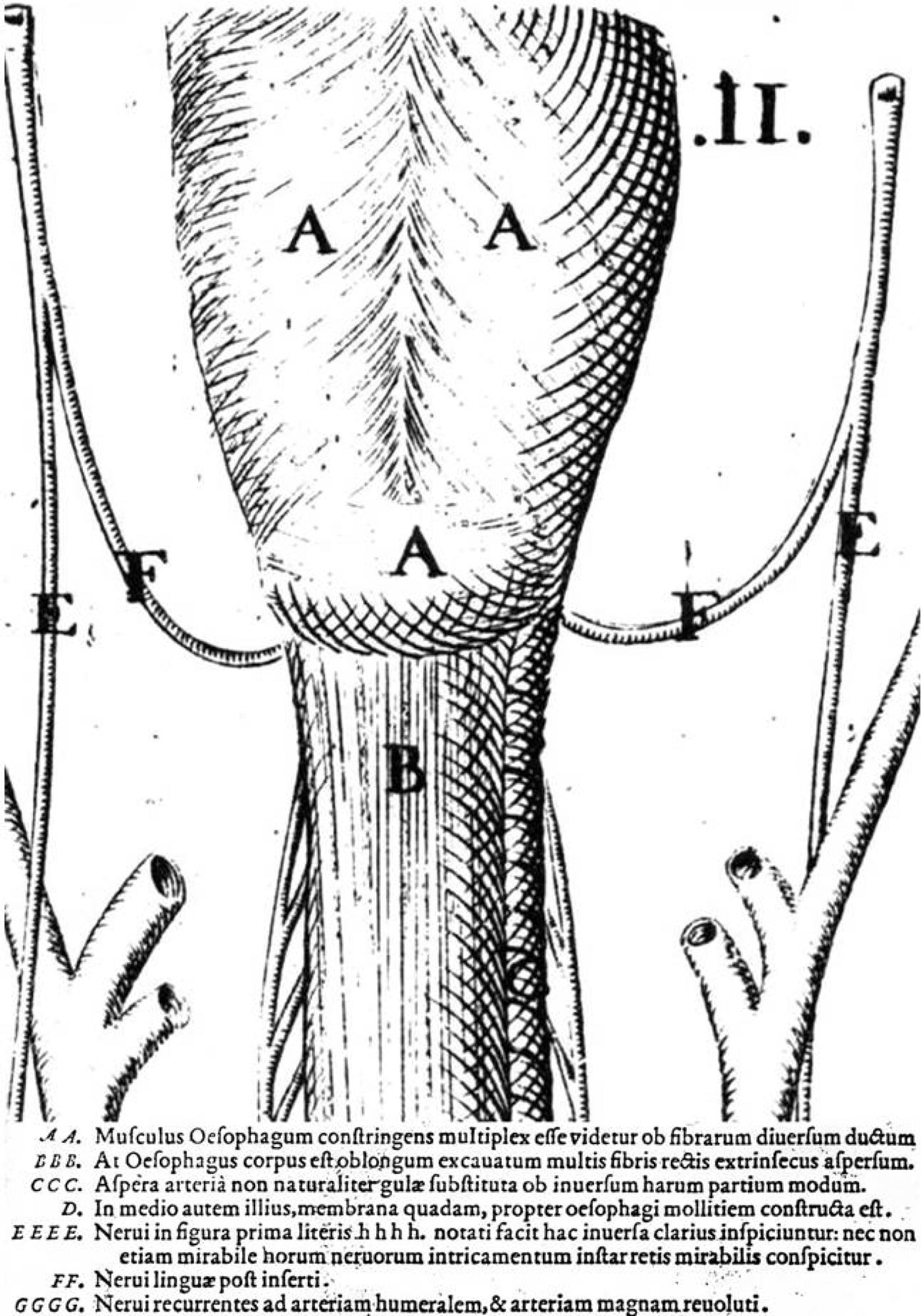
In 1601, Casserius published his treatise De vocis auditusque organis historia anatomica… (which translates as ‘An Anatomical History on the Organs of Voice and Hearing …’), a beautifully illustrated book on the vocal organs and organs of hearing in humans and animals.Reference Guerrier and Mounier-Kuhn4, Reference Casserius5 Casserius identified the cricopharyngeal muscle, and drew it with fibres arranged in a horizontal fashion, but considered it inseparable from the pharyngeal muscles; the cricopharyngeus muscle was then considered a part of the ‘multiple oesophageal constrictor muscle’ (‘musculus oesophagum constringens multiplex’; Figure 2).5 Casserius affirmed that ‘the muscle originates on both sides of the full length of the thyroid cartilage, which is composed of transverse fibres forming a semicircle, whereby it serves the swallowing of food and drink by a sort of involuntary movement’ (Chapter IV).Reference Hast and Holtsmark7
Anatomical illustration of the pharyngo-oesophageal region (with legends), from Casserius’ De vocis auditusque organis ….5
Subsequent anatomists
After Casserius, the French anatomist Jean Riolan (1577–1657), Adriaan van de Spiegel (1578–1625) (professor of anatomy at Padua after Casserius' death) and William Cowper (1666–1709) (a British surgeon and anatomist) described the pharyngeal muscles, but did not identify the cricopharyngeal muscle.Reference Riolan8–Reference Morgagni11
Antonio Maria Valsalva
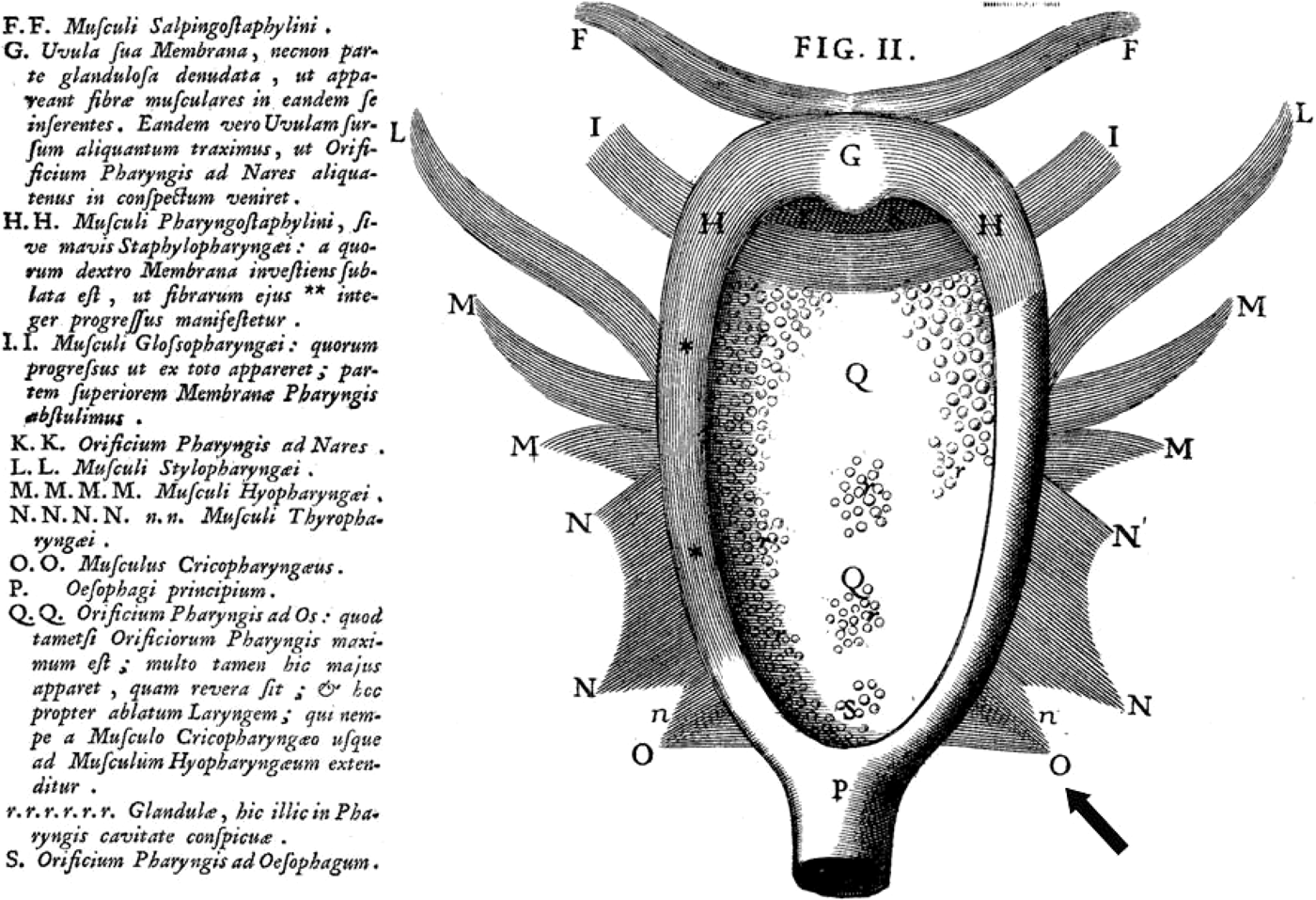
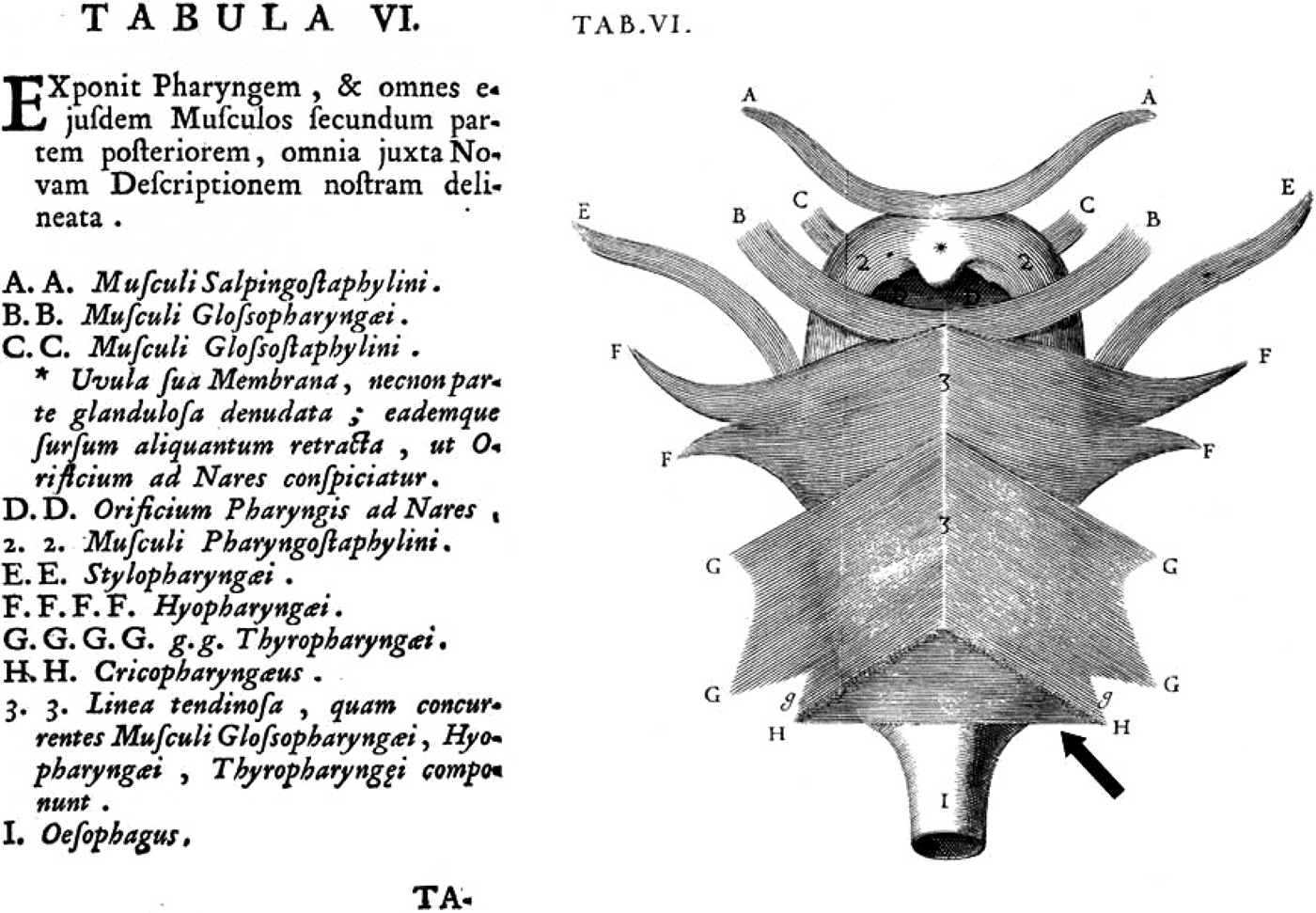
One century after Casserius, Antonio Maria Valsalva, a seventeenth century anatomist, described the details of the cricopharyngeus in his De aure humana tractatus… (which translates as ‘Treatise on the Human Ear …’) (Figures 3 and 4).Reference Guerrier and Mounier-Kuhn4, Reference Valsalva12 Valsalva was the first to describe the cricopharyngeus muscle as a discrete muscle separated by the pharyngeal constrictors and lacking a posterior median raphe (Figure 3).Reference Morgagni11–Reference Marchese-Ragona, Restivo, Marioni and Staffieri13 (Casserius certainly had already drawn the muscle similarly.) Valsalva described the pharyngeal muscles in this manner: ‘I named the fifth pair of pharyngeal muscles as the “thyro-pharyngeus”, which forms two acute continuations from both sides of the full length of the thyroid cartilage (though some of the fibres originate from the anterolateral sides of the cricoid cartilage) and its fibres rise slantwise to arrive in the posterior part of the pharynx, at the tendinous median raphe. From this description, it is evident that these fibres constitute not one, but two muscles. I call the latter the “cricopharyngeus”. It is situated at the beginning of the oesophagus, and is like a sphincter because its muscular fibres run obliquely and embrace the oesophageal inlet’ (Caput II: XX). Reference Valsalva12 As well as describing the anatomy, Antonio Valsalva also provided a very good description of the physiological properties of the cricopharyngeal muscle.
Anatomical illustration of the frontal view of the pharyngeal muscle and cricopharyngeal muscle (black arrow) (with legends), from Valsalva's De aure humana tractatus ….12
Anatomical illustration of the back view of the pharyngeal muscle and cricopharyngeal muscle (black arrow) (with legends), from Valsalva's De aure humana tractatus ….12
Antonio Maria Valsalva, the son of a wealthy jeweller, was born in Imola (near Bologna) in Italy, on 17th January 1666. He studied medicine and philosophy at Bologna University, and was a pupil of Marcello Malpighi, an eminent scientist and the founder of comparative physiology.Reference Bilancioni14–Reference Gaddoni and Galeati17 In 1687, not yet 22 years old, Valsalva graduated with full marks to become a doctor of medicine and philosophy with a thesis on the superiority of the experimental sciences. He became a member of a society called the ‘Academia Inquietorum’ (Academy of the Restless), a title indicating that the members were dissatisfied with previous knowledge, and wanting to study science for themselves by direct observation and experimentation.Reference Bilancioni14–Reference Gaddoni and Galeati17 In 1697, Valsalva succeeded Marcello Malpighi in the chair of anatomy at the University of Bologna; in 1705, he became a public professor on the subject. For 25 years, he was also the head of the ‘Hospital for the Incurable’ in Bologna (known today as the ‘S. Orsola’ Hospital).Reference Bilancioni14–Reference Medici18
Valsalva was an extremely skilled anatomist and pathologist, a fine physician, and an excellent surgeon for a quarter of a century. Although he was a surgeon and practitioner, he nonetheless remained essentially an anatomist.Reference Bilancioni14–Reference Medici18 Valsalva was the first anatomist to divide the ear into three compartments (outer, middle and inner) and to apply the term ‘labyrinth’ to the entire inner ear, which he realised was filled with fluid. He described and named the eustachian tube, and suggested the terms ‘scala vestibuli’ and ‘scala tympani’ for specific regions in the inner ear. He was the first to discover ankylosis of the stapes during a post-mortem examination.Reference Bilancioni14 Valsalva also experimented on the origins of hemiplegia, noting that motor paralysis was on the side opposite the cerebral lesion both in cases of stroke and of cranial injury.
In 1704, Valsalva published his treatise on the human ear (De aure humana tractatus…), edited in Bologna.Reference Valsalva12 In 1721, during a consultation with Morgagni in Venice, he suffered temporary dysarthria, a symptom of the fatal apoplexy that struck him two years later. On 2nd February 1723, Antonio Maria Valsalva suffered a brainstem stroke. He was not able to receive Holy Communion because of a severe swallowing disorder, and he died later on the same day.Reference Bilancioni14, Reference Busacchi16
Today, Valsalva's name is still coupled to two eponyms: Valsalva's sinuses and Valsalva's manoeuvre. Valsalva's sinuses are three dilatations in the root of the aorta, opposite the valve cusps. Valsalva's manoeuvre or experiment is used to test the patency of the eustachian tube; specifically, forcible exhalation against a closed glottis produces increased intrathoracic pressure and slows the pulse.Reference Bilancioni14–Reference Busacchi16
Bartholomeo Eustachi
An accurate description of the pharyngeal muscles appeared in a book by the anatomist Bartholomeo Eustachi (1500–1574). In 1552, Eustachi completed a series of 47 anatomical copperplates. These were never published in his lifetime, perhaps because of the success of Vesalius’ Fabrica (1543) or a fear of ex-communication by the Catholic Church. Only the first eight plates were issued by Eustachi as illustrations, in his Opuscula Anatomica (1564). The remaining 39 plates were lost for over a century after his death. The anatomist Giovanni Maria Lancisi discovered them, and published them in 1714 under the title Tabulae anatomicae Bartholomei Eustachi quas a tenebris tandem vindicatas (which translates as ‘Anatomical Illustrations of Bartholomeo Eustachi Rescued from Obscurity’).Reference Lancisius19
The anatomical illustrations by Eustachi are more accurate than the work of Vesalius, and most historians agree that if this work had been published during Eustachi's lifetime, he would now rank with Vesalius as a founder of modern anatomical studies.