Introduction
Sulphur mustard (HD), synthesized in 1822 by Despretz, is a lipophilic caustic alkylating vesicant (blister agent) that interferes with DNA integrity, cell-repair mechanisms, and replication.Reference Amirzargar, Yavangi, Rahnavardi, Jafari and Mohseni1-5 As such, it has mutagenic and carcinogenic effects.Reference Safarinejad3,Reference Ghanei, Rajaee, Khateri, Alaeddini and Haines6 It is a colorless, oily, and odorless liquid, hardly soluble in water but easily dissolved in oils and alcohol.Reference Iyriboz2 It was first used in World War I as an offensive weapon by the Germans during an attack against the British at Ypres, Belgium in July 1917.Reference Dacre and Goldman7 Since then, mustards have been used in several other conflicts despite the Geneva accords.
Although more toxic and effective chemical warfare agents are available, HD remains useful because it is highly toxic, difficult to treat, versatile, persistent, cheap, easy to produce industrially, and difficult to protect against. Moreover, HD is toxic when deployed as liquid, droplets, vapor, or as an aerosolized cloud.Reference Dacre and Goldman7
It causes severe, delayed burns to the eyes, skin, and respiratory tract. It damages cells within minutes of contact, however, the onset of pain and other health effects is delayed until hours after exposure.8 Large exposures may cause respiratory distress, convulsions, and death.Reference Dacre and Goldman7,8 Its DNA cross-linking causes hematologic cell toxicity.8 Finally, HD causes cholinergic toxicity, marked by excessive saliva, tears, and urine; gastrointestinal (GI) distress; and miosis.Reference Dacre and Goldman7,8 Apart from its acute effects, HD induces a wide-range of long-term pathological effects on the skin, eyes, respiratory tract, immune system, and in some cases on the GI, cardiovascular, nervous, and genitourinary (GU) systems.Reference Panahi, Ghanei and Ghabili9 Among the GU effects are sexual dysfunction, infertility, pregnancy complication, spontaneous abortion, or congenital malformation.Reference Dacre and Goldman7 While short-term GU effects have been described, the long-term GU sequelae of HD exposure remain unclear.
Approximately 50,000 Iranian soldiers and civilians were exposed to HD during the Iraq-Iran war (1980-1988).Reference Amirzargar, Yavangi, Rahnavardi, Jafari and Mohseni1,Reference Malekyari, Karimian, Farahbakh and Esmaeili10 This project aimed to address the following research question: Among the wives of Iranian veterans of the Iraq-Iran war that served and reside in Ahvaz (Population), does male HD-exposure (Intervention) compared to no exposure (Comparison) increase rates of pregnancy complications, adverse pregnancy outcome, or secondary infertility (Outcomes)?
Methods
Study Design and Setting
A retrospective, survey-based cohort study was conducted. All study parts were reviewed according to the Strengthening the Reporting of Observational Studies in Epidemiology (STROBE) Statement. Reference von Elm, Altman and Egger11 The study was approved by the Investigative Review Board at the Foundation of Martyrs and Veterans Affairs (FMVA; Iran; #IR.ISAAR.REC.1397.005). Patients were identified from the FMVA database of injured veterans through a systematic random sampling using a random number table. Study participation was optional. Written consent was required and included both study participation and publication of de-identified aggregate results. Surveys were conducted in person. No incentives were offered (eg, monetary, prizes, or non-monetary incentives) for study participation. Survey items were not randomized. Only completed surveys were analyzed. The datasets used and/or analyzed during the current study are available from the corresponding author on reasonable request.
Location
Ahvaz (population 1,300,000) is the capital of Khuzestan Province in southwest Iran. In 2011, Ahvaz accounted for approximately 34% of Kuzestan’s urban population and served as an integral support center during the Iran-Iraq war.Reference Amanpoor, Ahmadi, Monfared and Torabi12 Iranian soldiers and civilians in Ahvaz were the subject of Iraqi chemical weapons attacks. Of the 3,400 surviving chemical war veterans in Khuzestan, 1,100 live in Ahvaz.13
Participants
The study population consisted of the wives of Iranian military veterans who survived HD injuries incurred during battles in Ahvaz during the Iran-Iraq war. Potential participants were identified through FMVA records; FMVA is an Iranian foundation funded by the national government that supports and maintains records on the etiology and nature of injuries and disabilities affecting combat veterans. Records were screened according to inclusion and exclusion criteria. Control participants included the wives of non-HD-exposed veterans serving in Ahvaz concomitantly. Potential participants were contacted by telephone. For persons meeting inclusion criteria who were agreeable to participate, researches travelled to their homes to administer the survey in person.
The inclusion criteria were: (1) no exposure of veteran to chemical weapon other than HD; (2) wife’s pregnancy occurred only after spouse’s HD exposure; (3) maternal age at time of pregnancy between 18-40 years; and (4) resident of Ahvaz during pregnancy and study period. Exclusion criteria were: (1) high-risk pregnancy for medical reasons prior to HD exposure (eg, first pregnancy at age >35 years, multiple gestations, chromosomal abnormalities, any miscarriage, preeclampsia, eclampsia, HELLP syndrome, pre-term labor, delivery complications, fetal anomaly, or stillbirth); (2) medically high-risk pregnancy during study period (same definition); (3) high-risk occupation during pregnancy (eg, physically strenuous or toxin or radiation exposure); (4) veteran had significant combat injuries apart from HD exposure; (5) emigration from Ahvaz; and (6) divorce of veteran and spouse.
Sulfur Mustard Exposure
Exposure to HD was defined as any person having any physical contact with HD and experiencing medical symptoms, with the case being registered with FMVA. Exposure could have occurred either in a closed or open space. Injury was quantified in terms of total body surface area affected.
Research Instrument
The data collection tool was developed by the research team and contained questions on demographics (age, occupation, and education level); veteran’s chemical injury (type and severity); spouse’s obstetric history (pregnancy number, duration, complications, and outcomes before and after spouse’s chemical injury); and secondary infertility. Pregnancy complications included preeclampsia, eclampsia, HELLP syndrome, and pre-term labor. Adverse pregnancy outcomes were defined as miscarriage, stillbirth, pre-term delivery, low birth weight, and fetal anomaly.
Qualitative content was validated through review by 10 faculty members and experts in reproductive health and questionnaire development. Face validity was validated through tool review by 15 veteran’s wives of varying occupations and education levels. Content validity was assessed with two content validity ratios of 10 panels equal to 0.75 and content validity index equal to 0.87. The test-retest method was used to measure consistency and determine the external reliability. To achieve this, questionnaires were distributed to 20 HD-exposed veteran’s wives, completed and collected at two stages with a 14-day interval. The observed correlation coefficient was 0.78. The internal validity of the questionnaire as determined by the Cronbach’s alpha coefficient was 0.89
Sample Size
There were 1,100 chemical war veterans living in Ahvaz. Sample size analysis was based upon a pilot of 30 veterans living in Ahvaz. Among them, 10 veterans were in the case group and 20 veterans were in the control group. Type I error was 0.05 and Type II error was 0.10. The sample size in the case group was n = 68, and twice that in the control group (22-24). According to the probable sample size drop, 100 subjects were selected in the case group and 160 subjects were selected in the control group.
Data Analysis
All analyses were performed using IBM SPSS 23.0 (IBM Corp.; Armonk, New York USA) and GraphPad Prism 5 (GraphPad Software Inc.; La Jolla, California USA). The normality of study variables was assessed via One-Sample Kolmogorov-Smirnov test. Descriptive statistics were calculated for all variables. Categorical variables were compared using the Chi-Square. Univariate and multivariate logistic regression were used to identify those factors exerting a statistically significant effect on the defined outcomes. In the univariate model, each variable was entered in the model. In the multivariate model, backward elimination was utilized. Significance was determined as an alpha of 0.05. No interim analysis was planned or conducted.
Results
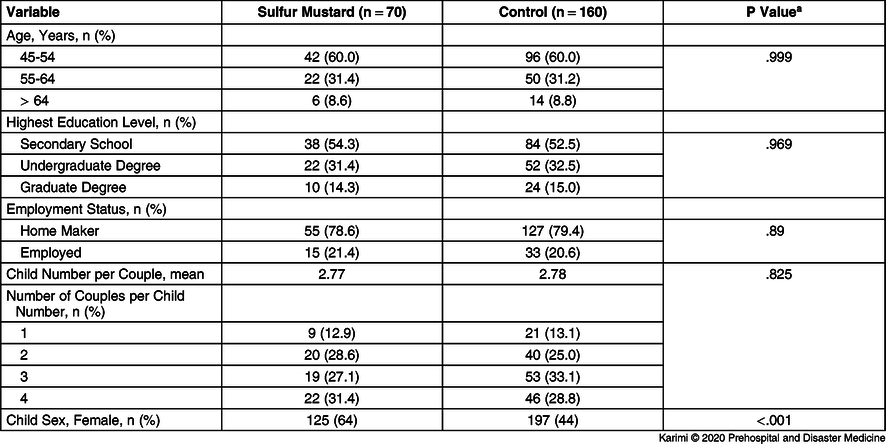
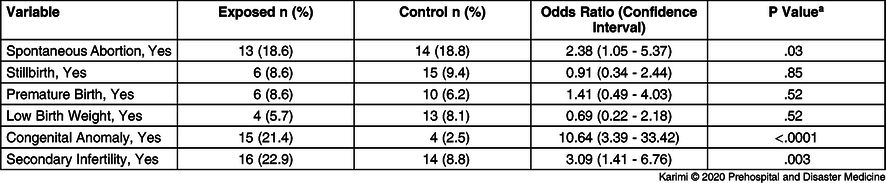
One-hundred subjects were included in this study. Thirty subjects were excluded and 70 were included in the final analysis. Demographics are presented in Table 1. The specificity of the HD-associated injury diagnosis in the FMVA records was 100%. No significant difference was found between the two groups in terms of age, education level, or occupation (Table 1). The results showed that the mean time between HD injury and pregnancy was four years in the case group. A total of 194 children (2.77 per study unit) were born in the HD group, whereas 444 (2.78 per study unit) were born in the control group (P = .825). Furthermore, number of children per study unit did not differ between groups (zero to four). The frequency of female children was significantly higher in the HD versus control group (64% versus 44%; P < .001). Secondary infertility was more than three-times higher in the HD group (22.9% versus 8.8%; P = .003). Similarly, the incidence of spontaneous abortion (18.6% versus 8.8%; P = .03) and congenital anomaly (21.5% versus 2.5%; P < .0001) were significantly higher in the HD group (Table 2). The incidence of stillbirth, premature delivery, and low birth weight did not differ significantly between groups.
Participant Demographics

a Chi-square
Pregnancy Outcomes for the Wives of Soldiers Exposed to Sulfur Mustard as Compared to Controls

a Determined via binary logistic regression with backward method.
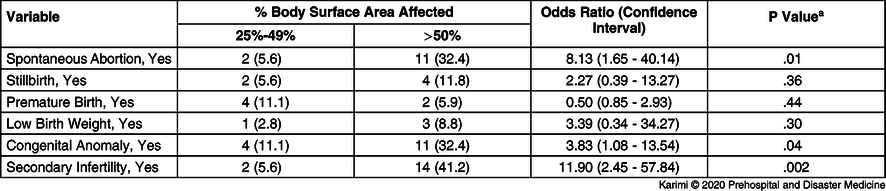
When stratifying case subjects by severity of chemical injury (25%-49% versus >50%), only the incidence of spontaneous abortion was increased in the greater severity group (5.6% versus 32.4%; P = .01; Table 3). Analysis via multiple logistic regression testing of demographic and study variables was significant only for HD-exposure severity (P < .05).
Pregnancy Outcomes for the Wives of Soldiers Exposed to Sulfur Mustard Stratified According to Percent of Body Surface Area Affected

a Determined via binary logistic regression with backward method.
Discussion
Blistering agents come in three types: HD, nitrogen mustard, and Lewisite (developed, but not used). Occasionally, phosgene oxime is included among blistering agents, although it is more properly termed a nettle agent (urticant). Approximately 50,000 Iranian soldiers and civilians were exposed to HD during the Iraq-Iran war (1980-1988).Reference Amirzargar, Yavangi, Rahnavardi, Jafari and Mohseni1,Reference Malekyari, Karimian, Farahbakh and Esmaeili10 Although the short-term toxicities are well-described, the long-term GU consequences remain unclear. Similar to prior reports, this study showed an increase in secondary infertility, a finding seemingly driven by those with greater exposure (>50% body surface area).Reference Panahi, Ghanei and Ghabili9,Reference Ketabchi14-Reference Marzony, Ghanei and Panahi16 This may, in part, be due to decreased sperm count and concentration,Reference Safarinejad3,Reference Amirzargar, Yavangi, Rahnavardi, Jafari and Mohseni15,Reference Azizi, Keshavarz, Roshanzamir and Nafarabadi17 increased azoospermia,Reference Amirzargar, Yavangi, Rahnavardi, Jafari and Mohseni15 and possibly decreased sperm motility.Reference Safarinejad3 Long-term effects on sex hormones have been inconsistent, including luteinizing hormone (increased,Reference Ketabchi14,Reference Agin and Sarvaghadi18 no changeReference Safarinejad3,Reference Shakeri, Yazdani and Kheradpezhouh4,Reference Amirzargar, Yavangi, Rahnavardi, Jafari and Mohseni15 ), follicle-stimulating hormone (increased,Reference Safarinejad3,Reference Ketabchi14,Reference Agin and Sarvaghadi18 decreased,Reference Amirzargar, Yavangi, Rahnavardi, Jafari and Mohseni15 no changeReference Shakeri, Yazdani and Kheradpezhouh4), testosterone (decreased,Reference Agin and Sarvaghadi18 no changeReference Shakeri, Yazdani and Kheradpezhouh4,Reference Amirzargar, Yavangi, Rahnavardi, Jafari and Mohseni15,Reference Safarinejad19 ), and prolactin (no changeReference Shakeri, Yazdani and Kheradpezhouh4).
Despite this information, the long-term effects on pregnancy have not been well-characterized. The spontaneous abortion rate amongst the general population in Iran remains unclear. An increase in long-term spontaneous abortions was observed following paternal HD exposure, a finding seemingly driven by those with greater HD exposure (>50% body surface area; Table 3).Reference Ketabchi14,Reference Marzony, Ghanei and Panahi16
No change in the long-term incidence of stillbirth, low birth weight, or premature birth was observed. The incidence of stillbirth was in keeping with prior studies in the Iranian general population (3.73 - 12.74 per 1,000 births),Reference Hadavi, Alidalaki, Abedininejad and Akhavan20-Reference Bahmanjanbeh, Kohan, Yarmohammadian and Haghshenas22 as were the rates of low birth weight (incidence 3.35% - 4.86%; prevalence 11.8%)Reference Bahmanjanbeh, Kohan, Yarmohammadian and Haghshenas22,Reference Roudbari, Yaghmaei and Soheili23 and premature birth (incidence 1.5% - 5.1%; prevalence 9.2%).Reference Alijahan, Hazrati, Mirzarahimi, Pourfarzi and Ahmadi Hadi24-Reference Vakilian, Ranjbaran, Khorsandi, Sharafkhani and Khodadost26
Congenital malformations in the control group were on par with those in studies of the general Iranian population (3.09 - 11.7 per 1,000 live births).Reference Alijahan, Hazrati, Mirzarahimi, Pourfarzi and Ahmadi Hadi27-Reference Mosayebi and Movahedian30 Conversely, the rate amongst the children born of an HD-exposed father was significantly increased. These findings corroborate those of other published studies.Reference Ketabchi14,Reference Abolghasemi, Radfar and Rambod31 Additionally, the discrepancy in baby gender between the groups raises the question of whether HD effects the Y chromosome to a greater extent than the X chromosome.
Lastly, the prevalence of secondary infertility in prior studies in the Iranian general population has been reported as 1.23% - 5.52%,Reference Mirzaei, Namiranian, Dehghani Firouzabadi and Gholami32-Reference Moghaddam, Delpisheh and Sayehmiri36 although the incidence remains unclear. The incidence for control patients in this study was 8.8%, whereas the incidence was significantly higher in the HD-exposed group.
Limitations
This study had limitations. The funding and logistical support was lacking to allow for analysis of sex hormones or sperm morphology or function. Additionally, only those veterans still residing in Ahvaz were eligible for inclusion and analysis. The ability to track those who had moved to other regions of the country or abroad was lacking.
Conclusions
Sulfur mustard exposure in combat may have long-lasting fertility effects on soldiers and their spouses, including spontaneous abortion, congenital anomalies, and secondary infertility. This is the first study to report long-term data on stillbirth, premature birth, or low birth weight for children born to an HD-exposed parent. Further investigation is needed into both the long-term effects of HD exposure and methods to protect soldiers.
Conflicts of interest
none