The combination of concordant atrioventricular and discordant ventriculo-arterial connections, or transposition, accounts for around one-twentieth of patients with congenitally malformed hearts seen postnatally.Reference Becker, Van Amber, Moller and Pierpont1 Over the past two decades, the prognosis has been improved for such patients with the widespread adoption of the arterial switch operation.Reference Bull, Yates, Sarkar, Deanfield and de Leval2–Reference Van Praagh and Jung4 Despite such progress, a delay in diagnosis can be fatal, mainly due to a failure of mixing at atrial level.Reference Fraisse, Skender, Nassi, Gaudart, Paut and Camboulives3, Reference Soongswang, Adatia, Newman, Smallhorn, Williams and Freedom5 Several studies have reported better conditions at presentation, and/or improved outcomes, when the diagnosis is made prenatally.Reference Soongswang, Adatia, Newman, Smallhorn, Williams and Freedom5–Reference Maeno, Kamenir, Sinclair, van der Velde, Smallhorn and Hornbeger9 These studies, however, have focused on transposition in the setting of an intact ventricular septum, or with a small ventricular septal defect,Reference Fraisse, Skender, Nassi, Gaudart, Paut and Camboulives3, Reference Soongswang, Adatia, Newman, Smallhorn, Williams and Freedom5, Reference Chantepie, Schleich, Gournay, Blaysat and Maragnes8, Reference Maeno, Kamenir, Sinclair, van der Velde, Smallhorn and Hornbeger9 or else have restricted attention to those cases suitable for the arterial switch operation.Reference Bonnet, Coltri and Butera7 Thus, previous studies have addressed only a subgroup of affected infants. In this study, we have examined a large antenatal population so as to identify all fetuses with concordant atrioventricular and discordant ventriculo-arterial connections. Our hypotheses were threefold. Firstly, prenatal diagnosis of the different forms of transposition should be extremely accurate, with few diagnostic errors. Secondly, prenatal echocardiographic findings should permit a reliable prediction of the postnatal surgical approach. Thirdly, the outcome for affected fetuses should be good, due to planned delivery with appropriate supportive care and surgical intervention.
Methods
All cases referred to our tertiary centre for fetal cardiology are entered prospectively into a computerised database (Filemaker Pro Versions 2 to 5; Claris Corporation, Santa Clara, California). We selected our cases from this database, studying all those seen between January, 1994, and December, 2003. The arterial switch operation had been performed at our centre throughout the period of study.
Thus, we searched our database for all fetuses with concordant atrioventricular and discordant ventriculo-arterial connections. We included fetuses with ventricular septal defects, those with pulmonary stenosis irrespective of its level, and those with aortic coarctation. Coarctation of the aorta is a difficult diagnosis to make during fetal life. Our echocardiographic assessment included a comparison of the size of the arterial trunks, and comparison of the size of aortic and ductal arches on a high transverse view of the fetal thorax, the so-called “three vessel view”. If there was any suspicion of coarctation, our policy was to recommend detailed serial scans of the aortic arch postnatally. Among the total number of fetuses identified with discordant ventriculo-arterial connections, we excluded those fetuses with isomerism of the atrial appendages, along with those having discordant atrioventricular connections, double inlet ventricle, and atresia of one atrioventricular valve. The excluded cases were not analysed in detail, but are shown in the table to demonstrate the diversity of cardiac lesions of which discordant ventriculo-arterial connections may be a part. We also excluded all cases of double outlet right ventricle, even if the interventricular communication was subpulmonary and the aorta was anterior to the pulmonary trunk. If the pulmonary trunk was overriding a ventricular septal defect, double outlet right ventricle was diagnosed if the pulmonary valve was judged to be committed by more than half to the right ventricle. In eight cases, we included both double outlet right ventricle and discordant ventriculo-arterial connections as differential diagnoses. For these cases, two of the authors (CP and JMS) reviewed the relevant prenatal echocardiograms, and included four cases as having discordant ventriculo-arterial connections. Cases initially described as having double outlet right ventricle without any differential diagnoses were not reviewed. Prenatal diagnosis of coarctation of the aorta remains a difficult diagnosis, requiring a subjective visualization of the size of the ventricles, the great arteries, and the aortic arch to judge its likelihood. If coarctation of the aorta was raised as a possibility by the attending fetal cardiologist, we interpreted this as the prenatal diagnosis for the purposes of our analysis.
Confirmation of the diagnosis and outcome were sought from postnatal echocardiograms, as well as cardiac catheterisation, clinical, surgical and autopsy reports. The gestational age at examination was determined by obstetric ultrasound criterions in all cases. Fetal echocardiograms were performed using Philips Sonos 2000-5500 ultrasound systems (Philips Inc. Andover, Massachusets, United States of America) or Toshiba SSA-270A ultrasound system (Toshiba Inc, Zoetermeer, The Netherlands). Survival at 30 days and one year was calculated with 95% confidence intervals, where appropriate. Outcome data was routinely sought, for all fetuses, throughout the period of study, and was available in over 95% of cases. All retrospective quantitative measurements from echocardiograms were made by a single non-blinded observer (JMS), with reference made to appropriate normal ranges.Reference Sharland and Allan10, Reference Mielke and Benda11
Results
Antenatal diagnosis
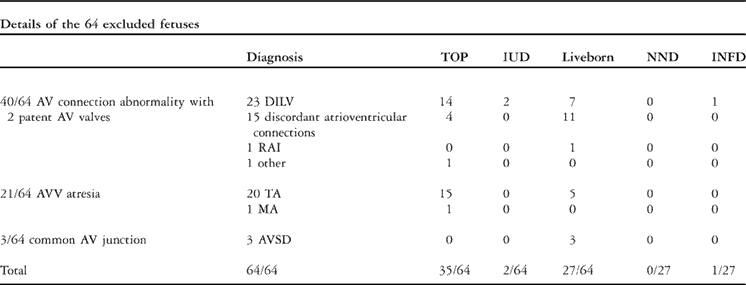
From a total of 14,466 mothers referred for fetal echocardiography during the study period, we diagnosed congenitally malformed hearts in 1,835 fetuses (13%). There were 120 instance of diagnosis of discordant ventriculo-arterial connections. Of those, 64 were excluded because of more complex anatomy (Table 1). Thus, 56 fetuses met the criterions for inclusion, accounting for 0.39% of the total number of patients, 3% of the total number of congenitally malformed hearts, and 46.6% of the group with discordant ventriculo-arterial connections. Of the selected cases, the ventricular septum was intact in 30 (54%), 9 had an associated ventricular septal defect (16%), 1 had pulmonary valvar stenosis with an intact ventricular septum (2%), 7 had pulmonary stenosis with a ventricular septal defect (13%), 1 had coarctation of the aorta with an intact ventricular septum (2%), and 8 had coarctation of the aorta with a ventricular septal defect (14%). The median gestational age at the time of diagnosis was 20 weeks, with a range from 12 to 34 weeks, and the number of fetal echocardiograms ranged from one to four. In ten cases (18%), the diagnosis was made beyond 24 weeks of gestational age. Following diagnosis in the midtrimester, our usual policy is to repeat scans later in pregnancy, at 28 to 30 weeks, and to perform a final echocardiogram at around 32 to 34 weeks. In 44 cases (78%), referral was because of suspected congenital heart disease at obstetric ultrasonic scanning. Nuchal translucency was increased above the 95th centile in 5 of 19 fetuses (26%) who had undergone such evaluation at 11 to 14 weeks, and was the sole indication for referral. In 3 cases, the referral was because of a family history of congenital heart disease. The remaining fetuses had various indications for referral, including an echogenic focus and raised maternal age. A fetal karyotype was obtained in 15 patients (27%), either because of congenital heart disease, or because of increased nuchal translucency. It proved normal in all cases. No case had dysmorphism either postnatally or at autopsy. Of the 52 fetuses for whom the sex is known, 39 (76%) were male. There was one twin pregnancy, where one of the fetuses had an intact ventricular septum with transposition, and the other was normal. There were extracardiac abnormalities in two cases (3.5%). One fetus, with an intact ventricular septum, had a left-sided diaphragmatic hernia, which was also diagnosed prenatally, and the parents were given a poor prognosis. This baby died a few hours after birth. The post mortem examination confirmed a massive left diaphragmatic hernia, a tiny left lung, and absence of the left pulmonary artery and vein. The second baby had a hemivertebra, restriction of intrauterine growth, and an intact ventricular septum. This baby survived surgery, and is asymptomatic.
We excluded 64 fetuses from detailed analysis, but we show their details to emphasise the other contexts in which discordant ventriculo-arterial connections may occur.
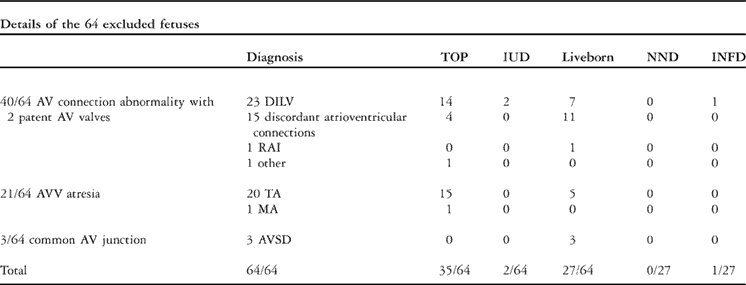
TOP: termination of pregnancy; IUD: intrauterine death; NND: neonatal death; INFD: infantile death; AV: atrioventricular; AVV: Atrioventricular valve; AVSD: Atrioventricular septal defect; DILV: Double inlet left ventricle; RAI: Isomerism of right atrial appendages; TA: Tricuspid atresia; MA: Mitral atresia.
Prenatal outcome
From the total group of 56 pregnancies, 6 of the parents opted for terminations (11%), at a range of 18 to 20 weeks of pregnancy. The parents consented for autopsy in three cases, and the fetal echocardiographic findings were confirmed. Of the 6 pregnancies ending in termination, two fetuses had severely unbalanced ventricles, so that a functionally univentricular repair had been envisaged. Termination was carried out for another fetus with a ventricular septal defect and coarctation of the aorta because of the previous experience of the family with death of a sibling having transposition with an intact ventricular septum. Termination was requested by 3 sets of parents following a diagnosis of transposition with an intact ventricular septum. For these families, 2 had met with cardiac surgeons, and the remaining one had been evaluated at two separate centers for fetal cardiology.
Diagnostic accuracy
Postnatal or autopsy data was available for 52 fetuses. In all cases, the primary finding of discordant ventriculo-arterial connections was confirmed. No case of discordant ventriculo-arterial connections was “missed” on a fetal echocardiogram during the period of study. For those with ventricular septal defects, the diagnostic sensitivity was 96% (23/24), specificity 88% (29/33), positive predictive value 85% (23/27), and negative predictive value 97% (29/30). For coarctation of the aorta, the sensitivity was 100% (9/9), specificity 96% (43/45), positive predictive value 82% (9/11), and negative predictive value 100% (43/43).
Prediction of the type of surgical repair
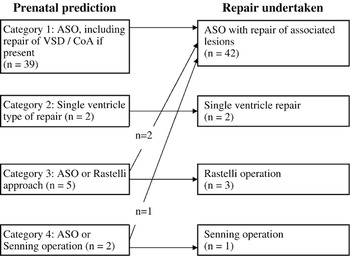
For the purposes of analysis, the prediction of the type of repair was divided into four major categories (Fig. 1). In all cases, the written correspondence and reports of the fetal cardiologist were reviewed in order to categorise. Of the 50 liveborn infants, two fetuses were excluded from this part of the analysis, including one for whom outcome is not known, and the fetus with a left diaphragmatic hernia who did not undergo cardiac surgery. The first category were those fetuses for whom the fetal cardiologist was confident of an arterial switch operation, coupled with repair of associated lesions, such as ventricular septal defect or coarctation of the aorta. The second group was made up of those in whom a biventricular repair was not judged feasible due to imbalance of ventricular size. The third group consisted of those with ventricular septal defect and a degree of pulmonary and/or subpulmonary obstruction, where the degree of pulmonary stenosis might prove sufficiently severe to preclude an arterial switch operation. In such cases, the attending fetal cardiologist had outlined both the option of an arterial switch operation and the option of a Rastelli type of repair. The final group, with marked asymmetry of ventricular size and intact ventricular septum, were those in whom the option of a Senning operation had been discussed by the attending fetal cardiologist as well as the arterial switch operation.
Flow diagram indicating predicted repair versus actual surgery undertaken for 44 liveborn infants who underwent surgery.

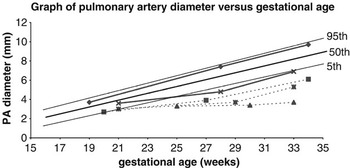
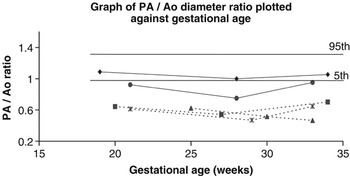
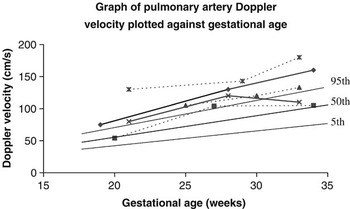
For the first two categories (Fig. 1), prognostication was accurate. For the latter two, then the surgical approach was variable. In view of the difficulties of predicting the approach for those having the options of the arterial switch or the Rastelli procedure, we analysed this group in more detail (Figs. 2–4). Only two fetuses were identified in the final group, both with marked asymmetry between the size of the right and left ventricles. The first of these had ventricular asymmetry from presentation at 21 weeks. At the final assessment, at 29 weeks gestational age, the right ventricular diameter was 12.3 millimetres, representing the 50th centile, versus left ventricular diameter of 7.4 millimetres, this being below the 5th centile. The sizes of, and patterns of flow across, the aortic and pulmonary valves were within normal ranges throughout gestation, and an arterial switch operation was successful postnatally. The other fetus with an intact ventricular septum had marked ventricular asymmetry with dominance of the right ventricle throughout gestation. At 34 weeks the right ventricular diameter, at 19 millimetres, was much larger than the left ventricle, at 11 millimetres, and the Doppler velocity measured in the pulmonary trunk had risen to 150 centimetres per second, having been normal earlier in gestation. This infant went on to develop progressive pulmonary valvar stenosis postnatally, and underwent a Senning operation with pulmonary valvotomy at the age of eight months.
This graph shows the pulmonary artery plotted against gestational age for fetuses with transposition of the great arteries, ventricular septal defect and obstruction to pulmonary blood flow in whom the options of Rastelli versus arterial switch repair were considered prenatally. The solid lines indicate fetuses with transposition of the great arteries, ventricular septal defect and pulmonary stenosis who underwent an arterial switch operation postnatally. The dashed lines indicate fetuses who underwent a Rastelli repair. Normal centiles are indicated.

Graph of pulmonary artery (PA) to aorta (Ao) diameter ratio plotted against gestational age for fetuses with transposition of the great arteries, ventricular septal defect and obstruction to pulmonary blood flow. The solid lines indicate fetuses with transposition of the great arteries, ventricular septal defect and pulmonary stenosis who underwent an arterial switch operation postnatally. The dashed lines indicate fetuses who underwent a Rastelli repair. Normal centiles are indicated.

Graph of pulmonary artery Doppler velocity plotted against gestational age for fetuses with transposition of the great arteries, ventricular septal defect and obstruction to pulmonary blood flow. The solid lines indicate fetuses with transposition of the great arteries, ventricular septal defect and pulmonary stenosis who underwent an arterial switch operation postnatally. The dashed lines indicate fetuses who underwent a Rastelli repair. Normal centiles are indicated.

Postnatal outcome
We lost 1 baby to follow-up, so there are 49 infants whose outcome is known. For the whole cohort, 46 of these fetuses had survived at 30 days (94%, with 95% confidence intervals from 83 to 99%), and 43 remained alive at 1 year (88%, 95% confidence intervals from 75 to 95%). The baby with an associated diaphragmatic hernia was the only preoperative death. One of the early postoperative deaths was of an infant with a single origin of the coronary arteries, which also took an intramural course. The second baby was severely cyanosed at birth due to closure of the arterial duct, and required an emergency balloon atrial septostomy. The final fetal echocardiogram in this case had been at 34 weeks gestional age, when the arterial duct appeared patent. The coronary arterial arrangement was the usual for transposed arterial trunks, but death occurred postoperatively secondary to poor left ventricular function.
Of the remaining patients, 3 died subsequently during infancy. The first child had a small subpulmonary ventricular septal defect, subpulmonary stenosis, and a dysplastic mitral valve. At 4 months of age, she underwent an arterial switch operation, combined with relief of subpulmonary stenosis and closure of the ventricular septal defect. At one year, she developed endocarditis causing mitral and aortic regurgitation, and died from sepsis and aortic regurgitation, despite repair and subsequent replacement of the mitral valve. A second infant ventricular septal defect and pulmonary stenosis died postoperatively after an atrial septectomy and construction of a Blalock-Taussig shunt. The third child dying in infancy had a ventricular septal defect and coarctation of the aorta. Complete repair had been performed on the second day of life, with closure of a residual ventricular septal defects performed on the 29th day. The baby remained dependent of ventilation, and died at the age of 3 months.
Discussion
To our knowledge, ours is the first study differentiating the different forms of discordant ventriculo-arterial connections when diagnosed during fetal life. These patients accounted for 3% of all fetuses with congenitally malformed hearts detected at our centre, which is less than the incidence of 5 to 7% cited for this condition diagnosed postnatally.Reference Becker, Van Amber, Moller and Pierpont1 This is explained by the known relatively low detection rate for transposed arterial trunks during fetal life. In a national study made in the United Kingdom between 1993 and 1995, only 3% of affected fetuses were detected.Reference Bull12 This is related to the nature of obstetric screening for congenital heart disease, where most obstetric units will include only the four chamber view, with only the more experienced units including views of the outflow tracts. As the “four chamber” view of the heart is usually normal in fetuses with discordant ventriculo-arterial connections and an intact ventricular septum, these cases are often overlooked during obstetric screening. Increasingly, nonetheless, obstetric units undertaking ultrasonic interrogations are using extended views of the fetal heart to include the outflow tracts, which explains why most of our fetuses were referred because of suspected congenital heart disease on scans for anomalies performed in such units. Between April, 1999, and December, 2003, our surgical data, submitted to the United Kingdom Congenital Cardiac Audit Database, confirmed that 29 out of 69 infants undergoing an arterial switch operation for transposed arterial trunks had been diagnosed prenatally. Our unit is located in a region with high rates of antenatal detection,Reference Bull12 which heavily influences our observations. The current rate of prenatal detection in the United Kingdom is not known, but is likely to be less than the figure we report. Increased nuchal translucency accounted for the referral of one tenth of our cases with transposition. Increased nuchal translucency is associated with congenitally malformed hearts, independent of karyotypic abnormalities,Reference Hyett, Perdu, Sharland, Snijders and Nicolaides13, Reference Makrydimas, Sotiriadis and Huggon14 but this screening test is not currently universally available, and was not available anywhere in the first 3 to 4 years of our series. In our cohort, one-quarter of the fetuses who underwent screening for nuchal translucency had values above the 95th percentile. Although the screen is of some value, the majority of affected fetuses had normal nuchal translucency, emphasising the continued value of the midtrimester anomaly scan with extended views of the fetal heart. There was one case of recurrence of transposition in siblings.Reference Gill, Splitt, Sharland and Simpson15 Previous data suggests either a low risk of recurrence in siblings, estimated at 0.27%,Reference Becker, Van Amber, Moller and Pierpont1 or that transposition is a sporadic lesion.Reference Burn, Brennan and Little16 Our study also confirms the known male predominance of affected cases.Reference Burn, Brennan and Little16 The absence of chromosomal abnormalities, and low incidence of extracardiac malformations, is highly relevant for counselling expectant parents.
Prenatal diagnosis, therefore, was very accurate at our tertiary centre for our chosen lesion. The major areas of diagnostic difficulty related to detection of associated ventricular septal defects and coarctation of the aorta. The difficulties in prenatal diagnosis of coarctation of the aorta are related to the “parallel” circulations seen during fetal life whilst the arterial duct is patent,Reference Sharland, Chan and Allan17, Reference Hornberger, Sahn, Kleinman, Copel and Silverman18 so that the diagnosis is inferred by indirect signs, and Doppler gradients between the aortic arch and descending aorta are not observed. Our policy of recommending serial postnatal echocardiograms for fetuses with suggestive signs of coarctation of the aorta explains our high sensitivity for diagnosis.
The prediction of the surgical approach was accurate in most cases, but there remains considerable difficulty in the group of fetuses with associated ventricular septal defect and pulmonary stenosis. Although the number of cases in this group was small, our data suggests that the size of the pulmonary trunk, or the ratio of its diameter to the aorta, is more helpful than the Doppler velocity across the pulmonary valve in predicting the type of repair (Figs. 2–4). This is consistent with other types of congenital heart defect in the fetus, where the diagnosis of pulmonary stenosis is made because of the size of the vessel rather than the Doppler velocity.Reference Pepas, Savis, Sharland, Tulloh and Simpson19 A subgroup of fetuses with an intact ventricular septum and ventricular asymmetry also require close monitoring, since obstruction of flow of blood to the lungs can develop in this setting, and preclude an arterial switch operation.
Previous studies have reported risk factors for preoperative mortality, including delayed diagnosis, restriction at the oval foramen, and constriction of the arterial duct. We had no preoperative death related to these factors, in contrast to previous studies.Reference Soongswang, Adatia, Newman, Smallhorn, Williams and Freedom5, Reference Chantepie, Schleich, Gournay, Blaysat and Maragnes8 These complications can be identified during fetal life, thus marking those fetuses at increased risk, but such assessments need to be performed near to term.Reference Maeno, Kamenir, Sinclair, van der Velde, Smallhorn and Hornbeger9 Assessment of pulmonary vascular resistance is less feasible prenatally.Reference Fraisse, Skender, Nassi, Gaudart, Paut and Camboulives3 The data of Bonnet and his colleaguesReference Bonnet, Coltri and Butera7 confirmed that antenatal diagnosis improved postnatal outcome by decreasing the delay before admission, and ameliorating the haemodynamic distress. At our own centre, externally validated data for the arterial switch operation has been available since 1999. Of 29 infants diagnosed prenatally and undergoing this surgery, 1 died within 30 days of surgery, compared to 1 of 40 infants diagnosed postnatally.
The surgical mortality for those with an intact ventricular septum depends particularly on the coronary arterial anatomy, which cannot readily be assessed during fetal life. Of the 6 deaths in our series, one, possibly 2, may be attributed to the coronary arterial anatomy and reimplantation, but the other 4 deaths in our series were related to extra-cardiac abnormalities, such as diaphragmatic hernia, or associated cardiac lesions. Our observed survival at 30 days and one year, at 94% and 88%, respectively, demonstrate that, despite prenatal diagnosis, there remains a significant mortality for patients with this type of congenitally malformed heart.
Acknowledgements
Cecile Pascal was supported in part by a research grant from the Fédération Française de Cardiologie.