Introduction
Consumers are increasingly demanding information about how domesticated animals used for food are managed and cared for (Mitchell, Reference MITCHELL2001). Many purchasers of animal products want assurances that the animals are raised humanely (Bredahl et al., Reference BREDAHL, NORTHEN, BOECKER and NORMILE2001). In many parts of the world, white eggs produced by White Leghorns and brown eggs laid by brown hybrids can be purchased from hens housed in conventional cages, enriched cages, and non-cage systems with or without outdoor access.
Conventional cages for egg laying strains of chickens are controversial because they are without furnishings such as perches, nests, and scratch pads. Thus, conventional cages do not allow hens to express certain behaviours (Lay et al., Reference LAY, FULTON, HESTER, KARCHER, KJAER, MENCH, MULLENS, NEWBERRY, NICOL, O'SULLIVAN and PORTER2011), but they do have the potential to offer advantages such as increased liveability or life expectancy (Fossum et al., Reference FOSSUM, JANSSON, ETTERLIN and VÅGSHOLM2009; Lay et al., Reference LAY, FULTON, HESTER, KARCHER, KJAER, MENCH, MULLENS, NEWBERRY, NICOL, O'SULLIVAN and PORTER2011) and improved respiratory health because of less aerial ammonia and dust (Xin et al., Reference XIN, GATES, GREEN, MITLOEHNER, MOORE and WATHES2011) as compared to non-cage systems. Non-cage systems are systems such as multi-tier aviaries or a single level littered floor that provide nest boxes and perches. The littered area of non-cage systems provides hens with opportunities to dust bathe, forage, and scratch. When furnishings of a nest box, perches, and a scratch pad are added to a cage, this system is referred to as an enriched cage. The predecessor of enriched cages was the taller get-away cages with elevated perches. A detailed description of housing systems used for laying hens is described by Mench et al. (Reference MENCH, SUMMER and ROSEN-MOLIN2011).
Providing enrichments to cages might be a compromise that allows hens to capture some of the advantages of conventional cages and also better meet their behavioural needs. This review focuses on the perch as a furnishing and how its design and addition to the cage can affect the welfare and production efficiencies of egg laying strains of chickens. Though the review refers mainly to research conducted on perches in cage systems, a few highly relevant citations for non-cage systems are included. For a review on perches for all housing systems, see Struelens and Tuyttens (Reference STRUELENS and TUYTTENS2009).
Behaviour
The natural roosting position for laying hens is on a perch with feet locked in a clasped position (Duncan et al., Reference DUNCAN, APPLEBY and HUGHES1992). Each of the two feet of commercial strains of hens have four independent flexible toes with the first toe, referred to as the hallux, turned backward, while the other three toes face forward (Lucas and Stettenheim, Reference LUCAS and STETTENHEIM1972). The hallux joins the leg at the same level as the three toes at the front of the foot. This arrangement of toes makes hen's feet ideal for grasping perches. For each foot, there are two flexor tendons, flexor hallicus longus and flexor digitorum longus, which extend down the surface of the muscle surrounding the tibiotarsal bone to the toes. A hen that sits causes the tendons to tighten, and the toes curl. This tendon locking mechanism allows hens to sleep without falling off of the perch (Terres, Reference TERRES1996).
Most hens are strongly motivated to perch (Lambe and Scott, Reference LAMBE and SCOTT1998; Olsson and Keeling, Reference OLSSON and KEELING2002) and show signs of unrest and frustration if perching is thwarted (Olsson and Keeling, Reference OLSSON and KEELING2000). Day-time perch use by hens in furnished cages can exceed 30% with up to 85 to 100% of the hens using the perch during the night (Tauson, Reference TAUSON1984; Duncan et al., Reference DUNCAN, APPLEBY and HUGHES1992; Tauson and Abrahamsson, Reference TAUSON and ABRAHAMSSON1994; Abrahamsson et al., Reference ABRAHAMSSON, TAUSON and APPLEBY1996; Appleby et al., Reference APPLEBY, WALKER, NICHOL, LINDBERG, FREIRE, HUGHES and ELSON2002). There is much more movement on and off floor perches during daylight as compared to at night (Lambe and Scott, Reference LAMBE and SCOTT1998). During the day, Hisex brown medium hybrid hens of 2 or 14 hen group sizes with access to wooden perches of different heights spend most of their time standing followed by preening, sitting, and walking on the perch (Struelens et al., Reference STRUELENS, TUYTTENS, DUCHATEAU, LEROY, COX, VRANKEN, BUYSE, ZOONS, BERCKMANS, ÖDBERG and SONCK2008a). When given a choice, a group size of 2 hens preferred not to contact one another during perching (Struelens et al., Reference STRUELENS, TUYTTENS, DUCHATEAU, LEROY, COX, VRANKEN, BUYSE, ZOONS, BERCKMANS, ÖDBERG and SONCK2008a), which is similar to results of domestic hens in the wild (Wood-Gush et al., Reference WOOD-GUSH, DUNCAN and SAVORY1978). There was generous perch space (more than 15 cm/hen) and a 10-day habituation period prior to conducting the 2 hen preference test in the study of Struelens et al. (Reference STRUELENS, TUYTTENS, DUCHATEAU, LEROY, COX, VRANKEN, BUYSE, ZOONS, BERCKMANS, ÖDBERG and SONCK2008a). In contrast, others have reported that undisturbed hens perch closely to one another resulting in body contact (Olsson and Keeling, Reference OLSSON and KEELING2000; Reference OLSSON and KEELING2002).
In addition to being able to express their natural roosting behaviour, perches allow hens to reduce bird density on the floor creating a reprieve from standing on a sloped, wired cage floor (Appleby et al., Reference APPLEBY, SMITH and HUGHES1992; Tauson and Abrahamsson, Reference TAUSON and ABRAHAMSSON1996; Abrahamsson and Tauson, Reference ABRAHAMSSON and TAUSON1997). Perches also allow hens to get away from aggressive hens and feather peckers (Tauson, Reference TAUSON1984; Duncan et al., Reference DUNCAN, APPLEBY and HUGHES1992). However, there are welfare disadvantages to installing perches in some types of cages. In the study of Moinard et al. (Reference MOINARD, MORISSE and FAURE1998), hens in large (800cm2/hen) and tall (60 cm) cages without a nest and with 2 wood perches mounted 6 cm from the cage floor experienced a higher incidence of vent cannibalism as compared to hens in the same cage without a perch. In addition, hens under elevated perches can be defecated on by perching hens above (Struelens et al., Reference STRUELENS, TUYTTENS, DUCHATEAU, LEROY, COX, VRANKEN, BUYSE, ZOONS, BERCKMANS, ÖDBERG and SONCK2008a).
Perch design and placement
perch space
Synchronization of perching behaviour is important to laying hens (Appleby, Reference APPLEBY2004), so enough space is needed to allow all hens to perch at the same time (Appleby et al., Reference APPLEBY, SMITH and HUGHES1992; European Food Safety Authority or EFSA, 2005). According to European Union (EU)-Directive 1999/74/ European Commission (EC), 15 cm of space/hen is needed to allow all hens to roost on a straight perch at the same time (European Commission, 1999). The EFSA (2005) recommends 15 cm of perch space/brown hybrid hen. Brown hybrid hens had adequate night-time perching space at 15 cm/hen, but not at 11.3 cm/hen (Appleby et al., Reference APPLEBY, SMITH and HUGHES1992). Perch use at night was not affected by either 14 cm or 15 cm of perch space/brown hybrid hen suggesting that 14 cm of perch space was adequate (Appleby, Reference APPLEBY1995). Providing 14 and 15 cm as compared to 12 and 13.3 cm of perch space/brown hybrid hen resulted in less feather damage, but more nail problems (Appleby, Reference APPLEBY1995). Hens appeared calmer when given more perch space, but the calming effect could also have been influenced by the fact that hens with more perch space also had more feeder and floor space/hen (Appleby, Reference APPLEBY1995). The EFSA (2005) recommendation of 12 cm of perch space/White Leghorn hen is consistent with studies reporting that 12 cm of perch space/White Leghorn hen is sufficient to achieve high perch usage at night (Tauson, Reference TAUSON1984; Tauson and Abrahamsson, Reference TAUSON and ABRAHAMSSON1994).
perch arrangement
Most but not all commercial furnished cages have multiple perches that are arranged parallel to the feed trough. Front as opposed to rear perches were more popular for day time perching perhaps because of the closer proximity to the feeders and drinkers (Duncan et al., Reference DUNCAN, APPLEBY and HUGHES1992). Perches placed 17 cm as compared to 24 cm from the back wall of the cage resulted in cleaner plumage, feet, cage floor, and perch with less dirty eggs. Production traits (exception was dirty eggs), plumage, foot, nail, and skeletal health as well as behaviour were not affected by perch placement of 17 vs. 24 cm from the back wall (Abrahamsson and Tauson, Reference ABRAHAMSSON and TAUSON1993).
If cross-wise perches are used, hens require more perching space as the area in proximity to the cross cannot be used as effectively and may even disrupt perching positions at night (Wall and Tauson, Reference WALL and TAUSON2007; Struelens et al., Reference STRUELENS, VAN POUCKE, DUCHATEAU, ÖDBERG, SONCK and TUYTTENS2008b; Struelens and Tuyttens, Reference STRUELENS and TUYTTENS2009). As an example, a cross perch consisting of 30 + 30 cm dimensions provided the same amount of perch space as a 60 cm straight perch, but the hens did not utilize the cross-perch as effectively leading Struelens et al. (Reference STRUELENS, VAN POUCKE, DUCHATEAU, ÖDBERG, SONCK and TUYTTENS2008b) to recommend that for each location where perches cross one another, 30 cm of perch space should be excluded from the total perch space. A straight vs. a cross perch, each providing 15 cm of perch space/hen, did not affect mortality, egg production, or egg quality (Wall and Tauson, Reference WALL and TAUSON2007).
perch surface angle
The angling of a softwood rectangular perch, with respect to its upper surface being parallel to the cage floor, showed that ISA Browns had no preference for the different orientations and spent the same amount of time perching when given a choice of 8° angled, 10° angled, or the flat non-angled perches (Appleby et al., Reference APPLEBY, HUGHES, MCDONALD and CORDINER1998).
perch height
Perches are typically mounted in cages a minimum of 6 cm above the cage floor to allow for passage of eggs to the collection area and to allow hens to easily move across the cage (Struelens and Tuyttens, Reference STRUELENS and TUYTTENS2009). Furnished cages have more limitations on perch height because of the cage ceiling as compared to non-cage systems. If given no choice, hens still heavily used low perches installed in furnished cages (Abrahamsson and Tauson, Reference ABRAHAMSSON and TAUSON1993).
When cage ceiling is not a limiting factor, hens prefer the highest perch for night time perching for many housing systems (Struelens and Tuyttens, Reference STRUELENS and TUYTTENS2009), including cages (Tauson and Abrahamsson, Reference TAUSON and ABRAHAMSSON1994; Struelens et al., Reference STRUELENS, TUYTTENS, DUCHATEAU, LEROY, COX, VRANKEN, BUYSE, ZOONS, BERCKMANS, ÖDBERG and SONCK2008a). As an example, 2 or 14 hens were given a choice of perch heights of 6, 11, 16, 21, 26, 31, and 36 cm from the cage floor (Struelens et al., Reference STRUELENS, TUYTTENS, DUCHATEAU, LEROY, COX, VRANKEN, BUYSE, ZOONS, BERCKMANS, ÖDBERG and SONCK2008a). There were 4 hen places for each perch height so the 2 hen test was free choice, while the 14 hen test involved hen competition for perch height choice. With a cage height of 150 cm, the 2 hen test showed that hens had the greatest night-time preference for the tallest perch (36 cm). The 14 hen test with a cage height of 150 cm demonstrated that hens used all perch heights, but as perch height increased from 6 to 36 cm, a greater proportion of hens used the higher perches. At a cage height of 45 cm, the 2 hen test showed that hens preferred a perch height of 16 cm at night, though they used all perch heights except for perches of 6 and 36 cm from the cage floor. For the 14 hen test, the preferred perch height of hens at night was 16, 21, and 26 cm though they used all perch heights except for the 36 cm high perch which was too close to the cage ceiling (9 cm) (Struelens et al., Reference STRUELENS, TUYTTENS, DUCHATEAU, LEROY, COX, VRANKEN, BUYSE, ZOONS, BERCKMANS, ÖDBERG and SONCK2008a). It is thought that hens prefer greater heights for night perching because of their concern for ground predators (Wood-Gush and Duncan, Reference WOOD-GUSH and DUNCAN1976). In fact, perch height affects the type of behaviour displayed by hens (Struelens et al., Reference STRUELENS, TUYTTENS, DUCHATEAU, LEROY, COX, VRANKEN, BUYSE, ZOONS, BERCKMANS, ÖDBERG and SONCK2008a). Hens on higher perches spent more time sitting and sleeping, while hens on lower perches spent more time standing and walking (Struelens et al., Reference STRUELENS, TUYTTENS, DUCHATEAU, LEROY, COX, VRANKEN, BUYSE, ZOONS, BERCKMANS, ÖDBERG and SONCK2008a).
Besides hen preference, perch position is important relative to hen welfare. A welfare benefit was that the humerus of hens was stronger in get-away cages with higher perches as compared to hens in furnished cages with lower perches most likely due to more wing flapping (Tauson and Abrahamsson, Reference TAUSON and ABRAHAMSSON1994).
Hens with access to front and back perches with heights of 6 and 20 cm, respectively, were less stressed (lower heterophil/lymphocyte ratio) than hens in cages with front and back perch heights of 27.5 and 20 cm, respectively (Scholz et al., Reference SCHOLZ, RÖNCHEN, HAMANN, PENDL and DISTL2008). Hens with access to one lower perch (6 cm) were less stressed perhaps because they were able to navigate more easily between the 2 perches that were installed at heights of 6 and 20 cm. Hens with access to front and back perches with heights of 27.5 and 20 cm, respectively, could have had more accidental collisions impeding navigation and hen movement leading to more stress and pain (Scholz et al., Reference SCHOLZ, RÖNCHEN, HAMANN, PENDL and DISTL2008). Because of the limitation of ceiling height and wall partitions in furnished cages, hens cannot fly to higher perches from floor level as easily as they can in non-cage housing systems, so lower perches perhaps can be used in combination with higher perches to allow hens to step-up to the elevated perches without being stressed (Struelens et al., Reference STRUELENS, TUYTTENS, DUCHATEAU, LEROY, COX, VRANKEN, BUYSE, ZOONS, BERCKMANS, ÖDBERG and SONCK2008a).
ceiling height
Not only is perch height important to hens, but also the distance from the perch to the ceiling. The minimum cage height recommended by the EU-Directive 1999/74/EC for furnished cages is 45 cm (European Commission, 1999). When given a choice, most brown hybrid hens prefer at night a minimum distance of 19 to 24 cm from the perch to the cage ceiling. If hens are given a distance of 24 cm from the perch to the cage ceiling, then perches may be elevated as high as 21 cm from the cage floor. Preference tests showed that hens given a ceiling-perch distance of 9 cm refused to use the perch and only a few brown hybrids used a perch with a distance of 14 cm between it and the cage ceiling (Struelens et al., Reference STRUELENS, TUYTTENS, DUCHATEAU, LEROY, COX, VRANKEN, BUYSE, ZOONS, BERCKMANS, ÖDBERG and SONCK2008a).
Taller cages create room for higher perches which hens prefer; however, the perches have to be accessible through steps. Taller cages also allows for placement of perches at different heights allowing hens to express different behaviours depending on perch height. Taller cages create more volume or 3 dimensional spacing reducing bird density on the cage floor (Struelens et al., Reference STRUELENS, TUYTTENS, DUCHATEAU, LEROY, COX, VRANKEN, BUYSE, ZOONS, BERCKMANS, ÖDBERG and SONCK2008a).
Bone breaking strength was greater for the humerus with no effect on the tibia of hens housed in cages with a height of 60 cm as compared to 40 cm. The greater cage height also reduced the incidence of broken wings after slaughter, but this may have also been due to a larger cage opening size of the taller cages. A disadvantage was that taller cages increased the proportion of deaths due to body cannibalism in beak intact brown hybrids perhaps because of more light entering the taller cages (Moinard et al., Reference MOINARD, MORISSE and FAURE1998).
cage hygiene
A build-up of manure under perches can increase the risk of coccidiosis (EFSA, 2005). Cages with perches as compared to those without perches had inferior floor hygiene (Nakaue et al., Reference NAKAUE, GOEGER and ARSCOTT1984; Abrahamsson and Tauson, Reference ABRAHAMSSON and TAUSON1993). Because of less hen traffic under the perches, manure may not fall through the wired cage floor to the dropping boards as effectively as in conventional cages without perches.
perch width
Most commercial perches are 4 to 5 cm wide. Perches that are too wide may prevent hens from wrapping their toes around the perch in a locked grip (Struelens and Tuyttens, Reference STRUELENS and TUYTTENS2009). Hens given access to 7 perches that varied in width from 1.5 to 10.5 cm showed no width preference during the night. During the day, the narrowest perch of 1.5 cm was the least preferred. For wider perches (> 1.5 cm), hens showed increased daytime perching as perch width increased up to 10.5 cm in 1 experiment but not the second experiment (Struelens et al., Reference STRUELENS, TUYTTENS, AMPE, ÖDBERG, SONCK and DUCHATEAU2009). Total time perching and hen preference were similar for brown hybrids given 3.8 vs. 5.0 cm softwood perches (Appleby et al., Reference APPLEBY, HUGHES, MCDONALD and CORDINER1998). For hens standing and resting on perches in cages, different diameter perches of 3.4, 4.4, and 6.0 cm did not affect the peak forces on the foot pad and keel, respectively (Pickel et al., Reference PICKEL, SCHRADER and SCHOLZ2011). Struelens et al. (Reference STRUELENS, TUYTTENS, AMPE, ÖDBERG, SONCK and DUCHATEAU2009) recommended that a perch width of 1.5 cm or less not be used for laying hens.
perch texture
Smooth perches are considered inferior because they are slippery and have poor grip quality (Struelens and Tuyttens, Reference STRUELENS and TUYTTENS2009). In a study that examined hardwood, textured metal, smooth plastic, softwood, and padded vinyl perches, Appleby et al. (Reference APPLEBY, SMITH and HUGHES1992) suggested that hens may prefer a rougher surface texture such as softwood perches because hens least preferred the smooth plastic perches.
perch shape
Studies on perch shape are sometimes confounded with the material used in the perch making it impossible to determine if perch effects were due to the shape of the perch, the material of the perch, or a combination of both (Tauson and Abrahamsson, Reference TAUSON and ABRAHAMSSON1994; Valkonen et al., Reference VALKONEN, VALAJA and VENÄLÄINEN2005).
There was a trend for more perching activity of caged hens occurring on rectangular as compared to circular perches during the daytime with no differences in perching activity due to perch shape at night. Both the circular and rectangular perches were constructed of softwood (Duncan et al., Reference DUNCAN, APPLEBY and HUGHES1992). In contrast, Lambe and Scott (Reference LAMBE and SCOTT1998) reported no differences in perching time for hens on littered floor that had access to these 2 different shaped perches. For hens using the circular wood perches, their feet slipped backwards and forwards while feeding, suggesting instability (Duncan et al., Reference DUNCAN, APPLEBY and HUGHES1992). Circular perches also caused more damage to the soles of hen's feet than rectangular perches (Duncan et al., Reference DUNCAN, APPLEBY and HUGHES1992), but the peak force on the footpads of hens standing on perches was greater for square as compared to oval perches (Pickel et al., Reference PICKEL, SCHRADER and SCHOLZ2011). Foot health, measured using a separate scoring system for toe hyperkeratosis and nails, was excellent for caged hens with access to plastic perches that were mushroom-shaped (as viewed in cross section) as well as for caged hens with access to wooden perches that were wide, narrow, or flat/round (Tauson and Abrahamsson, Reference TAUSON and ABRAHAMSSON1994).
Keel bone lesions were not affected by shape of perches (plastic mushroom, rectangular wood, and round wood) and also did not differ from hens in cages without perches (Tauson and Abrahamsson, Reference TAUSON and ABRAHAMSSON1994). However, peak force on the keel bone was less and contact area was greater for hens resting on square as opposed to oval or round perches suggesting that square perches could lead to fewer keel bone deviations (Pickel et al., Reference PICKEL, SCHRADER and SCHOLZ2011).
perch material
Materials commonly used in the construction of perches for use by hens of the commercial egg industry include wood, plastic, and metal. As reviewed by Struelens and Tuyttens (Reference STRUELENS and TUYTTENS2009), plastic and metal perches were considered inferior from a functional point of view because they were slippery (Scott and MacAngus, Reference SCOTT and MACANGUS2004) and had poor grip quality. Softwood or vinyl-padded perches allowed for the feet of the hen to better grip the perch due to the slightly rougher surface as compared to the smoother metal or plastic perches. However, wooden perches, which contain cracks and crevices, can easily harbour red mites, are difficult to clean and disinfect (Tauson and Abrahamsson, Reference TAUSON and ABRAHAMSSON1996), and subjected to faster wear (Struelens and Tuyttens, Reference STRUELENS and TUYTTENS2009).
Caged hens preferred softwood perches over vinyl-padded, hardwood, plastic, or metal perches (Appleby, et al., 1992). In a littered floor pen study, hens given a choice showed no preference for perch material spending similar amounts of time using rectangular wood, plastic, or metal perches (Lambe and Scott, Reference LAMBE and SCOTT1998). In addition, hens on littered floors, when given a choice, showed no preference for a wood perch that was rectangular in shape as compared to the same wood perch except that it was covered in foam rubber for softness and a fabric to prevent the hens from pecking it (Lambe and Scott, Reference LAMBE and SCOTT1998). Furthermore, when hens on littered floor had access to only one perch, the type of material used to make the perch did not influence perching time leading investigators to conclude that because hens are so highly motivated to perch, they will do so regardless of the perch type (Lambe and Scott, Reference LAMBE and SCOTT1998).
Keel bone lesions or deformities were not affected by plastic vs. wooden perches (Tauson and Abrahamsson, Reference TAUSON and ABRAHAMSSON1994). Soft round polyurethane perches resulted in less peak force and more contact area with the keel bone as compared to round steel, mushroom shaped plastic, and flattened round perches (Pickel et al., Reference PICKEL, SCHRADER and SCHOLZ2011). However, surrounding wooden perches with a rubber lining did not reduce keel bone lesions or deformities as compared to wooden perches of equal diameter without a rubber lining (Tauson and Abrahamsson, Reference TAUSON and ABRAHAMSSON1996).
Foot health was compromised by using plastic perches (Tauson and Abrahamsson, Reference TAUSON and ABRAHAMSSON1994; Reference TAUSON and ABRAHAMSSON1996; Valkonen et al., Reference VALKONEN, VALAJA and VENÄLÄINEN2005). The foot-pads of caged hens with access to wooden perches were in better condition than the foot-pads of hens provided with plastic perches though shape could have affected results. The wooden perches were round, while the plastic perch was T-shaped (Valkonen et al., Reference VALKONEN, VALAJA and VENÄLÄINEN2005). In get-away cages that provide perches at different heights, the mushroom shaped perches made of plastic caused more bumblefoot than wooden perches at 55 weeks of age (Tauson and Abrahamsson, Reference TAUSON and ABRAHAMSSON1994). More bumblefoot was reported with plastic as compared to hardwood perches for hens in get-away cages of 15 hens/cage (Tauson and Abrahamsson, Reference TAUSON and ABRAHAMSSON1996). Bumblefoot and toe pad hyperkeratosis (perfect score of 4) did not differ between hens in get-away cages with access to rubber or hardwood perches (Tauson and Abrahamsson, Reference TAUSON and ABRAHAMSSON1996). The feet of hens standing on soft round polyurethane perches had less peak force on the foot pad as compared to round steel perches suggesting that the softer surface might lead to fewer foot pad problems (Pickel et al., Reference PICKEL, SCHRADER and SCHOLZ2011).
Pullet rearing
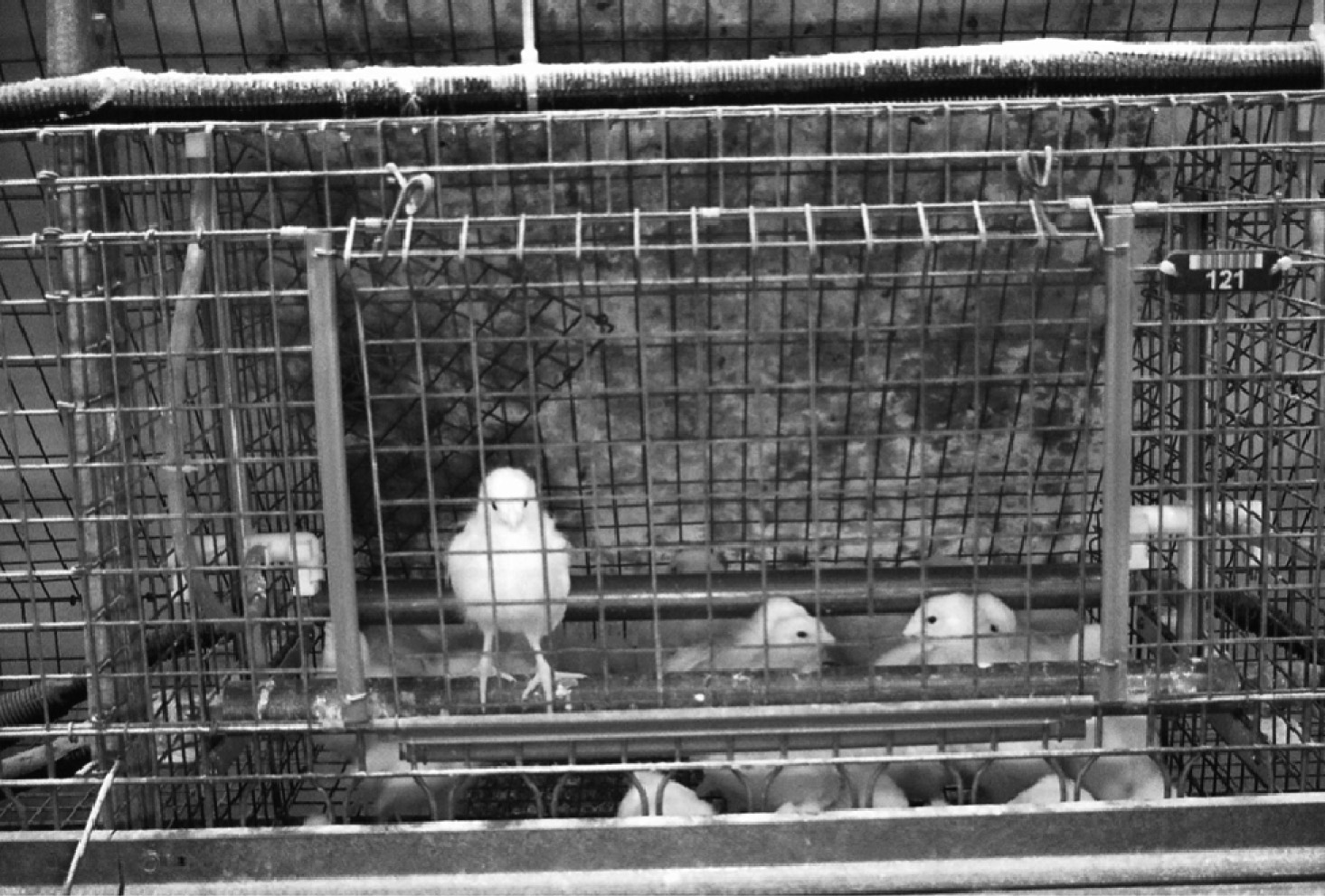
Little attention has been given to evaluating the use of enrichments in the pullet cage, in particular the ability to roost and understand how chicks learn to perch. Caged pullets given access to front and back circular, metal perches immediately following hatch began using roosts as early as 2 weeks of age (Figure 1), though perching was rare at this age. Perch use increased with age, peaking at 12 weeks of age and maintaining this level of perching activity until the end of the observations at 16 weeks of age (Enneking et al., Reference ENNEKING, WAKENELL, GARNER and HESTER2012b). Perches in pullet cages stimulated activity promoting exercise leading to improved musculoskeletal health (Enneking et al., Reference ENNEKING, CHENG, JEFFERSON-MOORE, EINSTEIN, RUBIN and HESTER2012a; Reference ENNEKING, WAKENELL, GARNER and HESTER2012b). There were no fractures or keel bone deviations up to 12 weeks of age among caged pullets with and without perches (Enneking et al., Reference ENNEKING, CHENG, JEFFERSON-MOORE, EINSTEIN, RUBIN and HESTER2012a). Eight flocks of pullets raised in non-cage systems, with 7 of them having perches, showed similar trends with only 1 fracture occurring in the 400 pullets examined (Wilkins et al., Reference WILKINS, POPE, LEEB, GLEN, PHILLIPS, ZIMMERMAN, NICOL and BROWN2005). Hyperkeratosis of the foot-pad and toes was practically non-existent and were not affected by perch access up to 12 weeks of age (Enneking et al., Reference ENNEKING, CHENG, JEFFERSON-MOORE, EINSTEIN, RUBIN and HESTER2012a).
Keel bone damage of laying hens in furnished cages is reduced if pullets are reared on the floor with perches rather than cage reared (Moe et al., Reference MOE, GUÉMÉNÉ, LARSEN, BAKKEN, LERVIK, HETLAND and TAUSON2004). Caged pullets with or without access to perches from hatch to 16.9 weeks of age had similar keel bone score and fracture incidence at 71 weeks of age, indicating that early exposure to pullet perches did not improve end of lay skeletal health (Hester et al., Reference HESTER, ENNEKING, HALEY, EINSTEIN, CHENG and RUBIN2013a).
Caged White Leghorn chick perching on a metal round perch at 15 days of age.

Skeletal health
The addition of perches to cages can have both positive and negative consequences on skeletal health.
bone strength and mineralization
Installation of perches in laying cages improved bone strength (Hughes and Appleby, Reference HUGHES and APPLEBY1989; Duncan et al., Reference DUNCAN, APPLEBY and HUGHES1992; Abrahamsson and Tauson, Reference ABRAHAMSSON and TAUSON1993; Reference ABRAHAMSSON and TAUSON1997; Tauson and Abrahamsson, Reference TAUSON and ABRAHAMSSON1994; Abrahamsson et al., Reference ABRAHAMSSON, TAUSON and APPLEBY1996; Barnett et al., Reference BARNETT, GLATZ, NEWMAN and CRONIN1997; Jendral et al., Reference JENDRAL, KORVER, CHURCH and FEDDES2008; Tactacan et al., Reference TACTACAN, GUENTER, LEWIS, RODRIGUEZ-LECOMPTE and HOUSE2009). With the exception of the tibia, caged White Leghorn hens with access to perches as compared to those that did not have perches had greater mineralization of the keel, femur, and wing bones (Hester et al., Reference HESTER, ENNEKING, HALEY, EINSTEIN, CHENG and RUBIN2013a). There was no improvement in the strength of the tibia because of perch access in caged brown hybrids, and there was no correlation between the strength of the tibia and time spent perching (Appleby et al., Reference APPLEBY, SMITH and HUGHES1992). Long-term perch use (18 to 72 weeks of age) increased trabecular volume of the tarsometatarsus of caged brown hybrids as compared to those with no perch access (Hughes et al., Reference HUGHES, WILSON, APPLEBY and SMITH1993; Wilson et al., Reference WILSON, HUGHES, APPLEBY and SMITH1993). A positive correlation was reported between the time individual hens spent perching during the day and the trabecular volume of the tarsometatarsus (Hughes et al., Reference HUGHES, WILSON, APPLEBY and SMITH1993).
keel bone deformities and fractures
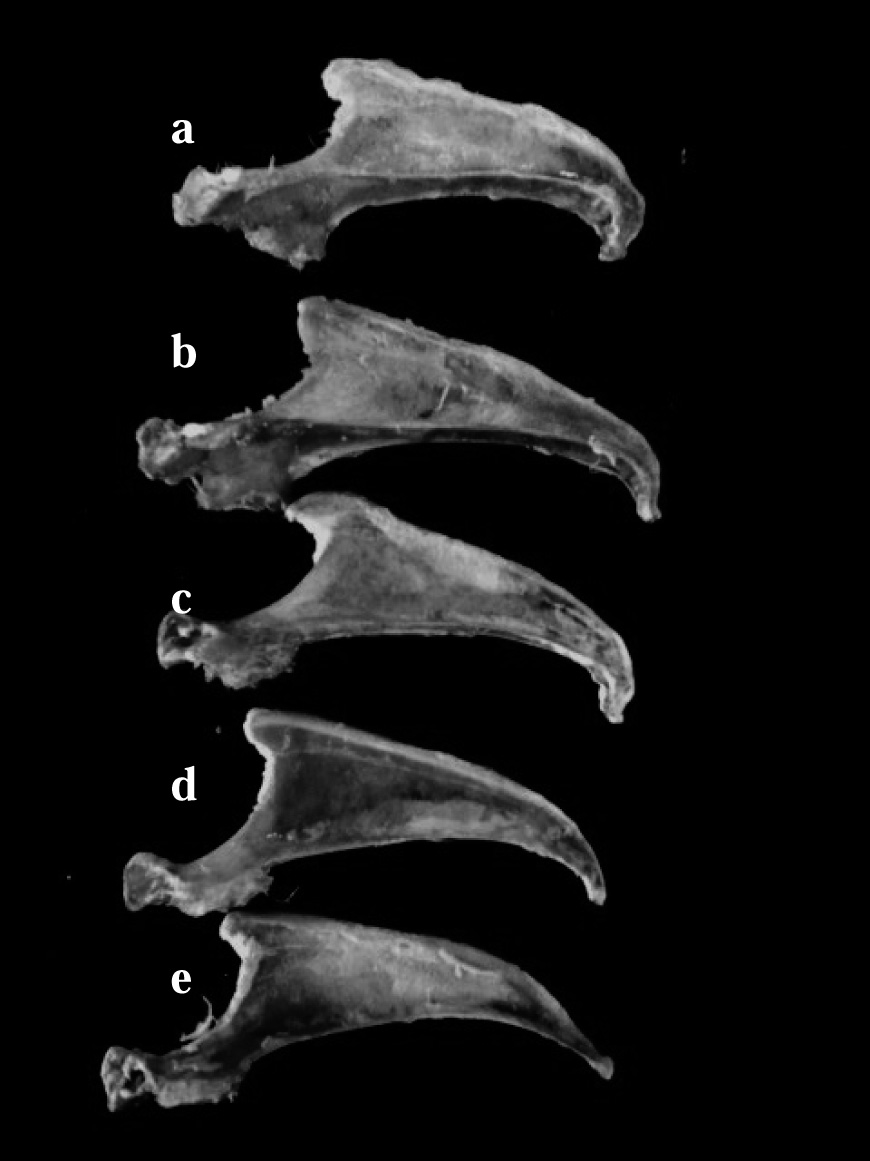
Pressure is placed on the keel bone during roosting causing it to curve or deviate. Fractures of the keel can lead to deformities as old fractures heal. Figure 2a depicts a severe example of keel deformation as compared to a normal keel in Figure 2e. It is well documented that perches in cages as compared to cages with no perches result in greater keel bone deviations (Abrahamsson and Tauson, Reference ABRAHAMSSON and TAUSON1993; Tauson and Abrahamsson, Reference TAUSON and ABRAHAMSSON1994; Reference TAUSON and ABRAHAMSSON1996; Abrahamsson et al., Reference ABRAHAMSSON, TAUSON and APPLEBY1996; Tauson, Reference TAUSON1998; Vits et al., Reference VITS, WEITZENBURGER, HAMANN and DISTL2005; Hester et al., Reference HESTER, ENNEKING, HALEY, EINSTEIN, CHENG and RUBIN2013a).
Keel bones from caged White Leghorns hens at 71 weeks of age. The most severe deformation is depicted in (a) with a normal keel depicted in (e). Severity in keel bone deformation decreases from (a) to (e).
Caged hens with access to metal round perches as compared to hens in barren cages without perches experienced a higher incidence of keel bone fractures. The high incidence of mostly old breaks of the keel in cages with (92 ± 2%a) and without perches (83 ± 2%b, P = 0.009; Hester et al., Reference HESTER, ENNEKING, HALEY, EINSTEIN, CHENG and RUBIN2013a) suggests a serious welfare issue because fractured keel bones induce pain (Nasr et al., Reference NASR, NICOL and MURRELL2012; Richards et al., Reference RICHARDS, WILKINS, KNOWLES, BOOTH, TOSCANO, NICOL and BROWN2012). The increase in bone mineralization as a result of perch use in cages was not great enough to prevent damage and fracture to the keel bone (Hester et al., Reference HESTER, ENNEKING, HALEY, EINSTEIN, CHENG and RUBIN2013a).
Foot health
hyperkeratosis
White Leghorns in conventional laying cages with and without perches have similar foot health scores (lesions of the pad and toes; Tauson, Reference TAUSON1984). Likewise, smooth round metal perches did not cause hyperkeratosis of the feet and toes of White Leghorns as scores were representative of healthy, normal feet and similar to hens without perches (Hester et al., Reference HESTER, ENNEKING, JEFFERSON-MOORE, EINSTEIN, CHENG and RUBIN2013b). In contrast, Abrahamsson and Tauson (Reference ABRAHAMSSON and TAUSON1997) thought that the constant standing and walking on the wired floor of a conventional cage floor without opportunity to perch caused a poorer toe-pad hyperkeratosis score in 55 weeks old hens of conventional cages (score of 3.97) as compared with those in furnished cages which had a round flattened upper surface wooden perch, nest box, and sand box (score of 4.00, P = 0.001). Although the study of Abrahamsson and Tauson (Reference ABRAHAMSSON and TAUSON1997) reported significant difference between conventional and furnished cages with regard to hyperkeratosis, a score of 3.97 for the hens of the conventional cage does not reflect a serious foot health problem. Appleby et al. (Reference APPLEBY, SMITH and HUGHES1992) reported greater foot-pad damage and Tauson and Abrahamsson (Reference TAUSON and ABRAHAMSSON1996) reported more problems with toe pad hyperkeratosis in caged hens without perches as compared to those with perches. Damage to the foot-pad was less in hens that spent more time perching. In contrast to all other studies, Glatz and Barnett (Reference GLATZ and BARNETT1996) reported that caged hens had greater foot damage with access to a rectangular wooden perch as compared to hens without a perch. Because of the hot summer months, these hens were heat stressed and feed consumption was depressed for the perched hens which may have contributed to the poorer foot health. Placement of the perch within the cage and the possibility that the perch was too narrow were also offered as additional explanations for the poorer foot health (Glatz and Barnett, Reference GLATZ and BARNETT1996).
bumblefoot
Bacterial infections cause footpads to swell leading to bumblefoot. Bumblefoot is more prevalent in poorly managed wet littered floor systems (Lay et al., Reference LAY, FULTON, HESTER, KARCHER, KJAER, MENCH, MULLENS, NEWBERRY, NICOL, O'SULLIVAN and PORTER2011). Bumblefoot has also been associated with poor perch design and hygiene, regardless of the type of housing system (EFSA, 2005). For example, bumblefoot scores were poorer for hens in cage systems with perches as compared to cages without perches most likely due to manure accumulation on the surface of the perch (Tauson and Abrahamsson, Reference TAUSON and ABRAHAMSSON1994; Reference TAUSON and ABRAHAMSSON1996). Caged hens housed in small groups of 3 or 4 hens/cage and given access to circular softwood perch installed in cages 7.5 cm from the cage floor did not experience bumblefoot with scores similar to hens in conventional cages without perches. When larger group sizes were used (15 hens/cage) providing multiple height perches in get- away cages, bumblefoot and poorer foot hygiene became a problem. Hens in the get-away cages without perches had no bumblefoot with perfect foot hygiene scores. It was suggested that the presence of the perches in get- away cages caused more water spillage on the perches and dirtier floors leading to bumblefoot (Tauson and Abrahamsson, Reference TAUSON and ABRAHAMSSON1994).
nails
Excessive nail growth can be a problem if hens do not have access to abrasive materials for trimming nails (Roll et al., Reference ROLL, BRIZ, LEVRINO and XAVIER2008). If nails are too long, they can break off more easily causing open, bleeding wounds with increased susceptibility to infection (Lay et al., Reference LAY, FULTON, HESTER, KARCHER, KJAER, MENCH, MULLENS, NEWBERRY, NICOL, O'SULLIVAN and PORTER2011). Long nails of hens can be trapped in the wire floor of poorly designed cages (Barnett et al., Reference BARNETT, GLATZ, NEWMAN and CRONIN1997).
The presence of metal perches in laying cages resulted in shorter nail lengths as compared with the nails of caged hens without a perch. However, the disadvantage was that the jumping on and off the metal perches by the caged hens led to an increase in the incidence of broken nails (back nail only) as compared to hens in cages without perches (Hester et al., Reference HESTER, ENNEKING, JEFFERSON-MOORE, EINSTEIN, CHENG and RUBIN2013b). Other researchers have reported no effect on nail length of hens in conventional laying cages with and without a perch (Tauson, Reference TAUSON1984; Appleby et al., Reference APPLEBY, SMITH and HUGHES1992). In contrast, access to wooden perches in laying cages resulted in hens with longer nails than those in standard cages which might be due to increase perching time, less contact with the wired floor, and the less abrasive nature of wood (Glatz and Barnett, Reference GLATZ and BARNETT1996; Barnett et al., Reference BARNETT, GLATZ, NEWMAN and CRONIN1997).
Feather quality
Beak intact hens in laying cages with a round wooden perch had poorer feather scores for the neck, breast, wings, and tail, but not the back, as compared to hens of conventional cages without perches, perhaps due to more abrasion because of bird to bird contact during perching (Tauson, Reference TAUSON1984). The poorer feather score of the perching hens in this study (Tauson, Reference TAUSON1984) was not due to feather pecking as these hens showed a tendency towards performing less of this undesirable behaviour than the control hens in conventional cages without perches. In contrast to the study of Tauson (Reference TAUSON1984), the presence of a wooden perch in a conventional cage as compared to no perch improved the tail (Barnett et al., Reference BARNETT, GLATZ, NEWMAN and CRONIN1997) and vent (Glatz and Barnett, Reference GLATZ and BARNETT1996) feather scores of beak-trimmed hens, but the total plumage score was not affected by the perch treatment. Feather scores of the breast and tail were poorer in beak-trimmed hens with access to perches in laying cage and were likely due to the contact and rubbing of the breast and tail feathers on the metal perch. In contrast, back feathers were in better condition for perched hens as compared to hens without perches (Hester et al., Reference HESTER, ENNEKING, JEFFERSON-MOORE, EINSTEIN, CHENG and RUBIN2013b). Perhaps hens with perches performed less trampling, or fewer cage mates walked over the backs of one another while sitting on the cage floor. Others have reported that feather condition of hens was similar between laying cages with and without a perch (Barnett et al., Reference BARNETT, GLATZ, NEWMAN and CRONIN1997; Moinard et al., Reference MOINARD, MORISSE and FAURE1998). Using a wide array of perching materials, Appleby et al. (Reference APPLEBY, SMITH and HUGHES1992) also reported no effect of the perch in cages on feather condition. Beaks of hens were not trimmed in the studies of Appleby et al. (Reference APPLEBY, SMITH and HUGHES1992) and Moinard et al. (Reference MOINARD, MORISSE and FAURE1998).
Mortality
Mortality was similar between hens housed in conventional laying cages with and without perches (Dorminey and Arscott, Reference DORMINEY and ARSCOTT1974; Nakaue et al., Reference NAKAUE, GOEGER and ARSCOTT1984; Braastad, Reference BRAASTAD1990; Glatz and Barnett, Reference GLATZ and BARNETT1996). In contrast, non-beak-trimmed ISA Browns in laying cages with wooden perches installed 6 cm from the cage floor experienced increased mortality because of cloacal cannibalism (Moinard et al., Reference MOINARD, MORISSE and FAURE1998). Hens expelling eggs while perching exposed their cloaca to other hens in the cage leading to vent cannibalism (Moinard et al., Reference MOINARD, MORISSE and FAURE1998). Cloacal cannibalism did not occur among hens with metal round perches, and there was no mortality in the beak-trimmed White Leghorns with perches at a height of 8.9 cm from the caged floor (Hester et al., Reference HESTER, ENNEKING, JEFFERSON-MOORE, EINSTEIN, CHENG and RUBIN2013b). Perch height should not have played a major role in the difference in cannibalism incidence between the study of Hester et al. (Reference HESTER, ENNEKING, JEFFERSON-MOORE, EINSTEIN, CHENG and RUBIN2013b) and the one of Moinard et al. (Reference MOINARD, MORISSE and FAURE1998) because the perches were elevated at similar heights. Breed and beak trimming differences between studies are the likely explanations for the opposing results between studies. Perches installed in large cages could possibly decrease the risk of piling and smothering (Hansen, Reference HANSEN1976) though more research is needed due to lack of empirical data.
Body weight
Caged hens with perch access as compared to no perches had lower body weight (Tauson, Reference TAUSON1984; Braastad, Reference BRAASTAD1990; Tauson and Abrahamsson, Reference TAUSON and ABRAHAMSSON1994; Glatz and Barnett, Reference GLATZ and BARNETT1996; Hester et al., Reference HESTER, ENNEKING, JEFFERSON-MOORE, EINSTEIN, CHENG and RUBIN2013b). The perching activity could have led to increased activity. However, others reported no effect on hen body weight as a result of perches in cages as compared to those without perches (Dorminey and Arscott, Reference DORMINEY and ARSCOTT1974; Nakaue et al., Reference NAKAUE, GOEGER and ARSCOTT1984; Appleby et al., Reference APPLEBY, SMITH and HUGHES1992; Barnett et al., Reference BARNETT, GLATZ, NEWMAN and CRONIN1997).
Egg production
White Leghorns and brown hybrids with access to perches in laying cages had similar egg production as hens in conventional cages without perches (Dorminey and Arscott, Reference DORMINEY and ARSCOTT1974; Tauson, Reference TAUSON1984; Braastad, Reference BRAASTAD1990; Appleby et al., Reference APPLEBY, SMITH and HUGHES1992; Duncan et al., Reference DUNCAN, APPLEBY and HUGHES1992; Abrahamsson and Tauson, Reference ABRAHAMSSON and TAUSON1993; Tauson and Abrahamsson, Reference TAUSON and ABRAHAMSSON1994; Wall and Tauson, Reference WALL and TAUSON2007; Hester et al., Reference HESTER, ENNEKING, JEFFERSON-MOORE, EINSTEIN, CHENG and RUBIN2013b). Only Glatz and Barnett (Reference GLATZ and BARNETT1996) reported a decrease in egg production as a result of a wooden perch installed in a conventional cage. Glatz and Barnett (Reference GLATZ and BARNETT1996) attributed the lowered egg production to the placement of the perch 24 cm from the feed trough preventing hens from eating from the perch which is a perplexing explanation for the observed reduction in feed intake. Egg production of caged White Leghorns was not affected by perch placement 18 cm from the feed trough, and these hens were also not able to eat from the front perch because of their inability to reach the feed (Hester, unpublished data). Providing a perch to dwarf White Leghorns with a feed trough height of 25.4 cm as compared to no perch improved egg production (Nakaue et al., Reference NAKAUE, GOEGER and ARSCOTT1984). With a lower feed trough height of 20.3 cm, egg production was similar between dwarf White Leghorns with or without a perch and did not differ from the hens with perches at a feed trough height of 25.4 cm (Nakaue et al., Reference NAKAUE, GOEGER and ARSCOTT1984).
Egg quality
Perch access resulted in caged hens laying eggs with similar shell traits (e.g., shell thickness) as compared with hens without perches (Nakaue et al., Reference NAKAUE, GOEGER and ARSCOTT1984; Hester et al., Reference HESTER, ENNEKING, JEFFERSON-MOORE, EINSTEIN, CHENG and RUBIN2013b). The incidence of cracked eggs increased for hens housed in laying cages with perches as compared to hens in cages without perches (Experiment 2 of Dorminey and Arscott, Reference DORMINEY and ARSCOTT1974; Tauson, Reference TAUSON1984; Duncan et al., Reference DUNCAN, APPLEBY and HUGHES1992; Abrahamsson and Tauson, Reference ABRAHAMSSON and TAUSON1993; Glatz and Barnett, Reference GLATZ and BARNETT1996). If there is no nest in the cage, some hens may lay their eggs from the perch rather than from a standing position on the cage floor. The greater distance for the egg to travel from the perched hen before landing on the cage floor could compromise the integrity of the shell. Even with a nest present in cages, some hens will still lay their eggs from the perch (Alvey et al., Reference ALVEY, LINDBERG and TUCKER1996). Other studies have reported no effect of perches in laying cages on % cracked eggs (Experiments 1 and 3 of Dorminey and Arscott, Reference DORMINEY and ARSCOTT1974; Nakaue et al., Reference NAKAUE, GOEGER and ARSCOTT1984; Appleby et al., Reference APPLEBY, SMITH and HUGHES1992; Hester et al., Reference HESTER, ENNEKING, JEFFERSON-MOORE, EINSTEIN, CHENG and RUBIN2013b). The diverse results could be due to the use of different perch heights and designs as well as shell integrity differences among genetic stock.
In an attempt to reduce cracked eggs, Appleby et al. (Reference APPLEBY, HUGHES, MCDONALD and CORDINER1998) used 38 mm wide softwood rectangular perches that were sloped 8° parallel to the cage floor and reduced the incidence of eggs laid from the perch to less than 1/3. Use of 50 mm wide softwood perches similarly sloped at 8° did not reduce the incidence of eggs laid from the perch; the incidence was high (> 80%) and did not differ from the 38 and 50 mm wide softwood perches that were installed without an angle (referred to as flat perches). Unfortunately, the investigators were unable to repeat the results in a subsequent experiment using the same treatments with the exception that the angled perches were sloped at 10° instead of 8°. The incidence of eggs laid from the perch was 18% for all treatment groups (Appleby et al., Reference APPLEBY, HUGHES, MCDONALD and CORDINER1998).
Perch access resulted in a greater percentage of dirty eggs as compared to eggs from caged hens without perches (Nakaue et al., Reference NAKAUE, GOEGER and ARSCOTT1984; Abrahamsson and Tauson, Reference ABRAHAMSSON and TAUSON1993; Glatz and Barnett, Reference GLATZ and BARNETT1996; Hester et al., Reference HESTER, ENNEKING, JEFFERSON-MOORE, EINSTEIN, CHENG and RUBIN2013b); however, others reported no effect of perches in conventional cages on % dirty eggs (Tauson, Reference TAUSON1984; Appleby et al., Reference APPLEBY, SMITH and HUGHES1992). Differences in hen perching activity and the height of the perch from the cage floor may have contributed to the dissimilarities in % dirty eggs among studies. Perch placement should be of sufficient height from the cage floor (minimum of 6 cm) to allow eggs to roll down the sloped floor to the collection area (Struelens and Tuyttens, Reference STRUELENS and TUYTTENS2009). Perch placement within a cage should also allow hens to stand on the perch without the top of their heads touching the roof of the cage. Eggs can become trapped in cages with perches perhaps due to less movement of hens on the floor of the cage as compared with hens in cages without perches. Perching hens perhaps spend less time walking on the floor of the cage leading possibly to lower vibrations of the floor. Since eggs may arrive later at the collecting area as compared to cages without perches, greater fecal contamination could occur leading to more dirty eggs. Less hen traffic under the perches may not allow manure to fall through the wired cage floor to the manure collecting area as effectively as compared to cages without perches. Downgrades due to dirty eggs may be minimized if table eggs are washed, sanitized, and dried (Hester et al., Reference HESTER, ENNEKING, JEFFERSON-MOORE, EINSTEIN, CHENG and RUBIN2013b).
With dwarf White Leghorns, interior egg quality was not affected by perch access in cages (Nakaue et al., Reference NAKAUE, GOEGER and ARSCOTT1984).
Egg weight
Egg weights were lower (Tauson, Reference TAUSON1984; Hester et al., Reference HESTER, ENNEKING, JEFFERSON-MOORE, EINSTEIN, CHENG and RUBIN2013b) with perch availability in conventional laying cages as compared with control cages without perches. There are other studies which reported that egg weight was not affected by perches in laying cages (Dorminey and Arscott, Reference DORMINEY and ARSCOTT1974; Nakaue et al., Reference NAKAUE, GOEGER and ARSCOTT1984; Braastad, Reference BRAASTAD1990; Appleby et al., Reference APPLEBY, SMITH and HUGHES1992).
Feed usage and efficiency
Furnished cages, as compared to conventional cages, provide more space/hen allowing for more movement. The stepping on and off perches and the traffic to the nest and foraging areas would imply that hens in furnished cages get more exercise. However, hens resting on perches could result in energy savings (EFSA, 2005). Most studies show that perching in cages reduces feed usage. The presence of perches in laying cages resulted in less feed usage as compared with hens in conventional laying cages without perches (Dorminey and Arscott, Reference DORMINEY and ARSCOTT1974; Tauson, Reference TAUSON1984; Braastad, Reference BRAASTAD1990; Tauson and Abrahamsson, Reference TAUSON and ABRAHAMSSON1994; Hester et al., Reference HESTER, ENNEKING, JEFFERSON-MOORE, EINSTEIN, CHENG and RUBIN2013b), but when expressed as feed /dozen eggs, the trend for improved feed efficiency was not significant (Dorminey and Arscott, Reference DORMINEY and ARSCOTT1974; Hester et al., Reference HESTER, ENNEKING, JEFFERSON-MOORE, EINSTEIN, CHENG and RUBIN2013b). At night when perching is more prevalent (Duncan et al., Reference DUNCAN, APPLEBY and HUGHES1992), hens insulate one another (Lill, Reference LILL1968) which results in lower food usage (Tauson and Abrahamsson, Reference TAUSON and ABRAHAMSSON1994; Tauson, Reference TAUSON1998). With dwarf White Leghorns, feed usage was not affected by perch access in cages, but feed efficiency was affected (Nakaue et al., Reference NAKAUE, GOEGER and ARSCOTT1984). Providing a perch to dwarf White Leghorns with a feed trough height of 25.4 cm as compared to no perch improved feed efficiency. With a lower feed trough height of 20.3 cm, feed conversion was similar between dwarf White Leghorns with or without a perch and did not differ from the hens with perches at a feed trough height of 25.4 cm (Nakaue et al., Reference NAKAUE, GOEGER and ARSCOTT1984).
Hen stress
There were no differences in heterophil/lymphocyte (H/L) ratios, cell-mediated immune response, and corticosterone levels (either at rest or in response to adrenocorticotropic hormone) between caged hens with and without wooden perches (Barnett et al., Reference BARNETT, GLATZ, NEWMAN and CRONIN1997).
Research needs and conclusions
A better understanding of how chicks learn to use perches and how perches might be used during pullet rearing to improve hen welfare is needed. No studies have been conducted on the effect of different amounts of perch space on the welfare of White Leghorns. More work is needed on perch design to minimize the incidence of fractured keels. A perch should be designed that allows hen's feet to have a good functional grip on the perch. The perch needs to be composed of a soft material that will reduce the pressure on the keel bone when the hen is resting. The perch should be resilient to wear, not harbour mites, and be easily cleaned.
Providing elevated perches so that hens feel safe and less fearful might create other hen welfare problems such as vent cannibalism or fecal contamination of the hens below. Elevated perches in furnished cages could also lead to more cracked eggs. It is unknown what the minimum height of perches in cages needs to be to optimize hen welfare and to be perceived by the perching hen as a safe haven. Hens feeling safe and hens being safe may be incompatible; a compromise may be needed.
In conclusion, providing cages with perches meets a strong behavioural preference of laying hens. With the exception of dirty and cracked eggs, perches can be installed in cages without detrimentally affecting the production performance of hens. However, they are not without disadvantage with keel fractures of hens being a major welfare detriment. Enriched cages with amenities such as perches can provide a housing system that can capture some of the benefits of cages that are lacking in littered floor and aviaries such as improved hen liveability and air quality for egg laying strains of chickens and animal caretakers.