INTRODUCTION
Attention deficit–hyperactivity disorder (ADHD) is associated with a high risk of low academic achievement, emotional disorder, and social interaction impairments, which can have pervasive negative affects on children's academic performance and work habits (Barkley, 1998). Douglas (1972) put forward the theory of cognitive–neurological deficits and suggested that the core deficits of ADHD were impairments in attention and executive function. In particular, research on executive function in children with ADHD has focused primarily on inhibition (Barkley et al., 1992; Pennington & Ozonoff, 1996). Studies of goal-oriented behaviors, strategy production, and self-regulation have been relatively limited.
Norman and Shallice (1986) introduced the Supervisory Attentional System (SAS) model to account for executive control system deficits. The SAS is designed to control goal-directed behavior in novel situations, including goal articulation, plan formulation, decision making, marker creation, and marker triggering. It entails the contention scheduling and supervisory attention systems, which are responsible for the routine and nonroutine cognitive processes, respectively. The Six Elements Test (SET; Shallice & Burgess, 1991) was specifically developed from this theoretical framework to assess multitasking, efficient subtask scheduling, and time monitoring.
Clark et al. (2000) found that a group of adolescents with ADHD attempted significantly fewer tasks on the SET but did not break more rules compared with a control group without ADHD, which indicated that the adolescents with ADHD were significantly more impaired in their ability to strategically plan and organize information and monitor their ongoing performance.
More recently, Siklos and Kerns (2004) developed a modified SET (C-SET) that is more suitable for younger children with ADHD. They found that children with ADHD had intact retrospective memory but exhibited impairment in the ability to strategically plan, organize information, and monitor their ongoing performance. These findings suggest that the C-SET is a useful measure of rule-governed multitasking behavior in children. However, the reliability and validity of the C-SET have not been fully validated.
Published studies of multitasking performance have predominantly considered English-speaking participants and, almost invariably, Western cultural groups. Very few data have been generated from non-Western samples. In China, research into executive functions has only commenced in the past few years. The pilot study described herein attempted to adopt the C-SET to explore the multitasking behavior of children with ADHD. We also explored the relationship between the C-SET and executive functions. We hypothesized that patterns of multitasking behavior similar to those reported by Clark et al. (2000) and Siklos and Kerns (2004) would be demonstrated. We expected that children with ADHD would attempt fewer tasks than their age-matched controls but would not break more rules than the controls. We also expected to find relationships between the C-SET and executive functions.
METHODS
Participants and Procedure
A sample of 22 children (18 boys, 4 girls) with ADHD participated in the study. The mean age and IQ was 8.39 years (SD = 1.01) and 106.08 (SD = 19.46), respectively. The ADHD participants were recruited primarily through one consultant pediatrician with a clinical practice that served a large urban population in Guangdong Province, China. They had all been diagnosed by a consultant pediatrician as meeting the Diagnostic and Statistical Manual of Mental Disorders, 4th Edition (DSM-IV; American Psychiatric Association, 1994) criteria for ADHD on the basis of a clinical interview. Parents or teachers completed the Child Behavior Checklist (CBCL, Achenbach, 1991) and the Conners' Parent Rating Scale (CPRS, Conners, 1971) that covers the DSM-IV (American Psychiatric Association, 1994) symptoms for ADHD. Inclusion in the study required a diagnosis of ADHD from the consultant pediatrician, a score at or above the clinical cutoff on the ADHD rating scale of the CPRS, and the absence of clinician-based diagnoses of comorbid behavior disorders.
Another sample of 22 healthy children (15 boys; 7 girls) was recruited a regional primary school in Guangzhou for comparison. The mean age and IQ of the control group was 8.23 years and 110.01 (SD = 16.55), respectively. They had no identified problems based on the annual screening conducted by the school and parents, and no comorbid behavior disorders as defined by evaluations of other CPRS scales. None of them had any record of problems from previous screening procedures and no indication of difficulties on any of their school term reports. They were nominated by their teachers and were selected to provide for similarity to the ADHD group based on gender and age (within 1 year).
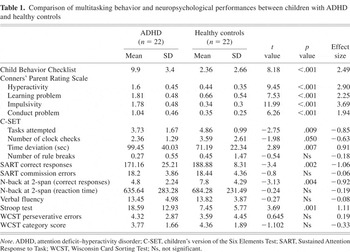
Although the ADHD and control groups did not differ significantly in age, they differed slightly in gender. As shown in Table 1, significant differences in the CBCL and CPRS were found between children with ADHD and the healthy controls. Written consent was signed by all guardians of both the children with ADHD and the healthy controls.
Comparison of multitasking behavior and neuropsychological performances between children with ADHD and healthy controls

For data analyses, we first compared the two groups using independent t test with the significance level set at p < .05. Given the small sample and exploratory nature of the present study, we also calculated the effect size using Cohen's d (Cohen, 1988). The correlations were also conducted to explore the cognitive skills associated with the C-SET to provide useful preliminary information on its validity.
Measures
The study used a Chinese adaptation of the children's version of the SET, referred to as the C-SET (Siklos & Kerns, 2004). The C-SET consists of six tasks: (1) Lego, in which the child was given instructions to build a small catapult; (2) Hidden Pictures, in which the child was required to find hidden objects within a series of pictures and circle them; (3) Pirate Scene, where the child was given a magnetic board with an image of a pirate ship and an island, as well as magnetic pieces of pirates, treasures, treasure maps, and cannons, and was told to place the pieces on the story board and tell the examiner a story about the scene; (4) Mazes, where the child was required to attempt a series of mazes of increasing difficulty; (5) Dinosaur Puzzle, in which the child was required to put together pieces to complete the dinosaur; (6) What's Wrong with This Picture, in which a series of pictures with elements that were “wrong” or “silly” were given to the child, who was required to identify and circle the wrong elements.
Each task was placed in either a red or a blue box on a shelf next to the child in such a way that three tasks were in red boxes and the remaining three were in blue boxes. The child was told to complete each task within 10 minutes according to two rules: (1) although it is not possible to complete all of the tasks in 10 minutes, it is advisable to get the most “points” for at least attempting all six of the tasks; (2) two boxes of the same color cannot be done consecutively. A timer placed in front of the child counted down from 10 minutes as a reminder of the exact time left for the task. Children were instructed to attempt every task and not to spend too long on any individual task. Once all of the tasks and rules were explained to each participant, they were asked a series of questions to ensure that they understood and remembered all of the rules. At the end of the 10 minutes, a check was made to ensure that the child had done what was expected. The number of tasks attempted, number of clock checks, and the number of broken rules were recorded. We added another index—time deviation—to reflect how the children distributed their time across the six subtasks, as well as whether they had preferences for particular materials. This index was measured by any time deviation from an average of time spent over the six tasks, that is, any deviation of time from 100 seconds (10 minutes divided by 6).
Before the formal study, the test–retest reliability of the Chinese version of C-SET at 4-week interval was examined among a group of 27 (15 boys, 12 girls) healthy primary school children 7–12 years of age (mean = 8, SD = 1.2). The reliabilities were high, with coefficients ranging from 0.7 to 1.0 (p values < .01).
A set of comprehensive tests of neuropsychological function was also administered to all participants, including the Sustained Attention to Response Task (SART; Robertson et al., 1997), N-back (Callicott et al., 1998), the modified version of the Wisconsin Card Sorting Test (WCST, Nelson, 1976), the Chinese versions of Verbal Fluency and the Stroop Test (Lee & Chan, 2000). The first two tests, respectively, assessed sustained attention and working memory, whereas the latter three tests measured set shifting, efficiency in associating beginning sounds with spoken words, and response inhibition.
RESULTS
As shown in Table 1, there were no significant differences between the ADHD and control groups in the number of rules broken. The ADHD children performed significantly worse than the control group in tasks attempted, and there was a marginally significant group difference in number of clock checks. The ADHD children also had a longer time deviation than the control group (t = 2.89; p = .007). Similar group differences were found in analyses of covariance that controlled for age and gender. In these analyses, the ADHD children performed significantly worse than the control group in tasks attempted (F = 9.128; p = .004) and deviation of time (F = 10.088; p = .003). They also checked their clocks less frequently than the control group (F = 4.224; p = .046).
The ADHD children performed significantly worse than healthy controls in most of the tests that involved working memory span, sustained attention, and inhibition. The same results were found after controlling for age and gender, with significant differences between the ADHD and control groups in the number of correct responses on the N-back task for N = 2 (F = −3.13; p = .004), the SART (F = −13.14; p = .001), and the Stroop (F = 16.1; p < .001).
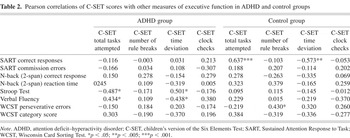
Table 2 summarizes the intercorrelations between different parameters of C-SET and executive functions for the ADHD and control groups separately. For the ADHD group, significant relationships were found between number of tasks attempted on the C-SET and Stroop Test and Verbal Fluency, and the time deviation of tasks in the C-SET and Stroop Test and Verbal Fluency. For the control group, both number of tasks attempted on the C-SET and the time deviation of tasks in the C-SET were significantly correlated with SART correct responses. Moreover, the number of rule breaks in the C-SET was also significantly correlated with the perseverative errors in WCST. Marginally significant correlations (p values < .07) were also found between number tasks attempted on the C-SET and WCST categories completed in both groups.
Pearson correlations of C-SET scores with other measures of executive function in ADHD and control groups

DISCUSSION
This study applied the Chinese C-SET to children with ADHD and healthy children who were 7 to 12 years of age. Our major findings are twofold. First, children with ADHD attempted fewer tasks and had a more variable distribution of time across tasks—a pattern of multitasking behavior that was similar to that reported in previous studies (e.g., Clark et al., 2000; Siklos & Kerns, 2004). Second, very similar intercorrelations between C-SET and neuropsychological test performances were found in both ADHD and control groups. These findings suggest that the impairments in executive function in children with ADHD are manifest in deficits in working memory and self-monitoring.
The results are consistent with previous studies of children with ADHD (e.g., Barkley et al., 1992), and they confirm ADHD-related deficits in self-regulation, planning, and problem solving (e.g., Sonuga-Barke et al., 1996). The children with ADHD in this study attempted significantly fewer tasks but did not break more rules compared with the control group. One of the reasons may be that children with ADHD do better under structure and, thus, were able to follow rules imposed in one-to-one testing, but that they had relatively greater difficulty in self-monitoring.
Evidence that the children with ADHD checked their clocks less often than the children without ADHD also suggested specific impairments in effort distribution and in self-monitoring. The impairment of the ADHD group in self-monitoring offers support for Barkley's (1997) hypothesis that children with ADHD have deficits in internal time regulation. This finding is also consistent with findings by Kerns et al. (2001). In further support of Barkley's hypothesis, the children with ADHD in our study checked their clocks and attempted fewer tasks on the C-SET than the control group. Siklos and Kerns (2004) made a similar observation, noting that their ADHD and control groups differed in the number of times they looked at their clocks during the C-SET. Further studies of the relation between time estimation and performance on tasks such as the C-SET are needed to determine whether the deficits found in our study are due to weaknesses in self-monitoring or in time estimation.
Research has shown that children with ADHD can complete tests quietly and intently under highly structured conditions in which they are provided with clear rules and immediate feedback (Draeger et al., 1986). In contrast, these children are deficient in inhibiting automatic behavior and generating new plans while engaged in everyday activities during play or in the classroom (Campbell et al., 1994). A major virtue of the C-SET is that it simulates multitasking in activities of daily living.
Examination of correlations of C-SET scores with performance on tests involving attention and working memory suggests that the C-SET places demands on these abilities. According to the SAS model, strategy allocation, activation of appropriate markers for the rules of the task, self-monitoring, and updating the current information (working memory capacity) are all processes that must be activated to successfully complete the C-SET. The lack of group differences in rule breaking, thus, suggests that the C-SET activated appropriate rule markers in the children with ADHD, as is consistent with previous studies (Clark et al., 2000; Siklos & Kerns, 2004).
Limitations in this study include our small sample size and the restricted age range of the participants, which precluded investigation of the development of executive functions. The findings nevertheless document the suitability of the C-SET in evaluating multitasking performance among primary school children and highlight its cross-cultural applicability. Future study of a broader age range will enhance the utility of the C-SET as a research tool and shed light on developmental changes in the skills assessed by this task.
ACKNOWLEDGMENTS
The authors acknowledge and thank the children, parents, and teachers who participated in and assisted with this study. The study was partially supported by the 100-Scholar Plan of Sun Yat-Sen University and a National Science Foundation China grant (#30370485) to Raymond Chan.