INTRODUCTION
Structure 719, a two-room residence at the peninsular site of Zacpeten in Lake Salpeten, is one of the latest-occupied, indigenous Maya structures in the central lakes region of Peten, Guatemala. Excavations in the 1990s revealed abundant artifactual and faunal refuse inside and outside, as well as around the associated temple and shrine comprising Group 719 (Pugh Reference Pugh2001:429–443). This refuse included quantities of small, useful, portable objects that reflect “provisional discard” (Hayden and Cannon Reference Hayden and Cannon1983) and “rapid, unplanned abandonment” (Schiffer Reference Schiffer1996:99; see LaMotta and Schiffer Reference LaMotta, Schiffer and Allison1999:22–23; Cameron and Tomka Reference Cameron and Tomka1993; Inomata and Webb Reference Inomata and Webb2003). Since our original publication on Structure 719 (Pugh et al. Reference Pugh, Rice, Cecil, Rice and Rice2009), we have solidified our interpretation of it as a council house, or popol nah, and completed further analyses of the faunal, lithic, and ceramic materials. Here, we address what activities were carried out in a late-sixteenth or seventeenth century Maya council house just before its abandonment.
BACKGROUND: ZACPETEN AND THE KOWOJS
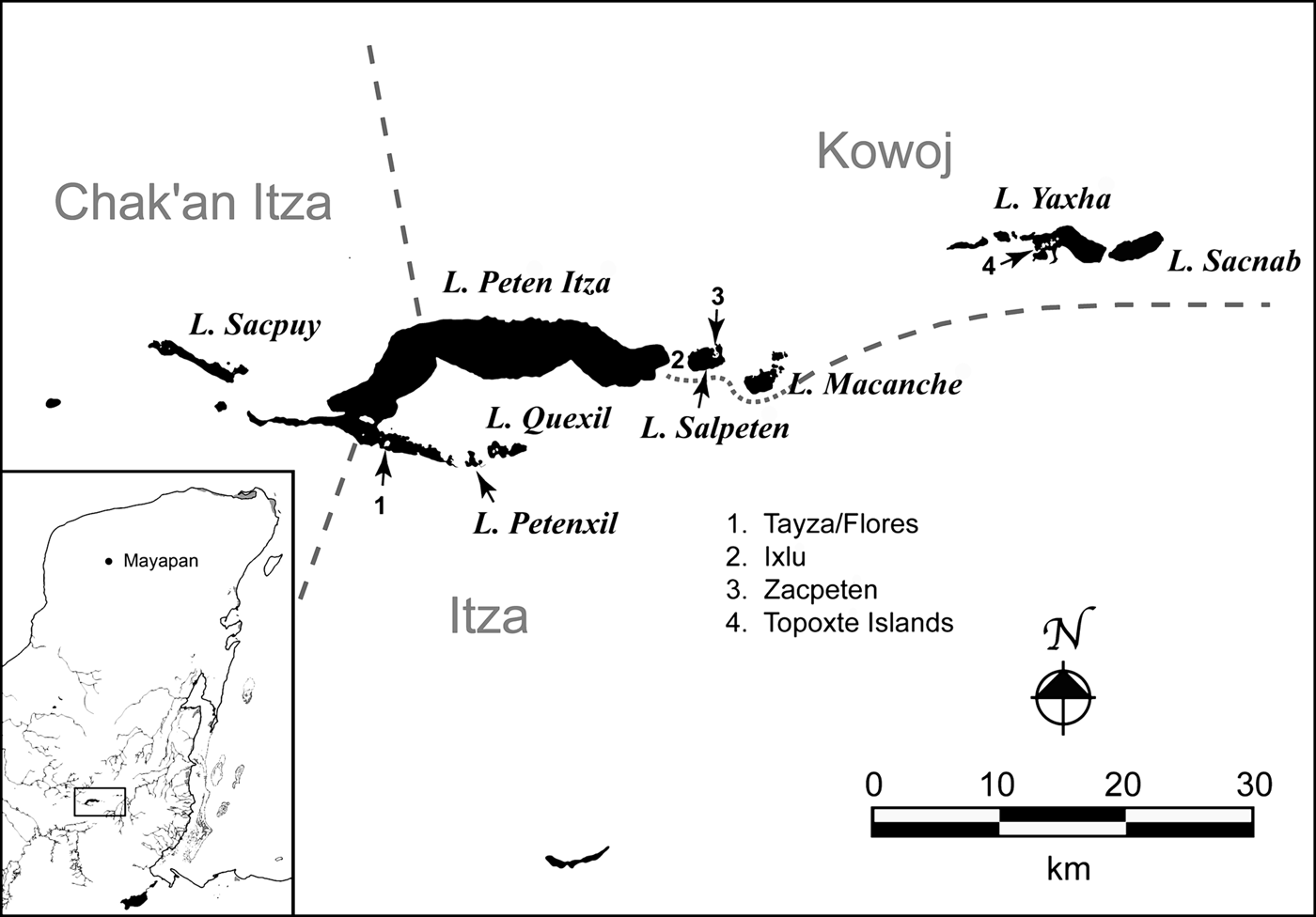
During the Postclassic (a.d. 1000–1525) and Contact (a.d. 1525–1697) periods, Zacpeten was inhabited by two Maya ethnopolitical groups, first the Itzas, centered at Lake Peten Itza in the west (Rice and Rice Reference Rice and Rice2018b), and then the Kowojs in the east at Lake Yaxha (Figure 1; Rice and Rice Reference Rice and Rice2009). An expansionist faction of Kowojs took over the Itza community, probably around the mid- to late-fifteenth century, after abandoning their political center on the Topoxte Islands. This faction challenged Itza dominance, moved westward, and occupied Itza towns. They developed an alliance with the Chak'ans, a western faction of Itzas, against the Itzas led by the Ajaw Kan Ek'. At Zacpeten, the Kowojs built two temple assemblages, their signature civic-ceremonial complexes also known at Late Postclassic Mayapan (Yucatan), placing one (Group A) on the foundations of an earlier Itza basic ceremonial group (see Proskouriakoff Reference Proskouriakoff, Pollock, Roys, Proskouriakoff and Smith1962:89–91). They built another at Ixlu on the western edge of Lake Salpeten (Rice and Rice Reference Rice and Rice2016). The Kowojs also constructed Structure 719, an elite or noble residence (Pugh et al. Reference Pugh, Rice, Cecil, Rice and Rice2009).
The central Peten lakes district, showing the locations of Zacpeten, Kowoj, and Itza (and Chak'an) territories at the time of conquest, and sites mentioned in the text. The short dotted line indicates the area of late Kowoj westward expansion into Itza territory. Map by Don S. Rice.

In 1695–1696, Zacpeten (Sakpeten) was identified to inquiring Spanish officials as one of five villages around lakes Salpeten and Macanche, east of Lake Peten. These were under the jurisdiction of reyzuelo (petty king) Cincantek (Villagutierre Soto-Mayor Reference Villagutierre Soto-Mayor, Wood. and Comparato1983:272), probably Ajaw B'atab' K'in Kante (Jones Reference Jones1998:95–96). This individual, a priest and one of four principal regional governors (ajaw b'atab') of the Itza ruling council (k'in), was an uncle or another close relative of the Itza leader Ajaw Kan Ek'. Nonetheless, he was allied with the eastern Kowojs and the western Chak'an Itza faction in war against the Ajaw.
In March 1697, Spanish forces from Campeche brutally assaulted the Itza island capital of Tayza (modern Flores Island), in southwestern Lake Peten Itza (Jones Reference Jones1998). The years immediately following conquest were devastating for both Spaniards and Mayas. The Itza and Kowoj residents of the lake basins quickly fled into the forested interior, away from the presidio on Remedios (Nuestra Señora de los Remedios y San Pablo, Laguna del Itza), the newly renamed island. If we trust radiocarbon dates from domestic structures at Zacpeten, households or co-residential units abandoned the site at different times, some by the early sixteenth century (e.g., Structure 732), and others by the time of Spanish conquest (Structure 747; Table 1). Structure 719 seems to have been occupied for some unknown time thereafter.
Radiocarbon date ranges in Gregorian years a.d. (2-sigma; bimodal intercepts of calibration curve; 95 percent probability) from Zacpeten domestic structures. Data from Pugh Reference Pugh2001:433, 446, 451; Pugh and Rice Reference Pugh, Rice, Rice and Rice2009:Table 5.2.

a Structure 719 had four intercepts, the unlikely latest two at 1835–1878 (4.6 percent) and 1916+ (18.3 percent).
Post-conquest Zacpeten, 25 km east-northeast (straight-line distance) from Remedios, might have been a center of resistance and a temporary refuge of sorts from the ravages of disease and conflict, at least for Kowojs. An epidemic of an unknown disease, possibly influenza, swept through the lakes region in 1699 (Jones Reference Jones1998:377–379). Armed violence among and between Itza and Kowoj factions, and between them and the Spaniards, accelerated alarmingly, culminating in a rebellion in 1704 (Jones Reference Jones1998:377–386, 397–401). Before and after this rebellion, the Spaniards established new congregación mission towns around Lake Peten to subdue and catechize the natives. Some Itzas, Kowojs, and others voluntarily came to live in these new towns, while others from as far away as (present-day) western Belize were forcibly moved there by Spanish soldiers. It is not known when or where the residents of Zacpeten resettled, or if the abandonment of the community was voluntary or forced.
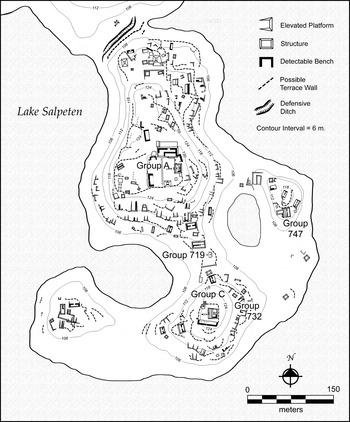
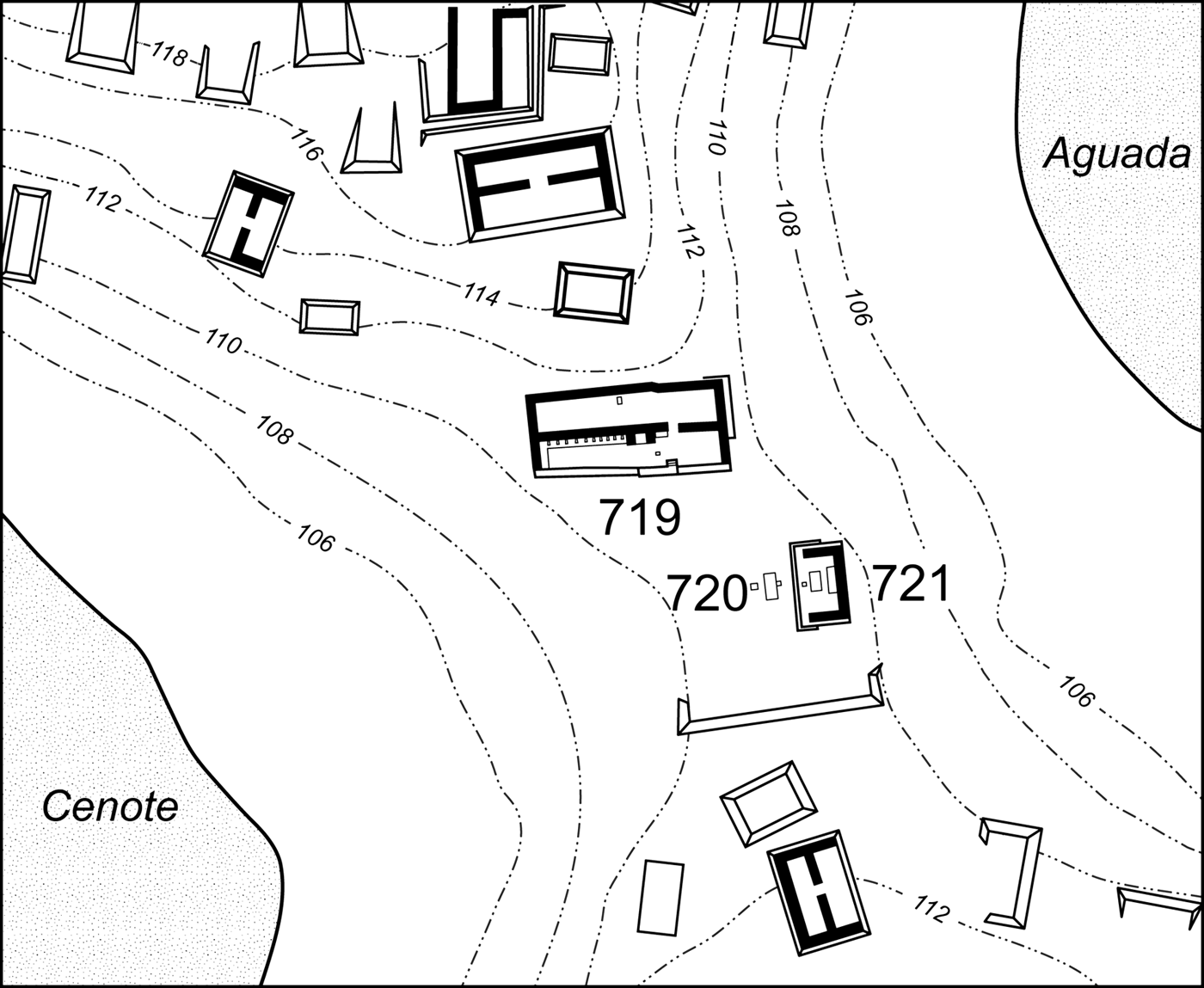
Structure 719 is one of three constructions in Group 719, which occupies a low saddle in the west-central portion of the Zacpeten Peninsula (Figure 2). The structures perch upon an irregular platform with elevations dropping to the west, south, and east (Figure 3). This complex is situated between the higher elevations supporting temple assemblages Group A to the north and Group C to the south, and between two small bodies of water: an embayment (probably a collapsed cenote) of the lake to the west and an aguada to the east.
The peninsular site of Zacpeten in Lake Salpeten, with location of structures and groups mentioned in the text. Map by Don S. Rice.

Group 719, on a low saddle between two bodies of water. Heavy black lines indicate structure walls. Temple assemblage Group A is on a higher elevation to the north; Group C is on an elevation to the south. Note other tandem structures nearby. Map by Don S. Rice.

Architecturally and functionally, Group 719 resembles the site's distinctive Postclassic civic-ceremonial temple assemblages: a hall on the north (Structure 719) and, to the southeast, a small temple (Structure 721) containing rectangular rear and central altars. It was destroyed by fire at or around the time of abandonment. A small, low masonry shrine (Structure 720) with two small masonry rectangles to the east and west sits in front (west) of the temple.
Group 719 also resembles Classic and Postclassic popol nah complexes in the highlands and lowlands. A popol nah is a council house or “mat house” (pop “mat”; nah “house”) with presumed community functions in governance and decision-making. Pop refers to a simple woven reed mat, considered the symbolic “seat of authority” of Maya lords. Physically, these structures vary through time and across the Maya region, but they are generally single-roomed halls, much wider than deep, that may have multiple entrances or colonnades and interior benches. They may be associated with other structures such as shrines, oratories, or temples (see Bey and May Ciau Reference Bey, May Ciau and Braswell2014; Cheek Reference Cheek2003; Fash et al. Reference Fash, Fash, Lane, Larios, Schele, Stomper and Stuart1992). These halls might have served as “men's houses” where priests and others involved in temple rituals passed the required preceding periods of fasting and sexual continence.
Proyecto Maya Colonial carried out archaeological fieldwork at Zacpeten in 1995–1997, primarily through horizontal clearing: removal of the upper 30–50 centimeters of surface soils and forest duff (Level 1) and masonry structural collapse (Level 2) down to the last living surfaces. Test soundings to bedrock were excavated to evaluate construction histories. Project activities in Group 719 involved clearing of 532 m2 (in 1 × 1 m units) inside and outside Structure 719, plus nine test pits; Structures 720 and 721 were exposed by 168 m2 of clearing (Pugh Reference Pugh2001:429–444). Excavated soils were screened through one-eighth-inch hardware cloth.
STRUCTURE 719
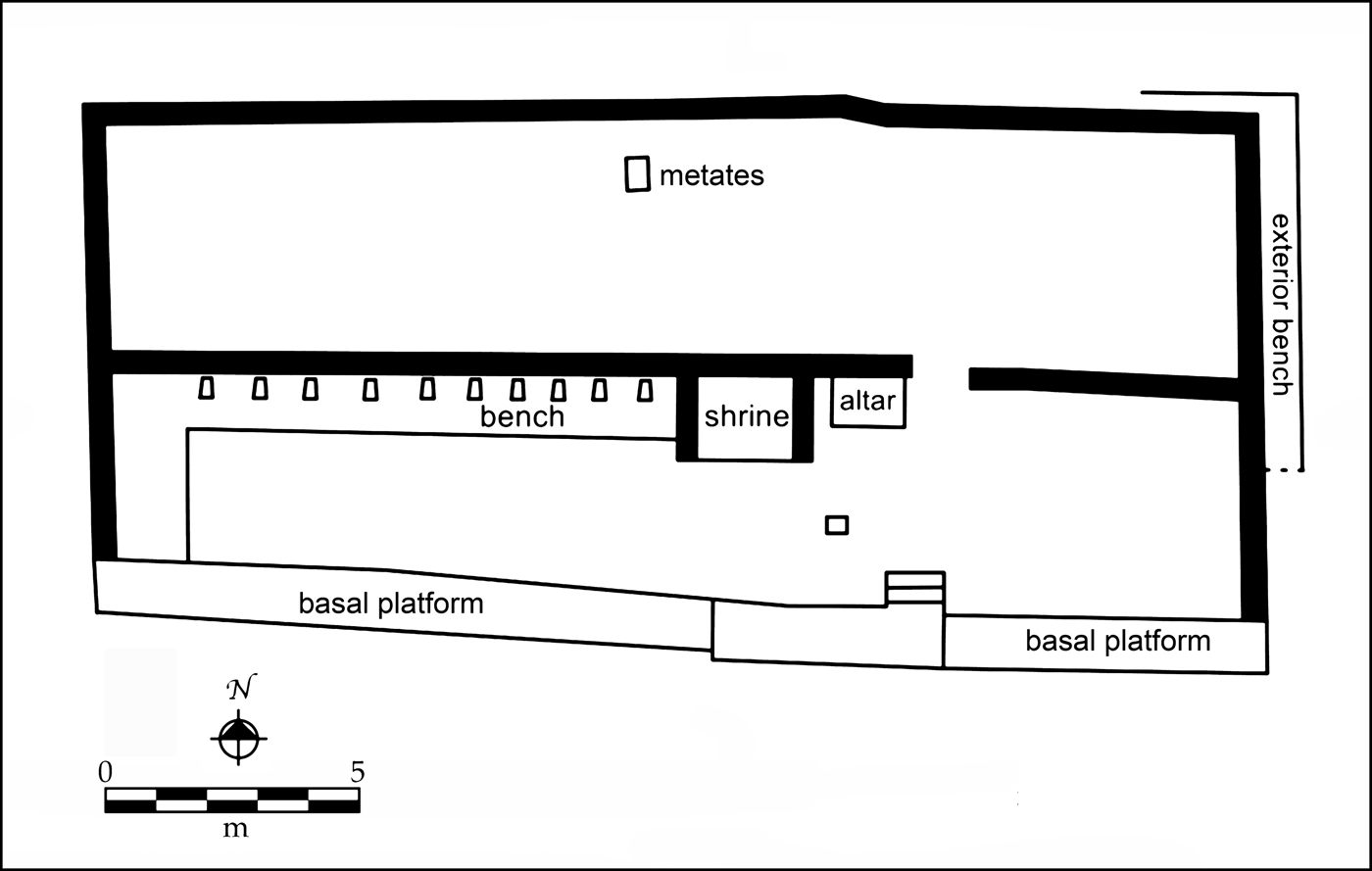
Structure 719 consists of the foundation walls of a large, south-facing, rectangular building (Figure 4). Measuring approximately 24 m east-west by 11.5 m north-south, it is a “tandem” structure with two narrow rooms, one behind the other and separated by a low wall (see Pugh Reference Pugh2001:429–443, 471–491). The side, back, and transverse wall foundations, 30–50 cm thick and probably originally 80–100 cm high, were constructed of typical Postclassic masonry—two parallel lines of large, roughly shaped stones encasing rubble (Pugh and Shiratori Reference Pugh, Shiratori, Rice and Rice2018)—and supported upper walls and roofing of perishable materials. Structure 719 was built over an earlier Late Postclassic structure, presumably residential, and its asymmetry reveals that it was remodeled some time later with an eastern addition. Exterior features include the low, 1.2 m-wide, basal platform with steps in the front and a 70 cm-wide platform wrapping around the northeast corner.
Plan of tandem Structure 719, showing interior and exterior features. Map by Don S. Rice after original drawing by Timothy W. Pugh.

Architectural detail, artifact distributions, and ethnohistorical data reveal that the two rooms of tandem structures, front and back, had distinct functions. The front room, a vestibule or anteroom, was open (to the south in the case of Structure 719), probably with now-disintegrated wooden timbers supporting the roof, and had a plaster floor. Structure 719 was entered east of center by two steps up from the basal platform. The western portion of the vestibule was distinguished by an L-shaped masonry bench against the transverse and west walls. The upper surface of the long axis of the bench was divided into 11 seats by 10 dressed limestone dividers, likely removed from Classic buildings, embedded in the fill. It was unclear if the smaller, damaged western arm of the bench also had such dividers. The surface and upper front edges of the bench were plastered and painted with red curvilinear designs resembling those on Kowoj pottery. Blotches of red paint were visible on the plastered floor (Pugh Reference Pugh2001:430).
A medial shrine stood adjacent to the bench and against the transverse wall, with a small box-like altar just to its east. Both were plastered. In addition, the altar had red and black painted designs of dots and lines, and the preserved plaster bore evidence of multiple layers of stucco and paint, testifying to periodic renewal. A narrow opening in the transverse wall, just east of the altar, permitted passage between the front and back rooms. On the floor south of the altar was a small masonry rectangle of unknown function, possibly a column support. The plastering and painting of the bench, shrine, and altar appeared to have been recent events, likely part of the remodeling and possibly occurring very shortly before abandonment. The thick painted stucco of the bench might have also been destroyed soon after, as no painted portions of the stucco remained affixed to the wall. Instead, hundreds of fragments of this plaster lay at the foot of the bench (Pugh Reference Pugh2001:430).
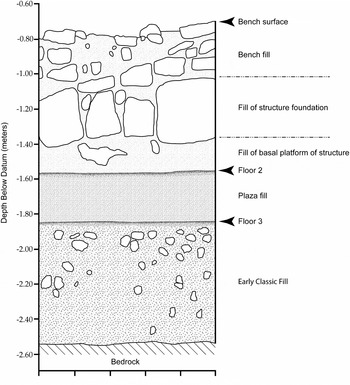
A test sounding near the center of the northern bench penetrated 1.85 m of construction before reaching bedrock (Figure 5). The lowest construction was approximately 70 centimeters of Early Classic fill; as identified in other test units, this structure was oriented 65° east of north and was topped by a thin plaster surfacing (Floor 3). Above was approximately 25 centimeters of fill (plaza construction), which was initially dated to the Early Postclassic. Subsequent excavations in Itza territory, however, revealed that many decorative diagnostics of Late Postclassic pottery are rare outside of Tayza/Flores (Rice Reference Rice2017; e.g., Ixlu; Rice and Rice Reference Rice and Rice2016), and we now consider the plaza to actually date to this later period. This fill was also capped by thin plaster surfacing (Floor 2). Late Postclassic fills of the basal platform were overlain by large (20–40 cm) stones of the structure foundation itself and topped by the 40 cm-thick rubble of the bench fill.
East profile of a test unit placed in the central seat of the bench in the front room of Structure 719. Image by Don S. Rice after original drawing by Timothy W. Pugh.

Tandem structures are typically elite residences at sites throughout the Postclassic and Contact period Maya lowlands. Some of them in the Peten lakes area also appear to have served civic-ceremonial functions as council houses. The open anteroom permitted the community to witness politico-ritual activities and persons, ostensibly facilitating fairly transparent governing by the ruling council. At the Itza island capital of Tayza in early 1697, visiting Franciscan father Andrés de Avendaño y Loyola (Reference Avendaño y Loyola, Bowditch, Rivera and Comparato1987:34) describes meeting with the ruler, Ajaw Kan Ek', in just such a structure:
… the hall [where] the King or Ah Canek has a vestibule to his house, in which he receives his guests as he did us, although in addition it has the floor covered with bitumen [a Spanish term for various colored or painted substances] and polished … . At the entrance of the said hall stands a large stone table more than two yards [varas; 80 cm] long and proportionally broad, placed on stone columns, with twelve seats of the same around it for the priests … . [T]he number of people who ran together at the novelty of seeing us was so great, that besides filling all the hall inside, those who could not find a place there obstructed on the outside all the light the hall had … .
The Peten Itzas of Tayza led a political confederacy with a ruling council of local leaders (Jones Reference Jones1998; Rice and Rice Reference Rice and Rice2018a), who apparently met in the Ajaw's anteroom, seated around this stone “table.” Little is known about Kowoj political structure, but the existence at the late Kowoj site of Zacpeten of a similar tandem Structure 719, with ten or more formal seats but minus the table in the vestibule, raises the possibility of a similar council form of governance.
The back room of Structure 719 had only dirt flooring, which was at the same level as the plastered front room. It lacked masonry and other architectural features, although two large limestone metates were embedded together in the floor near the rear center of the room and two unslipped jars were embedded in the floor against the transverse wall, just north of the shrine. These jars held carbonized remains, including maize, which yielded calibrated dates of a.d. 1640–1700 and 1720–1820 (Table 1; Pugh Reference Pugh2001:433). Unlike the plaster floor of the publicly visible front room, which was largely swept clean, the floor of the back room was cluttered with artifacts and de facto or primary refuse, revealing multiple productive activities. Sherds and lithics were concentrated in the perimeters of the room, next to the walls, with the central east-west space of the room relatively clear. Two test soundings, outside and in front of the structure, probed significant deposits that appeared to be ritual refuse. One was in front of the front steps and the second, larger deposit lay at the southwest corner, underlying the plaza floor.
POTTERY
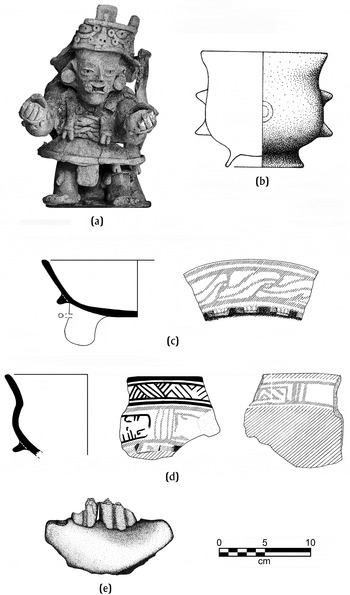
The Postclassic pottery vessels encountered in the interior of Structure 719 gave us our first clues to its rapid abandonment. As reported previously (Pugh Reference Pugh2001:433, 435–436; Pugh et al. Reference Pugh, Rice, Cecil, Rice and Rice2009:194–203), both the front and back rooms included whole or largely reconstructible slipped and decorated tripod plates and jars (Figures 6c and 6d), unslipped utility jars, and incense burners. In total, 36,589 pottery fragments were recovered from in and around the building.
Pottery and cow bone from Structure 719, front room. (a) Profile and exterior decoration (burned) of a Macanche Red-on-paste tripod dish with a notched basal flange. (b) Profile and decoration (polychrome exterior; interior red on paste and red slip) of a small Saca Polychrome collared jar with notched basal flange (left to right). (c) Mumul Composite (spikes and disk) censer from the east side. (d) Reconstructed Kulut Modeled effigy censer from atop the medial shrine. (e) Center portion, labial side, of the left mandible of a cow recovered north of the Kulut effigy censer on the medial shrine. Drawing by Don S. Rice after original drawings by Prudence M. Rice.

Slipped pottery was made of two distinctive pastes: marly Clemencia Cream Paste (CCP) ware, associated with the Kowojs, and gray-to-tan Snail-Inclusion Paste (SIP) ware, made by the Itzas (see Cecil Reference Cecil2001, Reference Cecil, Rice and Rice2009). The pottery in the front room was primarily ritual in function, including a partially reconstructible Saca Polychrome (SIP) collared bowl found with censers in the east part of the room and at least six decorated, slipped dishes, possibly paired by type. Two of these were Macanche Red-on-paste type, featuring distinctive red-painted Kowoj decoration on the Itzas’ SIP ware and proposed to be products of the western Chak'an Itza faction. In the rear room, a partially reconstructible Ixpop Polychrome (SIP) vessel and another of Macanche Red-on-paste lay near the two Chilo Unslipped (UCP) ollas embedded in the dirt floor next to the transverse wall. A miniature Chilo vase was found against the back wall.
Postclassic incense burners are of two forms: composite (vases or bowls with appliqued spikes, disks, and/or fillets with finger [nail] impressions; Figure 6b) and effigy (a pedestal vase with a whole or partial modeled anthropomorphic effigy figure attached to the side; Figure 6a). Effigy incensarios were found only in the front room of Structure 719; composite censers were recovered in both front and back. In the front room, a reconstructible Kulut Modeled (UCP ware) effigy censer, with traces of red, black, and blue pigment and a small cup in its receptacle, was recovered on the west side of the medial shrine along with part of a cow mandible (Figure 6e; Freiwald and Pugh Reference Freiwald and Pugh2018; Pugh Reference Pugh2001:435; Pugh et al. Reference Pugh, Rice, Cecil, Rice and Rice2009:195, Figure 9.2). Kulut censers have been identified only at Kowoj sites and the effigy figure is thought to represent either the Maya creator god Itzamna or an ancestor.
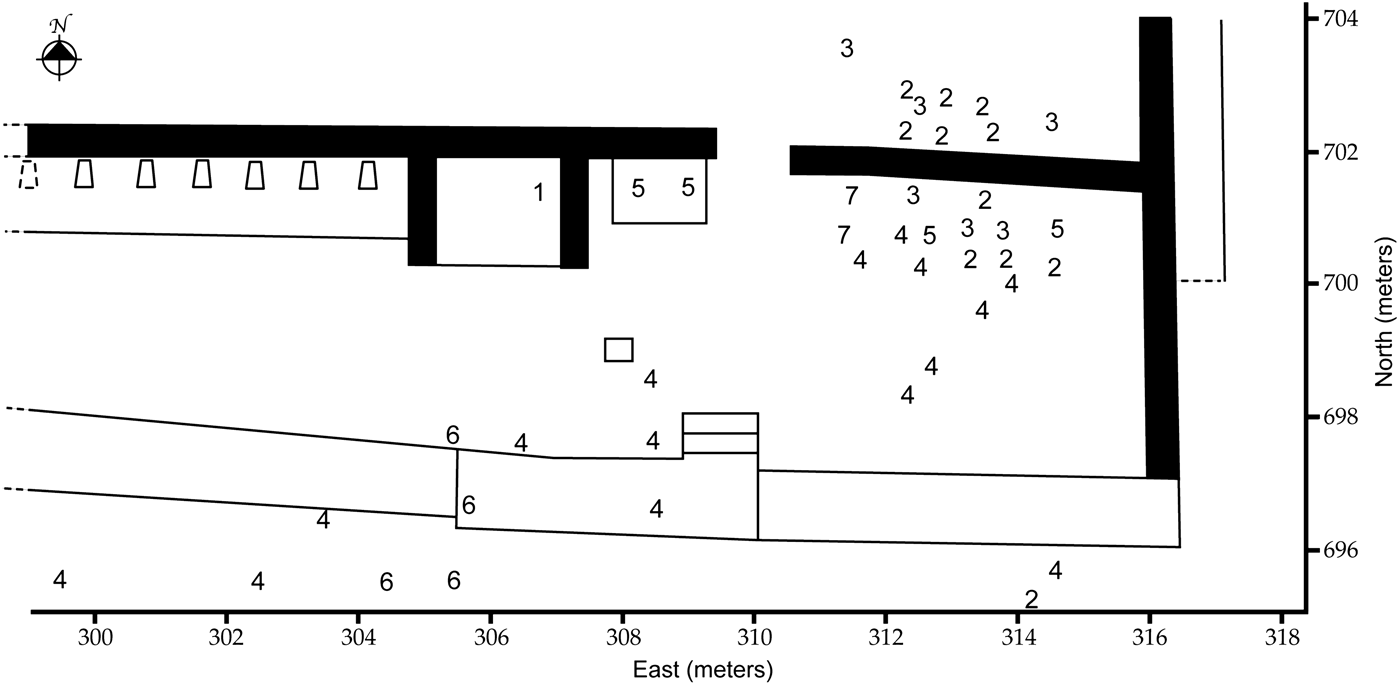
The east side of both front and back rooms held scattered fragments of at least 11 and possibly as many as 15 partially reconstructible composite incensarios of five different types/pastes (Figure 7; Pugh et al. Reference Pugh, Rice, Cecil, Rice and Rice2009:208–209). Three of the types were represented by three vessels, each displaying a different degree of interior burning, assessed as heavy, moderate, and light. These burning patterns were interpreted in terms of “k'atun idols” in Yucatan, with overlapping rotations through three 10-year periods of service (Tozzer Reference Tozzer1941:168, n885; also Chase Reference Chase, Chase and Rice1985). The heavily burned censers were likely at the end of their 30-year duty and about to “retire,” whereas those lightly burned were recently introduced as “guests” for 10 years.
Distribution of censer fragments in the eastern part of Structure 719: (1) Kulut Modeled; (2) Mumul/Zaklak Composite; (3) La Justa Composite; (4) Gotas Composite; (5) Extranjeras Composite; (6) Patojo Modeled; and (7) Chilo Unslipped tripod. Map by Don S. Rice after original map by Timothy W. Pugh.

Temple Structure 721 also held scattered fragments of at least 12 effigy and at least 11 composite censers, smashed and burned.
Chemical and Petrographic Analyses
Sixty pottery fragments (55 slipped vessels and five incense burners) were examined through chemical (Instrumental Neutron Activation Analysis) and petrographic (thin-section) analyses as part of a broader study of Peten Postclassic pottery production and exchange (Cecil Reference Cecil2014). These samples represent red-slipped Itza SIP (n = 48) and Kowoj CCP (n = 10) wares, plus incensarios of Montículo Unslipped ware and the very late Uapake Carbonate Paste ware (UCP). To ensure capture of technological and decorative variability, samples were selected by stratified random sampling on all red-slipped wares and censers.
The five sampled incense burners represent four different chemical compositional groups (Table 2), indicating manufacture by at least four producer units. Two Tirso Modeled samples fall into the same compositional group as the CCP ware decorated samples (CCW1) manufactured around Lake Yaxha. The Pitufo Modeled (SIP) sample, the leg of an effigy censer, is similar to SIP ware samples but with weathered calcite-rich clay (TSG5; a different compositional group than that of the slipped types [TSG4]) and characterized by high concentrations of strontium and barium (PCEN3). The probable location of manufacture for this group is the Zacpeten-Macanche area. The Kulut Modeled (UCP ware) fragment has abundant angular calcite; chemically, it is in a group (PCEN6) with high concentrations of calcium and lower concentrations of strontium and barium. The location of production of this chemical group is unknown, but within the Peten lakes region. The La Justa Composite spiked censer (Montículo ware) from the back room represents a chemical group (PCEN9) distinguished by high concentrations of all elements except potassium, cesium, rubidium, strontium, and calcium. This sherd is the only composite censer in that chemical group, which otherwise consists of all effigy incensarios characterized by inclusions of grog from Classic volcanic ash paste ware. This group was most likely manufactured at Zacpeten.
Chemical and technological style groups of analyzed red-slipped pottery and incense burners from Structure 719.

The slipped pottery samples fell into two distinct chemical groups that correlated with their paste ware designations (Table 2), although a number were unassigned. These unassigned samples could be statistical members of two different chemical composition groups and are not outliers representing non-local pottery. Most of the SIP samples constituted a single chemical group (SIP2) characterized by higher concentrations of strontium and lower amounts of barium. Mineralogically, the group is distinguished by the presence of chert and twinned calcite inclusions. All of the CCP sherds fall into a separate geochemical group (CCW1) with high calcium, strontium, manganese, cobalt, and arsenic, along with plagioclase and chert mineral inclusions (in addition to the common calcite). This group was produced in the Lake Yaxha region.
Most of the analyzed slipped SIP pottery samples were from the back room of Structure 719 (Paxcaman Red, Ixpop Polychrome, Saca Polychrome, Macanche Red-on-paste, and Picu Incised). Only two slipped fragments from the front room were analyzed: a rare Trapeche Pink (SIP ware) body sherd and a Cante Polychrome (CCP ware) tripod plate. Pottery from outside the structure was from secondary refuse. Samples from the east side consisted primarily of monochrome slipped SIP sherds, plus a plate of Ixpop Polychrome and another of Cante Polychrome. Most of the pottery from behind (north of) the structure came from the west side and had eroded decoration: a Mengano Incised (SIP) jar, a Saca Polychrome jar, and a Chompoxte Red-on-cream: Akalche variety plate (CCP).
Decorated serving wares from the refuse deposits in front of Structure 719 were also analyzed. Five samples came from the large deposit under the plaza fill at the southwest corner: a Picu Incised jar; two plates and a jar of Chompoxte Red-on-cream: Akalche variety; and a jar of Cante Polychrome. Analyzed pottery from the later deposit at the base of the front stairs included three jars (Cante Polychrome, Macanche Red-on-paste: Tachis variety, and Paxcaman Red), and tripod plates of Macanche Red-on-paste (variety unspecified), Fulano Black (n = 2), and Ixpop Polychrome (n = 2).
Figurines
Besides serving vessels and incense burners, nine fired-clay figurines or fragments were recovered in and around Structure 719, ranging in date from Late Classic (n = 4) through Terminal Classic (n = 4; including two of a local emulation of Fine Orange ware), and one Postclassic. A Terminal Classic frog-like zoomorph was recovered in refuse to the east of the structure; all others were anthropomorphic, five in the front room and three in the back. It is surprising that Late and Terminal Classic figurines were found among the very Late Postclassic ceramics on these living surfaces, but the same is true of other Zacpeten structures: only three of 35 recovered figurines at the site were Postclassic in date, judged by style and paste (Christina T. Halperin, personal communication 2017). The majority must have been found objects or heirlooms.
LITHIC ARTIFACTS
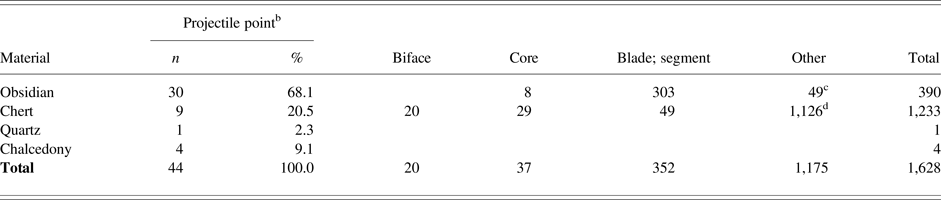
Structure 719, especially its back room, yielded abundant chipped and groundstone lithic artifacts. Great quantities of in situ production debitage testify to manufacture of chipped tools of varied materials, including imported obsidian and local chert and other siliceous stone (Table 3). More chert bifaces and biface fragments were recovered in Structure 719 than in any other Zacpeten structures except those in temple assemblage Group A. These lithic artifacts were the focus of two recent studies, one on small projectile (arrow) points, particularly of obsidian and their sources (Meissner Reference Meissner2014, Reference Meissner2017), and the other on the technology of making varied flaked tools and milling stones (Yacubic Reference Yacubic2014).
Chipped stone artifacts and artifact fragments, excluding flakes and debitage, by raw material in Structure 719. Data from Meissner Reference Meissner2014; Pugh et al. Reference Pugh, Rice, Cecil, Rice and Rice2009:Table 9.2; Yacubic Reference Yacubic2014:Table 8.

a Excluding flakes and debitage.
b Meissner Reference Meissner2014:413.
c Including flakes and shatter (Yacubic Reference Yacubic2014:Table 8).
d Debitage (Yacubic Reference Yacubic2014:Tables 19 and 20).
Obsidian and Small Projectile Points
Eight obsidian cores were found in and around Structure 719 (Pugh Reference Pugh2001:Figure 9-16), more than all the other excavated Zacpeten structures combined. As elsewhere in the Maya lowlands, obsidian cores were imported, having already been prepared (via early-stage blade-core methods) at the highland quarry sites for further work by consumers (Yacubic Reference Yacubic2014:118, 137). The two limestone metates embedded in the floor of the back room might have been used as anvils for preliminary reduction of these cores. Indeed, concentrations of prismatic blades were noted just east of this feature (Pugh Reference Pugh2001:Figure 9-15). Evidence for obsidian tool production exists in the form of early-stage and “late-stage pressure blade production, bladelet production, blade-core maintenance and bipolar-flake production” (Yacubic Reference Yacubic2014:134). A deer antler with evidence of use was found in the front room, possibly employed in final pressure flaking.
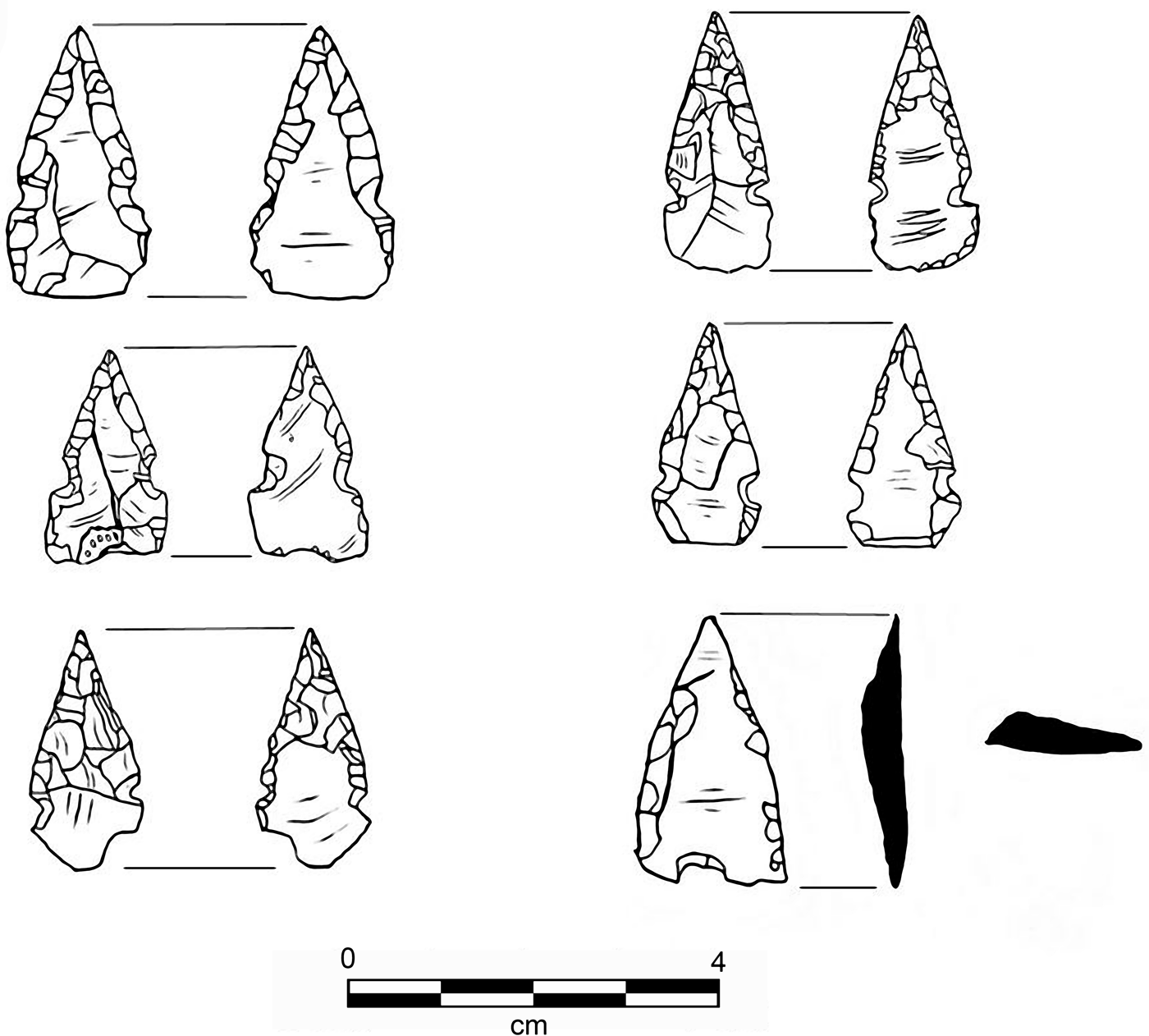
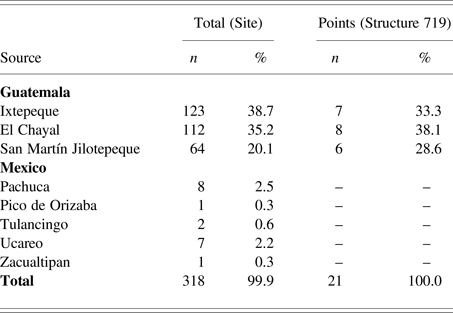
Obsidian working was likely directed toward production of small projectiles or arrow points (Figure 8; Meissner Reference Meissner2014:413; Yacubic Reference Yacubic2014:112). Of all the structures excavated at the site, Structure 719 yielded more obsidian prismatic blade segments (n = 303) than any other, and also the highest frequencies of projectile points per excavated square meter in comparison to other civic-ceremonial structures (0.08/m2; n = 44; Meissner Reference Meissner2014:413, Figure 7.29). X-ray fluorescence (XRF) analyses (Rice and Cecil Reference Rice, Cecil, Rice and Rice2009; Meissner Reference Meissner2017 used pXRF) revealed that 90 percent of the more than 300 analyzed obsidian artifacts throughout the site came from varied Guatemalan source flows (Table 4). The chert and other siliceous stone points were assumed to be made of local materials, although one point recovered from a bench seat was made of honey-brown chert from the Northern Belize Chert Bearing Zone.
Small chert and chalcedony projectile points from Structure 719 made on flake blanks. Note differences in bases. Drawing by Nathan Meissner.

Instrumentally sourced (XRF and pXRF) obsidian at Zacpeten. Data from Meissner Reference Meissner2017:Table 2; Rice and Cecil Reference Rice, Cecil, Rice and Rice2009:331,334; Yacubic Reference Yacubic2014:108.

At least five obsidian points had signs of impact damage (n = 3) or repair (n = 2), but no impact damage was observed on the microcrystalline silicate points. The repaired points were found in the front room near the bench, whereas the unrepaired points were found outside the structure near the front of the building. It is difficult to interpret any definitive cultural patterns with a sample size this small, but the current data could suggest that points from the back room were unused. Several microcrystalline silicate points had signs of thermal alteration (n = 4), although the pot lid fractures likely indicate that pyrolytic damage occurred post-production. Nearly all non-obsidian points were manufactured from indistinguishable flake or blade blanks, minimally retouched along the margins for shaping and sharpening.
Milling Stones and Pigment Production
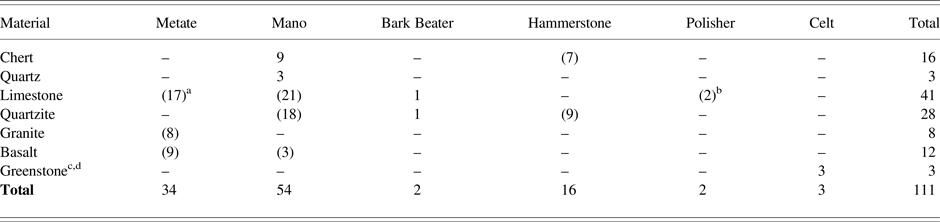
Grinding or milling stones—produced through a sequence of flaking, pecking, and smoothing (Yacubic Reference Yacubic2014:175–178)—include tools such as manos and metates, celts, bark beaters, hammerstones, and polishers. A total of 138 of these tools and fragments or flakes were recovered in Structure 719, primarily in the back room (Table 5). Most of the materials are local (limestone, chert) but a significant number of artifacts are made from vesicular basalt imported from the highlands and granite from the Maya Mountains in southern Belize. Basalt milling tools are found only in the Postclassic period in the central Peten lakes. There is little evidence to suggest that heavy millstones were produced at Zacpeten, other than possibly carrying out the final finishing steps, and they were probably imported from production sites near the quarries (Yacubic Reference Yacubic2014:199–200, 205–206). Handstones may have been produced in individual households (Yacubic Reference Yacubic2014:206).
“Groundstone” artifacts and fragments, excluding flakes and debitage, by raw material in Structure 719 (back room, Yacubic Reference Yacubic2014:196). Data from Pugh et al. Reference Pugh, Rice, Cecil, Rice and Rice2009:Table 9.3; Yacubic Reference Yacubic2014:196; Yacubic Reference Yacubic2014:Tables 18–21, 23.

a Includes two set into the floor of the back room.
b These are mentioned by Yacubic (Reference Yacubic2014:196), but not noted in his Table 23.
c Yacubic Reference Yacubic2014:196.
d One jadeite fragment and two unidentified greenstone fragments.
The occupants of Structure 719 also produced red pigment and plaster in the western part of the rear room (Pugh et al. Reference Pugh, Rice, Cecil, Rice and Rice2009:200). Two small limestone metates or mortars were recovered, with four smooth crystalline cobbles—two with red stains—nearby (Pugh Reference Pugh2001:433). In addition, three fragments of gypsum local to the Lake Salpeten basin were found. One of these was burned: calcined gypsum is used to make “plaster of Paris.” Near this fragment were two “deep red” stones, probably hematite, and another unidentified red stone was found near the embedded metates.
OTHER STONE AND METAL
A jadeite bead, two red stone beads, and a flat, rectangular fragment of jadeite (part of a mosaic?) were recovered in a Chilo Unslipped cache bowl in the medial altar (Pugh Reference Pugh2001:431; Yacubic Reference Yacubic2014:196). Similar bowls with larger numbers of beads, plus bone, marine materials (shell, coral, and stingray spine), and copper foil, were recovered in caches in structures in the temple assemblages (Pugh and Rice Reference Pugh, Rice, Rice and Rice2009:Figure 7.10). A few jadeite flake fragments in the back room of Structure 719 may indicate lapidary work (Yacubic Reference Yacubic2014:206).
A minature greenstone celt was found in Structure 721, the group temple. These objects are generally recovered only in Postclassic contexts in the lakes area (see Aoyama et al. Reference Aoyama, Inomata, Pinzón and Palomo2017 for Preclassic miniature greenstone axes). Despite their small size, they could have been axe weaponry if mounted into a hardwood handle. They may have also been a type of currency (Thompson Reference Thompson1970:138). Since this artifact and most of the other miniature celts at Zacpetén were found in ceremonial contexts, they may have been heirlooms and the symbolic attributes of the objects may have been emphasized. Celts were associated with lightning and the rain god Chaak. They were also personified by God K, who represented power and dynastic descent (Taube Reference Taube1992:17–79).
Structure 719 included two alloyed copper bells and the blade of an axe head of the same material. The bells appeared to have been cached in the back room along the midline, and may have been produced at Lamanai (Cockrell and Simmons Reference Cockrell and Simmons2017). The axe blade was found with the concentration of composite censer sherds on the floor of the front room, and probably once rested upon the transverse wall. Because we encountered no other fragments of the axe head, we suspect that it been broken in antiquity, but its fragments were retained as the metal would have been unique (see Tozzer Reference Tozzer1941:121, n552).
FAUNA
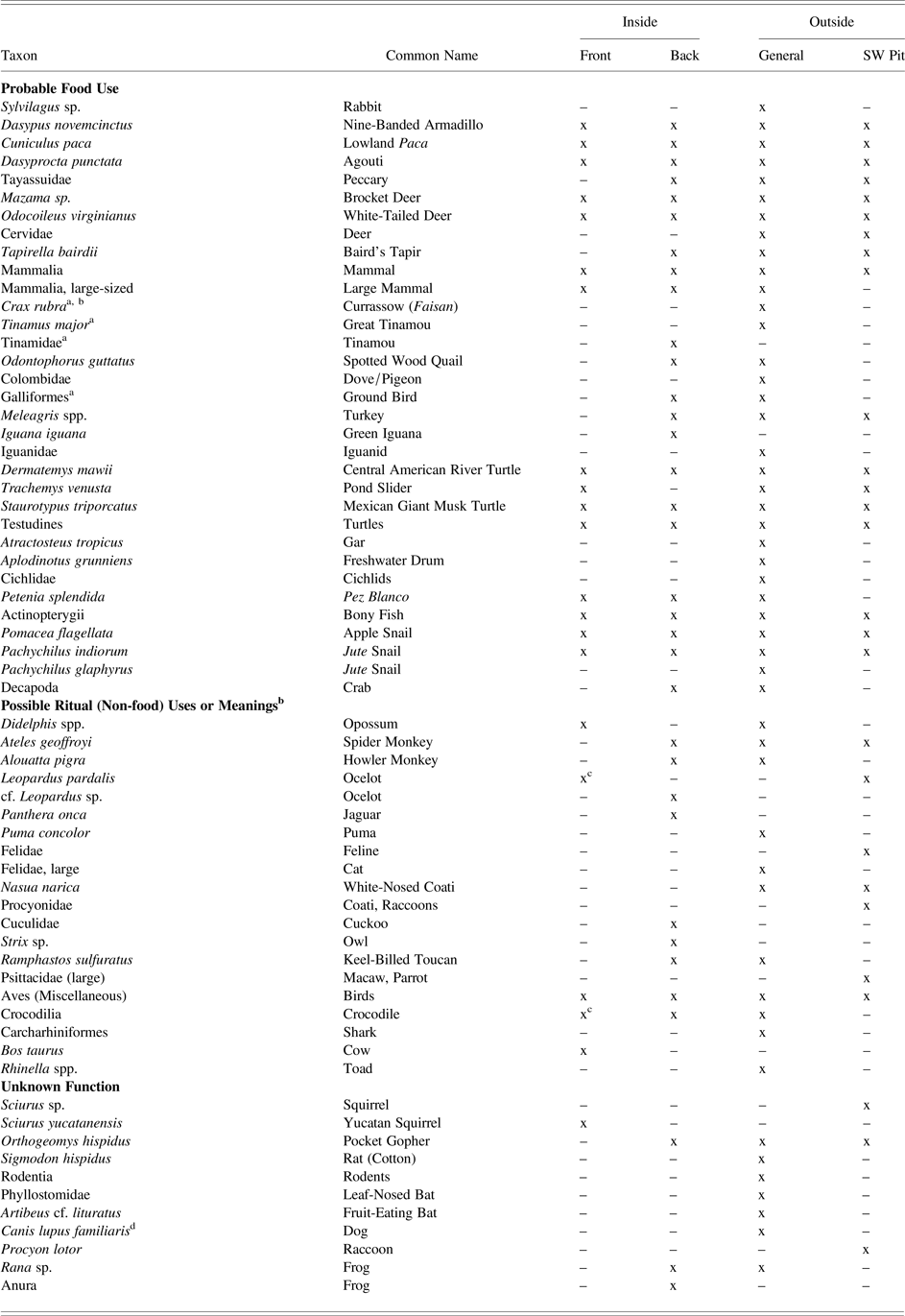
The faunal remains recovered in and around Structure 719 provide unique insights into the activities carried out in this structure. The vertebrate assemblage consists of 46 taxa including at least 23 species of mammals, at least nine birds, eight reptiles (including three turtle species), two amphibians, one cartilaginous fish, and at least three bony fishes. Invertebrates include abundant freshwater snails, plus crab. The most ubiquitous remains both inside and outside the structure are deer, turtle, and Petenia splendida, the tasty whitefish known as pez blanco or just blanco. Species identification and contextual associations of 369 lots are presented here. The list of genera and species in Table 6 is organized into three “functional” categories: food use; probable ritual uses or meanings; and unknown. These last may be adventitious creatures, such as rodents and bats.
Faunal taxa present in and around Structure 719, by uses and spatial context.

a Possibly important for feathers as well as food.
b These may have associations with ritual or special meanings in connection with mention in the Popol Vuh, Madrid Codex (e.g., monkeys), or for special uses such as ornaments (teeth), skins (e.g., jaguar, crocodile), or bird feathers.
c From a test unit excavated through the front bench construction (see Figure 4).
d The dog may have been a hunting companion, an item of food, or a sacrificial victim. Dogs were reportedly the second most common sacrifice after humans (Tozzer Reference Tozzer1941:114, n528).
A broad range of large, forest-dwelling mammals (deer, peccary, tapir, jaguar, and puma) was recovered inside and outside Structure 719. Of these, deer are the most common, with either white-tailed or the smaller brocket deer found virtually everywhere. Numerous smaller mammals (opossum, armadillo, agouti, paca, ocelot, dog, coati/pizote, and monkeys) are also present. Four tapir bones were recovered in various locations. Franciscan Bishop Diego de Landa (in Tozzer Reference Tozzer1941:203) remarks that the Mayas “considered it an act of great bravery to kill [a tapir] and the skin or parts of it lasted as a memorial down to the great grandsons.” All of the mammals are native to the neotropical habitat, except one specimen from a domestic cow, the only Eurasian taxon present in the assemblage. This fragment, a heavily altered (possibly by water) portion of a left cow mandible with the second and third molars intact, was found in the northeast corner of the medial shrine in the front room (Figure 6e; Pugh et al. Reference Pugh, Rice, Cecil, Rice and Rice2009:Figure 9.2). It was heavily polished on the posterior, anterior, and ventral surfaces, suggesting use in polishing a hard surface, such as ceramic, plaster, or stone.
The 13 monkey (11 spider and two howler) bones came from the limbs, including five phalanges, two metatarsals, and two calcanei. Rarely identified in Maya zooarchaeological assemblages (Rice and South Reference Rice and South2015), monkey bones may relate to Maya merchants’ belief that “a monkey's hand [is] a talisman of good luck” (Miller and Taube Reference Miller and Taube1993:118).
At least nine species of birds were recovered, although most species are represented by few elements with the exception of the turkey. The remains are primarily ground birds, but cuckoo, owl, toucan, and macaws or parrots were also identified along with small-sized, unidentified avians that might be songbirds or other taxa. Birds—including owl, toucan, cuckoo, quail, tinamou, and turkey—were particularly common in the back room and they might have been captured for their feathers. Bird specimens were rare in Postclassic residential contexts at the sites of Nixtun-Ch'ich' and Tayasal (Freiwald and Pugh Reference Freiwald and Pugh2018).
Herpetological remains are varied, reflecting the natural diversity of this lacustrine region. Reptiles include crocodile, iguanas, smaller lizards, and several species of freshwater turtles; amphibians include a small number of frog and toad specimens. Abundant turtle carapace fragments recovered in temple Structure 721 raise the possibility that turtle shells were used as offering containers or drums. Freshwater mollusks, primarily apple and jute snails, were avidly consumed, as indicated by the recovery of abundant shells. Of a total of more than 7,400 pieces of shell at Zacpeten, 96 percent was from Structure 719, particularly in the southwestern corner trash pit (Pugh et al. Reference Pugh, Rice, Cecil, Rice and Rice2009:Table 9.3).
The ichthyologic remains primarily consist of freshwater bony fishes, including one drum, one gar, and abundant remains of blanco. Remains of a smaller cichlid are also present. Marine fauna were rare, not surprising given the deep interior location of the lakes region. Five marine shells were noted, including one small piece of worked shell in the west half of the rear room and two shell beads in refuse outside Structure 719. A fragment of a shark vertebra was recovered behind the structure.
The faunal remains were tabulated by spatial occurrence—inside the structure in front and back rooms, and east and west sides; and exterior front, back, and sides of Structure 719—in hopes of identifying discrete faunal working or discard zones. Unfortunately, no clear patterns could be discerned. The back room and exterior discard areas in front and back have the greatest variety. In comparison to the back room, the front room, including the altar and bench area, was largely free of animal remains. This is probably a consequence of the practice of regularly sweeping the plaster floor of this public space, as reported following rituals in northern Yucatán (Landa in Tozzer Reference Tozzer1941:105, 151–152).
Outside, the structure platform in front and on the northeast also yielded few faunal elements. A test unit at the exterior southwest corner of Structure 719 encountered, below the fill of the plaza, a trash pit with “large amounts” of snail shell and animal bone (Pugh Reference Pugh2001:432). Most of the remains recovered matched the species found inside and outside, although unique specimens included raccoon and parrots/macaws.
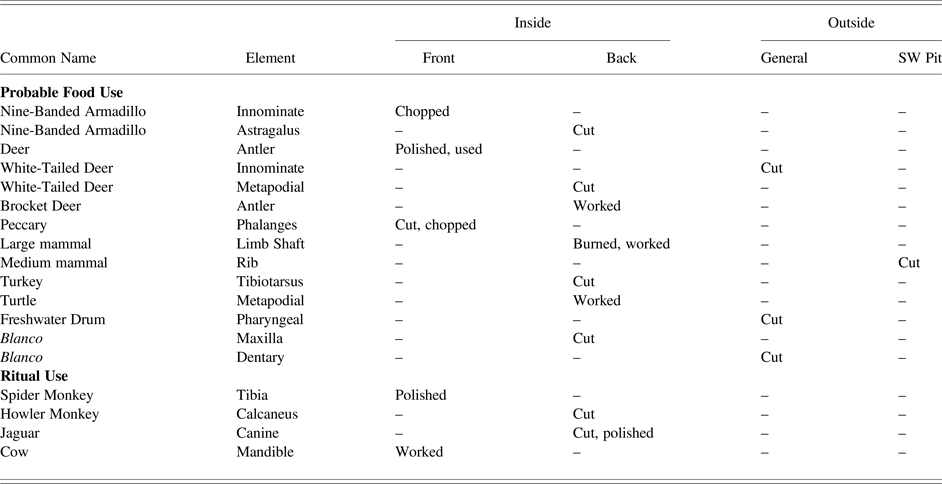
The majority of the fauna could have been exploited as food sources, although use in ritual or artifact manufacture is possible. Evidence of butchering or use of bone for tools, ornaments, or other purposes is uncommon (Table 7). Chop or cut marks related to butchering or skinning are noted primarily on animals believed to have had dietary uses. The cut marks on two peccary phalanges may have resulted from skinning, and marks on a whitetail deer ilium and metapodial from butchery. All of the polished or utilized bones (n = 5) are from the interior of Structure 719; there were none in the exterior, although simple cut bone is present in the interior back room and around the exterior. Polished areas suggesting use are found on a deer antler fragment from the front room and a turtle limb element, and a burned large-mammal awl fragment and a brocket deer antler tip are evidence of other tools. Ornamental bone polishing is present on a jaguar canine and possibly on a spider monkey tibia (lower leg bone), perhaps in preparation to make a flute.
Butchered, worked, and utilized faunal remains from Structure 719, by location.

A different perspective on faunal use Group 719 comes from crossover immuno-electrophoresis (CIEP) analysis of animal protein (blood) residues on two projectile points from temple Structure 721 (Meissner and Rice Reference Meissner and Rice2015). Both points were of San Martín Jilotepeque obsidian. One point from behind (east of) the structure tested positive for felid antisera (likely jaguar, ocelot, or puma) and a second, from south of the interior altar, tested positive for “chicken” antisera. It is unclear if this reflects domesticated European chickens (Gallus gallus domesticus) or indigenous wild gallinaceous fowl, but presumably the latter given that European chicken remains were not noted in the Structure 719 faunal assemblage.
NET SINKERS
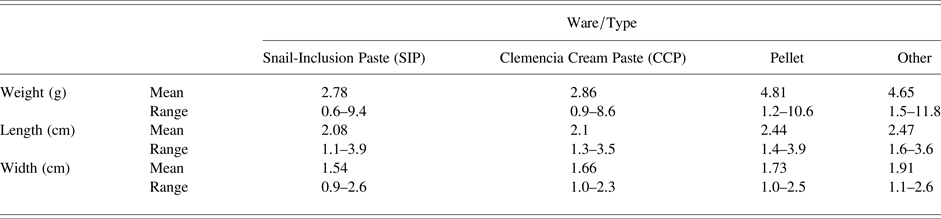
Net sinkers or pesas (“weights”) are small artifacts of pottery, notched at opposite ends, used to weight nets for capturing fish and varied aquatic fauna, or possibly sinkers for line fishing. Two general categories are known: secondary artifacts formed from fragments of broken pottery with the edges smoothed and the ends notched; and primary artifacts, a Late Postclassic innovation of specifically formed and notched pellets of clay. A total of 640 pesas recovered in nine structures or structure groups at Zacpeten was tabulated, of which the largest quantity—198 (31 percent; plus another 26 not measured and tabulated)—came from Structure 719 (Rice et al. Reference Rice, Rice and Pugh2017). This suggests that fishing and possibly net-making or repair were important activities, the former supported by the piscine (and turtle) remains at the structure. The Structure 719 worked-sherd sinkers were made of both the Kowojs’ CCP ware fragments (n = 49; 24.7 percent) and the Itzas’ SIP ware (n = 85; 42.9 percent); another 30 (15.2 percent) were of other pastes, primarily unslipped. Only 34 of the 198 artifacts (17.2 percent) were pellets, and only eight of these were of CCP ware.
The distribution of sinkers in Structure 719 was plotted by pastes/wares, and tabulating them by locations inside and outside the structure (Table 8). The objective was to determine if any concentrations, particularly of distinct types/wares, might indicate the location of a now-disintegrated fishing net or of net-working. It is obvious by inspection of Table 8 that SIP ware is the most common material for worked sherd sinkers in all contexts, and the back room had roughly twice as many pesas than did other contexts. But these artifacts were scattered throughout the structure: they were recovered in 140 of 532 (26.3 percent) excavated 1 × 1 m units; 97 of those units (69.3 percent) yielded only one sinker. In the front room, the most parsimonious explanation for this scatter is regular sweeping of the plaster floor of this open, public space. Pesas were found at the base of the bench and along the edges of the walls, but were rare in the eastern third of the structure; they were scattered over the basal platform in front as if they had simply been swept outside, particularly toward the southwest corner. In the back room, sinkers were found throughout along with other artifacts, but especially against the base of the walls. It is also likely that these tiny artifacts were trampled into the dirt floor and forgotten.
Distribution of worked sherd and pellet weights across Structure 719.

Statistical analyses of the distribution data were carried out with a null hypothesis (H0) that location and sinker type/form are independent and represent random distributions. The alternative hypothesis is that significant differences exist in terms of where various kinds of sinkers were found. All outside contexts were collapsed to a single category owing to small values in some cells, resulting in three location variables: “front room,” “back room,” and “outside.” An omnibus 3 × 4 contingency test revealed significant differences between sinker type and location at the α = .05 level (p = 0.018; χ2 = 15.35; df = 6). A post-hoc pairwise comparison among the variables involved multiple hypotheses, so a Bonferroni correction was applied, lowering the p-value critical rejection region to α = 0.05/6 or 0.0083. Pesas in the “Other” category tended to be found in the back room versus the front or outside, when compared to SIP (p = 0.0052) and pellet sinkers (p = 0.001). Little provenience differentiation was identified among the other types of weights.
When the dimensions of the Zacpeten pesas were compared among structures (Rice et al. Reference Rice, Rice and Pugh2017:Figure 5.7, Table 5.7), the greatest variability occurred in Structure 719 (Table 9): the lowest minimum, the highest maximum, and the greatest range of all metrics except thickness. This is also generally true of the SIP sinkers; the CCP pesas had a narrower spread and a lower standard deviation. This high dimensional variability, plus the lack of strong associations between spatial concentrations of sinkers (probable locations of fishing nets) and types, likely reflects the role of Structure 719 as a community structure with multiple males working inside. The relative paucity of pellet pesas—17.4 percent, compared with 72.6 percent (n = 95) in Structure 747 (Rice et al. Reference Rice, Rice and Pugh2017:32)—suggests that most weights were secondary or ad hoc tools formed with Postclassic sherds.
Dimensions and weights of Structure 719 net sinkers by ware/type.

Somewhat unexpectedly, 26 pesas, including three pellets, were recovered in and around the Structure 721 temple. As with the Structure 719 front room, the floor of the temple appeared to have been swept and the sinkers were mostly recovered at the base of the northern and eastern (rear) walls and in the back corners.
DISCUSSION AND CONCLUSIONS
The aim of this essay was to investigate activities carried out in and around a very late Contact and/or Conquest period southern lowland Maya popol nah or council house at Zacpeten on the eve of its sudden abandonment. Structure 719 is a two room “tandem” hall in Group 719, which also includes a temple, Structure 721, and a small shrine, Structure 720. All three structures were constructed on a Late Postclassic plastered plaza surface. The interpretation of Structure 719 as a council house (and possible residence) is based on comparisons to similar structures in the lowlands and highlands, and especially to the house of the Itza ruler. The best example of a comparable popol nah, both chronologically and geographically, is that at Tayza (Flores Island), where the Ajaw Kan Ek' met with his ruling council seated around a table in the open vestibule or front room (Avendaño Reference Avendaño y Loyola, Bowditch, Rivera and Comparato1987:34). Reportedly this tandem structure, with its front room an open, public space, was also his “house,” suggesting that he lived there.
It is difficult to conceive of Structure 719, as excavated, in terms of residential functions, however, even temporarily as with men's houses. The evidence for extensive chipped-stone tool production in the back room hardly suggests it was a private or domestic space, much less a safe one. The abundant flakes and other debris from tool making, plus bone and shell, evidently had not been recently gathered up and discarded, as was the practice among the Lacandon Mayas (Clark Reference Clark, Staski and Sutro1991). This small, sharp, and dangerous refuse would have made walking unsafe in the back room unless it was covered with mats or textiles. Moreover, little space is available for sleeping anywhere, unless the east side of the front room could have been closed from view with curtains or mats. The possibly merged residential and political functions of popol nahs in sixteenth and seventeenth century Petén suggests that these structures might have evolved away from the earlier and spatially distant council houses of Late Classic Copan or even Postclassic Mayapan. Such a transformation might have been a consequence of demographic stresses related to contact, warfare, disease, in-migration, and so on.
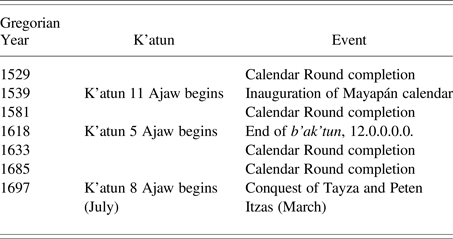
An interesting feature of Structure 719, evident in its final floor plan (Figure 4), is that both front and back rooms were remodeled with a wider/deeper eastern extension that has a slight (~4–5° southward) deviation in wall angles. Shrine Structure 720 was remodeled from a square to a rectangular footprint, perhaps at the same time. Structure 721 had only one phase of construction. The repainting of the Structure 719 front room bench, which appeared to have been fairly recent (prior to abandonment) and supported by the grinding of red pigments in the rear room, might have coincided with the remodeling. This renovation, in turn, might have been timed by some important calendrical commemoration connected with 20-year k'atun cycling or 52-year Calendar Round completion (Table 10). Or, the remodeling might have been occasioned by the formation of the Chak'an-Kowoj alliance. These points suggest that this noble residence became a popol nah only late in its history.
Some important calendrical events in the Contact and early Colonial periods.

Structure 719 was one of perhaps a dozen tandem halls identified during mapping of Zacpeten (see Pugh Reference Pugh2001:Figure 1-3). In Peten, these were generally elite or high-status residences and two, Structures 747 and 732, were excavated at this site. Structure 747 had a plastered rather than dirt floor in the back room and, like Structure 719, had two embedded metates standing on end in its medial axis (Pugh Reference Pugh2001:448). Obsidian blade production may have been an economic activity of its occupants, along with fishing, given the presence of a fishing kit including a disintegrated net (54 pesas) and ichthytoxin associated with a Chilo Unslipped jar (Rice et al. Reference Rice, Rice and Pugh2017:32, Figures 5.1–5.3, Table 5.4). Unlike Structure 719, however, no incense burners were recovered in the front room of this residence. Structure 732, slightly smaller but well-constructed, had incensarios in the front room. Structure 719 can be differentiated from these others because it is the only one of the three with a partitioned bench in the front and an associated temple and shrine. All three tandem structures had abundant de facto refuse on their living surfaces, suggesting that elites may have taken refuge and/or lingered in this peninsular community until flight was suddenly forced upon them.
Production
Most productive activities in Structure 719 were carried out in the western back room. The presence of censers and little else in the eastern end of the front room suggests that this area, closest to temple Structure 721, was specifically set apart from quotidian activities, or even built specifically as a storage area for ritual paraphernalia.
The most important economic endeavor in Structure 719, as discerned from artifact quantities, was chipping chert and obsidian stone tools. Large numbers of finished flaked-stone hand tools were found in the back room, particularly around the peripheries, but also in Structures 720 and 721 (Pugh et al. Reference Pugh, Rice, Cecil, Rice and Rice2009:Tables 9.2, 9.3). Along the central axis of the back room, four small spaces, about 1–2 square meters in area and roughly equidistantly spaced, plus another in the southeast corner, were largely clean of artifacts. These small floor areas might have been covered with textiles or mats, and possibly indicate individual work zones.
A key activity was production of obsidian prismatic blades to be snapped into segments from which arrow points could be fashioned. Projectile point manufacture was significant before, and especially after, conquest because of incessant internecine warfare in the lakes region, and then later rebellions against the new Spanish oppressors. At Structure 719, all three Guatemalan obsidian sources were represented, although Ixtepeque and El Chayal were considerably more common than San Martín Jilotepeque. This last appears to occur more frequently in the western area, at Nixtun-Ch'ich' and nearby San Jeronimo II, than in the east (Meissner Reference Meissner2014:14; Rice and Cecil Reference Rice, Cecil, Rice and Rice2009:Table 14.8). This might be a consequence of supply through western trade networks along the middle Río Usumacinta route, which, in the Peten lakes region, was controlled by Ah Tut, a well known Chak'an Itza provincial governor and trader (Jones Reference Jones1998:95). The multiple sources of obsidian, plus a point of Belizean chert, indicate diverse strategies of lithic procurement that may reflect the varied interactions and ethnopolitical affiliations of occupants of the popol nah.
The extraordinarily large number of milling tools—34 metates and 54 manos—in the back room of Structure 719 suggest that grinding various substances was also an important activity. The red (hematite) stones found there were used to produce red pigment, as indicated by the presence of red pigment in the cracks of some of the milling stones. This pigment might have been used for the painted decoration on the plaster in the front room of Structure 719 and/or the red floor of Structure 721. It also could have been the source for painting and slipping pottery, including censers. Powder ground from one of the red stones in the back room was water soluble (Pugh Reference Pugh2001:434, Figure 9-25) and chemically similar to Postclassic red slips (Cecil and Neff Reference Cecil and Neff2006).
Alternatively, one wonders if the pigment might have been used in painting paper, perhaps the screenfold “books” known as codices, made of bark paper or animal skin. The presence of two bark beaters in the structure suggests paper or bark-cloth making. A related activity might have been heating and grinding gypsum to make plaster for construction and/or sizing for codices. Any such codex might have been taken by the residents when they fled, confiscated or destroyed by the interlopers who forced the abandonment, or succumbed to the destructive processes of rain, humidity, and bioturbation if left behind.
No direct evidence for pottery making was identified in Structure 719, although some steps of effigy censer production might have been carried out there or at Zacpetén more generally. For example, molds for effigy censer faces were recovered in Structures 732 and 758, raising the possibility of production of these ritual vessels or perhaps only the effigies attached to them. At Mayapan, the faces (and perhaps bodies) of effigies appeared to have been made separately from the vases, and production was in the hands of political and religious elites (e.g., Masson et al. Reference Masson, Hare, Peraza Lope, Masson and Lope2014:261–262). The geochemically analyzed La Justa censer sherd is the only composite censer in chemical group PCEN9, which otherwise consists of all Patojo Modeled effigy fragments characterized by inclusions of grog from Classic volcanic ash paste ware. On the basis of other analyses (Cecil Reference Cecil2014), this geochemical group was judged to have been most likely manufactured at Zacpeten. This might explain the unusual occurrence of numerous Late and Terminal Classic ash-tempered figurines in Structure 719 and elsewhere at the site: they were found objects gathered to be crushed for grog in the censer effigies. As Cecil and Pugh (Reference Cecil and Pugh2018) explain, the incorporation of fragments of these earlier objects may incorporate their “mana”-like essences or forces to make these censers more efficacious in interactions with the supernatural world.
Little evidence for female-gendered activity was identified other than manos/metates, if these were used for grinding corn (e.g., the supply in the two jars embedded in the floor) rather than pigments. Virtually no artifactual evidence for textile manufacture was recovered in Structure 719: only six small and lightweight perforated-sherd disk spindle whorls were found, possibly used for spinning cotton, and no needles. Relatively large and heavy perforated-sherd spindle whorls were identified in the Zacpeten Group C temple assemblage, which might indicate male-gendered activity in spinning coarse, non-cotton fibers (bromeliads, tree bark) for cords and ropes (Rice et al. Reference Rice, Rice and Pugh2017:50). Besides the lack of spinning tools, bone tools were almost entirely absent except for the burned awl. Large numbers of worked-sherd net sinkers, highly variable in dimensions, attest to the role of fishing by the users of Structure 719, but apparently on an ad hoc, rather than specialized, basis. Net fishing was not a recent activity as no concentrations of these artifacts were found to suggest the storage or drying of a net as in Structure 747.
Ritual
As discussed, a deep test unit outside the southwest corner of Structure 719 revealed quantities of refuse under a plaster floor. Pottery in this deposit included fragments of late slipped and decorated Paxcaman (SIP), Topoxte (CCP), and Macanche Red-on-paste (SIP) types. This pottery, plus the faunal remains, especially large quantities of snail shells, suggest a significant repast or feast (Table 6), and the unusual animals—ocelot, macaw, and spider monkey—hint at other ritual activity accompanying the plaza finishing and perhaps construction of Structure 719 itself. A similar buried refuse deposit lay at the front center of the structure, near the steps. Besides serving ware pottery, this pit held remains of bird, agouti, turkey, and especially blanco. The deposit might have been associated with the late remodeling of the structure, and both feasting events might have coincided with particular calendrical junctions (Table 10).
The great variety of faunal remains inside and outside Structure 719, and the lack of spatial concentrations of various species, requires some explanation. These remains represent a broad range of large terrestrial mammals (deer, peccary, tapir, and felines), smaller animals (especially armadillo but also monkey, agouti, and rodents), varied birds (mostly unidentified but including turkey, toucan, faisan, and macaw), reptiles and amphibians (especially turtle but also crocodile, toad, and iguanids), fish (primarily Petenia splendida, but also others and a possible smaller cichlid), and mollusks. They include animals associated with Maya subsistence (most mammals, birds, fish, and snails), ritual (jaguar, crocodile, and deer), and elite products (colorful feathers), but very few tool fragments were identified among the nearly 5,000 recovered faunal specimens.
One explanation for these abundant and varied animal species might be that the residents of Structure 719 were engaged in making ritual paraphernalia for elites and priests in the temple assemblages and elsewhere around the time of conquest. Such paraphernalia could have included headdresses, masks, and non-textile garments requiring animal skins (jaguar, crocodile, and deer), teeth (jaguar, and crocodile), and feathers. Painted paper or a modeled papier-mâché-like material might have been a component of this finery or ritual as well. A few small flakes of greenstone (jadeite, serpentine, unidentified) in Structure 719 suggest lapidary work as another component of this activity, although, except for the altar cache, the finished artifacts were primarily recovered in temple assemblage Group A (Yacubic Reference Yacubic2014:Table 21).
Another—possibly complementary—scenario to explain the faunal diversity comes from Landa's description of a ritual in northern Yucatan held in the month of Mak. The priest and the Chaaks (rain gods, presumably human impersonators) with pitchers of water came to the courtyard of the temple and took their places in the corners. Previously, hunters had
… hunted for all the animals and creatures of the field, which were to be had and which there were in the country, and they came together with them in the court of the temple …They placed in the middle a great faggot of dry sticks tied together and set upright, and first burning some of their incense in the brazier they set fire to the sticks, and while they were burning, they took out a great many of the hearts of the animals and birds and threw them into the fire to burn. And if they were unable to get large animals like tigers, (jaguars), lions (pumas) or crocodiles, they made their hearts out of their incense. … When all the hearts were consumed, the [Chaaks] extinguished the fire with the pitchers of water. (Landa in Tozzer Reference Tozzer1941:162–163)
This activity was followed by much burning of incense. Landa says this ritual is called tupp k'ak', which means “to put out the fire” (k'ak' , “fire”). It is part of “Burner” rituals held on a 65-day rotation through the 260-day “year”: 20 days from the lighting of the fire to each of the next two stages (60 days total), followed by five more days to extinguishing the fire. The days of these rituals—the Burner Days—are always named Chikchan, Ok, Men, and Ajaw. The day of the ritual Landa observed was probably 11 Ok 8 Mak in a.d. 1553 (see Tozzer Reference Tozzer1941:163, n848). He claimed the ritual was associated with the rainy-season rains putting out the fires of the milpas prior to planting maize, but in 1553 the month of Mak would have occurred around March, a little too early for burning the fields. In any case, this tupp k'ak' ritual occurs every 65 days—four times in the 260-day cycle, and five times in a 365-day cycle. Obviously these multiple occurrences do not always coincide with the start of the rainy season. It seems possible, however, on the basis of the exceptionally diverse faunal remains at Structure 719, that a similar ritual—or perhaps multiple rituals 65 days apart—involving capture and butchering of “all the animals … in the country” for heart sacrifice might have been carried out not long before departure of the residents.
One wonders if elements of this ritual in Yucatan might have some deep connections to the importance of ritually burning offerings to the gods of the hunt at shrines in the highlands (Brown Reference Brown2004:36–39; Brown and Emery Reference Brown and Emery2008). These rituals involved the deposition of specific skeletal elements (e.g., crania and mandibles) in caches at sacred sites, such as caves. The juxtaposition of varied osseous elements with pottery, lithics, and other artifacts at Structure 719, however, may cast doubt on such practices.
Abandonment
When and why was Structure 719 abandoned? The abandonment of Group 719 was obviously hasty, but was it voluntary or forced? If the departure was voluntary, it might have occurred prior to the 1697 Spanish conquest, perhaps in response to some unknown event in the long-standing conflicts between the Itzas and the Kowoj-Chak'an alliance. It might have accompanied the late Kowoj westward advance to usurp the transshipment port or entrepôt of Ixlu on the isthmus between lakes Salpeten and Peten Itza (Rice and Rice Reference Rice and Rice2016), and the settling of new villages on the northern shore of the latter. We think it is more likely, however, that abandonment occurred in the first years after the 1697 conquest. By this time, the Kowoj-Chak'an alliance had collapsed and the two former allies were at war (Jones Reference Jones1998:95). In addition, soldiers from the Remedios (Flores) island presidio were roaming through the central lakes area stealing food and rounding up the scattered populations for resettlement. We know that European goods and perhaps soldiers reached Zacpeten at some point, as a pipe stem, a musket ball, and pieces of iron were recovered in the temple assemblages (Pugh et al. Reference Pugh, Rice, Cecil, Rice and Rice2009:213).
If the interpretation of ten-year patterns of use of the composite censers—heavy, medium, and light burning in the interior—in the east side of Structure 719 is correct, it might suggest that the building was reconstructed to function as a council house or popol nah at least 30 years before abandonment. Or, the incensarios might have been brought from other elite residences. We hypothesized that these vessels had been placed on the transverse wall or on a shelf, but fell and were broken when the roof collapsed; the transverse wall itself later collapsed over the fragments. If soldiers from the presidio were responsible for evicting the occupants of Structure 719 and other residential structures, they may have swept these objects of “idolatry,” innocuous though they appear, onto the floor. They also burned the temple, Structure 721.
In the end, however, we do not know with certainty if the censer breakage and temple burning were carried out by conquest forces or by raiding parties of Chak'ans or Itzas, or if it was intentional termination by the Kowoj occupants of the group at their departure. As Masson and Lope (Reference Masson, Peraza Lope, Masson and Lope2014:531–532) remind us, “abandonment and termination behaviors are potentially related,” and the abandonment of Mayapan was accompanied by burning, looting, destruction of buildings, smashing of artifacts, and breaking of monuments. No other excavated structures at Zacpeten showed evidence of wholesale burning.
Given this destruction, it is surprising that an intact Kulut Modeled effigy incensario and especially the cow mandible were found on the surface of the medial shrine. Although Spanish accounts mention cattle in Peten by at least 1696 (Farriss Reference Farriss1984:33; Jones Reference Jones1998:244), these introductions were not common until the 1720s, when private and royal ranches were successfully established (Schwartz Reference Schwartz1991:76; see also Freiwald and Pugh Reference Freiwald and Pugh2018). Thus the cow mandible, like the copper bells, might have been obtained through trade with communities in Belize. Zacpeten may have continued to serve ritual functions after abandonment, perhaps as a site of veneration or pilgrimage: in 1980, at the time of initial mapping of the site, a small lidded cache bowl with a face and arms modeled on the side was recovered on the surface of a structure (Rice Reference Rice, Sabloff and Wyllys Andrews V1986:Figure 8.5). Such visits might have been accompanied by some scavenging, but it is impossible to determine what items might be missing from the Structure 719 popol nah. No high-value objects were found among the de facto refuse in this or other tandem structures, except a few greenstone fragments and copper objects. If such items had been part of the original material assemblages they might have been taken when the occupants left or were removed by later visitors. Otherwise, everything lay largely undisturbed except for the occasional intrusion of forest creatures, until our late twentieth century archaeological explorations.
As a late replication of the Kowojs’ key temple assemblage architecture, Group 719 was a “mnemotope”: a manifestation of the past in the present and of the memory traces of a culture's earlier times (Purdy Reference Purdy2002). Construction of this small group created a focal place of surviving civic-ceremonial life for the Mayas in central Peten, a commemorative setting for ritual performances, and an effort to legitimate the present social order (see Connerton Reference Connerton1989). As indicated by the variability in the pastes of incense burners and serving wares (and their decoration), Structure 719 was probably used and/or occupied by lingering members of several socio-political groups: Kowojs, their one-time far western Chak'an Itza allies, other Itzas, and Mopans, all of whom might have sequestered themselves at this remote peninsular site during the stressful post-conquest times at the end of the seventeenth century. We conclude that Zacpeten Structure 719 served as a council house and center of community ritual and ritual-goods production until its abrupt abandonment, likely in the first decade or so of the eighteenth century.
RESUMEN
La Estructura 719 del sitio posclásico peninsular de Zacpeten en el distrito lacustre del Peten central es uno de los edificios ocupados más tardes en la región. Una estructura doble grande, tiene dos salas, frente y atrás, con un banco en la sala frente con once asientos formados por piedra de cal. Este edificio es parte de un complejo arquitectónico pequeño que incluye un templo (Estructura 721) con un altar (Estructura 720), y se parece a los conjuntos de templos posclásicos de los kowoj en Zacpetén y en otros sitios en la zona de los lagos.
Excavaciones en la Estructura 719 revelaron cantidades de basura “de facto” en los pisos de las dos salas y también en las exteriores, incluyendo cerámica decorada e incensarios. El cuarto atrás tenía artefactos líticos y diversos restos faunísticos en abundancia. Estos nos dieron evidencias de múltiples actividades de producción, particularmente moliendo piedras rojas para hacer pigmento y quebrando navajas de obsidiana para fabricación de puntas de flecha. La cerámica y la fauna indican festines así como el uso de partes de animales en ritual y en confeccionar objetos ceremoniales. Consideramos la Estructura 719 como una residencia de nobles que fue remodelada para servir como una casa de consejo o popol nah, con su templo. Este complejo fue un centro de producción de varios bienes (herramientas líticas, pigmento, yeso) y ritual de la comunidad hasta su abandono abrupto.
No sabemos los motivos para su abandono ni su fecha; pueden ser un ataque por los enemigos de los kowoj, los itzas, o el desalojamiento por los soldados españoles después de la conquista en 1697. Suponemos que el abandono probablemente fue en la primera década del siglo XVIII.
ACKNOWLEDGMENTS
Excavations at Zacpeten were undertaken with the permission of the Guatemalan Instituto de Antropología e Historia (IDAEH) with funding provided by National Science Foundation grants DBS-9222373, SBR-9515443, and SBR-9816325, and a grant from the Foundation for the Advancement of Mesoamerican Studies, Inc. We thank the editors and reviewers of Ancient Mesoamerica for their thoughtful comments on this manuscript. DeFrance and Boileau thank the curators and collections managers of the Environmental Archaeology Lab, the Division of Mammals, and the Division of Ornithology at the Florida Museum of Natural History, and thank Doug Nelson at the University of Michigan's Museum of Natural History for the loan of comparative specimens of Petenia splendida skeletons.