This article reassesses the place of petitioning – the practices associated with the drafting, signing, and presentation of petitions – within late nineteenth-century and early twentieth-century British political culture through an examination of the women's suffrage campaign. Such an analysis, first, restores a central component that is essential to understanding the dynamics of suffrage. There are scattered references to specific petitions within the vast historiography of suffrage, but the broader role of petitioning within the popular politics of suffragism has received no sustained analysis.Footnote 1 Yet Edwardian chroniclers observed that the history of the movement could largely be narrated around its petitions.Footnote 2 The suffrage campaign was founded through the 1866 petition to the House of Commons, and activists drew on an even longer tradition of women petitioning parliament.Footnote 3 Between 1866 and 1890, over 13,000 petitions in favour of women's suffrage were received by the Commons, containing almost 2.8 million signatures.Footnote 4 Suffragettes criticized Victorian suffragists and their Edwardian constitutionalist successors for their stale and unsuccessful methods. During her 1912 trial for stone throwing, Emmeline Pankhurst, the leader of the militant Women's Social and Political Union (WSPU), recalled the huge petition drive for women's suffrage during the debates over the 1884 reform bill as evidence of the futility of conventional methods.Footnote 5 Suffragists or constitutionalists associated with the National Union of Women's Suffrage Societies (NUWSS) were equally sceptical about petitioning a parliament of men. As the NUWSS's newspaper, the Common Cause, declared in 1910: ‘We have left off petitioning, because we were sick of it. The “right” to petition is really not unlike the “right” to use a telephone which has been disconnected.’Footnote 6 Historians of suffrage have echoed these views. For example, Martin Pugh has emphasized the limitations of petitioning as a tactic.Footnote 7
However, such views fail to explain why suffrage activists of all stripes continued to petition right up to and beyond 1914. The answer is that petitioning remained a key method of political expression and participation for women, and facilitated a broad range of activity, as we shall see. Understanding the multiple ways in which petitioning enabled a repertoire of popular politics not only explains why suffragists and suffragettes continued to petition, but provides a new and necessary context for studying this movement.
Secondly, a focus on petitioning does not mean resurrecting a hard distinction between ‘militant’ suffragettes and ‘constitutional’ suffragists, but rather complicates our existing understanding of the relationship between the different parts of the suffrage movement. Suffrage scholars examining local activity have broken down the traditional dichotomy drawn between the constitutionalist and militant wings of the movement, which had its roots in the competing historical narratives written by suffragists and suffragettes.Footnote 8 While drawing from a common heritage, this article shows the varied ways in which suffragettes and suffragists reworked the practice of petitioning that, crucially, fostered political cultures. Suffragettes pioneered the spectacular presentation of petitions, while suffragists used the signature-gathering process to facilitate a participatory, democratic, decentralized politics. The NUWSS has long been overshadowed by the WSPU in popular culture, and as Jill Liddington has written ‘it is easy to lose sight of the quieter suffragist story’.Footnote 9 Yet the NUWSS were equally innovative in adapting petitioning for an era of mass electoral politics, in which the importance of petitions from non-electors appeared to be diminished. Rather than offering a polarized reading of suffrage petitioning, a more nuanced understanding suggests that such practices are better situated on a spectrum of direct action politics in which both suffragists and suffragettes participated.
Moreover, studying petitioning adds a further layer of nuance to understanding the relationship between militancy and constitutionalism. The historiography of suffrage has moved away from discussing militancy primarily in terms of how far it aided or hindered the granting of the franchise.Footnote 10 Claire Eustance and Laura Nym Mayhall have broadened the conception of militancy to include the Women's Freedom League (WFL) and shown that militancy should be expanded to include civil disobedience and resistance, justified through a radical interpretation of constitutional history.Footnote 11 Sandra Holton has argued that militancy, whatever its impact on male politicians, was central to the construction of the ‘feminine heroic’ identity of suffragettes.Footnote 12 Krista Cowman has observed that ‘militancy was defined not by the violence or illegality of an action, but by the transgressive potential of that action’.Footnote 13 A study of petitioning further helps us to understand the different shades of militancy. Far from being the opposite of constitutionalism, militancy built on well-established practices and ideas, like petitioning. Indeed, there was a complex relationship between petitioning and more controversial forms of protest. The spectacular, transgressive presentation of petitions underpinned many of the high-profile examples of suffragette militancy, particularly between 1906 and 1909 and 1913 to 1914. For instance, on 22 June 1909, Marion Wallace-Dunlop was arrested for attempting to stencil clause 5 of the 1689 Bill of Rights (which guaranteed the right of British subjects to petition the monarch). In prison, she was the first suffragette to go on hunger strike.Footnote 14
Thirdly, an analysis of the practice of petitioning outside and beyond the suffrage movement emphasizes how traditional practices outside of party and electoral politics were significantly recast in response to a political culture transformed by electoral expansion, as well as new media. The decline of petitioning long noted by scholars is more accurately reframed as the waning of the classic model of mass petitioning the Commons associated with Victorian pressure groups.Footnote 15 In the early twentieth century, petitioning was reworked as a mechanism for political participation and expression that took myriad forms, and parliament was increasingly decentred as the main locus for the reception of petitions. This period was crucial for the reimagining of petitioning to respond more directly to the needs of mass democracy. The longer-term legacy was that petitioning remained a popular, but largely unrecorded, activity in later twentieth-century Britain.
I
The practice of mass petitioning the Commons on national issues was pioneered by late eighteenth- and early nineteenth-century agitations such as anti-slavery, radicalism, free trade, and Chartism.Footnote 16 Single-issue associations co-ordinated national campaigns as part of mass petition drives in which the business of organizing petitions and gathering signatures was largely devolved to local supporters.Footnote 17 With the exception of the Chartists, who produced three massive petitions in 1839, 1842, and 1848, these movements sought to mobilize numerously signed petitions from across the country, with the aim of demonstrating broad, diverse, popular support for a bill introduced by a backbench MP.Footnote 18
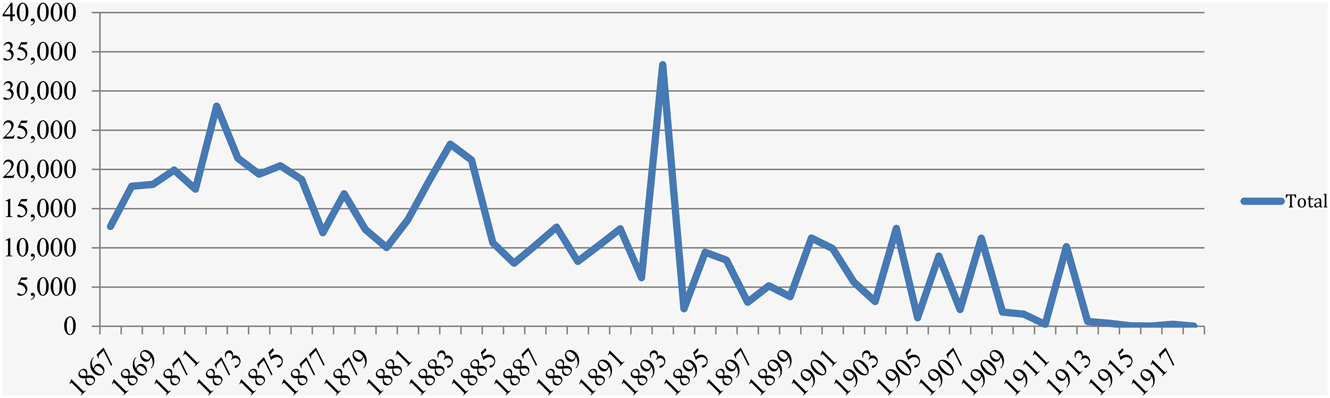
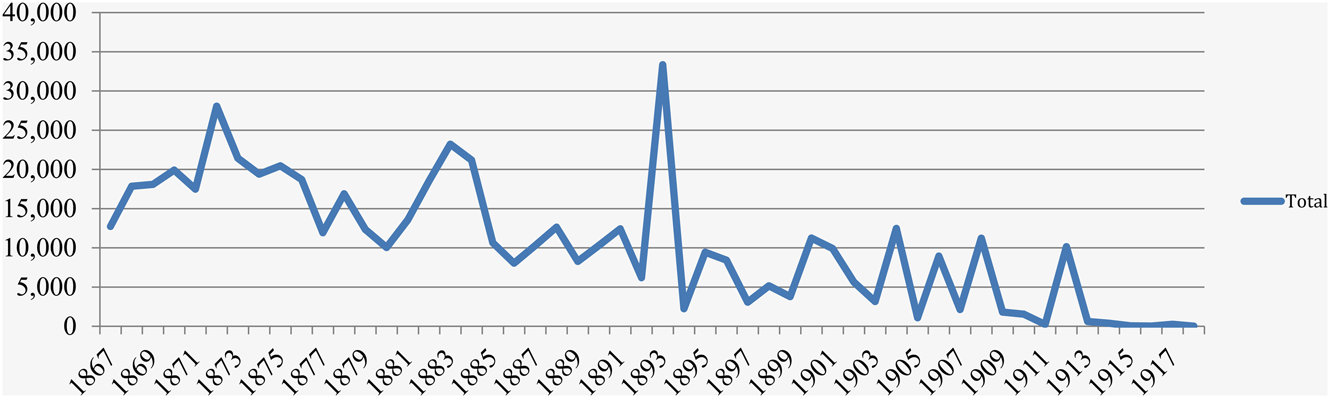
Petitioning was central to Victorian suffragism. Imitating the strategy of earlier radical liberal campaigns such as anti-slavery,Footnote 19 early suffragists aimed to maximize the number of petitions and signatures from different places across the country.Footnote 20 Suffrage activity contributed to the surge in petitions between the Second Reform and the Third Reform Acts (1867–85) (Figure 1), during which there were almost 17,000 petitions for the repeal of the Contagious Diseases Acts, containing 2.5 million signatures, and over 100,000 petitions for or against various temperance bills, containing over 19 million signatures.Footnote 21 By this time, the non-party parliamentary strategy adopted by suffragists and others was increasingly outmoded due to the growth of party discipline and the executive's growing control of the legislative timetable at the expense of the privileges of independent MPs.Footnote 22 Bills now required the support and time of the government, backed by a party majority, to stand any chance of becoming law.Footnote 23
Public petitions to House of Commons, 1867–1918
Source: Select Committee on Public Petitions, Reports (1867–1918).
Suffragists turned away from petitioning parliament after 1890. That year, the surviving signatories to the 1866 petition appealed to the Commons once more, but this was the swansong for the traditional mode of suffrage petitioning.Footnote 24 In reinventing the practice of petitioning, suffragettes and suffragists were influenced by their own criticism of their predecessors. Emmeline Pankhurst argued that while all subjects possessed the right to petition, its use was heavily gendered, as enfranchised men had little need for it. As she reflected during her 1909 trial, after her arrest for a public order offence while attempting to present a petition to the prime minister, ‘as a student of history, I have felt – and many other women, too – that this great constitutional right – is the only right that the women in this country possess’.Footnote 25 For Emmeline Pethick-Lawrence, the 1896 Special Appeal was ‘the greatest petition ever presented to the House of Commons’, yet it was ignored. The logical conclusion was that ‘nothing is left but militant action’.Footnote 26 Suffragists criticized the gendered way in which male MPs treated women's petitions. As early as 1879, Josephine Butler had complained to Lydia Becker that petitions against the Contagious Diseases Acts ‘do not carry one quarter the weight they would if women had votes’.Footnote 27 Suffragists had learnt from bitter experience that ‘when signed by those who have no vote,…[petitions] are useless and negligible’.Footnote 28 While suffragettes and suffragists drew on a shared tradition, their contrasting perspectives led them to rework the practice of petitioning in different directions.
The complaints of suffrage campaigners reflected a broader critique of the classic model of mass petitioning. Constitutional commentators, like the parliamentary clerk, Sir Erskine May, complained that petitions reflected the prowess of organizational machines rather than genuine public opinion:
Sometimes, indeed, the way in which petitioning has been systematised has discredited the right on which it is founded and the questions it has sought to advance. Petitions in thousands, using the same language, inscribed in the same handwriting and on the same description of paper, and signed by fabulous numbers, have marked the activity of agents, rather than the unanimity of petitioners, and instead of being received as the expression of public opinion, have been reported as an abuse of a popular privilege. In some cases the unscrupulous zeal of agents has even led them to resort to forgery and other frauds for the multiplication of signatures.Footnote 29
Petitions that were perceived as the products of slick organization could be treated disrespectfully by parliamentarians. When a huge petition, containing 600,000 signatures in favour of the local taxation bill, was presented in 1890, the spectacle descended into a parliamentary farce.Footnote 30 The petition was so large that MPs on one side of the chamber could not see those on the other. The wooden frame holding the petition together collapsed, scattering papers across the floor, and the ‘preposterous’ spectacle was greeted with laughter by MPs.Footnote 31
Other commentators argued that mass petitioning had become stale. ‘The practice of petitioning has indeed become somewhat mechanical’, Leonard Courtney observed.Footnote 32 While petitioning was deeply entrenched in the repertoire of activists, petitions to the Commons suffered from diminishing returns in terms of attracting public, media, and parliamentary attention. Moreover, petitioning was perceived to be redundant due to the extensions in the franchise.Footnote 33 On reluctantly resuming petitioning in 1893, the United Kingdom Alliance, which campaigned for the local prohibition of alcohol, argued that the extension of the franchise in 1885 had rendered petitioning ‘obsolete’. They complained that ‘the Temperance party were scornfully told that petitions, as vehicles of public opinion, were not worth the paper upon which they were written and what was wanted was votes’.Footnote 34 Suffrage campaigners were not alone in criticizing the traditional mode of petitioning in the late nineteenth century, but this led them not to abandon, but to reinvent the practice of petitioning.
II
Petitioning remained central to all shades of the suffrage movement because it facilitated and underpinned a broader political culture and repertoire of popular politics. Petitioning is a practice that serves multiple purposes, as the growing scholarship on the history of petitions has made clear. This explains why people petition, even in the face of official indifference or antipathy. The historical and social science literature emphasizes that petitions facilitate political expression, participation, and representation, and enable the recruitment of activists, the building of networks, the mobilization of support, and the articulation of collective identities, and this remains the case regardless of the response of authorities.Footnote 35
To judge the effectiveness of suffrage petitioning narrowly in terms of how far it secured legislative change misses the manifold effects of petitioning. The analysis offered here shares the premise of Sandra Holton when she criticizes ‘masculinist’ historians of suffrage for judging militancy in terms of its effectiveness as a political tactic rather than what it meant to women.Footnote 36 In this spirit, the focus is not on what petitioning meant to male politicians, but what it meant to suffrage campaigners and the forms of political action it enabled. Recent studies of the United States are suggestive in showing how suffrage petitioning was a ‘formative practice’ for American women, generating new forms of association and organization, and networks, and made ‘voting rights…more imaginable and more visibly possible’.Footnote 37 The value of petitioning for activists was that it facilitated different types of direct action, including the creation of spectacles and powerful incursions into exclusively male political environments, as well as mobilizing support in a variety of ways.
The militant reinvention of petitioning was grounded in a radical interpretation of constitutional history, which emphasized the ‘right of resistance to political tyranny’, and stressed the paramount importance of the presentation of petitions.Footnote 38 For Sylvia Pankhurst, the history of petitioning demonstrated the necessity of the presentation being ‘accompanied by the pomp and circumstance, and the dramatic and spectacular character, of a public deputation, and by the influence that only personal pleading can lend. Every scrap of evidence tends to show that the right of petition was to be exercised personally.’Footnote 39 After her appeal against her conviction for a public order offence while attempting to present a petition to Asquith was rejected in December 1909, Emmeline Pankhurst asked rhetorically ‘how much value is a petition which cannot be presented in person?’Footnote 40 Through presenting petitions and other tactics, as Laura Nym Mayhall has shown, militants sought to stage ‘constitutional dramas’, high-profile events that confronted authorities and justified resistance through dramatizing ‘women's exclusion from the constitution’.Footnote 41
Suffragettes based their right to present petitions on two statutes. Clause 5 of the Bill of Rights, which was inscribed on WFL members’ badges, guaranteed the right of British subjects to petition the monarch, and, by extension, petitioners argued, their ministers.Footnote 42 This was partially qualified by the 1661 Act against Tumultuous Petitioning (Car. II, c. 13), which stated that petitions to parliament or the king had to be signed by twenty or fewer individuals, only ten of whom could present their petition. Early nineteenth-century radical campaigns revealed that the proscription of petitions with over twenty signatures was unenforceable, but the state resisted the right of petitioners (even when in groups of ten) to present their petitions.Footnote 43
Suffragettes recast petitioning in ways that allowed them to legitimize protest in the heart of the political system, create arresting spectacles, and claim access to elite male political space. Suffragettes valued petitioning not as an opportunity personally to persuade male authorities, but rather to publicize and rally support for the cause. During the years of ‘mild militancy’ (1906–9), petitioning underpinned many of the ‘eye-catching events’ in Westminster that were designed to attract publicity.Footnote 44 For example, petitions from the women's parliament were presented to the prime minister (February 1907, February 1908); activists attempted to throw petitions into the king's coach on its way to the state opening of parliament (January 1908); and further attempts were made to present petitions personally to Asquith (June and July 1909). The last efforts led to the arrest of Emmeline Pankhurst, among others, and to the WFL's long picket outside parliament (July–October), waiting for the prime minister to receive their deputation.Footnote 45 Following their June 1909 arrests, Emmeline Pankhurst and Eveline Haverfield were tried for obstructing the police. At both the trial and subsequent appeal (July and December 1909), the magistrate and the lord chief justice reaffirmed the right to petition, but denied that this encompassed a right for petitioners to be received.Footnote 46
Presenting petitions allowed suffragettes to create spectacles. The militant reworking of petitioning was part of a wider shift towards visuality within political culture that was evident in the proliferation of vivid party posters, or the political use of pageantry.Footnote 47 In the case of suffrage, Lisa Tickner has written, activists sought to stage events that were ‘topical, sensational and amenable to vivid illustration’ and catered to the new popular press and photography.Footnote 48 Petitioning activity in Westminster was part of the wider phenomenon of ‘spectacular militancy’ and ‘visibility politics’ and was one of the ways in which suffragettes performed militancy.Footnote 49
Key to the spectacle of suffragette petitioning was its transgressive edge in women seeking access to elite male space in the sites of political power, namely parliament, No. 10 Downing Street, and Buckingham Palace, representing a direct visual challenge to the male polity.Footnote 50 As Martha Vicinus has written, ‘The most revolutionary aspect of the suffragette movement was precisely its insistence upon a female presence – even leadership – in male arenas’ and ‘forbidden public places’.Footnote 51 There are parallels with suffragettes’ disruption of the ‘powerfully male environments’ of political meetings in the same period, which Jon Lawrence has argued were designed to reveal the ‘brutality of the male polity’, by exposing women to the violence of male crowds.Footnote 52 ‘Black Friday’ (18 November 1910), when suffragettes experienced violence at the hands of the police, while seeking access to parliament, was another example closely linked to the right to petition.Footnote 53 Small detachments of women sought access to parliament as deputations, in what the WSPU termed a ‘raid’ or a ‘rush’.Footnote 54
The militant style of petitioning appealed to alternative authorities instead of a parliament regarded as unrepresentative and illegitimate. Petitioning the prime minister was an acknowledgement that the government controlled the legislative process, and a significant move away from petitioning the Commons in favour of private members’ bills. As Asquith refused to see suffrage deputations, women had ‘no alternative but to go back to our old rights as laid down in the Bill of Rights,…and appeal to the King’, the WFL's leader, Charlotte Despard, argued.Footnote 55 Despard's attempt in July 1909 to secure a personal audience with Edward VII for a suffrage deputation was resisted by the king's private secretary and the Home Office, who argued that constitutional procedure was for petitions to the monarch to be presented by the home secretary.Footnote 56 This may have been administratively convenient and the established convention by this time, but Despard correctly noted that there was ‘nothing’ in the Bill of Rights ‘which specifies that subjects shall only approach the King through his Secretary of State’.Footnote 57
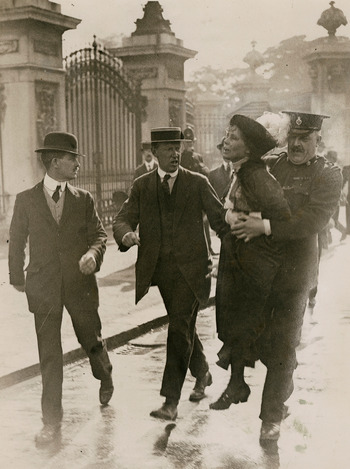
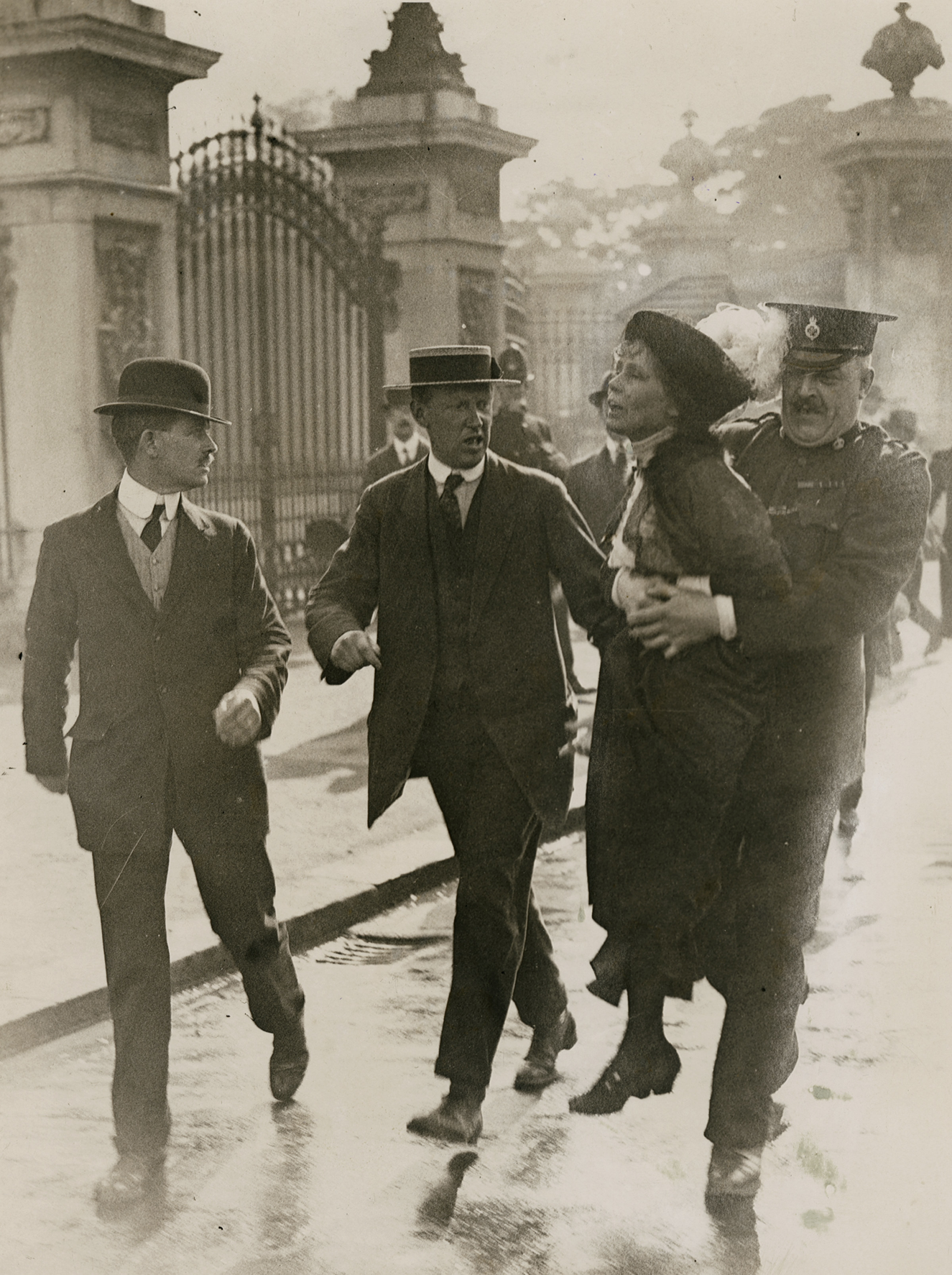
This convention was the obstacle suffragettes faced in 1913 and 1914 when they attempted to revive spectacular petitioning in a series of high-profile attempts to present petitions to the king. After a suffragette attempted to present a petition to George V in Bristol, the home secretary and the king's private secretary considered whether this constituted an offence under the 1842 Protection of Her Majesty's Person Act (5 & 6 Vict., c. 51) but concluded that the statute was ‘inapplicable, and, if it were applicable, unwise’.Footnote 58 Militants never received their audience with the king. However, the May 1914 deputation to the monarch is a good late example of the spectacular, transgressive quality of suffragette petitioning captured in the iconic photographs of Emmeline Pankhurst's arrest outside Buckingham Palace (Figure 2).
Emmeline Pankhurst's arrest at Buckingham Palace, Central Press, vintage print, 22 May 1914, x137688. © NPG, London
While the spectacular presentation of petitioning underpinned a broader repertoire of protest, suffragettes experienced similar frustrations to early nineteenth-century radicals. Authorities resisted their demands, and they were unable to broaden the right of petition to encompass a right of audience. However, if petitioning had proved to be unsuccessful, and if exercising their constitutional liberties led to their arrest on public order offences, then this only served to highlight the emptiness of women's political rights without the vote.
III
Abandoning ‘general petitioning by non-voters’ to parliament, the preferred tactic of their Victorian predecessors, suffragists were equally innovative in developing new forms of petitioning.Footnote 59 Taking the moral high ground, constitutionalists criticized the dubious practices employed by their anti-suffragist opponents rather than compete with them in petitioning the Commons.Footnote 60 Suffragists made the signature-gathering process central to their political practice, and, as with the suffragettes, they persisted with petitioning as it facilitated and underpinned a broad range of political activity. Through signing petitions, suffragists engendered grassroots activism, facilitated interactions between local and Westminster politics, fostered decentralized, participatory political cultures, mobilized support in different ways, and, finally, in 1910, engaged with the electoral process on a national scale. Suffragists reworked the practice of petitioning in three ways.
First, instead of maximizing signatures from the general public, suffragists sought to mobilize particular groups of women through petitions. In some cases, these representative petitions grounded their claims to significance on the expertise of the signatories. The list of 2,000 women, published in the Fortnightly Review in 1889 (responding to the anti-suffrage appeal signed by 104 women in the Nineteenth Century), was organized into categories reflecting their professions, for example, as doctors, teachers, or poor law guardians.Footnote 61 In 1906, a deputation to the Liberal prime minister Henry Campbell-Bannerman presented a petition from 1,500 women university graduates.Footnote 62 The petitions from women textile workers in Lancashire and elsewhere in 1900–1 were part of this trend for representative petitions from specific groups of women, though their importance was based on demonstrating cross-class support for suffrage rather than professional expertise.Footnote 63
Secondly, suffragists organized high-profile singular petitions that demonstrated popular support for women's suffrage but which were open for inspection. Conceived in 1894, the Special Appeal was designed to ‘bring the whole mass of signatures under the attention of each member’ in a single document representing ‘women of all classes, parties, and occupations’. It was designed to be exhibited rather than presented to the Commons.Footnote 64 Signatures were classified so that MPs could see the scale of support within their constituency. The Speaker gave permission for the document, which contained over 250,000 signatures, to lie in the Commons Library, but refused suffragists’ request to be heard at the bar of the House.Footnote 65 After a hiatus, the Special Appeal was finally allowed to be exhibited in Westminster Hall on 19 May 1896.
The Appeal paved the way for the reunification of the movement, which had become divided over the exclusion of married women from suffrage bills, under the aegis of the NUWSS a year later.Footnote 66 Clementina Black's 1906 suffrage declaration, an independent scheme endorsed by the NUWSS, was similar to the Special Appeal.Footnote 67 Referring to abuses that had ‘thrown discredit upon Parliamentary petitions’, Black described her petitionary document as a declaration, with the safeguard that the signatures ‘are, and will be, open to public inspection’.Footnote 68
Thirdly, and most significantly, suffragists adapted petitioning for an era of mass electoral politics through soliciting petitions from male electors, initially at by-elections in 1908–9 and culminating in a national petition campaign during the January 1910 general election. The voters’ petitions represented a remarkable example of organized, national mass participation in the electoral process by women in the period before the vote, but it has barely been mentioned in suffrage historiography.Footnote 69 The standard account of the 1910 general elections erroneously attributes the campaign to the ‘suffragettes’.Footnote 70 Voters’ petitions were an important move away from traditional modes of petitioning towards more direct electoral involvement and were a stepping stone to the NUWSS's 1912 commitment to aid Labour candidates via an Election Fighting Fund. Outside of party activism, the voters’ petition campaign represents one of the most extensive, co-ordinated examples of women's involvement with a general election before their enfranchisement in 1918.
The 1910 campaign provides the best example of how suffragists used the signature-gathering process as part of a democratic, decentralized, participatory politics. The petitions reflected the ‘strength’ of the NUWSS, which lay ‘not in its power to create a sensation, but in the fact that it is so widespread and so democratic’.Footnote 71 It was no coincidence that the voters’ petition policy emerged at a time when the NUWSS was seeking to distance itself from the WSPU.Footnote 72 Suffragists conceived voters’ petitions as a constructive way of engaging with the electoral process that, unlike the WSPU's opposition to Liberal candidates, avoided polarizing opinion along party lines, and furthermore, would educate voters on the difference between suffrage organizations.Footnote 73
The voters’ petitions departed from existing petitioning practice in two ways. First, the policy acknowledged that the votes of men carried more weight than women's petitions and sought to turn this to the movement's advantage.Footnote 74 By gathering voters’ signatures within constituencies, the petitions would give MPs an electoral incentive to back women's suffrage. The results from trialling the initiative at thirteen by-elections between December 1908 and summer 1909 were encouraging, leading the Cumberland suffragist Catherine Marshall to hail the voters’ petitions as one of the NUWSS's ‘most successful branches of work’.Footnote 75 In eleven constituencies, petitions were signed by 10 per cent or more of the electorate, with 47 per cent signing in Dumfries Burghs, 32 per cent in Derbyshire High Peak, 30 per cent in Sheffield Attercliffe, 25 per cent in Mid-Derbyshire, and 20 per cent in Edinburgh East, and Cleveland.Footnote 76
Secondly, the NUWSS's ambition of organizing voters’ petitions in ‘every constituency’ at the January 1910 general election used petitioning as a mechanism to hold an unofficial referendum on women's suffrage.Footnote 77 It was no coincidence that the idea of applying the strategy nationally emerged at a time when there was growing interest in the idea of the referendum to settle long-standing issues, such as tariff reform, on which parties were internally divided. The device also appealed to opposition Conservatives as a ‘popular veto’.Footnote 78 Although suffragists avoided describing the voters’ petitions as a referendum, it was an attempt to measure the support of electors nationally on a single issue during a time-limited poll. The aggregate of constituency voters’ petitions would suggest a broader verdict.Footnote 79 The use of petitioning to hold an unofficial referendum was a significant innovation, highlighting the evolution and continued relevance of petitioning in an era of mass electoral politics.
The organization of the voters’ petitions reflected suffragists’ commitment to a decentralized, democratic, participatory political culture. The NUWSS supported special campaigns in seven constituencies represented by cabinet ministers or prominent anti-suffragists, but otherwise activity was organized locally.Footnote 80 Major societies co-ordinated campaigns within their regions, while elsewhere activity was left to local associations, or dynamic individuals.Footnote 81 Volunteers would interact with voters and gather signatures through attending election meetings, door-to-door canvassing, and standing outside polling stations.
Suffragists as well as suffragettes deployed the politics of sight during their campaign. Like free trade activists displaying big and little loafs in their shops, suffragists occupied retail premises decked with colourful decorations, placards, and posters, which acted as hubs for local activity.Footnote 82 Manchester was ‘placarded with giant posters, red, white, and green [the NUWSS colours], in the centre of which is a huge facsimile in white of the petition sheet’.Footnote 83 Once the signature-gathering process was complete, suffragists held local ceremonies in which a deputation handed the voters’ petition over to the local MP.Footnote 84 Holding such rituals in constituencies rather than Westminster was a symbolic choice that reminded MPs of the local electoral support for suffrage, and also underlines the difference between suffragist practice and the metropolitan focus of the WSPU.
Logistical problems and stretched resources prevented suffragists from achieving blanket coverage across the country, even in areas of strength. The nine constituencies of Manchester and Salford had 270 polling stations, which would have required ‘at least a thousand workers’, whereas local suffragists ‘could not muster much more than 100’.Footnote 85 The London Society worked ‘night and day’ to co-ordinate activity across fifty-eight contested elections over a ten-day period.Footnote 86 Even then, it was not possible to cover everywhere, leading one activist to grumble that there was no petition for the voters to sign ‘at the poll’ in St Pancras West.Footnote 87 The difficulties in covering expansive constituencies led one Whitby suffragist to confess that ‘I am feeling rather overwhelmed by the difficulties in organising the Voters Pet[itio]n in a constituency 20 miles long, with, in many parts, a scattered population, isolated farms, small hamlets, no trains, etc., etc.!’Footnote 88
In some constituencies, women faced the hostility of authorities, police, and voters as their presence at polling stations represented a new and symbolically significant incursion into male political space. In Manchester, police prevented canvassers from standing close to the polling station, with the consequence that petition sheets were reduced to ‘pulp’ in the rain.Footnote 89 In Edinburgh, Dundee, and Exeter, women were prevented from standing within the gates of polling stations.Footnote 90 In Birmingham, one man scribbled over the petition sheet, ‘spoiling fifteen names’.Footnote 91 A post-election memorandum on the London elections noted that while party agents had been friendly and the police protective, the ‘voters themselves were less friendly, and were often hard to convince’.Footnote 92 After canvassing in south London, Cyril Johnson complained that ‘I have not been more successful in obtaining any more signatures. I find the stupid & suicidal policy of the militants in continually exhorting voters “to keep the Liberal out” has made countless enemies to the cause.’Footnote 93
Despite these difficulties, voters’ petitions were collected for 290 out of the 542 English, Welsh, and Scottish constituencies, containing 300,000 signatures, of which 244 petitions (containing 278,933 signatures) were presented to the Commons.Footnote 94 Across 50 constituencies in south-east England, the London Society organized voters’ petitions containing 30,426 signatures.Footnote 95 In western Scotland, five constituencies produced 25,237 signatures.Footnote 96 In Crewe, the absence of a local society meant that the activity was left to a Miss Robertson, who managed to get a third of the 9,000 voters to sign in a single week.Footnote 97
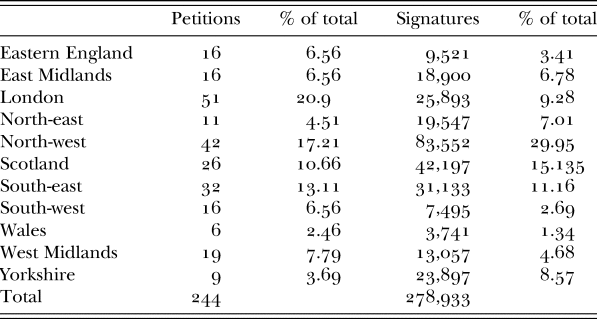
The signatures on the presented petitions accounted for 4 per cent of the registered electorate in England, Wales, and Scotland. While it proved impossible to organize petitions in every constituency, a geographical analysis of the petitions shows that there were petitions from every region in England, as well as Scotland and Wales. The data reveals the broad reach of suffrage in terms of activism as well as male support.Footnote 98 The main areas of strength were London and the south-east, the north-west, and Scotland (Table 1). Yorkshire only produced 9 petitions, but these made up 9 per cent of the total signatures. Of the 244 voters’ petitions that were presented, 227 have been linked to constituencies.Footnote 99 Of these, in 137 constituencies petitions were signed by less than 10 per cent of the electorate, in 60 by 10–19 per cent, in 20 by 20–9 per cent, and in 10 by 30 per cent or more. The three leading constituencies were Reigate, Barnsley, and Carlisle, which produced petitions signed by 41 per cent, 38 per cent, and 33 per cent of voters respectively.
Regional and national classification of voters’ petitions and signatures presented to House of Commons, 1910
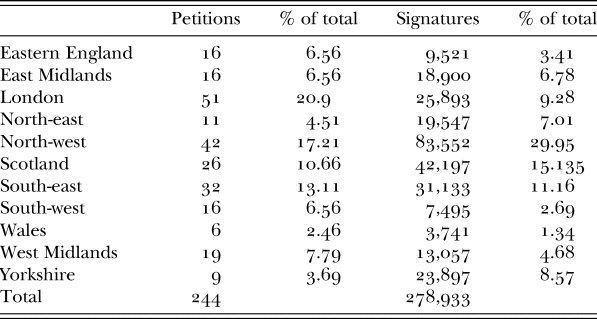
Source: SCPP, Reports (1910).
The voters’ petitions experiment was always about more than numbers, however. As the Manchester Guardian editor and MP C. P. Scott said when presenting the Stretford voters’ petition to the local MP, ‘it had not been the aim of those who had got up the petition to have a great pile of signatures’.Footnote 100 Suffragists emphasized the ‘open way’ in which signatures were gathered, and, as a measure of quality control, checked against the electoral register.Footnote 101 Suffragists believed that the signature-gathering process was educative and offered a valuable opportunity for face-to-face interaction with voters. Polling day reports dwelt on canvassers explaining the difference between them and militants.Footnote 102 Catherine Marshall wrote that in Cumberland and Westmorland electors were ‘universally friendly & sympathetic when they understood we did not adopt or approve of militant methods’.Footnote 103 Overall, the campaign was hailed as ‘a magnificent advertisement’.Footnote 104
The spectacle of women standing in or outside polling stations was symbolically powerful. Even if no voters had signed, one canvasser wrote that ‘our presence would in itself have been a most effective silent protest against our exclusion from citizen rights’.Footnote 105 Another wrote of her experience that she finished a long day with the ‘wistful hope that…on some future election day she and her sisters may be allowed to spend half a minute inside the polling station instead of twelve hours outside the door’.Footnote 106 Suffragists had used petitioning to stage their own national constitutional drama, which, although less sensational than suffragette petitioning, was in its own way an equally powerful and visual challenge to the male polity.
IV
All shades of the women's suffrage movement regularly expressed disillusionment with the fruits of petitioning male authorities. After all the energy invested in the voters’ petitions of January 1910, their fate, thrown with little ceremony after their presentation into the ‘darkness of the Speaker's bag, and then to the dim records of the House, unnoticed by a warm human word spoken for or against it’, was an anti-climax.Footnote 107 Many suffragists afterwards argued that the voters’ petition policy was ‘played out’, and called for a more direct electoral strategy.Footnote 108 Yet there remained advocates of petitioning. Eleanor Rathbone called for a ‘monster petition of women’, as it would be
an admirable way of keeping together the hundreds of workers who can neither speak nor organise, nor take part in work at a distance and who have been brought for the first time into the field…by the…Voters’ Petition…There is a danger the energies of these workers will be wasted and their enthusiasm evaporate unless they can be provided with a definite task within their powers.Footnote 109
The NUWSS rejected Rathbone's proposal, and when suffragist leaders resumed parliamentary petitioning to counter the activity of anti-suffragists, they did so without enthusiasm.Footnote 110 At the December 1910 general election, the NUWSS ran independent suffrage candidates, a tactic that has been described as ‘an overall disaster’, instead of voters’ petitions.Footnote 111
Adverse legal decisions prompted more gloom about the viability of petitioning as a political tactic among militants. Sylvia Pankhurst believed that the lord chief justice's rejection of her mother's appeal in December 1909 had ‘rendered null and void’ the ‘ancient constitutional right of petition’.Footnote 112 Her sister Christabel greeted the same verdict as having ‘torn up the Bill of Rights and rendered vain and meaningless the ancient, common law right of petitioning’.Footnote 113
Yet petitioning continued to occupy a major place in the political imagination of the suffrage movement. As part of its lobbying in support of the conciliation bill, the NUWSS organized memorials to MPs from ‘influential and representative’ groups of men within their constituencies, while Rochdale suffragettes took a novel approach by sending a telegram petition to Asquith.Footnote 114 In June 1913, the suffrage ‘Pilgrimage’, an NUWSS-organized march on Westminster, beginning from seventeen locations across the country, sent petitions along the way.Footnote 115 Suffragettes, as we have seen, again attempted to petition the king in 1913 and 1914, and Christabel Pankhurst embarked on an extensive letter-writing campaign to leading politicians in favour of the 1913 conciliation bill that her most recent biographer has described as ‘petitioning’.Footnote 116 During wartime, suffragists again deployed memorials and deputations of influential local men to exert pressure on MPs at by-elections, including in Ealing, where the tactic led to the incumbent converting to women's suffrage in June 1917, having previously voted against the principle.Footnote 117 In 1916, the Workers’ Suffrage Federation circulated a petition among organizations representing women munitions workers and others.Footnote 118 Studies of the suffrage movement after 1914 have usually emphasized the organizational splits and divisions occasioned by the First World War, or the reconceptualization of gendered notions of citizenship.Footnote 119 Holton has written that the NUWSS's political work was limited to by-elections during the conflict.Footnote 120 Yet even in such a context, petitioning could sustain low-key political activity during wartime, the effectiveness of which should not be underestimated as the Ealing by-election shows.
After the war and the 1918 Representation of the People Act granted the vote to women over thirty, and men over twenty-one, petitioning was deployed by the women's movement in the campaign for the equalization of the franchise. In 1920, the WFL attempted to petition the prime minister, and suffragists unsuccessfully tried to present a further two petitions the following year.Footnote 121 In 1928, when equalization was finally achieved, suffragists presented a petition to the prime minister Stanley Baldwin, asking him to prioritize the measure, but their attempt to present a letter to the king was frustrated.Footnote 122 Petitions and deputations were used by women's organizations across a range of issues in the 1920s. In 1925, the Women's International League circulated a petition to the government in favour of the principle of arbitration, and the pages of the Common Cause provide other examples.Footnote 123 The practice of petitioning seems to have increasingly taken the form of lobbying government rather than demonstrations or popular politics, perhaps as women's associations had become incorporated within the political system to a degree as insider groups, but it remains to be examined.Footnote 124
V
Contemporary commentators, like suffrage activists, questioned the purpose of petitioning, as we have seen. A perceptive observer wrote in 1893 that petitions ‘never influence a single vote’. While the ‘sudden flooding of the House with petitions has made the Government draw back from some line of policy…it would be difficult to point to any recent example. Petitions had more weight thirty or forty years ago than they have now.’ Petitioning had become ‘almost an act of homage’ rather than an effective political tactic.Footnote 125 While petitioning remained a ‘locus for public opinion’, James Thompson has recently argued that it was of lesser importance compared to the press and the platform.Footnote 126
The apparent decline of petitioning is more accurately reframed as the waning of the classic model of mass petitioning the Commons associated with Victorian pressure groups. There was a decline of the number of public petitions to the Commons in the Edwardian period (Figure 1). The number of issues represented in public petitions to the Commons also dwindled in the early twentieth century, meaning that the overall number of petitions to the House was increasingly sustained by a few long-running campaigns like Welsh church disestablishment and temperance.Footnote 127 If petitions decreasingly focused on parliament as a site of constitutional protest, the broader culture of petitioning, especially to other authorities, remained a significant vehicle for popular politics.
For these reasons, examining the practice of petitioning broadens existing understandings of changes in late Victorian and Edwardian political culture. One of the themes of the ‘new political history’ has been how political parties adapted to the challenges of mass electoral politics in the period after the reforms of 1883 to 1885. Scholars have closely examined how politicians, party agents, and activists engaged with and mobilized voters, as well as a wider public including women, through rhetorical appeals, election meetings, posters, and debates about popular issues, such as free trade, land reform, or Irish home rule, which served as proxies for broader discussions of identity, citizenship, and democracy.Footnote 128 The recasting of petitioning shows how other long-established political practices outside of the electoral and party arena were transformed in response to the new political context, in which a majority of adult males had the vote. Petitioning was adapted to an era in which photographic and visual media, the popular newspaper press, and advances in technology and communications made traditional methods appear old-fashioned.
The new modes of presenting petitions with an emphasis on visual spectacle to cater to media and public interest, the diversifying range of subscriptional forms, and the importance of grassroots activism constituted a reimagining of petitioning to respond more directly to the needs of an emergent mass democracy rather than the traditional organizational imperatives of Victorian pressure groups. The example of the women's suffrage has wider significance as these innovations were being extended into other movements, revealing important shifts in political cultures outside of party, electoral, and parliamentary politics. For instance, suffragists were not alone in pioneering innovations in the material form of petitions. Anti-suffragists harnessed a new type of mass popular culture to develop the postcard petition, with printed standardized text, which individuals could sign, address to authority, and post to their MP.Footnote 129
The early twentieth century was a key moment in the decentring of parliament as the main locus for the reception of petitions, establishing a pattern for the rest of the century. After 1914, public petitions to parliament collapsed and never returned to the levels of their Victorian heyday in terms of the number of petitions or signatures; yet later twentieth-century social surveys consistently revealed that a majority of the population signed petitions.Footnote 130 The implication is that petitioning remained a significant, common, widespread, but largely unrecorded form of political participation once it had been decoupled from parliament.
In the Edwardian period, petitioners addressed a range of authorities beyond parliament, including an increasingly democratized local government, as evidenced by the 1909 petition signed by 50,000 Protestant citizens of Liverpool to their mayor complaining of the ‘partial and unjustifiable’ conduct of police during the recent sectarian riots.Footnote 131 Petitioning the prime minister or monarch seems to have been particularly attractive to petitioners. When in 1914 a deputation of nonconformists from St Asaph presented a ‘protest’ against the disendowment clause of the Welsh church bill to Asquith, they received a lecture from the premier about this departure from ‘ordinary constitutional practice’ of petitioning the Commons.Footnote 132 Yet the traditional course was unlikely to have generated the same publicity as a ‘protest’ presented in Downing Street. A number of high-profile examples show the importance of petitioning the monarch during this time, such as the women's petition to Edward VII regarding distress in the East End of London in 1905, a petition to George V from Welsh miners about an industrial dispute in 1911, and the following year, the king received a petition, signed by 300,000, to suspend the National Insurance Act.Footnote 133
The 1912 Ulster covenant and women's declaration against the third home rule bill epitomized many of the developments in the Edwardian culture of petitioning. On ‘Ulster day’, Sunday, 28 September 1912, following a ‘solemn religious service’, Unionists across Ulster signed the covenant and declaration as part of a carefully choreographed process.Footnote 134 The signing of these documents was conceived as a multi-media event, to be captured and relayed through print, photography, lantern slides, and newsreels.Footnote 135 The covenant did not appeal to authority, and thus refused to recognize the legitimacy of the Liberal government and parliament, but was a bond between signatories to resist home rule, by force if necessary. To strengthen the identity of the signatories, each was given a certificate.Footnote 136 Ultimately, the signatory list for the covenant served as a muster roll for the Ulster Volunteer Force, while that for women's declaration was used as part of a fund-raising drive to tap up female donors to the cause.Footnote 137
The 1914 British covenant against Irish home rule provides a good example of important shifts in both petitioning and British political culture. Nineteenth-century petitioners had routinely appealed to the monarch to veto legislation or dissolve parliament after failing to persuade the legislature.Footnote 138 As such requests to the king were now thought to strain constitutional propriety, Unionists asked for the third home rule bill ‘to be submitted to the judgment of your people’.Footnote 139 The British covenant, which was accompanied by a women's covenant signed by 750,000,Footnote 140 demonstrates how the emergence of referendal theory in Unionist political thought was frequently tied to petitioning.Footnote 141 While initiative petitions to trigger referendums never developed in Britain as they did in the United States, where they emerged in the early twentieth century, the example of the British covenant, as well as the suffragists voters’ petitions, suggest that the Edwardian period contained the possibility of such an evolution.Footnote 142
Across Edwardian political culture, there was a shift away from petitioning parliament to appealing to a range of authorities, a greater emphasis on the visuality and spectacle of petitioning as part of multi-media campaigns, and new links between petitioning and other types of activity, including referendums. This, then, was a period of changes, some of which proved to be long lasting, and experimentation with a variety of possibilities, only some of which were realized. Petitioning, it is clear, retained an important place in political culture and popular politics.
VI
For the British movement, no less than for American suffragists, petitioning was a ‘formative political practice’.Footnote 143 Petitioning was a flexible, mutable tool that was used by all shades of the suffrage movement because it underpinned a broader repertoire of activism and fostered political cultures. The nation-wide reach of the voters’ petition campaign contributed to the expansion of the NUWSS after 1910 in terms of membership and local branches, which historians have taken as evidence that suffragism had developed into a formidable, dynamic mass movement on the eve of the First World War.Footnote 144 Understanding the centrality of petitioning to suffrage activity also complicates our understanding of the relationship between suffragettes and suffragists by placing them on a spectrum of direct action politics and showing the interconnectedness between militancy and constitutionalism. The implication is that practices, as much as ideas, individuals, and organizations, are key to understanding the wider dynamics of suffrage.
At the same time, focusing on practice also suggests how the suffrage campaign and its historiography can be integrated into the wider context that explains political changes. The innovations by suffrage activists were part of a broader transformation of petitioning, adapting it to the perceived needs of mass democracy. The practices outside elections and party politics contributed to the rapid development of British politics before the First World War, and need to be given greater weight in future accounts of popular politics in this critical period.
Finally, this article suggests that focusing on responses of authority or the lack of immediate results does little to explain why people petition. The example of suffrage highlights the historic significance of petitioning in forming social movements and underpinning collective action. Contemporary criticisms of e-petitions for their lack of perceived efficacy in achieving immediate changeFootnote 145 miss this point that ‘the petition itself is a technology [of recruitment]’ whether in paper or digital form.Footnote 146 However, the case of suffrage also shows that petitioning is not a substitute for other forms of activity, but is at its most powerful when it is integrated with such action as part of an organized campaign.