Introduction
In January, 1944, a Tibetan Buddhist delegation representing the authorities of Labrang monastery from the region of Amdo made its way to China's wartime capital, Chongqing. During the delegation's three week visit, its leader Apa Alo (Huang Zhengqing) performed a series of gestures that stressed Labrang's commitment to the central government's wartime effort such as the donation of funds for the purchase of 30 aircraft for the Chinese air force.Footnote 1 More important, however, was the message that Apa Alo delivered to the authorities in Chengdu at the end of his sojourn:
From now on the duty awaiting us Tibetan brothers is on the one hand, to consolidate the propagation of Buddhist culture of the Tibetan regions; on the other hand we particularly need the acceptance of modern knowledge, make an effort to overcome nature, raise the living standards of people, and promote social progress. We hope to cooperate towards the great cause of resistance and reconstruction, and to jointly build the new China of the Three People's Principles. This is the new understanding and the new mission of the Tibetan and Mongol brothers.Footnote 2
The new mission ahead, as envisaged by Apa Alo, was not only meant to be carried out by gestures of support towards the war effort. Drawing upon the government's well trodden wartime discourse of ‘reconstruction’ (jianshe) and unity, Apa Alo conjured a progressive landscape for borderland societies that embraced science and modern knowledge while at the same time placing Buddhism as a source of unity that ‘strengthened the power of national defence’ and that of the Chinese nation (Zhonghua minzu) as a whole. Apa Alo then concluded his speech with a call for Chinese youth to venture into the borderland regions and ‘serve’ (fuwu) Labrang's community in its own particular ‘cultural reconstruction’ (wenhua jianshe) along the lines of modern education and industrialization.Footnote 3
Apa Alo's presence in Chongqing and his cited speech above are an important reminder of the ways in which the borderlands have shaped our understanding of China's War of Resistance. Not only did it represent the growing importance of the borderlands in wartime politics whereby non-Han communities sought to negotiate their position (and loyalty) vis-à-vis the central authorities. It also sheds light on the different strategies that the Guomindang (GMD) state employed in order to assert sovereignty over those outlying territories that were mostly contested during the whole of the Republican period.
This paper argues that the wartime period provided an exceptional opportunity for the GMD state to experiment with a series of projects that sought to further its nation-state project in the borderland regions of China. Among these the ‘cultural reconstruction’ of Labrang monastery noted above was a good example of such schemes that had emerged from the resultant intellectual exodus that took place after the Japanese invasion of 1937. The establishment of modern schools in Labrang for example were the result of pioneering anthropological techniques carried out by refugee scholars such as Li Anzhai (1900–1985) and his wife Yu Shiyu (1904–1969) between 1939 and 1941, who carefully adapted these to particular religious conditions. Owing to its success this strategy then became institutionalized afterwards by the GMD's Ministry of Education (Jiaoyubu) which later recruited Li Anzhai among its wartime advisors in 1943. A central tenet to this strategy was the mobilization of youth where trained cadres and students performed what became known as ‘frontier service’ (bianjiang fuwu). Under this scheme young ‘frontier workers’ (bianjiang gongzuoyuan) would approach local communities and gradually modernize them by ‘serving’ locals and catering to the community's own particular demands by means of building schools, hospitals and agricultural projects.
This paper aims to demonstrate that, the notion of ‘frontier service’ and the ‘cultural reconstruction’ project it propounded, embodied a particular type of approach which differentiated itself from enforced assimilationist policies carried out in other areas, such as Guizhou, which have largely shaped our views on the GMD's policy towards minorities as a whole.Footnote 4 Not only was it a strategy that sought to modernize and unify China around a distinct multicultural identity, it was also an important mobilizing force amongst sectors of wartime youth which arguably introduced young Han Chinese to a region which they had hitherto only imagined in the pre-war period. Among these groups in particular were Chinese Christians who displayed a strong commitment to this project, demonstrating that such initiatives were not necessarily a solely GMD-dominated enterprise but one which allowed for other modernizing agendas as well.
This paper is divided into three parts: the first part discusses the main tenets of ‘frontier reconstruction’ (bianjiang jianshe) during the wartime period and the ways in which education and the concept of ‘service’ emerged as an important element behind this strategy devised by anthropologist Li Anzhai in Labrang monastery. The second part examines the ways in which such schemes mobilized Chinese youth to the frontier, situating it within the larger context of wartime mobilization. The third, and final, part discusses the case of the Christian based Bianjiang Fuwubu (Border Service Department) who took part in this enterprise in Western Sichuan and Xikang province.
Reconstructing the borderlands in wartime China
After scores of refugees and the GMD regime led by Chiang Kai-shek (1887–1975) relocated to Chongqing in late 1938 the hitherto remote borderlands for most of China's urban population in the pre-war period were now a tangible asset in terms of both natural and human resources. The ‘marginal’ borderlands in the north and southwest were now referred to by writers and the authorities as the ‘base area for our nation's revival’.Footnote 5 By emphasizing the wealth of its resources and the potential of its native inhabitants to become Chinese citizens a distinct vision of a truly unified China emerged with the borderlands as a stronghold against imperialism on all fronts. In effect, the unprecedented massive influx of population and resources to the borderland regions during the war period undoubtedly had a series of political and social effects on China as a whole. Not only was the GMD afforded the opportunity to strengthen its hold on a region which had mostly paid lip-service to its promises of loyalty to the regime, it also contributed to a further formulation of national policies that sought to ‘reconstruct’ the borderlands as part of an integral and unified modern Chinese nation-state.
In many ways the meaning behind such a pivotal event echoed the aspirations long held by a majority of the Chinese Republican period elite seeking to ‘rescue the Empire’ that had disintegrated at the end of the Qing dynasty.Footnote 6 Recasting these territories and its inhabitants as ‘Chinese’ invariably led to larger debates amongst scholars and officials over the racial and cultural composition of the so-called Zhonghua minzu (Chinese nation) as shown by James Leibold.Footnote 7 In effect, during most of the Republican period borderland territories such as Manchuria, Tibet and Xinjiang were hotly contested between competing states leading to a series of strategies that played upon the religious, ethnic and historical loyalties of the different inhabitants that lived in these regions. Building, in Prasenjit Duara's words, both ‘sovereignty and authenticity’ in these territories was an ongoing enterprise which not only drew upon the likes of historians and ethnographers but also the mass media in order to convey among a mostly urban population a broader sense of community and nationhood.Footnote 8
During the 1930s the GMD state actively supported campaigns that called for the ‘opening’ (kaifa) of the borderlands with a particular emphasis on the northwest. In the light of the growing advances of the Japanese army during this period it comes as no surprise that these efforts were directly linked to a search for alternative industrial areas that would be vital to any war effort.Footnote 9 The establishment of industries, land settlement projects, and the extraction of natural resources were all common themes that shaped the reconstruction plans of the borderlands during the wartime period.
Despite the GMD's strategic relocation to the relatively secure stronghold of the southwest in 1938, the regime faced a series of challenges on all fronts when it came to state-building attempts in the region. Not only did it face the ongoing Japanese efforts seeking to foster loyalties with Mongols and Muslims as part of its Pan-Asian project, but also the provincial power wielded by the likes of Liu Wenhui (1895–1976) in Xikang or Ma Bufang (1903–1975) in Qinghai forced Chiang Kai-shek to seek other ways of state-building that could not rely on military force alone. As Hsiao-ting Lin has argued, the GMD thus pursued a policy of economic reconstruction which allowed ‘high powered peaceful penetration’ of the region by creating in March, 1939, the Sichuan and Xikang economic development committee.Footnote 10 Such a scheme involved large investments in transportation and communications, allowing the GMD to increase its influence in these regions.
Xikang was thus championed in official propaganda as an example of frontier provinces playing their part in a united war effort, despite the evident mistrust existing between Liu Wenhui and Chiang Kai-shek. The official mouthpiece of the Chinese Ministry of Information in English-speaking nations, China Newsweek, proudly claimed that Chinese, Tibetan and Yi labourers were building roads on the eastern Tibetan plateau and on the Xikang-Yunnan India border as an important contribution to national defence and reconstruction.Footnote 11 Even the popular commercial magazine Liangyou [The Young Companion] had a special edition highlighting Xikang's reconstruction efforts using spectacular photographs of both natural landscapes and engineering projects under the title of ‘New Xikang’ (Xin Xikang).Footnote 12 Towards the end of the war, similar reconstruction schemes appeared for provinces such as Xinjiang. The National Resources Commission plans for developing Xinjiang emerged along the lines of natural resources exploitation, transport, hygiene, and basic education.Footnote 13
Such an approach towards the modernization of the borderlands had important implications for its inhabitants as well. Not only was the economic reconstruction of these provinces deemed essential for China's wartime effort, the non-Han inhabitants of these regions would also have to be involved in order to strengthen the unity of the Chinese nation-state. It is perhaps no coincidence that the same year the Sichuan and Xikang economic development committee was established, an important resolution in this respect was passed by the People's Political Council (hereafter PPC). James Leibold calls our attention to this unique moment when the PPC called for urgent wartime measures to be taken in order to unify Mongols, Tibetans, Hui and the Miao by assimilating them into a uniform language, the improvement of their economic conditions and the reform of ‘evil customs’.Footnote 14
Nevertheless the principles of unity and livelihood of those non-Han societies that underlined these reconstruction projects did not necessarily entail a single assimilationist approach. Voices within the GMD sought to find alternative ways that took into account the inherent cultural diversity found in different societies while at the same time striving to attain the same principles espoused above.
The presence of this nuanced approach could be gauged from speeches delivered by high level GMD officials during the wartime period. In April, 1943, Zhu Jiahua (1893–1963), the executive secretary for the Three People's Principles Youth Corp (hereafter Sanqing Corp) and director of the Academia Sinica, gave an extensive speech to frontier workers in China's northwest outlining the principles of ‘frontier policy and frontier reconstruction’. After explaining the main tenets of GMD policy which included Sun Yat-sen's promise of local rule for minorities he expounded on the details of a modern economic reconstruction scheme for the frontier which attempted to balance the needs of both the state and those of minorities:
One objective is to make the frontier and the interior become one national defence economic unit system. [The other objective] is to make the frontier people's (bianmin) lifestyle problems be settled satisfactorily. Naturally, in terms of the needs of national defence, the hidden wealth of the frontier must actively find ways to be developed. . .. However, special attention must be brought upon the lifestyle of the frontier peoples, which cannot be easily changed in a short period of time.. . . I consider that most of the frontier peoples still live a nomadic lifestyle, if we could divide the region and establish land pastures, they could improve their livestock . . . thus choose a site to establish tanneries, wool fabric, canned goods, among other industries. In this way we can settle the foundations of a frontier nation economy (biandi guomin jingji de jichu).Footnote 15
Zhu Jiahua's vision of an integrated frontier economy was significant in the light of many debates surrounding the nature of Chinese nationhood during this period. As official GMD doctrine increasingly emphasized the racial and homogenous nature behind the unity of the Chinese nation, it is notable that Zhu's views seemed to emphasize a culturalist approach defended by the likes of scholars such as Gu Jiegang (1893–1980) and Fei Xiaotong (1910–2005).Footnote 16 In fact, ‘frontier reconstruction’ was by no means a monolithic concept during this period but rather a contested one between both scholars and officials. By seeking to enhance the life standards and customs of non-Han societies as well as their integration into a nascent Chinese nation-state, these schemes invariably extended to other aspects where education (jiaoyu) would also play a crucial role.
Borderlands Education and ‘Frontier Service’: Li Anzhai and the Labrang Enterprise
In February, 1939, Li Anzhai, a member of the Yanjing Sociology Department, arrived at Labrang monastery located in Gansu province. His arrival was in many ways a fortuitous event owing to the outbreak of war. Two years earlier Beiping had been taken over by the Japanese and although Yanjing was still allowed to function, most of its Chinese academic staff had sought alternative institutions for their research. Yanjing's Sociology Department allocated its members research posts in different areas of China where funding was made available. Li was able to benefit from the Sino-British Indemnity Commission fund which had opened a research station in Lanzhou.
Between 1939 and 1941 both Li and his wife, Yu Shiyu, embarked on a series of research projects which were combined with an active educational enterprise that sought to engage with the Tibetan community in Labrang. The ideals behind such an enterprise were clearly stated in Li's first impressions of Labrang and its surroundings through a circular letter sent to friends in March, 1939:
I dreamt once how I might influence the Lama priests in an interest in establishing the Paradise of the Western Heavens here on earth among the Tibetan nomads and agriculturalists, and how they spread far and away as teachers among them to better this life, even though as a preparation for the next. I also dreamt how I could train a few Tibetans or a few middle-school graduates to study and work with the Tibetans, so that in the course of time a new consciousness and a new life might be moulded for the masses as a whole. Pure Sinitization [sic] could not solve the problem, because the Tibetans are afraid of being absorbed into the Chinese. Furthermore, the menace of armed exploitation by the Moslems has been of historic significance. Nothing short of a True Tibetan Renaissance, as part of the process of the National Renaissance of China, could save the situation.Footnote 17
The so-called ‘Tibetan Renaissance’ echoed by Li Anzhai was a potent reminder that loyalty for China and the GMD regime by no means translated into the surrender of Tibetan identity to the overriding dimensions of Chinese nationalism often associated with Chiang Kai-shek's views expressed in China's Destiny.Footnote 18 The same idea was also echoed in Apa Alo's political pilgrimages to Chongqing, cited at the beginning of this paper, where he clearly stressed the role played by Tibetan Buddhism in China's unity, resistance and reconstruction during this period.
It is important to note that Li Anzhai's efforts in Labrang were part of a longer history of the community's engagement with modernity and other political regimes. During the late 1920s and early 1930s the authorities in Labrang had made several attempts to cultivate relations with Chinese authorities and opened itself to a series of modernizing projects. These projects were viewed as being necessary to strengthen Tibetan Buddhism in the face of the ongoing economic and social changes taking place in China. Apa Alo, the head of Labrang's wartime delegation to Chongqing, for example, had put forward a request to the Chinese authorities in Lanzhou to build a school for Tibetans as early as 1926. Covert CCP agents, such as Xuan Xiafu also established important relations with monastic authorities in Labrang attempting to build bridges between modernity and Tibetan society.Footnote 19 Embracing modernity and an understanding with Chinese authorities, while at the same time preserving the cultural and political integrity of Tibetans in the region, seemed to be the hallmark of Apa Alo's efforts during this period that extended well into the wartime period. It also comes as no surprise that Labrang monastery's pledge of support for the central GMD authorities was in great part motivated by a desire to offset the Muslim influence of the Ma family which had militarily occupied the monastery between 1924 and 1927.Footnote 20
Li Anzhai and Yu Shiyu's efforts in Labrang comprised a series of educational projects which included the teaching of Chinese language, industrial manufacturing such as tanneries, and the introduction of modern and scientific knowledge into the curricula of Labrang's Tibetan Buddhist monastic schools. Yet, as noted above, for Li Anzhai none of these could simply be imposed on Tibetan society as it would only cause alienation and estrangement from those who were working on the frontier. For Li Anzhai, frontier workers, such as himself and other throes of young Chinese who arrived in the area, had to meticulously study the religion and the society they were engaging with and eschew all prejudices. Only by means of a humble attitude which emphasized ‘service’ (fuwu) could local societies be drawn into the benefits of modernization at the behest of their own will.Footnote 21
Such an approach had a clear transnational element in its origins. Not only did it draw upon the Christian experiments of rural reconstruction, funded by the Rockefeller Foundation at Yanjing University and by the YMCA under James Yen,Footnote 22 it also drew upon anthropological theories of ‘development’ and functionalism which had emerged in the wake of the declining legitimacy of colonialism. Western anthropologists in particular pushed for a reshaping of colonial policies in the 1930s in order to emphasize an understanding of native traditions and concern for their welfare guided by the scientific legitimacy of their discipline.Footnote 23
One important consequence of this shift could be observed in the realm of education in the borderland areas during this period. Although GMD policy in this field has generally been regarded as a monolithic assimilating project that sought to ‘sinicise’ non-Han Chinese people, a closer look at those scholars, working together with the GMD as advisors on borderland affairs, presents a much more nuanced view with regard to these policies.
In the 1930s the GMD, in particular, went to great efforts to create local schools in areas such as Kham (Eastern Tibet) which sought to cultivate the loyalty of the young, local elite.Footnote 24 Many of these students were then sent to Nanjing where education was under the control of the Mongolian and Tibetan Affairs Committee with a curriculum that emphasized technical abilities, citizenship, hygiene and Han language.Footnote 25 Although originally known as Mongolian and Tibetan schools, after 1938 they became official government ‘Borderlands Schools’ (bianjiang xuexiao).Footnote 26
During the wartime period ‘borderlands education’ became a central theme of debate between the Ministry of Education and the Mongolian and Tibetan Affairs Committee. The Borderlands Education Committee (Bianjiang Jiaoyu Weiyuanhui) established in 1941 met annually and drew upon the experience and knowledge of a series of scholars and officials who had debated and devised particular strategies with the ultimate goal of creating a loyal and modern citizenry in the borderland areas.
It is interesting to note that Apa Alo's visit to Chongqing in January, 1944, coincided with the fourth meeting of the Borderlands Education Committee (hereafter BEC). Ample coverage of both his visit and the conference appeared in the Zhongyang Ribao [Central Daily News] suggesting that indeed the borderlands were an important public issue for the GMD regime during the wartime period. Phrases such as ‘Spread Culture, Make plans for the Frontier’ (Fujiao Choubian) echoed by members of the BEC were also highlighted in the press.Footnote 27
A close look at the participants of the BEC assembly that took place in January, 1944, provides an insight into their diversity of interests. Aside from the presence of GMD figureheads such as the Minister of Education Chen Lifu (1899–2001) and Kong Xiangxi (1881–1967), committee members included General Bai Chongxi (1893–1966) who led the Military Training Department (Xunlianbu), Chinese anthropologists such as Wu Zelin (1898–1990), together with Hui and Tibetan representatives.Footnote 28 Li Anzhai himself was also present having become a member of BEC in 1943.
Discussions on educational strategies for the borderlands were a crucial issue addressed during the conference. Li Anzhai, together with Ren Naiqiang (1894–1989) a native Sichuanese who also pioneered in the field of Tibetan studies, discussed their experiences in dealing with Tibetan students. In their report, Li and Ren severely criticized the indiscriminate use of textbooks brought in from China (neidi). These books, they argued, were unsuitable for the specific needs of borderland society. Problems were augmented with teaching personnel who did not speak Tibetan and lacked any specific knowledge of the region.Footnote 29 In an earlier work Li Anzhai claimed that national conditions and local conditions were also important to balance when designing educational material. Geography lessons necessarily had to engage with the conditions of China's northwest, particularly that of the Tibetan regions. The natural sciences should also focus on the local flora and fauna.Footnote 30
Yet it is important to recall that the ultimate goal of borderlands education was firmly linked to the main goals of Chinese state-building and the building of a modern citizenry. Religion in borderland societies such as Tibetan Buddhism posed a challenge to these goals and had to be addressed accordingly. As a result Li Anzhai argued at the conference that only by making reference to religious faith in textbooks could one ‘effectively guide the border person,. . . and very gently lure him forward, until reaching the level of citizenship (gongmin)’.Footnote 31 Textbooks for example would begin by teaching simple words such as man, heaven, sun, moon, earth, water, fire, and wind. Not only were these elements of natural phenomena easy to point out, ‘they are the elements of Buddhist doctrine belief that form the universe’.Footnote 32
Such a number of projects which attempted to reshape China's borderlands had to necessarily draw upon a particular pool of talent that could be both trained and mobilized for this purpose. In effect the figure of the ‘frontier worker’ (bianjiang gongzuoyuan) during the wartime period emerged as an important symbol of patriotism and modernization which could be deployed throughout China's north and southwest regions. Handbooks and articles on the subject of frontier personnel training and recruitment were rife during this period authored by scholars who emphasized the importance of anthropological training and the fact that ‘service personnel ought to respect local people's beliefs and customs’.Footnote 33 Dictionaries on local dialects produced by Chinese linguists in the field were aimed at assisting frontier personnel as well.Footnote 34
As noted above, one key aspect underlying the actions of the frontier worker was that of ‘service’ (fuwu). ‘Frontier service’ was conceived within a greater scheme of frontier reconstruction ultimately aiming at incorporating those marginal elements of society under the aegis of the Chinese nation-state. ‘Backward and impoverished’ cultures were to be transformed under the guidance of a caring and attentive state and an empathic Han Chinese population. Serving ethnic minorities was meant to mark a new page in Han and non-Han relations as opposed to oppressive and neglectful regimes in the past. This could only be attained by establishing a long-term relationship with local communities in order to gain their trust. As the leader of the Christian-based Border Service Department (Bianjiang Fuwubu) (discussed below) Zhang Bohuai argued, ‘service’ ‘regards the heart as the starting point . . . it is akin to a psychological attack, without the use of guns, only enthusiasm, sincerity’.Footnote 35
Li Anzhai's educational project in Labrang monastery was in many ways the starting point for such an enterprise during the wartime period. His main point of inspiration had been the socialist rural reconstruction projects he observed in Mexico in the early 1930s under the government of Lázaro Cárdenas.Footnote 36 Brigades known as cultural missions (misiones culturales) would approach these communities in the form of medics, technicians, or teachers and provide the needs that they voluntarily requested.
Upon leaving Labrang in 1941 Li established the West China Frontier Research Institute (Huaxi Bianjiang Yanjiusuo) in Chengdu, which was involved in both research and the training of frontier workers. As stated in article two of its charter the Institute ‘uses frontier research to create talented men in both service and education and has as its aim the improvement of the West China frontier’.Footnote 37 With workstations located in the counties of Songpan, Lifan, and Jiarong in northern Sichuan the institute organized frontier cultural missions (bianjiang wenhuatuan) comprising medics, sociologists, anthropologists, geologists, chemists, biologists, and linguists who, once in the frontier, would ‘study, assimilate, serve, diagnose, improve’, and who, ‘not seeking fame or wealth [would] make the people of the frontier take the road to voluntary self improvement’.Footnote 38 Among those who received training were young members of the Sanqing Corp as well as Chinese Christian missionaries, whose efforts are discussed below.
For all its humble connotations, ‘service’ undoubtedly was part of a modern discourse of the Chinese Enlightenment which sought to save the nation, be it in the form of peasants, proletariat or the people of the frontier. It is not surprising therefore to find in Li Anzhai's articles on frontier service constant reference to the ways of the foreign missionary who dedicated his life to saving souls:
However, in China's frontier, has one looked at the ways in which the Western missionary works? They settle down in these areas for a long period of time and do not seek short term success, rather only in the long term. . . . [Missionaries] become proficient in frontier languages and become well acquainted with all sort of situations and customs . . . they ride horses, brandish a weapon on the side, dress in the local clothes and speak correctly the local language.Footnote 39
Missionaries were both a role model and a metaphor for Chinese frontier workers to look up to. Just as Western missionaries, the Han Chinese also had the mission to learn how to brave the harsh conditions of the frontier and understand the feelings of the community they wished to serve. At the same time they needed to be a model of dignity and composure in order to maintain a good reputation for those who would come in the future.Footnote 40
Chinese youth and the frontier
It perhaps comes as no surprise that China's youth was signalled out as an obvious source of talent for such a mission. The recruitment and training of students in Chinese universities and state institutions seems to suggest that the frontier became an important outlet for mobilizing youth at a critical juncture of the war.
In the pre-1937 period the mobilization of youth in Republican China had become an important vehicle for shaping citizenship and national identity, as shown in Federica Ferlanti's study of the ‘New Life Movement’ in Jiangxi province.Footnote 41 More importantly she notes how this particular type of mass-mobilization became increasingly geared towards war preparations, with students playing a major role as vehicles of propaganda.Footnote 42 Jeffrey Wasserstrom's study on Shanghai student protests also seems to suggest a growing militarization of youth culture from 1931 onwards exemplified by the donning of military uniforms by students in anti-Nanjing demonstrations.Footnote 43
There is much evidence to suggest that Chinese students were anything but passive in the initial stages of the war. Involved in activities such as rural propaganda campaigns, the aiding of refugees and civil defence work, students organized themselves both spontaneously or under a wide banner of organizations such as the Christian led YMCA and YWCA, the Communist-run The Group (Qun She) and the GMD-led Sanqing Corp.Footnote 44 The importance attached to mobilizing Chinese youth during the war was indeed an important source of debate in scholarly and political circles. As Steven MacKinnon has stated in his vivid description of wartime Wuhan, the main contentious political issue for parties like the GMD and the CCP was in effect how to harness the spontaneous energy of students towards the war effort.Footnote 45
MacKinnon describes the many debates that took place in 1938 within GMD circles whereby radicals and conservative cliques vied over the exact role to be played by ‘wartime education’ among students.Footnote 46 Chiang Kai-shek himself also intervened in this debate and, in an attempt to stem fractious debates, he formally launched the Sanqing Corp in June, 1938, to address both the war effort and re-invigorate the party.Footnote 47 Despite the rising number of members, 367,391 by 1940, the Sanqing Corp has often been criticized for the opportunism of its new members, its coercive nature in recruitment efforts, and an overall failure to achieve its goals of mobilization.Footnote 48
During the latter stages of the war the authorities seemed constantly to vent their frustration over what they perceived as a lack of patriotism towards the war effort among students. In February, 1943, General Bai Chongxi visited Chengdu and gave two scathing talks to Chinese students at both the Central Military Academy and West China Union University (Huaxi Xiehe Daxue) on the importance of military training. An American diplomatic official who was present at the latter reported that Bai had stated ‘if a nation wished to survive in the present day world it must have general military training’. He then noted that Bai,
strongly criticised the freedom and lack of discipline displayed by Chinese students. . .. General [B]ai spoke ‘straight from the shoulder’ and minced no words. His caustic remarks were received quietly by the students. It is more than likely that General [B]ai's remarks reflect the Chinese government's growing impatience with what it regards as the slackness and growing lack of patriotism displayed by Chinese students.Footnote 49
Such perceived slackness can of course be interpreted under various prisms. Opposition to the GMD and a growing disbelief in its overall legitimacy were rising among students, as seen in the outbursts and protests by members of the Sanqing Corp itself against Premier Kong Xiangxi at Lianda, the National Southwest Associated University borne out of the fusion of Peking and Tsinghua University, in Kunming.Footnote 50 Oral testimonies recall how military training (junxun) and political classes known as ‘party doctrine’ (dangyi) were overtly avoided by students and described as being essentially xuming, existing only in name.Footnote 51
These accounts, however, present a rather partial picture of the many realities and experiences that Chinese youth underwent during the war. There is no doubt that as the war dragged on a feeling of weariness and frustration took over many students in both Yunnan and Sichuan. Yet the wartime experience was also shaped by the excitement (and hardship) provided by the borderland areas during this same period.
The ongoing campaigns mentioned earlier that called for the ‘opening of the frontier’ sought to recruit young Chinese talent in order to become the vanguard of a modern state-building force. During the BEC conference of 1944 a ‘frontier cultural relic exhibition’ (bianjiang wenwu zhanlan) opened nearby under the auspices of the National Central Mass Education Building (Guoli Zhongyang Minzhong Jioayuguan). The note in the press on the exhibition stated that its main intention was to echo Chiang Kai-shek's call to the youth to venture into the frontier.Footnote 52 The excitement of the frontier amongst Chinese youth could also be gauged through other exhibitions that had taken place earlier. In 1941 an exhibit on Xikang, set up by photographer and explorer Zhuang Xueben, brought about 7,000–8,000 students from Nankai Middle School and Chongqing University and several hundred students from Chengdu.Footnote 53 China of course was not unique in this respect. Elena Shulman has studied a similar phenomenon in Stalinist Russia whereby 25,000 urban female volunteers migrated to the borders of Soviet Eurasia during 1937–1939 motivated by a sense of adventure and a need to defend the achievements of socialism.Footnote 54
Hsiao-ting Lin has shown that from 1942 onwards the GMD began a series of campaigns to encourage talented young Chinese professionals and officials to serve in Xinjiang province in China's northwest. In 1943, 7,200 new GMD party cadres were relocated to the northwest alongside 20,000 Han Chinese refugees and ex-soldiers who were transferred as part of land settlement projects.Footnote 55 In early February, 1944, the Zhongyang Ribao [Central Government Daily] noted that 3,000 young Chinese from the Sanqing Corp were joining frontier reconstruction work in the northwest. It added that all members had been fully trained to carry out social service work (shehui fuwu gongzuo) having previously been assigned different tasks by the central government.Footnote 56
The training of personnel and the application of science was an essential trait of this enterprise of frontier modernity embraced by the GMD. In many ways it was an extension of the ‘China Scientisation Movement’ promoted vigorously by the GMD through the Academia Sinica in the early 1930s.Footnote 57 This was clearly reflected in a speech aired at the Central Government Broadcast Station by Zhu Jiahua earlier in 1941 commenting on the importance of ‘scientisation’ (kexuehua) for the reconstruction of the northwestern frontier. He stated: ‘The duties of science first reside in the subjugation of nature, by which one can create paradise from a clump of thistles and thorns’.Footnote 58
In this respect science and youth were intricately linked in order to carry out frontier reconstruction work. The journal published by the Sanqing Corp in Xikang for example reminded its readers that they were living in a scientific age and as a result Xikang youth had to vigorously promote the ‘scientisation’ of national defence in the borderlands.Footnote 59 The inaugural speech by the head of a Sanqing Corp academy in the same region urged its pupils to apply scientific methods to the enriching of human life and to aiding the survival of human society by means of raising the culture of the frontier, promoting production in frontier areas and the development of its natural resources.Footnote 60
Chinese Christian youth and the frontier: the Bianjiang Fuwubu (Border Service Department) movement
The frontier reconstruction movement however was not a solely GMD dominated enterprise. During the wartime period Chinese Christians and universities also created their own movements drawing upon similar models of organization and recruitment of student volunteers. One of these organizations of the period was known as the Church of Christ in China Border Service Department (Zhonghua Jidujiaohui Quanguo Zonghui Bianjiang Fuwubu), hereafter BJFWB.
Between 1939 and 1955 the BJFWB became the first solely Chinese Christian enterprise to venture into the borderlands attempting to contribute to the war effort by assisting ethnic minorities in the areas of Xikang, western Sichuan and north Yunnan. Through the embodiment of both Christian and nationalist ideas of brotherhood the BJFWB was an interesting experiment of frontier reconstruction which drew on progressive anthropological theories of cultural contact, conflict and fusion. Its members, led by the former Dean of the Arts College at Jilu College, Zhang Bohuai, were active Chinese missionaries who carried out research and community service in the region attempting to strengthen the Chinese national war effort. In this way Christianity sought to portray itself as a unifying element within the Chinese nation, in stark contrast to the well established anti-imperialist narratives which traditionally depicted it as an alien culture that divided China.Footnote 61
In this context the establishment of the BJFWB in 1939 followed a similar pattern to other organizations of the same period. It sought to contribute to the war effort by bringing welfare to the non-Han population in order to prepare them as future citizens in the name of national unity and under the spirit of Christian brotherhood. In 1943, one of the movement's initial supporters and Premier of the Republic, Kong Xiangxi, recalled its origins at one of the annual meetings and began by reminding everyone that: ‘One of the most dangerous tactics of modern imperialism is the process of alienation of minority groups within a nation’.Footnote 62 Kong then reflected on how foreign missionaries in the past had been able to access these areas and valued the importance of religion in promoting brotherhood. Thus Kong defined the importance of the movement by stating that: ‘It aims at the promotion of nationwide brotherhood among the border people with a religious spirit and motive and a manifold program of service. It is missionary and patriotic at the same time’.Footnote 63 Its founders, Cheng Jingyi and Zhang Bohuai had come up with the idea in the midst of the grave refugee crisis taking place in war-stricken Guizhou and sought aid from Kong due to the existing personal connections between them.
Not only was the movement defined as being Chinese in character but it also defined itself officially along the established lines of GMD ideology infused with Christianity. Its official guidelines published in 1943 stated: ‘this department by using the spirit of service of Christ and the central party's [GMD] guiding virtue of transforming the frontier people through education, seeks to engage them in all sorts of service in order to illuminate the frontier brothers’ knowledge, their economic toil, improve their livelihood, promote national unity and enrich the nations’ strength’.Footnote 64
The BJFWB explicitly endorsed all government work in the region and never portrayed itself as an autonomous movement. In an article written by one of its members it stated that ‘government is the nation's single unit. [If] our work separates from this unit we have no foundation’.Footnote 65 Within this growing enterprise called on by intellectuals and sanctioned by the GMD state, the BJFWB sought to carve out its own niche drawing on similar elements of national discourse while at the same time forwarding its own agenda of conversion.
Every summer, between 1940 and 1945, a group of volunteer students ventured into the borderlands in an attempt to serve their so-called frontier brothers under the auspices of the BJFWB. Such expeditions, denominated as the Summer Student Service Corps (Xuesheng Shuqi Fuwutuan) were an interesting example of the ways in which the allure of the frontier and its inhabitants captivated an inherently curious and active urban Chinese youth. Scores of students would register each year within each of their universities in Chengdu hoping to be selected among the final hundred who would finally march off to the frontier and work at the various working stations of the BJFWB in northwestern Sichuan.
The Summer Student Service Corps (hereafter SSSC) were created in 1940 by the leaders of the BJFWB and officially stated as their objective the ‘[improvement of] frontier brothers life and the promotion of frontier culture’.Footnote 66 It directly ascribed its existence to the emergence of student movements during the War of Resistance. Zhang Bohuai cited the cases of Christian students who, in 1937, had participated in rural village corps (nongcun fuwutuan) attempting to explain the present situation to the masses and thus ‘raise awareness of a national consciousness’.Footnote 67 In 1939, Zhang Bohuai himself helped to organize economic relief for refugees in northern Sichuan, after coming back from Shanxi and Gansu province, with the help of 87 students.Footnote 68
For the BJFWB, youth was envisaged as holding the key to a more harmonious future in terms of interethnic relations. It stated:
The relative backwardness of these minority groups and the lack of mutual understanding between them and the rest of the nation are due to the neglect of them by the past and present generations. The effective remedy and improvement, therefore, depends on how well the youth of this and following generations understand the problems and how willingly and wisely they are going to tackle them. For that purpose, the Border Mission from the beginning paid much attention to getting the university students interested in the work.Footnote 69
Recruitment took place at the beginning of each year in Chengdu within each university bringing in about 300 to 400 willing candidates.Footnote 70 From April onwards those selected had to attend a series of lectures and as summertime approached specialists were invited to the West China Union University campus to host intensive training sessions designed to prepare students for frontier work.Footnote 71 An example of one of these intensive sessions was described by Jiang Yizhen in his testimony of one of the summer expeditions. Students would first watch a film entitled Biandi Fengguang (Scenes of the Frontier) and then listen to a sermon led by Dr Shao Jingshan.Footnote 72 After supper, students would be divided according to their specialized fields through which they would contribute to frontier work over the summer. These included hygiene, propaganda, education, social surveys and missionary work. Anthropologists such as Xu Yitang, together with other academics, also taught part of these sessions and led discussion groups among the students.Footnote 73 Official reports held at the Sichuan Provincial Archives also reveal the different themes and topics they were trained in. These varied from doing research on the content of frontier work in order to ‘become familiar with local conditions’ to learning cooking methods ‘in order to be self-sufficient’.Footnote 74 Basic language training and performance classes intended for propaganda drama troupes were studied as well.Footnote 75
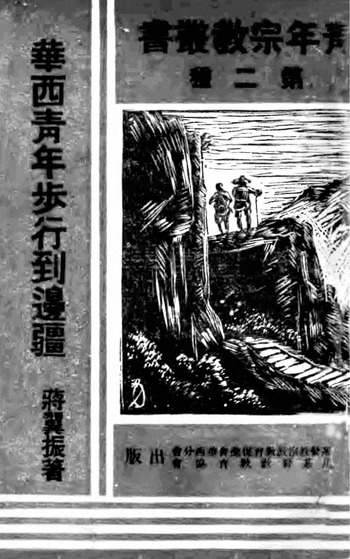
The importance attached to what amounted to a selfless devotion to serve the inhabitants of the frontier was an important theme which is well documented in the records of these summer expeditions. In essence, it reflected the values attributed to the devotion of Chinese intellectuals who went out to reach the masses despite the personal sacrifices it entailed. Jiang Yizhen's book cited above, for example, opened with a poem that stated: ‘Sweating profusely,. . .walking along holding a stick in one's hand, short clothes and humid dress, accompanied by 79 carefully chosen student youth and 10 scholars, walking towards the frontier step by step’.Footnote 76 Walking, in effect, had become a potent symbol of humility which occluded the sense of moral and cultural superiority that corps members felt towards the masses. Furthermore, the guidelines for BJFWB personnel and the summer service corps stated that, as for transportation, ‘going on foot is regarded as a matter of principle’.Footnote 77 It is thus no coincidence that the cover of Jiang Yizhen's book Huaxi Qingnian Buxing dao Bianjiang (West China Youth Walk to the Frontier) was illustrated by a woodcarving depicting two solitary people walking up high and steep cliffs and only aided by a walking stick (see Figure 1). The fact that no illustrations of non-Han people appear in this book illustrates to what extent the movement was centred more on self-sacrifice and inner cultivation than on the actual beneficiaries of the movement itself.
Front Cover of Jiang Yizhen's Huaxi Qingnian Buxing dao Bianjiang [West China Youth Walk to the Frontier].
Source: Zhonghua Jidujiao Zongjiao Jiaoyu Cujinhui Huaxi Fenhui [Chinese Religious Education Promotion Association, West China branch], Chengdu, no date].

‘Service’ itself was by definition the means by which students would not only assist their downtrodden frontier brothers but also allow for a true understanding of their plight. Students who participated in summer work among the Qiang in Lobozai (northwest Sichuan) in 1942 for example had
actually helped the Qiang peasants in their field work in order to get close enough to them and to help them educationally and morally. In and through all these they had a rich experience and good time as well. They have come back not only with happy memory of the work but also genuine affection for the people and a true appreciation of the cause.Footnote 78
Human relations, however, were only a part of the dynamics present in the SSSC. Every summer selected students, together with their academic mentors, were also expected to carry out rigorous fieldwork in order to make useful contributions in their own discipline. The spirit of inquiry and adventure present among the students at the time was eloquently pictured by Zhang Bohuai as he described the farewell ceremony held for the first corps on the main campus of the West China Union University. After referring to the solemnity of the ceremony which included representatives of both the provincial and central government Zhang added:
each [student] was carrying his or her own travelling kit on the back, in which are a suit of clothes, a first aid box, a package of books and notebooks, a roll of forms and schedules for social investigation and toilet articles. . . . They were to befriend peoples who, until then, knew only of traders and soldiers from the interior of China.Footnote 79
Summer service in the frontier provided a unique opportunity for some students to carry out research for their own dissertations. The BJFWB's journal recalled in 1943:
Three years until now, summer student frontier service corps’ leaders and members have continuously published their thesis in regards to the frontier in newspapers and journals. Our department is convenient for realising both work and touring for the purpose of specialised research.Footnote 80
Scholars accompanying students also cited the usefulness of venturing into the borderlands during the summer periods. Hu Xiuying (S. Y. Hu), for example, a botanist from Lingnan University, served as an adviser for the SSSC in 1940 and recalled how this had ‘offered her an opportunity of living in a normal isolated [Jiarong] village for a month’.Footnote 81 A number of works published by both students and academics dealing with social surveys, religion, land utilization and medical surveys were the direct result of these expeditions which encouraged selfless devotion and scientific enquiry as its underlying motives.Footnote 82
Yet the SSSC was not merely a passive onlooker of portraying society on the frontier. It was a dynamic group which sought to engage with the frontier and its inhabitants and bring about its modernization and integration into a greater Chinese nation. The extent of its activities could be gauged from official reports written during this period. In 1940 an official of the Sichuan Educational Department sent a briefing on the SSSC movement in which he described the corps as ‘descending on the frontier people in numbers exceeding 200, [characterized by] an active ideology (xingdong sixiang), influencing the locality everywhere in all aspects and perform a self strict supervision’.Footnote 83
In effect its ‘active ideology’ encompassed the main tenets of frontier reconstruction present in both Christian modernity as well as those usually preached by the GMD based on the teachings of Sun Yat-sen. Squads of medical students set up temporary hospitals in the midst of Lamaseries to attend Tibetans by which they attempted to persuade them into believing the benefits of Western medicine. Agricultural improvement projects were also established in the vicinity of Xichang in Xikang province. Propaganda units, akin to those drama troupes set up by Chinese students when war broke out in 1937, were also organized. In 1943 it was reported that these mobile drama groups (xunhui judui) had ‘penetrated deep into Yi territory, and publicly performed stage plays related to the cooperation of Yi and the Han for the sake of Resisting Japan and Saving the Country’.Footnote 84 According to other sources, one other main project led by the BJFWB was that of assisting downed American pilots over the Liangshan area. Reaching out to the Yi communities and explaining who Americans were was also part of ‘war education’ efforts.Footnote 85
That young Han Chinese students were able to come into contact with the frontier and its inhabitants was in itself a significant event. There is no doubt that the War of Resistance produced a unique series of circumstances that brought about a major shift of national consciousness in physical and geographical terms. By bringing urban Chinese youth into the localities of the Sichuanese borderlands notions of Chinese identity underwent major shifts as the ‘frontier brothers’ became a palpable source of inspiration to promote nationhood and change. In effect the transition of previously imagined notions of China's interior and its inhabitants into concrete and intimate human experiences could also be observed in those students who marched from Changsha to Kunming and later formed the National Southwest Associated University (Lianda).Footnote 86
Summer service in the frontier regions no doubt reinforced among students the urgency to bring about much needed change among those who were perceived to be missing out from the benefits of modernity and Chinese civilization. It is important to recall that one important underlying notion behind the exodus into China's borderlands was that of preserving China's cultural heritage from the onslaught of Japanese invasion.Footnote 87 Yet the preservation of China's ‘cultural heritage’ was also matched by a fascination with the exotic ‘other’, as seen in the photographic evidence registered by these excursions. As was the case among other Chinese intellectuals of the time, the SSSC contributed to the establishment of an Orientalist image which cast non-Han societies within the discourses of national folklore.
Student summer expeditions in fact became important vehicles for disseminating notions of ‘frontier culture’ by attempting to represent both the image and the plight of minorities in Chinese coastal cities once the War of Resistance had ended. As Zhang Bohuai recalled:
As a result of such summer teams, folk songs, folk dances and folklores of the Border Peoples have become familiar features on the campuses of universities in West China. Every university became a publicity bureau of the Border People. The Physical Culture Department of Ginling College especially has made a great contribution in this line. Through its graduates, folksongs and folk dances of the Border People have since made their appearances in many middle schools in Shanghai, Nanking, and other places throughout the whole country. With the appreciation of these things, a wide interest in, and a new attitude towards, the minority groups have developed among the students of the country. The future is bound to be better than the past.Footnote 88
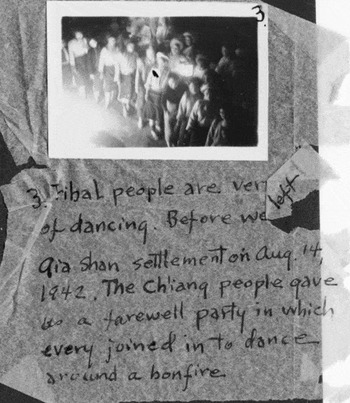
Some of these photographic testimonies found at the repositories of the Yale Divinity Library are especially helpful to comprehend the ways in which this process was done. For example, the photograph shown in Figure 2, taken by one of these summer teams, depicts a Qiang farewell ceremony whose caption states: ‘Tribal people are very fond of dancing. Before we left Qia Shan settlement on 14 August 1942, the [Qiang] people gave us a farewell party in which every [sic] joined in to dance around a bonfire.’Footnote 89 Dancing and innate friendliness were defined as being part of the Qiang's character, themes that were constantly cited to portray a new stage of interethnic relations born out of wartime circumstances.
Ginling in Chengtu: Dancing around the fire. A farewell ceremony given by the Chiang people to the College group (Border Service, Summer, 1942).
Source: Box 397, Number 1176 UBCHEA Collection, Special Collections, Yale University Divinity School Library.

Visual spectacles of so-called folk dances and songs mentioned above as being part of campus life were indeed common practices for the period. Justin Jacobs for example has argued that the creation of the Xinjiang Youth Song and Dance Troupe by Governor Zhang Zhizhong (1890–1969) during 1947 had in mind the same mission of bringing a new embodiment of the frontier to its urban Han Chinese counterpart.Footnote 90 However it is wrong to assume that such practices are to be solely traced to the influence of Soviet minority governance tactics as suggested by Jacobs. These types of practices can be seen to be taking place as a much wider phenomenon during this period.Footnote 91
Commentators at the time in Christian circles assessed the effects of these summer expeditions in positive terms. In post-war planning the possibility of sending students from Nanjing and Shanghai to the border regions was raised once relocation to the eastern coast had taken place.Footnote 92 However, once post-war relocation took place such enterprises became almost non-existent due to the high costs involved.Footnote 93 Despite the need for urgency of frontier reconstruction, as reflected in the calls of the government and of some intellectuals, it became clear that the frontier had been demoted in the face of other pressing urgencies of national reconstruction taking place in the ravaged zones of the east coast. Once the headquarters of the BJFWB had been transferred to Nanjing, logistics and the rising cost of staff made it even more difficult for its operations to continue in the post-war period.
Conclusion
In the same way that Liu Xiaoyuan argued that the CCP's Long March was a ‘frontier passage’ of sorts, which awakened its leaders to the importance of ethnopolitics,Footnote 94 Magnus Fiskesjo is correct in applying the same term for the wartime period as it forced the GMD regime to take into account the pressing issues of ethnic minorities and their role in a nation at war.Footnote 95 The ensuing number of reconstruction schemes that emerged revealed not only the many views held within the GMD on how to build both state and nation on the borderlands, it also revealed the nature of collaboration with scholars who, despite their many misgivings with the repressive character of the regime later on, sought to creatively engage with the GMD's state building project and carve out their own niches of influence during the wartime period. As scholars such as Li Anzhai began to question the legitimacy of the regime it is not surprising that their loyalties, together with many of their projects, were transferred over to the Chinese Communist Party after 1949.Footnote 96
Yet the wartime period was also a unique ‘frontier passage’ for a nation on the move as well which not only involved the active participation of scholars but also throes of young Han Chinese students who by taking part in this enterprise began to apprehend a ‘new China’ and acknowledged its rich geographical and ethnic diversity. The impact of this enterprise could still be observed in the early post-war year's applications for ‘frontier administration’ posts in Xikang from young candidates who still showed a persistent use of the terms ‘frontier service’ and a desire to ‘reconstruct the basis of the frontier's economy’ among their aspirations.Footnote 97 Building the nation on the basis of frontier service arguably allowed for new ways of defining interethnic relations and envisaging a multicultural Chinese nation. Nevertheless, at the heart of this scheme was the quest to shape a new citizenry where religion, language and indigenous customs of the borderlands would invariably have to negotiate the form of their existence as they too were being re-constructed.