INTRODUCTION
In May 1896, Colonel “Buffalo Bill” Cody of the US Cavalry arrived in St. Louis, Missouri with his Wild West Show: “100 Indian Warriors,” “Congress of Rough Riders” and an exhibition herd of buffalo.Footnote 1 Describing how a then seven-year-old T. S. Eliot went to photograph what he called “a rather mangy buffalo” chained to a tree,Footnote 2 poet and biographer Robert Crawford suggests that the future writer of The Waste Land's “lifelong interest in comings together of the supposedly ‘primitive’ and the modern urban has its origins in his St. Louis boyhood.”Footnote 3 Over six decades later, on receiving the Emerson–Thoreau Medal from the American Academy of Arts and Sciences, Eliot himself stated, “My urban imagery was that of St. Louis, upon which that of Paris and London had been superimposed.”Footnote 4 Not only does this explanation of his formal influences offer a robust definition of how settler colonialism functions on a certain aesthetic level – by superimposing the colonizer's urban imagery onto the land of the colonized – but as an acknowledgement it also points towards the importance of St. Louis in shaping Eliot's writing, and moreover provides an opportunity to help situate Eliot's poetic form within the context of his settler colonial identity. This essay investigates how the construction of St. Louis impinges upon Eliot's The Waste Land.
In “Eliot, Narrative, and the Time of the World,” Harriet Davidson describes the poem's Unreal City sections as showing “a living death in a world stripped of the reality of space and time by the metaphoric desire for unity.”Footnote 5 This characterization of urban spaces in The Waste Land as unreal is partly rooted in the fact that the construction of Eliot's hometown, St. Louis, was dependent on a settler colonial quest narrative which, to echo Davidson, stripped the city of the reality of space and time by dismantling local chronological history. I structure this argument around three instances in the construction of St. Louis during the nineteenth century which illustrate this dismantling of its local history. In the opening section I focus on the construction of the Eads Bridge and how classical architectural styles confound local, historical realities by imposing forms of urban imagery which sustain certain settler narratives. In the subsequent two sections I focus on the role of ruins; among the most significant forms of urban imagery in Eliot's poem. Spencer Morrison has argued that “cycles of rapid spatial annihilation and reconstruction” infuse The Waste Land's urban ruins.Footnote 6 The presence of these cycles in the poem stems, in part, from the urban imagery of St. Louis, a city whose construction – and ultimate colonization through “Americanization” – was itself made possible by two significant instances of rapid spatial annihilation and reconstruction. The first of these discussed is the annihilation of many of the Mississippian mounds on top of which St. Louis was built, and the repurposing of their materials and space in order to fuel economic growth. The second is the rapid annihilation wrought by the St. Louis fire of 1849 which destroyed large portions of the city's previous French architecture; a cultural purge that paved the way for the reconstruction of St. Louis as a US city.
Investigating the architectural history of Eliot's hometown is a necessary response to the acknowledgement that his impressions of urban imagery were those of St. Louis, even if it is the case that “later impressions” came to be superimposed, and “to fuse, in some sort, with them.”Footnote 7 One way of thinking about this fusing process, wherein various layers of urban imagery cohabit within Eliot's work, is through the model of the palimpsest. Sarah Dillon describes the palimpsest as a “phenomenon where otherwise unrelated texts are involved and entangled, intricately interwoven, interrupting and inhabiting each other.”Footnote 8 As this paper illustrates, the construction of St. Louis was similarly palimpsestic. Not only, then, does Eliot's acknowledgement demonstrate that beneath the European textual surface of his poetry there is an inevitable, albeit submerged, engagement with St. Louis, its colonial history and US settler colonization, but, moreover, it uncovers the extent to which the layered, palimpsestic conception of his own urban imagery is linked with the construction of his hometown.
This kind of contextualization destabilizes the source of modernist poetics and engages with what Rajeev Patke sees as the need to supplement the traditional assumption that “modernism was constituted through an aesthetic break with preceding European traditions,” with an “awareness of the transformation of European (or Western) sensibilities through the influence of colonialism.”Footnote 9 To this end, Patke also notes that whilst attempts to define the start of modernity are numerous, theorists as distant as Hegel and Fredric Jameson have posited the European colonization of the Americas as one possible marker.Footnote 10 In order to enrich our current understanding of Eliot's poetry it is necessary to ask, where does St. Louis's urban imagery emerge from? What were the cultural conditions for that imagery's production? And how does the investigation of those cultural conditions change our reading of The Waste Land, and its relation to settler colonialism?
I. BRIDGES AND EMPIRE
J. M. Rawa notes that “Western expansion under the aegis of Western quest gained momentum during the nineteenth century in which the imperial trajectory continued to make use of its master trope to manufacture consent for Euro-American imperialism.”Footnote 12 Whitman captures the spirit of this Euro-American imperialism – a quest for global connectivity with America at the centre – which infused the nineteenth-century production of urban space in the United States. Bridges are among the most significant symbols of this modern connectivity and I begin this section by using the construction of Eads Bridge in St. Louis as a case study to demonstrate the extent to which the city's architecture was informed by the mythology of this quest narrative.
The young T. S. Eliot, who in his final years of schooling was part of a small group “distinguishing themselves in the Classical Course,”Footnote 13 grew up in a city where classicism was also the most popular architectural style. As Robert Sharoff explains, throughout its architectural history, “Classicism lingered longer in St. Louis than just about anywhere else in the United States. Indeed, almost all of the city's greatest architects were Classicists.”Footnote 14 This was part of a nationwide trend, and throughout the nineteenth century and into the early twentieth, US towns and cities were built in a European style that evoked empire. Read through the model of the palimpsest, this classical architectural style – designed to situate St. Louis within the historical empires of Europe – functioned as a fresh layer of urban text. This evocation of ancient European culture resonates with Josephine McDonagh's argument that the palimpsest creates only an “illusion of depth … while always in fact functioning on the surface level.”Footnote 15 As Margaret Malamud states, “the metaphorical power of architecture as a symbolic system helped bestow upon American culture a genealogy and a legitimacy, placing it at the pinnacle of a trajectory that reached back through the more recent European empires to the Renaissance and ultimately to Greco-Roman antiquity.”Footnote 16 The city's first leading architect, George Barnett (1815–1898) designed hundreds of buildings in various European styles, doing more than any other designer to establish classicism as the city's “dominant architectural language.”Footnote 17 This dominant architectural language – one heavily invested in the agenda of legitimizing US settler colonization – was among the first and certainly the most omnipresent forms of modern language to which Eliot was exposed.
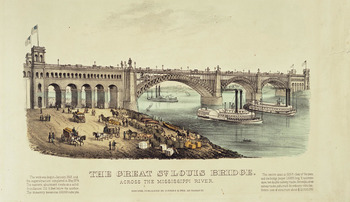
Out of this architectural culture emerged another major figure in the history of St. Louis's urban imagery, James Eads (1820–87), who, according to one legend, on first seeing the Mississippi, whispered, “This is going to be my river.”Footnote 18 Whether true or not, the proliferation of this legend attests to the associations between the “dominant architectural language” of the nineteenth century and the rhetoric of settler colonial conquest. Eads's crowning achievement was his 1867 design for what would become the world's first steel truss bridge, connecting East and West St. Louis across the Mississippi River (see Figure 1). Twenty years later, after that bridge's construction, the Scientific American compared Eads to the Spanish conquistador Hernando de Soto, reflecting that “Eads gained his fortune by conquering the river, and the mighty structures resulting from his genius will remain in perpetuation.”Footnote 19 Certainly this structure remained in Eliot's mind, writing in 1930 that it was “a great treat to be taken down to the Eads Bridge in flood time.”Footnote 20 Prior to the bridge's construction, Eads had become probably the foremost expert on the Mississippi's ever-shifting topography and flow.Footnote 21 At one point he described the Mississippi river in terms anticipatory of Virginia Woolf's stream of consciousness: “Every atom that moves onward in the river is controlled by laws as fixed and certain as those which direct the majestic march of the heavenly spheres.”Footnote 22 But Eads's nascent modernism also implies a sense of predestination, reflecting the language of quest and conquest within the context of US westward expansion. After all, the construction of his bridge was part of the project to help St. Louis fulfil its assumed role as the “Gateway to the West.” As Eliot himself would later describe Forest Park in St. Louis, it was “to me, as a child, the beginning of the Wild West.”Footnote 23
The Great St. Louis Bridge. Across the Mississippi River. Lithograph, Currier and Ives, 1874. Image courtesy of the Missouri History Museum, St. Louis.

The implementation of the Romanesque viaduct style in Eads's design, alongside the sense of conquest reflected in its construction, is demonstrative of a larger desire to create something timeless (but which can more accurately be described as history-less) in the new US city. By re-creating ancient Rome on the banks of the Mississippi in the nineteenth century, figures such as Eads subscribed to a vision which ploughed over the reality of preceding local histories and allowed those involved to envision themselves as being at the frontier of a unified project: the “heavenly” march of Western civilization. The architecture of St. Louis props up this mythologically inclined worldview, and therefore it speaks directly to Eliot's urban imagery in The Waste Land. It is important here to return to Davidson's description of the Unreal City sections in the poem as showing “a living death in a world stripped of the reality of space and time by the metaphoric desire for unity.”Footnote 24 Fittingly, these Unreal City sections also engage with the image of the bridge. Specifically, Eliot signals the tragic aftermath of imperial conflict in the wake of the First World War, on London Bridge:
In this instance the bridge is the site of the “so many” dead, “undone” by war. Rawa links the quest narrative that influenced the construction of Eads Bridge, and the “language of quest” used in propaganda aimed at persuading people to fight in the First World War;Footnote 26 “The old Lie,” as Wilfred Owen famously denounced it.Footnote 27 Owen's rejection of the quest, among the period's best examples of “domestic resistance to the rhetoric of nationalism and imperialism,”Footnote 28 centres on the fact that it is untrue. This sense of the quest's untruth manifests itself in The Waste Land in the unreality of the city. Eliot connects the deaths of those betrayed by the quest to the poem's urban imagery by locating the dead on the bridge itself. This connection draws attention to the fact that imperialist urban imagery is a product of that same quest and embodies a state apparatus which, as Noam Chomsky points out, is used to “manufacture consent” for empireFootnote 29 – and, I would add, the terms of the quest. In this sense, the London Bridge of The Waste Land can be read as not only physically supporting the flowing crowd of the dead, but also supporting and facilitating the ideological conditions that caused their deaths. This is supplemented by the fact that “there is no water” in the waste land.Footnote 30 In this waterless, “arid plain” the real function of the bridge is revealed:Footnote 31 to prop up the “Old Lie,” the unreal. This confusion of purpose is signalled in the fact that instead of water flowing underneath the bridge, it is the crowd that “flowed over” it.
Again, at the poem's conclusion, Eliot locates the fate of empire in the image of the bridge, specifically in the line “London Bridge is falling down falling down falling down.”Footnote 32 Whilst Edward Timms is right in his assertion that the unreal in Eliot's urban imagery signals the “precariousness of imperial power, indeed of Western civilisation as a whole, foreshadowing the decline of London,”Footnote 33 by situating Eliot's urban imagery within the context of his settler colonial identity, it becomes clear that this unreality also speaks to an important preoccupation with the forces of US imperialism which gained increasing momentum throughout his lifetime.
II. THE BURIAL OF THE DEAD
In order to gauge the full extent to which the urban imagery of St. Louis impinges upon The Waste Land it is necessary to consider pre-European urban space in the area. Modern St. Louis was built on part of the ruins of the Mississippian city of Cahokia. Occupied primarily between 800 and 1400, Cahokia was the largest pre-Columbian settlement north of Mexico and the religious and economic centre of Mississippian culture. Estimates place the population of this agricultural society in the range of ten thousand to twenty thousand at its peak between 1050 and 1150; the equivalent of many European cities at the time. It once covered 1,600 hectares and included 120 mounds. These mounds gave rise to St. Louis's early nickname, Mound City. The largest of these mounds and the focal point of Cahokia are now the centre of the Cahokia Mounds State Historic Site – one of twenty-three UNESCO World Heritage Sites in the United States.Footnote 35 The destruction of many of these mounds and the superimposing of European forms of urban space throughout the history of St. Louis constitute an instance of what Morrison calls “cycles of rapid spatial annihilation and reconstruction,”Footnote 36 which can be understood as a settler colonial, cultural burial of the dead. It is therefore important to investigate the conditions that enabled this burial, and to consider the extent to which the formal properties of this process are present in The Waste Land.
Eliot's “The Burial of the Dead” is largely paradoxical in that the poem's form, far from a burial, in fact relies on the excavation and displaying of what Paul Douglass has called its “intertextual archaeology.”Footnote 37 “The Burial of the Dead” ends with the speaker voicing his concerns over the “Dog far hence, that's friend to men,”Footnote 38 that must be kept away for fear of digging up the buried corpse, and an external voice responding with Baudelaire's “You! hypocrite lecteur! – mon semblable, – mon frère!”Footnote 39 Eliot's deployment of this line – itself an example of intertextual archaeology – draws attention to the poem's own digging up of the dead (in this case Baudelaire), and therefore to the narrator's hypocrisy in voicing his concerns over the dog. What is significant is that through the ironic location of this accusation of hypocrisy within an instance of excavated and displayed intertextual archaeology the poem can be read as reflecting on the paradoxical strategies involved in its own representation of burial. But the poem's meditation on this paradox is also rooted in the formal properties of nineteenth-century archaeology in the United States. Just as The Waste Land presents a paradoxical burial of the dead, wherein the process of burial is itself predicated on the excavation and displaying of intertextual archaeologies, the US approach to archaeology, which was only just emerging as an established professional field at the end of the nineteenth century, was one dogged by a similar paradox. The cultural conditions dictated by the US settler quest narrative meant that the desire to excavate human remains and display artefacts from preceding American cultures resulted largely in burying the observable lifeways of those cultures, and obscuring the evidence connecting contemporary indigenous communities with their ancestral histories in the landscape. Sonya Atalay has noted that “a growing literature now exists demonstrating the specific ways in which the discipline of archaeology was closely tied with the project of colonization in North America and elsewhere.”Footnote 40 It is important to consider what the alignment of archaeology with the colonization of North America means for the urban imagery of The Waste Land.
Approaches to archaeology at the time were widely dictated by its interrelation with the fields of anthropology and ethnology. Alexandar Polunin has argued that “Eliot's knowledge of contemporary anthropology was in fact fundamental not only to the structural composition of The Waste Land, but also to the formation of the aesthetic principles which underpinned the emergence of early Modernist poetry as a whole.”Footnote 41 But even as the anthropological studies of the day sought to clarify the role of mythology and the quest tradition in shaping Western culture, significant portions of the Anglo-American academic establishment in which Eliot received his education (Harvard established its anthropology programme in 1890 under the presidency of Eliot's cousin, Charles W. EliotFootnote 42), and their approach to anthropological study, continued to be compromised by their own adherence to the terms of the dominant quest narrative of the nineteenth century: the westward drive of US settlement in North America. The construction of St. Louis, a frontier city, and the destruction of the ancient mounds, were part of a nation-building process that had involved colonizing vast amounts of territory. In order to facilitate this expansion, it was necessary that the terms of the US quest narrative inspire a cultural atmosphere which enabled large factions within the settler colonial academic establishment to continue reinforcing the belief that the indigenous peoples of North America were incapable of anything approaching European civilization. The urban imagery of the city and the nineteenth-century US scientific establishment which facilitated the appropriate conditions for its growth came to a radical intersection in St. Louis, an intersection which The Waste Land engages with on numerous levels.
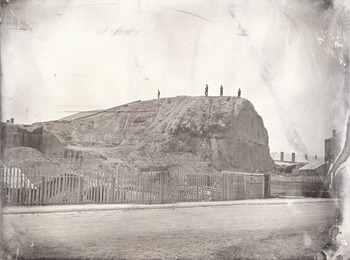
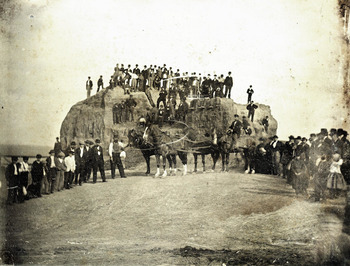
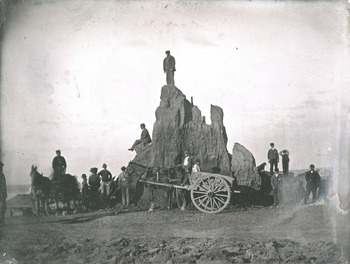
In his memoirs, John Wesley Powell (1834–1902), the first director of the Bureau of Ethnology, wrote, “Whether we desire it or not, the ancient inhabitants of this country must be lost, and we may comfort ourselves in the reflection that they are not destroyed, but are gradually absorbed, and become a part of a more civilized community.”Footnote 43 This kind of ambivalence goes some way towards explaining why the population of St. Louis, driven by the economic opportunities of expansion, were left relatively unchallenged in their destruction of indigenous historical sites. The daguerreotypes of Thomas M. Easterly (1809–82) document the gradual destruction of Big Mound, a significant part of the archaeological remains of Mississippian culture in St. Louis (see Figures 2, 3 and 4). As Biloine Whiting Young and Melvin Fowler note, Big Mound was “being torn down to provide fill for the extension of the North Missouri Railroad.”Footnote 44 They also report that a tomb found inside contained “about 20 burials,”Footnote 45 of which “most of the bones, beads, and artifacts uncovered … went into landfills. A modern city, the gateway to the West, was being built and the past was bulldozed aside to make way for the future.”Footnote 46 As one local paper, the Daily Missouri Democrat, wrote on 8 November 1868, “Men are digging on every side. And what should have been purchased by the city and preserved inviolate will soon be known only in local tradition.”Footnote 47 Later calls to stop the destruction wrought by the growth of the city included Thomas H. English's The Cahokia Indian Mounds: A Plea for Their Preservation, in which he stated, “It is not yet too late to save the Cahokia mounds, but in a few years more it certainly will be.”Footnote 48
“Big Mound, at Fifth (Broadway) and Mound Streets, St. Louis.” Copy Photograph, Emil Boehl after Thomas Easterly, 1852. Image courtesy of the Missouri History Museum, St. Louis.

“Big Mound Shown Partially Graded.” Daguerreotype, Thomas M. Easterly, 1869. Image courtesy of the Missouri History Museum, St. Louis.

“Big Mound during Destruction. The Last of the Big Mound.” Daguerreotype, Thomas M. Easterly, 1869. Image courtesy of the Missouri History Museum, St. Louis.

These calls to protect the mounds reveal the extent to which the population of St. Louis sensed that something significant was being lost. For those engaged in the preservation effort, the subsequent urban imagery of St. Louis was haunted by this sense of loss resonant with Doyle and Winkiel's assertion that “canonical white Anglo modernism is … haunted by ghosts – the repressed ghosts of … a subaltern modernity.”Footnote 49 This sense of a haunted modernity is evidenced in the ritualistic form which the Cahokia preservation effort would later take. Among these efforts was the formation, in 1911, of a secret organization of business and professional men known as the “Monks of Cahokia.” This secret group was formed with the intention of protecting one of the mounds known as “Monks Mound.” As Warren K. Moorehead states, “The members would secretly gather atop Monks Mound in hooded monks’ robes and perform certain rituals.”Footnote 50 This ritualistic response to an instance of destruction resonates in both form and content with Eliot's poem. In The Waste Land itself, the sense of haunting is strongest in the lines “Who is the third who walks always beside you? / When I count, there are only you and I together.”Footnote 51 Significantly, this unidentified figure, “wrapt in a brown mantle, hooded,”Footnote 52 is linked with the earlier appearance of the “Unreal City / Under the brown fog of a winter noon,”Footnote 53 and therefore suggests an interchangeability between the hidden persons and hidden cities of the poem. The following stanza further strengthens this association, this time describing
again as “Unreal.”Footnote 54 These associations within the text reveal an acute sense that urban city space is haunted by unidentified, hidden figures. Within this context, the absence or un-identification of the city on top of which Eliot's source of urban imagery was built is deafening. This understanding of Eliot's urban imagery is further supplemented by the appearance of one specific figure in The Waste Land: Phlebas, “the drowned Phoenician sailor.”Footnote 55
One by-product of the manufacturing of consent for US settler colonization was the spawning of various attempts to explain away the presence of advanced indigenous American civilizations. Inevitably these explanations went to some lengths not to acknowledge the fact that mounds such as those at the Cahokia site were built by the ancestors of the current tribes of Native Americans. One persistent claim was that these mounds and other related archaeological discoveries that existed all over North America were evidence that ancient seafaring Phoenicians had discovered America long before Columbus. In Myths and Symbols (1905), Stephen D. Peet, an elected member of the American Antiquarian Society, wrote,
The discovery of these various forms of superstition in the American continent suggests to us the possibility of a transmission of the same complicated cultus to the western coasts of the great sea. This is an important fact. Was it owing to the extension of the Phoenician voyages or to the zeal of Druidic priests that these things were introduced? The contact seemed to have produced a marvellous effect. It was not a decline from the bronze age which we see in these familiar symbols, but the effect of contact with European voyagers in pre-Columbian times, pre-Columbian discovery in fact. The conclusion is startling, but this is the only way that we can account for the marvellous resemblances. Certainly no ordinary nature worship could produce a cultus which would combine all the elements of the eastern faiths Druidic, Phoenician, Hittite, all in one, nor could the law of growth account for the details as they are seen.Footnote 56
The myth of the seafaring Phoenician discovery of America, through its implicit delegitimizing of existing indigenous connections to the landscape, runs adjacent to the political forces that created the urban imagery of St. Louis. The “drowned Phoenician sailor” that appears in “The Burial of the Dead” figures as a card in Madame Sosostris's Tarot deck. In “Notes on the Waste Land,” Eliot states, “I am not familiar with the exact constitution of the Tarot pack of cards, from which I have obviously departed to suit my own convenience.”Footnote 57 One such departure includes the “drowned Phoenician sailor,” which is not a part of the original Rider-Waite tarot deck of 1910.
Discussions surrounding such a theory were also carried out closer to Eliot's home. In Ancient America (1871), Connecticut politician John Denison Baldwin summarized the theory, writing,
The known enterprise of the Phoenician race, and this ancient knowledge of America, so variously expressed, strongly encourage the hypothesis that the people called Phoenicians came to this continent, established colonies in the region where ruined cities are found, and filled it with civilized life. It is argued that they made voyages on the “great exterior ocean,” and that such navigators must have crossed the Atlantic; and it is added that symbolic devices similar to those of the Phoenicians are found in the American ruins, and that an old tradition of the native Mexicans and Central Americans described the first civilizers as “bearded white men,” who “came from the East in ships.”Footnote 58
Although Baldwin ultimately dismissed the idea that the mound builders had come from across the Atlantic, he also rejected the fact that the mounds were constructed by the ancestors of existing Native American peoples, stating, “Those who seek to identify the Mound-Builders with the barbarous Indians will find nothing that will support their hypothesis,”Footnote 59 decrying such a connection as “absurd.”Footnote 60 Another New Englander, and closer to Eliot still, the popular nineteenth-century poet William Cullen Bryant (1794–1878), also referred to the myth in one of his most famous poems, “The Prairies” (1834). After guiding his steed over “the verdant waste” in the second stanza,Footnote 61 the speaker considers those buried beneath:
As Fowler and Whiting Young argue, “The belief that the mounds had been created by a superior, non-Indian race,” a belief adopted here by Bryant, “had comforting political ramifications. If Europeans could convince themselves that the savage Indians were, in reality, interlopers who had overrun a prior advanced civilization … then they could feel justified in their persecution of the Indians and in the destruction of the Indian cultures.”Footnote 63 This extract shows that the myth of the mound builders reached beyond the scientific debates of the era, into the New England poetic tradition which included figures such as T. S. Eliot's mother, Charlotte Eliot.
There is, at this point, an important comparison to be made between Eliot's reference to the seafaring, would-be mound-building Phoenician, and an earlier reference to another figure who also appears in the nineteenth-century New England poetic tradition: John the Baptist. Lee Oser argues that “The Prairies” by William Cullen Bryant and the poetry of two of Eliot's relations, John Greenleaf Whittier and James Russell Lowell (the latter of which was incidentally a correspondent of Ancient America author Baldwin), use John the Baptist as a symbol of either the national or the Puritan mission in America, and, I would add, its ongoing colonization. He argues that Charlotte Eliot also wrote in this tradition, with John the Baptist figuring in her poetry as a “symbol of the prophetic and missionary ideals of late-Puritan culture.”Footnote 64 He goes on to suggest,
From Eliot's perspective the figure of John the Baptist prophesying was very probably a cliché, a tenuous link to Puritan traditions that were becoming part of the dead past … In “The Love Song of J. Alfred Prufrock” the prophet no longer prophesies in the American wilderness; instead he is silenced and somewhat comically disfigured. With the image of Prufrock's “head … brought in upon a platter,” Eliot disrupted a long tradition of American Puritan iconography, and implicitly repudiated a legacy of mission and prophetic calling that survived within his immediate family.Footnote 65
Viewed alongside this, as well as Lyndall Gordon's suggestion that Eliot “was resolved not to fall into what he saw as the narrowness of the New England writer,”Footnote 66 something very similar can be seen occurring in “Death by Water.” Read within the context of serious discussions being had in the New England archaeological, anthropological and poetic establishments to which Eliot's family belonged, and which, as Oser points out, he had already begun to react against, the appearance of Phlebas the Phoenician in The Waste Land can be understood as a similarly playful reference to the sense of “mission and prophetic calling” which informed the imperialist energies of the United States in the nineteenth century, a discourse of quest and conquest which directly informed the urban imagery of St. Louis. In this context, Eliot can be seen to reposition Phlebas the Phoenician – the symbolic prophet used to affirm the validity of Euro-American expansionism and urban construction by delegitimizing Native American connections to the land – like the reference to John the Baptist in “Prufrock,” in a new subverted role. This role of the “fortnight dead,”Footnote 67 decaying remnants of the “once handsome and tall” traditional quester,Footnote 68 is framed within a morbid cautionary tale that speaks directly to US imperialist hubris.
What is revealed by reading Phlebas the Phoenician in this context is a generally unacknowledged aspect of The Waste Land's engagement with the mythologizing processes of settler colonialism, of the quest implicit in conquest. So, whilst Adam Arenson is probably justified in assuming that after the destruction of “The Big Mound” – “St. Louis's most impressive pre-Columbian monument” – “no nostalgic local writer composed as much as a poem in memorial,”Footnote 69 it is certainly the case that St. Louis's most famous writer's most famous poem speaks directly to the forces that caused its destruction. This demonstrates how investigating the links between Eliot's form and the destruction of the Cahokia mounds aids us in considering the relevance of figures such as the drowned Phoenician sailor around issues of conquest and colonization. Furthermore, it demonstrates how relocating the source of Eliot's form within St. Louis's urban imagery enriches our understanding of how The Waste Land speaks directly to the historical implications of the settler quest narrative.
III. THE FIRE SERMON
As well as the construction of Eads Bridge and the destruction of the Cahokia Mounds, the imaginative response to the St. Louis Fire of 1849, another instance of rapid spatial annihilation and reconstruction, resonates with Eliot's writing. As Arenson describes, the St. Louis Fire of 1849, coupled with the “destruction of the American Indian mounds,”Footnote 70 meant that
[t]he smoldering ruins of the French-built environment in St. Louis were paved over by a new American foundation. In 1848 and 1849, as the nation expanded into new western territories and welcomed hundreds of thousands of European immigrants … St. Louis entrepreneurs used their Great Fire to obliterate the past and obscure present tragedy. All fortunes would derive from the new downtown district. All other narratives of St. Louis's origins and identity were replaced with the Great Fire.Footnote 71
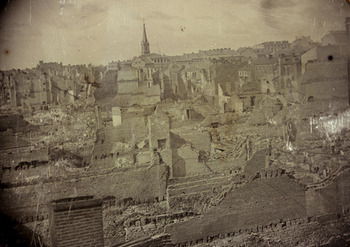
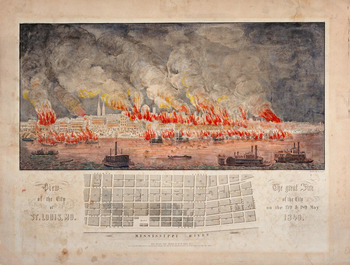
This fire functioned as a kind of settler colonial fire sermon, and its ability to “obliterate the past” offers another important connection with the characteristics of the Unreal City already discussed in this essay. As Eliot's grandfather, minister William Greenleaf Eliot, recalled, “the work of rebuilding began before the ruins were cold,”Footnote 72 but not before Easterly had another chance to record a moment of destruction in St. Louis's history. Observable in one daguerreotype is the wasteland left by the disaster (see Figure 5). However, whilst this more straightforward depiction of an urban catastrophe resonates with Eliot's poem aesthetically, it was the work of two German immigrant engravers, Julius Hutawa and Leopold Gast, that really captured the modernist forms implicit in the settler response to the destruction. Three months after the fire, they created a hand-coloured broadside (see Figure 6) that shows the city burning from the Illinois shore. The Missouri Republican newspaper urged citizens to purchase this imprint “for future reference,” as “this view of the city, we predict, will be esteemed of great value in future years.”Footnote 73 Arenson goes on to describe how
Hutawa and Gast preserved the Great Fire as a moment of transformation. By including a street grid of the burnt district, they provided a level of detail that allowed purchasers to point out exactly where they lived or worked, and where the fire reached. The broadsheet oriented the lived experience of the fire to the abstract blocks, and outlined the fire's footprint as the refounding began.Footnote 74
The value ascribed to this image, one in which new artistic forms of expressing urban imagery allow the viewer to orient themselves within the lived experience of the fire and the city, demonstrates how modernist formal principles emerge out of the responses to “moment[s] of transformation” and the need for those in settler colonial contact zones to reaffirm their sense of belonging to the landscapes they inhabit.Footnote 75 Like Hutawa and Gast's broadside, Eliot's “The Fire Sermon” reflects this modernist navigational impulse, enabling the reader to orient themselves within the urban imagery of the poem through the appearance of real street names and locations in London: “the Strand, up Queen Victoria Street,”Footnote 76 for instance. Just as Eliot's poem makes a quester of the reader who must now explore among the ruins of The Waste Land, Hutawa and Gast's broadside promotes the active participation of the observer who must situate themselves within the ruins of St. Louis. The popularity of this image, which demanded this level of active participation, was predicated on the spirit of US homogenization which obliterated the past and replaced all the other existing origins or versions of St. Louis as a city.
“Ruins of the Great St. Louis Fire, 17–18 May 1849.” Daguerreotype, Thomas M. Easterly, 1849. Image courtesy of the Missouri History Museum, St. Louis.

Great Fire of the City on 17th and 18th May 1849. View of the City of St. Louis, Mo. Lithograph, Julius Hutawa, 1849. Image courtesy of the Missouri History Museum, St. Louis.

Whilst this particular lineage again demonstrates how Eliot's modernist form is rooted in the settler colonial response to cycles of spatial annihilation and reconstruction, just as in the case of the burial–excavation paradox discussed in the previous section, The Waste Land remains self-conscious of its own formal influences and aware of the problems associated with spatial ordering. As Spencer Morrison has argued, “such an awareness of mapping's pliability as a representational mode – an awareness that mapping can be carried out not only by government administrators but also by citizens who conjure their own personal orderings of city space – infuses The Waste Land.”Footnote 77 Morrison also proposes that when near the poem's end, the speaker asks, “Shall I at least set my lands in order?”Footnote 78 the question “announces the possibility of a future spatial order that repairs the present's fragmentation.”Footnote 79 However, Morrison also suggests that “the interrogative form in which this possibility arises also subtly undercuts governmental mapping: the word ‘Shall’ casts doubt upon the ethics and viability of the project of spatial ordering.”Footnote 80 Reading The Waste Land against the St. Louis Fire bolsters Morrison's argument. The sense of hesitancy implied by this “Shall” speaks to the sense that, as Hutawa and Gast's broadside demonstrates, spatial ordering is itself partially responsible for the fragmentation and unreality of the city.
Ultimately, the construction of St. Louis in the nineteenth century was facilitated by a settler colonial quest narrative which sought to confound the reality of local history and bury preceding layers of urban settlement in the creation of a new US urban landscape. This paper has shown, across three case studies, how this process took place and the ways in which it generated a form of urban imagery which can be considered unreal. In doing so, this investigation not only contributes to our understanding of what Eliot means by unreality and the unreal in The Waste Land, but also, perhaps more importantly, aids us in uncovering the historical source of that unreality. Despite the fact that his foremost early influence, Jules Laforgue, was born in Uruguay, a region with its own history of nineteenth-century settler colonization, and his greatest promoter and editor, Ezra Pound, grew up in what was then the Idaho Territory, the relevance of settler colonialism to Eliot's work, as well as that of other modernists, continues to elude more widespread attention in scholarship. Settler colonialism functions, in part, through the manipulation of narratives in order to control space, the burial of some and the promotion others. Modernist literary criticism is therefore usefully positioned, not only to enrich our understanding of how settler colonization functions, but also, in doing so, to provide a clearer sense of the historical conditions under which modernist literature itself emerged.