INTRODUCTION
The suborder Blennioidei comprises 883 species, 130 genera and six families of marine fish widely distributed in tropical and warm temperate coasts (Patzner et al., Reference Patzner, Gonçalves, Hastings and Kapoor2009). According to these authors, they generally occur in shallow habitats and have a wide variety of forms, behaviours and ecological niches. Most blennioids display a suite of reproductive tactics that include sexual selection, polygamy and paternal care of eggs in sheltered sites (Gibran et al., Reference Gibran, Santos, Santos and Sabino2004; Neat & Lengkeek, Reference Neat, Lengkeek, Patzner, Gonçalves, Hastings and Kapoor2009). They display a great variety of trophic strategies, ranging from lepidophagy through carnivory to algivory and detritivory (Wilson, Reference Wilson, Patzner, Gonçalves, Hastings and Kapoor2009). This diversity of reproductive and feeding aspects enabled the evolution of different life histories within this group (Gonçalves & Almada, Reference Gonçalves and Almada1998; Oliveira et al., Reference Oliveira, Canario and Grober2001; Hastings, Reference Hastings2002; Awata et al., Reference Awata, Miura, Seki, Sagawa, Sato and Sakai2010).
The Dactyloscopidae is a basal group within Blennioidei based on molecular evidence (Stepien et al., Reference Stepien, Dillon, Brooks, Chase, Hubers, Kocher and Stepien1997). Also called sand stargazers, the members of this family are small inconspicuous sand-dwelling fish inhabiting tropical marine or estuarine waters on the Atlantic and Pacific coasts of the Western Hemisphere (Dawson, Reference Dawson1982; Nelson, Reference Nelson2006). Dactyloscopids comprise at least 48 species included in nine genera that present elongated bodies, eyes on top of the head and cryptic coloration (Hastings & Springer, Reference Hastings, Springer, Patzner, Gonçalves, Hastings and Kapoor2009). They present some unique features, such as ventilation of the gills by a brachiostegal pump and the development of opercular and lateral fimbriae, both traits associated with sand-dwelling habits (Doyle, Reference Doyle1998).
Dactyloscopus tridigitatus Gill, 1859 is one of the most abundant and widely distributed Atlantic dactyloscopids, ranging from southern Florida in the USA to south-eastern Brazil (Dawson, Reference Dawson1982). Like other sand stargazers, this species is completely adapted to live on sandy bottoms, sometimes totally buried in the sand or with only the mouth and eyes exposed, making it very difficult to detect them visually, since their coloration is very similar to that of the adjacent background (Wagner et al., Reference Wagner, Menezes and Ali1976).
Although there are several studies on the presence of D. tridigitatus along its area of occurrence (e.g. Wagner et al., Reference Wagner, Menezes and Ali1976; Halpern & Floeter, Reference Halpern and Floeter2008; Matamoros et al., Reference Matamoros, Schaefer and Kreiser2009), none of them provide details on reproduction or feeding of this species. Thus, the purpose of the present study is to describe selected life history traits of D. tridigitatus living on the surf-zone of an urban beach of south-eastern Brazil, in order to determine population structure, reproduction and diet of this blennioid.
MATERIALS AND METHODS
Study area and sample collection
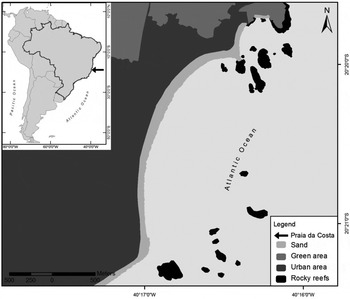
Praia da Costa (20°20′S 40°16′W) is a dissipative urban-sandy beach located in the municipality of Vila Velha, Espírito Santo State, south-eastern Brazil. Two kilometres long, it is mostly exposed, although its northern portion is protected by rocky reefs, which minimize the wave impacts and provides shelter for many organisms (Figure 1). This region typically has seasonal climate with two defined seasons: dry (April to September) and rainy (October to March) (André et al., Reference André, Marques, Pinheiro and Ferraudo2008).
Location and landscape aspects of the Praia da Costa, Espírito Santo State, south-eastern Brazil.

From May 2005 to April 2006, monthly active searches were carried out during the lowest tide along all the extension of the Praia da Costa's intertidal zone. After detection of the exposed protuberant eyes of the species, dip nets (40 cm in diameter and 1 mm nylon mesh size) were buried in the sand and the individuals collected. The fish collected were handled according to procedures indicated in the Guidelines for Animal Experiments established by the Brazilian College for Animal Experimentation (COBEA) and kept in 10% formalin for one week and preserved in 70% alcohol afterwards. Voucher specimens are in the fish collection of the Museu de Biologia Professor Mello Leitão (MBPML 939, 941, 945, 947, 948, 951, 953 and 955).
Biological analysis
A total of 127 specimens of Dactyloscopus tridigitatus was captured and measured (total length (TL) in mm, and mass (M) in g). After dissection, sex determination and gonadal maturation were established based on macroscopic morphology of the gonads (Carvalho et al., Reference Carvalho, Paschoalini, Santos, Rizzo and Bazzoli2009). In order to determine fecundity, the mature ovaries were selected and the vitellogenic oocytes were counted under a stereoscopic microscope, as well as the number of eggs in the clumps attached to pectoral fins of males. The diameter of 200 vitellogenic oocytes from each mature female (N = 15) was measured using a micrometric ocular coupled to a stereoscopic microscope.
To determine the diet composition, the gut was cut from the oesophagus to the anus, since the stomach is not evident. All the prey items were identified to the lowest possible taxonomic level. The importance of each prey in the diet was assessed by settling frequency of occurrence and prey wet weight (to the nearest 0.1 mg) using the alimentary importance index (AII) (Kawakami & Vazzoler, Reference Kawakami and Vazzoler1980) described by the equation AII = (Fi × Wi)/∑(Fi × Wi), where Fi and Wi are the frequency of occurrence (%) and weight (%) of each item, respectively.
Statistical analysis
The Fulton's condition factor (K) was calculated for males and females during the dry and rainy seasons, according to the equation K = (W/TL3)100. The Chi-square test (χ2) was used to assess the significance of difference in the sex-ratio of males to females through the study period. A one-way analysis of variance test, followed by the Tukey post-hoc test, was used to determine the significance of differences of length, mass, condition factor and number of mature eggs between sexes and seasons. The length–weight relationship of D. tridigitatus was calculated using the equation M = aTL b , where a is a coefficient related to body form and b (slope) is an exponent indicating isometric growth when around 3. Parameters a and b of the exponential curve were estimated by linear regression analysis over ln-transformed data, and the degree of association between the ln Lt and ln M was evaluated by the coefficient of determination (r2). Pearson's correlation coefficient (r) was used to determine the degree of correlation between the females' fecundity and TL, as well as the degree of correlation between the number of eggs carried by males and TL. Pearson's r was also used to determine the degree of correlation between the vitellogenic oocytes' diameter and female TL.
RESULTS
Population structure
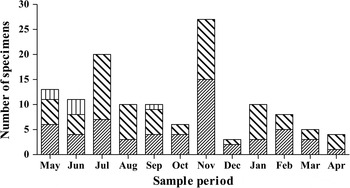
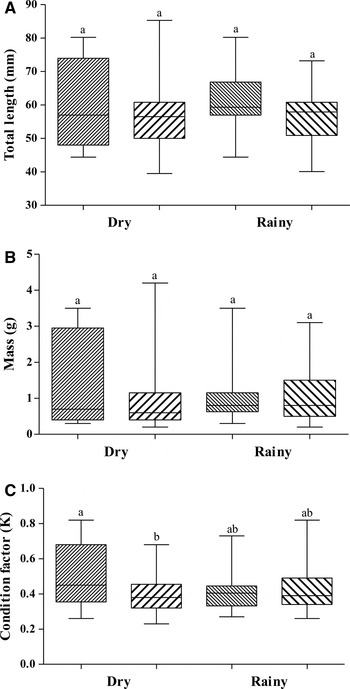
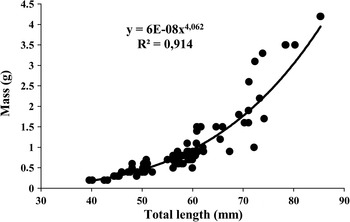
Fish were only found buried in the sandy substrate of intertidal zone sheltered by rocky reefs. No fish was found or collected in the exposed portion of the beach. Throughout the study period, 57 males (44.9%), 64 females (50.4%) and 6 juveniles (4.7%) of Dactyloscopus tridigitatus were collected. We found no significant difference in sex-ratio (χ2 = 29.13, P = 0.141) (Figure 2). In the dry season, males varied in TL and M, respectively, from 44.4 to 80.0 mm (mean ± SD = 59.5 ± 13.2 mm) and 0.3 to 3.4 g (1.43 ± 1.3 g), females from 39.5 to 85.3 mm (56.4 ± 10.9) and 0.2 to 4.2 g (0.92 ± 0.9 mm), and juveniles from 30.3 to 39.9 mm (35.8 ± 4.5 mm) and 0.1 to 0.3 g (0.1 ± 0.1 g). In the rainy season, males varied in TL and M from 44.5 to 80.2 mm (61.1 ± 9.3 mm) and 0.3 to 3.5 g (1.3 ± 0.9 g), and females from 40.1 to 73.2 mm (58.0 ± 8.5 mm) and 0.2 to 3.1 g (0.96 ± 0.6 g). No significant differences in the TL (F = 1.21, P = 0.308) and M (F = 1.64, P = 0.183) between sexes and seasons were detected (Figure 3A, B). Regarding to condition factor (K) in the dry season, males varied from 0.26 to 0.82 (0.51 ± 0.16), females from 0.23 to 0.68 (0.40 ± 0.12), and juveniles from 0.16 to 0.47 (0.29 ± 0.12). In the rainy season, the K of males varied from 0.27 to 0.73 (0.43 ± 0.12) and females from 0.26 to 0.82 (0.43 ± 0.13). Significant differences in the K values were observed between males and females only in the dry season (Figure 3C) (F = 3.01, P = 0.033). The parameter b of the length–weight relationship of D. tridigitatus was 4.06, parameter a was <0.001 and the coefficient of determination (r2) was 0.91 (P < 0.005) (Figure 4).
Number of males ( ), females (
 ) and juveniles (
 ) of Dactyloscopus tridigitatus collected from May 2005 to April 2006 in Praia da Costa, Espírito Santo State, south-eastern Brazil.

Mean values ± SD of total length (A), mass (B) and Fulton's condition factor (C) of Dactyloscopus tridigitatus during dry ( males, N = 25 and females
 N = 37) and rainy seasons (
 males N = 32 and
 females N = 27). Values followed by same letters above the bars are not significantly different (P > 0.05) by Tukey post-hoc test.

Length–weight relationship beteween Dactyloscopus tridigitatus from a sandy beach in south-eastern Brazil.

Reproduction
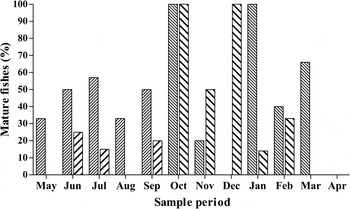
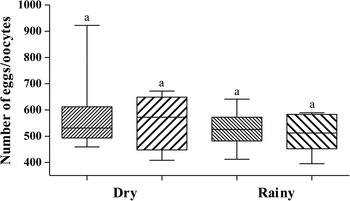
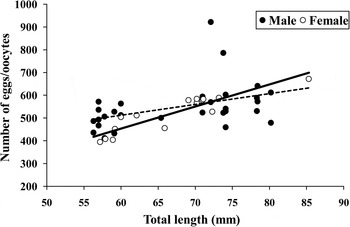
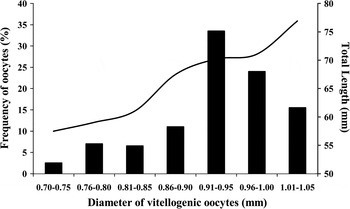
In the dry season, 44% of captured D. tridigitatus males were in reproductive activity, whilst 10.8% females were in this condition (χ2 = 20.11, P < 0.001). In the rainy season, 56.2% males were in reproductive activity as opposed to 40.7% of reproductive females (χ2 = 2.48, P = 0.115) (Figure 5). Each reproductive male was found carrying two incubating egg clumps under each enlarged pectoral fin (N = 29). The number of eggs found in each egg clump varied from 459 to 922 (590.4 ± 141.4) in the dry season, whilst in the rainy season the number of eggs carried by males varied from 412 to 641 (523.8 ± 62.2). For mature females captured in the dry season, the number of vitellogenic oocytes found in ovaries varied from 408 to 672 (556.3 ± 109.5), whilst in the rainy season the females' fecundity varied from 395 to 589 (507.7 ± 72.6). The number of eggs in each clump carried by males did not differ significantly from the number of vitellogenic oocytes of mature females (F = 1.69, P = 0.183) (Figure 6). The smallest egg-carrying male and the smallest mature female measured, respectively, 56.3 mm and 57.2 mm TL. The number of eggs found in each individual clump was weakly correlated to male TL (r = 0.41, P = 0.025). In contrast, the number of vitellogenic oocytes was strongly correlated to female TL (r = 0.91, P < 0.001) (Figure 7). The diameter of vitellogenic oocytes varied in size from 0.70 to 1.04 mm (0.92 ± 0.08 mm) and was strongly correlated to female TL (r = 0.96, P < 0.001) (Figure 8).
Relative frequency (%) of mature Dactyloscopus tridigitatus during dry ( males N = 11 and
 females N = 4) and rainy seasons (
 males N = 18 and
 females N = 11) in Praia da Costa, Espírito Santo State, south-eastern Brazil.

Mean values ± SD of the number of eggs carried by males and the number of vitellogenic oocytes from the mature ovaries of females of Dactyloscopus tridigitatus during dry ( males N = 11 and
 females N = 4) and rainy seasons (
 males N = 18 and
 females N = 11). Values followed by same letters above the bars are not significantly different (P > 0.05) by Tukey post-hoc test.

Correlation between the number of eggs carried by males and the females' fecundity against the total length of Dactyloscopus tridigitatus (regression line: dotted for males and solid for females).

Frequency (%) of vitellogenic oocytes' diameter from the mature ovaries of females (solid bars) and correlation between the oocytes' diameter and female total length of Dactyloscopus tridigitatus (solid line).

Diet composition
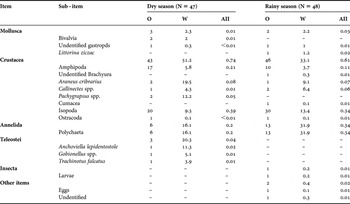
Out of the 127 individuals caught, 95 (74.8%) had at least one food item in the digestive tract. Empty guts were found both in dry (N = 14) and rainy seasons (N = 18). All egg-carrying males had empty guts. Dactyloscopus tridigitatus consumed a great variety of prey items including crustaceans, annelids, molluscs, teleosts, insects and eggs (Table 1). Although all items reached significant (AII ≥ 0.01) values, crustaceans (AII = 0.74 and 0.61) and Annelida (AII = 0.2 and 0.34) were the most consumed resources during both dry and rainy seasons. Along the dry period isopods (AII = 0.39) were the most important sub-item ingested by the species, followed by amphipods (AII = 0.21) and polychaetes (AII = 0.2). During the rainy season, both isopods and polychaetes ranked first (AII = 0.34), followed by amphipods (AII = 0.11).
Absolute occurrence (O), prey wet weight (W) and alimentary importance index (AII) of the items consumed by Dactyloscopus tridigitatus during both dry and rainy seasons.

DISCUSSION
The finding of Dactyloscopus tridigitatus buried in the sand of the intertidal portion protected by rocky reefs is likely related to the fact that sheltered environments serve as refuge from predators for many blennioid fish (Hastings, Reference Hastings1991; Gonçalves & Almada, Reference Gonçalves and Almada1997), and are also useful for reproductive behaviour during the breeding season (Hastings, Reference Hastings2002; Gibran et al., Reference Gibran, Santos, Santos and Sabino2004).
Unlike some blennioid species in which males exhibit sexual size dimorphism (Kraak, Reference Kraak1996; Giacomello & Rasotto, Reference Giacomello and Rasotto2005), for D. tridigitatus this characteristic was not detected in both dry and rainy seasons. In the present study, positive allometric growth (b > 3) was observed for D. tridigitatus, characterizing an increase in weight greater than the increase in length for both sexes. The high values of the allometric coefficient indicate great investment in growth related to small size of the specimens of population studied. Other blennies in the Blenniidae, Labrisomidae and Tripterygiidae families also have positive allometric growth on the Tropical West Atlantic coast (Macieira & Joyeux, Reference Macieira and Joyeux2009; Camilato et al., Reference Camilato, Simon, Pinheiro, Pimentel and Joyeux2010).
Males of D. tridigitatus were reproductively active in nearly every sampled month, whereas females showed more restricted periods of sexual activity which were concentrated in the rainy season. This can be explained by energy expended by females to produce larger and more costly gametes than males (Andersson, Reference Andersson1994) even with male parental care as an additional energy cost (Oliveira et al., Reference Oliveira, Canario and Grober2001). For most blennies paternal care is habitually egg defence (Almada & Santos, Reference Almada and Santos1995; Gibran et al., Reference Gibran, Santos, Santos and Sabino2004) as observed in the present study, in which D. tridigitatus males carry only incubating eggs. According to Oliveira et al. (Reference Oliveira, Canario and Grober2001), this fact allows males to continue breeding over the parental phase, thus their reproductive period is still longer than that of females. These factors usually result in a male-biased operational sex ratio (Kvarnemo & Ahnesjö, Reference Kvarnemo and Ahnesjö1996; Saraiva et al., Reference Saraiva, Barata, Canário and Oliveira2009), as observed for D. tridigitatus in the dry season of the studied beach. However, males and females of the sand stargazer presented similar reproductive rates in the rainy season, although during November and December females reached higher breeding rates. In fact, sex-role reversal can occur in some blenniids in which the number of reproductive females overlaps the number of mature males during the breeding season (Ahnesjö et al., Reference Ahnesjö, Kvarnemo and Merilaita2001; Shibata & Kohda, Reference Shibata and Kohda2006; Saraiva et al., Reference Saraiva, Barata, Canário and Oliveira2009).
Polygamy and promiscuity are described for some blennies that display a complex reproductive behaviour (Gonçalves & Almada, Reference Gonçalves and Almada1997; Gibran et al., Reference Gibran, Santos, Santos and Sabino2004; Saraiva et al., Reference Saraiva, Barata, Canário and Oliveira2009). Perhaps this breeding pattern of blennies can explain the two egg masses carried by D. tridigitatus males, which suggests that males mate with more than one female. The suggestion of promiscuity of D. tridigitatus is also supported by a weak correlation of the egg clumps' fecundity and the TL of the male, which indicate that male length is not a factor for sexual selection by females. This finding is similar to the blenny Acanthemblemaria crockeri, for which the male size is not correlated with the number of eggs received (Hastings, Reference Hastings1988). In contrast, female D. tridigitatus fecundity was positively correlated to TL, which indicates that larger females are able to produce more eggs. The vitellogenic oocyte diameter of about 1 mm recorded in mature ovaries of D. tridigitatus females is similar to other dactyloscopids (Watson, Reference Watson and Moser1996) and also to the blenny Labrisomus nuchipinnis (Gibran et al., Reference Gibran, Santos, Santos and Sabino2004).
There is no quantitative data on feeding habits of Dactyloscopidae available in the literature (Wilson, Reference Wilson, Patzner, Gonçalves, Hastings and Kapoor2009). However, this author classifies the sand stargazers as lie-and-wait predators that prey mainly on small crustaceans. This was the most consumed and important item in the diet of D. tridigitatus during both dry and rainy seasons, although it also ingested large amounts of polychaetes. The consumption of molluscs, teleosts, insects and eggs was not as expressive as these two main items, which indicates that they act as complementary resources in the diet of the analysed individuals. Therefore, the results of AII allow us to classify D. tridigitatus from Praia da Costa as a predator of mobile benthic organisms; the same trophic category given by Ferreira et al. (Reference Ferreira, Ferreira, Rangel, Mendonça, Gerhardinger, Filho, Godoy, Luiz-Jr, Gasparini, Creed, Pires and Figueiredo2007) and Halpern & Floeter (Reference Halpern and Floeter2008) for the same species in their qualitative studies. The absence of food items in the guts of egg-carrying males is a characteristic recorded among other Blennioidei species (Gonçalves & Almada, Reference Gonçalves and Almada1997; Wilson, Reference Wilson, Patzner, Gonçalves, Hastings and Kapoor2009). We found no egg cannibalism in our study, although filial cannibalism is mentioned for some other Blennioidei (Kraak, Reference Kraak1996; Manica, Reference Manica2002).
In conclusion, although the species exhibits burrowing behaviour which differentiates it from most of the Blennioidei, the main life history traits for the D. tridigitatus from the Praia da Costa are in accordance with the general pattern of this suborder, since this stargazer lives in sheltered habitats, has a long reproductive period, presents both polygamous and parental care behaviour and uses small invertebrates as its main trophic resource.
ACKNOWLEDGEMENTS
We thank Naércio A. Menezes (Museu de Zoologia da Universidade de São Paulo—MZUSP) for sending us the requested literature, the Instituto Brasileiro do Meio Ambiente e dos Recursos Naturais Renováveis (IBAMA) for the scientific support (Proc. 2885/95-5-15 SUPES/ES), and two anonymous referees for the review and improvement of the manuscript. This work was partially funded by Petrobras and the German Academic Exchange Service (DAAD).