Introduction
Maintaining a strong sense of psychological well-being in the face of the changes and losses of later life is generally considered a crucial part of ‘healthy’ ageing (Baltes & Baltes, Reference Baltes and Baltes1990; Rowe & Kahn, Reference Rowe and Kahn1998). In recent years there has been growing evidence to suggest that well-being may also be a potential resource for generally ageing well. Prospective studies have found that older people with greater well-being, whether assessed according to the hedonic view of well-being as positive affect or satisfaction with life or according to the eudaimonic view of well-being as sense of purpose, autonomy or meaning in life, are less likely to develop problems with mobility or other activities of daily life (Ostir et al. Reference Ostir, Markides, Black and Goodwin2000; Collins et al. Reference Collins, Goldman and Rodriguez2008; Boyle et al. Reference Boyle, Buchman and Bennett2010), show a slower decline in perceptual speed (Gerstorf et al. Reference Gerstorf, Lovden, Rocke, Smith and Lindenberger2007) and make a better recovery in terms of motor, cognitive and functional status after a stroke (Ostir et al. Reference Ostir, Berges, Ottenbacher, Clow and Ottenbacher2008). Older people with a more positive attitude to their own ageing report better functional health at subsequent follow-ups (Levy et al. Reference Levy, Slade and Kasl2002).
In a meta-analysis of 35 prospective studies where greater positive well-being was linked with a reduced risk of mortality both in healthy populations and in those already ill at baseline, the survival benefit associated with greater well-being was particularly marked in people aged ⩾60 years (Chida & Steptoe, Reference Chida and Steptoe2008). In all of these studies, with the exception of that by Levy et al. (Reference Levy, Slade and Kasl2002), where there was no control for the potentially confounding effect of depressive symptoms, the protective effect of positive well-being persisted after adjustment for negative affect, and so was not due merely to the absence of symptoms of depression.
Frailty is a clinically recognizable syndrome in older people whose core feature is an increased vulnerability to stressors due to impairments in multiple, inter-related systems, decreased physiological reserves and a decline in the ability to maintain homeostasis (Fried et al. Reference Fried, Tangen, Walston, Newman, Hirsch, Gottdiener, Seeman, Tracy, Kop, Burke and McBurnie2001; Bergman et al. Reference Bergman, Ferrucci, Guralnik, Hogan, Hummel, Karunananthan and Wolfson2007). Frailty is common (Syddall et al. Reference Syddall, Roberts, Evandrou, Cooper, Bergman and Aihie2010) and is associated with numerous adverse outcomes, including falls, disability, hospitalization, institutionalization and death. There is currently no universally accepted model or definition of frailty (Rockwood & Bergman, Reference Rockwood and Bergman2012; Rodriguez-Manas et al. Reference Rodríguez-Mañas, Féart, Mann, Viña, Chatterji, Chodzko-Zajko, Gonzalez-Colaço Harmand, Bergman, Carcaillon, Nicholson, Scuteri, Sinclair, Pelaez, Van der Cammen, Beland, Bickenbach, Delamarche, Ferrucci, Fried, Gutiérrez-Robledo, Rockwood, Rodríguez Artalejo, Serviddio and Vega2013), but it is generally agreed that its causes are complex and likely to involve both biological and psychosocial mechanisms (Rockwood et al. Reference Rockwood, Fox, Stolee, Robertson and Beattie1994; Walston et al. Reference Walston, Hadley, Ferrucci, Guralnik, Newman, Studenski, Ershler, Harris and Fried2006). Evidence as to whether psychological well-being might be a protective factor as regards risk of frailty in later life is sparse but, in two prospective studies, older people who reported high levels of positive affect had a reduced likelihood of becoming physically frail (Ostir et al. Reference Ostir, Ottenbacher and Markides2004; Park-Lee et al. Reference Park-Lee, Fredman, Hochberg and Faulkner2009). Whether other dimensions of psychological well-being are similarly protective as regards risk of frailty is unknown. In a cross-sectional analysis of data from the Canadian Study of Health and Aging, higher scores on an index of frailty, comprising 33 health deficits, was associated with lower scores on the Ryff Psychological Well-being scale (Andrew et al. Reference Andrew, Fisk and Rockwood2012). Of the six subscales that make up this measure (autonomy, personal growth, environmental mastery, positive relations, purpose in life and self-acceptance), only purpose in life and autonomy were not associated with frailty score. Whether these findings reflect the effect of these dimensions of well-being on frailty risk or the impact of increasing frailty on well-being is unclear.
The English Longitudinal Study of Ageing (ELSA) is a large population-based sample of older men and women. We used data from the ELSA to investigate the 4-year prospective association between scores on the CASP-19, a measure of psychological well-being that assesses perceptions of control, autonomy, self-realization and pleasure (Hyde et al. Reference Hyde, Wiggins, Higgs and Blane2003), and risk of incident physical frailty in men and women aged 60 to ⩾90 years.
Method
Participants
The sample for ELSA was based on people aged ⩾50 years who had participated in the Health Survey for England (HSE) in 1998, 1999 or 2001 (Marmot et al. Reference Marmot, Nazroo, Banks, Blundell, Erens, Lessof and Huppert2011; Steptoe et al. Reference Steptoe, Breeze, Banks and Nazroo2012a ). It was drawn by postcode sector, stratified by health authority and proportion of households in non-manual socio-economic groups. A total of 11 392 people participated in wave 1 in 2002–2003. At wave 2 in 2004–2005 and at wave 4 in 2008–2009, participants who completed the main interview were invited to have a visit from a nurse that included measurements of physical function, anthropometry and blood sampling. Nurse visits were conducted at alternate follow-up surveys so data on these measurements were not collected at wave 3. Ethical approval was obtained from the Multicentre Research and Ethics Committee. Participants gave written informed consent.
Measures
Maximum handgrip strength was measured three times on each side using a dynamometer; the best of these measurements was used for analysis. Height and weight were measured with a portable stadiometer and electronic scales respectively. Body mass index (BMI) was calculated as [weight (kg)]/[height (m) squared]. Gait speed was assessed in participants aged ⩾60 years by measuring the time taken to walk a distance of 8 ft at their usual pace; the timed walk was repeated and the mean of the two measurements was calculated. Participants responded to three questions about the frequency with which they undertook vigorous exercise (e.g. running, swimming, cycling, tennis, aerobics or gym workout, digging), moderate exercise (e.g. gardening, cleaning the car, walking at a moderate pace, dancing, floor or stretching exercises) and mild exercise (e.g. vacuuming, laundry, home repairs). Each question had four response options (more than once a week, once a week, one to three times a month, hardly ever or never). These questions about physical activity were extracted from a validated physical activity interview used in the HSE (Joint Health Surveys Unit, 2007). We ranked the combinations of responses to these questions according to the amount and intensity of exercise involved to provide a summary estimate of usual physical activity, whereby higher scores indicated more frequent, vigorous activity. Symptoms of depression were assessed using the eight-item version of the Center for Epidemiologic Studies Depression Scale (CES-D; Steffick and the HRS Health Working Group, Reference Steffick2000). We used these data, together with information on participants' weight at the initial survey, to derive indicators of pre-frailty and frailty at wave 2 and wave 4 in men and women aged ⩾60 years using the Fried criteria; these are unintentional weight loss, weakness, self-reported exhaustion, slow walking speed and low physical activity (Fried et al. Reference Fried, Tangen, Walston, Newman, Hirsch, Gottdiener, Seeman, Tracy, Kop, Burke and McBurnie2001). Pre-frailty was defined as the presence of one or two of these criteria. Frailty was defined as the presence of three or more of these criteria. These criteria were originally validated in the Cardiovascular Health Study and the Women's Health and Aging Studies (Fried et al. Reference Fried, Tangen, Walston, Newman, Hirsch, Gottdiener, Seeman, Tracy, Kop, Burke and McBurnie2001; Bandeen-Roche et al. Reference Bandeen-Roche, Xue, Ferrucci, Walston, Guralnik, Chaves, Zeger and Fried2006) and have subsequently been validated in other cohorts (Avila-Funes et al. Reference Avila-Funes, Helmer, Amieva, Barberger-Gateau, Le Goff, Ritchie, Portet, Carriere, Tavernier, Gutierrez-Robledo and Dartigues2008; Bouillon et al. Reference Bouillon, Sabia, Jokela, Gale, Singh-Manoux, Shipley, Kivimaki and Batty2012). We operationalized these criteria using definitions that were identical or very similar to those used in the original phenotype of frailty studies (Fried et al. Reference Fried, Tangen, Walston, Newman, Hirsch, Gottdiener, Seeman, Tracy, Kop, Burke and McBurnie2001; Bandeen-Roche et al. Reference Bandeen-Roche, Xue, Ferrucci, Walston, Guralnik, Chaves, Zeger and Fried2006): weight loss was defined as either loss of ⩾10% of body weight since the initial survey (for frailty at wave 2) or since wave 2 (for frailty at wave 4), or current BMI < 18.5 kg/m2; weakness was defined as maximum grip strength in the lowest 20% of the distribution, after taking sex and BMI into account; exhaustion was considered to be present if the participant gave a positive response to either of the CES-D questions ‘Felt that everything I did was an effort in the last week’ or ‘Could not get going in the last week’; slow walking speed was defined as a walking speed in the lowest 20% of the distribution, after taking account of sex and height [as in some previous studies of frailty (Ostir et al. Reference Ostir, Ottenbacher and Markides2004; Espinoza et al. Reference Espinoza, Jung and Hazuda2012), participants who did not perform the timed walk because they were unable to walk alone or had health restrictions were also categorized as having slow walking speed]; and low physical activity was defined as physical activity in the lowest sex-specific 20% of the distribution. In the case of weakness, exhaustion or physical activity, the definitions and cut-points used were identical to those used in the original phenotype of frailty studies (Fried et al. Reference Fried, Tangen, Walston, Newman, Hirsch, Gottdiener, Seeman, Tracy, Kop, Burke and McBurnie2001; Bandeen-Roche et al. Reference Bandeen-Roche, Xue, Ferrucci, Walston, Guralnik, Chaves, Zeger and Fried2006).
Participants were asked whether a doctor had ever told them that they had any of the following conditions: high blood pressure/hypertension, angina, heart attack, congestive heart failure, diabetes or high blood sugar, a stroke, chronic lung disease, asthma, arthritis or rheumatism, osteoporosis, or cancer. We used this information to calculate the number of chronic physical diseases present. Participants took tests of cognitive function (Steel et al. Reference Steel, Huppert, McWilliams, Marmot, Banks, Blundell, Lessof and Nazroo2003) as follows: immediate and delayed verbal memory (recall of 10 aurally presented nouns) was assessed using word lists developed for the US Health and Retirement Study; prospective memory (remembering to do a specific task) and attention (letter cancellation task) were assessed using tests previously used in the Medical Research Council (MRC) Cognitive Function and Ageing Study (Brayne et al. Reference Brayne, Nickson, McCracken, Gill and Johnson1998); and executive function was assessed using a test of verbal (semantic) fluency (naming as many animals as possible in 60 s) taken from the revised Cambridge Cognitive Examination (CAMCOG-R; Roth et al. Reference Roth, Huppert, Mountjoy and Tym1999). A total cognitive function score was calculated by summing scores on these tests. Socio-economic status was indexed by total household wealth, including savings and investments, value of any property or business assets, net of debt, excluding pension assets. Household wealth has been identified as the most accurate indicator of long-term socio-economic circumstances in the ELSA (Banks et al. Reference Banks, Karlsen, Oldfield, Marmot, Banks, Blundell, Lessof and Nazroo2003). Participants provided information about current smoking status and were categorized into three groups (never smoked, ex-smokers and current smokers).
Psychological well-being was assessed using the CASP-19 quality of life questionnaire, which consists of 19 items covering four theoretical domains: control, autonomy, self-realization and pleasure (Hyde et al. Reference Hyde, Wiggins, Higgs and Blane2003). Examples include: ‘I feel free to plan for the future’ (control), ‘I feel that I can please myself what I do’ (autonomy), ‘I choose to do things that I have never done before’ (self-realization) and ‘I enjoy the things that I do’ (pleasure). The response to each item is scored on a four-point Likert scale coded 0 to 3. Total scores range from 0 to 57, with higher scores indicating greater psychological well-being. To assess whether hedonic and eudaimonic dimensions of psychological well-being had similar associations with risk of frailty, we used scores on the four-item pleasure subscale as a measure of hedonic well-being and the combined total score on the remaining 15 items as a measure of eudaimonic well-being, as described previously (Steptoe et al. Reference Steptoe, Demakakos, de Oliviera and Wardle2012b ). Cronbach α values in the study sample were 0.88 for the total score, 0.68 for hedonic well-being and 0.78 for eudaimonic well-being, indicating good internal consistency.
During the visit by the nurse, blood samples were taken from all participants except for those who were not willing to provide written consent, those with clotting or bleeding disorders and those taking anticoagulant drugs. Fasting samples (defined as no food or drink except water for the past 5 h) were taken where possible (67% of participants). Samples were assayed for C-reactive protein (CRP) and fibrinogen at the Royal Victoria Infirmary, Newcastle-upon-Tyne, UK. Detailed information on the technicalities of the blood analysis, the internal quality control and the external quality assessment for the laboratory that carried it out are given in the 2004 HSE technical report as both the HSE and the ELSA used the same laboratory and the same guidelines and protocols for blood analysis (Graig et al. Reference Graig, Deverill, Pickering, Spronston and Mindell2006).
Analytical sample
Of the 5918 study members aged ⩾60 years who were interviewed at wave 2 in 2004–2005, 5377 agreed to be visited by a nurse (91%). Of these, 3454 were interviewed and visited by a nurse at wave 4 in 2008–2009 after a mean follow-up period of 3.93 years. The present analysis is based on 2557 people who had complete data on psychological well-being and baseline covariates at wave 2 and frailty at wave 4. To investigate possible bias due to missing data, we used multiple multivariate imputation to impute values in any covariates with missing values (Royston, Reference Royston2004). Imputation models included psychological well-being, components of frailty and the potential confounding variables. We used switching regression in STATA software (Royston, Reference Royston2004) and carried out 10 cycles of regression switching and generated 10 imputation data sets. The multiple multivariate imputation approach creates copies of the data (in this case 10 copies), each of which has missing values imputed based on available data and with an appropriate level of randomness using chained equations. The final estimates are obtained by averaging across the estimates from each of these 10 data sets using Rubin's rules and taking into account the uncertainty in the imputation along with uncertainty due to random variation. Effect sizes obtained after imputation of missing information were essentially the same as those obtained from the sample with complete data, so we present results based on the sample with complete data.
Statistical analysis
We used an ANOVA and the χ 2 test to examine differences in baseline characteristics according to the presence of pre-frailty or frailty at follow-up. We used multinomial logistic regression to examine the relationship between total score for psychological well-being at baseline and risk of incident pre-frailty or frailty, controlling for potentially confounding factors (age, sex, household wealth, smoking status, number of chronic physical diseases, BMI, depressive symptom score, cognitive function and frailty status at baseline; that is whether participants had no, one or two, or three or more components of frailty). To assess whether hedonic or eudaimonic dimensions of psychological well-being differed in their relationship with frailty risk, we repeated these analyses using scores for hedonic and eudaimonic well-being in place of the total score. In a subset of participants with data on blood concentrations of the inflammatory markers CRP and fibrinogen (n = 1786), we examined the effect on the associations of further adjustment for these factors as there is some evidence to link both of them with lower levels of well-being (Steptoe et al. Reference Steptoe, Demakakos, de Oliviera and Wardle2012b ) and with risk of frailty (Puts et al. Reference Puts, Visser, Twisk, Deeg and Lips2005; Barzilay et al. Reference Barzilay, Blaum, Moore, Xue, Hirsch, Walston and Fried2007; Gale et al. Reference Gale, Baylis, Cooper and Sayer2013). We used linear regression to examine whether the onset of pre-frailty or frailty in those who were initially not frail was associated with a change in psychological well-being at follow-up. Analyses were weighted using probability weights supplied with the data to correct for any systematic differences in response rates across subgroups and to take account of the complex design of the survey (Steptoe et al. Reference Steptoe, Breeze, Banks and Nazroo2012a ). Detailed descriptions of these weights and their calculation can be found in the technical reports on the study available at www.ifs.org.uk/elsa.
Results
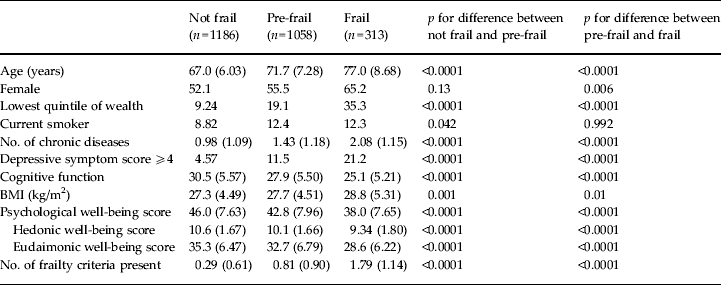
Table 1 shows the baseline characteristics of the 2557 men and women in the study according to whether they were not frail, pre-frail or frail at follow-up. The weighted percentage of participants who were pre-frail or frail at follow-up was 43% and 14% respectively. The degree of frailty at follow-up, indicated by whether participants were classified as not frail, pre-frail or frail at that time, was associated with older age, greater likelihood of being in the lowest quintile for household wealth, having more chronic physical diseases, poorer cognitive function, greater prevalence of depression, having a higher BMI, poorer psychological well-being and having more indicators of frailty at baseline. There was no difference in sex distribution between those who were not frail and those who were pre-frail at follow-up, but there was a significantly higher proportion of women among those who were frail. Compared to those who were not frail at follow-up, those who were pre-frail were slightly more likely to have smoked at baseline, but there were no differences in baseline smoking status between those who were pre-frail and those who were frail at follow-up.
Baseline characteristics of the study participants (n = 2557) according to frailty status at follow-up

BMI, Body mass index.
Values given as mean (standard deviation) or percentage.
Preliminary analyses showed that the relationship between psychological well-being and risk of incident pre-frailty or frailty did not differ between the sexes or by age (p for interaction terms>0.5). Multivariate multinomial logistic regression analyses of frailty risk were therefore carried out in men and women together, adjusting for sex and age.
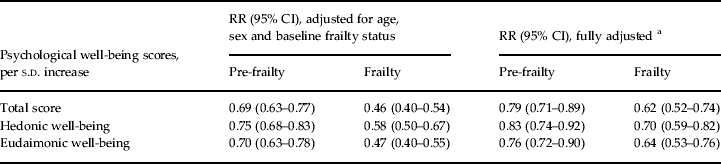
Table 2 show the relative risks for incident pre-frailty and frailty in men and women for a standard deviation higher score in psychological well-being (both total score and scores on the two subscales, hedonic and eudaimonic well-being). The results are shown adjusted for age, sex and baseline frailty status, and then with further adjustment for the other potential confounding variables, household wealth, depressive symptoms, cognitive function, BMI, smoking and number of chronic physical diseases. In the models adjusted for age, sex and baseline frailty status, there were significant inverse associations between total score for psychological well-being at baseline and risk of incident frailty: for a standard deviation increase in psychological well-being the relative risk ratio (RR) for incident frailty was 0.46 [95% confidence interval (CI) 0.40–0.54]. Further adjustment for other potential confounding factors partially attenuated the association (RR 0.62, 95% CI 0.52–0.77). There was a significant association between total score for psychological well-being and risk of incident pre-frailty: for a standard deviation increase in psychological well-being, the RR for incident pre-frailty was 0.69 (95% CI 0.63–0.77). Further adjustment for other potential confounding factors partially attenuated this association (RR 0.79, 95% CI 0.71–0.89). We repeated these analyses to compare whether risk of frailty varied depending on whether hedonic or eudaimonic dimensions of well-being were the predictor. Higher scores on both dimensions were associated with decreased risk of frailty or pre-frailty.
Relative risk ratios (RRs) for incident pre-frailty or frailty for a standard deviation (s.d.) increase in psychological well-being scores at baseline

CI, Confidence interval.
a Adjusted for age, sex, household wealth, depressive symptoms, cognitive function, body mass index, smoking, number of chronic physical diseases and whether frail, pre-frail or non-frail at baseline.
To maximize our sample size in the analyses described above, we included participants who were pre-frail or frail and adjusted for frailty status at baseline. To check for the possibility of reverse causation whereby psychological well-being at baseline might have been adversely affected in those who already had one or more components of frailty, we repeated our analyses after excluding all such individuals. In the remaining sample of 1409 men and women, none of whom were pre-frail or frail at baseline, associations between psychological well-being and risk of incident frailty were very similar to those found in the full sample: for a standard deviation increase in psychological well-being at baseline, the multivariate-adjusted risks of incident pre-frailty or frailty were 0.77 (95% CI 0.66–0.89) and 0.58 (95% CI 0.41–0.84) respectively.
In all models, increased age, female sex, lower household wealth, higher BMI, greater number of chronic physical diseases, and poorer cognition were independent risk factors for incident frailty and pre-frailty (data not shown).
In a subset of participants who had data on blood concentrations of the inflammatory markers CRP and fibrinogen at baseline (n = 1786), we repeated the multivariate analyses with additional adjustment for these variables. This adjustment had no effect on the associations between baseline psychological well-being scores and risk of pre-frailty or frailty at follow-up (data not shown) either in the whole sample or when men and women were analysed separately.
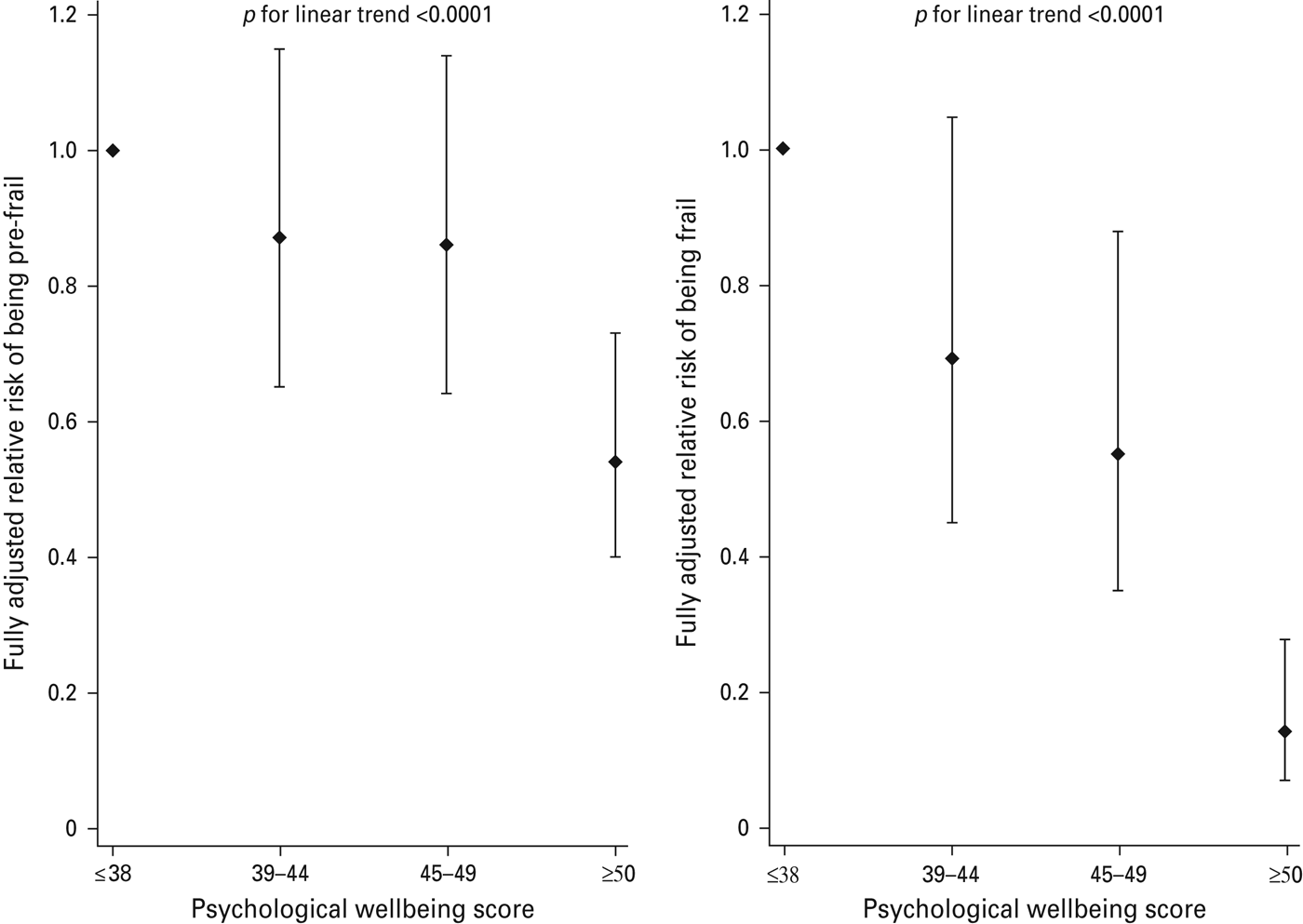
To illustrate how risk of pre-frailty or frailty at follow-up varied according to level of psychological well-being at baseline, Fig. 1 shows fully adjusted RRs according to quarters of the distribution of psychological well-being scores at baseline, using those in the lowest quarter of the distribution as the reference group.
Fully adjusted relative risk ratios (RRs) for being pre-frail or frail at follow-up according to quarters of the distribution of psychological well-being at baseline. People in the lowest quarter of the distribution are the reference group.

At the time of the baseline survey, levels of psychological well-being were significantly lower in those with more components of frailty (p for linear trend <0.0001). To investigate whether this cross-sectional association might be bidirectional in effect, we used the sample of 1409 people who were neither pre-frail nor frail at baseline to examine whether the onset of pre-frailty or frailty during the follow-up period was associated with a change in psychological well-being since baseline. In regression analyses with adjustment for age, sex and psychological well-being at baseline, scores for psychological well-being at follow-up were 1.58 points (95% CI 0.93–2.22) lower in those who had become pre-frail and 3.70 points (95% CI 1.99–5.41) lower in those who had become frail compared to those who were not frail. These associations were only slightly attenuated when further adjusted for the potential confounding factors, depressive symptom score, cognitive function, household wealth, number of chronic illnesses, BMI and smoking status at baseline. After these adjustments, scores for psychological well-being at follow-up were 1.30 points (95% CI 0.65–1.96) lower in those who had become pre-frail and 2.30 points (95% CI 1.22–4.77) lower in those who had become frail compared to those who were not frail. Separate analysis of the eudaimonic and hedonic dimensions of psychological well-being showed that those who had become pre-frail or frail showed a relative decline on both dimensions on well-being since the baseline survey (data not shown).
Discussion
In this large longitudinal study of people aged 60 to ⩾90 years, higher scores on a measure of psychological well-being that assesses control, autonomy, self-realization and pleasure were associated with an increased risk of incident pre-frailty and frailty in both men and women. Adjustment for a range of potential confounding factors, including depressive symptoms, household wealth, cognitive function, number of chronic physical illnesses, BMI, smoking, inflammatory markers, age and sex, and baseline frailty status had only small attenuating effects on these associations, and estimates changed little when analyses were repeated excluding all those who were pre-frail or frail at baseline. Separate examination of scores for hedonic (pleasure) and eudaimonic (control, autonomy and self-realization) dimensions of the psychological well-being measure showed that higher scores on both were associated with decreased risk of frailty or pre-frailty. These results suggest that psychological well-being may be a protective factor. We also found an effect in the reverse direction, in that the incidence of either pre-frailty or frailty in those initially not frail was associated with a relative decline in psychological well-being since the baseline survey.
Only two previous studies have examined the prospective association between psychological well-being in older people and risk of becoming frail. In a cohort of 1500 Mexican Americans, high levels of positive affect were associated with a lower risk of incident frailty (Ostir et al. Reference Ostir, Ottenbacher and Markides2004). One limitation of this study is that no adjustment was made for depressive symptoms so it is impossible to be certain whether the findings reflect a potentially protective effect of positive affect or merely the absence of negative affect. In another US cohort based solely on women, the Caregiver-Study of Osteoporotic Fractures, high levels of positive affect were predictive of a reduced risk of incident frailty independently of depressive symptoms (Park-Lee et al. Reference Park-Lee, Fredman, Hochberg and Faulkner2009). The results of the present study show that it may be not only the hedonic aspects of well-being such as the experience of happiness and pleasure but also the eudaimonic aspects such as a sense of autonomy, control, purpose and fulfilment that protect against the development of frailty. No previous study has examined whether psychological well-being is predictive of the state of pre-frailty. Consistent with the hypothesis that pre-frailty and frailty represent degrees of severity in the same chronic process, we found that psychological well-being, along with other risk factors examined, was predictive of both.
It is important to consider whether our results showing an apparently protective effect of psychological well-being could have arisen due to reverse causation. In accordance with Fried (Fried et al. Reference Fried, Tangen, Walston, Newman, Hirsch, Gottdiener, Seeman, Tracy, Kop, Burke and McBurnie2001; Bandeen-Roche et al. Reference Bandeen-Roche, Xue, Ferrucci, Walston, Guralnik, Chaves, Zeger and Fried2006), physical frailty was defined as the presence of three or more criteria (unintentional weight loss, weakness, self-reported exhaustion, slow walking speed and low physical activity) and pre-frailty was defined as the presence of one or two of these criteria. In looking at risk of developing frailty or pre-frailty at follow-up, we adjusted for the number of these criteria that were present at baseline, and for symptoms of depression and BMI at baseline together with other potential confounding factors. Associations between well-being and later frailty or pre-frailty were only partially attenuated by these adjustments, and persisted when people who were pre-frail or frail at baseline were excluded. However, might factors such as weakness, slow walking speed and low physical activity have had an adverse impact on psychological well-being prior to baseline, before they reached a level where they counted as frailty criteria? Evidence on this is sparse. In a meta-analysis of longitudinal data from five cohorts in the Healthy Ageing across the Lifecourse (HALCyon) programme, better performance on measures of grip strength, walking speed, timed get-up-and-go speed and chair-rise speed were all associated with slightly higher scores on the Warwick Edinburgh mental well-being scale (a measure of both hedonic and eudaimonic well-being) a few years later, but the direction of effect in these associations could not be determined accurately (Cooper et al., Reference Cooper, Stafford, Hardy, Aihie Sayer, Ben-Shlomo, Cooper, Craig, Deary, Gallacher, McNeill, Starr, Kuh and Galein press). So far as we are aware, there is no previous longitudinal evidence as to whether poorer physical capability per se leads to a decline in well-being in older people, although the results of the current study suggest that the onset of pre-frailty or frailty, assessed in part by the presence of weakness or slow walking speed, is predictive of lower psychological well-being at follow-up than would be expected from initial levels. This difference persisted after adjustment for depressive symptoms, cognitive function and other potential confounding factors. It has been suggested that the transition from robust health to increasing frailty can pose psychological challenges as individuals have to adjust to the losses and changes inherent in such a transition (Fillit et al. Reference Fillit, Butler, Fillit and Butler2009). This may account for the apparent decline in psychological well-being found here. Further follow-up is needed for accurate determination of the trajectory of well-being in these frail older people.
The mechanisms whereby psychological well-being might influence risk of frailty, or indeed other aspects of health, are not fully understood (Steptoe et al. Reference Steptoe, Dockray and Wardle2009). Health behaviours such as exercise, diet and smoking may provide one potential explanation as they can be influenced by emotional state (Kiecolt-Glaser et al. Reference Kiecolt-Glaser, McGuire, Robles and Glaser2002). Previous analyses using the ELSA cohort have shown that higher levels of psychological well-being are associated with being more physically active and with a lower likelihood of smoking. In the present study it seemed inappropriate to adjust for physical activity level given that low physical activity is one of the frailty criteria, but when we did so (data not shown), it had very little attenuating effect on the associations. We included adjustment for smoking but this behaviour too did not account for the link between well-being and risk of frailty. No data were available on diet at baseline. Another possibility is that direct psychobiological mechanisms underlie the association. Higher levels of psychological well-being have been associated in cross-sectional surveys with lower concentrations of inflammatory markers and cortisol (Steptoe et al. Reference Steptoe, Dockray and Wardle2009). There is some evidence from prospective studies that higher levels of inflammatory markers or higher ratios of cortisol to dehydroepiandrosterone sulfate (DHEAS) may be risk factors for frailty (Puts et al. Reference Puts, Visser, Twisk, Deeg and Lips2005; Barzilay et al. Reference Barzilay, Blaum, Moore, Xue, Hirsch, Walston and Fried2007; Reiner et al. Reference Reiner, Aragaki, Gray, Wactawski-Wende, Cauley, Cochrane, Kooperberg, Woods and Lacroix2009; Baylis et al. Reference Baylis, Bartlett, Syddall, Ntani, Gale, Cooper, Lord and Sayer2013). A previous paper using ELSA data reported cross-sectional associations between higher levels of psychological well-being and lower blood levels of the inflammatory markers, CRP and fibrinogen and, in men only, higher blood levels of DHEAS at wave 4 (Steptoe et al. Reference Steptoe, Demakakos, de Oliviera and Wardle2012b ). We had no information on concentrations of cortisol or DHEAS in our participants at the wave 2 baseline, but adjustment for levels of the inflammatory markers, CRP and fibrinogen, had no effect on our estimates for the relationships between psychological well-being and either frailty or pre-frailty.
The strengths of our study include the large sample size, the fact that it is representative of the community-dwelling English population aged ⩾60 years (Taylor et al. Reference Taylor, Conway, Calderwood, Lessof, Marmot, Banks, Blundell, Lessof and Nazroo2003), our use of a prospective study design in which we assessed incident cases of pre-frailty or frailty that occurred after the measurement of psychological well-being, and the fact that we had information on a range of potential confounding factors. There are also some weaknesses. First, we were not able to assess whether psychological well-being assessed prior to the development of pre-frailty or frailty might promote the transition to a less frail state. Whereas transitions to a state of greater frailty are more common than movement in the reverse direction, there is sufficient evidence of the latter to suggest that frailty is potentially reversible, at least in the less severe stage (Gill et al. Reference Gill, Gahbauer, Allore and Han2006; Espinoza et al. Reference Espinoza, Jung and Hazuda2012). Second, not all the participants in the baseline survey gave a blood sample (77% of those interviewed); non-responders to the blood sample tended to be older and in poorer health. However, because adjustment for concentrations of inflammatory factors in the subsample with these data had no attenuating effect on the associations between psychological well-being and frailty, we consider it unlikely that these findings would be very different if we had data on inflammatory factors for the entire study sample. Furthermore, all analyses were weighted to reduce any potential bias arising from differential non-response.
In this prospective study of men and women aged 60 to ⩾90 years, those who scored higher on a measure of psychological well-being that assessed perceptions of control, autonomy, self-realization and pleasure had a lower risk of becoming physically frail during follow-up. Future research needs to investigate the mechanisms underlying this finding.
Acknowledgements
We are grateful to the UK Data Archive for supplying the ELSA data. The original data creators, depositors or copyright holders, the funders of the data collections and the UK Data Archive bear no responsibility for the analysis or interpretation presented here.
The Centre for Cognitive Ageing and Cognitive Epidemiology is funded by the Biotechnology Sciences Research Council, the Engineering and Physical Sciences Research Council, the Economic and Social Research Council, the Medical Research Council and the University of Edinburgh as part of the cross-council Lifelong Health and Wellbeing initiative (G0 700 704/84 698). This work was funded by the Medical Research Council (MC-A620-5TF00).
Declaration of Interest
None.