INTRODUCTION
Re-election and the politics of environmental stewardship often seem to be at juxtapositions. We often hear from the leaders of developed nations (notably from the G8 in recent years) that their governments will address environmental concerns and improve community services when the economy is healthy and growing. Government planning for development of resources however, often seems at conflict with sustainable agriculture, local community resources management, maintaining ecosystem services and biodiversity conservation. Yet local to regional environmental resource stewardship by groups of local citizens, across the boundaries of politics, policies and property rights, is possible (Ostrom et al. Reference Ostrom, Diez, Dolsak, Stern, Stonich and Weber2002; Armitage et al. Reference Armitage, Berkes and Doubleday2007).
To be successful, community based natural resource management (CBNRM) needs to meet the needs and aspirations of its community of members, and be ecologically and socially sustainable while evolving capacities to respond and adapt to internal and external pressures of change. There are a variety of challenges to devising successful CBNRM that can operate at a local level, while nested meaningfully within other levels and scales of social-ecological systems interactions that influence sustainability (Ostrom et al. Reference Ostrom, Diez, Dolsak, Stern, Stonich and Weber2002; Marshall Reference Marshall2008). At broader scales such actions can have positive and negative externalities or simply impinge on perceptions of other policy makers, whether neighbouring communities or governments. There is no panacea formula for successful CBNRM (Ostrom Reference Ostrom2007). Shackleton (Reference Shackleton2001) correctly highlighted the pitfalls in attempting to transfer general lessons from case studies or examples in one place to another because circumstances, scales, local customs, governance capacities and resource conditions will vary (see also Shackleton et al. Reference Shackleton, Shackleton and Cousins2001; Duit & Galaz Reference Duit and Galaz2008). Local to regional social-ecological systems interactions create scalar contexts which are important, along with entrepreneurial innovation matching circumstances. Community evolution of particular ways of thinking about innovative problem solving and institutional design for resource governance can provide ideas for further adaptation and implementation in other social-ecological contexts (for example Fabricius et al. Reference Fabricius, Folke, Cundill and Schultz2007; Plummer & Armitage Reference Plummer and Armitage2007). It is expected that flow-on benefits include building adaptive capacity towards long-term social-ecological sustainability, the essence of resilience (Gunderson et al. Reference Gunderson, Holling and Light1995; Walker & Salt Reference Walker and Salt2006).
At a global level there are considerable differences in CBNRM between developed and developing nations. In general terms, for developing countries, CBNRM is critically entwined in community livelihoods; it is an important element in local economic development, poverty reduction, market based conservation initiatives and other sustainable wildlife or natural resource uses. In addition to local sustainable development and diversification of income, an important objective of CBNRM is to engage groups of citizens in collective action towards sustainable conservation and natural resource management (NRM) across resource tenure regimes (types of property relations between people and resources); for example, across several individual private land holders properties, on communal (common-property or collectively owned) resource tenure or on public lands of shared interest. CBNRM has come to mean different things in different places, to meet a variety of circumstances and needs. In the industrialized world and many developed countries, CBNRM tends to have much less of a community economic development focus and rather more of a focus on the repair and future nurture of ecosystems and natural resources. CBNRM in developed countries is used as a local engagement mechanism for improving ecological and resource management (especially in intense land or resource use areas), environmental repair and river restoration (through, for example, catchment management or land care organizations). Other community based resource management (CBRM) in developed countries focuses on co-management in national parks and protected areas, collaboration for control of feral and invasive species, and pollution control and remediation. Similar to developing countries, states of the developed world also have their own considerable variety in cultural and contextual circumstances of social-ecological systems interacting at multiple scales, which can hinder or advance CBNRM. This paper is not a comparison however, of CBRM in developing and developed countries, but rather an examination of developed nations’ CBRM experiences through a landscape systems geographical lens of social-ecological systems (as complex adaptive systems; see Odum Reference Odum1977; Gunderson et al. Reference Gunderson, Holling and Light1995; Johnson et al. Reference Johnson, Swanson, Herring and Greene1999; Brunckhorst Reference Brunckhorst2000). Hence, this discussion attempts some synthesis of interdisciplinary concepts and lessons derived from landscape ecology and complex systems theory, together with field experience from a few novel CBRM models (see Carpenter et al. Reference Carpenter, Armbrust, Arzberger, Chapin, Elser, Hackett, Ives, Kareiva, Leibold, Lundberg, Mangel, Merchant, Murdoch, Palmer, Peters, Pickett, Smith, Wall and Zimmerman2009). Some of the lessons might be, however, also applicable in developing countries.
LANDSCAPES OF PROPERTY, POLICY AND PLACE
The social-institutional foci of this paper are the three ‘Ps’, namely property, policy and place, or identity and attachment, as the paper's sub-title suggests. The three ‘Ps’ interact in particular geographical contexts of space and time to produce conditions that influence ecological resources and human livelihoods, or complex social-ecological systems. Their collective interactions remain little studied however. This paper seeks to examine conversations on the influence and use of property, policy and place concepts in application towards more sustainable conservation and resource management, particularly CBRM.
Institutions are socially accepted ways of doing things. Institutions such as property ownership and policy are socially constructed norms and rules often reinforced through encoding by formal government, whereas informal institutions are often upheld by cultural or behavioural norms reinforced by monitoring and sanctions. Property is an institution reinforced by society, culture and communities as to ownership (or lack thereof) of some good. Ownership refers to an acknowledged exclusive use of something by an individual or group. Property institutions confer rights of access and exclusion, often to resources or land. Tenure regimes of various kinds define particular exclusivity of ownership or use rights of resources (often but not always parcelled in land) to certain individuals, groups of individuals, corporations, a level of government or the state (Ostrom et al. Reference Ostrom, Diez, Dolsak, Stern, Stonich and Weber2002; Williamson et al. Reference Williamson, Brunckhorst and Kelly2003; Brunckhorst & Marshall Reference Brunckhorst, Marshall, Larson and Smajgl2007). Policy is considered as a definite course of action. Policy requires a deliberation and selection from alternatives to decide on the plan of action (the policy) and the manner of policy implementation (for example coercion, incentives, law and regulation). A policy may become institutionalized through community acceptance and maintenance by society at appropriate levels (Cash et al. Reference Cash, Clark, Alcock, Dickson, Eckley, Guston, Jager and Mitchell2003). Identity and attachment to a place is also built through long-term association and interactions. Place attachment is developed through a variety of interactive engagements within a specific local geography, its natural resources and community; for example, home building and place making, resource use and other shaping of local surrounds together with the building of trust through local networks and community (Cheng et al. Reference Cheng, Kruger and Daniels2003; Stedman Reference Stedman2003).
The need for defined resource access or property rights, policies, regulation, resource governance and collective action for ecological restoration and resource management derives from the fact that one person's use of natural resources may impact upon other people (Ostrom et al. Reference Ostrom, Diez, Dolsak, Stern, Stonich and Weber2002). Politics is about the formal and informal contests and negotiations of power in, or over, various circumstances and how and what power or decisions might be shared or not (Sandström Reference Sandström2009). The constituency or community of interest and representation of other bona fide stakeholders are important, together with an understanding of the most appropriate and efficient levels at which decisions can be made and responsibility for action taken (Brunckhorst et al. Reference Brunckhorst, Coop and Reeve2006).
In Australia, the USA, Canada and the United Kingom (nations with shared tradition of common law underpinning their corporate and property law institutions), conservation actions and sustainable resource management policies and programmes are rarely integrated across private land-holdings, other resource property tenures or government administrative jurisdictions. One reason for this would be a narrowing of property and ownership to an individual level, reflected in narrower administration and more centralized government (Freyfogle Reference Freyfogle1998; Williamson et al. Reference Williamson, Brunckhorst and Kelly2003; Brunckhorst & Marshall Reference Brunckhorst, Marshall, Larson and Smajgl2007). There are therefore considerable contextual differences, not only between different levels of government, but across different spaces and places within each.
Developed nations tend to institutionalize narrow perceptions, regulations and institutions that can act against development of local community-based initiatives for sustainable resource governance (Diamond Reference Diamond2005; Pretty Reference Pretty2007; Armitage et al. Reference Armitage, Berkes and Doubleday2007). Efforts to increase the scale and effectiveness of ecological sustainability initiatives need to employ innovative institutional arrangements for more holistic integration of environmental conservation across tenure regimes (for example public and private land holdings) and government administrations where the need to manage or conserve resources requires management across multiple jurisdictions (Pretty Reference Pretty2007; Carpenter et al. Reference Carpenter, Armbrust, Arzberger, Chapin, Elser, Hackett, Ives, Kareiva, Leibold, Lundberg, Mangel, Merchant, Murdoch, Palmer, Peters, Pickett, Smith, Wall and Zimmerman2009). A local to regional landscape ecology view of tenure regimes, policy and place attachment provides an interdisciplinary meld valuable in the design of cross-jurisdictional resource management towards sustainability. However, such approaches are sometimes overlooked in both community-based and government planning and policy deliberation and action (see Gunderson et al. Reference Gunderson, Holling and Light1995; Brunckhorst et al. Reference Brunckhorst, Bridgewater, Parker, Hale and Lamb1997; Freyfogle Reference Freyfogle1998; Johnson et al. Reference Johnson, Swanson, Herring and Greene1999; Ostrom et al. Reference Ostrom, Diez, Dolsak, Stern, Stonich and Weber2002; Diamond Reference Diamond2005; Pretty Reference Pretty2007; Carpenter et al. Reference Carpenter, Armbrust, Arzberger, Chapin, Elser, Hackett, Ives, Kareiva, Leibold, Lundberg, Mangel, Merchant, Murdoch, Palmer, Peters, Pickett, Smith, Wall and Zimmerman2009).
Social-ecological systems and landscapes
Mosaics of changing landscape patterns reflect responses and feedbacks of social-ecological interactions, which drive change in natural resource capacity and ecosystem health. Landscape ecology provides a useful regional approach to understanding social-ecological systems interactions to assist the design of institutional arrangements towards more enduring sustainability. This structuring of landscapes and regions through social-ecological systems interactions defines operational contexts in which to integrate cross-scale interactions of resource use, property rights, agency jurisdictions and ecological patterns and processes (Brunckhorst et al. Reference Brunckhorst, Bridgewater, Parker, Hale and Lamb1997, Reference Brunckhorst, Coop and Reeve2006). Through understanding the local context of social-ecological elements and past pressures of change in these interacting systems, together with the current policies and circumstances, it is possible to synthesize new knowledge to understand plausible future directions and designs for improved resource governance towards sustainable futures (Berkes et al. Reference Berkes, Colding and Folke2003; Brunckhorst Reference Brunckhorst2004; Pretty Reference Pretty2007).
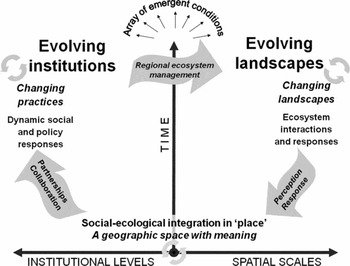
Landscapes internalize many of the interactions amongst ecosystem and social elements. Patterns or processes that develop out of interdependent interactions occurring across landscapes are uniquely different from the individual ecosystem elements that created them. Systems scientists refer to these as emergent properties or conditions of systems interactions (for example Odum Reference Odum1977; Gunderson et al. Reference Gunderson, Holling and Light1995; Walker & Salt Reference Walker and Salt2006). Emergent conditions of social-ecological systems interactions are often at the heart of sustainability issues and may involve interactions of fast and slow moving variables, feedbacks, threshold effects and reorganization (Berkes et al. Reference Berkes, Colding and Folke2003; Walker & Salt Reference Walker and Salt2006). A subtle synthesis of systems interactions might lead to manifestation of surprises, including possible systems crash, such as collapse of viable species populations, ecosystems or whole social-ecological systems (Diamond Reference Diamond2005; Walker & Salt Reference Walker and Salt2006; Duit & Galaz Reference Duit and Galaz2008). Social-ecological systems are also referred to as complex-adaptive systems, because they are characterized by the possession of self-organizing capacities which are responsive to pressures of change. Such adaptive capacity of natural and human systems is an important responsive mechanism for dealing with risk, vulnerability and buffering pressures of change (i.e. ‘resilience’; see Walker & Salt Reference Walker and Salt2006). Reorganization of resource management and conservation across multiple jurisdictions and tenures can contribute to improved efficiencies and benefits for ecosystem management and regional landscape sustainability (Williamson et al. Reference Williamson, Brunckhorst and Kelly2003; Brunckhorst Reference Brunckhorst2004; Fabricius et al. Reference Fabricius, Folke, Cundill and Schultz2007). Landscapes are emergent responsive conditions, manifest as patterns of feedback cycles that reflect social-ecological systems interactions (Fig. 1) and interdependencies including institutional elements such as expressions of property, policy and place shaping processes, which in turn define the multi-scale geographical context of the interactions (Gunderson et al. Reference Gunderson, Holling and Light1995; Brunckhorst et al. Reference Brunckhorst, Bridgewater, Parker, Hale and Lamb1997; Brunckhorst Reference Brunckhorst2000; Ostrom et al. Reference Ostrom, Diez, Dolsak, Stern, Stonich and Weber2002; Berkes et al. Reference Berkes, Colding and Folke2003; Marshall Reference Marshall2008).
Social-ecological systems interactions and interdependencies operate as cycles of feedback and adjustment, across spatial and institutional scales which influence the co-evolution of future landscapes and institutions. Conditions emerge (such as ‘place’ attachment at local scales of community and landscape) that are conducive to integration and collaboration for novel resource and ecological management.

While landscapes synthesize human and ecological interactions, they are often referred to as a social construct, whether imagined or understood, or constructed (processes reflected in patterns) inadvertently or deliberately. Environmental history also reflects human institutions (Diamond Reference Diamond2005; Pretty Reference Pretty2007). Institutions and landscapes evolve together over time (Fig. 1). Reactions to landscape change are reflected in new policies, planning and activity that create new landscape change. Landscape constituents and patterns ebb and flow, changing in shape and proportions. Government (often linear command and control reactions) can include land and resource tenure adjustments (for example agricultural land conversion to urban development, increased regulation, conservation through national parks, reallocation of resource rights to highest value) and other policy decrees which influence social-ecological systems resilience (Gunderson et al. Reference Gunderson, Holling and Light1995; Johnson et al. Reference Johnson, Swanson, Herring and Greene1999). Community responses can include collective action for ecosystem and resource management and restoration, and redesign of resource rights, access and conservation (Berkes et al. Reference Berkes, Colding and Folke2003; Williamson et al. Reference Williamson, Brunckhorst and Kelly2003; Armitage et al. Reference Armitage, Berkes and Doubleday2007). Various forms of property and resource rights (private, public and common) are a key influence on landscape change and the degradation (or potential resilience) of ecological resources and ecosystem services. Over time feed-back and feed-forward loops drive the non-linear co-evolution of landscapes and institutions within and across geographic spaces and produce an array of emergent conditions (Fig. 1). Identity with and attachment to a place is often reflected in how local people invest in shaping the landscape and their place in it over time (Stedman Reference Stedman2003; Cheng et al. Reference Cheng, Kruger and Daniels2003). These interactions and responses effect positive and negative change on social-ecological systems, shaping sense of place contexts in a landscape space. In turn, this collective shared history develops social capital frameworks to forge collaboration and integration of local-level governance, policy and community co-management initiatives for ecological resources management (Brunckhorst et al. Reference Brunckhorst, Coop and Reeve2006, Reference Brunckhorst, Reeve, Morley, Bock, Pettit, Cartwright, Bishop, Lowell, Pullar and Duncan2008). Nevertheless, policy makers, planners and scientists are increasingly finding themselves at odds with property and policy systems that create barriers to effective environmental management and conservation (Gunderson et al. Reference Gunderson, Holling and Light1995; Cash et al. Reference Cash, Clark, Alcock, Dickson, Eckley, Guston, Jager and Mitchell2003; Armitage et al. Reference Armitage, Berkes and Doubleday2007). Rather than fighting such embedded institutions, innovative approaches to circumvent such barriers might be more efficient and effective for scaling-up landscape planning and management (Fabricus et al. 2007; Brunckhorst et al. Reference Brunckhorst, Reeve, Morley, Bock, Pettit, Cartwright, Bishop, Lowell, Pullar and Duncan2008). Combining lessons from successful cross-tenure management arrangements and collective (cross-property or common property) resource management institutions can provide a means of collaboratively managing landscapes (Williamson et al. Reference Williamson, Brunckhorst and Kelly2003; Brunckhorst & Marshall Reference Brunckhorst, Marshall, Larson and Smajgl2007).
Landscapes of ‘place’ and ‘space’
Meaningful places and spaces are valuable concepts in CBRM. Investing in place shaping of landscapes, resources, livelihoods and the space called home (not just the physical house but the area identified as home and/or community) create important meaning for residents. The landscapes’ natural features have special meaning to them, as does the interweaved, human shaped landscape and its uses (Stedman Reference Stedman2003; Brunckhorst et al. Reference Brunckhorst, Coop and Reeve2006). Local knowledge about the landscape, its resources and residents is built in and about this geographic space with place meaning. It is where the main local community of interest exists, where residents interact, have networks of trust and have an interest in local civic affairs (Stedman Reference Stedman2003; Brunckhorst et al. Reference Brunckhorst, Reeve, Morley, Bock, Pettit, Cartwright, Bishop, Lowell, Pullar and Duncan2008). Place and community are important in policy development, cooperation and observance of formal and informal rules, facilitates self-organization and motivation for collective action (Cheng et al. Reference Cheng, Kruger and Daniels2003; Armitage et al. Reference Armitage, Berkes and Doubleday2007; Sandström Reference Sandström2009).
The growth of metropolitan areas, suburbs and centres of commerce create detachment from more natural working landscapes. These areas tend to be where policy centres from central government are located, which further the separation or fragmentation of landscapes, natural resources, communities and cooperation (Pretty Reference Pretty2007; Armitage et al. Reference Armitage, Berkes and Doubleday2007). Synthesis and reintegration is needed (Carpenter et al. Reference Carpenter, Armbrust, Arzberger, Chapin, Elser, Hackett, Ives, Kareiva, Leibold, Lundberg, Mangel, Merchant, Murdoch, Palmer, Peters, Pickett, Smith, Wall and Zimmerman2009). Systems of property rights, administrative jurisdictions, policy and resource management institutions need to be more seamlessly integrated at all levels of resource governance and institutional arrangements to match landscape scales of social-ecological interdependencies (Brunckhorst Reference Brunckhorst2000, Reference Brunckhorst2002; Berkes et al. Reference Berkes, Colding and Folke2003). In addition to the operational rules for successful resource management institutions (Ostrom et al. Reference Ostrom, Diez, Dolsak, Stern, Stonich and Weber2002), several other principles are considered essential for the successful design of ecologically-sustainable cross-scale interactions of social-ecological systems (Armitage et al. Reference Armitage, Berkes and Doubleday2007). Community identity with a place context is also important (Cheng et al. Reference Cheng, Kruger and Daniels2003). Local economies, rural towns and communities, land use and ecosystem health are emergent properties of social-ecological systems interactions that, to resident stakeholders, define a place and its space (Stedman Reference Stedman2003; Brunckhorst et al. Reference Brunckhorst, Coop and Reeve2006).
At broad scales however, how can policy makers, communities and scientists better understand the local-regional landscape (social-ecological) context for integrating CBNRM? To understand a regional landscape context to integrate multi-jurisdictional resource governance, three principles are considered important. Firstly, that the ecosystems of the landscape context possess a relatively high level of homogeneity. Secondly, that the regional boundaries maximize the area that residents consider important for civic engagement and reflect their local to regional communities of interest. The third principle is a nested multi-scaling capacity for dealing with externalities of conservation and resource use. These principles have been applied to the definition of nested spatial frameworks for integrating natural resource management, planning and government administration (for example in the state of New South Wales, Australia; Brunckhorst et al. Reference Brunckhorst, Coop and Reeve2006, Reference Brunckhorst, Reeve, Morley, Bock, Pettit, Cartwright, Bishop, Lowell, Pullar and Duncan2008). The method is being adapted to identify a multi-level framework to enhance community engagement in off-reserve conservation (J.M. Scott & D.J. Brunckhorst, unpublished data 2009). The approach might also be of value to identify the social-ecological geographies of the European Union, to provide insights into regionalism and, spatial and institutional design options for resource governance across EU international jurisdictions (M. Shannon, personal communication 2009).
Redesign of institutions and interactions across various types of tenure, in a landscape of ecological and place meaning, can create incentives for cross-jurisdictional collaboration. At finer levels of local management, redesign of institutions and interactions across various types of land tenure boundaries and multiple resources can also create incentives for collaboration and more sustainable livelihoods (Shackleton et al. Reference Shackleton, Shackleton and Cousins2001; Brunckhorst Reference Brunckhorst2000; Marshall Reference Marshall2008). Cross-tenure resource management of private and public land or resource tenure, such as within and across farm holdings, conservation reserves and other public land, needs a clear understanding of incentives, benefits and responsibilities (Williamson et al. Reference Williamson, Brunckhorst and Kelly2003; Brunckhorst & Marshall Reference Brunckhorst, Marshall, Larson and Smajgl2007). Some learning laboratory experiences are contributing insights. These include private conservation trusts, common property institutions and co-management arrangements between individual private landholders or public land management agencies (Imhoff Reference Imhoff2003; Knight & White Reference Knight and White2008; Brunckhorst & Marshall Reference Brunckhorst, Marshall, Larson and Smajgl2007), and more complex nested institutional design and resource management across multiple tenures and resources (Imhoff Reference Imhoff2003; Marshall Reference Marshall2008). A biosphere reserve model established in the salt-ravaged endangered Mallee ecosystems of South Australia grew to include an area of 9000 km2, across more than 30 properties representing nine different tenure types of public and private land (Brunckhorst et al. Reference Brunckhorst, Bridgewater, Parker, Hale and Lamb1997; Diamond Reference Diamond2005; Pfueller Reference Pfueller2008). Another landscape-scale model, the ‘Tilbuster Commons’, involved rotational grazing of a single herd of cattle across several adjacent ranches, each having and retaining individual private land title. The cattle were collectively owned by the landholders who set up a company to manage the resource enterprise (native pasture based cattle grazing) across their properties, with profits distributed through share holdings proportional to their landholding and contributions. Multiple benefits of the cross-property collaboration included the ability to set aside conservation areas, stream restoration and improved water quality, risk management, improved biodiversity, land and pasture, drought resilience and good financial returns. A benefit highly valued by participating farm families was the freeing up of time which allowed them to pursue other interests, employment or holidays (Williamson et al. Reference Williamson, Brunckhorst and Kelly2003).
Various models are emerging in the USA and Canada for partnerships across the private tenure of ranchers and public tenure, including federal lands (for example national forests) and state natural areas through collaborative programmes that produce environmental benefits, public goods (such as improved water quality and biodiversity conservation) and private benefits for the ranchers (Imhoff Reference Imhoff2003; Armitage et al. Reference Armitage, Berkes and Doubleday2007; Knight & White Reference Knight and White2008). They have been developed with an understanding of the ecological landscape linkages, and characteristics of place attachment, trust and reciprocity amongst the community of owners and managers. Two such projects in the USA involved the Forest Service relinquishing considerable control and regulatory authority to local groups of private ranchers. In New Mexico, the Quivera Coalition provides local management support for various wildlife conservation measures including the Mexican wolf which requires an extensive area to roam. In turn local ranchers have extended grazing rights across forest land and some land releases for hobby farm developments (Imhoff Reference Imhoff2003; Knight & White Reference Knight and White2008). In Idaho, the Lava Lake Land and Livestock group manage more than 300 000 ha of public and private land for sheep and cattle ranching, conservation and river and wetland restoration. The main commercial enterprise is production of boutique certified organic lamb. A component of the conservation and the riverine wetland restoration has included reintroduction of wolves, along with trialling new ways to manage sheep grazing to improve and sustain native rangeland. The wolves keep the large native herbivores, such as elk, from degrading wetland and stream vegetation, which allows for natural rehabilitation. The wolves are tracked and avoided to a large extent. Using a variety of different grazing management techniques, including grazing rotations and temporary electric fencing of stock at night when on summer mountain grazings, livestock losses have generally been no more than average losses prior to wolf reintroduction. Private ranchers and other land tenure managers are also able to plan and negotiate more flexible conditions, collectively building greater social-ecological resilience for multiple resource use, economic viability, and conservation and restoration objectives (M. Stevens, K. Launchbaugh, M. Scott, personal communications July 2006 and September 2009).
In southern Sweden, a broad area of rich but rapidly declining ecosystem services, including water and agricultural production, was the site for self-organizing leadership by local community and administrators, who aimed to transform management in response to the declining systems. The adaptive collaboration evolved as a landscape vision based integration and transformation of local jurisdictions and community towards co-management of the extensive wetlands, meadows and towns of the Kristianstads Vattenrike social-ecological system (Olsson et al. Reference Olsson, Folke and Hahn2004; Armitage et al. Reference Armitage, Berkes and Doubleday2007).
These examples, and many others, demonstrate the emergence of collaborative land-holder and community based initiatives, each with novel arrangements to break down barriers and collaborate across boundaries of administrative jurisdictions and policy that create impediments to integrated, landscape scale CBRM. Understanding the local landscape social-ecological context allowed for redesign of individual and collective resource management relationships, including policies of administrative jurisdictions and their boundaries and across various types of land tenure and ownership (see also Plummer & Armitage Reference Plummer and Armitage2007; Sandström Reference Sandström2009). Building bridges across multiple tenures and jurisdictions and policy administrations contributed more successful integration of social and institutional levels and ecological scales of natural resources management.
CONCLUSIONS
It is clear that there is considerable variation in CBNRM across countries and cultures with different national, sub-regional and local circumstances. Wherever CBRM is developed or evolves organically, it is influenced by, and a part of, the character of different landscapes and institutions and their co-evolution over time in which it is locally situated. While property, tenure and resource rights are clearly important for many reasons in resource management, some developed countries seem to have overemphasized and entrenched narrow and individualistic views of property rights (especially fragmented individual tenure of land and resources) and related policies at the expense of other forms of tenure and resource rights which might facilitate multi-scale sustainable resource governance and environmental restoration. Government agencies and sectoral interests tend to reflect similarly narrow jurisdictional approaches. Environmental conservation strategies have also tended to be constricted to an individually bounded public or private tenure approach. However, social-ecological systems operating across landscapes, various land tenures and policies produce patterns and (slow and fast) processes reflecting complex systems properties, including emergence of new conditions. For sustainability purposes in the long term, continuing emergence of resilience and reflexive reorganizing capacity is required to maintain essential ecosystem services and support institutional adaptation within and across social-ecological scales of context. Local levels of CBRM institutional evolution are important for adaptive resilience capacities to develop and scale up, through regional nesting, at other organizational levels. Scaling up across landscapes and institutions is necessary to manage externalities of resource use or other interactions, including systems feedbacks, change pressures or surprises with variable spatial extents and influences (Ostrom et al. Reference Ostrom, Diez, Dolsak, Stern, Stonich and Weber2002; Brunckhorst et al. Reference Brunckhorst, Coop and Reeve2006, Reference Brunckhorst, Reeve, Morley, Bock, Pettit, Cartwright, Bishop, Lowell, Pullar and Duncan2008; Marshall Reference Marshall2008).
Meaningful places and spaces are valuable concepts in CBRM. Resident communities are motivated to self-organize responsively for collective action when there are benefits in doing so and they have a shared history, similar resources and similar or complementary land and resource uses, that have also shaped the landscapes they call home. Local social-ecological contexts of landscapes are shaped by interactions and interdependencies from which emerge identity with a place, and shared respect for the local environment and people, in turn, produces meaningful civic participation. This creates the backdrop and stage for the adaptive dance between CBRM actors from different sets of jurisdictions of property and policy on which ride many elements required for successful ecological restoration and resource governance (Armitage et al. Reference Armitage, Berkes and Doubleday2007). There are ecological and socioeconomic advantages in using landscape ecology in designing ‘landscapes of property’ applications for the practice of ecological management effective at multiple scales. Applying systems theory in CBRM practice is assisted by using landscape ecology principles which contribute practical design elements for overcoming the erosion of resilience produced by narrow linear applications of property tenures and policies. There are many worthy case studies, and more could be learned from the experimental and experiential development of such holistic on-ground models.