





1. Introduction
The Dutch language is renowned for its remarkable degree of dialectal variation in plural pronouns. Beginning in the Middle Dutch period, simplex pronouns (subject, object, and possessive) were often reinforced with the noun lieden or lui (both meaning ‘people’) to mark plurality. This process yielded composite pronouns such as wijlie(den) ∼ wijlui ‘we’, jijlie(den) ∼ joului ‘you (pl.)’, zijlie(den) ∼ zijlui ‘they’, and so on. As these forms lexicalized, however, the original morpheme boundaries were often blurred to such a degree that their etymology became obscured, prompting controversy among dialectologists. This has been the case, for instance, with the standard Dutch second-person plural pronoun jullie, as scholars still disagree on whether the first syllable derives from a subject or object pronoun, and whether the reinforcing element reflects lieden or lui (both ‘people’) (Kloeke Reference Kloeke1941, Van Loey Reference Van Loey and Pée1958a, Van Bakel Reference Van Bakel2001).
Etymological uncertainty also surrounds the third-person plural (henceforth 3pl) compound hullie ∼ hulle. Originally an object and possessive pronoun (‘them, their’), hullie has in some dialects also assumed the role of subject (‘they’; cf. standard Dutch zij ∼ ze). Hullie ∼ hulle is of special interest to the history of Dutch and Dutch dialectology, as it became the all-purpose 3pl pronoun in Afrikaans as well as in the now-extinct colonial variety of Dutch spoken in former New Netherland and the diaspora variety of the town of Pella (Michigan). Although it is losing ground to hun, the form remains a robust feature in several nonstandard varieties in the Netherlands and Belgium.
This article revisits the etymology of hullie ∼ hulle, focusing on the origin of its first syllable.Footnote 1 In the majority of contemporary Dutch dialectological scholarship, including the major (etymological) dictionaries, hullie ∼ hulle is uncritically presented as a hun-compound. According to the authoritative Van Dale dictionary, for instance, hullie is “popular speech for hunlieden” (Van Dale Reference Van Dale1961:829, my translation). Below, this consensus is challenged: It is argued that the first syllable of these compounds is more plausibly derived from heur than from hun. Establishing a proper etymology for hullie ∼ hulle (and hulder) is not a trivial matter. It is important not only for accurate historical-linguistic reconstruction, but also because misclassification can have practical consequences for dialectology, potentially skewing the results of quantitative dialect geography and modeling.
At the outset, it is important to establish an often-overlooked fact: In Middle and Early Modern Dutch, the pronoun haar (∼ heur ∼ heer) was polysemous, functioning both as ‘her’ (feminine 3sg object and possessive pronoun) and as ‘them, their’ (all-gender 3pl object and possessive pronoun). In present-day standard Dutch, haar is restricted to the singular feminine function (‘her’), whereas hun serves as the default 3pl object and possessive pronoun. Dialectally, however, haar, especially in the shape of heur, continues to be a frequently used 3pl pronoun and in fact still outnumbers hun in the Dutch language area as a whole (De Rooij Reference De Rooij1990, Jacobs Reference Jacobs2025a). In other words, the simplex forms heur and hun were – and in many regions still are – synonymous, exhibiting a complementary geographic and register-based (nonstandard vs. standard) distribution.
The article is structured as follows: Section 2 surveys the distribution of 3pl nonsubject pronouns in the Dutch language area. Section 3 discusses what is known about the historical emergence of hullie ∼ hulle. Section 4 reviews the prevailing view that hullie derives from hunlieden and examines the implications of this assumption for dialectological research. The central part of the article, section 5, presents the empirical and dialectological evidence supporting a derivation from heurlui/heurlie(den) rather than hunlie(den). Section 6 briefly considers the relevance of Afrikaans and New Netherland Dutch. Section 7 concludes.
2. 3pl nonsubject pronouns in the Netherlands and Belgium
As noted, the Dutch language area is renowned for its wealth of plural compound pronouns. For the 2pl alone, it “distinguishes no less than 14 different forms …, not even taking into account phonological differences” (De Vogelaer & Coussé Reference De Vogelaer and Coussé2011:7). Although hullie has in some dialects assumed the role of subject pronoun, it is historically a nonsubject pronoun. In the Dutch language area, three major subtypes can be identified:Footnote 2
-
(a) Hun. Hun /hʏn/ is the official 3pl dative and possessive pronoun in standard Dutch and, colloquially, also serves as an accusative (at the expense of the official 3pl accusative hen) and even as a subject pronoun in some varieties (e.g. Van Bree Reference Van Bree2012). Dialectally, hun predominates in the south of Dutch Limburg, the southeast of North Brabant, and Belgian Limburg, including the adjoining easternmost flank of Flemish Brabant (De Rooij Reference De Rooij1990:125).
-
(b) Haar. As noted in the Introduction, haar /haːr/ – along with its regionally popular allomorphs (h)eur /(h)øːr/ and (h)eer /(h)eːr/ – has retained 3pl functions in a surprising number of nonstandard varieties, mainly in the north and east of the Netherlands (Groningen, Drenthe, Overijssel, Gelderland), extending as far south as northern Dutch Limburg (cf. De Rooij Reference De Rooij1990). It furthermore survives as a 3pl pronoun in several varieties of Low German, and was also occasionally recorded in Zeelandic and Flemish territory up until at least the early twentieth century (see Jacobs Reference Jacobs2025a). The derived haar clitics /ər/ and /dər/ (typically written er and d’r) are even more widespread as unstressed 3pl object and possessive pronouns, including outside the core haar regions.Footnote 3
-
(c) Lui ∼ lieden compounds of the type (h)ullie ∼ (h)ulle and (h)ulder. The pronoun (h)ullie /ˈ(h)ʏli/ – the focus of this article – occurs in some locations with h-procope and has several allomorphs, of which /hʏlə/ (spelled hulle) and /høːli/ (spelled heulie) are the most widespread. Within the Netherlands, it is found in nonstandard varieties in South and North Holland, northern North Brabant, Utrecht, Gelderland, and, albeit sporadically, in Zeelandic. In Belgium, hullie predominates in Flemish Brabant (excluding the area bordering Limburg, which has hun) and Antwerp (excluding the city of Antwerp itself and a handful of surrounding towns that have hun). The form (h)ulder /ˈ(h)ʏldər/ is likewise routinely presented as a hun-compound, with the reinforcing element taken to be lieder (the old genitive of lieden ‘people’).Footnote 4 It is strikingly dominant in West and East Flanders as well as in Zeeland (De Rooij Reference De Rooij1990:128; cf. De Schutter Reference De Schutter1966; Van Bree Reference Van Bree2012:236).
3. The historical emergence of hullie ∼ hulle
Hullie was already widespread in the late nineteenth century: There are occasional attestations in newspaper articles from the mid-nineteenth century onwards, and Winkler (Reference Winkler1874a, Reference Winkler1874b) recorded it in eleven townships across a sample of around seventy.Footnote 5 The online Dutch etymology database (Van der Sijs Reference Van der Sijs2010) cites an example from Meesters (Reference Meesters1832) as the earliest attestation. As De Vogelaer & Coussé (Reference De Vogelaer and Coussé2011:11, 12) note, its absence from historical Dutch corpora should not be taken as evidence that it was lacking in pre-modern Dutch. Rather, contemporary authors likely preferred to write the full lieden-compounds instead of their reduced forms.
In fact, it is plausible to assume that hullie had already gained currency in seventeenth-century colloquial Dutch, as it became the all-purpose 3pl pronoun of the colonial variety of Dutch formerly spoken in New Netherland (Prince Reference Prince1910, Reference Prince1913). New Netherland Dutch is thought to have separated from mainstream European Dutch by the late seventeenth century. Moreover, the allomorph hulle is the 3pl pronoun in Afrikaans, whose grammar is believed to have crystallized by the late eighteenth century.
Originally a possessive and object pronoun, hullie has additionally moved into the subject slot in some Dutch dialects (Van Bree Reference Van Bree2012). The same functional expansion is observed in Afrikaans (hulle) and New Netherland Dutch (hullie). However, this development bears no relevance to the etymology of the form and will therefore not be pursued further here.
4. The etymology of hullie in the literature and its methodological implications
As noted, the source of the second syllable of hullie is generally – and correctly – attributed to the plural noun lieden ∼ lui ‘people’.Footnote 6 The etymon of the first syllable, on the other hand, is considerably less clear: On strictly phonetic grounds, hun and heur both seem plausible candidates. Discussing the rural Antwerp 3pl pronoun hullie, Cornelissen & Vervliet (Reference Cornelissen and Vervliet1900:54, my translation) explicitly acknowledge this problem: “Is höllie a reduction of hunlieden or of heurlieden? … From the pronunciation … it is not clear if it must be spelled hunlie or heurlie.” Kloeke (Reference Kloeke1941:166) and, more recently, Goossens (Reference Goossens, Olivier and Coetzee1993) have likewise emphasized the coexistence of two possible etymologies.
The minority of authors who have traced hullie back to heurlieden include Van Helten (Reference Van Helten1885:46), Kloeke (Reference Kloeke1934:22), Van Loey (Reference Van Loey1948:39, Reference Van Loey and Pée1958a:320, Reference Van Loey1958b:23), Schönfeld (Reference Schönfeld1970:144), and Goossens (Reference Goossens, Olivier and Coetzee1993:67).Footnote 7 Nevertheless, the overwhelming majority of dialectological studies including authoritative Dutch (etymological) dictionariesFootnote 8 treat hullie as a reflex of hunlie(den), whereas the alternative heurlie(den) is generally ignored. The following quotations, spanning roughly a century and a half, are representative:Footnote 9
-
– “Hullie is, in Maaslandic Dutch, the 3rd-person plural personal pronoun. It arose from hunlie = hunlieden” (Van der Meer Reference Van der Meer1927:41)
-
– “In colloquial Dutch, hullie instead of hunlie, i.e. hunlieden, is very common” (Te Winkel Reference Te Winkel1883:227)
-
– “The form hullie derives from hunlie(den)” (Pannekeet Reference Pannekeet1984: entry hullie)
-
– “…forms that have developed from hunlieden, such as (h)ullie” (WNT, see under zijlieden)
-
– “Thus, the substandard form hullie (‘they’ [plural]) can be explained as deriving from hunlieden” (Philippa et al. Reference Philippa, Debrabandere, Quak, Schoonheim and van der Sijs2003–2009)
-
– “In most sampling points in Holland, the compound is a form not attested in the historical corpora, typically hullie or hunnie. These forms are compounds of oblique hun ‘them’ which have been extended to subject function” (De Vogelaer & Coussé Reference De Vogelaer and Coussé2011:13)
-
– “In the ‘hullie’ category, also the ‘hunnie’ forms are included, since both forms descend from the same complex form ‘hunlieden’” (Pots & Wiedenhoff Reference Pots and Wiedenhoff2014:31)
-
– “Similar processes of assimilation probably explain the existence of plural object forms like hullie and hulder as alternatives for hun(lieden) and hen(lieden)” (Lismont Reference Lismont2025:330)
As these examples show, the hunlie(den) etymology is typically presented as self-evident, without supporting argumentation. It has become an entrenched consensus.Footnote 10
Importantly, the implications of this consensus go beyond a mere matter of etymological labeling. In statistical and corpus-based dialect research, etymological assumptions directly inform coding decisions, which in turn shape areal generalisations and quantitative outcomes. In this particular case, if hullie is coded as a reflex of hun, the historical hun area is automatically expanded at the expense of haar ∼ heur. This risks creating a distorted picture of the relative weight of hun and heur across the Dutch language area, obscuring the fact that heur was historically the more widespread 3pl nonsubject pronoun. The following examples illustrate the issue at hand:
-
– Working from the assumption that hullie is a variant of hunlie, De Schutter (Reference De Schutter1966:85) concludes that “The hunlie type … covers a very extensive area.” Yet, the form hunlie itself is not attested as such in the Dutch dialect record (see section 5.4).
-
– Likewise, taking as a starting point that hullie “originates from hunlie(den),” De Rooij, in what remains one of the most comprehensive surveys of Dutch 3pl nonsubject pronouns, concludes that hunlieden is “well represented” in the present-day Dutch language area (De Rooij Reference De Rooij1990:128, my translation). In a follow-up study, De Rooij maintains that hun is not restricted to the standard but also occurs frequently in dialects “as the first element of forms like hullie and hulder” (Reference De Rooij1991:5, my translation).
-
– According to The Syntactic Atlas of the Dutch Dialects (Barbiers et al. Reference Barbiers, Bennis, De Vogelaer, Devos and van der Ham2005:37): “Lieden-compounds with hun (e.g., hullie, hunnie) are found more often than hun itself, in an area with a size comparable to the hun-area, with the Dutch Randstad (the urbanised area in the west of the Netherlands) as the nucleus, and reaching from Noord-Holland and Zuid-Holland to Utrecht, Noord-Brabant and Gelderland.” This conclusion, too, crucially depends on treating hullie as a hun-compound.
-
– In another large-scale quantitative Dutch dialect survey (Goeman et al. Reference Goeman, van Oostendorp, van Reenen, Koornwinder, van den Berg and van Reenen2009), hullie is lumped together in one category with hun and hunnie in the mapping of 3pl possessive pronouns.
In sum, the widespread a priori treatment of hullie as a hun-compound has consequences that go beyond etymological labeling. It generates problematic areal generalizations by projecting hun into regions where it is historically unattested, inflates the apparent spread of hun at the expense of haar ∼ heur, and gives statistical weight to forms which have not been independently documented (such as hunlie), ultimately affecting our understanding of the historical distribution of Dutch 3pl pronouns.
By extension, it is easy to see how it may bear on historical-linguistic reconstructions of extra-territorial varieties such as Afrikaans, New Netherland Dutch, and Pella Dutch (Michigan), where cognates of hullie are well documented.Footnote 11 If hullie is uncritically linked to historical hun territory, this can skew assumptions about the dialectal input and regional origins of these varieties.
5. Evidence in favor of the heurlui ∼ heurlie(den) etymology
The aim of this section is to evaluate the competing hun- and heur-based etymologies of hullie ∼ hulle against the available historical dialect evidence. Ideally, such an evaluation would draw on systematically comparable pronominal paradigms from different stages of Dutch, as documented in nineteenth-, twentieth-, and twenty-first-century dialect monographs and atlases. In practice, however, the available dialect sources from the nineteenth, twentieth, and twenty-first centuries – while invaluable in their own right – either were not designed to provide paradigm-level inventories of 3pl nonsubject pronouns (e.g. Winkler Reference Winkler1874a, Reference Winkler1874b,Footnote 12 Leopold & Leopold Reference Leopold and Leopold1882,Footnote 13 the online Syntactic Atlas of the Dutch Dialects, henceforth DynaSAND = Barbiers et al. Reference Barbiers, Bennis, De Vogelaer, Devos and van der Ham2006 Footnote 14) or are not corpus-searchable (e.g. the Reeks Nederlandse Dialectatlassen, henceforth RND = Blancquaert & Pée Reference Blancquaert and Pée1925–1982Footnote 15). This places clear limits on the type of quantitative and comparative analysis that can be undertaken.
Given these methodological constraints, for the following analyses I have adopted a targeted empirical approach, drawing mainly on Winkler (Reference Winkler1874a, b), Leopold & Leopold (Reference Leopold and Leopold1882), and the RND and DynaSAND databases, supplemented by evidence from a range of lesser-known secondary sources from the nineteenth to the twenty-first century. This strategy has yielded five lines of evidence from across the Dutch language area that support an analysis of hullie ∼ hulle as a heur-compound.
5.1. The historical scarcity of hunlieden
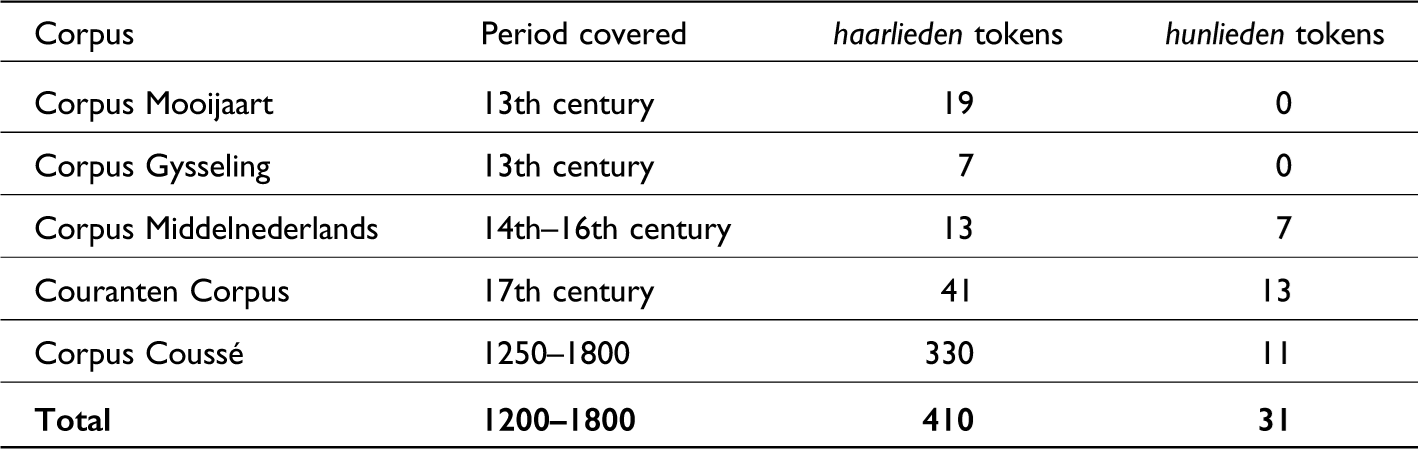
The aforementioned fact that hullie was transplanted to New Netherland and South Africa suggests hullie already existed in (late) seventeenth-century mainstream Dutch. Tellingly, in the period leading up to the settlement of those two former colonies, haarlieden compounds (and colloquial variants with heur-) were consistently more popular than hunlieden. This is shown in table 1, which displays the amount of haarlieden versus hunlieden tokens in five historical Dutch corpora.
Amount of haarlieden and hunlieden tokens in five historical Dutch corporaFootnote 16

Table 1 Long description
A table comparing the amount of haarlieden and hunlieden tokens in five historical Dutch corpora. The table has five rows and four columns. The columns are labeled Corpus, Period covered, haarlieden tokens, and hunlieden tokens. The rows are labeled with the names of the corpora and the periods they cover. Row 1: Corpus Mooijaart, 13th century, 19 haarlieden tokens, 0 hunlieden tokens. Row 2: Corpus Gysseling, 13th century, 7 haarlieden tokens, 0 hunlieden tokens. Row 3: Corpus Middelnederlands, 14th-16th century, 13 haarlieden tokens, 7 hunlieden tokens. Row 4: Couranten Corpus, 17th century, 41 haarlieden tokens, 13 hunlieden tokens. Row 5: Corpus Coussé, 1250-1800, 330 haarlieden tokens, 11 hunlieden tokens. The total row shows 410 haarlieden tokens and 31 hunlieden tokens for the period 1200-1800.
Even though hun rapidly grew in popularity from the 1600s onward, especially across Brabant and Holland, derived hunlieden compounds are virtually unattested across both provinces in the Corpus Coussé (De Vogelaer & Coussé Reference De Vogelaer and Coussé2008:27).Footnote 17
5.2. The geographic link between hullie and historical 3pl heur(lie) territory
Historical Dutch plural pronoun studies such as Van Loey (Reference Van Loey1958b:24) and De Vogelaer & Coussé (Reference De Vogelaer and Coussé2008, Reference De Vogelaer and Coussé2011) emphasize that 3pl hun, firmly embedded in present-day mainstream Dutch, originated in the southeast of the Dutch-speaking area, particularly Limburg and (the east of) Flemish Brabant. The ‘homeland’ of 3pl haar ∼ heur is more difficult to pinpoint, since it is found with a 3pl function in Middle and Early Modern Dutch texts from across the entire Dutch language area (Jacobs Reference Jacobs2025a). The provenance of the derived -lui ∼ -lie(den) compounds, however, can be clearly situated in West Flanders, Zeeland, and the Hollandic dialect area, a geographic pattern already noted by Van Loey: “the origin of heurlie is known: in the west of our language area, the personal and possessive pronouns were extended with lieden: wijlieden, heurlie(de)” (Van Loey Reference Van Loey1958b:23; cf. Van Loey Reference Van Loey and Pée1958a:319, 320; Van Bree Reference Van Bree2012:238). Presumably for this very reason, Van Loey remains one of the few authors who readily attributed the Antwerp 3pl forms hulle and hullie – which he transcribed as [hoelə] ∼ [hoelijə] – to heurlie(den).
Tellingly, as noted in section 3, the attestations of hullie ∼ hulle cluster precisely in the western parts of the Netherlands and Belgium – i.e. where 3pl haar + lieden compounds were historically popular – while being unattested in southern Limburg or eastern Flemish Brabant, areas historically linked to the emergence of hun.
This historical-geographic continuity is further suggested by the fact that hullie dialects commonly employ the haar-derived clitics er and d’r in unstressed position (e.g. De Schutter Reference De Schutter1966:86, 87).Footnote 18 In other words, in these varieties, hullie and er ∼ d’r form a tonic-atonic (viz. strong–weak) pair (see examples 1–5). These clitics are important reminders that the dialects in question belong historically to the plural haar ∼ heur area rather than the hun area, consistent with the heurlui ∼ heurlie → hullie etymology.
(1)
a.
ig bɛn bli.t dat ik mət hʌ.li nit mega.n bɛn ‘I’m glad that I didn’t go with them’
(Den Burg, North Holland, RND sentence 16)
b.
dər munt iz dru.g van də durst ‘Their mouth is dry with thirst’ (Den Burg, North
Holland, RND sentence 86)
(2)
a.
ik sɛ̃n blɛi dak me œli ni megəgɔ zɛ̃n ‘I’m glad that I didn’t go with them’
(Baarle-Nassau, North Brabant, RND sentence 16)
b.
dərə mond is droeg fan d’n dɔrst ‘Their mouth is dry with thirst’ (Baarle-Nassau,
North Brabant, RND sentence 86)
(3)
a.
ik bin blɛi dad ik mi hœli ni bin megəgɔn ‘I’m glad I didn’t go with them’
(Nijmegen, Gelderland, RND sentence 16)
b.
dər mɔnt is drøx fan dən dɔrst ‘Their mouth is dry with thirst’ (Nijmegen,
Gelderland, RND sentence 86)
(4)
dər – of hʌli münt iz dro.X fan də dɔrst ‘Their mouth is dry with thirst’ (Aalsmeer,
South Holland, RND sentence 86)Footnote 19
(5)
a.
ig bɛm blæ.i dat Ik met hœli ni. meigəgɑ.n bIn ‘I’m glad I didn’t go with them’
(Schalkwijk, Utrecht, RND sentence 16)
b.
dər munt Is drɔ.X van də dɔrst ‘Their mouth is dry with thirst’ (Schalkwijk,
Utrecht, RND sentence 86)
5.3. The co-occurrence of heurlie ∼ heurlui and hullie
Further support for the derivation heurlie ∼ heurlui → hullie can be drawn from the fact that these forms co-occur in several dialects and dialect clusters. In a number of cases, this co-occurrence reveals a clear diachronic trajectory, in which original -rl- forms appear to have been gradually replaced by assimilated -l(l)- forms. Five case studies are discussed below. These concern dialects and dialect areas for which comparable data are available from both the late nineteenth century and the late twentieth century, allowing a diachronic comparison across roughly a century.
Goeree Overflakkee
A first case in point is the dialect of Goeree Overflakkee – politically part of South Holland but linguistically leaning more towards Zeelandic. Leopold & Leopold (Reference Leopold and Leopold1882) provide multiple examples of original -rl- forms (heurli ∼ heurle) as an all-purpose 3pl pronoun in the Flakkee area (6a), with no mention yet of the assimilated -l(l)- forms such as hullie. In the early twentieth century, heurlie is still mentioned in a grammatical sketch of Goerees, but now as an allomorph of heulie and heuljə (Den Eerzamen Reference Den Eerzamen1924:297, Reference Den Eerzamen1937:135, 154). In the late twentieth century, the assimilated forms appear to have gotten the upper hand: the New Winkler (Scholtmeijer Reference Scholtmeijer1996) and DynaSAND report heulie and hullie respectively for the towns of Ouddorp (6b) and Dirksland (6c), whereas the original -rl- forms are no longer mentioned.Footnote 20 Also, as expected for a variety historically belonging to the haar ∼ heur area, all Goerees dialect material features the plural haar-clitics er and d’r.Footnote 21
(6)
a.
Mar dát bluuft onder heurli ‘But that stays between them’ (Flakkee, Goeree
Overflakkee, in Leopold & Leopold Reference Leopold and Leopold1882:171)
b.
D’n jongsten van heulie zei tegen z’n vaoder: […] ‘The youngest among them
told his father: […]’ (Ouddorp, Goeree Overflakkee, in Scholtmeijer Reference Scholtmeijer1996)
c.
Hullie ha der niks mee te make ‘They have nothing to do with that [= It’s none
of their business]’ (Dirksland, Goeree Overflakkee, in DynaSAND)
South Hollandic
Similar patterns emerge for the South Hollandic dialect zone. In a general overview, Van Bree (Reference Van Bree2004:83) lists hullie as a 3pl nonsubject pronoun alongside d’rlui and the clitics er and d’r. Likewise, Hoekstra & Scholtmeijer (Reference Hoekstra and Scholtmeijer2004) report ullie, d’r, and possessive d’rlui. For Leiden specifically, Winkler (Reference Winkler1874b) records the composite ’rloui, whereas hullie is attested in late-twentieth-century dialect material; in a similar vein, Leopold & Leopold (Reference Leopold and Leopold1882) document derlòi (7a) for Goudswaard, whereas more recent sources show hullie and heulie (7b). Leopold & Leopold (Reference Leopold and Leopold1882:261) furthermore provide heurlui for Noordwijk (8a). Although Scholtmeijer (Reference Scholtmeijer1996) still recorded -rl- forms for Noordwijk, the reduced form hullie is found in other late-twentieth-century Noordwijk sources (8b). Taken together, these South Hollandic cases mirror the pattern observed for Goeree Overflakkee, with older -rl- compounds gradually giving way to assimilated -l(l)- forms.
(7)
a.
al brak derlòi hart ōōk ‘even if their heart also broke’ (Goudswaard, in Leopold & Leopold Reference Leopold and Leopold1882:190)
b.
maer heulie herinnere ‘t d’r aige niet ‘but they do not remember’ (Goudswaard,
in DynaSAND)
(8)
a.
das heurlui zaaek ‘That is their business’ (Noordwijk, in Leopold &
Leopold Reference Leopold and Leopold1882:261)
b.
Kaik, vanmiddag spelen hullie in het oranje ‘Look, today they are playing in
orange’ (Noordwijk, in Het Parool 16-05-1978, p. 21)
The province of Utrecht
Prose by Herman de Man from the 1920s and 1930s, reflecting Utrechts dialect, is replete with the form heurlui (9a). In Lopik – where several of De Man’s novels are set – hullie is now the norm (9b), pointing to a shift from heurlui to hullie. At the same time, Winkler (Reference Winkler1874a:350) and Vor der Hake (Reference Vor der Hake1911:19) already document hullie for Soest and the city of Utrecht respectively, suggesting that in those places hullie had become the colloquial norm at an earlier date than in Lopik. Across the present-day province of Utrecht, the mainstream Dutch form hun is gaining the upper hand: One DynaSAND interviewee from Eemnes Buiten explicitly notes that hullie used to be correct but is no longer so. Also, the three Utrecht entries in the New Winkler (Scholtmeijer Reference Scholtmeijer1996) record only hun. However, although the six usable DynaSAND entries for Utrecht all attest hun, three of them still mention hullie, and one – Spakenburg – still attests heurlie (10a), alongside heulie (10b) and hullie (10c). Three out of the six DynaSAND entries furthermore still record the haar-clitic d’r as a 3pl possessive.
(9)
a.
met die felle oogen lokte ze heurlui weerom ‘with those fierce eyes she lured
them back again’ (Lopikerwaard, Utrecht, in De Man Reference De Man1924:34)
b.
Ze geloven dat wij rijker zijn as hullie ‘They believe that we are richer than them’ (Lopik, Utrecht, in DynaSAND)
(10)
a.
Heurlie meugen blieven ‘they can stay’ (Spakenburg, Utrecht, in DynaSAND)
b.
Heulie weten het niet meer ‘They don’t remember’ (Spakenburg, Utrecht, in
DynaSAND)
c.
Hullie hen der niks mee te make ‘They have nothing to do with it’
(Spakenburg, Utrecht, in DynaSAND)
Taken together, the Utrecht data thus point to a unidirectional replacement of earlier heurlui by hullie, followed more recently by the expansion of hun; importantly, though, the heurlui → hullie transition appears to have occurred earlier in some localities (e.g. Soest) than in others (e.g. Spakenburg).
Gelderland
The province of Gelderland offers another instructive case. This region falls squarely within the haar ∼ heur area, not just historically but also synchronically. Of the six Gelderland localities for which the Old Winkler (Winkler Reference Winkler1874a) provides data, four show the 3pl object pronoun eur (Dinxperlo, Varsseveld, Winterswijk, and Zutphen), one displays a conservative composite heurlu (Overbetuwe), and another has hullie (Tielerwaard). The New Winkler (Scholtmeijer Reference Scholtmeijer1996) confirms this picture: It records eur in three localities (Dinxperlo, Varsseveld, and Winterswijk), alongside hullie in two (Nijkerk and Uddel). Furthermore, the haar-clitics er and d’r are commonly found across Gelderland (De Schutter Reference De Schutter1966:87; cf. examples (3a, b) above).
Scholtmeijer’s dictionary (Reference Scholtmeijer2011) for the Veluwe area in Gelderland records 3pl eur, alongside hulie ∼ hullie as well as conservative eurluu and heurluuj.Footnote 22 Very similar -rl- compounds (huerluy and heurluui) were attested also by Van Schothorst (Reference Van Schothorst1904:79) for the North West Veluwe and by Leopold & Leopold (Reference Leopold and Leopold1882) for the Veluwe town of Uddel (11a). Consistent with a gradual transition from heurlui to hullie, the 3pl object pronoun for Uddel in the New Winkler (Scholtmeijer Reference Scholtmeijer1996) is hullie (11b).
In Leopold & Leopold (Reference Leopold and Leopold1882), heurlie and eurluw furthermore feature in dialect texts from the De Graafschap region, where a Dutch Low Saxon dialect known as Achterhoeks is spoken. In present-day Achterhoeks, the old eurluu ∼ eurleu forms are still reported as nonsubject 3pl pronouns, alongside simplex eur, and the assimilated forms hullie and hulle. Notably, the dialect’s own Wikipedia page explicitly warns for the intrusion of standard Dutch hun: “Instead of eurluu, the erroneous hun is often used just as in Dutch.”Footnote 23
Undeniably, the use of hun is currently expanding into various Gelderland dialects. However, despite this expansion, and despite the historical productivity of -lie ∼ -lui compounds in the region,Footnote 24 none of the Gelderland materials consulted for this article provide any indication of the existence of a hypothetical hunlie compound.
(11)
a.
dat zii ’t beter weten a’s heurluui ‘that they know better than them’ (Uddel,
Gelderland, in Leopold & Leopold Reference Leopold and Leopold1882:511)
b.
En hie verdeil’n dat onder hullie ‘And he shared it among them’ (Uddel,
Gelderland, in Scholtmeijer Reference Scholtmeijer1996)
Taken together, the Gelderland evidence shows that this region firmly belongs to the historical haar ∼ (h)eur domain, within which assimilated (h)ullie forms now coexist with more conservative composite (h)eurlie ∼ (h)eurlui forms. The latter plausibly served as templates for the former.
West Frisian Dutch
The transition over time from heurlie(den) to hullie can be illustrated particularly clearly in West Frisian Dutch, a North Hollandic dialect group (not to be confused with the West Frisian language spoken in the province of Frisia). For the towns of Benningbroek, Enkhuizen, and Texel, all situated within the West Frisian Dutch area, Winkler (Reference Winkler1874a, b) records composite heurlui forms, whereas the corresponding New Winkler versions (Scholtmeijer Reference Scholtmeijer1996) uniformly feature hullie.
At the same time, although hullie allomorphs now predominate in West Frisian Dutch, conservative -rl- forms appear to have persisted up to the present in some subvarieties. Thus, Pannekeet’s (Reference Pannekeet1984) West Frisian Dutch dialect dictionary still lists the conservative form heurle alongside the assimilated heulie, hullie, and hulle. Likewise, derloi is attested for Egmond aan Zee both in the Old and in the New Winkler. The DynaSAND database, furthermore, documents herlie alongside hullie in the West Frisian Dutch town of Grosthuizen. It remains unclear whether this variation reflects generational stratification (with the more conservative -rl- forms associated with older speakers), genuine synonymy within individual speaker grammars, or subtle phonetic and phonological differences between neighboring communities. Nevertheless, the overall picture is one in which originally conservative -rl- forms are increasingly replaced by assimilated hullie allomorphs.
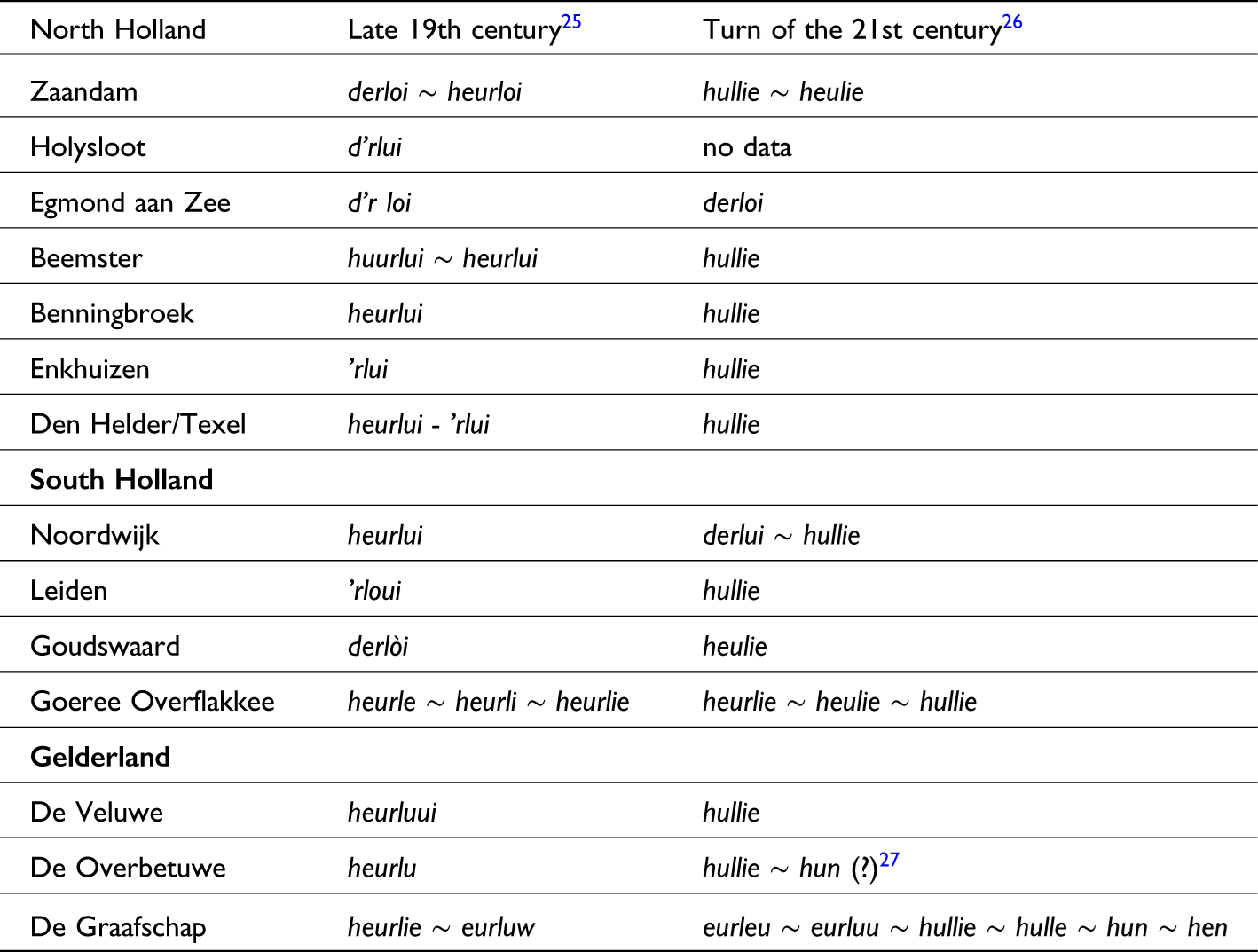
Additional North Hollandic evidence comes from Zaandam, where several -rl- forms are attested in late-nineteenth-century sources (Winkler Reference Winkler1874a, Leopold & Leopold Reference Leopold and Leopold1882, Boekenoogen Reference Boekenoogen1897), while reduced hullie allomorphs are documented in dialect material from roughly a century later (see table 2).
Composite 3pl object pronouns with intervocalic -rl- attested in the late nineteenth century versus their modern-day counterparts

Table 2 Long description
The table compares composite 3pl object pronouns in North Holland, South Holland, and Gelderland in the late nineteenth century with their counterparts around the turn of the twenty-first century. Older forms with intervocalic -rl-, such as heurlui, derloi, and heurlie, are compared with later forms, frequently hullie, heulie, or hulle. The table shows a general tendency for older -rl- forms to be replaced by or coexist with assimilated -l(l)- forms.
Table 2 summarizes the composite -rl- forms found in Winkler (Reference Winkler1874a, b) and Leopold & Leopold (Reference Leopold and Leopold1882) alongside the corresponding forms in Scholtmeijer (Reference Scholtmeijer1996) and other dialect descriptions from the turn of the twenty-first century. Localities are grouped geographically, rather than by dialect classification. Note that in most of these places, hun will be the principal 3pl nonsubject pronoun in the more mainstream registers.
Waterlands and Urkers
The cases summarized in table 2 are ones for which a relatively clear diachronic contrast between late-nineteenth-century -rl- compounds and their modern reflexes can be established. As noted, however, in some varieties, older -rl- forms seem to persist up to the present alongside the newer hullie variants, reflecting a stage of coexistence rather than straightforward replacement. Such is the case not only for the above-mentioned West Frisian Dutch varieties, but also for the ‘Waterlands’ dialects of Volendam and Monnickendam.
For Volendams, -rl- forms such as eurlui, erlui, and derlui are attested (örlö.j and (d)ərlö.j in Van Ginneken 1954:99; ərloe in the RND) alongside hullie (spelled höli in Van Ginneken 195499).Footnote 28 In Monnickendams, considered a close cousin of Volendams, derlui is documented in the RND (sentence 86), while hullie is given by Van Ginneken (1954:99) and, more recently, by DynaSAND. Likewise, in Urkers, a conservative transitional dialect spoken on the island of Urk (Flevoland), (h)eurlui, erlui, and d’rlui are all documented alongside reduced eului and eulie (Kaiser & Meertens Reference Kaiser and Jacobus Meertens1942:312, 313, DynaSAND).Footnote 29
For these varieties, more targeted research is needed to clarify the present-day distribution of 3pl nonsubject pronouns.Footnote 30
To sum up, it is plausible that the situation in parts of North and South Holland, Utrecht, and Gelderland in the late nineteenth and early twentieth centuries resembled that of Goeree Overflakkee, in that older forms such as (h)eurlie ∼ (h)eurlui coexisted with, and were gradually supplanted by, assimilated -l(l)- allomorphs such as hullie, heulie, and hulle. At any rate, the evidence surveyed in this section allows for a clear generalization. The dialects and dialect groups discussed above share the following properties:
-
– hullie is synchronically a salient 3pl pronoun in these varieties;
-
– historically, they formed part of the 3pl haar ∼ heur domain;
-
– they all display a documented history of heurlie ∼ heurlui compounds;
-
– in none of them is there any evidence for the existence of hunlie(den) compounds (see below).
5.4. The absence of hunlie in modern-day Dutch
The proposed etymology is also supported by negative evidence, namely the absence of hunlie-type compounds.
If hullie truly derived from hunlie(den), it becomes difficult to explain why intermediate -nl- forms, that is, hunlie or hypothetical allomorphs such as unli ∼ hunle ∼ hunlui, are unattested at present in any of the areas where hullie is used. Although hunlie(den) compounds do appear in older texts, I have found no evidence of their existence beyond the written record. Neither Winkler’s (Reference Winkler1874a, b) late-nineteenth-century dialect study nor its late-twentieth-century successor (Scholtmeijer Reference Scholtmeijer1996) documents the form hunlie. In Leopold & Leopold (Reference Leopold and Leopold1882), a collection of dialect texts whose orthography aims to reflect actual pronunciation, there is not a single instance of hunlie, whereas it contains numerous examples of (h)eurlui and (h)eurli(e), in addition to a few instances of hullie. Even in De Rooij (Reference De Rooij1990), who, based on a study of the RND, provides what is arguably the most extensive listing of Dutch 3pl nonsubject pronouns and their allomorphs, hunlie is not mentioned.
The few times that hunlie is mentioned in the dialectological literature, it is typically with the caveat that the form is actually pronounced hullie. For instance, De Schutter (Reference De Schutter1966:86), writing on rural Antwerp, notes: “we find hunlie (that is, hullie) almost everywhere.” My own examination of the rural Antwerp entries in the RND confirms that the form hunlie is nowhere to be found. It is, indeed, hullie ∼ hulle across the board.
The only bisyllabic form that unambiguously exists in spoken Dutch and can indeed be derived from hun is hunnie. However, this form, which appears to be largely confined to Hollandic territory,Footnote 31 is clearly of more recent origin: it is unattested in Winkler (Reference Winkler1874a, b), Leopold & Leopold (Reference Leopold and Leopold1882), or even in Scholtmeijer (Reference Scholtmeijer1996). Furthermore, it is far from obvious that hunnie is a lieden-compound, as the second syllable could simply represent a paragogic vowel. In other words, it has no bearing on the issue at hand.
5.5. Semantic and phonetic considerations
Finally, a semantic argument can be made. The need to disambiguate between singular and plural reference is widely regarded as a driving force behind the formation and spread of lieden ∼ lui compounds (Van Hout Reference Van Hout2003, De Vogelaer & Coussé Reference De Vogelaer and Coussé2008, Reference De Vogelaer and Coussé2011). This supports the heurlie ∼ heurlui etymology. After all, in Early Modern mainstream Dutch, the pronoun haar ∼ heur was ambiguous between a singular (feminine) and plural (all-gender) interpretation (Jacobs Reference Jacobs2025a), and would therefore have been a more obvious candidate for disambiguation with lieden ∼ lui than the plural-only pronoun hun. Indeed, the grammarian Van Heule (Reference Van Heule and Caron1625[1953]:35) had already proposed a formal distinction between heur (singular) and heurlieden (plural). This argument is of course supported by the facts presented in section 5.1: Compounds with heur are not only much more widespread and numerous, but also older than compounds with hun.
In table 3, the possessive pronominal paradigm of Katwijks (South Hollandic) is presented to illustrate how lieden-reinforcement may have solved older ambiguities between the 2sg and 2pl as well as 3sg and 3pl, eventually resulting in a jouw vs. jollie and heur (3sg) vs. heulie (3pl) opposition.
Possessive pronouns in Katwijks (Overdiep Reference Overdiep1937:280)

Table 3 Long description
A table showing singular and plural possessive pronouns in Katwijks: 1sg mijn versus 1pl ons; 2sg jouw versus 2pl jollie; and 3sg sijn (masculine) / heur (feminine) versus 3pl heulie (all-gender).
Phonetics provide further support. Dialect surveys record forms such as [hali], [hʌli], but also [hœli] and [høli] (often spelled <eu>). These variants are readily explicable as continuations of haar and heur, reinforced by lie(den). By contrast, hun is anchored in a high front-central rounded vowel [ʏ], with reductions commonly yielding [ɵ] or [ə], but not typically lowering to mid rounded [ø]/[œ] or to unrounded [a]/[ʌ].
Note, finally, that even if many of the older -rl- compounds in table 2 occur in the shape of (h)eurlui rather than heurlie, this does not weaken the case for analyzing hullie as a heur-compound. The mainstream 2pl pronoun jullie offers a useful parallel: It is, in fact, commonly assumed to derive from jou- or jijlui, rather than jou- or jijlie(den) (Kloeke Reference Kloeke1941, Verdenius Reference Verdenius1942). The following three arguments put forth by Kloeke (Reference Kloeke1941:162) in support of a pathway from joului to jullie ∼ julle are convincing and can directly be applied to hullie ∼ hulle, too:
-
1. The alternation between <ui> /oey/ and <ie> /i/ is commonplace in the Dutch language area (e.g. ruiken ∼ rieken ‘to smell’, Diets ∼ Duits ‘German’ and, indeed, lui ∼ lie(den)).
-
2. In connected, unstressed speech, sequences such as joului oom or joului aan readily give rise to reduced forms (-lejoom, -lian) from which -lie can naturally emerge.
-
3. The Afrikaans 2pl julle cannot plausibly derive from an earlier -ie, since Afrikaans otherwise preserves the etymological -ie in inherited words.
6. A note on Afrikaans and New Netherland Dutch
As noted previously, the fact that hullie became the principal 3pl pronoun – for all syntactic functionsFootnote 32 – in Afrikaans (hulle) and New Netherland (or ‘Jersey’) Dutch (hullie) provides salient evidence for the early currency of hullie, strongly suggesting that it was a popular form already in the Dutch metropolitan ports of the seventeenth and eighteenth centuries. A closer look at these extraterritorial varieties provides subtle but interesting clues in support of the heurlui ∼ heurlie etymology.
In the literature on Afrikaans, hulle has, much like hullie, routinely been analyzed as a hun-compound. Scholtz (Reference Scholtz1980:66, my translation), for example, speaks of “the complete displacement of hun by the emphatic hunlieden (or hunlui), which became hullie and then hulle in Afrikaans,” and Dury (Reference Dury, Martino and Lima2000:163) states that “Afrikaans hulle and Western Dutch hullie (‘they’, ‘them’) derive from hun lieden ‘them folk’” (see already Mansvelt Reference Mansvelt1884:64; cf. Boshoff & Nienaber Reference Boshoff and Nienaber1967: entry hulle). However, unlike the Dutch dialectological literature, scholars of Afrikaans have not uniformly accepted the hunlie(den) attribution for hulle. Rather, the issue has been subject to more serious investigation and debate (Scholtz Reference Scholtz and Potgieter1970, Goossens Reference Goossens, Olivier and Coetzee1993; see Howe Reference Howe2013:235–237 for a summary). Goossens (Reference Goossens, Olivier and Coetzee1993:69) indeed prefers to analyze hulle as a contraction of the older South Hollandic form heurlui, noting that South Hollandic historically belonged to plural haar ∼ heur territory and that it is the dialect from which Afrikaans is thought to have drawn most of its vocabulary (cf. Buccini Reference Buccini1996). An additional argument is that seventeenth- and eighteenth-century colonial documents from South Africa occasionally feature haarlui and heurlui – but never hunlui – as a 3pl pronoun (Goossens Reference Goossens, Olivier and Coetzee1993:69, Howe Reference Howe2013:236). Goossens’ proposal is gradually gaining traction in the literature on Afrikaans (cf. Raidt Reference Raidt1998:281, Van Bree Reference Van Bree2012:236, Howe Reference Howe2013:237).
Like Afrikaans, the now-extinct colonial Dutch variety of New Netherland is likewise dialectally associated with Hollandic (Buccini Reference Buccini, Shannon and Snapper1995) and it had hullie as an all-purpose 3pl pronoun. Of possible interest to the etymology of hullie is that Prince (Reference Prince1910), the principal authority on New Netherland Dutch, documented the expression alle har meaning ‘all of them’, whereas traces of hun are wholly lacking. Although this of course does not settle the issue, it at least suggests that the varieties from which New Netherland Dutch developed were familiar with plural haar ∼ heur but not (or only marginally so) with plural hun.
7. Conclusions
This article has revisited the etymology of the Dutch 3pl compound pronoun hullie and its well-known allomorph hulle that characterizes Afrikaans. The widespread assumption that these forms derive from hunlie(den) does not withstand closer scrutiny. On geographic, dialectal, semantic, and phonetic grounds, hullie is more plausibly traced back to heurlie(den) or heurlui. The absence in the spoken record of intermediate forms such as hunlie crucially undermines the traditional view. Instead, the co-occurrence in various dialects of conservative heurlie ∼ heurlui forms with colloquial hullie strongly suggests the latter derives from the former.
More generally, the case of hullie underscores the importance of critically evaluating etymological assumptions that underpin dialect mapping, especially where composite forms are involved. Misattributing hullie and hulder to hun has led to a skewing of statistical and corpus-based accounts of Dutch 3pl pronouns. Correcting this misclassification is essential both for accurate historical reconstruction and for understanding the true balance between hun and heur across time and space. In short, hullie stands as evidence for the centrality of haar ∼ heur in the history of Dutch 3pl pronouns and pronominal compounding, and invites a reassessment of how such compound pronouns are charted and classified in Dutch dialectology.
It must be noted that several aspects of the analysis applied above to hullie can be extended to the 3pl hulder. This form in fact outnumbers hullie in West and East Flanders as well as in Zeeland (De Schutter Reference De Schutter1966, De Rooij Reference De Rooij1990). Like hullie, hulder is canonically analyzed as a hun-compound (with the -lder suffix thought to derive from lieder, the old genitive of lieden ‘people’). Since, like hullie, hulder too occurs mainly in historical haar ∼ heur areas, the conventional classification of hulder as a hun-compound must be regarded with caution, too.
Finally, the present study has brought into focus a broader methodological gap in Dutch dialectology, namely the absence of targeted, paradigm-level data on 3pl nonsubject pronouns. Future research explicitly designed to elicit such forms (across object, possessive, and clitic functions) would provide an important testing ground for the claims and arguments advanced here and would help refine historical reconstructions of Dutch pronominal systems.


 Open access

