1. Introduction
Pragmatic competence means an ability to deal with a complex interplay of language, language users, and context of interaction. According to LoCastro (Reference LoCastro2003:15), pragmatics is ‘the study of speaker and hearer meaning created in their joint actions that include both linguistic and non-linguistic signals in the context of socioculturally organized activities’. This definition prioritizes speaker-hearer interaction in a sociocultural context, suggesting that pragmatic competence refers to one's knowledge of linguistics, norms, and social conventions, and one's ability to use these knowledge bases in a socially-bound interaction.
Second language (L2) learners experience considerable difficulty in learning pragmatics, partly because of the complexity of pragmatics involving more than just focus-on-form(s). In order to learn pragmatics, learners must attend to multipart mappings of form, meaning, function, force, and context. These form-function-context mappings are not only intricate but also variable and do not obey systematic, one-to-one correspondences. There are immense availabilities of linguistic forms, their functional possibilities, and contextual elements associated with the mappings. In addition, linguistic and non-linguistic means to perform social functions, as well as norms and conventions behind these practices, are often uniquely defined in a given culture, and so it is often difficult for one to notice how people project appropriate levels of politeness or how they communicate meaning indirectly (Wolfson Reference Wolfson1989).
Adult L2 learners experience a unique challenge in their pragmatic development, stemming from the co-existence of first language (L1) and L2-based pragmatic systems. Unlike children, whose pragmatic and linguistic competences develop simultaneously, adult learners are already competent in the pragmatics of their native language, having developed a rich foundation of universal pragmatic knowledge and strategies within their native culture (Mey Reference Mey2001). They already possess implicit knowledge of politeness and mutual face-saving strategies, inferencing heuristics, and conversation mechanisms such as turn-taking and repair (Kasper & Rose Reference Kasper and Rose2002). Therefore adult learners must address the added burden of controlling pre-existing pragmatic representations while acquiring a new set of representations in L2 (Bialystok Reference Bialystok, Kasper and Blum-Kulka1993). In order to integrate form-function-context relations that are appropriate to L2, they must learn new pragmalinguistic forms and sociopragmatic knowledge.
With these challenges in mind, as well as previous findings that have revealed slow pragmatic development in a naturalistic setting (Taguchi Reference Taguchi and Trosborg2010), we are reminded of how important it is to focus on teaching pragmatics. The general consensus believes that pragmatics, like grammar and lexis, should be incorporated into classroom pedagogy. Researchers and practitioners continue to explore creative ways to include pragmatics in a classroom, as seen in over a dozen teachers’ guides, websites, and resource books – complete with ready-made lesson plans – that exist in the field to date (e.g., Bardovi-Harlig & Mahan-Taylor Reference Bardovi-Harlig and Mahan-Taylor2003; Martínez-Flor & Usó-Juan Reference Martínez-Flor and Usó-Juan2006; Sykes & Cohen Reference Sykes and Cohen2006; Ishihara & Cohen Reference Ishihara and Cohen2010; Houck & Tatsuki Reference Houck and Tatsuki2011). These resources provide a context for pragmatics teaching by illustrating how we can incorporate key elements of pragmatics – social context, functional language use, and norms of interaction – into classroom activities and tasks. Some teaching tips that have emerged from these resources include the following: how to raise learners’ awareness of pragmalinguistic forms and sociocultural norms of interaction; how to engage learners in producing pragmatically-focused output; how to provide meta-pragmatic opportunities in which learners can reflect on cross-cultural differences and their understanding of pragmatics; and how to guide learners’ observations and discovery of pragmatic rules (Cohen & Ishihara Reference Cohen, Ishihara and Tomlinson2013).
Along with this pedagogical advancement, the importance of pragmatics has inspired researchers to increase their focus on the empirical study of pragmatic instruction, resulting in close to 60 instructional intervention studies that have accumulated in the field of L2 pragmatics, all of which I will be focusing on in this review paper. A bulk of early studies during the 1990s revealed that most aspects of pragmatics are teachable, reiterating that instruction will benefit the development of pragmatic competence (for a review, see Kasper & Rose Reference Kasper and Rose1999). Having established that there was an advantage to instruction, research transitioned to a focus on the question of efficacy: what instructional methods could best assist the learning of pragmatics? This question was taken up by a line of intervention studies that compared the effects of teaching methods by measuring the degree of learning from pre- to post-instruction. Researchers examined the effectiveness of a variety of instructional methods, including explicit and implicit teaching, input- and output-based instruction, skill acquisition and practice, metapragmatic discussion, and teaching within the Zone of Proximal Development (Vygotsky Reference Vygotsky1978). Many of these studies have appeared in edited volumes dedicated to instructional studies in L2 pragmatics (e.g., Rose & Kasper Reference Rose and Kasper2001; Martínez-Flor & Alcón-Soler Reference Martínez-Flor and Alcón-Soler2005; Rose Reference Rose2005; Alcón-Soler & Martínez-Flor Reference Alcón-Soler and Martínez-Flor2008;), as well as in a meta-analysis (Jeon & Kaya Reference Jeon, Kaya, John and Ortega2006) and a line of major review articles on instructional pragmatics (e.g., Kasper & Rose Reference Kasper and Rose1999, Reference Kasper and Rose2002; Kasper & Roever Reference Kasper, Roever and Hinkel2005; Rose Reference Rose2005; Cohen Reference Cohen2008; Takahashi Reference Takahashi and Trosborg2010a, Reference Takahashi, Martínez-Flor and Usó-Juan2010b; Taguchi Reference Taguchi2011). Empirical studies have revealed effective teaching methods that could enhance pragmatic knowledge and retention of the knowledge. Theoretical positions and assumptions behind each method have informed us about underlying cognitive mechanisms that drive learning, which in turn have helped us decide how pragmatics can be most efficiently incorporated into the classroom.
We can benefit a great deal by taking a breather to perform a critical review of exactly what we know in light of these various L2 pragmatics studies, especially as they relate to the magnitude of work in which the field is currently invested and will surely be expanding upon in the years to come. I will bring together the research and developments over the past two decades by reporting the synthesis of instructional intervention studies. I will compare existing findings and explore the patterns and inconsistencies that emerge among them, all with a focus on what they have contributed to the accumulative knowledge of instructional effects in pragmatics. I will then conclude with implications for future research based on the survey of the existing practice of instructed pragmatics, including my discussion of the areas in which the current literature is particularly limited and how I believe the field can expand the scope of research in four major directions.
2. Review of instructional studies in pragmatics
Findings of instructional studies in L2 pragmatics are reviewed based on two questions: (1) is instruction effective in learning pragmatics?; and if so, (2) what methods are most effective in learning pragmatics? To address these questions, I conducted electronic bibliographic searches to locate all the instructional L2 pragmatics studies published up to April 2014, the time of the writing of this paper. I searched for all journals, book chapters, and conference monographs through the databases of LLBA, World Cat, ERIC, and ProQuest. To locate relevant studies, I used general subject terms such as ‘pragmatics,’ ‘interlanguage pragmatics,’ and ‘sociolinguistics’ with a combination of ‘teaching’ and ‘instruction’. I also searched major review articles and handbooks for relevant studies. This database search uncovered over 95 entries. I analyzed each study according to these eligibility criteria:
1. The study used a pre-/posttest design with or without a control group. Studies that did not use this design were excluded from the analysis because one cannot make a causality claim of instruction without this design feature. I also excluded studies that used different tasks at pre and posttest, for one would not be able to determine whether the change from pre to posttest is due to instruction or due to task differences.Footnote 1
2. The study included sufficient information about teaching methods. I removed studies that simply reported that participants received instruction without any information about the instruction itself.
3. The study included descriptions of participants.
4. The study included data that showed outcomes of instruction. Studies that did not provide sufficient pre- and/or posttest information were excluded. For example, some studies provided a cursory summary of the findings, claiming that one method was more effective than the other without showing any actual data. These studies were excluded.
In addition to these criteria, duplicates of a study were screened, and only one unique study was included in the analysis. When author(s) produced more than one paper from a single project, I combined these papers and analyzed the findings as if they had come from one project.Footnote 2 Finally, several studies conducted instruction in a study abroad setting and compared its effects with the performance of the students in a domestic context. I excluded these studies from this review, as it was not clear whether the gains found in the study abroad group were due to instruction or from studying abroad. This screening process resulted in 58 unique studies. I proceeded to code each study for target language, target pragmatic features, sample size, participants’ L1, instructional methods, measures and data used to assess instructional effects, and findings. In addition to these aspects, I coded individual studies for treatment features – teaching methods or types of activities and tasks used. Two rounds of coding were conducted to insure accuracy. The coding of treatment features was checked by another person who has expertise in pragmatics. The following section presents a review of the findings in response to the first question.
3. Is instruction effective in learning pragmatics?
The teachability of pragmatics is not a novel area of inquiry; we can see its influence as far back as the 1980s, when researchers had begun to expand the scope of instructed second language acquisition (SLA) from only targeting morpho-syntactic features to including sociolinguistic abilities (e.g., Holmes & Brown Reference Holmes and Brown1987). A major event marking this trend was Gabriele Kasper's plenary talk at the TESOL Convention in Orlando in 1997, which advocated for the pioneering efforts of early studies on teaching pragmatics and inspired the growth of applied empirical investigation into the effectiveness of instruction. As a result, dozens of experimental studies have been conducted to date, and there is a line of review papers on instructed pragmatics (Kasper & Rose Reference Kasper and Rose1999; Rose Reference Rose2005; Jeon & Kaya Reference Jeon, Kaya, John and Ortega2006; Roever Reference Roever, Long and Doughty2009; Takahashi Reference Takahashi and Trosborg2010a, Reference Takahashi, Martínez-Flor and Usó-Juan2010b; Taguchi Reference Taguchi2011). Jeon & Kaya's (Reference Jeon, Kaya, John and Ortega2006) meta-analysis located 34 instructional studies whereas Takahashi (Reference Takahashi, Martínez-Flor and Usó-Juan2010b) reviewed 49 studies. These papers provide the generalization that pragmatics is indeed teachable; instructed groups, particularly those who have received explicit instruction, tend to outperform their non-instructed counterparts.
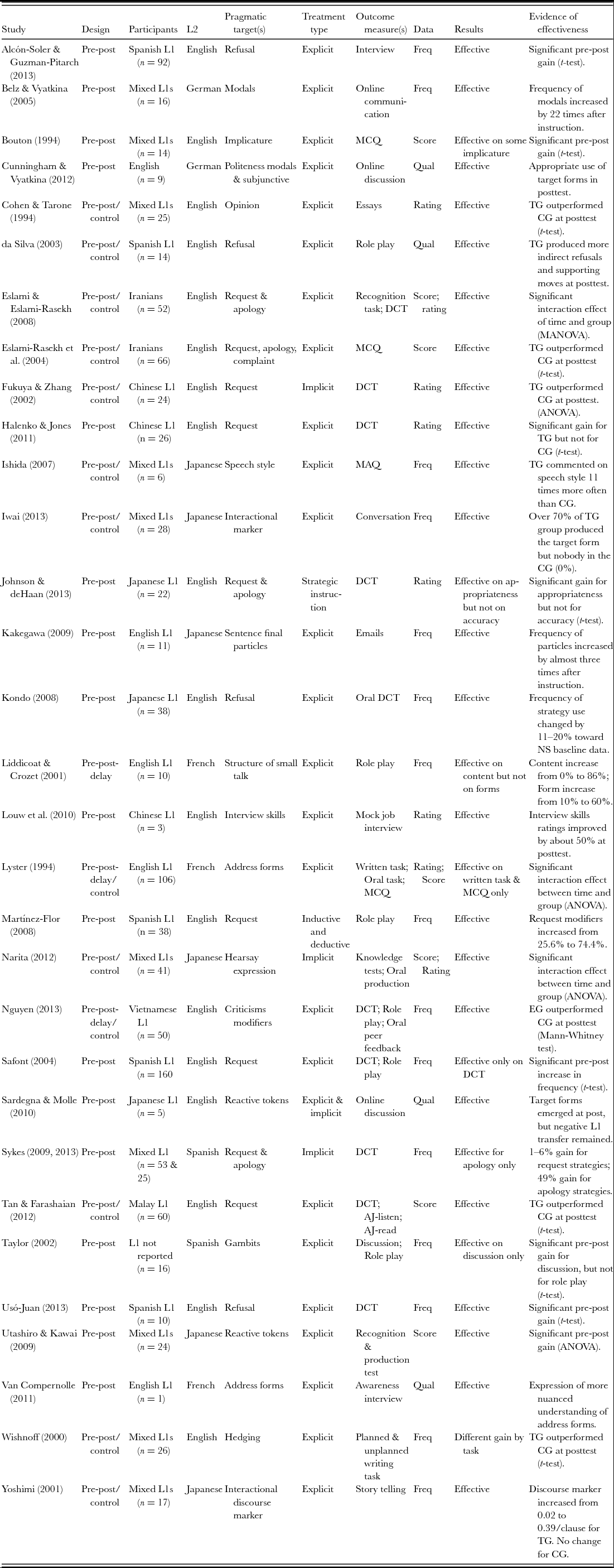
In this paper, I do not intend to simply echo this generalization, but rather evaluate it critically. My goals are to examine the general pattern of the findings that have contributed to the generalization and concurrently to scrutinize the characteristics of the studies that do not fit the pattern. To achieve these goals, I surveyed the focal 58 studies and selected the studies that adopted a single instructional method (e.g., explicit teaching), which I then examined for effectiveness by comparing learners’ performance from pre- to post-instructional phase (studies that compared different instructional methods will be discussed in the next section). I included the studies both with and without a control group. By including a control group that does not receive instruction, we can ensure a stronger design, as any differences between the treatment and control group can be attributed to instruction, not to natural gains that might be found in the control group. Of 58 studies, I identified a total of 31 studies in this category, 12 studies with a control group, and 19 studies without a control group. Table 1 displays features of these studies.
Pre-post comparison studies with or without a control group (k = 31)

Note. MAQ: metapragmatic awareness questionnaire. AJ: appropriateness judgment task. MCQ: multiple-choice questionnaire. DCT: discourse completion test. Explicit: instruction with metapragmatic information. Implicit: instruction without metapragmatic information. Delay: delayed posttest. TG: treatment group. CG: control group. Freq: frequency count of target strategies and forms. Qual: Qualitative analysis of conversations and verbal reports.
I would like to draw special attention to the coding category ‘evidence of effectiveness’ in Table 1. This category was created because of the lack of common metrics for evaluating instructional effects between quantitative and qualitative studies. There are quantitative studies that used inferential statistics (e.g., ANOVA) to test whether there was statistically significant improvement from pre- to post-instruction or the treatment group surpassed the control group at posttest. Other quantitative studies compared the frequency of target pragmatic forms produced by learners between pre- and post-instruction and used the frequency increase as evidence of learning. Qualitative studies analyzed learners’ conversations or discourse and revealed qualitative changes in learners’ use of the target pragmatic features from pre- to posttest. I analyzed the data reported in individual studies carefully to determine the validity of the claims made about the effectiveness of instruction.
As shown in Table 1, target languages vary, but English dominates the group, yielding 18 studies in total. There are a few European languages: two studies targeting Spanish, three targeting French, and two targeting German. Japanese is the only non-Western language in this group, having been addressed in six studies. We also find that the scope of target pragmatic features is skewed toward speech acts (15 out of 31 studies). Request appears to be most popular, having been targeted in eight studies. Besides speech acts, several studies taught discourse organizational skills, such as the structure of small talk (Liddicoat & Clozet Reference Liddicoat, Crozet, Rose and Kasper2001) and job interview skills (Louw, Derwing & Abbott Reference Louw, Derwing and Abbott2010). Eight studies focused on conversation devices, such as sentence final particles (Kakegawa Reference Kakegawa and Taguchi2009), interactional discourse markers (Yoshimi Reference Yoshimi, Rose and Kasper2001; Iwai Reference Iwai, Kondo-Brown, Saito-Abbott, Satsutani, Tsutsui and Wehmeyer2013), gambits (Taylor Reference Taylor2002), hedging (Wishnoff Reference Wishnoff2000), hearsay expressions (Narita Reference Narita2012), and reactive tokens (Utashiro & Kawai Reference Utashiro, Kawai and Taguchi2009; Sardegna & Molle Reference Sardegna and Molle2010). Regarding teaching approaches, 25 studies adopted the explicit teaching method and incorporated direct metapragmatic explanations of target features, while two studies adopted the implicit method, which withholds explanations.Footnote 3 Other studies adopted a combination of different approaches.
In more recent studies, there is a noticeable trend in the use of technology-enhanced (semi) authentic tasks to treat and assess the learning of pragmatics (e.g., Belz & Vyatkina Reference Belz and Vyatkina2005; Kakegawa Reference Kakegawa and Taguchi2009; Cunningham & Vyatkina Reference Cunningham and Vyatkina2012; Johnson & deHaan Reference Johnson and deHaan2013). These studies used telecollaboration, wiki, video conferring, online discussion, and virtual environment for teaching and assessing pragmatics. For instance, Cunningham & Vyatkina (Reference Cunningham and Vyatkina2012) implemented direct teaching on polite modal verbs and subjunctive mood in the German in a US university. The instruction consisted of explicit metapragmatic information on the formal register, which was provided via worksheet and web conferences with German-speaking professionals using Adobe Connect Pro.
3.1 Instructional effects, general patterns
By closely analyzing the focal 31 studies, I have found a clear benefit of instruction over non-instructional contexts. Essentially all 31 studies showed significant gains in L2 learners’ knowledge and use of learned pragmatic forms from pre- to post-instruction (although some studies revealed mixed findings, which I will discuss later).Footnote 4 In the studies that used a control group, the instructed group outperformed the control group in pragmatic development. This finding is noteworthy, considering that these 31 studies represent diverse L1 and L2 groups, pragmatic targets, and measures of learning. Assessment measures range from structured receptive skill tasks (e.g., appropriateness rating, multiple-choice knowledge test, and recognition task), to structured production tasks (e.g., DCTFootnote 5, role play), and to more performance-oriented, open-ended authentic tasks, such as face-to-face and online communication. The consistent instructional benefits observed across modalities and task characteristics strongly support the teachability of pragmatics. Teaching leads to increased pragmatic knowledge – this outcome seems to be generalizable across languages, instructional targets, and outcome measures.
It is worth noting that several studies that only employed implicit teaching methods (Fukuya & Zhang Reference Fukuya and Zhang2002; Narita Reference Narita2012) produced significant effects just like studies that used explicit methods. While the explicit method may produce larger effect sizes than the implicit method (see Jeon & Kaya Reference Jeon, Kaya, John and Ortega2006), the implicit approach can be just as effective in causing changes in learners’ pragmatic systems, as long as the approach involves activities that draw learners’ attention to focal pragmatic forms and form-function-context mappings.
Fukuya & Zhang (Reference Fukuya and Zhang2002) examined the effect of recasts (corrective feedback) on English as a foreign language (EFL) learners’ acquisition of the speech act of requests. Participants role played a scenario that featured request making and received a recast from their instructor when they produced non-target-like request forms. In this treatment, learners were not only made aware that their request forms were inappropriate, but also had an opportunity to compare their forms with more target-like request forms. Because the recasts occurred through meaningful communication, learners were able to establish a connection among the target pragmalinguistic form, the function it expressed, and the context of its occurrence with ease. The learner strengthened this connection by repeatedly activating it via recast, essentially leading to learning, as found in the post-instructional gains in accuracy and appropriateness of the request forms in the DCT task.
Narita (Reference Narita2012), on the other hand, used consciousness-raising tasks to draw L2 Japanese learners’ attention to hearsay evidential markers (e.g., the expression rashii meaning ‘I heard that’). These markers convey the speaker's epistemic stance by indicating the speaker's certainty about the content and source of the information. Treatment sessions focused on two levels: noticing and understanding of the evidential markers. Learners compared the hearsay reports in English and Japanese and detected differences (noticing). They also explained reasons for the differences (understanding). Narita measured the learning outcome with two knowledge tests and one oral production test that assessed learners’ ability to use hearsay expressions. The treatment groups outperformed the control group on both immediate and delayed posttest. Through subsequent analysis, Narita revealed no significant difference between the learners who demonstrated noticing of the target forms only and the learners who showed understanding of the forms – although the understanding-level group performed slightly better on the posttests.
These findings reiterate that learning pragmatics is possible without the provision of explicit metapragmatic explanation. The findings lend support to Schmidt's (Reference Schmidt, Kasper and Blum-Kulka1993, Reference Schmidt and Robinson2001) noticing hypothesis, which claims that attention is necessary for input to become noticed and subsequently internalized as intake. In both studies, instruction assisted learners in becoming aware of the target form-function-context mappings and converting them into explicit knowledge. Learners had plenty of opportunities to engage in the processing of the mappings by comparing L1 and L2-based input or comparing learners’ own forms and target-like pragmalinguistic forms. These processing practices lead to learning, with or without direct explanation of the mappings.
3.2 Assessment tasks and instructional effects
The present review also demonstrates that the effect of instruction is not all-encompassing across different pragmatic targets and outcome measures. My review yielded mixed findings for several studies that taught multiple pragmatic features or used multiple assessment measures (see Table 1). Of 31 studies, nine studies used two or more outcome measures, four of which found significant effects on some measures but not on others (Lyster Reference Lyster1994; Wishnoff Reference Wishnoff2000; Taylor Reference Taylor2002; Safont Reference Safont2004). For instance, Safont (Reference Safont2004) examined the effect of explicit instruction (direct explanation of forms that is followed by oral practice) on the acquisition of English requests. Posttest results from written DCT data revealed significant changes in learners’ use of request-making strategies in all strategy types. Role play data, on the other hand, showed only a partial change in learners’ strategy use.
These findings suggest an interaction between instructional effects and assessment task characteristics. The effect of instruction appeared more strongly on the task that did not have much processing demand. Given the written nature of a DCT task, participants typically have more time to plan their responses than in a role play task that requires spontaneous face-to-face interaction while following the specifics of a prompt. When participating in role play, learners must remember situational descriptions and perform the assigned roles using the pragmalinguistic forms that they have just learned. The nature of role play is additionally taxing because it requires joint construction of discourse. Learners must align their behavior to the projection of the unfolding discourse, dictated by their interlocutor's action, in order to shape their contribution to the conversation. These multiple levels of processing make the role play task more demanding to perform, consequently affecting the degree of instructional effect. DCT and role play tasks might be measuring instructional outcomes at two different levels. Particularly when untimed, a DCT task might be tapping into learners’ competence or knowledge of pragmalinguistic forms. A role play, on the other hand, could be a more accurate representation of learners’ performance, determining whether learners can use their pragmalinguistic knowledge to accomplish higher-level objectives, such as negotiation, mutual understanding, and interactional goals. That is, pragmatic knowledge gained from instruction must be robust to become perceptible in the role play task, since the learner is being called on to use multiple skills and strategies to complete the task.
We can infer a similar influence of processing demand in Lyster's (Reference Lyster1994) study that examined the effect of direct teaching on L2 French learners’ acquisition of address forms (tu and vous). Experimental groups outperformed the control groups on the written production task and multiple-choice test, but not on the oral production task, which asked learners to address a person illustrated in pictures that required the use of different levels of formality. Wishnoff (Reference Wishnoff2000) also found differential gain between two assessment tasks. He used planned and unplanned writing tasks (essays and online discussions) to measure L2 English learners’ use of hedging in academic writing (e.g., modifiers such as probably). While the mean frequency of hedging increased by over five times in the planned task after the instruction, the degree of increase was only 1.4 times in the unplanned task, reflecting the processing demand coming from online production. Similarly, in Nguyen's (Reference Nguyen2013) study that taught constructive criticism in academic writing classes, the treatment group surpassed the control group in all three measures (DCT, role play, and oral peer feedback), but effect size was different across these measures. The results of DCT and role play revealed a greater effect (Mann-Whitney r = 0.67 for DCT and r = 0.71 for role play) than that of peer oral feedback (Mann-Whitney r = 0.50), which required learners to critique each other's essays on the spot.
In addition to the processing demand, my review suggests that the degree of correspondence between the instructional task and the outcome task mediates the instructional effect. Taylor (Reference Taylor2002) examined whether gambits can be effectively taught in L2 Spanish. Learners received explicit instruction on a list of gambits from video clips. After the learners were briefed, they practiced the gambits in role plays and in a discussion task, where they presented arguments and responded to their peers’ arguments by using gambits. The learners were then divided into two groups to complete different tasks as a measure of their learning. One group engaged in a discussion about cultural differences between the US and Latin America. The other group performed a role-enactment task in a customer-clerk situation. Taylor noted gains in the discussion group, both in terms of the quantity and variety of gambits produced, while the role-enactment group showed no gain.
The author attributed the findings to the transactional nature of the role-enactment task requiring students to accomplish a series of goals, which interfered with the use of gambits. However, I interpret the findings from the degree of correspondence between the treatment task and test task characteristics. According to DeKeyser (Reference DeKeyser, VanPatten and Williams2007), transfer of skill from a learned task to a novel one is likely to occur if the cognitive operations involved in the novel task resemble those in the learned task. This concept, referred to as ‘transfer-appropriate processing’ (TAP), has been used as a design feature in previous L2 pragmatics studies (see S. Li Reference Li2012 in the next section). In the context of Taylor's findings, it is possible that significant learning was found in the discussion but not in the role-enactment task because the former observed the TAP, while the latter did not. The learners practiced the gambits in discussion by responding to each other's arguments. Then they were tested on the same discussion task after the instruction. Although the discussion topics were different, the target language skill, namely presenting and reacting to an argument, was shared between the two task situations, which probably facilitated the transfer of knowledge to a test task situation. The role-enactment task, on the other hand, did not follow the TAP principle. By misaligning the target language use behaviors between the treatment and test tasks, learners were probably not able to demonstrate their knowledge in a new task situation.
Together, these findings add to the generalization drawn from the previous studies regarding the superiority of instruction over non-instruction. Instruction is no doubt effective, but its effects surface differently across different assessment measures. When one assesses learning through a task that elicits a smaller processing load or a task that taps similar skill areas to those in a treatment task, evidence of learning may appear greater.
3.3 Pragmatic targets and instructional effects
So far, I have presented mixed findings from studies that used multiple assessment tasks, concentrating on the interaction between assessment task characteristics and instructional effects. In this section, I will focus my review on another potential interaction: the interaction between pragmatic targets and instructional effects, based on the findings from four studies: Bouton (Reference Bouton, Bouton and Kachru1994), Liddicoat & Crozet (Reference Liddicoat, Crozet, Rose and Kasper2001), Sykes (Reference Sykes, Lomika and Lord2009, Reference Sykes, Taguchi and Sykes2013), and Johnson & deHaan (Reference Johnson and deHaan2013). Of 31 studies, these four studies taught multiple pragmatic targets to a single group of learners, or assessed learning on multiple aspects of pragmatic competence, and revealed mixed intervention effects across targets. There are other studies that taught more than one pragmatic feature, but they did not report findings separately (Z. Eslami-Rasekh, A. Eslami-Rasekh & Fatahi Reference Eslami-Rasekh, Eslami-Rasekh and Fatahi2004; Eslami & Eslami-Rasekh Reference Eslami, Eslami-Rasekh, Alcón-Soler and Martínez-Flor2008; Louw, Derwing & Abbott Reference Louw, Derwing and Abbott2010), or present the difference clearly (Cunningham & Vyatkina Reference Cunningham and Vyatkina2012).
When one receives inconclusive results of instructional effects across different pragmatic targets, it seems that, given the same learner group, teaching approach, and assessment methods, some pragmatic features are more amenable to instruction than others. The question then is where this variation comes from. The difficulty of target pragmatic features (conjoined with learners’ instructional readiness indicated in their proficiency) is no doubt one of the candidate factors, but a question still remains as to what constitutes pragmatic difficulty. In previous studies in grammar acquisition, researchers operationalized difficulty based on the property of the form and environment surrounding the form, drawing on features such as complexity of a grammatical form, saliency and frequency of the form in input, and redundancy of grammatical information in a sentence (N. Ellis & Collins Reference Ellis and Collins2009). However, pragmatic difficulty is different from grammatical difficulty because of the very nature of the construct, which involves a wide range of elements such as forms, functions, contexts, conventions of practice, norms of interaction, and social relationships. Because pragmatic rules reflect a constellation of these elements, we can understand difficulty and complexity within the rules only through a reference to multiple levels, including linguistic and sociocultural levels. In grammar, saliency has been operationalized based on the phonological environment of a form (e.g., stress and existence of vowel) (N. Ellis & Collins Reference Ellis and Collins2009), but in pragmatics, saliency could go beyond form-internal characteristics and extend to social and interpersonal features attached to the forms. In addition, saliency could be a personal matter. Learners might attach pragmatic saliency to surprise or emotional arousal that comes from experiencing pragmatic failure or discovering unique cultural practices related to the pragmatic rule. While pragmatic difficulty is a basis for empirical inquiry, there is little systematic research investigating the property of pragmatic features and their learnability in instructional studies. Given the paucity of research, I do not intend to make any definite conclusion on this issue. What follows are my tentative interpretations of the small set of findings available in this review, which I expect will be subject to future empirical investigation.
Findings from Bouton (Reference Bouton, Bouton and Kachru1994), Liddicoat & Clozet (Reference Liddicoat, Crozet, Rose and Kasper2001), and Johnson & deHaan (Reference Johnson and deHaan2013) suggest that opaqueness of the target pragmatic rules may affect learnability of the rules. Bouton (Reference Bouton, Bouton and Kachru1994) investigated the effect of explicit instruction on comprehension of conversational implicature. Bouton found that English as a second language (ESL) learners’ comprehension of implicature remained nonnative-like even after more than four years living in the target country. The learners particularly struggled with formulaic implicature such as Pope implicature (e.g., responding to a question ‘Did you finish your homework?’ with ‘Is the Pope Catholic?’). They did, however, become native-like over time with idiosyncratic implicature (e.g., relevance implicature that draws on general inferential skills to comprehend underlying meaning). Interestingly, these longitudinal findings formed a sharp contrast with instructional findings. When learners were taught how to interpret formulaic implicature, their scores increased to almost a perfect level across items, but there was no score gain for idiosyncratic implicature on average.
Bouton attributed these contrasting findings to the different degrees of opaqueness in these two types of implicature. Idiosyncratic implicature is less opaque because meaning is not attached to a single linguistic expression, nor is it stable across these instances of language use. The idiosyncratic nature of this implicature type makes teaching it difficult, as comprehension skills developed in relation to one idiosyncratic implicature do not transfer to another item. Learners acquire this implicature over time by exposing themselves to the implicature while interacting in the target community.
In contrast, formulaic implicature has a clear structural formula that one can follow to interpret meaning. Take the Pope implicature as an example. A person responds to one yes/no question by asking another to which the answer is obvious. Once learners are taught the structural relationship between the two questions, they will be able to comprehend the Pope implicature. Their knowledge can transfer to a novel Pope implicature item that follows the same structural formula. According to Bouton's findings, learners’ naturalistic development with this type of implicature was slow because the formula was new and culture-specific to the ESL learners. Once instruction made learners recognize the underlying mechanisms of Pope implicature, the speed of their development increased.
In Liddicoat & Clozet's (Reference Liddicoat, Crozet, Rose and Kasper2001) study, on the other hand, learners were explicitly taught six rules for small talk in French. The rules had two aspects: content of the small talk (e.g., strategies of the talk such as dramatizing what you have done) and form of the small talk (e.g., features used to show involvement in the talk, such as overlap and feedback). A positive effect of instruction appeared in the immediate posttest on all content features. However, only two learners became able to use overlap in their small talk. The authors explained that content features were easier to learn because, given their macro-level aspects, they are integrated into talk and learners can easily notice them. Features that signal engagement (i.e., overlap) were difficult to integrate in small talk because they are micro-level conversation mechanisms that are difficult to extract from input. They also require automaticity and monitoring skills to implement.
Johnson & deHaan's (Reference Johnson and deHaan2013) study also revealed that learners picked up macro-level semantic strategies more easily than micro-level syntactic accuracy. Drawing on the model of Strategic Interaction (Di Pietro Reference Di Pietro1987), Johnson & deHaan implemented direct instruction of request and apology in an online wiki space, which provided learners with opportunities for reflection, peer feedback, and explicit feedback. They found positive effects of instruction on the appropriateness of speech acts in five out of six DCT items. However, they found an opposite trend for the accuracy of speech acts; instruction was effective in only one DCT item. Because instruction focused both on accuracy and appropriateness, the reversed pattern of findings indicate that the appropriateness aspect, as revealed by the use of politeness strategies and appropriate discourse moves, was easier to learn than the precise syntax of speech act forms.
On the other hand, findings from Sykes's (Reference Sykes, Lomika and Lord2009, Reference Sykes, Taguchi and Sykes2013) studies suggest that the structural and functional simplicity of target pragmalinguistic forms could facilitate learning. Sykes created a three-dimensional space that emulated a Spanish-speaking world where learners engaged in goal-directed tasks with computer-generated avatars and practiced request and apology. Through a comparison of DCT data from pre- to posttest, Sykes revealed only a negligible change in learners’ choice of request strategies. In contrast, there was a marked increase in the target-like use of hearer-oriented apology strategies (13% at pretest and 62% at posttest). However, similar to the findings from the request speech act, external modifications of apology showed very little gain. These confounding findings are likely to result from the formulaic nature of the apology head act. The dramatic shift from the speaker-oriented strategies (e.g., ¡Lo siento!) to the hearer-oriented strategies (e.g., Perdóname) occurred probably because these forms were salient chunks. Learners were able to acquire a new apology formula at the lexical level because of the simplicity of the formula. They were unable to add more complex linguistic strategies at the syntactic level, as indicated by their minimal changes in requests and external modifications in apologies, particularly when in-game activities were self-guided and did not provide arrangement for systematic focus-on-form.
In summary, available findings suggest that the properties of pragmatic features affect instructional outcomes. Linguistic simplicity and opaqueness of the pragmatic rule (rules having a salient structure or system that one can extract, explain, and teach) seem to be aspects of pragmatic features that are more amenable to instruction.
4. What methods are most effective in learning pragmatics?
In this section, I will move on from the issue of teachability to address the efficacy of pragmatic instruction, asking what methods could best enhance the learning of pragmatics. The previous section presented 31 out of 58 focal studies that examined the effect of a single teaching method. The remaining 27 studies compared several teaching methods as regards learning outcomes, which I bring together in this section to provide a comprehensive summation. Different from the studies reviewed in the last section, most studies in this section used inferential statistics to reveal an advantage of one instructional method over another. House (Reference House1996) was the only study in this group that did not use inferential statistics and instead compared frequency of target pragmatic features produced by two treatment groups.
Many of the previous studies operationalized teaching methods by adopting Schmidt's (Reference Schmidt, Kasper and Blum-Kulka1993, Reference Schmidt and Robinson2001) noticing hypothesis. The noticing hypothesis capitalizes on learners’ attention to linguistic forms, their functions, and relevant contextual features as a necessary condition for pragmatic input to become intake. Explicit and implicit teaching enables learners to increase their awareness of the target form-function-context mappings and subsequently internalize them. Following Kasper's (Reference Kasper, Rose and Kasper2001) definition, the explicit method typically involves direct metapragmatic explanation followed by focused practice. The implicit method withholds metapragmatic explanation but tries to develop learners’ implicit understanding of the target features by using input flood, input enhancement, consciousness-raising tasks, and implicit feedback (e.g., recasts). Previous studies generally confirmed the superiority of the explicit over the implicit method (Jeon & Kaya Reference Jeon, Kaya, John and Ortega2006; Takahashi Reference Takahashi and Trosborg2010a).
Unlike previous reviews that compared studies as a dichotomy between the explicit and the implicit approach, my paper reviews instructional studies as a whole and conducts a bottom-up analysis of effective teaching methods. I grouped the focal 27 studies according to three types of findings: (1) studies that revealed a clear advantage of one method over another; (2) studies that revealed no difference between methods; and (3) studies that revealed mixed findings. Then, I analyzed the studies in each category for common instructional features – whether the studies share any discernible characteristics in terms of teaching methods, materials, and activities used. I admit that many of the studies in all three categories essentially fall into the explicit-implicit paradigm (16 out of 27 studies). However, by steering clear of these two labels, my approach accounts for more recent studies that have extended beyond this explicit vs. implicit comparison, revealing characteristics of other instructional conditions that were found to be more effective.
This bottom-up approach also addresses the problem of inconsistencies in the definitions of explicit and implicit method, which are often noted in the previous review articles (e.g., Takahashi Reference Takahashi and Trosborg2010a). Although the availability of metapragmatic information is the key factor that distinguishes between the two methods, actual operationalization of the methods varies across studies. For example, explicit treatments often involve more than just metapragmatic explanation, and include implicit activities such as video viewing, dialogue analysis, and cross-linguistic comparisons. As a result, we do not know which parts of explicit instruction produced positive outcomes. On the other hand, some implicit treatments simply use input exposure, while others use input enhancement techniques by manipulating the nature of the input. Other studies use consciousness-raising activities to draw learners’ attention to the target features. Indeed, the implicit condition exhibits a continuum from being completely implicit (input exposure) to the more explicit end of implicit treatment (input enhancement and consciousness-raising) (see also Takahashi 2011a). Given this diversity in the operationalization of treatments, directly comparing explicit and implicit interventions may not be very meaningful. A more profitable approach would be to move away from the umbrella terms of ‘explicit’ and ‘implicit’, and conduct a bottom-up categorical analysis by pooling treatment methods that produced a clear advantage over the competing method(s), analyzing their characteristics, and compiling common features of effective treatments. This paper attempts this approach.
4.1 Comparisons of instructional methods, general patterns
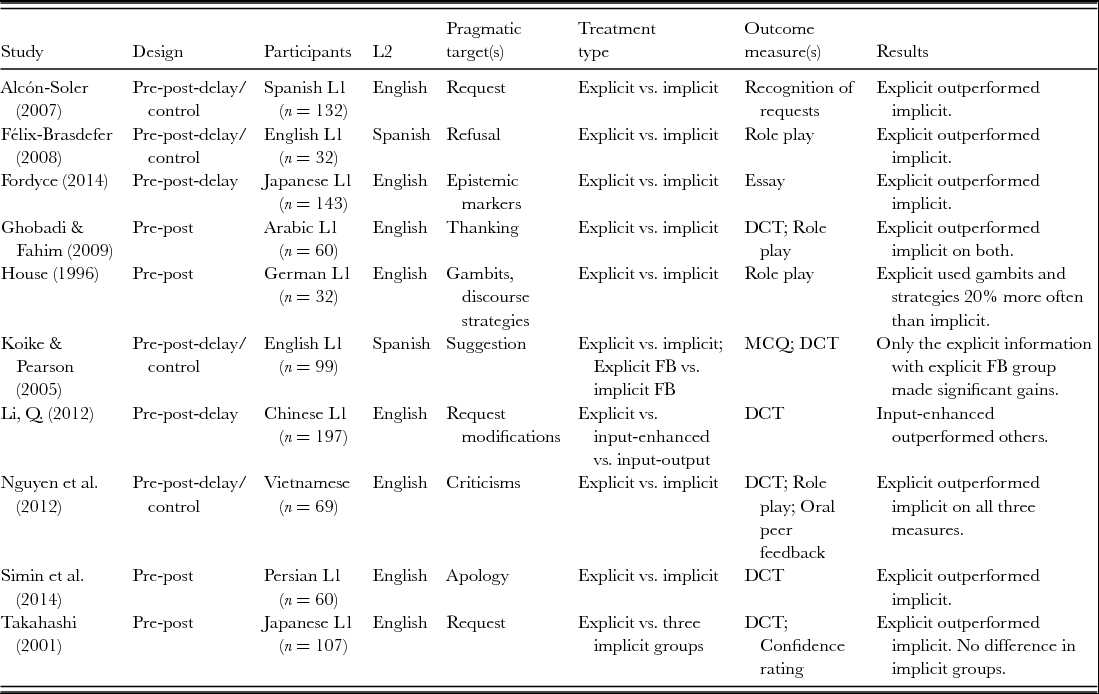
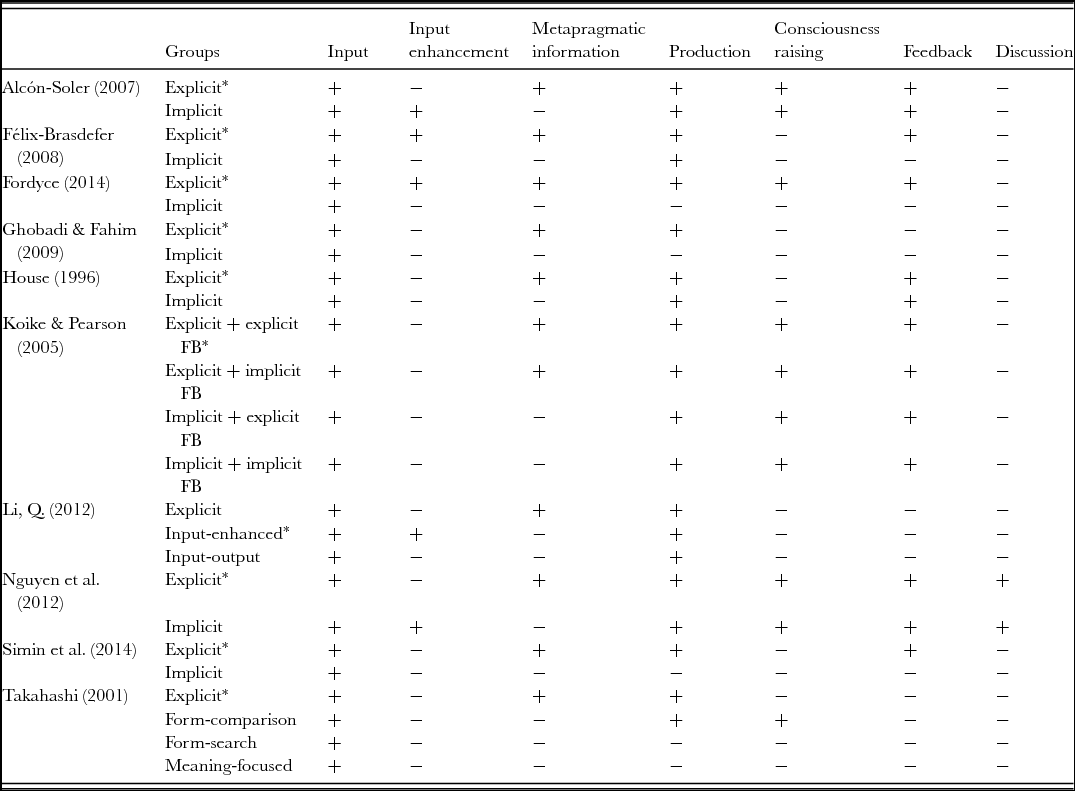
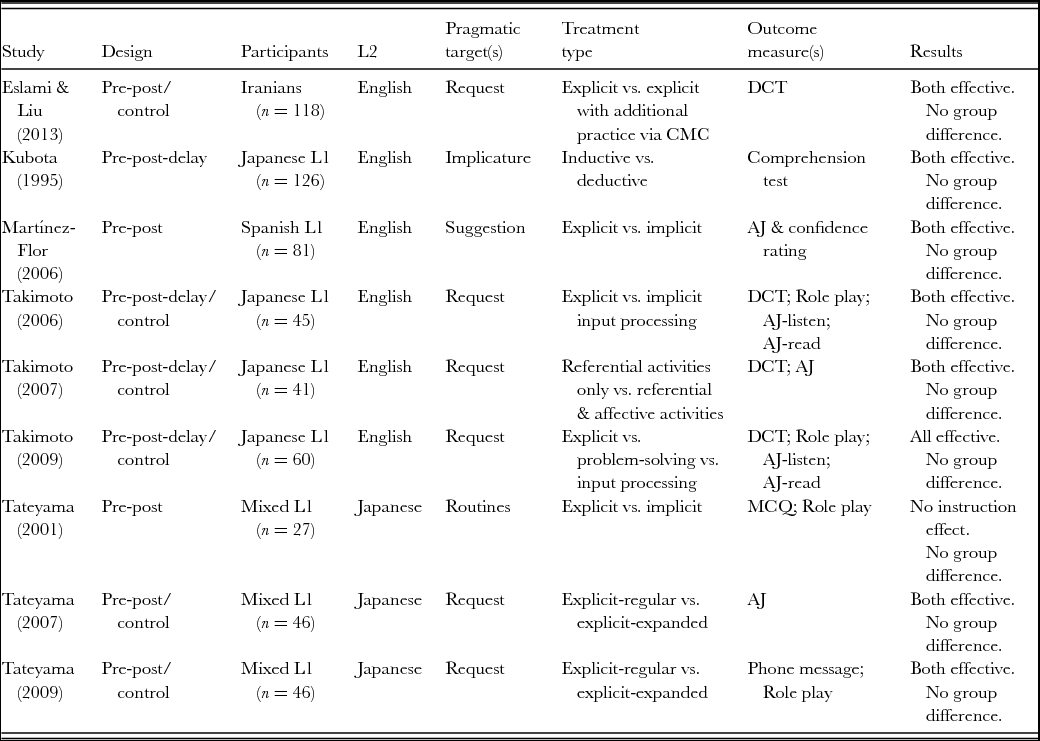
Of 27 studies that compared the effects of two or more instructional methods, ten studies revealed a significant difference between the methods compared (Table 2). Nine studies revealed no difference between the methods (Table 4). The treatment features of these studies are summarized in Tables 3 and 5. The symbol + in Tables 3 and 5 indicates that the feature was present in the treatment, while the symbol – indicates absence of the feature. The remaining eight studies had mixed findings depending on the types of assessment measures used (see Table 6; see Table 7 for treatment features). These eight studies are discussed in the next section, but I will first discuss the studies presented in Tables 2 and 4.
Studies that revealed the effectiveness of one method over another (k = 10)
Note. MCQ: multiple-choice questionnaire. DCT: discourse completion test. Explicit: instruction with metapragmatic information. Implicit: instruction without metapragmatic information. FB: feedback. Delay: delayed posttest.
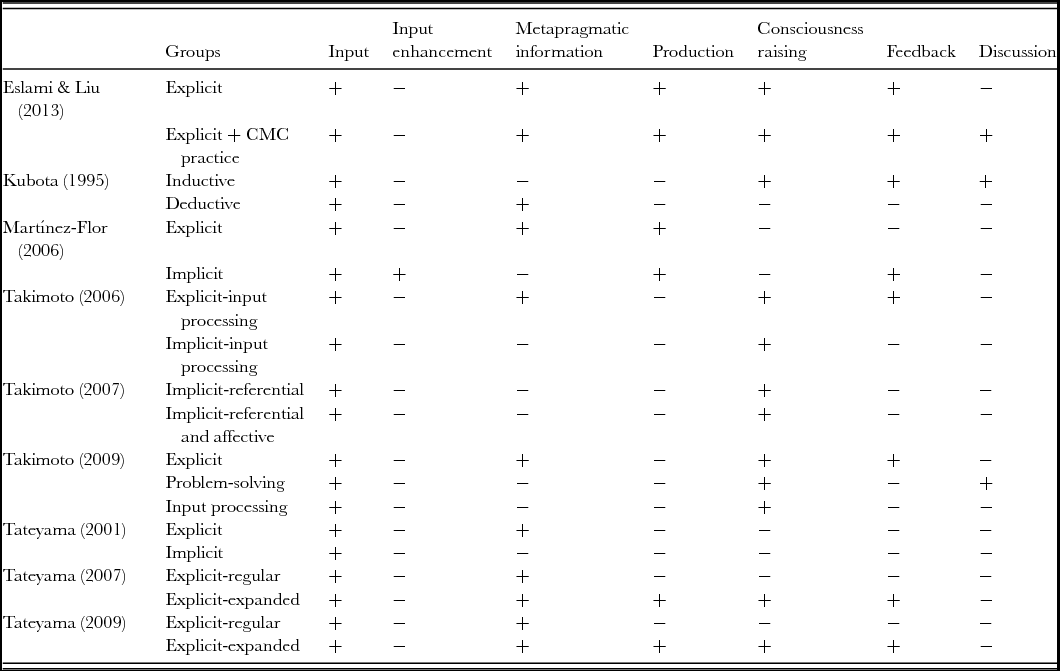
Treatment features of the studies that revealed the effectiveness of one method over another
Note. * The method that was found to be more effective than the other. Input: exposure to input (e.g., dialogues, texts) that contains target pragmatic forms. Input enhancement: techniques used to draw learners’ attention to input by highlighting the text or using bald face (limited to the features of input). Metapragmatic information: explicit explanation about pragmatic rules. Production: tasks that elicit production of target pragmatic forms (e.g., DCT, role play). Consciousness-raising: tasks that draw learners’ attention to target pragmatic features without explicit metapragmatic information. This includes recognition tasks (structured, systematic receptive skill-based exercises that engage learners with recognition of pragmatic features). Feedback: feedback on learners’ use or understanding of target pragmatic features. Discussion: metapragmatic discussion of target pragmatic features in pair or group.
Studies that revealed no difference between teaching methods (k = 9)
Treatment features of the studies that revealed no difference between methods
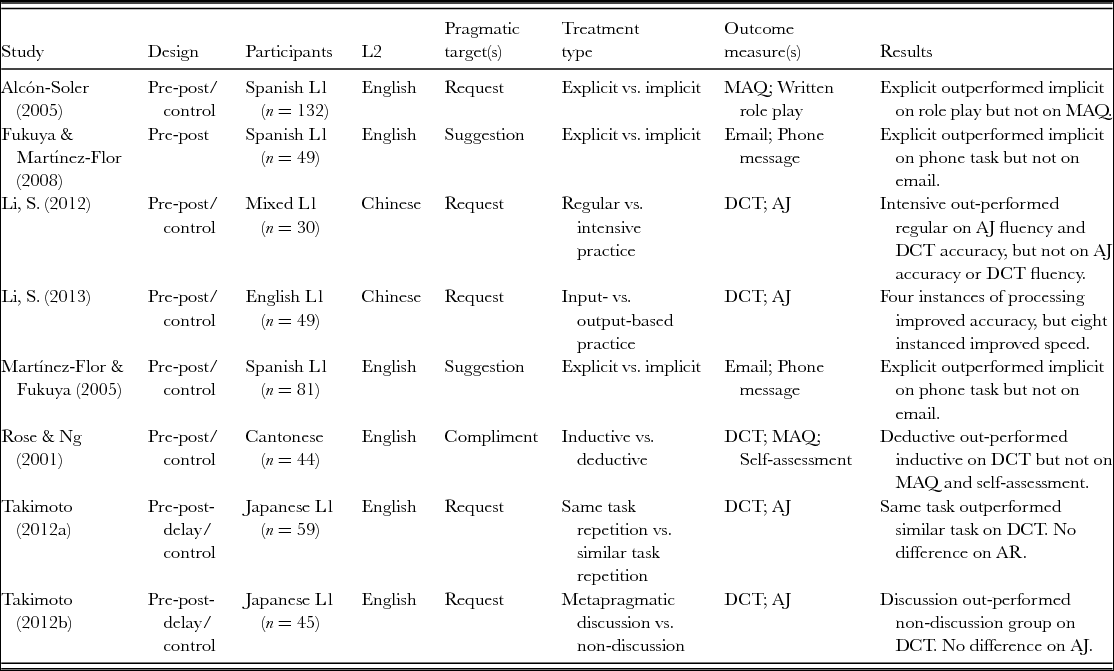
Studies that compared different methods and produced mixed findings (k = 8)
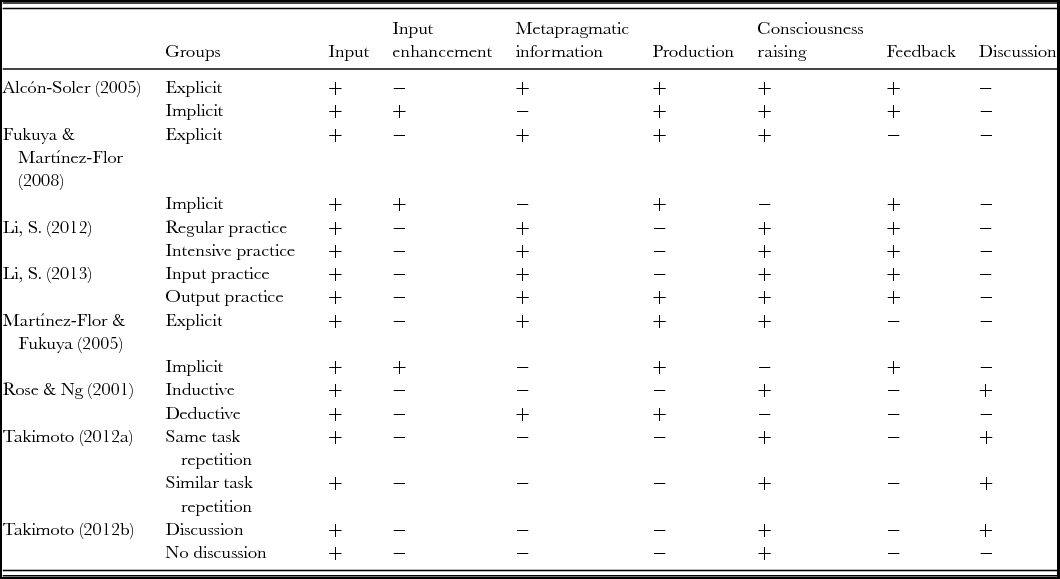
Treatment features of the studies that compared different methods and produced mixed findings
Comparison of the focal studies reveals two features that are common across ‘more effective’ treatment conditions – provision of metapragmatic explanation and production practice (see Tables 2 and 3). There is one exception, however. Q. Li's (Reference Li2012) study found an advantage to implicit over explicit instruction. I will come back to this study later, but first, I will discuss the characteristics of the other nine studies.
All nine studies operationalized explicit teaching as a treatment that involves direct information on pragmalinguistic and sociopragmatic features. This method essentially won over its implicit counterpart, which did not involve overt explanation of target features. Typically, in the studies using the explicit method, researchers explained pragmatic features through lectures and handouts by using samples drawn from video clips or conversation scripts. Besides metapragmatic information, these nine studies share another treatment feature – the production of target pragmatic forms. Production tasks used in these studies were wide-ranging, including a structured written task such as translation (Takahashi Reference Takahashi, Rose and Kasper2001), a DCT (Koike & Pearson Reference Koike and Pearson2005; Alcón-Soler Reference Alcón-Soler and Mayo2007), a closed role-play task in which learners acted out a situation featuring the target speech act based on a prompt (House Reference House1996; Félix-Brasdefer Reference Félix-Brasdefer2008; Ghobadi & Fahim Reference Ghobadi and Fahim2009), an open-ended, authentic task such as essay or letter writing (Fordyce Reference Fordyce2014; Simin et al. Reference Simin, Eslami, Eslami-Rasekh and Ketabi2014), and peer feedback on essays (Nguyen, T. H. Pham & M. H. Pham Reference Nguyen, Pham and Pham2012).Footnote 6
Based on my review, I find there to be a consistency in the benefit of metapragmatic explanation combined with production practice across different treatment lengths (2.5–26 hours) and different outcome measures (e.g., spoken vs. written tasks; planned vs. spontaneous tasks). This realization suggests the generalizability of the findings. In addition, the effects were maintained at a delayed posttest, pointing to the robustness of this approach. Of nine studies, five studies used a delayed posttest, and in four of these cases retention of learned pragmatic knowledge was confirmed (Alcón-Soler Reference Alcón-Soler and Mayo2007; Félix-Brasdefer Reference Félix-Brasdefer2008; Nguyen et al. Reference Nguyen, Pham and Pham2012; Fordyce Reference Fordyce2014).
The superiority of this teaching approach becomes even clearer when we consider these findings in light of Tateyama's (Reference Tateyama and Bradford-Watts2007, Reference Tateyama and Taguchi2009) findings that compared two explicit conditions, explicit-regular and explicit-expanded, on the acquisition of requests by learners of Japanese (Table 4). The regular group received explicit explanation on Japanese requests followed by communicative practice. The expanded group received the same regular instruction and additional activities (e.g., watching videos, analyzing request-making conversations). Learning was measured by a telephone message task, a role play, and an appropriateness-rating task. Both groups gained significantly after the instruction, but no between-group difference was found in any of the three measures. The findings indicate the significance of the explicit method. Metapragmatic information, followed by communicative practice, was powerful enough to boost learning of the target forms. After that, any extra practice given through implicit materials did not really matter. A minimum amount of explicit instruction was as effective as the more prolonged version of the instruction, regardless of the types of outcome measures. Eslami & Liu's (Reference Eslami and Liu2013) study also lends support to this claim. They found no difference between two explicit conditions: the group who received direct instruction on English requests and the group who received the same instruction with additional request-making practice via computer-mediated communication (CMC).
The positive effect of metapragmatic information consolidated by means of production practice reinforces Schmidt's (Reference Schmidt, Kasper and Blum-Kulka1993, Reference Schmidt and Robinson2001) noticing hypothesis mentioned in the previous section. Explicit information makes the target features most salient. Because learners are physically made aware of the target forms, there is little ambiguity about their level of noticing, as long as they are paying attention during the instruction. Through repeated production of the forms, by creating utterances or discourse using the target forms, learners begin to understand them. These explicit methods also closely correspond to the five characteristics of the explicit form-focused instruction approach, as specified by R. Ellis (Reference Ellis2005), which (1) directs learners’ attention to target forms; (2) is planned and obtrusive; (3) presents target forms in isolation; (4) involves the use of metalanguage; and (5) includes controlled practice of forms.
Different from explicit teaching, implicit teaching is found to be less effective. Upon close examination of the treatment features of the underperforming implicit condition, I have determined the aspects that are particularly unsuccessful. One such aspect is simple input exposure (Table 3). In House (Reference House1996) and Koike & Pearson (Reference Koike and Pearson2005), the implicit group received conversation excerpts with target features embedded.Footnote 7 The implicit condition (control group) in Félix-Brasdefer's (Reference Félix-Brasdefer2008) study had learners observe native speaker refusals and role-play situations. In Simin et al. (Reference Simin, Eslami, Eslami-Rasekh and Ketabi2014), the implicit group produced apologies in English, but did not receive feedback or explanation. In Ghobadi & Fahim (Reference Ghobadi and Fahim2009), the implicit group read about thanking behaviors in America, with no follow-up on the forms of thanking. Similarly, Fordyce (Reference Fordyce2014) exposed learners to epistemic stance markers through authentic texts. Alcón-Soler's (Reference Alcón-Soler and Mayo2007) study used input enhancement by exposing learners to film excerpts with target request forms and social factors highlighted in bold. Nguyen et al. (Reference Nguyen, Pham and Pham2012) also used enhancement by providing excerpts of native speakers’ critiques with target forms in bold type. In all of these studies, implicit treatments fell short of explicit treatments in the gain size of learning.
These findings indicate that input exposure alone cannot surpass the level of learning produced by the explicit instruction, even when the input is made salient through enhancement techniques. When there is no metapragmatic information, implicit treatments must supply other activities that ensure learners’ attention to pragmatic features and that facilitate processing of the features. Takahashi's (Reference Takahashi, Rose and Kasper2001) study offers a clue for such implicit treatments (Table 2). In teaching requests in English, she compared the explicit condition with three different implicit conditions: form-comparison, form-search, and meaning-focused. The form-comparison group compared their requests with native speakers’ requests in conversation transcripts, while the form-search group simply pointed out any native-like language use in the transcripts. The meaning-focused group read the same transcripts and answered comprehension questions. DCT data showed that the explicit group outperformed all implicit groups. There was no difference among the three implicit conditions, but a tendency in favor of the form-comparison group emerged. This group produced more target forms than the other two conditions.
Indeed, Takahashi's (Reference Takahashi2005) follow-up study found that more learners in the form-comparison group reported noticing the target forms than the form-search group. In addition, the learners who showed higher awareness of the forms tended to produce the target forms. These findings reiterate that a high level of awareness is crucial for the noticing and subsequent intake of the target pragmatic forms. The form-comparison condition assured learners of awareness and noticing of the forms, and provided space for learners to process the forms. Under this condition, learners analyzed target forms, compared them with their own forms, induced reasoning behind the differences, and tested hypotheses regarding their understanding. Although this condition lacked metapragmatic information that could consolidate understanding, it still assisted learners’ understanding by having them process the input.
The effectiveness of these implicit treatment characteristics becomes obvious when we compare the findings with studies that revealed no significant difference between the explicit and implicit approach. Five studies fall in this category: Kubota (Reference Kubota1995), Martínez-Flor (Reference Martínez-Flor, Bardovi-Harlig, Félix-Brasdefer and Omar2006) and Takimoto (Reference Takimoto2006, Reference Takimoto2007, Reference Takimoto2009) (see Tables 4 and 5). These studies showed that the explicit method is not superior – that the implicit method can be as good as the explicit method.
For example, Martínez-Flor (Reference Martínez-Flor, Bardovi-Harlig, Félix-Brasdefer and Omar2006) used input enhancement combined with recasts. The explicit group watched video clips about giving a suggestion, and received metapragmatic explanation and production practice. The implicit group watched the same videos with target forms and contextual factors in bold, and then role played situations in front of the class for which the teacher provided recasts. Results showed that the implicit treatment was as effective as its explicit counterpart on students’ confidence level when assessing appropriateness of suggestions. This is probably because the recast used in the treatment made learners process the target suggestion formulae. By juxtaposing the learners’ forms with native-like forms, the contrast of the forms became salient. Learners’ awareness was boosted through the rising intonation that accompanied the forms. All of these occurred in a contextualized manner (role playing a situation), which enabled learners to process both pragmalinguistic forms and sociopragmatics factors in one setting.
Takimoto's (Reference Takimoto2006, Reference Takimoto2009) findings also suggest that attention and processing are crucial determinants of an effective implicit treatment. Takimoto (Reference Takimoto2006) compared two conditions. One was the implicit condition where learners completed two input-processing tasks. This condition was compared with the explicit condition in which learners completed the same input-processing tasks but received explicit feedback. Both groups surpassed the control group, and there was no difference between the treatment groups. In a subsequent study, Takimoto (Reference Takimoto2007) compared the group receiving the referential-oriented task only and the group receiving both the referential- and affective-oriented tasks. Again, no difference was found between the treatment groups, suggesting that the referential-oriented task was sufficient, without a provision of additional practice (the affective-oriented task).
Takimoto (Reference Takimoto2009) added another implicit condition to the above explicit-implicit comparison, creating a three-treatment comparison. He added a problem-solving group that analyzed request forms with sociocultural variables and discussed features of requesting behavior. The results mirrored those of his Reference Takimoto2006 study: all treatment conditions gained above the control group, and no difference was found among the treatment groups. The only deviation from his previous findings was that the explicit group failed to maintain their learning in the delayed posttest on one measure – appropriateness rating of request forms via listening. Takimoto explained this finding as being the result of the shallow level of processing that was involved in this condition. Because the learners in this group received metapragmatic explanation and did not discover the rules on their own, they did not pay close attention to pragmatic features.
The key feature of the implicit treatments used in Takomoto's studies is two-fold: inducing learners’ attention to forms and having them evaluate the forms for appropriateness. This condition ensured both noticing and processing of the target forms because learners were guided to discover the pragmatic rules for themselves (i.e., which request form to use in what context) by attending to the forms and their meaning in context. They also had an opportunity to confirm or revise their understanding because after making their own choice, they listened to the conversation that contained correct forms to check whether they were processing the target forms correctly. A collection of these implicit learning activities resulted in firmly established pragmatic knowledge, equivalent to that produced in the explicit treatment.
These previous findings lead to the generalization that a mere input exposure is not sufficient for implicit learning. Implicit treatments that encourage greater depth of processing of target features, a level of processing higher than noticing and leading to understanding, are likely to result in significant learning and retention of knowledge. Activities need to be sequenced to ensure attention to forms first, followed by noticing the forms in context, and finally processing them to induce rules from input. The input-processing activities in Takimoto's study serve as a good model because they ensure learners’ attention and processing by having them physically respond to input and identify errors. Other promising studies include those of Martínez-Flor (Reference Martínez-Flor, Bardovi-Harlig, Félix-Brasdefer and Omar2006), which used recasts with enhancement (rising intonation), and Takahashi (Reference Takahashi, Rose and Kasper2001), which included a form-comparison task. Cognitive comparison between their own forms and target forms encourages learners to discover pragmatic rules underlying the differences.
To summarize, my review has thus far demonstrated two possible instructional conditions for benefiting pragmatic learning: (1) explicit teaching with metapragmatic information and opportunities to produce target pragmatic forms; and (2) implicit teaching involving structured practice for processing pragmatic rules. In this last section, I will turn to the studies that do not fit either of these patterns: Q. Li (Reference Li2012) and Tateyama (Reference Tateyama, Rose and Kasper2001). These studies appear to deviate from the majority of studies, but the variations found in their findings present implications that warrant attention when considering the effectiveness of pragmatic instruction.
Q. Li's (Reference Li2012) study revealed the superiority of implicit over explicit teaching of request acquisition. This study is unique because it focused on external modifications – elements that are outside of the head act and support the transmission of the illocutionary force. For example, a common supportive move in requests is using a grounder (giving a reason for the request). The supporting elements of request were taught under three conditions: explicit, enhanced input, and input-output. The explicit group received metapragmatic information, and role played scenarios. The enhanced input group received the dialogues with input enhancement and role played scenarios. The input-output group read the dialogues (without enhancement) and role played situations. DCT data revealed the superiority of the two implicit conditions. Findings present counter evidence to the advantage of the explicit approach. The author argued that the nature of the target features might have influenced the findings. Because giving a reason for a request (a grounder) is a universal strategy and is easily transferrable from the L1, explicit information was probably not necessary or even detrimental, as it could induce cognitive overload on the learning process. Enhanced input was effective for locating triggering evidence in the input – just like with the L1, using a grounder is the crucial discourse element when asking a favor.
Tateyama's (Reference Tateyama, Rose and Kasper2001) study on the Japanese routine sumimasen (expression of thanking, apology, and attention getting) is another study that does not conform to the general patterns. She found no difference between the explicit and implicit treatment. More noticeably, this study is the only study that did not reveal instructional effects. Neither treatment group showed significant gains after the instruction. It is puzzling why the relatively simple chunk of information was not learned after the instruction. I interpret this anomaly to have resulted from a misalignment between the instructional target and the assessment measure of role play. The implicit group improved by only 0.21 on a five-point rating scale, while the explicit group dropped their score by 0.13 at posttest. Although no descriptions of the rating scale are given in the paper, raters’ comments indicate that they were focusing on linguistic features other than the target routine, such as fluency and use of sentence final particles, when deciding on the score. In addition, the role-play situations elicited speech acts (e.g., refusal and request). Although the target routine typically appears as part of the speech acts, there are other forms and semantic moves critical in those speech acts, which were not taught during the instruction sessions.
In summary, the findings from the previous studies present some general conclusions. First, explicit form-focused instruction involving metapragmatic information and production practice is generally more effective than its implicit counterpart. Second, simple exposure to input is not effective; learners must be made aware and notice input needs. Third, for the implicit condition to be as effective as the explicit condition, treatment tasks need to be arranged in a way that engages learners in processing the form-function-context mappings. This can be achieved by having learners either respond to the input or compare and contrast examples to induce the rules behind them. However, we have also seen some inconsistencies in these generalizations. Several studies did not demonstrate an advantage in metapragmatic explanation, or, in the case of one study, any positive effect of instruction. These findings suggest that the nature of target pragmatic constructs and the characteristics of assessment tasks function as mediating factors when evaluating instructional effectiveness. This interaction among treatment, construct, and assessment becomes clearer in the next section, which focuses on the studies of mixed findings.
4.2 Comparison of instructional methods, mixed findings
This section reviews eight studies that compared different teaching methods and produced mixed findings depending on the types of outcome measures used. Table 6 displays a profile of these studies. See Table 7 for treatment features.
Three studies in this group compared the explicit and the implicit method, but other studies in this group compared other teaching methods: the inductive vs. the deductive approach (Rose & Ng Reference Rose, Ng, Rose and Kasper2001), the input-based vs. the output-based method (S. Li Reference Li, Taguchi and Sykes2013), and metapragmatic discussion vs. non-metapragmatic discussion (Takimoto Reference Takimoto2012b). One study compared groups who received different amounts of pragmatic practice (S. Li Reference Li2012), and another study compared groups who repeated treatment tasks under different conditions (Takimoto Reference Takimoto2012a). All studies except one included a control group.
The eight studies show that certain teaching methods are effective in some assessment measures but not in others. But what causes this variation? To answer this question, I have classified the studies into two groups and one study: (1) Rose & Ng (Reference Rose, Ng, Rose and Kasper2001), Martínez-Flor & Fukuya (Reference Martínez-Flor and Fukuya2005), Alcón-Soler (Reference Alcón-Soler and Mayo2007), and Fukuya & Martínez-Flor (Reference Fukuya and Martínez-Flor2008); (2) Takimoto (Reference Takimoto2012a) and S. Li (Reference Li2012, Reference Li, Taguchi and Sykes2013); and (3) Takimoto (Reference Takimoto2012b). Studies in each category share patterns in their findings, which assists in understanding the interaction among methods, assessments, and learning outcomes.
4.2.1 Assessment tasks, treatment methods, and instructional effects
The four studies in the first group make comparisons between explicit (or deductive) treatment that provided explicit metapragmatic information and implicit (or inductive) treatment that used a variety of activities (input exposure and enhancement, recast, and consciousness-raising tasks). These studies all found that the explicit is superior to implicit, although the superiority was found only in one of the assessment measures used. There is a tendency for the explicit method to outperform the implicit method on the measure that involves a greater processing demand, such as tasks requiring production, as opposed to recognition or tasks that are spontaneous as opposed to planned in nature. In other words, the implicit was as effective as the explicit method in a simpler, less demanding task, but not in a task of greater difficulty.
For instance, in Alcón-Soler's (Reference Alcón-Soler and Mayo2007) study, the explicit group received instruction by means of metapragmatic information and awareness-raising tasks, while the implicit group received input enhancement followed by awareness-raising tasks. The results showed that both methods helped learners to recognize target pragmatic forms. However, the explicit group surpassed the implicit group on a DCT that involved production of the forms. Similar findings were found in Rose & Ng's (Reference Rose, Ng, Rose and Kasper2001) study. The deductive group that received metapragmatic information outperformed the inductive group on a DCT, but no group difference was found on the self-assessment and metapragmatic awareness task.
While these studies revealed a contrast between tasks involving production and receptive skills, Martínez-Flor & Fukuya (Reference Martínez-Flor and Fukuya2005) and Fukuya & Martínez-Flor (Reference Fukuya and Martínez-Flor2008) revealed a contrast between online and offline tasks in moderating the instructional effects. The explicit group received metapragmatic information, whereas the implicit group did role play with recasts. Results revealed an advantage for the explicit approach in the phone message task (a suggestion recorded on the answering machine), but the gains in both groups were on par in the email task in which learners send emails with a suggestion.
These findings suggest that explicit instruction can produce knowledge that is strong enough to counter processing demand in the assessment task. The production of pragmatic features presents a greater processing load than the recognition of features. In production, learners’ lexis and grammar must be exact and accurate so that the illocutionary force encoded in the forms is correctly understood. However, in recognition, complete linguistic processing may not be necessary because the learners’ job is to select pragmatically appropriate forms in input. Similarly, a spontaneous spoken task (e.g., leaving a phone message) tends to produce a greater cognitive load than a planned, offline task (e.g., emailing), as a spoken task allocates less time to attention and online planning than a written task (Skehan Reference Skehan1998). In spontaneous speech, learners consume their processing resources for articulating pragmatic knowledge in online speech, as well as monitoring and regulating their speech at the same time. Borrowing Skehan's (Reference Skehan1998) terms, this demand is a characteristic of ‘cognitive complexity’ (memory and attention) and ‘communicative stress’ (time pressure and the modality demand), and using Robinson's (Reference Robinson2011) term, this demand is part of ‘task complexity’.
Based on the studies analysed in this section, explicit pragmatic knowledge, ingrained through explicit instruction, seems more immune to this cognitive demand. Explicit knowledge is declarative and rule-based. It is accessible to conscious awareness and is capable of being put into words. It is learned faster than implicit knowledge, which is acquired through an exemplar-based approach by accumulating and storing chunks of information (R. Ellis Reference Ellis2004, Reference Ellis2005). The relative advantage of explicit knowledge in a cognitively demanding task can be attributed to the rule-based nature of the knowledge. Composed of precise, tangible rules, explicit knowledge is easier to access, retrieve, and monitor than implicit knowledge that is memory-based and consists of a distribution of instances. As a result, learners can direct their attention more easily, and this attention control works to their advantage in a more cognitively demanding task.Footnote 8
In summary, my analysis of the first group of studies revealed an interaction between instruction and assessment, giving rise to mixed findings of instructional effects. The findings show that instructional effects vary substantially depending on the demands required in the assessment tasks. Explicit instruction seems more resistant to increased task demands, producing effects that are generally stable across different assessment measures.
4.2.2 Amount of practice and instructional effects
This section reviews three studies in the second group: S. Li (Reference Li2012, Reference Li, Taguchi and Sykes2013) and Takimoto (Reference Takimoto2012a). Here I will continue the discussion of the instruction–assessment interaction, under the theme of the amount of practice in pragmatic skill development. The concept of practice permeates instructional research because treatment tasks designed under specific teaching methods are a form of practice, providing learners opportunities to attend to and process pragmatic rules. A range of practices has been used to teach pragmatics. Receptive-skill practices typically involve consciousness-raising, which direct learners’ attention to pragmatic forms and contextual factors in input. Some receptive tasks have learners respond to the input by evaluating appropriateness of target form or comparing different forms. Production-skill practices, on the other hand, have learners use the target forms in output. Common tasks include the DCT, role play, naturalistic conversation, and metapragmatic discussion.
The L2 pragmatics field has been mainly concerned with the type of practice (e.g., input-based or output-based, consciousness-raising or direct explanation), and little research has addressed the amount of practice. Researchers have incorporated the issue of quantity into the discussion on the length of instruction, but even so, the topic of quantity has been under-represented in the literature, because very few studies have compared instructional effects across different treatment lengths. Decisions on treatment length have been arbitrary, typically reflecting practicality and convenience in the given study context. Treatment has been as short as one class session (Q. Li Reference Li2012) or as long as two hours a week spread over 15 weeks (Alcón-Soler Reference Alcón-Soler2005) (see Takahashi Reference Takahashi and Trosborg2010a, for a review of treatment length). Jeon & Kaya's (Reference Jeon, Kaya, John and Ortega2006) meta-analysis showed that a longer treatment (over five hours) produced larger gains than a shorter treatment (less than five hours). Clearly, there is a relationship between treatment length and instructional outcomes, but this link has not been corroborated empirically.
The lack of research in this area is due partially to the difficulty in operationalizing the treatment length. Depending on learner characteristics and complexity of target pragmatic features, it may not be feasible to predict the amount of time needed to complete a treatment task. Simple time length may not help indicate the quality and intensity of practice, even when the amount of time can be predetermined and manipulated to compare treatment conditions. Because time could lapse when learners are receiving directions or transiting from one activity to another, and because there is no information on how much time is actually spent on processing the target pragmatic features, a plain comparison of instructional times may not be so fruitful.
S. Li's (Reference Li2012, Reference Li, Taguchi and Sykes2013) studies presented solutions to these problems. He operationalized treatment length as the number of opportunities that learners have in processing form-function-context mappings. In his study, treatment length was equated with frequency of practice; a longer treatment involved a greater number of processing opportunities dedicated to the target mappings, and a shorter treatment involved a smaller number of processing opportunities. Building on skill acquisition theory (Anderson Reference Anderson1993), S. Li conceptualized development of pragmatic knowledge as involving a transition from the stage of declarative knowledge to procedural knowledge. Acquisition starts with the conscious learning of declarative knowledge (the knowledge of what, such as which refusal forms to use in what situation). With repeated practice, declarative knowledge can develop into procedural knowledge (knowledge of how, such as applying the rules of refusal in communication). The end point is a stage where procedural knowledge becomes automatic and unconscious, leading to fast, accurate, and stable performance.
Following this model, S. Li investigated whether different amounts of practice yielded different effects in the development of accurate and fluent pragmatic performance. L2 Chinese learners were assigned to three groups: an intensive training group, a regular training group, and a control group. The intensive and regular groups received metapragmatic explanation on request forms and practiced them via input-based activities. The intensive group practiced twice as much as the regular group. Results revealed no group difference in accurate judgment of request forms (due to a ceiling effect). However, the intensive group's response became significantly faster after practice, while no such advantage was found in the regular and control groups. An oral DCT revealed no significant practice effect on fluency, but there was on accuracy: the intensive group outperformed the other two groups after practice. These findings are in line with skill acquisition theory. A greater amount of practice led to more accurate and speedy pragmatic performance. There was also a cross-modality effect of practice, because input-based practice improved accuracy in the production tasks but not in fluency. Declarative knowledge (as measured by accuracy) tends to be shared across different skill domains (listening and speaking) but procedural knowledge (as measured by fluency) requires skill-specific practice (DeKeyser Reference DeKeyser, VanPatten and Williams2007).
In a subsequent study, S. Li (Reference Li, Taguchi and Sykes2013) used both input-based and output-based practices, and examined how much practice was needed to promote accuracy and fluency of pragmatic performance. The input group practiced the target requests via input-based activities, and the output group practiced them via output-based activities. A listening judgment task and an oral DCT assessed changes in pragmatic performance over time. Results showed that, regardless of practice modality (input- and output-based), four instances of processing target pragmatic features were sufficient for learners to accurately judge and produce target forms, but more than eight instances were needed for them to develop fluency in performance.
Takimoto's (Reference Takimoto2012a) study offers another perspective on the amount of practice and pragmatic development. Different from S. Li's studies, which investigated different treatment effects stemming from different amounts of practice, Takimoto examined the effects of task repetition on learning English request forms. He compared two conditions: same task and similar task repetitions. The former condition repeated exactly the same input structured activities, while the latter group repeated these activities using slightly different scenarios. While no difference was found between the two treatment conditions on the appropriateness-rating task, the same task group outperformed the similar task group on production of requests in a DCT, probably because of the deeper level of processing involved in the same task condition. The same task repetition familiarized learners with the activity content more easily, consequently freeing up their memory and directing their attention to target forms.
The studies reviewed in this section revealed mixed results of instructional effects coming from a number of factors intertwined with each other: treatment type (input- and output-based), amount of target language practice (more and less intensive practice; same and similar task repetition), and attributes measured in assessment tasks (accuracy and fluency). These findings show that different dimensions of pragmatic competence (accuracy and fluency) are affected differently by different treatment conditions (input- vs. output-based) as well as by a different amount of practice. In a treatment condition where practice taps the same modality as the assessment task, instructional effects can be found both in accuracy and fluency, and the effect is generally larger with increased amounts of processing practice. However, when the treatment practice involves a different modality than the assessment task, the effects appear in accuracy but not in fluency, because practice in that skill area is needed to develop fluency. Regarding the optimal amount of practice, procedural knowledge (fluency) required twice the amount of processing practice to fully develop than declarative knowledge (accuracy).
These studies have expanded the scope of the instructional target from pragmatic knowledge alone to processing efficiency in using this knowledge. By adding fluency to the teaching and assessment of pragmatic competence, we strengthen our understanding of instructional effects. Explicit instruction may be effective in developing declarative pragmatic knowledge in a relatively short amount of time, but the development of procedural pragmatic knowledge (efficiency in performing pragmatic functions) takes a longer time and requires sustained practice. Adding to the previous discussion on effective treatment conditions, repetitive practice in a meaningful context has emerged as a new, promising treatment feature for developing pragmatic abilities.
4.2.3 Effect of metapragmatic discussion on pragmatic learning
The last study I will review here is Takimoto's (Reference Takimoto2012b) study that investigated the effects of metapragmatic discussion in learning pragmatics. Metapragmatic discussion shares the underlying assumption of the noticing hypothesis because it capitalizes on the role of attention on the target pragmatic features. Studies under the noticing hypothesis typically have used metapragmatic explanation, feedback, and consciousness-raising tasks to draw learners’ attention to pragmatic forms. Takimoto, however, used metapragmatic discussion for this noticing effect. The method was implicit and did not involve any direct explanation of pragmatics.
Metapragmatic discussion corroborates Swain & Lapkin's (Reference Swain and Lapkin1995) concept of collaborative dialogue. Swain's (Reference Swain1993) output hypothesis attests that producing language through interaction helps learners who are consciously aware of their linguistic problems: they notice a gap between their forms and target forms, test their hypothesis about the target language, and reflect on their language. Collaborative dialogue is a form of output, but it is output used for a cognitive function, because language mediates learners working together to solve linguistic problems and jointly construct knowledge (Swain & Lapkin Reference Swain and Lapkin1995). Metapragmatic discussion is a type of collaborative dialogue in which learners negotiate and co-construct their knowledge of pragmatic rules. Learners can discuss pragmalinguistic forms, contextual factors, and the link between them, developing a joint understanding of the principles underlying the link. Collaborative talk could strengthen pragmatic knowledge because it prompts a deeper level of cognitive processing by requiring learners to think through the rules and explicitly verbalize their thoughts.
Although several studies included metapragmatic discussion as part of the treatment (e.g., Kubota Reference Kubota1995; Rose & Ng Reference Rose, Ng, Rose and Kasper2001; Nguyen et al. Reference Nguyen, Pham and Pham2012), these studies used metapragmatic discussion in combination with other activities and did not examine the sole effect of metapragmatic discussion, independent of other treatment tasks. In contrast, Takimoto's study compared two conditions: consciousness-raising instruction with and without metapragmatic discussion for teaching request downgraders. Both treatment groups completed problem-solving tasks in which they compared different request forms with contextual features and rated the appropriateness of the forms. Then they came up with a list of ways they could make the requests more appropriate. One group made a list collaboratively with peers, while the other group did so individually. There was no group difference on the appropriateness judgment test, but the group with metapragmatic discussion outperformed the other on the DCT. These findings suggest the potential usefulness of collaborative dialogue in promoting pragmatic competence.
5. Discussion and directions for future research
In this review article, I have illustrated the landscape of the rapid development of L2 pragmatics instructional literature by comparing and synthesizing previous empirical findings on the topic of instructional effectiveness. Fifty-eight studies, located through literature searches up to April 2014, have offered us several generalizations about effective teaching methods:
1. Instruction is more effective than non-instruction, but instructional effects diverge substantially depending on the demands involved in the assessment tasks and pragmatic targets. Pragmatic targets that are structurally simple (e.g., chunks) or pragmatic rules that are concrete, systematic, and salient may be learned more easily. When assessment tasks involve smaller cognitive demand or closely correspond to treatment tasks, evidence of learning tends to manifest more strongly. In other words, instruction is considered enduring and robust if significant gain is found across pragmatic targets and assessment methods of varying complexity levels (see section 3).
2. Explicit teaching is generally more effective than implicit teaching. Two treatment conditions that stand out as effective features are direct metapragmatic information and production practice. These features conform to the characteristics of explicit form-focused instruction that use metalanguage, draw learners’ attention to target forms, and provide controlled practice of the forms (R. Ellis Reference Ellis2005). The strength of explicit treatments is particularly notable in the effects observed in the assessment tasks that pose a greater processing demand (e.g., a production task and a spontaneous, online task) (see section 4.1).
3. In some cases, the implicit approach could produce better outcomes than the explicit approach. Q. Li's (Reference Li2012) findings suggest that implicit, inductive teaching might support a certain property of pragmatic features more profitably. (see section 4.1)
4. Implicit teaching can be as effective as explicit teaching if it involves activities that work on two levels: noticing and processing. These activities can have learners first derive the target form-function-context mappings from input and then reinforce the mappings by processing them consciously. Simple exposure to input, even typologically enhanced, has a shortfall in producing learning. Input-processing activities push learners to respond physically to the target input. Consciousness-raising activities push learners to compare and analyze different forms and social factors to deduce rules. Peer-to-peer collaborative dialogues engage learners in discussing metapragmatic features, thus effectively supporting their development. (see sections 4.1 and 4.2)
5. Effective treatment can be summed up under the quality of processing depth. Learners who are informed of target features from metapragmatic information, or learners who are guided to deduce pragmatic rules, may have an opportunity to process the input at a deeper level than those who just receive input without working further on it. As a result, the former group can develop a higher level of awareness of target pragmatic rules, which in turn strengthens their understanding of the rules. (see section 4.1)
6. Accuracy and fluency comprise two distinct dimensions of pragmatic competence that develop differentially through practice. When learners consistently practice their processing of pragmatic rules by applying them to solve problems, they increase their accuracy and fluency. These two dimensions do not develop at the same pace. A greater amount of practice is needed to improve fluency, which is skill-specific in nature. Fluency training in one skill area does not easily transfer to other skill areas. (see section 4.2.2)
These generalizations are certainly not conclusive; future research is needed to assess their stability and to carefully consider variations in the findings. At the same time, analyses of the existing body of research have identified several areas that are subject to future research. Building on the suggestions drawn from my findings, what follows is an examination of emerging issues critical to future investigations of instructional effectiveness in L2 pragmatics research.
5.1 Interaction among teaching methods, assessment, and pragmatic targets
One area that can be expanded upon in the future is the research that explores the interaction among teaching methods, assessment task characteristics, and pragmatic targets. Irregularities in the study findings reviewed in this paper, along with a recent review on the interaction between pragmatic knowledge and task type measuring the knowledge (Bardovi-Harlig Reference Bardovi-Harlig2013), unquestionably point to this interaction. However, to my knowledge, almost no studies have crafted a concrete research design that explicitly probes this interaction. Roever (Reference Roever, Long and Doughty2009) echoes this suggested research direction, with his proposal for a three-way interaction among pragmatic targets, types of interventions, and learner profiles. Roever argues that future research should explore answers to the question: what kinds of pragmatic features (e.g., formulaic expression vs. syntactic mitigations) should be taught to what types of learners using what kinds of methods (e.g., explicit or implicit; direct explanation or intensive practice)? I would add another element to Roever's proposal – assessment task characteristics. When considering the effects of instructional methods, it is crucial that we factor in the complexity of target pragmalinguistic forms, sociopragmatic factors, and learners’ instructional readiness (in terms of proficiency), and assessment measures.
I also believe that the complexity of the assessment task can serve as a variable that researchers can manipulate in order to test the durability and robustness of teaching. If the magnitude of learning is consistent across tasks with different processing demand, or if learners are able to transfer their training to a novel task situation, we can be more confident about the strength of learners’ knowledge and persistence of teaching. Cases of mixed findings found in multiple tasks certainly support this research possibility, but the number of such studies is still relatively small. Outside of the instructional studies, only two studies have examined pragmatic task difficulty in relation to social variables (Fulcher & Marquez-Reiter Reference Fulcher and Marquez-Reiter2003; Taguchi Reference Taguchi2007). This situation leaves room for future research growth on the topic of learning-assessment task interaction.
The wealth of studies available in the area of task-based language teaching/learning (e.g., Candlin Reference Candlin, Candlin and Murphy1987; Skehan Reference Skehan2003; Willis & Willis Reference Willis and Willis2007) and the Cognition Hypothesis (Robinson Reference Robinson2011) could serve as guidelines in designing such a study and create a new link between task-based instruction and L2 pragmatics research. Under the Cognition Hypothesis, task demands are conceptualized using three dimensions: task condition (interactive demands), task difficulty (individual learner characteristics such as working memory), and task complexity (cognitive demands such as availability of planning time). The Cognition Hypothesis proposes that we can sequence pedagogical tasks by increasing or decreasing cognitive complexity. L2 pragmatics research can draw on the taxonomy of complexity variables established in the literature to determine what features make one task more demanding to perform than another. We can use these task characteristics to develop an assessment task through which we can make inferences about the robustness of learning as demonstrated by how learners complete a range of tasks, both simple and complex, in sequence.
On the other hand, differential instructional effects, observed across different pragmatic targets, imply a need to tailor teaching according to pragmatic targets. Different methods and pedagogical activities might be necessary, depending on the nature of pragmatic structures, to maximize learning. For instance, teachers can more effectively teach linguistically complex pragmalinguistic forms through explicit metapragmatic explanation, while they can use the implicit methods of input exposure, combined with self-discovery activities, to teach chunks and formulae. Less concrete pragmatic rules might require more extensive practice in applying the rules over a number of situations than more concrete rules that can be learned from direct explanation of the rules. Declarative pragmatic knowledge might be developed more efficiently through direct teaching of rules, but procedural pragmatic knowledge or the fluency dimension of pragmatic competence could benefit more greatly from exposure and practice.
5.2 Expansion of target languages and target pragmatic constructs
A striking tendency found in my synthesis is the heavy influence of L2 English studies on the field, which should be remedied in the future by investigating pragmatics instruction in languages other than English. As indicated earlier, of 58 studies, 38 studies involved teaching English pragmatics. Japanese is the next in the line, targeted by nine studies. Other language groups are under-represented in the list as well: just two in Chinese, two in German, four in Spanish, and three in French. Future research should move away from English as a dominant language of instruction and expand the pool of studies in other less-commonly taught languages.
By expanding our research into other target language groups, we expand the scope of target pragmatic features and advance our understanding of pragmatics-specific-to-languages. Individual languages have unique linguistic and interactional resources that are important to structuring pragmatic practices in a given language. For instance, Cunningham & Vyatkina (Reference Cunningham and Vyatkina2012) demonstrated that German modals and the subjunctive mood serve as an important means of achieving a formal register and establishing polite rapport with an interlocutor when interacting in German. Modal verbs are common in formal German discourse as a means of making a polite request. The subjunctive mood is a covert tool for expressing social distances, which is often neglected in a formal classroom. These politeness structures are critical when communicating with German-speaking professionals, and thus are important components of pragmatics to teach. The study showed that explicit teaching, combined with authentic telecollaboration, successfully enhanced L2 German learners’ use of these pragmalinguistic forms. The worksheet and discussion topics used in the online intercultural exchanges are useful sample materials for those who wish to teach these German-specific pragmatic features.
These studies illustrate the importance of pragmatics-specific-to-languages. Most previous studies selected a common unit of speech acts as instructional targets and designed materials to teach core speech act strategies. Moving away from this trend, future studies could use a bottom-up approach and identify pragmalinguistic and sociopragmatic features that are considered critical as learners develop competence in a given language. Individual languages have unique pragmatic devices in their interactional norms and structure. They use different linguistic means to convey appropriate levels of politeness or communicate meaning indirectly. Future research should explore these characteristics of the pragmatic construct specific to languages and link those to the methods by which those features can be taught effectively.
In order to broach this line of research, we can look to recent studies analyzing the pragmatics in languages that are less-commonly studied. Moving away from the concentration on English, an increasing number of studies have examined pragmatics in a variety of under-represented languages such as Chinese, Persian, and Vietnamese (Eslami Reference Eslami2005; X. Li Reference Li2012; Roever & Nguyen Reference Roever and Nguyen2013). There are a few edited volumes focusing on pragmatics in a specific language (e.g., Kasper Reference Kasper1995; Márquez-Reiter & Placencia Reference Márquez-Reiter and Placencia2004; Taguchi Reference Taguchi2009). These empirical papers and books may prove helpful when exploring the uniqueness and commonalities of pragmatic practice within and across languages.
5.3 Beyond explicit vs. implicit: Expansion of theoretical paradigms for pragmatics teaching
In this paper, as well as in other review articles of instructional L2 pragmatics research (e.g., Jeon & Kaya Reference Jeon, Kaya, John and Ortega2006; Takahashi Reference Takahashi and Trosborg2010a; Taguchi Reference Taguchi2011), we note that the explicit vs. implicit method debate, guided by Schmidt's (Reference Schmidt, Kasper and Blum-Kulka1993, Reference Schmidt and Robinson2001) noticing hypothesis, has dominated the literature for quite some time. The field has recently expanded the theoretical scope by adding new guiding frameworks for pragmatic instruction. However, empirical data under these frameworks is still very limited, and there is a need for future exploration. Takimoto has recently introduced a new SLA theory, input processing theory, into pragmatic instruction, which he has used in a line of studies (Reference Takimoto2006, Reference Takimoto2009, Reference Takimoto2012a, Reference Takimoto2012b). This theory assumes that language acquisition is a by-product of comprehension (VanPatten Reference VanPatten, Gass and Mackey2012). The theory describes a number of strategies that learners use when processing linguistic data. For example, the ‘lexical preference principle’ states that learners process lexical items for meaning before grammatical forms when they both encode the same semantic information. As a result, grammatical information does not get processed easily. Instruction is designed to alter these processing strategies by having learners engage in structured input activities in which they have to rely on grammatical forms to understand meaning. Takimoto has modified structured input activities in a way that guides learners in processing form-function connections with relevant contextual factors. There has been a positive outcome for the processing instruction in production and comprehension of pragmatic forms, without explicit metapragmatic information, lending support to the input processing theory.
This theory shares commonality with the noticing hypothesis in that both capitalize on the role of awareness and consciousness. The difference is that the input processing model restricts itself to comprehension of language data, not production, so the instructional activities more strictly conform to the theoretical underpinnings of processing instruction. In contrast, studies under the noticing hypothesis typically combine a range of activities, both explicit and implicit, and production- and comprehension-based. As a result, it is often difficult to discern which parts of the instruction tap the noticing of pragmatic features and which aspects are supplementary. In addition, as VanPatten (Reference VanPatten, Gass and Mackey2012) emphasizes, processing is not noticing because ‘learners can notice just about everything but they do not connect what they notice with meaning or function’ (p. 270). Based on this factor, the input-processing theory provides a clearer explanation of how noticed input gets processed by learners, compared with the noticing hypothesis that explains learning in broad terms of attention and awareness.
More recently, S. Li's (Reference Li2012, Reference Li, Taguchi and Sykes2013) studies have incorporated the insights from the input processing theory with the addition of a new theoretical framework – skill acquisition and the ACT-R model (Anderson Reference Anderson1993). Skill acquisition is a process in which declarative knowledge becomes proceduralized through practice. S. Li modeled this process by first providing explicit instruction on the target pragmatic forms and then providing repeated practice. Different from studies under the noticing hypothesis or input processing theory, skill acquisition studies focus on the proceduralization of knowledge. In other words, the studies are not so concerned about the process involved in the formation of declarative knowledge. Learners receive explicit information about pragmatic rules in one setting, and their mastery of knowledge is confirmed at an almost perfect level. Only after that can they move on to the practice stage. Hence, these studies focus on the effect of practice in strengthening the knowledge base. Consolidation of declarative knowledge is expected to occur at the practice stage through repeated retrieval and application of the knowledge in treatment tasks (see also House Reference House1996).
Different theoretical frameworks, which capitalize on collaborative talk, have explored the consolidation of pragmatic knowledge, namely ‘languaging’ (Swain & Watanabe Reference Swain, Watanabe and Chapelle2013) and sociocultural theory (Vygotsky Reference Vygotsky1978). Although not explicitly stated, I interpret Takimoto's (Reference Takimoto2012b) study to be drawing on the theoretical concepts of collaborative dialogue, ‘language-related episode,’ and ‘languaging’. When interacting with peers, pragmalinguisitc forms and contextual factors are constantly attended to, negotiated, and recycled for use. This process helps consolidate pragmatic knowledge because it prompts a deeper level of cognitive processing by having learners explicitly verbalize their thoughts about pragmatics and negotiate their understanding. Since Takimoto did not analyze peer interaction data for evidence of learning, future research should analyze the quality of ‘pragmatic related episodes’ emerging from collaborative dialogues and link the analyses to learning outcomes. By illustrating which aspects of interaction generate opportunities for learning, this study would provide more theory-based evidence of learning.
Languaging assists the internalization of new knowledge, and, at the same time, helps externalize the knowledge by transforming learners’ thoughts-in-progress into artifacts that allow for conscious inspection (Swain & Watanabe Reference Swain, Watanabe and Chapelle2013). This argument is in line with Vygotsky's (Reference Vygotsky1978) sociocultural theory that claims that verbalization mediates cognition and can lead to a deeper understanding of a concept. Van Compernolle's (Reference van Compernolle2011) study has adopted this theoretical paradigm. He assisted learners’ understanding of French tu/vous variation by providing them with illustrations of sociocultural concepts related to the pronoun choice (e.g., social distance) and promoting their verbalized reflection of the concepts.
In essence, this approach utilized metapragmatic talk. However, different from Takimoto's (Reference Takimoto2012b) study that used peer-to-peer interaction, the talk here took the form of dialogues with a tutor, working within the zone of proximal development (ZPD). Although this approach has provided a useful basis for pragmatics learning, we could benefit from additional empirical studies focusing on efficacy. Because this method targets learners’ ‘understanding’ of meaning behind pragmatic choices, it is questionable whether the ‘understanding’ indeed translates to performance, or whether understanding of one pragmatic area facilitates understanding of other areas (i.e., transfer of conceptual understanding). It is also unknown whether this method produces a better and more enduring, long-term effect than other methods. These questions are pertinent, because this method involving one-to-one tutoring over an extended period is restricted in practicality.
As described above, the field has started to see a greater variety in the theoretical epistemology underpinning the practice of teaching pragmatics. The field is gradually moving away from heavily concentrating on the noticing hypothesis and explicit vs. implicit comparison, and has augmented other cognitive models (input processing and skill acquisition), as well as socially-oriented paradigms (collaborative dialogues and languaging; sociocultural theory). Although these theoretical frameworks differ in how they view the underlying mechanisms that drive learning, they all consider the internalization of pragmatic knowledge to be crucial in instruction. Under the noticing hypothesis, attention and awareness are the factors that trigger pragmatic input into becoming intake. Input processing theory expands on the role of attention and awareness by explicating how learners can process input and deduce the rules behind it. Under the skill acquisition theory, internalization of pragmatic rules occurs through repeated, conscious application of the rules. Sociocultural theory and collaborative dialogues view verbalization as a means for externalizing understanding of pragmatic concepts, making them available for contemplation, which in turn facilitate internalization of the concepts. This diversity in theories and methods that the field has started to observe will hopefully continue with more empirical data, which comes from the recent frameworks discussed here, with the addition of new guiding theories drawn from a broader discipline of SLA, psychology, and education.
One promising framework that has not entered into the L2 pragmatics research is the previously mentioned Cognition Hypothesis (Robinson Reference Robinson2011). The hypothesis claims that more complex tasks promote more interaction, leading to language development. Robinson proposes two dimensions of task complexity: resource-dispersing and resource-directing. The former involves task features that require learners to regulate attention to various dimensions of language when they are manipulated (e.g., availability of planning time), while the latter refers to features that pose cognitive demands that direct learners’ attention to specific aspects of language. ‘Reasoning’ is one of the features under the resource-directing dimension that can be manipulated to increase or decrease task demands. Greater reasoning demand prompts learners to think about the spatial, causal, or interpersonal dimensions of a given scenario. For example, when the scenario requires learners to explain someone's behavior with reference to the intentions of the person (e.g., why Cindy came to the class early), learners are more likely to be directed to make a reference to the mental states and use verbs such as ‘believe’ and ‘wonder.’
This variable can be applied to pragmatic tasks. For example, a typical DCT scenario can be manipulated to increase ambiguity of the situation by leaving out information about speaker relationships and social distance so that learners have to make linguistic references to the social factors and discuss reasoning behind pragmalinguistic forms appearing in the situation. A greater amount of interaction occurring in this reasoning process could promote greater attention to forms and context, essentially leading to the internalization of them. Previous studies indeed revealed that performing more complex tasks led to more learning opportunities through interaction (e.g., Kim Reference Kim2012), but findings are limited to the area of morpho-syntax; pragmatics remains unexplored in this paradigm. The Cognition Hypothesis could serve as an additional theoretical framework that enriches our understanding of mechanisms behind pragmatics learning. Future research could be profitably conducted in this area.
5.4 Beyond posttest: From instruction to real-world pragmatics
A typical practice in instructional research is that studies are conducted in a laboratory setting or restricted institutional environment, without an attempt to link instruction with real-world language use. In addition, most intervention studies rarely go beyond posttest. Investigation stops at the stage where the researchers have assessed the effect of intervention by comparing learners’ performances from pre- to posttest. These characteristics certainly represent the studies examined in this review. The majority of the studies were conducted either in a laboratory by recruiting participants exclusively for the purpose of the experiment (e.g., Takimoto Reference Takimoto2009; Utashiro & Kawai Reference Utashiro, Kawai and Taguchi2009), or in a regular classroom by sparing a few class periods for target pragmatic features (e.g., Halenko & Jones Reference Halenko and Jones2011; Tan & Farashaian Reference Tan and Farashaiyan2012). All studies in this review used the pre-post test design to measure gains before and after the instruction, and a minority group of studies (16 out of 58 studies) added a delayed posttest to assess the lasting impact of instruction. These experimental designs certainly help control influence from extraneous variables that are not related to instruction (e.g., natural gain), and as a result, increase our confidence in the claims to be made about ‘instructional effects’. However, we have to wonder what impact the instruction has caused on learners’ ability to cope with ‘socioculturally organized activities’ (LoCastro Reference LoCastro2003:15) when speaking and listening in real-life social interaction. How much of the learned pragmatic knowledge and target pragmatic features can learners use beyond posttest? To what extent has the instruction assisted learners’ progress toward becoming a socioculturally competent user of the target language? These issues of transfer of learning and relevance of post-instruction to learners’ real-life pragmatic practice have rarely been addressed in the literature.
There are some exceptions, however. The studies that have used technology platforms for instruction have shown a promising approach to connecting learning with authentic language use (Wishnoff Reference Wishnoff2000; Belz & Vyatkina Reference Belz and Vyatkina2005; Kakegawa Reference Kakegawa and Taguchi2009; Sykes Reference Sykes, Lomika and Lord2009, Reference Sykes, Taguchi and Sykes2013; Sardegna & Molle Reference Sardegna and Molle2010; Cunningham & Vyatkina Reference Cunningham and Vyatkina2012). In many of these studies, there has been an interface between instruction and authentic online dialogues with native speakers so the degree of learning is reflected in the learners’ ability to perform target pragmatic functions in a naturalistic meaning exchange. For instance, Kakegawa (Reference Kakegawa and Taguchi2009) examined the development of Japanese learners’ use of sentence final particles through their email correspondence with native speakers. After explicit instruction, learners increased the frequency of the particles and used a greater variety of them in their emails. Similarly, Sardegna & Molle (Reference Sardegna and Molle2010) taught English reactive tokens and backchannel cues and analyzed learners’ production of them in video conferencing sessions with English speakers. The learners showed a marked increase in the variety of response tokens produced in video conferencing, indicating the effectiveness of the combination of direct teaching and authentic online communication. Sykes (Reference Sykes, Lomika and Lord2009, Reference Sykes, Taguchi and Sykes2013), on the other hand, implemented a semi-authentic context via virtual social platforms. She created a three-dimensional, graphically rich space that emulated a Spanish-speaking world where learners engaged in goal-oriented tasks with avatars and practiced speech acts in the built-in environment. Although the instruction was found only partially effective, this platform holds promise because it presents a learning context that simulates real life. Some of the key instructional features endorsed in the multiuser virtual world – input, interaction, simulation, and multimedia environment – are indeed key conditions for learning pragmatics that are concerned with language use for achieving social functions.
These studies are representative of recent developments in computer-based curricula that highlight the relationship between digitally-meditated technologies and teaching pragmatics. Technology-mediated contexts such as computer-assisted language learning (CALL), CMC, social networking, blogging, mobile experiences, multiuser virtual environments, and corpus linguistics techniques have been explored as venues for students to engage in pragmatics learning on their own, both inside and outside the classroom (Taguchi & Sykes Reference Taguchi and Sykes2013). Existing literature informs us about the potentials of technology in expanding the options of teaching, but at the same time presents critical insights into how technology can best be leveraged as a solution to existing barriers to formal teaching. Effective use of technology could increase authenticity of pragmatic language use and incentivize the learning of pragmatics, which is often difficult to attain in a formal instructional setting. The studies reviewed here are exemplary forms of such resourceful, technology-driven teaching approaches.
Outside the studies in this review, several studies conducted in a study-abroad setting attempted to link instructional context with real world language use (Riddiford & Joe Reference Riddiford and Joe2010; Winke & Teng Reference Winke and Teng2010; Shively Reference Shively2011; Alcón-Soler Reference Alcón-Soler, Guzman-Pitarch, Martí-Arnándiz and Salazar-Campillo2013). For example, Riddiford & Joe (Reference Riddiford and Joe2010) described a process of immigrant workers acquiring speech acts in New Zealand. Formal instruction prepared learners for typical workplace interactions. After the formal training, the learners were placed in on-site job training. Learners’ development in the speech act of requests was found in their increased use of external and internal modifiers, indicating that learners were able to transfer their learned pragmatic knowledge to authentic workplaces. The pragmatic knowledge learned in class became useful once the learners entered a New Zealand workplace, where high-stake speech acts, such as request, occur in everyday interactions.
Winke & Teng's (Reference Winke and Teng2010) study, on the other hand, provided explicit pragmatic instruction in a study-abroad context. They developed a task-based tutorial workbook that assisted students of Chinese with observing and practicing speech acts when communicating with native-speaking tutors while studying abroad. Results showed that the learners made a significant gain over time as measured by their oral production of speech acts, and outperformed their counterparts who did not study abroad. The learners’ journals revealed 44 comments on specific pragmatic features taught in the tutorial sessions. For example, one learner reported on the phrase, yibanban (‘so so’), and found it a handy compliment response strategy. The data suggest that tutorial sessions were effective in directing learners’ attention to authentic pragmatic practices and helping them notice implications of them in everyday communication. Instruction helped learners use tutorial materials as a springboard to exploring pragmatics in a local community and to strengthen their pragmatic knowledge by constantly applying it to their observation of pragmatics-related episodes.
These studies have expanded the possibilities of instructional studies by linking two distinct contexts – instructional context and authentic communicative contexts outside the instructional setting. The findings are encouraging in showing that instruction is effective not only in producing immediate learning, but also in facilitating the transfer of learning to genuine communicative situations. Knowledge of sociocultural behaviors, norms of interaction, and conventions of language use learned through instruction can be applied to everyday interaction with great consequence, because the authentic community is the place where learners’ pragmatic knowledge is seriously tested. Put differently, learners’ performance beyond the instructional setting truly reflects the robustness and stability of learned pragmatic knowledge.
These studies have also contributed to the meaningfulness and utility of pragmatic instruction. Learners’ cultural integration in both studies was at stake because their learning and use of pragmatic knowledge had a direct consequence in their real-life social interactions. The findings imply that learning pragmatics and socialization into the target community are in a reciprocal relationship. Learning pragmatic rules could assist learners’ cultural integration and participation in a local community. At the same time, learners’ local contact and interaction serve as a venue in which they can reinforce their understanding of pragmatics. Pragmatic competence often develops in the host community through direct observation, output practice in communicative situations, and meaningful contact with target language speakers. Explicit instruction could serve as a means for ratifying this process and facilitating acquisition of pragmatics. Future studies should be creative in designing a method for looking into the ‘aftereffect’ of instruction by examining how learners can transfer learned knowledge to real world communicative acts and continue growing in that knowledge area.
Some useful resources in this direction of research are seen in a line of work on strategy instruction for learning pragmatics (Cohen Reference Cohen2005; Ishihara & Cohen Reference Ishihara and Cohen2010). A merit of strategy instruction is that it supports learners’ autonomous, independent learning, helping them take the initiative and assume responsibility for their learning outside of instructional settings. Strategies can help learners act as amateur ethnographers and collect information about pragmatics. Strategies can concurrently assist learners with monitoring and guiding their own learning process. Sample procedures of strategy training are found in Cohen's (Reference Cohen2005) taxonomies of speech act learning strategies. He proposed a three-layer classification of strategies: strategies for the initial learning of speech acts (e.g., identifying target speech acts and gathering information about them), strategies for retaining speech act information (e.g., using a memory aid to remember head act expressions), and learners’ metapragmatic tactics (e.g., observing others’ speech acts and monitoring their own speech acts).
A more concrete model of strategy instruction is found in Shively's (Reference Shively2010) framework, which aims to promote strategy instruction in a study-abroad context. This model proposes that, at the pre-departure stage, learners complete activities that are designed to raise their awareness of pragmatics. At the in-country phase, they are introduced to fieldwork methods for pragmatic data collection and learn to look for pragmatic features in naturalistic interactions, and to analyze, interpret, and reflect upon pragmatic behaviors in relation to interactional norms in the host culture. These data-gathering and reflection activities are followed by the communicative practice of pragmatic features in local communities. Finally, at the post-study-abroad stage, learners are encouraged to continue learning culture and language, by staying connected with the social networks that they participated in while abroad via technology. Although this pedagogical model is thoroughly designed, it has not been implemented or empirically explored. Whether this model, or strategy training in general, proves a useful option for pragmatics teaching remains a question for future empirical investigation.
6. Conclusion
The last two decades have seen a swift expansion of instructional intervention studies in L2 pragmatics. Like grammar and lexis, pragmatic competence has been found to be successfully enhanced through instruction as viewed within the common SLA frameworks of attention and noticing, explicit/implicit instruction, inductive/deductive approach, input processing, skill acquisition and practice, collaborative dialogues, and sociocultural theory. Some generalizations about effective conditions for pragmatic development have emerged from the past findings, but these generalizations are conditional on future investigations via a wider range of target languages, pragmatic features, and assessment measures. The interaction among learner characteristics, pragmatic construct, treatment methods, and assessment task characteristics is an important part of future research programs, because without considering this interaction, a comprehensive claim about instructional effectiveness is difficult to make. Expanding target languages of instruction, cultivating diverse theoretical underpinnings for instruction, and creating opportunities for the transfer of training to real-world pragmatics are some of the areas that await future research. Whether we refer to instructional methods or pedagogical materials, the body of selected literature discussed in this paper suggests a variety of possibilities and challenges involved in teaching pragmatics. While the assortment of issues emerging from this review has generated more questions than answers, in terms of effective instructional conditions for pragmatic learning, the collective and collaborative efforts of future researchers and teachers can advance the current practice of pragmatics teaching, subsequently contributing to the accumulation of knowledge on optimal conditions for teaching and learning pragmatics.
Acknowledgement
I’d like to thank four anonymous reviewers and the editor of Language Teaching for their helpful suggestions on an earlier version of this paper. Thanks also go to Shuai Li and Feng Xiao for their help with the coding of the primary studies. Special thanks also go to Joe Monte for proofreading. All the errors that remain are mine.
Naoko Taguchi is Associate Professor in the Modern Languages Department at Carnegie Mellon University, Pittsburgh, USA. Her research interests include pragmatics, classroom-based research, and English-medium instruction. She is the author of Context, individual differences, and pragmatic competence (2012, Multilingual Matters), editor of Pragmatic competence (2009, Mouton de Gruyter), and co-editor of Technology in pragmatics research and teaching (2013, John Benjamins). Her work has appeared in Annual Review of Applied Linguistics, The Modern Language Journal, Language Learning, TESOL Quarterly, Applied Linguistics, and Studies in Second Language Acquisition, among others. She is on the editorial board for The Modern Language Journal and Japanese SLA.
Baker Hall 160 Modern Languages Department
Carnegie Mellon University
5000 Forbes
Pittsburgh, PA 15213 USA