Introduction
Palliative medicine provides holistic support to terminally ill patients and their caregivers, by way of physical, psychosocial, and spiritual care across a variety of settings such as inpatients and outpatients units, as well as home-based palliative care teams (HPCTs).
HPCTs have become increasingly important, considering an aging population, and are known to double the odds of dying at home, while reducing patients’ symptom burden. For families attending to loved ones at home, there are specific challenges such as loneliness and insecurity in taking on care provider responsibilities (Melin-Johansson et al., Reference Melin-Johansson, Henoch and Strang2012).
One of the main HPCT components, which provides patients and family members a sense of security and connectedness to the palliative care team, is a telephone number allowing for direct contact with the team (Wilkinson et al., Reference Wilkinson, Salisbury and Bosanquet1999; Gomes et al., Reference Gomes, Calanzani and Curiale2013; Sarmento et al., Reference Sarmento, Gysels and Higginson2017). This telephone availability, in addition to actual team home visits, can alleviate a sense of isolation, while providing guidance and support on the alleviation of physical and psychosocial suffering. However, not all patients or family members call their palliative care team. To date, there is limited research on different telephone triage programs (Gammaitoni et al., Reference Gammaitoni, Gallagher and Welz2000; Mistiaen and Poot, Reference Mistiaen and Poot2006; Zhou et al., Reference Zhou, Holden and Bedard2012; Bruera et al., Reference Bruera, Yennurajalingam and Palmer2013) and the reasons triggering some patients to call and others not.
The aim of this paper is to explore the differences between non-callers (patients with no phone contact during the team's follow-up period) vs. callers (one or more phone calls during the team's follow-up period) with regards to sociodemographic, clinical, physical, and psychosocial variables.
Methods
Design and measures
We conducted a retrospective analysis of all patients, with and without telephone contact, as registered in our HPCT anonymized database (October 2018 to September 2020), with the aim of exploring the differences between those with no contacts to our HPCT vs. the patients with one or more contacts, during the team's follow-up period, using several demographic, clinical, physical, and psychosocial variables.
Our telephone support line is available 365 days of the year between 9 am and 8 pm on weekdays and 9 am to 2 pm on weekends and holidays. All calls are answered either by a doctor or a nurse specialized in palliative care.
After each patient's discharge (due to death or clinical or symptomatic stabilization), his/her clinical file is updated and closed. All data retrieved from the four-domain holistic patient/family-centred documentation sheet (#4D2S) (Julião et al., Reference Julião, Sobral and Calçada2020) for application at each clinical encounter are anonymously inserted in a database. The #4D2S is composed of four main patient/family-centred domains: #1 Physical Well-being, including the Edmonton Symptom Assessment Scale (ESAS) (rated from 0 — absence of symptom to 10 — extreme exacerbation of the symptom) (Hui and Bruera, Reference Hui and Bruera2017); #2 Social and Occupational Well-being, composed of social support, advanced directives, and living will items); #3 Psychological Well-being comprised of several psychological measures, including the Hospital Anxiety and Depression Scale (HADS; Pais-Ribeiro et al., Reference Pais-Ribeiro, Silva and Ferreira2007), the single question for depression (SQD) “Are you depressed?”(Chochinov et al., Reference Chochinov, Wilson and Enns1997; Julião et al., Reference Julião, Nunes and Sobral2016), the single question for anxiety (SQA) “Do you feel anxious?” (Palliative Care Needs Assessment Guidance, 2014), prognosis awareness, conspiracy of silence (clinically assessed at the first consultation), feeling a burden (assessed by the team member at the first consultation), and the Desire-for-Death Rating Scale (Chochinov et al., Reference Chochinov, Wilson and Enns1995); and #4 Spiritual Well-being, comprised of a general hope question, religious beliefs, and personal spiritual practices; the Portuguese dignity question (Chochinov et al., Reference Chochinov, McClement and Hack2015; Julião et al., Reference Julião, Courelas and Costa2018) and will to live (WtL) (0 — completely intact WtL; 10 — worst possible WtL). Additional to all sociodemographic and diagnosis information, one of the items inserted in our database is the total number of telephone calls received from patients from admission to discharge. The reasons for calling the HPCT are not registered. For the analysis, this variable was dichotomized into “no phone calls” and “≥1 phone calls.”
All patients anonymously registered in the database gave written informed consent for the use of their data for scientific purposes after reading an information sheet complying with the European Union General Data Protection Privacy Regulation Privacy Laws. Anonymization consists of the removal of any personal data to irreversibly prevent the identification of the individual to whom it relates. According to the Portuguese National Ethics Committee for Clinical Research, “Personal data that has been rendered anonymous in such a way that the person is no longer identifiable, is no longer considered personal data and is therefore not covered by the General Data Protection Regulation.” For this reason, the study was not submitted to an Ethics Committee.
Statistical analysis
Descriptive statistics were performed to characterize the sample studied. The association between independent categorical variables and having made or not having made phone calls was examined using χ 2 test or Fisher exact test, as appropriate. Frequencies and percentages are presented. The t-test for independent samples was used to assess mean differences in the continuous variables according to the phone calls received. Means and standard deviations (SD) are reported. We used IBM SPSS Statistics for Windows software, version 26.0, Armonk, NY, USA, and statistical significance was defined as p < 0.05.
Results
Patients’ sample
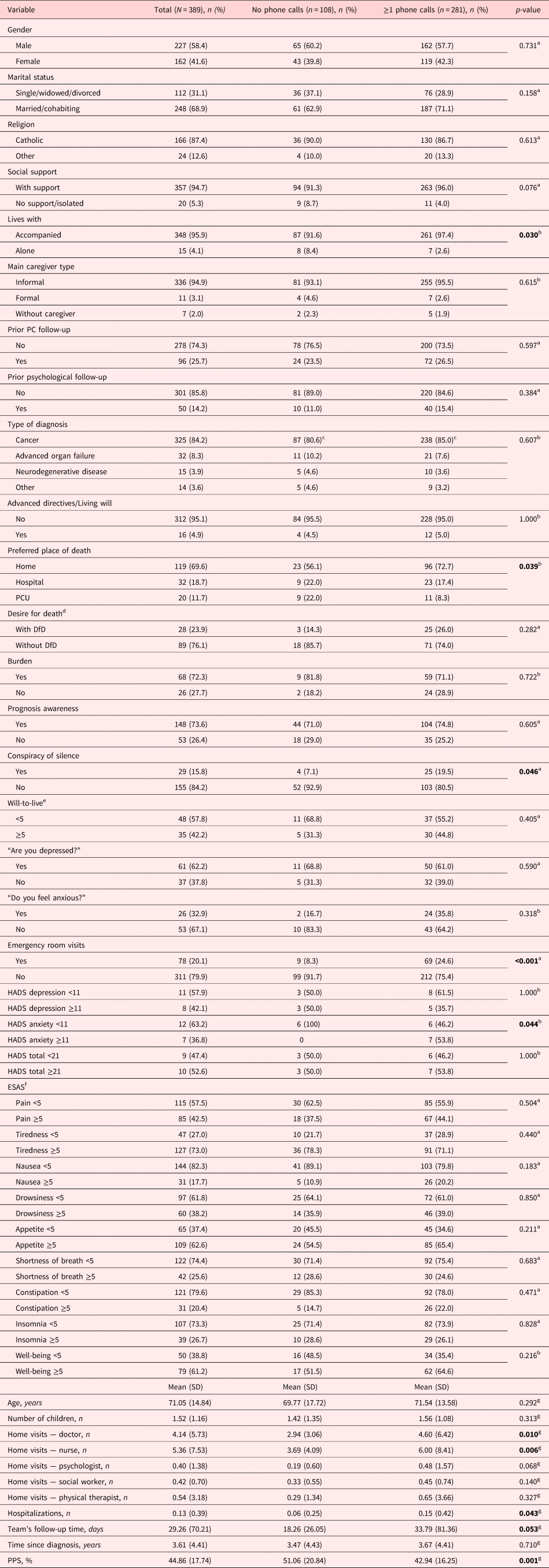
We, retrospectively, analyzed 389 database entries (i.e., patients anonymously registered in database with data regarding telephone contacts), between October 2018 and September 2020. Fifty-eight percent of the patients were male, and the majority were married or cohabiting (69%). The average age was 71 years (range: 18–103). All sociodemographic, clinical, physical, and psychosocial data are shown in Table 1.
Sociodemographic, clinical, physical, and psychosocial characteristics of the patients according to the number of contacts performed (N = 389)

In some variables, the total does not add up to 389 owing to non-responses.
Bold values are statistically significant.
DfD, desire for death; ESAS, Edmonton Symptom Assessment Scale; HADS, Hospital Anxiety and Depression Scale; PC, palliative care; PCU, palliative care unit; PPS, Palliative Performance Scale; SD, standard deviation.
a Pearson chi-square.
b Fisher's exact test.
c Categories with statistically significant differences from the others, according to Bonferroni correction.
d Desire for Death Rating Scale (rated from 1 to 6): without DfD = score <4; with DfD = score ≥4.
e Will-to-live: 0 — total will to live; 10 — worst possible will to live.
f ESAS: 0 — absence of symptom; 10 — extreme exacerbation of the symptom.
g t-test for independent samples.
Factors associated with calling or not calling the HPCT
As shown in Table 1, the majority of patients (n = 281, 72%) had one or more phone calls made to our HPCT. On average, a mean of 2.45 calls (SD = 3.61; range: 0–26) per patient was registered. Patients who called at least once were more likely to live with someone (accompanied) (p = 0.030) and chose home as the preferred place to die (p = 0.039). Moreover, those who made at least one phone call had more frequent doctor and nurse's home visits (p = 0.010; p = 0.006, respectively), and had a prolonged HPCT follow-up time (p = 0.053, although marginal), along with more frequent emergency room visits and hospitalizations (p < 0.001; p = 0.043, respectively) than those who did not make any call. A lower palliative performance status was found among those who made at least one phone call to the team (p = 0.001).
When looking at physical symptoms, no differences for any ESAS items were found between those who did and did not call. Callers had a higher frequency of conspiracy of silence (p = 0.046) and anxiety (using HADS) (p = 0.044), when compared with non-callers. No statistically significant differences were observed for age, gender, marital status, number of children, religion, social support, main caregiver type, prior palliative and psychological follow-up; type of diagnosis and time since diagnosis, presence of advanced directives/living will; number of home visits by the psychologist, the social worker or the physical therapist; desire for death, feeling a burden, prognosis awareness, WtL, or depression (Table 1).
Discussion
To the best of our knowledge, this study is the first to describe differences between non-callers vs. callers to an HPCT. Our study showed several factors that seem to correlate with an increased number of phone calls; while physical suffering did not play a relevant role in triggering contacts, psychosocial and several clinical factors did. There are relatively few publications on the use of telephone programs in palliative care, with the data showing contacts based on requests for support services, medical assistance due to changes in patients’ overall condition, and concerns regarding symptoms such as anxiety, depression, and physical distress (Pimentel et al., Reference Pimentel, Yennurajalingam and Chisholm2015; Baird-Bower et al., Reference Baird-Bower, Roach and Andrews2016).
Our study yields some noteworthy findings, including that callers were more likely to live with someone than non-callers. Perhaps patients who are accompanied are more likely to be encouraged to reach out by their caregiver/advocates. Hence, these terminally ill patients may be responding not only to their own distress but also to distress that is acknowledged and validated by those they live with. Given we do not know what triggered phone calls, it might also be the case that interpersonal issues between patients and their family members precipitate the need to call, for example, the family members’ own anxiety; needing to mediate potential conflicts or address caregiver-related questions or uncertainties. Additionally, callers were more likely to be anxious, consistent with previous reports by Pimentel et al. (Reference Pimentel, Yennurajalingam and Chisholm2005), and engaged in a conspiracy of silence, marked by limited or no open communication about the disease and its anticipated course. This could, in part, explain the higher number of contacts with the team, in order to ventilate and even discuss matters that are otherwise hidden or silenced. It is also possible that non-callers are more self-reliant and reticent to reach out for help, as they are already used to managing disease-related distress and complications alone.
Patients that called more often to our HPCT were more likely to choose to die at home. Evidence shows that home death requires complex, multidisciplinary involvement (Centeno et al., Reference Centeno, Lynch and Donea2013), requiring ongoing effort and input of caregivers and professionals in the home in order to achieve a peaceful, dignified and comfortable death. Hence, non-callers might be more likely to seek out an institutional death, where perhaps they might perceive themselves to be less of a burden to others. This is consistent with the picture of callers being more help seeking, hence having more doctor and nurse visits, emergency and hospital contacts, compared with their non-caller counterpart. Given that callers were more likely to live with someone, it is possible that those they live with identify problems earlier and engage healthcare providers sooner than non-callers, resulting in more frequent home visits.
Perhaps not surprisingly, the HPCT was more likely to receive calls in circumstances where the palliative performance status was lower and thus indicative of a terminal decline in functioning. Because we did not formally track the reasons for calling, we are unable to definitely say whether the initiator of the call was the patient or the family member. Anecdotally, it is the case that family members often called when patients were nearing death with questions related to their own emotional discomfort, along with concerns pertaining to the patient such as pain and shortness of breath (often confused with death rattle and Cheyne–Stokes breathing); in addition to postmortem logistics such as contacting a medical examiner or making funeral arrangements.
Our study has several important limitations. Most important, we did not document the reasons for each of the telephone calls received by our service. This could have provided vital, more textured information, complementing that we were able to glean as described above. The current study is based on a retrospective analysis of an anonymous database that reflects non-protocolled health professionals’ assessments in each clinical contact. For that reason, we could not control the number of entries for each patient, leading to a high percentage of missing data interfering with our statistical analysis. Our sample was composed primarily of older, end-stage cancer patients; thus, future research in younger patients and/or patients with nonmalignant terminal conditions is warranted.
Finally, our HPCT does not offer a 24/7 support telephone service after 8 pm on weekdays nor after 2 pm on weekends. Hence, we could have missed patients who develop acute symptoms after hours, and are left to either deal with such urgent or emergent issues on their own or must seek out alternative supports (e.g., hospital visits and drop-in clinics).
Conclusion
Knowing the patterns that drive people to call our HPCT team members provides important insights into patients and families alike. Two distinctive pictures emerge: one of callers who may be more anxious, more help seeking and wish to die at home; vs. non-callers, who are more isolated, less likely to reach out for help and prefer to die in an institutional setting. Knowing these distinctive patterns helps us to interpret these behaviors in terms of management issues and important end-of-life care conversations.
Our data show that every component of the holistic approach is needed to achieve optimized comfort and quality of life, and that reinforcing timely psychosocial support is critical to address suffering both from callers, who verbalize their distress, and from non-callers, who are less likely to actively seek help.
Author contributions
MJ, BA, CS, and HMC were responsible for the conception, design, and writing the initial draft. MJ and CS were responsible for the database managing and initial data analysis. CS was responsible for the statistical analysis. All coauthors made the revision of the final report and had full access to all the data.
Funding
BA is funded by the National Institute for Health Research (NIHR) Applied Research Collaboration East of England (ARC EoE) programme. The views expressed are those of the author and not necessarily those of the NHS, the NIHR, or the Department of Health and Social Care.
Conflict of interest
There are no conflicts of interest.