As many of the signatories are no doubt new to this country they will perhaps not be aware that black-faced minstrels performing a song and dance act have been a traditional form of entertainment in the British Isles for a great many years.
—Kenneth Lamb (director of Public Affairs, BBC) to David Pitt (Campaign Against Racial Discrimination) 1967On 19 May 1967, Kenneth Lamb, director of Public Affairs at the BBC, wrote to David Pitt, the chair of the Campaign Against Racial Discrimination, or CARD, in response to CARD's petition calling for an end to the BBC's televised variety show the Black and White Minstrel Show.Footnote 1 By 1967, the show, which featured white actors in blackface performing musical dance numbers, often on a set styled to suggest the Southern United States, had already been broadcast for nine years, and its popularity with British television viewers was well established. It would continue to be broadcast by the BBC into British homes until 1978—an astonishing twenty-year span.
The petition, signed by two hundred people, provoked an immediate response from Lamb, who was enjoying a hit program and functioning within a large organization accustomed to ongoing scrutiny by government, the press, and the public of its fulfilment of its charter to “inform, educate, and entertain” British audiences.Footnote 2 In line with the BBC's practice of responding to complaints of individual viewers and various groups, Lamb replied in a manner that situated Pitt, a man whom Lamb either assumed or knew to be black, as “new to this country.”Footnote 3 Lamb lectured Pitt and CARD members on the appropriate perspective one should bring to viewing the show, emphasizing that minstrelsy was a “traditional form of entertainment in the British Isles” with a long history of which immigrants were likely unaware. While arguing that the practice of minstrelsy was both historic and not inherently racist, Lamb implied that it was something that native white British viewers already understood.
Lamb was confident that his response reflected broader attitudes toward the program among British audiences. In the thin file on the show available at the BBC Written Archives, a consensus in defense of the show is evident across both of Britain's broadcasting institutions. On the same day that Lamb wrote to CARD, Stephen Murphy, a senior program officer at the Independent Television Authority, or ITA, privately wrote in support of the BBC's rebuff of CARD's complaints to someone he thought could influence the situation further: E. J. B. Rose, director of the Survey of Race Relations, itself affiliated with the National Committee for Commonwealth Immigrants. To Rose, Murphy jokingly acknowledged, “I should make it clear that I have no personal interest in this: The Black & White Minstrel Show is a BBC program, and an unhealthily successful one at that!” Still, Murphy argued, “I doubt if anyone takes stereotypes seriously anyways, but if they do, then the Black and White Minstrel stereotype is rather a helpful one—warm, friendly, affectionate and gay.” He went on: “Blacking up is a theatrical convention so old that is has lost any derogatory meaning. All that this group of CARD members is doing—though I understand the petition has the official backing of CARD—is to create a racial issue where none exists.”Footnote 4 Murphy ended with a nod to Rose's influence with the committee: “I doubt if this campaign will ever get off the ground: but if it does, then I hope that the NCCI will dissociate itself from it.”
This letter to the committee was another attempt to educate immigrants, through organizations that represented them, on the appropriate response to the show. Murphy and Lamb's invocation of minstrelsy as simultaneously historic and not a “racial issue” mobilized what, as this article demonstrates, was a widespread justification for the presence of blackface within popular film and television in postwar Britain, rooted in conceptions of a color-blind white British audience. In 1962, five years prior to the controversy of May 1967, Kenneth Adam, then director of television at the BBC, had described minstrelsy in a booklet about the show for the program's fans as “a perfectly honourable and uncondescending convention.”Footnote 5 After Flamingo, a monthly magazine aimed at West Indians and Africans living in Britain, ran a piece criticizing the show in September 1961, the next two issues featured some of the letters that, according to its editors, Edward Scobie and Ellis Komey, “came pouring in” to Flamingo's offices.Footnote 6 Many of these letters, noted the editors, “were from white readers who thought Negroes ‘too touchy.’”Footnote 7 One reader, P. Okuri from Birmingham, recounted the reaction of white people in his office when he showed them Flamingo's story: “They could not understand why we should feel so badly about the programme. They kept telling me it was good fun and full of entertainment.”Footnote 8
Minstrelsy and blacking up was, from this perspective, an established custom within British entertainment that was not seen as racist by its white British producers or its majority white audience. This racialized custom, however, has largely been overlooked by scholars examining the relationship between immigration, race, and screen culture in postwar Britain. Attention has instead focused on the so-called social-problem films of the late 1950s and early 1960s by Basil Dearden and Roy Ward Baker, while Sarita Malik, Darrell M. Newton, and Stephen Bourne have examined the self-conscious effort by television broadcasters at both the BBC and Independent Television, or ITV, in the 1960s and 1970s to address immigration and growing racial tension in Britain through programming.Footnote 9 In 1965, two “Conferences on Immigrants” were held between BBC officials and black and Asian representatives, and it was in this period that black and Asian actors began appearing on British screens with some, albeit scarce, regularity.Footnote 10 Much work has also been done on the “racial sitcoms,” such as BBC's Till Death Us Do Part (1965–1975) and ITV's Love Thy Neighbour (1972–1976). Gavin Schaffer, Sally Shaw, and Brett Bebber have noted the ambivalent responses among audiences to the bombastic, white, male, and explicitly racist protagonists that scriptwriters and producers seemingly saw as a means of sending up racist attitudes in often “affectionate” ways.Footnote 11 Yet this focus on the social-problem films and racial sitcoms has distracted us from much broader mobilizations of racialization on screen in the same period. Rob Waters's work provides a valuable step forward as he examines broadcasters’ concerns in the 1960s and 1970s about the influence on both black and white British audiences of programs featuring images of Black Power and America's “race problem.”Footnote 12 As Kennetta Hammond Perry has noted, the fragile state of race relations in Britain and its articulation in the national and international press were facing increased scrutiny in the aftermath of race riots in Notting Hill in 1958.Footnote 13
I argue in what follows that we need to look at British “screen culture” as a broader entity that consistently traded in racist imagery underpinning both producers’ and audiences’ notions of racial customs. I refer to “screen culture” throughout to include numerous types of moving-image media produced and exhibited in this period, including feature films, newsreels, amateur film or “home movies,” and television. Such a broad focus highlights popular customs of minstrelsy and blacking up within British screen culture as an important antecedent to the Black and White Minstrel Show. The show began broadcasting on 16 August 1958, two weeks before the Notting Hill riots of 30 August to 5 September, but the passing mentions the show has garnered in the works outlined above downplay both its immense popularity and the program's peculiar relationship to concerns about immigration and racial prejudice in the period.Footnote 14 By 1963, the BBC's Corporation Handbook reported that 16.5 million viewers were watching the show on Saturday evenings, making it the broadcaster's top program and easily dwarfing the five to seven million viewers of Till Death Us Do Part.Footnote 15 The silence in current historiography on the Black and White Minstrel Show likely stems, in part, from the exceptional nature of the show itself. Unlike the racial sitcoms or social-problem films, the show appeared to be a singular phenomenon in both its format—a variety musical show featuring uniformly costumed, blacked-up male singers and dancers, performing alongside a female dance troupe known as the Television Toppers—and its stage setting—which rotated among scenes that included the American Old South. Certainly, the overt blacking up at the center of the show has accounted for broad discomfort at the program's existence. A Radio Times interview in 2011 with Ronnie Corbett, comedian and star of the popular show The Two Ronnies (BBC, 1971–1987), which produced a satirical sketch, “The Short and Fat Minstrel Show,” in 1976, featured his ruminations on the Black and White Minstrel Show: “How outdated that seems.”Footnote 16 A Guardian review in 2015 of a television show based on the black actor Lenny Henry's life noted that scenes depicting his performance as member of the touring theatrical version of the show in the 1970s “make difficult viewing” in the contemporary period.Footnote 17
The BBC archive also tells a tale of uneasiness with the program that has likely influenced the ability and willingness of historians to grapple with the show's popularity. The show's file contains just twelve pages, in contrast to the relatively thick files of multiple exchanges of memos on other broadcasted programs. A note from an archivist at the BBC Written Archive Centre, deposited in 2007, confirms that material relating to the program was removed at some unknown point: “In the exchange of memos between Barrie Thorne (Chief Accountant) and Oliver Whitley (Chief Assistant to DG) on 19 May 1967 and 26 May 1967, there are handwritten notes (made by Registry staff) referring to where other related papers are filed within Management Registry. These references (to Registry Classification N0387 N0441) have been followed up, and these files were found to be destroyed as part of the BBC's Records Management programme and have never been deposited into the BBC Written Archives Centre.”Footnote 18 In this case, “records management” possibly functioned as a means of addressing embarrassment about either the program itself or discussions among producers relating to it. Consequently, historians have been left with only those twelve pages and brief references to the program in other files at the BBC's Written Archive Centre to examine. Any investigation of the program must thus necessarily move beyond the written archive to gain a more complete picture of the program's immense appeal. In many ways, however, this archival absence is a further element of a story about the claimed color blindness of both producers and audiences in twentieth-century Britain.Footnote 19
The focus on a narrow range of activities at the BBC and ITV during the 1960s and 1970s and a related dependence on the written archives of both organizations, as well as the social-problem films of a limited number of directors, has skewed our understanding of the historic existence of blackface as a type of racialized custom in British entertainment over a much longer period, from the 1920s through to the 1970s. Blacking up for entertainment had indeed been, as Kenneth Lamb stated, “a traditional form of entertainment in the British Isles for a great many years,” among professional actors and ordinary Britons. The practice was newly affirmed, defended, and amplified in the postwar period when it was routinely featured on British television and films beyond the Black and White Minstrel Show. Evidence of this custom is largely visual and housed within the wide variety of moving images that constitute screen culture. I further argue that the persistence of blacking up hinged on the acceptance of this practice by British audiences, who were imagined by white producers as color-blind, or what Robin Bernstein has called “racially innocent,” seemingly unable and unwilling to acknowledge racialized structures within forms of entertainment.Footnote 20 In doing so, I draw on works influenced by critical race theory that examine the difficulties of majority-white populations in acknowledging racism as it provides a useful framework for examining the concurrent existence of highly racialized screen content in Britain from the 1920s to the 1970s and a persistent argument among both producers and audiences that this content was not racist.
Recent works on color blindness and “white fragility” within critical race theory can offer a vital means of interpreting historic understandings of race within postwar Britain.Footnote 21 As Bill Schwarz argues, white British subjects were “re-racialized” in postwar Britain as greater immigration by black and Asian colonial and commonwealth subjects prompted “Englishness” to be rearticulated as an explicitly white identity and culture.Footnote 22 While Chris Waters, Camilla Schofield, Jodi Burkett, and others have documented the sometimes unintentional efforts of numerous groups, including sociologists, politicians, broadcasters, and even student activists, to repeatedly define immigrants as “non-English,” what has gained less attention has been what Perry calls the “mystique of British anti-racism,” or Britain's own color blindness.Footnote 23 International and domestic conceptions of postwar Britain as broadly antiracist were rooted in three vital elements that underpinned immigration in postwar Britain: first, constant reminders that, politically and socially, Britain was not suffering from the formalized racial segregation found in parts of the United States; second, the largely voluntary, rather than forced, movement in the aftermath of World War II of an immigrant population with considerable knowledge of Britain as a result of colonial ties; and third, a collective willingness within Britain to see elements of Britain's colonial aims and the process of decolonization as altruistic rather than primarily exploitative.Footnote 24 Together, these factors contributed to a complex rationale embraced by ordinary Britons, and indeed many immigrants, that posited Britain as racially tolerant.
Works by Eduardo Bonilla-Silva and Charles W. Mills on “color-blind racism” or “racial ignorance” have nevertheless argued that claims to racial tolerance or an inability to see race, usually held by white people, simultaneously deny the existence of both anti-black racism and white privilege while supporting and authoring systems that uphold both.Footnote 25 Historians of postwar Britain could fruitfully make use of this framework of color blindness to understand persistent historic disavowals of Britain's own “race problem” in the postwar public and private sphere, alongside equally persistent evidence of just such a problem as articulated by immigrants, civil-rights campaigners, and other interested parties.Footnote 26 Attention to the historic existence of color-blind racism can become a useful means of interpreting racially constructed silences and, in this case, “records management” within the archive. With the Black and White Minstrel Show, attention to color-blind racism allows one to acknowledge and address the repetitive aspects of arguments by primarily white producers and audiences who claimed that a program that clearly hinged on racial stereotypes and caricatures was “not about race.” This framework also underpins willingness by producers and some audiences to point to as evidence of a much longer tradition of minstrelsy and blacking up. Within this rationale, white producers and audiences ultimately maintained their right to identify and name “racism” on their own terms and at the expense of the black voices calling attention to Britain's own “race problem.” Black audiences were imagined by white producers and audiences as suffering from a disposition to see race everywhere, including spaces of screen culture that were characterized as racially innocent.
“A Traditional Form of Entertainment”: Blacking Up in the Early Twentieth Century
As both Lamb and Murphy argued in 1967, the history of minstrelsy and blacking up as a form of entertainment is vital to the framing of broader pleasures of racism on screen in twentieth-century Britain. The practice of white actors and singers donning blackface and performing “blackness” was thought to be an import from the United States, a form of entertainment with a history rooted in the practices of slavery and post-abolition anxieties about reconstruction. Scholars such as Eric Lott and Stephen Johnson, working in diverse fields, including theater, music, and dance studies, as well as American history, have charted the multiple meanings that white audiences and performers ascribed to blacking up in the nineteenth and early twentieth centuries, while noting the stereotypes that these performances consistently relayed.Footnote 27 The transatlantic transference of this practice into a British context demands attention to what blackface and minstrelsy offered to majority white audiences consuming these within a framework that also included the pleasures and performances of empire. In the British context, Hazel Waters, Michael Pickering, Tom Scriven, and, more peripherally, Anne McClintock have documented the practice's public as well as private meanings in the nineteenth century.Footnote 28 Scriven notes minstrelsy's formation in the nineteenth century of “the archetype of black people as dim-witted, oddly-framed and fundamentally comical” as white actors in blackface articulated British anxieties about black men in urban settings and the slippages of class and racial formation that accompanied this. Pickering documents just how ubiquitous both blacking up and minstrelsy were in Britain, arguing that “variant forms of blackface caricature appeared outside the minstrel show, in media as wide-ranging as advertising, postcards, puppet shows, comics, and juvenile literature.”Footnote 29 The sheer wealth of material documenting the existence of minstrelsy, he concludes, provides “abundant evidence not only of its apparent constancy but also of its cultural acceptability.”Footnote 30 The visual and aural spectacle of blackface and minstrelsy ensured that the practice persisted on screen when cinema-going among Britons increased throughout the interwar period.Footnote 31 Singers such as Al Jolson could be seen in blackface on screen in Britain in 1928's American feature film Jazz Singer and 1939's Rose of Washington Square, in which Jolson sang “Mammy,” as well as in the postwar biographical film The Jolson Story (1946).Footnote 32 British performers like G. H. Elliott modeled themselves after Jolson, gaining popularity on stage and for BBC radio broadcasts throughout the 1930s.Footnote 33 By 1930, the practice of singing in blackface was common enough that Elliott took to referring to himself in press and advertisements as “the original chocolate coloured coon,” to distinguish himself from imitators.Footnote 34 Amateur minstrel troupes mounted their own shows between the wars, one of the more notable being the London Metropolitan Police Minstrels.Footnote 35 By 1927, the police troupe had existed for fifty-four years and consisted of upward of forty men in blackface performing skits and songs; proceeds from the shows went to a number of police charities, including the Metropolitan Police City Orphanage.Footnote 36 The troupe was well known in London and endorsed by high society in 1929, when Lady Byng “persuaded” the police commissioner to allow the troupe to sing at midnight at her annual charity cabaret ball.Footnote 37
The song and dance minstrelsy modeled by Jolson, Elliott, the London Metropolitan Police Minstrels, and others were not the only form of blackface that British audiences were consuming between the wars. While minstrelsy stressed blacking up as part of the performance, blacking up in less overt ways informed common presentations of blackness on screen. On the silver screen, actors of color seldom played people of color. Instead, a lead or secondary actor with white skin would wear makeup throughout the film in order to “pass” as black or Asian. This white actor might be surrounded by black and Asian actors as extras, but the director and studio generally assumed that a lead with considerable dialogue would best be played by a blacked-up white actor. This approach also assumed that audiences would either not notice the blacking up or share similar expectations about the ability of white actors to accurately “act” black or Asian characters. Examples of films featuring blacked-up actors are numerous and include hits such as The Drum (1938), directed by Zoltan Korda, featuring the Canadian actor Raymond Massey in blackface as the Indian Prince Gul, alongside other supporting characters such as the British-born Roy Emerton as Wafader and Charles Oliver as Rajab. In Lives of the Bengal Lancers (1935), the central antagonist, Mohammed Khan, was played by Douglas Dumbrille, another white Canadian actor, while the African American actor Noble Johnson played the supporting role of Prince Ram Singh. The ubiquity of blacking up in the period is such that it is easier to identify films that featured black or Asian actors in speaking roles than films where blacked-up actors occupied these roles, like Sanders of the River (1935), starring the African American singer Paul Robeson and actress Nina Mae McKinney. Little evidence exists as to whether interwar British audiences explicitly recognized the blacking up of actors, but the number of popular films that used passing through blacking up as a plot device would leave audiences in little doubt to the existence of this practice.
In the empire films of the 1930s, British officers sometimes engaged in blacking up to undertake covert intelligence work. In The Drum, Captain Carruthers, played by Roger Livesey, is initially seen on screen blacked up and masquerading as an Indian man, complaining about the price of a rail ticket and begging for food.Footnote 38 In Lives of a Bengal Lancer, Lieutenant Barrett applies blackface to fulfil his colonel's mission to infiltrate a hostile tribe; later in the film, the lead character, McGregor, played by Gary Cooper, and another officer don blackface. In both The Drum and Lives of a Bengal Lancer, these officers are shown removing or donning blackface in front of a mirror with the aid of an Indian servant. This overt blacking up emphasized the physical, linguistic, and cultural authority of these British officers and their ability to easily fool the locals with their masquerade. Korda's The Four Feathers (1939) went a step further and placed blacking up as central to the plot, as the main English character, Henry Faversham, successfully dons blackface to rescue his fellow friends and imprisoned officers in the Sudan. The ongoing inclusion of blacked-up actors in feature films from the period was so common that censors at the British Board of Film Classification did not remark on the practice but rather treated the characters by their projected racial identity.Footnote 39
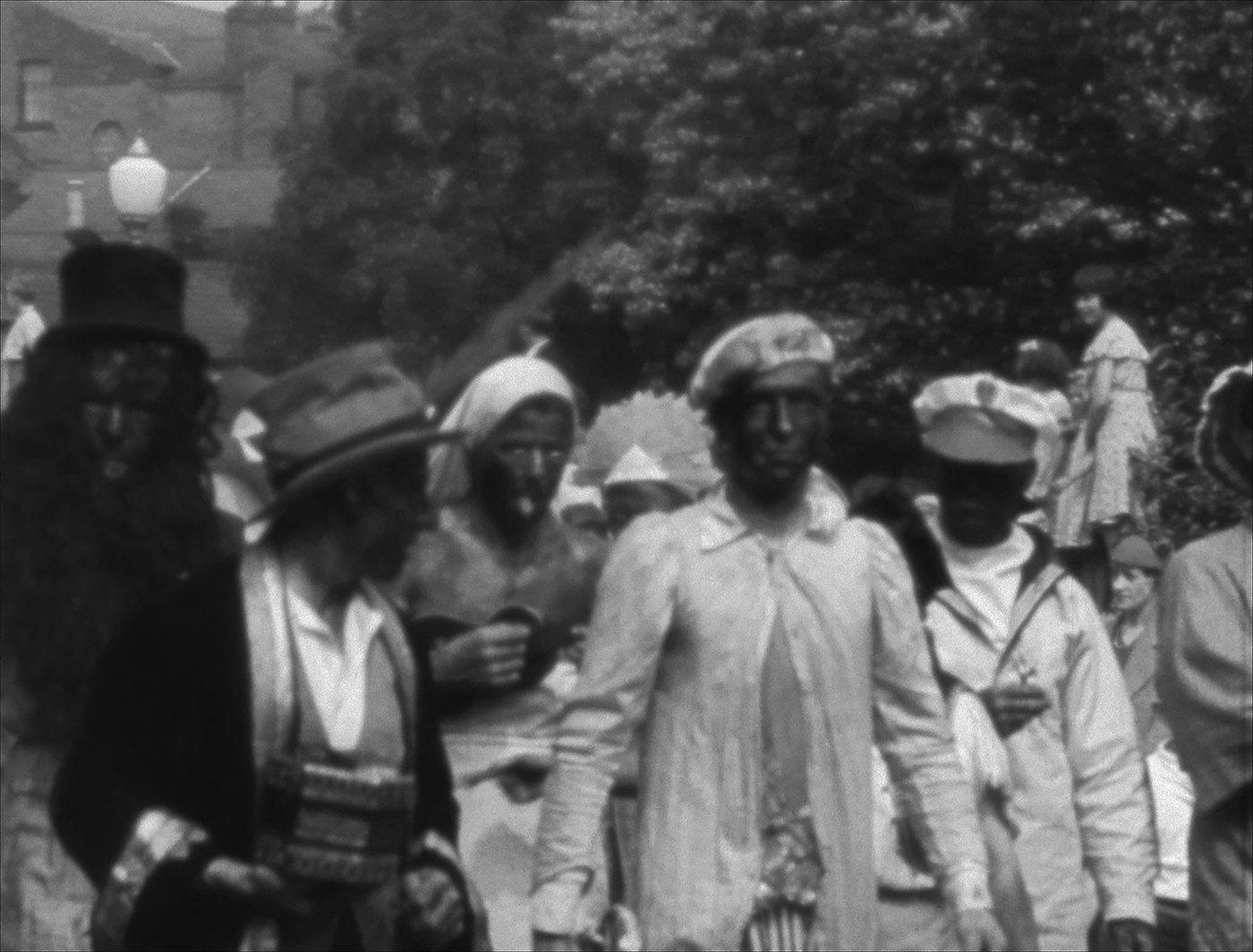
A rather different type of film, the amateur film or “home movie,” demonstrates that a range of ordinary Britons were also blacking up in public environments in the early twentieth century in local parades, pageants, and celebrations. Zoë Thomas and Tom Hulme have placed an overdue spotlight on historic pageants as a means of modeling various forms of citizenship and identity in the period.Footnote 40 Amateur films, shot from the 1920s onward, are an excellent source for footage of historic and contemporary theater, pageants, and parades, and indicate that these sites could be used to visually articulate stereotypes and affirm racialized boundaries by blacked-up men and women within predominantly white communities.Footnote 41 Home movies housed in media archives across the United Kingdom, such as the North West Film Archive, the Yorkshire Film Archive, the Screen Archive of the South East, and the Media Archive for Central England, indicate that ordinary Britons used burnt cork and other material to black up, not only for the purpose of Morris dancing but in clear imitation of African Americans, Africans, South Asian, Chinese, and Japanese communities, and North American “Indians.”Footnote 42 Groups of blacked-up participants can be seen wearing a range of clothing that equated blackness with poverty, such as tattered topcoats and black wool wigs. The existence of such practices, a type of local theater captured by film but not for film, indicate that the often upper-class amateur filmmakers who could afford the expensive “cine-cameras” were themselves intrigued by this spectacle.Footnote 43
For example, in footage capturing Melton Mowbray's carnival in 1938 (figure 1), the camera zooms in on various figures in blackface and follows them for several seconds.Footnote 44 The cutaway immediately afterward to a different set of costumed participants indicates that the local filmmaker edited the footage of the procession to grant these figures considerable screen time. There was little hesitancy in filming this charade, just as there was little hesitancy in performing the practice in pageants from the southern to northern regions and from the 1920s onward, as we shall see. This was a seemingly traditional custom of blacking up captured on screen.
Melton Mowbray Carnival Scene (still), 1938, Media Archive for Central England. Courtesy of MACE.

A discussion in 1930 in Scotland Yard, however, about the possibility of an international exhibition of a film featuring the London Metropolitan Police Minstrels indicates that there may have been a sense of dawning unease among officials about the appeal of minstrelsy to audiences outside of Britain. In February 1930, N. A. Pogson, director of International Productions Ltd, approached Lieutenant Colonel Sir Percy Laurie at Scotland Yard with a suggestion that the company make a “talkie” film of the troupe's performance, “a Police story to be mixed up with sentiment and thrills—the sort of dope that appeals to the cinema public of to-day.”Footnote 45 The police troupe had been previously filmed in 1917, when a short reel of its arrival at the Princess Theatre in Crayford, Kent, was shot, seemingly with the troupe's permission, as members play to a camera clearly situated to capture their performance.Footnote 46 This film is identified only as a “local news item,” yet its staged elements indicate it was likely produced by a small production company hoping to sell the footage for inclusion in a newsreel. By 1930, however, increased understanding of the international reach of film played a part in the rejection of Pogson's proposal. Sir Charles Royds, assistant commissioner “A” of the London Metropolitan Police, when reviewing clauses of the proposed contract, raised this point: “Once the film is made it will be exhibited all over the world without any control by Scotland Yard. At present the Minstrels perform only in certain selected London theaters or places of amusement; if this agreement is entered into they would in effect be performing everywhere and anywhere. I can conceive of circumstances or places in which the exhibition of such a film (say in America or India or indeed anywhere abroad) might be very injurious to our prestige.”Footnote 47
Further efforts by International Productions to have the film made prompted the following response from the London Metropolitan Police: “We impressed upon them . . . that any story which would in any way cheapen the Police Force in the eyes of the public or use them as a stunt would not be entertained.”Footnote 48 The commissioner's concern with the public reputation of the police as presented on screen echoed existing concerns and practices of the British Board of Film Classification, which dictated that the police, alongside other British institutions, should be represented as capable and officious in their duties for impressionable audiences.Footnote 49 Yet it was the commissioner's reference to the film's reception in India and America, in particular, that indicates he may have been considering audiences of color, with Indian film audiences and American film audiences that included African Americans foremost in his mind. This consideration spoke to a dawning, although certainly not coherent, comprehension of black and Asian audiences as viewers likely to possess a different response to the practice of blacking up, and an ability to see racism where white British audiences did not. By preventing the intersection of a minstrel practices in London with the international medium of film, the London Metropolitan Police implicitly framed the blacking up of the Police Minstrels as a racialized custom understood by white audiences in Britain alone.
This is a rare moment in the archive, however, and for the most part, British audiences continued to be imagined as both white and eager to consume the practice of blacking up throughout the 1930s and World War II. Efforts to conceive of and then appeal to black and Asian audiences during wartime, as Wendy Webster has argued, were largely limited to the Colonial Office Film Unit and the documentary films it produced toward the end of the war.Footnote 50 British film during wartime did begin to reflect, to some extent, the gender, regional, and class diversity apparent on the ground, as numerous historians have noted, yet British audiences were still imagined to be primarily white.Footnote 51 Feature films produced in the United States, an industry less impacted by the war, still made use of blacking up as passing, such as 1942's Arabian Nights, featuring multiple actors blacked up alongside the Asian actor Sabu, even as popular filmmakers like Frank Capra attempted to belatedly produce homages to African American soldiers toward the war's end.Footnote 52 Photographs held at the Imperial War Museum also show that white British troops continued to engage in blacking up and minstrel performances in their leisure time.Footnote 53 Thus the racialized custom of blacking up and consuming images of blackface remained intact throughout the war for most white audiences, as documentaries featuring black and Asian faces operated on the fringes of the screen for what were viewed as marginal audiences.
Family Viewing and Blacking Up on the Big and Small Screens
The advent of television broadcasting in the postwar period highlighted just how entrenched the practice of blacking up was within British entertainment, as it was given a new lease on life as wholesome family entertainment. While some feature films produced in the 1950s and ’60s made use of West Indian actors living in Britain, such as Earl Cameron and Errol John, the interwar empire films and American films set in the Old South discussed above were broadcast on both the BBC and ITV, bringing historic blackface practices to new generations of television viewers. This screen culture went largely unremarked, except by a few voices of color left with the burden of declaring the broadcasting of this material as racist. Rob Waters's spotlight on the British black and Asian audiences consuming images of the Black Power movement in the United States has an unfortunate counterpart in decisions by the BBC and ITV to continually program content featuring blackface and to assert that this content was harmless and indeed wholesome. This is an important and overlooked aspect of the wider custom of blacking up on screen that informed later defenses of the Black and White Minstrel Show.
Broadcast listings indicate just how frequently films featuring actors in minstrel makeup and in blackface could be seen on British televisions. The central place of empire films in television broadcasting was signaled early on when the BBC televised an adapted theatrical performance of W. P. Lipscombe and R. J. Millney's Clive of India on New Year's Eve 1956.Footnote 54 It was ITV, however, that broadcast the bulk of empire films from 1957 and throughout the 1960s through its dizzying array of regional broadcasters, all of which featured actors in blackface.Footnote 55 In autumn 1957, ITV began a Saturday program on ABC, its Midlands weekend broadcaster, entitled The Great Pictures of Alexander Korda.Footnote 56 The draw of Korda's films had been stressed by ABC in a feature in the Times aimed at potential advertisers, highlighting programming decisions “carefully measured by audience research,” that translated into “more viewers” and included “live plays, outside broadcasts, sport, serials, the great Korda film classics, and variety.”Footnote 57 In 1958, the same films were again broadcast as a Saturday program, this time called Great Movies of Our Time. Evidence indicates that the timing of such films fell within the “watershed” period of family viewing. In 1961, ITV regional broadcasters Tyne Tees, South Wales, and West of England all featured Sanders of the River as “Sunday Television” at 3 p.m. and 4 p.m., while a perennial favorite with broadcasters, The Thief of Baghdad (1940) with Sabu and a blacked-up John Justin as the sultan of Baghdad, was shown in July, September, and December of that year.Footnote 58 The BBC began to include both interwar and postwar empire films in its program listings in 1966, with Richard Burton blacked up as Dr. Rama Safti in The Rains of Ranchipur (1955) and the Russian actress Eugenie Leontovich as the maharani, broadcast in the prime slot of 7.25 p.m. on a Sunday.Footnote 59 Clive of India (1935), featuring Spanish actor Cesar Romero blacked up as the Indian nawab Mir Jaffar, was broadcast on BBC1 in 1970 at 3 p.m. on a Saturday and described in the Times regular television program listings as “a film for the family.”Footnote 60 The American film Swanee River (1940) featuring Al Jolson's minstrel show was also broadcast on BBC2 in 1973 at the family viewing time of Saturday afternoon from 3 p.m. to 4.20 p.m.Footnote 61 These are just some examples of the presence of blackface on television, framed by scheduling that positioned this content as classic and wholesome entertainment.
After broadcasting hours for the BBC and ITV were extended after 1972, the pressure to provide programming resulted in a marked increase of films featuring blackface on television. In 1975 alone, the following films were featured on ITV's various regional broadcasters (of which some audiences, particularly in the south and the Midlands, could access more than one) and on the BBC: The Four Feathers (1939) twice in the year, on Anglia on 22 March, and London Weekend on 28 June; The Thief of Baghdad (1940) three times, on 29 March on Midlands, on 26 May on Thames broadcaster, and on 25 August again on Thames; Khartoum (1966) twice in the year, on Grampian on 29 March and Southern on 12 April; Sanders of the River (1935) on Westward on 31 May; Go into Your Dance (1935) (with Al Jolson blacked up as a minstrel) on BBC2 on 29 July; Elephant Boy (1937) on Tyne Tees on 9 August Lives of a Bengal Lancer (1935) on BBC1 on 11 October; and Arabian Nights (1942) on BBC2 on 20 December.Footnote 62 All of these broadcasting times except two were Saturday or Sunday viewings, and all but two also fell within the watershed.
The timing of these broadcasts is itself a key indicator of how producers and programmers imagined the responses of British audiences to such films. While Anamik Saha has noted the consistent marginalization of minority programming in the schedules of British broadcasters in the twenty-first century, programming from 1955 to 1978 indicates that both empire films and films featuring overt blackface on television continued to be imagined as a site of audience consensus.Footnote 63 British audiences, according to BBC and Independent Television Authority files and press coverage, seldom protested the prime viewing slots that producers granted to such films. It was a lone voice in 1957 that spoke out when the Times quoted, in part, a letter by M. T. Mbu to Associated Television of the Midlands, arguing, “The film Sanders of the River, which was shown in the organization's program ‘The Great Pictures of Korda’ last Saturday night is ‘most damaging’ to Nigeria.”Footnote 64 The Times selectively reported on the complaint: “The letter asks of what use this film, ‘allegedly shot in 1935 or thereabout’ could be to anybody in 1957 ‘when all efforts are being directed to better understanding among nations of the world, particularly the British Commonwealth of Nations.’” In a denial of Mr. Mbu's effort to name the film and its broadcasting as racist, the Times noted that his response was not the majority response, arguing, “many British viewers who saw the film would describe it as thrilling.” Mr. Mbu's unsuccessful argument for the complete “withdrawal of this obsolete film” was firmly aligned only with a minority of viewers who would not see the film as “thrilling” first and foremost.Footnote 65
New empire films were also produced in the period and overshadowed the production of the social-problem films created by Basil Dearden and Michael Relph, and Roy Ward Baker. As Webster has documented, films such as Guns at Batasi (1964), Bridge on the River Kwai (1957) (Christmas viewing in 1974), and Lawrence of Arabia (1962) found receptive British audiences in both cinemas and on television.Footnote 66 Although Basil Dearden had made efforts to examine anti-immigrant prejudice in Pool of London (1951) and Sapphire (1958) and had cast Earl Cameron in both, his creation of Khartoum (1966) featured Laurence Olivier in blackface playing the Mahdi. Dearden's willingness to hire a white actor to don blackface indicates that this racialized custom was well entrenched among directors of a variety of political persuasions. The British Board of Film Classification also did not note Olivier's blacking up in June 1964 when they considered the film, but were instead preoccupied with “some of the belly-dancing” and “shots and sounds of panic, carnage and corpses.”Footnote 67 Yet Olivier's performance and the practice of blacking up were not without comment on its release in 1966. The Times's film critic referenced British comedian Peter Sellers, who had impersonated an Indian accent as Mr. Lalkala (along with the comedian Spike Milligan as Mr. Banerjee) on the popular BBC radio show The Goon Show (1951–1960) and had blacked up on screen as Dr. Ahmed el Kabir in the 1960 British film The Millionnairess: “We are given a formidable display of eye-rolling and lip-licking, a weird Peter Sellers-oriental accent and a valiant but unsuccessful attempt to disguise Sir Laurence's all too English features with false hair and green lipstick.”Footnote 68 This performance did not prevent the Times from concluding that Khartoum was an “intelligent film,” and it enjoyed a steady success both in cinemas and on television.Footnote 69
In comparison, a social-problem film like Roy Ward Baker's Flame in the Streets, an adaption of a play Hot Summer Night featured on ITV's Armchair Theatre, had a relatively modest life on television. After three broadcasts in 1968 (on Southern, Rediffusion, and Grampian), it was shown only three times across the entire 1970s: on Sunday, 8 April, 7.55 p.m. in 1972 on the Midlands Westward broadcaster, then for the first time in Yorkshire in 1973 at the dubious time of 11 p.m. on a Friday, and on Westward in 1973, again in a late-night slot of 10.35 p.m. on a Friday.Footnote 70 In this regard, the social-problem films of the 1960s should be firmly placed within a broader landscape that indicates the frequency and regional broadcasting of these films.Footnote 71 Blacking up in films, as a form of passing, also persisted even as black press publications like Flamingo and Claudia Jones's West Indian Gazette regularly featured the practice as problematic and instead highlighted black talent.Footnote 72 Both periodicals viewed black actors as consistently losing out to high-profile white actors in blackface on employment opportunities within the industry.
The Black and White Minstrel Show and Color-Blind Racism
As I have demonstrated, the broadcasting of both historic and contemporary films featuring actors in blackface had been established as a racialized custom within Britain's television landscape from 1957 onward. Nevertheless, this custom took on a more virulent life within made-for-television programming in Britain. The previous popularity of Al Jolson films and radio acts such as the Kentucky Minstrels with British audiences led to the BBC's trialing of a discrete one-hour program in 1957 entitled the 1957 Television Minstrels, featuring the Mitchell Minstrels, helmed by the popular musical director George Mitchell.Footnote 73 Reaction to the program was positive, with Ronald Camp, a television reviewer for the Daily Mail, referencing his own experience of blacking up: “Tradition dies hard—and it is a long time since I blacked my face and sang Swanee.” Deeming the efforts of producer George Inns a success that would surely lead to an extension of the program, Camp suggested, “Of course, he must ask Mr George Elliott, the beloved Coon, to come along once more so that we can all join the applause when he sings Lily of Laguna.”Footnote 74 The Black and White Minstrel Show began broadcasting on 14 June 1958 with an initial 8 p.m. Saturday evening slot before moving to 7.30 p.m. in 1959—a prime-time slot for its mix of highly choreographed dance pieces, regular solo performances by blacked-up minstrels Leslie Crowther and George Chisholm, and guest appearances by comedians, actors, and singers who did not don blackface. The television show spawned a series of successful records featuring music from the minstrels and a traveling theatrical show playing in community halls and theaters across the United Kingdom and in the West End of London; by 1969, it had already run for seven years, “breaking every box-office record.”Footnote 75 Regular stories in the press about the minstrels, such as the Daily Telegraph's “Minstrels Run out of Make-Up” in 1962, were featured as light human-interest stories.Footnote 76
The popularity of the Black and White Minstrel Show did not extend, however, to the entirety of Britain's population. The petition to ban the show was put to the BBC in May 1967 by CARD and thirty-two-year-old Clive West, who was identified as a “Trinidadian” by the Times and as “an unemployed stoker” by the Daily Mirror.Footnote 77 West's petition was selectively quoted, with two lines from it repeatedly cited in press coverage: “This hideous impersonation is quite offensive and causes much distress to most coloured people”; and “Moreover it creates serious misunderstanding between the races.”Footnote 78 Reporting on West's role in bringing the petition to CARD vacillated between identifying the petition as a CARD initiative and hinting that West was a rogue affiliate.Footnote 79 In a letter to the editor of the Times in support of the petition, David Pitt clarified that it “was drafted and circulated without our prompting” by one of the two hundred signatories.Footnote 80 West himself explained to the Times, “I requested to C.A.R.D that the show should be taken off as it depicts my race as a singing, dancing, laughing, idiotic people.” He went on to elaborate both the reasoning and process behind the petition: “[The Black and White Minstrel Show] is a laugh at the expense of a minority and it causes distress to coloured people by showing them as a race that cannot be taken as serious-minded citizens. The petition was a spontaneous effort and both white and coloured people have signed it.”Footnote 81
Contacted for comment by the Daily Mirror, West was quoted as saying that the show “makes a monkey out of us.”Footnote 82 West's comments built upon views within the West Indian community previously voiced within the black press. The Dominican-born journalist, historian, and publisher Edward Scobie was instrumental in the creation of magazines that catered to what he termed “a Negro voice” that united “West Indians, British Guianese, Americans or Africans,” while also aiming to attract white readers.Footnote 83 The fourth and most successful magazine publication in which Scobie was involved, Flamingo (following 1948's Checkers, Bronze (1954–55), and Tropic (1960)) ran from 1961 to 1963 and circulated throughout the UK from its base in London. Flamingo featured an article on the Black and White Minstrels in its very first issue, entitled “Bad Taste B.B.C.!”Footnote 84 The piece opened with interviews with West Indians of various professions, including a writer, a theatrical agent and actress, and a businessman, discussing their reactions to the show. “Lloyd Squires, a young West Indian businessman in Brixton has this to say of The Black and White Minstrel Show: ‘I feel ashamed and disgusted when I see the antics of these coons on the programme. No one whom I know likes it. Some have told me that they switch off the moment the show starts and then feel uncomfortable and miserable for the next 30 minutes when they know that “the fastest show in black and white” as the producers call it, is on the air.’”Footnote 85 Flamingo also quoted “a young Englishman, Bob Dawbarn,” presumably white, who noted, “I just do not understand how Auntie B.B.C. which seems only too willing to ban folk songs or stop comedians from imitating politicians, can continue to put out this insulting show which is offensive to many people.”Footnote 86
Responses to Flamingo's piece, however, raised a familiar refrain from Flamingo's white readers. A James Graham of Glasgow wrote, “If we are to achieve better racial understanding in this country, it will be despite the complex-ridden ‘Bad Taste B.B.C.!’ of your September issue . . . The ‘attack’ on Negroes in the ‘Black and White Minstrel Show’ is manifestly no more degrading to Negroes than are the other countless show-business parodies degrading to us Scots . . . Bad taste Flamingo!”Footnote 87 November's issue featured a comment by the editors, noting, “The following letter sums up the position of a substantial number of readers.” The letter stated, “Most of my friends and I think that the ‘Black and White Minstrel Show’ is first-rate entertainment. I strongly disagree with your criticism and I am sure that it displays over-sensitiveness . . . In any case, ‘Black and White Minstrel Show’ surely should be regarded as a compliment by your West Indian and African readers. It shows how dominant people of Negro descent are in the entertainment world for the B.B.C. to emulate.”Footnote 88
The argument that the stereotypes deployed on the show benefited black immigrants preceded similar sentiments put forth by Stephen Murphy at the Independent Television Authority. Both statements acknowledged that a stereotype might indeed exist, while arguing that this particular form of representation on British screens, which ran counter to negative news coverage of immigrants documented by Schaffer and Malik, was a beneficial one.Footnote 89 In both arguments, the blacking up of white bodies as black bodies in order to achieve these distorted stereotypes of warm cheerfulness was not addressed; rather, the minstrelsy was treated as a form of accurate imitation or passing.
Flamingo's article did not reach the BBC, according to existing records; however protests against the program did become evident within the BBC. The BBC's own satirical program That Was the Week That Was (1962–63) made a point in 1963 about violent anti-black racism in the United States and the format of the Black and White Minstrel Show, when actors impersonating the minstrels sang a morbid song about lynching. Prior to this, in 1962, Barrie Thorne, who would be chief accountant by 1967, complained to Kenneth Adam, then director of television, about the show. Although the original complaint is not in the show's file at the BBC Written Archives Centre, Adam's indignant response was: “I yield to no one in my detestation of apartheid and the Little Rock philosophy. But to suggest that to continue a perfectly honourable theatrical tradition of the British music hall is a ‘disgrace and an insult to coloured people everywhere’ is, I submit, arrant nonsense.”Footnote 90
When CARD submitted its petition in May 1967, it again mobilized such arguments. The BBC kept an eye on the press as a site of public feeling over two days on 18 and 19 May.Footnote 91 It is unclear whether CARD or the BBC itself gave the story to reporters, but the papers unanimously endorsed the BBC's position that the Black and White Minstrel Show was a harmless “traditional” program devoid of racist implications. The Daily Mail's coverage made a headline of the petition's argument, “This hideous impersonation distresses coloured people,” before featuring a further subheading, “Tradition,” above the BBC's rationale for the blacking up within the show.Footnote 92 An unnamed “BBC official” stated, “The Corporation has a strict attitude about the presentation of racialism in its programs and we do not think the Black and White Minstrels offend in any way.” The official continued, “The show is not about race. It is traditional, enjoyed by millions for what it offers in good-hearted family entertainment. The series is one of the few BBC shows that holds a regular place in the Top Twenty.” The Daily Mirror followed, with “Traditional” again forming the subheading, and a rather more incendiary headline: “Race Rumpus over the Black and White Minstrels.”Footnote 93 The content of the Mirror's reporting mimicked that of the Daily Mail's, quoting the official at the BBC regarding “good-hearted family entertainment” and the declaration that the show as “not about race.” The story also described the signatories as “immigrants” and added further evidence that the show was beloved by what it identified as 14.5 million viewers. It quoted “Lady Constantine, wife of Sir Learie Constantine, the West Indies cricketer and diplomat,” who had been contacted regarding the story. Lady Constantine maintained, “My husband and I take it as a show and have no objection to it at all. You might say we were fans.” Her endorsement of the show, while Lord Constantine was a member of the BBC's General Advisory Committee, offered what the Mirror positioned as definitive proof of the BBC's own argument. Yet Sir Constantine had expressed concern two years prior over blacking up within the film industry, at the BBC's Second Conference on Immigrants (West Indies) held in July 1965. Constantine stated to the chairman of the BBC and participants, “In films, I have always objected to white people blacking their faces to present certain pictures when we can get naturally coloured faces to do the job. There is something obnoxious about it to me” He went on to endorse the BBC's efforts at “looking in on coloured people.”Footnote 94 Echoing the West Indian Gazette and Flamingo, he viewed the overlooking of black actors in favor of blacked-up white actors as the pressing and offensive issue.
The refrain that The Black and White Minstrel show was “not about race” persisted among producers and audiences of the program. The Times quoted George Inns as “astonished by the protest,” saying, “How anyone can read racialism into this show is beyond me.”Footnote 95 Letters to the Daily Mail, collectively grouped in a feature “The Red Pink and Blue Minstrel Show!,” also overwhelmingly favored this argument.Footnote 96 Of the five responses printed (one by three signatories), only one endorsed CARD's assessment of the program: a “Patience Jeeves” wrote, “I was not surprised to read that coloured people have protested. Surely it is time that the ‘chocolate covered coon’ image was finally ended?” The remaining letters, however, drew on familiar strategies meant to maintain the color-blind racial innocence of the program. D. A. Lockhart from Surrey attacked an emergent political correctness, proposing that the show be renamed the Red and Blue Minstrel Show before declaring, “Wait a minute though! Red and blue are political so we can't risk that. Pink and green would be out for similar reasons.” E. Allison-Webb, in an approach similar to Lamb's, suggested that members of CARD were not viewing the program properly and as such were not seeing the fun in the show: “Have the campaigners against Racial Discrimination . . . no sense of humour? Or do we have to change our every way of life?” This last element, that this misreading of the program and the broader accommodation of immigrants into Britain had a negative impact on the lives of white Britons, was also inferred in the other letters. T. Oxlade from Islington wrote, “If these people wish to be absorbed into the community, they should take the chip off their shoulders and join in the fun.” The three signatories of the last letter, K. M. Ross, M. Grant, and R. M. York, were rather more threatening regarding the consequences of reading racism into the program's innocent fun: “Has it occurred to the campaigners themselves that they themselves induce far more resentment by continually provoking the people of this country to anti-racial feelings?”
On 22 May, the head of programming at the BBC had noted in a confidential meeting of the management board, “the Press had been severely critical of the basis of the petition and letters printed in the Daily Mail [that] reflected the general view that the program was not racially offensive.”Footnote 97 When the controversy was revived on 11 August by an article in the Tribune by Elizabeth Thomas critical of the program, the assistant head of programming noted in another meeting of the management board that letters to the editors in the article's aftermath had “all been strongly critical of the view expressed by Elizabeth Thomas.”Footnote 98 What these discussions ultimately centered on was a struggle over who could legitimately identify and name racism in postwar Britain. West and CARD's campaign highlighted how contentious this struggle was, and how little power Blacks and Asians in Britain had to author definitions of racism. The controversy pointed to an emerging antipathy to what was coming to be known as “political correctness,” as white viewers and producers voiced frustrations with immigrants’ naming of racist practices. Further arguments outlined the Black and White Minstrel Show and popular culture more widely as an arena that should be overlooked in favor of areas that obviously had an impact on the quality of life of immigrants in Britain, such as employment and housing. The oft-quoted memo from Oliver Whitley, chief assistant to the director general, fell into the latter camp: “The best advice that could be given to coloured people by their friends would be: ‘on this issue, we can see your point, but in your own best interests, for Heaven's sake shut up. You are wasting valuable ammunition on a comparatively insignificant target.’”Footnote 99
Indeed, the scale of issues facing organizations such as CARD were referenced by David Pitt in a letter to the Times about its editorial, entitled “The Wrong Target,” of 19 May: “For over two years, we have documented the extent of racial discrimination in employment, housing, and services and have pressed the case for effective legislation to cover these fields. CARD published a detailed report last month on 43 of our cases, but the only part of it that received publicity in the press were 5 cases of complaints about police conduct. In contrast, the present petition is given widespread newspaper coverage and is then criticized for attacking the wrong target.” Pitt noted that CARD's “main target is racial discrimination,” and his acknowledgment in the same letter that the show was, nevertheless, an important “side issue” further points to the difficulties in identifying the impact of popular culture on audiences’ construction of race in the period.Footnote 100
While Pitt saw the goings-on of the screen as a side issue for CARD, producers and regulators of screen culture in Britain had spent years, and in some cases decades, imagining the screen's impact on audiences. Censorship practices for British film and television are well documented.Footnote 101 The British Board of Film Classification, the BBC, and the Independent Television Authority were very attuned to audience responses, and a raft of non-governmental organizations, such as the London Public Morality Council and the National Viewers’ and Listeners’ Association, and formal enquiries such as the Pilkington Committee, reminded these organizations of the fragile impressionability of British viewers. The advertising industry also depended on this very element.Footnote 102 Yet, when it came to constructions of race on screen, the logic articulated within these organizations was inverted to present audiences as deeply unimpressionable. O. J. Whitely's memo on the Black and White Minstrel Show also included his estimation of the British audience: “It seems to be absurd to imagine that people who are not already racially prejudiced could possibly be in some way contaminated by the Minstrels. People who are already racially prejudiced are more likely to be exacerbated by the protest itself than the object of the protest.” By Whitley's estimation, the longevity of blacking up in British entertainment resulted in an audience immunity to the racist elements of the practices and thus there was little chance of audiences absorbing these attitudes. This position was in stark contrast to the careful treatment the BBC gave to images of politics, class conflict, sexuality, or bad language on screen and on air, which were consistently viewed as potentially shaping audience behavior. The young Englishman Bob Dawbarn noted this race-based exception in his aforementioned comment in Flamingo: “I just do not understand how Auntie B.B.C. which seems only too willing to ban folk songs or stop comedians from imitating politicians, can continue to put out this insulting show which is offensive to many people.”Footnote 103
The West Indian audiences that Flamingo and the West Indian Gazette acknowledged in their consistent coverage of Britain's screen culture were not the primary audience imagined by the BBC and the British press for the Black and White Minstrel Show. The audience referenced by the BBC and the press was articulated as white, British, and devoid of the racial lens that American audiences were presumed to possess, based on the historic presence of African Americans in the United States. The Times editorial “The Wrong Target” argued against CARD's characterization of the show: “These are certainly not criticisms that come readily to the minds of most viewers of the show. The B.B.C. regards it as a wholesome family entertainment, and it is doubtful whether any but a handful of the 14,500,000 viewers who regularly switch on had previously considered that it had racial undertones.”Footnote 104
This “handful of viewers” was the aberration and not the norm, according to the Times. The editorial writer acknowledged, “It is true, for example, that a show of this kind would not be shown on American television but this is for obvious historical reasons. The ‘nigger minstrel’ show springs from the old South and Uncle-Tom-like acceptance of the divisions between white and black.” In this argument, “historic reasons” acts as a euphemism for the presence of black audiences in the United States and the presumed wider racial sensitivity of American audiences. The Times went on to argue, “Again, it is doubtful whether this strikes the average viewer in Britain.”
Yet, as Waters demonstrates, the BBC and ITV both carefully considered the impact on both white and black television audiences in Britain of images of the Black Power movement in the United States.Footnote 105 British audiences were imagined as fragile and impressionable when consuming this particular representation of blackness on screen, one that highlighted systemic white anti-black racism and both organized and militant responses to it. Barrie Thorne at the BBC also used the controversy raised by CARD and the BBC's own argument about the racial innocence of the program, to request that an American audience have the final say on whether the show was racist or not: “One way of testing responsible opinion would be for the BBC to send the Black and White Minstrels book and the coloured Radio Times front cover of them to the National Association for the Advancement of Coloured People and the Urban League, and ask for their opinion. The BBC might also ask the three American networks, since it is only a theatrical show, what reaction they think the series would have on responsible coloured opinion in the United States if it was put coast to coast.”Footnote 106 Thorne ended by arguing, “The theatrical tradition of the show could then be measured against the historical background and the continued fight against segregation going on in the United States, here, and elsewhere in the world.” Thorne thus posited African American audiences as able to “see” racism in ways that white British audiences and British producers were unable to do so. The historic presence of African Americans, but not the relatively recent presence of immigrants from the Commonwealth in Britain, was thus central to the ability of white audiences to see race.
The BBC did unsuccessfully attempt to address some elements of the controversy in the two years following CARD's petition. The BWMS incorporated two black performers into the minstrels on 5 August, drawing a swift internal rebuke from the Board of Management, indicating that the inclusion “of two real negroes had broken the well-established convention of the coloured coon” and, as Mr. Whitley noted, “this might seem to run counter to the grounds on which the BBC had rebutted the recent petition by CARD.”Footnote 107 A show that was “not about race” threatened to acknowledge the opposite as it suddenly included two black performers.
Two subsequent efforts to mount programs that featured the Mitchell Minstrels without their blackface makeup were also short-lived. In September 1968, Brian Dean, television writer for the Daily Mail, made reference to the past controversy with CARD when he reported on the production of a new program, Masquerade, in an article entitled “The White-and-White Minstrel Show.” Even then, the BBC was reported as saying of the Black and White Minstrel Show, “It is not about race. It is traditional and enjoyed by millions for what it offers.”Footnote 108
In 1970, it was again Dean who reported on the BBC's failed efforts to avoid blackface on screen: “Two years ago, the BBC tried out a new Minstrel show Masquerade in which the men left off the dark-brown stage make-up and appeared, as it were, in the raw. They did it again in Music, Music, Music. But although it probably pleased the show's critics, it didn't please the viewers. The fact is that the traditional blacking-up is the Minstrel show.”Footnote 109 The Minstrels returned to their Saturday night slot on BBC1, while Music, Music, Music, which had been broadcast on Sundays on BBC2 at 7.25 p.m., disappeared.
Rangi Ram and “The Black and White Minstrels from Jockey Mead”
The publicly acknowledged “tradition” of blacking up, however, continued in both film and television in the late 1960s and throughout the 1970s. As well-known white comedians blacked up on screen, the celebrity of these actors in Britain tipped passing into a form of modern minstrelsy. In Peter Sellers's film The Party (1968), the Daily Mail reported, Sellers “darkens his face, puts on his favourite funny accent, and plays a ham-fisted Indian actor at large in Hollywood.”Footnote 110 Sellars also played an extra in an old-fashioned empire film remarkably similar in its opening scene to Lives of a Bengal Lancer (1935). The film was released in 1969 in Britain to tepid reviews, yet none, barring the Daily Mail’s brief reference, made any comment on Sellers blacking up.Footnote 111 The comedian Spike Milligan, who had worked opposite Sellers on The Goon Show, blacked up as an Irish-Asian immigrant, Kevin O'Grady, in ITV's short-lived series Curry and Chips in 1969. Building on the success of Till Death Us Do Part, Johnny Speight's new series quickly ran afoul of the Independent Television Authority, as Brian Dean reported that viewers protested “at the use of words like ‘wog,’ ‘Sambo’ and ‘coon’ in the thirty-minute comedy.” Jagmohan Joshi, secretary of the Indian Workers’ Association, was quoted as saying, “My association will do everything in its power to get the show stopped.”Footnote 112 As Brett Bebber has documented, internal audience surveys at the Independent Television Authority demonstrated that the show was widely viewed, but audiences refused to acknowledge that the show's racial attitudes could influence their own.Footnote 113
Milligan's Kevin O'Grady showed up once again in an episode of the BBC's Till Death Us Do Part in 1974 entitled “Paki-Paddy.” The BBC would not abandon blackface on television, as the Black and White Minstrel Show continued to be shown until 1978, and new sitcoms featuring blacked-up actors, such as It Ain't Half Hot Mum, set in colonial India during World War II, ran from 1974 to 1981. The white British actor Michael Bates played a leading role as “Bearer Rangi Ram,” alongside two Asian actors, Dino Shafeek and Babar Bhatti, as a trio of Asian servants. Often shown slyly subverting the wishes of the British officers, the characters were nevertheless deeply rooted in stereotypes familiar to British audiences. Again, however, the blacking up merited little comment by commentators either within the BBC or the press.
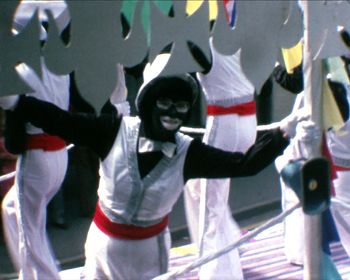
It is when we turn to home movies from the period that we see how impressionable viewers actually were when it came to seeing the practice on screen. In the postwar period, local residents blacked up in explicit imitations of British screen culture, entire floats in parades and carnivals featuring men and women performing songs as black and white minstrels. In 1961, in the North West of England, Dr. Derek Nuttall, a local filmmaker, captured the Bacup carnival procession that included children dressed as the Black and White Minstrels, among numerous other costumes.Footnote 114 In 1963, near Brighton, amateur filmmaker Cecil Cramp filmed the Horsham carnival procession that featured the “Black and White Minstrels from Jockey Mead” on a float, dancing and wearing boater hats and blackface.Footnote 115 On 25 August 1979, a local filmmaker in Rocester, Staffordshire, known as Humphries, took footage of the village festival that featured another float with adults blacked up in a blend of both the black and white minstrels and the “golliwog” that appeared in advertisements and labeling for Robertson's Golden Shred marmalade. The parade also included two men blacked up, one wearing feminine dress and carrying a large handwritten sign saying “Wogs of Rocester,” while the other, dressed as a baby, was pushed in a pram.Footnote 116 A filmmaker in Kegworth who shot films of local carnivals over a number of years from the late 1970s into the early 1980s captured a marching band blacked up and costumed like the black and white minstrels in one year, and a float in a subsequent year titled “Mississippi,” with adults blacked up and engaged in song and dance in imitation of the Black and White Minstrels Show (figure 2).Footnote 117
Sharpe: Kegworth Easter Market and Carnival Parades, 1977–1980s, MACE. Courtesy of MACE.

Further films showing adults dressed as minstrels are evident in collections in the Yorkshire Film archive.Footnote 118 The Moving Image Archive of the National Library of Scotland also holds remarkable footage of two hundred primary-school pupils performing in wooly wigs and garish costumes as the Black and White Minstrels for an audience at the Bo'Ness Fair in 1974.Footnote 119 I suspect that much more exists in media archives, as practices of blacking up as either minstrels or other figures are not always identified in current cataloguing practices in a uniform manner, or at all. The existence of such footage is evidence of the very impressionability that normally preoccupied producers and regulators of screen culture in Britain, but which was ultimately refuted by decisions to place the black and white minstrels and other blacked-up actors on screen. The evident fun and pleasure that local actors experienced when blacking up spoke of the tradition of color-blind “racial innocence” long associated with family entertainment in Britain. In the case of the Kegworth carnivals, which explicitly signaled a Mississippi setting, blacking up also continued to be associated with references to the American Deep South.
Conclusion
Blacking up's framing as racially innocent in Britain sat at a crossroads of what was perceived as America's historic race problem and its historically black and white audience, as well as a customary practice in Britain that was sanctioned by media producers and regulators in the period and by audiences themselves. This popular custom on British screens was largely untouched by efforts in the 1970s into the 1980s to consider programming for “racial minorities.” Minority programming pursued by both the BBC and ITV only facilitated the separation of minority immigrant audiences from the majority white British audience that producers of Britain's screen culture had already been serving from the interwar period onward. Entreaties since the 1960s by Sir Learie Constantine and others to broaden the inclusion of racial minorities as actors seemed to have little effect, and by 1972 a confidential report, “Non-Whites in British Television,” produced for the BBC's Audience Research Department by Bradley S. Greenberg, a professor at Michigan State University, found a woeful lack of racial diversity on British television, as measured over a week's viewing in 1971. The report's aim was to gather data because “both the BBC and the ITV have been approached by groups advocating greater presentation of non-whites on television,” and “no meaningful data exist as to the current practice.” Just 0.04 percent of the actors within drama, variety, and feature film programming were identified as “non-white,” in comparison to a BME population at the time that was stated in the report as being 2.5 percent. Of this 0.04 percent representation, the majority were actors in American shows, which included Hawaiians featured in Hawaii 5-0, broadcast on ITV at the time, and the overwhelming majority of roles were non-speaking.Footnote 120
The ongoing presence of blackface and minstrelsy on both British film and television from the 1920s to the 1970s indicates the role that film producers and organizations such as the British Board of Film Classification, BBC, and ITV played in shaping the ability of ordinary white Britons to both see and acknowledge racism. The broadcasting of “traditional” wholesome pleasures of blacking up, televised on a weekly basis for twenty years until 1978 when the Black and White Minstrel Show went off the air, and buttressed by other material discussed here that predated the existence of the Black and White Minstrel Show, ultimately silenced discussions of racism within screen culture and society more widely under the guise of color blindness. Black and Asian people who were asked to deny, or more rarely affirm, minstrelsy and blacking up as racist were thus burdened with the task of naming racism to organizations and audiences who clearly did not want to name it as such and were highly defensive. Identifying blackface as racist prompted outcries by white audiences and producers who denied or resented the authority of black and Asian immigrants to name British customs as problematic, and who denied their own central roles as a majority white audience catered to by a media that was itself highly dependent on the appeal of racialized screen content to audiences. Efforts by Flamingo, CARD, and others to acknowledge racism within screen culture were accompanied from the late 1960s onward by complaints within media organizations and the press about an emergent language of political correctness, which further characterized Britain's own audiences of color as a highly sensitive minority that suffered from seeing race everywhere. As Gavin Schaffer notes, television producers would only begin to carefully examine issues of racial representation with majority white audiences after the political gains of the National Front in 1973.Footnote 121 Even with this shift, the color-blind British audience that film and television producers imagined as their majority was still able and encouraged to enjoy the unstated and unacknowledged but consistently met traditional pleasures of blacking up and minstrelsy on screen in film and television.