Implications
The simultaneous stocking of cattle, sheep and/or goats, especially on landscapes having a heterogeneous mixture of plant species, have positive ecological and economic advantages compared with mono-species stocking. However, predation of small ruminants, especially from canines, can inflict major economic losses, thus eliminating the benefits of mixed-species stocking. Modifying small ruminant behavior so that they consistently remain in the presence of cattle can reduce or eliminate death losses of small ruminants while providing other husbandry advantages. Bonding small ruminants to cattle to form flerds is an option worth considering in lieu of traditionally managed flocks and herds. The objective of this manuscript was to briefly review some of the background of mixed-species stocking with a focus on the benefits of using animal behavior to manage mixed-species livestock groups, especially where fulltime herders are not used.
Introduction
Different herbivore species have foraged together since herbivory began. Foraging is a spatial–temporal animal process composed of a series of sequential bites among forage plants (Laca, Reference Laca2009). The sum of these bites impact the landscape either positively or negatively and also the health and well-being of the foraging animal. Among the most studied mixed-species natural ecosystems is the Serengeti-Mara Plain of Africa (Sinclair and Norton-Griffiths, Reference Sinclair and Norton-Griffiths1979; McNaughton, Reference McNaughton1985; Sinclair and Arcese, Reference Sinclair and Arcese1995; Sinclair et al., Reference Sinclair, Packer, Mduma and Fryxel2008). The concept of using mixed-species stocking dates from antiquity (Galaty and Johnson, Reference Galaty and Johnson1990), frequently in a ‘leader’–‘follower’ relationship that can reduce parasitism (Rocha et al., Reference Rocha, Bresciani, Barros, Fernandes, Silva and Amarante2008) and may improve individual animal performance (Nolan and Connolly, Reference Nolan and Connolly1976; Dickson et al., Reference Dickson, Frame and Arnot1981; Odadi et al., Reference Odadi, Jain, Van Wieren, Prins and Rubenstein2011) and improve utilization of the available vegetation (Smith, Reference Smith1965) by enhancing vegetation heterogeneity (Rook et al., Reference Rook, Dumont, Isselstein, Osoro, WallisDeVries, Parente and Mills2004). Beginning with early range managers (Jardine and Anderson, Reference Jardine and Anderson1919) to today's landscape stewards (Vandenberghe et al., Reference Vandenberghe, Prior, Littlewood, Brooker and Pakeman2009), managing more than one species of livestock offers both opportunities and challenges (Heady and Child, Reference Heady and Child1994; Walker, Reference Walker1994).
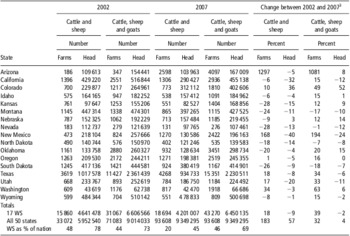
The concept of managing two or more animal species simultaneously has been referred to by several names. Range management textbooks (Stoddart et al., Reference Stoddart, Smith and Box1975; Holechek et al., Reference Holechek, Pieper and Herbel1989) refer to it as common use, whereas Bell (Reference Bell1972) called it mixing livestock. Mixed grazing (Hodgson, Reference Hodgson1979; Allen, Reference Allen1991), mixed-species grazing (Squires, Reference Squires1981), multi-species grazing (Esmail, Reference Esmail1991; Heitschmidt and Taylor, Reference Heitschmidt and Taylor1991; Coffey, Reference Coffey2001), co-grazing (Animut and Goetsch, Reference Animut and Goetsch2008), mixed stocking (Allen et al., Reference Allen, Batello, Berretta, Hodgson, Kothmann, Li, Mclvor, Milne, Morros C Peeters and Sanderson2011) and mixed-species stocking (Blanc et al., Reference Blanc, Thériez and Brelurut1999) also are used to describe this management practice. Regardless of the name given to this management practice, it may be one of the most biologically and economically viable systems available to producers, especially on landscapes that support heterogeneous plant communities. In this paper, we refer to simultaneous stocking and management of two or more animal species as mixed-species stocking. Mixed-species research began in the United States in the Edwards Plateau region of Texas during the early 1900s (Glimp, Reference Glimp1988), and by 1985 use of multiple livestock species was either proposed or being conducted in 8 of the 17 western states (Anderson et al., Reference Anderson, Smith and Hulet1985). The most recent data on number of farms and number of cattle and sheep or cattle, sheep and goats (mutually exclusive categories) obtained by the National Agricultural Statistics Service in 2002 and 2007 showed that although the overall number of cattle and sheep, as well as cattle, sheep and goats decreased for the 17 western states, the number of farms reporting either two or three of these species had actually increased (Table 1; Burt, Reference Burt2011). These data, as well as data assembled by the Food and Agriculture Organization of the United Nations reflecting country trends between 2000 and 2009 (FAOSTAT, 2011), suggest that among 237 countries, 77% have cattle, sheep and goats, and the mean trend across these 182 countries was for numbers of cattle, sheep and goats to increase over this 9-year period. Unfortunately, both the United States and global data sets reflect only the presence of livestock species by state or country. Although the United States data do reflect producers within each state having both sheep and cattle and sheep, goats, and cattle there is no information on how producers manage their livestock (i.e. as mixed-species or mono-species groupings). The FAO data simply reflect live animals by species in each country without any indication of how they are managed or how many species each producer manages. However, both data sets suggest that there is great potential for mixed-species stocking throughout the world.
Number of farms and head of stock (cattle and sheep or cattle, sheep and goats) and percent change in mixed-species farms among the 17 WS between 2002 and 2007 based on USDAFootnote 1 ,Footnote 2

WS = Western States; USDA = US Department of Agriculture Statistics.
1 The table data represents a special tabulation prepared by the National Agricultural Statistics Service, USDA in October 2011 at the request of the senior author Burt (Reference Burt2011). The data (ID 15240) are accessible at http://www.nass.usda.gov/Data_and_Statistics/Special_Tabulations/Request_a_Tabulation/data-lab-records.html.
2 Data were obtained using a questionnaire that did not differentiate between mono- v. mixed-species stocking. Data for cattle + sheep and cattle + sheep + goats are mutually exclusive. Cattle represent all non-dairy and non-feedlot cattle. The goat category represents all goats other than dairy goats.
3 Between 2002 and 2007 a ‘positive number’ indicates an increase, a ‘negative number’ indicates a decrease and a ‘0’ indicates no change between years.
Although the simultaneous management of more than one animal species presents challenges in management and marketing (Animut and Goetsch, Reference Animut and Goetsch2008), research suggests that the potential for biological and economic benefits outweigh the challenges (Brelin, Reference Brelin1979; Schuster, Reference Schuster1985). A major advantage is the better overall utilization of the standing crop, that is, animal species prefer different plant species and may use different parts of the landscape preferentially even though dietary overlap is understood to take place.
Mixed-species stocking also impacts ecological processes that are often overlooked. Research has demonstrated that cattle do not defecate randomly across the landscape. Instead defecation patterns affect nutrient cycling and plant–animal nutrition by landscape characteristics along with management factors (Tate et al., Reference Tate, Atwill, McDougald and George2003). Although cattle prefer not to graze around their dung, sheep have been reported to graze around cattle dung, thus increasing the utilization of pasture (Forbes and Hodgson, Reference Forbes and Hodgson1985). Although stocking pastures with sheep or cattle alone caused a decline in desirable forage species while decreasing soil water infiltration (increased bulk density), using sheep and cattle together maintained desirable grasses and controlled undesired ‘weedy’ species without negatively impacting water infiltration (Abaye et al., Reference Abaye, Allen and Fontenot1997).
Although one usually considers mixed-species stocking to refer to two or more of the predominant domestic ruminant livestock species (Ralphs et al., Reference Ralphs, Kothmann and Merrill1986; Abaye et al., Reference Abaye, Allen and Fontenot1994; del Pozo et al., Reference del Pozo, Osoro and Celaya1998; Animut et al., Reference Animut, Goetsch, Aiken, Puchala, Detweiler, Krehbiel, Merkel, Sahlu, Dawson, Johnson and Gipson2005a and Reference Animut, Goetsch, Aiken, Puchala, Detweiler, Krehbiel, Merkel, Sahlu, Dawson, Johnson and Gipson2005b; Celaya et al., Reference Celaya, Oliván, Ferreira, Martínez, García and Osoro2007; Sanon et al., Reference Sanon, Kaboré-Zoungrana and Ledin2007), wildlife if present should be considered as part of the mix (Grelen and Thomas, Reference Grelen and Thomas1957; Milne et al., Reference Milne, Macrae, Spence and Wilson1978; Bryant et al., Reference Bryant, Kothmann and Merrill1979; Campbell and Johnson, Reference Campbell and Johnson1983; Bastian et al., Reference Bastian, Jacobs, Held and Smith1991; Gallina, Reference Gallina1993; Didier et al., Reference Didier, Villca and Abasto1994; Kreuter and Workman, Reference Kreuter and Workman1996 and Reference Kreuter and Workman1997; Vavra, Reference Vavra2005; Williams and Haynes, Reference Williams and Haynes2006; Anderson and McCuistion, Reference Anderson and McCuistion2008). Although not specifically addressed in this paper, the addition of wildlife to the species mix can create additional management challenges and economic opportunities from both ecotourism (Georgiadis et al., Reference Georgiadis, Ihwagi, Olwero and Romañach2007) and sport hunting or game cropping (Denney, Reference Denney1972; Demarais et al., Reference Demarais, Osborn and Jackley1990). If wild ungulate management is part of a multi-species stocking program, adequate habitat is probably the most critical factor to be managed to ensure profitability (Scotter, Reference Scotter1980). Furthermore, mixed-species stocking may also involve animals other than ruminants, including swine (Sehested et al., Reference Sehested, Søegaard, Danielsen, Roepstorff and Monrad2004), horses (Hubbard and Hansen, Reference Hubbard and Hansen1976; Gudmundsson and Dyrmundsson, Reference Gudmundsson and Dyrmundsson1994; Menard et al., Reference Menard, Duncan, Fleurance, Georges and Lila2002; Loucougaray et al., Reference Loucougaray, Bonis and Bouzillé2004) and even chickens (Duffy, Reference Duffy2009).
Considerations when combining animal species
Livestock production on rangelands supports a large proportion of today's human population and this is not expected to change in the foreseeable future (Raney et al., Reference Raney, Skoet and Steinfeld2009). Even though a substantial amount of private rangelands in the United States is currently being purchased by amenity buyers (Gosnell and Travis, Reference Gosnell and Travis2005), worldwide livestock production from rangelands forms a key part of the complex livelihood of producers (Seré et al., Reference Seré, Ayantude, Duncan, Freeman, Herrero, Tarawali and Wright2008).
Depending on whose classification is used, rangelands comprise between 33% (McGuire, Reference McGuire1978) and 80% (Lund, Reference Lund2007) of the earth's terrestrial surface. Classification systems also impact the identification of vegetation with synonymy being largely responsible for the wide range in the estimated number of seed plants worldwide (223 300; Scotland and Wortley, Reference Scotland and Wortley2003; 422 127; Govaerts, Reference Govaerts2001). Of these plant species, ∼34 455 are found in North America (Govaerts, Reference Govaerts2001). Although foraging animals may utilize certain plant species in amounts that far exceed their presence in the landscape (van Dyne et al., Reference van Dyne, Brockington, Szocs, Duek and Ribic1980), overall only ∼10% of the net primary production of terrestrial ecosystems serves as principal dietary components of herbivores (Crawley, Reference Crawley1983). Merrill et al. (Reference Merrill, Thomas and Hardy1957) suggested that a plant community having a combination of forage classes is best suited for mixed-species stocking. Ruyle and Bowns (Reference Ruyle and Bowns1985) go so far as to say that vegetation can maintain a stable composition under higher foraging pressure when two herbivores rather than one are used to stock a pasture, whereas Aich and Waterhouse (Reference Aich and Waterhouse1999) state that too little, as well as too much foraging by small ruminants, can lead to environmental degradation in temperate zones. Foraging is a multifaceted and complex phenomenon involving many aspects of the abiotic, as well as the biotic components of a landscape, the standing crop, the animal and its behavior and ultimately the interface of plant and animal components within a non-static spatial and temporal context.
Aspects of the plant and animal interface
Worldwide, overgrazing is a primary issue in range management (Menke and Bradford, Reference Menke and Bradford1992). Therefore, the first step in any foraging system should be to determine and apply the proper stocking rate using the most appropriate animal species. The second most important factor on animal-dominated landscapes is animal distribution. Although we know at least 68 factors that can impact distribution (Anderson, Reference Anderson2010), no single perfect management technique will ensure proper distribution and ultimately produce proper forage utilization.
Procedures for calculating proper stocking rates are available to estimate how many animals a given landscape can support (Holechek et al., Reference Holechek, Pieper and Herbel1989; Holechek and Pieper, Reference Holechek and Pieper1992; Pratt and Rasmussen, Reference Pratt and Rasmussen2001). In fact, formulae have been developed for calculating economically optimal stocking rates (Koen, Reference Koen1987) and for choosing locations where herbicide use can be replaced with biological control (Warren et al., Reference Warren, Ueckert, Shelton and Chamrad1984; Bangsund et al., Reference Bangsund, Nudell, Sell and Leistritz2001). Stocking rates affect the quality and quantity of forage during future years (Animut et al., Reference Animut, Goetsch, Aiken, Puchala, Detweiler, Krehbiel, Merkel, Sahlu, Dawson, Johnson and Gipson2005b), and therefore play a key part in the success or failure of all grazing strategies involving mixed-species stocking.
In the Willamette Valley of Oregon where precipitation is ∼114 cm (45 inches) annually, Bedell (Reference Bedell1968) found neither light nor heavy stocking rates produced large differences in forage selection pattern for either cattle or sheep. However, the benefit from mixed-species stocking for a particular animal species may increase as the proportion of that species in the mix decreases (Dickson et al., Reference Dickson, Frame and Arnot1981).
A common ‘currency’ that can be used to determine the correct number of each animal species to place on a particular landscape is the animal unit equivalent (Havstad et al., Reference Havstad, Fredrickson and Estell2004). Although animal units (AU) do not account for dietary differences among species (Hobbs and Carpenter, Reference Hobbs and Carpenter1986), they can serve as a guide when deciding how many animals to stock. Even though the concept of animal unit is best applied to cattle, it is also used for interspecific calculations (Scarnecchia, Reference Scarnecchia1985). For interspecific calculations, the mean mature mass of the animal species being considered should be divided by 500 kg. The denominator is the mean mass of one mature, non-lactating bovine fed at maintenance for zero gain in the middle third of pregnancy expressed as weight0.75 (Allen et al., Reference Allen, Batello, Berretta, Hodgson, Kothmann, Li, Mclvor, Milne, Morros C Peeters and Sanderson2011). A major consideration is that food requirements among species increase with increases in body mass (Moen, Reference Moen1973; Brown, Reference Brown1995).
Plants can be grouped into three life forms: a classification dating to the 1800s (Warming, Reference Warming1895). These three broad classification categories place all seed-bearing plants within three broad categories: grasses, forbs (herbaceous dicots commonly referred to as weeds) and woody plants (phenology can range from shrubs to trees depending on their response to effective precipitation and past management practices). It is from among these three plant categories, often found in a patchy mosaic (Dumont et al., Reference Dumont, Carrere and D'Hour2002), that most domestic ruminant livestock select their diets. Browsers and grazers differ in their foraging behavior (Gordon, Reference Gordon2003). Although care should be exercised when making generalizations about ruminant diets, in general, cattle prefer grass, sheep select forbs when given an opportunity and goats tend to browse trees and shrubs when both an understory of herbaceous, as well as an overstory of woody vegetation exists (van Dyne et al., Reference van Dyne, Brockington, Szocs, Duek and Ribic1980; Skiles, Reference Skiles1984). However, a great variability exists within a species as to diet preferences (Dumont et al., Reference Dumont, D'hour and Petit1995) and diets can be modified by husbandry practices.
Heady (Reference Heady1964) proposed that it is through the interaction of preference (an animal characteristic) and palatability (a characteristic of the plant) that foraging takes place. Although preference may be relatively easy to determine, its impact on the standing crop is not always straightforward (Pollock et al., Reference Pollock, Legg, Holland and Theobald2007). Recently, Laca (Reference Laca2009) suggested that when plant associations are ‘less patchy’ and ‘well mixed’ across a landscape, livestock apparently are less able to select a preferred diet. This phenomenon partially explains the heterogeneous use of large pastures (Vallentine, Reference Vallentine1990) and the effect of plant spatial patterns on herbivore foraging (Anderson et al., Reference Anderson, Smith and Hulet1985; Clarke et al., Reference Clarke, Welch and Gordon1995; Hester et al., Reference Hester, Gordon, Baillie and Tappin1999; Dumont et al., Reference Dumont, Carrere and D'Hour2002). Thus, understanding animal behavior is crucial to managing standing crop utilization.
Dietary preferences are not random among ungulates but have evolved since the Miocene and Ecocene epochs within heterogeneous vegetation communities in which mono-cultures are rare (Stebbins, Reference Stebbins1981; Janis et al., Reference Janis, Damuth and Theodor2000). Therefore, the dietary plasticity scientifically demonstrated among herbivores (Villalba and Provenza, Reference Villalba and Provenza2009) further suggests mixed-species stocking may be an ecologically superior method for sustainably harvesting forage resources. Ruminants not only have unique anatomical characteristics (Shipley, Reference Shipley1999), they have the ability to digest plant materials high in cellulose (van Soest, Reference van Soest1994). Interspecific differences in diet digestibility between goats and sheep (Alcaide et al., Reference Alcaide, García and Aguilera1997) and intraspecific differences between Spanish and Angora goats in the use of juniper (Pritz et al., Reference Pritz, Launchbaugh and Taylor1997) have been reported. Larbi et al. (Reference Larbi, Smith, Raji, Kurdi, Adekunle and Ladipo1997) reported intraspecies and interspecies variation in ruminal digestion of browse among sheep, goats and cattle. These findings combined with the fact that animals are not static in their individual dietary preferences (Loehle and Rittenhouse, Reference Loehle and Rittenhouse1982) or in their spatial and temporal use of landscapes (Kothmann, Reference Kothmann1980) makes studying and understanding mixed-species foraging a complex and a challenging process.
Where dietary overlap among species is minimal, mixed-species stocking will spread grazing pressure equitably among plant species (Esmail, Reference Esmail1991). In mixed-species livestock/wildlife groupings, cattle and elk appear to have similar diets, whereas white-tailed deer in an Idaho forest preferred forbs and shrubs (Kingery et al., Reference Kingery, Mosley and Bordwell1996). Recent reconstruction of paleodiets suggests that mixed diets may have been the original feeding style of deer rather than specialized leaf eating that was once universally regarded as the ancestral state of all ruminants (DeMiguel et al., Reference DeMiguel, Fortelius, Azanza and Morales2008). Although browsing cattle may be the exception to the rule, cattle too can have a high proportion of browse in their diets (Squires, Reference Squires1982).
Cattle, sheep and goats can be classified into three feeding categories: grazers, intermediate feeders and browsers (Hofmann, Reference Hofmann1989). Horses are generalist herbivores that contribute to structural diversity of tall and short grasses (Menard et al., Reference Menard, Duncan, Fleurance, Georges and Lila2002). Overall, goats tend to eat a wider range of plant species than do cattle or sheep (Taylor, Reference Taylor1985). Furthermore, animal diets show distinct diurnal patterns (Kothmann, Reference Kothmann1966; Solanki, Reference Solanki1994). Possibly because of their varied diets, goats are particularly important in marginal agricultural lands, especially in arid and semiarid environments (Lebbie, Reference Lebbie2004). Sheep can browse, as well as graze, and together cattle and sheep may actually use more browse than either species alone (Ruyle and Bowns, Reference Ruyle and Bowns1985). Mellado et al. (Reference Mellado, Valdez, Lara and Lopez2003) found that overstocking with goats not only reduced shrubs but also grass cover. Because of differing anatomical adaptations and dietary preference differences between goats and cattle, their diets tend to show the least similarity, whereas cattle v. sheep and goat v. sheep diets may be similar (Taylor, Reference Taylor1985). Recently reported research suggests that in subtropical grasslands cattle and sheep exhibited spatial complementarity across seasons (Bendersky et al., Reference Bendersky, Díaz, Cendoya, Brizuela, Cid, Cibils and Pizzio2011) and this has also been shown on semiarid landscapes (Anderson et al., Reference Anderson, Smith and Hulet1985). One of the most beneficial aspects of mixed-species stocking may be that certain plant species that are toxic to one animal species may actually serve as forage for another species (Krueger and Sharp, Reference Krueger and Sharp1978; Popay and Field, Reference Popay and Field1996). Food preferences are apparently controlled by flavors (Villalba and Provenza, Reference Villalba and Provenza2009), as well as post-ingestive feedback (Yearsley et al., Reference Yearsley, Villalba, Gordon, Kyriazakis, Speakman, Tolkamp, JIllius and Duncan2006), and although taste appears to be the primary sense to the foraging animal (Krueger et al., Reference Krueger, Laycock and Price1974) all senses play a role (Kare and Halpern, Reference Kare and Halpern1961). Even when the major senses have been experimentally impaired, forage selection was not found to occur randomly (Krueger et al., Reference Krueger, Laycock and Price1974). This suggests that sensory integration is occurring. One such relationship may involve the sense of touch in the tongue interacting with other touch receptors in the lips to influence diet selection. Early research revealed ruminants are sensitive to sweet, salty, bitter and sour tastes (Bell and Kitchell, Reference Bell and Kitchell1966). Although intraspecific differences exist (Goatcher and Church, Reference Goatcher and Church1970a), individuals within the same species show considerable variability in their response to these four tastes (Goatcher and Church, Reference Goatcher and Church1970b; Morand-Fehr et al., Reference Morand-Fehr, Ben Ayed, Hervien and Lescoat1997). Cattle appear to prefer sweet over other tastes (Nombekela et al., Reference Nombekela, Murphy, Gonyou and Marden1994), whereas goats and sheep are ∼10 times more tolerant to salt than cattle and both sheep and goats are more tolerant to bitter-tasting materials than cattle (Goatcher and Church, Reference Goatcher and Church1970b; Lu, Reference Lu1988). These data suggest that because standing crop contains plants exhibiting a range of differences in chemical composition, including saltiness (van Niekerk et al., Reference van Niekerk, Hassen, Snyman, Rethman and Coertze2009) and bitterness (Marten, Reference Marten1973), a mix of animal species may be the most efficient way to harvest the standing crop. The same chemical constituents also tend to vary by forage class, with forbs and woody vegetation having more compounds perceived as bitter. Therefore, browsing animals are more likely to be adapted to have greater tolerance to bitter compounds. Although an animal's innate physiology impacts dietary choices (Mellado et al., Reference Mellado, Olivares, Pittroff, Díaz, López and Villarreal2007), learning is important, especially with juveniles who learn from their dams (Hinch et al., Reference Hinch, Lecrivain, Lynch and Elwin1987) and peers (Chapple et al., Reference Chapple, Wodzicka-Tomaszewska and Lynch1987). All the factors known to affect foraging make an animal's dietary choices dynamic and plastic both spatially and temporally.
Opportunities using mixed-species stocking
Besides the previously discussed positive benefits of mixed-species stocking, on the landscape, there can also be economic benefits. Although there are added costs to managing more than one animal species, Esmail (Reference Esmail1991) suggests that marketing more than one species of animal can lead to more economic stability for an enterprise if the cost of mixed-species production is similar to marketing a single animal species. However, there is little literature to determine the best proportion of cattle to sheep (Nolan and Connolly, Reference Nolan and Connolly1976). Over a 20-year study, Taylor (Reference Taylor1985) found in Texas that cattle gained significantly more per head when stocked with sheep and goats than when stocked alone. Similarly, sheep liveweight gain increased when they were stocked with cattle and goats compared with their being grazed alone. Furthermore, percent lamb crop and wool production was greater when sheep and cattle were stocked together compared with sheep foraging alone. Mohair production and goat liveweight was not statistically different among goats in mixed- and mono-species stocking. Research from the Virginia Cooperative Extension Service suggests that adding sheep to a cattle-only enterprise could increase net income 29% above cattle-alone enterprise (Umberger et al., Reference Umberger, McKinno and Eller1983). Jordan et al. (Reference Jordan, Phillips, Morrison, Doyle and McKenzie1988) reported that lambs pastured with both cattle and sheep gained more weight than lambs grazing only with sheep; however, calves did not appear to benefit but this may have been due to a parasitic helminth infection. This observation agrees with earlier work of Smith and Archibald (Reference Smith and Archibald1965) who suggested cattle probably play an insignificant role in perpetuating parasitism in sheep.
Challenges with mixed-species stocking
One of the greatest challenges to implementing domestic mixed-species stocking may be in the control of predators (Walker, Reference Walker1994), especially predation among small ruminants (Merrill, Reference Merrill1985). However, in production agriculture, assigning the correct cause for animal losses (especially from predation) can be challenging (Gegner, Reference Gegner2002), because the causes of livestock depredation are many and varied and require a high degree of monitoring to arrive at accurate conclusions (Linnell et al., Reference Linnell, Smith, Odden, Kaczensky and Swenson1996). A ‘reason’ frequently given for the co-occurrence of multiple wildlife species being found together in nature is for predator protection (Fitzgibbon, Reference Fitzgibbon1990). Overall, coyotes appear to pose the most serious threat to sheep in the United States of America (Blejwas et al., Reference Blejwas, Sacks, Jaeger and McCullough2002), although other predators can be major threats in other parts of the world (Mazzolli et al., Reference Mazzolli, Graipel and Dunstone2002). For canine predators, principally coyotes, guard dogs and electric fences have proven effective (Hulet et al., Reference Hulet, Shupe and Howard1987b). In the suite of methods used to control coyote predation, one of the more novel approaches has capitalized on livestock behaviors to provide protection for sheep and goats.
Flerds
The Jornada Experimental Range (JER) introduced sheep into its research program in 1983 in an attempt to more fully utilize plant species not being utilized by cattle. During 1984, 44% of the original 144 range-managed ewes were killed as a result of coyote predation (Hulet et al., Reference Hulet, Shupe and Howard1987b). To combat this death loss, a number of predator control measures were introduced, including the use of Turkish Akbash guard dogs, electrified fences, trapping, poison baits and hunting coyotes from a hang glider and snares. In addition, a technique using animal behavior was initiated to reduce coyote predation. This behavioral modification was initiated on the basis of information gained from a mixed-species conference held in Morrilton, AK in the mid-1980s in which an astute California livestock producer suggested that he experienced less predation when he ran cattle and sheep together in the same paddock (Blackford, Reference Blackford1985).
The JER's mixed-species research revealed that cattle and sheep seldom used the same areas of a paddock simultaneously when stocked together (Anderson et al., Reference Anderson, Smith and Hulet1985). Under free-ranging conditions the interspecific group would form at least two distinct intraspecific groups (a herd of large ruminants and one or more flocks of small ruminants). On the basis of Blackford's experience in California and a search of the literature, it was discovered that when steers and sheep were maintained together in small plots they would form a social cohesion (Bond et al., Reference Bond, Carlson, Jackson and Curry1967). This association has been described in the psychological literature as cross-specific attachment formation (Cairns, Reference Cairns1966). On the basis of this information and observations of the JER livestock, a research program was begun to investigate whether sheep could be trained to remain in the presence of cattle under free-ranging conditions. The objective was to determine whether this association would reduce coyote predation on the basis of several observations, including (1) JER cows consistently demonstrated an aggressive posture when dogs were used to move them, (2) when the cattle were threatened by dogs, they would initially ‘bunch’ together into a circle with their heads facing the dog; however, with added pressure from the dog, the cattle would frequently become aggressive as they attempted to move away from the dog and kick the dog if it came too close and (3) JER sheep would simply run from the dog if they were pursued. On the basis of these observations, the following question was asked: if sheep were near cattle under free-ranging conditions, would they receive protection from coyotes through the formation of a cohesive and enduring single animal group? This association was termed a flerd, a contraction of flock and herd (Anderson et al., Reference Anderson, Hulet, Shupe, Smith and Murray1988).
How to form a flerd
Penning 45-, 62- and 90-day-old weaned lambs with 8- to 9-month-old heifers for as little as 30 days resulted in lambs within this age range becoming bonded to cattle as indicated by their tendency to stay near cattle when evaluated under free-ranging conditions (Anderson et al., Reference Anderson, Hulet, Smith, Shupe and Murray1987a). During a subsequent 163 days following an additional 30 days of pen confinement with cattle, none of the bonded lambs that had been penned with cattle for 60 days were lost to predation, whereas the loss of nonbonded lambs averaged one sheep every 5 days (Hulet et al., Reference Hulet, Anderson, Smith and Shupe1987a). Later, it was demonstrated that the bond between sheep and cattle could be formed in as little as 14 days (Fredrickson et al., Reference Fredrickson, Anderson, Estell, Havstad, Shupe and Remmenga2001) with the socialization leading to interspecific bond formation occurring even earlier in some individuals. However, experience from JER research suggested that the bond must ‘mature’ for it to endure under free-ranging conditions. Thus, the longer sheep and cattle can remain together while the bond is forming, the more enduring the bond becomes. Furthermore, the bond appears to be directional in that bonded sheep will follow any cow that will tolerate this behavior. This provides an advantage from coyote predation compared with small ruminants that remain in a single intraspecies group. Regardless of the number of splinter groups of bonded small ruminants that may form, each small ruminant will be found with at least one cow.
In the initial study, the 62-day-old lambs did not form a bond with cattle because of physical abuse by one heifer to the lambs while they were in that penned group (Anderson et al., Reference Anderson, Hulet, Smith, Shupe and Murray1987b). This observation highlights the importance of observing and stopping abusive animal behaviors immediately when creating a flerd.
Small and large ruminants can also be socialized under field conditions to produce a flerd (Hulet et al., Reference Hulet, Anderson, Shupe and Murray1992b). To facilitate field bonding and help ensure cohesiveness, one or more bonded wethers can form the initial ‘core flerd’ to which ewes are then added. The JER research revealed that a bonded wether consistently remained closer to the cattle and was much more difficult to separate from cattle than similar-aged ewes (Anderson et al., Reference Anderson, Estell, Havstad, Shupe, Libeau and Murray1996). When bonding small ruminants to cattle under field conditions, it is best to initially add a single sheep or goat to a ‘core flerd’ and observe for enduring cohesiveness over a 3- to 4-day period, then continue the process until a flerd size is appropriate for the area to be stocked. This protocol is based on the behavior of small ruminants to want to be with peers because of strong intraspecific bonds (Hunter, Reference Hunter1960). The number of animals to be added to the core flerd at one time and the interval between additions vary based upon the behavior of the individual(s) being added and the behavior of the flerd. Therefore, there is no formula for adding animals; rather, focus on observations of cohesiveness of the ‘growing flerd’ and the endurance of this cohesiveness over time without intervention. To assist in the bonding process, a dog trained to hand and voice signals can be used to periodically ‘bunch’ members of the flerd under field conditions. As the dog is sent into the flerd, the small ruminants should run toward the cattle. As it is desirable to train the small ruminants to follow cattle in a flerd configuration, always move the small ruminants toward the cattle.
As a bond ‘matures’, interspecific separations can and will increase compared with the initial bond. However, this separation does not appear to jeopardize the effectiveness of the flerd or its ability to provide protection from coyotes. Although it is prudent to establish bonded small ruminants using the youngest animals possible, yearling ewes formed an attraction to heifers averaging 3 months of age (Anderson et al., Reference Anderson, Hulet, Smith, Shupe and Murray1992).
Goats too have been successfully incorporated into flerds. Hair goats (Angora) were the first breed to be added (Hulet et al., Reference Hulet, Anderson, Smith, Shupe, Taylor and Murray1989) followed by meat goats (Spanish; Hulet et al., Reference Hulet, Anderson, Smith, Shupe and Murray1991). Although both Mohair and Spanish goats will merge into a sheep–cow flerd, Mohair goats formed closer bonds with cattle than did Spanish goats. Mean nearest neighbor distances have been observed to differ among sheep breeds (Arnold and Dudzinski, Reference Arnold and Dudzinski1978, p. 60), and similar differences would also be expected among goat breeds, thus helping explain the differences in flerd cohesiveness when hair instead of meat goats were used.
To determine how bonding affected foraging, diets from a flerd were compared with nonbonded animal groups. Between April and June 1986 with above-average precipitation, small ruminant diets in a flerd and nonbonded small ruminants differed (Anderson et al., Reference Anderson, Hulet, Hamadeh, Smith and Murray1990). Lambs bonded to cattle consumed a diet containing 35% grass, 59% forbs and 5% shrubs. This diet was 7% higher (P = 0.0048) in grass, 5% lower (P = 0.0858) in forbs and 4% lower (P = 0.0189) in shrubs compared with nonbonded sheep diets. In contrast, cattle diets from the two groups did not differ (P ⩾ 0.05) but averaged 57% grass, 35% forbs and 8% shrubs. A comparison of small ruminant diets during the 1988 growing season, again with above mean precipitation, (July, August and September) produced grass, forb and shrub components in the diets that differed <5% between bonded and nonbonded sheep, whereas the cattle diets between the two groups were similar (Hulet et al., Reference Hulet, Anderson, Nakamatsu, Murray and Pieper1992a).
Flerds can offer additional husbandry advantages besides predator protection. An ecological benefit is that flerds spread small ruminant foraging more uniformly over the landscape, thus fostering better animal distribution compared with nonbonded flocks (Anderson et al., Reference Anderson, Murray, Sun, Fredrickson, Estell and Nakamatsu2011). Furthermore, sheep co-grazing with cattle in a flerd are easier to locate because bonded small ruminants consistently stay near cattle and fencing that contains cattle will contain bonded small ruminants, thus removing the need for costlier sheep/goat fencing (Anderson et al., Reference Anderson, Havstad, Shupe, Libeau, Smith and Murray1994).
Combining flerds with other methodologies hold great promise. When virtual fencing (Anderson, Reference Anderson2007; Umstatter, Reference Umstatter2011) becomes a commercial reality, controlling cattle movements will simultaneously control bonded small ruminant movement. However, if human or livestock health or safety issues cannot be breached, then controlling livestock with virtual fencing is not an option as this means of animal control is based on modifying animal behavior without physical barriers. Combining flerds with semiautomated walk-over-weighing systems for sheep (Geenty et al., Reference Geenty, Lee, Atkins, Smith and Sladek2009) and cattle (Anderson and Weeks, Reference Anderson and Weeks1989) and the directional training of small ruminants (Taylor et al., Reference Taylor, Hinch, Trotter, Brown, Price, Doyle and Lamb2009), mixed-species stocking management may be one of the lowest stress (Smith, Reference Smith1998) animal husbandry practices for converting plant protein into animal protein. Implementation of mixed-species animal management must realistically address contemporary conservation objectives (Evans et al., Reference Evans, Redpath, Evans, Elston, Gardner, Dennis and Pakeman2006) and provide a meaningful lifestyle to managers with both ecological and economic benefits in order to meet food demands of a growing global population.
New and evolving management methodologies require additional research, and flerds are no exception. At least three topics deserve further investigation. (1) Which senses are responsible for producing bond development in small ruminants? This information might decrease length of time for bond formation. As oxytocin plays a prominent role in the development of social bonding (Carter et al., Reference Carter, Williams, Witt and Insel1992), it would be worthwhile to determine whether this hormone could be used to create flerds. (2) What is the ratio of bonded small ruminants to cattle for optimum predator protection? This will be a challenge because livestock breed, season and landscape topography are just a few of the factors (Anderson, Reference Anderson2010) that can affect how animals distribute themselves over a landscape. (3) What is the maximum size flerd that will remain cohesive over time? This too will likely be site specific.
Conclusion
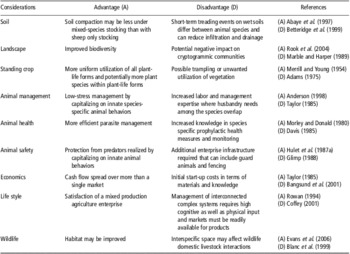
Mixed-species stocking is not a new livestock management concept. However, research suggesting that using animal behavior to facilitate mixed-species stocking is new. Agricultural census data suggest that mixed-species stocking has the potential to grow in the United States and worldwide, especially with goats. As with any agricultural enterprise both the pros and cons (Table 2) must be considered before adopting mixed-species husbandry. However, if flerds are used to accomplish mixed-species stocking, at least four benefits can be expected: (1) a reduction in predator losses due to canine predation, (2) less time is required to physically check livestock groups because large and small ruminants will consistently be found together, (3) adequate fencing to control cattle can also control small ruminants that are bonded to cattle and (4) Flerd small ruminants tend to spread themselves more evenly over the landscape during foraging compared with nonbonded flocks, thus improving livestock distribution.
Nine scientific pros and cons to consider before implementing mixed-species stocking

Acknowledgement
The assistance of retired USDA-ARS, JER technicians Mr. Roy Libeau and Mr. Larry Shupe together with numerous additional support staff are acknowledged for their time and insight when collecting the field data involving flerds, flocks and herds.