Most of our decisions carry some amount of risk. When people work, do sports, interact socially, make decisions about health, or gamble, they often make risky decisions that could affect their own and others’ lives and futures. This is also the case when driving: in fact, most traffic casualties are due to human factors. To illustrate, about 1.24 million people die each year in road accidents around the world and a significant proportion of these deaths is due to risky decision making on the road (World Health Organization, 2013).
A risky behavior always involves a decision. Normative models have proposed four sequential steps to explain the process of decision making. First, people build a mental representation of the decision situation. Second, they make an evaluation of the different behavioral alternatives and the possible consequences or degree of risk associated with each alternative. Third, they make a decision, usually based upon previous evaluations. Finally, they receive feedback on their choice, which guides their future behaviors in similar situations (Rangel, Camerer, & Montague, Reference Rangel, Camerer and Montague2008, among others). However, people do not always make risky decisions following rational rules. Instead, they often do so in an irrational way, following their emotions and processing the situation in a more automatic fashion (Loewenstein, Weber, Hsee, & Welch, Reference Loewenstein, Weber, Hsee and Welch2001; Slovic, Finucane, Peters, & MacGregor, Reference Slovic, Finucane, Peters and MacGregor2007).
Dual-system theories have dominated the study of risk perception and risk taking during the last decades (see Alós-Ferrer & Strack, Reference Alos-Ferrer and Strack2014, for a recent review). These theories may explain why in many situations people take risks, even though these seem to be irrational and could have fatal consequences (e.g., in gambling addictions, risky sports or driving). Dual-system theories postulate that human behavior is the result of the interplay of two different modes of processing (Evans, Reference Evans2008). A controlled processing system (often also called rational, reflective or system 2) which relied mostly on rational rules, and is characterized as slow, conscious, and deliberative. And, an automatic processing system (also known as experiential, reflexive or system 1) faster, unconscious, effortless, and controlled by well-learned prior associations and emotional factors (Kahneman, Reference Kahneman2011; Lieberman, Reference Lieberman, Forgas, Williams and von Hippel2003; Strack & Deutsch, Reference Strack and Deutsch2004).
Research on risky behavior has demonstrated a dissociation between two components of the decision making process: “risk perception/evaluation” and “risky decisions” (Slovic et al., Reference Slovic, Finucane, Peters and MacGregor2007). For instance, recent studies on risky driving showed a clear dissociation between an evaluative judgment of risk (e.g., this situation is risky or not) and the risky decision itself (e.g., braking or not braking Megías, Maldonado, Cándido, & Catena, Reference Megías, Maldonado, Cándido and Catena2011). These studies established the distinction between evaluative and urgent behavior and demonstrated how they can be modulated by emotions in different ways. Further, these results suggested that urgent behavior relies more upon the automatic-experiential system involving more experiential and emotional processing of the situation, whereas evaluative behavior seems to depend more on the controlled-rational system (Megías et al., Reference Megías, Navas, Petrova, Cándido, Maldonado, Garcia-Retamero and Catena2015).
Most research on the role of the two systems in risk perception and risky decision making has focused on the manipulation of the context (i.e., the frame, see Slovic et al., Reference Slovic, Finucane, Peters and MacGregor2007) and the role of emotional factors (e.g., mood, see Megías, Maldonado, Cándido et al., Reference Megías, Maldonado, Cándido and Catena2011; Pessoa, Reference Pessoa2009). However, few studies have investigated how feedback, the last step of the decision making process, could influence or modulate evaluations and decisions in risky situations.
Regarding the effect of feedback on decision making, recent theoretical accounts (Simen, Cohen, & Holmes, Reference Simen, Cohen and Holmes2006; Simen et al., Reference Simen, Contreras, Buck, Hu, Holmes and Cohen2009) proposed that the reward rate provides a global signal that controls the decision threshold during a task: the larger the reward, the lower the selected decision threshold. This idea has been supported by experimental results indicating that participants adjust their decision thresholds in order to maximize the reward rate (Simen et al., Reference Simen, Contreras, Buck, Hu, Holmes and Cohen2009). It has been suggested that not only the average rate of recently received rewards but also the opportunity to escape from an aversive situation may lower the decision threshold (Niv, Reference Niv2007). Thus, we can speculate that an unpleasant stimulus might lower the threshold for a decision made around that time, consequently speeding up responses in risky situations (see Contreras, Megías, Maldonado, Cándido, & Catena, Reference Contreras, Megías, Maldonado, Cándido and Catena2013).
In the case of driving, the usual way to control risky driving has been with propaganda emphasizing the negative consequences of risky behavior and penalizing it. However, no research to our knowledge has systematically analyzed the effect of negative emotional feedback on both the evaluation of risk and the actual risky behavior. Therefore, the main aim of this research was to analyze the process of decision making in risky driving situations. First, we aimed to demonstrate once again the dissociation between risk evaluation and actual risky decisions (i.e., braking), based on previous research and dual process theories (Megías, Maldonado, Cándido et al., Reference Megías, Maldonado, Cándido and Catena2011). Second, we sought to verify how negative emotional feedback could modulate and interact with risk evaluation and risky decisions (i.e., urgent versus evaluative behavior) in risky driving situations.
Experiment 1
When driving, we often encounter risky situations and are forced to make urgent decisions such as braking to avoid accidents with serious consequences. This shows that risk perception and risky decision making are an important part of driving, especially in situations where a slow or wrong decision could lead to severe consequences.
As already mentioned, previous research demonstrated that evaluation of risk and the actual risky behavior (e.g., braking) differ and are related to different processing systems (Megías, Maldonado, Cándido et al., Reference Megías, Maldonado, Cándido and Catena2011). To illustrate, urgent behaviors were faster and showed a larger response bias toward braking than evaluating risk, although they also showed a worse risk sensitivity. Similarly, urgent and evaluative behaviors were also differentially influenced by emotional stimuli appearing in driving situations (Megías, Maldonado, Cándido et al., Reference Megías, Maldonado, Cándido and Catena2011). These results accord with dual process theories of risky decision making and support the idea that risk evaluation mostly relies on the rational-controlled processing system, whereas urgent behavior relies on the more automatic, emotional, and experiential system.
In this first experiment, we investigated the influence of emotional feedback on both urgent and evaluative behavior. To do so we used three different groups. In a control group we aimed to replicate the dissociation observed in previous experiments: In an evaluative task participants had to decide if the situations involved risk (or not), while in an urgent task they had to brake (or not) (Megías, Maldonado, Cándido et al., Reference Megías, Maldonado, Cándido and Catena2011, Megías, Reference Megías2014). In two experimental groups we used the same tasks and associated the risky response with feedback. In particular, in the first experimental group participants received a written message about whether they had an accident as a consequence of their decision (verbal feedback). In the second experimental group, instead of a message, a negative emotional image showing an accident was presented (emotional feedback).
We made several hypotheses: a) according to Megías, Maldonado, Cándido et al. Reference Megías, Maldonado, Cándido and Catena2011; Megías et al. (Reference Megías, Navas, Petrova, Cándido, Maldonado, Garcia-Retamero and Catena2015) previous studies, it is expected a trend towards more cautious responses in the urgent tasks compared to the evaluative task, that is, a higher probability of response and larger response bias toward braking than evaluating risk. In addition, urgent behavior should also be characterized by faster responses and worse risk sensitivity than evaluative behavior. b) We expected feedback, especially when provided with emotional images, to reduce risky behavior (higher probability of response and larger response bias toward “to brake/to evaluate risk”) and increase the response speed.
Method
Participants
Ninety-six students from the University of Granada volunteered to take part in the study in exchange for course credits (mean age: 21 years; range: 19–25; 60 women and 36 men). All of them had normal or corrected-to-normal vision. Participants were informed that unpleasant pictures would be displayed during the experiment and that they were free to abandon the study at any time without losing credits. They signed an informed consent form and were treated in accordance with the Helsinki declaration (World Medical Association, 2013).
Stimuli
A set of 60 images depicting traffic situations from the driver’s perspective were presented to the participants. All images were captured from the Honda Riding Trainer Simulator (see Di Stasi et al., Reference Di Stasi, Álvarez-Valbuena, Cañas, Maldonado, Catena, Antolí and Cándido2009, for more details about the simulator). The images had a resolution of 1024x768 pixels and were displayed on a 14" TFT monitor. Forty-five of the driving images presented risky situations, while the remaining fifteen showed no risk. The selected risky situations had a medium risk level of 3.89 (on a scale from 1 to 7) as identified by a previous parametric study (Megías, López-Riañez, & Cándido, Reference Megías, López-Riañez and Cándido2013).
For the emotional feedback manipulation five pictures with negative valence showing traffic accidents were selected from the Spanish version of International Affective Picture System (IAPS) (Vila et al., Reference Vila, Sánchez, Ramírez, Fernández, Cobos, Rodríguez and Moltó2001; IAPS image Codes: 9900, 9911, 9912, 9913, 9920). Mean valence of the pictures was 3.2 (1: very negative –9: very positive) and mean arousal was 5.11 (1: low arousal –10: high arousal).
Procedure
Participants were randomly assigned to one of three experimental conditions: control group, verbal feedback group, and emotional feedback group. All participants performed two tasks: an evaluative and an urgent task. Both tasks were identical except for the requested response. In the urgent task participants were instructed to adopt the perspective of a driver and brake or not in the traffic situations displayed on screen. In the evaluative task participants were instructed to take the perspective of an observer and evaluate whether the traffic situation entailed risk or not.
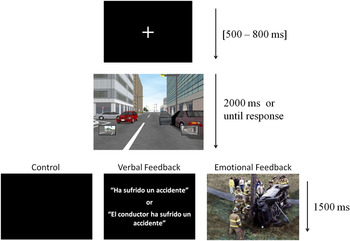
The experiment consisted of two blocks of 120 trials each: one block for the urgent task and one block for the evaluative task. The order of presentation of the blocks was counterbalanced between subjects to control for possible effects of experience between tasks. Ninety medium-risk images and thirty no-risk images were displayed in each block (images were the same in both blocks). Each trial began with a fixation cross with a variable interval time (between 500 and 800 ms). Next, the traffic situation was displayed and remained on screen until the participant responded or until 2000 ms had elapsed. Participants responded by pressing the space button to indicate that the traffic situation was risky (evaluative task) or to decide to brake (urgent task). In the feedback groups, a feedback screen was displayed for 1500 ms after the traffic situation in 75% of the risky situations in which the participant did not respond (i.e., indicated no risk/not braking). The feedback in the verbal feedback group consisted of a text message reading “ha sufrido un accidente” (in English: you have suffered an accident) for the urgent task, or “el conductor ha sufrido un accidente” (the driver has suffered an accident) for the evaluative task. In the emotional feedback group, the feedback consisted of a picture of a traffic accident extracted from the IAPS database. Pictures showing accidents were the same for the urgent and evaluative task. The control group received no feedback (see figure 1).
The schematic experimental procedure of the task.

The experiment used a 3 (Group: control, verbal feedback, emotional feedback) x 2 (Task: urgent, evaluative) mixed repeated measures design with Group as a between-subjects factor and Task as a within-subject factor. Gender was included as covariate in the model in order to control for any possible influence of this variable.
Results and Discussion
The means of the probability “to brake/to evaluate risk”, reaction times, and signal detection indices (response bias and sensitivity) were submitted to four separate repeated measures ANOVAs. Signal Detection Theory were used to calculate response bias (c) and sensitivity (d’) scores (Macmillan & Creelman, Reference Macmillan and Creelman2005). Risk was the signal to discriminate from noise (non-risky situations). An alpha level of 0.05 was adopted for all analysis. Before performing the ANOVAs, Kolmogorov-Smirnov and Levene’s tests verified normality of the distribution and homogeneity of the variances of all dependent variables (all p’s > .05).
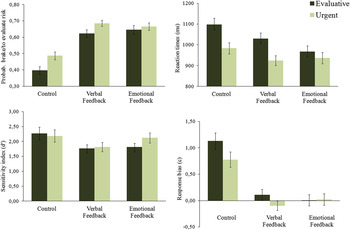
The ANOVA on the probability “to brake/to evaluate risk” showed significant main effects of Group [F(2, 92) = 32.03, MSE = .029, p < .001, η2 p = .41], Task [F(1, 92) = 17.16, MSE = .005, p < .001, η2 p = .16] and their interaction [F(2, 92) = 4.96, MSE = .022, p < .01, η2 p = .09]. Post hoc analysis of the Group x Task interaction revealed that there was a higher probability of response in the urgent task than in the evaluative task in the control group (M urgent = 0.49; M evaluative = 0.39) and verbal feedback group (M urgent = 0.69; M evaluative = 0.62) (all p’s < .01). The difference between tasks was not significant in the emotional feedback group (M urgent = 0.66; M evaluative = 0.65). With respect to the effect of Group in each task, there was a higher probability of response both for the urgent and evaluative task in the verbal and emotional feedback groups than in the control one (see figure 2).
Average probability of positive response (to brake or to evaluate risk), reaction times, and signal detection indices (response bias and sensitivity) for each condition of Group and Task.

Reaction time analysis showed a main effect of Group [F(2, 92) = 3.49, MSE = 39400.03, p = .03, η2 p = .07] and Task [F(1, 92) = 6.76, MSE = 7583.55, p = .01, η2 p = .07]. Moreover, the Group X Task interaction was also significant [F(2, 92) = 4.38, MSE = 7583.55, p = .01, η2 p = .09]. Post hoc analysis showed shorter reaction times in the urgent task than in the evaluative task for the Control group (M urgent = 983ms, M evaluative = 1097ms) and the Verbal feedback group (M urgent = 924ms, M evaluative = 1029ms) (all p’s < .01). Moreover, responses in the evaluative task were faster for the emotional feedback group than for the control group (p < .01) all other comparisons were not significant (see figure 2).
Regarding the signal detection analysis, the sensitivity index (d’) did not reveal any main effects or interactions (F’s < 1). The response bias (c) showed main effects of Group [F(2, 93) = 23.77, MSE = .72, p < .001, η2 p = .34], Task [F(1, 93) = 6.85, MSE = .25, p = .01, η2 p = .07], and a marginally significant Task x Group interaction (p = .06). Participants in the control group were more conservative in the evaluative task than in the urgent task (p < .01), such that there was a higher response bias to brake than to evaluate risk (M urgent = 0.78, M evaluative = 1.13). Moreover, the verbal and emotional feedback groups showed more cautious behavior than the control group in both tasks (Verbal feedback group: M urgent = –0.10, M evaluative = 0.11; Emotional feedback group: M urgent = 0.02, M evaluative = 0.01). No other effects were significant (see figure 2).
Finally, we tested if the verbal feedback and emotional feedback groups were matched in amount of feedback received, in order to discard differences that could affect the previous results. A t-test showed no significant differences in the number of feedbacks received in each group (p > .05; M verbal feedback = 26.27, SD = 10.94; M emotional feedback = 30.05, SD = 11.53).
In sum, the results showed a clear effect of the type of task. Consistent with our first proposed hypothesis, participants were faster and more cautious in the urgent task, braking more frequently than evaluating risk. Moreover, participants responded quicker and showed a less risky response pattern in the two feedback groups compared to the group without feedback, as predicted in the second hypothesis.
Experiment 2
In Experiment 1 we were able to find a clear dissociation between the urgent and evaluative tasks, replicating previous findings (Megías, Maldonado, Cándido et al., Reference Megías, Maldonado, Cándido and Catena2011; Megías et al., Reference Megías, Navas, Petrova, Cándido, Maldonado, Garcia-Retamero and Catena2015). At the same time, both verbal and emotional feedback enhanced speed and led to a response bias to evaluate risk and brake more often. However, there could be a certain degree of confusion between the possible effects of feedback and the presentation of negative images.
For example, recent research has shown that driving while emotionally aroused by emotion-laden collision avoidance signals may induce unsafe driving behavior instead of increasing road safety (Di Stasi et al., Reference Di Stasi, Contreras, Cañas, Cándido, Maldonado and Catena2010; Pêcher, Lemercier, & Cellier, Reference Pêcher, Lemercier and Cellier2009; Serrano, Di Stasi, Megías, & Catena, Reference Serrano, Di Stasi, Megías and Catena2014). Similarly, Megías, Maldonado, Catena et al. (Reference Megías, Maldonado, Cándido and Catena2011) showed that emotion-laden visual stimuli during driving, especially negative ones, impaired hazard discrimination. Furthermore, mood and emotion can modulate risk proneness in driving (Mesken, Reference Mesken2006). This modulation can be accounted for by Forgas’ affect infusion model (Forgas, Reference Forgas1995) and Bower’s associative network theory (Bower, Reference Bower1981). Both models predict that when people are making a judgment or a decision, it is easier to attend to a process and retrieve information congruent with their actual emotional state. For example, drivers in a negative mood are more likely to consider the negative aspects of risky situations, making them faster and safer in their decisions at the cost of a worse risk sensitivity (Megias, Reference Megías2014). On the other hand, reward rate influences the decision threshold and the use of an unpleasant stimulus might further lower this threshold, consequently speeding up responses in risky situations (Contreras et al., Reference Contreras, Megías, Maldonado, Cándido and Catena2013; Simen et al., Reference Simen, Contreras, Buck, Hu, Holmes and Cohen2009).
In order to analyze the independent effects of negative feedback and the use of negative emotional stimuli, in the following experiment we used four groups. In the control group, identical to the previous experiment, participants only had to brake or evaluate risk. In the punishment group, risky behavior was associated with the loss of points, analogous to punishment techniques used to control the behavior of drivers in real settings. In the emotional group, the same images used as negative emotional feedback in the previous experiment, were presented before the response of the participants to induce a negative emotional state. Finally, in the emotion + punishment group both emotional pictures and punishment were presented. Moreover, in this experiment we used real images of driving situations, previously evaluated by experts on their degree of risk, in order to make the task more ecologically valid.
For this study, the following hypotheses were proposed: a) as experiment 1, a higher probability of positive response (brake and risk), shorter reaction times, and a more cautious response bias were expected in the urgent task compared to the evaluative task. b) Following the results of the experiment 1, punishment should reduce the tendency toward risky behavior, increasing the probability of response and causing a larger response bias toward “to brake/to evaluate risk”. Moreover, faster reaction times should be observed in the punishment groups compared to the no-punishment ones. c) Finally, and as main aim of the second study, we wanted to dissociate the effect of feedback from the emotional state aroused by the negative emotional images. In this case, our hypothesis is more speculative. In the emotional group, emotional images could lead to a reduction of risk behaviors (higher probability of braking and evaluating risk) and faster responses, as when they were presented as negative emotional feedback in the experiment 1. However, according to the above mentioned literature, emotional stimuli presented before or during the risk-taking process could impair hazard discrimination or even induce unsafe driving behavior.
Method
Participants
A total of 117 participants from the Universidad de Granada volunteered in this study in exchange for course credits (mean age: 20 years; range: 18–25; 70 women and 47 men). All had normal or corrected-to-normal vision. Participants were told that they would see unpleasant pictures and could abandon the study whenever they pleased. The study was conducted in conformity with the declaration of Helsinki. (World Medical Association, 2013).
Stimuli
In this second experiment, the traffic situations presented to participants consisted of real traffic pictures taken in Spanish and Finnish roads from the driver’s perspective. The pictures were previously evaluated for their subjective risk level by 40 volunteers in possession of driving license. Ninety pictures showed road situations with medium-high risk (average risk = 4.11 [0: no risk; 7: high risk]) and 30 showed no risk (average risk = 1.50). In addition, the pictures were chosen according to certain criteria in order to reduce the interpersonal variability in the interpretation of some factors like the speed of the vehicle (see Megías et al., Reference Megías, Navas, Petrova, Cándido, Maldonado, Garcia-Retamero and Catena2015, for more details). In all risky situations the best option to avoid the hazard was always to brake. The pictures were displayed with a 1024x768 resolution on a 14" TFT monitor.
The picture stimuli used in the emotional groups were the same that in Experiment 1.
Procedure
The experiment consisted of 4 groups: control, emotional, punishment, and emotional-punishment. Two groups included punishment (punishment and emotional-punishment), and two groups included emotional manipulation (emotional and emotional-punishment). Participants were randomly assigned to one of the four groups.
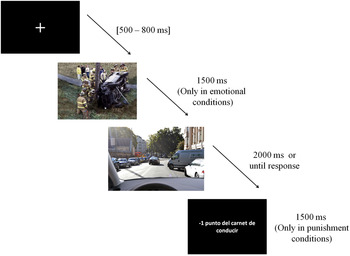
As in Experiment 1, all participants performed the urgent task and the evaluative task in two different blocks (order of the blocks was counterbalanced between participants). Each block had 120 trials, ninety risky traffic situations and thirty non-risky ones (the two blocks presented the same situations). The trials of the control group involved the following sequence: after a fixation point of variable duration (between 500 and 800 ms), the traffic situation was presented until the participant responded or until a maximum of 2000 ms had elapsed. Participants had to indicate, by pressing the space bar, whether the traffic situation was risky in the evaluative task, and had to decide whether to brake or not in the urgent task. In the emotional group, a picture depicting a traffic accident was displayed before the target traffic situation in 75% of the cases in which the traffic situation was risky. In the punishment group, a screen showing the text “–1 punto del carnet de conducir” (in english: –1 point in your driving license) was displayed after the target traffic situation in 75% of the risky situations where the participant did not respond (i.e., indicated no risk/not braking). Finally, in the emotional-punishment group both the traffic accident pictures and the text message were presented in 75% of the risky traffic situations. The emotional pictures and text messages stayed on screen for 1500 ms for all groups (see figure 3).
Experimental procedure.

In sum, the design of the experiment was a 2 (Punishment: punishment, no-punishment) x 2 (Emotion: emotion, no-emotion) x 2 (Task: urgent, evaluative) mixed repeated measures with Punishment and Emotion as between-subjects factors and Task as a within-subjects factor. Gender was introduced as covariate in the analysis to control possible gender differences.
Results and Discussion
Means of the probability “to brake/to evaluate risk”, reaction times, the signal detection response bias (c) and signal detection sensitivity index (d’) were analyzed using four separate repeated measures ANOVAs. A significance level of .05 was adopted for all the statistical tests. According to Kolmogorov-Smirnov and Levene’s test, all data met criteria of normality and homogeneity of variance.
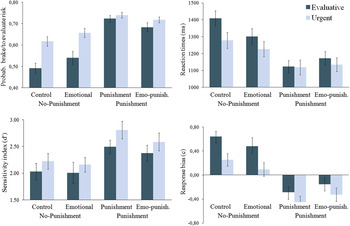
Analysis of the probability “to brake/to evaluate risk” showed a main effect of Punishment [F(1, 111) = 71.53, MSE = .019, p < .001, η2 p = 0.39], and an interaction between Punishment and Task [F(1, 111) = 22.98, MSE = .006, p < .001, η2 p = .17]. Post hoc comparisons were significant for urgent versus evaluative task in the no-punishment (p < .001) and marginally significant in punishment conditions (p = .06). There was a higher probability of response in the urgent task than in the evaluative one (no-punishment group: M urgent = 0.64, M evaluative = 0.52; punishment group: M urgent = 0.73, M evaluative = 0.70). Moreover, punishment increased the probability of braking and evaluating risk compared to no-punishment (see figure 4).
Average probability of positive response (to brake or to evaluate risk), reaction times, and signal detection indices (response bias and sensitivity) as a function of Punishment, Emotion, and Task. Error bars are standard errors of the mean.

Reaction times revealed main effects of Punishment [F(1, 111) = 22.12, MSE = 81191.24, p < .001, η2 p = .17], and an interaction between Punishment and Task [F(1, 111) = 5.38, MSE = 16814.72, p = .02, η2 p = .05]. No other effects or interactions were significant (F’s < 1). The urgent task had significantly shorter reaction times than the evaluative task in the no-punishment groups (M urgent = 1354ms, M evaluative = 1252ms; p < .001). Both the urgent and evaluative task showed shorter reaction times in the punishment groups than in no-punishment groups (p < .01) (see figure 4).
ANOVAs on the two signal detection indices (d’ and c) showed main effects of Punishment [d’: F(1, 111) = 14.09, MSE = .89, p < .001, η2 p = .11; c: F(1, 111) = 49.76, MSE = .49, p < .001, η2 p = .31] and Task [d’: F(1, 111) = 5.29, MSE = .52, p = .02, η2 p = .06; c: (F(1, 111) = 22.54, MSE = .21, p < .001, η2 p = .17]. There were no other main effects or interactions. Post hoc analysis showed higher sensitivity to risk and a less conservative response bias for the urgent task than for the evaluative task (d’: M urgent = 2.44, M evaluative = 2.23; c: M urgent = –0.11, M evaluative = 0.17; p’s < .05). In addition, there was a higher sensitivity index and a more cautious response bias in the punishment groups than in the no-punishment groups (d’: M punishment = 2.10, M no-punishment = 2.57; c: M punishment = –0.31, M no-punishment = 0.37; p’s < .05) (see figure 4).
As in the first experiment, we also tested the amount of punishment received and the number of emotional images presented in each group. A t-test analysis showed no significant differences in the amount of punishment received in each group (p > .05; M punishment = 16.05, SD = 10.31; M emotional-punishment = 17.29, SD = 11.92). The number of emotional images presented also showed no significant effect (p > .05; M emotional = 134.96, SD = 1.25; M emotional-punishment = 134.93, SD = 1.31). On the other hand, the number of emotional images presented was higher than the punishment received (p < .05; M emotional = 134.96, SD = 1.25; M punishment = 16.05, SD = 10.31). However, despite the existence of a greater number of emotional images, the emotional effect was not observed.
In short, according to the first hypothesis, participants were more likely to respond, were faster, discriminated risk better, and showed a more cautious response bias in the urgent task than in the evaluative task. Second, the punishment conditions showed a pattern of faster and more cautious responses, as predicted in the second hypothesis. In addition, punishment conditions also revealed a higher risk sensitivity. Finally, there was no effect of Emotion. Contrary to our expectations, the presentation of negative emotional content before the risk situations did not have effect on participants’ response. Thus, the emotional feedback effect showed in the first experiment could be explained by the effect of the feedback rather than the emotional state induced by the emotional images.
General Discussion
One of the aims of this research was to analyze the dissociation between risk evaluation and actual risk taking in the same driving situation in order to replicate previous findings (Megías, Maldonado, Cándido et al., Reference Megías, Maldonado, Cándido and Catena2011), in accordance with dual process models of decision making. The important and novel aim of this research was to investigate the effect of negative feedback, especially the type of punishment used with drivers in real-world settings, on risk evaluation and risky decision making. Three main findings emerged from the experiments.
First of all, urgent behavior was faster and more conservative than the evaluation of risk. In particular, participants avoided risk by braking more often, even though they evaluated the situation as risky less often. These results replicated previous findings (Megías, Maldonado, Cándido et al., Reference Megías, Maldonado, Cándido and Catena2011) and supported the proposal that two different systems operate in risky situations. Evaluation of risk, as it happens when we are co-pilots or mere observers of the risk situation, seems to be determined by the controlled processing system; actual decisions, however, as it happens when the driver has to brake to avoid a risky situation, seem to depend on the automatic processing system. Dual process models (Alós-Ferrer & Strack, Reference Alos-Ferrer and Strack2014; Evans, Reference Evans2008) agree that the automatic processing system (affective-experiential) is mostly unconscious, sensitive to emotions, and based on situation-action connections that have been associated with success in the past. This system relies on previous learning experiences coded as habits or heuristics and requires less mental effort and awareness than the controlled processing system (rational-analytic). Hence, the automatic processing system is believed to be much faster and geared towards immediate action. It is most useful when urgent behaviors such as braking are required. On the other hand, the controlled processing system is more deliberative, based on logical or statistical rules, verbally oriented, and slower, as it happens in the evaluative task.
We should also note that the dissociation between evaluation and decision making in such risky situations does not agree with normative models assuming a serial process in which evaluation must precede and guide actual decisions (Rangel et al., Reference Rangel, Camerer and Montague2008, among others). Alternatively, urgent situations could involve a more rapid and less precise risk evaluation, leading to more conservative responses, due to the possible fatal consequences of the decision to be taken. Therefore, they could be guided by heuristics or well learned habits acquired by previous experience and dependent upon the experiential-automatic processing system rather than the rational-controlled one, as stated before (Megías, Maldonado, Cándido et al., Reference Megías, Maldonado, Cándido and Catena2011; Megías et al., Reference Megías, Navas, Petrova, Cándido, Maldonado, Garcia-Retamero and Catena2015).
In summary, actual risky decisions, such as braking to avoid a hazard, seem to be controlled by the experiential-automatic system. When guided by this system, responses are faster and braking is more frequent than evaluating the situation as risky; in other words, risk is avoided at the cost of more errors or a less conservative response criterion. This double type of processing may explain the lack of relationship between the “evaluation of risk” and the “actual risky behaviors” in many situations (Reyna, Reference Reyna2004), as it often happens in gambling and driving.
Second, the use of negative images as feedback after risky responses, as well as the information about having an accident due to a risky choice, had similar effects on both evaluation and actual decisions in risky driving situations. However, the presentation of the same images before the response did not have the expected effect, as they scarcely affected risk evaluations and braking. These results suggest that the effect found in the first experiment was most likely due to the power of feedback than to the emotional state aroused by the images. On the other hand, the absence of any reliable effect of emotional content in the second experiment is at odds with previous research (Megías, Maldonado, Catena et al., Reference Megías, Maldonado, Cándido and Catena2011; Megías et al., Reference Megías, Di Stasi, Maldonado, Catena and Cándido2014). The lower number of different emotional pictures and their weaker negative valence compared to those used in previous research could explain the lack of effects in this group.
Finally, the main findings of this research were related to the effect of feedback on both risk evaluation and risk taking. Following feedback, there was a similar increase in speed and risk discriminability for both types of responses, at the cost of a less conservative response bias, even in situations where risk was considered very low by experts. These results do not easily accord with normative or dual process models, but agree with the proposal that reinforcement, in this case punishment, controls the decision threshold during the task (Contreras, Catena, Cándido, Perales, & Maldonado, Reference Contreras, Catena, Cándido, Perales and Maldonado2008; Simen, Reference Simen, Cohen and Holmes2006). The use of negative feedback lowered the decision threshold, speeding up responses in risky situations (Simen et al., Reference Simen, Contreras, Buck, Hu, Holmes and Cohen2009) and increasing the probability of response to avoid punishment. Therefore, these findings support the idea that a point-based penalty system, like the one used in many countries to control drivers’ risk taking, has positive effects on drivers’ behavior (Donmez, Boyle, & Lee, Reference Donmez, Boyle and Lee2007).
These results have important implications, especially for young drivers. In general, young drivers have a higher rate of road accidents. Although this increment of road accidents can be due to less experience (Groeger, Reference Groeger2000), it is also related to more risk taking, such as higher speed or driving under the influence of drugs (Gregersen & Bjurulf, Reference Gregersen and Bjurulf1996; Rhodes & Pivik, Reference Rhodes and Pivik2011). Our results suggest that, first, teaching well-learned habits (e.g., internalizing urgent behaviors) to manage different types of risky situations should be an essential part of the training of new drivers. Second, the use of negative feedback, especially punishment associated with risky behavior, can stimulate safe driving habits (Donmez et al., Reference Donmez, Boyle and Lee2007). It is important to acknowledge that the effectiveness of punishment depends upon its controllability. When the aversive stimuli (points and penalties) are signaled (as it happens frequently in Spain), thus predictable and controllable, their appearance only generates transitory fear or anxiety. Only when they are unpredictable and uncontrollable (as it happens in other countries like France, see Nazif & Perez, Reference Nazif and Perez2011) do they have sufficient persuasion power and effectiveness in controlling risky behaviors.
There are several limitations of this study that must be mentioned. First, participants were controlled for age and gender, however there are other personal variables that might influence the risk behavior and were not evaluated as part of the study. In this way, research suggests that driver´s ability to perceive risks increases with experience, independently of age or time in possession of the driving license. Experienced drivers detect hazards more quickly and efficiently (Deery, Reference Deery1999). Thus, participants should be controlled by experience in future studies. Individual differences in risk propensity has also been related to personality characteristics as extraversion, openness, neuroticism, agreeableness, and conscientiousness (Nicholson, Soane, Fenton-O’Creevy, & Willman, Reference Nicholson, Soane, Fenton-O’Creevy and Willman2005). Moreover, impulsivity level of the participants could be biasing the reaction times in the task (Edman, Schalling, & Levander, Reference Edman, Schalling and Levander1983). As second limitation, risk perception and risk taking behavior can be affected by specific emotions during the decision making process. Fear and anger have opposite effects on our behavior: whereas angry people tend to make risk-seeking choices, fearful people show more risk-averse choices (Lerner & Keltner, Reference Lerner and Keltner2001). Finally, this research only relied on a set of young drivers and a small number of risky situations, reduced to pictures of driving scenarios. The generalization of these results to a different population, as well as new and more realistic risky situations, remains open to future research. In addition, the incorporation of electrophysiological and neuroimaging techniques would provide interesting and new valuable information. For example, the use of skin conductance response measurements, following Kinnear, Kelly, Stradling, and Thomsonb’s methodology (2013), would allow to explore changes in the emotional physiological reactions to driving hazards as a function of the type of feedback. Moreover, looking for differences in the brain circuits associated with evaluative and urgent responses may offer the best support for the role of the two processing systems in risky situations.
In summary, the results of this study showed that in risky decision making, evaluation of the situation and actual decisions may be controlled by two different processing systems and may thus not always correlate. Evaluative judgments seem to depend mostly on a controlled rational processing system. Actual decisions rely mostly on the automatic (emotional and experiential) system that operates based on well learned habits and heuristics. Our results agree with dual process models of decision making and expand our knowledge about human behavior in risky driving situations. Finally, the observed effects of negative feedback, especially punishment, upon both evaluations and actual decisions, suggest that negative feedback could be an effective way to control the decision making process. In sum, these results increase our understanding of driver behavior on the road and suggest efficient ways to control risky behavior, which is one of the main causes of accidents and deaths around the world.