Majoritarian electoral systems are known to award large parties more seats than their vote shares (Taagepera and Shugart Reference Taagepera and Shugart1989). Much like in advanced democracies, single-member district (SMD) systems in electoral autocracies also provide large seat bonuses to governing parties.Footnote 1 Consequently, one would expect self-serving dictators to choose SMD to maintain their electoral dominance in the legislature. Intriguingly, however, many electoral autocracies adopt proportional representation (PR) systems, a seemingly less favourable and suboptimal institutional choice.Footnote 2 These anomalies beg the question: why do autocrats decide to adopt PR systems even though SMD systems are likely to generate a pro-regime seat bias? Put more generally, how can we explain dictators’ choice of electoral systems?
This article answers these questions and explores the origins of electoral systems in electoral autocracies. Over the last decade, a growing literature in authoritarian politics has shown how elections help autocrats hold onto power (Gandhi and Lust-Okar Reference Gandhi and Lust-Okar2009). According to this scholarship, elections provide dictators with valuable information about their popularity (Malesky and Schuler Reference Malesky and Schuler2010). Elections also inform dictators about key bases of support and opposition strongholds (Blaydes Reference Blaydes2011). With this information, elections enable dictators to co-opt ruling elites by distributing spoils and dividing the opposition more efficiently (Lust-Okar Reference Lust-Okar2004). By manufacturing an overwhelming victory, authoritarian leaders can also use elections to demonstrate their regime's invincibility and deter challengers (Magaloni Reference Magaloni2006). Far less explored, however, is the variation of electoral systems in electoral authoritarian regimes. The literature on electoral systems has almost exclusively focused on democracies. Meanwhile, scholars have only begun to explore the conditions in which dictators favour one type of electoral system over another.
A full understanding of the origins of electoral systems in electoral authoritarian regimes is thus necessary. Theoretically, recent scholarship has highlighted how dictators employ various techniques to manufacture a landslide victory (Higashijima Reference HigashijimaForthcoming; Simpser Reference Simpser2013). We contribute to this scholarship by investigating an under-explored yet fundamentally important aspect of electoral manoeuvring in autocracies: electoral system manipulation.Footnote 3 Indeed, since electoral rules shape politicians’ strategy and behaviour during elections (Cox Reference Cox1997), our knowledge of electoral politics in electoral autocracies remains incomplete without a deeper insight into the origins of electoral institutions. As Ellen Lust-Okar and Amaney Jamal (Reference Lust-Okar and Jamal2002) argue, electoral systems in electoral authoritarian regimes can still influence electoral outcomes and change the distribution of power among pivotal actors. Empirically, as our analysis will reveal, there is wide variation in electoral systems among electoral autocracies. Unlike electoral systems in democracies that remain stable over time, autocratic electoral institutions also appear to be much more fluid and hence warrant further investigation.
Building upon the literature on electoral institutions, we first argue that different electoral systems are associated with different political and economic outcomes pertinent to the survival of electoral autocracies. For instance, by lowering the barrier for entry, PR systems encourage potential challengers to participate in politics through the existing institutional structure. Consequently, PR increases the effectiveness of dictators’ institutional co-optation strategy towards the opposition. PR also helps dictators keep the opposition fragmented. Finally, by boosting turnout, PR helps dictators demonstrate their popularity and invincibility. In contrast, SMD offers a seat bonus that allows dictators to incorporate more ruling elites. Essentially, SMD generates extra institutional resources to help dictators entice the cooperation of potential opponents.
Given the diverse effects associated with different electoral systems, we suggest that different dictators strategically select different electoral systems to address their political needs and priorities. We build on Milan Svolik's (Reference Svolik2012) contributions and contend that dictators with insufficient capacity and resources will identify ruling elites as their primary threat and top political priority. These resource-poor dictators should be more likely to adopt SMD to boost their legislative seats and then use these additional seats to co-opt regime insiders. Alternatively, dictators with abundant resources have more rents to share with ruling elites, and they can also reasonably expect to win elections with large margins. Therefore, resource-rich dictators are able to use both materialistic and institutional capital to deal with ruling elites and can thus afford to use PR to alleviate the second threat: the opposition from the masses.
To test our theoretical expectations, we construct a data set covering 90 electoral autocracies from 1949 to 2009. Using resource wealth to capture dictators’ capacity to induce compliance, we find that dictators with abundant natural resources are more likely to adopt PR. Our results hold regardless of alternative variable operationalizations and estimation strategies. They are also robust to potential endogeneity and sample selection biases. We further supplement our analysis with additional statistical analyses and comparative case studies on Kazakhstan and Kyrgyzstan to illustrate the relationship and mechanisms between resource wealth and the choice of electoral systems in electoral autocracies.
Literature
Scholars have advanced three explanations for the selection of electoral systems, most of which come from democracies. These explanations include: (1) political (Boix Reference Boix1999; Rokkan Reference Rokkan1970); (2) economic (Cusack et al. Reference Cusack, Iversen and Soskice2007; Rogowski Reference Rogowski1987); and (3) historical factors (Andrews and Jackman Reference Andrews and Jackman2005). However, we suggest that crucial differences between democracies and autocracies – for instance, that dictators rarely leave office through elections – make it difficult to directly apply the existing theories to the authoritarian context.
For example, the hypothesis from Stein Rokkan and Carles Boix treats strong socialist threats as the driving force in choosing PR, yet most autocracies are not exposed to such imminent threats. Indeed, as Boix stated clearly, his theory is only applicable to democracies. Similarly, Thomas Cusack et al.'s economic coordination and Ronald Rogowski's international economy perspective argue strong political competition leads to distributional conflict between economic classes. However, opposition parties in authoritarian states are again too weak to be truly competitive. Finally, we suggest that electoral system changes in autocracies are largely driven by dictators’ strategic considerations rather than historical legacies. In sum, much remains to be understood about the logic behind electoral system choices in electoral autocracies.
In light of the limitations of the conventional wisdom, scholars have recently begun exploring the choice of electoral systems in electoral autocracies. In their pioneering research, Lust-Okar and Jamal (Reference Lust-Okar and Jamal2002) argue that the type of authoritarian regime shapes dictators’ preferences over electoral rules during political liberalization in the Middle East. Jennifer Gandhi and Abigail Heller (Reference Gandhi, Heller, Herron, Pekkanen and Shugart2018) offer useful information about elections and electoral rules in authoritarian regimes during the post Second World War period. Finally, Gabriel Negretto and Giancarlo Visconti (Reference Negretto and Visconti2018) argue that autocrats in Latin America use PR as a tool to either facilitate intra-party competition, or increase regime support, or weaken the majority party during the course of political liberalization.
This article extends these useful insights. Theoretically, we build on Lust-Okar and Jamal's contributions on the costs and benefits of different electoral systems. We also borrow the insights from Gandhi and Heller's study and explicitly take into account the electoral constraints imposed by the ruling elites. We also concur with Negretto and Visconti that the adoption of PR is a well-calculated strategy by autocrats. Specifically, by highlighting dictators’ differing abilities to induce compliance from ruling elites and society, we posit a novel theory for electoral autocrats’ choice of electoral systems. Empirically, we expand the sample to include virtually all of the world's electoral autocracies. In doing so, we hope to add to our understanding of the origins of electoral institutions in electoral autocracies.
The divergent effects of SMD and PR
An extensive literature has documented various political and economic outcomes associated with different electoral systems (Cox Reference Cox1997). Given the diverse effects by different electoral systems, we argue that dictators strategically choose electoral systems to meet their political needs and priorities. Parallel to what Robert Franzese (Reference Franzese2002) refers to as the ‘electioneering Ramsey Rule', this article suggests that dictators will use all institutional tools available for political gains, provided the gains are inversely proportional to their marginal cost.
First, we argue that the greater vote-seat disproportionality in SMD gives dictators an extra boost of legislative seats. This is a direct extension of Maurice Duverger's well-known mechanical and psychological effects of majoritarian systems. SMD also allows authoritarian leaders to gerrymander electoral districts to induce an even larger seat bias. Taken together, SMD tilts election results towards the ruling party in electoral authoritarian regimes, an advantage we term ‘the SMD seat premium'. Most importantly, the SMD seat premium gives dictators additional resources with which to co-opt ruling elites. As Jennifer Gandhi and Adam Przeworski (Reference Gandhi and Przeworski2007) argue, legislative seats are valuable co-optation tools for dictators seeking to make policy concessions to potential rivals. Lust-Okar (Reference Lust-Okar, Lust-Okar and Zehouni2008) also argues that dictators can use legislatures to guarantee long-lasting provisions of rents. We add to this literature and suggest that the extra legislative seats from SMD allow dictators to incorporate more political forces into the legislature and thus give dictators more flexibility to deal with regime insiders.
Although PR systems do not generate extra seats for the incumbent, PR systems do possess several important characteristics imperative for the survival of dictators. First, by lowering the barrier for entry, PR encourages the opposition from the masses in electoral autocracies to participate in politics through existing institutions. Since it is still possible to win seats with smaller vote shares under PR, new challengers then become more willing to compete through the electoral process than they are to take an anti-system approach. Consequently, PR makes dictators’ institutional co-optation strategies towards the opposition more effective. Also, due to the greater proportionality under PR, existing opposition forces are less likely to coordinate and build a unified electoral coalition against the incumbent. As Gary Cox (Reference Cox1997) shows, PR not only increases numbers of effective parties but makes strategic coordination between political parties more difficult. In short, PR allows dictators to effectively divide and rule. By contrast, SMD can promote opposition coordination, even in electoral autocracies. Consider the 2003 Georgian election held under SMD, where the two main opposition parties formed a coalition prior to the election, which later played a pivotal role in the success of the Rose Revolution.
Finally, PR systems help dictators demonstrate their strengths by scoring a higher level of voter turnout. Even voters in electoral autocracies have greater incentives to vote in PR elections because fewer votes are wasted. Importantly, high turnout is crucial for dictators, since winning an election with high turnout reinforces the regime's popularity and invincibility (Magaloni Reference Magaloni2006). Illustratively, Carolina de Miguel et al. (Reference De Miguel, Jamal and Tessler2015: 1363) note that the recent Egyptian election had to be extended for an additional day to bolster turnout and legitimacy. According to news reports, many voters ‘stayed home due to political apathy, opposition to another military man becoming president, discontent at suppression of freedoms among liberal youth, and calls for a boycott by Islamists'.
Electoral system choice in electoral autocracies
The discussion so far suggests that SMD systems help autocrats co-opt ruling elites with the extra seat bonus. PR systems, on the other hand, empower dictators to demonstrate regime strengths and weaken mass opposition. Precisely because different electoral systems provide dictators with different advantages, we argue that dictators’ optimal choice of electoral systems crucially depends on their type. Specifically, we differentiate dictators based on their resources and capacity to induce compliance (voluntarily or involuntarily) from the ruling elites within the regime and from the citizens in the society.
Conceptually, we consider a dictator to be ‘resource-rich’ (‘resource-poor') if she has strong (weak) capacity and (in)sufficient resources to exercise her influence and control over ruling elites and citizens. Resource-rich dictators should be better positioned to secure submission to their authority from opponents. They can cultivate loyalty and deter defection from ruling elites by buying off political support and solidifying security forces. Simultaneously, they can entice active or passive support from the citizenry by distributing materialistic benefits and strengthening the coercive apparatus. Other scholars echo our proposition, arguing that dictators armed with resources are more likely to prevent coups, pacify the masses and simply survive longer (Magaloni and Kricheli Reference Magaloni and Kricheli2010).
Importantly, we suggest that different types of dictators tactically choose different electoral systems based on their political priorities. As Svolik's (Reference Svolik2012) study shows, dictators constantly face two major challenges to their reigns. First, in what he refers to as the problem of power-sharing, Svolik identifies elites inside the power circle as the most imminent and immediate threat to dictators because more than two-thirds of dictators are forced out of power by regime insiders. We concur with this insight and suggest that the dominant mode of political conflict in dictatorships is the power struggle between dictators and ruling elites. Importantly, we suggest that resource-poor dictators are more likely to be ousted by coups from ruling elites.Footnote 4 It follows that dictators who lack capacity and resources will identify the power-sharing problem as their top political priority. Given their lack of resources, resource-poor dictators have incentives to use SMD to boost their legislative seats. In so doing, they can use these additional seats to co-opt the ruling elites and secure their support. In this regard, SMD ensures that ruling elites, the primary threat to autocrats, remain loyal to the regime to the greatest extent possible.
Additionally, SMD systems allow resource-poor dictators to use their limited resources most effectively and efficiently. As Torsten Persson and Guido Tabellini (Reference Persson and Tabellini2003) show, SMD incentivizes political elites to concentrate their electoral endeavours in marginal districts with more swing voters, while PR encourages politicians to seek broad support from the whole population. SMD consequently becomes an ideal institutional choice for resource-poor dictators, as this system allows dictators to allocate their limited resources to key members of the winning coalition. Simply put, SMD provides a dictator with the ‘most bang for her buck'.
Meanwhile, choosing PR systems can be politically risky for resource-poor dictators. When dictators lack the necessary resources and capacity to secure a landslide victory, PR systems may backfire and reveal a regime's weakness because PR does not yield an additional seat bonus. Consider, for example, Albert Zafy's Madagascar, where losing a majority under a PR system in the 1993 legislative election encouraged the opposition to challenge the dictator again and defeat him in the 1996 presidential election. Indeed, Steven Levitsky and Lucan Way (Reference Levitsky and Way2010) argue that losing legislative control in authoritarian regimes can result in critical consequences for dictators.
On the other hand, PR is an ideal institutional investment for resource-rich dictators. We suggest that resource-rich dictators have plenty of materialistic and institutional capital to co-opt both ruling elites and citizens. Under such circumstances, resource-rich dictators are more capable of addressing the power-sharing problem and have less need for the seat-premium produced by SMD. Essentially, resource-rich dictators can ‘afford’ to employ PR to further deal with the second threat, which Svolik calls the authoritarian control problem – the opposition from the masses. Specifically, PR's greater proportionality enables dictators to keep the existing opposition forces fragmented and uncoordinated in the society. In other words, PR helps dictators divide and weaken the existing opposition.
In addition to preventing societal groups from unifying together, PR also helps resource-rich dictators alleviate the authoritarian control problem by pre-empting the emergence of new opposition. As discussed earlier, PR allows autocrats to benefit from higher levels of turnout. Importantly, higher turnout allows dictators to credibly signal their popularity and invincibility and discourage new challengers. Even if new challengers do emerge from the society, they are more likely to participate in politics through elections, rather than using more violent means, because PR is associated with lower electoral thresholds. Finally, following Persson and Tabellini (Reference Persson and Tabellini2003), PR also incentivizes dictators to use society-wide redistribution programmes to win popular support. Taken together, PR effectively deters challengers and allows resource-rich dictators to pre-empt the threat from the masses.
Readers might reasonably wonder why resource-rich dictators, given their political strengths, do not simply choose an SMD system and then pocket the resources without sharing them with the masses. The key to understanding the logic of electoral reforms in authoritarian regimes lies in dictators’ expected time horizons. In his seminal contribution, Mansur Olson (Reference Olson1993) shows that a ‘roving bandit’ who expects to lose office soon will grab everything while they can, whereas a ‘stationary bandit’ who expects to stay in power for a while is more likely to engage in economic development with an eye for the future. Similarly, Joseph Wright (Reference Wright2008) shows that dictators with long time horizons are more likely to invest foreign aid in public goods whereas dictators with short time horizons are more likely to pocket foreign aid as personal wealth. Extending these insights, we suggest that resource-rich dictators are more likely to perceive longer time horizons since they can use their wealth to buy off support and make credible threats to potential challengers. Consequently, they are less likely to kill the goose that lays the golden egg by stealing resources for their personal leisure and endanger their own regimes. Instead, they are more likely to choose PR and invest resources in the masses to further consolidate the regime.Footnote 5
In sum, as Figure 1 reiterates, we suggest that resource-poor dictators prioritize on the authoritarian power-sharing problem and they are more likely to use SMD to co-opt ruling elites with extra seats. Meanwhile, resource-rich dictators are able to take a step further and address the power-control problem, and they are more likely to choose PR to alleviate the threat from the masses. Therefore, we hypothesize:
Hypothesis: Dictators with greater resources are more likely to choose PR over SMD systems.
The Type of Dictators and the Choice of Electoral Systems

Cross-national evidence
We focus on electoral authoritarian regimes from 1949 to 2009. We first follow the minimalist approach and differentiate autocracies from democracies based on whether there exist free and fair elections, and we rely on José Antonio Cheibub et al.'s (Reference Cheibub, Gandhi and Vreeland2009) data to identify autocracies. Then, following Andreas Schedler (Reference Schedler2002), we consider electoral authoritarianism as those autocracies where multiple political parties exist and legally compete in elections, but the freedom and fairness of the elections is severely violated. We use two data sources to identify electoral autocracies. The first is the National Elections in Democracy and Autocracy (NELDA) data set. NELDA treats elections as minimally competitive if there is ex ante uncertainty over election results. Specifically, elections are minimally competitive if: (1) multiple parties are legal; (2) more than two candidates are allowed to stand in electoral districts; and (3) the opposition is allowed to participate in the election. We use these criteria to distinguish electoral autocracies from closed autocracies.
NELDA is useful because it covers a large number of countries over an extensive time period. It does not, however, include countries where political parties are de jure illegal but relevant groups function as de facto parties (e.g. Jordan, Kuwait, Swaziland and Uganda). We therefore complement NELDA with Svolik's (Reference Svolik2012) data set on authoritarian systems. Following Svolik (Reference Svolik2012), we count autocratic countries as electoral authoritarian regimes if multiple political actors, including both partisan and non-partisan opposition groups, compete in legislative elections. Taken together, if a country meets the criteria in either one of the two data sets, we treat that country as an electoral authoritarian regime. After compiling our data set, we examined some of the borderline cases and we decided to remove Angola (1992–2008) from our sample.Footnote 6 Online Appendix B provides a list of the regimes in our sample.
Dependent variable: Effective Electoral Threshold
The dependent variable, electoral system type, is measured by the Effective Electoral Threshold (EET) index. Since Boix's (Reference Boix1999) seminal study, scholars have increasingly adopted this measure for electoral systems. Conceptually, the EET measures ‘the proportion of votes that, for each electoral system, secures parliamentary representation to any party with a probability of at least 50 percent’ (Boix Reference Boix1999: 614). Operationally,

where M represents the average district magnitude in a country-year. Note that algebraically, EET is a direct linear transformation of M, another common measurement of electoral systems. Empirically, EET is a more encompassing measure of electoral systems than the conventional binary SMD–PR variable.Footnote 7 In our sample, the EET ranges from 0.74% (Iraq in 2005) to 37.5% (Singapore from 1968–1991). When the EET is lower than the legal threshold that often exists in PR systems, we use the legal threshold in place of the EET for that country.Footnote 8
Explanatory variables
Measuring dictators’ resources and capacity is not an easy task. In an influential study, Boix and Svolik (Reference Boix and Svolik2013) face a similar difficulty, and they propose measuring power distribution within the ruling coalition using natural resource wealth. As they explain, ‘dictators will need fewer allies in countries whose economy can be easily controlled and exploited by the government. At the extreme, a dictator in a country with a single natural resource that is easily extractable and uniquely located may use it to pay off subordinates who would substitute for allies’ (Boix and Svolik Reference Boix and Svolik2013: 208). Following them, we also use measures of natural resource wealth to tap into the dictator's capacity to induce compliance from ruling elites and the citizenry.
In effect, natural resource wealth fits our conceptualization of dictator type well, as it enables dictators to use the carrot-and-stick approach to cultivate support from ruling elites and citizens. First, by allocating natural resources to the military and police, authoritarian leaders can strengthen their coercive capabilities. As Levitsky and Way (Reference Levitsky and Way2010: 60) put it, fiscal strength is key for effective coercion in authoritarian regimes, as ‘unpaid state officials are less likely to follow orders'. Studies also find that high military spending discourages both coup and rebel attempts, and these effects are particularly strong in oil-rich countries (Bodea et al. Reference Bodea, Higashijima and Singh2016). Second, natural resources also improve a dictator's ability to distribute tangible benefits. In a useful review, Michael Ross (Reference Ross2015) concludes that abundant natural resources provide ruling elites with rent opportunities. Additionally, resource wealth makes it easy for dictators to buy off their opponents and keep the opposition divided. Finally, by placating citizens’ grievances through social spending, autocrats can use natural resources to gain voluntary support from the citizenry. As several studies demonstrate, natural resource wealth strengthens dictators’ distribution capability and thus makes autocratic regimes resilient to collapse (Wright et al. Reference Wright, Frantz and Geddes2015).
To operationalize natural resource wealth, we use Ross's (Reference Ross2012) variable of oil-gas value per capita, calculated by taking the product of a country's total oil-gas production and the current oil-gas price, divided by total population. This variable has the most extensive data coverage among similar natural resources variables. Examining this variable, we find that 68 out of 90 electoral authoritarian countries experience temporal changes in natural resource wealth, indicating that this variable has substantial within-country variation.
To visualize the relationship between natural resource wealth and electoral systems, we follow William Cleveland (Reference Cleveland1993) and combine jitter plots and violin plots in Figure 2.Footnote 9 As we can see, while a good proportion of observations are clustered at zero (i.e. non-oil-producing countries), there are also a lot of non-zero observations (oil-producing countries) in our sample. More importantly, the plots show that within the PR group, there are more oil-producing countries than non-oil-producing ones, whereas the opposite is true within the SMD group. Second, if we examine the distribution of natural resources across electoral systems, we can see that SMD systems have a lot of electoral autocratic countries with no oil resources, whereas there are far fewer non-oil-producing autocracies under PR. Together, these results corroborate our theoretical expectations and provide prima facie evidence for our theory.
Bivariate Relationship between Resource Wealth and Electoral Systems
Note: The x-axis represents types of electoral systems (left: SMD, right: PR) and the y-axis represents logged mean of natural resource endowments.

Finally, we control for several confounding factors that may impact electoral system selection. First, according to Boix (Reference Boix1999), strong opposition threats encourage ruling parties to adopt PR systems. Yet, using the seat or vote shares of opposition parties to measure opposition threats can be problematic because these indicators are directly affected by the dependent variable, the electoral system. Instead, we use anti-regime collective action to measure the strength of opposition threats, as these actions can be highly threatening to authoritarian regimes if successfully mobilized. We first follow Deniz Aksoy et al. (Reference Aksoy, Carter and Wright2015) and use Arthur Banks's Cross-National Time-Series Data Archive (CNTS) to measure anti-government collective action events, including riots, demonstration and strikes. Importantly, since the Banks data have been criticized for media reporting bias and varying societal norms, we follow Bruce Bueno de Mesquita and Alastair Smith (Reference Bueno de Mesquita and Smith2010) and use the change rather than the level of anti-government events to ameliorate the potential problems.
Moreover, one may wonder whether countries engaging in civil war may be more likely to adopt PR to reflect diverse interests in society and reach a peace agreement (Bogaards Reference Bogaards2013). Accordingly, we control for civil war (Correlates of War).Footnote 10 Additionally, several studies underscore the importance of uncertainty, showing that crafters of institutions’ strategic designs in transitioning countries do not necessarily allow them to reap the benefits they anticipated (Andrews and Jackman Reference Andrews and Jackman2005). We include the number of years since a given country transitioned into an electoral authoritarian regime to control for the effect of uncertainty.
Finally, the literature of democratic diffusion suggests that the spread of democracy has a significant impact on the propensity to move to PR systems (Blais et al. Reference Blais, Dobrzynska and Indridason2005). We use the proportion of democratic countries in a given region to operationalize the spread of democracy. In addition, a country's electoral system may be mimicked by neighbouring countries (Bol et al. Reference Bol, Pilet and Riera2015). Regional trends of a particular electoral system may encourage a country to follow a similar system. In order to consider such diffusion effects, we control for neighbouring countries’ average of EET. Finally, following Boix (Reference Boix1999), we add standard time-varying controls such as logged total population and trade openness. The summary statistics for all variables are available in Online Appendix C.Footnote 11
Estimation results
Our unit of analysis is country-year in electoral authoritarian regimes. In all models, we add a lagged dependent variable to control for time dependence or the path-dependent characteristics of electoral systems. We also include country fixed effects. This modelling strategy enables us to account for any unobserved country-level heterogeneity that potentially affects both resource wealth and electoral systems. To deal with time-specific effects, we include dummies for each year. Standard errors are clustered by country.Footnote 12
As an obviously naive first test, we regress the variable of EET on just the variable of natural resource wealth in Table 1 (Model 1). The result confirms our theoretical hypothesis, suggesting resource-rich authoritarian regimes are associated with more PR systems.
Determinants of Electoral Systems in Electoral Authoritarianism

Note: Robust standard errors clustered by country in parentheses.*p < 0.1, **p < 0.05, ***p < 0.01.
We next incorporate into our model specification the control variables we discussed earlier (Model 2). As we can see, the results in Model 2 corroborate our previous findings on the relationship between dictators’ natural resource wealth and their optimal choice of electoral system.
One methodological concern regarding Model 2 is the Nickell bias, which suggests that, in panel data with T time units, adding a lagged dependent variable and fixed-effects will yield biased estimates of order 1/T. The potential Nickell bias is particularly concerning since the number of countries (86) is larger than the time-series (60) in our article. Therefore, we also estimate system GMM models to guard against this bias and better capture the dynamic relationship between dictators’ resource wealth and electoral systems. The coefficient for the variable of natural resource wealth remains negative and significant in Model 3.
From Table 1, we can see that the natural resource wealth variables are negatively associated with the electoral system variable in all models. These results clearly suggest that dictators with abundant natural resources are more likely to adopt PR systems by lowering EET. For example, Model 2 indicates that a US$1,000 increase in natural resource income per capita lowers EET by 0.253. Given that the average change in EET ranges from −0.46 to 0.24 and one standard deviation of natural resource wealth is US$2,400, the impact of natural resource wealth is substantial. Figure D1 in Online Appendix D further graphically presents the substantive effects of natural resource wealth on EET.
Robustness check
To ensure the robustness of our previous results, we perform a series of robustness checks. Figure 3 summarizes the findings by presenting the estimated coefficient of our key independent variable of natural resource wealth. As we can see, our previous findings hold.Footnote 13 We first examine the issues on data and we use log transformation to reduce the skewness of our natural resource variable (Online Appendix E, Table E-1). We also employ alternative measurements of natural resource abundance (Table E-2). We further explore the heterogeneity of authoritarian regimes and examine different regime types, such as personalist and party-based regimes (Table E-3).Footnote 14 We also guard against the danger of selection bias in our empirical estimation with a Heckman selection model since our observations may be a self-selected sample from all potential authoritarian countries that have ever considered institutionalizing elections in the first place (Table E7-1, Table E7-2). We also deal with the potential threat of endogeneity between natural resource wealth and dictators’ institutional choice with an instrumental variable model (Table E8).Footnote 15
Plotting Robustness Checks
Note: The dashed lines are the 95% confidence intervals and the straight lines are the 90% confidence intervals.

Additional implications and comparative case studies
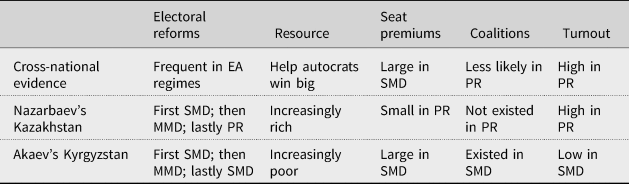
Our theory also implies several consequences of electoral systems in electoral autocracies, and this section offers empirical evidence for these implications.Footnote 16 First, we suggested that SMD leads to larger seat premiums favourable to ruling parties in electoral autocracies. Indeed, the case of Singapore nicely illustrates the SMD seat premium: between 1968 and 1991, the People's Action Party obtained 98% of the total seats with only 70% of the total votes. Our regression analysis in Online Appendix F further supports this implication, showing that more majoritarian systems are positively correlated with larger seat premiums for ruling parties. Second, we suggested that PR systems are more likely to deter pre-electoral opposition coalitions. Again, our cross-national analysis in Online Appendix G provides supporting evidence for this implication, finding that more PR systems are correlated with lower probability of pre-electoral coalitions by opposition parties. Third, we posited that PR systems are more likely to increase voter turnout. Our empirical investigation in Appendix H corroborates that it is indeed the case.
Additionally, our theory rests upon two important assumptions regarding resource wealth and electoral systems. First, we suggested that political leaders in autocracies have more leeway to change electoral systems than leaders in democracies. Figure I-1 in Online Appendix I examines inter-temporal variations in the EET variable for both electoral authoritarian and democratic regimes. We find that electoral systems in democracies are more permissive and less volatile than in electoral autocracies, and this empirical observation is consistent with our argument. Second, we made another assumption that natural resources should increase political support for authoritarian regimes, and based on this assumption we use natural resources as a proxy for a dictator's ability to induce compliance. To provide direct evidence on this proposition, we empirically test whether natural resource wealth helps dictators mobilize regime supporters in legislative elections. As expected, in Online Appendix J we find that a larger amount of resource wealth increases both vote shares and margins of victory for ruling parties. We summarize all of these implications and findings in Table 2.
Additional Cross-National Analyses and Comparative Case Studies

To further illustrate how natural resource wealth impacts dictators’ choice of electoral systems, the next sections conduct comparative case studies of Nazarbaev's Kazakhstan (1991–2008) and Akaev's Kyrgyzstan (1991–2005). The structured comparison of both regimes is ideal for several reasons. First, the two electoral authoritarian regimes shared similar historical, social, and institutional background conditions when they declared independence in 1991. Importantly, these similar background conditions allow us to control for numerous factors that might otherwise serve as alternative explanations for electoral system selection: ethnic diversity, which necessitates PR systems;Footnote 17 geographic locations, which decide the degree of foreign influence to adopt certain election rules; historical legacy, which encourages new regimes to retain previous electoral institutions;Footnote 18 and the practice of patronage politics, which breeds candidate-based electoral systems.
Despite their similarities, however, the two regimes experienced contrastingly different electoral systems after declaring independence. Therefore, these two countries provide us with a rare opportunity to conduct a systematic controlled comparison. More intriguingly, both regimes also experienced inter-temporal changes in electoral systems in different manners, allowing us to make more rigorous controlled comparisons than we could with only cross-country case studies. As we can see from Figure 4a and 4b, both regimes used SMD after independence, similar to what they experienced under the Soviet Union. Then both regimes shifted to majoritarian-dominant mixed systems in the late 1990s. However, the Akaev regime later returned to a pure SMD system. In contrast, Kazakhstan's Nazarbaev made the country's electoral system highly proportional by adopting a pure PR system with a nationwide district in 2007. In short, our most similar systems design helps us better explain the between-country and inter-temporal variations in electoral systems in these two regimes.
Natural Resources and Electoral System Changes in Kazakhstan and Kyrgyzstan
Note: The data source of electoral systems is our original data set of the effective electoral threshold. The data for natural resources comes from Ross (Reference Ross2012).

Specifically, our case studies illustrate several important aspects of the logic of electoral system choices. These causal links, consistent with the cross-national evidence presented above, are summarized in Table 2. First, we trace how natural resources became useful in forcing compliance for both ruling elites and citizens in Kazakhstan. We also show that the decline of such resources gradually undermined the same groups’ loyalty in Kyrgyzstan. Importantly, we show that Kazakhstan's adoption of the PR system was mainly driven by a rapid increase in their natural resource wealth, whereas Kyrgyzstan's switching back to the SMD system resulted from its autocrat's lack of such resources to maintain the support from ruling elites. Second, we demonstrate that SMD provides significant seat premiums to ruling parties in these two electoral authoritarian regimes. Third, our case studies suggest that majoritarian systems encouraged the opposition in both countries to form pre-electoral coalitions. Finally, we show how SMD also reduces voter turnout and unifies the opposition.
Rich resource wealth and choosing PR in Kazakhstan
Since independence, the Kazakh government has reformed its electoral system three times, each time moving towards a more PR-based system. Inheriting the electoral system from the Soviet Union, Kazakhstan's first constitution, adopted in 1993, stipulated that all legislators, except those who were appointed by the president, would be elected through single-member districts.Footnote 19 In May 1999, Nazarbaev introduced a mixed-member majoritarian system in which 67 legislators would be elected via SMD while the remaining 10 members would be determined via PR in a nationwide district. In June 2007, Nazarbaev initiated an even bigger change in Kazakhstan's electoral system: introducing a pure PR system.
Prior to 2007, ruling elites in Kazakhstan received more seats than their vote shares indicated due to the SMD seat premium. For instance, in the 1999 election, ruling elites obtained 80.6% of seats with just 61.7% of the vote. Conversely, the main opposition party, the Communist Party of Kazakhstan (CPK), obtained only 3.9% of seats even though the party gained 17.7% of total votes (Nohlen et al. Reference Nohlen, Grotz and Hartmann2001: 420–423). After the adoption of the PR system in 2007, however, the seat premium shrank to roughly half of the seat premium seen in past elections under SMD.
Meanwhile, under SMD, turnout in parliamentary elections continuously decreased from 73.5% in the first parliamentary election to 62.5% in the 1999 election and finally to 54.29% in the 2004 election (Nohlen et al. Reference Nohlen, Grotz and Hartmann2001: 420). Interestingly, once Kazakhstan switched to the PR system, the turnout bounced back dramatically, hitting 68.41% in the 2007 elections. Finally, the SMD system encouraged the opposition to build a coalition to compete in elections. In the 2004 election, two outright opposition parties, CPK and the Democratic Choice of Kazakhstan, forged an opposition bloc to coordinate their election campaigns (Issacs Reference Issacs2011: 89–90). By the 2007 elections under the new PR system, however, the opposition failed to unite for elections after serious internal divisions emerged.
What explains the dramatic shift to PR in Kazakhstan, then? We suggest that a rapid increase in natural resource wealth enriched state coffers and enabled Nazarbaev to utilize the resources for his political advantage. Similar to other post-communist countries, Kazakhstan suffered serious economic decline during the first few years of independence. In response, the Kazakh government began to export natural resources such as oil, gas and minerals (Pomfret Reference Pomfret2006). Since 1999, when the international price of oil rapidly increased (see Figure 4e), natural resource sectors substantially boosted Kazakhstan's economy and allowed the country to sustain almost 10% economic growth until 2007.
Importantly, by establishing Kazakh Oil (the national oil and gas company) to centralize the management of natural resource sectors, Nazarbaev increasingly utilized natural resources to cultivate political support through his intensive patron–client networks. Total social spending, for instance, rose from US$199.37 per capita in 2001 to US$505.24 per capita in 2007. Public spending particularly spiked during election years when the government implemented new education and social policies, increased salaries and pensions, and reduced taxes (Higashijima Reference HigashijimaForthcoming: Chapter 7; Kendall-Taylor Reference Kendall-Taylor2012). The increased public spending was primarily directed towards state employees and pensioners, and embedded in strong patron–client relationships in which benefits trickled down to their followers in return for their votes. For example, just before the 2007 legislative elections, the government announced that it would increase the wages of public servants. As a result, real wages in fact increased by 30% that year (OECD 2011). One of our interviewees pointed out how effectively this vote-buying strategy worked for the government:
Public employees – teachers, professors in universities, and doctors in hospitals – were mobilized to vote for ruling parties. During election campaigns, these institutions not only asked their staff to vote for Nur Otan, but sometimes they threatened employees by saying, ‘If you do not vote for Nur Otan, then there would be some measures, some implications for you, even being fired from your institution.’Footnote 20
Additionally, the oil boom helped Nazarbaev strengthen the security apparatus, increasing spending on both the military and the internal security apparatus from US$26.34 per capita in 1994 to US$112.23 per capita in 2004 (Correlates of War).
Thanks to his effective carrot-and-stick approach, the electoral performance of Nazarbaev and his ruling coalition parties grew over time whereas that of opposition parties shrank. The vote share of ruling parties in the PR segment steadily increased from 61% in 1999, to 79.06% in 2004, and then to 88.41% in 2007 (Figure 4c), whereas the opposition camp decreased their vote shares from 17.7%, to 15.4%, and then to 4.54%. In fact, many political elites in Kazakhstan believe that rich natural resources would have helped Nazarbaev win elections with at least 60–70% of the vote, even if the elections were totally honest.Footnote 21 Most crucially, Nazarbaev's growing political dominance in the early 2000s made it possible for him to shift the electoral system to PR, which, he explained, “provided a real reflection of the distribution of political forces and the valid will of the population” (Issacs Reference Issacs2011: 90).
Poor resource endowment and choosing SMD in Kyrgyzstan
Similar to Kazakhstan, Kyrgyzstan started legislative elections with the SMD system in 1995. Kyrgyzstan then shifted to a mixed system prior to the 2000 election. Interestingly, before the 2005 election, Akaev changed the electoral system back to the SMD system (see Figure 4b).
Like Kazakhstan, Kyrgyzstan's SMD system also provided a seat premium and thus opportunities to co-opt ruling elites. For instance, in the 2000 legislative election, the opposition camp obtained 49.1% of votes nationwide, but they gained only 10.5% of the seats. The ruling parties and pro-presidential independents, on the other hand, occupied more than 85% of total seats (Nohlen et al. Reference Nohlen, Grotz and Hartmann2001: 447). Sjoberg (Reference Sjoberg2011: 92) reports that candidates nominated by the biggest ruling party, Alga Kyrgyzstan, were 66% more likely to win seats than the opposition candidates in the 2005 election.
Akaev's heavy dependence on SMD is attributed to the fact that he lacked abundant and centralized natural resources to gather political support. Kyrgyzstan has almost no valuable natural resources such as oil and gas. A relevant source of natural resource wealth is the Kumtor gold mine, which accounted for nearly 50% of industrial output in Kyrgyzstan between 1996–2000 (Pomfret Reference Pomfret2006). This windfall income, however, was too small to be politically relevant. Gold income per capita was only US$36.72 on average during the Akaev regime and accounted for only 1% of GDP per capita, which was far smaller than Kazakhstan's natural resource wealth (15% of GDP per capita on average between 1995–2005).
Due to his inability to gather political support through natural resources, Akaev increasingly faced strong opposition. Until the late 1990s, Akaev managed to sustain political support from regional elites with local patronage networks. The exhaustion of resources, however, increasingly forced the president to confront the emerging opposition. Luckily, the seat premium from the SMD segment allowed Akaev to buy off politicians in the legislature. Being a legislator provided ruling elites with various privileges, such as immunity from prosecution, access to illegal transactions through law-making influence, and protection of their property from special interests. From Akaev's perspective, employing SMD enabled him to co-opt regional elites, garner political support in their strongholds, and solidify his rule.
In the 2000 election, Akaev used various electoral malpractices to prevent the opposition from gaining political momentum. Additionally, Akaev also decided to return to the pure SMD system before the 2005 elections with an eye towards maintaining a majority in the parliament. The shift to the SMD system did boost the seat shares of ruling politicians. Despite declining financial resources, two ruling parties, Alga Kyrgyzstan and Adilet, occupied 53% of total seats after the second round. Further, SMD discouraged ruling politicians to defect from the regime after the electoral reform.
The switch to the pure SMD system in the 2005 election, however, suppressed voter turnout and undermined citizens’ trust in democratic practices. The turnout in the second round of the 2005 election was only 51%, the lowest since the first elections in 1995. Moreover, after the election, only 22% of citizens believed the election was fair (Sjoberg Reference Sjoberg2011); most of the citizens considered the election biased in favour of the incumbent. Akaev's decision also encouraged the opposition to unite for electoral purposes. The most visible opposition coalition was the People's Movement of Kyrgyzstan, which then formed an alliance with three other opposition coalitions with ‘the potential to project significant strength … from the union of individual opposition figures from both the north and south of the country’ (Radnitz Reference Radnitz2010: 135).
In sum, the case of Nazarbaev's Kazakhstan suggests that growing natural resource wealth cemented political support from both ruling elites and citizens over time, which enabled Nazarbaev to switch from SMD-based mixed systems to a PR system. The adopted PR then helped the president improve voter turnout and keep the opposition divided. By contrast, the case of Akaev's Kyrgyzstan suggests that an essentially small and shrinking amount of natural resources made it difficult for Akaev to maintain popular support, which incentivized him to return to the pure SMD system prior to the 2005 election.
Conclusions and discussion
This article argues that resource-poor dictators are incentivized to employ SMD systems to co-opt ruling elites in the legislature with the extra seats, while resource-rich dictators tend to choose PR systems to alleviate the threat from the masses. Using cross-national data on electoral authoritarian regimes, our empirical analyses lend strong empirical support to our theory. We also presented our comparative case studies of Kazakhstan and Kyrgyzstan, showing that majoritarian systems bias seat distributions in favour of ruling parties, foster a unified opposition, and lower voter turnout in electoral autocracies.
This article makes several key contributions to the literature. First, it contributes to the electoral system choice literature. We highlight the limitations of conventional wisdom on the origins of electoral systems in democracies, and we posit a new theory of electoral autocracies’ choice of electoral system. Our article also connects to the emerging literature rethinking the oil curse (Ross Reference Ross2012, Reference Ross2015). Our empirical findings suggest that autocrats rich in natural resources may not necessarily alienate themselves from citizens. Rather, we show that dictators with natural resource endowment tend to adopt PR systems, thereby lowering the barrier of entry and encouraging citizens’ political participation. Finally, our findings also supplement a study by Bueno de Mesquita and Smith (Reference Bueno de Mesquita and Smith2009) which shows that as the level of free resources increases, dictators are more likely to strengthen their authoritarian rule with a smaller coalition system.
Second, by exploring the origins of electoral institutions in electoral autocracies, we add to the ongoing debate about the role of elections in authoritarian politics. As discussed, scholars have identified various beneficial functions of elections for authoritarian leaders. On the flip side, recent studies have begun to question the consolidating effects of elections, suggesting that elections in authoritarian regimes can lead to instability (Knutsen et al. Reference Knutsen, Nygard and Wig2017). By taking into account the origins of electoral systems, this article argues that the effects of elections in electoral autocracies are likely to be endogenous to dictators’ rationale for selecting electoral institutions in the first place. In this light, our article engages in a direct dialogue with the endogenous nature of political institutions in authoritarian regimes. According to this perspective, political institutions in autocracies are the least likely to be randomly assigned and their designs are influenced by autocrats’ rational calculations as well as various socio-economic factors. As Pepinsky (Reference Pepinsky2014: 635) puts it, institutions in authoritarian regimes ‘reflect the distribution of power in authoritarian regimes rather than exogenously shape it'. Pepinsky (Reference Pepinsky2014: 633) further urges scholars to distinguish between ‘institutions as causes … and institutions as epiphenomena'. Extending this insight, our theory illuminates the origins of electoral institutions in electoral autocracies.
Before concluding, it is important to highlight the limitations of this study and implications for future research. First, while this article uses natural resources as a proxy to measure dictators’ capacity to induce compliance, it is worth noting that dictators’ strengths can stem from various other sources as well, such as the types of legitimacy (Negretto and Visconti Reference Negretto and Visconti2018). To be sure, our analytical focus echoes the notion of incumbent capacity advanced by Levitsky and Way (Reference Levitsky and Way2010). At a broader level, our conceptualization of the resource-rich dictator also parallels what Svolik (Reference Svolik2012) refers to as the ‘established autocrats’ who ‘have acquired so much power that they can no longer be credibly threatened by their allies'. On the other hand, a resource-poor dictator is similar to what Svolik refers to as the ‘contested autocracy’ where ‘politics is one of balancing between the dictator and the allies’ (Svolik Reference Svolik2012: 6). Therefore, it would be useful, both theoretically and empirically, to move beyond the parsimonious focus on natural resources and paint a fuller picture of different types of dictators.
Additionally, while this article focuses on the choice of electoral systems in autocracies, there are likely to be multiple pathways through which dictators can manipulate the electoral outcomes. Finally, our findings suggest that strong dictators would prefer PR, and PR in turn can help dictators pre-empt potential challengers and consolidate their rules. Therefore, one implication is that the mutually reinforcing dynamics between electoral systems and natural resource endowments can lead to authoritarian resilience over time. Meanwhile, if the oil price continues to stay low, the low oil-price equilibrium can force some dictators to shift back to majoritarian systems and even make their regimes more vulnerable. In this sense, the oil prices can have strong implications in both electoral system designs and regime durability for contemporary authoritarian regimes. Together, these implications represent interesting research opportunities in the future.
Supplementary material
To see the supplementary material for this article, please visit https://doi.org/10.1017/gov.2021.17.
Acknowledgements
This research was supported by the US National Science Foundation (#1323671), Japan Society for the Promotion of Science (15H06682, 17H04779) and the National Research Foundation of Korea (NRF- 2017S1A3A2066657). A previous version was presented in the 2015 annual meetings of the American Political Science Association and Southern Political Science Association, the 2016 pre-APSA workshop of the Electoral Integrity Project, European University Institute, Fukuoka University, Graduate Institute of Geneva, Keio University, Korea University, Michigan State University, University of Houston, University of Michigan, and Waseda University. We thank all of the participants for their helpful comments. Jeff Conroy-Krutz, Erica Frantz, Allen Hicken, Ani Sarkissian and Michael Wahman also gave useful feedback after reading earlier versions of this article. The three anonymous reviewers also provided helpful comments which contributed to further improving this research. Finally, we are indebted to Jessica A. Schoenherr and Christina Scheller for their indispensable research assistance.