INTRODUCTION
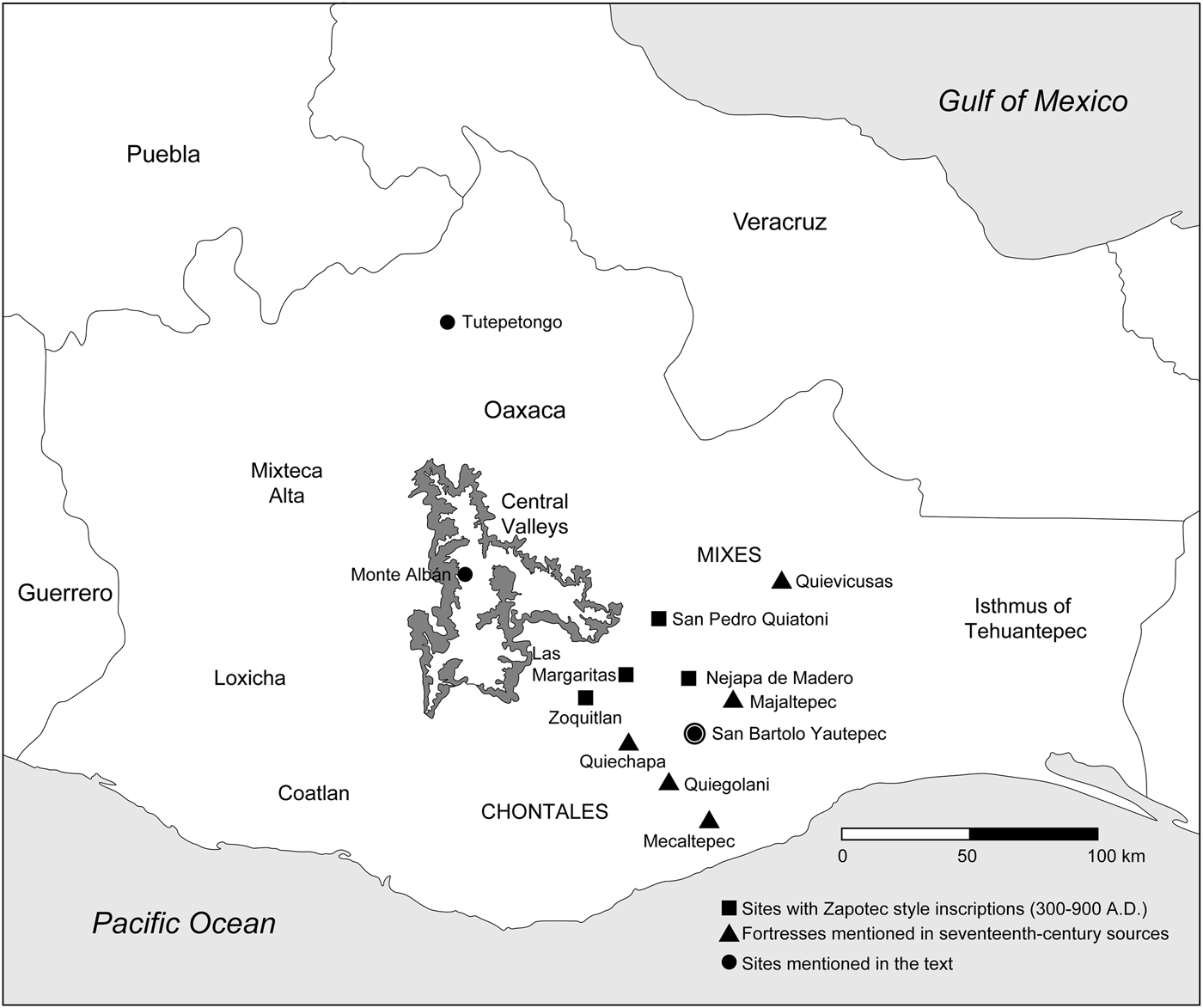
The recent finding of two fragments of an ancient mantic manuscript in San Bartolo Yautepec, Oaxaca has important implications for understanding the indigenous divinatory and scribal practices of the mountainous region between the central valleys and the Isthmus of Tehuantepec. Only recently has archaeological research in this region begun to elucidate the long term social processes that led to the development of urban societies (King Reference King2010, Reference King, Oland, Hart and Frink2012; King and Zborover Reference King, Zborover, Scheiber and Zedeño2015; King et al. Reference King, Konwest and Badillo2012, King et al. Reference King, Konwest, Workinger, Badillo and Enríquez2014). Today, peoples in that region of Oaxaca speak Zapotec. To the south they neighbor Chontal-speaking communities and, to the north, Mixe speakers. During the political heydays of Monte Albán, between the sixth and ninth centuries a.d., the region of San Bartolo Yautepec became part of Monte Albán's sphere of influence. Zapotec-style inscriptions in nearby localities such as San Pedro Quiatoni, Las Margaritas, Santa María Zoquitlán, and Nejapa de Madero attest to this (Urcid Reference Urcid2001:18, 482–487, Figure 1.8; King et al. Reference King, Konwest and Badillo2012). A series of hilltop settlements, dating primarily between the fourteenth and sixteenth centuries a.d., were reported as early as the seventeenth century a.d. (Burgoa Reference Burgoa1934 [1674]:bk. II, p. 236) and some of them seem to evince diverse functions and complex multiethnic interactions of Mixe, Zapotec, Chontal, and Nahua peoples (Figure 1; King Reference King, Oland, Hart and Frink2012; King et al. Reference King, Konwest, Workinger, Badillo and Enríquez2014).
Location of San Bartolo Yautepec, sites, and regions mentioned in the text. Map by Elbis Domínguez Covarrubias.

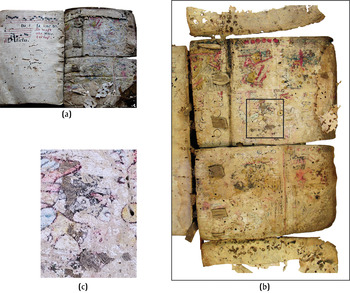
In 2001, members of the Instituto de Órganos Históricos de Oaxaca (IOHIO) led by Cicely Winter visited San Bartolo Yautepec to study the pipe organ from around 1800 housed in the community's church. In the course of their investigation, the civil and religious authorities showed them the contents of two wooden chests kept in the choir of the church, next to the pipe organ, including a number of bound and loose musical scores pertaining to different epochs, from the seventeenth through the twentieth centuries (Tello Reference Tello and Pellicer2013:153–165). In addition to their value as a collection of ancient written music, one book with scores for Gregorian chants, from the sixteenth or seventeenth century, had inside its back cover two fragments of an older manuscript (Figures 2a–2b). We present here a description of the fragments, the analysis of their inscriptions, and an interpretation of their content.
The reused manuscript fragments: (a) last page of the book and the back cover with the flaps of the jacket folded (photograph by Cicely Winter); (b) the back cover with the superior and inferior flaps of the jacket removed (photograph by Ethelia Ruiz Medrano); and (c) detail of the upper fragment showing fibrous remnants of a thick piece of amate paper placed on top of the fragments (photograph by Sebastián van Doesburg).

THE FRAGMENTS AND THEIR REUSE
Although much damaged, it is evident that the fragments once formed part of a mantic screenfold, scraps of which were reused to assemble the book with musical scores. In order to form the inner layer of the book's back cover, two cut pieces from the older screenfold were arranged vertically and placed upside down, an inversion of a written surface to render the content (but not the significance) of an inscription “invalid.” Such practice is well-attested in the much older Zapotec scribal tradition (Urcid Reference Urcid, Boone and Urton2011:139–143). For purposes of description, we designate the upper piece Fragment 2 and the lower piece Fragment 1.
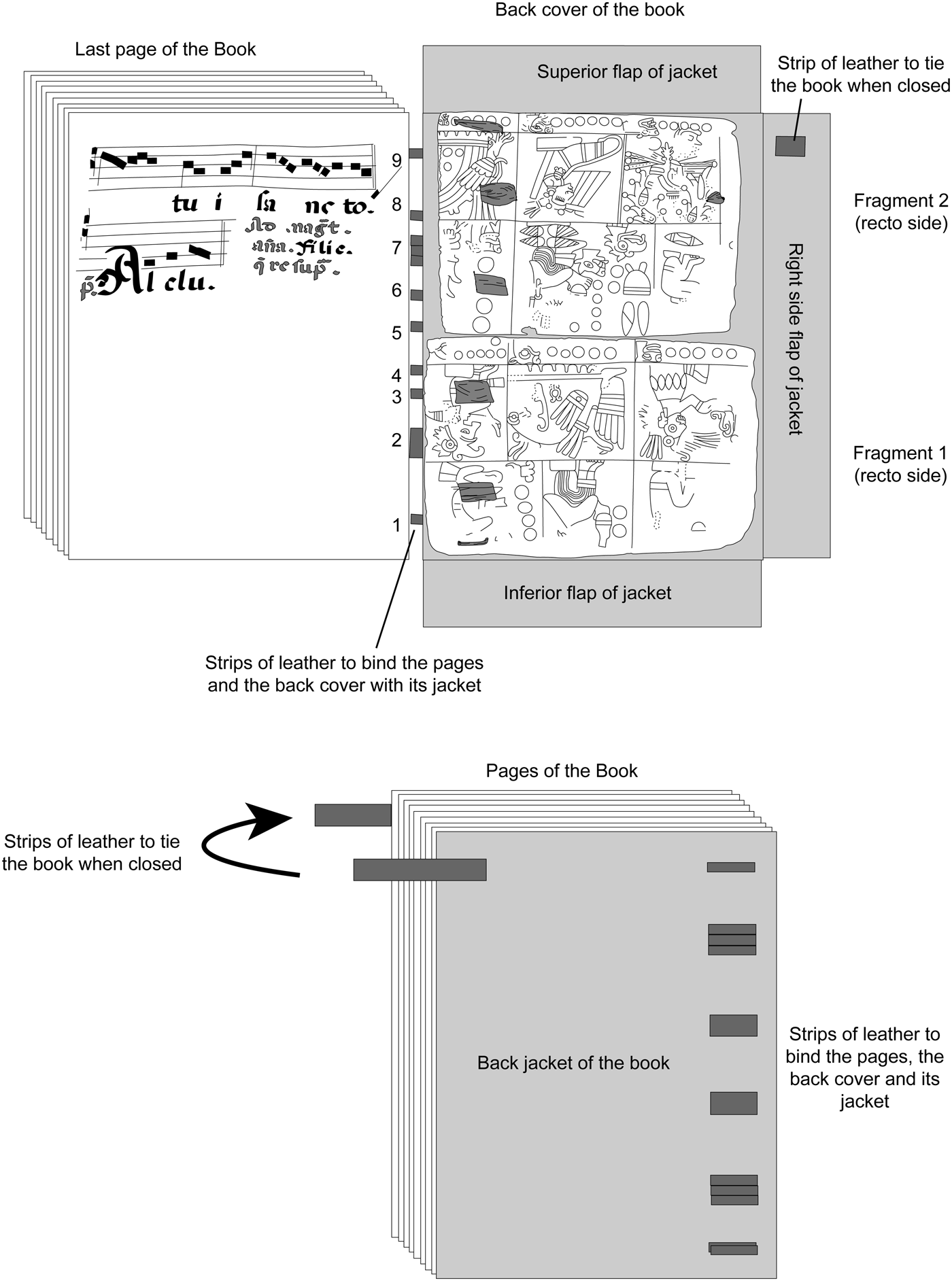
Several steps were followed in order to assemble the book (Figure 3). First, groups of eight folded paper sheets with the scores were sown together using nine thongs. The thongs at either end of the spine are thinner than the rest. The covers, now disappeared, were most likely pieces of bark paper (amate) approximately 4 millimeters thick that were attached by using all but the third, fifth, and seventh binding thongs. The two fragments of the ancient manuscript were then placed on top of the back cover. In addition, they were also bound using the same binding thongs. Thus, each fragment has on the side next to the spine three incisions with variable distances from one another between 3.4 and 6.3 cm. The final step involved wrapping the double-layered cover with a rectangular piece of leather—probably bovine—leaving three narrow flaps to the interior of each cover. By the time the fragments were discovered, the back amate cover had already disintegrated, leaving minute traces of entangled fibers on the side of contact with the fragments, especially on Fragment 2 (Figure 2c). The front cover and the opening sections of the book were also lost. Most likely the front cover was put together in the same way as the back cover, opening the possibility that assembling the book entailed the reuse of four, not just two, fragments of the same ancient manuscript. When the posterior cover of the book is opened, near the upper right corner, and affecting both the internal right side folding of the jacket and Fragment 2, there are two perforations through which a thin leather strap passed. This strap, still in place when the book was found, was used to hold the lateral flap of the jacket to the back cover. It may also have served to tie the book, presuming a counterpart in the lost front cover. The book eventually deteriorated because of heavy use, but more substantial damage resulted from a moth infestation that left multiple and extensive perforations and channels.
Diagrams of the assembly of the book and the back cover with the two fragments. Drawing by Elbis Domínguez Covarrubias.

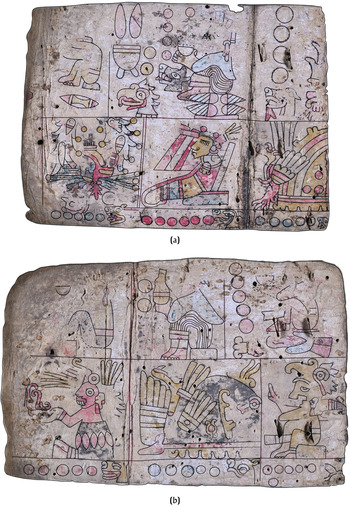
The surface of the manuscript fragments that is visible when the posterior cover is opened will be referred to as their recto side. Both pieces are made of deerskin (María Teresa Olivera Carrasco, personal communication 2012) and their paintings follow the techniques and graphic conventions of the late pre-Hispanic inter-regional scribal tradition (a.d. 1250–1550) (Figure 4). The deerskin was covered with a thin layer of calcium sulfate (gypsum) before the paintings were applied. Each fragment is divided into two horizontal registers by a thin red line painted approximately 7.75 centimeters from the inferior border. The imagery and calendrical notations were painted using organic based hues, including blue (derived from the añil, or xiuhquilite), red and pink (based on cochineal), gray and black (from carbon), and yellow and brown (from an unidentified plant) (José Luis Ruvalcaba Sil, personal communication 2012).
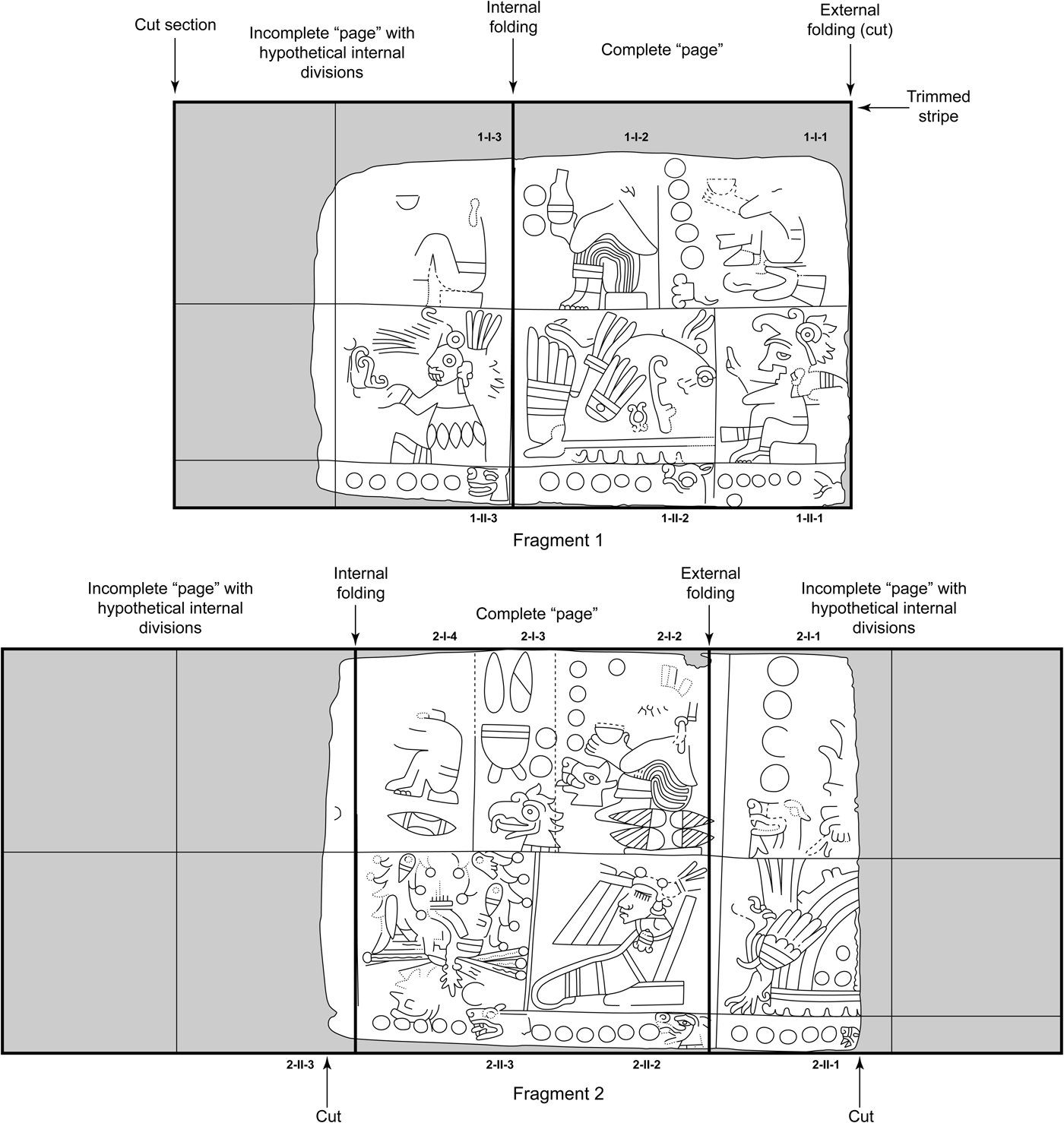
Photographs of the recto side of (a) Fragment 2 and (b) Fragment 1, now inverted, with superimposed line drawings (the jacket and the binding thongs are removed). Photographs by Sebastián van Doesburg (line drawing by Javier Urcid).

The fragments are not the same size. Although both are approximately 21 centimeters in length, Fragment 1 is slightly shorter in height, measuring 14 rather than 16 cm. The difference is most likely the result of the trimming of a strip along the upper side of Fragment 1 in order to make it coincide, once placed below Fragment 2, with the height of the book's cover. This inference is supported by the fact that when both fragments are aligned along the red horizontal line, their inferior borders also match.
The graphic composition on the recto side of both fragments has a similar structure, including the divisions into cells of varying size by means of vertical red lines. In some instances, these vertical lines span the entire width of the fragments and coincide with the original folding of the manuscript. Darkened stains undoubtedly related to the handling of the manuscript, evincing an exterior folding, further characterize the area near the vertical line on the extreme right side of Fragment 2.
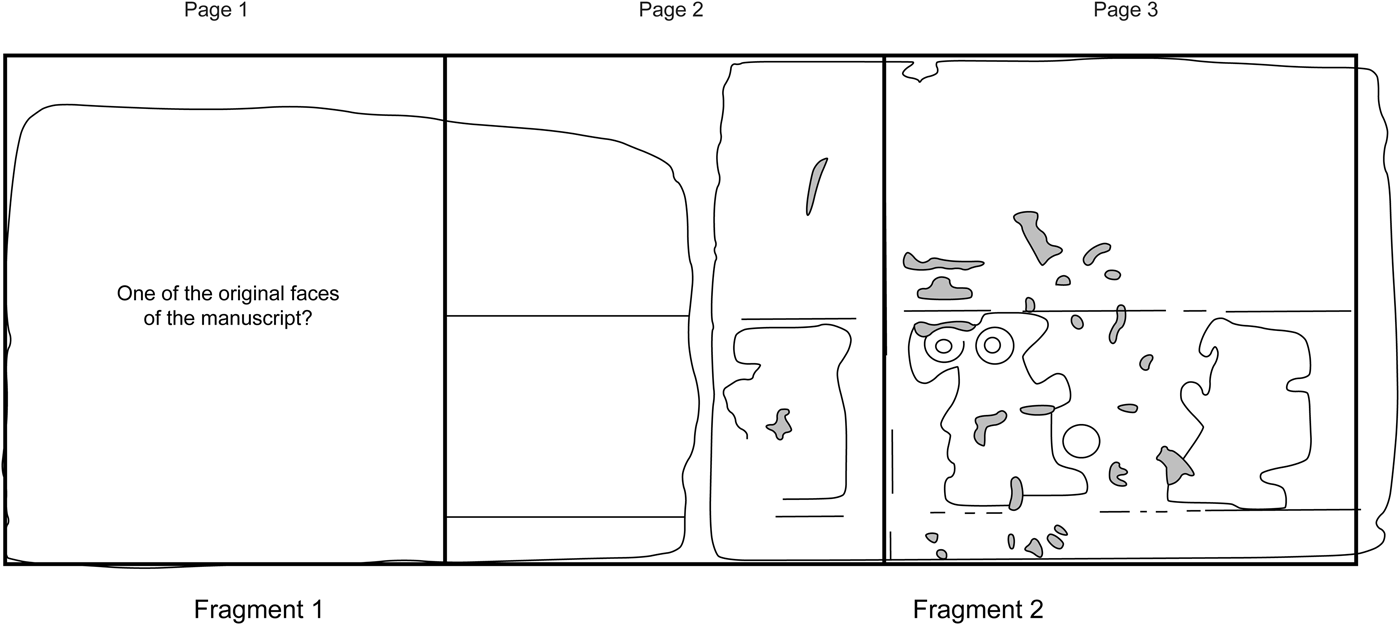
The vertical line on the left side of Fragment 1, as well as the vertical line in the extreme end of Fragment 2, appear to coincide with interior folding, and are characterized by the lack of dirt stains. The examination of the verso sides of the fragments corroborates the presence of the original folding. Thus, the two fragments as separate entities actually represent five “pages” of the original screenfold, one of them complete, and four others incomplete (Figure 5). It can be deduced from the complete “page” in Fragment 2 that, when folded, the manuscript measured 14.5 × 16 cm, similar in size to manuscripts Tonalpouhqui [Vaticano B] (14.5 × 12 cm) and Mictlan [Laud] (15 × 15.5 cm).Footnote 1 The location of the folding in Fragment 2 indicates that some nine centimeters are missing from the adjacent “page” on the right side. What remains of the adjacent “page” on the left side is only a thin section 1.5 cm in width. One can also deduce that Fragment 1 includes two incomplete “pages”: the left one is missing 6.5 cm and the right one lacks a portion measuring 1.5 cm.
Reconstitution of the fragments into “pages” and cuts made in order to reuse them. Drawing by Elbis Domínguez Covarrubias.

Considering the constraints imposed by the fragmentary nature of the evidence, we surmise that each surviving “page” of the manuscript had two cells in their lower half and two or three cells in their upper half. Each cell contains an image and an associated sign-numeral notation. The content of the extant cells, however, is, in turn, partial because of the additional cuts that were made to adjust the fragments to the size of the cover for the book of Gregorian chants.
THE GENRE OF THE MANUSCRIPT AND ITS STRUCTURE
Pre-Hispanic manuscripts mediated a host of social practices. Some were commissioned to legitimize privileges and rights of royal houses by linking their claims and selective history to primordial origins, naturalizing the foundations of political power and moral order. These narratives begin with a creation story that subsequently morphs into an account of cultural heroes, the deeds of founding ancestors, and key events in the consolidation of power by their successors, highlighting marriage alliances, warfare, and the demarcation of polity boundaries. In such manuscripts, the representation of personages identified by their calendrical name (taken from the 260 day cycle) and/ or their personal appellatives abound. So do identifications of relevant landscape features, including human settlements, boundary markers, and loci of ritual significance. The temporal framework structuring these accounts rely on the Calendar Round (the cycle of 52 solar years), specifying the occurrence of events in terms of an annual and day date.
Specialists in the mantic arts who mastered different techniques of divination, sacred lore, and astrology used a different kind of manuscript in order to engage in oracles and prescribe proper ritual enactments that reinforced (if favorable) or counteracted (if inauspicious) the outcomes of foretelling. Although this type of manuscript was written using similar graphic conventions as the historical screenfolds, its layout and content is different. The mantic manuscripts embodied a set of philosophical principles concerning time and space, with the purpose of guiding users in the intricate processes of prognostication to cope with all sorts of crises in the social fabric: the good outcome of births, the expected development of persons and their proper moral conduct, seeking harmony in interpersonal relations, ensuring success with crops, trade, and war, and to confront the personal and collective impact of death. The imagery in the mantic manuscripts is loaded with visual metaphors aimed at interpreting the veiled nature of human and divine motivations; to recognize propitious, negative, or neutral days to carry out an activity; to prescribe and select the lucky days to perform rituals or to make the necessary offerings to maintain equilibrium; as well as to predict the temperament or the character of the newly born, the betrothed, and married persons. Hence the importance in this type of manuscript of the 260-day count and associated cycles (rather than the Calendar Round of 52 years) as organizing temporal dimension.
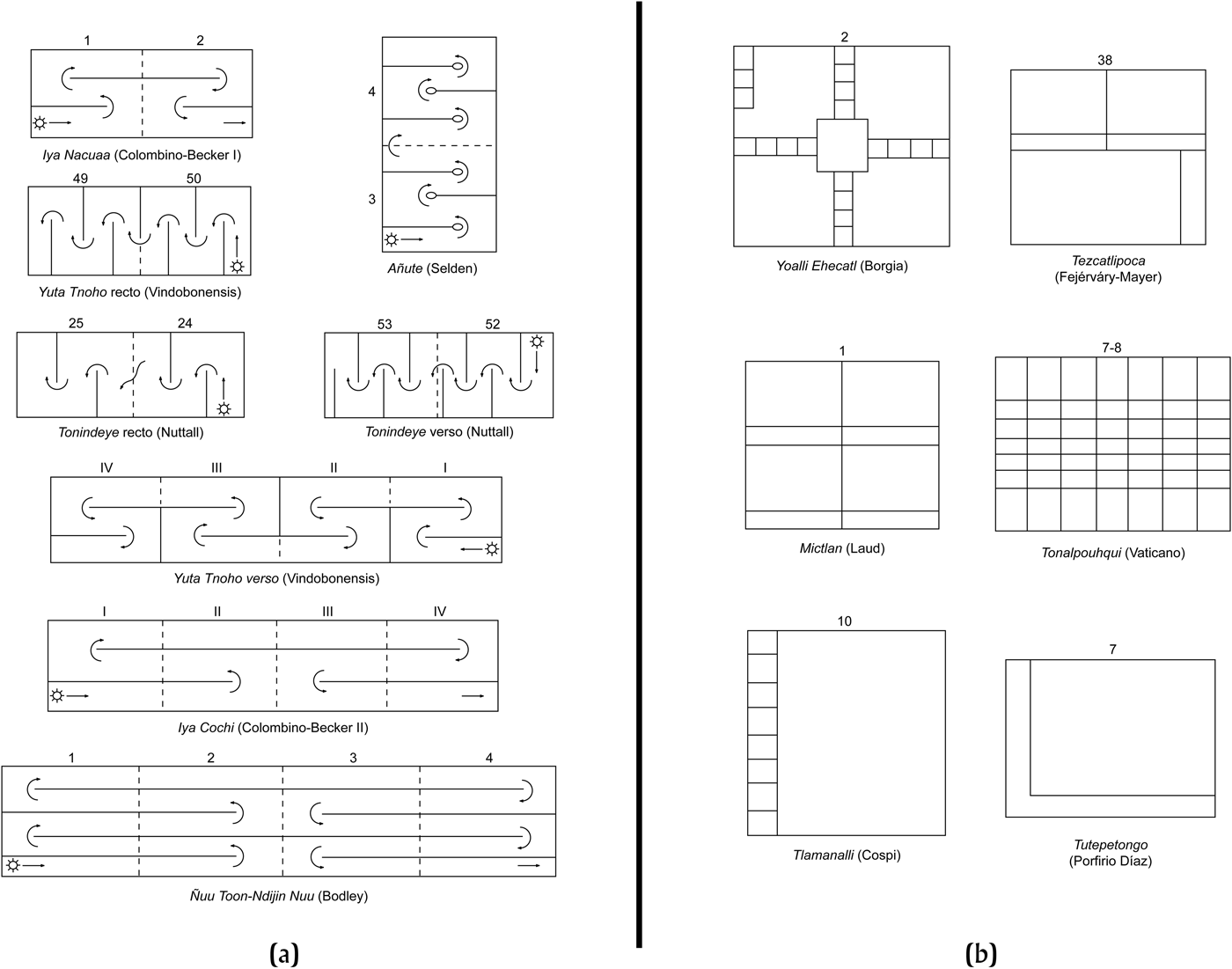
One of the implications of the different usage of the concepts of time and space between the historical and the mantic manuscripts is their contrasting composition. The former are characterized by having guiding lines that follow time in a continuous linear display. The mantic manuscripts, in contrast, are organized in terms of registers and cells, often in groups, that stand for the subdivisions of the 260-day cycle (Figure 6). Thus, more emphasis is placed on the cyclic and recurrent notion of time. Each subdivision is accompanied by an image laden with symbolism that had to be interpreted by diviners. Several cells form thematic “chapters,” so that for each matter to address there was a particular section in a given screenfold. For instance, a manuscript may have a section devoted to the propitiation of mother-father lightning to ensure a good crop, while another section may be devoted to ascertain marriage compatibility given personal propensities that were determined at birth.
Structure in the (a) historical (drawn after Smith Reference Smith1973:217) and (b) mantic screen folds (drawing by Elbis Domínguez Covarrubias).

Several details on the Yautepec fragments indicate that the screenfold from which they derive was used for mantic purposes. Instead of lines guiding a continued reading sequence, the fragments have a series of cells, each one with an image, a day sign, and an associated numeral. The few represented personages lack their calendrical names and there are no glyphs that reckon annual dates. The mantic nature of the once-complete screenfold allows the comparison of its fragments with seven extant pre-Hispanic divinatory manuscripts, including the Yoalli Ehecatl [Borgia], Mictlan [Laud], Tonalpouhqui [Vaticano B], Tezcatlipoca [Fejérváry-Mayer], Tlamanalli [Cospi], the mantic section of manuscript Tutepetongo [Porfirio Díaz] and the Yecu [Fonds Mexicains 20]), all of them with sections structured along various subdivisions of the 260-day cycle. With the exception of the manuscript Tutepetongo, which originated in the town of the same name in Oaxaca, the provenance of the enumerated manuscripts remains unknown, although at least some of them most likely originated somewhere in the macroregion spanning from the Basin of Mexico to the central valleys of Oaxaca.
The manuscripts have similar “chapters” or subdivisions of the 260-day count, which demonstrates the existence of mantic practices that were copied and shared by diviners across large portions of Mesoamerica. The most common subdivision of the sacred calendar is comprised by 20 groups of 13 days each (trecenas). Each trecena had a patron deity who exerted her/his influence over it, or more precisely, over the persons born within it. In order to enrich the mantic possibilities, the twenty trecenas were organized in groups of four or five, ascribing each group to one of the cardinal directions: thus, trecenas I, V, IX, XIII, and XVII were associated with the east, trecenas II, VI, X, XIV, and XVIII with the north, and so forth. In order to increase the complexity of the sacred count and its mantic potential even further, the specialists divided each trecena into two parts of seven and six days each (like in manuscript Yoalli Ehecatl), or eight and five days each (like in manuscript Mictlan). This additional partition allowed linking each part of a trecena to other divine patrons. According to Friar de Sahagún:
[…] the count of the mantic arts […] is a reckoning by itself, because its aim is to forecast the conditions and events of those who are born in a given sign or character; this count was known only to diviners and those who had the ability to learn it, because it is riddled with difficulties and covert meanings. Those who know the count are called tonalpouhque [keeper of the count of days], and they were highly regarded and honored; they were seen as prophets and fortunetellers [Sahagún Reference Sahagún1981:373, Appendix to Book IV; translation by Urcid].
Spanish missionaries vigorously attempted to suppress the use of the mantic count, as it was construed by them as heretic and idolatrous. For instance, in the mid-sixteenth century, a renowned professor of rhetoric at the university in Mexico City who was trained in the Renaissance tradition of Salamanca referred to the divinatory count as: “the [temporal] sequence they deployed in their false and diabolic astrology, which I have described in order to highlight the deceit in which this miserable people have lived until now” (Cervantes de Salazar Reference Cervantes de Salazar1985:bk. I, ch. 29, p. 53; translation by Urcid). Such an attitude towards indigenous divinatory practices resulted in the burning of many mantic manuscripts. Yet, by the mid-twentieth century, the divinatory count continued being used in several communities of Oaxaca and was ethnographically recorded among Mixe and Zapotec speakers from the northern and southern mountains, the latter region neighboring the general area where the two fragments under discussion appear to have originated (Carrasco Reference Carrasco1951; Carrasco et al. Reference Carrasco, Miller and Weitlaner1959; Mann and Chadwick Reference Mann and Chadwick1960; Weitlaner Reference Weitlaner1958; Weitlaner and Weitlaner-Johnson Reference Weitlaner and Weitlaner-Johnson1963). The mantic count, including its subdivision into twenty trecenas, is still being used today by Mixe ritual specialists (Lipp Reference Lipp1991; Duinmeijer Reference Duinmeijer1997) and by diviners in the Loxicha and Coatlán region (Ron van Meer, personal communication 2009).
Regarding the Yautepec fragments, all the recognizable personages painted on them, as well as the day signs that represent animals, face to the left. This orientation suggests that the scanning along the horizontal axis of the upper and lower registers in each fragment is from right to left, which is the most common manner in which “chapters” are arranged in the extant mantic manuscripts.Footnote 2 Further support for this inference is the syntagmatic structure of day sign and numeral in the cells from the lower register of both fragments, with the day name to the right and the numeral dots, arranged in a row, to the left. The possible relationship between the two fragments will be discussed once the content of each cell is described. Given the compositional structure mentioned before, we describe the cells in the upper registers first, proceeding from right to left. We then consider the cells in the lower registers of the fragments, following them from right to left. Each cell is individually identified with a three-digit code that include the fragment number, a Roman numeral to designate upper or lower registers (I and II, respectively), and a sequential Arabic number.
THE IMAGERY IN THE UPPER CELLS OF THE FRAGMENTS
The upper register of Fragment 1 is divided into three cells. The first two (1-I-1 and 1-I-2) belong to the same “page.” The imagery painted in cell 1-I-1, although much faded, appears to render a man in profile view seated on a folded red cloth with a blue knot. His legs are pulled towards his body. While the left arm is bent and leans over the knees, the right hand is extended and holds a red painted vessel. The man wears only a white loincloth and the front sash protrudes from his legs. His skin appears to have been painted entirely red, though his feet and arms were painted in a darker tone. Nothing of the face remains: the top part of the head my have been cut off when the fragment was trimmed. The left portion of the cell contains five red dots vertically arranged, although the top one is barely discernable. Below the numerical column is the day sign Flower, placed sideways. The glyph proper is painted yellow and the twisted root red. Since we have posited that a strip at the top of the fragment was cut off, the number associated with the day name Flower may have been greater than five.
Cell 1-I-2 shows a woman in profile view seated on a stool, with the legs pulled towards the torso and the feet parallel to each other. She is clad with a blue blouse and a long white skirt with red stripes. The lower border of the skirt ends in two horizontal bands, one yellow and the lowermost red. A hand protrudes from the upper garment and holds a yellow vessel with a red band in the rim. The content of the vessel towers into a now indistinct yellow form. The woman's face (mostly blurred), hand, and feet were all painted red. Not much remains of the calendrical notation on the left side of the cell, except for two, perhaps three, yellow dots arranged in a column. It is evident that a day name was painted at the bottom of the column, but only faint traces of red and black colors are discernable.
Cell 1-I-3, which pertains to the adjacent left “page,” is very damaged. It may have the representation of a person in profile view seated on a stool, with his black painted legs pulled towards the body, which is yellow. The feet are red, and so is the waistband. A faded rose stain where one would expect the hand, and an equally faded yellow stain above it, suggest the presence of a hand holding a vessel. Nothing remains of the person's head except a stain that hints at a pending red ear ornament. If there were a calendrical notation in the cell, it would have been painted further to the left. The vertical line that must have defined the left side of the cell is also completely obliterated.
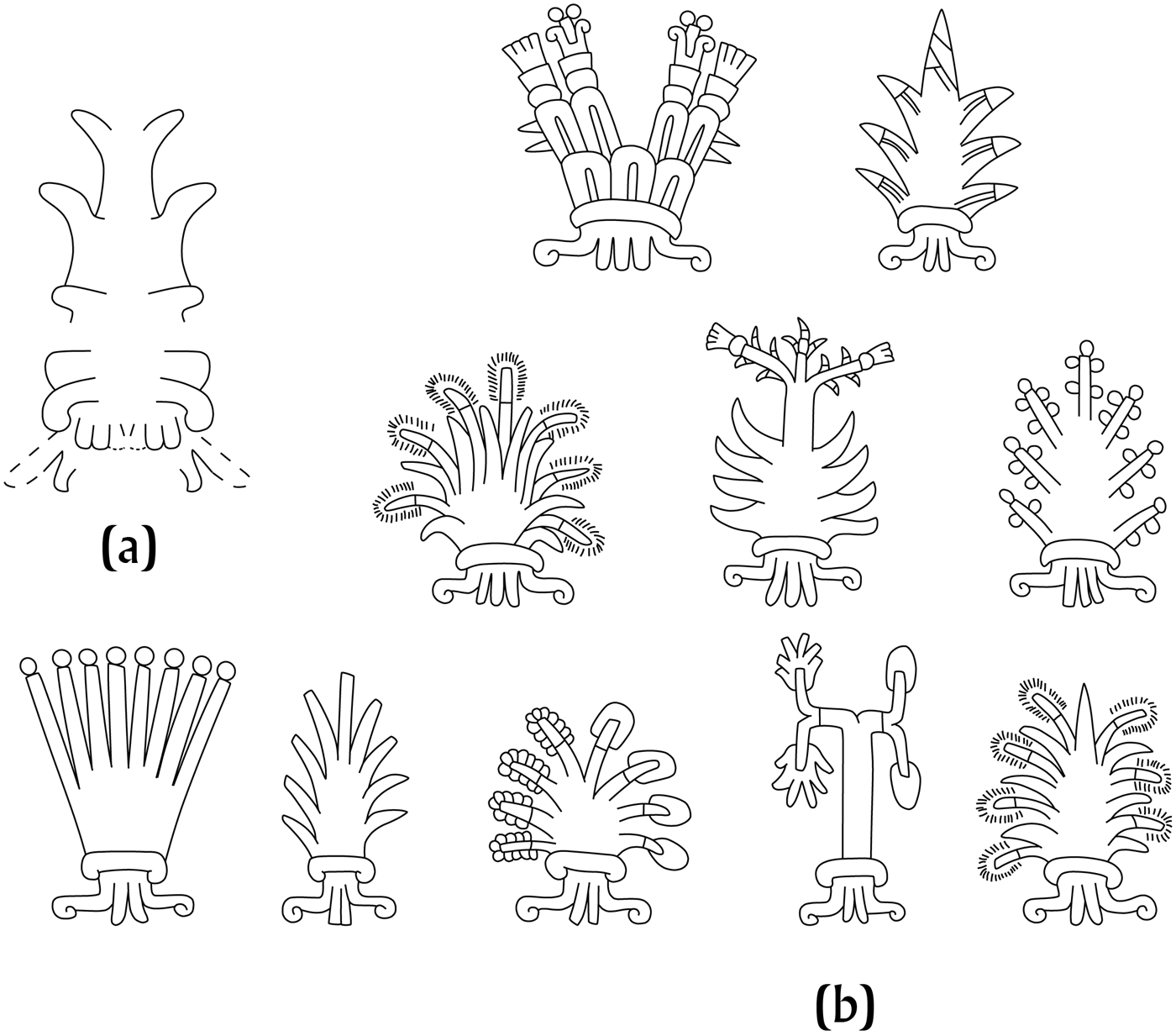
The upper horizontal register of Fragment 2 is divided into five cells. The first one pertains to the section of an incomplete “page,” whereas the next three fall within the adjacent “page.” The fifth cell would correspond to an incomplete “page” to the left. Even though cell 2-I-1 is partially preserved, enough remains to ascertain the representation on the right side of a blue-colored plant. Two main leaves remain, painted above a yellow base that is supported, in turn, by a red band. Below it is the depiction of a root system, with a yellow cap that has a series of short and long red vertical stripes hanging from it. The sign is similar to the representation of certain plants, like agaves and grasses, in other manuscripts (Figure 7). On the left side of the cell remains a columnar sequence of four yellow dots above the traces of the day sign Serpent. The latter is distinguishable by the red bifid tongue. While the head of the snake was painted mostly yellow, the snout and supra-orbital plaque appear blue. There is a small section between the snout and the eye painted red, and this color was used as well to mark a line around the ophidian's mouth. The short section of body is yellow and the corresponding belly is red.
Hypothetical reconstruction of the plant represented in Fragment 2 (a), and imagery of plants in other manuscripts (b). Drawings by Elbis Domínguez Covarrubias.

Cell 2-I-2 shows a woman in profile seated on a stool, with her legs folded against her torso. The stool is unique. It is comprised at the bottom by a red shallow rectangle on top of which are two pairs of stacked drop-shaped motifs in horizontal position, with the pointed ends drawn outwardly. The converging rounded portion of the drop-shaped motifs are painted red while their pointed ends are blue, marked by a series of black diagonal parallel lines. The “stool” may actually represent a sacrificial stone (Quìe tiye in Zapotec) with embedded obsidian knives. The blouse of the woman is blue and her long skirt combines red and white vertical stripes. The lower edge of the garment ends in alternating yellow and red horizontal broad stripes. While the foot of the woman is shown red, her stretched hand is yellow. With it she holds a yellow bowl with a white rim. Very little remains of her head. Still visible is a blue ringed ear ornament with a strip of cloth painted red. Traces of dark paint around her mouth suggest her personification of the patron deity of women's chores (Tlazolteotl in Nahuatl). The elaborate headdress appears to have included blue and red motifs. On the left side of the cell, below her hand, is the day sign Dog followed by four faded red dots in vertical sequence. The Dog glyph is predominantly black in color, with a blue nose, white eye and teeth, and a red tongue.
Cell 2-I-3 is the narrowest of all. At the top are faint traces of two red-colored drop-shaped motifs placed vertically. One of them has a diagonal line that divides the motif into two parts. These may be representations of flint knives. Below them is a tripod vessel, although only two supports are shown. The horizontal bands below the vessel's rim are red and yellow. While the body of the vessels is indistinct in terms of color, the supports were painted blue. To the right of the vessel is a columnar sequence of two yellow dots followed at the bottom by the day sign Eagle. The feathers in the bird's head are blue and the beak is yellow. Red color highlights the supraorbital plaque, the tongue, and a band that runs under the beak.
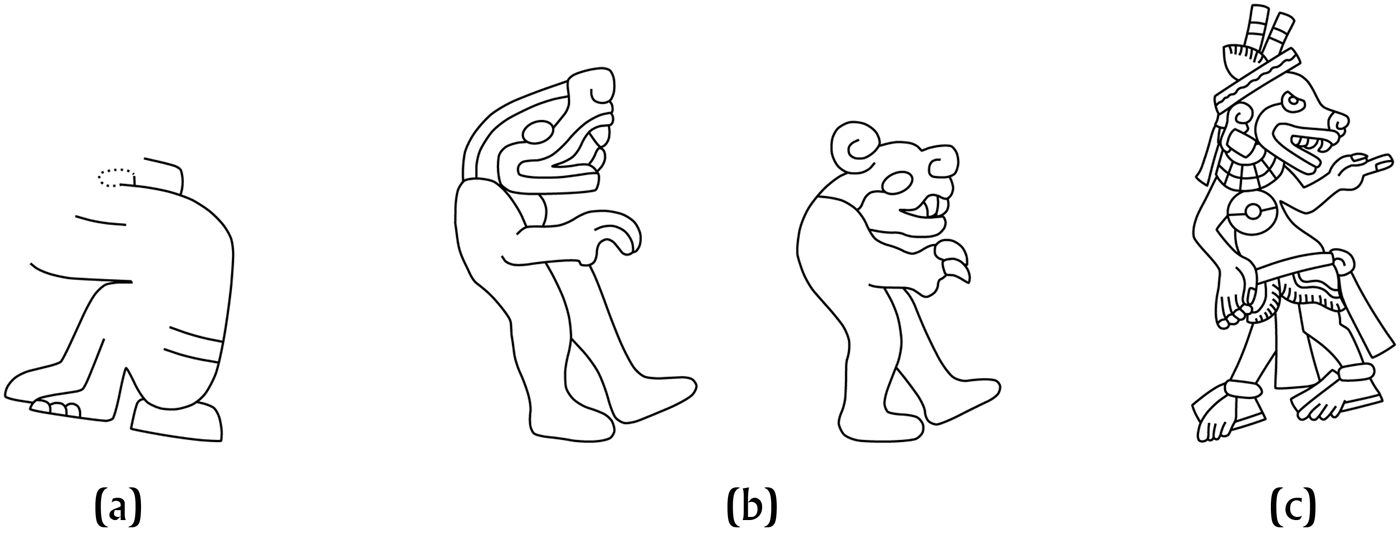
Cell 2-I-4 has the partial representation of a male personage in profile view seated over a gray-colored stool. While the skin of the personage is yellow, the waistband of the loincloth is red. Although the arms and the head are now unrecognizable, the overall posture gives the impression that the figure's head was rendered as if bowing, or perhaps substituted by that of an animal, like in other known representations (Figure 8). Below the personage is a flint knife in a horizontal position that has both tips painted red, followed towards the center by blue bands. The middle portion of the knife has longitudinal curved lines, with the semi-circles next to the borders in blue, and the areas in the center painted yellow. It is likely that the flint knife was accompanied by numeral dots placed vertically along the left border of the cell and in front of the personage but no traces of them are now evident. Only a thin section of cell 2-I-5 remains and the only discernable traces of paint inside it is a semicircular area of red color near the lower right corner.
(a) The personage painted in cell 2-I-3 compared to (b) human figures with serpent and jaguar heads carved on a lintel of unknown provenience, now in the Museo Amparo, Puebla (cat. no. 1544), and (c) a conflated human-opossum in manuscript Tonindeye, f. 68. Drawings by Elbis Domínguez Covarrubias.

THE IMAGERY IN THE LOWER CELLS OF THE FRAGMENTS
Beginning with Fragment 1, cell 1-II-1 depicts a male figure in profile view seated on a yellow-colored stool. His left arm, crossed over the chest, rests on the bent knees. The right arm and hand are raised, showing prominently the thumb and index finger. The face and body of the personage are painted yellow. The only anklet shown, on the left leg, and the loincloth, were seemingly painted white or blue, and the front sash has a red stripe in the center. The feet and the raised upper extremity are red. The personage wears an eagle head with blue feathers as a helmet, and behind his shoulder appears an unidentified element divided vertically in sections of yellow, red, white or blue, and red. The man's face is adorned with a stepped nose ornament painted blue. Below the personage and separated from him by a thin line is a horizontal sequence of five red dots. A sixth dot is present in a second row, towards the left. To the right of the numeral are the indistinct traces of a day name, including a blue spot and a thin half white, half red, undulating band.
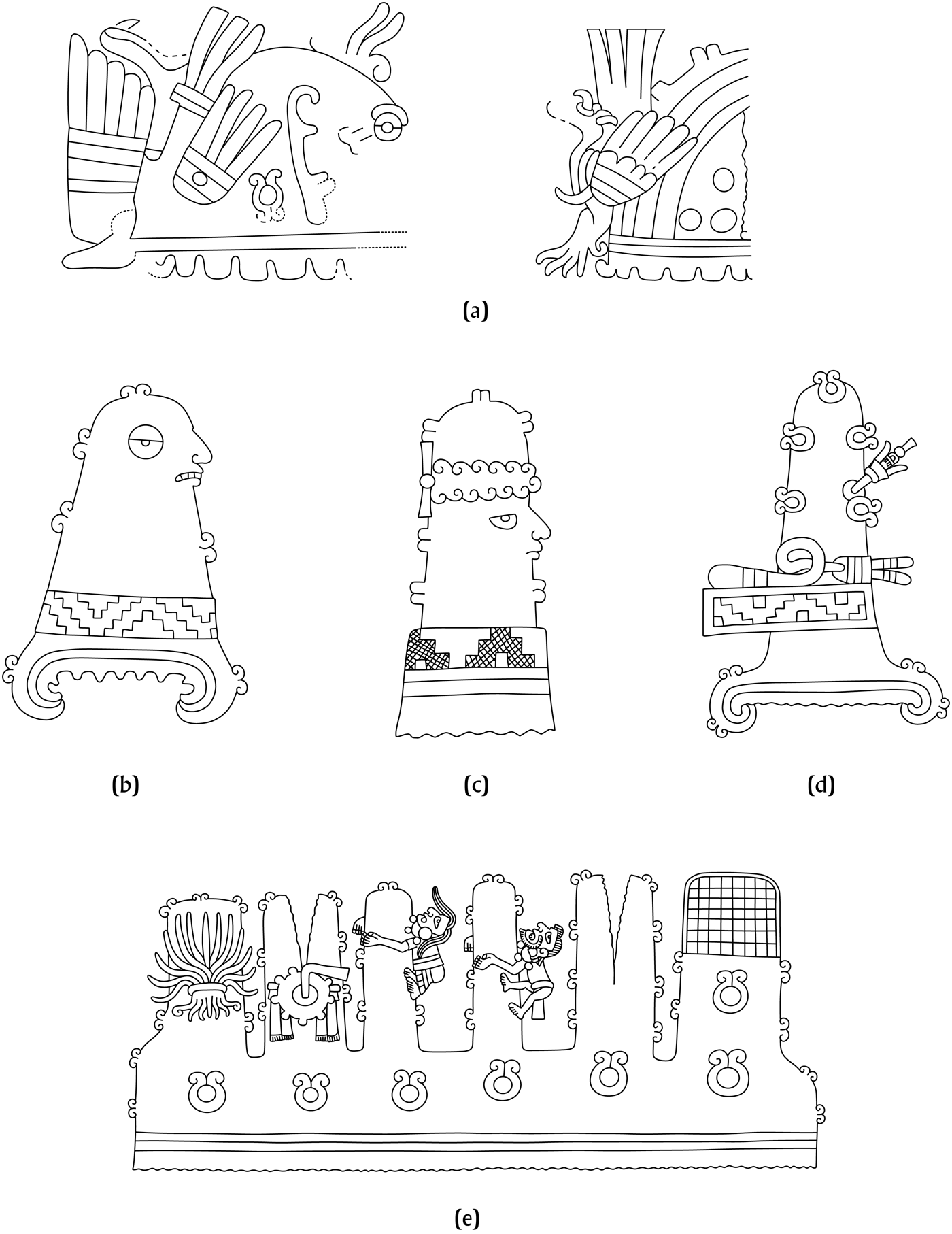
Cell 1-II-2 has a place sign. The complex configuration is blurred in several parts, but one can still make up a black anthropomorphized hill glyph with a red basal band. Under this band, and spanning the entire base of the sign, is a dented yellow motif typical of the hill glyphs painted on the manuscripts from the Mixteca Alta and beyond (Figure 9). The right side of the hill glyph mimics a face, including an eye (its outer circle painted half red, half white) with its blue supraorbital plaque, a long yellow ear and a puff of “hair” (a yellow plant) on the “forehead.” On the left side of the sign, as if carrying them on its “back,” the hill glyph has three bundles of yellow painted grass or feathers. The bundles appear tied by white, yellow, and, in one instance, red bands. Tucked between the two posterior bundles is what looks like an inverted jaguar foot. The latter is yellow, has red stripes marking both ends, and a possible claw on the upper left side. A red painted zone under the largest bundle may signal the base of the hill sign. Between the ear and the anterior bundle is a red circle framed by two sets of yellow bands with scrolls at either ends. This sign appears frequently in other manuscripts and represents cave-like openings (Figures 9d–9e). Below the hill sign, also separated by a thin line, is a horizontal sequence of five blue dots. To the right of the numeral is an eroded day sign. The clearly visible ear and the predominantly yellow color of the glyph narrows down its identification to a Rabbit, Jaguar, or Deer day sign. The nose and supraorbital plaque of the represented animal are blue, and a red line frames the seemingly open mouth.
Representation of hill signs in several manuscripts: (a) Cells 1-II-2 (left) and 2-II-1 (right), Yautepec Fragments; (b) Tonindeye, p. 60; (c) Tonindeye, p. 70; (d) Tonindeye, p. 75; and (e) Yuta Tnoho, p. 21. Drawings by Elbis Domínguez Covarrubias.

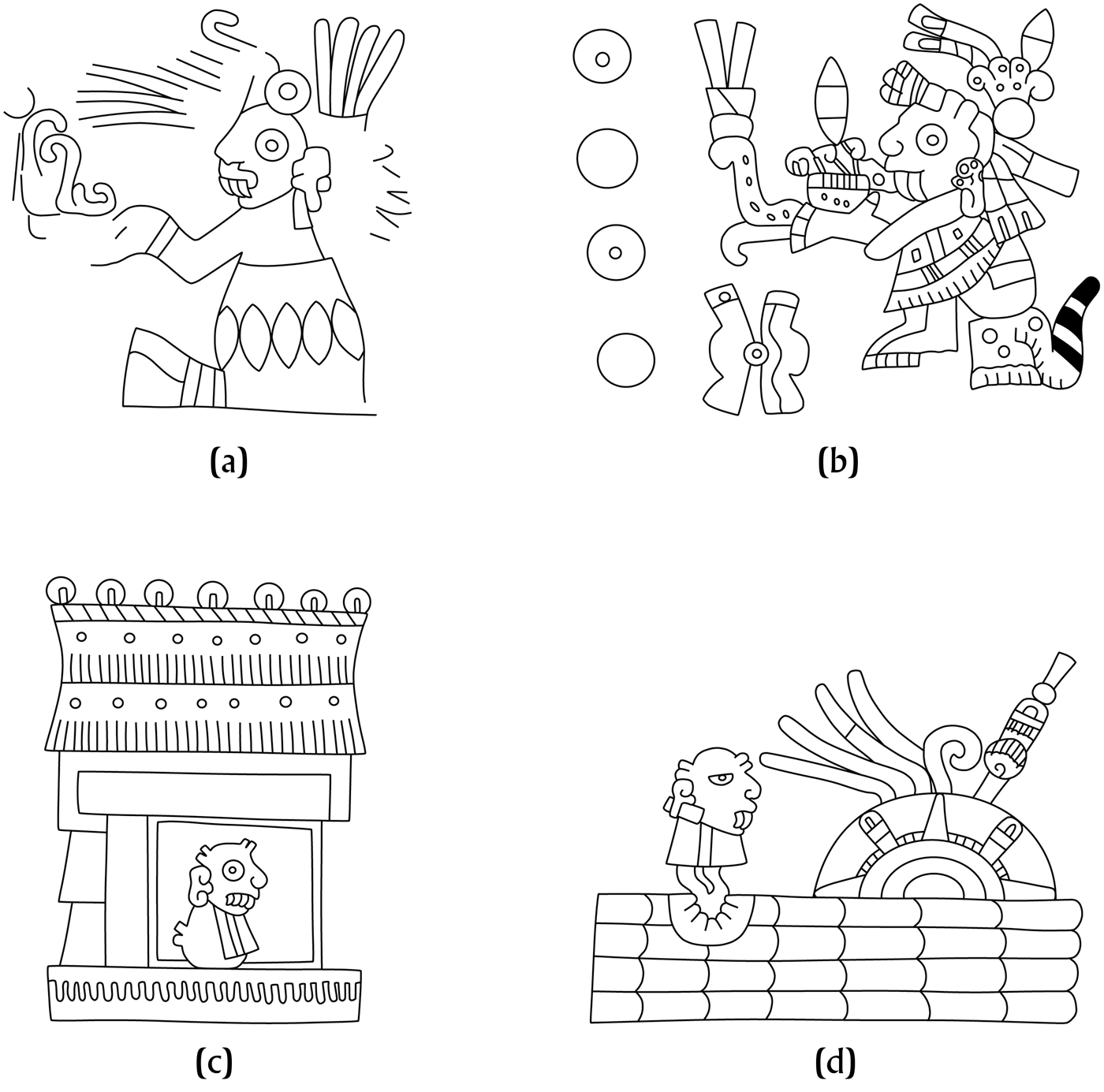
Cell 1-II-3, on the next “page”, has the representation of a masked, seated personage shown in profile, who personifies an earth spirit or “place owner” (Figure 10). The name of this entity in the Mixtec language is Ñuhu Tova (Anders et al. Reference Anders, Jansen and Pérez Jiménez1992a:244, 123–125, 125n2), but its equivalent in Zapotec is unknown. Except for the yellow hand and ear, the rest of the personage's skin is red. The figure wears a long black skirt decorated at the level of the waist by a series of vertically placed red painted stone knives. The inferior border of the skirt ends in two red stripes. The buccal mask, the wristlet, and the strip of cloth worn as ear ornament were colored with a brighter red. Arrangements of yellow and blue feathers appear above and behind the head. The embodied spirit appears as if presenting an offering, although only a discernable series of red volutes suggests fire or smoke emanating from it. A yellow spot is above the highest volute, but the motif is unidentifiable. A thin line separates the personage from a numeral below it. The later is comprised of at least five red dots in a row. To the right of the dots is a day sign whose faint ear and predominantly yellow color suggests the depiction of a Jaguar, Rabbit, or Deer. Its nose and supraorbital plaque are blue. A red line delimits the mouth, with a seemingly yellow tongue.
Representation of earth spirits in several manuscripts: (a) Cell 1-II-3, Yautepec Fragment 1; (b) Tonalpouhqui, p. 72; (c) Yuta Tnoho, p. 5; and (d) Tonindeye, p. 76. Drawings by Elbis Domínguez Covarrubias.

The inferior register in Fragment 2 has four cells. Only the two central ones pertain to a complete “page.” The lateral ones correspond to adjacent incomplete “pages.” The imagery in cell 2-II-1 includes the left half of an elaborate domed-shaped hill sign. Painted predominantly yellow, the sign has two arched bands in red and white. The base replicates a white and a red band, followed at the bottom by a yellow dented motif. Protruding from the outermost arched yellow band are sets of paired rectangular extensions that denote an earthly or stony quality. The central section of the hill sign appears to have a vertical undulating red band (a flow of blood?), and to the left of it three red dots triangularly arranged. In the far left of the hill sign, and partially overlapping it, are two bundles of feathers. One has long, seemingly white feathers. The other, in the foreground, is comprised of short yellow and long white feathers, and is tied by a series of red, yellow, and blue stripes. Also present to the left of the hill sign is what looks like the inverted paw of a jaguar. A red branching motif that may stand for a root system is placed between this and one of the bundles of feathers. Below the hill glyph, and separated by a thin line, is a horizontal sequence of five blue dots, followed to the right by the day sign Alligator. The latter is identifiable by two pointed upper teeth. The nose is painted blue, with a red stripe behind it, and another bordering the mouth.
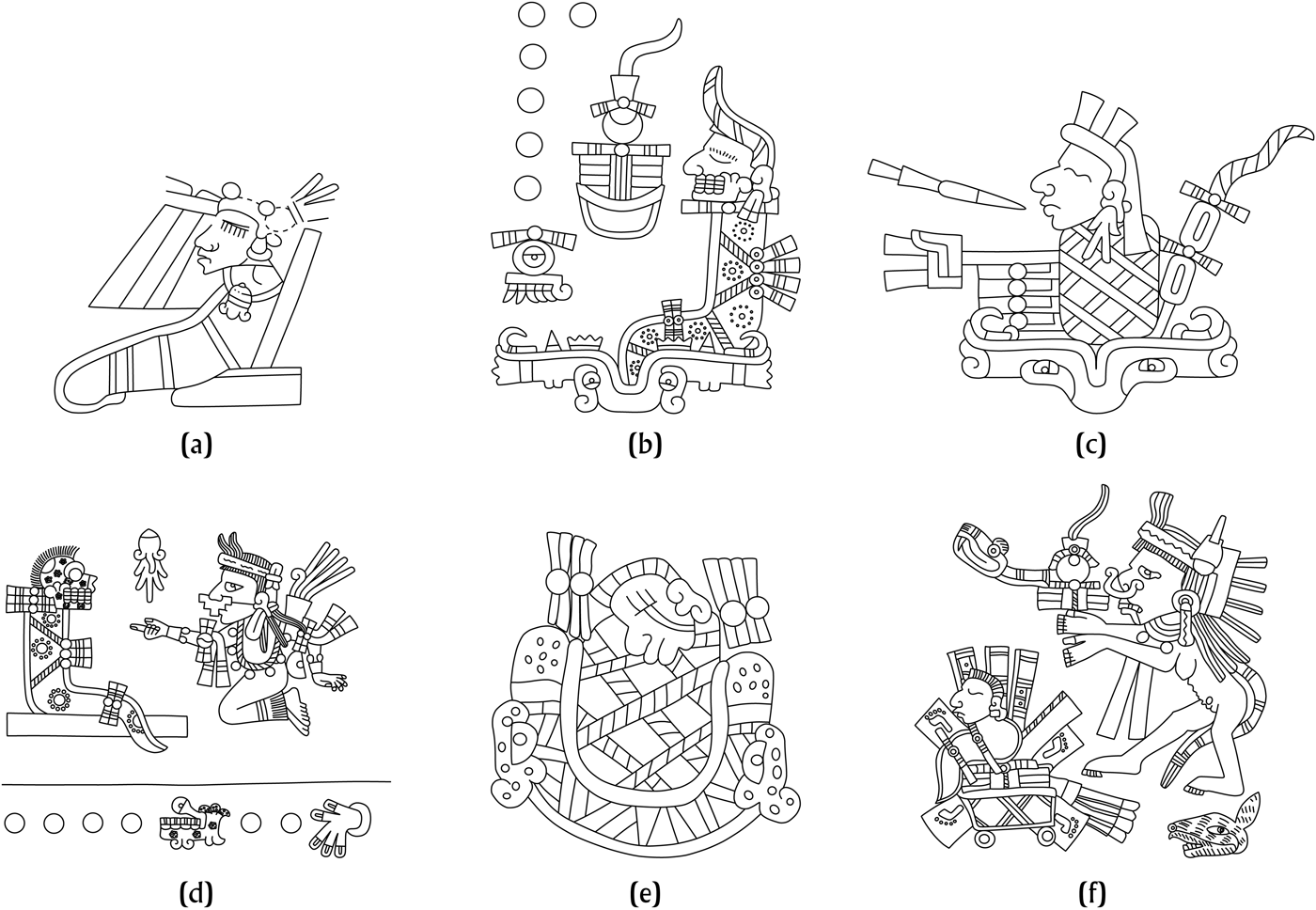
The imagery in cell 2-II-2 is the best preserved in the fragments. It depicts in profile view a mortuary bundle resting in a seated position on a blue painted throne that has a backrest (Figure 11). The face, with closed eye and downturned eyelashes, is yellow. A garment with red, yellow, blue, gray, and white sections separated by white and red stripes, covers the body. A red band frames most of the garment. The upper torso has a broad semicircular breast ornament, and suspended from it is a downturned “heart” pectoral positioned so as to coincide with the location of the organ. The hair is decorated by three red colored circles and, on the back of the head, by a tied bundle of yellow feathers. In front of the face appears a white cloth-like motif with red horizontal stripes. Below the bundle are a thin line and then six red dots in a row. To the right of the numerals is a day sign that, based on the ear and its predominantly yellow color, may represent a Jaguar, a Rabbit, or a Deer. This sign, like the similar ones already described, is characterized by a blue nose and supra-orbital plaque. Yet, what singles it out is a gray band that may represent a beard.
Representation of funerary bundles in several mantic manuscripts: (a) Cell 2-II-2, Yautepec Fragment 2; (b) Mictlan, p. 44; (c) Tezcatlipoca, p. 17; (d) Tezcatlipoca, p. 23; (e) Tonalpouhqui, p. 12; and (f) Yoalli Ehecatl, p. 14. Drawings by Elbis Domínguez Covarrubias.

Cell 2-II-3 has a complex scene that is difficult to interpret and describe because of its obliterated condition. The focus appears to be an offering of vertically placed gray sticks bound together with red and white stripes. The bundle seems to include two cloth-like sashes painted red and yellow that hang from the tying bands. A red branching motif representing a stream of blood seems to emanate from the bundled offering. Above the bundle of sticks, and coming down at either side of it, are two streams of water with their individual flows ending in yellow circles. The two inset signs in each stream may represent shells. The offering appears to be placed in a body of water, splashing to the sides as the two streams come falling down. This configuration perhaps represents a waterfall. To the right of the “blood” glyph is a circle and the blurred traces of an unidentified element are observed to the left. The latter extends downwards beyond the thin line that separates the calendrical notation at the bottom. The day glyph of the notation is undoubtedly Jaguar, and the sign also extends upwards beyond the boundary line. To the left of the Jaguar sign is a row of five blue dots. The left boundary line that defines cell 2-II-3 is clearly visible, followed by a narrow stretch of leather pertaining to cell 2-II-4. Yet, no paintings are preserved in this section.
The description of the cells’ contents makes it evident that the calendrical notations in the inferior registers, separated by a horizontal line from their respective cells, are arranged in rows, while those in the upper registers are not set apart from the cells and appear in vertical sequences. In the inferior registers there are always two cells per page, with alternating red and blue dots between cells. Such regularity is not present in the upper registers, where each “page” has a variable number of cells. Nevertheless, there is a pattern of alternating red and yellow dots between cells. Given these differences, and despite the fact that the registers encompass both fragments, we conclude that the upper and lower registers contain different mantic “chapters.”
RELATIONSHIP BETWEEN INFERIOR AND SUPERIOR REGISTERS AND BETWEEN FRAGMENTS
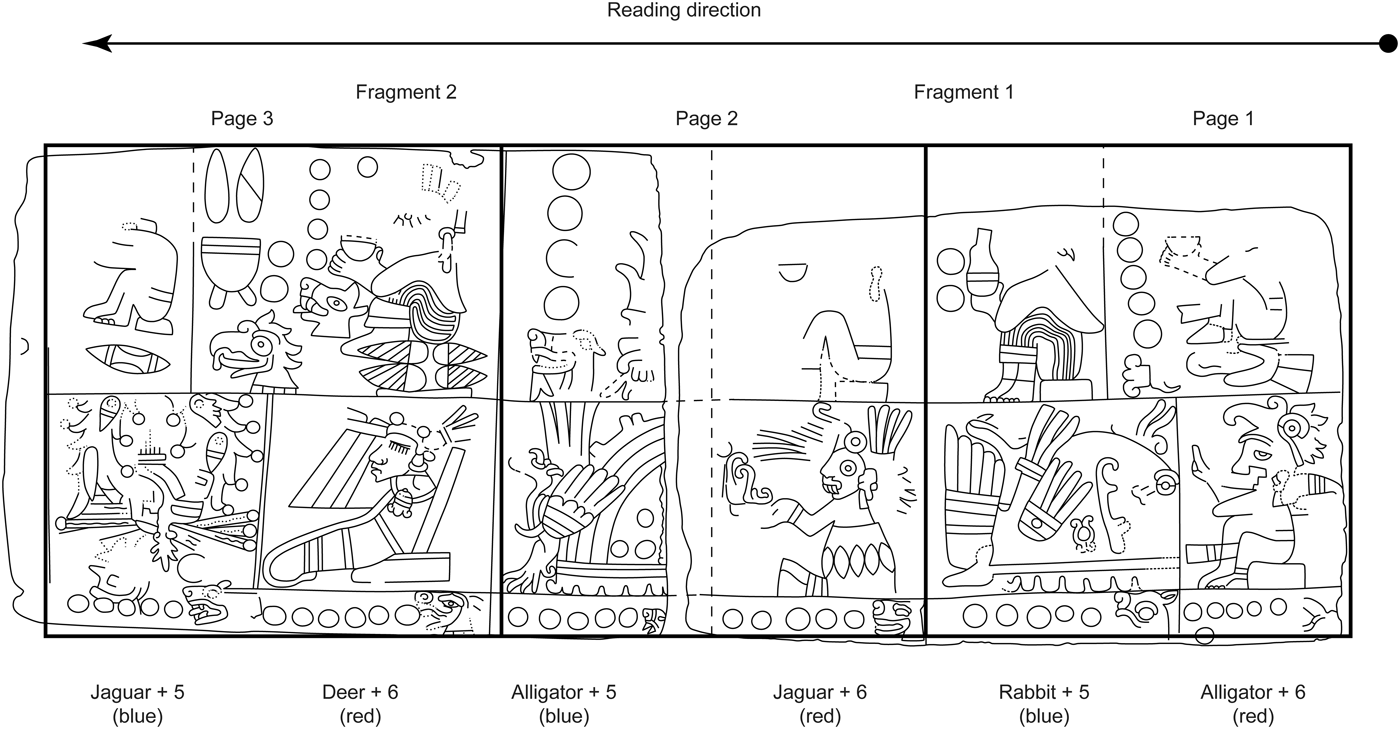
By placing the fragments next to each other, with Fragment 2 to the left of Fragment 1, other structural patterns of the manuscript are revealed (Figure 12). In addition to the differential placement of the coefficients in the upper and lower registers, the different “chapters” in the fragments have unique patterns in the associated coefficients. It is worth emphasizing that, as in other mantic manuscripts, the numerals are not the coefficients of the represented days but, rather, specify intervals between days. To be more precise, the dots function as abbreviations that avoid having to paint all the days signs in a count. Thus, the reckonings are based on “exclusive intervals,” that is, neither the initial day nor the final day in a given count is included. The intervals take the reader from one cell to the next, and they form the structure of the counts in the manuscripts. Consequently, these dots should not be read before but after the day signs, that is, from right to left.
The fragments in horizontal sequence and the pattern of calendrical notations in the lower “chapter.” Drawings by Elbis Domínguez Covarrubias.

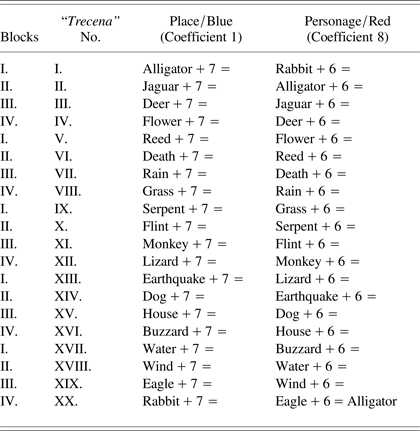
The first pattern to consider involves the calendrical notations in the inferior registers. These are evidently the partitioning of a given trecena into two parts of seven and six days each. Since, as we have already discussed, the folding in the manuscript indicate that each “page” has two cells in the inferior register, it becomes clear that the right side cell has the partition with seven days (the initial day plus the six-day interval) and that the left side cell has the partition with six days (the initial day plus the five-day interval). Furthermore, we can elicit that in the two fragments the groups of seven days have the imagery of a personage, while the groups of six days have the imagery of a place. This pattern allows us to propose a hypothetical reconstruction of the structure of the “chapter” inscribed in the inferior registers. All twenty trecenas are indicated in Table 1.
The Trecenas of the Divinatory Cycle and their Partition into Sets of Seven and Six Days

The series in Table 1 is not represented in its entirety in the known mantic manuscripts; rather, it occurs in abbreviated form. The full cycle was first divided into five “blocks” of four trecenas each. Each trecena was subdivided into parts of seven and six days (or eight and five days, depending on the manuscript) and mantic imagery was composed for each of these parts. There were only eight distinct images for the first four trecenas, however. The following four “blocks” would use the same imagery as the first. In this way, each mantic image became associated with a “column” of five starting days. The first image would carry the initial days of trecenas I (Alligator), V (Reed), IX (Serpent), XIII (Movement) and XVII (Water). The coefficients were omitted because they are obvious: each trecena starts invariably with number 1. Thus, it follows that if partitioned into seven and six days, the second half of each trecena must begin with a coefficient of eight.
We begin the analysis with Fragment 2 because here we have a firmly identified departing day: reading from right to left, the day indicated in cell 2-II-1 is Alligator. By adding six days (five blue dots) one reaches the day Deer, one of the candidate day signs in cell 2-II-2. In the same way, seven days (six red dots) after the day Deer falls on the day Jaguar, the day sign clearly drawn in cell 2-II-3. Since the interval associated with the day Jaguar is five, the name of the day in the first cell of the missing “page” to the left of Fragment 2 would have been Flower.
Regarding the pattern of calendrical notations in the inferior register of Fragment 1, the only way to explain the interval of six days (five blue dots) between the candidate days signs in cells 1-II-2 and 1-II-3 is between the days Rabbit and Jaguar. Thus, these must be the days represented in those cells. Given this pattern, and taking into account that there are six dots in cell 1-II-1, the day inscribed in that cell should be Alligator. Equally as well, one would expect the day sign in the cell to the left of 1-II-3 to be Alligator (the day Jaguar plus six days).
It becomes evident when consulting Table 1 that the day count in Fragment 1 immediately precedes the day count in Fragment 2. In other words, both fragments are continuous, with Fragment 2 to the left of Fragment 1. Together, they include the first three trecenas of the series rendered in three surviving “pages” of the manuscript. In Figure 12 we have numbered these “pages” using Arabic numbers. We venture to suggest the possible spatial arrangement of the three preserved trecenas: the eagle-man and the black hill (“page 1”) may have been ascribed to the east, the “owner of a place” and the hill-blood (“page 2”) to the north, and the funerary bundle and the offering of a bundle of sticks in a waterfall (“page 3”) to the west. Taking this hypothetical scenario even further in order to complete the first step through the four blocks, it may be that the only missing trecena is the one assigned to the south. The remaining steps through the four blocks could have been implicit, as is the case in manuscript Tutepetongo.Footnote 3
This reconstruction coincides with the sequence in the folding between “pages,” where an exterior canvas is followed by an interior one, and so on. Additional evidence in support of this reconstruction is found on the posterior surface of the “pages.” Once the jacket was removed, the verso side of both fragments evinced the faint traces of a red line along the horizontal axis of each fragment, similar to the one on the recto side that divides that surface of the fragments into upper and lower registers (Figure 13). The typical surface treatment of the ancient manuscripts, that is, a thin layer of lime mixed with an agglutinant covering the leather in order to receive the paint, also became evident upon the exposure of the verso side of the fragments.
The fragments in horizontal sequence and the pattern of guiding lines on the verso side. Drawing by Elbis Domínguez Covarrubias.

Traces of another horizontal thin red line are also visible on the verso side of both fragments, running about 1.5 centimeters from the lower border. This line is similar to the one that separates the calendrical notations in the cells from the lower registers on the recto side. On the verso side of Fragment 1, however, these lines are only evident on the right half, while in Fragment 2 they seem to cross the entire span. When simulating the relationship of the fragments that we have proposed in terms of the verso side, the two horizontal lines on the left half of “page 2” (in Fragment 1) conjoin with the two lines on the right half of “page 2” (in Fragment 2). The detail that the verso side of “page 1” (in Fragment 1) seemingly did not have dividing horizontal lines suggests that this was one of the original faces of the manuscript. This inference not only agrees with the folding sequence of the “pages” (leaving the verso of “page 1” towards the exterior), but also supports the reconstruction of the trecena count on the recto side, since the beginning of the count on that side would coincide with the end of the verso side of the manuscript. Thus, we assume that the binder of the book of Gregorian chants cut two pieces belonging to either the beginning or the end of the leather strip that formed the manuscript.
The faint traces of red stains in the spaces defined by the dividing lines on the verso side of “pages 2 and 3” clearly indicate that they were inscribed. In addition, the lower register in both “pages” appears to have negative traces with the silhouette of three seated personages. The one on the right side of “page 2” seems to face to the left, while the two personages on “page 3” may be confronting each other. The one on the left side has traces of large black-line concentric circles in the area of the headdress, plus a single circle in front. Unless the remains resulted from a localized chemical reaction between pigments and the lime base, the images—for an unknown reason—may have been intentionally and carefully erased with moisture. Perhaps the black circles postdate the erasure. Whatever the cause of the traces, at one point the manuscript evidently began or ended on the verso side with a lower “chapter” similar to those on “pages 23–24” and “35–36” of the manuscript Tezcatlipoca, where married couples or conversing deities interact with one another.
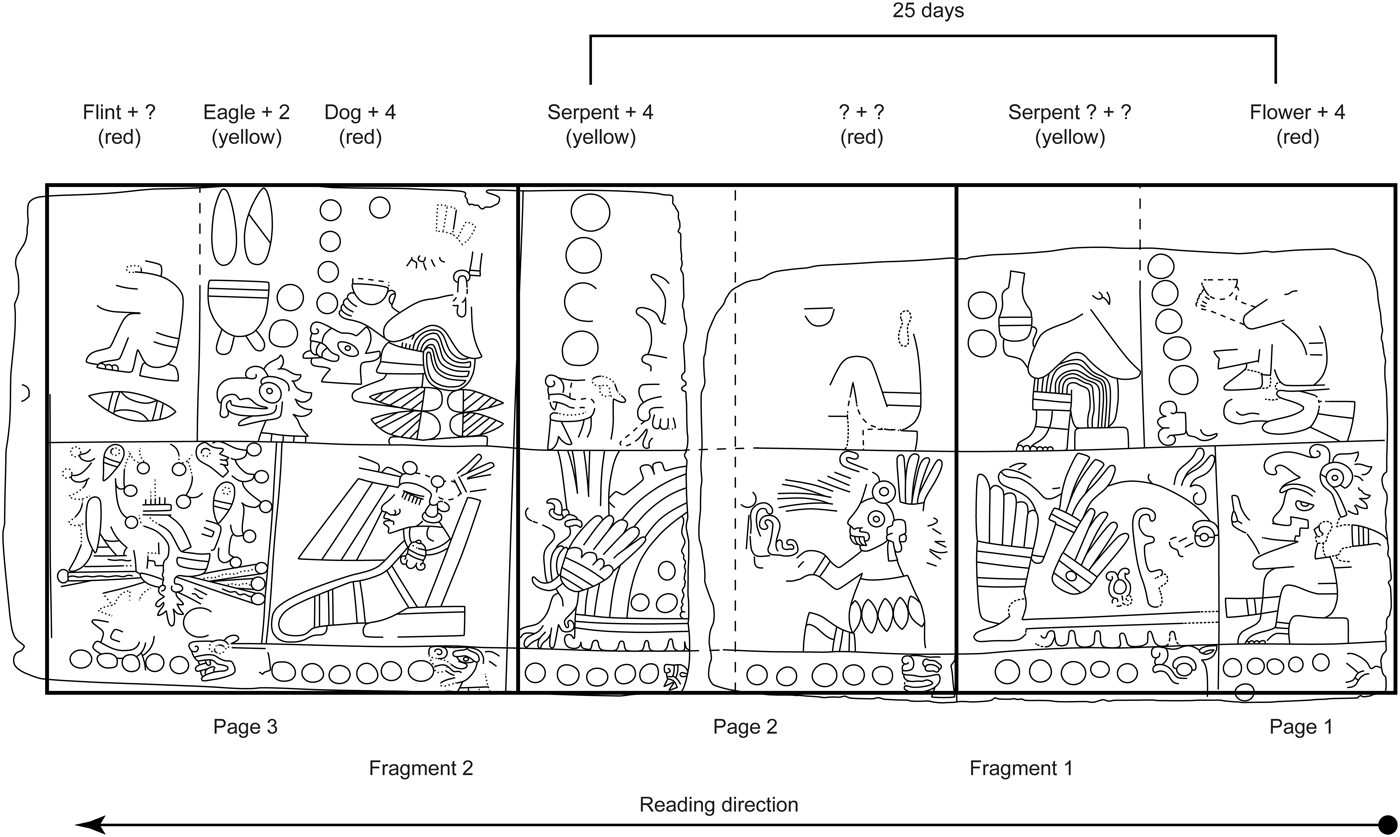
In order to analyze the calendrical notations in the upper registers on the recto side, we begin with Fragment 2, where these are better preserved (Figure 14). Reading from right to left, the interval between the days Serpent (cell 2-I-1) and Dog (cell 2-I-2) is five days, which fits the four dots painted above the day Serpent in cell 2-I-1. The day Eagle in cell 2-I-3 falls five days after the day Dog, which also explains the four dots painted above the latter. The same pattern is evident with the day Flint in cell 2-I-4 since this day is three days after the day Eagle, accounting for the two dots associated with the latter. Not only do the intervals 5–5–3 form a trecenas, but this analysis also confirms the right-to-left sequence that had been previously deduced on the basis of the orientation of images and glyphs.
The fragments in horizontal sequence and the pattern of calendrical notations in the upper “chapter.” Drawing by Elbis Domínguez Covarrubias.

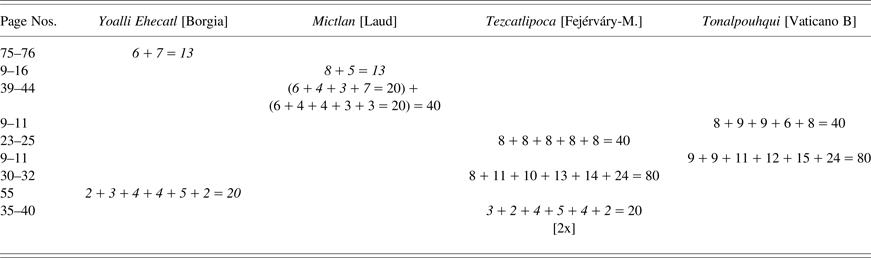
In this context we can compare the types of intervals and divisions of the sacred count in other known mantic manuscripts. Several of the screenfolds have parallel “chapters,” which has greatly aided in their interpretation. It is important to highlight that, although there are certain divisions of the trecenas and veintenas, the 5–5–3 partition does not occur in any of the known divinatory screenfolds. We summarize the type of partitions attested in four of these manuscripts in Table 2.
Types of Trecena and Veintena Subdivisions in Four Mantic Manuscripts

Notes.Numbers in italics sum to 13.
Several lines of evidence suggest that the sum of 13 days from cells 2-I-1 through 2-I-4 may be a coincidence, and that their intervals may form part of a larger count. First, it seems unlikely that the day Serpent marked the beginning of the count. Following the proposed relationship between the fragments, we can speculate which of the now illegible calendrical notations were painted in the last two cells on the upper register of Fragment 1. Since cell 1-I-1 has the day Flower followed by at least five dots, then the day that could have been painted on the next cell to the left would have been Serpent. Since it appears that a strip along the top border of the fragment was cut, however, we cannot eliminate the possibility of a greater interval. Since the calendrical notations in cells 1-I-2 and 1-I-3 are almost completely obliterated, we can at least calculate an interval of 25 days between the days Flower (1-I-1) and Serpent (2-I-1). This estimate generates three interpretative problems: 1) unless a fourth cell was present in the upper register of Fragment 1, an interval of 25 days would require relatively large partitions (for example 8, 7, 7) in cells 1-I-1 through 1-I-3; 2) such an irregular grouping is unusual in the divisions of the sacred calendar and has no parallel in any of the known mantic manuscripts; and, 3) it does not explain why the count would start with the last day (Flower) rather than the first one (Alligator). It is evident that what remains of the calendrical notations in the upper register of both fragments do not reveal a pattern that fits with the proposed interpretation of the count in the inferior register and, therefore, cannot provide an independent confirmation of the relationship between the fragments that we have postulated.Footnote 4 Nevertheless, it appears that the upper register in both fragments is part of the same “chapter” since—of the seven cells in it—at least four depict personages offering a drinking vessel. A fifth cell shows a stand-alone tripod vessel and another one a possible agave plant. This evidence suggests that the “chapter” may be related with the production and drinking of pulque. Although its calendrical structure is different, the “chapter” on page 72 of manuscript Tonalpouhqui [Vaticanus] also has a section that deals with the production and drinking of pulque.
THE SINGULAR CHARACTER OF THE “CHAPTERS”
An interpretation of the content of the “chapters” is difficult because of the fragmented nature of the evidence, which precludes access to broader contexts that would help us better understand the internal relations implicated by the calendrical counts and the associated imagery. Although we drew similarities between two of the three presumed “chapters” in the fragments and those in other mantic manuscripts, we did not detect scenes with close parallels to those in other divinatory screenfolds. The absence of such close parallelisms may be coincidental, since mantic manuscripts have at times “chapters” not present in other screenfolds. Another possibility is that the manuscript represented by the fragments was the product of a distinctive school, of a different tradition to the one preserved in the other surviving manuscripts. The imagery in the fragments seems to support this alternative interpretation since it includes compositions not common in the other known screenfolds. Thus, it is possible to argue that the unusual partition of the trecenas into sets of seven and six days in the inferior register of both fragments was part of a regional scribal tradition, despite the fact that the general calendrical structure is identical to one in manuscript Yoalli Ehecatl (Anders et al. Reference Anders, Jansen and Reyes García1993:75–76), or is similarly arranged as a section in manuscript Tezcatlipoca (Anders et al. Reference Anders, Jansen and Pérez Jiménez1994b:30–32). It should be noted that each page is divided into two horizontal registers in this later manuscript. The lower one has the calendrical notations separated and arranged in a row, with the day name to the right, and the numerical intervals to the left. Some of the calendrical notations on the upper register are vertically arranged, with the day sign at the bottom and the numerical intervals at the top.
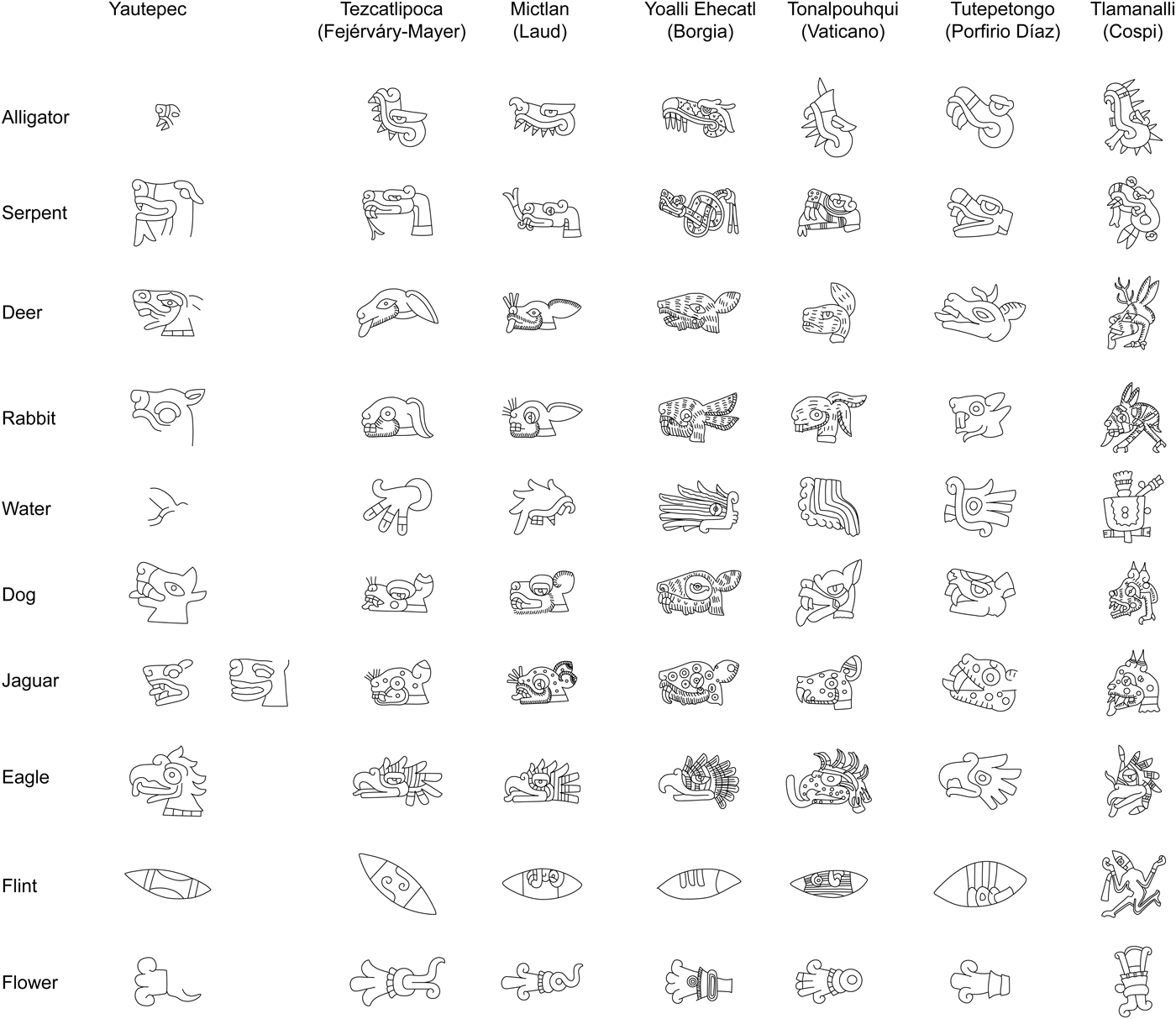
The similarities and differences between the fragments of the Yautepec manuscript and the other known mantic screenfolds in the way the glyphic day names are represented are also notable (Figure 15). One of the most conspicuous differences in the Yautepec fragments concerns what we have interpreted here as the day sign Deer, a sign that diverges substantially from its homologues in the other screenfolds. The signs Jaguar and Eagle in the Yautepec fragments have an elongated motif under the snout and beak that may signal a beard, a motif that is also present in one of the Rabbit signs in the mantic section of manuscript Tutepetongo. Yet, it seems evident that the degree of divergence between the calendrical glyphs in the Yautepec fragments and the other screenfolds is not greater, for instance, than the internal variability of the signs in manuscript Tlamanalli. Figure 15 does not include greater ranges of internal variation like the synecdochical versions of certain day signs in manuscript Tezcatlipoca. A final detail present in the Yautepec fragments is the way in which the imagery in several of the cells extends beyond the limits of the boundary lines, something that occurs as well in “pages 9–11” of manuscript Tlamanalli.
The day name glyphs in the Yautepec fragments and comparison to their homologues in other mantic manuscripts. Drawings by Elbis Domínguez Covarrubias.

CONCLUSION
The manuscript from where the two fragments originated was painted following pre-Hispanic scribal practices, although this does not necessarily imply that it was written prior to the arrival of the Spaniards in the region towards the end of 1521. The mountains of Oaxaca were outside of the sphere of European influence for several years after the conquest of the central valleys, and the manuscript may have been painted early during the Spanish colonial period. Although the native kingdoms in the region of Nejapa were probably incorporated when Cosiiopii, the Zapotec ruler of Tehuantepec, allied himself with Cortés in 1521, Spanish control of the mountains was limited for many decades and indigenous uprisings against Spaniards continued at least until 1550 (among the Mixes even until 1570) (Gerhard Reference Gerhard1986:201). Radiocarbon dating of the Yautepec fragments would not necessarily help in resolving the problem of the temporality of the manuscript but perhaps should be attempted in the future. As to its later history, the association of a book of Gregorian chants with the manuscript fragments may be part of a phenomenon first noted by Ruiz Medrano (Reference Ruiz Medrano2011a, Reference Ruiz Medrano2011b), one in which native intellectuals consciously incorporated certain traditional ritual objects (or parts of) into Christian liturgical practices, conjoining seemingly disparate autochthonous and foreign symbols of power as a strategy to assert cultural sovereignty and identity.
The calligraphic quality of the European-style book suggests that the latter was written in a major ecclesiastical center, and the best candidate is, of course, the Dominican convent in Nejapa. There, a friar or an indigenous scribe could have copied the scores for Gregorian chants from a printed source. Whether as loose sheets or already assembled into a book, the scores eventually made it to San Bartolo Yautepec, a community that during the Spanish colonial period was under the spiritual care of the convent in Nejapa (Villaseñor y Sánchez Reference Villaseñor y Sánchez1992 [1746–1748]:378–379). The ancient screenfold, however, could have been confiscated somewhere in the Sierra, a region characterized by a complex ethnic and linguistic mosaic involving Zapotec, Mixe, and Chontal communities. The existence of pre-Hispanic manuscripts in the region between Nejapa and the Pacific Ocean is referenced in the writings of Friar de Mendieta and Friar de Sahagún (Reference Sahagún1981:bk. 358, ch.13, p. 11). The former recounts that:
Something else that friar Francisco Gomez told me is that when traveling [in 1570] from Guatemala in the company of friar Alonso de Escalona, they passed through the town of Nejapa, in the province of Oaxaca. There, the vicars from the Dominican convent showed them several painted papers, copies taken from very ancient paintings made on long strips of leather, rolled and smoked….The Dominican friars found the painted leathers among the Indians living towards the south sea, who told them that these memories have been passed down to them from their ancestors (Gerónimo de Mendieta Reference Mendieta1980 [1870]:537, translation by Urcid).Footnote 5
San Bartolo Yautepec is, of course, south of Nejapa on the way towards the Pacific Ocean. Even though Mendieta's account refers to rolled (a format for manuscripts of the historical genre) rather than folded manuscripts (the format of all the known mantic manuscripts), it opens the possibility that the ancient screenfold under consideration was painted and used in San Bartolo Yautepec. In this scenario, once the scores for Gregorian chants arrived in the community, an indigenous sacristan could have lined the book using two, perhaps even four, fragments taken surreptitiously from a local screenfold so as to assert his indigenous identity.
The fragments constitute the only currently known direct evidence of an ancient indigenous manuscript from the southeastern mountains of Oaxaca. Their discovery evince that at the time of Spanish contact, and probably even before, the elites of that region formed part of extensive networks of interaction that linked various kingdoms ranging from southern Puebla to the Isthmus of Tehuantepec who shared a common visual language (Pohl Reference Pohl, Smith and Berdan2003a, Reference Pohl, Smith and Berdan2003b; Pohl and Byland Reference Pohl, Byland, Nicholson and Keber1994). Even though the specific provenience of the manuscript from which the fragments originated cannot be pinned down with certainty, the screenfold equally gives voice to other indigenous peoples of Oaxaca, others to those from the Mixtecas and the central valleys of Oaxaca, who also wrote about their own cultural practices and histories.
RESUMEN
Es inusual, después de cuatro siglos, encontrar manuscritos pintados en la antigua tradición mesoamericana. Pero en el año 2001 sucedió un hallazgo espectacular e inesperado cuando miembros del Instituto de Órganos Históricos de Oaxaca visitaron San Bartolo Yautepec para documentar el órgano del siglo XVII que se encuentra en la iglesia de la comunidad. En el transcurso de esa investigación, las autoridades locales les mostraron dos baúles resguardados en el coro alto de la iglesia que contenían libros de música y partituras sueltas de distintas épocas. Uno de los libros, con partituras de cantos gregorianos del siglo XVII, tenía dos fragmentos de un códice antiguo reutilizados para formar la carátula posterior.
Originalmente, los fragmentos de piel de venado formaron parte de un manuscrito en biombo de aproximadamente 15 cm de largo por 16 cm de altura que se abría y cerraba horizontalmente. Varias líneas de evidencia sugieren que los pedazos compaginan, lo que genera tres hojas contiguas pintadas por ambos lados. Parece que el lado verso tiene una de las carátulas originales, lo que arroja un total de cinco páginas que están divididas por líneas rojas para definir registros y celdas. Cada celda contiene la representación de un personaje, de un lugar, o de un objeto, acompañado a la vez de un signo y puntos numerales. Estas notaciones calendáricas y las imágenes se pintaron en colores azul, verde, rojo, rosa, amarillo, café, gris, negro y blanco.
La estructura en celdas indica que el manuscrito se usó para la adivinación, lo que permite comparar los fragmentos con los siete manuales mánticos que se conocen, incluyendo los códices Yoalli Ehecatl [Borgia], Mictlan [Laud], Tonalpouhqui [Vaticano B], Tezcatlipoca [Fejérváry-Mayer], Tlamanalli [Cospi], Yecu [Fonds Mexicains 20] y una sección del códice de Tutepetongo [Porfirio Díaz]. Las tres hojas del manuscrito contienen partes de tres o cuatro, capítulos. El “Capítulo 1,” incluye las tres primeras trecenas de cinco que formarían un primer bloque, dividiendo cada una en un grupo de siete días (puntos rojos) y otro de seis días (puntos azules). Los períodos de siete días están asociados a personajes, y los períodos de seis días tienen la representación de un lugar.
La condición del fragmento que contiene el “Capítulo 2,” lo mismo que la erosión de las pinturas que lo conforman, dificultan entender la estructura calendárica. Las notaciones calendáricas generan intervalos de 5–5–3 días, lo que suman el número esperado de una trecena. Sin embargo, semejante división no tiene paralelo en ninguno de los otros códices mánticos conocidos. Por lo tanto, la supuesta trecena podría ser coincidencia, o la división en trecenas no estructuró el contenido del Capítulo 2. Dada la condición de los fragmentos no es posible derivar algo sobre los Capítulos 3 y 4.
El códice no es necesariamente prehispánico, y pudo haberse pintado al inicio de la época colonial siguiendo aún la tradición indígena. Su re-uso para encuadernar el libro de cantos gregorianos habría servido como símbolo de la memoria, identidad y autonomía cultural ante el régimen colonial. Aunque ciertos patrones permiten postular la posible relación física entre los fragmentos del códice, algunas peculiaridades en la forma de registrar el calendario adivinatorio y las composiciones poco comunes en la imaginería nos llevan a considerar que los fragmentos presentan una variante regional de escritura y prácticas mánticas. Los pedazos son la única muestra existente de un códice en la sierra sureste de Oaxaca, y son parte de un manuscrito que nos obliga a reconsiderar el papel de otras comunidades indígenas del antiguo mundo mesoamericano que igualmente escribieron sobre sus costumbres.
ACKNOWLEDGEMENTS
We want to extend special thanks to Cicely Winter for her invitation to study the fragments. We also acknowledge the people of San Bartolo Yautepec for their help with our research and to the community authorities for their kind permission to publish our study. We are also indebted to restorer María del Refugio Gutiérrez for her support and permission to study the original while it was being cleaned and stabilized. María Teresa Olivera Carrasco (Laboratorio de Arqueozoología, Instituto Nacional de Antropología e Historia) and José Luis Ruvalcaba Sil (Instituto de Ciencias Físicas, Universidad Nacional Autónoma de México) generously provided important information about the leather (deerskin) and colors (sources identified through non-invasive techniques) used in painting the fragments. Thanks to Ethelia Ruiz Medrano for sharing a copy of her unpublished article. The assistance of Elbis Domínguez Covarrubias in crafting the accompanying illustrations is much appreciated. The comments of three reviewers helped to improve the final version of the manuscript.