1. Introduction
The question of the status of medial semi-vowels is a pervasive problem in Sino-Tibetan linguistics: an entire monograph focusing on Chinese (Handel Reference Handel2010), has been devoted to this issue. Some languages have rich systems of semi-vowels (Middle Chinese in particular is reconstructed with -w-, -j- and two other degrees of palatalization), but it is not always clear whether these have to be analysed as part of the onset or considered to be the first element of a diphthong including the main vowel.
Although existing reconstruction systems (Matisoff Reference Matisoff2003) allow the medials *–w- and *-j-, the presence of medial semi-vowels in Sino-Tibetan languages can be explained by three distinct hypotheses besides inheritance from the proto-language: first, diphthongization of vowels in some contexts; second, fusion of presyllable with *w- or *j- initial root (*Cə-w->Cw-); third, lenition of the initial consonant of the second syllable (*C1u-C2V>C1wV).
Much comparative research and detailed investigations of individual languages are needed to confirm whether the medials -w- and -j- observed in the attested Sino-Tibetan languages are primary (inherited from the proto-language) or secondary (innovated through one of the three possible paths of sound change described above). The present article will discuss the status and the origin of medial glides in Tibetan, the first step towards solving this question in Sino-Tibetan perspective.
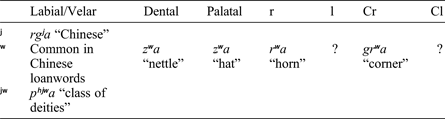
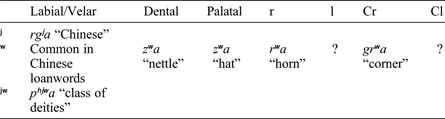
The syllable structure of Old Tibetan is notoriously complex. Not only does it include initial clusters involving two stops (such as bd- or db-), it also presents two semi-vowels -ʷ- (also called wa-zur) and -ʲ- (ja-btags) which can combine with other complex clusters, such as for instance gr ʷa “corner”. The two glides can even be combined one with another, as in the name of a class of deities pʰʲʷa. These medial glides also have equivalents that appear in initial position w- (or ɦʷ-) and j-.
In this article, I discuss the distribution and pre-Tibetan origins of these semi-vowels, first in medial position, and then in initial position.
2. Semi-vowels as medials
The distribution of the two semi-vowels in medial position is not parallel. The palatal -ʲ- only appears after non-coronals, and is incompatible with the other glides -r- and -l-, while the wa-zur appears with any initial clusters – gaps in the distribution are probably accidental, due to the overall rarity of the wa-zur (see Table 1).
The distribution of the medial semi-vowels in Old Tibetan
The peculiar distribution of the palatal glide suggests (according to von Koerber's rule) that the Old Tibetan (alveo-)palatal affricates and fricatives were synchronically a combination of /dental + ʲ/ clusters, in other words that the sounds transcribed as <ɕ>, <ʑ>, <tɕ>/< tɕʰ> and <dʑ> in Old Tibetan were really /sʲ/, /zʲ/, /tʲ/ and /dʲ/ phonologically.
Besides, the absence of clusters such as *rʲ and *lʲ in Old Tibetan can be accounted for by Li Fang-kuei's second law and Benedict's law respectively, as *rʲ>rg ʲ- and *lʲ>ʑ- (examples can be found in Hill Reference Hill2011b).
Hence, the apparent gaps in the distribution of *ʲ result from a series of sound changes, and suggests that pre-Tibetan *ʲ used to be compatible with any initial consonant.
On the contrary, while the wa-zur appears with almost any initial consonant in Old Tibetan, there is strong evidence that this medial semi-vowel is secondary, as proposed in Jacques (Reference Jacques2009) and confirmed by Hill (Reference Hill2012b). First, this medial is extremely rare in native Tibetan words; it most commonly appears in loanwords from Chinese, ideophones or interjections. Second, it only occurs with the (unmarked) vowel /a/, and mainly in open syllables. Third, several native Tibetan nouns in -ʷa have corresponding alternating forms in –u, suggesting that -ʷa results from the fusion of –u with a common nominal suffix –ba *-uba>-ʷa. The wa-zur can therefore be safely considered to be a late innovation, and cannot constitute evidence for reconstructing a medial *-ʷ- in any form of pre-Tibetan.
In conclusion, on the basis of internal reconstruction, we can posit that pre-Tibetan *-ʲ- could appear after any consonant, while there is no evidence for a medial *-ʷ-.
3. Semi-vowels in initial position
The semi-vowels /j/ and /w/ appear in Classical Tibetan not only in medial position, but also in initial without a preceding consonant. In Old Tibetan, as argued by Uray (Reference Uray1955) and Hill (Reference Hill2006), there was no genuine w- initial, only the cluster ɦʷ-, and this onset only appears in words of doubtful origin such as ɦʷa “fox”. Thus, the only semi-vowel initial in Old Tibetan was j-.
An interesting contrast occurs between gj- (as in gjag  “yak”) and g ʲ- (as in g ʲaŋ
 “mud wall”), whose exact phonetic interpretation in Old Tibetan is debatable.
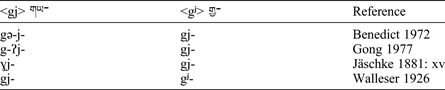
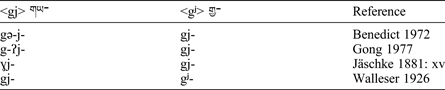
Hill (Reference Hill and Hill2012a) summarizes all proposals by previous authors to account for the difference between these two onsets, as shown in Table 2.
Proposed phonetic interpretations of <gj> vs <gʲ> (adapted from Hill Reference Hill and Hill2012a)
This question is not just an isolated problem in the reconstruction of Old Tibetan phonetics. The contrast between <gj> and <gʲ> represents that between /g/ as a sŋon. nd ʑug “prefix” and as a miŋ.gʑi “base consonant”. The choice of one or other reconstruction has an influence on the entire phonetic system (but it is the only pair of onsets where a contrast can be observed). Benedict's solution entails reconstructing all sŋon. ndʑug consonants as presyllables with a schwa-like vowel (thus <gtor> ‘to spill’ would be *[gə-tor]), while Jäschke's would imply reconstructing clusters with fricatives as a first element (<gtor> would be *[xtor]).
Hill points out that Benedict's solution (followed by Matisoff Reference Matisoff2003) conflicts with the data from modern dialects. Hill quotes Matisoff's reconstruction of <sbrul> as a sesquisyllabic *[sə-brul], and points out that no trace of a schwa-like vowel can be found in initial clusters. Hill therefore argues that this reconstruction reflects pre-Tibetan more than Old Tibetan. From this example, he concludes that the clusters represented in the Tibetan script were real clusters even in the Old Tibetan period, and refutes Benedict's interpretation of them as sesquisyllables.Footnote 2
Hill also rejects Jäschke's reconstruction, for three reasons. First, he finds it unlikely that the creators of the script would have used the same letter to represent two distinct phonemes, one stop and one fricative. Second, if <g> is interpreted as [g] in some contexts and as [ɣ] (and presumably [x]) in others, <b> and <d> as sŋon-ndʑug “prefix” letters would conversely have to be reconstructed as fricatives [β]/[ɸ] and [ð]/[θ]. This hypothesis seems difficult according to Hill because prefixed d- is never pronounced as an interdental fricative in any Tibetan dialect (however, note that the common pronunciation as /r/ could be accounted for by supposing a sound change *[ð]>[r]), besides, b- is distinctly pronounced as a stop in some varieties of Amdo (in the Rngaba variety, <bka> is read [pkʷ͡a], as the author heard from a native speaker). Third, the prefixed <b>, <d> and <g> are often resyllabified as the coda of the preceding syllable in dissyllables; this would be unexpected if the consonants in question were fricatives according to Hill.
For the reasons summarized above, Hill favours Walleser's interpretation of the script (see Table 2). While Hill's approach has undeniable merits, it fails to take into consideration two facts. First, in modern dialects and loanwords into other languages, <gj> and <gʲ> never merge (see Table 3); second, while a contrast between k(ʰ)ʲ- and gʲ- existed in Old Tibetan, there were no such groups as †<kj> or †<kʰj>, and voicing of <g> in the spelling gj- does not necessarily point to a voiced stop: in Tibetan orthography, in the positions where voicing is neutralized (as the first element of a cluster/presyllable or in coda positions), the script always uses voiced stops <b> <d> <g> (except in the case of /g/ + /ɬ/, which is written as <kl>). Japhug,Footnote 3 a language which presents the rare contrast between /c/ and /ɟ/ vs. /kj/ and /gj/, has the voicing contrast with both types of palatalization (-kio ‘to cause to slip’ vs. -ŋgio ‘to slip’ and co ‘valley’ vs. -ɲɟo ‘be damaged’). The absence of †<kj> or †<kʰj> in Tibetan is a strong argument against Walleser's hypothesis.
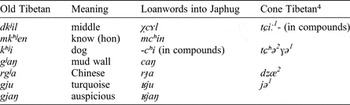
Tibetan gʲ- vs. gj-

In modern Tibetan languages, while the <gʲ> always becomes either a palatal stop, an alveolo-palatal affricate or a velar stop (as in Dzongkha, see van Driem and Karma Reference Van Driem and Tshering1998), <gj> changes to either high-tone j-, to a cluster ʁj- or further to z- in the dialects, but never into a palatal stop, as is shown in Table 3 (from the author's fieldwork).
If Walleser's interpretation were correct, we would expect a contrast such as [gj] vs [gʲ] to be unstable. While it is not inconceivable that some dialects could have preserved the contrast, it is surprising that not a single merger took place.
I propose an interpretation partially similar to that of Benedict: *[ɟ] for the spelling <gʲ> and *[Gə-j] for <gj>. The difference between this solution and Benedict's is that he failed to consider that the voicing of the presyllable was non-phonemic. Taking into account the neutralization of voicing in this context, I transcribe it here with a capital letter indicating the archiphoneme of /g/ and /k/. It is probable that this archiphoneme was realized as unvoiced most of the time, as in coda position.
Without presupposing a schwa-like vowel in gj- one would be at pains to explain: 1) why the onsets transcribed <gj> and <gʲ> never merge in any dialect and; 2) why the <g> element of the cluster <gj> never appears as a stop or an affricate in any dialect or loanword into any language. This implies that all sŋon. ndʑug consonants <g> <d> <b> were still presyllables in the common ancestor of all modern dialects (not necessarily mgo.tɕan <s><r><l>) even though no modern language preserves the archaic stage. Jäschke's reconstruction of sŋon. ndʑug as fricatives must be a phonetic development that occurred later (independently) in various dialects following the loss of the schwa in the presyllable.
There is no equivalent contrast between <j> and <ʲ> with any other consonant but <g>. In other words, there are no other cases of a minimal contrast between a true cluster and a sesquisyllable. However, one may speculate whether such a contrast used to exist with <b>. The combination of <b> and <j> is always spelled <bʲ>, but there are at least two cases in which b- is clearly prefixal in origin, and not part of the root: the verb bʲib “to cover” and the verb ⁿbʲug “to smear”.
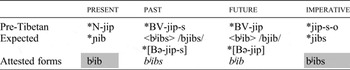
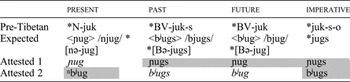
The transitive verb bʲib “to cover” has an intransitive counterpart jib, jibs “to hide”. Dictionaries (Hill Reference Hill2010) only give the forms presentbʲib, pastbʲibs for “to cover”. However, given its obvious relationship to jib “to hide”, it is clear that b- is prefixal here and that the root is /jib/. The expected transitive paradigm for a root /jib/ should be that shown in Table 4.
Hypothesized original paradigm of bʲibs “to cover” (analogical forms shaded in grey)

A similar situation is provided by the verbs ⁿbʲug, bʲugs “to smear” and ɲug, ɲugs “to smear”. Rather than being distinct verbs, these two paradigms are best analysed as analogical developments from the past and the present forms of a root /jug/ respectively, as shown in Table 5.
Hypothesized original paradigm of ⁿbʲug “to smear” (analogical forms shaded in grey)

Other possible cases of /bj/ *[bə-j-], /mj/ *[mə-j-] and /nj/ *[nə-j-] include those shown in Table 6, which likewise do not seem to be preserved in the non-literary layer of any modern dialect.
Other potential examples of /bj/ and /mj/ written as <bʲ> and <mʲ>

Although the past forms bʲibs and bʲugs are written with the cluster <bʲ>, given the prefixal character of b- here, we could hypothesize that this spelling in fact reflects */bj/, and that a contrast between /bj/ and /bʲ/ parallel to that of /gj/ and /gʲ/ could have existed in Old Tibetan. According to this theory, this contrast was never represented in the script owing to its rarity. In modern dialects, however, Old Tibetan *bj and bʲ should give rise to different outcomes: in Cone Tibetan for instance, while the latter gives ɕ- (low tone), the former should become j- (high tone). bʲibs does not seem to be attested in any dialect, but the form bʲugs is, allowing us to test the hypothesis of a contrast /bj/ vs /bʲ/ in Old Tibetan.
In Cone, bʲugs appears as ɕʉ2 (Jacques forthcoming): it presents the same correspondences as regular /bʲ/, and cannot have any other origin (alveolo-palatal stops in this language come only from labial + j clusters, see Jacques Reference Jacques2011). Thus, this form appears to contradict the hypothesis of a contrast /bj/ vs /bʲ/, otherwise †jʉ1 would have been expected. It is still possible that future investigations on Tibetan dialects will reveal the expected form.
This section shows that there is no Tibetan-internal evidence for a consonant *w in pre-Tibetan, but there is ample evidence for *j, as well as a consistent difference of treatment of *j in genuine clusters *kj- / *gj- and in sesquisyllabic clusters *Gə-j-. Evidence for *Bə-j- as opposed to *kj- / *gj-, however, is not conclusive.
A corollary of this discussion is that pre-initial stops were still presyllables in the common ancestor of all Tibetan languages. The schwa will not, however, be written in our transcription, as it is predictable from the phonological transcription.
4. Comparative evidence
The previous sections have investigated the reconstruction of pre-Tibetan semi-vowels on a purely Tibetan-internal basis; this section will study this issue in the light of comparative data, mainly Japhug Rgyalrong (personal fieldwork), Tangut and Lolo-Burmese (Bradley Reference Bradley1979 and Matisoff Reference Matisoff2003).
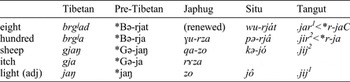
In both initial and medial positions, Tibetan /j/ and /ʲ/ clearly correspond to Japhug Rgyalrong ʑ- (< *j-), Situ Rgyalrong j- and Tangut *j-, as shown by the examples given in Table 7.Footnote 5 (Note the application of Li Fang-Kuei's second law *rj>rgʲ- in “eight” and “hundred”.Footnote 6)
Correspondences of Tibetan /j/ and /ʲ/ to j- in other ST languages

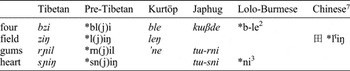
In some cases the presence of /ʲ/ or of an alveolo-palatal consonant in Tibetan can be attributed to the influence of a following front vowel (see Table 8). Note the application of Benedict's law *lj->ʑ- in some of these examples. Palatalization of *n seems to have been general in Tibetan, and only a few examples of /ni/ are attested in Old Tibetan. Examples of non-palatalized /li/ are more common, and the exact conditions on the palatalization of dentals before front vowels in Tibetan is unclear; the different treatment might be due to dialect mixture (palatalizing vs non-palatalizing dialects).
Palatalization of nasals and palatals in Tibetan

Note: Kurtöp from Hyslop Reference Hyslop2011, Old Chinese from Baxter and Sagart Reference Baxter and Sagart2010.
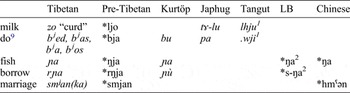
In other cases, however, we observe the presence of palatalization in Tibetan without front vowel, as shown in Table 9. Note the application of Houghton's law *ŋj->ɲ- in the examples in Table 9. The palatalization in these words which have non-front vowel /a/ or /o/ could originate from the loss of a presyllable with front vocalism (a kind of Umlaut), or exemplify honorific forms (with Gong's *-j- infix) which came to replace the standard forms. This intriguing palatalization seems restricted to Tibetan and perhaps some closely related languages, and could be relevant to language subgrouping.Footnote 8
Irregular palatalization in Tibetan

While Old Tibetan had two distinct phonological units /j/ and /ʲ/ (probably the same phoneme in different syllabic positions rather than two distinct phonemes), there is no need to push this distinction back to pre-Tibetan; /ʲ/ is either secondary (due to the palatalizing influence of a front vowel), or originates from *j in *Cj- clusters, while /j/ originates from *j in initial position (either absolute initial position, or initial of the second syllable of a sesquisyllable).
Hill (Reference Hill2011b: 448) reconstructs pre-Tibetan *rj- vs *rʲ-, the first yielding Old Tibetan rgʲ- (Li Fangkuei's second law) and the second becoming ʑ-. His examples for the second sound change are shown in Table 10. If true, this sound law would force a reconstruction of the /j/ vs. /ʲ/ contrast going back to pre-Tibetan, or perhaps an even earlier stage.
Alleged examples of *rʲ > ʑ- in Tibetan

However, Tibetan ʑabs “foot (honorific)” is in no way related to the root “to stand”. As Gong (Reference Gong1977) pointed out, Old Tibetan has a morphological process of creating honorific forms by a palatalizing infix. ʑabs is the palatalized honorific of zabs “depth”, a noun derived by the suffix –s from the adjective zab-mo “deep”.
While the first comparison “day” is potentially acceptable, one pair of examples is not sufficient to posit a sound law. For this reason, this author does not accept Hill's contrast of *rj- vs. *rʲ- in pre-Tibetan, and only reconstructs one *j in earlier stages of this language.
While there is ample evidence for *j in both Old Tibetan and pre-Tibetan, evidence for a labial semi-vowel is more difficult to come by.
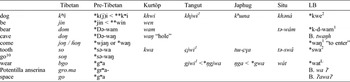
Comparison of Tibetan to other languages leads to the general observation that /wa/ in Burmese and Rgyalrong corresponds to /o/ in Tibetan, and /wi/ or /we/ correspond to /ji/ or /ʲi/ in Tibetan, as seen in Table 11.
The fate of pre-Tibetan *w in Old Tibetan

The correspondence wa : o is generally interpreted as reflecting a vowel fusion *wa > o in Tibetan (Laufer's law). The second wi/we : ji results from the palatalization of *w before front vowels. None of these sound laws are shared by Kurtöp, and constitute defining features of Tibetan.
Hill (Reference Hill2011a, Reference Hill2012b), criticizing existing proto-Lolo-Burmese reconstructions, argues that Laufer's law is only genuinely valid in absolute initial position and after velars. Hill contends that Burmese underwent a general change Co > Cwa in the historical period. Therefore, all cases of Cwa(C) in Burmese (C stands for any consonant), and proto-Lolo-Burmese should be reconstructed with the vowel *o. The only genuine cases of *wa in Lolo-Burmese occur, according to Hill, when w- is in initial position, in examples such as “to come”, “to wear”, “Potentilla anserina” and “space” above. This would suggest that the comparison of Burmese wa to Tibetan o is spurious in most cases, for instance in so : swah “tooth”, which Hill would reconstruct as *so.
I am unable to comment on the Lolo-Burmese data, but Hill's idea is refuted in the case of “tooth”. This word has the complex onset sw- or ɕɣ- (< *ɕw-) in Rgyalrong languages, which do not show vowel breaking as does Burmese; and Jingpo (as well as many other ST languages) has simply wā “tooth” with no trace of the fricative. The absence of s- in Jingpo suggests that in Tibetan, Lolo-Burmese and Rgyalrong, the group sw- results from the fusion of a presyllable with the main syllable *sə-wa > *swa.
A similar fusion with a presyllable should be supposed in the case of “bear” and “cave”, though in these cases the presyllable was a dental stop. No voicing contrast existed in presyllables; voicing occurred as the result of the contact with the following *w-.
In initial position, the regular outcome of *w- was ɦ- (when followed by *a) or j- (when followed by a front vowel). The case of the verb “to come” in Tibetan, which appears as either joŋ or ɦoŋ, can be explained as a case of morphological palatalization (like Gong's honorific *j infix). The rarity of examples of *w- > ɦ- (ɦoŋ seems to be the only good example) can be explained by the facts that: (1) *w- disappears in clusters, its only trace being on the following vowel; and (2) *w- does not become ɦ- after front vowels.
The presence of *w after dentals (in the case of “tooth”, “cave” and “bear”) seems to be of a different nature from that of *w after velars. In the first case, we have evidence from either Rgyalrong or Jingpo that the dental was originally a presyllable, while in the case of velars the Rgyalrong and Tangut evidence suggests reconstructing a labiovelar. It is possible that some velar presyllables changed to dentals in pre-Tibetan before *w (as an instance of what Hill (Reference Hill2011b) calls “Saskya Pandita's rule”), but no evidence has yet been found.
5. Conclusion
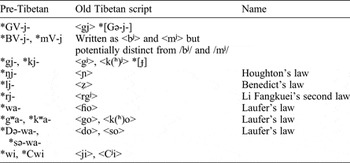
This paper shows that both *j and *w must be reconstructed in pre-Tibetan and that both appear in initial and medial position. It also favours the interpretation of pre-initial stop consonants as presyllables rather than true cluster onsets. Table 12 shows the sound laws that I therefore postulate.
While the present paper accepts most of the sound laws presented in Hill Reference Hill2011b, it rejects the law *rʲ->ʑ- and Hill's (Reference Hill2011a) hypothesis that Tibetan /o/ after dentals never comes from *wa.
Postulated sound laws