Methicillin-susceptible Staphylococcus aureus (MSSA) and methicillin-resistant Staphylococcus aureus (MRSA) are important causes of healthcare-associated infections in neonatal intensive care unit (NICU) patients. In particular, MRSA colonization is a risk factor for subsequent infection.Reference Huang 1
Mupirocin is a topical antibiotic used to treat superficial S. aureus skin infections and to decolonize S. aureus nasal carriers. Mupirocin therapy is a strategy employed to control MRSA and MSSA outbreaks in NICUs by treating colonized infants,Reference Lally, Lanz and Schrock 2 as a universal prophylaxis,Reference Delaney, Wang and Melish 3 or in a combination of these.Reference Song, Cheung, Klontz, Short, Campos and Singh 4 Data describing the use of mupirocin to prevent S. aureus colonization in neonates are limited, with a single study showing reduction of S. aureus infections and both MSSA and MRSA colonization after institution of daily mupirocin prophylaxis.Reference Delaney, Wang and Melish 3
Potential adverse consequences of mupirocin use include the development of resistance. Reported rates of mupirocin resistance in pediatric patients have ranged from 0 to 31%. Most studies demonstrate a strong association between mupirocin resistance and prior mupirocin exposure.Reference Antonov, Garzon, Morel, Whittier, Planet and Lauren 5 Another potential unintended consequence of mupirocin use is pathogen replacement. Although it is highly active against staphylococci and streptococci, mupirocin has poor activity against gram-negative pathogens, and mupirocin treatment could facilitate infections with nontargeted gram-negative organisms. 6
The current study aimed to evaluate the effects of monthly intranasal mupirocin prophylaxis administered to NICU patients on MRSA transmission and invasive S. aureus (MRSA and MSSA) infections. Mupirocin susceptibility in MRSA isolates was studied over time.
METHODS
Study Design and Setting
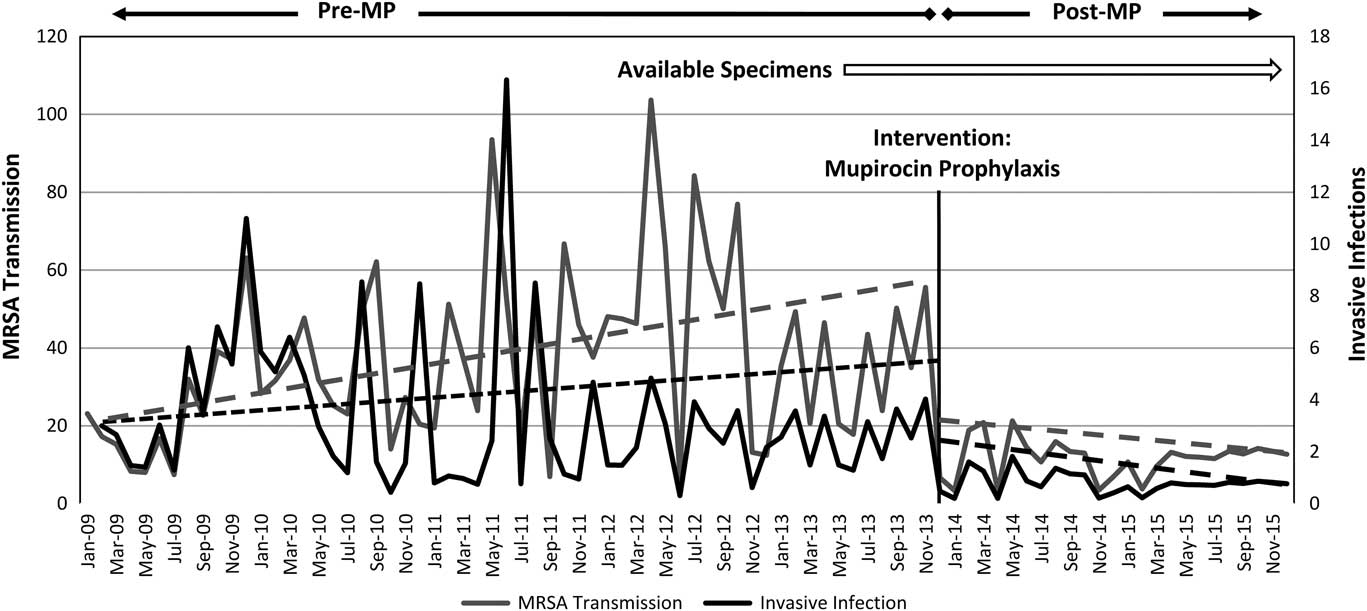
The study setting was a 101-bed level IV NICU with an established comprehensive strategy for preventing MRSA transmission, including admission and weekly surveillance cultures. Colonized infants were assigned to cohorts, were placed on contact precautions, and received topical mupirocin to nares twice daily for 7 days and periodic chlorhexidine bathing. Despite these measures, MRSA transmissions and infections persisted (Figure 1). Baseline transmission rates were assessed from December 1, 2009, to December 8, 2013. Baseline mupirocin susceptibility was assessed in a subset of available isolates collected from NICU infants between February 18, 2013, to December 8, 2013. Postintervention data were collected from December 9, 2013, to December 31, 2015.
Interrupted time-series plot of methicillin-resistant Staphylococcus aureus (MRSA) transmission and methicillin-susceptible Staphylococcus aureus (MSSA) invasive infection rates over time. NOTE. Dotted lines represent the predicted values from the interrupted time-series model for comparing slopes and intercepts.

Mupirocin Prophylaxis Intervention
Beginning December 9, 2013, all NICU patients received mupirocin to the anterior nares twice daily for 5 days. Courses were repeated every 5 weeks. The NICU pharmacists prompted the attending physician on the designated day to order mupirocin, unless the attending identified a contraindication (eg, nares too small to admit applicator tip). Infants could receive mupirocin prophylaxis more than once if they were present in the unit for more than 5 weeks.
Data Collection
All patients admitted to the NICU were screened for MRSA at admission and weekly thereafter. The “present on admission” (POA) category included infants with MRSA surveillance cultures positive at admission and those known to be MRSA colonized (eg, tested at another facility). Transmission was defined as a positive MRSA surveillance or clinical culture preceded by a negative culture. An invasive S. aureus infection was defined as MRSA or MSSA isolated from blood, joint fluid, or cerebrospinal fluid. Patient demographics and clinical characteristics were abstracted from medical records for patients with mupirocin-resistant S. aureus isolates. Rates of central line-associated bloodstream infections (CLABSIs) and the proportion caused by gram-negative organisms were identified through routine infection prevention surveillance and reported as a balancing measure.
Microbiologic Methods
Surveillance swabs were plated on chromogenic agar plates (Spectra MRSA agar, Remel, Lenexa, KS), and MRSA isolates were frozen for later analysis. Frozen isolates were confirmed to be S. aureus by matrix-assisted laser desorption ionization-time of flight mass spectrometry (MALDI-TOF). Mupirocin susceptibility testing was performed on 1 isolate or case patient during the preintervention (February 18, 2013, to December 8, 2013) and postintervention (December 9, 2013, to December 31, 2015) periods. The mupirocin minimum inhibitory concentration (MIC) was measured by E-test (Biomerieux, Durham, NC) using break points of ≤4 μg/mL for susceptible isolates and ≥512 μg/mL for high-level resistance. Mupirocin-resistant MRSA isolates were compared to a convenience sample of mupirocin-susceptible isolates by repetitive-element sequence-based polymerase chain reaction (rep-PCR) using the DiversiLab system (Biomerieux, Durham, NC) to assess clonality.
Statistical Analysis
An interrupted time series analysis model was employed to assess the effect of mupirocin prophylaxis on rates of MRSA transmission and invasive S. aureus infection during the pre- and postintervention periods. The significance of changes in intercept and slope of the regression lines was assessed before and after the introduction of mupirocin. Continuous variables were reported using mean and interquartile range (IQR). The analysis was conducted in accordance with The Cochrane Effective Practice and Organization of Care group recommendations. 7 The University of Louisville Institutional Review Board approved this study.
RESULTS
Transmission
Following the implementation of monthly mupirocin prophylaxis, healthcare-associated (HA) MRSA transmissions decreased from 23.1 per 10,000 patient days (95% CI, 11.8–41.2) to 12.7 per 10,000 patient days (95% CI, 6.7–24.9; P=.009), a 45% reduction. The rate of S. aureus invasive infection decreased from 3.0 infections per 10,000 patient days (95% CI, 1.8–7.2) to 0.8 infections per 10,000 patient days (95% CI, 0.3–1.5; P=.030), a 73% reduction.
The intercepts of regression lines for MRSA transmission showed a significant difference between premupirocin versus postmupirocin periods (−20.39; 95% CI, −4.93 to 34.87; P<.001); suggesting a change in rates. Similarly, a significant change in the slopes of regression lines was observed between the 2 periods (−0.84; 95% CI, −1.45 to −0.39; P=.024), suggesting a change in trajectory (Figure 1).
For invasive infection, while the intercepts of the regression lines showed a significant difference between 2 periods (−1.2; 95% CI, −1.8 to −0.7; P=.002), a significant change in the slopes of regression lines was not observed (−0.12; 95% CI, −0.34 to 0.45; P=.644) (Figure 1).
Mupirocin Susceptibility
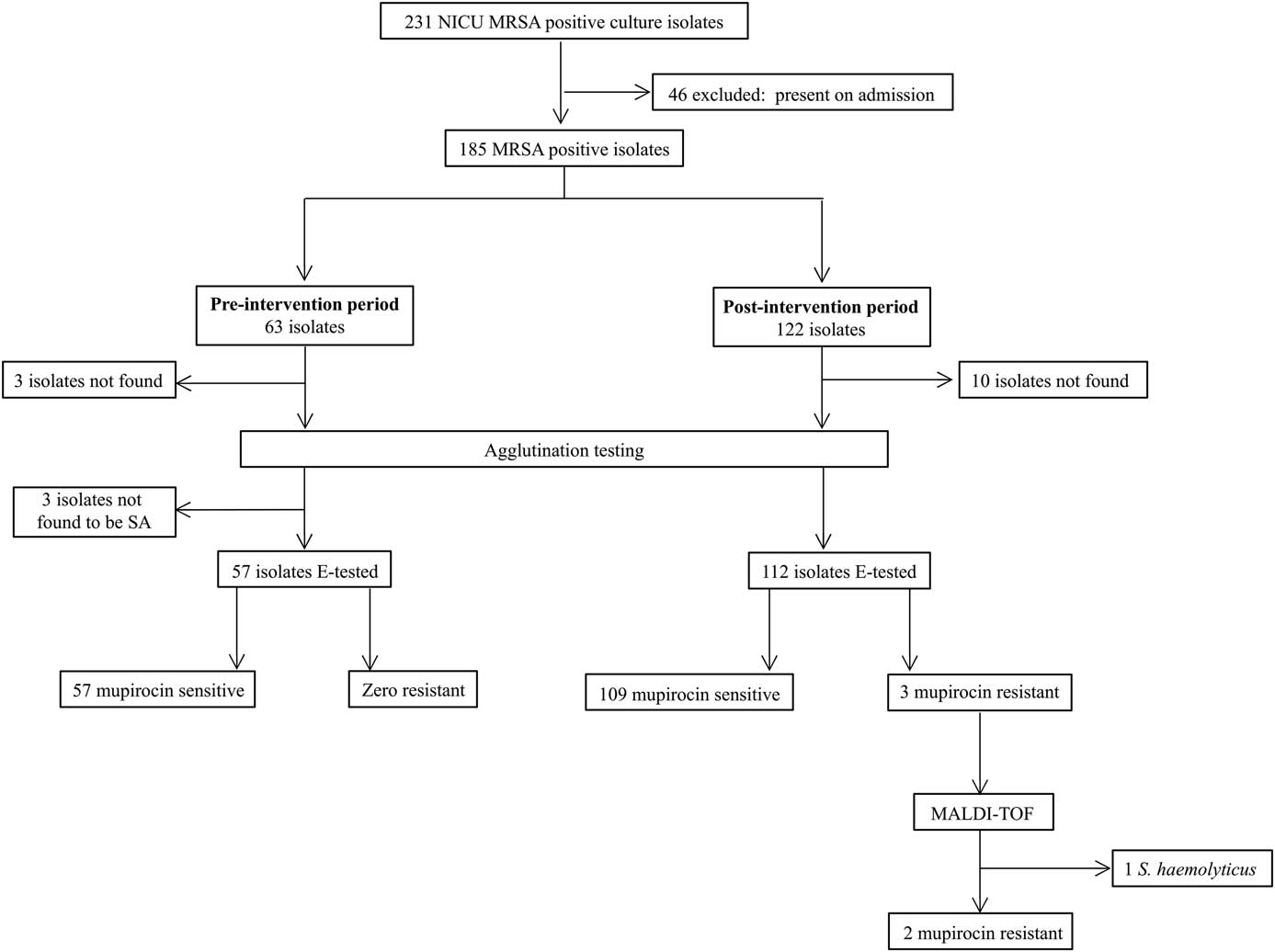
In total, 63 patients had MRSA-positive cultures (59 surveillance cultures, and 1 culture each from sputum, ear drainage, neck lesion, and blood) in the 10-month preintervention period, while 122 patients had MRSA-positive cultures (119 surveillance cultures, 2 blood cultures, and 1 skin lesion culture) during the 24-month postintervention period. During the preintervention period, 10 infants with MRSA POA were excluded from further analysis, 3 specimens were not located for testing, and 3 specimens were subsequently not confirmed to be S. aureus by agglutination. In total, 57 samples from the preintervention period underwent E-testing, and all were susceptible to mupirocin. During the postintervention period, 36 infants with MRSA POA were excluded from further analysis and 10 infant samples were unavailable, leaving 112 available specimens. Of these 112 specimens, 109 were mupirocin susceptible (97.3%; 95% CI, 0.92–0.99). Of the 3 isolates highly resistant to mupirocin, 1 isolate was identified as Staphylococcus haemolyticus rather than MRSA by MALDI-TOF (Figure 2). Only 1 infant with mupirocin-resistant MRSA had prior mupirocin exposure. Rep-PCR was performed on the 2 mupirocin resistant MRSA isolates, the S. haemolyticus isolate, and 7 convenience samples of MRSA isolates from the postintervention period. The 2 mupirocin-resistant MRSA isolates were unrelated (<80% similarity).
Flow diagram of methicillin-resistant Staphylococcus aureus (MRSA) preintervention and intervention period isolates.

Mupirocin Usage and Adverse Effects
In the preintervention period, infants were colonized or infected on average by day 19 of their NICU stay (IQR, 10–51). In the postintervention period, infants were colonized or infected on average by day 13 of their NICU stay (IQR, 9–23).
Compliance with the mupirocin prophylaxis protocol was retrospectively calculated as the number of unique mupirocin orders placed within 24 hours of the first day of scheduled monthly prophylaxis divided by the number infants present in the NICU at 23:59 on that day. Compliance was 85% (95% CI, 0.76–0.91) for 20 of 22 months. Of the 86 patients who acquired MRSA in the postintervention period, 64 patients (74%) had never been treated with mupirocin because they were admitted between scheduled courses of mupirocin prophylaxis. The median number of courses of mupirocin received by infants who became colonized or infected despite mupirocin prophylaxis was 1 (IQR, 1–2).
Adverse events associated with mupirocin prophylaxis were actively solicited through daily interviews with bedside nurses and medical staff only during the initial unit-wide administration. One preterm infant (1.15; 95% CI, 0.03–6.23) developed apneic spells temporally associated with mupirocin administration.
Central Line-Associated Bloodstream Infections (CLABSIs)
CLABSIs did not increase postintervention: 2.35 of 1,000 catheter days in 2013; 1.26 of 1,000 catheter days in 2014; and 0.96 of 1,000 catheter days in 2015. The percentage of infections caused by gram-negative organisms was stable: 5 of 7 (71%) in 2013; 6 of 9 (67%) in 2014; and 3 of 5 (60%) in 2015.
DISCUSSION
Coincident with implementation of monthly mupirocin prophylaxis in a NICU, significant decreases in MRSA transmission and invasive S. aureus infections were observed. Although mupirocin prophylaxis was not completely protective against MRSA colonization, 74% of infants who acquired MRSA during the study period had not received mupirocin. Over a 2-year period, mupirocin prophylaxis was apparently well tolerated among infants in the NICU, while resistance to mupirocin was rarely identified and was not associated with adverse clinical outcomes.
Our results are consistent with most reports from other NICUs describing low rates of mupirocin resistance, even in the setting of widespread mupirocin use. In a level IIIB NICU with a long-standing program of daily prophylactic nasal mupirocin for all infants, no mupirocin resistance was detected in S. aureus isolates over an 8-month period.Reference Delaney, Wang and Melish 3 A level IIIC NICU employing targeted mupirocin decolonization for MRSA colonized infants identified low-level mupirocin resistance in only 3 of 84 MRSA isolates collected over 7 years.Reference Suwantarat, Carroll, Tekle, Ross, Popoola and Milstone 8 Although a Korean NICU reported mupirocin resistance in 79.3% of infants with healthcare-associated MRSA, resistance was also identified in 47.4% of those colonized with MRSA within 48 hours of admission, suggesting importation of mupirocin resistance from the community.Reference Park, Kim, Lee, Park and Lee 9
While pathogen replacement could not be excluded given the relatively short postintervention period in this study, it is encouraging that neither CLABSI nor the proportion of CLABSI caused by gram-negative organisms increased. A large retrospective cohort study involving infants from 3 large NICUs, including the study NICU, found no increased risk of infection with gram-negative organisms among MRSA-colonized NICU patients who received targeted mupirocin-based decolonization.Reference Pierce, Bryant, Lessler and Milstone 10 This study was conducted prior to the use of universal mupirocin prophylaxis in the study NICU, suggesting the need for ongoing surveillance.
Our report has several limitations. Not all S. aureus isolates identified during the study period were available or viable for resistance testing, but unavailable isolates were dispersed throughout the study period, reducing the potential for bias. One mupirocin-resistant isolate was found to be S. haemolyticus rather than S. aureus by MALDI-TOF. Because we could not exclude the possibility of a mixed culture, we retained these data in our total number of S. aureus transmissions. After the first mupirocin application, we relied on passive rather than active surveillance for identification of adverse events potentially related to mupirocin. Dedicated NICU pharmacists made daily rounds with clinical teams and participated in the ordering of mupirocin prophylaxis, mitigating the risk of underrecognition and underreporting of such events. Not all infants received mupirocin prophylaxis. Reasons for noncompliance were not systematically assessed, but they likely reflect logistical challenges associated with the need for individual clinicians to initiate orders on a specific day each month. This challenge could be mitigated by standing orders. While mupirocin prophylaxis was temporally associated with a decrease in MRSA transmission, we cannot exclude the possibility of secular trends or unmeasured improvements in basic infection prevention practices on transmission rates. Notably, active surveillance for MRSA transmission in the study hospital is performed only in the NICU, but transmission events per 1,000 patient days, as identified solely by clinical cultures in non-NICU units, did not change over the study period. Finally, our study was performed in a single NICU and may not be generalizable to other facilities.
Nevertheless, in this NICU, mupirocin prophylaxis was an effective strategy for reducing MRSA transmission. Mupirocin resistance was rare, but ongoing assessment is warranted along with randomized controlled trials of mupirocin prophylaxis in this population.
ACKNOWLEDGMENTS
Financial support: This research was supported by grants from The Children’s Hospital Foundation. Dr Ristagno was supported by the Kosair Charities Fellowship in Pediatric Infectious Diseases.
Potential conflicts of interest: The authors report no relevant conflicts of interest.