Introduction
Housing and ageing has been an increasing political and policy concern due to the UK’s housing sector being ‘woefully underprepared for ageing’ (Select Committee on Public Service and Demographic Change, 2013). This article focuses on a generally overlooked group: older home ownersFootnote 1 in lower valued properties. We focus on experiences of owner occupiers and the views and perceptions of social landlords, voluntary groups and organisations in central Scotland. This article explores home ownership in older age and asks the question: What role has the Right to Buy (RTB) policy in the UK had in the differentiation of older home owners? We focus on the role of the RTB policy in the UK due to it being a significant piece of legislation that made the privatisation of the UK social housing sector mandatory from 1980. This article shows the repercussions for older people’s housing pathways and the UK’s ability to prepare for the needs of its ageing population.
Homeownership in the UK is built on a ‘cultural norm’ and assumption that it guarantees security and independence (McKee, Reference McKee2011). Due to this, owner occupiers in lower valued properties have often been overlooked as a group due to assumptions of wealth and security. This has been reinforced by policy discourses that have tended to treat older people as a homogenous group, facing common problems, with social policy overlooking inequalities in older age (Walker, Reference Walker1981, Reference Walker2018). Yet these inequalities have been shown to be significant in places such as the USA as they result in unmet housing needs for lower income older homeowners (Golant, Reference Golant2008). This article challenges the assumptions around home ownership and older age, highlighting an emerging group that are living with the ongoing legacy of the RTB policy in the UK.
The RTB in particular and its consequences for public sector housing supply has played a significant role in promoting low cost homeownership in the UK (Forrest and Murie, Reference Forrest and Murie1988; Pierson, Reference Pierson1994; Forrest et al., Reference Forrest, Murie and Gordon1995; Jones and Murie, Reference Jones and Murie1999) with over 2.8 million council and social rented homes being sold under the RTB between 1980 and 2015 (Murie, Reference Murie2016). However, rather less attention has been paid to the longer-term housing careers of these homeowners. For example, much focus has been on the ‘losers’ rather than the ‘gainers’ (Forrest and Murie, Reference Forrest and Murie1988: 229). This article gives new insight into the ‘winners’ to highlight that not all homeowners have benefited in the longer term as housing choice has become limited in older age. The research presented here suggests that the experiences of ‘gainers’ are not homogeneous and now pose challenges as these home owners age.
Background
As the UK’s population ages, increasing attention has been placed on how the housing, health and social care needs of that population will be met. Care and Repair England (2014) has claimed that a ‘Perfect Storm’ is brewing, in which the ageing population contains increasing numbers of low income home owners living in decaying housing they cannot maintain and without the ability to finance their care. The RTB (a policy introduced in 1980 that allowed those living in public sector housing to buy their home with a generous discount) has had a significant role in the housing choices for older owner occupiers in lower value properties. This is not only because of the significant numbers of purchasers, but also because those most likely to purchase their properties have lived in their homes for over twenty years and are long established tenants planning to stay in their family home (Murie, Reference Murie2016).
This has remained simultaneously one of the most controversial and popular mass privatisation policies of all time (Goodlad and Atkinson, Reference Goodlad and Atkinson2004; Jones and Murie, Reference Jones and Murie2006). Whilst UK Conservative administrations (1979-1997 and from 2010 onwards) broadly sought to increase the uptake of RTB, Labour sought to contain it from 1997-2010. The mass sale of council housing throughout the UK was not accompanied by significant new building or reinvestment in the sector, although there is a diverging picture across Britain. From 1980–2013, 2.6m Right to Buy sales were recorded across Britain, with the public sector and housing associations completing 692,000 houses, a ‘replacement rate’Footnote 2 of 27 per cent. In Scotland, the comparable figures are 497,000 sales and 98,000 completions giving a replacement rate of 20 per centFootnote 3. The history of the RTB has been covered extensively (Forrest and Murie, Reference Forrest, Murie, van Vliet, Huttman and Fava1985, Reference Forrest and Murie1988; Pierson, Reference Pierson1994; Forrest et al., Reference Forrest, Murie and Gordon1995; Jones and Murie, Reference Jones and Murie1999, Reference Jones and Murie2006; Goodlad and Atkinson, Reference Goodlad and Atkinson2004; Murie, Reference Murie2016), with much of the literature reflecting on what are generally seen as damaging consequences for social rented housing supply and the future of public landlords rather than the housing careers of those people who utilised the RTB. In a rare example of the latter, Williams and Twine (Reference Williams and Twine1992) recognised the RTB as being likely to widen housing choices for existing owners.
Post-devolution Scotland now demonstrates a clear and sharp divide between different nations within the UK, with McKee et al. (Reference McKee, Muir and Moore2016) noting that there is an increasingly important spatial nuance underpinned by divergent political narratives in different parts of the UK (see also Gibb, Reference Gibb2014). Most notably, 2016 heralded the end of the RTB in Scotland while it is being extended in England. This policy divergence echoes through prevalent rhetoric North and South of the border: the Scottish agenda has been to save current and future social housing stock (Scottish Government, 2014), also acknowledging that ‘… many of those who exercised their right to buy have struggled to meet the costs of home ownership’ (Scottish Government, 2013: 2). Furthermore, McKee (Reference McKee2010) has questioned whether the responsibilities of home ownership make it the most appropriate tenure ‘solution’ for lower income households. The next section looks at this in more detail.
The differential experience of home ownership and the Right to Buy
Writing in 2006, Jones and Murie noted that over two million households had exercised their RTB in the UK and their analysis shows that not all purchasers have had the same experiences. Bringing more households directly into the housing market has extended the reach of its episodes of boom and slump (Forrest et al., Reference Forrest, Murie and Williams1990: 3). The 2007 global financial crisis has demonstrated how pervasive the impacts of boom and slump might be, particularly for households at the lower end of the income spectrum (Hills et al., Reference Hills, Cunliffe, Gambaro and Obolenskaya2013). Homeownership has been linked to a stereotypical image of investment, mobility, independence and security when in reality the experience of homeownership varies with time, context and by social group (Forrest et al., Reference Forrest, Murie and Williams1990). Neither the receipt of general and particular benefits associated with the tenure, nor the impact of costs, is evenly distributed across the spectrum of owners. Summarising evidence from England in the 1980s, Saunders (Reference Saunders1990) notes that ‘(t)he contrasts within this tenure (i.e. home ownership)… can be every bit as striking as those which separate owners from renters’ (Saunders, Reference Saunders1990: 134). Looking further back, Merrett and Gray (Reference Merrett and Gray1982: 275) refer to the understanding by the UK GovernmentFootnote 4 during the Second World War that home owners did not always enjoy well-constructed houses, that financing purchase unduly strained the resources of some owners and that ownership growth might hinder labour mobility.
In the period since home ownership became the majority tenure, that is since 1971 for England and Wales (Wilcox et al., Reference Wilcox, Perry and Williams2015: Table 17) and since 1990 for Scotland (Scottish Government, 2015), analysis of separate national house condition surveys has drawn attention to the higher rates of disrepair and poor housing condition in the dwellings owned by low income owners, commonly related to the inability to afford effective repair (Revell and Leather, Reference Revell and Leather2000) and in those owned by elderly owners unwilling to undergo the stress of contracting repair work (Leather and Moseley, Reference Leather and Moseley2002). Further, Dorling argues that it was only in the 1980s that ‘…otherwise apparently ‘respectable’ home-purchasing residents started to get into arrears on their mortgages’ (Dorling, Reference Dorling2015: 163-4). Drawing on General Household Survey and English House Condition Survey data, Forrest and Leather (Reference Forrest and Leather1998: 35) anticipated an increase in the number of very old home owners experiencing poor housing conditions and a reduction in the likelihood of older home owners’ aspirations being realisable due to limited equity and a lack of moving opportunities.
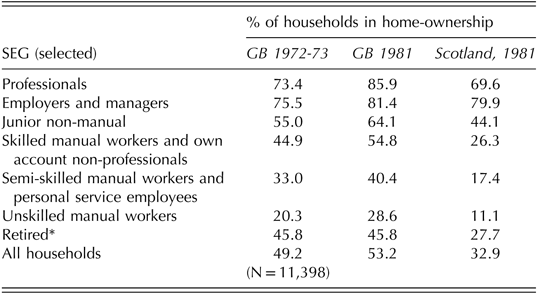
Arrears problems and the inability to afford repair costs tend to become more likely with earners in a household on lower or more uncertain incomes (as well as with greater macroeconomic volatility). In turn, these correlate with lower socio-economic status and, as home ownership has grown, more households of lower socio-economic status have become owners. Thus, across Britain in 1971-72 (according to the General Household Survey), almost a half of all households were home owners, the rate in Scotland was 27.9 per cent. The rate ranged from three households in four with a head classified as an employer or manager to one unskilled manual worker in five (Table 1). By 1981 (i.e. approximately the time the Right to Buy was introduced), Britain’s home ownership rate had increased to 53.2 per cent (and Scotland’s to 32.9 per cent). As shown in Table 1, that overall increase was associated with some significant increases in the home ownership rate in households of modest socio-economic status (as well as amongst professional households). Nevertheless, in Scotland in 1981 only about one household in four with a skilled manual head of household (or personal service employee) owned its own home. The figure across Britain as a whole was over twice that.
Home ownership rate by socio-economic group of head of household (SEG), GB 1972–73 and 1981, Scotland 1981

Note: * In 1972-73 proxied by head of household aged 60 and above.
Source: Office for Population Censuses and Statistics (OPCS, now ONS) (1975) General Household Survey 1972-73, London Tables 2.2 and 2.10: HMSO; Office of Population Censuses and Surveys, 1981 Census: Aggregate data (England and Wales) [computer file]. UK Data Service Census Support. Downloaded from: http://casweb.mimas.ac.uk. This information is licensed under the terms of the Open Government Licence [http://www.nationalarchives.gov.uk/doc/open-government-licence/version/2]; Registrar General for Scotland, 1981 Census: Aggregate data (Scotland) [computer file]. UK Data Service Census Support. Downloaded from: http://casweb.mimas.ac.uk. This information is licensed under the terms of the Open Government Licence [http://www.nationalarchives.gov.uk/doc/open-government-licence/version/2].
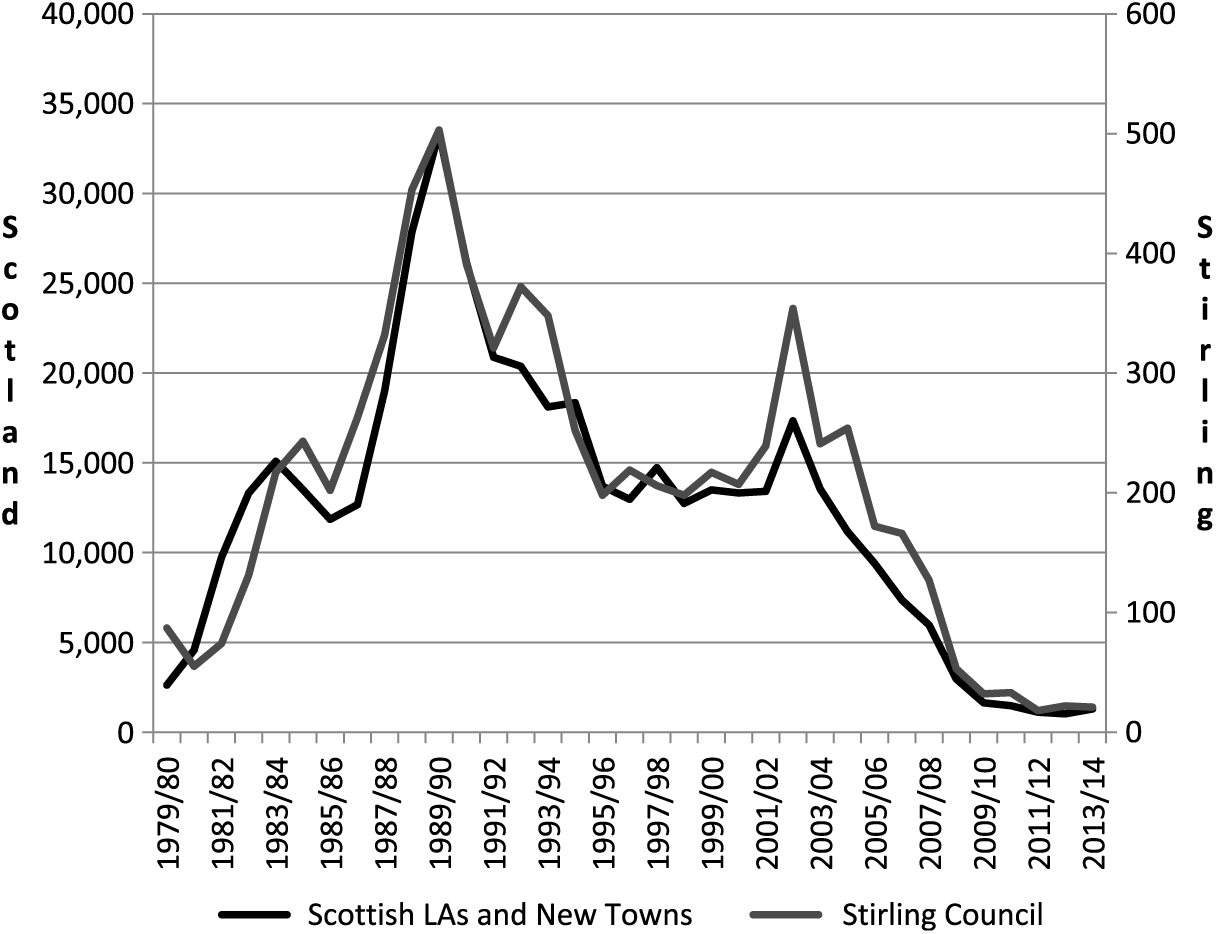
Similarly to the UK as a whole, the RTB in Scotland clearly played a major role in extending the number of home owners. Thus, between 1980 and 2014, there were just over half a million private sector new build completions across Scotland (554,633; data sourced from http://www.gov.scot/Resource/0047/00478069.xls on June 4, 2015) and just under half a million local authority right to buy sales (433,378; data sourced from http://www.gov.scot/Resource/0047/00478002.xls on June 4, 2015). The number of sales grew from 4,576 in 1980-81 to 33,391 in 1989-90 falling back to 12,972 in 1996-97. Apart from something of a spurt in 2002-03 (17,333 sales), numbers then declined to the order of 1,200 per annum in the current decade (Figure 1)Footnote 5.
Council house sales 1979–80 to 2013–14.

The increasing rates of home ownership amongst lower socio-economic status households, to which the RTB has made a significant contribution, provide vindication for the argument that the RTB ‘…transformed the housing market’ (Jones and Murie, Reference Jones and Murie2006: 119). Saunders (Reference Saunders1990) views the right to buy as ‘…one of the most dramatic redistributive measures ever taken by a British government’ (Saunders, Reference Saunders1990: 183), also acknowledging that those remaining as council tenants have become relatively poorer. Jones and Murie (Reference Jones and Murie2006), whilst agreeing that the uptake of RTB had a progressive redistributive effect, also argue that the differential loss of council rented properties, i.e. from the rather higher rates of sale of more desirable houses, had a regressive effect on the distribution of housing opportunities. Furthermore, for those ‘winners’ who did exercise the RTB, there ‘appears to be a substantial differential between realised market values of former public sector homes as compared to other second-hand dwellings’ (Pawson and Watkins, Reference Pawson and Watkins1998).
As this article later shows, the group that saw the purchase of their home as guaranteeing them a home for life are now facing a different set of housing needs compared to the time of their purchase as they grow older. The next section explores the link between the RTB and the ageing population.
The Right to Buy and the ageing population
The concept of housing careers and aspirations is a useful framework for looking at housing markets and mobility as people move through the life cycle and to and from renting and home ownership (Kendig, Reference Kendig1984). Kendig (Reference Kendig1984: 277) notes that ‘the most important aspect of a housing career is the ability to attain, retain, or regain home ownership’. Clearly, home ownership is linked to aspirations, which is constrained by their income and wealth in relation to what is offered in the market, i.e. what qualities of housing are offered (including place) for what price. A housing career has been seen as a simple linear progression whilst the concept of the housing life course (van Ham, Reference van Ham, Clapham, Clark and Gibb2012) or housing pathway (Clapham, Reference Clapham2005) appears to offer more flexibility in looking at the ageing population and diversification of actual housing behaviours (Ong et al., Reference Ong, Wood and Colic-Peisker2015).
There is also increasing recognition of the wish for older people to ‘age in place’ and the interrelations between home, community, sociocultural contexts, faith and cultural groups (Wiles et al., Reference Wiles, Leibing, Guberman, Reeve and Allen2011). This is about staying in the right place, looking at inter-dependence and independent living as well as how services are integrated to support ageing well (Golant, Reference Golant2015; McCall et al., Reference McCall, Eadie, Lovatt, MacIntyre, Phillips, Porteus, Robertson, Rutherford, Sixsmith, Woolrytch and Ziegler2018). In Wales, there has been a focus on ‘last-time buyers’ to support the challenges of an ageing population and increase choices at the right time in life (Phillips et al., Reference Phillips2017).
The exploration of housing pathways becomes increasingly relevant as, like many other advanced industrial societies, it is well known that the UK has an increasingly ageing population. Between 2010 and 2035 it is projected that those aged sixty-five and over will account for 23 per cent of the total population and those aged over eighty-five make up a larger proportion of that group (ONS, 2012). Analysis of the 2011 census shows that the growth between 2001 and 2011 in people aged over fifty was equivalent to 98 per cent of the rise in Scotland’s overall population (Griffiths and McCall, Reference Griffiths and McCall2015). Furthermore, this ageing population is likely to show enduring housing-related inequalitiesFootnote 6. For example, the 2011 Census data also show that those in social rented accommodation report more health problems (62 per cent of home owners over sixty-five report good health, compared to 37 per cent of those over sixty-five in socially rented accommodation) (Griffiths and McCall, Reference Griffiths and McCall2015).
In Scotland, Age, Home and Community: A Strategy for Housing for Scotland’s Older People: 2012 – 2021 (refreshed in 2018) outlines a series of aims centred on helping people to live independently as long as possible, adaptations and making more effective use of current stock. However, the strategy did not address how experiences are likely to be heterogeneous. The policy interest in making the most effective use of current housing stock seems to couple with a wider perception that older owners are ‘hoarding housing wealth’ (Griffith, Reference Griffith2011), not forgetting that, as Hamnett (Reference Hamnett1999) argues, the extent of housing wealth held is likely to vary significantly and spatially across Britain (reflecting differences in house prices and house price inflation) and for different sorts of household (reflecting which rungs on the housing ladder they are able to reach) (see also Searle and Smith, Reference Searle, Smith, Smith and Searle2010). The picture is further complicated with tenure changes such as the number of older renters increasing in England (to 4.7 million in 2016-17 from 2 million in 1996-97) (Ministry of Housing, Communities and Local Government, 2018) and challenges with the integration of health and social care in regards to the engagement of the housing sector (McCall et al., Reference McCall, Eadie, Lovatt, MacIntyre, Phillips, Porteus, Robertson, Rutherford, Sixsmith, Woolrytch and Ziegler2018).
The trends within the ‘homeowner societies’ such as the UK and Australia have shown increasing signs of diversity in housing pathways in later life with those leaving homeownership in older age more likely to need housing assistance (Ong et al., Reference Ong, Wood and Colic-Peisker2015). In regards to resales of RTB, the early picture indicated that most of the vendors for resales were over 55 and typically traded homes locally (although the original legislation exempted properties with age-related adaptations). However, the majority of the resales were of older (particularly 1919 Act) houses and of perceptibly better quality housing stock (Forrest et al., Reference Forrest, Murie and Gordon1995). This suggests that for some of those who did not sell, their houses may well be of lower quality. Owners will still face maintenance bills and it seems likely that they will not have enjoyed house price booms to the same extent as very many home owners.
These issues of ageing, poor housing and homeowner aspirations seem to converge to the ‘Perfect Storm’ scenario (Care and Repair England, 2014) and suggest that the experience of older home owners in lower value houses will differ significantly. This article now presents some quantitative and qualitative findings regarding this particular group of homeowners and perceptions around the role of the RTB policy.
Methodology
Our research looked to further the knowledge and understandings of the housing behaviours and housing needs of lower-income older owner occupiers in one Scottish local government area. For the purposes of the analysis we identified older owner occupiers as those having a household reference person aged fifty-five years or over. We undertook initial secondary data analysis of housing waiting lists to identify the number and characteristics of older home owners applying for social housing. The research was granted ethical approval by the University of Stirling (Spring 2014).
In addition to exploring housing market behaviours, we explored housing needs of lower income older owner occupiers, as perceived by key stakeholders in the area. Registered social landlords (n = 8), voluntary bodies (n = 2) and one private developer were interviewed either face-to-face or on the telephone, using a semi-structured interview guide. Qualitative data analysis was conducted on QSR Nvivo and other themes included motivating factors and barriers to moving home, the need for information and advice, location, housing design and future planning. Participants included registered social landlords, voluntary organisations and private developers that were known to support housing in the local area.
The findings from these interviews, in addition to the findings from the analysis of waiting lists, were used to inform the development of a survey questionnaire. The survey included questions on a range of topics including current housing circumstances, housing history and views on future house moves. It was used to explore the views and behaviour of older owner occupiers who had already considered changing their housing circumstances and was therefore not designed to be representative of all older home owners in the council area.
317 older owner occupiers were identified as possible interviewees from waiting listsFootnote 7 and local council records of owners who had received Care and Repair services (a regionally varied scheme of assistance for older owner occupiers aged sixty and over for repair and home improvement) in 2013-14 (cross-referenced with postcode areas of lower housing market values as recognisable in the Register of Sasines’ data on house purchases in the council area in 2012)Footnote 8. The Stirling council area has tended to see house prices somewhat above the national average: for example the median price of all transactions in Stirling was £139,000 in 2013-14 (compared to £130,000 in Scotland) whilst the lower quartile price was £90,000 (with Scotland as a whole at £82,500)Footnote 9.
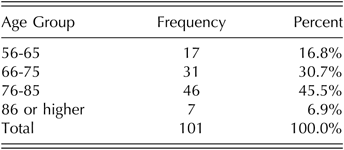
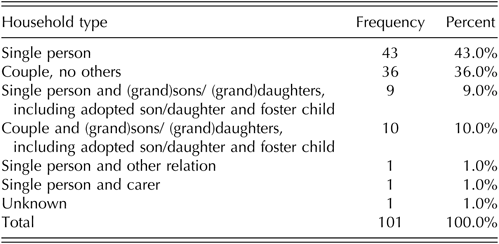
After potential participants were contacted about the study and given an option to opt out, a total of 101 interviews were completed face to face via structured questionnaires between June and July 2014, meaning a response rate of 32 per cent. Tables 2 and 3 show that the majority of respondents were aged seventy-six to eighty-five and lived in single person households:
Age (banded) of respondent

Source: Household survey.
Respondent household type

Source: Household survey.
The relatively low response rate, coupled with the nature of the sampling frame (see above) means that it would not be appropriate to make wide generalisations from the data obtained but to use them illustrativelyFootnote 10. Respondents lived across the Council area and were largely retirees (with slightly more aged under seventy-five than over). 85 per cent were retired and a further 3 per cent described themselves as permanently sick or disabled. Approximately 10 per cent were working part or full time, self-employed or had some irregular earned income. Approximately 30 per cent of the respondents were reported as having both an impairment and/or long-term illness and being disabled in a way that limited daily activities. The proportions were highest amongst owners in the seventy-six to eighty-five age band.
Findings: the legacy of the Right to Buy
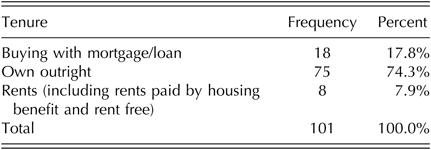
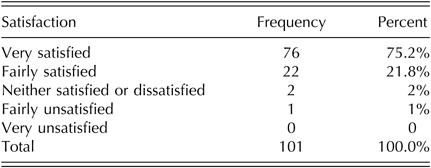
The research that we carried out did not initially have a specific focus on the Right to Buy as we were investigating the needs of older owner occupiers in lower value housing and exploring their housing options. Yet, two thirds of the sample of owners interviewed lived in a house they had bought under the RTB, and a further 6 per cent lived in a resold former council houseFootnote 11. Even acknowledging that the sample construction may have been likely to yield a high proportion of former council homes, the RTB looms very large in interviewed owners’ housing careers. The majority of participants owned their home outright and were very satisfied with their current housing (Table 4 and 5):
Respondent housing tenure

Source: Household survey.
Satisfaction with current house

Source: Household survey.
32 respondents said that they did not use any aid or adaptation to get around their house and had no need of one, and one person said that s/he could not get round the house. The majority (over two thirds) thus did need a form of assistance and the most commonly cited were handrails (fifty-two people), a walking stick or crutches (forty) and a walking frame (thirteen). Thirty-six respondents said that they/a household member had some form of care or support service. These findings reveal a population of owners drawn from older cohorts of the fifty-five-plus age groups where small, and single person households dominate; very high proportions (one in three at least) either find it difficult to access all of their housing or make use of some form of care and support.
Additionally, the RTB was a strong theme in the qualitative interviews with housing associations and services. The experiences of housing professionals in this sector outlined a variety of different experiences with RTB owners who had been either looking for a social rented home or had experienced a health crisis. Furthermore, the majority of the participants in the study linked the categorisation of ‘lower valued properties’ with older RTB properties.
My experience … [shows that] is really about RTB and the value of those properties and the person’s ability to maintain them as owner occupied stock (Housing association manager).
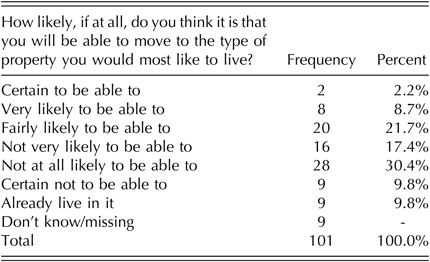
Those living in RTB properties were seen as being less likely to move to a new property. Almost 58 per cent of those with a self-defined need for housing did not expect to be able to meet it (taking the responses of ‘not very likely’, ‘not at all likely’ and ‘certain not’ to be able to move) (Table 6). Also, nearly half (46.2 per cent) had previously lived in the same neighbourhood/village as their current home. Looking at people’s reasoning more closely, the most common explanations were that people were ‘happy in their current house’ or that they were ‘too old to move’ or ‘they couldn’t afford the price’ of a new home.
Likelihood of moving to property of choice

Source: Household survey.
The inability to move in the owner occupied market related to the perceived potential resale value of their house. Furthermore, there was recognition, borne out by findings from owners themselves, that people taking up the RTB saw that as fulfilling their housing aspirations:
But people see their RTB houses as a house for life. Because it’s cheaper than paying rent (Housing association interview).
Well an obvious issue is people able to cash in on equity – an RTB property will not get them a nice bungalow (Housing association interview).
Therefore, the wider stakeholders viewed current RTB owner occupiers as a group that had their housing choices limited through low equity, which was constraining their ability to buy another house. However, their preference to remain in their home clearly indicates an unwillingness to buy a different property.
Approximately two thirds of owners surveyed did not want or expect to move, commonly because of attachment to their current house, neighbourhood or village. As is well recognised in the literature (see the review by Maclennan, Reference Maclennan, Clapham, Clark and Gibb2012), houses are locationally fixed: buying or renting a house means simultaneously acquiring the characteristics of its neighbourhood, its environment, and its local public and private services. The suggestion is that not only had RTB purchasers anticipated that their home would satisfy their long term aspirations, so too would the place they were purchasing. Further corroboration for this is seen in that 75.2 per cent of respondents indicating they were ’very’ and a further 21.8 per cent ‘fairly’ satisfied with their property.
Over a third of the sample of owners used, and relied on, some form of aid or assistance to get around their house. Current homes were viewed as often unsuitable for their current health needs. The findings suggested that one of the unforeseen long-term consequences of the RTB has been to leave some buyers ‘trapped’ in houses that are no longer suited to their needs. The survey of owners found that approximately one household in three RTB purchasers (and 28 per cent of all owners) had at least one member who could not get around their whole house. Rates of being unable to access the whole house were about twice as high (43 per cent) amongst households with a Household Reference Person (HRP) aged seventy-six to eighty-five than amongst those with a HRP aged fifty-six to sixty-five (21 per cent); they were also higher in owners of houses rather than flats. The findings are triangulated by service providers’ views:
… A lot of people… are currently living in unsuitableFootnote 12 properties. This is mainly people who have bought their council house and it is not now suitable for their needs. For example having an upstairs toilet. The properties do not seem suitable for minor adaptions… This group tend to be people who have lived in the same home for their lifetimes… and they consistently have a housing issue that needs addressed before they can go home [from hospital or interim care] (Care and Housing support worker).
For service provider interviewees, the main drawbacks of being in older Right to Buy properties centred around concerns of suitability for the ageing population. This related firstly to accessibility and secondly to the costs of repairs and maintenance:
For those who bought their house over 20 years ago. They haven’t benefited from house price increases. They just carry on but they will have bad windows, kitchens, as opposed to those who benefited from market improvements and had equity (Housing association manager).
The data as a whole are suggestive of a significant proportion of owner occupiers in lower value properties being in unsuitable accommodation for their current and likely future health needs. Many within this group were in properties bought through the RTB, which can have expensive maintenance needs due to the age of the stock.
Diverse health and housing needs
The above examples highlight that some owner occupiers in older RTB properties may have changing health and housing needs. There was an indication that these homes are costly to maintain, difficult to adapt and therefore can affect access to essential parts of the house.
Although the Scottish policy on housing and ageing emphasises the importance of living at home, coinciding with the preference of most older owners (Banks et al., Reference Banks, Blundell, Oldfield and Smith2012; Clark, Reference Clark, Clapham, Clark and Gibb2012), evidence suggests that adaptations of current housing stock, especially older and less well maintained stock, cannot be the only solution. Even in the one local authority area studied, there would appear to be a significant number of owners living in simply inadequate housing, who were looking to move but seemed to have few options available. Thus, whilst the survey of owners found that one in three households anticipated moving in the few years subsequent to interview, primarily because of ‘ill health’ or wanting to downsize, one in eight did not believe that a suitable house that they could afford would be available. The proportion was slightly higher for RTB purchasers but not in a statistically significant way. Service provider views corroborated this:
Housing needs are not being fully met for this group… It is the issue of life events that are random mostly as being the driving force for changing lifestyles. Makes this a hard group to work with (Care and Housing support worker).
Others, particularly RTB purchasers and for all where HRPs were aged seventy-six to eighty-five, stated that they were ‘too old to move’. For service providers, there were differences between RTB purchasers and other owner occupiers:
Those who have built their way up the housing ladder – rather than those who are still in their right to buy – are better at adapting and downsizing as they have experience of the market. The thought is less daunting to them (Care and Housing support worker).
Furthermore:
In addition to financial barriers, there may be barriers in terms of health and… family links. Education may be a further barrier, as may the fact that many people who are in lower value properties may have purchased these through right to buy schemes and as such may have no experience of looking at property, purchasing property or indeed the practicalities of moving from an owned property (Notes from interview with volunteer).
Further to cultural and financial barriers, the findings suggest that for this group the transition into other accommodation is usually influenced strongly by a health crisis and/or lack of options. This complements other research: for example, Shelter (2012) found that older RTB purchasers, especially those in ill health, were more likely to get into financial difficulties and face arrears and repossession. When participants were asked what the main motivating factors were to move house, health emerged strongly:
Critical life events, especially connected to health and disabilities (Housing support worker).
There are more present issues in lower value of the houses and you have the more pervasive issues of confidence, health and feelings of safety and security (Housing Association CEO).
Health was also perceived as presenting a high barrier to moving:
This is linked to a difference in culture as they have lived in the same house all their lives and an alternative would seem overwhelming – especially if their crisis has been brought on by a health issue or major life event (Housing support worker).
It was recognised that a health crisis would be likely to force a move to a house that the home owner had not chosen, taking away their control and sense of agency. For this group, a move to social rental in particular would mark an unwelcome turn of their housing career, perceived as a ‘step down’ the housing ladder. All owners surveyed strongly identified with that status and wished to stay homeowners. This was no less true amongst those who had applied for social housing. Home owners rejected renting as they ‘wanted their own house’ and renting (in either social or private sectors) was a ‘waste of money’. Intermediate tenures, such as shared equity or shared ownership, were barely recognised. This mirrors other findings in the sector that outline shared ownership arrangements, for example, as being complex and confusing for prospective owners, especially resale buyers (Cowan et al., Reference Cowan, Wallace and Carr2015). In these respects, the views of the home owners surveyed are no different from those repeated in other survey evidence on the advantages and disadvantages of different tenures (Saunders, Reference Saunders1990; Jones and Murie, Reference Jones and Murie2006) but their experiences of being homeowners diverged greatly.
Discussion
We see evidence of a divergence between homeowners in the forms of not only income and wealth inequalities but also being able to cope with changing health needs. The findings have indicated that as some home owners have grown older, the consequences of their RTB purchase have had a vital part to play in their current motivation and ability to move home. Wider stakeholders in the housing sector working in local authority, housing associations and the voluntary sector have indicated a clear link between the RTB and older owner occupiers in lower value properties. By treating the initial RTB property as a lifetime home, there is a perception that those with low equity and low income have limited housing choices in older age. At the same time, aspirations of home owners recorded here are in line with Goodlad and Atkinson’s (Reference Goodlad and Atkinson2004: 457) research that noted that those who benefited from the RTB had also bought the idea that the RTB was an instrument of wealth creation, independence and that ‘the working poor have benefited, people have never looked back’. Treating both the ageing population and homeowners as homogenous groups has overlooked both wealth and health inequalities.
The research reported here suggests that not all older home owners have seen unequivocal benefits from taking up the Right to Buy. The influence of economic constraints and the influence of socioeconomic determinants such as health and debt (Ong et al., Reference Ong, Wood and Colic-Peisker2015) remain key restraints and have had a role in differentiating older home owners as a group. This challenges the perceived idea of ‘generational wars’, an often cited media narrative commonly focused on access to housing (Spies-Butcher, Reference Spies-Butcher2014). The article adds to Hoolachan and McKee’s (Reference Hoolachan and McKee2019) conclusions that inter-generational inequalities are much more nuanced and can be misleading in regards to blame. This article highlights that limitations in access and housing choice is not only experienced by younger generations, but also sub-sets of older home owners.
Furthermore, the interconnection of health and social issues in older age and the suitability of homes concurs with the increased consideration of the complexities of ‘ageing in place’ and the need to consider ‘access to and familiarity with social networks, transport and health services, and a wide variety of amenities [that] underpin the preference for aging in place (Wiles et al., Reference Wiles, Leibing, Guberman, Reeve and Allen2011). The research has shown that there are symbols and identities attached to the Right to Buy in the housing sector, which add complexities to the ability to ‘ageing in place’. There is a need to focus on ‘right-sizing’ at the end of life in a way that empowers older people and increasing their sense of place and belonging (Means, Reference Means2007; Golant, Reference Golant2015; Phillips et al., Reference Phillips2017; McCall et al., Reference McCall, Eadie, Lovatt, MacIntyre, Phillips, Porteus, Robertson, Rutherford, Sixsmith, Woolrytch and Ziegler2018). There is no ‘one-size-fits-all aging in place solution’ and the current emphasis in policy about remaining in current homes should instead be about being in the right home in the right place (Golant, Reference Golant2008: 393). Our findings reinforce this, indicating that some owner occupiers are simply in inadequate housing, but also do not see themselves as likely to move. The Welsh solution of looking at ‘last-time buyers’ through equity release and help to buy schemes is a key policy intervention that could support housing choice in older age (Phillips et al., Reference Phillips2017). This suggests more policy focus is needed on home owners at the other end of the scale as they age, not only on younger first time buyers.
Conclusion
This article challenges both the notions of homeowners and older people as being homogenous groups. We see in our examination of the legacy of the Right to Buy policy emerging insights to both wealth and health inequalities that give insight to the picture of owner occupiers on lower incomes. A caveat to this study, however, is its local context, scale and scope. Owner occupiers in lower value properties are a difficult group to access and support. Our research suggests, however, that there is an emerging group of older home owners living in houses that do not suit their current, or likely future, needs (especially in regards to health). Interviews with voluntary sector care, advocacy groups and social landlords point to the potential vulnerability of older owner occupiers in older homes, on lower income and limited equity. We thus challenge assumptions in ‘generational wars’: not all those who gained from the RTB are winners; they include people with more limited equity and limited housing choices.
This legacy of the Right to Buy in Scotland represents an ongoing concern, in which focus on maintenance, repairs and supporting ‘right-sizing’ is essential for helping older home owners on lower incomes ‘age – (well) – in – place’ (Golant, Reference Golant2015; Phillips et al., Reference Phillips2017; McCall et al., Reference McCall, Eadie, Lovatt, MacIntyre, Phillips, Porteus, Robertson, Rutherford, Sixsmith, Woolrytch and Ziegler2018). We suggest a renewed policy focus on increasing housing choice for older people through schemes similar to those offered to first-time buyers in the UK to enable access to suitable housing as they grow older.
Acknowledgments
We appreciate the support of the funders of the research: the Scottish Futures Trust and Stirling Council, for their support and assistance in the conduct of the research. We also acknowledge the support of voluntary sector housing and related agencies, and of older home-owners and their families, in participating. All of the views expressed are our own.